Introduction
Staff retention, particularly that of professional workers, seems to be a critical issue in managing today’s human resources (HR). It continues to receive attention from researchers and practitioners alike who recognize the significant costs associated with employee exit (Mai, Ellis, Christian, & Porter, Reference Mai, Ellis, Christian and Porter2016). Turnover is wasteful and costly, because when employees leave, an organization loses not only the investment made in training and development programs, but also the cost of losing skill and knowledge acquired on the job. An employee’s departure leads to economic costs, both in terms of direct costs (i.e., replacement, recruitment, and management time) and perhaps more considerably, in terms of indirect costs (i.e., morale, frustration, and pressure on remaining staff). It also affects normal operation and service quality, and erodes competitiveness (Karatepe, Reference Karatepe2012). Therefore, employers have to consider the risk of losing their well-trained employees who might leave for better prospects in other organizations. This issue is particularly problematic in certain business operations such as a shared service organization, where there are indications of a high rate of loss of employees (Deloitte, 2017; Engebritson, Reference Engebritson2019).
As a contemporary employee retention theory, job embeddedness is considered in the present study as an anti-withdrawal construct. The concept refers to the combined forces that keep an employee from quitting his or her job (Mitchell, Holtom, Lee, Sablynski, & Erez, Reference Mitchell, Holtom, Lee, Sablynski and Erez2001). Unlike conventional models of retention, job embeddedness highlights the accumulated and non-affective reasons as to why employees are willing to stay. The theory addresses challenges that could potentially lead to unwanted turnover within the organization, and represents a novel perspective on the reasons of turnover by answering ‘what causes people to stay on their current job.’ A number of studies have followed this theory, and reported that highly embedded employees are less likely to quit (e.g., Kiazad, Holtom, Hom, & Newman, Reference Kiazad, Holtom, Hom and Newman2015; Thakur & Bhatnagar, Reference Thakur and Bhatnagar2017; Zhang, Fried, & Griffeth, Reference Zhang, Fried and Griffeth2012). Despite the growing body of research on job embeddedness–turnover, scholars still have much to uncover, and continue to call for further empirical investigation, particularly to determine how embeddedness is developed so that workers can be psychologically connected to their job and workplace (Ghosh & Gurunathan, Reference Ghosh and Gurunathan2015; Nguyen, Taylor, & Bergiel, Reference Nguyen, Taylor and Bergiel2017; Singh, Shaffer, & Selvarajan, Reference Singh, Shaffer and Selvarajan2018). Thus, it is important to further investigate the factors that may cause employees to become embedded in an organization, and better understand job embeddedness as an intervening mechanism (Dechawatanapaisal, Reference Dechawatanapaisal2017; Thakur & Bhatnagar, Reference Thakur and Bhatnagar2017). Understanding of antecedents that clarify how employees become embedded within different foci; thus, differently affecting work outcomes is vital. So, this study responds to this research call by offering different pictures of factors affecting job embeddedness and its utility when predicting withdrawal intention.
The present study adopts the conservation of resources (COR) theory (Hobfoll, Reference Hobfoll2001) to develop a research model that investigates the antecedents and the mechanisms that influence job embeddedness and its outcome. The theory suggests that individuals attempt to acquire, protect, and accumulate resources that they centrally value within themselves or in a social context. It is argued here that one important work-related source of resources can be support from their employer, supervisors, and co-workers, aka workplace social support. This implies that favorable perceptions of such social support allow individuals to obtain feelings of empathy, appreciation, respect, and trust (Eisenberger & Stinglhamber, Reference Eisenberger and Stinglhamber2011; Halbesleben & Wheeler, Reference Halbesleben and Wheeler2015). This leads toward greater embeddedness, and alleviates unfavorable work outcomes.
In addition, identifying a moderator that strengthens the impacts of workplace social support on employee outcomes may extend existing knowledge about who benefits most from such supportive constituents in the job embeddedness–turnover model. The reason is that turnover decision may not be determined solely by the factors that were significant at the time of joining; rather, these factors may change and evolve overtime (Thakur & Bhatnagar, Reference Thakur and Bhatnagar2017, p. 726), depending on the levels of personal valuation of work context (Bailey, Yeoman, Madden, Thompson, & Kerridge, Reference Bailey, Yeoman, Madden, Thompson and Kerridge2019; Jiang & Johnson, Reference Jiang and Johnson2018), and the likelihood that individuals will thrive at their work (Lysova, Allan, Dik, Duffy, & Steger, Reference Lysova, Allan, Dik, Duffy and Steger2019). Work meaningfulness was chosen to be a moderator for this study because it is a critical psychological state that reflects the degree to which employees’ work contributes to their personal values, meanings, and sense making (Hirschi, Reference Hirschi2012; May, Gilson, & Harter, Reference May, Gilson and Harter2004; Steger, Dik, & Duffy, Reference Steger, Dik and Duffy2012). Individuals may differ in terms of how they perceive the importance of support and appeal of any number of job characteristics (Rosso, Dekas, & Wrzesniewski, Reference Rosso, Dekas and Wrzesniewski2010), and when job characteristics and tasks align with their own values and personal identities (Lysova et al., Reference Lysova, Allan, Dik, Duffy and Steger2019). They may have several episodic experiences at work that are meaningful or meaningless, which they integrate into a belief system about the significance of their work (Allan, Batz-Barbarich, Sterling, & Tay, Reference Allan, Batz-Barbarich, Sterling and Tay2019). That is, the levels of meaning making affect may subsequently influence individuals’ work attitudes and behaviors. Given these considerations, this study argues that workplace social support is likely to have a greater impact on job embeddedness, when coupled with work meaningfulness.
Also, the present study proposes to check the conditional indirect effects of the three forms of workplace social support (i.e., organizational support, supervisory support, and co-worker support) on turnover intention via job embeddedness in the presence of work meaningfulness, alias a moderated mediation relationship (Preacher, Rucker, & Hayes, Reference Preacher, Rucker and Hayes2007). This integrative model helps to examine what the total effects on turnover intention would look like if job embeddedness mediates the relationship between workplace social support and intention to leave, and this mediation is moderated by work meaningfulness. The novelty of this study lies in its inclusion of supportive constituents and work meaningfulness in the meditational pathway of job embeddedness–turnover model. It also addresses the research gap of studies on such theories in non-western-based context and identifies differences across professions that require further investigation (e.g., Bailey et al., Reference Bailey, Yeoman, Madden, Thompson and Kerridge2019; Lysova et al., Reference Lysova, Allan, Dik, Duffy and Steger2019; Thakur & Bhatnagar, Reference Thakur and Bhatnagar2017).
In a nutshell, the purpose of this study is to test the impacts of workplace social support on job embeddedness, and whether these effects are moderated by work meaningfulness. It also examines whether job embeddedness might mediate the linkages between the three forms of workplace social support and turnover intention, when coupled with the moderator. Findings from this study should help managers and practitioners to raise more awareness of workers’ perspectives in managing HR, and provide them with guidelines for designing appropriate interventions or helping resources to facilitate individuals to construct their own meaning of work in order to boost positive work outcomes.
The next section provides a theoretical foundation for the research, leading to hypothesis development. Research methodology and sample are then presented, and the findings are analyzed and discussed. The paper concludes with a discussion of implications, the study’s limitations, and avenues for future research.
Theoretical background and hypothesis development
Perceptions of workplace social support and job embeddedness–turnover model
Workplace social support (i.e., organizational support, supervisory support, and co-worker support) is generally defined as ‘the availability of helping relationships and the quality of those relationships’ perceived by employees (Leavy, Reference Leavy1983, p. 5). It is linked to emotional concern, instrumental aid, information, and social relationship with others in the workplace (Kim, Hur, Moon, & Jun, Reference Kim, Hur, Moon and Jun2017). Such social support is also identified as helping resources that enable individuals to better perform, deal with issues, and cope with stress (Halbesleben, Neveu, Paustian-Underdahl, & Westman, Reference Halbesleben, Neveu, Paustian-Underdahl and Westman2014; Halbesleben & Wheeler, Reference Halbesleben and Wheeler2015). According to the COR theory, employees who perceive that these supportive resources are available and can be accessed in the presence of positive organizational treatment are likely to enhance their ability to fulfill their regular job, and help buffer against unfavorable workplace stressors (Hobfoll, Halbesleben, Neveu, & Westman, Reference Hobfoll, Halbesleben, Neveu and Westman2018). It seems that individuals who have more social companionships have more access to instrumental assistance and supportive resources (Eisenberger & Stinglhamber, Reference Eisenberger and Stinglhamber2011; Kim et al., Reference Kim, Hur, Moon and Jun2017). Accessibility to these resources should minimize concern that the allocation of their personal energy to perform will disrupt the fulfillment of their roles and responsibilities. To exchange resources within the organization, individuals are motivated to enter and develop relationships with others, because they expect such relationships to provide supplementary and valuable resources in return (Halbesleben & Wheeler, Reference Halbesleben and Wheeler2015; Rhoades & Eisenberger, Reference Rhoades and Eisenberger2002).
Although the three kinds of workplace social support (i.e., organizational support, supervisory support, and co-worker support) are related to helping relationships, their mechanisms are different in terms of interactions and hierarchies. In other words, they are distinct constructs (Kossek, Pichler, Bodner, & Hammer, Reference Kossek, Pichler, Bodner and Hammer2011). Perceived organizational support captures employees’ beliefs in regard to the extent to which the organization values their contributions, and cares for their well-being, and to how it responds or provides these helping resources (Eisenberger, Stinglhamber, Vandenberghe, Sucharski, & Rhoades, Reference Eisenberger, Stinglhamber, Vandenberghe, Sucharski and Rhoades2002). It depends on employees’ attributions concerning the organization’s intent behind their receipt of favorable or unfavorable treatment. This type of resources may consist of the amount of assistance, standardization, relevant equipment, and work environment provided by the organization to help employees to effectively perform (Eisenberger & Stinglhamber, Reference Eisenberger and Stinglhamber2011; Marchand & Vandenberghe, Reference Marchand and Vandenberghe2016).
Perceived supervisory support is defined as the extent to which employees believe their supervisor values their contributions, offers assistance, and cares about their well-being (Cole, Bruch, & Vogel, Reference Cole, Bruch and Vogel2006). The study of Gordon, Adler, Day, and Sydnord (Reference Gordon, Adler, Day and Sydnord2019) characterizes perceived supervisor support as how employees view actions performed by their superiors to give them important resources. Accordingly, the presence of support emerging from supervisors motivates employees to get involved in their work and help them overcome various challenges (Kossek et al., Reference Kossek, Pichler, Bodner and Hammer2011). Perceived co-worker support is defined as the extent to which individuals believe their peers are willing to provide them with work-related assistance to support in the execution of their tasks, share resources or information, and provide necessary advice to those who encounter work problems (Haider, Jabeen, & Ahmad, Reference Haider, Jabeen and Ahmad2018; Yang, Lei, Jin, Li, Sun, & Deng, Reference Yang, Lei, Jin, Li, Sun and Deng2019). The availability of support by colleagues includes mutual assistance by sharing knowledge and expertise, as well as by providing encouragement and support.
Job embeddedness refers to an anti-withdrawal work state whereby employees become enmeshed in an occupational web or a social system that makes it undesirable for them to leave, despite opportunities presenting themselves elsewhere (Mitchell et al., Reference Mitchell, Holtom, Lee, Sablynski and Erez2001). Individuals with a higher level of bonding develop more sense of obligation in the web, and have more difficulty quitting their jobs (Crossley, Bennett, Jex, & Burnfield, Reference Crossley, Bennett, Jex and Burnfield2007). Through this theoretical lens, job embeddedness represents employees’ psychological attachment to personally valued job characteristics and working conditions that influence their satisfaction levels. The stronger the connections individuals hold with others in the workplace, the more they are bound to the job and the organization (Kiazad et al., Reference Kiazad, Holtom, Hom and Newman2015; Zhang, Fried, & Griffeth, Reference Zhang, Fried and Griffeth2012).
How embeddedness is developed, or what causes employees to embed in their jobs and keep them with their workplace still require investigation. Scholars suggest that studies on antecedents of embeddedness still have much to be explored (e.g., Ghosh & Gurunathan, Reference Ghosh and Gurunathan2015; Nguyen, Taylor, & Bergiel, Reference Nguyen, Taylor and Bergiel2017; Thakur & Bhatnagar, Reference Thakur and Bhatnagar2017). Given the theoretical foundation of COR, resource abundance makes individuals become more embedded and obtain positive work outcomes (Halbesleben et al., Reference Halbesleben, Neveu, Paustian-Underdahl and Westman2014; Kiazad et al., Reference Kiazad, Holtom, Hom and Newman2015). In contrast, individuals may feel less embedded when they perceive that the related resources for coping with a certain situation are threatened, depleted, or insufficient for further utilization (Hobfoll et al., Reference Hobfoll, Halbesleben, Neveu and Westman2018). Such resources are supplied from the various sources of work-related support, for example leader–follower relationship (Harris, Wheeler, & Kacmar, Reference Harris, Wheeler and Kacmar2011); HR management practices (Bambacas & Kulik, Reference Bambacas and Kulik2013); organizational support (Akgunduz & Sanli, Reference Akgunduz and Sanli2017; Nguyen, Taylor, & Bergiel, Reference Nguyen, Taylor and Bergiel2017); work–life balance (Thakur & Bhatnagar, Reference Thakur and Bhatnagar2017); and quality of work life (Dechawatanapaisal, Reference Dechawatanapaisal2017). In this respect, embeddedness is theorized to be the result of a number of work-related resources, and the intent of this study is to extend current research by proposing that workplace social support acts as a complementary resource that influences job embeddedness, and subsequently minimize withdrawal intention.
Workplace social support (i.e., organizational support, supervisory support, and co-worker support) is a critical source that influences employee behavior, and typically serves as the primary means through which employees interact within their job and work climate (Eisenberger & Stinglhamber, Reference Eisenberger and Stinglhamber2011; Halbesleben & Wheeler, Reference Halbesleben and Wheeler2015). Positive perceptions can generate additional resource gains for employees to help them perform better, get facilitated as necessary, resolve issues, and improve their works, and such resource abundance increases the level of emotional attachment to their place of employment (Karatepe, Reference Karatepe2012; Kim et al., Reference Kim, Hur, Moon and Jun2017). This gives them more sense of work obligation (Hobfoll et al., Reference Hobfoll, Halbesleben, Neveu and Westman2018; Kurtessis, Eisenberger, Ford, Buffardi, Stewart, & Adis, Reference Kurtessis, Eisenberger, Ford, Buffardi, Stewart and Adis2015), and more loyal to the organization (Singh, Shaffer, & Selvarajan, Reference Singh, Shaffer and Selvarajan2018). The feeling of being valued, supported, respected, and included by an organization, supervisors, or colleagues makes employees appreciate and trust their workplace more, and have more confidence in their job’s fulfillment of its exchange obligation (Marchand & Vandenberghe, Reference Marchand and Vandenberghe2016). They subsequently develop stronger organization-based emotional bonding such as embeddedness toward their job and willingness to stay in their career longer (Akgunduz & Sanli, Reference Akgunduz and Sanli2017; Kiazad et al., Reference Kiazad, Holtom, Hom and Newman2015). Through the COR lens, employees provided with sufficient helping resources, aka workplace social support, are likely to experience more positive attitudes toward their job and organization. The preceding discussion leads us to believe that such supportive constituents will have direct effects on employee turnover intention and embeddedness, resulting in the following hypotheses:
Hypothesis 1: Perceived organizational support (a); perceived supervisory support (b); and perceived co-worker support (c) are negatively related to turnover intention.
Hypothesis 2: Perceived organizational support (a); perceived supervisory support (b); and perceived co-worker support (c) are positively related to job embeddedness.
Mediation of job embeddedness
Job embeddedness is considered a key mediating construct between job-related factors and individual attitudes or behaviors (Harris, Wheeler, & Kacmar, Reference Harris, Wheeler and Kacmar2011; Kiazad et al., Reference Kiazad, Holtom, Hom and Newman2015; Thakur & Bhatnagar, Reference Thakur and Bhatnagar2017). Key findings of meta-analytic studies postulated direct and indirect relationships of job embeddedness with employees’ attitudes and behaviors (e.g., turnover, performance, and organizational citizenship behavior), and stated that job embeddedness is a process that exerts pressure on individuals to contribute or take some actions, and leads to work-related outcomes (Ghosh & Gurunathan, Reference Ghosh and Gurunathan2015; Zhang, Fried, & Griffeth, Reference Zhang, Fried and Griffeth2012). Likewise, this study expects job embeddedness will mediate the effects of workplace social support on employees’ turnover intention.
The COR model suggests that employees’ motivations to acquire, protect, and retain resources explain why individuals become embedded in their organization and provide context for their work behavior once they are embedded in the system (Hobfoll et al., Reference Hobfoll, Halbesleben, Neveu and Westman2018). They tend to build a reservoir of gaining and sustaining resources for better outcomes and to protect them against future losses (Halbesleben et al., Reference Halbesleben, Neveu, Paustian-Underdahl and Westman2014; Kiazad et al., Reference Kiazad, Holtom, Hom and Newman2015). In this context, it is argued that the more employees perceive that workplace support is available, the greater the likelihood that they will have psychological enmeshment, and will reciprocate the good deeds of the organization by remaining with their employer longer. In other words, job embeddedness helps to transmit the availability of workplace social support to induce an intention stay. Therefore, the following hypothesis is proposed:
Hypothesis 3: Job embeddedness mediates the negative relationship between perceived organizational support (a); perceived supervisory support (b); and perceived co-worker support (c) and turnover intention.
Moderation of work meaningfulness
Perception of work meaningfulness is primarily based on employees’ interactions and subjective interpretations of work experience in the related work environment (Hirschi, Reference Hirschi2012; May, Gilson, & Harter, Reference May, Gilson and Harter2004). Meaningfulness refers to ‘work experienced as particularly significant and holding more positive meaning for individuals’ (Rosso, Dekas, & Wrzesniewski, Reference Rosso, Dekas and Wrzesniewski2010, p. 95). It is also considered as the amount of importance individuals perceive in their work, which propels them toward goal-directed behaviors (Allan et al., Reference Allan, Batz-Barbarich, Sterling and Tay2019; Lysova et al., Reference Lysova, Allan, Dik, Duffy and Steger2019). Steger, Dik, and Duffy (Reference Steger, Dik and Duffy2012) conceptualize its definition into three primary facets: (1) positive meaning in work, the subjective sense that one’s work has personal significance; (2) meaning making through work, the degree to which work helps people make sense of the world and contributes to personal growth; and (3) greater good motivations, the belief that one’s work positively impacts others.
When everyday work is marked by a deep sense of significance, individuals are poised not only to thrive but to weather any difficult times at work, including challenging tasks, dullness, unattractive incentives, and perhaps criticisms (Carton, Reference Carton2018). They are likely to perceive work meaningfulness when their work has a goal, purpose, and value that is intrinsically linked to their own personal goals, purposes, and values, as well as their ability to accrue such meanings. According to these scholars, the current study defines work meaningfulness as the global judgment that one’s work is personally significant, valuable, and worthwhile.
Work meaningfulness is one of the fast-moving fields, and so far, the related studies are increasing. Prior research has much to say about the sources of work meaningfulness (e.g., Lysova et al., Reference Lysova, Allan, Dik, Duffy and Steger2019), the measures (e.g., Both-Nwabuwe, Dijkstra, & Beersma, Reference Both-Nwabuwe, Dijkstra and Beersma2017), and its beneficial outcomes (e.g., Allan et al., Reference Allan, Batz-Barbarich, Sterling and Tay2019), but the discussion about how and to what extent work meaningfulness translates into work attitudes and behaviors might have the possibility to explore (Allan, Douglass, Duffy, & McCarty, Reference Allan, Douglass, Duffy and McCarty2016; Bailey et al., Reference Bailey, Yeoman, Madden, Thompson and Kerridge2019; Jiang & Johnson, Reference Jiang and Johnson2018), especially in the context of different jobs, organizations, and societies (Lysova et al., Reference Lysova, Allan, Dik, Duffy and Steger2019).
In this study, work meaningfulness is posited to moderate the effects of workplace social support (i.e., organizational support, supervisory support, and co-worker support) on job embeddedness. Work meaningfulness is a candidate for a moderator, because it reflects the degree to which people’s work contributes to their personal goals, purposes, as well as meanings, and allows them to make sense of the world. A certain level of work meaningfulness may motivate employees to go above and beyond the normal requirements of their work, when they appreciate and value the relevant resources they obtain from their workplace, in order to preserve their overall sense of meaning and further search for meaning (Allan et al., Reference Allan, Douglass, Duffy and McCarty2016).
The guideline provided by the person–environment interaction model (Kristof-Brown, Reference Kristof-Brown2015) is adopted to explain the moderating relationship. Following this model, it is argued that a person’s social resource or environmental system (i.e., organization, supervisors, and co-workers) may exert a differential effect on work outcomes (i.e., job embeddedness), when coupled with the levels of personal value or attribute differences (i.e., work meaningfulness). Meaning making through work may reinforce the relationship between workplace social support and job embeddedness, because employees who view their work as significant and meaningful – typified by higher levels of work meaningfulness – are more likely to value the support they receive from their employer, and adopt it as a resource to help them deal with work issues more effectively. Such resource gains are likely to give those with a strong perception of meaning making more sense of work obligation and loyalty (Jiang & Johnson, Reference Jiang and Johnson2018; Lysova et al., Reference Lysova, Allan, Dik, Duffy and Steger2019). More specifically, differences in values of work meaningfulness matter for determining the effects of workplace social support on job embeddedness. Thus, it is hypothesized that:
Hypothesis 4: The positive relationships between perceived organizational support (a); perceived supervisory support (b); and perceived co-worker support (c) and job embeddedness vary based upon the extent of work meaningfulness, such that these relationships are stronger for employees with a high level of work meaningfulness than a low level of work meaningfulness.
Moderated mediation of job embeddedness
The present study also proposes that the mediating role of job embeddedness in the relationship between the perception levels of workplace social support (i.e., organizational support, supervisory support, and co-worker support) and intention to leave may depend on work meaningfulness. This model is based on a statistical perspective, which represents a case of moderated mediation. It implies that the indirect effect between the three supportive constituents and the outcome depends on the moderator (Preacher, Rucker, & Hayes, Reference Preacher, Rucker and Hayes2007). That is, work meaningfulness is likely to accentuate the conditional indirect relationships between perceptions of workplace social support and turnover intention via job embeddedness.
Though workplace social support provides an influential basis for work outcomes (e.g., Akgunduz & Sanli, Reference Akgunduz and Sanli2017; Kurtessis et al., Reference Kurtessis, Eisenberger, Ford, Buffardi, Stewart and Adis2015; Nguyen, Taylor, & Bergiel, Reference Nguyen, Taylor and Bergiel2017), such benefits may not be effectively realized unless personal significance interacts with it (Allan et al., Reference Allan, Douglass, Duffy and McCarty2016; Bailey et al., Reference Bailey, Yeoman, Madden, Thompson and Kerridge2019). Also, it is reasonable to expect that employees who view their work as meaningful are more likely to exhibit higher levels of intrinsic motivation (Steger, Dik, & Duffy, Reference Steger, Dik and Duffy2012) and perform better (Harris, Kacmar, & Zivnuska, Reference Harris, Kacmar and Zivnuska2007), but less likely to demonstrate unfavorable work behaviors, such as absenteeism, job search activity, and turnover (Allan et al., Reference Allan, Batz-Barbarich, Sterling and Tay2019; Bailey et al., Reference Bailey, Yeoman, Madden, Thompson and Kerridge2019; Kurtessis et al., Reference Kurtessis, Eisenberger, Ford, Buffardi, Stewart and Adis2015). Given these considerations, this study argues that the amount to which job embeddedness translates the effects of the three supportive constituents (i.e., organizational support, supervisory support, and co-worker support) on employees’ intention to leave may be contingent upon the level of work meaningfulness. Hence, the following moderated mediation hypotheses are proposed:
Hypothesis 5: The indirect effects of perceived organizational support (a); perceived supervisory support (b); and perceived co-worker support (c) on turnover intention through job embeddedness vary based upon the extent of work meaningfulness, such that these mediation paths are weaker for employees with a high level of work meaningfulness than a low level of work meaningfulness.
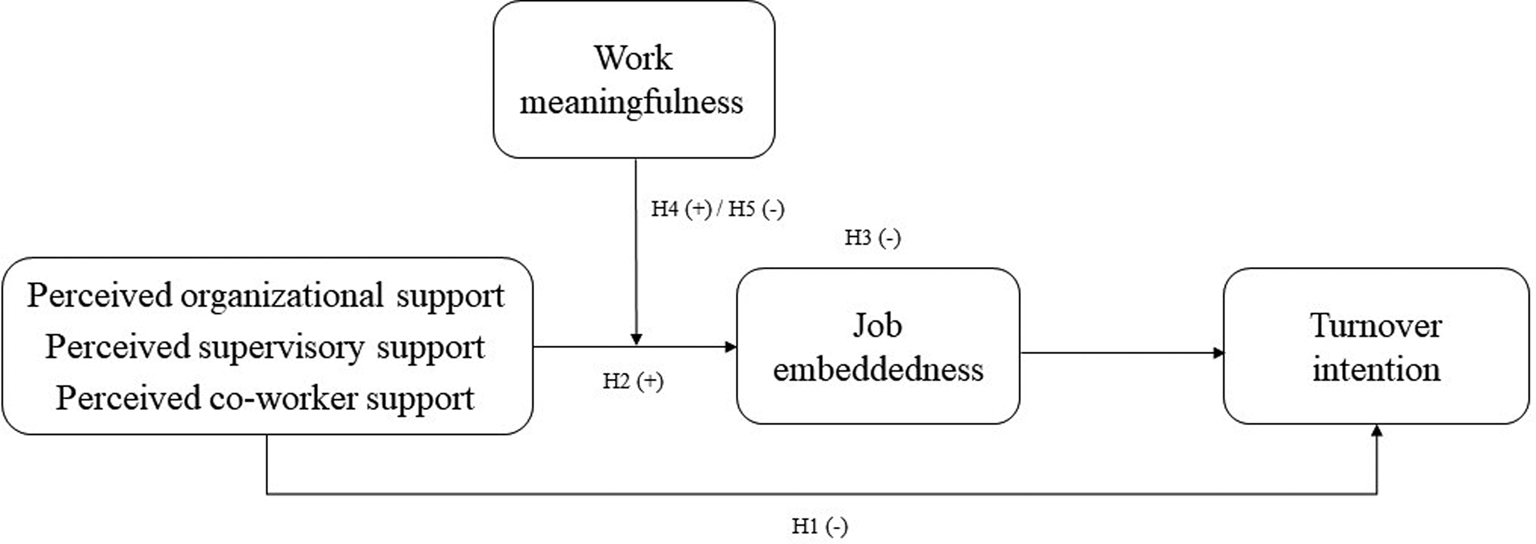
The study’s conceptual model is depicted in Figure 1.
Conceptual model.

Methodology
Sample and procedures for data collection
A survey was administered to full-time employees of a financial and accounting shared service center of the largest corporation in Thailand. It provides operational support to all critical financial and accounting transactions and activities of the company, and the related subsidiaries and international joint ventures. Using a convenience sampling method, the questionnaires were sent out to the targeted respondents through the in-charge team of HR practitioners. All questionnaires were administered electronically through a web-based system externally hosted by an academic institution. The survey link (URL) with a randomized password to access was sent to targeted respondents via their official e-mail addresses. A help desk team with ability to answer any survey-related queries was provided by the researcher to support the respondents during the 4-week data collection period.
The questionnaire windows included a cover letter that informed participants about the purposes and procedures of this study. Participants were asked to complete the questionnaire as part of a study on an annual employee survey. The questions’ order was randomized by the survey system. Assurance was given that their responses would remain anonymous and confidential. They could decline to participate. A guaranteed anonymity for the survey respondents and a randomized order of the question items may initially prevent common source bias from self-reporting informants in a cross-sectional study (Podsakoff, MacKenzie, & Podsakoff, Reference Podsakoff, MacKenzie and Podsakoff2012). Out of 1,490 questionnaires distributed, 1,162 were returned, representing a response rate of 78%. Owing to missing and incomplete data, only 1,137 questionnaires were considered appropriate for further analysis. The high response rate was due to employees’ willingness to contribute to the annual organization-wide survey, and strong coordination in the data collection process from the responsible HR team.
Measures
A Thai version of all measures was created by following Brislin’s (Reference Brislin, Triandis and Berry1980) translation-back-translation procedure. Prior to distribution, the translated version was pre-tested with HR practitioners of the participating work units to ensure understanding of the terminology and the content of the questionnaire. All the measuring instruments employed in this study used 6-point Likert scales, ranging from ‘strongly disagree (1)’ to ‘strongly agree (6),’ in order to offset the central tendency bias that is often encountered with Asian respondents (Huang, Lawler, & Lei, Reference Huang, Lawler and Lei2007).
Job embeddedness
The scale to measure job embeddedness was adapted from the global embeddedness items developed by Crossley et al. (Reference Crossley, Bennett, Jex and Burnfield2007). This reflective seven-item embeddedness measure represents the general level of ‘on-the-job’ embeddedness of employees and captures their overall impressions of attachment to an organization. A sample item is, ‘I am tightly connected to this organization.’
Work meaningfulness
Although a multidimensional scale to measure meaningfulness is extensively used (e.g., Lips-Wiersma & Wright, Reference Lips-Wiersma and Wright2012; Steger, Dik, & Duffy, Reference Steger, Dik and Duffy2012), this study adopted a unidimensional scale compiled by May, Gilson, and Harter (Reference May, Gilson and Harter2004) to assess the degree of meaning that individuals perceive in their work-related activities. The reason is that the unidimensional model captures individuals’ global judgment of whether their work is meaningful directly, while the multidimensional scale may reflect constructs that overlap with other sources or the outcomes of meaningfulness (Allan et al., Reference Allan, Batz-Barbarich, Sterling and Tay2019; Martela & Pessi, Reference Martela and Pessi2018). A sample from this six-item scale is, ‘I feel that the work I do on my job is valuable.’
Perceived organizational support
This study measured perceived organizational support using a six-item scale developed by Eisenberger, Huntington, Hutchison, and Sowa (Reference Eisenberger, Huntington, Hutchison and Sowa1986). A sample item is, ‘My organization is willing to help me if I need help.’
Perceived supervisory support
Work-related support from the respondents’ supervisor was measured using the four-item supervisor support scale adopted from Stinglhamber and Vandenberghe’s (Reference Stinglhamber and Vandenberghe2003) study. A sample item is, ‘My supervisor is helpful to me in getting the job done.’
Perceived co-worker support
This variable was measured with a three-item scale used by Yang et al. (Reference Yang, Lei, Jin, Li, Sun and Deng2019). Items in this measure include, ‘My co-workers listen to me when I need to talk about work-related problems.’
Turnover intention
The employee’s intention to quit was assessed by three items adopted from Colarelli’s (Reference Colarelli1984) intention to turnover scale. A sample item is, ‘I frequently think of quitting my job.’
Demographic control variables
Gender was measured using a dichotomous variable where 0 indicates a male and 1 indicates a female respondent. Marital status was measured through the use of self-reported items via a three-point scale, denominated as single, married, and divorced or separated. Participants’ age and tenure were captured in years.
Measurement model
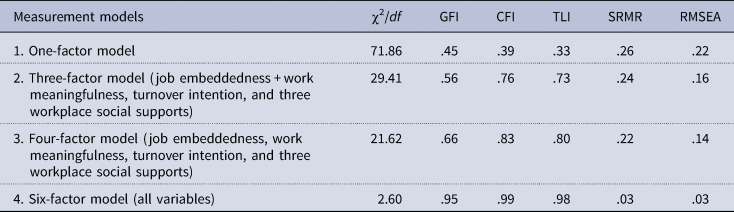
Before hypothesis testing, a confirmatory factor analysis (CFA) was conducted to validate all multiple-item scales in order to indicate how well the identified measures predict the latent variables (Hair, Black, Babin, & Anderson, Reference Hair, Black, Babin and Anderson2010). The CFA results indicate that the six-factor model (i.e., job embeddedness, work meaningfulness, turnover intention, and the three workplace social supports) shows an acceptable fit to the data (see Table 1): χ2/df = 2.60, goodness-of-fit index = .95, comparative fit index = .99, Tucker–Lewis index = .98, standardized root means square residuals = .03, and root mean square error of approximation = .03 (Hu & Bentler, Reference Hu and Bentler1999). All fit indices are consistent with prior research (e.g., Both-Nwabuwe, Dijkstra, & Beersma, Reference Both-Nwabuwe, Dijkstra and Beersma2017; Singh, Shaffer, & Selvarajan, Reference Singh, Shaffer and Selvarajan2018; Yang et al., Reference Yang, Lei, Jin, Li, Sun and Deng2019), confirming measurement validity of each scale.
Comparison of measurement model fit indices

CFI, comparative fit index; GFI, goodness-of-fit index; RMSEA, root mean square error of approximation; SRMR, standardized root means square residuals; TLI, Tucker–Lewis index.
Since all measures were collected during the same period of time using the same questionnaire, the presence of common method variance (CMV) was further validated by loading the related observed variables into a one-factor model, a three-factor model, and a four-factor model, respectively. Such comparative models and the χ2 difference tests demonstrate worse fit than the six-factor model. These findings indicate that the constructs are distinct from one another, and that CMV does not seem to be a pervasive problem in this study. Harman’s single-factor test was also applied to additionally evaluate CMV (Podsakoff, MacKenzie, & Podsakoff, Reference Podsakoff, MacKenzie and Podsakoff2012). All the variables were loaded into a factor analysis model to test whether a single factor might account for the majority of the covariance among the measures. The unrotated factor outcome shows that the single factor explained 38% of the total variance, lower than the threshold value of 50%, confirming that CMV would not be a concern in this data set.
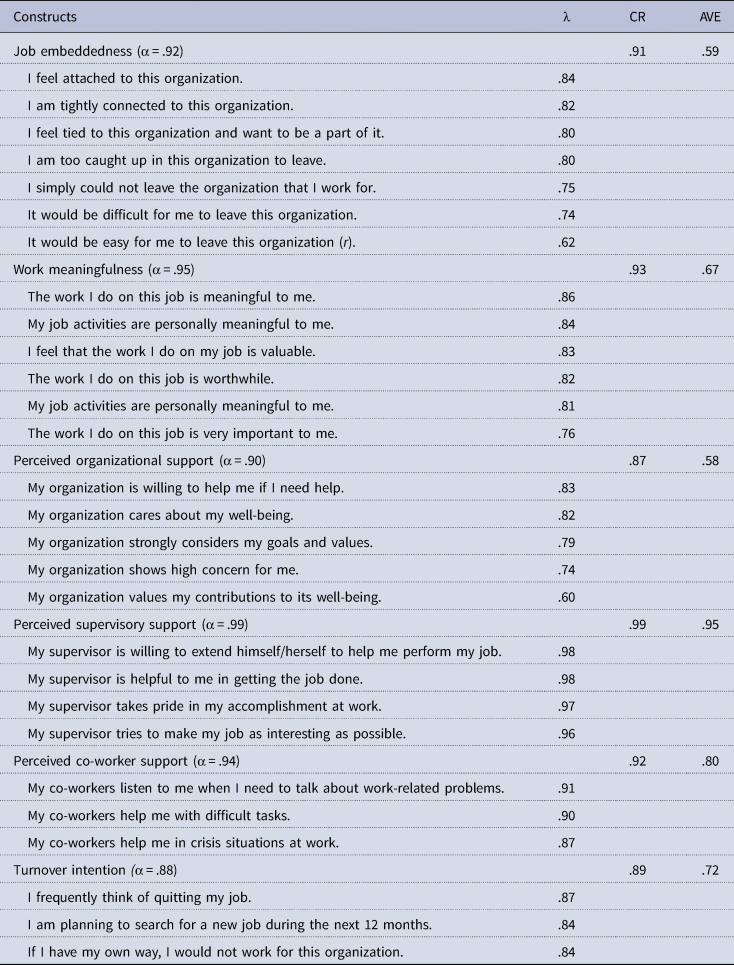
Convergent validity was tested using factor loadings, composite reliability (CR), and average variance extracted (AVE) (Hair et al., Reference Hair, Black, Babin and Anderson2010). As shown in Table 2, convergent validity was supported, because standardized coefficients from items to factors ranged from .60 to .98, with statistically significant regression weight, and all items exceed the conventional threshold of .5 (Anderson & Gerbing, Reference Anderson and Gerbing1988). All items are well-loaded onto the associated factors. However, one item from the perceived organizational support construct was removed due to insignificant factor loadings below the aforementioned threshold. CR values, which illustrate the degree to which the construct indicators indicate the latent variables, ranged from .87 to .99. This exceeds the recommended value of .7 (Hair et al., Reference Hair, Black, Babin and Anderson2010). The AVE values, which reflect the overall amount of variance in the indicators represented the latent construct, also exceed the recommended value of .5 (ranging from .58 to .95), indicating adequate convergent validity (Bagozzi & Yi, Reference Bagozzi and Yi1988).
Validity of the measurement model

AVE, average variance extracted; CR, composite reliability; λ, factor loadings.
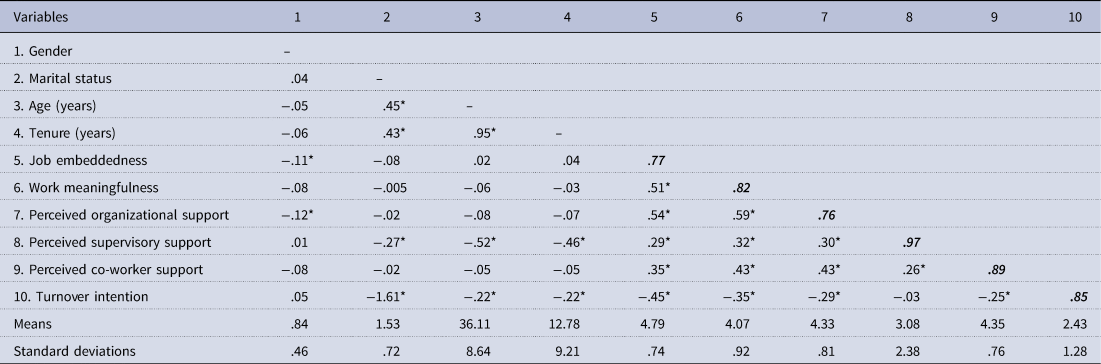
Discriminant validity was assessed by comparing the correlations between constructs and the square root of the AVE for that construct (Fornell & Larcker, Reference Fornell and Larcker1981). As shown in Table 3, all the square roots of the AVE values were higher than the correlation values in the same row and column, legitimizing adequate discriminant validity. Reliability was estimated using Cronbach’s alpha for multiple-item measures (Hair et al., Reference Hair, Black, Babin and Anderson2010). All related values were greater than .7, indicating a high level of internal consistency.
Means, standard deviations, intercorrelations of the variables, and discriminant validity

Diagonals represent the square root of the AVE.
Note: *p < .01 (two-tailed test).
Results
Descriptive statistics
Descriptive statistics and the bivariate correlations for the related constructs are presented in Table 3. Job embeddedness is positively related to work meaningfulness (r = .51), perceived organizational support (r = .54), perceived supervisory support (r = .29), and perceived co-worker support (r = .35). However, it is inversely related to turnover intention (r = −.45). Work meaningfulness is positively related to perceived organizational support (r = .59), perceived supervisory support (r = .32), perceived co-worker support (r = .43), but negatively related to turnover intention (r = −.35). The correlations among all three forms of social support are moderately significant and positive (r = .26–.43). All except for perceived supervisory support are inversely and significantly related to turnover intention.
Among the respondents, 70% were female, 30% male. A total of 60% were single, 39% were married, and the rest were divorced or separated. The average age and average tenure were 36 years (sd = 8.6) and 12.8 years (sd 9.2), respectively. Prior to the analysis, all variables used in the model were checked for multicollinearity by examining the variation inflation factors (VIFs). No issue was detected, since all VIF values were lower than 5, below the threshold of 10 (Hair et al., Reference Hair, Black, Babin and Anderson2010).
Hypothesis testing
Direct and mediating effects
Structural equation modeling, with a maximum likelihood method of estimation, using AMOS version 22 was performed to test the hypothesized model. It is a powerful statistical tool for assessing the relationship between latent constructs, and it allows for the use of multiple measures to test a priori hypotheses regarding relationships between observed and latent variables simultaneously (Byrne, Reference Byrne2010).
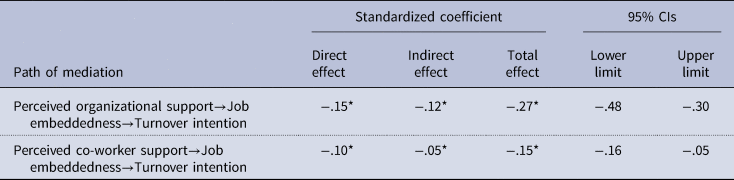
Preacher and Hayes’ (Reference Preacher and Hayes2004) three-step approach was also used to examine the structural paths concerning the mediation effect of workplace social support on turnover intention via job embeddedness. The first step tested the total effects of the predictors (i.e., organizational support, supervisory support, and co-worker support) on the outcome variable (turnover intention) without the presence of the mediator (job embeddedness). In this step, a significant relationship must exist between the predictors and the outcome variable. The estimates of the paths from perceived organizational support and perceived co-worker support to turnover intention were significant (β = −.27 and −.15 respectively, p < .01), thus supporting hypotheses 1a and 1c. However, perceived supervisory support failed to reach significance (β = −.01, p = .2), thus rejecting hypothesis 1b.
The second step tested the relationships between the predictors and the mediator, and the mediator to the outcome variable. The results show that perceived organizational support and perceived co-worker support depicted a significant association with job embeddedness (β = .51 and .13 respectively, p < .01), whereas perceived supervisory support did not (β = .03, p = .2). Hypotheses 2a and 2c are confirmed, but hypothesis 2b is rejected. The relationship between job embeddedness and turnover intention was also significant (β = −.40, p < .01).
To investigate the third condition and test the mediation effect, the direct paths from workplace social support to turnover intention were added to the proposed structural model. The results reveal that the indirect effects of perceived organizational support and perceived co-worker support on the outcome variable is weakened but still significant, when controlling for job embeddedness (β = −.12 and −.05 respectively, p < .01), indicating a partial mediation. The regression results show that the coefficient of determination (R 2) values were 35 and 23% of the variance in job embeddedness and turnover intention, respectively. The mediation analysis results are presented in Table 4.
Mediating effects

Note: *p < .01; bootstrap sample size = 20,000.
Additionally, the bootstrapping procedure in AMOS with 95% bias-corrected confidence intervals (CIs) was performed, using 20,000 resamples (MacKinnon, Lockwood, & Williams, Reference MacKinnon, Lockwood and Williams2004). The results reveal that zero is not included in the intervals of the indirect effects of perceived organizational support and perceived co-worker support on intention to leave through job embeddedness (CI = −.48 to −.30 and −.16 to −.05 respectively, p < .01), confirming that there are mediation effects to report. Therefore, both hypotheses 3a and 3c are confirmed.
Moderating effects
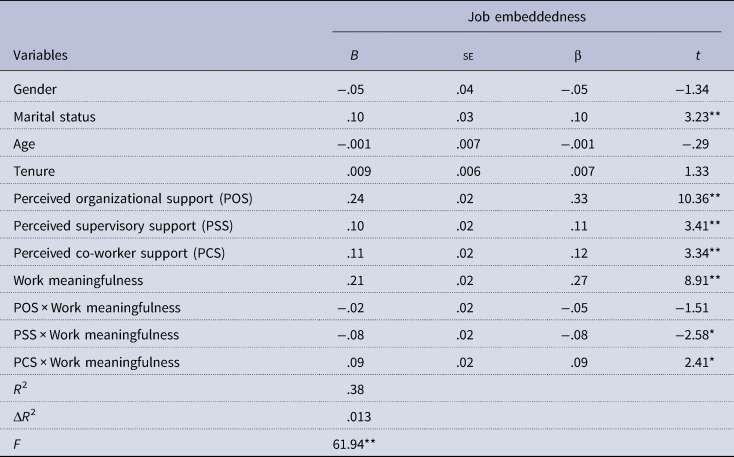
The moderating effect of work meaningfulness on the relationships between workplace social support (i.e., organizational support, supervisory support, and co-worker support) and job embeddedness were assessed, using multiple regression analysis and a standard procedure suggested by Aiken and West (Reference Aiken and West1991). This approach can concurrently estimate a collection of independent variables and the related interactions to predict job embeddedness. Following their recommendations, the three predictors (i.e., organizational support, supervisory support, and co-worker support) and the moderator (work meaningfulness) were mean-centered before running a regression.
The interaction terms for perceived supervisory support and perceived co-worker support with work meaningfulness were significant in predicting job embeddedness (β = −.08, p < .01 and .09, p < .05 respectively), thus supporting hypotheses 4b and 4c. Unexpectedly, the interaction between perceived supervisory support and work meaningfulness was in the direction opposite to the hypothesis. However, the findings show that work meaningfulness did not moderate the relationship between perceived organizational support and job embeddedness (β = −.05, p = .2), thus rejecting hypothesis 4a. Including the related interaction terms explained an additional of 1.3% of variance (ΔR 2) in job embeddedness over and above the main effects. The effect size may sound small. Nonetheless, Mellor (Reference Mellor1992) has argued that even a 1% increase in R 2 is not trivial. The moderation analysis results are presented in Table 5.
Moderating effects

B, unstandardized regression coefficients; β, standardized regression coefficients; se , standard errors.
Note: **p < 0.01, *p < 0.05.
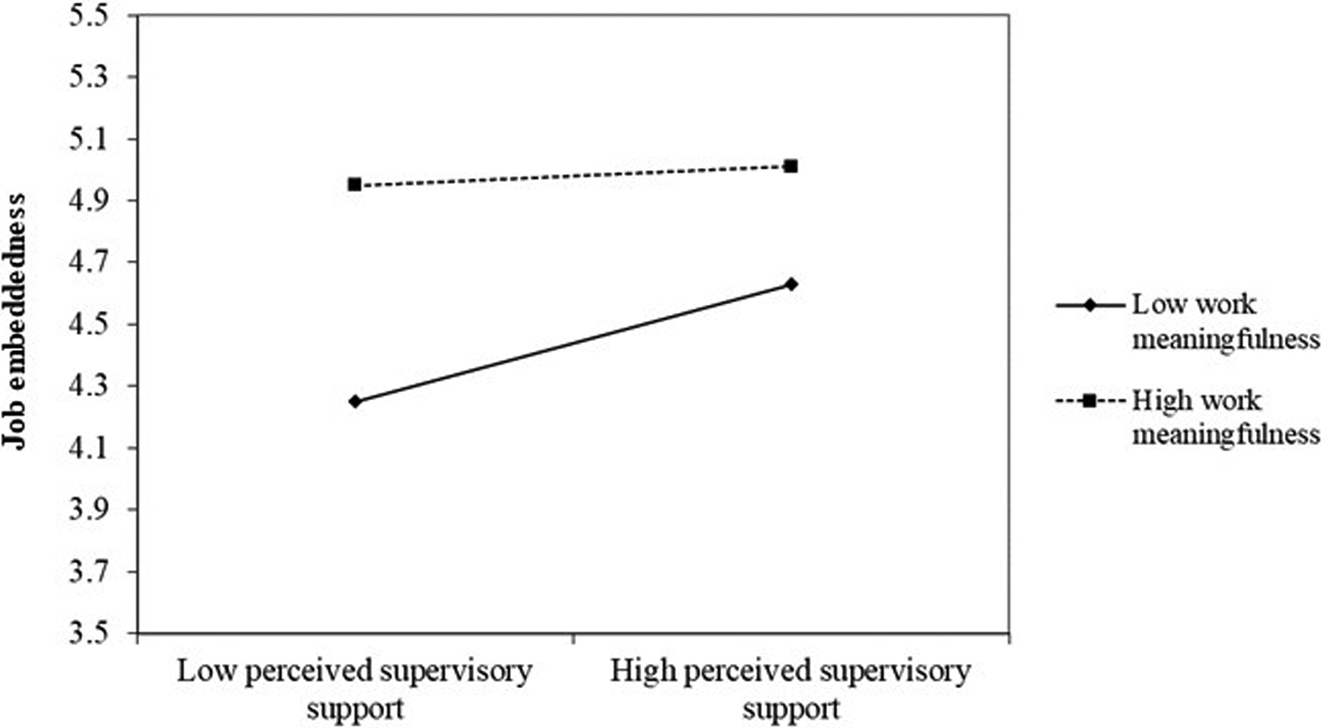
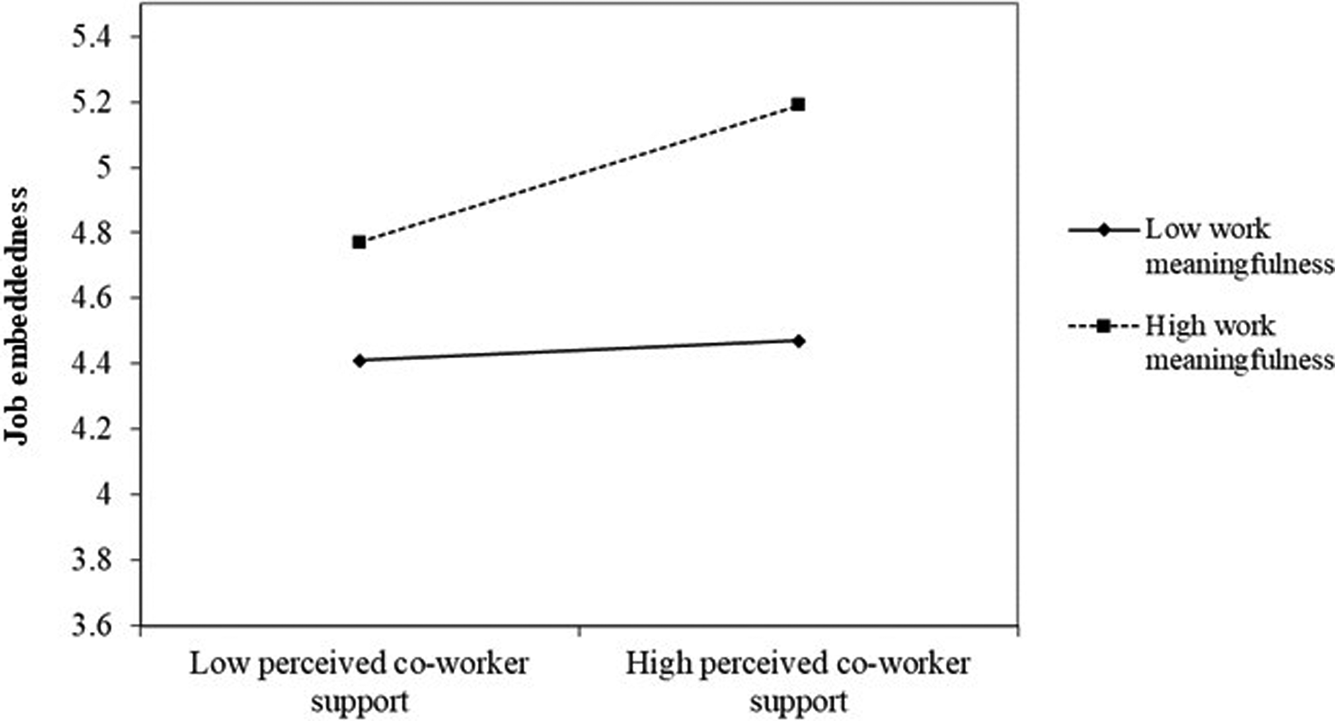
Moreover, simple slope analysis was performed to probe the nature of any significant interactions (Cohen, Cohen, West, & Aiken, Reference Cohen, Cohen, West and Aiken2003). As shown in Figure 2, the chart reveals that when work meaningfulness is low, perceived supervisory support has a stronger positive effect on job embeddedness. Also, the interaction plot in Figure 3 shows that perceived co-worker support has a stronger effect on job embeddedness when work meaningfulness is high. The impacts of perceived co-worker support are not present when work meaningfulness is low. Thus, the results of such simple slope analyses make it possible to corroborate hypotheses 4b and 4c.
Interaction of perceived supervisory support and work meaningfulness, predicting job embeddedness.

Interaction of perceived co-worker support and work meaningfulness, predicting job embeddedness.

Moderated mediation model
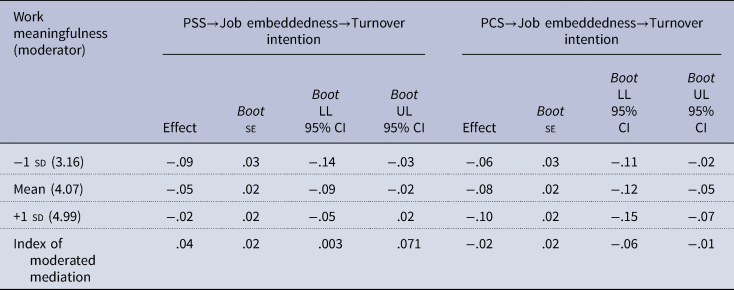
Moderated mediation analyses reveal the statistically significant impacts of work meaningfulness as a moderator in the meditational pathways between workplace social support and turnover intention via job embeddedness. To validate the conditional indirect effect of each interaction term, the PROCESS macro (model 7) (Hayes, Reference Hayes2013) was applied to estimate the moderated mediation model, using 20,000 bootstrap samples with 95% CIs. The magnitude of such effects was examined at three values of the associated moderator: the mean, one standard deviation above, and one standard deviation below the mean.
The moderated mediation results presented in Table 6 confirm that the indirect effects of perceived supervisory support and perceived co-worker support on turnover intention via job embeddedness depend on the degree of work meaningfulness, but appear to move in a different direction. The indices of moderated mediation were significant for the perceived supervisory support (B = .04, boot se = .02, CI = .003 to .071) and perceived co-worker pathways (B = −.02, boot se = .02, CI = −.06 to −.01). As these CIs did not include zero, the results imply that the indirect effects of both perceived supervisory support and perceived co-worker support on turnover intention via the mediator are conditionally moderated by work meaningfulness, validating the moderated mediation for hypotheses 5b and 5c. However, the CIs for the index of moderated mediation concerning the conditional indirect effects of the perceived organizational support pathway regarding the degree of work meaningfulness contained zero, which failed to reach statistical significance, thus rejecting hypothesis 5a.
Conditional indirect effects

Note: Bootstrap sample size = 20,000.
CI, confidence interval; LL, lower limit; PCS, perceived co-worker support; PSS, perceived supervisory support; sd, standard deviations; UL, upper limit.
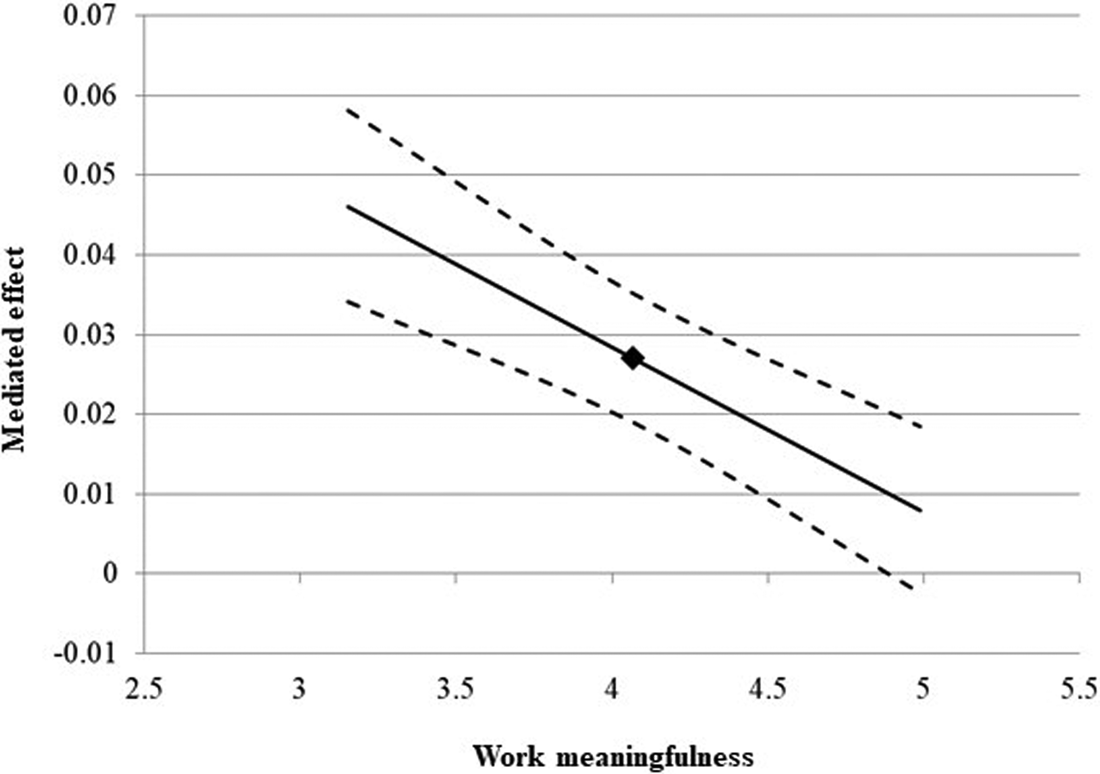
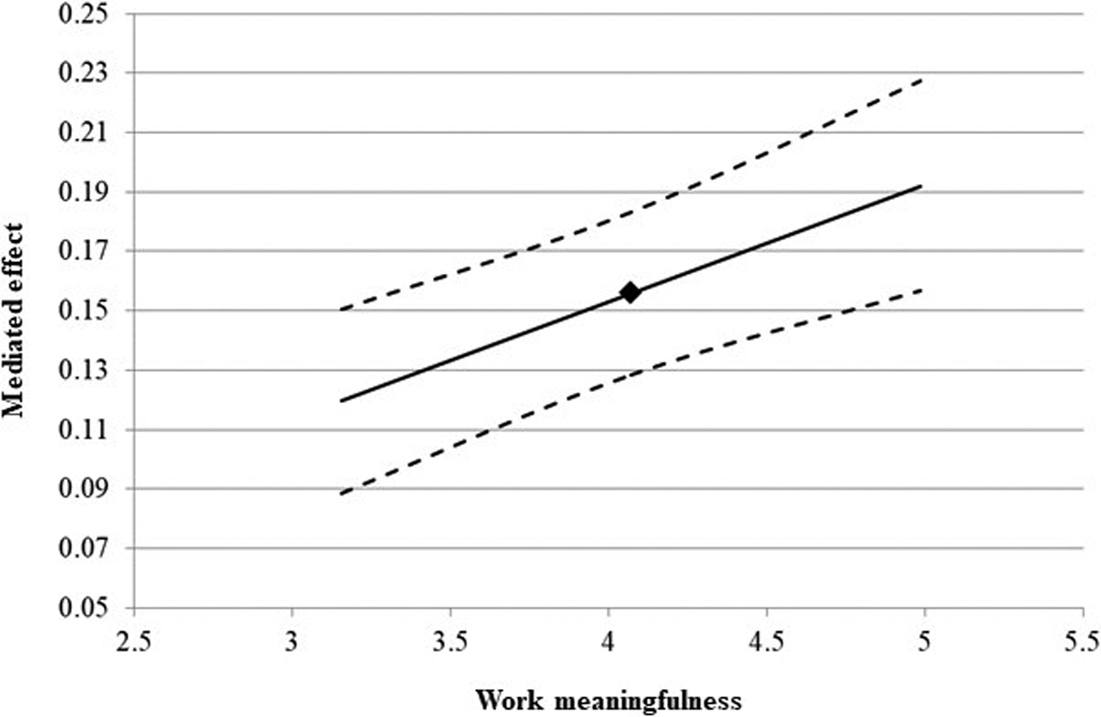
Specifically, at the low level of work meaningfulness (−1 sd), perception of supervisory support had a significant indirect effect on turnover intention via job embeddedness (B = −.09, boot se = .03, CI = −.14 to −.03). When work meaningfulness is high (+1 sd), the indirect effect was insignificant (B = −.02, boot se = .02, CI = −.05 to .02), as shown in Figure 4. Contrariwise, Figure 5 demonstrates the conditional indirect effect of perceived co-worker support via job embeddedness was marginally weaker for employees with a high level of work meaningfulness (+1 sd) (B = −.1, boot se = .02, CI = −.15 to −.02), than those with lower value (−1 sd) (B = −.06, boot se = .03, CI = −.11 to −.02).
Conditional effect of perceived supervisory support on turnover intention via job embeddedness at values of work meaningfulness.

Conditional effect of perceived co-worker support on turnover intention via job embeddedness at values of work meaningfulness.

Discussion
The primary objective of this study is to investigate the relationships among perceptions of workplace social support (i.e., organizational support, supervisory support, and co-worker support), job embeddedness, work meaningfulness, and intention to leave from the perspective of financial and accounting shared service workers. The COR theory is utilized to address the role of workplace social support as a critical resource that serves as the primary means through which employees interact with their job and work climate (Eisenberger & Stinglhamber, Reference Eisenberger and Stinglhamber2011; Halbesleben & Wheeler, Reference Halbesleben and Wheeler2015; Hobfoll et al., Reference Hobfoll, Halbesleben, Neveu and Westman2018). The study answers a recent call by researchers to provide a more differentiated picture of factors affecting job embeddedness (e.g., Singh, Shaffer, & Selvarajan, Reference Singh, Shaffer and Selvarajan2018; Thakur & Bhatnagar, Reference Thakur and Bhatnagar2017). As an anti-withdrawal work state, job embeddedness is considered to be a mediating variable between workplace social support and turnover intention. Moreover, this study sheds light on a boundary condition of work meaningfulness as guided by prior literature (e.g., Allan et al., Reference Allan, Douglass, Duffy and McCarty2016; Bailey et al., Reference Bailey, Yeoman, Madden, Thompson and Kerridge2019) for the relationship between workplace social support and the mediator. It also explores how such a boundary condition amplifies the conditional indirect effects when job embeddedness influences and mediates workplace social support and intention to leave.
The findings suggest that perceived organizational support and perceived co-worker support act as helping resources that enable employees to experience more positive attitudes toward their job and organization. Both foster individuals’ embeddedness, which in turn lead to diminished withdrawal intention. However, a partial mediation suggests that job embeddedness accounts for some of the relationships between such supportive constituents and intention to leave. The results imply that employees who perceive that their focal organization values, cares about, and supports their contributions are likely to create their own psychological enmeshment to their job and place of employment. It also seems that co-workers are the first call of port for employees needing support for solving job-related problems. When they feel comfortable consulting with and obtaining support from their colleagues at work, they feel embedded. As a result, the favorable sense of obligation will prevent them from seeking job opportunities somewhere else. Drawing from COR theory, both supportive constituents are resources that embed employees in the organization and keep them on the job in order to accumulate and avoid loss of resources (Halbesleben et al., Reference Halbesleben, Neveu, Paustian-Underdahl and Westman2014; Hobfoll et al., Reference Hobfoll, Halbesleben, Neveu and Westman2018; Kiazad et al., Reference Kiazad, Holtom, Hom and Newman2015). It means that access to these resources and possibility to utilize them in the future create a perceptual force that motivates individuals to stay in their career longer, because they expect that such resource abundance will provide supplementary and opportunity in return.
On the contrary, the results suggest that supportive supervision does not operate as a determining factor affecting turnover intention. This finding is of special concern. In this study, relatively low mean ratings of perceived supervisory support, as opposed to the high rating of perceived organizational support and co-worker support, partly justify such findings. Perhaps, the absence of significant relationship mentioned above can be caused by the work conditions in a financial and accounting shared service organization, where processes and operating procedures are well-structured and systematically standardized (Deloitte, 2017). These may imply that supervisors’ daily contact with employees may not be functionally needed to convey links, interactions, and caring, compared with other helping resources. Such findings, based on the COR theory (Hobfoll, Reference Hobfoll2001), offer a new way of understanding job embeddedness, and extend the applications of work-based social support in order to gain more favorable work outcomes as well as manage possible losses.
Work meaningfulness is found to be a significant moderator in the relationships between both perceived supervisory support and perceived co-worker support with job embeddedness. The significant moderating effects imply that that employees who have different levels of meaningfulness are likely to react to the relevant supports obtained from their supervisor and colleges differently. The results indicate that adequate supports from supervisors play a more important role to enhance job embeddedness than those from co-workers among employees who have lower levels of work meaningfulness. Because supervisors act as organizational agents in the interactions between management and employees, they have responsibility for directing and managing workers’ performance (Gordon et al., Reference Gordon, Adler, Day and Sydnord2019). They could express concerns (i.e., emotional support) and provide tangible assistances (i.e., instrumental resources) that could directly elevate the work-based emotional attachment of subordinates. On the contrary, employees who view their job as highly meaningful, receiving sufficient support from their co-workers are associated with higher levels of embeddedness. The findings are in line with the person–environment interaction model (Kristof-Brown, Reference Kristof-Brown2015) that the interplay between an individual and a given setting may bring about a differential influence on one’s attitudes and behaviors.
This study also reveals that work meaningfulness moderates the mediation processes between perceived supervisory support and perceived co-worker support with turnover intention. The model suggests that the relationships between both social supports and the outcome variable are more complicated than what the direct, mediated, or moderated models represent. That is, for employees who have lower levels of perception of work meaningfulness, job embeddedness as an intervening variable alleviates the effect of supportive supervision on turnover intention. Helping resources derived from supervisors are likely to inspire these groups of workers feel more embedded, and inducing them to consider staying longer. Inversely, adequate support from co-workers seems to be helpful to create a stronger sense of embeddedness that ultimately minimizes turnover among those with higher levels of work meaningfulness. The moderated mediation results may imply that an integrated model of organizational practices to cope with a certain work situation should be considered in managing HR.
However, the results do not lend empirical support to work meaningfulness as a moderator in the relationship between perceived organizational support and job embeddedness, and its meditational pathway toward turnover intention. In other words, both direct effect on job embeddedness and indirect effect on intention to leave may not depend on the moderator. It appears that employees with high work meaningfulness would not be in need of acknowledgement, concern, and support from their organization to elevate the levels of embeddedness and retention.
Theoretical implications
This study contributes to existing theory by presenting how the COR theory offers a parsimonious explanation for the relationships among organizational variables by relating job embeddedness to its various antecedents and impacts. It responds to the call for research by scholars in the field of job embeddedness (e.g., Singh, Shaffer, & Selvarajan, Reference Singh, Shaffer and Selvarajan2018; Thakur & Bhatnagar, Reference Thakur and Bhatnagar2017; Zhang, Fried, & Griffeth, Reference Zhang, Fried and Griffeth2012) to further explore the work-based factors from various sources of resources that lead to job embeddedness. The findings contribute to the growing literature that integrates employee embeddedness into the COR framework (Halbesleben & Wheeler, Reference Halbesleben and Wheeler2015; Kiazad et al., Reference Kiazad, Holtom, Hom and Newman2015). As noted earlier, favorable perceptions of workplace social support increase the availability of ameliorating resources that assist employees to fulfill their regular job, get facilitated as necessary, and help buffer against unfavorable situations, and also encourage them to invest more to develop further resources or to ward off depletion. Such resource abundance allows individuals to obtain feelings of appreciation, and increases levels of emotional connection to their job and organization, which motivate them to stay and obtain more resources. The present study adds to the literature by enhancing the existing knowledge of the antecedents of embeddedness and its intermediary role in the relationship between workplace social support and turnover. This is especially important, given the growing effectiveness of the embeddedness construct in explaining employee retention, particularly in an Asian country that has been highlighted as a gap in the literature (Dechawatanapaisal, Reference Dechawatanapaisal2017).
An additional contribution is the discovery of an important moderator (i.e., work meaningfulness) that links perceived supervisory support and co-worker support as well as job embeddedness, and reinforcing the meditational pathways between such supportive constituents and turnover intention. The results help us to identify which groups of workers should be assisted to gain additional resources for better aspirations in their everyday work, and motivate them to stay in their career longer. These add to an increasingly compelling body of literature on work meaningfulness by testing this construct in an integrative framework suggested by Lysova et al. (Reference Lysova, Allan, Dik, Duffy and Steger2019), and highlighting its role as a buffer to enrich beneficial work outcomes. It also provides a methodological way to consider the moderated mediation relationships of the three support constituents and turnover via the degree of meaning making variable. As such, the current research empirically advances the literature of work meaningfulness and job embeddedness, and extends the application of workplace social support.
In addition, the study hypotheses were tested regarding shared service employees. The results open up a new avenue to better understand the importance of HR in a kind of operational setting. This helps managers and practitioners determine the right interventions concerning workers’ attitudes and behaviors to maximize benefits of such operational model and business context, or other service organizations (Wirtz & Jerger, Reference Wirtz and Jerger2016).
Practical implications
This study’s findings offer important managerial implications that translate into practice. First, the results demonstrate that organizations can increase job embeddedness and reduce the turnover intention of their workers by making the three support constituents (i.e., organizational support, supervisory support, and co-worker support) more favorable. Managers should therefore design and implement workplace arrangements that create the feeling of being valued, supported, respected, and included among employees. These could occur through customizing organizational policies and practices that sufficiently support daily operations, streamlining work processes for better service deliveries, creating an environment where supervisors provide adequate support to staff, and strengthening social ties among cohorts to enable them to build up their network resources. Well-structured and systematic procedures to maintain operational standards are needed to manage a transaction-based organization, like financial and accounting shared services. Organizations may also try to develop a corporate culture where interaction between colleagues at different levels and from different workgroups is the norm.
Second, favorable perceptions of supervisory and co-worker supports cause a noticeable improvement in job embeddedness when they interact with work meaningfulness. So, if organizations want to obtain the benefits of meaning making through work, managers must invest time and energy in building core values of caring, sharing, and supporting, derived not only from supervisors but also from peers. It may be necessary to promote both work productivity and employee satisfaction by amicably and supportively strengthening supervisor–subordinate and peer-to-peer relationships as helping resources (Allan et al., Reference Allan, Douglass, Duffy and McCarty2016; Kim et al., Reference Kim, Hur, Moon and Jun2017), hence gaining stronger bonds of cohorts and workplace. When needed, they are able to seek the right support.
Third, it should be acknowledged that staff retention cannot be achieved purely through extrinsic motivation. One practical intervention involves revising and designing a job to make it more meaningful to align with employees’ skills, competencies, attitudes, and work culture, as well as today’s changing demand due to customers, technology, process, business context, and competition. This would help employees gain more intrinsic motivation. Job redesign, enrichment, and rotation should be considered in order to expose employees to various aspects of an organizational work setting. Meaning creation through job redesign may make a highly transactional, routine, and mundane job, like financial and accounting more attractive and significant. A well-planned practice may reduce the monotony and dullness involved in a shared service job, develop role novelty, and expand career opportunities. Consequently, organizations may discover the hidden potentials of employees, and then inspire them to become embedded and keep them on their career longer.
Finally, the moderated mediation model suggests that if a particular job position is deemed to be meaningless, then providing individuals with stronger supportive supervision as a resource replenishment may help them feel more embedded and reconsider leaving. Supervisors who are expected to provide such relevant support should be trained to be able to mentor or coach their subordinates. On the contrary, favorable co-worker support adds auxiliary value among employees who view their work as meaningful. Organizations should urge and accentuate the importance of teamwork and collaboration among employee networks. Also, a team atmosphere that unites employees together should be put in place for strengthening social relationships in the organizational context in order to better manage long-term retention. Doing so, organizations can minimize costs incurred due to turnover, including replacement and training expenses, thus ensuring business continuity.
Limitations and directions for future research
This study has some limitations that suggest caution when interpreting the results. First, the nature of the sample involved only one occupation – financial and accounting shared service workers, which might limit the generalizability of the findings. A potential avenue for future research is to expand the generalizability by replicating similar studies in multiple professions, diverse demographic cohorts, or various business sectors and industries.
Second, the study is reliant on a single-source survey data, which could give rise to CMV. However, as noted earlier, the threat of CMV was primarily mitigated by a randomized order of the question items and significant statistical tests suggested by Podsakoff, MacKenzie, and Podsakoff (Reference Podsakoff, MacKenzie and Podsakoff2012). So, it is proven that CMV will not impair the methodological rigor of this study. Though, despite the precautions mentioned above, the possibility of CMV should not be overlooked. As such, it is recommended that future studies might collect data from multiple sources, or at different time points. Other potential outcome variables from different sources of data, for example, actual turnover and employee performance might be considered to further reduce error in parameter estimation. Third, all responses were collected at one point in time, despite the fact that individuals’ holistic judgment on a contextual perception (e.g., embeddedness and perceived support) may fluctuate in response to day-to-day events and business cycles or even by their own recent work experiences (Dalal, Bhave, & Fiset, Reference Dalal, Bhave and Fiset2014). Participants’ reflections may improve or decline due to what they encounter at a particular moment. Subsequent research might consider temporal experiences to continuously assess individuals’ reactions at a different timeframe to better understand how they change over time.
Fourth, in this study, the globally recognized, yet relatively short versions of job embeddedness and work meaningfulness scales were chosen to test the proposed hypotheses. Both are unidimensional scales. However, in view of the contextual complexity, scholars have suggested employing more comprehensive embeddedness and meaningfulness measures (e.g., Both-Nwabuwe, Dijkstra, & Beersma, Reference Both-Nwabuwe, Dijkstra and Beersma2017; Kiazad et al., Reference Kiazad, Holtom, Hom and Newman2015; Lysova et al., Reference Lysova, Allan, Dik, Duffy and Steger2019). It is thus beneficial for future research to adopt multidimensional scales to investigate such relevant issues. Finally, additional mediators (e.g., work engagement) or moderators (e.g., job strain) might be included in the model to provide managers and practitioners with critical information to develop more robust retention strategies.
Conclusion
In sum, this empirical study found that job embeddedness is an intermediary mechanism that mediates the relationship between perceived organizational support as well as perceived co-worker support with turnover intention. Meaningful work plays a significant moderating role with supportive constituents from supervisor and co-workers in the influence of job embeddedness. In addition, work meaningfulness was found to moderate the mediated effects of these supportive constituents on intention to leave through job embeddedness. Despite its limitations, the current research contributes to the literature by considering an integrated mechanism of the interrelationships among organizational practices, furthering understandings of the complexity of workplace social support as additional antecedents of the embeddedness–turnover model, through the COR lens, and clarifying a boundary condition of work meaningfulness and its impact on employee retention.