Clahsen and Felser (CF) offer a novel explanation for the qualitative differences in language processing often observed between adult first language (L1) speakers and second language (L2) learners. They argue that, although L2 learners are successful in drawing on lexical, morphological, and pragmatic sources of information, they underutilize syntactic structure, which results in shallower and less detailed processing than that of native speakers.
We concur with CF on the role of shallow representations in syntactic processing and, further suggest that shallow processing is much more pervasive in both monolingual and bilingual adult speakers than previously assumed. As shown by Ferriera and others (e.g., Ferreira, Bailey, & Ferraro, 2002; Sanford & Sturt, 2002), even native speakers are not immune to shallow processing of unambiguous passive constructions, garden-path sentences, and quantifier scope ambiguity. Additional evidence comes from our laboratories. We present the results of two new studies, one investigating the processing of universal quantifiers by adult native English speakers and the other prepositional phrase (PP)-attachment ambiguity resolution by bilingual heritage speakers of Russian. These studies show that shallow processing is not restricted to L2 processing, nor is it limited to syntax.
PROCESSING OF UNIVERSAL QUANTIFIERS IN ADULT NATIVE SPEAKERS OF ENGLISH
Evidence that shallow syntactic processing is not limited to L2 learners comes from a recent study (Brooks & Sekerina, in press) of the interpretation of universally quantified sentences, such as Every car is in a garage, in native English-speaking college students. Previous studies of children (e.g., Donaldson & Lloyd, 1974) indicated that in situations where cars and garages were arranged in partial one to one correspondence (e.g., three cars each in a garage, along with an extra garage), children up to age 9 often answered “no” to the question Are all the cars in garages? Geurts (2003) interpreted these so-called “quantifier spreading” errors as indicative of the use of a simpler processing strategy in mapping syntactic structures to semantic representations. In particular, strong universal quantifiers, such as all or every, require relational representations that indicate whether the set of entities modified by the universal quantifier exhausts its domain of quantification (e.g., the set of cars). In contrast to strong quantifiers, weak quantifiers such as numbers (e.g., two) do not have intrinsically relational meanings, and therefore, only require instantiation for their interpretation. Geurts argued that children treat universal quantifiers as if they were weak quantifiers, and assign semantic interpretations that fail to properly identify the quantifier's domain. Given such an underspecified semantic representation, they resort to pragmatic mechanisms in responding to experimental questions. Consistent with the pragmatic account of children's reasoning with universal quantification, are results (e.g., Freeman, 1985) showing that the distribution of error types (i.e., so-called underexhaustive versus overexhaustive variants of quantifier spreading) is highly malleable and influenced by context.
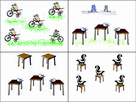
It has been widely assumed that improvements in working memory and/or attention allocation eliminate children's mapping errors with universal quantification (Geurts, 2003), such that adults are essentially error free. We tested this belief using a timed picture-selection task (Brooks & Sekerina, in press): 21 monolingual English-speaking undergraduates were shown pictures structured to be comparable to the “garage” problem used in child studies. (See Figure 1 for an example picture set of mice on tables.) Across trials, adults were instructed to identify the picture whether either Every mouse is on a table or Every table has a mouse on it. Rather astonishingly, our college students averaged only 75% correct for both sentence types, with errors restricted to selecting the opposite picture showing, for example, mice on tables (i.e., adults successfully avoided the “distractors” showing, e.g., mice on bikes). For the 12 critical trials, given a choice of two “most relevant” pictures, above-chance performance required 10/12 correct (binomial distribution). By this criterion, only 38% of the adults were above chance. Thus, use of shallow processing strategies in comprehending universal quantifiers appears to be pervasive in adults, as well as children.

A sample array of pictures from the experiment with quantifiers. Adapted form Brooks and Sekerina (in press).
PROCESSING OF PP-ATTACHMENT AMBIGUITY
CF (2005) describe the results of a number of eye-tracking studies on ambiguity resolution in children using sentences containing reduced relative clauses, such as Put the frog on the napkin in the box (Trueswell, Sekerina, Hill, & Logrip, 1999). The temporary ambiguity concerned the interpretation of the PP1 on the napkin that is initially interpreted as destination for the verb put. In the visual context with one frog biasing the destination interpretation of the PP1, native English-speaking adults showed signs of misinterpretation in their eye movements; however, they successfully recovered from it and performed the correct action. Children's eye movements and action data revealed deterministic processing, such that they misinterpreted the PP1 as a destination and showed an inability to revise their interpretations in the face of disambiguating information.
We recently tested early Russian–English bilingual adults to determine the extent to which their on-line processing of a Russian PP-attachment ambiguity is comparable to native speakers (Sekerina, 2004). Our participants were Russian heritage speakers (i.e., young adults who emigrated to the United States when they were elementary school-age children). These individuals spoke Russian exclusively from birth until emigration for 11 years on average. With few exceptions, they were literate in Russian having spent several years in Russian schools.
We introduced a somewhat different type of disambiguation, involving the presence or absence of and in sentences like Put the frog on the towel/napkin [and] in the box. To create a second source of ambiguity, we took advantage of the fact that Russian neuter nouns have identical vowel endings for locative and accusative cases, whereas feminine nouns have distinct endings for these two cases. In a 2 × 2 design we crossed the presence/absence of and with case ambiguity. In the case ambiguous condition, the PP1 na polotenc-eNEUT (on the towelACC/LOC is ambiguous between modification and destination while in the case unambiguous condition, the PP1 na salfetk-u/-eFEM (on the napkinACC/LOC is not. The bilingual heritage Russian speakers' action and eye movement data were compared to those of monolingual Russian adults, who made less than 10% errors across conditions. Surprisingly, bilinguals showed an unusually high error rate (43%) in processing syntactically unambiguous sentences with ambiguous case marking. This error was explained by proposing that the bilinguals were unable to process the Russian word and (i.e., i) when it was adjacent to a case marker that was phonologically similar (i.e., −e). These results indicate underspecified morphophonological processing in L1 of “balanced” bilinguals.
Under what circumstances does shallow processing predominate?
There remains the question of precisely why shallow processing is widespread. CF (2005) provide no explanation saying that “the exact circumstances under which native speakers rely on such ‘good enough’ representations are not entirely clear.” Our view is that part of the answer resides in individual differences in verbal working memory and allocation of attention that apply to all language learners alike (Nation, Marshall, & Altmann, 2003). Language processing is not either input or learner driven; it is a continuum of possibilities ranging from perfect fully articulated representations and exact mapping to just “good enough” representations.