Introduction
In the United States, non-Hispanic (NH) Black and Hispanic drinkers consume less alcohol than NH Whites, but experience more alcohol-related problems, including social consequences, illness, incarceration, and death (Mulia et al. Reference Mulia, Ye, Greenfield and Zemore2009; Mukku et al. Reference Mukku, Benson, Alam, Richie and Bailey2012; Zapolski et al. Reference Zapolski, Pedersen, McCarthy and Smith2014; Zemore et al. Reference Zemore, Ye, Mulia, Martinez, Jones-Webb and Karriker-Jaffe2016). This indicates a need to identify factors that mitigate risk for problem drinking and alcohol use disorders (AUD) and whether these factors differ in NH Whites, NH Blacks, and Hispanics in the United States. Religiosity (e.g. religious service attendance and salience of religious/spiritual beliefs to an individual's daily life) is one important protective factor that has been shown to buffer against a range of physical and mental health behaviors (Bonelli & Koenig, Reference Bonelli and Koenig2013), including AUD (Edlund et al. Reference Edlund, Harris, Koenig, Han, Sullivan, Mattox and Tang2010).
Religiosity is consistently associated with fewer drinking problems. Those who report greater religiosity are less likely to initiate alcohol use, consume fewer drinks per occasion, and report fewer AUD symptoms (Miller et al. Reference Miller, Davies and Greenwald2000; Trinkoff et al. Reference Trinkoff, Zhou, Storr and Soeken2000; Degenhardt et al. Reference Degenhardt, Chiu, Sampson, Kessler and Anthony2007; Michalak et al. Reference Michalak, Trocki and Bond2007; Stockdale et al. Reference Stockdale, Wells, Tang, Belin, Zhang and Sherbourne2007; Wallace et al. Reference Wallace, Delva, O'Malley, Bachman, Schulenberg, Johnston and Stewart2007; Jackson et al. Reference Jackson, Sher and Schulenberg2008; Edlund et al. Reference Edlund, Harris, Koenig, Han, Sullivan, Mattox and Tang2010; Moscati & Mezuk, Reference Moscati and Mezuk2014; Holt et al. Reference Holt, Roth, Huang and Clark2015; Jeynes, Reference Jeynesn.d.). Different aspects of religiosity have been characterized by two broad domains: (1) public religiosity, which indicates participation in social religious activities, including service attendance, and (2) intrinsic religiosity, which indicates the perceived importance, or salience of religion/spirituality in an individual's life (Koenig et al. Reference Koenig, Larson and Larson2001a , Reference Koenig, McCullough and Larson b ). Both public and intrinsic religiosity have been shown to be inversely related to alcohol use and problems (Edlund et al. Reference Edlund, Harris, Koenig, Han, Sullivan, Mattox and Tang2010; Holt et al. Reference Holt, Roth, Huang and Clark2015).
NH Black and Hispanic adults report more religious involvement, and draw on religious beliefs in coping with stress more frequently than NH White adults (Miltiades & Pruchno, Reference Miltiades and Pruchno2002; Chatters et al. Reference Chatters, Taylor, Bullard and Jackson2008; Taylor et al. Reference Taylor, Chatters, Bullard, Wallace and Jackson2009). In some studies, the associations between religiosity and mental health outcomes are more pronounced for NH Blacks (Cook et al. Reference Cook, Pearson, Thompson, Black and Rabins2002; Miltiades & Pruchno, Reference Miltiades and Pruchno2002; Nasim et al. Reference Nasim, Utsey, Corona and Belgrade2006; Chatters et al. Reference Chatters, Taylor, Bullard and Jackson2008; Taylor et al. Reference Taylor, Chatters, Bullard, Wallace and Jackson2009; Robinson et al. Reference Robinson, Bolton, Rasic and Sareen2012) and Hispanics (Levin et al. Reference Levin, Markides and Ray1996; McCullough & Larson, Reference McCullough and Larson1999; Abraído-Lanza et al. Reference Abraído-Lanza, Vasquez and Echeverría2004; Robinson et al. Reference Robinson, Bolton, Rasic and Sareen2012) than for NH Whites. Further, the attitudes and social norms regarding alcohol use that impact drinking behavior (Caetano & Clark, Reference Caetano and Clark1999; Keyes et al. Reference Keyes, Li and Hasin2011) vary by race/ethnicity (Herd, Reference Herd1988; Herd & Grube, Reference Herd and Grube1993, Reference Herd and Grube1996; Caetano & Clark, Reference Caetano and Clark1998a , Reference Caetano and Clark b ). For example, earlier studies showed high rates of abstention and more disapproval of heavy drinking among NH Blacks (Midanik & Clark, Reference Midanik and Clark1994) than among Hispanics and NH Whites (Caetano & Clark, Reference Bentler1999; SAMHSA, 2013; CDC, 2014). These patterns may reflect involvement of many African Americans with fundamentalist Protestant religions (Herd, Reference Herd1988). Compared with NH Whites, Puerto Ricans were recently shown to have the highest AUD incidence, followed by Mexican-Americans, other Hispanics, and Cuban-Americans (Ríos-Bedoya & Freile-Salinas, Reference Ríos-Bedoya and Freile-Salinas2014). These rates may reflect more permissive views of drinking among specific Hispanic sub-cultures (SAMHSA, 2013; CDC, 2014; Ríos-Bedoya & Freile-Salinas, Reference Ríos-Bedoya and Freile-Salinas2014). Because drinking behaviors and involvement in religiosity vary across cultural groups, the relationship between religiosity and alcohol use behavior may also vary across racial/ethnic groups in the United States.
Few studies have empirically assessed these differences in large, representative samples of adults (Wallace et al. Reference Wallace, Delva, O'Malley, Bachman, Schulenberg, Johnston and Stewart2007; Chatters et al. Reference Chatters, Taylor, Bullard and Jackson2008; Robinson et al. Reference Robinson, Bolton, Rasic and Sareen2012; Sternthal et al. Reference Sternthal, Williams, Musick and Buck2012). Only one previous study has examined if the relationship between religiosity and substance use disorders varies by race/ethnicity, finding that one aspect of public religiosity (religious service attendance less than once per year) was associated with increased odds of having any substance use disorder (SUD) for NH Blacks and NH Whites, but not for Hispanics (Robinson et al. Reference Robinson, Bolton, Rasic and Sareen2012). While the SUD outcome in this study included AUD, results were not reported separately. Taken together, this literature suggests that the associations between religiosity and psychiatric and SUD may vary by race/ethnicity. However, whether race/ethnic differences exist in the buffering effects of religiosity (public and/or intrinsic religiosity) on alcohol consumption and AUD specifically, remains unclear.
This study takes a first step in examining whether race/ethnic differences exist in the relationships among religiosity (public religiosity and intrinsic religiosity), alcohol consumption frequency and AUD in a US nationally representative sample of NH Black, Hispanic, and NH White adults. This is important given the need to identify factors that mitigate risk for problem drinking in all race/ethnic groups.
Method
Sample design and procedures
The National Epidemiologic Survey of Alcohol Related Conditions (NESARC) is a survey of non-institutionalized US adults residing in homes or group quarters. NESARC data were collected at two time points: wave 1 (2001–2002) with 43 093 participants (response rate: 81% of those eligible) and wave 2 (2004–2005) with 34 653 of the original participants (cumulative response rate at wave 2, 70.2%). Young adults (aged 18–24), NH Black and Hispanic households were oversampled. Data were weighted to reflect the demographic characteristics of the US population based on the 2000 census (Grant et al. Reference Grant, Stinson, Dawson, Chou, Ruan and Pickering2004). The research protocol, including written informed consent, received full ethical review and approval from the US Office of Management and Budget. Further study design and sampling details are described elsewhere (Grant et al. Reference Grant, Stinson, Dawson, Chou, Ruan and Pickering2004; Hasin et al. Reference Hasin, Stinson, Ogburn and Grant2007).
Participants
The present study included wave 2 participants, as the wave 2 interview included all relevant variables. Of the 34 653 participants assessed at wave 2, 11 774 individuals (33.9% of the total sample) reported having not used alcohol in the last 12 months and 38 individuals drinking status was ‘unknown’. All NESARC participants were asked if they are of ‘Hispanic or Latino origin’ (yes/no). Next, participants were asked to select one or more categories to describe their race. Response options included: ‘American Indian or Alaska Native’, ‘Asian’, ‘Black or African American’, ‘Native Hawaiian or Other Pacific Islander’, and ‘White’. Of 22 841 drinkers, 14 412 self- identified as ‘non-Hispanic or Latino’ and ‘White’, 3568 self-identified as ‘non-Hispanic or Latino’ and ‘Black or African-American’, and 3985 self-identified as ‘Hispanic or Latino’, for a total of 21 965 participants. Of this sample, 52.4% were female, with an age range of 20–90 years [mean = 49.1, standard deviation (s.d.) = 17.3]. We acknowledge that an individual's racial, ethnic, and cultural identity are complex, sometimes overlapping and sometimes separate entities. Throughout this paper we describe individuals’ self-report of these identities (as described above) as race/ethnicity. Further we will describe those who self- identified as ‘non-Hispanic or Latino’ and ‘White’ as non-Hispanic White (NH White) and those who self- identified as ‘non-Hispanic or Latino’ and ‘Black’ as non-Hispanic Black (NH Black). Those who identified as ‘Hispanic or Latino’ will be described as Hispanic.
Measures
Participants were interviewed in person with the Alcohol Use Disorder and Associated Disabilities Interview Schedule, DSM-IV version (AUDADIS-IV), a fully structured interview designed for experienced lay interviewers (Grant et al. Reference Grant, Harford, Dawson, Chou and Pickering1995, Reference Grant, Dawson, Stinson, Chou, Kay and Pickering2003; Ruan et al. Reference Ruan, Goldstein, Chou, Smith, Saha, Pickering, Dawson, Huang, Stinson and Grant2008). The AUDADIS-IV includes comprehensive measures of alcohol consumption, AUDs, demographic characteristics, and aspects of religiosity.
Past year alcohol use frequency
Participants were asked to report how frequently they used alcohol within the last 12 months, during the period they drank most. Response options included: never (set to missing), 1–2 times per year (0), 3–6 times per year (1), 7–11 times per year (2), 1 time per month (3), 2–3 times per month (4), 1 time per week (5), 2 times per week (6), 3–4 times per week (7), nearly every day (8), and every day (9). Of the total sample 11 774 individuals (34%) reported having not used alcohol in the last 12 months. These individuals included 5727 NH Whites comprising 28.4% of all NH White participants, 3012 (45.7%) NH Blacks, and 2370 (37.3%) Hispanic individuals.
AUD
Binary past year Alcohol Abuse and Dependence (AUD) diagnoses were defined using DSM-IV criteria (APA, 2000), as assessed by the AUDADIS-IV (Grant et al. Reference Grant, Dawson, Stinson, Chou, Kay and Pickering2003). These measures have been described in detail previously (Hasin et al. Reference Hasin, Stinson, Ogburn and Grant2007). The AUDADIS alcohol dependence and abuse diagnoses separately (note that this study uses alcohol abuse and/or dependence) have good to excellent test–retest reliability (k = 0.67–0.84) in general population samples (Grant et al. Reference Grant, Dawson, Stinson, Chou, Kay and Pickering2003, Reference Grant, Harford, Dawson, Chou and Pickering1995), and good to excellent convergent, discriminant, and construct validity in US populations (Hasin et al. Reference Hasin, Muthuen, Wisnicki and Grant1994, Reference Hasin, Van Rossem, McCloud and Endicott1997; Hasin & Paykin, Reference Hasin and Paykin1999) and international populations (Cottler et al. Reference Cottler, Grant, Blaine, Mavreas, Pull, Hasin, Compton, Rubio-Stipec and Mager1997; Vrasti et al. Reference Vrasti, Grant, Chatterji, Ustün, Mager, Olteanu and Badoi1998; Canino et al. Reference Canino, Bravo, Ramirez, Febo, Rubio-Stipec, Fernandez and Hasin1999), including clinician reappraisals.
Religiosity
Participants were asked about their religious affiliation using the following question: ‘Do you currently attend religious services at a church, synagogue, mosque or other place of worship?’ Note, that which religious services (i.e. church, mosque, etc.) the participant attends was not ascertained. Regardless of the participant's response (yes/no), public religiosity was measured by responses to the following two items. The first was ‘How often do you attend these (religious) services?’ Response options included: never (0), once a year (1), a few times a year (2), 1–3 times a month (3), once a week (4), and twice a week or more (5). The second was ‘How many members of your religious group do you see or talk to socially at least once every two weeks?’ Response options ranged from 0 to 99 members of the participant's religious group. Intrinsic religiosity was measured by the following item: ‘In general, how important are religious or spiritual beliefs in your daily life?’ Response options included: not important at all (0), not very important (1), somewhat important (2), and very important (3). The AUDADIS religiosity items have good to excellent test–retest reliability (k = 0.54–0.94) in clinical and general population samples (Ruan et al. Reference Ruan, Goldstein, Chou, Smith, Saha, Pickering, Dawson, Huang, Stinson and Grant2008; Lo et al. Reference Lo, Tenorio and Cheng2012).
Statistical analyses
All analyses were conducted in Mplus version 7.4 (Muthén & Muthén, Reference Muthén and Muthén1998–2015), with estimates, weights, and standard errors adjusted for the complex sample design of the NESARC survey. Missing data were addressed via full-information maximum likelihood.
Structural equation modeling (SEM) was used to investigate the (1) main effects of three religiosity items (frequency of attending religious services, number of members of one's religious social group; importance of religious or spiritual beliefs) and (2) the interaction between frequency of attending religious services and importance of religious or spiritual beliefs on two alcohol phenotypes (frequency of consumption and AUD diagnosis) in NH White, NH Black, and Hispanic participants. This analytic framework models all regressions simultaneously, adjusting for the covariance among alcohol use frequency and AUD, and minimizes concerns regarding multiple testing.
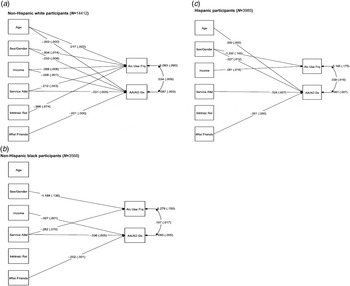
A full, saturated model (see Supplementary Fig. S1) was first estimated. This model included the religiosity items described above, as well as age, sex/gender, race/ethnicity, and household income, since alcohol use behavior differs by these variables in the NESARC (Hasin et al. Reference Hasin, Stinson, Ogburn and Grant2007; Reynolds et al. Reference Reynolds, Pietrzak, El-Gabalawy, Mackenzie and Sareen2015). Next, we systematically compared this model with a multiple group model, which allowed all model parameters to vary in each of the race/ethnic groups. We assessed how well this model fit the data using multiple fit indices including Akaike's Information Criterion (AIC; Akaike, Reference Akaike1976), the Tucker–Lewis index (TLI; Tucker & Lewis, Reference Tucker and Lewis1973), and the comparative fit index (CFI; Bentler, Reference Bentler1990) to assess the model's balance of explanatory power and parsimony. Standardized (STDY) estimates from the best-fitting models are provided in the Results and tables of this manuscript to aid in group comparison and interpretation of the data. Unstandardized parameter estimates from the full and best-fitting models are presented in Fig. 1 and Supplementary Fig. S1 (full model).
Unstandardized effects of religiosity items on past year alcohol consumption frequency and AUD presented seperately for (a) NH White, (b) NH Black, and (c) Hispanic drinkers produced by the best-fitting model (multiple group model) in Mplus.

Results
Religiosity
Results are detailed in Table 1 and Supplementary Fig. S1. Currently attending religious services (at a church, synagogue, mosque or other place of worship) was reported by 69.1% of NH Black participants, 55.5% of Hispanic participants and 51.1% of NH White participants. Frequency of religious service attendance, number of religious friends, and importance of religious and spiritual beliefs varied by race/ethnicity (Table 1, Supplementary Fig. S1). On average, NH Blacks attended services more frequently than NH Whites and Hispanics. NH White participants reported that they regularly socialize with ~7 members from their religious group, compared to ~6 for NH Blacks and ~5 for Hispanic participants. NH Black participants reported the highest level of intrinsic religiosity (that religious/spiritual beliefs were ‘very important’ to their daily activities), followed by Hispanic and NH White participants.
Endorsement of religiosity items by race/ethnicity (n = 21 965)

CI, Confidence interval.
All estimates are unstandardized, and adjusted age, sex, income, and for the complex survey design in Mplus.
Pairwise comparisons for service attendance and intrinsic religiosity are displayed in Supplementary Fig. S1.
Service attendance: How often do you attend religious services? Response options included: never (0), once a year (1), a few times a year (2), 1–3 times a month (3), once a week or more (4), and twice a week or more (5).
No. of religious friends: ‘How many member of your religious group do you see or talk to socially every two weeks?’ Response options ranged from 0 to 99 members of your religious group.
Intrinsic religiosity: ‘How important are religious or spiritual beliefs in your daily life?’ Response options included: not important at all (0), not very important (1), somewhat important (2), and very important (3).
SEM
The full model (see Supplementary Fig. S1) provided a good fit to the data (AIC, 49 642.17; BIC, 59 790.23; CFI, 0.999; TLI, 0.999) and had an R 2 = 0.085 (s.e. = 0.006, p < 0.001) for drinking frequency and 0.033 (s.e. = 0.004, p < 0.001) for AUD. The multiple group model, which estimates model parameters separately for NH Whites, NH Blacks, and Hispanics provided a slight improvement in fit over the full model (AIC, 57 201.83; BIC, 57 599.23; CFI, 1.0; TLI, 1.0). For NH Whites, this model and had an R 2 = 0.080 (s.e. = 0.007, p < 0.001) for drinking frequency and 0.040 (s.e. = 0.005, p < 0.001) for AUD. For NH Black participants, this model and had an R 2 = 0.073 (s.e. = 0.012, p < 0.001) for drinking frequency and 0.031 (s.e. = 0.006, p < 0.001) for AUD. For Hispanic participants, this model and had an R 2 = 0.107 (s.e. = 0.019, p < 0.001) for drinking frequency and 0.015 (s.e. = 0.005, p < 0.01) for AUD. Below we present results based on the best-fitting model (i.e. the multiple group model).
Drinking frequency
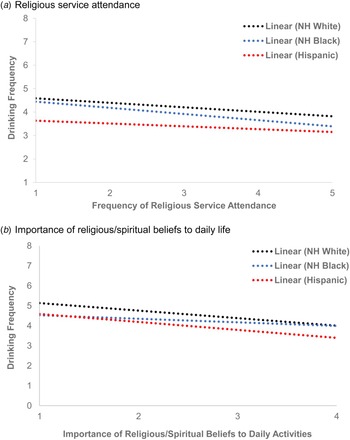
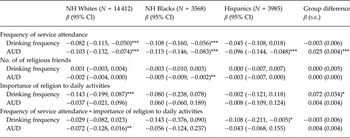
Standardized estimates for each race/ethnic group are detailed in Table 2 and unstandardized parameter estimates are presented in Supplementary Fig. S2. Among NH Whites and NH Blacks, participants who more frequency attended religious services reported less frequent alcohol use; among Hispanic participants, this was not observed. These effects were slightly more robust for NH Blacks than for NH Whites and Hispanics; however, this difference was not statistically significant (interaction; β: −0.003, p < 0.555) (Fig. 2a ). There were no significant differences in frequency of alcohol use as a function of religious social group size for any race/ethnic group. NH White participants to whom religious/spiritual beliefs were very important reported less frequent alcohol use. This was not observed for NH Blacks or Hispanics. These racial/ethnic group differences were statistically significant, albeit modest (interaction β: 0.072, p < 0.033).
The effects of religiosity items on past year alcohol use frequency and past year AUD that differ by race/ethnicity. (a) Religious service attendance. (b) Importance of religious/spiritual beliefs to daily life.

Standardized effects of religiosity items on past year alcohol consumption frequency and AUD by race/ethnicity (N = 21 965)

AUD, Alcohol use disorder; CI, Confidence interval.
This table displays standarized (STDY) β-coefficients from the best-fitting model, which includes: sex, age, household income, all of the above variables, and is adjusted for NESARC's complex survey design in Mplus.
Only individuals who have consumed alcohol in the past 12 months are included. Significant main effects of religiosity items on alcohol use behaviors are indicated by *** p < 0.001; **p < 0.01; *p < 0.05.
AUD
For all participants, only public religiosity was inversely related to AUD. Frequency of religious service attendance is inversely related to AUD. This association was more robust for NH Blacks compared to NH Whites and Hispanics (interaction; β: 0.025, p < 0.001). Among NH Blacks, participants with a larger religious social group had less risk for AUD. This was not observed for NH Whites or Hispanics. These racial/ethnic group differences were not statistically significant. There were no significant differences in AUD risk as a function of intrinsic religiosity for any race/ethnic group.
Post-hoc analyses
Among Hispanic participants only, the interaction between frequency of religious service attendance and intrinsic religiosity was significantly associated with frequency of alcohol consumption; however, effects were modest (β: −0.108, p < 0.05). Among NH White participants only, the interaction between frequency of religious service attendance and intrinsic religiosity was significantly associated with AUD (β: −0.072, p < 0.01). In both cases, among those who more frequently attended religious services, greater intrinsic religiosity was associated with less alcohol use (among Hispanics) and/or AUD (among NH Whites).
Discussion
This study examined if religiosity was associated with past year drinking frequency and DSM-IV AUD, and if associations differed in NH Blacks, Hispanics and NH Whites in the US population. We examined two aspects of religiosity, public religiosity and intrinsic religiosity, which have been previously associated with less drinking and fewer alcohol use problems in the United States, but to varying degrees in NH Blacks, Hispanics and NH Whites (Chatters et al. Reference Chatters, Taylor, Bullard and Jackson2008; Robinson et al. Reference Robinson, Bolton, Rasic and Sareen2012; Sternthal et al. Reference Sternthal, Williams, Musick and Buck2012). Results indicate that both public and intrinsic religiosity are related to frequency of alcohol use in NH Blacks, NH Whites, and Hispanics, although to varying degrees. Specifically, frequency of religious service attendance was associated with less frequent alcohol use (among NH Blacks and NH Whites, but not Hispanic participants) and less AUD among all race/ethnic groups. The association between religious service attendance frequency and AUD was more robust among NH Blacks. Further, among NH Black participants only, religious social group size was associated with less AUD risk. In contrast, intrinsic religiosity was associated with less frequent alcohol use among NH Whites only.
Most previous studies indicate that NH Blacks and Hispanics benefit more from religious involvement than NH Whites on risk for mental and physical health problems (Levin et al. Reference Levin, Markides and Ray1996; McCullough & Larson, Reference McCullough and Larson1999; Cook et al. Reference Cook, Pearson, Thompson, Black and Rabins2002; Miltiades & Pruchno, Reference Miltiades and Pruchno2002; Abraído-Lanza et al. Reference Abraído-Lanza, Vasquez and Echeverría2004; Nasim et al. Reference Nasim, Utsey, Corona and Belgrade2006; Chatters et al. Reference Chatters, Taylor, Bullard and Jackson2008; Taylor et al. Reference Taylor, Chatters, Bullard, Wallace and Jackson2009; Robinson et al. Reference Robinson, Bolton, Rasic and Sareen2012). However, the two most recent and nationally representative studies found that religious NH Blacks and Hispanics did not experience greater mental health benefits than their NH White counterparts (Robinson et al. Reference Robinson, Bolton, Rasic and Sareen2012; Sternthal et al. Reference Sternthal, Williams, Musick and Buck2012). In fact, one of these studies found that found that intrinsic religiosity was associated with worse mental health for Hispanics compared to NH Whites (Sternthal et al. Reference Sternthal, Williams, Musick and Buck2012). Franzini et al. (Reference Franzini, Ribble and Wingfield2005) also found that intrinsic religiosity was associated with worse mental health for Hispanics and NH Blacks (compared to NH Whites); however, public religiosity was associated with improved mental health for NH Blacks and Hispanics. Taken together, this suggests key differences in the influence of public v. intrinsic religiosity on mental health outcomes across racial/ethnic groups. The present findings that the association between public religiosity and alcohol use behavior is more robust for NH Blacks (although, not Hispanics), and that the association between intrinsic religiosity and drinking is more robust for NH Whites (and conversely, less robust for Hispanics and NH Blacks), map onto these previous findings.
In the United Sates, NH Whites, NH Blacks, and Hispanics vary with respect to attitudes and norms regarding drinking (Herd, Reference Herd1988; Herd & Grube, Reference Herd and Grube1993, Reference Herd and Grube1996; Caetano & Clark, Reference Caetano and Clark1999). Less accepting attitudes toward heavy alcohol use have been observed among NH Blacks (Caetano & Clark, Reference Caetano and Clark1999). Herd suggests that these patterns may reflect a legacy of the temperance movement and current involvement of many African-Americans with fundamentalist Protestant religions (Herd, Reference Herd1988). Lower rates of alcohol use have been observed among those who belong to religious denominations that teach abstinence (Amoateng & Bahr, Reference Amoateng and Bahr1986; Ford & Kadushin, Reference Ford and Kadushin2002). This has been interpreted within the framework of social regulation theory (Seybold & Hill, Reference Seybold and Hill2001); if an individual belongs to a denomination which discourages alcohol use (i.e. fundamental Protestants), attendance of religious services and events could promote conformity to norms against alcohol abuse, reduce time for engagement in alcohol use, and provide a source of stability and support in the individual's life (Ghandour et al. Reference Ghandour, Karam and Maalouf2009). In contrast, there is a more accepting alcohol culture among some Hispanic subgroups (SAMHSA, 2013; CDC, 2014). For example, among Mexican and Puerto-Rican Americans, cultural, family, and sometimes religious celebrations typically revolve around food and alcohol (Davila, Reference Davila, Davison and Yalin1987; Ríos-Bedoya & Freile-Salinas, Reference Ríos-Bedoya and Freile-Salinas2014). Moreover, Caetano & Clark (Reference Caetano and Clark1999) examined trends in situational norms and attitudes towards alcohol use between 1984 and 1995 among NH Whites, NH Blacks, and Hispanics in the United States. Each race/ethnic group had a distinct pattern of variation in norms and attitudes across the 11-year time span. Among Hispanics and NH Whites, there was some evidence of increased ‘liberalism’ (i.e. more permissive/accepting attitudes towards alcohol use) between 1984 and 1995, both for situational norms and attitudes. In contrast, among NH Blacks, the overall pattern of responses to the attitudinal items revealed increased ‘conservatism’ (i.e. less permissive/accepting attitudes towards alcohol use). The more robust associations between public religiosity and alcohol use behavior observed in this study for NH Black participants may be explained by the conservative attitudes regarding alcohol use among some NH Black communities in general, and within the context of the fundamentalist Protestant church. In the current study, we were unable to identify the participant's religious affiliation, and therefore were unable to explore religious affiliation and/or the degree to which one's particular religious affiliation has rules against alcohol consumption, as a potential mediator. However, this may help explain the current findings and should be explored in future studies. Future research should be aimed at understanding the overlapping and individual role of cultural and community alcohol use norms and attitudes and religiosity within different subpopulations of NH Blacks.
Among Hispanic participants, we find that despite relatively high levels of religiosity, religious social group size and importance of religion/spirituality had no association with drinking frequency or AUD risk. Frequency of religious service attendance was associated with lower risk of AUD, but not less frequent alcohol use. The majority of Hispanic Americans affiliate with Catholicism, a religious institution with relatively liberal rules regarding alcohol use (Bock et al. Reference Bock, Cochran and Beeghley1987; Cosper et al. Reference Cosper, Okraku and Neumann1987; Clark et al. Reference Clark, Beeghley and Cochran1990; Patock-Peckham et al. Reference Patock-Peckham, Hutchinson, Cheong and Nagoshi1998; Ghandour et al. Reference Ghandour, Karam and Maalouf2009). In the context of social regulation theory, it is possible that the less robust associations between religiosity and alcohol use behavior observed in this study for Hispanic participants may be explained by these participants' involvement in Catholicism. In addition, alcohol use norms are relatively liberal among some Hispanic subgroups (Caetano & Clark, Reference Caetano and Clark1999; SAMHSA, 2013; CDC, 2014); Mexican and Puerto-Rican teens typically have their first drink at a family or cultural activity with the consent of their parents (Perez, Reference Perez2000; Harwood et al. Reference Harwood, Bernat, Lenk, Vázquez and Wagenaar2004; Benjet et al. Reference Benjet, Borges, Méndez, Casanova and Medina-Mora2014), indicating the social/cultural sanctioning of alcohol use in two of the largest subgroups of Hispanic-Americans. The less robust (or null) associations between religiosity and alcohol use behavior observed in this study for Hispanic participants may be explained by the (relatively) permissive attitudes regarding alcohol use among some Hispanic cultures in general, and within the context of the Catholic church. Future research should be aimed at understanding the overlapping and individual role of cultural and community alcohol use norms and religiosity within different subpopulations of Hispanic-Americans.
While this study examines differences by race/ethnicity, an important implication of these findings is that public religiosity is associated with less risk for AUD in all NESARC participants, regardless of race/ethnicity. There are several ways in which public religiosity may increase resiliency and limit alcohol use problems (Dennis et al. Reference Dennis, Cox, Black and Muller2009; Foster et al. Reference Foster, Quist, Young, Bryan, Nguyen and Neighbors2013; Sukhwal & Suman, Reference Sukhwal and Suman2013). Public religiosity may increase an individual's access to a social support network with shared values, which has consistently been shown to protect against SUD (Moak & Agrawal, Reference Moak and Agrawal2010) and mental health problems (Koenig et al. Reference Koenig, Larson and Larson2001a , Reference Koenig, McCullough and Larson b ; Seybold & Hill, Reference Seybold and Hill2001). As mentioned above, public religiosity also provides a means of social regulation/control of deviant behaviors that may lead individuals to adopt healthy behaviors (Seybold & Hill, Reference Seybold and Hill2001; George et al. Reference George, Ellison and Larson2002) such as avoiding heavy alcohol use. Further, among Hispanic individuals who more frequently attend religious services, intrinsic religiosity and alcohol use frequency were inversely associated. Among NH White individuals who more frequently attend religious services, intrinsic religiosity and AUD were inversely associated. This indicates that intrinsic religiosity contributes additionally to the association between frequency of service attendance with lower drinking frequency (for Hispanics) and AUD risk (for NH Whites), over and above the public aspect of religiosity. Social regulation theory (Seybold & Hill, Reference Seybold and Hill2001; George et al. Reference George, Ellison and Larson2002) may explain this study's finding that public religiosity reduces risk for AUD, whereas intrinsic religiosity (on its own) does not.
Researchers have posited that intrinsic religiosity may give meaning to adverse life events that helps individuals cope with them (Koenig et al. Reference Koenig, Larson and Larson2001a , Reference Koenig, McCullough and Larson b ; George et al. Reference George, Ellison and Larson2002; Kidawi et al. 2014; Moreira-Almeida et al. Reference Moreira-Almeida, Koenig and Lucchetti2014). This study found that intrinsic religiosity is associated with less risk for AUD among NH Whites. Furthermore, among Hispanic individuals who more frequently attend religious services, intrinsic religiosity and alcohol use frequency were inversely associated. Among NH White individuals who more frequently attend religious services, intrinsic religiosity and AUD were inversely associated. Chawla et al. (Reference Chawla, Neighbors, Lewis, Lee and Larimer2007) argued that religious importance might be more representative of the internalization of values and norms of religious doctrine in a unique way not captured by public religiosity. Further, religious importance may be related to the internalization of pro-family norms that may help the individual cope with stressful situations in pro-social ways that do not involve substance use (Stolzenberg et al. Reference Stolzenberg, Blair-Loy and Waite1995).
Strengths and limitations
Some study limitations are noted. (1) The AUDADIS was administered by trained lay interviewers rather than clinicians which has the potential to decrease the validity and reliability of AUD measurement via false-negative diagnoses (Eaton et al. Reference Eaton, Neufeld, Chen and Cai2000). This concern is somewhat mitigated by recent studies that indicate these biases are unlikely to impact model estimates (Amstadter et al. Reference Amstadter, Richardson, Acierno, Kilpatrick, Gaboury, Tran and Thach2010), and by the AUDADIS's structured design (Hasin et al. Reference Hasin, Muthuen, Wisnicki and Grant1994, Reference Hasin, Van Rossem, McCloud and Endicott1997; Hasin & Paykin, Reference Hasin and Paykin1999). (2) This is a cross-sectional study, which limits inferences about temporal ordering of variables, a requirement for causal inferences. (3) There was a possibility for recall bias considering adults self-reported on past year alcohol use behaviors. (4) The rates reported for disorders in this study could be underestimated due to attrition. To account for the attrition between the wave 1 and wave 2 NESARC (13.3%), wave 2 data were adjusted for non-response associated with socio-demographic characteristics (Grant et al. Reference Grant, Goldstein, Chou, Huang, Stinson, Dawson, Saha, Smith, Pulay, Pickering, Ruan and Compton2009). (5) Race/ethnicity categories were broad and based on US census options. Given the goal of this study, analyses only included NH Black, Hispanic, and NH White participants. Further, this study examined all individuals who reported that they were of ‘Hispanic or Latino origin’ as one homogenous group. The annual incidence and risk for AUD varies greatly among Hispanic subgroups (Ríos-Bedoya & Freile-Salinas, Reference Ríos-Bedoya and Freile-Salinas2014). Future studies should examine subpopulations within race/ethnic groups, including those who identify with more than one group, as well as examine if findings from this study extend to other race and/or ethnic groups. Finally, several individual (e.g. genetic predispositions, religious affiliation), familial (e.g. parental psychopathology), and community-level (e.g. social norms regarding alcohol) influences were not incorporated in the study, which likely play a role in the complex relationships between religiosity, race/ethnicity, and alcohol use and problems in the United States. Future studies with longitudinal designs should be employed to identify underlying mechanisms, and to disentangle the complex relationships between protective aspects of religiosity and alcohol use behaviors across race/ethnic groups.
These limitations are counterbalanced by several important strengths. First, the NESARC is the largest psychiatric epidemiological survey of the US general population conducted to date, with measures of public and intrinsic religiosity that are frequently used in health research, and a wide range of alcohol use behaviors. Second, this study differentiated between public and intrinsic religiosity, and between drinking frequency and AUD risk, which in the context of substance use research, are often combined and examined together. Finally, this study serves as an important first step in understanding the complex influence of religiosity on alcohol use behavior and heterogeneity observed in racial/ethnic groups in the United States.
In summary, this study demonstrated an inverse relationship between AUD and religious service attendance for NH Black, Hispanic and NH White individuals in the US population. These results also suggest that the association between public religiosity and AUD is more robust among NH Blacks, and that the association between intrinsic religiosity and drinking frequency may be more robust for NH Whites. Finally, this research suggests potential benefits for substance use clinicians to appropriately incorporate suggestions regarding religiosity/spirituality into AUD treatments among individuals for whom aspects of religiosity provide important psychosocial support.
Supplementary material
For supplementary material accompanying this paper visit http://dx.doi.org/10.1017/S0033291716001975.
Acknowledgements
This research was funded by National Institutes of Health grants 1K01DA037914 (Meyers), U01AA018111 (Hasin), the New York State Psychiatric Institute (Hasin), and T32DA031099 (Brown, PI Hasin).