Introduction
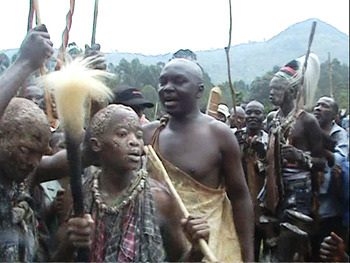
The Bagisu (also known as Bamasaaba) of eastern Uganda initiate adolescent boys into manhood through the imbalu ritual. While several commentators (including some Bagisu) have understood imbalu only in terms of pen-surgery (the removal of the foreskin from the boy’s penis) (Makwa Reference Makwa2010, Reference Makwa, Nannyonga-Tamusuza and Solomon2012), this ritual is highly integrated with music and dance. Imbalu is both ritual, music, and dance. When the Bagisu talk about khushina imbalu (dancing circumcision), they clearly imply that music and dance play a central role in articulating the meanings of this ritual. Undergoing a process that involves the creation, rehearsals, performance, music, and dance in imbalu are avenues for sharing indigenous knowledge about manhood, social histories, and other aspects of life in this community. Furthermore, despite the Bagisu boasting of numerous spaces where imbalu rituals are performed, the Namasho Cultural Site (hereafter known as NCS) is a place where the Bagisu of the Balutseshe clan take candidates to engage in activities involving the making, performance, and showcasing of imbalu music and dance. This paper underscores the interplay between music, dance, and ritual at NCS in tutoring the young generation among the Bagisu of the Balutseshe clan on social histories, gender ideologies, and rituals of the sacred swamp. I also investigate how Namasho acts as a ground for training candidates in creating music, singing, and dancing in order to ensure the successful performance of the imbalu ritual.
For over five decades now, scholars within and outside ethnomusicology have underscored the integration of music, dance, drama, and ritual, thus presenting a performance (especially in African contexts) as a consortium of arts––singing, drumming, dancing, dramatising, and poetry (Nketia Reference Nketia1974; Berliner Reference Berliner1978; Chernoff Reference Chernoff1979; Friedson Reference Friedson1996; Khamalwa Reference Khamalwa, Sylvia and Thomas2012; Ozah Reference Ozah2015; Agawu Reference Agawu2016). In his survey of the music traditions of Africa, J.H. Kwabena Nketia (Reference Nketia1974) emphasises that a musical performance in African settings is conceived as an occasion that brings together not only music, dance, drama, and poetry, but also all the activities that explicitly or implicitly influence its outcome. As he puts it, “The conception of a musical piece and the details of its form and content are influenced not only by its linguistic framework or literary intention, but also by the activities with which it is associated” (ibid.:206). Although the inseperable nature of music and other aspects of art is apparent in all social events, scholarly work on ritual notes that there is usually a thin layer between ritual and art. This view is shared by Marie Agatha Ozah in her study of the moninkim female initiation ritual among the Ejagham of South-eastern Nigeria and South-western Cameroon. Ozah presents moninkim performances as an “amalgamation of dance, instrumental, and song rhythms, which [form] a polyrhythmic texture” (Reference Ozah2015:441). And these elements re-inforce one another during the performance. As the case of moninkim shows, despite the “instrumental ensemble [giving] accompaniment for the dancing…moninkim’s dance steps often [accentuate] the rhythmic nuances of the song texts while [adding] new and varied rhythmic patterns [, all coalescing to form one and the same ritual moninkim]” (ibid.). What Ozah observes in relation to moninkim is what happens in the imbalu circumcision rituals among the Bagisu.
Related to discussions on the interconnectedness between music, dance, drama, and ritual is the notion that music is far more than just the sounds produced. As advanced by Christopher Small, music includes the processes of creation, rehearsals, performance, and consumption, interpretation, and re-interpretation. Discussing the concept of musicking, Small asserts that, “music is not a thing at all but an activity, something that people do” (Reference Small1998:2) and stresses that it accrues from collaborative activities and processes. In addition to composers, performers, and listeners, musical activities involve other people including those who carry instruments, prepare spaces where performances take place, and people who sell tickets. Small argues that “composing, practicing and rehearsing, performing, and listening are not separate processes but are all aspects of the one great human activity that is called musicking” (ibid.:10).Footnote 1 More so, the musicking process involves listening and reflecting on the musical activity afterwards. This viewpoint is shared by Steven Feld who argues that creation of meaning from a musical event is a continuous process involving people at different stages of music creation, performance, and consumption (Feld Reference Feld, Keil and Feld1994:78).
Influenced by ideas on the close association of music, dance, drama and other arts, I present imbalu as an assemblage of music, dance, and ritual. As Wotsuna Khamalwa has also pointed out, there is “often no clear dividing line between imbalu as ritual and imbalu as performance” (Reference Khamalwa, Sylvia and Thomas2012:64). Music and dance interact to give meaning to imbalu. Furthermore, I adopt Small’s (Reference Small1998) ideas to articulate the process imbalu undergoes and the role of different actors in enhancing the meanings of this ritual. Needless to mention, along the imbalu ritual continuum are candidates, musicians, parents, the candidate’s brothers, sisters, aunts, and the entire community, all interacting to concretise the meanings of this ritual. As such, although the success of imbalu rituals depends on the nature of music and dance integrated in them (Makwa Reference Makwa2010), it also depends on the effort and cooperation of the different actors. From the Ugandan scene, other scholars have engaged in discussions on the close relationship between music, dance, and other aspects of culture. Sylvia Nannyonga-Tamusuza (Reference Nannyonga-Tamusuza2005, Reference Nannyonga-Tamusuza2015) shows how baakisimba music and dance co-create each other to define gender roles, identities, and relations among the Baganda (Central Uganda). Similarly, Damascus Kafumbe (Reference Kafumbe2018) presents kawuugulu as a drum, song, and dance ensemble that plays a significant role in managing, structuring, modelling, and legitimising power relations in the kingdom of Buganda. I add my voice to these works by presenting occasions that involve the creation, performance, and showcasing of imbalu musics and dances as sites for the transmission of valuable knowledge about society.
My ideas on this knowledge are informed by Michael Omolewa’s (Reference Omolewa2007) insights on indigenous education. Omolewa observes that indigenous education is a form of instruction “usually generated within the communities […and] is based on practical common sense, on teachings and experience and…is holistic [in nature]” (ibid.:596). He informs us that instruction in such contexts is embedded in language, proverbs, myths, stories, as well as music and dance. Making reference to the Chagga of Tanzania, Ladislaus Semali and Amy Stambach (Reference Semali and Stambach1997) also assert that besides being informal in nature, the extended family structure plays a crucial role in fostering African indigenous education.Footnote 2 In addition to underscoring these viewpoints, I also demonstrate that indigenous education is context-based. By instructing the young generation on specific aspects of culture, people concentrate on issues that address the immediate needs of their setting. Apart from imbalu forming a gateway for Bagisu boys to attain the prescribed manhood, each of the clans in Bugisu (the area where the Bagisu live) uses the integrated musics and dances as events to talk about heroes in their areas of jurisdiction and recount histories associated with such places. They also use these occasions as moments to articulate gender roles, identities, and relations in society.
Data for this paper is part of my research on imbalu spanning a period of over ten years in Bududa, Mbale, Sironko, Bulambuli, and Namisindwa Districts. Apart from participating in imbalu rituals as a Mugisu (singular for Bagisu) and sharing my insider perspectives, as Spradley (Reference Spradley1979:21), Agawu (Reference Agawu2003:201), and Ssempijja (Reference Ssempijja2012:218) have observed, I have also conducted in-depth interviews with elders, musicians, and other community members to gather data. As a means of providing the context of this paper, the following section is a discussion on imbalu musicking and dancing.
Imbalu Rituals as Musicking and Dancing
Imbalu is a ritual the Bagisu perform in even-numbered years to initiate boys aged between sixteen and twenty-two years into manhood (Heald Reference Heald1999; Khamalwa Reference Khamalwa2018). Besides being a gateway for the circumcised to become independent members of society (Makwa Reference Makwa2010, Reference Makwa, Nannyonga-Tamusuza and Solomon2012), imbalu forms a platform for articulating the relationship between men, women, and children in this community (Khanakwa Reference Khanakwa, Fleisch and Stephens2016:115). Imbalu is an aggregate of activities which are occasions for the creation, performance, and transmission of music and dance. And the different stages it undergoes can fit into Arnold van Gennep’s (Reference van Gennep1960) scheme of separation, liminality, and social re-integration that he uses to describe the process through which rites of passage undergo. Discussing the stages under which ritual subjects pass, van Gennep argues that one is first separated by the community before being initiated, secluded, and finally re-integrated into society. Victor Turner (Reference Turner1969) builds on van Gennep’s ideas and provides details about the liminal stage of rites of passage. Like van Gennep, Turner postulates that people intending to engage in rites of passage are first separated from the wider community before they are initiated. Afterwards, they are secluded and made to undergo a process of transformation through rituals of seclusion. Rites like imbalu bring several initiates under one roof to undergo healing, and this creates an association that Turner refers to as communitas. Upon completion of the seclusion process, initiates are reintegrated into society to embark on the new roles expected of them as men or women. As such, by highlighting the process of imbalu, this section discusses the nature of musicking and dancing in imbalu rituals and how they transform the boy right from the time he separates himself as a candidate, through the time of circumcision and healing the penis wound, and until he is re-integrated into the community.
As Suzette Heald (Reference Heald1999:15) has observed, imbalu activities are ushered in with the blowing of horns by prospective candidates, either in the month of December the year before or in January during the circumcision year. This activity enables boys to announce the impending imbalu ceremonies and declare their intentions for transitioning into manhood to their fathers and elders of the clan (Makwa Reference Makwa2010:85). If one gets the consent of the aforementioned, he is given dancing regalia to perform isonja dance,Footnote 3 geared towards imparting dancing and song composition skills into the boy. However, this training dance is not compulsory; participation is influenced by two questions, namely: (1) has the candidate acquired the necessary dancing regalia? and (2) have prospective candidates from a particular locality hired namyenya Footnote 4 to train them? Heald observes that when boys do not engage in isonja performances, they dance “along the paths and through the compounds of their neighbourhoods” (Reference Heald1999:16) to announce their readiness for manhood to the public.
Between April and July, the boy visits distant relatives from whom he acquires items like money and chickens (which help the family in organising imbalu ceremonies). These visits also enable the boy to receive formal blessings to undergo the ritual successfully. The Bagisu regard these activities as khuwentza imbalu (searching for circumcision/manhood). As the boy visits relatives, he sings songs confirming his readiness for manhood, also recounting genealogies of his clan. Songs sung during this period also become conduits for the boy to enumerate heroes of the clan––including blacksmiths, rain-makers, great farmers, and warriors.
Most imbalu ceremonies take place in August. Three days before pen-surgery, the boy brews beer, is smeared with yeast, and taken to a central place to meet his peers from related lineages. On circumcision day, he visits ibukhotsa (mother’s clan) and itoosi (the sacred swamp). Music and dance are part and parcel of these events. As he engages in khukoya (brewing) and khuakha (smearing) rituals, he sings songs to reassure the community that he is ready for manhood. On his way for pen-surgery, music and dancing project the boy’s determination for the knife. The song imbalu muliro (Makwa Reference Makwa2010:122) is one of the common songs performed at this time and is used to warn the boy about the “hotness” of the knife—“imbalu” means fire. At the moment of operation, music and dance are performed by other people attending this ritual. They hit metal gongs (biite) as the circumciser cuts the foreskin from the boy’s penis besides making what Khamalwa calls “an endless din of ‘silililililili, silililililili, silililililili’ to imitate the noise made by the knife as it grates through fresh hide” (Reference Khamalwa2018:99) during this ritual.
The activities of brewing beer, smearing, and visiting the maternal clan and sacred swamp are a build-up to pen-surgery (Makwa Reference Makwa2010:96). They constitute the separation phase along the imbalu ritual trajectory. There are also the rituals of khucheenda tsinzila (walking the paths) and mukombe (seclusion) that come after the operation, which add up to constitute the liminal stage of imbalu. Happening three days after pen-surgery, khucheenda tsinzila is a ceremony where an elder takes the initiate around the village to re-orient him into day to-day life. I was informed that at this stage, the initiate is shown the paths he should use, as well as those he needs to avoid, whenever he may go out of the seclusion room. During these excursions, the initiates sing songs that depict them as brave people who faced the knife. Through song, they also ridicule those who either did not get circumcised or cried during the operation. After this ritual, boys are taken back to their seclusion rooms (some may stay there as individuals while others may live as a group) to continue the healing process. Seclusion takes boys in the interdeterminate state where they are neither where they had been nor where they want to be, since they now have wounds on their penises which they treat following strict procedures.
Khukhuyalula (hatching) and inemba ritual dance are the last ceremonies in the imbalu ritual cycle and are intended to reintegrate the initiates into society as men. On the eve of inemba, they undergo a hatching ritual which forms an occasion for these young men to burn dry banana leaves (kamasanza), the items they slept on during seclusion. Burning these leaves symbolises complete detachment from boyhood and hatching into adulthood as men (Makwa Reference Makwa, Nannyonga-Tamusuza and Solomon2012:87). The music created and performed during this ceremony is similar to that witnessed during khucheenda tsinzila as it is meant to project these young men as victorious people. In the following section, I discuss the music and dance events at NCS to offer a contextual background to discussions on indigenous education enacted at this site through imbalu musicking and dancing.
Musicking and Dancing Imbalu at Namasho
Going to Namasho is going to engage in several rituals and be part of all sorts of musics and dances performed by Balutseshe. At this place, you also see them smear candidates with clay from the scared swamp. If you do not want to join in whatever they do, do not waste your time going there. (Paul Wangokho, interview, 22 August 2012, at his home in Shiluku Village, Bulucheke Sub-County)
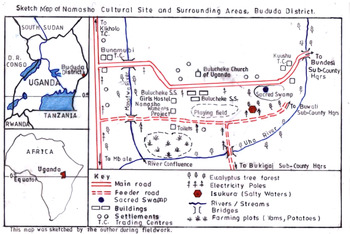
Namasho is a cultural site found in Bududa District. It is where the Bagisu, tracing their ancestry from a man called Lutseshe, stage specific activities related to imbalu rituals (Makwa Reference Makwa2017:63). This cultural site is located in Bulucheke Sub-County, about forty-five kilometres from Mbale Town. It stretches from the playground of Bulucheke Secondary School and includes isukura (salty waters where community members take cattle for drinking), and extends as far as the confluence of Manafwa and Uha rivers to the south (ibid.:61). Part of this site is a thicket which is never cut and it is in this overgrown section of Namasho that the sacred swamp, where imbalu candidates are smeared with clay on the day of circumcision, is found. Despite other activities like bull wrestling taking place at Namasho, the place mainly stands out as an imbalu ritual performance venue for the Bagisu of the Balutseshe clan. Figure 1 below is a sketch map of Namasho Cultural Site, also including the activities that take place there.
Map of Namasho Cultural Site (created by author).

The Balutseshe take imbalu candidates to this place on two occasions: the day of brewing beer and when the boy is returning from the maternal clan on the day of circumcision. While on the day of circumcision the boy is taken straight to the sacred swamp to be smeared with clay, going to Namasho on the day of brewing is meant to allow candidates, their sisters, brothers, aunts, uncles, friends, and well-wishers to compose, sing, dance, and showcase musics and dances associated with imbalu. Following Small’s (Reference Small1998) concept of musicking, these relatives and friends interact to give meanings to the musical event at this site. They respond to the songs sung by the candidate and surround him, thus establishing a security wall around him.
What Heald encapsulates below can be adopted to describe the scenes witnessed at NCS:
Circumcision [imbalu at Namasho] involves everybody and the atmosphere is charged with excitement. The boy himself dances more or less non-stop…. Emotions are running extremely high and circumcision dancing parties give way to no-one, with unwary passers-by risking getting a lash from the sticks they carry. For the boy, normal rules of conduct can appear suspended; his absorption in the dancing and thus in imbalu should be so total that the normal courtesies of everyday life are irrelevant. (Reference Heald1999:17)
Considering this atmosphere, what is the nature of musics and dances created, circulated, and showcased at Namasho? First, there is khukhubulula, the candidate’s singing of songs that praise himself, the family, and the clan he hails from. These are songs composed at the beginning of the year during the performance of isonja and at the time the boy visits his relatives. However, some of the texts to these songs are created at Namasho. Usually beating the two sticks which he carries along, the boy leads the song while community members following him respond. The response by the followers is to reaffirm what the candidate says through song––reaffirming his lineage to the public to confirm that he actually belongs there. It could be a lineage of blacksmiths, warriors, great farmers or rain-makers. Whenever he forgets some of these people, the followers usually remind him to articulate them. Some boys use these songs to praise their girlfriends since marriage is the stage that proceeds circumcision in traditional Kigisu society.
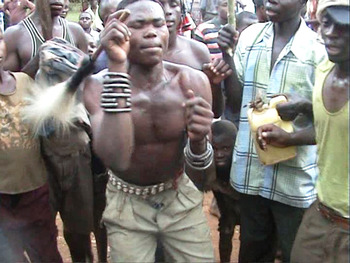
As seen in Figure 2, some candidates wear birere (metallic bungles) on their wrists. These metals are hit against one another, to the rhythm of the song one performs. Occasionally, candidates stop and make two or three leaps in the air. This sporadic dancing is intended to emphasise the message articulated through song, as well as to portray the boy as a strong and able person ready to confront the challenges of manhood (Makwa Reference Makwa, Nannyonga-Tamusuza and Solomon2012:71). Some candidates punctuate their singing with playing tsimbebe and tsingombi (short and long horns). Horns usually come in when the candidate has sung for a long time and needs to vary his music. There are scenarios when the horn may be played by someone from the group escorting the boy.
An Imbalu Candidate Performing Music at NCS. Photo by author in August 2010.

Bibiwoyo are the other songs constituting the imbalu musical events at NCS. Timothy Wangusa (Reference Wangusa1989) notes that bibiwoyo are coaxing songs sung to project an imbalu candidate as an important person. Usually led by a circumcised man, bibiwoyo are structured in a question-and-answer form. In spite of also being sung during the stages of khuwenza imbalu (searching for circumcision/manhood), khukoya (brewing beer), and khuakha (smearing rituals), these songs are usually sung when the boy is being taken for pen-surgery. In performing these songs, the song leader presents the boy as a person of higher status through the use of titles like umukoosi (the one who is respected), umusani (a man) or umwami (chief). My research revealed that by using these titles, the Bagisu explicitly present imbalu as a conduit through which the boy acquires a higher status in society.
In addition to khukhubulula and bibiwoyo, kadodi (which is both a music and dance genre) forms part of the musics and dances staged at NCS. Originating from north Bugisu (Sironko and Bulambuli Districts) in 1968 (Makwa Reference Makwa2005), kadodi is composed of a set of between four and five drums: ingoma ngali (the big drum), iye kamakhono (the one played with bare hands), simita (the one that gives the basic beat), indonyi (the one that outlines the basic melody), and simita umufiti (khalangilisa), the smallest drum. Kadodi is performed to entertain imbalu parties as they visit the boy’s relatives, friends or cultural sites. The throbbing beats played on these drums make it easy for people to walk long distances, as they dance and sing, without getting tired. At Namasho, different kadodi bands add to the musical soundscapes of this cultural site.
Finally, at Namasho, some people play pre-recorded music, which is either popular music recorded in studio or imbalu songs recorded in previous years. While this music is played at NCS for entertainment purposes, I was told that previously recorded imbalu songs are meant to remind circumcised men about the commitment for manhood they made during their circumcision. It is important to note that boys undergoing circumcision sing about the role of men, including the defence of one’s family and community. They also sing about sisters, aunties, mothers, and other female relations to articulate the obligation to foster a harmonious relationship between men and women in society.
Performances staged at NCS are not only the musics and dances created while in this area. They also culminate from musics and dances created and rehearsed during earlier stages of imbalu. The retired song expert, Paul Wangokho, informed me that isonja is usually one of the items taken to Namasho with the aim of displaying the skills boys learnt at the beginning of the imbalu year to people who congregate at this cultural site. He also noted that the presence of several banamyenya (singular for namyenya) from different clans translates this site into a centre for showcasing skills in performing this dance. While at Namasho, song leaders implicitly advertise themselves to future imbalu candidates. Moreover, community members keep reflecting on what happened at NCS even after circumcision. They take stock of what went well and those events that went wrong, thereby instituting strategies to maintain the good things and establish ways of mitigating those which did not go well. This view re-echoes Nicholas Ssempijja’s ideas on generation of meaning through musical performances when he argues that meaning is not only located at the stage of performance; one can trace it before and after, during the preparatory and off-stage phases of music (Reference Ssempijja and Solomon2015:106). As already noted, musicking and dancing imbalu at NCS are sites where boys are tutored about their community. This instruction is what I discuss in the sections which follow.
Instruction on Social Histories
The Bagisu who congregate at NCS during imbalu rituals trace their ancestry to Lutseshe. Despite many existing accounts, my study has established that Lutseshe produced four sons: Mwakiyu,Footnote 5 Mayoka, Masata, and Shiyi (Makwa Reference Makwa2016, Reference Makwa2017). With each of these sons having their own children, four lineages emerged––Bawakiyu, Bamayoka, Bamasata, and Bashiyi. Going to Namasho for imbalu rituals follows a pattern where the Bawakiyu are expected to arrive at this place first, closely followed by Bamayoka, Bamasata and Bashiyi respectively. Other inhabitants of Bulucheke (the place where the Balutseshe live) are Bamwalukani, who are regarded as bamuli/babetzwa (people who came from “elsewhere” and merely settled in this area) (Abiasa Zeruya Wazemba during an interview, Reference Wazemba2013). During the processions to NCS, the Bamwalukani come last.Footnote 6 In situations where an unauthorised group comes first, it is asked by those whose position was taken to provide a ram to make purification rituals––slaughtering the ram and cooking its meat with herbs to “cleanse the already defiled place” (Abasa Mutinye, interview, 24 August Reference Mutinye2010, at NCS).
As they engage in imbalu activities at Namasho, candidates are explicitly instructed by clan elders about these processions. They are constantly reminded whether Bawakiyu have gone forward or not. If they have not, the boys from other clans are made to stand several metres and wait. In this process, they are reminded that this is the arrangement they should always follow in future whenever they bring their children to this place for imbalu performances. As such, through these musical and dance processions, young people are educated about the relationship between the different sub-clans of Balutseshe and their obligation to pay allegiance to Lutseshe, their ancestor. As Mutinye puts it,
Imbalu is not merely about removing the boy’s foreskin from the penis. The community uses it to impart certain knowledge into those being initiated. For example, when we bring candidates here [at Namasho] we want them to understand the different families of Lutseshe. Who were his children? Who was the oldest and youngest? When we come, which people are supposed to lead the way and which ones should follow? We expose them to all these such that when they take charge [in future], they do not get lost. (interview, 24 August Reference Mutinye2010)
As such, the issue of exposing the young people to the lineage matrices of Balutseshe is core to society. As future custodians of the imbalu ritual, society expects these boys to understand the different hierarchies existing among various sub-clans and accord them the necessary respect. In an earlier study, I emphasised how NCS acts as a living archive for this community, where power structures “embedded in society are exposed through affirming certain lineages as more powerful than others” (Makwa Reference Makwa2017:65). By following specific procedures to access this place as they engage in music and dance activities, society exposes the young generation to the different hierarchies prevalent in this community. The occasion of accompanying other candidates to NCS becomes a moment to test whether someone learnt the pattern of approaching this place or not. In cases where one goes to a “wrong” direction, elders scold him for failing to adhere to the protocols imparted into him during the period of engaging in musicking and dancing his imbalu. By rebuking young men during these subsequent imbalu performances, society implicitly continues instructing them about its worldviews.
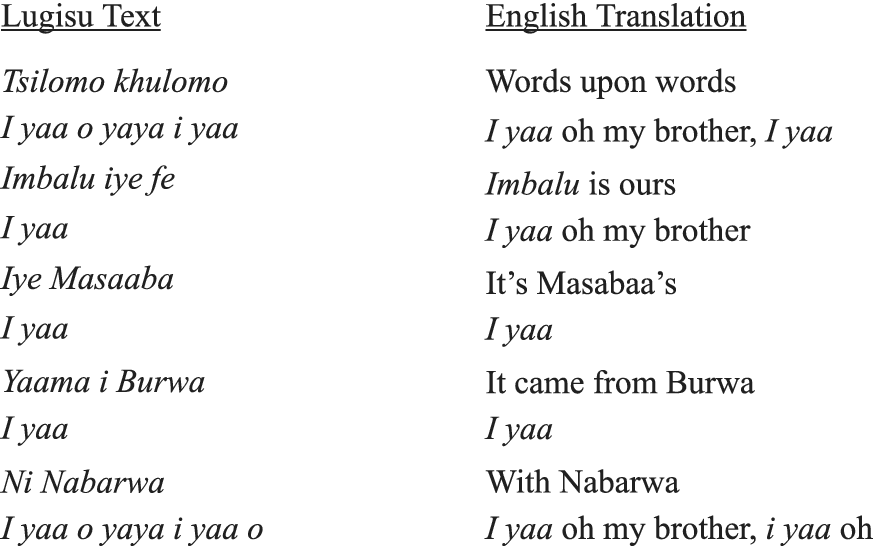
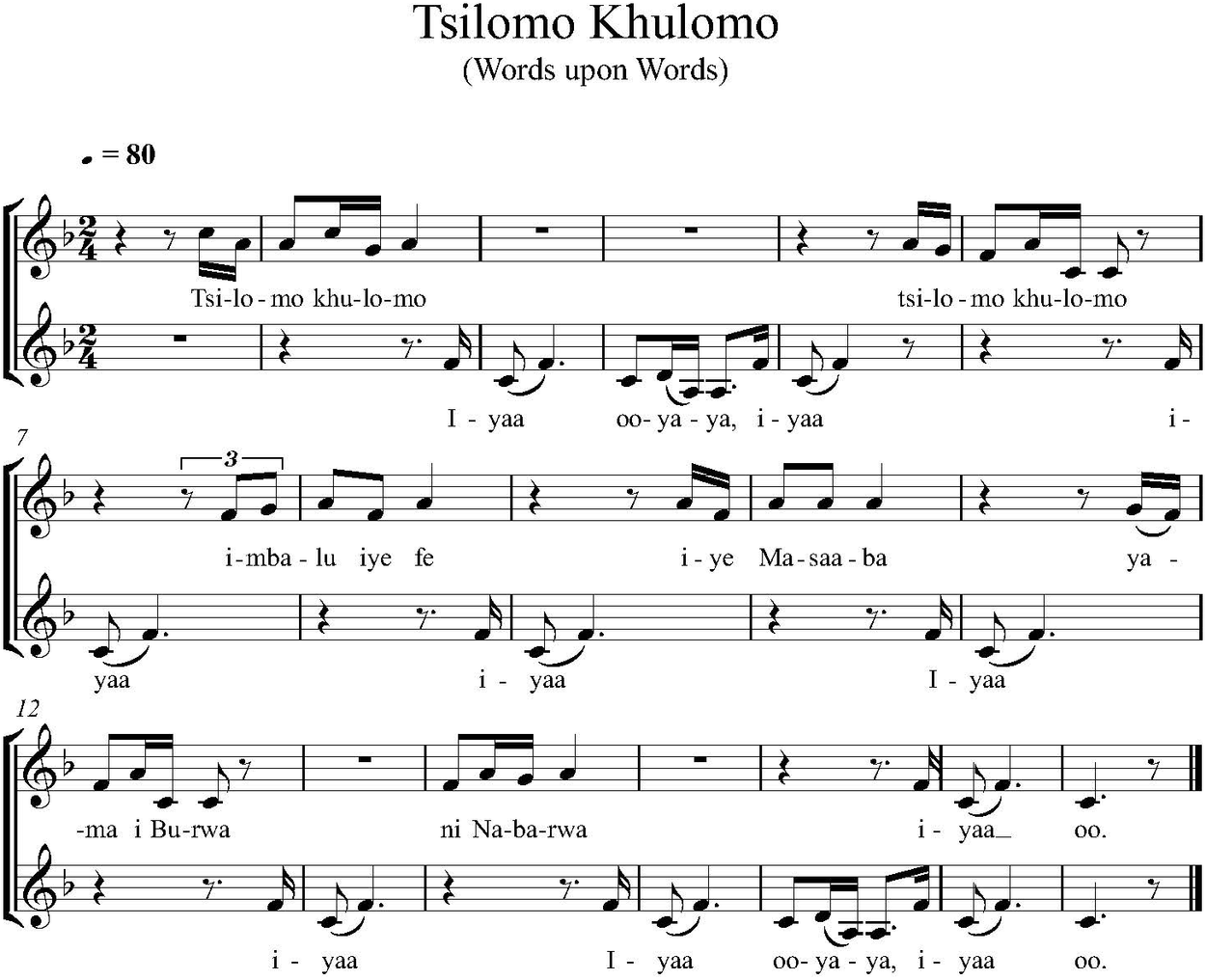
Musicking and dancing imbalu at NCS are also scripts through which the community reads the history of the Bagisu, imbalu rituals, and Lutseshe. To illuminate this, I analyse the song “Tsilomo Khulomo” (Words upon Words) whose Lugisu text is juxtaposed with the literal English translation below. The texual illustration is followed by its graphical transcription (Figure 3a and Figure 3b). I recorded this song at Namasho on 24 August 2010.
Song text of “Tsilomo Khulomo”; transcribed by author.

Transcription of the song “Tsilomo Khulomo” (Words upon Words);Footnote 7 transcribed by author.

The text of this song recounts the history of imbalu, which is implicitly the history of the Bagisu. Despite numerous mythical narratives existing among the Bagisu to explain the origin of imbalu, what can be regarded as the Nabarwa and Masaaba story is the common narrative explaining its origin. As pointed out by Khamalwa (Reference Khamalwa2018) and described in three of my earlier works (Makwa Reference Makwa2005, Reference Makwa2010, Reference Makwa2016), Nabarwa (who belonged to the Barwa clan of the Kalenjins of Kenya) fell in love with Masaaba, the ancestor of the Bagisu. However, since it was an abomination for her, as someone who had been circumcised (because she came from a circumcising community), to marry an uncircumcised man, she convinced Masaaba to get circumcised before they could marry. Masaaba obliged and the two got married. As such, whenever the Bagisu evoke the phrases “imbalu iye fe” (imbalu is ours) “iye Masaaba” (it belongs to Masaaba), “yaama iBurwa” (it came from Burwa) and “ni Nabarwa” (with Nabarwa) through song, they explicitly refer to the above history. By performing this song, the Bagisu reaffirm their allegiance not only to imbalu, but also to Masaaba. More so, when the Balutseshe clan take boys to Namasho, the purpose is to create and perform songs with the intention of teaching them the history of imbalu and society as a whole.
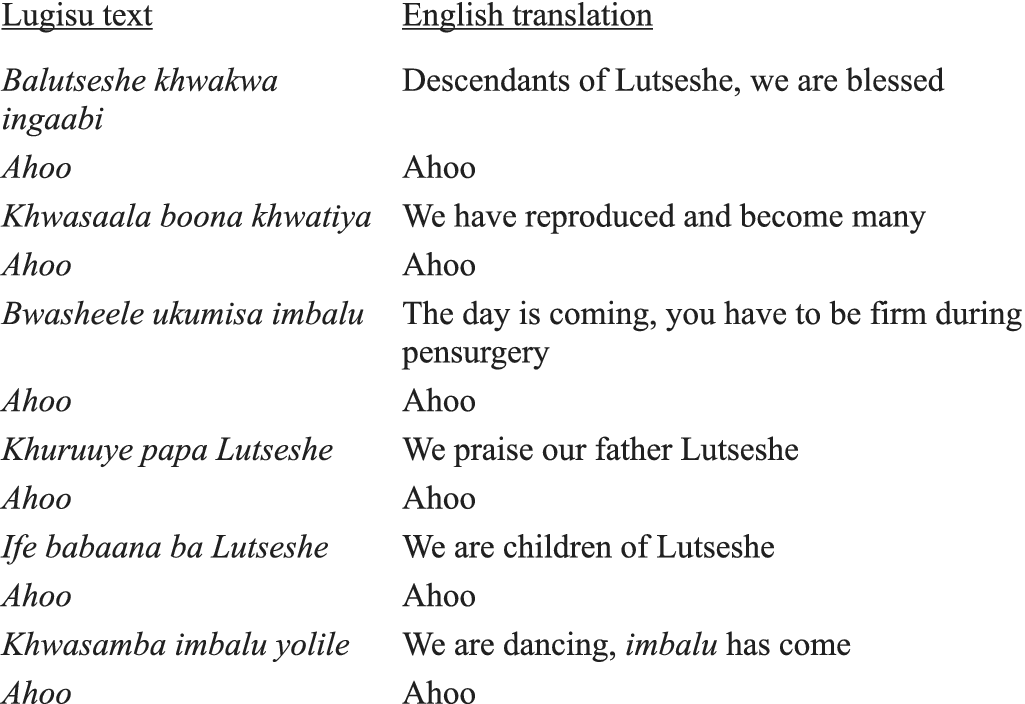
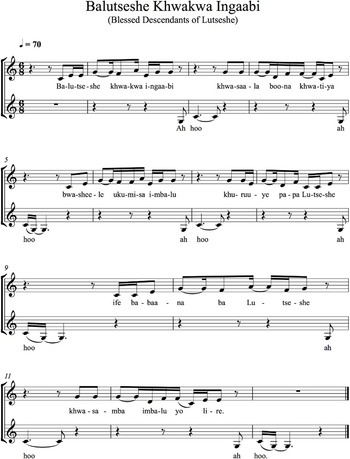
There is also the history of Lutseshe being recounted through songs created, performed, and showcased at NCS. The song “Balutseshe Khwakwa Ingaabi” (Descendants of Lutseshe, We Are Blessed) whose text in Lugisu is juxtaposed with its literal English translation, is normally performed at NCS with the aim of extoling Lutseshe (see Figure 4a and Figure 4b for the graphical representation of this song in staff notation).
Song text of “Balutseshe Khwakwa Ingaabi”; transcribed by author.

“Balutseshe Khwakwa Ingaabi” (Descendants of Lutseshe, We are Blessed); transcribed by author.

This song is about Lutseshe, the ancestor of the Balutseshe clan. Apart from affirming that people who congregate at this cultural site are children of Lutseshe, it articulates the reason why some people have children while others do not have —it is only those with blessings who produce, not everybody. Several informants affirmed that encouraging imbalu candidates to sing this song participates in giving the Balutseshe an opportunity to “thank” their ancestor for blessing them with children. The community also uses the song to implore those preparing for circumcision to be firm in order to uphold the name of this ancestor. As imbalu is geared towards elevating the status of the boy into manhood, the following section is a discussion on how musicking and dancing this ritual at NCS enhances instruction about the Bagisu gender ideology.
Instruction on Bagisu Gender Ideology
The music and dance activities at NCS also act as conduits for articulating gender roles, identities, and relations among the Bagisu. Writing about the concept of “doing gender,” Candace West and Don H. Zimmerman (Reference West and Zimmerman1987) note that we should move from an understanding that gender is merely an achieved status in society to critically considering the various social processes through which gender is produced, reproduced, and contested. As they write, the “doing of gender is undertaken by women and men whose competence as members of society is hostage to its production. Doing gender involves a complex of socially guided perceptual, interactional, and micropolitical activities that cast particular pursuits as expressions of masculine and feminine” (ibid.:126).
Besides defining gender, West and Zimmerman also articulate the various roles societies ascribe to men and women in order to be qualified to occupy their status. Indeed, as Sylvia Tamale (Reference Tamale2005) has observed, most traditional societies expect men to perform roles that are in the public sphere––hunting, fishing, officiating during ritual performances, and engaging in politics. On the contrary, women are expected to occupy the private sphere associated with the domestic roles that come with it: cooking as well as caring for children and their husbands. That gender roles in traditional African societies were meant to underscore the complementary co-existence of men and women is a view advanced by Tamale (ibid.:11; Reference Tamale and Tamale2012). Despite the Bagisu also underscoring this idea, gender roles, identities, and relations are meant to reinforce patriarchy, a social system that elevates the status of men and pushes women to the periphery.
As Nannyonga-Tamusuza (Reference Nannyonga-Tamusuza2005) writes in relation to the construction of gender outside the palace among the Baganda in Central Uganda, the process of gendering among the Bagisu begins at birth and goes on through puberty and adulthood until the person dies. Imbalu circumcision rituals form one of the sites during which gender roles, identities, and relations among the Bagisu are produced, re-affirmed, and concretised (Makwa Reference Makwa2010:64, 76). Moreover, this process is never complete: men and women’s positions in society are constantly negotiated and contested from time to time. As someone can be classified under a particular gender category, s/he can lose it, only to be regained if the person fulfils the roles and identities associated with that gender.
In the Kigisu traditional society, male and female sexes attained at birth are the “raw materials” upon which the man and woman genders are constructed.Footnote 8 When a male child is born, society regards it as lusoola (a tree species known for its hard wood––used not only for the construction of houses, but also during the performance of several rituals). He is socialised to become a hardened man who should stand firmly to defend himself, the family, and community as a whole. Although the mother takes care of both male and female children, male children are gradually detached from their mothers when they are about ten years old. This separation is meant to expose them to roles including herding cattle, as well as cutting trees to build houses, tasks the community expects them to execute when they become men after circumcision. This view is also shared by Sherry B. Ortner who contends that “mothers and their children, according to cultural reasoning, belong together. [However,] boys must be purged of the defilement accrued from being around mother and other women so much of the time [at a later age]” (Reference Ortner1996:31–32). I have witnessed scenarios when Bagisu men “remind” their sons of the necessity to vacate “women’s space” (as the kitchen is usually called) when they reach about ten years if they must become men. Moreover, as Khamalwa (Reference Khamalwa2018:76) has observed, traditionally when the boy fails to demonstrate that he is ready to become a man at the stage of performing isonja dance, he is told by elders to return to the mother––to continue growing as he waits for the next circumcision year.Footnote 9 And to continue growing symbolises returning to the mother and help her with the household chores.
Men who stand firmly during circumcision, get married, produce children, and fulfil other family obligations are regarded as basani burwa (singular, umusani burwa) or basani babeene (singular, umusani umweene), expressions used to denote “real men” (Makwa Reference Makwa2010:71). On the contrary, males who show cowardice during circumcision, fail to get married, or get married but are not able to sustain their families, or cannot provide leadership to their families, are looked at as basani mateleesi (singular umusani mateleesi), where Mateleesi is likened to the “soil from a destroyed house that cannot be used on another house” (ibid.:72). In this way, “if a circumcised person is not married, has no children and sells off his property, he is as useless as soil which cannot make a house” (ibid.). Despite communal life taking precedence over individual life (Khamalwa Reference Khamalwa, Sylvia and Thomas2012:66), the way a man manages his family is used as a yardstick to determine whether he can manage the community or not. How assertive or strong is he at family level? Does he provide enough food and other resources to his wife, children and people at his care? In fact, he who fails to “properly” manage his family can never be entrusted with leadership at community level.
As the case of gendering men has demonstrated, the process of constructing the woman gender begins when a female child is born and goes on through puberty and marriage, and until the person dies. The Bagisu regard girls as kamasopo (singular, lisopo), a weak shrub used for cooking. Girls are also likened to maswa kanjelekha (singular, liswa lyanjelekha) denoting “lands” or the “land across.” Maswa kanjelekha implies that women do not have a permanent space in their fathers’ households but at the place of their future husbands. As such, when a baby girl is born, she is socialised into a “responsible” wife who would care for her children and husband. To be able to execute her duties well, society expects her to be submissive and meek. She should speak politely, eat gently and respond to the male folk with respect. A girl who gets married and fails in her traditionally prescribed roles puts the mother and other female relatives in disrepute. They may not be given the prestigious iyebwana, which is a cow that the girl’s husband pays to her female relatives for training her on women’s roles, as well as ensuring that she does not lose her virginity before marriage.Footnote 10 A woman who fails in her marriage and returns to construct her own house in the father’s courtyard is referred to as nashombekheti (the one who built her own house).Footnote 11 In fact, such a woman ceases to be a “normal” woman since she can also marry men from this house and the relatives of such men have the “right” to ask for dowry (bride pride) from this woman.
These gender conceptualisations re-echo notions of femininity and masculinity as used by Walser (Reference Walser1993) and Khanakwa (Reference Khanakwa, Fleisch and Stephens2016) to present assertiveness, being strong, tough, independent and objective as some of the attributes this community uses to define the identity of a man. On the other hand, among the Bagisu, women are considered as weak, emotional, submissive, and subjective beings. Furthermore, they show that as men and women perform their duties, the Bagisu expect them to relate to each other in certain ways. How does a woman talk to a man, particularly her husband? What distance does she observe while interacting with the in-laws? Moreover, how do men and women complement each other as they perform their roles in society? (Tamale Reference Tamale1999:4–8). As such, what I regard as the Bagisu gender ideology are not only the roles and attributes people need to possess in order to qualify to be called men or women, it also encapsulates ways men and women relate with one another as they dispense their social roles. As imbalu parties engage in creating, performing, and transmitting music and dance at NCS, they articulate these gender ideologies. Through khukhubulula, bibiwoyo, isonja, and kadodi dances, as well as the rituals at the sacred swamp, they articulate the roles of men and women, their identities, and how these gender categories should relate with one another.
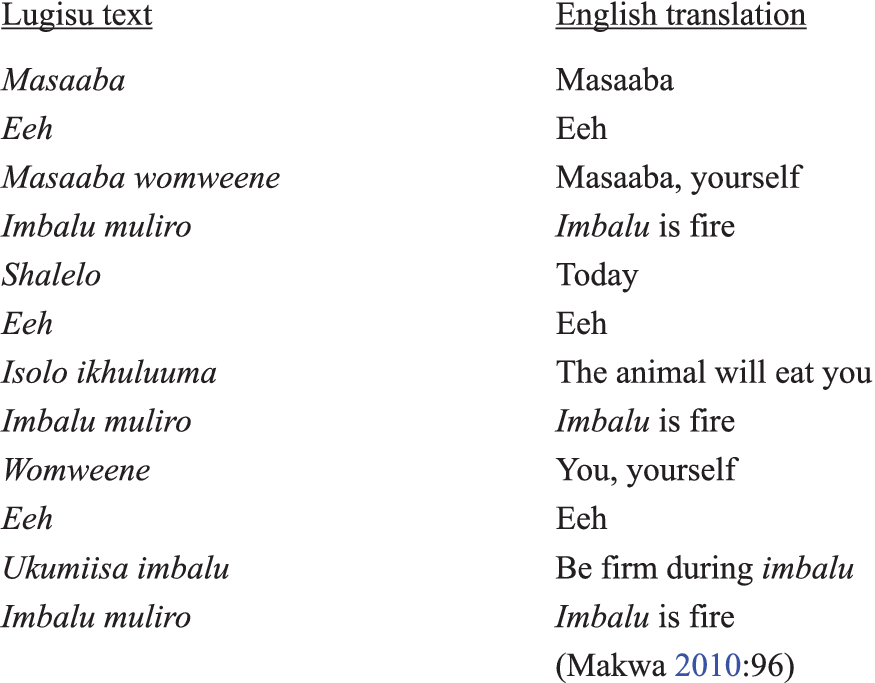
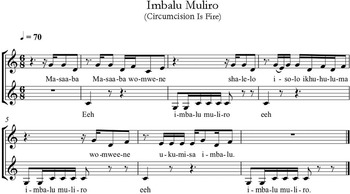
First, the song text acts as a vehicle through which the community educates young men aspiring for manhood about the roles and identities of men. To articulate these issues, I analyse the song “Imbalu Muliro” (Circumcision Is Fire) (see also transcription in Figure 5a and Figure 5b) that I grew up performing with imbalu candidates at NCS.
Song text of “Imbalu Muliro.”

Transcription of the song “Imbalu Muliro” (Circumcision Is Fire).

It is right to also classify the song illustrated in Figure 5b as belonging to the call and response category––one person (usually an elder) leads and the rest respond. This arrangement relates to the patriarchal nature of the Kigisu society. Like Tamale has noted in relation to the Baganda, patriarchal societies engender relations that require men to be above women (Reference Tamale2005:5). As imbalu is geared towards elevating the boy’s status to manhood, the community uses this song as a tool to instruct these young men to maintain this status quo.
Despite not explicitly enumerating the roles of men––the need to get married, produce children, and provide for one’s family––this song implicitly articulates what is required of men in society. The song is based on the metaphor that imbalu is a symbol of masculinity. Not only is imbalu meant to refer to the painful experience during pen-surgery,Footnote 12 it also re-echoes the challenges associated with being a father, husband, or head of a family. To be a man is to defend oneself, family, clan, and community as a whole. Heald (Reference Heald1999) underscores the last idea by asserting that a traditional Mugisu young man was expected to fight for his clan during the inter-clan wars that engulfed Africa during the early nineteenth century. Moreover, a man is expected to have the ability to put up with pressures related to providing basic needs for one’s family. The community also expects him to stand firmly while offering leadership. Because leadership comes with challenges, one who is not circumcised can never be elected to any political office.Footnote 13
Masata, a custodian of inemba ritual dance underscored similar views when he told me that:
The boy is taken to Namasho to sing, dance, and enjoy the company of his bamakooki (age-sets). But the most important thing is also to learn about what pertains to manhood. Through most songs, he learns that imbalu is fire––but this does not only refer to the “heat” of the knife. It actually refers to the heat that roles of men bring about. (interview, 3 July Reference Masata2020, in Bituwa Village, Bulucheke Sub-County)
The boy is expected to engage in these songs, responding to them to affirm that he has received the message and is ready for the roles awaiting him as a man.
The way the boy is made to sing and dance while at Namasho is also meant to exhibit and reinforce attributes like assertiveness, toughness, and strength. Since the mid-1980s when I began following imbalu candidates to NCS, I have heard elders tell them: “samba Footnote 14 imbalu ni kamani nga umusani (dance imbalu with strength/energy like a man), wafana busa nga ukhali umusani ta, loma naabi (you just appear like someone who is not a man, speak with energy), umusani urafua nga ulikho ubulula (as a man, be tough while singing).” Timothy Wangusa also captures this scene in his novel when he notes that elders were keen in observing whether Wabwire and Kangala were singing and dancing imbalu in ways that depict them as men, the position they were aspiring to attain. According to Wangusa, “occasionally, an elder detached himself from the crowd and put his ear to the ground to listen to and assess the quality and forcefulness of the candidate’s rhythmic stamping of the earth, and either nodded his head in approval or shook it in disapproval” (Reference Wangusa1989:58). Such scenes are reminiscent of what happens at NCS. Although the boy is told to uphold these roles and identities, he is also constantly reminded to respect his female relations. As informants told me, one cannot stand alone as a man; he needs the cooperation of his wife, mother, sisters, as well as maternal and paternal aunts to thrive. That is why these relatives surround him and respond to the songs he sings while in spaces like Namasho. As illustrated in Figure 6, an elder is instructing imbalu candidates at NCS. My experience as a circumcised Mugisu shows that whenever community members gather in places like Namasho to perform imbalu rituals, elders use such occasions to articulate to the boys the society’s gender roles, identities, and relations.
An Elder Instructing Imbalu Candidate at NCS. Photo by the author in August 2010.

While instruction goes on during these music and dance performances at NCS, to understand whether imbalu candidates understood what they were taught or not is realised after the boy has undergone the imbalu ritual. The way one behaves, relates with others, and takes on roles ascribed to men in society will show whether he learnt something or not. More instruction of the boy takes place at the sacred swamp, a portion of NCS where the boy is smeared with clay, as I discuss in the following section.
Instruction on Rituals of the Sacred Swamp
Finally, musicking and dancing imbalu at NCS enable the Balutseshe to transmit knowledge related to the sacred swamp. In ensuring that the young generation acquires the right instruction in this respect, Masata told me that society underscores four issues, namely: (1) how people access and leave the thicket housing the sacred swamp; (2) members of the Balutseshe who qualify to be smeared with mud from this swamp; (3) the procedures of smearing boys with clay at this swamp; and (4) the kinds of declaration the umulongi (custodian of this sacred swamp) utters as he smears candidates with clay from the swamp.Footnote 15
At NCS, the sacred swamp is housed in a thicket which is never cut. Michael Wanambwa (the elder who took me around this site) noted that on the morning of the circumcision day, the umulongi creates a way through which people access the swamp (interview Reference Wanambwa2015). The umulongi ensures that this inlet allows people to enter from the east and only exit from the west after the smearing ritual. I was told that this cycle is followed to imitate the Bagisu’s worldview about normal life. The Bagisu believe that normal life mimics the movement of the sun across the sky: it rises from the east in the morning and sets in the west in the evening. Likewise, someone is born, grows, and later dies. However, his/her death does not imply termination of life. S/he who sired children is considered a “living” person even when is dead. The children uphold his/her name through giving it to their offsprings. At burial, a Mugisu man or woman is made to face the east, a practice that signals new life. In replicating this pattern at the sacred swamp, society does not only consider imbalu as ritual death where the boy symbolically dies and emerges as a mature person, upon healing the penis wound and performing the hatching ritual, but the East-West entering and exiting from the thicket signifies good luck as well. It symbolises emergence from seclusion and subsequent enjoyment of the privileges of manhood on the part of the boy. It was further revealed to me that this arrangement re-echoes the belief that the Bagisu originated from the east where the Kalenjins (ancestors of Nabarwa) are also found.
That all the Balutseshe can access this swamp during these smearing rituals is what I learnt as I conducted this study. After all, the knowledge exposed at this site is significant to the young generation since they learn how to conduct the rituals staged there. However, although all the boys undergoing imbalu go to this thicket, those related to a sub-clan of the Bakuwa are not smeared with mud. They only go to this place and get umulongi’s verbal blessings before returning to the courtyard for circumcision. Lawrence Wapayule and Sam Fred Namara (interview Reference Namara and Wapayule2020) told me that Bakuwa are associated with kumusambwa kwo Nanyembe (the spirit of Nanyembe) which gives the Bagisu power to circumcise. It is important to note that despite all the Bagisu having the obligation to perform imbalu, certain members of society are selected to handle inyembe (the knife) to carry out the circumcision. Believed to be possessed by this spirit, it is common to find some men (and certain cases women) falling to the ground and shaking violently while uttering words which may be difficult to understand. In such scenarios, the person’s relatives bring umushebi (circumciser) who comes with herbs which he administers to the “patient” in question. After gaining consciousness, the circumciser brings his knife and hands it over this person and utters words to the effect that one has been chosen by Nanyembe (the one who gives others the knife) to circumcise.Footnote 16 As Wapayule and Namara noted, smearing boys who have links to such power with mud during circumcision can exercebate these possessions which may affect the boy’s ability to stand firmly during the operation.Footnote 17
Furthermore, Khamalwa’s discussions below give a glimpse on how boys are smeared with mud in this place. Khamalwa writes that:
Individually, and strictly according to family seniority, the novices jump into the air twice, and on the third jump, land in the mud. Every candidate is blessed with beer being blown over him before being smeared singly, and according to laid down protocol [from toe to head and later planting lusanyo––a kind of grass on the heap of mud placed on his head]. The [umulongi] dutifully go[es] about [his] job amidst the usual string of admonition to the candidate to prove himself a man.
(Reference Khamalwa2018:93)In putting lusanyo in the mud heaped on the boy’s head, the umulongi aims at making the boy look fierce, to portray him as someone ready for war. Bagisu boys proceeding for pen-surgery must appear as warriors heading for war, thus, as Heald puts it, “convincing themselves that they have the power to defeat the enemy” (Reference Heald1999:11).
Because this swamp is a gathering point for all Balutseshe, the umulongi evokes Lutseshe’s name while smearing the boys. The following speech by Masata during an interview in March 2019 summarises the declaration uttered by umulongi while smearing the boys at the sacred swamp:

From this excerpt, we see umulongi also educating the boy about the history of imbalu by evoking the name of Masaaba. We also see him imploring the candidate to pay allegiance to his clan and Lutseshe, the ancestor. More so, the boy is asked to be firm during the operation since fear puts his clan at stake. Similarly, the community exposes the boy to knowledge on how to access and leave the swamp, its custodians, people who qualify to be smeared with mud/clay from this swamp, the recitations of the umulongi, and how one is smeared with clay/mud from this place.
The encounter between umulongi and other elders, on the one hand, and boys undergoing the imbalu ritual, on the other hand, at this swamp also foregrounds the relationship between the Bagisu and their environment. As the case of NCS has shown, specific rocks, grooves, confluences of rivers, streams, and thickets are among the spaces where the Bagisu perform several rituals including imbalu. Just as they pay allegiance to certain individuals as the example of Masaaba and Lutseshe has demonstrated, by taking candidates to specific places, society implicitly implores them to guard and defend the environment, something that mother earth gave them (Wangokho during an interview). Indeed, the motto of the Bagisu (commonly known as Bamasaaba) is “lwe liswa ni bulamu bwe Bamasaaba” (For the land and life of the Bamasaaba). Defence of oneself, his household, clan, and boundaries of the community are among the core tenets of manhood among the Bagisu. Although musicking and dancing imbalu at NCS is crucial in educating people about society, there is a question as to how society can ensure that it continues to act as a communal classroom among the Balutseshe during the contemporary period.
Namasho as a Communal Classroom in Contemporary Times
In my work on archival practices for music and dance, I have pointed out that the lifestyle of contemporary Bagisu is shaped by different socio-cultural, economic, and religious factors (Makwa Reference Makwa2016). Writing about imbalu, Khanakwa (Reference Khanakwa, Fleisch and Stephens2016) argues that colonialism and missionary work account for the numerous changes manifested in this ritual. As she encapsulates, colonialists and missionaries “attempted to appropriate [the imbalu ritual] through evangelisation, medicalisation and western education” (ibid.:18).
Like other Ugandan communities, numerous Bagisu have embraced Western education and religious practices. In terms of education, children in Bulucheke go to various pre-and primary, secondary schools, and also tertiary institutions. Many other Bagisu from this area have gone as far as Mbale Town, Kampala City, and other parts of the world to acquire Western education. Because of exposure to a broad range of knowledge, they have shunned indigenous ways of education. Despite going to witness imbalu and other rituals in cultural sites like Namasho, some Bagisu view instruction transmitted in these places as backward or “mechanical learning”––to borrow Tamale’s (Reference Tamale and Tamale2012:5) concept––which does not expose them to critical thinking. Moreover, such individuals have witnessed and experienced other global cultural values like dressing and language, which do not resonate with the worldviews of a traditional Mugisu.
Closely intertwined with Western education are Western religious practices. Like it is with schools, Protestantism, Catholicism, Seventh Day Adventist, and those churches belonging to the Pentecostal movement are scattered all over Bududa. There are also numerous Islamic sects in this area. Common among these religious groups is the tendency to blackmail any form of indigenous lifestyle since it does not conform to biblical and Qur’anic teachings (Khanakwa Reference Khanakwa, Fleisch and Stephens2016:119). As an example, rituals including imbalu are presented as satanic and therefore with potential to divert Christians or Moslems from the true teachings of God/Allah. Those Bagisu subscribing to traditional practices are increasingly finding it hard to advocate for ritual performances like imbalu. Omolewa underscores these views when he appends that modern people’s “ways of knowing continue to be transformed by diversity in colonial experience, religion, customs and languages and penetration by outside forces including current globalisation efforts” (Reference Omolewa2007:595).
The other significant factor is over-population in Bugisu sub-region and Bududa District in particular. Records from the Uganda Bureau of Statistics (2016) indicate that Bududa is among the areas with a high population density. The high population has forced many people to opt for swamps and cultural sites like Namasho as places for cultivation and settlement. As such, to argue that places like Namasho are rapidly being encroached upon is to underscore the fact that the nature of education enacted through such sites will gradually vanish.
Indeed some Bagisu and the Government of Uganda still attach value to imbalu rituals since they are seen as a cultural identity for the Bagisu. Bududa District Local Government, in partnership with Uganda Tourism Board have, for the past decade or so, expressed concern over the erosion of some aspects of imbalu and therefore called for efforts to preserve these rituals. I have also seen efforts by Inzu Ye Masaaba (Masaaba Cultural Institution) lobbying UNESCO to declare imbalu as a protected intangible heritage. People advancing these calls hope that declaring imbalu a world heritage implies that cultural sites like Namasho and imbalu rituals, musics and dances staged there, will automatically be protected.Footnote 18 During fieldwork in 2014, I participated in a series of meetings where this call was the main item on the agenda. Although I have not witnessed a project geared towards preserving imbalu musics and dances initiated and managed by the community, several community members had amassed substantial amounts of these materials in their homes when I interacted with them. Moreover, whenever I met such people, they proposed to sell to me “their” imbalu items––recordings of imbalu rituals made while I was away. All these efforts demonstrate that the community values these items because of the importance they play in society.
In spite of these efforts, challenges associated with safeguarding areas like NCS pose a serious threat to the sustainability of these rituals and the knowledge transmitted through them. Institutional archives including those attached to media houses (radio and television stations) can provide spaces where recordings of ritual performances from places like NCS can be collected, documented, and deposited. Although such archives in Uganda have traditionally been inaccessible to potential users (Nannyonga-Tamusuza Reference Nannyonga-Tamusuza2006), Makerere University Klaus Wachsmann Audio-visual Archive (MAKWAA) has adopted approaches geared towards accessibility of items in its custody. From engaging in repatriation of material back to communities of origin to putting exhibitions in place, material in MAKWAA is accessed and can be used by teachers, musicians, and ordinary members of the community.
Based on these observations, I argue for concerted efforts towards recording the performances staged in NCS and keeping them with archives like MAKWAA. Besides enabling community members to reconnect with the voices of dead relatives, recordings held in archives are used as teaching material in educational institutions (Fargion Reference Fargion, Nannyonga-Tamusuza and Solomon2012). As such, not only can the Bagisu visit MAKWAA and access these items, the recordings can be repatriated to members of the Balutseshe clan to be exposed to the nature of education enacted through imbalu musicking and dancing at Namasho.
In addition to using modern recording gadgets to capture and keep these materials with archives (Makwa Reference Makwa2017), the government of Uganda should liaise with the Bududa District Local Government to compensate land owners in this area. Without a doubt, Uganda in the recent past has witnessed numerous cases of land grabbing mainly blamed on government officials. In spite of complexies related to land ownership, the fact that the government has embarked on efforts to harness imbalu for tourism through Uganda Tourism Board, compensation of land owners in NCS implies that the place will remain primarily as a public property which can promote tourism to continue upholding the identity of the Bagisu in this area.
Conclusion
This paper has examined how musicking and dancing imbalu at NCS become a site for enacting indigenous education among the Bagisu of the Balutseshe clan in Uganda. By describing the music and dance activities at Namasho, the paper illuminates how these events provide a platform for these people to educate the young generation about clan genealogies, history of the Bagisu and imbalu, the rituals performed in the sacred swamp, and gender roles, identities, as well as relations between men and women. To foreground these issues, I have discussed the process imbalu rituals and the associated musics and dances go through, and how they are created, performed, and showcased at NCS. The study concludes that Namasho is a classroom where education about this community is enacted and passed onto the young generation through musicking and dancing imbalu circumcision rituals. Ranging from instruction on social histories and gender issues to rituals at the sacred swamp, this education is meant to enable these people to understand their community and appreciate the heritage associated with it.
In spite of these music and dance activities at NCS playing a significant role in instructing these people, I argue that the changing socio-cultural, economic, and technological life of contemporary Bagisu may not enable it to flourish. Needless to say, despite the Bagisu still valuing the imbalu rituals and the associated musics and dances such as those performed at NCS, these artistic forms are reproduced through machinations of modern studios where new sound effects are added and used as ring tones and caller tunes. Moreover, they are restaged during schools’ “Music, Dance, and Drama” competitions, political rallies, in addition to becoming materials for popular artists to create new songs. By adopting new costumes as well as being choreographed to fit other settings, these new contexts make imbalu musics and dances take on new meanings and uses. They are not ritualistic in nature, but act as tools for mobilisation and display of cultural heritage. In order to sustain imbalu musics and dances as forms of knowledge transmission, I call for concerted efforts to record such events and keep them with modern archival institutions as a way of preserving this form of education. Through visits to archives, repatriations of such material back to communities and organisation of exhibitions, the Balutseshe will be exposed to music, dance, and other rituals that not only foster an understanding of their community, but sustain this form of education among the Bagisu as well.
Acknowledgements
This paper was first presented at the second International Music Education Conference held at Kyambogo University in Uganda, 21–22 March 2018. I would like to thank the organisers of this conference for inviting me to make my presentation, Lawrence Branco Ssekalegga for proof-reading the music transcriptions, as well as Sylvia Nannyonga-Tamusuza, Richard Kagolobya and the anonymous reviewers for their comments.