INTRODUCTION
When treatments to control the progress of disease are futile in terminally ill cancer patients, the goal of care often changes from prolonging life to achieving the best health-related quality of life (HRQoL) and quality of care (QoC) (Plunkett et al., Reference Plunkett, Chrystal and Harper2003). Healthcare providers must therefore assess patients' experiences of HRQoL if they are to improve QoC (Stromgren et al., Reference Stromgren, Groenvold and Pedersen2002b ). Terminal cancer patients may have better survival when treated with high-quality care (Mercado et al., Reference Mercado, Zingmond and Karlan2010) or with early provision of palliative care (Temel et al., Reference Temel, Greer and Muzikansky2010). Thus, there is a need for studies of QoC as perceived by terminally ill cancer patients from the time of their terminal diagnosis and throughout the progression of their disease.
Accurate estimates of the length of life remaining for cancer patients with terminal illness are needed to provide the best care and thus enable patients to experience a dignified and comfortable death (Glare et al., Reference Glare, Sinclair and Downing2008). Evidence has been accumulating over recent years for a positive association between duration of survival and HRQoL score in patients with advanced and terminal cancer (Vigano et al., Reference Vigano, Donaldson and Higginson2004). However, the magnitude and clinical relevance of QoC effects remain unclear. Some authors have found that the intensity of some physical symptoms (e.g., anorexia, xerostomia, dysphagia, and dyspnea) are independent prognostic factors in terminally ill cancer patients (Vigano et al., Reference Vigano, Dorgan and Buckingham2000). Others have argued that psychosocial dimensions are of dubious predictive value (Ringdal & Ringdal, Reference Ringdal and Ringdal2000) and that HRQoL cannot be employed to predict the prognosis in individual patients (Addington-Hall et al., Reference Addington-Hall, MacDonald and Anderson1990). Moreover, there is a tendency toward employing convenience samples (Chang et al., Reference Chang, Thaler and Polyak1998) rather than well-defined and representative cohorts in studies on this topic. Stratified HRQoL factors are useful in clinical practice because they allow for simple interpretation of survival and do not impose a burden on terminal patients (Sloan et al., Reference Sloan, Loprinzi and Laurine2001).
The purpose of this study was to determine the changes in HRQoL and QoC perceived by terminally ill cancer patients and the stratified set of HRQoL or QoC factors that are most likely to influence survival at the end of life (EoL).
METHODS
Study Design and Recruitment
This was a multicenter, Korean, prospective cohort study in which terminally ill cancer patients were recruited from 11 university hospitals and the National Cancer Center between July of 2005 and October of 2006. Patients were eligible to participate if they were aged 18 years or older, diagnosed as terminal by their physicians at an outpatient or inpatient facility, capable of filling out questionnaires or communicating with an interviewer, and sufficiently competent to understand the intent of the study and provide informed consent to take part. Cancer patients were defined as terminally ill if they had progressive advanced disease and, in their physician's judgment, were likely to die within months (because of general prostration, refusal of further chemotherapy, or nonresponsiveness of the condition to conventional anticancer therapy). Enrollment was within days of being diagnosed with and informed of the terminal prognosis. Patients were not eligible to participate if they continued conventional anticancer treatment after enrollment, were of non-evaluable disease status, had changed their treatment plan, or could not complete the questionnaire because they had become physically or mentally incapacitated. All patients provided informed consent to participate, and the study was approved by the respective institutional review boards.
Physicians identified 702 consecutive terminal cancer patients, of whom 83 were excluded: 11 continued conventional anticancer treatment after enrollment, 14 were of non-evaluable disease status at follow-up, 15 were lost to follow-up because they had changed their treatment plan, and 43 had become physically or mentally incapacitated. Of the 619 remaining eligible participants, 463 (74.8%) completed the baseline HRQoL and QoC questionnaires; the most common reason given for nonparticipation was lack of time. All 463 (100%) of those who completed the questionnaires died during the follow-up period.
Data Collection
The patients' demographic data and clinical information were collected within days of their diagnosis as terminally ill. The questionnaires were administered to patients in face-to-face interviews at an outpatient or inpatient facility to patients at the same time, within days of the baseline timepoint of the study, which was when the physician judged that the cancer was refractory to conventional anticancer therapy (i.e., surgery, radiotherapy, chemotherapy, or hormone therapy) and that the patient was likely to die within months.
The administered questionnaire at baseline was constructed to (1) gather demographic information (i.e., age, sex, level of education, marital status, and religious affiliation), and (2) evaluate QoL and QoC issues. The patients took about 15 minutes to complete the baseline questionnaire, and were then followed up to evaluate QoL and QoC issues by mail at 1 and 3 months post-enrollment.
QoL was measured using the core 30-item European Organization for Research and Treatment of Cancer Quality of Life Questionnaire (EORTC QLQ–C30) (Yun et al., Reference Yun, Park and Lee2004), which is a brief, validated, self-reporting, cancer-specific measure of QoL that comprises five multiitem functional scales that evaluate physical, role, emotional, cognitive, and social function statuses, as well as one global health status/QoL scale. Three symptom scales measure fatigue, pain, and nausea/vomiting, and six single items assess other symptoms (dyspnea, insomnia, appetite loss, constipation, and diarrhea) and financial difficulties. High functional scores represent better functioning and QoL, while a high symptom score indicates more severe symptoms.
Quality of care was measured using the Quality Care Questionnaire–End of Life (QCQ–EoL) (Yun et al., Reference Yun, Kim and Lee2006), which is a brief, validated, self-reporting, and cancer-specific measure of QoC that comprises four multiitem subscales covering dignity-conserving care, care by healthcare professionals, individualized care, and family relationships. The QCQ–EoL contains 16 items and is scored on a 4-point Likert-type scale (“not at all,” “a little,” “quite a bit,” and “very much”), with a higher score indicating a higher perceived QoC (Cronbach's α = 0.87 at baseline). In addition, mortality data were gathered by linkage to the National Statistical Office. Subjects were followed through to December 31, 2007. The follow-up period represented 161.2 person-years (median = 70 days).
Statistical Analysis
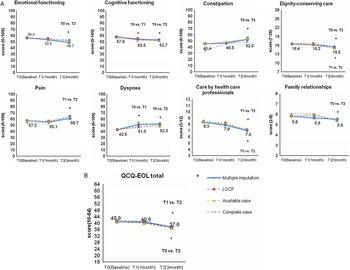
The characteristics of patients are described using frequencies for all variables, as estimated using descriptive statistics. The EORTC QLQ–C30 and QCQ–EoL findings were summarized according to the recommended scoring manual (Yun et al., Reference Yun, Kim and Lee2006; Wood et al., Reference Wood, White and Hillsdon2005). Four methods were employed to perform analyses of partially censored data; sensitivity analysis was also performed. Except when the subject died (Yun et al., Reference Yun, Lee and Kim2011a ,Reference Yun, Lee and Park b ), missing data were handled by complete-case analysis (CC), available-case analysis (AC), and the last observation carried forward (LOCF) and multiple imputation (MI) methods. A mixed model was utilized to estimate the change in HRQoL and QoC from baseline to 3 months using the data generated by the abovementioned four methods (Wood et al., Reference Wood, White and Hillsdon2005). The significance of differences was calculated from baseline (T0) to 1 month (T1), from baseline to 3 months (T2), and from 1 to 3 months by taking into account the correlation of repeated observations for a given subject with the data generated by the four methods. The model was also adjusted for baseline score, age, sex, and ECOG–PS. Sensitivity analysis was conducted to determine the significant subscales of HRQoL and QoC for all data generated by the four methods (Figure 1). The least-squares mean values of HRQoL and QoC, derived from the MI data, are given as representative values in Figure 1, since values obtained from MI data most closely resembled the truth (de Goeij et al., Reference de Goeij, van Diepen and Jager2013).
Least-square mean (Lsmean) change in health-related quality of life (HRQoL) and quality of care (QoC), calculated using data obtained using four imputation methods. *A mixed model was employed used to estimate the change in HRQoL and QoC from baseline to 3 months with the data obtained using four imputation methods, adjusted for baseline score, age, sex, and Eastern Cooperative Oncology Group performance status (ECOG–PS). **Number of observations included in the analyses, relative to the missing data handling method.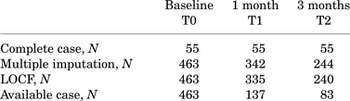

In the exploratory stage of HRQoL and QoC variable selection to predict survival, the Kaplan–Meier method was applied with the Wilcoxon test in a univariate analysis. Associations were sought between survival time and potentially prognostic HRQoL and QoC subscales. The problematic group for the functioning and global QoL of EORTC QLQ–C30, and all subscales of the QCQ–EoL, yielded scores of 33 or less on a scale of 0 to 100, while that for the symptoms of EORTC QLQ–C30 yielded scores of above 66 (Fayers, Reference Fayers2001).
Some HRQoL and QoC parameters that were significant on univariate analysis at the 5% level and demographic and clinical data that were found in a previous study to be significant (EOCG–PS) (Yun et al., 2010) were entered into a stepwise Cox regression analysis, and adjusted hazard ratios (aHRs) with 95% confidence intervals (CI 95%) were calculated. Baseline and mortality data were employed for survival analyses. All statistical tests were two-tailed and performed using SAS version 9.2 (SAS Institute, Cary, North Carolina). The level of statistical significance was set at p < 0.05.
RESULTS
Patient Characteristics
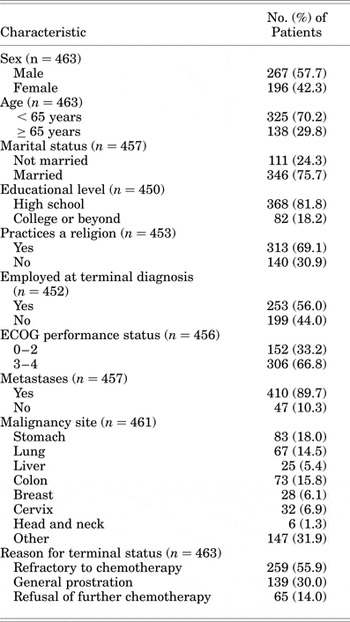
Table 1 summarizes patients' demographic and clinical characteristics. The mean patient age was 57.3 years (range, 20–87 years), and more than half were male (57.7%). The most frequent reasons for terminal prognosis were refractoriness to chemotherapy and general prostration (85.9%).
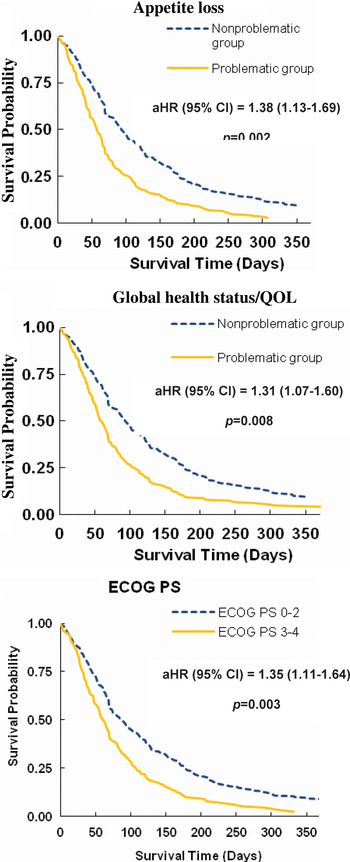
Overall survival curves for the prognostic factor subgroups.

Demographic data and clinical characteristics of patients

ECOG–PS = Eastern Cooperative Oncology Group performance status.
Changes in HRQoL and QoC Over Time Among the Terminal Cancer Patients
Figure 1 shows the change in HRQoL ratings of the terminal cancer patients over time, as calculated using the four methods. The accompanying table summarizes the number of observations included in the analyses as a result of the four methods (CC analysis, MI, LOCF, and AC analysis). Emotional (T0 vs. T2, p < 0.0001) and cognitive functioning decreased significantly over time (T0 vs. T1, p = 0.005; T0 vs. T2, p = 0.003), while dyspnea (T0 vs. T1, p < 0.0001; T0 vs. T2, p < 0.0001) and constipation (T0 vs. T2, p = 0.002) increased significantly. Pain significantly increased from 1 month after the terminal diagnosis (T1 vs. T2, p = 0.005). There were no significant changes in diarrhea and financial difficulties between any of the follow-up timepoints.
Dignity-conserving care (T0 vs. T2, p = 0.001; T1 vs. T2, p = 0.016), care by healthcare professionals (T0 vs. T2, p < 0.0001; T1 vs. T2, p < 0.0001), family relationships (T0 vs. T2, p = 0.013), and QCQ–EoL total score (T0 vs. T2, p < 0.0001; T1 vs. T2, p < 0.0001) decreased significantly. There was no significant change in perceived individualized care among the follow-up timepoints.
Univariate Survival Analysis
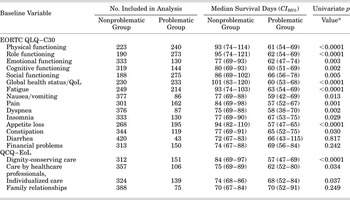
In univariate analysis (see Table 2), the problematic groups at baseline for physical (p < 0.0001), role (p < 0.0001), emotional (p = 0.003), cognitive (p = 0.002), social functioning (p = 0.005), global QoL (p < 0.0001), fatigue (p < 0.0001), nausea/vomiting (p = 0.013), pain (p = 0.001), dyspnea (p = 0.002), insomnia (p = 0.029), appetite loss (p < 0.0001), and constipation (p = 0.030) on the EORTC QLQ–C30 were significantly associated with reduced survival. The problematic groups at baseline for dignity-conserving care (p < 0.0001), care by healthcare professionals (p = 0.034), and individualized care (p = 0.037) in the QCQ–EoL were also significantly associated with reduced survival.
Univariate analyses of overall survival between the problematic and nonproblematic groups using the data collected at the time of terminal cancer diagnosis

EORTC QLQ–C30 = European Organization for Research and Treatment of Cancer Quality of Life Questionnaire Core–30; QCQ–EoL = Quality Care Questionnaire–End of Life.
* Derived from the Kaplan–Meier method with the Wilcoxon test.
Multivariate Cox Proportional-Hazards Regression Analysis
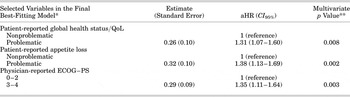
In multivariate analysis for variables that showed statistical significance in univariate analysis, problematic global QoL [aHR (CI 95%) = 1.31 (1.07–1.60)], problematic appetite loss [aHR (CI 95%) = 1.38 (1.13–1.69)], and poorer ECOG–PS [aHR (CI 95%) = 1.35 (1.11–1.64)] were significantly associated with reduced survival (Table 3, Figure 2).
Multivariate analysis of overall survival based on the best-fit model of the Cox regression analysis, using data obtained at the time of terminal cancer diagnosis

aHR = adjusted hazard ratio; CI 95%=95% confidence interval.
* Those parameters significant on univariate analysis at a 5% level were included in a stepwise Cox regression analysis.
** The multivariate analysis included 455 baseline observations.
DISCUSSION
This study prospectively examined changes in HRQoL and QoC among terminally ill cancer patients from the time of their terminal cancer diagnosis to 3 months afterward performing sensitivity analysis. Furthermore, the factors of HRQoL and QoC at baseline that predict survival of terminally ill cancer patients were identified.
The most difficult problem in studies of quality of life at the end of life is collecting data at scheduled intervals (Grande & Todd, Reference Grande and Todd2000). Missing data due to deterioration of patients' physical and cognitive function and the high rate of attrition in QoL studies of terminal cancer patients raise questions regarding the generalizability of data gleaned from such studies. If the data are not correctly handled during analytic procedures, this may substantially bias the study results, thus reducing interpretive power (Haukoos & Newgard, Reference Haukoos and Newgard2007). Results can be sensitive to the missing-data mechanism, and if little is known about this mechanism, sensitivity analysis by various methods should be performed (Little, Reference Little2005). Many methods have been developed to analyze partially censored data, and these methods are procedures based on completely recorded units (i.e., CC and AC analysis, LOCF, and MI methods). Multiple imputation is a more sophisticated (less biased and more predictable) missing-data analysis technique that provides mean values and results that more closely resemble the truth (de Goeij et al., Reference de Goeij, van Diepen and Jager2013).
The sensitivity analysis of changes in HRQoL over time revealed that terminally ill cancer patients experience decreased emotional (Price et al., Reference Price, Bell and Sommeijer2013) and cognitive functioning (Giesinger et al., Reference Giesinger, Wintner and Oberguggenberger2011) and increased dyspnea (Giesinger et al., Reference Giesinger, Wintner and Oberguggenberger2011), pain (Price et al., Reference Price, Bell and Sommeijer2013), and constipation (Friedrichsen & Erichsen, Reference Friedrichsen and Erichsen2004). Constipation is a severe problem for many patients receiving palliative care (Friedrichsen & Erichsen, Reference Friedrichsen and Erichsen2004). Opioid-induced gastrointestinal motility problems produce worsened constipation in terminal cancer patients (Friedrichsen & Erichsen, Reference Friedrichsen and Erichsen2004). Pain is a prevalent symptom at the end of life that is highly prioritized by patients (Elmqvist et al., Reference Elmqvist, Jordhoy and Bjordal2009). Although there is substantial evidence for the treatment and management of pain, the prevalence of patients reporting pain is high (Ripamonti et al., Reference Ripamonti, Santini and Maranzano2012). The increase in physical disease burden is accompanied by a deterioration in emotional functioning during the final year of life (Price et al., Reference Price, Bell and Sommeijer2013; Elmqvist et al., Reference Elmqvist, Jordhoy and Bjordal2009). It may be necessary for patients and their families to move from hoping for a dramatic improvement to accepting and preparing for the approaching death (Clayton et al., Reference Clayton, Hancock and Butow2007).
Persistent cognitive impairment has been identified in terminal cancer patients (Pereira et al., Reference Pereira, Hanson and Bruera1997). The potential causes of cognitive impairment in terminally ill cancer patients are drugs (e.g., tricyclic antidepressants, benzodiazepines, nonsteroidal antiinflammatory agents, and opioid analgesics) (Pereira et al., Reference Pereira, Hanson and Bruera1997), and the most common diagnosis in this sample was delirium, which in turn may be a major cause of cognitive impairment (Minagawa et al., Reference Minagawa, Uchitomi and Yamawaki1996). By determining the dimensions of HRQoL that change significantly after a diagnosis of terminal cancer in this manner, it is possible to focus on determining the best intervention for each patient's EoL care.
Moreover, terminally ill cancer patients appear to perceive that the quality of dignity-conserving care, care by healthcare professionals, and family relationships in QoC deteriorate over time (Charalambous, Reference Charalambous2013; Prigerson et al., Reference Prigerson, Zhang and Nilsson2013). Improvements in patients' symptoms and QoL can be achieved by further training of oncologists in palliative care (Peppercorn et al., Reference Peppercorn, Smith and Helft2011) and by involving other members of the multidisciplinary team (e.g., psychologists and chaplains) (Smith et al., Reference Smith, Temin and Alesi2012). The underlying cause of this perceived deterioration in the quality of EoL care may be a deficiency in standard oncological care for patients with incurable cancer (Charalambous, Reference Charalambous2013).
The present data confirm the following as having independent prognostic value in terminally ill cancer patients: global QoL (Lundh Hagelin et al., Reference Lundh Hagelin, Seiger and Furst2006), appetite loss (Lundh Hagelin et al., Reference Lundh Hagelin, Seiger and Furst2006), and ECOG–PS (Maltoni et al., Reference Maltoni, Caraceni and Brunelli2005). The results generally confirm reports from other specialized palliative care services (Stromgren et al., Reference Stromgren, Goldschmidt and Groenvold2002a ) and the findings of a study of patients during their last month of life (Rivadeneira et al., Reference Rivadeneira, Evoy and Fahey1998). Most of the HRQoL and QoC variables exhibited statistically significant prognostic information for survival in univariate analyses. However, multivariate analysis revealed a high correlation among many variables, and three major variables are considered to be strong and reliable prognostic factors predicting short-term survival. In particular, appetite loss, which is considered the common terminal pathway, had a great prognostic impact (Rivadeneira et al., Reference Rivadeneira, Evoy and Fahey1998). Several factors may lead directly to appetite loss and thereby lower energy intake (e.g., dysphagia, nausea, xerostomia, and changes in taste and smell) (Fearon et al., Reference Fearon, Strasser and Anker2011). Although the prognostic capacity of subjective indicators of global QoL is somewhat contradictory (Maltoni et al., Reference Maltoni, Caraceni and Brunelli2005), the prognostic relevance in terminally ill cancer patients with a median survival of 70 days seems to be attributable to global QoL (Llobera et al., Reference Llobera, Esteva and Rifa2000). Thus, a dip in patient global QoL, appetite loss, and ECOG–PS on entering the terminal phase of life may be a useful clinical warning that could aid clinician and patient decision making regarding futile chemotherapy, thus reducing the number of patients who receive chemotherapy shortly before they die (von Gruenigen et al., Reference von Gruenigen, Frasure and Reidy2003).
This study found significant changes over time in emotional and cognitive functioning, dyspnea, pain, constipation, dignity-conserving care, care by healthcare professionals, family relationships, and QCQ–EoL total score. However, the changes in these factors were not predictive indicators of survival in these terminally ill cancer patients (data not shown); only conditions in global QoL, appetite loss, and ECOG–PS at baseline were predictive.
Our study was subject to several limitations. Since no information was collected on the use of healthcare services other than those provided by the study hospitals, the possibility that other types of care influenced survival cannot be excluded. However, that possibility was minimized by eliminating enrolled patients who received further chemotherapy during follow-up.
CONCLUSION
Persistent deterioration in emotional and cognitive functioning, dyspnea, constipation, pain of HRQoL, dignity-conserving care by healthcare professionals, and family relationships of QoC were identified in terminal cancer patients. If the maintenance and enhancement of HRQoL and QoC for this population is the main focus of palliative care, future standardization of palliative care should be focused on assessment of these factors. In addition, the following QoL-enhancing factors were identified that are predictive of survival at the end of life: global QoL, appetite loss, and ECOG–PS.
DISCLOSURES
The authors state that they have no conflicts of interest to declare.
ACKNOWLEDGMENT
This study was supported by the National Cancer Center (grant numbers 0710420 and 1010470).