As one of the major greenhouse gases causing global climate degradation, CO2 is also a valuable carbon resource, and its rational development and utilization have immeasurable social and economic benefits. At present, most CO2 reduction reactions are carried out through electrocatalysis, photocatalysis or thermal catalysis processes. Compared with traditional catalytic technologies, plasma catalysis exhibits a unique activation mechanism and application potential in the reaction of CO2 reduction to CO. It can directly break the C=O bond of CO2 at low temperatures and at atmospheric pressure through high-energy electrons and active free radicals and convert CO2 to CO in one step (Zheng et al., Reference Zheng, Zhang, Li, Chen, Yu and Wang2017; Yan et al., Reference Yan, Wang, Liang, Makaremi, Wood and Dai2019; Bahmanpour et al., Reference Bahmanpour, Signorile and Kröcher2021).
In plasma catalysis technology, dielectric barrier discharge (DBD) has the advantages of a simple structure, low cost, mild reaction conditions, convenient operation and easy control of reaction start and stop, making it an attractive alternative to traditional catalysis (Van Durme et al., Reference Van Durme, Dewulf, Leys and Van Langenhove2008). However, DBD catalysis also has problems such as its low selectivity and easy carbon deposition when used alone (Zhang et al., Reference Zhang, Li, Zhu, Cen, Du and Tu2017a; Zhou et al., Reference Zhou, Chen, Ma, Yu and Dai2018). Therefore, it is usually used in combination with catalysts by selectively adding catalysts loaded with various metals to adjust reaction selectivity, enabling high-value-added carbon-containing products such as CO, CH4 and CH3OH to be obtained. Among these, CO serves as a feedstock for synthesizing higher hydrocarbons, whereas CH4 and CH3OH can be utilized as renewable energy sources or energy storage materials. Currently, the most used catalysts are porous Al2O3 and Al2O3 molecular sieves (Diao et al., Reference Diao, Zhang, Liu, Chen, Wu and Shi2022), whose most prominent properties are their high specific surface area and rich pore structure.
To date, no studies have investigated the synergistic application of clay minerals and plasma in the catalytic hydrogenation of CO2. Clay minerals commonly contain Al2O3, with kaolinite (Kaol) and Halloysite (Hal) often containing ∼40% Al2O3. They also have the porous structure and high specific surface area required for catalytic reactions (Li et al., Reference Li, Li and Suzuki2013). This structure enables them to perform well in physical and chemical adsorption of CO2, and they have potential as catalysts for CO2 reduction reactions (Lo & Taghipour, Reference Lo and Taghipour2021). In addition, clay minerals are widely distributed and have a much lower cost than porous Al2O3 and Al2O3 molecular sieves, which are usually ∼2000 USD per ton, whereas the price of clay minerals is generally only 200 USD per ton, making them better suited for industrial applications in CO2 conversion.
In clay minerals, active metal sites influence the adsorption, activation and intermediate formation pathways of CO2. The presence of interlayer water not only modulates the local dielectric environment and plasma–surface interactions of the catalyst but also stabilizes key reaction intermediates via hydrogen bond networks or influences charge carrier migration. Furthermore, the hydrophilicity/hydrophobicity of catalytic materials profoundly governs the adsorption, diffusion and desorption behaviour of reactants and products on the catalyst surface, thereby affecting reaction selectivity and long-term stability (Sheydaei et al., Reference Sheydaei, Gasemsoltanlu and Beiraghi2019; Santagata & Johnston, Reference Santagata and C.T2022).
In this study, eight clay minerals were tested for their performance regarding CO2 conversion and CO selectivity, and the results demonstrated that they can combine with DBD to synergistically catalyse CO2 conversion. The effects of their structural and compositional features on catalytic performance were investigated with a characterization test system due to the complex structure and composition of clay minerals. This study highlights a low-cost green catalyst for the DBD catalytic system, and it is of great significance for the rapid screening of clay minerals and the guidance of their further modification. This will also helps in the designing of efficient catalysts based on clay minerals, thus opening new ways to improve CO2 conversion rates and product selectivity.
Experimental
Materials
Eight typical clay minerals were used in this study: Kaol, Hal, Na-montmorillonite (Na-Mt), Ca-montmorillonite (Ca-Mt), vermiculite (Ver), palygorskite (Pal), sepiolite (Sep) and clinoptilolite (Cp). Kaol was purchased from China Kaolin Clay Co., Ltd. Hal was purchased from Guzhang Shanlin Shiyu Mineral Products Co., Ltd. Na-Mt and Ca-Mt were provided by Inner Mongolia Ningcheng Tianyu Chemical Co., Ltd. Ver was bought from Xinjiang Yuli Xinlong Vermiculite Co., Ltd. Pal was provided by Jiangsu Jiuchuan Nano Material Technology Co., Ltd. Sep was obtained from Xiangtan Sepiolite Technology Co., Ltd. Cp was collected from Beijing Guotoushengshi Technology Co., Ltd. Silica sand (SiO2) and alumina spheres (Al2O3) were purchased from Macklin. All materials were used without further purification and were sieved to 40–60 mesh.
Experimental steps and reaction evaluation
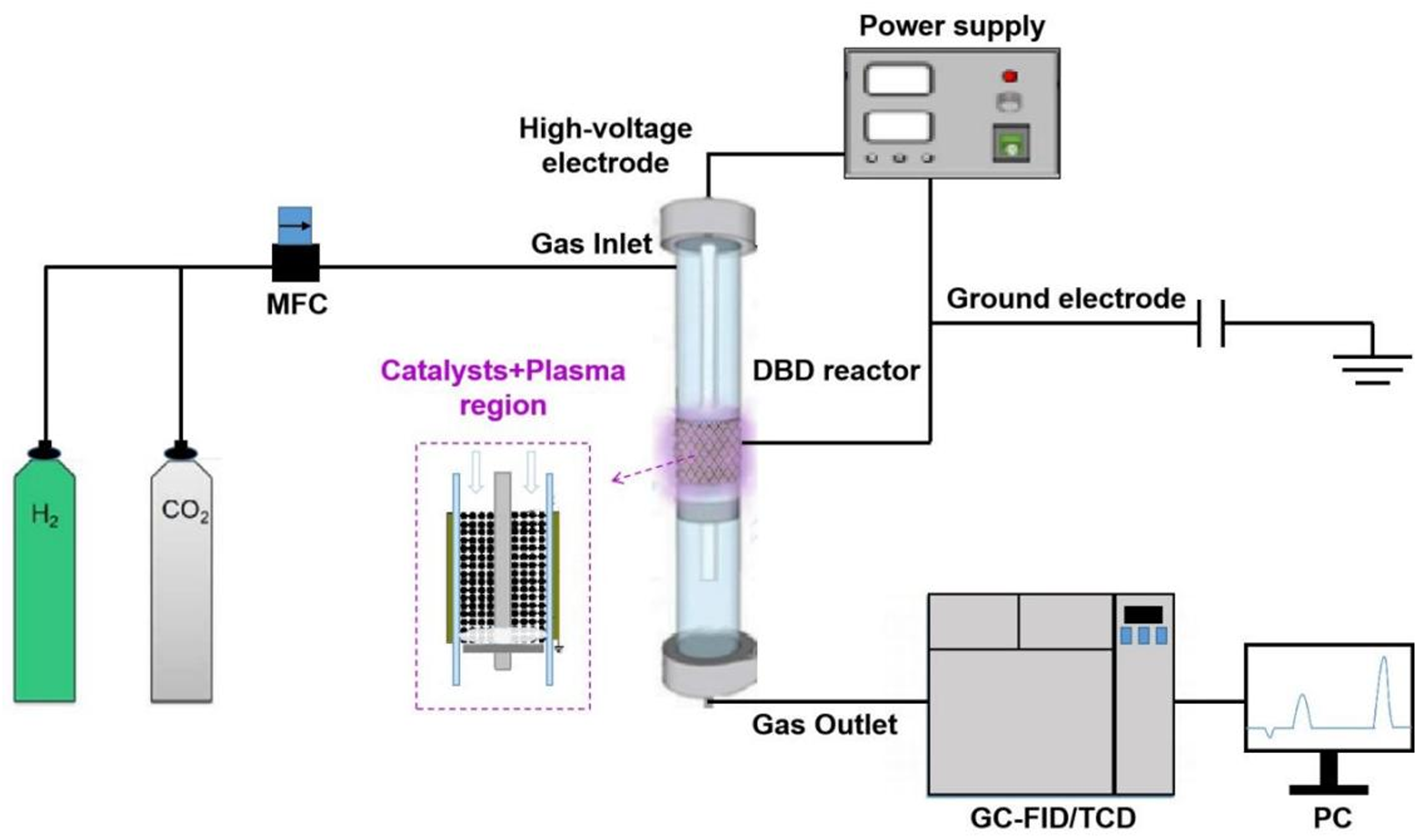
The experimental equipment for the CO2/H2 conversion in the DBD reactor is shown in Fig. 1. The DBD reactor was composed of a quartz tube (12 mm outside diameter × 8 mm inside diameter), a stainless-steel rod that was coaxially placed in the centre with the quartz tube and served as a high-voltage electrode and a wire mesh wrapped over the quartz tube that served as the ground electrode. The clay mineral (100 mg) as a catalyst held by quartz wool was installed in the discharge zone. A mixture of H2 and CO2 was passed through and monitored by a calibrated mass flow controller, and the total inlet gas flow rate was 100 mL min–1 with a gas ratio of 4:1 (H2:CO2). When the concentration of the incoming reactant gas was stabilized, the DBD discharge was carried out with the discharge frequency fixed at 10 kHz and the applied power kept at ∼36 W. After the reaction had been stabilized for 2 h, gas sampling commenced and the composition was analyzed using gas chromatography. The analysis was performed on a Yidian Analysis GC-126N gas chromatograph equipped with a thermal conductivity detector coupled to a TDX-01 column and a flame ionization detector coupled to a PLOT Q column.
Schematic diagram of the experimental setup. FID = flame ionization detector; MFC = mass flow controller; TCD = thermal conductivity detector.

To evaluate the reaction performance of CO2 conversion in the DBD-only and DBD-catalysis system, the conversions of CO2 ( ${{\text{X}}_{{\text{C}}{{\text{O}}_{\text{2}}}}}$) and selectivity of CO and CH4 (
 ${{\text{S}}_{{\text{CO}}}}$,
 ${{\text{S}}_{{\text{C}}{{\text{H}}_{\text{4}}}}}$) were calculated as per Equations 1–3:
 \begin{equation}{{\text{X}}_{{\text{C}}{{\text{O}}_{\text{2}}}}}{\text{ = }}\frac{{{\text{C}}{{\text{O}}_{{\text{2[in]}}}}{\text{ - C}}{{\text{O}}_{{\text{2[out]}}}}}}{{{\text{C}}{{\text{O}}_{{\text{2[in]}}}}}}{\text{ \times 100\% }}\end{equation}
 \begin{equation}{{\text{S}}_{{\text{CO}}}}{\text{ = }}\frac{{{\text{C}}{{\text{O}}_{{\text{[out]}}}}}}{{{\text{C}}{{\text{O}}_{{\text{2[in]}}}}{\text{ - C}}{{\text{O}}_{{\text{2[out]}}}}}}{\text{ \times 100\% }}\end{equation}
 \begin{equation}{{\text{S}}_{{\text{C}}{{\text{H}}_{\text{4}}}}}{\text{ = }}\frac{{{\text{C}}{{\text{H}}_{{\text{4[out]}}}}}}{{{\text{C}}{{\text{O}}_{{\text{2[in]}}}}{\text{ - C}}{{\text{O}}_{{\text{2[out]}}}}}}{\text{ \times 100\% }}\end{equation}
In the exhaust gas, only CO and CH4 are detected by the gas chromatograph, whereas carbon deposition occurs during the reaction, and the selectivity of carbon deposition ( ${{\text{S}}_{\text{C}}}$) can be calculated using Equation 4:
 \begin{equation}{{\text{S}}_{\text{C}}}{\text{ = 1 - }}{{\text{S}}_{{\text{CO}}}}{\text{ - }}{{\text{S}}_{{\text{C}}{{\text{H}}_{\text{4}}}}}\end{equation}
Characterization
A Rigaku RINT 2100 X-ray diffractometer (XRD) was used to analyse the phase composition and crystallinity of the powder catalyst. The morphological characteristics of the catalyst were observed using a JSM-7600F field emission scanning electron microscope (SEM) at an acceleration voltage of 20 kV. A Bruker AXS S8 TIGER X-ray fluorescence spectrometer (XRF) was used to determine the main elemental composition of the clay minerals. The pore-size distribution and pore volume of the clay minerals were determined using an ASAP 2020 PLUS physical adsorption instrument, and the specific surface area was calculated using the Brunauer–Emmett–Teller (BET) method. A Nicolet iS50 Fourier-transform infrared (FTIR) spectrometer was used to analyse the functional groups and chemical bonds of the catalyst samples. The surface elemental chemical states of the samples were characterized using ESCALab220I-XL X-ray photoelectron spectroscopy (XPS).
Results and discussion
Measured CO2 conversion and product selectivity
The effects on CO2 catalytic performance in the DBD reactor without catalyst or with the addition of various clay mineral materials were first evaluated to identify the clay mineral species with relatively greater catalytic performance. In this catalytic system, the following two reactions primarily occur (Equations 5 & 6):
 \begin{equation}{\text{C}}{{\text{O}}_2} + {\text{ }}{{\text{H}}_2} \to {\text{ CO }} + {\text{ }}{{\text{H}}_2}{\text{O}},{\text{ }}\Delta {H_{298K}} = {\text{ }}41.2{\text{ kJ mo}}{{\text{l}}^{-1}}\end{equation}
 \begin{equation}{\text{C}}{{\text{O}}_2} + {\text{ }}4{{\text{H}}_2} \to {\text{ C}}{{\text{H}}_4} + {\text{ }}2{{\text{H}}_2}{\text{O}},{\text{ }}\Delta {H_{298K}} = {\text{ }}-165.1{\text{ kJ mo}}{{\text{l}}^{-1}}\end{equation}
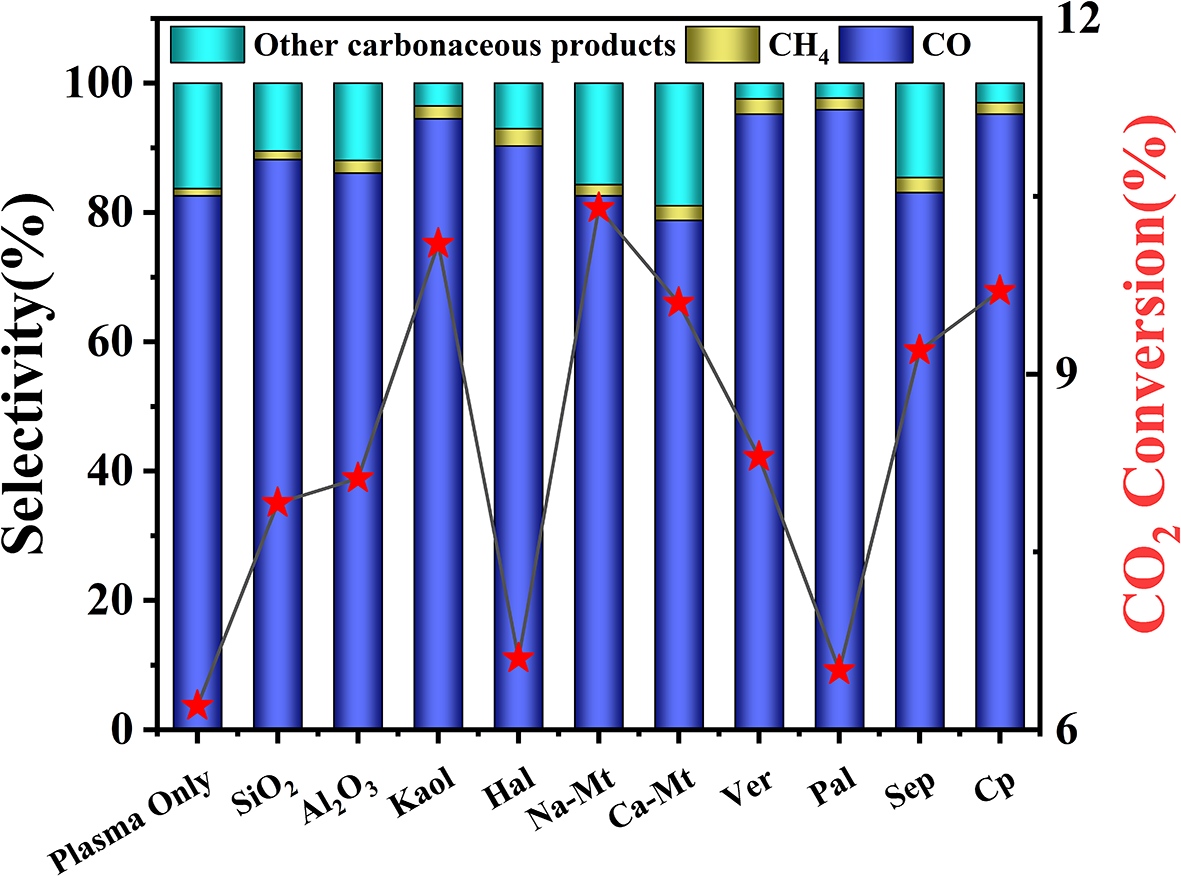
In the catalytic systems without filler and those filled with SiO2 and Al2O3, the CO2 conversion rates were 6.2%, 6.8% and 7.1%, respectively, and these results proved that the addition of filler could improve CO2 conversion, which was attributed to changes in the electric field distribution and electron energy distribution (Zhuang et al., Reference Zhuang, Zhang, Gao, Zhang and Liao2017). In addition, when clay minerals with adsorption properties for CO2 were filled in the DBD reactor, it could be observed that the CO2 conversion rate was further improved, especially when Kaol and Na-Mt were filled in, when the conversion rates were increased by ∼1.6 times and ∼1.7 times, respectively. The CO selectivity of the system was significantly improved when filled with Hal, Kaol and Pal, from 83.7% to 90.3%, 94.5% and 95.9%, respectively (Fig. 2). This indicates that the reaction performance correlates with the structure and catalytic activity of the filler. Furthermore, within the DBD system, this structure may improve the micro-discharge properties on the catalyst surface and within the pore channels (Sun et al., Reference Sun, Wu, Wang, Li, Wang and Harding2022).
CO2 conversion product selectivity with various clay minerals and plasma synergies.

Main characteristics and properties of the clay minerals used in this work
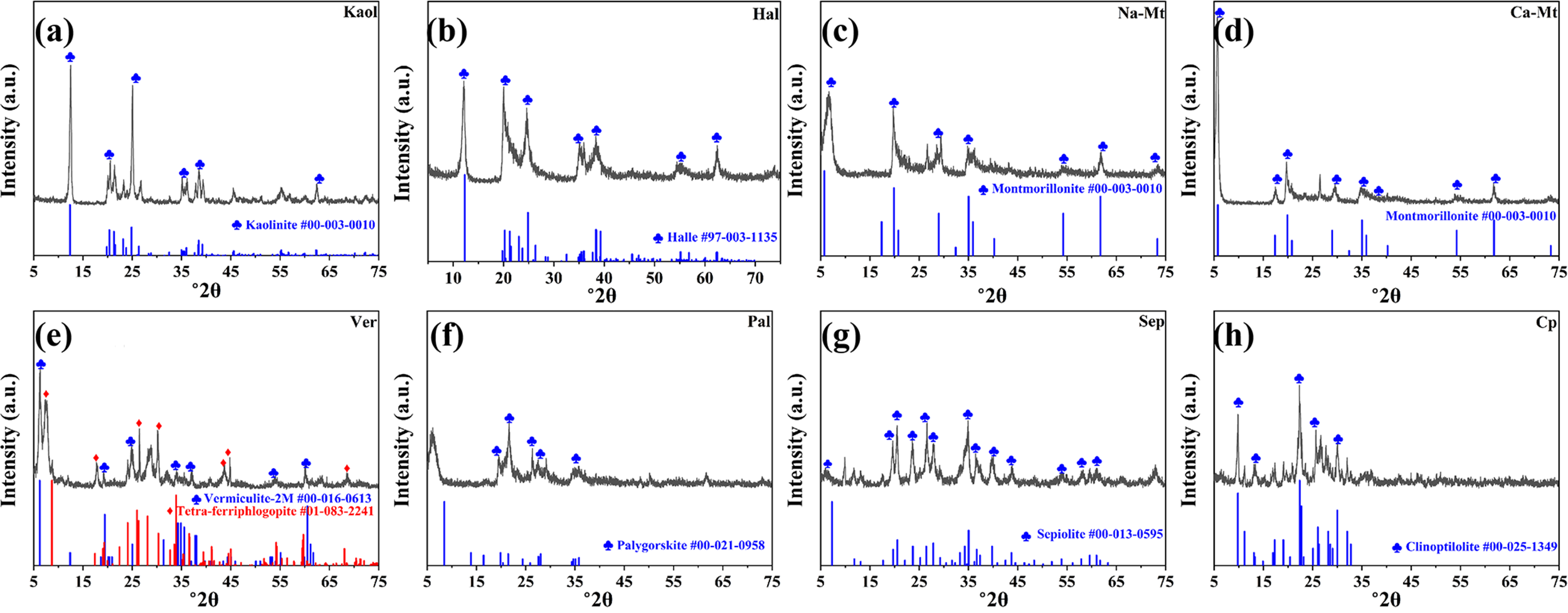
The crystal structures of the clay minerals used in this study were obtained by XRD characterization, and the XRD traces are shown in Fig. 3, confirming the distinct crystal phases and structural features of the eight clay minerals, which are closely related to their catalytic performance. The characteristic peaks at 12.40°2θ and 24.95°2θ are attributed to the (001) and (002) crystal planes of Kaol (Fig. 3a; Madejová et al., Reference Madejová, Keckés, Pálková and Komadel2002), whereas the characteristic peak at 24.57°2θ is attributed to the (002) crystal plane of Hal (Gray-Wannell et al., Reference Gray-Wannell, Cubillas, Aslam, Holliman, Greenwell and Brydson2023), and the characteristic peak at 20.07°2θ is mainly formed due to the presence of interlayer water, which causes the Hal to curl into a tubular structure (Fig. 3b; Santagata & Johnston, Reference Santagata and C.T2022). In the XRD traces of Na-Mt and Ca-Mt, the characteristic peak at 7.2°2θ in Na-Mt mainly corresponds to its (001) crystal plane, and the characteristic peak at 6.0°2θ in Ca-Mt also corresponds to its (001) crystal plane, which correspond to the greater Na2O and CaO contents, respectively (Fig. 3c,d; Mao et al., Reference Mao, Liu, Chu, Chen, Zou and Chen2022). The characteristic diffraction reflection at 6.13°2θ corresponds to the (002) crystal plane of Ver, and noticeable tetra-ferriphlogopite impurities can be observed in the Ver (Fig. 3e). The characteristic peak at 8.51°2θ is mainly attributed to the (110) crystal plane of Pal (Fig. 3f). The characteristic peak at 7.5°2θ mainly corresponds to the (110) crystal plane of Sep (Fig. 3g; Sarikaya et al., Reference Sarikaya, Önal and A.D2020). The characteristic peak at 10.0°2θ mainly corresponds to the (020) crystal plane of Cp (Fig. 3h; Sheydaei et al., Reference Sheydaei, Gasemsoltanlu and Beiraghi2019).
XRD traces of the clay minerals: (a) Kaol, (b) Hal, (c) Na-Mt, (d) Ca-Mt, (e) Ver, (f) Pal, (g) Sep and (h) Cp.

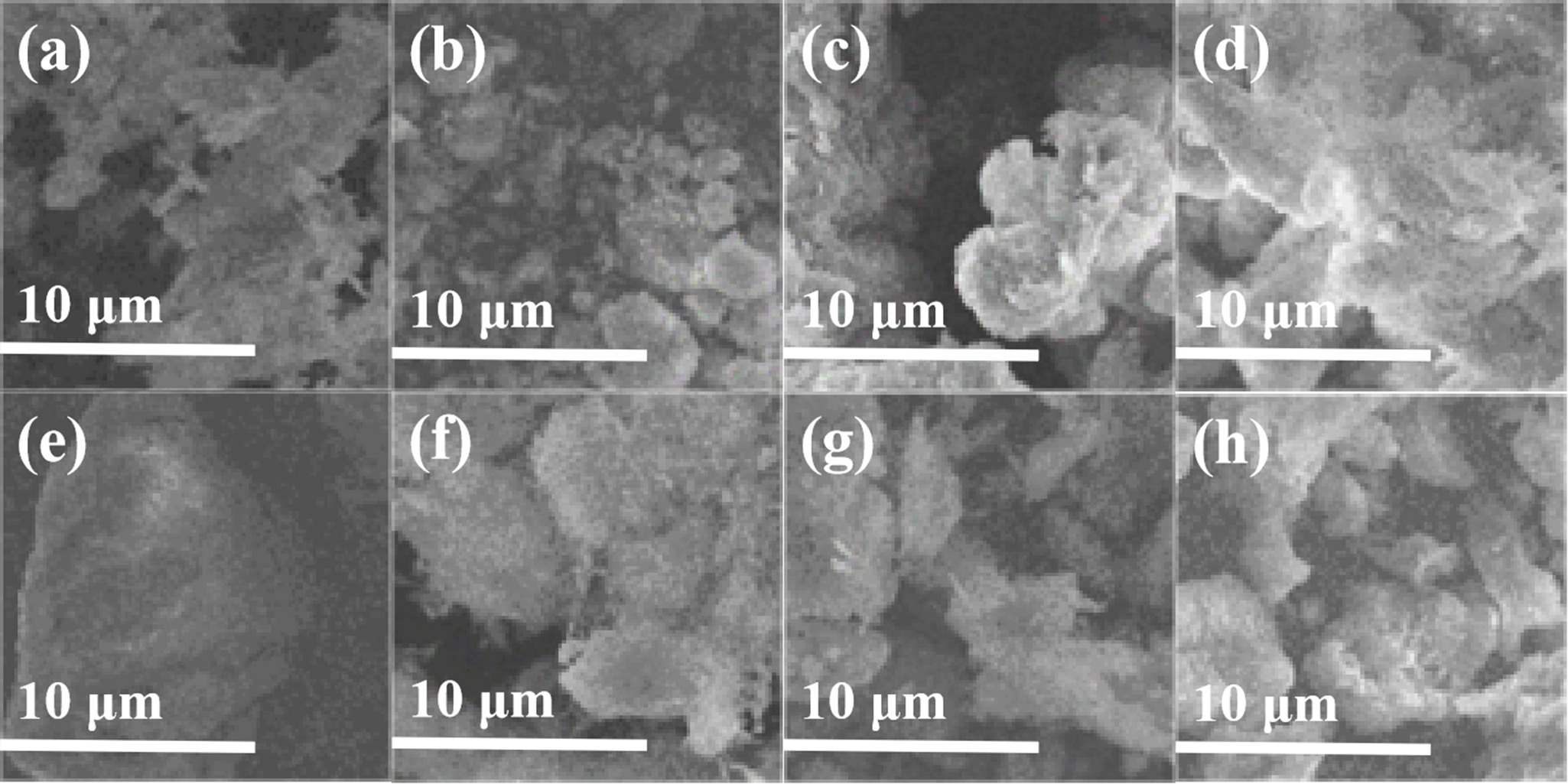
The microscopic morphology of the catalysts was obtained using SEM characterization, and the particle sizes of the samples were all within the micrometre scale (Fig. 4). Kaol predominantly shows a thin lamellar structure (Fig. 4a), whereas Hal predominantly exhibits a curly tubular structure (Fig. 4b; Santagata & Johnston, Reference Santagata and C.T2022). This unique tubular morphology, confirmed by both XRD and SEM, provides a confined nano-space that can concentrate reactive species, potentially explaining its high CO selectivity despite its moderate conversion rate. Both Na-Mt and Ca-Mt have lamellar structures and curled edges, but Na-Mt has a relatively thin lamellar structure compared to Ca-Mt, as well as being more dispersed overall (Fig. 4c,d; Zhu et al., Reference Zhu, Zhu, Zhu, Ge and Wang2009; Fernandez et al., Reference Fernandez, Curutchet and R.M2014). It can be observed that Ver presents a relatively intact parallel plate lamellar structure with a large number of slit-like pores between the lamellae (Fig. 4e; Zhang et al., Reference Zhang, Sun, Peng, Luo and Zeng2023). Pal shows a fibrous structure containing a multi-scale organization of individual nanofibers, crystal bundles and particles (Fig. 4f; Zhuang et al., Reference Zhuang, Zhang, Gao, Zhang and Liao2017), whereas Sep has a smooth structure on the surface and exists in the form of blocks or flakes (Fig. 4g; Weng et al., Reference Weng, Gong, Liao, Lv and Tan2018). Cp mainly shows a short columnar structure, and the pore structure can be observed on its surface (Fig. 4h).
SEM images of the clay minerals: (a) Kaol, (b) Hal, (c) Na-Mt, (d) Ca-Mt, (e) Ver, (f) Pal, (g) Sep and (h) Cp.

The morphological characteristics of the above samples are in accordance with what has been reported previously in the literature.
Factors affecting CO2 conversion and product selectivity
The results of the catalytic tests showed that clay minerals could play a positive role in the synergistic DBD-catalysed reduction of CO2, in which the addition of Kaol and Na-Mt could effectively improve CO2 conversion, and the addition of Hal, Kaol and Pal could effectively improve CO selectivity. Considering the complexity of the structural composition of clay minerals, in order to explore the effects of their various structural properties on their performance and to further guide the screening and performance optimization of clay minerals, the effects of pore characteristics, surface hydroxyls, metal active sites and interlayer water on the catalytic performance of the various clay minerals were systematically investigated.
Tubular structures
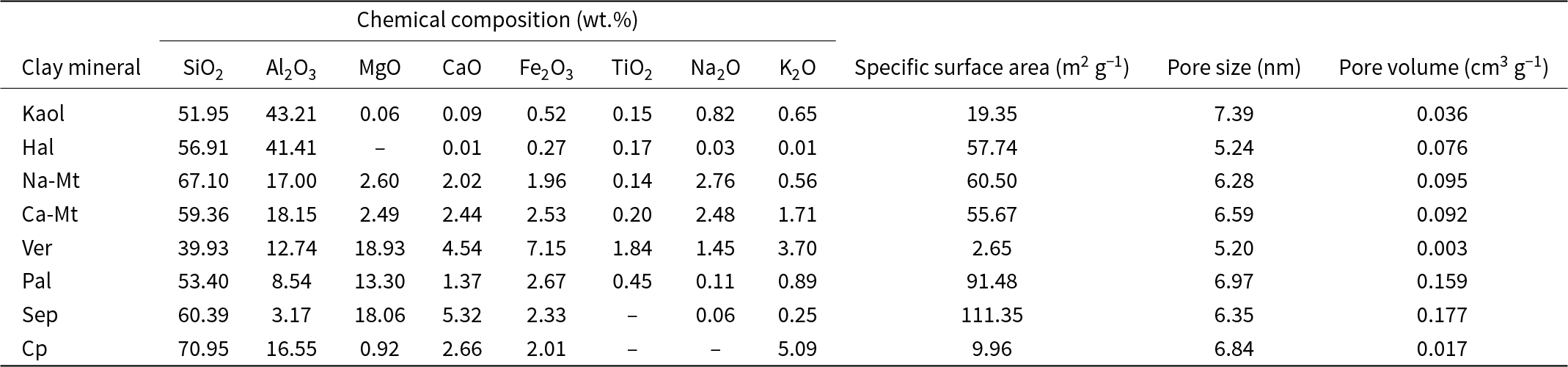
Clay minerals typically have rich porous structures and high specific surface areas, enabling them to adsorb CO2 through van der Waals forces or weak chemical bonds. To elucidate the effects of tubular structures on catalyst performance, the pore-size distributions and pore volumes of the clay minerals were tested, and their specific surface areas were calculated using the BET method, as reported in Table 1.
Chemical composition and physical parameters of the clay minerals.

Clay minerals can be used as low-dielectric-constant catalysts containing a porous structure, which, when applied in concert with a DBD system, can generate micro-discharges between particles and in the pores, leading to energy concentration and the formation of denser plasma actives (Bogaerts et al., Reference Bogaerts, Zhang, Zhang, Van Laer and Wang2019). Previous simulations and experimental studies have shown that larger pore structures can be more favourable for plasma formation (Hensel et al., Reference Hensel, Martisovit, Machala, Janda, Lestinsky, Tardiveau and Mizuno2007; Bogaerts et al., Reference Bogaerts, Zhang, Zhang, Van Laer and Wang2019).
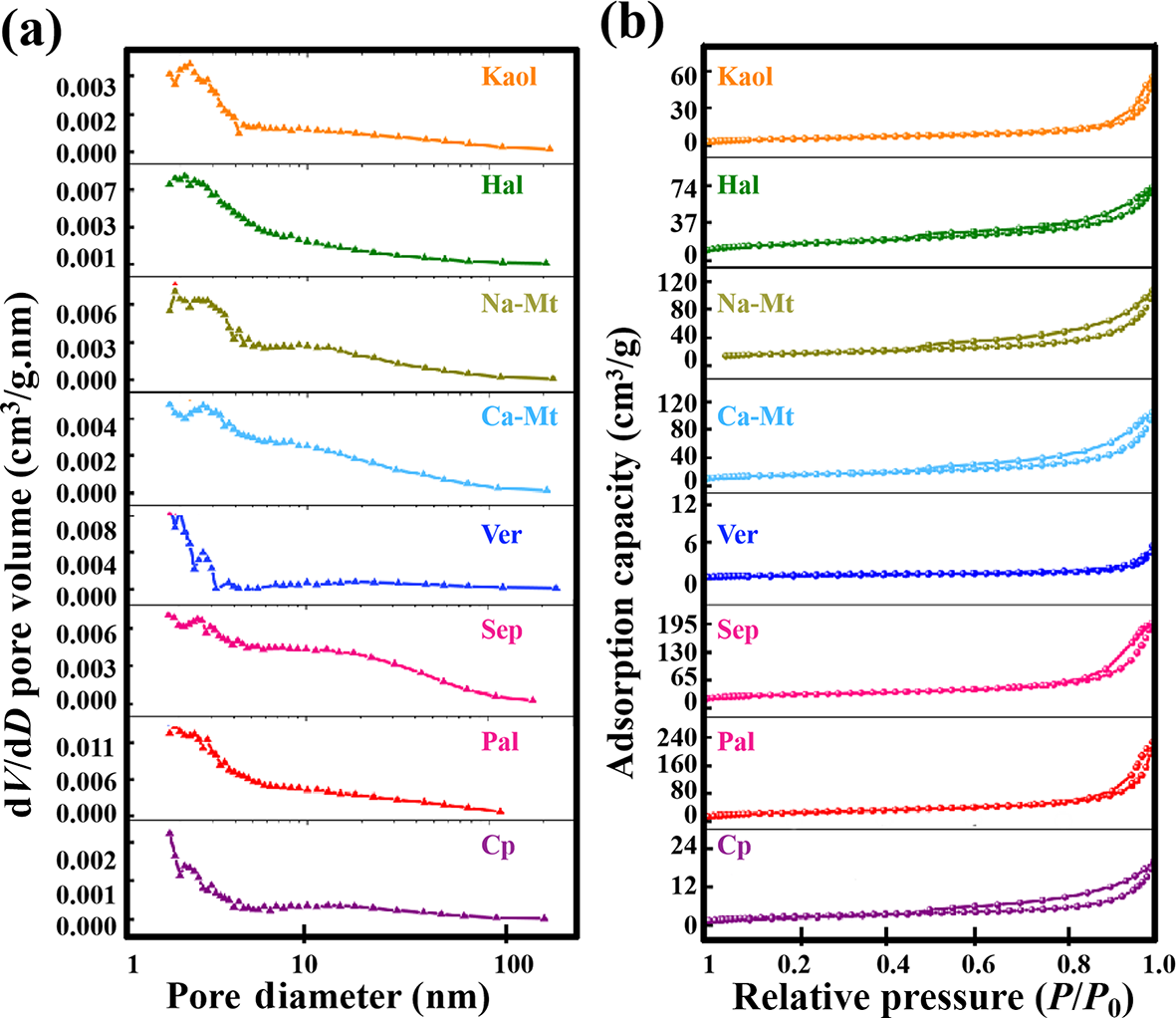
The reactive species produced by DBD can accelerate the CO2 reduction reaction, and as the bond strength of adsorbed CO2 molecules is much weaker than in the gaseous state, the plasma can more easily break the bonds that activate the adsorbed CO2 atoms (Jwa et al., Reference Jwa, Lee, Lee and Y.S2013). The N2 adsorption–desorption curves of the eight clay mineral samples show similar trends, with hysteresis loops observed in the curves of each sample except Ver. The classification based on the adsorption–desorption curves belongs to the typical type IV, indicating that these samples mainly contain micropores (interlayer nanopores) and macropores (interparticle pores; Fig. 5a; Zhang et al., Reference Zhang, Qi, Li, Zhang and Sun2017b). The pore-size distribution of the clay minerals is concentrated below 10 nm. All clay mineral samples except Ver had larger pore volumes, which were more favourable for CO2 adsorption and the formation of active species. Therefore, the CO2 conversion rate of Ver was lower. In addition, Sep, Hal and Pal are one-dimensional (1D) tubular systems, whereas the remaining samples are two-dimensional (2D) tubular systems. In a flowing DBD-catalysed reaction system, those samples with a 1D tubular structure exhibited slower gas transfer and diffusion kinetics compared to those samples with the more accessible 2D tubular system (Lo & Taghipour, Reference Lo and Taghipour2021). This intrinsic mass transfer limitation explains the generally lower CO2 conversion observed for Sep, Hal and Pal. However, Sep, possessing the largest pore volume (0.177 cm3 g–1) among all of the samples, showed a slightly better CO2 conversion performance, as its high porosity partially compensated for these diffusional constraints (Fig. 5b).
(a) N2 adsorption–desorption isotherms and (b) pore-size distribution of the various clay mineral samples.

These characterization results are consistent with the test results, fully demonstrating that the catalytic performance of those clay minerals with a 2D tubular structure and large pore size contributes to the improved catalytic conversion of CO2 under DBD conditions.
Surface hydroxyl groups and framework vibrations
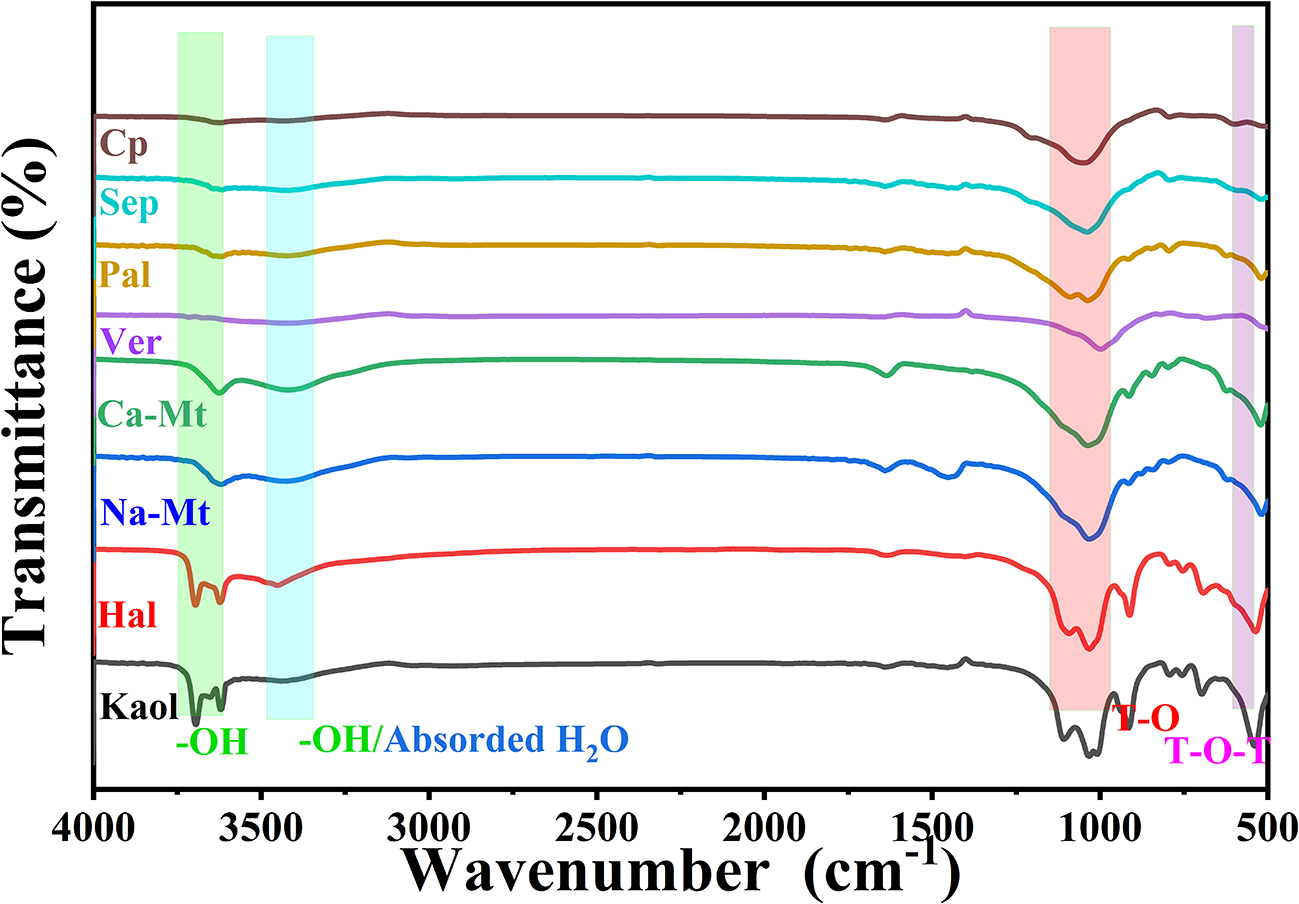
The concentration of reactive hydroxyl groups on the surface of clay minerals positively affects the CO2 adsorption process and CO desorption process (Wang et al., Reference Wang, Shen, Jin, Tian, Li and Zhou2019). Considering the different surface hydroxyl concentrations of clay minerals, the surface hydroxyl groups of the minerals were characterized using FTIR spectroscopy. The peak near 3600 cm–1 is attributed to –OH. The –OH characteristic peaks of Ca-Mt and Na-Mt are weaker, whereas those of Kaol and Pal are stronger, which corresponds to the lower CO selectivity of the former and the higher CO selectivity of the latter in the test results. This correlation can be understood from two aspects. Firstly, surface hydroxyls act as Lewis base sites, interacting with the acidic CO2 molecules to form surface bicarbonate-like species, thereby enhancing chemical capture. Secondly, during the plasma-driven process, these adsorbed intermediates are more readily activated and dissociated to form CO. Furthermore, an optimal coverage of surface hydroxyls may facilitate the desorption of the CO product, preventing its over-hydrogenation to CH4 or polymerization into carbon deposits. The presence of proximal hydroxyl groups may also stabilize key reaction intermediates. Furthermore, an optimal coverage of surface hydroxyls is crucial, as this facilitates the desorption of the CO product. Efficient desorption prevents the prolonged residence of CO on the surface, thereby mitigating its over-hydrogenation to CH4 or its polymerization into carbon deposits, which is a common deactivation pathway. This explains the superior CO selectivity of Kaol and Pal, which possess abundant surface –OH groups. Beyond the surface hydroxyls, the intrinsic tetrahedral–octahedral–tetrahedral (T-O-T) framework vibrations of the clay minerals, observed in the lower-wavenumber region (900–1100 cm–1) of the FTIR spectra, also contribute to the catalytic process. These lattice vibrations influence the dielectric properties of the minerals, potentially enhancing the local plasma discharge intensity and promoting the generation of reactive species when coupled with the DBD electric field. A stable yet responsive T-O-T framework thus provides a favourable microenvironment for the plasma–catalytic synergy.
From these results, it can be concluded that a higher concentration of surface –OH in clay minerals can enhance CO2 adsorption and simultaneously increase CO desorption in the DBD-catalysed process, thus affecting the CO2 conversion and the selectivity of the reduction products. The underlying T-O-T framework supports this process by modulating the plasma–catalyst interaction and providing structural stability (Fig. 6).
FTIR spectra of the various clay mineral samples.

Metal active sites
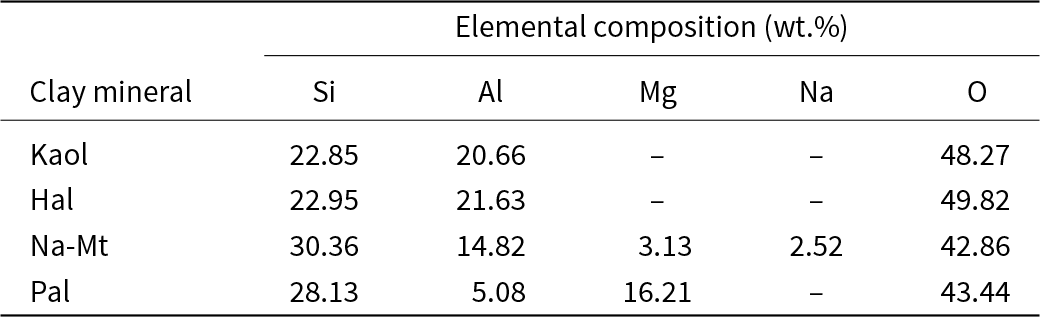
Different clay minerals have different metal contents (Table 2). Na-Mt and Kaol with high CO2 conversion and Hal and Pal with high CO selectivity were characterized by XPS to investigate the effects of metal active sites on their catalytic performance.
Element compositions of Kaol, Hal, Na-Mt and Pal.

Due to the isomorphism of clay minerals, Al3+ and Si4+ are partially replaced by some low-valent cations such as Mg2+ and Na+ (Table 2). The introduction of low-valent cations makes the lattice of clay minerals negatively charged and forms some basic sites on their surfaces and in their pores, which contributes to the adsorption of weakly acidic CO2 (Lo & Taghipour, Reference Lo and Taghipour2021). In addition, due to the cation exchange, the basicity of Na-Mt is enhanced, so that it can better adsorb CO2, thus obtaining a greater CO2 conversion rate.
It has been shown that Mg2+ in clay minerals can provide more surface basic sites for CO2 adsorption (Xie et al., Reference Xie, Wang, Zhang, Deng and Wang2014) and can improve CO2 conversion after DBD activation. However, the amount of low-valent cations exchanged in pristine clay minerals is usually small (Liu et al., Reference Liu, Tournassat, Grangeon, Kalinichev, Takahashi and M.M2022), and even after DBD-assisted activation the effect of a small amount of cations on improving CO2 conversion is small. Thus, the CO2 conversion of Kaol and Hal, which contain almost no Mg2+, is greater than that of Pal, which contains more Mg2+.
Although alkaline oxides can increase the number of alkaline active sites and enhance CO2 adsorption capacity, metal oxides containing 3d orbitals (e.g. Fe2O3) suffer from restricted oxygen atom mobility. This hinders the timely desorption of CO species adsorbed on the catalyst surface. This not only reduces the number of available surface active sites for adsorption but may also trigger CO re-disproportionation reactions, thereby adversely affecting CO2 conversion rates. More notably, strong basic oxides such as CaO can readily react with CO2 under plasma conditions to form stable carbonate byproducts. This process not only consumes reactant CO2 but also can block active sites, leading to catalyst deactivation. This provides a plausible explanation for why Ca-Mt, with its relatively high CaO content (2.44 wt.%), exhibited lower CO selectivity (78.3%) than the catalyst-free DBD condition (83.7%; Wang et al., Reference Wang, Liu, Fu, Cai, Li and Long2021). Therefore, this further resulted in a slightly lower selectivity of Ca-Mt to CO (78.3%) than that of the DBD-only condition (83.7%). In addition, carbon deposition reactions are also present on the clay mineral surface during the reaction, affecting product selectivity, and the resistance to carbon deposition is related to the alkalinity of the clay mineral surface (Wang et al., Reference Wang, Liu, Fu, Cai, Li and Long2021). Increasing the number of alkaline sites in the clay mineral and providing more oxygen species can accelerate the elimination of carbon deposition and improve product selectivity.
This characterization is consistent with the experimental results from this study, demonstrating that clay minerals with an appropriate amount of alkali metal sites can achieve greater CO2 conversion rates and CO selectivity in the DBD-catalysed conversion of CO2.
Interlayer water
To date, the effect of the water content of clay minerals on CO2 adsorption performance has been studied. When the water content is low, CO2 can be better adsorbed on the surface of clay minerals, whereas with increasing water content, H2O will hinder the adsorption of CO2 molecules. For example, Schaef et al. (Reference Schaef, Loring, Glezakou, Miller, Chen and Owen2015) carried out research on the adsorption of CO2 by montmorillonite from a near-anhydrous state to having a high water content, and they found that with increasing water content, the interlayer spacing of montmorillonite increased, the adsorption of CO2 was inhibited and the adsorption capacity decreased significantly. The interlayer water and adsorbed water in clay minerals will be dissociated by the plasma during the reaction process, generating hydroxyl radicals, and the generated hydroxyl radicals will quickly recombine with CO to produce CO2 again, thus reducing the CO2 conversion rate (Wang et al., Reference Wang, Zhao, Li and Wang2018; Li et al., Reference Li, Ongis, Manzolini and Gallucci2021). The water contents of the four samples in the current study were analysed based on the XRD results and the literature, and it was observed that these four clay minerals exhibit distinct hydration characteristics. Kaol contains only tightly bound structural hydroxyl water, whereas montmorillonite harbours weakly bound zeolite water within its pores. Na-Mt contains substantial amounts of interlayer water associated with exchangeable cations, with its content varying significantly across samples. Hal uniquely possesses both interlayer water and structural hydroxyl water (Liu et al., Reference Liu, Tournassat, Grangeon, Kalinichev, Takahashi and M.M2022; Gray-Wannell et al., Reference Gray-Wannell, Cubillas, Aslam, Holliman, Greenwell and Brydson2023). The presence of interlayer water is evidenced by the characteristic peak of Hal appearing at 20.07°2θ (Fig. 2g). Pal demonstrates strong water absorption and is more prone to adsorbing H2O generated during the reaction process. In addition, it has been found that an increase in the water content also reduces the adsorption capacity of clay minerals for CO2 (Hussain et al., Reference Hussain, Akhter, Russo and Saracco2015; Chen et al., Reference Chen, Madden, Pham, Forrest, Kumar and Yang2016). Therefore, lower interlayer water contents and weaker hydrophilicity will contribute to the catalytic conversion of CO2 under conditions of synergistic interaction with plasma. This result corresponds to the fact that the CO2 conversion performance of Kaol, which has almost no interlayer water, is better than that of Hal, which has more interlayer water. It is also better than that of Pal, which has greater hydrophilicity.
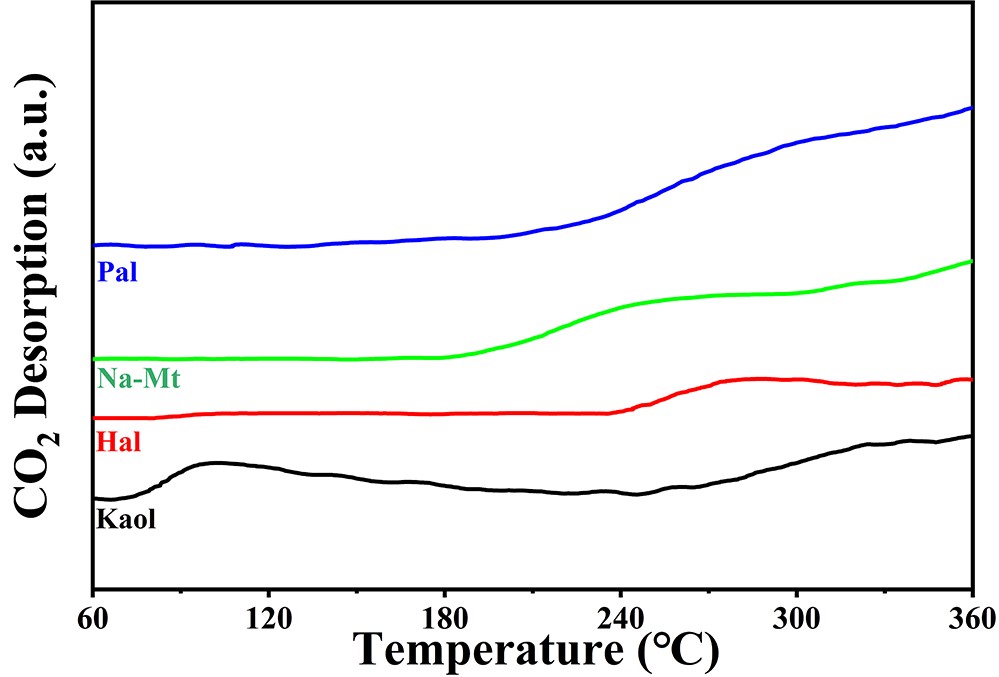
To further elucidate the surface alkalinity and CO2 adsorption capacity of clay minerals, CO2-programmed temperature desorption tests were conducted (Fig. 7). Kaol exhibited desorption peaks in the low-temperature region, potentially related to its weakly basic sites. Concurrently, its moderately strong basic sites ensured high CO2 conversion rates. However, Na-Mt, which exhibited the highest CO2 conversion rate, showed a strong CO2 desorption peak in the medium-temperature region. The strong adsorption of CO2 at these sites facilitates its activation within the plasma zone and subsequent reactions. Conversely, Hal displayed a relatively weak overall desorption signal, indicating fewer alkaline sites, thereby enabling greater CO selectivity but lower conversion rates. The strong signal observed for Pal may be attributed to the removal of zeolite water, demonstrating that surface hydroxyl groups positively influence CO selectivity. Simultaneously, a lower water content improves CO2 adsorption, whereas appropriately sized alkali metal sites boost CO adsorption, playing a critical role in achieving high CO2 conversion rates.
CO2-programmed temperature desorption of Kaol, Hal, Na-Mt and Pal.

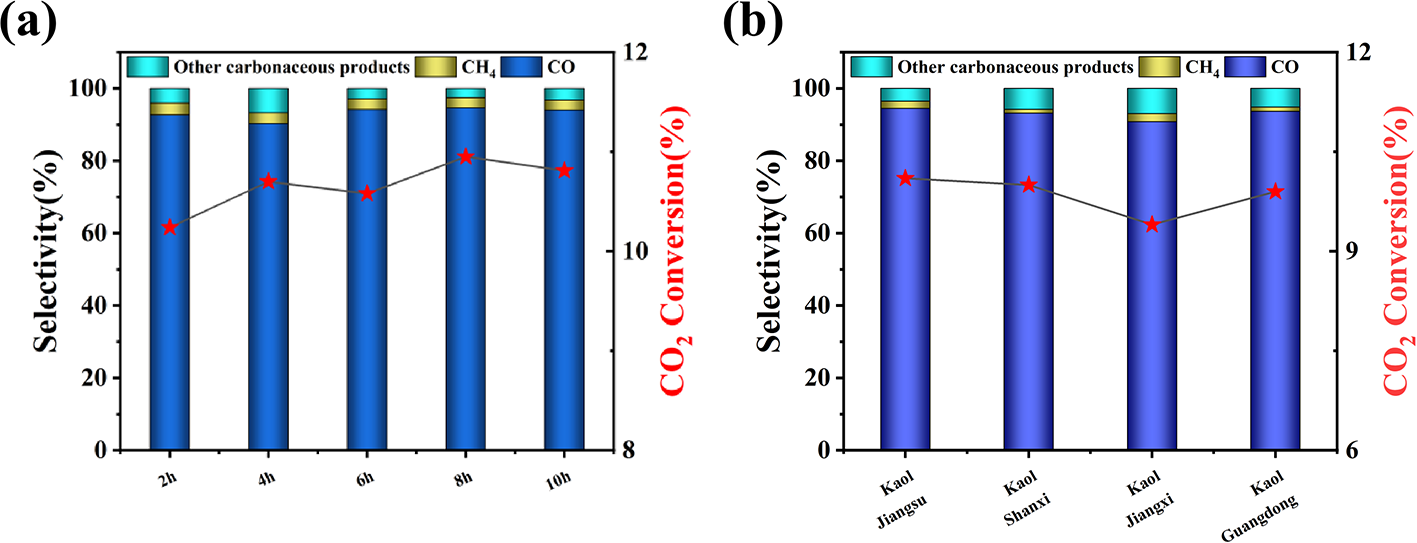
Similarly, cyclic stability testing was conducted on the Kaol sample exhibiting the best catalytic performance. Within the catalytic system, the CO selectivity of the Kaol sample reached its peak after 6 h and remained stable for 10 h, demonstrating excellent catalytic performance and stability (Fig. 8a). We also compared the catalytic performance of Kaols from various origins (including Jiangsu, Shanxi, Jiangxi and Guangdong), and we found that their catalytic properties were largely comparable. Among these, Kaol from Jiangsu exhibited the greatest CO2 conversion rate and CO selectivity, indicating that this reaction system is generally applicable to Kaol minerals (Fig. 8b).
(a) Cycling stability testing of Kaol catalysts in CO2 conversion processes and (b) catalytic performance of Kaols from various origins.

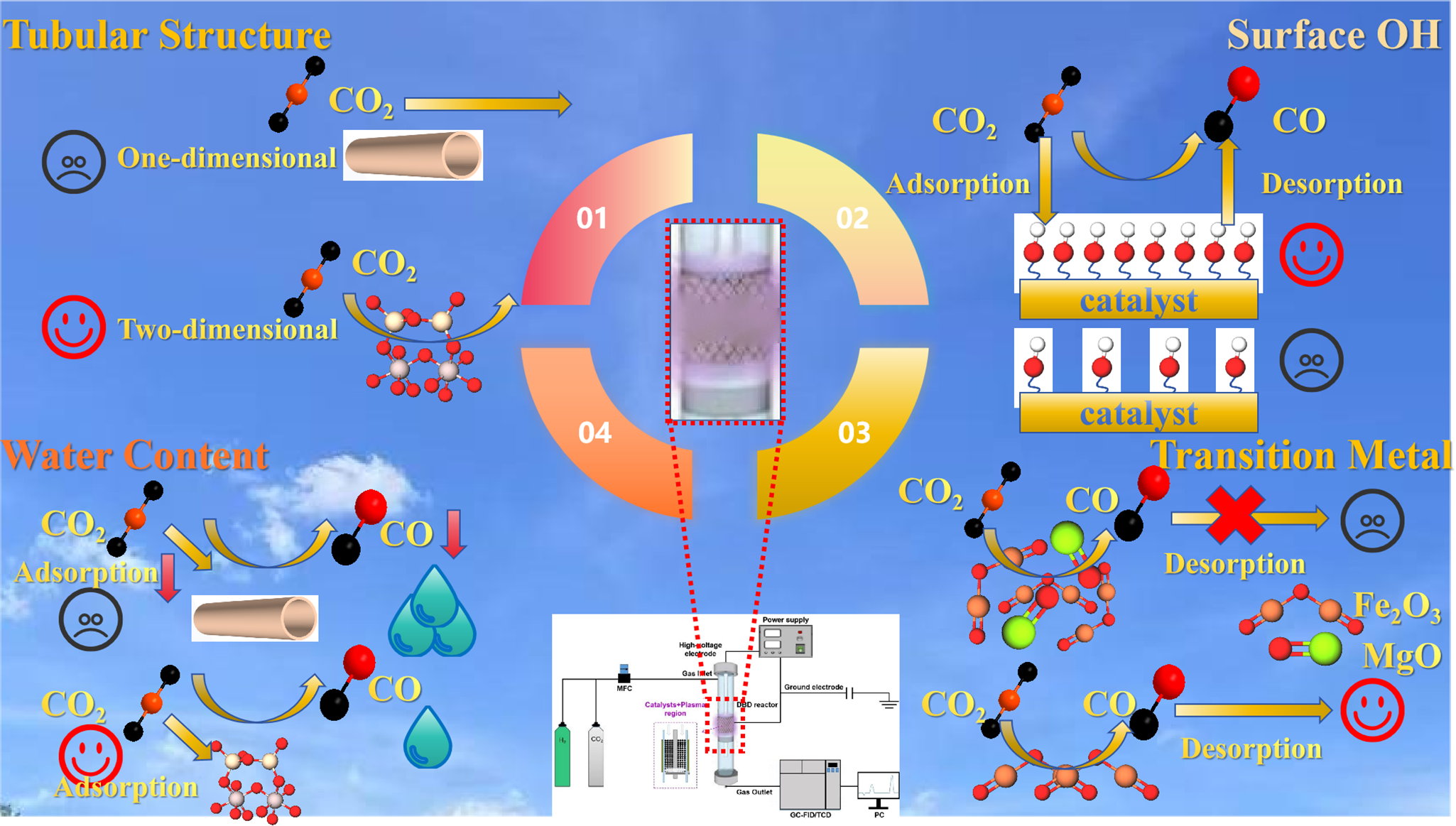
From these results, it can be concluded that the appropriate structures of the clay minerals in this catalytic system are conducive to this reaction. First, the surface structure and pore structure of clay minerals can enrich and confine CO2 molecules through their surface hydroxyl (–OH) groups and alkali metal sites. Simultaneously, high-energy electrons and reactive species generated by DBD discharge can interact with CO2 adsorbed on the clay mineral surface, forming surface intermediate species. Subsequently, under the influence of reactive species, the intermediates are reduced to CO, which then desorbs from the hydroxyl-rich surface. In this process, the 2D pore structure enhances CO2 capture, whereas a low-moisture environment prevents CO from being reoxidized back to CO2. Additionally, suitable alkali metals facilitate CO2 adsorption and prevent excessive adsorption of carbon-containing species on the clay surface. This entire process demonstrates the multiscale synergistic effects between the structural characteristics of clay minerals and the plasma in the energy supply and species activation (Fig. 9).
Schematic of the mechanism of synergistic plasma catalysis by clay minerals. FID = flame ionization detector; MFC = mass flow controller; TCD = thermal conductivity detector.

Conclusion
In this work, the co-catalysed CO2 conversion by DBD with eight typical clay minerals was investigated, in which the CO2 conversion of Kaol was 1.6 times greater than that observed in the DBD-only condition, and the CO selectivity was 94.5%, demonstrating that clay minerals can be used as well-performing, green and low-cost DBD catalysts. The influence of the structural properties of clay minerals on DBD-assisted CO2 conversion was also systematically investigated. The results indicated that clay minerals with a 2D pore structure, more surface hydroxyl groups, suitable transition metal active components and low water content demonstrated better catalytic performance and product selectivity. This work highlights a low-cost green catalyst for the DBD catalytic system, as well as new ideas and guidance for further application and optimization of clay minerals in DBD catalytic reactions.
Data availability
The data that support the findings of this study are available from the corresponding author upon reasonable request.
Financial support
This work was supported by the Beijing Natural Science Foundation (No. 2232061) and the National Natural Science Foundation of China (No. 42377227, 52272094).
Competing interests
The authors declare none.