The early 1990s witnessed a bizarre interaction between states and international bureaucrats. In response to the global HIV/AIDS pandemic, the World Health Organization (WHO) and five other international bureaucracies had set up proprietary programs dealing with the problem. Large amounts of money were at stake. In just one year, for example, the WHO alone raised $37 million in extra-budgetary funds for its in-house AIDS program. The United Nations Development Program, the World Bank, and other organizations strove for similar fundraising for their AIDS projects. But the demands of six bureaucracies, each running its own AIDS program, eventually angered wealthy donor countries. In 1993, these states declared that a new international intergovernmental organization (IGO) must be created to take over all AIDS-related work. The six international bureaucracies openly condemned the idea and vowed to thwart any attempts to launch such a body. And yet, wealthy donor states did something puzzling: rather than creating the IGO themselves, they handed the task to bureaucrats in the six organizations. This resulted in the formation of the Joint United Nations Program on HIV/AIDS (UNAIDS).
This contravenes the predictions of conventional principal-agent (P-A) theories: as preference divergence between agents and principals increases, agent discretion should decrease.Footnote 1 Standard P-A theories suggest that states delegate policy formation to international bureaucrats for informational gain but limit the bureaucrats' discretion in order to prevent agency slippage. If states and international bureaucrats disagreed, why did states allow so much agent discretion in the creation of UNAIDS? Why did states depend on the very people who had threatened to undermine any new IGO? More generally, why would agents who openly oppose their principals nevertheless gain broad discretion?
The question has general relevance to IGO research for two reasons. First, approximately two-thirds of the IGOs that exist today were created with involvement by international bureaucrats employed in preexisting IGOs.Footnote 2 Sometimes this involvement is circumscribed, with international bureaucrats simply supplying secretariat services for states' negotiations. Other times, their discretion is more substantial: they may participate in design negotiations, initiate conferences that bring states' attention to the need for new designs, or even develop design plans of their own.Footnote 3
Second, international bureaucrats can exert considerable influence in IGO design.Footnote 4 The case of UNAIDS provides an example. Granted substantial discretion by states, international bureaucrats from the WHO and five other secretariats implemented an unusual element when they crafted UNAIDS. In addition to rotating seats for states' representatives, the new IGO's Program Coordinating Board (PCB) includes permanent seats for bureaucrats from the WHO and the other relevant IGOs. Even more notable, the PCB reserves seats for five civil society representatives from various regions.Footnote 5 The international bureaucrats designing UNAIDS discarded a long-standing norm in UN organizations against third-party representation, and this institutional design feature has afforded an extraordinary amount of clout to intergovernmental and nongovernmental organizations.
Our theory encompasses this and offers more generalizable insights about IGO creation. We develop a formal model in which a coalition of states first decides between working within the status quo or launching a new IGO. If the coalition of states chooses to discard the status quo, it next shapes how much discretion the staff of an existing IGO has in the design of the new body. Our model implies that when states need expertise held by an international bureaucracy, the international bureaucracy may operate with considerable design leeway regardless of whether its design preferences diverge from those of the states. Discretion is a way for states to “sweeten the pot” and thus secure costly design effort from international bureaucrats. This, we show, explains why states delegated the design of UNAIDS to bureaucrats with very different preferences.
To examine the generalizability of the argument, we employ an original data set that covers the origins of randomly selected IGOs. If our theoretical model is empirically relevant, we should not only see international bureaucrats regularly participating in IGO design, but a positive association should exist between states' need for expertise and the depth of bureaucratic discretion in the design process—regardless of whether bureaucrats' design preferences mirror those of states. In line with previous work,Footnote 6 we find that only a minority of the universe of intergovernmental organizations was created by states alone. For 65 percent, international bureaucrats participated in the design process.Footnote 7 Cross-tabulations also indicate that international bureaucrats' institutional design leeway increases as the need for expertise increases. More starkly, we uncover a distinctive characteristic of the minority of intergovernmental organizations that were launched by states without international bureaucrats: these organizations tend to be political forums, bodies that serve largely as “talk shops” for states and do not require much bureaucratic expertise.
This article contributes to several strands of the cooperation literature. For one thing, we advance the literature on institutional design by theorizing about the role of international bureaucrats. Previous research emphasizes that cooperation problems affect institutional design,Footnote 8 and we draw attention to the neglected question of whose cooperation problems are important. If states need bureaucratic expertise, and the bureaucracy expects a high cost from expending design effort, then relevant cooperation problems involve not only states but also international bureaucrats.
Furthermore, we contribute to the literature on principal-agent relations by showing that the scope of P-A models in international politics is broader than previously recognized. Extant P-A studies have focused largely on policy implementation,Footnote 9 but we show that the very process of designing IGOs also can be modeled fruitfully as a P-A problem. To facilitate future research along these lines, we provide a series of model extensions that allow us to derive predictions regarding the effects of multiple principals and competing agents.
Finally, we provide new insights into the factors that determine the effects of IGOs on state behavior. If international bureaucrats exert considerable influence on IGO design, a P-A model of IGO design can help scholars explain variation in the effects that IGOs ultimately have on policies and outcomes. International bureaucrats' design preferences shape IGO design. IGO design, in turn, is an important determinant of IGO effects.Footnote 10
Theory and Hypothesis
To shed light on the role of international bureaucrats in IGO creation, we develop a model that builds on P-A theories.Footnote 11 In our model, a state is faced with a new cooperation problem that extant IGOs are not equipped to handle well.Footnote 12 This “state” can be regarded as a leading state, or alternatively as a coalition comprising multiple states.Footnote 13 The state considers the possibility of establishing a new IGO.
The state holds preferences over design outcomes. It prefers an IGO that effectively responds to the new cooperation problem. Effectiveness depends on the design and structure of the new IGO. For example, the rational design literature emphasizes that voting rules and dispute resolution rules influence cooperation outcomes.Footnote 14 The state would prefer to align the design of the IGO with the demands of the cooperation problem at hand. To do so, it could try to design the new IGO on its own, or it could enlist the help of international bureaucrats working within extant organizations.
The new cooperation problem is assumed to stem from an exogenous shock. Such shocks come in many forms: surging commodity prices, environmental degradation, the outbreak of a communicable disease, and so on. This exogenous shock, which may itself pertain to a technical issue, creates demand for cooperation, which in turn requires policy coordination, pooling of resources, enforcement, bargaining, delegation of authority, and so on. States are assumed to benefit from designing an IGO that can facilitate cooperation.Footnote 15 To illustrate, we can foreshadow our case study of the International Energy Agency (IEA). Following the 1973 oil shock, industrialized countries faced a completely new economic context, and there was a clear need for coordinating policies, such as the use of strategic petroleum reserves. The Organisation for Economic Co-operation and Development (OECD), which would have been a natural organization for cooperation, was paralyzed because some industrialized countries used the organization's unanimity rule to block initiatives for policy coordination. Thus, a subgroup of OECD member-states demanded a new IGO to address the cooperation problems created by the oil shock.
The IEA example shows the need for further commenting on our assumption that the “state” may be a coalition of states. In practice, states often have diametrically opposed preferences. In such circumstances, our model's assumptions hold if there is a leading state, or a coalition of states, with the ability to act despite other states' objections. As in the IEA case, a subgroup of states could seek a new IGO in spite of the opposition of another subgroup of states, and our theory would shed light on both subgroups' incentives and choices. This argument applies to the IEA case, as the opponents of energy policy coordination could not prevent the majority of industrialized countries, led by the United States, from moving their cooperation to the newly created IEA. However, our model is not applicable if vocal opponents of a new IGO can effectively block the proponents from acting. In that situation, with the opponents of a new IGO having more bargaining power, states could not enlist international bureaucrats for IGO design in a mutually profitable fashion.
First Stage: Choosing Whether to Delegate
Our model has two stages: (1) choosing whether to delegate to an agent; and (2) conditional on delegation, choosing agent discretion. In the first stage, the state decides whether to delegate institutional design tasks to international bureaucrats in preexisting IGOs.
If the state chooses not to delegate, it has two alternative strategies. For one thing, the state can choose to retain the status quo and not create a new IGO at all.Footnote 16 However, retaining the status quo is costly for the state. This is because changed circumstances call for a new policy that is difficult to implement without functions such as centralization and coordination, which are more effective if based on formal rules and structures in a new IGO.Footnote 17 The status quo is also costly for the bureaucrat because it cannot reap the benefits from designing a new IGO according to its own preferences.
Even if the state does opt to create a new IGO, it does not have to delegate design tasks to international bureaucrats in preexisting IGOs. It can undertake unilateral action and create a new IGO without external assistance. This allows the state to design the IGO according to its own preferences. However, because the creation of a new international intergovernmental organization requires a detailed understanding of how an IGO is operated under international anarchy, the state cannot easily rely on its national bureaucrats or scientific institutions for solutions.Footnote 18 In other words, because the management of the cooperation problem itself requires delegation to a new IGO, we assume that not all of the needed information is available at the national level, and therefore the state lacks expertise on how the new IGO should be designed. Consequently, on its own the state may unintentionally design a dysfunctional IGO. The magnitude of this risk depends on how complex the IGO design problem is. This complexity may reflect both technical difficulty and the novelty of the cooperation problem at hand, as well as a combination of the two.
But another option is delegation: making use of international bureaucrats in preexisting IGOs, the state can become a principal and hand institutional design tasks to a bureaucrat-agent.Footnote 19 Because the bureaucrat-agent has operated an intergovernmental organization, it has valuable expertise. For example, a bureaucrat-agent who has operated a regional economic organization for years probably has a good understanding of the implications of institutional design for a new economic organization. Consequently, the bureaucrat-agent can more effectively design a new IGO to match the demands of the cooperation problem at hand.
If an extant international bureaucracy possesses useful expertise, why would states ever opt to create a new IGO? Why not minimize transaction costs by relying on the extant IGO to address the new cooperation problem itself? States turn to the costlier approach of creating a new institution when the existing constellation of institutions offers no suitable venue.Footnote 20 But it is important to avoid conflating the lack of a suitable venue with a lack of useful expertise. For one thing, expertise may be dispersed across existing institutions. In the case of UNAIDS, for example, the new cooperation problem did not fit neatly within a single extant IGO and yet, six different agencies possessed expertise about the pandemic's medical, economic, and other facets. Furthermore, an existing institution may suffer from handicaps (for example, institutional capture) that are unrelated to expertise.Footnote 21 This is what prompted the design of the IEA, an IGO that was created instead of expanding the OECD. While OECD bureaucrats had expertise in managing energy supplies, a minority of member-states used the organization's unanimity rule to prevent OECD bureaucrats from actually releasing those supplies in response to the oil crisis. UNAIDS and IEA illustrate a critical point: an international bureaucracy can possess valuable expertise for the institutional design process, even if its own organization is not well equipped to handle the new cooperation problem itself.
Second Stage: Choosing Design Discretion, Conditional on Delegation
If the state-principal delegates, it must select how much discretion to grant. Low levels of discretion imply that the bureaucrat-agent has limited influence on the design outcome, whereas high levels of discretion imply the opposite. Discretion allows the state-principal to capitalize on the bureaucrat-agent's expertise. So, why would the state-principal not allow full discretion? The reason is that the bureaucrat-agent has independent preferences over IGO design, and these may diverge from those of the state-principal. For instance, the bureaucrat-agent may prefer to design the IGO in ways that privilege itself with influence over future policy formation. Thus, a tension exists: the state-principal needs the expertise of the bureaucrat-agent, but the state-principal also worries about possible abuse of discretion.
Generally, international bureaucrats would rather participate in institutional design negotiations than be excluded. To be sure, the bureaucrat-agent may be hesitant because the new IGO is a potential competitor: any new IGOs will draw from the same pool of resources and responsibilities that preexisting IGOs do. Nevertheless, international bureaucrats also have a stake in institutions with which they will work. They understand that if a new IGO is created, it begins to operate even without their input. Therefore, international bureaucrats from preexisting IGOs would rather be inside than outside of design negotiations, so that they are better positioned to shape institutional designs to be more favorable to their own interests.
However, the bureaucrat-agent's incentive to participate does not ensure that it has an incentive to exert costly effort on behalf of the state-principal's interests. In other words, international bureaucrats would rather participate than be excluded from design negotiations—but they are not automatically inclined to expend effort to collect information, conduct analyses, and implement the new IGO design for the principal. Thus, an important feature of our model is that the bureaucrat-agent can choose to “shirk” by not fully investing its expertise in the IGO design process. It may choose to do so because competent IGO design requires costly effort. For one thing, working to design an effective new IGO comes at an opportunity cost: the resources and expertise expended in resolving the state-principal's new cooperation problem could have been conserved to address other problems or improve the operation of the bureaucrat-agent's home IGO. But sometimes effort entails an even greater cost: the new organization may wrest responsibilities away from the bureaucrat-agent's own IGO. International bureaucrats pay close attention to this possibility, which would make their design costs high.
But if the bureaucrat-agent fails to exert costly effort, then the new IGO will function no better than if the state simply had undertaken design on its own, without delegating at all.Footnote 22 How, then, can the state-principal prompt the bureaucrat-agent to employ its useful expertise and invest in IGO design? By increasing discretion, the state-principal can make design efforts more beneficial to the bureaucrat-agent, who has greater leeway to design the new IGO in ways that privilege itself over future policy formation. According to our theory, discretion thus has a dual rationale: not only allowing states to benefit more from the bureaucrat-agent's expertise, but also increasing the bureaucrat-agent's expected payoff from exerting costly effort in IGO design.Footnote 23
It is worth noting that our theory emphasizes the state-principal's ex ante regulation of discretion. We assume the state-principal can select the level of discretion but does not punish the bureaucrat-agent ex post for shirking. However, our theory can readily accommodate the possibility of ex post punishments and rewards.Footnote 24 For example, the state-principal could punish or reward the bureaucrat-agent through incentives such as promotions, or opportunities with national administrations. Conversely, shirking bureaucrats are deprived of these lucrative rewards. As the state-principal's ability to administer ex post punishments and rewards increases, the need to constrain discretion decreases.
Empirical Expectations
The theory has two stages: the decision to delegate and, conditional on delegation, the choice of discretion. We begin by summarizing the logic of delegation and then discuss our main hypothesis concerning the level of discretion.
In the initial stage, how does the state choose whether or not to delegate? One important determinant is state-bureaucracy preference divergence. The preferences of the state are unlikely to be mirrored exactly by international bureaucrats, and therefore three broad types of preference divergence are possible. Figure 1 shows these three preference constellations in a unidimensional IGO design space. In each, the ideal point of the state-principal (State) and the ideal point of the bureaucrat-agent (Bureaucracy) diverge from the status quo.
Preference constellations

In Figure 1, the first constellation portrays diametrically opposed preferences: the state and the bureaucracy prefer design outcomes on opposite sides of the status quo. Here, any shift away from the status quo in either direction is harmful to one of the two players, so a mutually profitable delegation act is impossible. The state must either retain the status quo or act unilaterally. Without delegation, the state never proceeds to the second stage of selecting an agent's discretion level.
In contrast, a mutually profitable delegation act is possible under two other types of preference divergence. The second preference constellation in Figure 1 portrays “conservative bureaucrats”: both actors have a common interest in a leftward shift away from the status quo, but the state-principal prefers a more radical shift than the bureaucrat-agent does. The third preference constellation portrays “revisionist bureaucrats”: both actors have a common interest in a leftward shift away from the status quo, but the bureaucrat-agent prefers a more radical shift than the state-principal does. In short, barring diametrically opposed preferences, delegation is possible regardless of whether the potential bureaucrat-agent is conservative or revisionist.
In the initial stage, if the state chooses not to delegate, how does it select between undertaking unilateral action and retaining the status quo? The pivotal factor, as shown in Figure 2, is the level of specialized expertise needed to design a new and effective IGO. If the need for specialized expertise is low, then the state may be equipped to act unilaterally to design a new IGO. Empirically, this scenario would play out when an exogenous shock creates a new cooperation problem for which extant IGOs do not provide a suitable venue, and yet there is little uncertainty about how a new IGO should be created (perhaps because states themselves have designed similar organizations in the past).Footnote 25 However, if the need for specialized expertise is high, then the state may need to retain the status quo, without creating a new IGO. In other words, when the need for specialized expertise is high, states would either enlist the help of international bureaucrats if delegation is possible, or retain the status quo if delegation is not possible. This suggests an observable implication: when looking at IGOs that actually have been created, we expect to see that states create IGOs unilaterally only when the need for specialized expertise is low. We will employ quantitative data to evaluate this implication.
Contrasting scenarios with low or high need for expertise

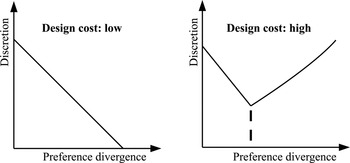
When the need for specialized expertise is high rather than low, the state becomes increasingly willing to delegate even when international bureaucrats' design cost and the state-bureaucracy preference divergence are fairly high. In fact, the need for expertise also is an important consideration when mutually beneficial delegation is possible. Figure 2 plots state-bureaucracy preference divergence versus the bureaucracy's design cost, highlighting the “zone” in which delegation is expected to occur. The left graph depicts this zone when the need for specialized expertise is low, while the right graph depicts this zone when the need for specialized expertise is high. Note how the zone of delegation expands as the need for expertise increases: if the state is in great need of the expertise possessed by the international bureaucracy, then delegation is expected even when the bureaucracy's design cost and the state-bureaucracy preference divergence are fairly high.
Having explained the logic of delegation, we can now focus on our primary research question: what explains variation in discretion conditional on delegation? The following is our primary hypothesis:
Consider the case of conservative bureaucrats when the bureaucrat-agent's design cost is high. As the bureaucrat-agent's ideal point shifts away from the state-principal's preference and toward the status quo, discretion increases.
This hypothesis initially seems counterintuitive, because conventional P-A theories predict that increases in principal-agent preference divergence result in decreases in agent discretion. But here, design discretion increases with preference divergence, because the state-principal has to entice the bureaucrat-agent to invest in the design of a new IGO. Additional design discretion is an inducement that sweetens the pot for the bureaucrat-agent, and thus secures the bureaucrat-agent's effort in the design of the new IGO. Increasing discretion has a dual rationale: it allows the state-principal to benefit more from the bureaucrat-agent's expertise, but it also increases the bureaucrat-agent's expected payoff from exerting costly effort in IGO design.
Figure 3 shows how equilibrium discretion (vertical axis) varies with preference divergence (horizontal axis). On the left side, where the bureaucrat-agent's design cost is low, the state-principal selects an optimal level of discretion without worrying about securing costly effort from the bureaucrat-agent. Our hypothesis pertains to the conditions on the right side, where the bureaucrat-agent's design cost is high. The relationship between discretion and preference divergence starts out negative, because the bureaucrat-agent agrees with the state-principal that the status quo is bad. But as the bureaucrat-agent's ideal point moves toward the status quo, the negative relationship is replaced by a positive relationship: a high level of discretion is needed to induce effort. The state-principal must thus select between high discretion or no delegation at all.
Equilibrium discretion as a function of preference divergence, given conservative bureaucrats

If either of the conditions outlined in the hypothesis do not hold, the counterintuitive association between discretion and preference divergence disappears. Conventional P-A wisdom—that discretion is negatively correlated with principal-agent preference divergence—again would hold. To see this, suppose first that the bureaucrat-agent remains conservative, but its design cost is low rather than high. The left side of Figure 3 captures this difference. In such a situation, the bureaucrat-agent cannot credibly threaten to shirk, so the state-principal can easily secure the bureaucrat-agent's design effort. In contrast to the high-cost scenario, in the low-cost scenario there is now only a single rationale for discretion: it is not necessary for increasing the bureaucrat-agent's expected payoff from exerting costly effort, but it still enables the state-principal to capitalize on the bureaucrat-agent's expertise. Thus, for a conservative bureaucrat-agent with a low design cost, discretion increases as the bureaucrat-agent's ideal point shifts toward the state-principal's preference and away from the status quo.Footnote 26
Next, suppose that the bureaucrat-agent is revisionist rather than conservative. That is, compared to the state-principal, it is more interested in moving away from the status quo. In this case, we again expect conventional P-A wisdom to hold: for a revisionist bureaucrat-agent, discretion decreases as the bureaucrat-agent's ideal point moves away from both the state-principal's preference and the status quo. Since the bureaucrat-agent has a keen interest in avoiding the status quo, the state-principal need not sweeten the pot to induce the bureaucrat-agent to exert costly design effort.
Case Studies
We predict that, for a conservative bureaucrat-agent with a high design cost, institutional design discretion increases as the bureaucrat-agent's ideal point shifts away from the state-principal's preference and toward the status quo. In other words, contra conventional wisdom, the less the bureaucrat-agent's design preference mirrors that of the state-principal, the more discretion the agent enjoys. To test this hypothesis—and to demonstrate reversion to conventional wisdom when either the bureaucrat-agent is not conservative or its design cost is not high—we turn first to case studies.
The three cases probe the hypothesis both directly and indirectly. The direct test occurs in the UNAIDS case, where both of the hypothesis' conditions hold: the bureaucrat-agent's design cost is high, and the bureaucrat-agent is conservative. We show that even if international bureaucrats hold a design preference that differs markedly from the preference held by states, states may grant them substantial discretion in designing a new organization. This supports our hypothesis. Wealthy donor states demanded a new IGO to take over all AIDS-related programs within the UN system. However, international bureaucrats in WHO and five other UN agencies opposed this idea. They sought to protect their own turf and also to make sure that the fight against the pandemic was driven by victims' needs rather than funders' interests. But despite these conspicuous divergences from states' preferences, states invited the six secretariats to take a central institutional design role. International bureaucrats did so—for although they faced a high cost in organizational creation, states had compensated them by offering significant discretion in the institutional design arena.
The indirect tests of the hypothesis involve relaxing each of its two conditions in turn. The second case deals with the origins of the IEA, and it exhibits what happens if the high-cost condition of our hypothesis is relaxed. Unlike in the UNAIDS case, the relevant international bureaucracy faced a low design cost: while exerting effort in design negotiations imposed an opportunity cost on staff from the OECD, these bureaucrats knew that the new IGO would not wrest responsibilities and resources away from their own organization. Both OECD staff and certain states were genuinely alarmed by the status quo and recognized the need for a new organization, so they collaborated in designing it. States, needing specialized expertise to create the new IEA, welcomed participation by like-minded international bureaucrats facing a relatively low design cost.
The third case deals with the origins of the Caribbean Environment Program (CEP), and it exhibits what happens if the conservatism condition of our hypothesis is relaxed. If states want to move away from the status quo, but international bureaucrats want to move even further, states may move to limit the institutional design discretion of these “revisionist” bureaucrats. Bureaucrats from the UN Environment Program (UNEP) drew attention to marine pollution, and states agreed that new organizations should be constructed to deal with this problem. Yet once UNEP personnel had set up new bodies in areas such as the Mediterranean and the Persian Gulf, their revisionist nature became clear to states. The United States sought to dampen such activism in its own region, the Caribbean. By hamstringing UNEP bureaucrats financially, the United States curtailed their institutional design discretion.
Conservative Bureaucrats, High Costs: The Joint United Nations Program on HIV/AIDS
Acquired Immunodeficiency Syndrome (AIDS) was first identified in the early 1980s in the United States and western Europe. Initially, it was presumed a “rich country” problem. But by 1985, there were 17,000 reported cases across seventy-one countries.Footnote 27 Many more went unreported.
The new disease confounded even the most powerful states. For one thing, medical and scientific knowledge was spotty. It took years, for example, to debunk the widely held view that the ailment was confined to homosexuals and intravenous drug users. In addition, states were reluctant to deal transparently with AIDS, because admitting the scale of the problem was risky. For instance, in many countries the disease was prevalent within the military, and states understandably did not wish to advertise this vulnerability. Furthermore, government officials had little experience or inclination to deal with the matters brought up by AIDS. The disease signified “sexuality and death, not the stuff that politicians … gravitate toward.”Footnote 28 Even if government officials could have surmounted their uneasiness with topics such as drug use and prostitution, the thorniness of the pandemic extended beyond its “unsavory” modes of transmission. More than just a medical problem, it brought up contentious social issues such as poverty, reproductive rights, illiteracy, and discrimination.
In the mid-1980s, WHO's director-general, Danish doctor Hafdan Mahler, recognized a need and opportunity for his staff to take a leadership role—not only to guide the organization's weakest member states, but also the strongest ones. “Political sensitivities and inadequate knowledge, expertise, experience, and financial and human resources” had plagued states' efforts to combat AIDS on their own.Footnote 29 In 1986, Mahler established an in-house AIDS initiative under the direction of US physician Jonathan Mann. This initiative, which would come to be known as the Global Program on AIDS (GPA), reported directly to the WHO director-general and was authorized to conduct external fundraising.
Under Mahler and Mann's guidance, the WHO bureaucracy became a global authority on the pandemic. Few states could match the organization's health policy know-how, medical expertise, and worldwide connections. Even the most advanced states had trouble gleaning health data from other countries in the way that WHO staff did. WHO statements and recommendations “provided a form of higher authority to which governments could refer as a benchmark of appropriate policies.”Footnote 30 Powerful and weak states alike came to rely on the organization's bureaucrats.
In 1987, the UN General Assembly officially designated the WHO the “lead agency” in the global response to AIDS. That same year, the GPA garnered US$ 37 million in extra-budgetary contributions and organized an unprecedented conference, bringing together ministers of health from more than 110 states to discuss the pandemic. It also formed relationships with dozens of nongovernmental organizations, thereby gaining access to civil society networks and in-country operations. By 1990, the GPA had concluded agreements to establish AIDS programs within 155 of WHO's 166 member states.Footnote 31
The efforts of WHO bureaucrats focused on their area of expertise, the pandemic's health aspects. Further AIDS programs were launched by five other organizations within the United Nations family: (1) the UN Educational, Scientific, and Cultural Organization (UNESCO); (2) the UN Children's Emergency Fund (UNICEF); (3) the UN Development Program (UNDP); (4) the UN Population Fund (UNFPA); and (5) the International Bank for Reconstruction and Development (World Bank). These organizations established programs tailored to their areas of expertise, such as education, children, social work, family planning, or economic growth.
Initially, states supported the proliferation of programs. But the end of the Cold War changed things. “Victorious” Western states began to muse whether the UN was still needed—or at least, whether it needed to be so large. The new or democratizing states of eastern Europe now required foreign aid as well. Among the traditional donor states, many were experiencing economic recessions of their own. Meanwhile, past contributions to fighting AIDS appeared to have a perverse effect: because improved information and surveillance had facilitated greater data collection, the pandemic seemed to be growing rather than abating.
In this context, wealthy Western donor states grew disgruntled with the status quo of six UN agencies running distinct AIDS programs. “What we wanted at the global level,” explained a high-level Swedish official, “was one voice [saying] where is the pandemic, what is happening, what are the main avenues for treatment, what are the numbers we're talking about.”Footnote 32 By 1993, donor states such as the Netherlands, the United States, and Sweden had concluded that the AIDS-related activities of the six IGOs ought to be amalgamated into a single body dedicated to the pandemic. This was “a shot across the bow”—particularly for the WHO, the UN's lead agency for AIDS.Footnote 33
Bureaucrats within the WHO, UNDP, UNESCO, UNFPA, UNICEF, and the World Bank recognized the need to avoid overlap, yet they opposed this push for amalgamation. As things stood, each agency controlled the part of the AIDS effort that dealt with its respective area of expertise. Each managed its own financial and human resources, developed its own on-the-ground connections, and maintained its own notions of appropriate policy responses. The current state of affairs involved occasional overlap and competition over resources, but it permitted all six parties to focus on their individual areas of expertise without being forced to fight one another every time a decision needed to be made. And in this, the international bureaucrats were united. They wanted to continue carrying out their work as they saw fit, without states' meddlesome push for a new intergovernmental organization. For the bureaucracies, the cost of creating a new IGO was high: not only would it take them away from their own work in the short term, but the new organization would also subsume their organizations' programs in the longer term.
Thus began an intricate power struggle between wealthy donor states and the international bureaucrats. International bureaucrats' resistance to the change, griped one US diplomat, was akin to “trying to turn around the Queen Mary.”Footnote 34 States first tried coercion. They threatened to cut off funds for the AIDS programs of the six IGOs. The message to international bureaucrats was stark: “If you want us to continue to fund multilaterally, you will get together and [work through] a cosponsored agency.”Footnote 35
But the threat was not credible. Even if states could create a new body on their own, they would have grave difficulties forcing international bureaucrats to collaborate with it. AIDS was a complex problem, plagued by scientific uncertainty, stigma, politically awkward topics, and worrisome social issues. The pandemic had stymied even the most powerful states, prompting them to defer to WHO bureaucrats in the first place. The six agencies had spent years developing invaluable expertise, experience, and in-country networks for dealing with global AIDS. Excluding any agency from the institutional design negotiations was infeasible, because each had a different, needed specialization: health, economic growth, children, social work, education, family planning. International bureaucrats could withhold their information and connections, or even use them to undermine anything states imposed on them. Cutting the IGOs' funding would antagonize the employees, not win them over.
The international bureaucrats saw the donor states' determination to move away from the current state of affairs and realized they would be better off if they had a say in how it was done. The donor states recognized that, without the buy-in of the bureaucrats, any new body would be doomed. And so states shifted from sticks to carrots. A new IGO, called UNAIDS, would be established by 1996. But personnel of the six agencies would determine its design, via a Committee of Cosponsoring Organizations (CCO). For the WHO bureaucracy, which until then had been the UN's lead agency for AIDS, there was a special carrot. Peter Piot, a Belgian doctor and WHO employee, would be UNAIDS's first director and the chair of the CCO in the interim.
Such institutional design leeway for international bureaucrats was a “compromise,” admitted a Swedish diplomat. A high-level Dutch official agreed, complaining that the employees of the intergovernmental organizations simply proved “too powerful.”Footnote 36 IGO staff did not shy away from taking advantage of their leeway. Bitter about the donor states' “meddling,” they agreed that the new organization should be protected from similar incursions. Condemning governance and control by member states, their initial design inclination was to “set up a board, selected by themselves, that would make all the decisions about expenditure and hiring people… It would have been a matter of [their being] judge and jury.”Footnote 37 The eventual design was toned down, but it still contained some radical aspects. For instance, UNAIDS is governed by a Program Coordination Board (PCB) consisting of states, international bureaucrats, and nongovernmental organizations. It is the first UN body with governing board seats set aside for civil society representatives. Furthermore, states must rotate in and out of the mere twenty-two spots allotted to them, while every one of the cosponsoring IGOs possesses a permanent spot.
The UNAIDS case reveals states and international bureaucrats with very different preferences. Donor states believed a new all-encompassing IGO was needed. International bureaucrats in the WHO, UNDP, UNESCO, UNFPA, UNICEF, and World Bank did not. States realized they needed these IGO personnel. The six agencies had expertise, experience, and on-the-ground operations. These resources were indispensable, not only for designing a new AIDS body, but for helping it to operate effectively. To secure their help, states agreed to abide by their institutional design proposals. IGO employees were blunt about their opposition to a new organization and their resentment of states' interference, so this leeway for international bureaucrats was chancy for states. It was clear that the two groups had very different design inclinations. Yet international bureaucrats enjoyed substantial design discretion.
Conventional wisdom suggests that agent discretion would decrease as principal-agent preference divergence increases. But the UNAIDS case demonstrates conditions—agent conservatism and high design costs—under which the opposite is true. Next, in two shorter case studies, we show how the conventional wisdom once again applies if the bureaucrat-agent does not have high design costs (as in the origins of the IEA) or is not conservative (as in the origins of the CEP).
Conservative Bureaucrats, Low Costs: The International Energy Agency
In late 1973, the Organization of Arab Petroleum Exporting Countries (OAPEC) announced a total ban on oil exports to the Netherlands and the United States. The Netherlands and other states called on the OECD to ease the crisis by releasing oil from a stockpile it administered. But the OECD secretary-general, Dutch national Emiel van Lennep, was hamstrung. Tapping the stockpile required unanimous approval by member states. France and the United Kingdom withheld their approval, immobilizing the OECD secretariat's response.
This was not the first time that the unanimity rule had frustrated organizational activities. Earlier in 1973, OECD personnel had held informal discussions on the “need to create a stronger institutional basis to manage a wider range of energy problems.”Footnote 38 Even before the oil fiasco, international bureaucrats were dissatisfied with the status quo.
States came to share this displeasure. Stymied within the OECD, they first tried to handle the embargo on their own. However, they “did little collectively but argue among themselves, while scrambling for oil supplies individually, thus serving to bid up the price of oil.”Footnote 39 Next, they pondered a change to the OECD's unanimity rule for decision making. That proved impossible because changing the rule would also require unanimity. Eventually, member-states realized they needed a more drastic shift from the status quo: a new IGO.
But they needed help. The embargo was squeezing the United States, the natural leader. The United States also faced an ongoing war in Vietnam, a government embroiled in the Watergate scandal, congressional pushback against abuses of power in the executive branch, and a weak economy.Footnote 40 Moreover, the federal Office of Emergency Preparedness (which had possessed the major responsibility of emergency planning) had been dismantled, undermining a pool of expertise within the US's national bureaucracy.Footnote 41
The OECD secretariat saw the opening. Secretary-General Van Lennep and other staff pointed out that building on the expertise and legal legitimacy of an existing organization would speed the institutional design process and appear less provocative to the Arab countries.Footnote 42 They argued that their organization was exactly the foundation that states needed. Even though the OECD had been unable to address the oil crisis directly, its staff had valuable experience with energy shortages and stockpiles. Moreover, the OECD offered a better institutional framework than did other IGOs. The varied interests of the global membership of the UN would be too unwieldy for a rapid reaction. Meanwhile, the nascent supranational bodies of the European Economic Community excluded important players such as Australia, Canada, Japan, New Zealand, and the United States.Footnote 43
With the notable exception of France, most member states concurred. Characterizing the situation as “the economic equivalent of the sputnik challenge,” US Secretary of State Henry Kissinger invited OECD employees, as well as officials from thirteen countries, to a February 1974 conference in Washington, DC.Footnote 44 Then, between March and November 1974, representatives of the OECD and seventeen of its twenty-four member states met in Brussels and sketched out the design of a new intergovernmental organization called the International Energy Agency (IEA).Footnote 45
The OECD secretariat's design costs were relatively low. Design negotiations temporarily took staff away from other responsibilities, but the new organization's mandate would not permanently wrest tasks away from the OECD itself. Moreover, OECD personnel proposed and obtained several design elements ensuring their influence in the new body. For instance, they secured the permanent right of the OECD secretary-general to nominate the IEA executive-director.
The origins of the IEA shows states and international bureaucrats that were united in their dissatisfaction with the status quo. Moreover, the international bureaucrats offered valuable expertise and experience with energy stockpiles, and they were determined to be involved in the design negotiations. True, their goals included institutionalizing the influence of the OECD secretariat within the new body, and this was not a priority that states shared. But overall, the aims of states and international bureaucrats coincided.
In contrast to the UNAIDS case, the IEA case demonstrates reversion to conventional P-A wisdom: a negative correlation between discretion and preference divergence. The OECD bureaucracy was a conservative bureaucrat-agent with low design costs and low divergence from the state-principal's preferences. Unsurprisingly, then, it enjoyed substantial design discretion when states welcomed them as partners in design negotiations. Had preference divergence been greater, agent discretion probably would not have been so high.
Thus, if a bureaucrat-agent is conservative but its design cost is not high, greater preference divergence between principal and agent no longer prompts greater discretion. A similar reversion to conventional wisdom occurs if a bureaucrat-agent is revisionist rather than conservative. Facing bureaucrats who seek to move even further from the status quo than states do, states try to curb design discretion. The origins of the CEP is such a case.
Revisionist Bureaucrats: The Caribbean Environment Program
UNEP began operating in 1972, and within four years it launched its first regional seas program, the Mediterranean Action Plan. Marine pollution was a priority for the new organization and its energetic executive-director, Egyptian microbiologist Mostafa Tolba.Footnote 46 After all, the vast majority of the world's population lives within eighty kilometers of a coast, and almost half of the cities with more than one million inhabitants lie at the mouths of tidal rivers.Footnote 47
To launch the Mediterranean Action Plan, UNEP bureaucrats and their allies had pursued a revisionist agenda, herding acrimonious states into cooperation. “The ecological epistemic community,” wrote one scholar, “has been able to use the administrative base provided by environmental ministries to effectively promote its own preferred vision of pollution control, which is broader in scope and more clearly delineated than the vague, formal missions assigned to the ministries in various countries.”Footnote 48 The outcome was remarkable. “There was hardly any big international organization that could have brought together Arab countries and Israel to sign a treaty as we did,” boasted Stjepan Keckes, the director of UNEP's Regional Seas Program.Footnote 49 Executive-Director Tolba was equally triumphant: “In the face of the belief that the Mediterranean was beyond saving, the UNEP decided to go forward.”Footnote 50
Exhilarated by their success in one region, UNEP bureaucrats envisioned a dramatic departure from the status quo: they would launch new marine pollution bodies in all regions of the world. Plans for new institutions dealing with the Red Sea and the Persian Gulf were drawn up almost immediately. Then, in 1979, UNEP staff turned their attention to their next goal: they sounded the alarm about huge spills at a Gulf of Mexico oil well and massive amounts of untreated human waste in the Caribbean Sea.Footnote 51
Developing countries, which make up the majority of the states bordering the wider Caribbean, sought the UNEP's expertise to create a new organization to deal with the region's environmental woes. UNEP bureaucrats readily agreed. They declared that their initiative in the Caribbean would surpass the economic and social scope of their earlier initiative in the Mediterranean.Footnote 52 They developed a document called the “Caribbean Action Plan,” which outlined more than sixty proposed projects of a new “Caribbean Environment Program (CEP).” The draft was presented to Caribbean states in 1980, modified by government-appointed experts from the region, then formally adopted by twenty-three of twenty-seven states in early 1981.Footnote 53
The United States recognized the need for the CEP, but it was leery of bureaucrats' grand ideas. US leaders sensed that earlier regional seas programs had “put the foxes in charge of the chicken coop.”Footnote 54 Moreover, they worried about the ease with which UNEP personnel collaborated with socialist governments in Cuba and elsewhere in the Caribbean.
In 1981, just before the UNEP bureaucracy finalized the CEP, Ronald Reagan assumed the US presidency. His administration decided to curtail UNEP revisionism as part of a broader plan of fiscal belt-tightening. The United States had been contributing about one-third of UNEP's $40 million budget, but the US Office of Budget and Management proposed a complete elimination of all US contributions. According to US Under-Secretary of State James Buckley, this aimed to curb the UNEP bureaucracy's tendency to exceed the merely “catalyst role” that states had specified for the organization in 1972.Footnote 55 International bureaucrats understood the implications. “We could not survive if the biggest donor suddenly cuts to zero,” stated UNEP's deputy executive director.Footnote 56
In the end, the United States reduced (but did not completely eliminate) its financial contributions. The ensuing budget crisis permitted UNEP personnel to continue participating in ongoing design negotiations for a CEP, but with less discretion than they had enjoyed in earlier initiatives in other parts of the world. Their suggestions were thoroughly vetted by the United States and other governments.
In 1983, the CEP did come to fruition, with a formal convention signed by the United States and twelve other countries. However, it lacked the specific targets and standards advocated by UNEP personnel. Thus, the convention indeed moved away from the status quo, but not as much as the UNEP bureaucracy initially envisioned. “But at least,” declared Executive-Director Tolba, “we have taken a long stride in the right direction.”Footnote 57
Summary of Case Studies
Our theory moves beyond the conventional view that agent discretion will necessarily be low when there is substantial preference divergence between agents and principals. Instead, it shows that preference divergence is not the only determinant of discretion: design costs and expertise matter too. Our theory produces testable implications about international bureaucrats' institutional design discretion in various scenarios.
For one thing, state-principals will afford low discretion to revisionist bureaucrat-agents. This is out of fear that the revisionist agent will produce worse designs for the principal, and also out of confidence that the revisionist agent's aversion to the status quo will ensure its investment in forming a new IGO. The CEP case illustrates.
Furthermore, state-principals will afford high discretion to conservative bureaucrat-agents with low design costs only if preference divergence is not high. This is because the conservative agent's low design cost already secures its costly effort in forming a new IGO. The IEA case illustrates.
On the other hand, state-principals will also afford high discretion to conservative bureaucrat-agents with high design costs, even if preference divergence is high. This is out of fear that the conservative agent's high design cost will deter its investment in forming a new IGO, unless state-principals “sweeten the pot” by permitting greater discretion. The UNAIDS case illustrates.
Statistical Analyses
Case studies are indispensable for investigating particular sets of international bureaucrats, in terms of their conservative or revisionist nature, or their high or low design costs. Doing the same investigation quantitatively would be less compelling, since it is very difficult to find a valid way to operationalize the complex concepts of preferences or design costs across a large number of observations. Nevertheless, a complementary statistical approach is possible—one that probes the generalizability of our argument without risking a simplistic operationalization of complex arguments. That possibility arises from the role of expertise in our theory.
The case studies address our primary research question, which pertains to the second stage of our model: what explains variation in agent discretion, given that delegation is chosen. Next, we use statistical analyses to consider the first and second stages together. Recall that specialized expertise is important in both stages. In the first stage, if the state chooses not to delegate, it must select between retaining the status quo (that is, not creating a new IGO) or creating a new IGO unilaterally. It is more likely to choose unilateral action if the need for specialized expertise is low. In the second stage, once the state has chosen to delegate, it must select the level of agent discretion. Preference divergence and all other factors equal, the discretion afforded to the agent should increase as the need for specialized expertise increases.
Specifically, as the need for specialized expertise increases, we should see (1) the state delegates to a bureaucrat-agent rather than acting unilaterally, and (2) the state affords high rather than low discretion to the bureaucrat-agent.Footnote 58 On IGOs that actually have been created, we can test this with cross-tabulations and difference-in-means calculations, including a matching design. We find evidence supporting our argument.
Research Design
We employ a new and original data set. It covers 180 intergovernmental organizations, randomly selected from the universe of existing IGOs as determined by the Union of International Associations (UIA), the publisher of the 2007–2008 online edition of the Yearbook of International Organizations (YIO).Footnote 59 The unit of analysis is a randomly selected IGO in the year 2008.Footnote 60
To check intracoder replicability, each observation was coded at two different points in time, in a different random order each time. This resulted in coding differences for less than 10 percent of the sample. Moreover, that portion was generally because of the second-round attainment of previously unavailable information from the IGO's website. A second coder also spot-checked a random subsample of the data set—this check of intercoder reliability produced no major changes to the data.
We seek to explain variation in the institutional design roles of staff from extant IGOs. This is operationalized with depth of international bureaucrats' design discretion, an ordered variable. Similar to earlier research,Footnote 61 we find that only about one-third of existing IGOs were created by states alone.
Personnel from preexisting IGOs may serve an information-providing and administrative function in institutional design negotiations, without wielding substantial discretion. Therefore, we distinguish the organizations that diverge from this in either direction: those that were created by states alone (that is, with below-average discretion of international bureaucrats), and those that were created with significant input by staff of extant IGOs (that is, with above-average discretion of international bureaucrats).Footnote 62 This yields a three-category ordering for the variable depth of international bureaucrats' design discretion, with higher values indicating more substantial institutional design roles. Specifically, for each intergovernmental organization in the sample, the variable takes on the following values: 0 if it was launched by states alone; 1 if it was created through interstate negotiations for which IGO staff merely provided support services; and 2 if it was designed with input from international bureaucrats from a preexisting IGO. About sixty-five IGOs fall into the first category, about eighty fall into the second, and about thirty-five fall into the third.
The Yearbook of International Organizations (YIO) provides brief narratives of the manner in which organizations were created. These generally indicate whether states designed alone, or in what way the staff of preexisting IGOs participated in the process.Footnote 63 To construct the data set, the information from the yearbook was verified and supplemented with numerous other sources, such as the organizations' individual websites and the Register of United Nations Bodies. Nevertheless, for some observations the YIO and supplementary sources indicate that international bureaucrats were involved in institutional design, but the sources do not provide enough detail to determine the depth of that involvement. Process-tracing unravels this in case studies—but it is infeasible in a large-N context. In such circumstances, to avoid overstating the extent of IGO discretion in the institutional design process, the variable depth of international bureaucrats' design discretion is set equal to 1. That is, international bureaucrats are assumed to have provided only support services for negotiations among states.
Based on 180 observations, the mean value of depth of international bureaucrats' design discretion is 0.83, indicating that the average observation was created with international bureaucrats in a support role within institutional design negotiations. The most frequently occurring value is 1, indicating likewise. Thus, depth of international bureaucrats' design discretion is coded conservatively: the variable receives a value higher than 1 only if the information sources provide specific evidence of more intensive participation by IGO staff.Footnote 64 This understates the depth of their role, thereby making it more challenging to find evidence in support of the argument advanced here.
Next, we code each of the 180 randomly sampled observations in terms of the expertise needed for its activities. Intergovernmental organizations generally need some form of specialized knowledge.Footnote 65 Therefore, we distinguish the organizations that stand out in this regard: those that deal with highly technical or scientific issues and therefore are likely to require above-average expertise, and those that serve largely as mere forums for states and therefore are unlikely to require much specialized expertise. The resulting ordered variable is need for expertise. Higher values indicate greater levels of specialized knowledge needed for organizational activities. Specifically, for each intergovernmental organization in the sample, the variable takes on the following values: 0 if it is a forum for states, requiring below-average expertise; 1 if it is an ordinary organization, requiring some expertise; and 2 if it is a highly technical organization, requiring above-average expertise. About 100 observations fall into the middle category, while each of the other two categories contain about forty observations.
The coding of need for expertise is kept objective and replicable by employing a keyword search of each IGO's description in the Yearbook of International Organizations.Footnote 66 “Expert” organizations are those for which the IGO name itself, the YIO entry on organizational aims, or the YIO entry on organizational classification contains at least one of the following keywords: data, expert, expertise, informatics, innovation, Internet, invention, measurement, patent, research, satellite, science, scientific, statistics, technology, technological, telecommunications. “Forum” organizations are those for which the IGO name itself, the YIO entry on organizational aims, or the YIO entry on organizational classification contains at least one of the following phrases: forum, legislature, minister, no permanent secretariat, officials, parliament, secretariat rotates. Based on 180 observations, the mean value of need for expertise is 1.00, indicating that the average observation requires ordinary expertise levels for its activities. The most frequently occurring value is 1, indicating likewise.
Correlations and Cross-Tabulations
We leave an in-depth, cause-and-effect probe of the determinants of IGOs' institutional design discretion for further research. After all, international bureaucrats' participation in the creation of new organizations has received little attention. The first task, therefore, is to examine whether correlations and cross-tabulations align with the theory and case studies. This provides a valuable check on whether our argument offers a promising foundation for more detailed work.
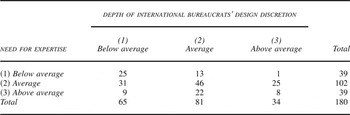
The correlation between need for expertise and depth of international bureaucrats' design discretion indeed is positive, as our theory predicts. The correlation coefficient is 0.27. The cross-tabulations in Table 1 permit a richer picture, albeit one that is almost certainly dampened by the conservative coding of depth of international bureaucrats' design discretion. Note that where the new institution's need for expertise is “below average,” staff of extant IGOs tended to have “below-average” design discretion—that is, states did not delegate to bureaucrat-agents at all, but instead created the institution on their own. In contrast, where the new institution's need for expertise is “average” or above, design discretion also tends to be “average” or above for staff of extant IGOs.Footnote 67
Cross-tabulations of expertise versus discretion, as frequencies in the random sample

Notes: The cross-tabulation supports our prediction: the greater the need for expertise in the new IGO, the greater the design discretion afforded to international bureaucrats working in a preexisting IGO. Any unilateral action, by which states create a new IGO on their own without delegating to international bureaucrats (that is, instances of below-average discretion), tends to occur when the need for specialized expertise is quite low. A chi-squared test and a Fisher's exact test (not shown) confirm that the relationship between expertise and discretion is statistically significant at the 1 percent level.
For comparisons, the cross-tabulation figures also can be examined as percentages rather than frequencies. First, consider row (1): the thirty-nine randomly sampled organizations that require “below-average” expertise to carry out their institutional activities. Of these, an overwhelming 64 percent were created by states alone, while a mere 3 percent were created with significant discretion by the staff of a preexisting IGO. This closely adheres to our expectations. Next, consider row (3): the thirty-nine randomly sampled organizations that require “above-average” expertise to carry out their institutional activities. Of these, only 23 percent were created by states alone, while the percentages created with “average” or “above-average” IGO discretion are 56 percent and 21 percent, respectively. While not strictly linear, the cross-tabulations provide preliminary evidence in support of the prediction: new bodies dealing with issues requiring specialized expertise do seem to be more likely to have been created with participation by international bureaucrats working in a preexisting IGO and wielding significant institutional design discretion.
An alternative way of thinking about this is by focusing on scenarios in which states opt to conduct institutional design on their own, without delegating to international bureaucrats. In Table 1, these scenarios are found in column (1). Of the sixty-five cases in which international bureaucrats were not involved at all, twenty-five cases (or 38 percent) featured a new IGO with below-average need for expertise. By contrast, only nine cases (or 14 percent) produced a new IGO with above-average need for expertise. Exactly the opposite pattern can be found when international bureaucrats had substantial discretion in IGO design, as shown in column (3) of Table 1. Only one of the thirty-four organizations created in such a fashion featured below-average need for expertise, whereas eight of the thirty-four featured above-average expertise.
Finally, note that the minority of intergovernmental organizations that were launched by states without any delegation to international bureaucrats, as shown in column (1) of Table 1, share a distinctive characteristic: such organizations tend to be political forums. This holds for randomly sampled bodies such as the Commonwealth of Independent States (CIS), Indian Ocean Commission (IOC), League of Arab States (LAS), and Pacific Islands Forum (PIF). As “talk shops” for states, little bureaucratic expertise is required, and states are much more likely to design them on their own. However, many intergovernmental organizations are more than political forums and thus require greater expertise for their operation. For these, international bureaucrats are likely to have had a role in the creation process.
Difference-in-Means Calculations, with Matching
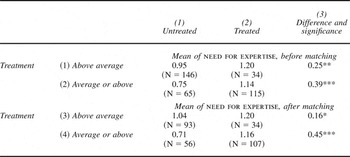
The cross-tabulations in Table 1 support our expectation that the depth of institutional design discretion by international bureaucrats increases as the need for specialized expertise increases. Further support is provided by the difference-in-means calculations in Table 2. Rows (1) and (2) show the mean value of need for expertise, broken down by “untreated” versus “treated” subgroups. Row (1) takes a conservative approach: it defines as “treated” only those IGOs that were created with above-average design discretion by international bureaucrats, and it defines other observations as “untreated.” With this definition, the mean value of need for expertise for the treated IGOs exceeds the mean value for the untreated IGOs by 0.25. With need for expertise ranging in value from 0 to 2, this is a substantive difference.
Difference-in-means analysis before and after coarsened exact matching

Notes: “Need for expertise” ranges from 0 to 2. “Treatment: above average” means above-average design discretion by international bureaucrats. “Treatment: Average or above” means average or above-average design discretion by international bureaucrats.
* Significant at 10 percent;
** Significant at 5 percent;
*** Significant at 1 percent.
A similar result appears in row (2), which uses a less conservative approach: it defines as “treated” those IGOs that were created with average or above-average design discretion by international bureaucrats, and it defines as “untreated” those IGOs that were created by states alone, without any delegation to international bureaucrats. With this less conservative definition, the mean value of need for expertise for the treated IGOs exceeds the mean value for the untreated IGOs by 0.39. Both differences are statistically significant at standard levels.
Difference-in-means calculations can be misleading if there is imbalance—that is, dissimilarity between the multivariate distributions of the treated and untreated units.Footnote 68 Because observational data lacks random assignment, treated and untreated groups are not necessarily identical before treatment.Footnote 69 Therefore, we also incorporate matching estimators to control for pretreatment covariates. Specifically, we use coarsened exact matching (CEM) softwareFootnote 70 to account for differences in the issue area or the timing of creation between treated and untreated IGOs. The timing of each IGO's creation is captured with the continuous variable creation year, which ranges from 1902 to 2006 for the 180 randomly sampled organizations. The issue area covered by each IGO is captured with the categorical variable issue area, which takes on the following values: 0 if the IGO addresses only political issues (for example, security, governance); 1 if it addresses both political and economic issues; 2 if it addresses only economic issues (for example, trade, banking); 3 if it addresses both economic and social issues; and 4 if it addresses only social issues (for example, health, education).
In line with previous work,Footnote 71 we use the L1 statistic as a comprehensive measure of imbalance. This statistic ranges from 0 (for identical distributions for treated and untreated observations) to 1 (for complete imbalance and no overlap between the densities). Prior to matching, the data set's imbalance measure with creation year and issue area is 0.4. After matching on these variables and pruning unmatched observations, the data set's imbalance measure drops to practically 0, indicating extremely well-balanced data. Since matching has ensured that treatment is now unrelated to the issue area and timing of creation, it is unnecessary to further control for these variables. Instead, a simple difference-in-means on the matched data is sufficient.Footnote 72
This is shown in rows (3) and (4) of Table 2. As before, we start with a conservative approach: in row (3) we define an IGO as “untreated” unless it was created with above-average design discretion by international bureaucrats. With this definition, the mean value of need for expertise for the treated IGOs exceeds the mean value for the untreated IGOs by 0.16. An even larger difference appears in row (4), which reverts to the less conservative approach of defining an IGO as “treated” by international bureaucrats unless it was created by states alone. With this less conservative definition, the mean value of need for expertise for the treated IGOs exceeds the mean value for the untreated IGOs by 0.45. After matching and under alternative definitions of treatment, we consistently find substantively and statistically significant differences between the two groups. As predicted, the depth of institutional design discretion by international bureaucrats increases as the need for specialized expertise increases.
Conclusion
Although the received literature focuses on states' institutional design activities, international bureaucrats participate frequently in the creation process. To delve into why this is so, we have developed a new theory and tested it using qualitative and quantitative data. Our approach builds on P-A theories to make sense of the institutional design arena on a larger scale. A distinguishing feature of our study is the demonstration of bargaining and principal-agent dynamics that complicate the IGO creation process. The institutional design literature has focused on potential conflicts among states,Footnote 73 without recognizing potential conflicts between states and international bureaucrats in the creation of new IGOs.
We show that while there are advantages to states if international bureaucrats participate in institutional design negotiations, there are potential drawbacks as well. Our theory produces a counterintuitive hypothesis: for a conservative bureaucrat-agent with a high design cost, discretion will increase as the bureaucrat-agent's ideal point shifts away from the state-principal's preference and toward the status quo. The surprising implication is that as principal-agent preference divergence increases, the principal affords more rather than less agent discretion. That is, an international bureaucracy may possess substantial discretion in institutional design, even if the state-principal recognizes that the bureaucrat-agent prefers that the new institution not be designed at all. Here, increasing discretion has a dual rationale: it allows the state-principal to benefit more from the bureaucrat-agent's expertise, but it also increases the bureaucrat-agent's expected payoff from exerting costly effort in IGO design. So, discretion serves as a way of “sweetening the pot” and overcoming the agent's high design costs, in order to secure the agent's costly investment in designing a new IGO.
Our counterintuitive hypothesis sheds light on the UNAIDS case. Conventional wisdom does not explain why states would concede institutional design leeway to hostile IGO secretariats,Footnote 74 but our theory proposes the necessity of this for securing costly effort. As the case study shows, states found themselves dependent on international bureaucrats for expertise relating to the design of UNAIDS.
Conventional P-A wisdom—that discretion is negatively correlated with principal-agent preference divergence—returns if either condition of our hypothesis is relaxed. First, if the bureaucrat-agent remains conservative but has a low rather than high design cost, then discretion increases as the bureaucrat-agent's ideal point shifts toward the state-principal's preference and away from the status quo. In contrast to the high-cost scenario, in the low-cost scenario there is now only a single rationale for discretion: it still enables the state-principal to capitalize on the bureaucrat-agent's expertise, but it is no longer necessary for increasing the bureaucrat-agent's expected payoff from exerting costly effort. This is demonstrated in the case of the International Energy Agency.
Second, if the bureaucrat-agent is revisionist rather than conservative, then discretion decreases as the bureaucrat-agent's ideal point moves away from both the state-principal's preference and the status quo. This is demonstrated in the case of the CEP. Even though states were unwilling to grant substantial discretion to international bureaucrats with “revisionist” preferences, states were nonetheless able to coax these bureaucrats to invest heavily in IGO creation. Given that the bureaucrats' interest in IGO creation exceeded the states' interest, states could select their preferred level of discretion without worrying about shirking or other P-A problems. In this regard, and somewhat surprisingly, revisionist bureaucrats can be rather useful for states.
In sum, bureaucratic expertise helps to explain the burgeoning role of international bureaucrats in creating new IGOs, even if bureaucrats do not share states' design preferences. We verify the logic's generalizability and unite our model's two stages by examining a new and original data set that characterizes the origins of 180 randomly sampled intergovernmental organizations. International bureaucrats' institutional design leeway is positively related to the need for expertise, and the minority of intergovernmental organizations that states opted to create through unilateral action tend to be political “talk shops” with little call for bureaucratic expertise. These findings survive a matching analysis that allows us to account for the nonrandom distribution of states' need for expertise across IGO creation events.
Our study refines, links, and extends received scholarship. It advances the literature on institutional design by theorizing about the role of international bureaucrats. It advances the literature on P-A issues by showing that the scope of P-A models in international politics is considerably broader than previously recognized.
In addition, our study advances the literature on international organization by helping scholars explain variation in the effects that IGOs ultimately have on policies and outcomes. Consider the UNAIDS case, in which international bureaucrats discarded a long-standing norm against third-party representation in UN organizations and instead installed permanent seats for civil society representatives in the new IGO's Program Coordinating Board. This empowers nongovernmental activists, who recently have been criticized of using “inflated HIV numbers effectively in their aggressive struggle for an increasing share of the limited international health budget.”Footnote 75 International bureaucrats influence how new IGOs are designed, and design elements shape what new IGOs do.
Our theory can be extended to scrutinize the robustness of the analytical findings and gain additional insight into the P-A politics of IGO design. The appendix summarizes results from eleven different formal extensions. Here, we discuss the most important findings.
One extension looks at multiple state-principals, whose preferences diverge from one another. In such circumstances, the bureaucrat-agent may play them against each other to increase its own bargaining power. In particular, high levels of discretion are required to induce relatively conservative states to participate, and this means that the bureaucrat-agent can secure higher discretion levels than in the absence of these conservative state-principals. Overall, one would thus expect more design discretion.
Other extensions consider scenarios in which international bureaucrats' bargaining power is curtailed. Perhaps states themselves are able to generate the needed expertise—for example, by learning from the design of an existing IGO with similar functions. Or perhaps any of several international bureaucracies possess the expertise that the state-principal seeks. In such circumstances, the P-A problem is mitigated as the state-principal can act unilaterally or select the “friendliest” bureaucrat-agent. But if multiple bureaucracies with complementary expertise are needed, this effect again disappears and the bargaining logic of the baseline model holds.
These extensions unearth questions for future research. One pertains to the possibility that international bureaucrats are strategically deployed as “pawns” in a bargaining game between states. International bureaucrats' expertise provides them with leverage and authority in negotiations, so they are valuable allies for states who worry about their inability to influence a new IGO's design.Footnote 76 For example, states with preferences that are closely aligned with the bureaucrat-agent's preferences would like to give the bureaucrat-agent considerable design discretion. But states whose preferences starkly diverge from those of the bureaucrat-agent would like to limit discretion, unless such discretion were absolutely necessary to ensure costly design effort. Under these conditions, the relative bargaining power of different states shapes the collective state-principal's choice regarding discretion.Footnote 77
Another promising question involves the bureaucrat-agent's incentive to misrepresent its expertise and design cost to the state-principal. If the bureaucrat-agent's discretion depends on these factors, then bureaucrat-agents should exploit their private information to gain additional discretion. A second-order P-A problem ensues, because the state must somehow distinguish between different types of bureaucrat-agents without having their expertise. Future research could examine the consequences of this form of asymmetric information.
A final new avenue for research pertains to the demand for new organizations. While much of the literature, this article included, focuses on states' incentives to cooperate, international bureaucrats' expertise plausibly provides them with agenda-setting power. If international bureaucrats are the leading experts on a problem, they may form an “epistemic community” that creates political demand for new organizations.Footnote 78 And if international bureaucrats push the process of IGO creation, they may be able to select their own design discretion—a possibility that further complicates our existing notions of how principals and agents interact.