Introduction
Because work looms so large in our lives I believe that most of us don’t reflect on its importance and significance. For most of us, work is well –work, something we have to do to maintain our lives and pay the bills. I believe, however, that work is not just a part of our existence that can be easily separated from the rest of our lives. Work is not simply about the trading of labour for dollars. Perhaps because we live in a society that markets and hawks the fruits of our labour and not the labour itself, we have forgotten or never really appreciated the fact that the business of work is not simply to produce goods, but also to help produce people. We need work, and as adults we find identity and are identified by the work we do. If this is true then we must be very careful about what we choose to do for a living, for what we do is what we’ll become. Footnote 1
Laboro ergo sum. “I work, therefore I am.” If what we do is what we will become, what happens when we are degraded by what we do? Skills mismatch is widely discussed in relation to the distribution of unemployment,Footnote 2 wage equation,Footnote 3 and in terms of the growing gap between immigrants and native-born in the labor markets and selective processes that endorse recruiting highly educated migrants.Footnote 4 However, de-qualification, overeducation, or deskilling, defined here as migrants taking on jobs that do not match with their skills, is rarely discussed as a matter of precariousness, at least not in the context of Turkey’s migratory scene.Footnote 5
Siar identifies three different processes of de-qualification of migrant labor: “as a host country’s way of filling up labor scarcities in the secondary market by exploiting cheap enclave labour, as a transitional phase for migrants to adjust to the ‘standards’ of the host country, or as a form of institutionalized discrimination.”Footnote 6 While the first can be treated as a negative side effect of market forces and the second ignored as a temporary arrangement, the third—institutionalized discrimination—is really a matter of human rights. In all three cases, different mechanisms are adding to the precariousness of migrants by depriving them of the chance to utilize the skills that they have worked hard to attain.
In a context like Turkey, which is transforming from a migrant-sending to a receiving and transit country, we observe important changes in its labor market, which is becoming increasingly internationalized. The same observation can be made for both the formal and the informal markets, where the line between the two is rather blurred. At the same time, Turkey’s migration scene is also becoming more heterogeneous. On the one hand, there are highly skilled migrants leading transnational lives in their jobs at multinational corporations, while on the other hand there are asylum seekers waiting to be resettled to a third country as a result of Turkey’s refugee policies. Then again, while there are irregular labor migrants taking on jobs in the informal domestic sector, as nannies for example, there are also many international students arriving to acquire their degrees in Turkey.
This paper is inspired by a research project entitled “Urban Implications and Governance of Central and Eastern European (CEE) Migration (IMAGINATION),” which is being conducted in Austria, the Netherlands, Sweden, and Turkey with the simultaneous aims of identifying types of migration from CEE countries and analyzing the social implications of these types of migration as well as governance approaches to these social implications.Footnote 7 The project has followed a mixed-methods approach. Research teams first analyzed the available data based on secondary sources, which comprised a literature review of earlier research as well as study of available official statistics. In what followed, each research group carried out a survey, a number of semi-structured interviews and focus groups with relevant stakeholders; e.g., representatives of migrant organizations, local governments, relevant private agencies such as labor recruitment bureaus, and NGOs involved in related areas of migration such as housing corporations and educational institutions. The aim has been to map what the researchers see as the socioeconomic, sociocultural, and legal-political implications of migration. In Turkey, a total of 45 survey interviews, 40 semi-structured interviews, and two focus groups were undertaken in the two selected urban regions of Edirne and İstanbul. In all four countries, migrant de-qualification has been a major issue raised by the stakeholders. Inspired by this finding, for this paper, a total of ten additional open-ended interviews with different cases of migrants, and from different nationalities, were conducted. The selection of the respondents for these cases followed a snowballing approach.
Despite the fact that Turkey has been moving from being an out-migration country to an in-migration one, as well as being an emerging market with a changing labor landscape, the data and research on migrants’ participation in the labor market are very limited.Footnote 8 With the increase in numbers, it is becoming an important policy issue and an interesting venue for future research, one in which there are few studies focusing on migrant de-qualification. While trying to fill in this gap in the literature by initiating a discussion on the issue, this paper makes two major claims. First, labor here is treated as a means of survival for the migrants in Turkey. Thus, the focus is not on labor migration as such, but rather on the problems that migrants face while participating in the formal and informal labor markets, hence treating de-qualification as a matter of precariousness. What has formerly been understood as skill translation—i.e., limited acceptance of foreign credentials, language, and weak networks for certain occupations—I argue should now be seen as devaluation, in reference to Bourdieu’s notion of valuation. Second, the paper argues that regardless of their status—regular/irregular, voluntary/forced, and temporary/permanent—all migrants are subject to the same mechanisms of de-qualification in the Turkish labor market, which is partially a result of the fact that the lines between the different categories are blurred in the Turkish context, where institutions, legislation, and policies are constantly changing. Here, I focus on the perceptions of the migrants, rather than on official statements by the authorities, in the hope of reflecting the former onto the latter in terms of concrete policy options. Accordingly, this paper is composed of three parts: the first section presents a theoretical overview of migrant de-qualification by underlining the different factors that lead to the de-qualification of migrants; the second part comprises an empirical analysis; and the final section is the conclusion, where different policy options for the future are discussed.
Migrant de-qualification: a theoretical overview
Sociological contributions on the gap between qualification and employment attained reveal that de-qualification is substandard to satisfactory employment, with overeducated workers having a lower income, less participation in continuing education and training, and less job satisfaction. Using a multilevel analysis of data from representative surveys among graduates in thirteen European countries and Japan, Verhaest and Van der Velden argue that cross-country differences in overeducation are explained by the quality and orientation of the educational system, the business cycle, and the relative oversupply of highly skilled labor where employment protection legislation has no impact on the incidence and persistence of overeducation.Footnote 9 Within this context, is it better for the unemployed to take up a job for which they are overeducated or to remain unemployed and continue the search for adequate employment?Footnote 10 Answering this question, Voßemer and Schuck’s “results support the stepping-stone hypothesis in terms of future employment chances, but also highlight non-negligible risks of remaining trapped in a job that is below one’s level of educational qualification.”Footnote 11
Within the migration literature, the standard narrative on de-qualification assumes that immigrants are economically vulnerable in their host countries insofar as their skills can only be imperfectly translated into new labor markets.Footnote 12 But why does de-qualification take place? The literature suggests several factors that lead to de-qualification of migrants: non-recognition of credentials, educational level, or experience abroad;Footnote 13 the poorer quality of education in some countries;Footnote 14 a language disadvantage; weak social networks; and a lack of information regarding the job market in the host country.Footnote 15 One economic explanation for de-qualification is the existence of a secondary market of lower-wage and lower-status jobs that migrants are ready to take.Footnote 16 Looking at forces that function at much higher levels of aggregation than are found in neoclassical theories, dual labor market theory links immigration to the structural requirements of modern industrial economies, and, in a way, also depicts how and why de-qualification comes about. Piore, the forefather of the dual market theory, assumed that there is a stable demand for migrant labor in the countries of immigration, which is natural in the economic structure of developed nations, where the economy is composed of a capital-intensive primary market and a labor-intensive secondary market.Footnote 17 The former market, usually reserved for natives, is characterized by a higher degree of skill and, accordingly, higher-paying and higher-status jobs; while the latter is a market for jobs requiring a lower degree of skill and consequently providing lower pay.Footnote 18 As economic development increases the demand for labor, the native labor force supplies the need in the primary market of the higher-wage, higher-status jobs.Footnote 19 As a result, there are labor shortages in the secondary market, and firms rely on migrant labor to fill the gap.Footnote 20 Even if they are highly skilled, migrants are willing to take on jobs requiring a lower degree of skill and providing lower pay, because they perceive their situation as being only temporary.Footnote 21 Immigrants do not take lower-wage jobs simply because they expect greater return in the future: these wages are also tolerable, as the alternative labor market—i.e., the sending context—offers even lower wages, even if their skills translate better from the classroom to the labor market.
Furthermore, borrowing from Lee, push and pull factorsFootnote 22 must also be taken into consideration, where the economic status of immigrants may be affected by the country from which they migrate (“origin effect”), the country to which they migrate (“destination effect”), and the specific relations between origins and destinations (“community effect”).Footnote 23 For example, economic, political, and cultural factors—such as political suppression in the countries of origin, relative income inequality, geographic distance, religious origin, the presence of left-wing parties in the government, and the size of the immigrant community in the countries of destination—all affect the labor force status of immigrants.Footnote 24 However, neither sociological theories of migration, with their emphasis on a limited mobility that is structural in dual labor markets, nor conceptual perspectives, which view migration mainly as a byproduct of capital investment in peripheral contexts, can sufficiently explain the mechanisms behind the de-qualification of migrants.
Adapting Pierre Bourdieu’s notion of institutionalized cultural capital and his views of the educational system as a site of social reproduction, Bauder provides an alternative explanation.Footnote 25 Based on data from interviews with institutional administrators and employers in greater Vancouver who service or employ immigrants from South Asia and the former Yugoslavia, he argues that regulatory institutions, by not recognizing foreign credentials or dismissing foreign work experience, actively prevent immigrants from entering the upper segments of the labor market.Footnote 26 As Siar also underlines, Bauder sees de-qualification as an institutionalized method of marginalizing migrants, with the aim of preserving the prevailing power structure.Footnote 27
Other empirical studies also emphasize the fact that not recognizing foreign credentials and dismissing migrants’ skills are apparent methods of de-qualification at the job-seeking stage. One example is Henderson et al.’s study of highly skilled Chinese migrants—in particular doctors, teachers, and engineers—who reported the non-recognition of their overseas qualifications in a sample seeking employment in New Zealand.Footnote 28 In a subsequent study with Chinese and Indian immigrants in New Zealand, Trlin et al. state as follows:
[P]ersonnel recruitment agencies, ostensibly geared to the placement of skilled professionals, were often reported to be unhelpful and not interested in “foreigners.” For example, Indian participants, pointing out that English was their language of instruction from at least high school level, saw the use of a telephone number in advertisements by recruitment agencies as a means of filtering out applicants with accented English.Footnote 29
Among the other means of de-qualification are demanding that migrants undertake training; requiring that they pass an examination before they can apply for a job; or setting a premium on local experience over the migrant worker’s qualifications.Footnote 30 Similarly, another study on immigrants in Canada underlines the fact that foreign work experience is significantly discounted in the Canadian labor market, which is a cause of the increasing income gap between immigrants and the Canadian-born over the past two decades.Footnote 31
The same study also states that the majority of immigrants entering Canada between 1981 and 2001 were from Eastern Europe, South Asia, East Asia, western Asia, and Africa—regions where the human capital is not easy to transmit owing to differences in language, culture, education, credentials, and discrimination.Footnote 32 Likewise, studying the occupational locations of men aged 30–54 with a university degree in engineering, Boyd and Thomas assessed identity-based discrimination as a consequence of race and ethnicity in the Canadian labor market.Footnote 33 Creese and Wiebe also emphasize the racialized and gendered nature of migration from sub-Saharan Africa in Canada, “where common demands for ‘Canadian experience,’ ‘Canadian credentials,’ and ‘Canadian accents’ were uneven across different sectors of the labour market.”Footnote 34
Focusing on the debate about the free movement of labor within the European Union (EU) in the wake of the economic crisis, studies have shown patterns of de-qualification similar to those present in North America. A thorough investigation of European and national-level sources shows that, rather than explanations presenting a “knowledge-driven migration” of the free movement of labor, over-qualification and the parallel underutilization of the skills of migrant workers arise as a prevalent phenomenon in the EU.Footnote 35 Investigating whether labor migrants affect productivity, Huber et al. also discovered underutilization of skilled foreign labor, with little proof to suggest that migrants show increased productivity, which may in return be a result of over-qualification.Footnote 36
In a more recent article, Webb uses Bourdieu’s notions of misrecognition and symbolic and social capital to identify the uneven outcomes of migration transitions on employment outcomes among migrant groups, by utilizing qualitative accounts from skilled migrants. He argues that it is the process of “it’s who you know, not what you know” that helps to secure employment corresponding to the qualifications and previous employment histories of both skilled migrants and their partners.Footnote 37 Webb also underlines the fact that—in an era when transnational skilled migration is increasing to record levels, particularly from non-OECD countries to OECD countries—building the right social network is the key to finding a job that matches a migrant’s qualifications.Footnote 38
Looking at the context of Israel, Friedberg underlines how the national origin of an individual’s human capital is a crucial determinant of its value, with education and labor market experience acquired abroad being significantly less valued than human capital obtained domestically, which can fully explain the earnings disadvantage of immigrants.Footnote 39 Comparing guest workers, ethnic Germans, immigrants from the EU-15 or other Western industrialized countries, non-EU immigrants, and second-generation immigrants with the native-born population in Germany, Kogan also underscores the importance of human capital and labor market segmentation in the employment exclusion of immigrant populations.Footnote 40
The literature cited and presented here looks generally at the problem of de-qualification in developed countries. The migration literature pertaining to Turkey, on the other hand, does not currently provide any analysis of the de-qualification of migrants in the Turkish labor market. With the major aim of filling this gap in the literature and initiating discussion on the subject, based on the results of a pilot study of ten open-ended interviews with different cases of migrants, as well as participant observation in İstanbul, this paper argues that similar mechanisms are also at work in the migration context of Turkey. In line with this, five issues have been identified: accreditation problems, language disadvantage, weak social networks, lack of information, and identity-based discrimination.
De-qualification in Turkey: an empirical analysis
Based on data provided by the General Directorate of Migration Management (Göç İdaresi Genel Müdürlüğü), as of 2014, almost 400,000 migrants had received residence permits in Turkey, constituting the regular migrant population; around 60,000 irregular migrants were apprehended the same year. From 2005 to 2014, 150,000 people sought international protection in Turkey. In addition, as of April 2016, there were 2.7 million Syrians in Turkey, who are currently under a temporary protection regime. Thus, Turkey is firmly moving from being a country of emigration to one of immigration. Ozcurumez and Yetkin describe this process as follows:
As an emerging market and a relatively successful survivor of the 2008 economic crisis, Turkey is increasingly more attractive for non-Turkish nationals who suffer from high rates of unemployment in their countries of origin. Some of this employment arrives legally and documented while a large portion arrives irregularly and stays as undocumented while integrated to the informal labor market, which constitutes close to half of the economy. While aiming to promote registered employment of and combat unregistered work by foreign nationals, Turkey adopts various policies and legislation with regulations seemingly easing acquisition of residence and work permits.Footnote 41
This description explains the context of the transformation of Turkey’s labor market, which has occurred in parallel to the country’s change from a migrant-sending to a migrant-receiving and transit country. One such policy change to ease foreigners’ access to the labor market in Turkey was the Law on Work Permits for Foreigners (Law No. 4817, dated March 15, 2003), which nullified the discriminatory Law on Activities and Professions in Turkey Reserved for Turkish Citizens (Law No. 2007, dated June 16, 1932), which barred foreign citizens from practicing a long list of professions, such as photographer, actor, waitress, interpreter, etc.Footnote 42 More recently, on January 15, 2016, the cabinet approved the decision to grant work permits to refugees who had fled to Turkey to escape conflicts in their homeland.Footnote 43 Despite such positive changes, empirical evidence shows that the labor market in Turkey still holds important features of precariousness for the migrants. De-qualification is one such feature, with various different mechanisms actively working against the migrants.
As explained earlier, the focus of this paper on de-qualification was inspired by an international research project following a mixed-method approach—viz., an extensive literature review, a survey, semi-structured interviews, and focus groups—with the aim of mapping the relevant stakeholders’ perspectives on the socioeconomic, sociocultural, and legal-political implications of migration. De-qualification proved to be a common issue faced by the migrants in all four countries studied in the project. The problem was especially noticeable and discussed among academic and policy circles in the case of Austria, where a significant characteristic of CEE migration—one largely different from the 1960s and 1970s guest worker migrations from the former Yugoslavia and Turkey—was the above-average level of education of many immigrants.Footnote 44 Favell underlined the danger of the “ambitious ‘New Europeans’ … becoming a new Victorian servant class for a West European aristocracy of creative-class professionals and university educated working mums,” with female migrants holding a teacher’s diploma or even a PhD working in Austria in the fields of child or geriatric care.Footnote 45
Relying mostly on survey data conducted in the course of previous research, it was seen that in the Netherlands—just as in Austria and again unlike the guest workers of the 1960s and 1970s—CEE labor migrants were also generally well educated. And in Sweden, as in Austria and the Netherlands, CEE migrants were also well educated in comparison to those born in Sweden, as they usually had had at least secondary education. This partly reflected the fact that immigrants from these countries were primarily young people, who are on average better educated, many having a university education.Footnote 46 Looking at the distribution in occupations sorted by skill level, we see that migrants working in low-skill professions increased from four percent to nine percent between 2001 and 2011; thus, given the higher level of education of migrants, these increases in low-skill jobs hint at a process of de-qualification.Footnote 47
In Turkey, one source of data existing on the education of migrants is residence permits granted based on education, which provides more information on student migration than does giving estimates on the educational level of migrants and their labor market participation. However, based on the interviews conducted by the research team for IMAGINATION, we can claim that many of the CEE migrants coming to Turkey are better qualified than the average in Turkey. Historically, many Bulgarian migrants have been known to be better educated, having had at least a certain type of vocational training.Footnote 48 In cosmopolitan cities like İstanbul, there are many educated female migrants known hold informal jobs in private households regardless of their qualifications.Footnote 49
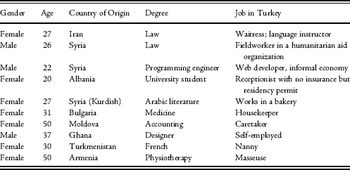
However, as the IMAGINATION project was particularly focused on CEE migration, in order to go beyond this geographical focus, ten additional open-ended interviews were conducted with the migrants in İstanbul, following a snowballing method. Particularly since the beginning of the turmoil in Syria, migrants from Syria have constituted the largest migrant community in Turkey. This quantitative increase was very much reflected in these interviews, with three out of the ten additional interviews conducted being with migrants from Syria; the other interviewees were from Albania, Armenia, Bulgaria, Ghana, Iran, Moldova, and Turkmenistan (see Table 1). We have interviewed people with university degrees working as waitresses or bakers in the informal service sector, or working formally for less salary and with no prospects for promotion.
Description of the Respondents

Five common themes emerged from the interviews conducted with the ten cases presented in Table 1, and these themes were also in line with the literature: problems of accreditation, a language disadvantage, lack of information, weak social networks, and identity-based discrimination.
Problems of accreditation: an enigmatic process
The institutional analysis of Nohl et al. shows that migrants are prohibited from performing many professions in Turkey, but the prevailing informality of the labor market makes it possible that a migrant doctor might practice his/her profession without a licence.Footnote 50 Accreditation, or equivalency, as used by the Council of Higher Education of Turkey (Yükseköğretim Kurulu, YÖK), is a process of recognition of foreign (associate, bachelor’s, and master’s degree) diplomas received from higher education institutions abroad.Footnote 51 Even in those cases where there are no working mechanisms of legal exclusion, the recognition of degrees entails an enigmatic process. To begin with, as of April 2015, the official YÖK website providing information about the recognition process and the relevant application form were available only in Turkish. In addition, the list of documents required to accompany the application is considerable—and in many cases of forced migration would be almost impossible to acquire.
Problems in regard to accreditation were not mentioned during any of the interviews conducted for this research. However, this is not to state that there are no problems with the accreditation process in Turkey. On the contrary, this result is caused by the simple fact that none of the interviewees have even tried to apply to have their degrees recognized by YÖK. In other cases—during the fieldwork of the IMAGINATION project, for example—problems of accreditation were widely cited by participants. In one instance, a migrant coming from Greece who had applied to have his degree recognized in Turkey simply cancelled the process out of frustration. This was despite the fact that he came from an ethnic Turkish background (and thus knew the language) and had already filed a long list of documentation; the continuous bureaucratic obstacles ultimately overwhelmed him.
Language disadvantage: a barrier for everybody
Following Bourdieu, language is treated here not merely as a method of communication or a skill, but also as a mechanism of power, with the language one uses being designated by his/her relational position in a given field or social space, determining who has a “right” to be listened to, to interrupt, to ask questions, and to what degree.Footnote 52 All of the respondents cited language disadvantage—here defined as not being able to speak Turkish—as a major obstacle to finding a proper job in Turkey.
As a female migrant from Iran emphasizes:
“[The] first obstacle is the language barrier. I found a job before coming here, but I think it is difficult if I try to find a job in the streets without speaking Turkish. Because I can’t get [a] working permit or residence permit, many work areas reject you or hire you for really low wages.” (female, 27, Iran, waitress with degree in law)
A young man from Syria also states:
“Language was the first barrier for me and other Syrians to work here. Also being social was really difficult for me. Getting to know the details of the country, everything … Trying not to annoy anybody …” (male, 22, Syria, web developer with degree in programming engineering)
Even those migrants who did not personally experience language disadvantage in the workplace emphasized problems in communication due to a lack of Turkish. Another young man from Syria, who works in a civil society organization assisting Syrian refugees in Turkey, asserts:
“It was a problem to communicate with people, but not in my job actually. Because in my job I work with Syrians and I speak Arabic with them. But for the rest of Syrians, language is the first or second major problem in finding a job. The first problem is the government procedures, and the second is language.” (male, 27, Syria, fieldworker with degree in law)
Even in jobs that do not require skills, not knowing the language in the workplace emerges as a problem for migrants. A female identifying herself as Syrian-Kurdish, with a degree in Arabic literature, talks about her experience when she switched jobs from a sewing workshop to a bakery:
“In my first job everything was more difficult, because I was not able to speak Turkish. When I learned Turkish from my friends around me, I got the new job from the bakery.” (female, 27, Syria, baker with degree in Arabic literature)
Lack of information: where to start?
Lack of information about the labor market in the country of arrival is another handicap for migrants. While this is partially related to the language barrier explained above, it is not limited only to this. As a respondent stresses:
“Looking for a job is kind of difficult here. A guy does not know where to start. In my case it was easier for me because my job is related to [the] Internet, but if I were, let’s say, a doctor, I would not have any idea how to find a job that would be suited to my abilities. I’m planning to go to Europe, so I can move forward. In my company, I deserve a better salary and better organization. Generally, people here, refugees, foreigners … In general, not just refugees, it is difficult to get a fair job for foreign people. First, because of the language: after Turkey decided to take refugees, it should have also provided Turkish languages—in the specific case of Syrians. Also, [the] Turkish government should create [employment] agencies for refugees, for instance like in Europe, there are some agencies where I could apply for a job according to my abilities.” (male, 22, Syria, web developer with degree in programming engineering)
Thus, there are no formal structures whereby migrants can apply to find a job that matches their skills. For almost all of our respondents, this vacuum is filled by friends, acquaintances, or co-nationals; namely, by the migrants’ social networks.
Weak social networks: venue for optimism
“I did not find this job through a social network, but it was a friend I knew. It is a good question, now we are making those networks for the Syrian refugees. For example, five-six Syrians create a Facebook page for finding a job for Syrians. Through this network many Syrians apply to different companies, but companies of course [do] not choose Syrians, since they have procedural problems. [The] social network is available only for people who have Internet access to [an] Arabic network of Facebook groups.” (male, 27, Syria, fieldworker with degree in law)
Although the respondent does not consider finding a job with the help of a friend to be a function of a social network, nevertheless belonging to a group or being surrounded by people that you know definitely helps in finding a job. Other respondents, such as a woman from Albania who was a student in Turkey but is now working as a receptionist in a hotel without a work permit, have mentioned using web-based social networks, such as Craigslist, to find a job. In some cases, migrants’ social networks also act as venues to learn the new language, as in the case of the Syrian-Kurdish migrant who stated above that she learned Turkish through her friends. Thus, social networks have multiple functions for the migrants, and constitute perhaps the only venue that provides some optimism for the migrants in Turkey.
Identity-based discrimination: being a woman out there
The fact that almost all migrants stated that a form of social network had supported their presence in Turkey does not mean that there is no identity-based discrimination. When asked whether he faced any kind of identity-based discrimination, the fieldworker from Syria stated:
“No, not me, because I find this specific job where I work with Syrian refugees. But for instance there is a doctor I know who speaks also Turkmen and Arabic. He came here to work, they say no to him because he is Syrian and could not get [a] work permit. Turkish officials are giving work permits to Americans and Europeans, but not to Syrians. I didn’t face ID-based discrimination, but I heard a lot of stories from different regions of Turkey, for instance Kilis.” (male, 27, Syria, fieldworker with degree in law)
Thus, even for those migrants who have not personally experienced identity-based discrimination, the perception is there. For others, especially for the women, the story is much gloomier. As a female migrant from Bulgaria put it:
“Not in the houses I work, but outside. I had so much trouble when I was trying to rent a house. I found an apartment with three other Bulgarians working here. [The] police was coming to the house to check if we were sex workers or not.” (female, 31, Bulgaria, housekeeper with degree in medicine)
Another migrant woman explained as follows:
“I left Iran because I was a 27-year-old unmarried person and I was hiding that I’m a lesbian, actually. I faced identity-based discrimination all the time because I was a woman in Iran. This is one reason why I had to leave Iran to go to Europe. I was feeling insecure in Iran because of my identity. Here I feel more secure, but still many times I think I’m discriminated [against] because I am a woman.” (female, 27, Iran, waitress with degree in law)
All in all, identity-based discrimination is a problem particularly touched upon by women, as the most vulnerable group among migrants.Footnote 53 When asked whether she had faced any kind of identity-based discrimination, another female migrant stated:
“Yes, in the neighborhood. At first everything was okay, but later local people started to stare at whoever spoke Arabic. We rent a two-bedroom apartment with six people. The owner wants to increase the rent, or, he says, we have to leave. Also, not me, but some of my friends that I am staying with faced sexual harassment by the local people in the streets.” (female, 27, Syria, baker with degree in Arabic literature)
Her statement shows that identity-based discrimination is present not only in the workplace but also in the streets, and that ethnic factors not only play a role in the de-qualification of migrants, but also have a direct impact on their daily lives. A male migrant sees identity-based discrimination differently:
“I faced absolute ID discrimination three times, but I believe that it does not represent public opinion, but just an individual behavior. Generally, people are good with Syrians here. But that also depends on the people.” (male, 22, Syria, freelance web developer with degree in computer engineering)
Unlike his female counterparts, for him, discrimination is not an institutionalized phenomenon, but happens only on an individual level. In fact, there are no studies analyzing the mechanisms of how identity-based discrimination plays a role in the de-qualification of migrants in Turkey’s labor market, which points to new areas for further research.
Conclusions: venues for future research
Based on a report published by the International Labour Organization “over-education is increasing and under-education is decreasing on at least one measure in at least half of the countries for which such trends can be assessed.”Footnote 54 Accordingly, skills mismatch is a common problem in Europe and a potential indicator or component of the measurement of labor underutilization. If skills mismatch is such a widespread challenge, why should we worry specifically about migrants? Considering the fact that in most developed and developing countries demographics are changing and local populations are aging, migrants begin to make up an important supply of labor, in Piore’s terms, not only for the labor-intensive secondary market, but also for the capital-intensive primary market. Thus, the de-qualification of migrants constitutes an important policy issue for the future.
The ILO report underlines four policy incentives meant to tackle the problem of skills mismatch in general: efficient job placement services; social dialogue to strengthen linkages between education and training systems and the world of work; solid labor market information; and more detailed empirical investigations to assess if the problem is temporal or structural.Footnote 55 In the case of migrants, de-qualification is identified as a structural rather than a temporal problem, and thus it requires direct policy interventions.
The first step may be to bring the discourse of de-qualification into the immigration and labor policy spectrum.Footnote 56 Citing a recent government report by Hawthorne that judges success based on the labor market outcomes of new migrants, Siar rightfully argues that destination countries must look beyond statistics and evaluation reports, which trumpet the accomplishments of their migration policies and settlement programs, and instead begin to conduct more comprehensive analysis of the real state of migrants in the labor market.Footnote 57
There is also a need to bring the discourse of de-qualification into the academic literature on international migration. Mechanisms for better data collection should be established, especially in countries like Turkey where the transformation into an immigration country is still a recent phenomenon, thus making migration policymaking a new phenomenon as well. Accordingly, it is necessary to collect data on the skills and education levels of migrants as well as on their placement in the labor market. For example, despite the fact that there has been an extensive registration process for Syrian migrants, during the process no data were collected about the education levels or skills of these migrants. In fact, it can be argued that if such data were available, labor underutilization would be more visible.
Based on the interviews, as well as on the research methodology followed in the IMAGINATION project, it is clear that two other important policy areas are Turkish language education and job placement services for migrants. Regarding the former, Turkish language classes should be provided to those migrants willing to enrol, thus putting this education on a voluntary basis and regardless of the legal status of the migrant in Turkey. In relation to the latter point, there should be job placement services available for migrants who would like to utilize them. However, in both cases, the most important concern of the policymakers must be the transparency of the system, with a constant flow of information to the migrants being given priority.
For many migrants, the phrase laboro ergo sum (“I work, therefore I am”) explains their means of survival. The equation is simple: only if one has a job can he/she afford to live, and in many cases migrants have to take on jobs that do not match their skills, which has been defined here as de-qualification. This paper argues that what has previously been understood as skill translation—i.e., a limited acceptance of foreign credentials, language disadvantage, weak networks for certain occupations—should now be seen as devaluation in reference to Bourdieu’s notion of valuation. De-qualification is considered here as an important element of precariousness in the labor market, with different mechanisms functioning simultaneously; namely, accreditation problems, language disadvantage, lack of information, and identity-based discrimination. Within this context, the only mechanism that actually supports migrants’ continuous existence in Turkey seems to be their social networks. Thus, in a very different context, Webb may be correct: if you are to exist in a system of such precariousness, “it’s who you know, not what you know.”