Implications
The death of newborn lambs is both an economic and welfare concern for sheep producers. Providing shelter from adverse weather conditions has been shown to reduce the level of mortality. This study aims to quantify the impact that shelter type can have on ewe and lamb bonding which may also influence mortality levels.
Introduction
In Australia a significant proportion (11% to 39%) of newborn lambs die (Knight et al., Reference Knight, Oldham, Smith and Lindsay1975, Owens et al., Reference Owens, Bindon, Edey and Piper1985) each year with the majority of deaths occurring within the first 72 h of birth (Haughey, Reference Haughey1991; Miller, Reference Miller1991). Management of lambs during this period has a major impact on increasing weaning percentage.
The two major causes of newborn lamb mortality are dystocia and the starvation–mismothering–exposure complex (SME) (Plant, Reference Plant2004). The SME complex is a broad term used to describe lamb deaths that are attributed to a variety of causes, however, typically SME results in hypothermia caused by a failure to feed (Haughey, Reference Haughey1991). SME occurs more frequently in small lambs, or those from multiple births (Hight and Jury, Reference Hight and Jury1970; Scales et al., Reference Scales, Burton and Moss1986). Lamb mortality of greater than 70% may occur in periods of high winds and rain (Obst and Ellis, Reference Obst and Ellis1977). Lowering wind speeds at lamb height by shelterbelts can reduce this by up to 50% (Egan et al., Reference Egan, Thompson and McIntyre1976; Alexander et al., Reference Alexander, Lynch, Mottershead and Donelly1980).
While ewes tend to isolate themselves from the main mob for lambing it is not clear whether this movement is deliberate or as a result of restlessness due to physical discomfort (Alexander et al., Reference Alexander, Lynch and Mottershead1979; Nowak, Reference Nowak1996). The use of shelterbelts to ‘trap’ these animals may lead to more lambs being born in shelter and therefore lower neo-natal mortality. The design of shelter needs to allow full separation from the main mob, as interest from other ewes and lambs is a significant cause of lamb separation from their mother (Alexander et al., Reference Alexander, Stevens, Kilgour, de Langen, Mottershead and Lynch1983). Research has shown that ewes lambing in shelter spent longer on average at the birth site than those lambing in the open resulting in a stronger maternal–offspring bond (Lynch and Alexander, Reference Lynch and Alexander1976; Alexander et al., Reference Alexander, Lynch and Mottershead1979 and Reference Alexander, Stevens, Kilgour, de Langen, Mottershead and Lynch1983). The ability of lambs to recognise their mother early in life also appears important, as twin lambs that were better able to recognise their mother when 12 h old had a greater chance of survival beyond 7 days (Nowak and Lindsay, Reference Nowak and Lindsay1992).
The ability of lambing ewes to isolate themselves from the flock may be influenced by the type of shelter. As the area protected by shelter is relative to the height of the shelter (van Eimern et al., Reference van Eimern, Karschon, Razumova and Robertson1964; Cleugh, Reference Cleugh1998) a shelter lower in height (e.g. grass hedgerows) requires more rows than a taller form (e.g. shrubs) to protect the same area. Knight et al. (Reference Knight, Wilson, Lynch and Hockey1989) found that when lambing, ewes favoured sites that were away from the flock but still in visual contact. With less distance between rows the ability of ewes to attain greater spatial separation from the remainder of the flock at lambing while still maintaining visual contact may be inhibited.
Earlier studies have attempted to quantify shelter utilisation by 24 h observation of the ewes (Welch and Kilgour, Reference Welch and Kilgour1970; Lynch and Alexander, Reference Lynch and Alexander1976; Stevens et al., Reference Stevens, Alexander and Lynch1981). While these examined the use of shelter by animals only Lynch and Alexander (Reference Lynch and Alexander1976) quantified the interaction between ewes and lambs within the sheltered areas. However, as assessment of interaction involved disturbance of the animals, through artificial lighting at night and human movement in or near the paddocks, behaviour may have been altered.
This experiment aimed to determine if shelter type influenced the level of contact between ewes and their offspring, and if contact between an ewe and their offspring would differ between ewes bearing singles and twins. Contact loggers were used to quantify the interactions between sheep to minimise the level of disturbance.
Material and methods
Experiment design
Two shelter types and two litter sizes were compared in an experiment at Ladysmith, NSW, Australia (147°31′E, 35°12′S). The treatment combinations were; shrub belts with twin bearing ewes (Twin-S), Hessian rows with twin bearing ewes (Twin-H), and Hessian rows with single bearing ewes (Single-H). The absence of unsheltered treatments for both singles and twins does limit some of the conclusions, which could be drawn from the data. All procedures undertaken in this experiment had been approved by the Charles Sturt University Animal Care and Ethics Committee (CSU ACEC 2008-046).
The paddock size ensured the same stocking rate in dry sheep equivalents (DSEs) for each treatment. The DSE ratings used in this experiment were estimated based on the feed demand of the ewes with different birth numbers (1.6 for single and 2.2 for twin bearing ewes). Each paddock contained 23 Merino ewes resulting in a stocking rate of 22.7 ewes/ha in Single-H and 17.1 ewes/ha in both Twin-S and Twin-H. While the stocking rate varied between birth types the aim was to provide similar nutritional status for the different treatments. If the ewe stocking rates were the same for singles and twins then the results may have been biased by nutritional influences.
The total feed on offer for the three treatments was measured before the ewes were put into the paddocks on 17 June 2008 and when the ewes were removed from the paddocks on 30 July 2008. When entering the paddocks the total feed on offer was; Single-H 1.87 t/ha, Twin-H 1.54 t/ha and Twin-S 1.84 t/ha. At the completion of the experiment total feed on offer was Single-H 1.20 t/ha, Twin-H 1.10 t/ha and Twin-S 1.19 t/ha.
The ewes were shorn five weeks before the experiment to encourage them to utilise the shelter (Alexander and Lynch, Reference Alexander and Lynch1976). The pregnant ewes were placed into the lambing paddocks 6 days before the first lamb was due to be born. The mean live weight and condition score (Jefferies, Reference Jefferies1961) of the ewes in each treatment at this time were; Single-H – 64.5 kg and 2.8, Twin-H – 67.4 kg and 2.7, and Twin-S – 67.6 kg and 2.8. Throughout the experiment the ewes were visually inspected each morning to record lamb births. Inspections commenced the day after they were moved into the paddocks to acclimatise them to the presence of humans.
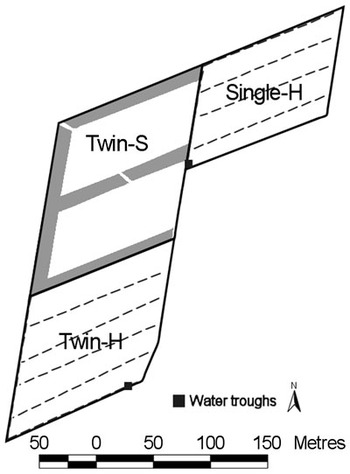
The shrub belts were each 10 m wide and had and average height of 2.5 m. These were fenced to prevent animal access. Hessian shelters were 1 m high, being fixed to two lines of plain wire suspended from posts spaced evenly along each row. Shelter was placed on the northern, western and southern boundaries of each paddock. The distance between parallel shelterbelts was determined by the height of the shelterbelt and equated to 20 times height spacing. These distances resulted in the internal shrub rows being 50 m apart and the Hessian rows being 20 m apart (Figure 1).
Experiment layout showing location of the three treatments, dashed lines indicate Hessian hedgerows and thick lines represent shrub belts. Twin-H, Hessian rows with twin bearing ewes; Twin-S, shrub belts with twin bearing ewes; Single-H, Hessian rows with single bearing ewes.

To allow sheep to pass from one section of the paddock to another, gaps were created in the shelterbelts. The internal shrub row had a single centrally located 3-m wide gap while the internal Hessian rows had 2 to 3 m gaps placed every 25 to 30 m with a 6 m gap at the eastern end of each row. No gaps were placed in any of the boundary shelterbelts except to enable access between paddocks.
Contact loggers
Contact loggers (SirTrack Ltd., Havelock North, New Zealand) were placed on a total of 36 ewes during two deployments, 18 per deployment. Ewes were selected according to foetal age to ensure they lambed in as short a time span as possible for maximum data collection. When entering the paddocks the mean live weight and condition score for the selected ewes was; Single-H – 64.3 kg and 2.8, Twin-H – 70.0 kg and 2.7, and Twin-S – 67.8 kg and 2.7. Loggers were fixed to leather collars for attaching to ewes (total weight – 425 g) and synthetic collars for attaching to lambs (total weight – 270 g, between 3.75% and 9% of lamb birth weight). Collars were attached to the lambs in the afternoon of the day their birth was recorded with the lambs being between 4- and 28-h old. After the contact logger collars were attached lambs were observed for several minutes to confirm their movement was not impaired.
In each deployment, collars were placed on six ewes per treatment. For the first deployment the collars were attached on 20 June 2008 in sheep yards immediately before the ewes being introduced to the trial paddocks. The collars were removed in small temporary yards in the lambing paddocks from all ewes with lambs greater than 3 days old on 7 July 2008. Four ewes had lambs less than 3 days old at this time, two each in Single-H and Twin-H, and these collars were removed on 9 July 2008.
For the second deployment, on 11 July 2008 the collars were placed on 18 ewes, which had not lambed, using the temporary yards. All collars were removed in small temporary yards in the lambing paddocks from ewes and lambs on 1 August 2008. Ewes and lambs were removed from lambing paddocks to the temporary yards for removal or fitting of collars for a maximum of 15 min.
Collars were placed on a total of 56 of the 60 lambs born to the ewes with collars installed, three lambs were born dead (Single-H – 2, Twin-H – 1) and one (Twin-S) was considered too weak to have a collar attached. The lambs were caught in the lambing paddock, the collar attached, and on release both the lambs and their mothers were observed for a period to ensure no adverse effects from collar attachment. This was gauged by the ability of the lambs to stand and walk and that the ewes had returned to their lamb(s). In this study 10 collared lambs, all twins, died. This was a mortality rate of 21% for the collared twin lambs, lower than found in other studies involving Merino ewes (Donnelly, Reference Donnelly1984; Kleemann and Walker, Reference Kleemann and Walker2005) and similar to the overall mortality of 23% for the twin lamb treatments, indicating no adverse effects on survival from collar attachment. An analysis of the effect of the different treatments on lamb mortality was not undertaken due to the low numbers of animals with collars attached.
The contact loggers use an ultra high frequency transceiver that transmits a code unique to each logger. They receive and log signals from all other contact loggers within a predetermined distance. For this study, the contact loggers were set to log all contacts within a maximum range of 4 to 5 m between ewes. This distance cannot be determined exactly as the radio waves can be reflected, refracted and/or absorbed by a number of naturally occurring objects (Mullen et al., Reference Mullen, Matis, Adams and Rangan2004). The output from each contact logger provides a record of the date and time of the commencement of every contact with any of the other contact loggers, each of which has its own individual identification number, and the duration of each contact. The data were then downloaded into a spreadsheet to allow the calculation of contact levels for given time periods.
Data analysis
Four 24 h periods were selected for analysis of each collar deployment. Period A was 5 days before the first collared ewe lambed in each deployment; this was the earliest 24-h period with full data for both deployments and provided a baseline for ewe contact comparisons. Periods B and C used data that were collected on the last day before the ewe lambed and the first full day post-lambing (commencing between 14 and 38 h after birth), respectively. Period D was the last full day of collar logging for deployment 1 (6 or 8 July 2008) or 4 days after the last lamb was born for deployment 2 (28 July 2008).
The data were placed into five contact classes: ewe–ewe, ewe–offspring, sibling–sibling, unrelated pairs of ewe–lamb and lamb–lamb. Data from the contact loggers were analysed to determine the number of meetings and the amount and proportion of time animals spent with each of the other collared animals in each treatment.
Ewe–ewe interactions were calculated using the last collared ewe in each paddock to lamb as the reference animal. This animal was assumed to still be in contact with the flock while the other ewes lambed. Studies have shown that sheep tend to move in flocks (McBride et al., Reference McBride, Arnold, Alexander and Lynch1967; Arnold and Pahl, Reference Arnold and Pahl1974) and become isolated from the main flock at lambing (Alexander et al., Reference Alexander, Lynch and Mottershead1979; Nowak, Reference Nowak1996).
As this experiment involves the comparison of single and twin lamb contact, any ewe combinations not representative of their treatment birth class at time of analysis were excluded from the ewe–offspring and sibling analyses for that time only. This included any ewe and lamb combinations where lambs had been stolen and/or abandoned by ewes. Two lambs were defined as stolen or abandoned as contact levels with their birth mother were less than 40 min/day.
While the memory of some loggers was full before removal, these collars were still useful as they continued to transmit their unique identification number and this information formed part of a contact recorded on any other collars that formed part of a paired contact enabling the reciprocal data to be used in analyses (Swain and Bishop-Hurley, Reference Swain and Bishop-Hurley2007).
Statistical analyses were carried out by two-way ANOVA using GenStat version 9.1 (GenStat, 2006). Due to the major differences in the level of contact between animals in the two deployments, the data were blocked before analysis.
Results
Ewe–ewe contact
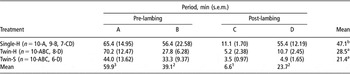
The level of contact between ewes was higher for single bearing ewes (Single-H) than for the twin bearing ewes (P < 0.01). There was no significant difference in overall contact levels between the two shelter types for the twin bearing ewes (Table 1).
Contact duration between ewes for the four 24 h periods before and after lambing

Single-H = Hessian rows with single bearing ewes; Twin-H = Hessian rows with twin bearing ewes; Twin-S = shrub belts with twin bearing ewes.
A – 5 days before first lamb, B – 24 h pre-lambing, C – 24-h post-lambing and D – minimum 3 days post-lambing.
a,bMeans within a column with different letters differ at P < 0.01 (s.e.d. = 6.99).
1,2,3Means within a row with different numbers differ at P < 0.001 (s.e.d. = 8.08).
Contact between ewes was higher before lambing than immediately after lambing (P < 0.001). There was a 35% decrease in contact for the day before lambing (period B) compared to period A with a further 84% decrease from period B to C, resulting in a total reduction in contact between periods A and C of 90%. After lambing contact levels increased by over 350% between periods C and D (Table 1). The mean contact duration between ewes immediately after lambing was 18% of that immediately before lambing for both Hessian treatments compared to 10% for the Twin-S (Table 1).
Related pairs contact
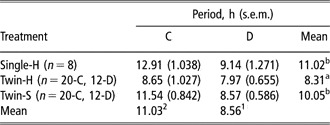
The level of contact between the ewes and each of their offspring was higher than that observed between ewes. At the initial contact measurement period (period A) the mean contact time between ewes was 59.9 min, which was between 9% and 12% of the contact duration between ewes and their offspring for periods C (11.03 h) and D (8.56 h), respectively. Contact levels between ewes and their lambs decreased between periods C and D by 22% (P < 0.001).
For ewes with twin lambs the mean level of contact between ewes and each of their lambs for periods C and D was 9.52 h (s.e.m.: 1.25). Shelter type influenced the level of ewe–offspring contact, with ewes in the Hessian treatment (Twin-H) having 17% less contact with their offspring than those in the shrub treatment (Twin-S; P < 0.001). In the treatments with Hessian (Single-H and Twin-H) contact was 24% lower in the twin lamb treatment. No significant difference was observed between the Single-H and Twin-S treatments (Table 2).
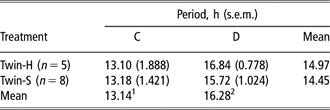
The amount of contact between siblings was 55% higher than between ewes and their twin lambs (Tables 2 and 3). The difference was greater for the Hessian treatment compared to the shrubs (80% cf. 44%). While contact between ewes increased between periods C and D, over the same period, the level of contact between ewes and their offspring decreased (P < 0.001) (Table 2). The level of contacts between siblings increased by 24% between periods C and D from 13.14 (s.e.m.: 1.088) to 16.28 h (s.e.m.: 0.691) per day (P < 0.05). Shelter type did not influence the level of contact between siblings (Table 3).
Contact duration between ewes and each of their offspring for the two 24 h periods after lambing

Single-H = Hessian rows with single bearing ewes; Twin-H = Hessian rows with twin bearing ewes; Twin-S = shrub belts with twin bearing ewes.
C – 24-h post-lambing and D – minimum 3 days post-lambing.
a,bMeans within a column with different letters differ at P < 0.001 (s.e.d. = 0.667).
1,2Means within a row with different numbers differ at P < 0.001 (s.e.d. = 0.544).
Contact duration between siblings for the two 24 h periods after lambing
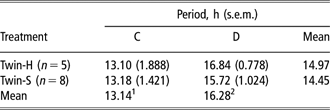
Twin-H = Hessian rows with twin bearing ewes; Twin-S = shrub belts with twin bearing ewes.
C – 24-h post-lambing and D – minimum 3 days post-lambing.
1,2Means within a row with different numbers differ at P < 0.05 (s.e.d. = 1.101).
Non-related pairs contact
The mean daily duration of contacts between ewes and individual non-related collared lambs was less than 1% of that between ewes and their offspring (5.7 min cf. 10.19 h). Mean daily contact between unrelated lambs (16.5 min) was also less than that recorded for siblings (14.6 h).
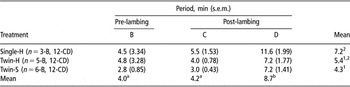
Overall contact levels were higher at period D compared to periods B and C (P < 0.001). There was no difference between the two Hessian treatments or the two twin lamb treatments but overall contact was higher for the Single-H treatment when compared to the Twin-S treatment (P < 0.05) (Table 4).
Contact duration between ewes and lambs other than their own for three 24 h periods

Single-H = Hessian rows with single bearing ewes; Twin-H = Hessian rows with twin bearing ewes; Twin-S = shrub belts with twin bearing ewes.
B – 24-h pre-lambing, C – 24 h post-lambing and D – minimum 3 days post-lambing.
a,bMeans within a row with different letters differ at P < 0.001 (s.e.d. = 1.15).
1,2Means within a column with different numbers differ at P < 0.05 (s.e.d. = 1.15).
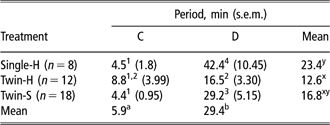
In addition, as was found for the level of contact between ewes and unrelated collared lambs, overall contact between unrelated lambs was higher for period D than period C (P < 0.001). There were no differences between the three treatments in the level of contact at period C but at period D all treatments had different levels of contact with the Single-H treatment the highest and Twin-H the lowest (P < 0.001) (Table 5).
Contact duration between non-related lambs for the two 24 h periods after lambing
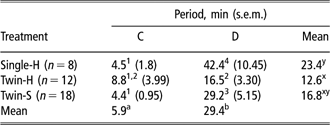
Single-H = Hessian rows with single bearing ewes; Twin-H = Hessian rows with twin bearing ewes; Twin-S = shrub belts with twin bearing ewes.
C – 24-h post-lambing and D – minimum 3 days post-lambing.
a,bMeans within a row with different letters differ at P < 0.001 (s.e.d. = 2.77).
x,yMeans within a column with different letters differ at P < 0.01 (s.e.d. = 3.4).
1,2,3,4Means with different numbers differ at P < 0.001 (s.e.d. = 4.81).
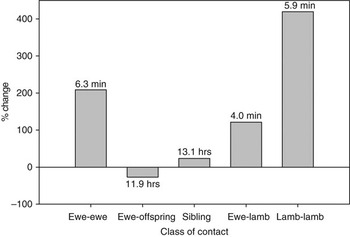
Contact between siblings increased by 22% over this time while the increases for non-related ewes and lambs were 120% and 420%, respectively (Figure 2).
Changes in contact levels for period D as a percentage of period C for the five analysis groups (numbers on columns indicate level of contact at period C).

Non-surviving lambs
Ten lambs died while the collars were attached. Nine of these died within 72 h of birth, the other dying 11 days after birth. Post mortems conducted showed that all lambs died of SME. Eight of these lambs were from the Twin-H treatment and two from the Twin-S treatment. Of the seven lambs, which had surviving siblings, at period C, two had more contact with their mother than the surviving sibling while five had less contact.
Discussion
The results show that both shelter type and litter size influenced the level of mother and offspring interaction. Contact between ewes and their offspring was greater for single lambs than twins for the same shelter type (Hessian). While for the two twin lamb treatments, the level of contact between ewes and their offspring was lowest in the Twin-H treatment. We cannot conclude from our data whether the Hessian shelter decreased contact levels in the single lambs to that of twin lambs or whether the shrubs increased contact levels in twin lambs to the level of single lambs and their mothers.
The reduction in contact levels among ewes as they approached lambing indicates that separation from the flock occurred at least 24 h before lambing. This separation may represent the onset of physiological changes associated with parturition (Welch and Kilgour, Reference Welch and Kilgour1970; Nowak et al., Reference Nowak, Porter, Levy, Orgeur and Schaal2000). There was a further decrease in contact immediately after lambing suggesting that ewes are seeking isolation from the remainder of the flock at this time. While the ewe stocking rate in the single-H treatment was 35% higher than the two twin treatments, at no time did the differences in ewe contact reflect this. For period A contact was 7% lower than Twin-H, for period B it was 100% higher, for period C it was 95% higher and for period D it was 300% higher (Table 1).
Knight et al. (Reference Knight, Wilson, Lynch and Hockey1989) found that when lambing, ewes favoured sites that were away from the flock but still in visual contact. In this experiment the shelter design in the Hessian treatments may have limited the ability of some ewes to spatially separate themselves greatly from the remainder of the flock when lambing as indicated by the higher ewe contacts in the Hessian treatments compared with the shrub treatment. Conversely as the shrubs are a more substantial barrier with only the single crossing point this may increase the ability of ewes to attain separation from the flock. Further study is required to determine which of these is the case.
This reduction in contact with the other members of the flock both before and after lambing has also been observed in wild sheep. Studies of wild mouflon sheep in Germany found that the ewes withdrew from the flock, both spatially and socially, for about 14 days. This time was divided approximately one-third pre-lambing and two-third post-lambing. It was presumed that the period of isolation assisted in the establishment of the mother–offspring bond (Langbein et al., Reference Langbein, Scheibe and Eichhorn1998).
Dwyer and Lawrence (Reference Dwyer and Lawrence1999) found that in a smaller paddock the distance between ewes decreased. In this experiment the level of contact between ewes with twin lambs was 60% higher, although not statistically significant, in the Hessian treatment compared to the shrubs before lambing (period A) (Table 1). Although the paddocks were the same size the reduced distance between the Hessian rows may promote the impression of smaller paddock size. The similarity in contact levels after this period suggest that the impending lambing or the presence of a lamb may reduce the effect of environment on ewe–ewe contact levels.
The level of contact recorded between ewes and their lambs in this study was much higher than Swain and Bishop-Hurley (Reference Swain and Bishop-Hurley2007) found in cattle when also using contact loggers. They found for cows and their calves (between 1 and 14 days old) the overall mean level of contact was 1.03 h/day. This compared to 10.26 h/day of contact between ewes and their lambs in this study. In fact 23% of cows spent less than 10 min/day with their calves while in this study the minimum daily contact between an ewe and their lamb was 3.72 h. While ewes also spent more time in contact with non-related lambs (mean 381 s/day) than cows (mean 232 s/day) the difference was not as pronounced.
Difference between the sheep used in this study, and the cattle studied by Swain and Bishop-Hurley (Reference Swain and Bishop-Hurley2007) may represent the difference between these two species in their spatial association with their offspring; sheep are considered ‘followers’ where the newborn follows the mother closely as she grazes (Alexander, Reference Alexander1988), while cattle can be either ‘hiders’ or ‘followers’ depending upon the interaction of innate and environmental traits (Wood-Gush et al., Reference Wood-Gush, Hunt, Carson and Dennison1984; Lidfors and Jensen, Reference Lidfors and Jensen1988). While some differences in the transmission and receiving ability of the contact loggers were expected due the different body sizes of the species studied this would not account for the substantial differences between the studies. The level of ewe and lamb contact is below that stated by Hinch et al. (Reference Hinch, Lecrivain, Lynch and Elwin1987) who found that ewes and their lambs were closely associated (mean distance 1 m) for 75% of the time, however, these data were collected by daytime visual observations only.
Lynch and Alexander (Reference Lynch and Alexander1976) also found higher levels of contact in the first 24 h after birth than in this experiment with ewes and lambs being within 2 m of each other more than 90% of the time. However, they state that some disturbance of animals occurred when the observers entered the paddocks at every hour. What is unknown in those experiments is how the visual presence of an observer, even when outside the paddocks, has influenced contact between ewes and their offspring. Does the ewe deem the observer to be a potential threat and therefore become more attentive? The use of contact loggers to collect data overcomes this problem and therefore provides a continuous and more realistic study of ewe and lamb contact levels.
This experiment has shown that contact between ewes and their lamb(s) decreases over a short time period (Table 2). As all of the lambs in this experiment were between 14 and 38 h old when the level of ewe and lamb contact was first analysed (period C); it could be expected that the number of contacts would be lower than that found by Lynch and Alexander (Reference Lynch and Alexander1976). Morgan and Arnold (Reference Morgan and Arnold1974) also found that the average distance between ewes and their lamb(s) increased as lambs got older. They recorded that when ewes and lambs were some distance apart this tended to be during periods of time when the ewes were grazing and the lambs were more likely to be lying or playing.
In this study, as lambs grew older the time spent with their mother decreased and the time spent with both siblings and other non-related ewes and lambs increased. The decrease in time spent with their mother was similar to the level of increase in time spent with their siblings. Over the same time period the increase in contact with non-related animals, although lower in actual time, as a proportion of contact immediately after birth, was much higher (Figure 2). For both non-related ewes and lambs the level of increase was greatest in the Single-H treatment (Table 5) possibly showing the effect of the increased stocking rate had on the level of contact between animals. Although there were major increases in the level of contact between non-related animals over time, at the final analysis time there were more lambs with collars present in each paddock and therefore higher levels of incidental contact could have occurred.
In cattle, Wood-Gush et al. (Reference Wood-Gush, Hunt, Carson and Dennison1984) found that calves tended to interact with each other from an early age, and this interaction increased over time. The large amount of time spent with siblings has been noted in both sheep and cattle with twins in both species staying together when grazing or resting (Ewbank, Reference Ewbank1967; Shillito-Walser et al., Reference Shillito-Walser, Willadsen and Hague1981). While the increase in contact levels between non-related lambs increased between the two recording periods, it still averaged only 30 min per day at period D. Morgan and Arnold (Reference Morgan and Arnold1974) observed that it was not until day 29 that peer groups of lambs separate from ewes. Peer groups were observed playing together later in our experiment (J. Broster, personal observation) and it may be in a ‘follower’ species like sheep these groups take longer to form than in a ‘hider’ species like cattle (Lent, Reference Lent1974).
The reduction in maternal contact was lowest in the Twin-S treatment suggesting this design led to less separation of lambs from their mothers as they became more independent. The increased visual distance in the shrub treatment (50 m cf. 20 m) could mean that as the ewe was grazing it was more often in sight of the lamb and when the distance was perceived as too great by either the ewe or lamb they moved to reunite, or alternatively, the higher amount of shelter interface per hectare within the Hessian treatments resulted in lambs resting adjacent to the shelter and feeling more protected both visually and climatically and only seeking out their mother when hungry or startled.
We conclude that shelter design influences the level of contact between ewes and their twin lambs and that under the same shelter design and DSE/ha, ewes with single lambs had greater contact with their offspring than ewes with twin lambs. As twin lambs are more susceptible to death from SME, when selecting between shelter designs that provide similar levels of protection from wind, the shelter design that maximises ewe and offspring contact and therefore bonding should provide the greatest reduction in newborn lamb mortality.
Acknowledgements
The authors acknowledge the financial support of the Future Farm Industries Cooperative Research Centre, which has provided funds for both the EverGraze research project and the PhD Scholarship for John Broster. EverGraze is a Future Farm Industries CRC, Meat and Livestock Australia and Australian Wool Innovation research and delivery partnership. Charles Sturt University provided a grant for the purchase of the contact loggers. The assistance of Dr Susan Robertson and Dr Belinda King during the lambing period is gratefully acknowledged.