‘All classes of people in India’, the historian R. C. Majumdar wrote in 1957, ‘were thoroughly discontented and disaffected against the British’ just before the outbreak of the sipahi mutiny in May 1857.Footnote 1 Subsequent scholarship on this subject has confirmed that the mutiny turned into a civil rebellion in north India, but revealed also that different groups of people responded differently to the mutiny.Footnote 2 When exploring these differences, historians have studied the countryside mainly. The loyalty of the landlord is a much discussed subject. So is the notion that some of the soldiers shared beliefs and attitudes with sections of the peasantry.Footnote 3 In this evolving narrative of the society at large, the urban merchants and bankers, ‘capitalists’ for short, remain shadowy if not missing altogether.Footnote 4 For example, the words ‘merchant’, ‘banker’, ‘trade’, or ‘market’ do not appear either as index entries or as significant topics in a selection of major works, old and new, on the subject.Footnote 5 In recent writings on Delhi under rebel administration, the banker has received some attention, only tangentially in discussions of court politics and city administration.Footnote 6 The ‘moneylender’ receives attention too, but almost always as a part of the peasant world. The oversight obscures an important aspect of the history, which connects directly to the economics of warfare and state formation, and indirectly to the study of Indian society in this time.
There are two open ends. First, there was an undercurrent of capitalist resistance to the rebel military enterprise within the rebel-held territories and an expression of support to the British Indian army outside this zone, but why these patterns arose is unexplained. Second, the nature of capitalist contribution to the war is not fully analysed. As in any war, supply of materiel and finance was of great importance to the armies. Business interests could either help the campaign by maintaining supplies, or damage it by blocking them. The mutiny disrupted the grain trade and the financing of trade over a large area between May and September 1857. Provisioning of the ‘field armies’, therefore, was a challenge for both parties. The rebels who held key cities needed to build partnerships with the city merchants and bankers. The British needed the Indian merchants even more, because the expatriate merchants in the Gangetic plains were either dead or under siege. The historical scholarship provides some snapshots on how the enterprise of building a partnership developed, but does not offer useful generalizations on the process.
In an attempt to bridge the gap, this article asks four questions. Did merchants take sides? Why did they do so? Did the actions matter to the outcome of the war? How did they matter? Based on a study of the evidence now available, merchants did take political decisions, often taking unusual risks in the process, especially in the zones of conflict. The article further suggests that these decisions need to be understood as a reaction to the insecurity of private property. Their response did contribute to the outcome of the war. In the material discussed here, we cannot make a direct correlation between specific battles and capitalist agency therein. There is, however, a case to be made that merchant disaffection and passive resistance were present in the rebel-held areas, and that merchants and bankers were a party to the British war effort, which focused on keeping long-distance trade routes open, safe, and well supplied.
In turn, these hypotheses link the mutiny with a global economic history of warfare.Footnote 7 The global history suggests that large conflicts interact with economic systems, to a degree that the outcome depends on economic and financial management more than strategy or gallantry in the battlefield. For example, during a war, states need to divert resources away from civil to military uses, and raise more resources. The fiscal mission, and at times the regulation of labour and capital markets that becomes necessary in its wake, can be stressful for private enterprise. Therefore, credible promises exchanged between states and merchants are crucial. Long conflicts like the world wars also made the conduct of monetary policy matter to whether or not fiscal gains were sustainable or to be drowned in macroeconomic collapse. Mancur Olson saw in wars the possibility of dramatic changes in the distribution of power in society.Footnote 8 Businesses that serve the state during periods of crisis can gain if the state wins the war, or lose if the state loses. In turn, these outcomes contribute to the speed and nature of the reconstruction process. Finally, because societies in sudden and deep crisis face an alteration in the comparative political advantage enjoyed by different groups, crises give rise to a variety of rent-seeking opportunities. The ‘grabbing hand’ is activated during the sudden withdrawal or collapse of the state.
Some of these ideas are useful in interpretations of why the mutiny ended. ‘British victory’, in an influential view, ‘partly resulted from the failure of the Bombay and Madras armies to follow the lead of the north Indian sepoys.’Footnote 9 This article suggests that the outcome also had to do with the pattern of dependence that developed between the rulers and private enterprise in north India. For example, the conflict created local shortages of resources, which were met on the British side by indigenous merchants and bankers. It threw war finance and war supplies of the rebels out of gear; the numbers who rebelled were large and tended to congregate in cities, whereas the resources of these cities to pay them did not grow. The subsequent attempts to regulate finances and markets caused enmity between the rebels and the merchant-bankers, whereas a revival of markets in regions outside but feeding into the war zone helped the opposition.
The sources for this article are conventional ones. But a systematic reading of these sources for the purpose of writing a business history is still awaited. The article relies mainly upon printed official documents. A substantial part of the official documents are available in digital versions of the Parliamentary Papers. Some compilations of printed documents were also published around 1900, and are available as digital books.Footnote 10 These volumes contain reports on the state of their jurisdiction sent to the governor generals' office by officers of civil administration, such as collectors, magistrates, engineers, commissioners where applicable, and secretaries to the provincial administration; correspondence of military, railway, home, and political departments; and reports of battles and occupied cities contributed by military officers.Footnote 11 Contemporary accounts, such as John Kaye's work extended by G. B. Malleson, used mainly these sources but a subset of what is now available, supplementing these with memoirs and eyewitness accounts.Footnote 12 This corpus runs into several thousand printed pages, but actual material relevant to this article is thinly scattered through these pages. I supplement these materials further with a few obscure printed sources such as biographical dictionaries. Source material on the business history of India is always hard to find. Biographical compilations often contain valuable data on firms of merchant-bankers that are not available elsewhere. We would wish to know more about these firms, but the resource is nowhere near as detailed as one would hope for.
Non-official English-language documents such as memoirs of former soldiers and contemporary accounts form a larger body of material. These are mainly descriptions of battles, sometimes written by those who took part in action, and sometimes, as with George Forrest, by archivists.Footnote 13 Despite Malleson being a former officer of the commissariat department, these works contain much less information than we hope to find on trade, markets, supplies, and transport. Further, intended as ‘tributes to the glory of our arms’, military memoirs were often reserved on Indian role in the British war effort.Footnote 14 This oversight meant not only that the gallantry of the Indian soldiers fighting on the British side received less attention than was fair but also that the job of feeding, clothing, and servicing the armies, primarily done with indigenous resources, was underestimated. This corpus is still helpful in cross-checking with the official documents the course of specific events.
Indian-language sources form an area where exciting new finds have been made in the last few years. These resources include folklore, newspapers, private accounts, and pamphlets and proclamations issued by the rebel governments.Footnote 15 However, these works, or what have been found, translated, and published so far, are slight on the economic aspects in general and the merchants and bankers in particular. The translation project has shed more light on cultural history but has not yet shown much promise of a substantially greater knowledge of economic, business, or military history than it is possible to gather from military intelligence on the Company's side.
There is one major exception to this statement. Perhaps the most systematic information on governance of the cities by rebels is available from a collection consisting of more than a thousand documents in Persian and Urdu produced between May and September 1857. Some of these were official messages and orders, others reports by spies; a few were deeds between merchants and court officers, and a few others were extracts from newspapers. They were preserved and catalogued for use in the trial of Bahadur Shah Zafar. In the words of John Lawrence, the chief commissioner of Punjab and a major player in the war effort, these documents formed evidence of ‘the system in which the general Government was conducted’ including ‘the raising of loans’.Footnote 16 This resource has been used, in detail for the first time, in Mahmood Farooqui's work on Delhi.Footnote 17 Another work on Delhi uses English sources that covered some of the same subjects.Footnote 18 I will draw on a printed volume in English describing the subject of the messages, rather than the full contents.Footnote 19 This 400-page catalogue or ‘press-list’ as it was called does not appear to have received attention in the literature before. The scholarly use made of the related documents does discuss bankers, but does not ask the same questions that this article asks, and therefore overlooks some of the information that this article finds of particular value.
Before ending the section, an explanation of the actors foregrounded in the article is in order. The ‘merchant’ in the title refers to people who conducted and financed long-distance trade, and were usually based in the towns. In mutiny scholarship, the trading group that figures most prominently consisted of people financing cultivation and dealing with the peasants. There were of course some overlaps between these groups, but they were also distinct in institutional and social terms. The former group operated on a larger scale, issued bills (hundi) whereas the latter did not, its clients were other substantial traders and officers of the courts, and they belonged in well-known trading castes and communities whereas the rural groups were more mixed and included peasants. Their business was less seasonal than that of the rural groups, and they accepted deposits whereas the rural moneylenders rarely did so. The distinction, in fact, is an established one.Footnote 20 The former segment is of particular interest to the article, for the urban actor operated on a sufficiently large scale, had long taken part in fiscal administration, and was reputed enough to be seen as an ally during a war. Since this group financed trade, the alliance would matter to securing supplies as well as to raise loans. In fact, the ‘press-list’ documents mentioned above contained debt contract agreements between some of the bankers who figure in the present article and members of the Mughal court dating back to the decades before the mutiny. Both the rebels and the British understood the strategic importance of the urban capitalist. In this time, the prominent urban groups came from a few castes and communities. They were mainly Hindu Khatris in Delhi and Jain and Hindu trading castes from Rajasthan elsewhere. Some of them, especially Gujarati Brahmins, either operated from or had a base in the temple towns. Thus, Mathura became a base for the firm of Gokuldas Parikh, former treasurer of Gwalior state, which played a significant role in the counteraction against the rebels. The inheritors of the firm were Jain Oswals.
How important was this section of the population in society? How large and how robust was urban trade in the decades leading up to 1857? The western and central part of the Gangetic plains had been relatively urbanized, and despite some decline in urban population in the eighteenth century, experienced a modest growth in the population of the major towns in the first half of the nineteenth century.Footnote 21 It would be safe to assume that the traders and bankers of the cities were not a depressed group. Indeed, even as some of their traditional businesses connected to tax collection had been in decline, commodity trade in sugar, cotton, indigo, and grain grew, if exports of these goods can be taken as a benchmark. What is more, directly or indirectly, these trades had created scope for collaboration between overseas trade and overland trade, and, in turn, between Europeans and Indians. Despite the end of textile export trade, shipping tonnage handled by Calcutta and Bombay ports increased threefold between 1840 and 1857 and exports exceeded imports. A significant part of the trade occurred in the Gangetic plains and travelled by the Indus and the Ganges towards the port cities.
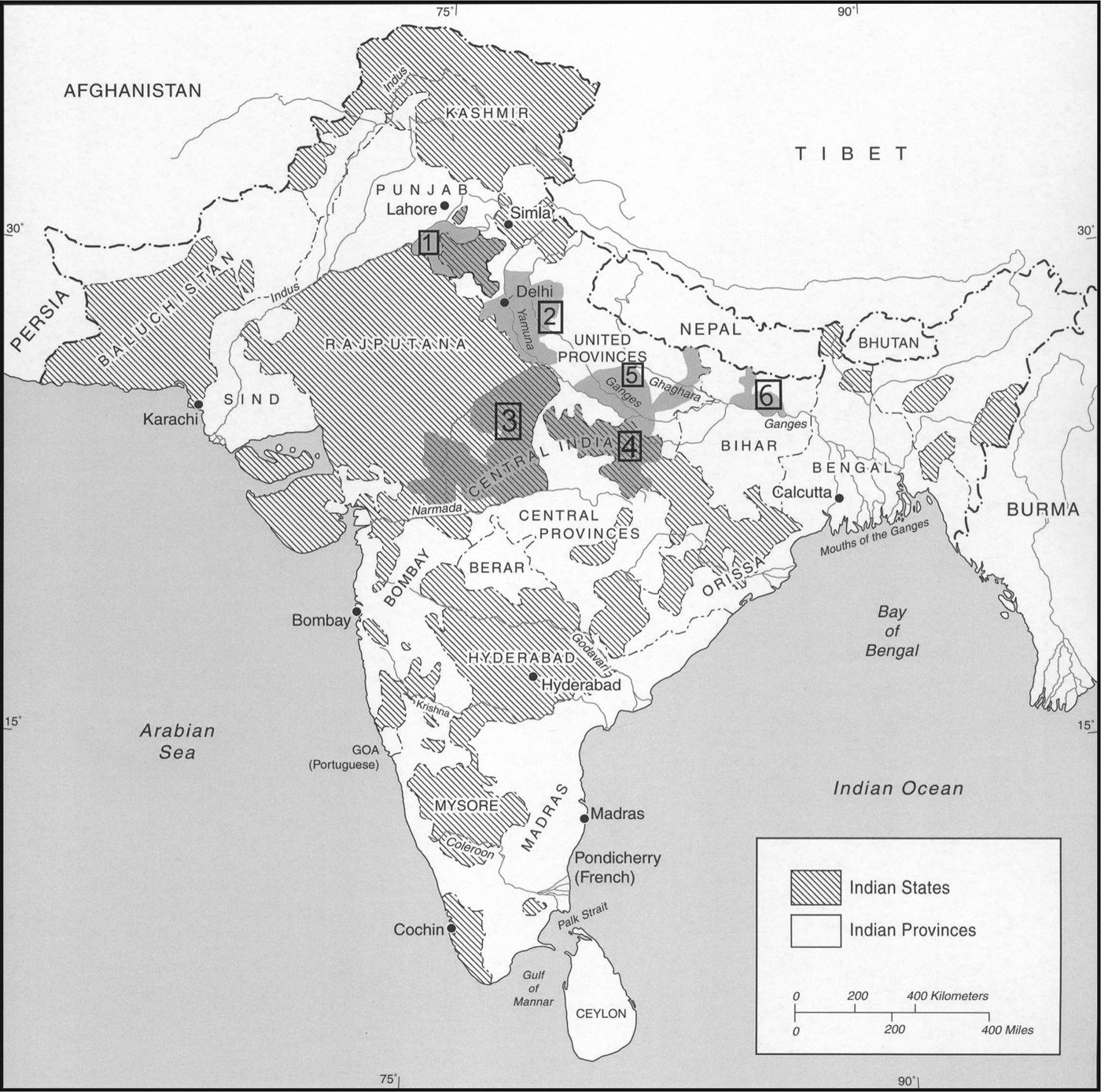
The rest of the article is divided into four sections. The next section discusses the historiography of the episode. The mutiny scholarship has developed along a number of roads. More recently, innovations in sources have introduced further divisions. A new study, therefore, needs to start by locating itself in the diverse literature. The rest of the article engages in narrative history spread over two sections. These divide the evidence into two blocks. One of these consists of what we know of the rebel effort to conduct warfare and consolidate governments. The second one considers the evidence on the British campaign, focusing mainly on the north Indian war zone with only brief comments on central India (see Fig. 1 for the boundaries of the war zone). The final section concludes with a reminder of the main conclusion of the article, which is that political attitudes by urban merchants and bankers made a difference to the outcome of the mutiny by undermining rebel attempts to run governments and by contributing to normal trading conditions in zones under British control.
Areas most affected by the mutiny, shown using 1910 district map. 1 Punjab states including Kapurthala, Patiala, Nabha, Jind, and Maler-Kotla. 2 Districts around Delhi: Meerut, Moradabad, Mathura, and Agra. 3 Central Indian states including Gwalior, Jhansi, Bhopal, and Indore. 4 Bundelkhand states including Charkhari and Rewa. 5 Districts around Lucknow city, including Lucknow, Allahabad, and Kanpur. 6 Bihar districts: Patna, Muzaffarpur, and Monghyr.

I
There are four main strands within the interpretive scholarship.Footnote 22 These deal with military strategy, representations (in colonial historiography, Indian and Victorian literary imagination), rebel actions and intentions, and institutional effects.Footnote 23 These analyses have in turn led to important arguments about overt or inchoate nationalistic and anti-colonial discourses.
Economics has not been overlooked. In fact, one of the first coherent accounts on the origin of the mutiny adopted a class struggle framework. Karl Marx was fascinated by the episode as much as he was in British rule in India, and suggested that the mutiny reflected discontent in the countryside induced by British attempts at institutional reform.Footnote 24 Marx's view was endorsed by Friedrich Engels. Later Marxist readings of the episode, notably by M. N. Roy and R. Palme Dutt observed too that the rebellion entailed a conflict between mercantile and landed interests. Thereafter, class analysis followed Marx to situate the capitalist within a narrative of the village. In a polemic against the then-prevailing views that the mutiny was a feudal backlash and a religious reactionary one, a Marxist-nationalist work of the 1960s argued that it was an uprising against ‘the commercial and industrial classes, the bankers and the mahajans’.Footnote 25 A recent contribution reiterates that the soldier-peasant order, joined in some cases by the urban artisans, had suffered ‘growing economic distress and pauperisation’.Footnote 26
It is true that in the early stages, rural moneylenders and indigo planters were attacked.Footnote 27 After British takeover of Awadh (1856), some of the auction purchasers of large landlord (talukdar) estates were mercantile in background. And they were disliked by the peasants, though not necessarily because of the new economic relationships that had emerged.Footnote 28 Studies of Awadh and Bundelkhand also show that rural merchants and moneylenders were often targets of attack by peasants.Footnote 29 Some of these later works have been influenced by the subaltern studies reinterpretation of Indian nationalism.
Can class conflict in the countryside supply a sufficient model of either the origin of the mutiny or of capitalist agency in its progress? I think not. First, the proposition that merchants were driven to joining the British because peasants resented economic exploitation is a constructed idea, and begs the question of merchant calculations. Military intelligence, in fact, revealed many cases of opportunistic attacks on merchant property by soldiers and urban gangs as well, as would happen in any episode of temporary breakdown of the state. Second, the proposition is not consistent with the proclamations made by the rebel government. None of these, as far as we know, mentioned exploitation of the poor by the rich, and at least one backed the merchants.Footnote 30 Third, it lives uneasily with the diversity in peasant response. And fourth, the most consequential economic actors were the urban firms who had little direct contact with cultivation, but who did have a potential role in strengthening the fiscal enterprise on either side.
The hypothesis that some groups joined the rebellion because their livelihoods had suffered on account of British reforms can in principle lead to the inference that livelihoods that did not suffer would side with the British. Eric Stokes seemed to suggest such a hypothesis in a discussion of the material basis of ‘magnate’ support.Footnote 31 Stokes, however, left the point insufficiently developed, especially in relation to the urban merchants and bankers. I agree with the implied hypothesis that some merchants and bankers might have foreseen that British rule would serve their economic interests better. However, that is an incomplete story. In a battle zone, taking any side carried risks and threats, merchants and bankers had a lot to lose, and an economic history of the mutiny needs to consider these short-term risks as well as the expected long-term returns.
It is necessary, therefore, to reread the evidence on capitalist experience.
II
This section gathers evidence on trader disaffection in the rebel-held regions. The larger picture that emerges from military intelligence gathered from the rebel-held towns is that of an uneasy attempt to form a coalition between the leadership and the capitalists. That partnership appeared to break down, because merchant property was also a target, of opportunistic raids by urban gangs or soldiers who had not been paid, or from suspicions of collaboration.
In the middle-Gangetic plains, the most consequential battles were for the control of Delhi, Lucknow, and Kanpur. The battles occurred between stationary armies and had elements of siege warfare. These were densely populated, large, and prosperous urban centres, containing many markets within them, and large settlements of merchants and bankers. The surrounding countryside was heavily cultivated and produced much of north India's grain output. The country was flat, with many good roads and good prospect of river-borne trade. Overland trade, therefore, was large. For these reasons, supplies were initially a small problem for the several hundred thousand rebel soldiers who moved into the cities. At least, military intelligence in May rarely mentions the issue of provision for the cities. The new government seized hold of the government treasury. On most occasions, convicts were released from prison. One report suggests that the freed convicts were seen as more loyal transporters of goods than the population at large.Footnote 32 In most parts of the Ganges–Jumna doab, the Company's own civil authority had crumbled away, and the landlords were, even when not welcoming to the rebels, not strong enough to stop or refuse supplies to soldiers. In the eastern districts of Awadh, the Baiswara landlords supported rebels reportedly because a large number of the Bengal army soldiers were Baiswara Rajputs.
And yet, managing the resources in an organized way as well as sustaining the flow of revenues both posed challenge to the new governments. Little information is available directly on the fiscal and monetary administration of the rebel-governed cities. We do know that from the start money was raised from the bankers and merchants of the cities by the rebels, as well as by the British, as we see later. Although such evidence is cited in the literature, from the usually brief citations, it is not clear what the bankers themselves thought of these arrangements. The documents show that in early May, as soon as an administrative structure was established in the city, upon an order from the Commander-in-Chief Mirza Mughal, the Kotwal or police chief prepared lists of merchants and bankers and estimated the ‘subscriptions’ to be raised from them.Footnote 33 In May and June, there were complaints from grain traders of harassment and extortion by bands of soldiers.Footnote 34 Bankers did not complain, but they were in the spotlight throughout. On 11 June, an officer of the court again raised the matter of subscriptions from bankers.Footnote 35 On 1 July, Jugal Kishor and Sheo Parshad, bankers, petitioned that although they paid money to the king, ‘they are subjected to the oppression of the Princes and the plunder of their houses and property by the sepoys’.Footnote 36 On 11 July, ‘the Mutineers demand money from the money-lenders of Delhi’.Footnote 37
A fortnight later, the king directed the commander-in-chief ‘to borrow money from the Punjabis and other wealthy people to meet war expenses’.Footnote 38 On several occasions in August, the court summoned bankers of the city to discuss how to raise more money.Footnote 39 One witness recalled a near-death experience in the court early in August.Footnote 40 But, in fact, there were also attempts by the court to pacify the bankers, who had by then been subjected to many unauthorized demands for money by the Kotwal, by individual officers, and by soldiers. At least four orders were passed in August to state that only the court could deal with the bankers.Footnote 41 Little heed, it seems, was paid to these orders. In September, crisis was breaking out all around. Some soldiers ‘decided to plunder the town of Delhi to realize their pay’, and a few others declared their intention not to fight until paid.Footnote 42 Mutineers who had not been paid did loot a number of shopkeepers.Footnote 43 Saltpetre stocks were running out. The dealer Debi Das's shop was raided by the soldiers to recover more of the article.Footnote 44 ‘Respectable persons at Delhi have been imprisoned as they failed to pay money to the Mutineers.’Footnote 45 Jewellery was needed for making coins; presumably some of the jewellery was seized from private hoards. Shops closed down for fear of raids.Footnote 46
How do we read these reports? In one interpretation, they suggested that the police were effective in making sure that the merchants and bankers did pay up.Footnote 47 That leaves open the questions why forced extraction had to be resorted to and whether it hurt or helped the war. Reports on extortion confirm the general and well-founded point that the administrative setup created by the rebels was ‘loose and precarious’, even ‘chaotic and incompetent’.Footnote 48 In fact, they suggest two further points explaining why the setup was precarious. First, the court turned towards the bankers and merchants of the city for accommodation because it had failed to secure a stable source of revenue from land. In turn, the weakness of the court exposed the capitalists to opportunistic attacks by soldiers that the court was unable to stop. The weakness stemmed not only from the shaky finances of the state, but also the fact that the rebel soldiers were divided into groups that followed their own commanders more than they did the writs issued by the court.
The second point is that the merchants and bankers responded to these risks by various acts of passive resistance, and covert spying for the British. Of course, bankers were frequently mentioned in the capacity of agents or court officers. Lala Jawalanath, the most prominent example, is often ordered to pay for an item of expenditure by the court or by a band of soldiers. Such orders meant either that Jawalanath had taxation powers, perhaps he undertook to raise money from fellow-merchants/bankers, or that he managed a part of the revenues. On the other side, there was the important example of Kanhaiyya Lal Saligram, who had an ambiguous relationship with the court. He worked for it, but on one occasion was ordered to be arrested by the court. He was not alone, but one of several bankers who hid themselves or refused to pay for the war. Saligram went further. Apparently unknown to the rebels, he kept the British informed of the situation inside the city. In June, communiqués from Lala Saligram (along with Mathra Das, Jainal, and Rup Kishor of Moradabad) reached the British agent in Delhi on the conditions of people (presumably merchants and bankers) loyal to the Company and imprisoned by the court.Footnote 49 We would not be surprised if there were many more figures like Saligram. Indeed, another Delhi merchant, Jat Mall, a witness in the trial of Bahadur Shah, stated that ‘the merchants and respectable tradesmen among the Hindus regretted [the overthrow of the British government]’.Footnote 50
Likewise, several prominent merchants and bankers inside and outside Lucknow were willing to help the rebel government, and kept in touch with each other. We know about these networks from intelligence gathered by the British after they consolidated their positions in Benares, Mathura, Patna, Meerut, and the outskirts of Lucknow. It is not known from the same source in how many of these cases the rebel landlords or generals were the clients of the bankers who wanted to secure their interest. In June 1857, when the British had established authority in Meerut, efforts to raise a public loan failed because local bankers did not respond.Footnote 51 Until the winter of 1857, Lucknow traders refused to serve the British. Bairo Pershad and Esree (Ishwar) Pershad, bankers of Benares, maintained a secret correspondence with the rebel government in Lucknow.Footnote 52 They were said to be close to Madho Singh, the landlord of Amethi. The Patna banker Lootf Ali Khan was arrested on the suspicion of sheltering rebel soldiers, but released for want of proof.Footnote 53
The governments of the occupied cities held meetings with the merchants and bankers, though few details are available on how the future role for the capitalists in the new governments was seen. Nana Saheb's war council in Kanpur did not include the wealthy merchants and bankers, but was willing to listen to them. For example, on 10 June 1857, ‘the city mohajuns…and influential men, such as Shew Pershaud, the present treasurer; Gunga Pershaud, tent-maker; Jogul Kishore, Jeweller; and Biddee, Pawn seller’ could have their favourite city police chief Hoolas Singh reappointed to his post after he had been initially suspended.Footnote 54
Suspicions of collaboration disturbed these efforts to create a common platform. Nowhere was this more obvious than in Kanpur, where potential suspects included a large segment of the middle class. Far more than Delhi or Lucknow, Kanpur was an Indo-European city. Its prominence was owing to the military camp, administrative offices, and long-distance trade in sugar and indigo. Few of the indigenous bankers, merchants, and Bengali ‘writers’ or clerks settled in the city felt compelled to join the Europeans sheltered in an entrenchment. But many amongst them ‘received much annoyance from the mutineers’, were imprisoned, and had to ‘hide themselves to save their lives’.Footnote 55 Proven cases of transaction with the European entrenchment were punished with death.Footnote 56
By June 1857, military intelligence was rife with reports of tensions inside Kanpur. A large part of the seized government treasure had leaked out. The use made of the contents suggests that these acquisitions were not used to strengthen the fiscal enterprise. For example, a vast quantity of stamp paper seized in Allahabad turned up in underground markets in Bengal and Bihar months later, on one occasion sold by sailors employed by river steamers.Footnote 57 The governance of Kanpur effectively passed on from Nana Saheb to the soldiers. ‘The mutineers, being in want of saltpetre confined Juggunnath, seller of that article, in order to extort the requisite supply.’Footnote 58 The soldiers operating the batteries outside the besieged European entrenchment plundered ‘supplies brought in,…helping themselves to large quantities of sugar’.Footnote 59 When reports of an imminent British attack reached the city in July, it proved difficult for the war council to procure carriage and supplies.Footnote 60
In or near Kanpur, merchants secretly supplied intelligence and protection to the Company and its allies. In July, in Kalpi, a cloth merchant Ganesh was caught trying to protect a party of Europeans.Footnote 61 In June, the merchants of Kanpur sent out intelligence to the British garrisons about conditions of the besieged European population. ‘A Native merchant's letter from Cawnpore’ brought to light, very usefully for the British, the discord between Nana Saheb and the soldiers, which at one point threatened his life.Footnote 62 That many rebel soldiers saw themselves as mercenaries made these disputes difficult to resolve.Footnote 63
If Kanpur, Delhi, and Lucknow had rebel governments, and therefore a prospect of negotiation between the state and business interests, in other cities of the Gangetic plains the authority of any party was weak.Footnote 64 From these places, numerous reports of attacks on merchant property began to come in. On the night of 10 May, urban gangs raided merchant homes in Meerut.Footnote 65 These raids turned into small-scale battles because the merchants had private armies. In Banda town in the month of June, the merchant armies succeeded in driving off the raiders.Footnote 66 In Azamgarh town in June 1857, ‘large sums of money were extorted by violence or threats of it from the merchants and bankers of the city’.Footnote 67 On the news of the outbreak in Meerut, parties made up of locals of Budaun started off, and ‘black-mail…was freely levied by the rioters from all the bunniyahs and muhajans in their neighbourhood’.Footnote 68 In May 1857, rebel soldiers attacked in Moradabad the home of a ‘wealthy bunneah’, and tortured one member of the family.Footnote 69 In September 1857, when British troops entered Hazaribagh, they found the bazaar plundered.Footnote 70 ‘The little band of rebels traversing Mirzapoor’ took their supplies by force.Footnote 71 As late as March 1858, attacks on merchants were reported from villages in the doab, but who the attackers were it was not known.Footnote 72
Some of these attacks on merchant property took the form of attempts at taxation, authorized or not, and some were attempts to punish collaborators. In August 1857, a minister (nazim) of the king of Lucknow occupied Gorakhpur town and ‘forcibly exacted large sums of money from the merchants of the city’.Footnote 73 In October 1857, a rebel general Niaz Mahomed Khan ‘levied fines’ from merchants in Sahaswan.Footnote 74 In Tirhoot, the army of Kooar Singh of Jagdishpur caused great anxiety to the town merchants. Letters intercepted south of the Jumna in November 1857 revealed evidence of enquiries being made by the rebels on which merchants traded with the English.Footnote 75 In Moradabad, a tense moment occurred in April 1858 when a commander of Rohilkhand rebels arrived and ‘demanded money and supplies’. The course of the war was already decided and it was not surprising that ‘the townspeople refused…whereupon the prince, after some negotiation, endeavoured to help himself by force’.Footnote 76
In the early days of the outbreak in Punjab there were episodes of seizure of mercantile property. Grain was taken by force from shops in Ludhiana, and ‘wherever a horse or mule could be found, the rebel hand was laid instantly upon it’.Footnote 77 The bankers were reported to have quietly transferred their money chests and the merchants locked up shops. In Jullunder, the mutineers caused little damage except for ‘an occasional…demand for money, [and] carrying off flour and grain from the bunniahs’ shops’.Footnote 78
In Rajputana and Mewat, ‘the air was infected with panic’.Footnote 79 Containing important overland trade routes and settlements of merchants and bankers, and yet, poorly defended, Rajputana was particularly exposed to attacks, on these occasions, not by rebel generals but semi-nomadic groups. In July 1857, armed Gujar troops moved about Mewat. The most notorious in British records was Deohans, who attacked Dholepur town. Among his casualties were three town merchants. The merchants sought protection from one Buham, who was killed in an encounter with Deohans on 14 July.Footnote 80 In ‘the great centres’ of trade in Rajputana, bankers sent away their families in June 1857 and sent petitions to the governor general seeking ‘advice and protection’. In Mewat itself, the Gujar attackers were in some cases inspired by the prospect of targeting their creditors and destroying account books.Footnote 81
Some of the raids conducted in September–October were more related to the high price of food in that season.Footnote 82 The kharif (autumn) harvest of 1857 was good, but prices of grain were higher than usual on account of disruption of supplies.Footnote 83 In the Rohilkhand plains, the stationary battles had been over by December with the fall of Lucknow, giving way, in winter and spring of 1858, to small-scale encounters between mobile armies. These episodes were frequent enough to exhaust the countryside of supplies and both parties faced difficulties in procuring food. When food ran scarce in the bazaars, traders' choices mattered more crucially. Months before in the market towns of Rajputana, British troops failed to procure any supplies in June until the news of the battle at Badli-ke-Sarai (8 June) reached the towns, and the supply situation reversed dramatically.Footnote 84 The same thing happened in Awadh in winter. Victory in Lucknow and against the Gwalior Contingent changed merchant attitudes in the heart of the war zone quickly. On the British side, punitive raids on minor landlords suspected of helping the rebels targeted food. ‘We took all the grain we could find, and burnt the village’ was a refrain that was to be repeated again and again in the autumn of 1857.Footnote 85 By then, the Awadh landlords had turned against the British out of desperation.Footnote 86
But raids on food stocks did not constitute the most effective strategy of the British campaign. Rather, it was building links with private trade along the two great arteries of cargo movement, the Indus and the Ganges.
III
This section gathers evidence on two things that mattered to the British war effort: protection and financial help extended by merchants in conflict zones, and keeping long-distance trade routes safe, well-stocked, and running. The second strategy could not possibly succeed without Indian traders choosing to help the commissariat department. This was so because the Company state neither had the administrative means nor the intention to follow what modern states often did in periods of conflict, directly regulate markets.
‘An army in India’, wrote one veteran of the Anglo-Punjab wars, ‘is followed by another army whose general or commander-in-chief is the bazaar kotwal’.Footnote 87 Shortly after the fall of Delhi on 11 May 1857, the troops that moved from Punjab to the outskirts of the city functioned in a two-tiered setup of this kind. Many members of the rear were artisans and service workers, ‘barbers, cooks, shoeblacks, and so forth’, and a large number of bheesties or water carriers. The elderly members of the group recalled the Afghan wars of 1840–2.Footnote 88 The bazaar kotwal supervised the procurement of food. In the eighteenth century, supplies were managed mainly by dealing with the bullock convoys that transported grain, and camp followers who supplied artisanal services and sometimes managed the procurement of grain on the way.
Early in the crisis, as the downfall of the Company regime seemed a certainty, ‘the camp followers, so necessary to the efficiency of an army in India, deserted like rats from a sinking ship’.Footnote 89 Indeed, camp-followers subsequently received scant mention in mutiny sources. In one rare instance, the ancient system was revived. In February 1858, Major (later Major-General) John Coke stationed near Moradabad enlisted the help of the mobile caravan-runners or Banjara headmen who had been grazing their cattle in the Terai.Footnote 90 But contracting with caravan-runners was not the norm.
This is not surprising. In 1857, the Company army fought a different form of warfare than those it had engaged in before. It had never fought battles on such a large scale in the Ganges–Jumna plains before. Its forces were larger on average than in the eighteenth century. And it was trying to retake cities under enemy occupation, which operation took time. These circumstances made supplies a crucial problem, and made it necessary to procure supplies by bureaucratic means, that is, rely on revenue and trade.
Needless to say, the Company regime received an unqualified expression of loyalty from the non-official European and Eurasians during the campaign. But if non-official Europeans were useful as military volunteers, they rarely had a chance to contribute in their traditional roles as traders, artisans, and planters. Except in Kanpur, their knowledge of overland and domestic trade was not useful. Few had experience of trading in grain and saltpetre, the two vital resources. Most had conducted businesses within the European quarters, were small in number, and with few exceptions, fugitives, killed or besieged.
The British authorities believed that the Indian merchants owed their wealth to the Raj, and would naturally come to its aid. ‘If there was any body of men in India who ought to have come forward to help us in difficulty it was “the monied interest”.’Footnote 91 There was an element of truth in this assertion. Some merchants and bankers were mobile and had more information about the course of events on a larger scale. For example, in Assam and Rangpur, the Marwari merchants made statements in public that ‘as every one must know…who, like us, has travelled’, the scale of reinforcement from Calcutta was too large for the rebellion to withstand.Footnote 92 In Meerut and Peshawar, the British acted on their belief and called upon the merchants in May and June to subscribe to war loans. The response was lukewarm in Meerut, as we have seen. It was generous in Punjab, but not before arm-twisting had been resorted to.Footnote 93 A show of neutrality was not only the politically safer option for the merchants, but also made economic sense since government paper was rapidly losing value. In Awadh and Rohilkhand, the confidence that merchants would voluntarily risk their lives for the British disappeared quickly.
Still, collaborations were present on a noticeable scale. In the early months of the mutiny, taking the side of the British anywhere in the middle Gangetic plains would have carried grave risks. Many firms, however, did so. The banking firms Lakhsmi Chand Jain of Mathura and Manik Chand of Allahabad are prominent examples.Footnote 94 Mathura was an important centre of finance in north India. Lakshmi Chand with his brothers Radha Krishan and Gobind Das sent the first pieces of intelligence to the revenue officer at Agra of a restlessness in the army, which led to a disarming of the infantry troops in Agra. The city was not seriously threatened thereafter. Upon the approach of the Nimach brigade in August 1857 – a rebel force commanded by Bakht Khan sent from Delhi to attack the rear of the British forces besieging Delhi – the brothers provided shelter to fugitive European families, transported them safely to Agra, kept the flow of intelligence intact, and during the months when the banking system in northern India had collapsed completely, made loans to the administration.Footnote 95 They could offer some of these services because the bankers commanded armies, and believed credibly that they could meet small-scale threats on their own. There were similar stories from Rajputana and Punjab. The Marwari banker of Bikaner, Bansi Lal Daga, started buying up Company government security that sold at one quarter of the face value in May 1857, ending up exceedingly rich seven months later. In order to defend his investment, he ‘identified himself so thoroughly with the cause of the Government as to undertake large contracts for the supply of food for the troops in the field, and freely advanced money on supply lines drawn on other parts of the country, disorganized as it was’.Footnote 96
The control of Agra Fort in July 1857 led to the establishment of a market inside the garrison compound. Artisans and shopkeepers came inside the fort. The same thing happened inside Saugor Fort later. On the matter of supplying food to the Agra Fort, ‘the cares of the Commissariat Department…were greatly lightened by the influence exerted by…Lala Joti Parshad, a contractor whose successful provisionment of the army during the Afghan, the Sikh, and the Gwaliar wars had gained him a great and deserved reputation’.Footnote 97 In Dehra Dun, ‘food was procured through local merchants’.Footnote 98 In August, the government urged Jyoti Prasad to supervise the running of regular horse vans from Agra southward for the carriage of supplies.Footnote 99
Colonel R. Baird Smith's report from Roorkee on the Ganges Canal stated that the first intelligence on the prospect of a mutiny came from the merchants engaged in grain trade for the military bazaar at Fatehgarh.Footnote 100 They were also grain millers, and were implicitly accused of mixing bone-dust with the flour. The scale in which the rumour circulated alarmed them. The merchants, however, continued making investments, which led Baird Smith to suspect that ‘although…conscious of the general feeling of…alienation…the actual outburst of the mutiny took their class almost as much by surprise as it did ourselves’.Footnote 101
Despite these instances, the mention of specific firms, individuals, or groups of traders remained rare in military intelligence. Far more space is devoted to the project of reviving trade on the western and eastern sides of the war zone. The two strategic supply routes the British could hope to hold on to were the Punjab segment of the Grand Trunk Road, between Jumna and Sutlej, in turn connecting via the Sutlej–Indus river-borne trade with Bombay and Aden, and the Ganges river traffic linking north India with Calcutta. After Punjab came back in British control, the collaboration between the merchants and the small army that laid siege in Delhi without immediate hope of a re-conquest proved of crucial help. After Delhi was recaptured on 14 September, the report prepared by the commanding officer in the battles for Delhi, General Archdale Wilson, separately acknowledged two initiatives on keeping the Company army well stocked. One of these was the office of the commissary general, and the other was the contribution of the rulers of the Punjab states, Patiala, Kapurthala, Nabha, Maler Kotla, and Jind in protecting trade routes, and supplying carriages and cargo.Footnote 102 The states themselves did not procure the goods; the merchants did, but they protected their property. ‘The great thoroughfare [Punjab-Delhi] was soon alive with carts and carriages and beasts of burden conveying downwards all that was most needed by the Army.’Footnote 103 On the western side, cargo boats came up to Ferozepur on the Sutlej from Karachi, and they carried freight from Aden and Bombay. These were crucial services, and explained why the managers of the Delhi campaign, such as the military secretary general Archibald Alison, never had to worry seriously about food or other necessities of life.
With the trade routes and commercial intelligence in their hands, the British in Punjab could restrict the sale of sulphur, saltpetre, and lead, and starve Delhi of these materials.Footnote 104 Hundreds of artisans were gathered in Ferozepur, well away from the reach of the rebels. The town was turned into a major manufacturing centre for tent cloth.Footnote 105 How much of a difference the hold on sulphur and saltpetre made had been demonstrated on 7 August. Several hundred artisans in Delhi had been pressed to work on manufacture of gunpowder in Begum Samroo's house. On 7 August, a shell destroyed this factory and storage, along with the lives of 500 or more artisans.Footnote 106 It is not surprising then that this one attack was celebrated as a huge strategic victory by the British camp.
If in Punjab, the Cis-Sutlej rulers protected trade routes, in the Ganges between Calcutta and Allahabad, the Company picketed the river, if not very effectively. Despite uprising in Danapur (25 July), there never was a decisive attempt by the rebel commanders to stop supplies up the river. River steamers were used for movement of commanders and reconnaissance missions by the British, to bring wounded soldiers and their families to Calcutta, and for cargo. In August 1857, baggage boats organized by merchants travelled along the Jumna, to reach supplies to units operating in the strategic grounds of the doab.Footnote 107 A rare Indian eyewitness account of the cargo boats was left by the Bengali litterateur and religious reformer Debendranath Tagore, who travelled from Allahabad to Calcutta by a military cargo-cum-passenger boat in October 1857.Footnote 108 These boats were targeted from the land, and were often stranded for fear of attacks.Footnote 109 But the rivers continued to be used by the troops and the traders.
The procurement effort was co-ordinated by offices newly established or much enhanced in power. In August, a special office called superintendent of carriage and supplies was established. The commissariat in Bengal was issuing numerous indents and contracts for procurement of food, coal, sulphur and saltpetre, and cloth.Footnote 110 The correspondence of these departments suggests that the task of market purchase and transportation of supplies could be co-ordinated better after the August reorganization. At any rate, procuring materiel from the market was thereafter as big a subject of discussion as troop movement and battle strategy.Footnote 111
Although neither Bombay nor Calcutta was a battlefront, both played a critical role in supplies. In June 1857, the new commander of the Bengal army, Patrick Grant, transferred the command of the field to Henry Havelock, citing the necessity to stay back and manage supplies from Calcutta.Footnote 112 In later months, ‘Calcutta deserves notice as the…depot of stores and supplies.’Footnote 113 Bombay, likewise, was far from the action but served Punjab. Jabalpur and Saugor, two large market towns, similarly served the central Indian front in 1858. In turn, the overland route between Bombay and Jabalpur played a role similar in importance to that of the Grant Trunk Road up north.Footnote 114
In Bombay and Calcutta, merchants and bankers needed no pressure to back the Company regime. In Calcutta, when the first stirrings of mutiny occurred among the 19th and 34th ‘native infantry’ in March–June 1857, and especially after the fall of Delhi, sections of the Bengali press were said to have expressed sympathies for the rebels. The matter was quietly overlooked by the authorities. The divergence in tone between the Bengali and the English press soon disappeared. After all, ‘as traders, the interests of the European and of the native merchants were identical’.Footnote 115
In September 1857, led by the Maharaja of Burdwan and leading members of the Sovabajar estate, Radhakanta Deb and Kalikrishna Deb, more than 2,500 prominent Indian citizens of Calcutta signed an address congratulating the viceroy on the recapture of Delhi.Footnote 116 The signatories, in their own testimony, included ‘merchants and trademen’. This message was followed by another submitted a few months later and signed by more than 5,000 individuals; again many of the signatories were merchants. The addresses were not just expressions of loyalty; they also expressed anxiety over private property and lives of expatriat Bengalis. The Bengali press of the time lamented ‘the disorganization caused by [the] mutiny’.Footnote 117
In Bombay and Surat, the mutiny brought in its wake a panic among the mercantile community. Order was restored when the only potentially serious episode among an infantry regiment was crushed brutally by the police chief Charles Forjett. When Forjett retired from service, he was honoured by ‘the native cotton merchants’ with a purse of 1,500 pounds and shares in a cotton mill worth 13,000 more.Footnote 118 Christopher Birdwood was also honoured by Bombay merchants; his contribution was to organize, as the chief officer of the commissariat, bullock trains between Bombay, Vasind, and Mhow, on which the success of Huge Rose's central India operations depended.Footnote 119 In Surat, a trading town, a panic broke out in the middle of 1858, when Tatya Tope was reported to be planning an attack on the city. The merchant-landlord Syad Hossan-Al Edrus offered to join the campaign against Tope.Footnote 120
With the trade infrastructure in place, markets revived during winter. In the relatively peaceful Champaran, European indigo planters had carried on their business as usual, if inconvenienced by the refusal of cash advances by indigenous bankers. Money, in fact, was scarce between May and August, because of the collapse of the remittance and bills business. In Monghyr, bankers refused to issue drafts.Footnote 121 But by September, in Bihar, ‘trade was reviving…and money-orders were procurable’.Footnote 122 As the British consolidated command over the two river-borne channels of transportation and trade, it was only rebel-held Awadh in the middle that remained cut off from trade and normal flow of funds.
Re-conquest caused a backlash against merchants who had remained in rebel-held cities, or they were simply targets of a further round of looting. An October 1857 despatch from Muzaffarpur reported that the Company's Indian soldiers were intimidating the shopkeepers into selling food at lower than market prices.Footnote 123 There were similar complaints from Patna. In Delhi, there was extensive looting that targeted the merchants. A captain of the 61st Regiment that recaptured Delhi delightedly recalled how he and a colleague, after several days of unsuccessful raids, came upon a huge store of gold brocade in a secret vault of a merchant home that was seemingly abandoned.Footnote 124
But there was also a growing anxiety about merchant disaffection, possibly fed by the feeling that private trade had been a crucial strategic ally. Thus, even when soldiers went out of control, the administration went the other way. Upon regaining full control of Awadh cities in January 1858, the administration issued a number of proclamations aimed to reassure merchants that procurements would be paid for.Footnote 125 The pacification process turned out to be more tortuous in Lucknow. The loyalty of the merchants being more in question in Lucknow, the oppression and extortion of the marauding Company army was especially severe here. ‘They were pacified by the personal interest displayed by the new Chief Commissioner in their welfare and by the practical measures he took…to put a stop to the seizures and demolition of houses in the city, which had formed one staple of their grievances.’Footnote 126
After November 1857, the axis of the mutiny shifted towards central India, where Tatya Tope commanded an alliance. It is sufficient here to add only a short note on central India. The important distinction of the region was its economic geography. Bundelkhand and Malwa consisted mainly of forested uplands that did not have densely cultivated tracts outside the Narmada river valley. There were few towns comparable in size with those of northern India. Transportation arteries were smaller in capacity. Being on the move, the armies were critically dependent on local traders and princes for supplies. The British Indian army and the rebels both needed to enlist the support of the princely states.
As things turned out, most states in central India, with the exception of Jhansi, remained loyal to the British, though often paralysed by divided loyalty within the court. The uncertainty was intense with Rewa, which faced a revolt in October. A number of Bundelkhand chiefs had let it be known that if Rewa joined the rebels they would do too. The great value of this buffer was that ‘daily at least 200 bullocks laden with grain pass through’ this area.Footnote 127 Elsewhere, alliances between local troops and rebels induced the rulers to open up supply lines to the latter. This was the situation with the Holkar when the residency in Indore was attacked on 1 July.Footnote 128 It happened again after Tope captured Charkhari in December, and Gwalior in May 1858 after a nominal battle. The Gwalior finance minister handed over the treasury to the combined rebel army. Thereafter, the central Indian campaign effectively ended. The depleted army of Tope moved in territories south of the Narmada, occasionally raiding merchant caravans, and facing resistance from merchants and peasants elsewhere.Footnote 129 Several reports of opportunistic raids on merchant convoys came to light in 1860 when Bombay's opium merchants petitioned for compensation. It transpired that for some time in 1858 and 1859, opium trains had also received protection from armed escorts supplied by the state.Footnote 130
IV
This article suggests that urban capitalists shaped the course of the rebellion of 1857, and shows some of the ways they did. It proposes two types of revision of the economic history of the mutiny. First, it is necessary to extend the economic history beyond the peasant-moneylender narrative that the literature has been familiar with, and include large-scale business enterprise of the cities. Second, political decisions by merchants and bankers in the war cannot be understood in terms of blind loyalty or fear. Merchants in the war zone were at risk, and took great risk in making political decisions. Capitalist attitudes were shaped by attacks on private property and by the fraught relationship that developed between the rebel soldiers, rebel governments, and the wealthy townsmen. The rebels' fiscal basis was confined to the economies of a few cities. Increasingly cut off from trade and revenue flows, the war effort within the cities turned extortionate on the resident merchants, some amongst whom secretly helped the Company's military effort. Outside the war zone, military control of the riparian trade highways gave the British access not only to the ports, but also to food, saltpetre, and carriages from friendlier traders located in the interior. Their war effort succeeded because trade and procurement joined forces.
It is a known fact – and an under-explored one – that the urban merchants saw the empire in a different light from the peasants and landlords. But the two propositions above lead to much more than a story of capitalists collaborating with the empire. They also illustrate a fundamental insight from the global economic history of warfare, namely, large and sustained conflicts alter risks and returns, and therefore cannot be understood other than as a chapter in economic and business history.