Freshwater is essential to life. However, freshwater is an extremely scarce resource. If all water on the planet were equated to 100 L, usable freshwater would amount to only 0.003 L, equivalent to about half a teaspoon (USGS, 2012). Due to the scarcity and critical need for freshwater, human societies and freshwater have historically coevolved. Human systems have always had a highly complex relationship with water (Bates, Kundzewicz, Wu, & Palutikof, Reference Bates, Kundzewicz, Wu and Palutikof2008; Di Baldassarre et al., Reference Di Baldassarre, Viglione, Carr, Kuil, Salinas and Blöschl2013; Krause, Reference Krause2014, Reference Krause2016; Krause & Strange, Reference Krause and Strang2016; Linton, Reference Linton2014; Sammel & McMartin, Reference Sammel and McMartin2014; Sivapalan, Savenie, & Blöschl, Reference Sivapalan, Savenie and Blöschl2012). This long-term relationship has allowed water to shape societies while also being shaped by societies (Brida, Owiyo, & Sokona, Reference Brida, Owiyo and Sokona2013; Wheater & Gober, Reference Wheater and Gober2015). The values, expectations, and policies that have emerged from humans’ relationships with water illustrate the plurality of discourses and ideologies that influence how cultures engage with water (Strang, Reference Strang2004, Reference Strang2014). This has brought about many ecological and social benefits and problems. Changing the amount and flow of freshwater has profound effects on local and global ecosystems (e.g., changing plant and animal populations), as well as altering economies (i.e., agricultural productivity), policy development (i.e., evidence-based strategies), and generating issues of inequity (i.e., increasing water inequities — distribution and quality; Linton & Budds, Reference Linton and Budds2014). Climate change is predicted to exacerbate these situations by increasing the likelihood of extreme freshwater events (EFWE), such as floods and droughts, causing freshwater resources to be increasingly threatened (Bates et al., Reference Bates, Kundzewicz, Wu and Palutikof2008). Already there are changing patterns of precipitation and evaporation, glacial melt, and ecosystem functioning (Conca, Reference Conca2015; Poveda & Pineda, Reference Poveda and Pineda2009).
Responding to these emerging challenges will require a deep understanding of the connections across social, economic, political, health, and educational systems associated with changing freshwater patterns. Many advocate for the populous to master this knowledge and encourage local communities to be actively engaged in the management and mitigation of freshwater and EFWE (Amaru & Chhetri, Reference Amaru and Chhetri2014; Bues & Theesfeld, Reference Bues and Theesfeld2012; Grant et al., Reference Grant, Fletcher, Feldman, Saphores, Cook, Stewardson, Low, Burry and Hamilton2013; Schnoor, Reference Schnoor2008; Wheater & Gober, Reference Wheater and Gober2015). Grant et al. (Reference Grant, Fletcher, Feldman, Saphores, Cook, Stewardson, Low, Burry and Hamilton2013) argue that generating broad public consensus and engagement related to freshwater challenges will reduce community vulnerability to the impact of water-related extremes. Empowering communities to effectively and appropriately navigate responses to EFWE is based on access to and appropriate application of knowledge, as well as the development of local capacities and opportunities to effect positive change. However, Romine, Schaffer, and Barrow (Reference Romine, Schaffer and Barrow2015) and Schmidt (Reference Schmidt2014) argue that the majority of the population have an inadequate understanding of freshwater and how social relations, power structures, technological interventions, and social inequities are produced and sustained through water. This raises questions around the cultural framing of freshwater and EFWE. Arguably, there is an important need to understand the social construction of freshwater and the opportunities and challenges this framing has to community awareness, perceptions, and engagement capacities.
This article brings attention to the influence of cultural framings of freshwater and EFWE. By examining the perceptions, assumptions, agendas, and language around freshwater and EFWE in formal educational curricula, we gain a better understanding of what is being taught and can deduce the implications this framing could have on communities. Our aim is to identify and respond to hegemonic social constructions about freshwater that, left unexamined, become naturalised. The focus of this research is formal (elementary and secondary) education. This article will conclude by discussing how psychological barriers have the potential of affecting the acknowledgement and investigation of EFWE.
Formal Education: Building Social Capital Around Freshwater
Formal education, from primary through to university, is a government-regulated process that is vital to building the knowledge and social capital of a community. Elementary and secondary education require mandatory participation of people within specific age groups, with the goal of preparing the public with specific skills and attitudes deemed necessary for a productive society (Eshach, Reference Eshach2007). Government-mandated curricula play a role in shaping how individuals and societies make sense of freshwater, its accessibility, management, consumption, and behaviours during extreme freshwater events (Sammel, Reference Sammel2014; Sammel & McMartin, Reference Sammel and McMartin2014). As such, formal education and curricula, as well as personal experiences, shape how individuals construct theoretical and practical understandings about freshwater (Bar, Reference Bar1989; Ben-zvi-Assarf & Orion, Reference Ben-zvi-Assarf and Orion2005; Henriques, Reference Henriques2000; Phillips, Reference Phillips1991; Romine et al., Reference Romine, Schaffer and Barrow2015; Sammel, Reference Sammel2012; Shepardson, Wee, Priddy, Schelleberger, & Harbor, Reference Shepardson, Wee, Priddy, Schelleberger and Harbor2009; Taiwo, Reference Taiwo1999; Vosniadou & Brewer, Reference Vosniadou and Brewer1992).
Given the importance of existing and emerging freshwater issues, there has been surprisingly little research investigating what governments mandate around freshwater within formal school curricula (Sammel, Reference Sammel2014; Sammel & McMartin, Reference Sammel and McMartin2014). The lack demonstrates a dearth of information about high impact and effective pedagogical practices, or content requirements, for teaching about freshwater in the K-12 system. What research is available explores student assumptions around water and how information is both retained and internalised after exposure to water education (Bar, Reference Bar1989; Ben-zvi-Assarf & Orion, Reference Ben-zvi-Assarf and Orion2005; Henriques, Reference Henriques2000; Phillps, Reference Phillips1991; Romine et al., Reference Romine, Schaffer and Barrow2015; Shepardson et al., Reference Shepardson, Wee, Priddy, Schelleberger and Harbor2009; Taiwo, Reference Taiwo1999). Commenting on the importance of what is learned within formal education, Romine et al. (Reference Romine, Schaffer and Barrow2015) noted that undergraduate students tend to retain basic understandings (or misunderstandings) about water as taught to them in elementary and secondary education. In other words, what is taught at school helps to shape how adults make sense of water and the decisions they make about water (Johnson-Laird & Byrne, Reference Johnson-Laird and Byrne1991).
Existing research around curricular development highlights that governmental values and curriculum inclusions are closely associated and derived from political relationships, community traditions or mores, and ethics (Boon & Maxwell, Reference Boon and Maxwell2016; Boon & Pagliano, Reference Boon and Pagliano2014). Understanding the factors that influence curricula involves a sophisticated appreciation of a plethora of elements, including political, economic, and cultural agendas. This analysis is beyond the scope of this article, but the authors note that the formal K-12 curriculum does not represent the totality of an individual's or a community's knowledge. Rather, it represents the knowledge that is systematically prioritised by governments as being essential for the next generation of citizens. Illuminating and reflecting on what is included and omitted from curricula around freshwater and EFWE is the goal of this article.
Study Regions and Context
The curricula in two Commonwealth jurisdictions were chosen for investigation: Queensland, Australia and Saskatchewan, Canada. These regions were chosen because both experienced record-breaking flooding in 2011. In 2011, the Canadian Prairies, mostly Saskatchewan, experienced a particularly devastating flood resulting in loss of livelihoods and infrastructure, including catastrophic failure of the Trans-Canada Highway. This flooding event was described as one of the five worst floods in Canadian history (CBC News, 2011). In the same year, Queensland faced one of the most devastating floods in Australian history, with 78% of the state declared a natural disaster zone (Wright, Nichols, McKechnie, & McCarthy, Reference Wright, Nichols, McKechnie and McCarthy2013). In both cases, post-incident assessments clearly highlight significant challenges in awareness and knowledge of EFWE, communication within and between government departments and the public, coordinated responses to minimise damage, and the implementation of proactive disaster management and response plans, where these existed (Water Security Agency of Saskatchewan, 2013; Wright et al., Reference Wright, Nichols, McKechnie and McCarthy2013). The rhetoric during and after these events constructed these EFWE as a prominently natural process with minimal association given to human activities or the social or political discourses and practices that shaped water movement and management throughout the state or province (Bohensky & Leitch, Reference Bohensky and Leitch2014; Eves & Wilkinson, Reference Eves and Wilkinson2014; Harwood, Haynes, Bird, & Govan, Reference Harwood, Haynes, Bird and Govan2014; Shepherd & van Vuuren, Reference Shepherd and van Vuuren2014; Towers, Haynes, Sewell, Bailie, & Cross, Reference Towers, Haynes, Sewell, Bailie and Cross2014; Yates & Partridge, Reference Yates, Partridge, Bruce, Partridge, Davis, Hughes and Stoodley2014).
Despite the obvious differences in climate and climatic regime, both Queensland and Saskatchewan are within regions with projected increases in EFWE resulting from climate change (Bates et al., Reference Bates, Kundzewicz, Wu and Palutikof2008; Commonwealth Scientific and Industrial Research Organisation, 2015). The largely negative impacts to humans around these 2011 EFWE offer real and pressing ‘teachable moments’ to help individuals and communities reflect on how water is viewed, understood, and responded to. This includes having a better understanding about the role formal education could play in preparing communities to respond, value, and consider the risks of EFWE in these regions. Furthermore, the similarities of the Australian and Canadian systems of education and government, investment in science and technology, and community infrastructure allow for comparisons to be made.
Method
An instrumental case study approach was chosen to analyse K-12 government-mandated curricula in Queensland and Saskatchewan with the aim of identifying core ideas about freshwater and EFWE within these curricula. For this study, the case was defined as the government-mandated curricula for K-10 Science, Geography and Social Studies discipline areas in Queensland (the nationally based Australian Curricula) and Saskatchewan (the provincially based Saskatchewan Curriculum). Search criteria of ‘water’, ‘drought’, ‘flood’, ‘tsunami’, and ‘natural disaster’ were used to identify both generic water-related curricular content, and content relating to EFWE. The complete K-10 curricula documents for all discipline areas of the Australian Curriculum and the Saskatchewan Curriculum were downloaded for analysis.Footnote 1 The Australian Curriculum has 43 ‘learning areas’ (subjects) published on the Australian Curriculum website. Nine ‘Areas of Study’ are included within the Saskatchewan Curriculum, with each year level having its own curriculum document for that area. It should be noted that published curricula do not reflect the complete picture of what is taught in classrooms, as teachers maintain considerable autonomy in how mandated material is presented and emphasised or contextualised. However, published curricula reflect the importance ascribed by governments to a particular knowledge area and thus provide a valuable resource for this investigation.
A preliminary investigation was undertaken of all of curricular documents, revealing two discipline areas in which the codes were most highly concentrated. In both jurisdictions, the discipline areas of Science and Geography/Social Studies emerged as predominant curricular sources. Once these disciplinary foci were identified, a more thorough search of each discipline area across the K-10 curricula was undertaken on a year-by-year basis.
There were three stages of this investigation. The first stage searched only for the word ‘water’ within each curriculum. The second stage investigated the other four search criteria to explore understandings of extreme freshwater events. During these first two stages, data from each year level were assessed per occurrence and frequency of search criteria in the stated learning goals of content descriptors and elaborations in the Australian Curriculum, and within the outcomes and indicators of the Saskatchewan Curriculum. Data were recorded per number and frequency of appearance, the discipline area in which the search criteria were found, and the content suggested to be taught. Records were kept of the numbers of times each of the five search codes appeared within each year level for each discipline area, and the content it recommended be taught. Where the analysis included names of people or generic preamble information, data were not recorded.
Data: Mandatory Teaching and Learning Expectations Around Freshwater and Extreme Freshwater Events in Queensland and Saskatchewan Curricula
In Australia, elementary or primary and secondary school science education is governed by a national curriculum. The Australian Curriculum (Science; referred to as ACS) guides the content taught at each year level from the Foundation Year (Kindergarten) to Year 12 and is mandatory up to Year 10. Geography is offered within two curricula from the Foundation Year to Year 10. The first, entitled Humanities and Social Sciences (referred to as HASS), combines History and Geography and is a compulsory subject from the Foundation Year to the end of Year 7. In Years 7–10, Geography Curriculum (ACG) is compulsory in Years 7 and 8 and as an elective in Years 9 and 10. All Australian teachers are required to use the Australian Curriculum, and all graduating students must meet the competency requirements for each subject undertaken (Australian Curriculum, Assessment and Reporting Authority [ACARA], n.d.). Within the Australian Curriculum exists valuable information about government priorities, which is often contained within a content descriptors section that outlines the specific ‘knowledge, concepts, skills and processes that teachers are expected to teach and students are expected to learn’ (ACARA, n.d. emphasis added). The Curriculum also provides content elaborations that provide examples and illustrate expectations related to the content descriptors. These elaborations are ‘optional, and are provided to give teachers ideas about how they might teach the content’ (ACARA, n.d. emphasis added).
Canadian Curricula are organised provincially rather than nationally. The Saskatchewan Curriculum provides outcomes, which describe ‘the knowledge, skills, and understandings that students are expected to attain by the end of a particular grade’ (Saskatchewan Ministry of Education, n.d.). Indicators provide a ‘representative list of the types of things a student should know or be able to do if they have attained the outcome’ (Saskatchewan Ministry of Education, n.d.). As with content elaborations in the Australian Curriculum, indicators are examples or optional suggestions to teachers. The Saskatchewan Science Curriculum (referred herein as SSC) is mandatory from Grades 1 to 10, while the Saskatchewan Social Science Curriculum (referred herein as SSSC) is required from Grades 1 to 9. To graduate, students must take one of the Grade 10 subjects offered in each discipline; for example, one Science- and one Geography-related subject.
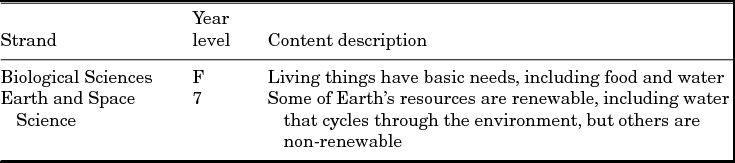
An examination of the Australian and Saskatchewan curricula illustrates 18 mandatory references to water from the Foundation Year to Year 10. There are two references to water within the ACS (Foundation Year and Year 7; see Table 1) and a further 29 optional content elaborations relating to water in the ACS.
Analysis of the Concept of Water Within the Australian Science Curriculum

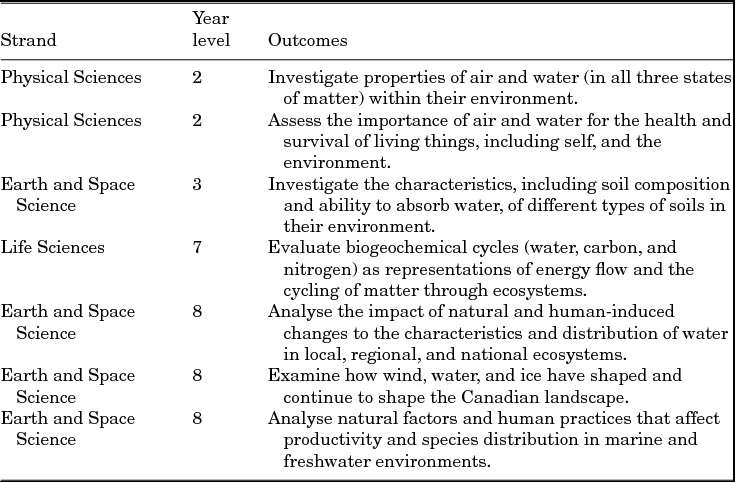
The SSC includes seven compulsory teaching and learning water requirements within the Grade 1–10 curriculum (see Table 2). Within these requirements, it was noted that the concept of water as a ‘need of living things’ is a common requirement in both the ACS (Foundation Year) and the SSC (Grade 2). The SSC has 125 optional teaching suggestions listed under the indicator section of this curriculum, with at least one at every grade level.
Analysis of the Concept of Water Within the Saskatchewan Science Curriculum

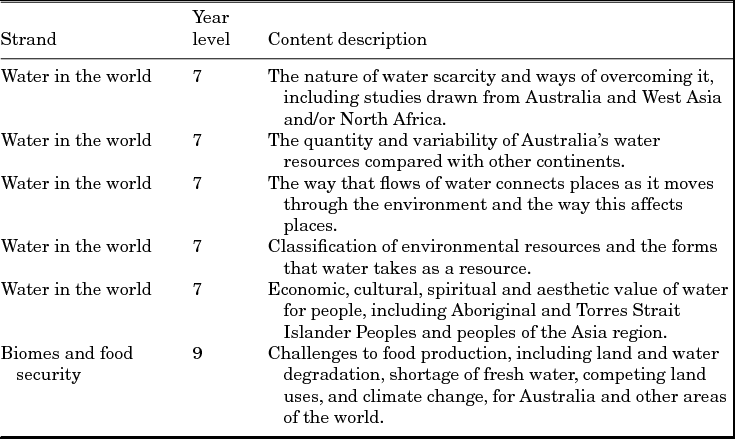
In Queensland, the HASS and ACG from Foundation Year to Year 10 include six mandatory teaching requirements that include water-related concepts (see Table 3). The majority are within the Year 7 ‘Water in the World’ unit that is compulsory for all Australian students. The Year 9 requirement is within an elective Geography subject. There are 50 suggested elaborations, with at least one optional teaching suggestion in every year level.
Analysis of the Concept of Water Within the F-6/7 Humanities and Social Sciences Curriculum and the Years 7–10 Australian Geography Curriculum

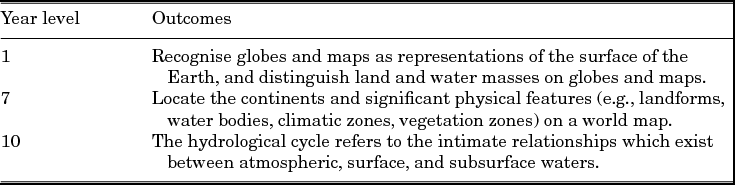
Australia's HASS and ACG mandatory requirements focus on water as a resource but encourage consideration be given to the social, economic, and political relations associated with water. In Saskatchewan, the SSSC has three mandatory teaching and learning requirements from Grades 1–10 (see Table 4). The Saskatchewan curriculum focuses on locating bodies of water on maps and the hydrological cycle. The hydrologic cycle provides a scientific overview of water as a chemical compound, the properties of this compound, and how it interchanges around Earth's ecological systems. The SSSC does refer to social and economic aspects of freshwater in the 26 indicators, but they are not compulsorily taught.
Analysis of the Concept of Water Within the Saskatchewan Social Sciences Curriculum

There is only one mandatory reference to the four search codes of ‘drought’, ‘flood’, ‘tsunami’, and ‘natural disasters’ in the Australian and Saskatchewan curricula investigated. This reference was found in Australia's HASS curriculum (see Table 5).
Analysis of the Concept of Extreme Water Events Within the HASS Curriculum

The findings of this analysis provide insight into the framing of ‘water’ ascribed by both these governments. These curricula focus most specifically on the water cycle, with minimal references to water-society relationships.
Discussion: Curricular Implications
All curricular documents analysed stated that a goal for education was for learning to be interconnected and interrelated to the lives of the students and relevant to the students’ social and environmental context (ACARA, n.d.; Saskatchewan Ministry of Education, n.d.). Further, each curriculum emphasises developing student safety, environmental stewardship, and the importance of including cultural perspectives. In relation to these stated goals, however, only one of the 18 mandatory water references specifically invite the assessment of water in relation to ‘self’ (the SSC in Grade 2). However, as it is located within the Year 2 curriculum, this requirement could only offer a basic introduction to how water connects to the student's daily life.
The majority (11 out of the 18) of the other mandatory references invite students to understand the concept of water as natural processes and/or chemical phenomena. This constructs and promotes water as a ‘natural’ resource or compound. With this framing, water could be incorrectly understood as apart from, and independent of, human socio-political systems, reflecting the socially entrenched view that water is somehow separate from, or operates independently of, the influences of social-water relationships (see Bakker, Reference Bakker2012; Di Baldassarre et al., Reference Di Baldassarre, Viglione, Carr, Kuil, Salinas and Blöschl2013: Linton & Budds, Reference Linton and Budds2014). When water is predominantly framed as ‘natural’, a distancing mechanism can take place where the populous comes to understand water as an abstract concept, focusing on the hydrologic cycle, independent of history or society. The Intergovernmental Panel on Climate Change's (IPCC) technical report on climate change and water challenges this discursive construction and advises that ‘water’ and ‘society’ should no longer be categorised as two distinct entities but understood as part of complex interactions that influence the quality and movement of water (Bates et al., Reference Bates, Kundzewicz, Wu and Palutikof2008). Linton (Reference Linton2014) argues that perpetuating the framing of water as ‘nature/natural’ offers those who ‘manage’ this ‘chemical compound’ the false belief that they can do so independently of complex and profound environmental and social interactions and consequences. Rather than being neutral, this framing conceals how the political policies and choices made on a citizen's behalf, or indeed, the choices people make within their own lives, can actually promote or prevent problems that we incorrectly categorise as ‘natural disasters’ (Schmidt, Reference Schmidt2014; Swyngedouw, Reference Swyngedouw2006, Reference Swyngedouw2009).
The remaining mandatory curricula references do invite students to analyse water's natural-social interface but mainly from a big-picture perspective. For example, within these 18 references, the highest level socio-cultural investigation can be found within the elective Year 9 Geography course. Here, the AGC requires students to investigate water as a challenge to food production in Australia and the rest of the world. This may provide students with an understanding of broad issues associated with the shortage and quality of freshwater, but it does so without advocating a link to the everyday world of the student. Students are not required develop the skills and capacities to critically analyse how these issues influence their local community. There is one exception to this. Found within the SSC, one of the Year 8 Earth and Space Science curriculum mandates does invite students to explore water issues within their local, regional, and national ecosystem. If the word ‘ecosystem’ is understood as implying more than just ‘nature’, and is inclusive of human communities, then this mandate may encourage students to internalise water as both a product and agent of change. As such, this curriculum mandate is the closest to aligning with requests from the United Nations for water to be reframed as a dynamic part of social systems. However, it does not go as far as community education advocates as it does not specifically support community engagement that results in responsive decisions, choices, and actions either individually and/or collectively (Amaru & Chhetri, Reference Amaru and Chhetri2014; Bues & Theesfeld, Reference Bues and Theesfeld2012; Grant et al., Reference Grant, Fletcher, Feldman, Saphores, Cook, Stewardson, Low, Burry and Hamilton2013; Harvey & Stocker, Reference Harvey and Stocker2015; Krause, Reference Krause2016; Krause & Strange, Reference Krause and Strang2016; Schnoor, Reference Schnoor2008; Wheater & Gober, Reference Wheater and Gober2015).
There is no mandatory requirement in any of the analysed curricula to teach about environmental stewardship and water, or student safety and water. The closest link is within the Year 5 HASS Australian curriculum, which requires students to explore the impact of floods and how people can respond.
This pattern of omission is repeated with the goal of being culturally inclusive. The Saskatchewan Science curriculum states that its priority is to ‘show parallels and distinctions between Indigenous knowledge and scientific knowledge’ so as to generate a deeper understanding of ‘our complex world’ (Saskatchewan Ministry of Education, n.d.). However, there is only one mandatory requirement linking Indigenous cultures to freshwater or EFWE, and this is not within the Saskatchewan curricula but within the Australian ACG in Year 7. This requirement is a good start to incorporating Aboriginal and Torres Straits Islander knowledge; however, there may be limitations with its interpretation. As written, this curriculum requirement does not encourage teachers to develop or sustain relationships with their local Aboriginal and Torres Straits Islander communities, or acknowledge the need for appropriate protocols. It does not acknowledge that Indigenous cultures have a knowledge base from the local area that predates the Western knowledge. These understandings and actions are needed if learning is to progress deeper than a superficial understanding of the Aboriginal and Torres Straits Islander community's valuing of water, and move towards acquiring the deeper moral messages embedded within this knowledge about what it means to live as an individual within community.
There is only one mandatory requirement within all of the analysed curricula to investigate EFWE, and this is within the Year 5 ACG. There is no mandatory requirement in the analysed Saskatchewan curricula to teach about floods or droughts, or for droughts to be taught in the analysed Australian curricula. This is a huge oversight as it implies that within the required, formal years of schooling, Saskatchewan and Australian students are not invited to understand droughts, and Saskatchewan students are not required to learn about flooding. The singular mandatory related reference is consistent with the framing of water as predominantly nature-based phenomena and viewed as something beyond humanity's control. This framing ignores significant social dimensions involved in EFWE. This framing may do little to develop students’ confidence and skills to holistically understand the complexity of the situation, or endeavour to generate solutions and engage with community processes to preempt or respond to EFWE. This lack of understanding distances students from the increasing threats of EFWE brought about by climate change. It also minimises students’ understandings of the implications that changing water patterns and EFWE are currently having on Queensland and Saskatchewan.
Within the analysed curricula there is only one mandatory reference to climate change and water. It is within the elective Year 9 Geography course. As such, within all compulsory science or geography subjects up to Grade 10, there is no mandatory requirement to teach about climate change and the considerable impact it is having or will have on water and society in Queensland and Saskatchewan. As such, these curricula do not reflect the IPCC's appeal for education to provide the public with a more holistic understanding of the social, economic, political, and health aspects associated with changing water patterns brought about through climate change. Further, within these curricular there are missed opportunities for developing the capacities of citizens within these jurisdictions to build the skills and confidence needed to understand and engage with local community processes and generate solutions.
The outcomes of this curricular analysis are supported by previously published research that demonstrates a lack of knowledge about the dialectic relationship of water and social systems (see Bakker, Reference Bakker2012; Boon & Pagliano, Reference Boon and Pagliano2014; Di Baldassarre et al., Reference Di Baldassarre, Viglione, Carr, Kuil, Salinas and Blöschl2013; Linton & Budds, Reference Linton and Budds2014; Sammel & McMartin, Reference Sammel and McMartin2014; Schmidt, Reference Schmidt2014; Swyngedouw, Reference Swyngedouw2006, Reference Swyngedouw2009). To further understand why this lack occurs, this article will briefly explore resistance theory and investigate barriers to change at the individual and organisational level, specially focusing on EFWE.
Discussion: Psychological Barriers to Change and the Teaching of Extreme Freshwater Events in Formal Education
With climate change anticipated to amplify the intensity and frequency of EFWE, why isn't this agenda promoted in government-mandated curricula? To understand the answer to this question, we draw on resistance theory, specifically Stoknes’ (Reference Stoknes2015) theories of resistance to climate change. Stoknes (Reference Stoknes2015) identifies five important psychological barriers to prioritising knowledge associated with climate change. We argue that these barriers equally relate to why risks, probabilities, and impacts of EFWE seem to be difficult to appreciate.
The first barrier includes issues of distance and time (Stoknes, Reference Stoknes2015). Despite the fact that every day the media discusses short- and long-term weather patterns, the chance of precipitation, and even current water levels within local dams and reservoirs, there is little recognition that a deep understanding of water and its dialectical relationship with society should be a key priority for all citizens. When the public are disconnected from the impact of EFWE they may assume that the probability of being personally affected is too small to be a threat. This distancing is also reflective of the curricula, where the teaching of EFWE is minimal (one compulsory reference in the 286 curricular references to water or EFWE). The absence of this concept creates a space where EFWE becomes ‘hard to sell’ in schools. In already overcrowded curricula, the message to teachers seems clear — if it is not mandated within the curriculum, then it is not essential knowledge.
The second barrier is loss aversion or ‘doom’ scenarios (Stoknes, Reference Stoknes2015). These are avoidance mechanisms built into systems: systems such as education epistemologies. One such mechanism could be the general assumption that students should not be exposed to inherently negative, upsetting, or disturbing concepts, particularly in the elementary school years. This assumption may be founded on the fear of scaring or upsetting students, generating behaviour management issues, and/or generating department or parent complaints. When EFWE are framed as being inherently negative, there may be a tendency to avoid the topic. Avoidance mechanisms ensure that any negative consequences associated with the concept are not discussed. Avoidance of negative concepts can give rise to a focus on ‘neutralised’ concepts, such as teaching about general patterns and properties of water.
The third psychological barrier is dissonance (Stoknes, Reference Stoknes2015). Dissonance occurs when there is inconsistency between beliefs and behaviours, creating situations that may become uncomfortable. For example, if we believe one thing, but the actions or behaviours to address the situation are inconvenient, then we might continue to engage in actions that maintain the problem, because they are perceived as easier. This is especially true when there are few support mechanisms to promote affirmative action; when people actively disagree with understandings of the problem; or when people ignore or downplay the importance of the situation. If a curriculum does not support lessons that include the exploration of EFWE, then it is less likely an individual teacher might embed this knowledge in their teaching. Over time, these actions become normalised. In this way, certain concepts are excluded from teaching, even when an individual teacher personally feels strongly about the concept (Sammel, Reference Sammel2012).
The fourth barrier is denial (Stoknes, Reference Stoknes2015). Denial stems from self-defence rather than lack of knowledge. When people perceive that their understandings, behaviours, or actions are being criticised or threatened, they may negate the information or remove themselves from the unsettling information. Denial can become a default position when there is a clear absence of legal, government-directed, mandatory requirements to teach a concept, such as EFWE. For example, a teacher may believe their community has not really been threatened by an EFWE, and so this concept is not really applicable to their students, and so it is not really their responsibility to teach it.
The last of Stoknes’ (Reference Stoknes2015) barriers is identity. Identity relates to a person's cultural upbringing. It may be viewed as a culmination of all the similar and competing cultural narratives or discourses that the individual has been exposed to. These discourses shape what a person has been taught to value and desire, and what they have been taught to disregard. A person's beliefs and values act as a filter that processes not only new information, but how information is regarded. Information we perceive as appropriate, as it confirms what we believe and value, may be easily assimilated. Information that contradicts the person's views or ideals may be rejected (or not even noticed). Stoknes (Reference Stoknes2015) explains that our cultural identity often overrides facts (‘identity easily eats reality for breakfast’, p. 78). If an individual is exposed to validated information that requires a change in perception or routine, often that information will be rejected. Presenting new evidence that conflicts with an individual's or a system's established knowledge base, perspective and process will not necessarily bring about change.
Conclusion
The analysed Queensland and Saskatchewan curricula highlights that students are encouraged to understand water as a historical and contemporary tool for shaping Earth's landscape, as a necessity for all living things, and as a resource to be conserved. This provides a solid frame for understanding the hydrological nature of water. However, this framing falls short of meeting repeated calls from the United Nations for freshwater to be understood in relationship with social systems. To meet this agenda, the framing of freshwater and EFWE would need to transition away from a mostly ‘nature-based’ interpretation towards the understanding that emphasises the deeper dialectical relations society and water hold.
This curricular analysis sheds light on other missed opportunities, specifically the invitation of incorporating cultural inclusivity, environmental stewardship, or developing and understandings safety process in relation to freshwater and EFWE. To address these concerns, curricula could incorporate the investigation of freshwater and droughts or flooding from within the student's own local area. This could involve inviting students to explore: the history of their community in relation to its access to freshwater; the knowledge of freshwater and EFWE held by local Indigenous communities; how local areas have experienced previous droughts or flood, and the lessons they learned; what plans, policies, or procedures are in place locally to mitigate EFWE; personal safety precautions around EFWE; other cultural understandings and processes around EFWE; or how others made sense of EFWE after experiencing such an event (which may include the students themselves, given the events of 2011).
We advocate that the teaching and learning of freshwater and EFWE must engage rather than distance. It must be socially meaningful and reflect local concerns. We believe that students need to understand the science of water alongside the complex socio-political interactions that work to mitigate or enhance the impact of changes to the water levels in regional watersheds. Ideally, we advocate for proactive curricula that allow students to be part of developing local, innovative solutions to the changing water conditions brought about through a changing climate. We believe curricula can champion the development of local, inclusive, and solution-seeking practices that offer deeper, more holistic understandings of how freshwater and EFWE are integral parts of students’ daily lives and the lives of their communities and ecosystems. This direction could potentially promote the development of skills and confidence for students to form an educated opinion and voice within their community. It could develop competencies in accessing community-specific, factual knowledge of historical and government processes, and encourage students to take part in practices that stimulate public discussions and debate. In this way, we believe curricula have the capacity to enhance and enrich a student's identity within their community and encourage civic participation.
Finally, we hope attention to the cultural framing of freshwater and EFWE within these curricular documents inspires others to reveal what has come to be accepted and considered normal within their own local curricula documentation.
Acknowledgments
The authors thank Griffith University, Australia, and the University of Regina, Canada for supporting this research.
Author Biographies
Dr Alison Sammel is a Lecturer at the School of Education and Professional Studies at Griffith University on the Gold Coast. Her research areas include the teaching and learning of Science, embedding Indigenous Knowledge in Science Education, and water and climate change education.
Dena McMartin is a Professor of Environmental Engineering as well as Director of Research Services and Assistant Vice-President Research at the University of Saskatchewan, Saskatoon, Canada. Prof. McMartin's research program focuses on rural water quality and quantity needs in Canada and abroad, and impacts of climate extremes on water.
Katherine Arbuthnott is a Professor at Campion College, at the University of Regina, Saskatchewan, Canada. Prof. Arbuthnott's research explores processes that facilitate goal-pursuit and self-control with particular application to pro-environmental behaviour and skill learning.