INTRODUCTION
Organisms in wild, natural ecosystems live in communities, where they interact with the environment around them and with other organisms (Tokeshi, Reference Tokeshi1999). Their abundance is subject to influences from extrinsic or abiotic factors, such as the precise location and nature of the habitat, the regional climate, and numbers fluctuate between years and seasons, depending on circumstances (Elton, Reference Elton1927; Begon et al. Reference Begon, Townsend and Harper2005). They also interact with other living organisms, including members of their own species, in order to reproduce or for protection, and they compete for food and other resources, leading to density-dependent regulation of population sizes. Interactions occur also with members of other species, not the least in predator-prey relationships in food chains (Elton, Reference Elton1927; Begon, Townsend and Harper, Reference Begon, Townsend and Harper2005).
Parasites likewise interact with the external environment: for example, their abundance may be dependent on climatic factors such as ambient temperature and humidity. Both are known to influence the development of free-living stages and affect the survival of transmission stages outside the host, as well as affecting the hosts themselves (Haukisalmi and Henttonen, Reference Haukisalmi and Henttonen1990; Guernier, Hochberg and Guegan, Reference Guernier, Hochberg and Guegan2004; Hudson et al. Reference Hudson, Cattadori, Boag and Dobson2006). They also interact with other living organisms, foremost among which are the hosts within which they live, that provide their immediate environment. A unique facet of parasitism is that parasites are parcelled within hosts in infrapopulations and infracommunities, a concept originally developed by Bush and Holmes (Reference Bush and Holmes1986) (See also later in this review and Esch et al. Reference Esch, Shostak, Marcogliese, Goater, Esch, Bush and Aho1990). In some cases they may also be transmitted in packages, as for example when heavily infected intermediate hosts are consumed by predatory definitive hosts (Bush, Heard and Overstreet, Reference Bush, Heard and Overstreet1993; Poulin, Reference Poulin2001). Each infrapopulation lives in a restricted environment delimited by the host's body. Within this space, each can affect the host in different ways, with consequences for the other co-infecting species (e.g. through the host immune response, pathology or nutrient limitation). Not surprisingly, therefore, in discrete populations of hosts, intrinsic factors such as host age, sex, diet, genetic status and social position, including life-history strategy, become varyingly important at influencing susceptibility to infection with parasitic and other invasive organisms (Barnard et al. Reference Barnard, Behnke, Bajer, Bray, Race, Frake, Osmond, Dinmore and Siński2002). Parasites within hosts interact with members of their own species (hence density-dependent regulation of infrapopulations is an important process limiting abundance and reproductive effort among parasites; Keymer, Reference Keymer1982) and finally they interact with other parasites exploiting the same host, and it is this, co-infection or polyparasitism, that constitutes the key theme of this issue.
Interactions between species within hosts can range from the mere coincidence of more than one species in the same host, through one species influencing the environment within that host in a way that benefits or impairs the survival of the second species, to species actually interacting directly. The latter may arise physically because parasites are crowded into a space-restricted site, through competition for resources, or via chemical mediators (e.g. ‘allomone-like’ substances, metabolic by-products – Roberts, Reference Roberts2000; Pedersen and Fenton, Reference Pedersen and Fenton2006). Added complexity in co-infections is generated by correlated exposure, by parasite longevity, by differences in the genetic constitution of individual hosts, and by broader effects on the hosts' immune system through commitment to a particular response phenotype (e.g. Th1 versus Th2). The latter feature in particular is a fertile field of current interest (Graham, Reference Graham2002; other contributors to this special issue). There can be profound consequences from such co-infections, with one species enhancing the susceptibility of the host to other life-threatening infections (Booth and Bundy, Reference Booth and Bundy1992; Nacher, Reference Nacher2002; Druilhe, Tall and Sokhna, Reference Druilhe, Tall and Sokhna2005; Pedersen and Fenton, Reference Pedersen and Fenton2006), and concern has been expressed about how little we actually know about the cumulative effect of co-infections on the health of the host (Buck, Anderson and MacRae, Reference Buck, Anderson and MacRae1978b; Keusch and Migasena, Reference Keusch and Migasena1982; Ezeamama et al. Reference Ezeamama, Friedman, Olveda, Acosta, Kurtis, Mor and McGarvey2005). This paper will focus almost entirely, but not exclusively, on co-infections of helminths in laboratory and in wild rodents. After reviewing some of the most persuasive evidence for the existence of interactions between species, based on laboratory studies, I hope to demonstrate that relationships between species compatible with an underlying interaction can be detected in field data, but that they need to be interpreted with due caution. In order to detect them a sound, comprehensive knowledge of the structure, predictability and composition of helminth communities is an essential pre-requirement. I make no apology for the selective use of the literature, since several comprehensive reviews of the subject have been published already, to which the reader is referred (Dobson, Reference Dobson1985; Christensen et al. Reference Christensen, Nansen, Fagbeni and Monrad1987; Petney and Andrews, Reference Petney and Andrews1998; Behnke et al. Reference Behnke, Bajer, Siński and Wakelin2000), and for focusing particularly on our own work: such was my remit.
TYPES OF INTERACTIONS AND SOURCES OF ERROR
Interactions between species can be synergistic, that is positive, one species benefiting another. A good example of such an interaction among free-living animals can be found in the relationship between the large blue butterfly (Maculinea arion) and rabbits (Oryctolagus cuniculus). However, this is not a simple relationship. High rabbit density does not directly create large butterfly populations or vice versa, but rather rabbits keep the grass low, allowing ants and their colonies to proliferate, providing a secure environment for the larvae of the large blue butterfly (Warren and Wigglesworth, Reference Warren and Wigglesworth2007). This first example, therefore provides us with due warning that the interpretation of analyses of interactions between organisms needs to be tackled with extreme caution, because of the scope for jumping to over-simplistic and erroneous conclusions.
Some associations may benefit both species, as in the case of the well known relationships between ants and aphids (Stadler and Dixon, Reference Stadler and Dixon2005). Synergistic relationships can range from the loose commensal, with little specificity, as in the case of bees pollinating a wide range of plants (Biesmeijer et al. Reference Biesmeijer, Roberts, Reemer, Ohlemüller, Edwards, Peeters, Schaffers, Potts, Kleukers, Thomas, Settele and Kunin2006), to the absolutely specific and obligatory as in the case Darwin's hawkmoth (Xanthopan morganii) and the orchid Angraecum sesquipedale (Nilsson, Reference Nilsson1998).
As already intimated, analyses of co-ocurrences of animals, with the intention of discovering underlying interactions between species, are fraught with problems, not least statistical problems and the risk of false conclusions through failure to control for environmental factors that concentrate animals together in some subsets of the population (Haukisalmi and Henttonen, Reference Haukisalmi and Henttonen1998; Howard, Donnelly and Chan, Reference Howard, Donnelly and Chan2001; Behnke et al. Reference Behnke, Gilbert, Abu-Madi and Lewis2005). Indeed, population structure often appears to generate the spurious appearance of interactions through genetic, spatial, age-related and ecological effects, and I would like to illustrate this with a very simple example.
In a survey of animals living on a golf course, frogs and damselflies occur in certain sectors of the total area surveyed but not in others. Moreover, sectors with large numbers of frogs also have many damselflies, whilst those with few frogs have low numbers of damselflies. It may be tempting to interpret this as reflecting interactions between the species with high abundance of frogs generating a high abundance of damselflies or vice versa. However, the true explanation is much simpler. In this case the golf course has many temporary and larger permanent ponds, and some are richer in biodiversity than others, supporting larger populations of both species. So, indirect effects can stem from some quality of the environment, which benefits both species (Wootton, Reference Wootton1994) and encourages co-occurrence, rather than because of any specific interactions between frogs and damselflies. This self-evident truth of free-living community ecology underlines the importance of distinguishing between co-occurrence of species based on convergence of common ecological processes that bring species together or separate them, and co-occurrence based on direct interactions between species (Howard et al. Reference Howard, Donnelly and Chan2001, Reference Howard, Donnelly, Kabatereine, Ratard and Brooker2002). It can be easily obscured in parasitology, where interactions have to be identified from co-occurrence in the host, and co-occurrence of the free-living and infective stages as well.
Interactions between species can also be antagonistic, often referred to as negative interactions, for example, exploitative or food chain relationships when the abundance of one species lowers that of the other. They can be competitive, based on exploitation of the same resource, when both species may suffer if the resource is limited (Begon et al. Reference Begon, Townsend and Harper2005). They can also be indirect, for example when a common pathogen lowers the fitness of both species in situations where they co-occur. So on damp pasture grazed by sheep, the amphibious snail Lymnea truncatula may occur, and if it is infected with Fasciola hepatica this is likely to impact on abundance/fitness of both hosts in the cycle.
Co-occurrence of parasites, or polyparasitism, is well known in the medical (Buck et al. Reference Buck, Anderson and MacRae1978a, Reference Buck, Anderson and MacRaeb; Ashford, Reference Ashford1991), veterinary (Diez-Baňos, Cabaret and Diez-Baňos, Reference Diez-Baňos, Cabaret and Diez-Baňos1992) and zoological literature (Haukisalmi and Henttonen, Reference Haukisalmi and Henttonen1993). The majority of animals in naturally existing wild communities (Lotz and Font, Reference Lotz and Font1994; Nilssen, Haugerud and Folstad, Reference Nilssen, Haugerud and Folstad1998; Lello et al. Reference Lello, Boag, Fenton, Stevenson and Hudson2004), and humans living under conditions of exposure, carry several species of parasites concurrently (Buck et al. Reference Buck, Anderson and MacRae1978a; Keusch and Migasena, Reference Keusch and Migasena1982; Kvalsvig, Reference Kvalsvig1988; Ashford, Craig and Oppenheimer, Reference Ashford1992; Booth et al. Reference Booth, Bundy, Albonico, Chwaya, Alawi and Savioli1998; Bottomley, Ishan and Basanez, Reference Bottomley, Isham and Basanez2005). Some of these are more often encountered together than expected by chance, and among co-occurring species there may be quantitative associations, such that heavy infections with one species seemingly predispose to heavy infections with the other. To give one well known example among human parasites, Ascaris lumbricoides and Trichuris trichiura often co-occur in infected individuals. Many different studies have highlighted their co-occurrence in human populations living in developing countries (Holland et al. Reference Holland, Asaolu, Crompton, Stoddart, MacDonald and Torimiro1989; Booth and Bundy, Reference Booth and Bundy1992; Howard et al. Reference Howard, Donnelly, Kabatereine, Ratard and Brooker2002). Tchuem Tchuenté et al. (Reference Tchuem Tchuenté, Behnke, Gilbert, Southgate and Vercruysse2003) found a highly significant positive relationship between the intensity of both species among those children that were passing eggs of both species (after exclusion of all double and single negatives). However, the data were generated through a survey of 5 schools, in which there were both boys and girls in 12 age classes. Abundance differed between schools and age classes, so these had to be taken into account to avoid erroneous conclusions. This was achieved by fitting minimum sufficient statistical models in generalized linear models to the data and examining the relationship between the residuals. Having controlled for differences between schools and age classes, the relationship was now weaker, indicating that some degree of correlated exposure was involved. Nevertheless the relationship survived the analysis and was still significant.
But even when all these relevant controls have been considered, does co-occurrence of species mean that the one species facilitates or antagonises the other? Not necessarily. Both A. lumbricoides and T. trichiura have robust, well-protected eggs, thus individuals in the data subsets who showed poor hygiene would be likely to be exposed to both. Co-abundance is therefore not necessarily attributable only to interactions with one species predisposing to infection with the other, but may more likely reflect the coincidence of similar transmission strategies. In the majority of co-infection studies on these two species correlated exposure has not been taken into account. The challenge now is to quantify human behaviour that enhances transmission in these children, as for example by measurement of ingestion of silica (Bundy, Reference Bundy1988) and to control for that. My prediction is that the quantitative relationship between the intensity of infection with A. lumbricoides and T. trichiura will largely disappear when this additional control is brought into the analysis.
LABORATORY MODELS OF POLYPARASITISM
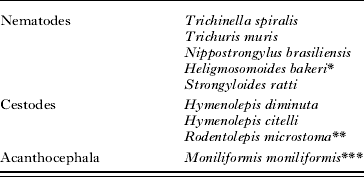
How can we explore the underlying processes, causes and effects, in more detail? My initial strategy was to explore interactions in laboratory models under the precisely controlled conditions of laboratory experimentation first, and then to test the predictions of laboratory-generated data in the field. A wide range of useful and relevant model systems is available (Table 1) for such work and these have been used extensively, although the work was largely conducted in the 1970s and is mostly forgotten.
Helminth parasites of rodents that have been used in studies of interactions between intestine dwelling species
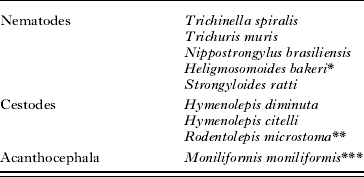
* Previously known as H. polygyrus and Nematospiroides dubuis.
** Previously known as Hymenolepis microstoma.
*** Previously known as M. dubius.
The classic work of John Holmes (Reference Holmes1961, Reference Holmes1962a, Reference Holmesb) is seldom cited these days. Hymenolepis diminuta and Moniliformis moniliformis both usually occupy the anterior region of the gut of rats but Holmes found that when rats were co-infected, M. moniliformis was able to hold its own, staying in the preferred site, while H. diminuta was ‘pushed’ back to non-optimal distal regions of the small intestine. But this is not the end of the story. There are two further twists, because H. diminuta is far longer lived than M. moniliformis, and as the latter dies of senility, the former moves back up into its preferred site. Equally of interest, Holmes (Reference Holmes1962b) failed to find the same relationship between these species in a different host, the hamster. It is also relevant that H. diminuta is a species that is particularly sensitive to crowding effects (density-dependent regulation), its size and fecundity being severely affected even when just two worms, rather than a single worm, are present (Read, Reference Read1951; Roberts, Reference Roberts2000). These papers by Holmes are widely regarded as the start of the field of quantitative helminth community ecology (Esch et al. Reference Esch, Shostak, Marcogliese, Goater, Esch, Bush and Aho1990; Janovy, Reference Janovy2002).
Holmes (Reference Holmes1973) hypothesised that where competitive interactions occur in ecological time, the interacting species that is the superior competitor would bring about the extinction of the weaker competitor, or force it to survive as an opportunistic organism, exploiting hosts only in situations where the superior competitor was absent. Over evolutionary time, we may expect some stabilisation by specialization to eliminate the competition, leading to selective segregation.
Gerry Schad (Reference Schad1963) made a seminal contribution to this concept. Schad worked on the pinworms of Greek tortoises, which were parasitized by 8 species of oxyuroid nematodes of the genus Tachygonetria. Hosts can be very heavily parasitized, and the 8 species have become specialists to avoid competition. Thus T. uncinata and T. numidica show virtually identical longitudinal distribution in the colon of tortoises, but it turns out that the former is a mucosal species, whereas the latter lives in the lumen. When Schad looked at the other species, it was evident that half were mucosal and half lumen dwellers, and he was able to match up approximately similar longitudinal distributions with this mucosal/luminal separation. Where both longitudinal and radial distributions were similar (e.g. T. robusta and T. stylosa), their feeding strategies differed. Thus T. robusta is an indiscriminate feeder, whereas T. stylosa feeds on fine particles such as bacteria. As a consequence of such adaptations over time site, resource and temporal segregation have evolved to minimise competition and niche overlap.
However, the situation may be even more complex and controversy has continued to this day. Some workers have argued that in particular hosts there may be many vacant niches and that the driving forces for niche segregation and speciation are reinforcement of reproductive barriers and maximum utilisation of food resources (Price, Reference Price1980; Rohde, Reference Rohde1991 and see Esch (Reference Esch, Shostak, Marcogliese, Goater, Esch, Bush and Aho1990) and Janovy (Reference Janovy2002) for reviews of the conflicting debate in this field). There is also the possibility that the assemblage of Tachygonetria spp. resident in Schad's tortoises was acquired by host capture from other reptiles, in which they had evolved to exploit slightly different host resources.
THE IMMUNE RESPONSE AS AN ENVIRONMENTAL STRESSOR
Parasitism, of course, has unique ecological features in so far as free living organisms do not have to face the threat of the environment conspiring specifically to destroy them. As with all other ecological problems, parasites have to adapt or die and over evolutionary time hosts refine their mechanisms of defence, whilst parasites develop new counter measures (Behnke, Barnard and Wakelin, Reference Behnke, Barnard and Wakelin1992; Maizels et al. Reference Maizels, Balic, Gomez-Escobar, Nair, Taylor and Allen2004) and this generates the Arms Race, also known as the gene-for-gene or Red Queen hypotheses (Dawkins and Krebs, Reference Dawkins and Krebs1979; Anderson and May, Reference Anderson and May1982; Behnke and Barnard, Reference Behnke, Barnard and Behnke1990).
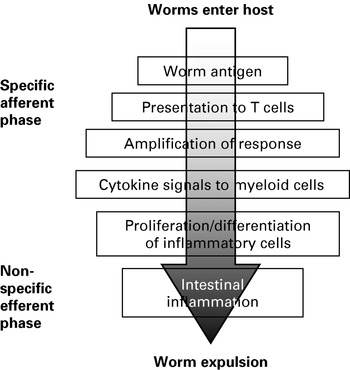
The details of the immune system are given elsewhere (Murphy, Travers and Walport, Reference Murphy, Travers and Walport2008). However, the features of relevance to what follows are summarised in Fig. 1. Initially the adaptive immune response of vertebrates involves a covert afferent phase during which recognition of foreign invaders takes place and, eventually, this is translated into an effector phase during which the actual defences are unleashed. The latter can be pathogenic for the host and come at a cost (Castro, Olson and Baker, Reference Castro, Olson and Baker1967; Mercer et al. Reference Mercer, Mitchell, Moar, Bissett, Geissler, Bruce and Chappell2000), but it is during this effector phase that worms can be expelled from the host. We have been arguing for some time about whether a magic bullet exists within the complex array of effectors (Pemberton et al. Reference Pemberton, Knight, Gamble, Colledge, Lee, Pierce and Miller2004; Anthony et al. Reference Anthony, Urban, Alem, Hamed, Rozo, Boucher, Rooijen and Gause2006; Artis, Reference Artis2006; Artis et al. Reference Artis, Wang, Keilbaugh, He, Brenes, Swain, Knight, Donaldson, Lazar, Miller, Schad, Scott and Wu2004), but the fact is that once unleashed some components of the response to intestinal helminths, whether effective against the triggering species or not, can be detrimental to other species.
Schematic diagram of the major stages of an adaptive immune response to parasitic infection in vertebrates.

Five broad categories of such interactions arising from this immune interaction can be envisaged. Species such as Trichinella spiralis generate an intestinal immune response during which gut function is severely affected and, as the immune response intensifies, so worm numbers decline. Concurrently marked changes in a range of cellular and soluble mediators can be detected, reflected for example in mastocytosis on the one hand (mast cell numbers increase and degranulate, releasing their highly toxic compounds) and in changes in the expression of receptors of signals from cytokines, including adhesion molecules, on the other hand (Else and Finkelman, Reference Else and Finkelman1999; Gause, Urban and Stadecker, Reference Gause, Urban and Stadecker2003; Nair, Guild and Artis, Reference Artis2006).
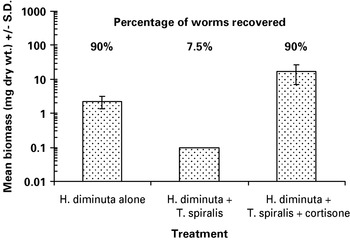
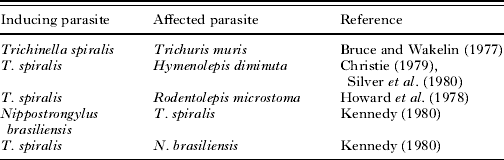
If a lumen dweller such as H. diminuta is present during this expulsion phase, it is severely affected (Behnke, Bland and Wakelin, Reference Behnke, Bland and Wakelin1977; Christie, Wakelin and Wilson, Reference Christie, Wakelin and Wilson1979; Silver, Dick and Welch, Reference Silver, Dick and Welch1980). Fig. 2 shows that in control mice 90% of worms established and survived, and grew to about 1–2 mg in weight by day 8, whilst in mice responding to T. spiralis, survival was just 7·5% and the biomass was only 0·1 mg. However, when the immune response was suppressed, in this case by treatment with the wide-spectrum steroid immunosuppressant cortisone, H. diminuta could survive and grow alongside T. spiralis without any evident detrimental consequences. Table 2 summarises many similar examples, all work conducted in the 1970s and early 1980s. As with all biological processes, however, there are some exceptions. Hookworms were able to survive the acute phase of the inflammatory response to T. spiralis in concurrently infected hamsters without any loss (Behnke, Rose and Little, Reference Behnke, Rose and Little1994), a reflection of their remarkable resilience in the face of the host's immune response (Loukas and Prociv, Reference Loukas and Prociv2001).
Loss of Hymenolepis diminuta from mice concurrently infected with Trichinella spiralis at the height of the response to the latter species. The figure shows the percentage survival of worms and the mean dry biomass (±standard deviation), following administration of 5 cysticercoids to each animal, eight days before autopsy. The mice were given 450 larvae of T. spiralis one day before infection with H. diminuta. Note that the error bars cannot be seen in the middle column because they are too small to be illustrated on the scale used. For further details of methods used including details of treatment with cortisone see Behnke et al. Reference Behnke, Bland and Wakelin1977.

Antagonistic interactions between intestinal nematodes. In these examples one species induces an immune response in the host, and a second co-infecting species is severely impaired, and even expelled by the non-specific consequences of the effector mechanisms induced
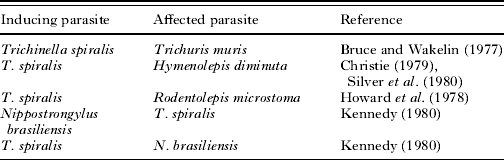
For comprehensive list of other combinations see Christensen et al. (Reference Christensen, Nansen, Fagbeni and Monrad1987).
In some cases there may be genuine cross immunity between species, a topic of immense importance in the race to develop vaccines against gastro-intestinal (GI) nematodes of ruminants, where cross-immunity would be a practical asset, protecting not only against the inducing species, but against other co-infecting nematodes. There have been disappointments on this front (Adams, Anderson and Windon, Reference Adams, Anderson and Windon1989), but one example of the successful demonstration of cross immunity between species is in the interaction between T. spiralis and Strongyloides ratti. Moqbel and Wakelin (Reference Moqbel and Wakelin1979) showed that even when rats were challenged with S. ratti 1·5 months after T. spiralis infection, establishment and survival of S. ratti were severely affected, long after the inflammation stimulated by the initial T. spiralis infection would have died down (See also Nawa et al. Reference Nawa, Mimori, Korenaga and Tada1982; Mimori et al. Reference Mimori, Nawa, Korenaga and Tada1983).
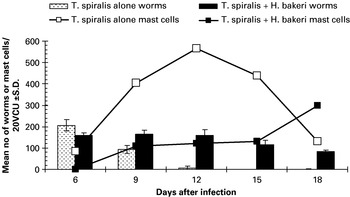
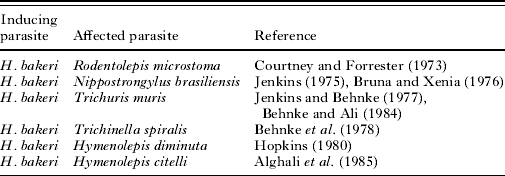
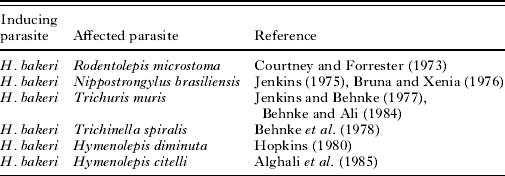
Some species are able to depress the immune response to benefit their own survival. A classic example of this is Heligmosomoides bakeri. When mice are infected with H. bakeri before T. spiralis, the latter survives much longer (Fig. 3). Expulsion is slowed down and the mast cell response is severely depressed (Behnke, Wakelin and Wilson, Reference Behnke, Wakelin and Wilson1978; Dehlawi, Wakelin and Behnke, Reference Dehlawi, Wakelin and Behnke1987). Much the same is seen when other parasites replace T. spiralis as the co-infecting species and Table 3 summarises some of the studies that have shown this to be the case. Although the mechanism of this immunodepression is not fully understood it is likely to be based on immunomodulatory factors released by the worms that specifically depress components of the host response such as mastocytosis (Behnke et al. Reference Behnke, Barnard and Wakelin1992; Wilson et al. Reference Wilson, Taylor, Balic, Finney, Lamb and Maizels2005; Rzepecka et al. Reference Rzepecka, Lucius, Doligalska, Beck, Rausch and Hartmann2006).
Extended survival of T. spiralis in mice concurrently infected with H. bakeri. The figure shows the mean number of T. spiralis recovered and the accompanying mast cell response. Mice were given 300 larvae of T. spiralis on day 0, the concurrently infected group having been infected with 300 larvae of H. bakeri 8 days earlier, and were killed in groups on the days shown. A small piece of intestinal tissue was taken for mast cell counts and mast cell counts are expressed in terms of the number of mast cells in 20 villus crypt units (VCU) per mouse. The figure shows that mice harbouring T. spiralis alone mounted an intense mast cell response that peaked on day 12 after infection (open squares and bold line), by which time most of the T. spiralis had been expelled (speckled columns). In contrast in mice that were infected with H. bakeri 8 days earlier and then challenged with T. spiralis, the mast cell response was severely depressed (filled in squares and thin line) and expulsion of T. spiralis was considerably slower with little evidence of loss on day 12 (filled in columns). A gradual decline of T. spiralis worm burdens was evident on days 15 and 18, but infections are known to persist for over 6 weeks in this combination (Behnke et al. Reference Behnke, Wakelin and Wilson1978). For further details of this experiment see Dehlawi et al. (Reference Dehlawi, Wakelin and Behnke1987).

Synergistic interactions between intestinal helminths. In these examples the first species is Heligmosomoides bakeri, and this depresses the immune response to other co-infecting species, prolonging their survival in the host
Other parasites alter the balance of the host's capacity to mount Th1 and Th2 responses or affect regulatory T cells (Wilson et al. Reference Wilson, Taylor, Balic, Finney, Lamb and Maizels2005). By initiating a Th2-driven response in the host, helminths may make the host more susceptible to concurrent infections that are better controlled by Th1 responses and vice-versa (Graham et al. Reference Graham, Cattadori, Lloyd-Smith, Ferrari and Bjornstad2007; Graham, Reference Graham2008). In the latter context it is, of course, equally possible that, by initiating a Th2 response in the host, one species may make the host environment more conducive to Th2 bias against a second species, also best controlled through this arm of the response, and vice versa. This represents antagonism between species.
So to summarise, interactions between parasites mediated through the immune system fall into five broad classes, three of which are antagonistic (non-specific interactive expulsion, cross immunity and induction of a host protective Th1/Th2 bias against the second species) and two synergistic (non-specific immunomodulation and induction of Th1/Th2 balance inappropriate for host-protective immunity against the second species).
IS THERE ANY EVIDENCE THAT SUCH INTERACTIONS EXIST IN THE FIELD?
Sources of data
It is the second group, the synergistic interactions, that has been a particular interest of mine. Building on the laboratory experimental work with colleagues and collaborators I have looked for evidence that the naturally occurring relatives of H. bakeri make wild rodents more susceptible to infection or enhance infections with other species of parasites. A particular focus of my field work therefore has been to determine whether synergistic interactions can be detected when one of the infecting species is a close relative of H. bakeri. Interactions as such are unlikely to be substantiated through correlations between prevalence or abundance of species, because correlational tests can never unravel cause and effect. However, if they exist we can make relevant predictions about the nature of these relationships. In this case we might predict that in the presence of heligmosomatids, wild rodents should show higher prevalence of other species of parasites compared with rodents not infected with heligmosomatids, and we might expect there to be a quantitative positive relationship in abundance of the two species among animals that carry both. If this turns out to be the case in several non-overlapping, independently collected data sets, based on hosts from diverse habitats and different combinations of other quantified factors, it would be difficult to dismiss as mere co-incidence based on random events.
To examine this, together with colleagues elsewhere, I have been exploring a number of such datasets. For H. polygyrus, the naturally occurring heligmosomatid of woodmice (Apodemus sylvaticus) we have three data-sets, two from the UK and one very recent data set acquired through collaboration with Catarina Eira in Portugal, Jordi Torres in Spain and their colleagues (Eira et al. Reference Eira, Torres, Vingada and Miquel2006). We have long-term datasets on almost fully censused parasite communities of bank voles (Myodes glareolus) from Poland (Behnke et al. Reference Behnke, Barnard, Bajer, Bray, Dinmore, Frake, Osmond, Race and Siński2001) and extensive data on spiny mice from Egypt (Behnke et al. Reference Behnke, Harris, Bajer, Barnard, Sherif, Cliffe, Hurst, Lamb, Rhodes, James, Clifford, Gilbert and Zalat2004).
Confounding factors affecting variation in parasite burdens
Before we can set about looking meaningfully for associations between helminth species that reflect possible underlying interactions, we have to understand the structure, composition, predictability and the stability/instability of the communities of which they are members. We must therefore examine some of the complexities that need to be tackled if we are to make sense of the data.
For all hosts, the full list of parasites described from those hosts is known as the total helminth fauna of that species, but no study actually encounters the full list, because hosts are usually sampled locally in a region within the range of the host, and regional helminth fauna is usually only a subset of the total (Poulin, Reference Poulin1998). Moreover, few investigators actually conduct a comprehensive autopsy searching within each conceivable location of the host, often specializing, for example, in just intestinal parasites. Within each region are parasite component communities of that host, comprising metapopulations of individual parasite species that circulate among the host metapopulation in a definable ecosystem, perhaps discreet woods, fields or other types of habitats. At the lowest level we have infracommunities which comprise infrapopulations of all the species encountered within an individual animal, and which are therefore in closest contact with one another (Poulin, Reference Poulin1997, Reference Poulin2004). It is interactions between infrapopulations within infracommunities, repeatedly observed in different component communities, that we seek to identify, but first I will outline some general patterns of parasite infra- and component-community structure in rodents, using data on helminths in bank voles.
Helminth communities in bank voles in Poland
In the NE of Poland we have been studying helminth communities in bank voles in 3 woodlands. Each has been surveyed in 1999, 2002 and 2006 always in late summer between the end of August and the first weeks of September. One of these sites has been followed for 10 years since 1998. The 3 sites lie almost on an exact straight line NE to SW across the region as described by Behnke et al. (Reference Behnke, Barnard, Bajer, Bray, Dinmore, Frake, Osmond, Race and Siński2001). They are separated by water barriers, including lakes, rivers and canals, and also by open arable land. The data from 2006 have not yet been completely analysed so what follows is mostly based on the first two expeditions to the region (1999 and 2002) and this comprises three sites, two years, but only one season, autumn. All these animals have been fully censused for helminths, haemoparasites, ectoparasites and 2 species of intestinal protozoa. Their morphometrics are recorded in meticulous detail and we have tissue samples from every animal for eventual genetic analysis.
We initially collected raw data on the abundance of each species in each host, and calculated standard derived variables such as species richness and indices of diversity. These helminth communities differ remarkably between the three sites in some respects but not in others, depending on which parameters are examined. So for example mean species richness varied from approximately 1 to 2 species per animal, but relative ranking of sites changed between the first two surveys. Species richness and Brillouins' index of diversity were both highest at Pilchy in 1999, but then at Urwitałt in 2002. So for derived measures, the relative ranking of sites changed, but the actual range of mean values was narrow indicating fairly modest change overall (Behnke et al. unpublished).
In contrast, when we examined individual species, the relative ranking across sites remained the same. Thus Heligmosomum mixtum always showed highest abundance at Urwitałt, intermediate at Tałty and was never seen at Pilchy. In contrast, Heligmosomoides glareoli was most abundant at Pilchy, abundance was lower at the other two sites, but even within that range it was more abundant at Tałty than Urwitałt. Objective measures of the relative importance of this effect of site in comparison to other quantified factors such as year of study, age and sex of host, can be derived by calculating the percentage of deviance explained by each factor for each species in the study, after fitting minimum sufficient models that most parsimoniously explain the variation (deviance for GLMs) in data. When we fit GLM models in R, the most important factor explaining deviance is always site. By comparison the difference between years explains far less deviance, as does the intrinsic factor age (Behnke et al. unpubished).
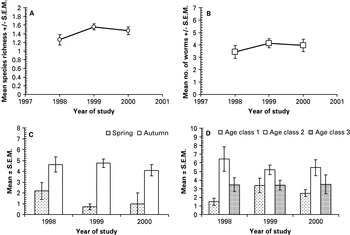
Focusing on Urwitałt in more detail, it can be seen that mean species richness in the period 1998 to 2000 did not change significantly, nor did the mean abundance of H. mixtum, and that despite a strong seasonal difference between spring and autumn and highly significant effects of age in each year of this study. The abundance of H. mixtum always peaked in the young adults and dropped in the older animals (Fig. 4; Bajer et al. Reference Bajer, Behnke, Pawełczyk, Kulis, Sereda and Siński2005).
Medium term stability in mean helminth species richness (A) and mean worm burden with Heligmosomum mixtum (B) in bank voles at Urwitałt, despite predictable patterns of season (C) and host age-dependent (D) variation in H. mixtum burdens. For full details of statistical analysis see Bajer et al. (Reference Bajer, Behnke, Pawełczyk, Kulis, Sereda and Siński2005).

Our studies on helminths in bank voles in NE Poland continue and the recent expedition in 2006 will add eventually another 268 individuals to the database. At this stage we have not yet looked for interactions between helminths in these datasets preferring to document comprehensively and to evaluate the relative role of the intrinsic and extrinsic factors that we have measured. With this knowledge, we will eventually be able to fit models that are robust and take all confounding factors into account. Not the least, we will be able to determine whether any detected co-occurrences of species form repeatable relationships that occur in different years of our long-term study and in each of our three study sites.
Helminth communities in wood mice in southern England
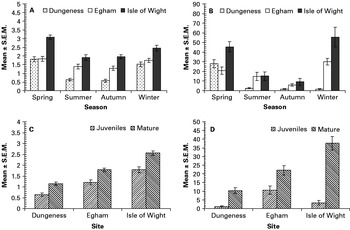
In the UK, one data-set on which we have published is also based on 3 sites, all examined in each of the four seasons in a single year and with a total sample of just under 400 animals. Here again we saw the highly predictable effects of season on mean species richness in all 3 sites. There were important differences between the sites, thus species richness was highest on the Isle of Wight, intermediate at Egham and lowest at Dungeness; Fig. 5A shows that the seasonal pattern was reflected almost identically in each of these three sites. The summer and autumnal dips were clearly apparent in all, with a rebound to higher levels for the winter and spring.
Seasonal (A and B) and age related (C and D) variation in species richness (A and C) and abundance of Heligmosomoides polygyrus (B and D) in three sites in SE England. For full details of methodology and statistical analysis see (Abu-Madi et al. Reference Abu-Madi, Behnke, Lewis and Gilbert1998, Reference Abu-Madi, Behnke, Lewis and Gilbert2000).

As is usual in the UK, H. polygyrus was the most prevalent species, and the seasonal pattern was also evident in this species (Fig. 5B), except that at Dungeness worm burdens remained low in the winter period and did not pick up until the spring. There were clear age-dependent increases in both species richness (Fig. 5C) and abundance of H. polygyrus (Fig. 5D).
Core and satellite species
From these studies, and the work of others (See Hanski, Reference Hanski1982 and Esch et al. Reference Esch, Shostak, Marcogliese, Goater, Esch, Bush and Aho1990, for discussions of the concept of core and satellite species; Kisielewska Reference Kisielewska1970c; Montgomery and Montgomery, Reference Montgomery and Montgomery1988; Haukisalmi and Henttonen, Reference Haukisalmi and Henttonen2000), the picture that has developed is one of an underlying predictability provided by the core species, which are generally host specific in their definitive rodent hosts – the Heligmosomatidae (H. mixtum in bank voles in Poland, and H. polygyrus in woodmice in the UK) and some cestodes (C. henttoneni in bank voles in Poland). However, this is not universal. In spiny mice in Egypt, the dominant species Protospirura muricola is not specific to Acomys spp., although in the region Acomys dimidiatus is probably its most important host.
Occasionally we see rising/falling trends across years. A good example of that is Aspiculuris tetraptera in bank voles in Poland, which seems to have been increasing in abundance for the last decade, while Syphacia petrusewiczi has been declining (Bajer, Sinski et al. unpublished data).
Species that show great variation in number between individual hosts cause enormous problems in analysis. We have recovered over 9000 Syphacia petrusewiczi from a single bank vole. S. petrusewiczi, being a contact transmitting species, shows a good relationship with host density (Kisielewska, Reference Kisielewska1970a; Montgomery and Montgomery, Reference Montgomery and Montgomery1988; Haukisalmi and Henttonen, Reference Haukisalmi and Henttonen1990; Arneberg, Reference Arneberg2001). However, Mesocestoides lineatus and Cladotaenia globifera, where again there can be hundreds of larvae in one animal, even when the overall prevalence is 1%, are further examples of unpredictable sporadic infections. All we can say about these is that the older the animal the more likely it is to be infected, and that infections in voles probably depend largely on the local presence of the definitive and first intermediate hosts.
Finally, we have another list of sporadic or satellite species which always show low prevalence and low intensity. They are largely unpredictable, their presence also depending on whether their definitive hosts have ventured into the site (e.g. mustelids that harbour the adults of Taenia mustelae and T. martis in the case of bank voles in Poland).
Does Heligmosomoides polygyrus predispose wood mice to infection with other species of helminths?
We were interested to see whether any support could be derived from field data for heligmosomatids increasing the likelihood of infection or abundance of infection with other species, as we might expect to be the case from the laboratory experiments with H. bakeri.
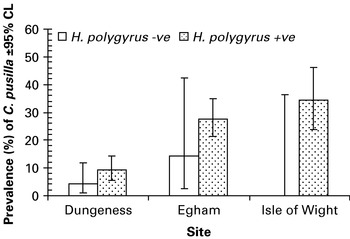
After analysing the data from the three-site study in SE England, we showed that indeed there were two robust relationships. One was with Catenotaenia pusilla. The prevalence of this species was always higher among mice that also harboured H. polygyrus. The significance of this relationship was tested in a model that also included season, age and sex and therefore controlled for the possible confounding effects of these factors, and yet it turned out to be robust, not confounded by other factors and reproducible in all three sites (Fig. 6).
The presence of H. polygyrus in woodmice increases the likelihood of infection with Catenotaenia pusilla, in each of three sites that were studied in SE England. The figure shows the prevalence of C. pusilla (±95% confidence levels, CL) in mice that were, and were not, infected with H. polygyrus, at each site. For further details of the methodology and statistical analysis see Behnke et al. (Reference Behnke, Gilbert, Abu-Madi and Lewis2005).

Initially we sought a correlation between the intensity of H. polygyrus and C. pusilla, but selecting only those animals that were infected with at least one worm of each species and using the raw data, i.e. the actual worm burdens. This produced a correlation that was on the borderline of significance (r s=0·24, n=68, P=0·054), but such an analysis did not take into account the possibility that both species of worms may have been aggregated together in some subsets of mice (i.e. in a particular age group, sex, season or site. See earlier section entitled ‘types of interactions and sources of error’) or that differences between subsets obscured an underlying relationship. Therefore, we controlled for possible confounding factors, by fitting the residuals of minimum sufficient models in GLIM and the correlation improved quite markedly (r s=0·32, n=68, P=0·008; Behnke et al. Reference Behnke, Gilbert, Abu-Madi and Lewis2005).
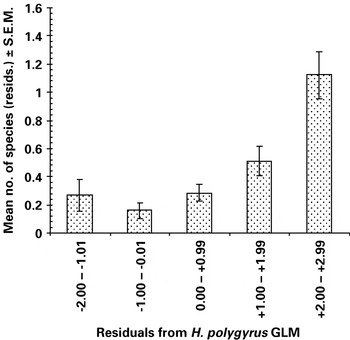
Even more robust was the finding that wood mice that carried more H. polygyrus for their particular subset, also carried more other species of helminths. Fig. 7 shows that when we controlled for all other quantified factors that may have generated correlated exposure by testing the correlation between the residuals of minimum sufficient GLM models of the abundance of H. polygyrus and species richness among mice that were infected with H. polygyrus and at least one other species of helminth, there was indeed a highly significant positive relationship.
Woodmice that carry more H. polygyrus for their subset, also have a higher species richness of other helminths for their subset (r s=0·45, n=179, P<0·001). See Behnke et al. (Reference Behnke, Gilbert, Abu-Madi and Lewis2005) for further details including full statistical approach and output.

Since we completed that analysis I have been looking for opportunities to test this finding on other independent data-sets, and recently I have been able to do so through collaborations with Catarina Eira and her colleagues in Portugal and Spain. Eira et al. (Reference Eira, Torres, Vingada and Miquel2006) recently published on a large dataset from wood mice, sampled across 4 seasons from 6 distinct habitats on the Portuguese coast. These mice were not infected with C. pusilla and the prevalence of other cestodes was too low to repeat exactly the same test as that described above. We were able to test the relationship between H. polygyrus and mean species richness with other helminths and again we found a significant positive relationship after controlling for all confounding factors that were quantified (in this case differences between 6 habitats, 4 seasons, three age classes and both sexes). These data will be published separately. So once again wood mice with high H. polygyrus infections for their particular subset were shown to be more likely infected with other species of helminths for their subset.
In yet another opportunity to test the relationship between H. polygyrus and species richness with other helminths I recently analysed data collected by John Lewis at Royal Holloway (University of London). Originally we had published on the helminths of wood mice sampled over a 4 year period (Behnke et al. Reference Behnke, Lewis, Mohd Zain and Gilbert1999), but the data now available were for 9 years, one of the longest running UK datasets for helminths of wood mice. So this time the possible confounding factors were 9 annual datasets, 3 age classes and both sexes, but all from the same location and in the same season of the year, in late September. Again, when we controlled for all the quantified sources of variation of data we were able to demonstrate that wood mice heavily infected with H. polygyrus for their subset, also carried more species of other helminths for their subset (Behnke, Lewis et al. unpublished).
CURRENT AIMS
In the years ahead, we will look closely at possible relationships between helminths infecting bank voles in Poland, and also at relationships between the heligmosomatids and intestinal protozoan infections such as Cryptosporidium parvum and Giardia spp. which co-infect these animals and which we have already quantified (Bajer et al. Reference Bajer, Behnke, Bednarska, Kuliś and Siński2004). Preliminary evidence suggests that synergistic co-occurrence between heligmosomatids and these intestinal protozoa is a feature of these systems (Bajer et al. Reference Bajer, Behnke, Bednarska, Kuliś and Siński2004). Furthermore we were able to detect both co-occurrence and quantitative associations between Cryptosporidium parvum and Giardia spp. in bank voles (Myodes glareolus) and field voles (Microtus arvalis) in Poland (Bajer et al. Reference Bajer, Bednarska, Pawełczyk, Behnke, Gilbert and Siński2002). Our analyses will be extended to murine communities in other ecosystems, notably the relatively species-poor helminth communities of spiny mice living in the arid terrain of the Sinai in Egypt, where we have already detected significant co-occurrence, although not quantitative associations, between intestinal protozoan infections (Cryptosporidium cf. parvum and Giardia sp.; Bajer et al. Reference Bajer, Harris, Behnke, Bednarska, Barnard, Sherif, Clifford, Gilbert, Siński and Zalat2006).
CONCLUSIONS
Experimental data establish firmly that interactions exist between intestinal helminths of rodents, and that the strongest effects are mediated through the immune responses of the hosts, but detecting these relationships in naturally occurring wild rodent communities has been fraught with problems (Haukisalmi and Henttonen, Reference Haukisalmi and Henttonen1993; Behnke et al. Reference Behnke, Gilbert, Abu-Madi and Lewis2005) and published data do not support a major role for such interactions in structuring helminth communities in wild rodents (Kisielewska, Reference Kisielewska1970a, Reference Kisielewskab, Reference Kisielewskac; Montgomery and Montgomery, Reference Montgomery and Montgomery1990; Haukisalmi and Henttonen, Reference Haukisalmi and Henttonen1993; Poulin, Reference Poulin2001, Behnke et al. Reference Behnke, Barnard, Bajer, Bray, Dinmore, Frake, Osmond, Race and Siński2001). By understanding the role played by extrinsic and intrinsic factors in causing variation in parasite burdens, including species richness, it is possible to make some headway. Helminths of wild rodents show predictable patterns of seasonal, host age-dependent and spatial variation in species richness and in the abundance of key core species such as the heligmosomatids. When these extrinsic and intrinsic sources of variation are controlled for, patterns of co-infection compatible with synergistic interactions can be demonstrated between intestinal helminths of wood mice, between gut protozoa and between haemoparasites in bank and field voles (Haukisalmi and Henttonen, Reference Haukisalmi and Henttonen1993; Bajer et al. Reference Bajer, Pawełczyk, Behnke, Gilbert and Siński2001, Reference Bajer, Bednarska, Pawełczyk, Behnke, Gilbert and Siński2002). At least one of these, the positive relationship between H. polygyrus and the species richness of other helminths in wood mice, has been demonstrated in three totally independent data-sets, two drawn from the UK and one from Portugal.
The challenge now is to determine whether similar relationships exist for other heligmosomatids infecting other rodents in Europe where the helminth communities are generally depauperate and among host-parasite combinations in more distant parts of the world where helminth communities may be richer (Brouat et al. Reference Brouat, Kane, Diouf, Bâ, Sall-Dramé and Duplantier2007 but see also Behnke et al. Reference Behnke, Harris, Bajer, Barnard, Sherif, Cliffe, Hurst, Lamb, Rhodes, James, Clifford, Gilbert and Zalat2004). Nevertheless, whilst such relationships have already been shown to be repeatable, collectively they explain only a small percentage (usually less than 10%) of the variance/deviance in abundance data. Although they may have a role to play in the more heavily infected animals, it is my view that other than in exceptional circumstances, quantitative interactions between species, as reflected in current worm burdens at sampling, are unlikely to play a major role in structuring helminth communities in wild rodents in Europe. Current worm burdens may well under-estimate the true consequences of co-infections, since current worm burdens need not necessarily reflect accurately the history of previous exposure and infection, including the possible polarisation of the immune system towards Th1 or Th2 responses and its consequences for different species (Graham, Reference Graham2008). Interactions through the immune system over time, with one species preceding the next, may not be revealed with sufficient precision at a single sampling when animals are culled (e.g. hosts may have rejected earlier worm burdens and absence of worms may reflect immunity and cross-immunity between species as well as lack of exposure). To unravel the complexities involved and to fully evaluate the significance of time in such interactions, longitudinal studies are required with repeated sampling of the same marked animals, trapped frequently over long periods across seasons. Disappointingly, in comparison to the impressive studies on haemoparasites (Telfer et al. Reference Telfer, Begon, Bennett, Bown, Burthe, Lambin, Telford and Birtles2007a, Reference Telfer, Clough, Birtles, Bennet, Carslake, Helyar and Begonb; including Telfer et al. in this issue) and viruses (Hazel et al. Reference Hazel, Bennett, Chantrey, Bown, Cavanagh, Jones, Baxby and Begon2000), to the best of my knowledge, there are no comparable studies on helminth infections in wild rodents, an approach that must now be considered a priority for future researchers in this field.
ACKNOWLEDGEMENTS
The work described in this paper could not have been undertaken without the contribution, help and support of very many people over three decades, collaborators and students alike. My Polish colleagues, Edward Sinski and Anna Bajer are thanked in particular for their important contributions, comradeship and support, as are John Lewis from Royal Holloway and Marawan Abu-Madi from Qatar University. Chris Barnard, who sadly died earlier this year, provided inspiration and played an enormous role in our joint work over the years and is much missed. Phil Harris has helped me to organise expeditions abroad, to supervise the student contingents, to process endless tubes of guts and worms, and to prepare manuscripts. Francis Gilbert pioneered the statistical approaches that we have jointly introduced into the world of parasitology, and his watchful eye over our statistical analyses ever since is always much appreciated. Over the years, many colleagues from the UK and from aboard (most recently Catarina Eira, Jordi Torres and their co-workers), have sent me, and trusted me with, their raw unpublished data. Their generosity and trust are much appreciated. It is my immense pleasure to formally thank the many undergraduate students, too many to list here, who have contributed to our expeditions over the years in no short measure, often paid for their own fares and their living costs abroad, and who have provided much of the energy, enthusiasm and motivation for continuing with this sort of work, despite shoestring budgets and a current world dominated by the RAE. My own contributions to the work described here have been supported by travel grants from the University of Nottingham, the British Council and the Royal Society and by grants from the M. B. Grabowski Fund. Finally, I thank Phil Harris, Ian Duce, Joe Jackson, Derek Wakelin, John Lewis, Anna Bajer, Edward Siński, Catarina Eira and Andrew MacColl, all of whom read earlier version of this paper and provided constructive advice to help me refine the text. I also wish to thank two excellent referees who put much work into helping me improve yet further this final version of the manuscript.