Historical background
The last Doge of Venice, Lodovico Manin IV, was the landlord of Passariano and to his family belonged the beautiful Villa Manin where this story takes place. The Manini family history has its roots in Tuscany around the 11th century, but in 1269 they were banned from Florence and started to wander Italy after choosing the losing side during the Guelfi and Ghibellini war. Moving first to Gemona and Cividale, and then Udine since 1312. Over the centuries Manini became Manin, stressing their relation to Venice, and by around 1501 the Persereano estate, later Passariano, was mentioned in some legal documents.
The Villa Manin has survived many hardships over the centuries: military occupation (Napoleon's troops at the end of the 18th century, Austro-Hungarian and German troops during World War I); the inevitable decline of the manor due to the loss of power and prestige of the Manin family; and finally, the last blow, the earthquake of 1976 that destroyed Friuli but was the beginning of a rebirth for the Villa. A few months after the earthquake the Regione Autonoma FVG issued a law that established a School for Conservation and Restoration of Cultural Heritage, with laboratories for didactic activities, and a library to support the activity of the Centre for Cataloguing and Restoration of Cultural Heritage — the location of the new school was the Villa Manin.Footnote 1
In 2015 the School evolved into the Istituto Regionale per il Patrimonio Culturale del Friuli Venezia Giulia (IPAC), and from the 1st of June 2016 it became Ente Regionale per il Patrimonio Culturale della Regione Autonoma Friuli Venezia Giulia (ERPAC). ERPAC's mission is to:
-
1. Promote research, learning and training in the field of conservation and restoration of Italian cultural heritage.
-
2. Support political action centred on landscape protection and promotion, with a global and historical vision of cultural heritage.
-
3. Assess and analyze the risk and vulnerability of a landscape which heavily depends on its cultural heritage.
-
4. Promote the active participation of citizens, local authorities, universities, and schools in preserving cultural heritage and memory.
ERPAC's library, photographic archive, and restoration school, are all proactive agents of the many activities in which ERPAC is engaged.
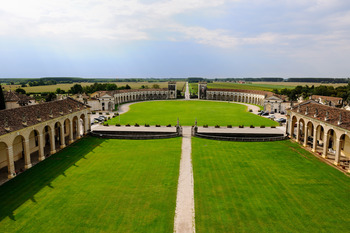
Villa Manin, view of the estate.

The Regional Centre for Cataloguing and Restoring Cultural Heritage in Friuli-Venezia Giulia
In 1969 the Region FVG bought Villa Manin di Passariano and its magnificent garden from the Institute for Venetian Villas, and in 1971 decided that the Villa was going to be used for cultural events and art exhibitions, as well as a headquarters, and established the Centro Regionale di Catalogazione dei Beni Culturali. After the disasters wrought by the earthquake of May 6th 1976, the School for Conservation and Restoration of Cultural Heritage with its laboratories was added to the centre. The first 4-year course of restoration started in March of 1977 with the aim to train highly qualified specialists who would be able to repair the damages that the earthquake exacted on the region's cultural heritage. After the emergency period, the school continued to follow its institutional mission of teaching, researching and practicing the art of restoration.
From 1977 to 1999 there were five courses, each one focusing on a specific type of cultural heritage: wooden sculpture, paintings on canvas and wood, archaeological stone, ceramic and metal materials, ancient textiles, and architectural surfaces. With the sixth course came a change of regulations which expanded it to a 5-year term (2006–2011) complying with the new Cultural Heritage and Landscape Code issued in 2004. The title of graduating students would now be Cultural Heritage Restorer specializing in books, documents and paper art works. There is a maximum of 15 students, and competition is heavy—applicants must pass an entrance examination based on technical, practical, and theoretic knowledge. Teaching and practical activities take place in the laboratories of the centre, but there are also external traineeships, as well as study and learning experiences in other Italian and foreign institutes. There is a ratio of one teacher to five students in the labs.Footnote 2
The teaching program and the organization of the whole course is set up by the Director of the Institute together with a scientific committee that includes experts from the Ministry for Cultural Heritage and the Deans of the Humanities Faculties of the Trieste and Udine Universities. The whole Esedra di Ponente (Western Exedra) hosts many different labs, based on the material to be restored. In the Barchessa di Levante (Eastern Barn Roof) there is a conference room with 99 seats, with wireless internet access and recording/projection systems.
The library and cataloguing
The library is an essential support resource for all research, cataloguing and restoration activities of the centre. It specializes in historical and art disciplines, restoration techniques, and cataloguing a wide range of cultural heritage items. Recently the library has joined the FVG cluster of the National Libraries System, adding its holdings to the national OPAC.
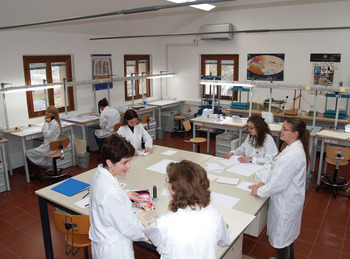
Students in the restoration course in the laboratory.

The cataloguing of the library started in 1972, and in 1997 a database of around 80,000 records was published on the centre's internet site. In 2005 a system called SIRPAC was created (Sistema Infomativo Regionale del Patrimonio Culturale), which began the era of shared cataloguing for cultural heritage items of many different kinds. This system enables local institutes, universities, and other associations and bodies engaged in cultural heritage preservation to participate in the cataloguing and unified management of the system's controlled fields (authority files for authors, editors, publishers, photographers, crests, insignia, hallmarks etc.). The centre offers a help desk and tutorship to cataloguers, with plans for a new online support tool in e-learning mode.Footnote 3
Through the portal: www.beniculturali.regione.fvg.it, users can access the SIRPAC database www.sirpac-fvg.org/index.asp, and browse more than 200,000 records that range from art works to parks and gardens, from demo- ethno-anthropological assets to archaeological sites and industrial archaeology buildings, from scientific and technological heritage to the Multimedia Archive of the Regional Emigration Memory (AMMER).
The centre collaborates with the multimedia archive AMMER, and with the CRAF, Centre of Photograph Research and Archiving, and shares its databases so that they might participate in cultural projects financed by the European Union. For instance, CULTURALP, a project aimed at preserving and promoting historical settlements in the Alps, or ITER (Itinerari TERmali = Spa Routes), a project to identify, preserve and promote historical spas. Over the last few years the centre has published many different types of items: exhibition catalogues, conference proceedings, multimedia, and a bibliographic series titled Quaderni di catalogazione e restauro.
Safeguarding the desert libraries: A project for preserving memory
In 2005, Mauritania asked Italy for support in preserving its cultural heritage, in particular, its ‘desert libraries’. The Region FVG initiated a 2-year project, supported and funded largely by the General Directorate for Cooperation for Development of the Italian Ministry for Foreign Affairs. The Mauritania project was launched in December of 2007 and saw the successful training of 12 local specialists in preservation techniques. These experts are now working in five laboratories set up for this purpose in the capital, Nouakchott, and in the four Mauritanian ‘villes anciennes’ of Oudane, Chinguetti, Tichitt and Oualata. The historical cities are on the UNESCO World Heritage List (1996), and are exceptional examples of settlements built to serve the trade routes of the Sahara Desert, and are witnesses to cultural, social and economic contacts for many centuries.Footnote 4
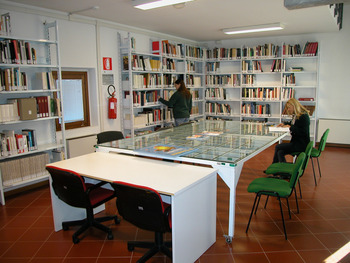
Library of the Centro Regionale di Catalogazione dei Beni Culturali.

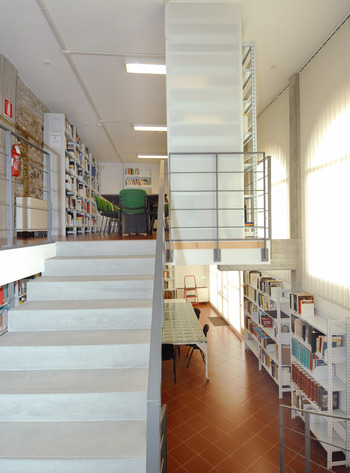
Library cataloguing services.

Training the specialists
The first phase of activities took place in the spring of 2008 in the capital of Mauritania. Twelve students were trained in collaboration with teaching staff from the University of Nouakchott and local experts. From July to September 2008, a second 3-month phase took the form of an intensive training course in Italy, held at the Villa Manin centre.
Overall, 480 hours of lectures were given, covering historical, scientific and technical disciplines. Activities included lectures, laboratory practice, apprenticeship and study visits to cultural institutions. Students had the opportunity to develop their skills and put them into practice working alongside Italian specialists in the field of conservation and preservation of library materials.Footnote 5
In 2009 the final training phase took place in Mauritania with autonomous laboratory activity which represented an important part of the training. During this last session, teaching staff from Mauritania and Italy took the technical and operational aspects a step further, by ensuring that the newly acquired skills were correctly put into practice.
This phase also saw the start of a research project on manuscript damaging insects, in collaboration with the University of Nouakchott and the Istituto Centrale per il Restauro e la Conservazione del Patrimonio Archivistico e Librario of Rome (ICPAL – Central Institute for the Restoration and Conservation of Archival and Library Materials). The 12 specialists positioned biological traps for insect samples as part of their apprenticeship. To raise awareness among libraries, meetings were organized with librarians to illustrate the full range of conservation services offered in the laboratories.
Setting up specialized laboratories
A further goal of the project was to establish five conservation laboratories in locations corresponding to the country's main manuscript collections. One is based in Nouakchott, at the Mauritanian Institute for Scientific Research, and four other conservation laboratories were established at Ouadane, Chinguetti, Tichitt and Oualata. Some technical equipment from the laboratories were installed on all-terrain vehicles enabling links to be maintained among the various sites, as well as connecting the most outlying locations. Today, the laboratories form part of a service network that covers the entire country, and is free to use by local communities and individual libraries.Footnote 6
Through their newly acquired skills and with the conservation equipment, the specialists can offer a range of services for manuscript preservation, including monitoring of environmental parameters, dust removal, pest control, construction of special containers for manuscripts, digitization, organization of information as well as orientation meetings for librarians and libraries. Some of these activities can take place within host libraries to avoid the need to move books or documents. More time-consuming or complex treatments such as heavy dust-removal, pest control, or digitization can be carried out at the laboratories. After treatment, items are returned to their owners, along with advice for ongoing preservation techniques and practices.
Archivio fotografico del Centro regionale di catalogazione e restauro dei beni culturali (The Photographic Archive of the Regional Cultural Heritage)Footnote 7
The Images of the Archive: From the analogue to the digital
The photographic archive is closely related to the cataloguing activities performed by the centre. The Central Institute for Cataloguing and Documentation (ICCD = Istituto Centrale per il Catalogo e la Documentazione) outlined the method of cataloguing at the national level, which includes the rule that catalogue records have to contain information about the photographic reproduction of cultural assets.
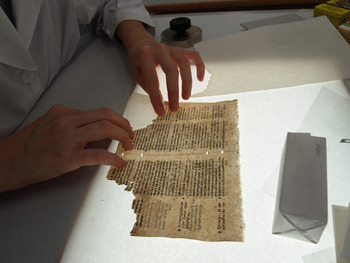
Laboratory restoration.

Since the beginning of the 1970s a great number of photos have been created—these photos form the base of the photographic archive dedicated to cultural heritage: works of art, architectural, ethnographic, and archaeological assets. Today the Archive contains about 212,000 photos and negatives, both analogue and digital. These images are used for publishing catalogues, posters, brochures, and for promotional activities. A low-resolution version of the image is attached to each of the archive's catalogue cards which are available online in SIRPAC.
In 1997 the centre started to digitize its existing analogue material, and since 2000, slides and prints have progressively been abandoned in favour of digital images. An extensive effort to consolidate the existing printed material began in 2004: only one photo would be kept in the paper card files, and the rest were stored away in boxes after digitization. The high-resolution images are organized by municipality, and safely preserved in a server of the regional network. The centre asks for minimal standards in archiving files: TIF format at 300 dpi resolution or the original RAW format.
Photographic material and promotion
From 1976 to 2001 the centre actively promoted its activity by publishing a bibliographic series titled Quaderni di catalogazione e restauro, which presented data and images from many municipalities, showing the many different types of assets: architecture, textiles, frescoes, church goldsmithing, numismatics and archaeological findings, to name a few. Documentation from the centre is often used for publishing exhibition catalogues, and the many art exhibitions held in the Villa Manin have been documented with photographic images from the centre.
Museums’ archives and collections
Since the mid-1990s the centre's photographer, Gianni Benedetti, has been documenting entire museum collections and the cultural assets of FVG both private and public. The ethnographic museums have the largest collections in quantity and variety: instruments for wine production, blacksmith works, carriages, wooden handiworks, coins, jewellery and goldsmithing objects.
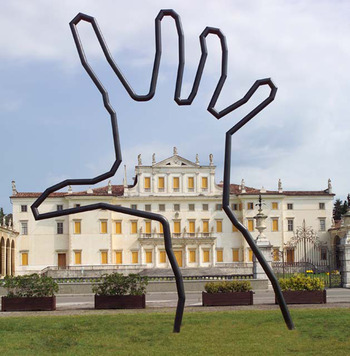
Contemporary art installation in the garden.

Joint cataloguing projects carried out with other regional cultural institutes were meant to organize, preserve, and promote the many assets in different collections. At the same time, individual photo collections also flourished, such as the one devoted to Villa Manin and its estate, as well as one focusing on the devastating 1976 earthquake. All of this material is accessible for consultation on appointment at the Villa Manin. Researchers are helped by expert personnel and often free copies of pertinent documentation is available. In those cases when the image did not originate from the centre, but collected through the participated cataloguing activity, researchers are put in contact with the owning institutes.
A version of this article was presented as a paper at the IFLA Art Libraries Section Satellite Conference in Chicago, 9–11, August 2016.