INTRODUCTION
Since the mid-1990s, numerous Buddhist temples located in and around the city of Kyoto, Japan, have replaced treasured sliding door paintings (J. fusumae), wall paintings (hekiga), folding screen paintings (byōbue), hanging scroll paintings (kakemono), and illustrated manuscripts (emaki), dating from as early as the thirteenth to fourteenth centuries, with high-quality digital reproductions. With these digital copies on display, the original works, many designated by the Japanese government as national treasures and important cultural properties, have been consigned to out-of-sight storage spaces on the grounds of their temple owners or in national and private museums. In this article, I refer to this practice as “digital replacement.” Footnote 1
Projects to digitize cultural properties have spread globally with an almost dizzying speed, and numerous museums and other institutions have made images of their collections available to the public as part of the Internet society. For instance, more than 3,000 institutions across Europe contribute to Europeana, the European Union-based online resource search system. Footnote 2 In February 2017, the Metropolitan Museum of Art in New York made 375,000 collection images freely available to the public using the licence designation Creative Commons Zero. Footnote 3 Among three-dimensional modeling projects are various leading-edge trials focused on world heritage sites under the United Nations Education, Scientific and Cultural Organization such as the Digital Michelangelo Project (Stanford University), the Great Buddha Project (University of Tokyo), and the Angkolian Temples Project (ETH Zurich). Footnote 4
While these projects simply acquire digital data and transform it into another form of representation, digital replacement projects are categorically different and have radcally dissimilar impacts on cultural properties and their social/historical contexts. Unlike the creation of scholarly and open access digital image databases, which leave objects in situ and in their modeling sites, digital replacement is conducted specifically to remove original objects from their sites and from the public gaze.
Digital replacement in Kyoto has occurred most often with sliding door and wall paintings, works that are intrinsic to specific Buddhist temple buildings and their surrounding garden spaces and are, in a word, “un-detachable” in terms of their inherent importance to specific ritual, spatial, aesthetic, and historical/cultural contexts. A vanguard project of this type was conducted in the mid-1990s at the Sanbōin subtemple within the Daigoji monastery. Since the mid-2000s, two competing corporate-based projects—one branded “Tsuzuri” (referred to in English as the “Cultural Heritage Inheritance Project”) and directed by Canon Incorporated in Japan and the other branded “Denshōbi” (“Transmitting the Beauty of Ancient Artisans”) and directed by Dai Nippon Printing Company (DNP)—have replaced numerous sets of fusumae and other works. Footnote 5 At the time of writing, these two projects have replaced works of sliding door painting and Buddhist painting (butsuga) with digital copies at six temples located in Kyoto Prefecture (Table 1). Footnote 6
List of digital reproduction/replacement projects for cultural properties: Buddhist temples, museums, Shintō shrines, and municipal cultural properties in Japan, April 2016 (conducted by the Kyoto International Culture Foundation, Hewlett-Packard Development Company Japan, Dai Nippon Printing Company, Kyoto Culture Association, and Canon, Japan)

The news media in Japan and abroad has generally cast these digitization projects in a favorable light. Scholars in art history and museum curators, meanwhile, have for the most part exhibited marked reluctance to review them in a critical manner. Footnote 7 There appear to be several reasons for such reticence. First, many scholars and curators hesitate to probe the management, technical processes, and implications of these projects because they are supervised by senior scholars who wield considerable authority in the discipline of art history in Japan. Second, particular scholars and curators may not want to jeopardize their relationships with temple owners upon whom they often depend for access to temple-owned artifacts for research and exhibition. Footnote 8 For these reasons, temple-painting digitization projects have taken place in the absence of careful and broad-based review of their merits and demerits. This article seeks to clarify the current status of, and problems inherent in, these digital replacement projects and to propose points for future discussion.
MERITS OF, AND CONCERNS ABOUT, DIGITAL REPRODUCTION AND REPLACEMENT
The importance of digitization to the reproduction of particular types of cultural property is undeniable, and there are clear merits worth noting. In contrast to time-consuming and material-demanding manual reproduction, digitization generally allows for lower-cost, rapid, and higher-quality reproduction. Once a work has been digitized, moreover, it is possible to produce new reproductions from properly stored data. A new copy can therefore be made to replace an earlier, faded, or damaged reproduction. Digitization also permits the production of multiple, simultaneous copies.
Each of the digitization projects carried out in Kyoto has so far deliberately eschewed this latter practice. Nevertheless, the companies that have been involved with these projects have sought to commoditize the digitization of cultural properties. Footnote 9 Put simply, there are no technical obstacles to the production of full-scale, high-quality digital reproductions of cultural properties for sale as luxurious interior decoration or the like. Digital data has also been used to create web content for temple institutions. In the case of the Daijōji monastery in Hyogo Prefecture, which is famous for the 165 wall and sliding door paintings by Maruyama Ōkyo (1733–95) Footnote 10 and his atelier that decorate its guest hall (kyakuden), image data produced by DNP during its digitization project has been repurposed in the temple’s “Digital Museum” website. Footnote 11 The website’s use of digital data to create online virtual, zoom-able representations is remarkably effective in evoking the guest hall’s sumptous architecture and painting programs.
Next, let us consider the merits of digital replacement. First of all, a temple that has replaced its original works with reproductions—the originals being placed in storage—can avoid the serious threats to cultural properties presented by fire, defacement, and theft. If the original works are deposited in a national museum and placed under its curatorial and conservation management, the temple is further freed from the direct responsibility of preservation. One can well imagine a temple’s abbot or abbess fearing for the possible loss of cultural properties during his or her tenure, and, therefore, we should not unconditionally blame him or her for agreeing to the replacement of original works with nearly original-looking digital copies. In terms of the administration of national cultural properties in Japan, meanwhile, we should note that the Agency for Cultural Affairs (Bunkachō), an affiliated agency of the Ministry of Education, Culture, Sports, and Science and Technology (Monbukagakushō), actively recommends the shift of designated cultural properties from in situ environments into museum storage and subsidizes the construction of storage facilities. For these museums, it is an honor to receive on extended loan national treasures and important cultural properties that are available to their curatorial teams for permanent and temporary exhibition. Replacement, in short, can fulfill the needs and policies of both temple owners and national cultural property administration. To the extent that this remains the case, digital replacement projects will undoubtedly continue.
Despite the merits of the digital reproduction/replacement of cultural properties in specific terms and circumstances, greater attention should be paid to the particular processes, results, and implications of full-scale digital replacement. Two technical issues complicate such projects. First, with the current technology, it is not yet possible to make copies that are exact in appearance to the aged originals as they are viewed within their native environments. In the process of digital reproduction as it is now carried out, engineers typically match data-generated images with the color of in situ originals under the conditions of standardized light. In the particular, and changing, lighting conditions of the installation environment, however, the color of the copy will diverge from that of the original because of the different spectral signatures of natural pigments (original work) and artificial inks (reproduction). A match under standardized light does not guarantee a match in the temple environment. In addition, the varying color temperatures of natural lighting differentiate the appearance of the originals and digital reproductions from hour to hour. Meanwhile, if, in trying to avoid the predicament of an “exact match” between original and copy, a project supervisor chooses to reproduce the originals in a hypothesized future condition (or in a conjectural reconstruction of the appearance at the initial date of completion in the past), the results are likely to provoke considerable controversy from many scholars as well as from the general public. Footnote 12
Even more difficult in technical terms, and therefore controversial, is the reproduction of the copious gold leaf and gold pigments that appear frequently on late medieval and early modern wall and sliding door paintings. Since modern ink-jet printing technology cannot replicate the particular reflective qualities of gold, technicians have been forced to adopt a number of less than satisfactory methods: (1) print imagery of gold leaf onto which a pictorial imagery is in turn printed; (2) apply actual gold leaf and print digital imagery upon it; (3) print pictorial imagery and then apply actual gold leaf. In general, digitally reproduced gold leaf fails to capture the subtle present-day tonalities of such original materials, which develop over centuries of exposure to light and air. Despite the technical difficulty that gold leaf and pigment presents to digitization, it is notable that replacement projects tend to focus on cultural properties that employ these materials. One might surmise that the choice to digitally reproduce these paintings is based on a desire to draw the attention of the general public to such visually glamorous cultural properties.
A second technical problem arises from the simple fact that digital copies begin to fade from the moment of their completion and installation. Moreover, the nature of this fading differs from that undergone by original works in situ and when placed in storage. Often digital copies appear to fade far more rapidly than expected. Ironically, it may be necessary to develop specific conservation methods for digital reproductions. Despite the evidence of such deterioration, there has been little effort to scientifically monitor and evaluate the conditions of digital reproductions.
TRENDS IN DIGITAL REPRODUCTION AND REPLACEMENT
The vanguard digital replacement project in Kyoto, which took place in the mid-1990s, was the duplication and replacement of 72 wall and sliding door paintings completed by the workshop of Hasegawa Tōhaku (1539–1610) and Ishida Yūtei (1721–86) and designated as important cultural properties, which decorated the Omote Shoin building at Sanbōin, Daigoji. Footnote 13 Undertaken by the Nissha Printing Company, the digital copies were printed on anomalously smooth paper, a choice dictated by the technical limitations of the time. Nevertheless, the reproductions were highly mimetic to the original paintings. Most general viewers would not be able to distinguish them from the original paintings unless they happened to view the copies in close proximity and recognized what are unnatural paper joints and the unusually slick surface of this type of paper. Footnote 14 During the brief guided tours that the general public may join, such close observation is all but impossible, however, and save for their occasional exhibition at Daigoji’s temple museum, the Omote Shoin paintings have been kept out of sight in storage.
The rapid corporate development of imaging technology from the 1990s into the new millennium accelerated digital image acquisition and the related utilization of cultural properties in both Japan and abroad. In 2000–03, the Tokyo-based Toppan Printing Company digitized works by Sandro Botticelli (circa 1445–1510) in the Uffizi Gallery, Florence, including Primavera (circa 1482) and The Birth of Venus (circa 1483). Footnote 15 Some of these full-scale digital replicas were then included in the special exhibition Digital Technology and the Museum: Public Seminars and Exhibitions of Information and Equipment Related to Digital Technology and the Arts, which was held at the National Museum of Western Art, Tokyo, from November 2001 to December 2001. Footnote 16 Before 1997, Hitachi had begun to develop its digital image system, a total image processing system mainly for the reproduction of cultural properties. Footnote 17 Hitachi then acquired the digital data of a number of famous paintings at the Uffizi Gallery and exhibited and sold replicas at the Tokyo National Museum in 2007. Footnote 18 In both instances, these projects aimed to establish the digitization of cultural properties as a new resource but did not replace original works with digital copies.
In terms of the wider range of art reproduction in Japan during this period, we might also note the remarkable Ōtsuka Museum of Art, which was inaugurated in 1998 in Tokushima Prefecture. Footnote 19 The museum’s huge complex (29,412 square meters in total floor area) displays thousands of reproductions of works of Western art printed on ceramic boards (tōban). Although the copies were produced using a silver halide photographic process rather than digital data and printing, the project merits attention for its scale and concept of reproduction. Visitors are presented with full-scale copies of canonical works of Western art, including the paintings of the Vatican’s Sistine Chapel and the Scrovegni Chapel in Padua; Leonardo da Vinci’s (1425–1519) The Last Supper at Santa Maria delle Grazie (in both pre- and post-restoration conditions); and Pablo Picasso’s (1881–1973) Guernica. Developed by the Ōtsuka Ohmi Ceramics Company, the ceramic print reproduction process has a number of limitations, including only a moderate spectrum of color reproduction, the rough surface texture of the ceramic boards, and the inevitable segmentation of large compositions that require printing across multiple boards. Footnote 20 The principle advantage of this reproduction process is durability. Footnote 21 In any case, despite its rather isolated location (125 kilometers from Osaka) and its display of reproductions rather than original works, the museum attracts some 220,000 visitors annually. The museum is reminiscent of André Malraux’s (1901–76) “[l]e Musée imaginaire,” and it presents one answer to the question of the museum in the age of copy technology. Footnote 22
One of the more impressive galleries within the Ōtsuka Museum of Arts contains copies of Michaelangelo’s (1475–1564) paintings for the Sistine Chapel, a space that was reproduced digitally in 1998 by Toppan Printing Company. In the latter case, we should note the interactive virtualization produced by the company using virtual reality technology. Footnote 23 Using the three-dimensional data it had acquired from the interior of the Sistine Chapel, Toppan virtualized the space on a 500-inch curved screen. Using a device similar to a video game controller, viewers can virtually walk inside the chapel and “fly” up to the ceiling to closely observe Michelangelo’s paintings. Compared with the ceramic print reproduction in the Ōtsuka Museum of Art, which is analog-based, viewed in real scale, and is materially tangible, Toppan’s Sistine Chapel virtual reality is fully digital, scalable, and intangible. In both instances, however, the existence of the reproductions does not displace the original work. It is perhaps obvious, but still bears emphasis, that the experience of seeing original paintings within their original architectural contexts, such as Michelangelo’s Sistine Chapel compositions, is not fully replaced by either the Ōtsuka tangible reproductions or the Toppan intangible reproductions.
This brings us back to the practice of digitization followed by the in situ replacement of original paintings with digital copies, a practice that has become increasingly common in and around Kyoto since 2006. In 2006, the Kyoto International Culture Foundation (Kyoto Kokusai Bunka Kyōkai) and Hewlett-Packard Development Company Japan (HPJ) collaborated on the production of digital reproductions of the Buddhist paintings of the Five Wisdom Kings (Godai sonzō), owned by Daigoji and designated national treasures; Kanō Tan’yū’s (1602–74) four sliding door paintings of Tigers (Gunkozu), owned by the Nanzenji monastery and designated important cultural properties; and four sliding door paintings of Katata Village (Katatazu fusumae), attributed to Tosa Mitsunobu (c.1434–c.1525) and owned by the Seikadō Bunko Art Museum in Tokyo but painted originally for the Zuihōin subtemple within Daitokuji. Footnote 24 It should be noted that the digital reproductions of the Katata Village paintings, which were exhibited at Artexpo New York on 2–6 March 2006, “returned home” to the Zuihōin temple, where they were installed in the location of the original paintings, which remain in the collection of the Seikadō Bunko Art Museum. Footnote 25
Following these projects, the Kyoto International Culture Foundation shifted its corporate affiliation from Hewlett-Packard to Canon, and, in 2009, it was restructured as a non-profit organization named the Kyoto Culture Association (KCA). Since then the KCA and Canon have continued digitization and digital replacement efforts under the name Tsuzuri: Cultural Heritage Inheritance Project. Footnote 26 Tsuzuri categorizes its work as, on the one hand, “high resolution facsimiles of Japanese art abroad” and, on the other, “high resolution facsimiles of historical cultural assets.” Footnote 27
The objective behind the first digitization category is “to donate high resolution facsimiles of precious Japanese cultural assets that have been owned in other countries over the course of history to their former owners in Japan.” Footnote 28 Tsuzuri has therefore produced various works that have “returned home,” at least in digital reproduction form, including Kanō Sansetsu’s (1590–1651) four-panel sliding door paintings of The Old Plum (Rōbaizu), owned by the Metropolitan Museum of Art in New York and Tawaraya Sōtatsu’s (unknown– c.1643) six-panel folding screen painting of Waves at Matsushima (Matsushimazu byōbu), owned by the Freer Gallery of Art in Washington, DC. Footnote 29 The Sansetsu copies were installed onsite at the paintings’ former owner, the Tenshōin subtemple of the Kyoto Myōshinji monastery, and the Sōtatsu copy was given to its former owner, the Shōunji temple in Sakai City, Osaka Prefecture. The objective behind Tsuzuri’s second category is to “promote the use of high resolution facsimiles as ‘living aids’ for teaching Japanese history, and targets cultural assets that most people may remember from their history textbooks and in elementary and junior high school.” Footnote 30 Following this theme, Tsuzuri has undertaken what it calls its “cultural properties sommelier project” (Bunkazai somurie) in cooperation with the KCA and the Kyoto National Museum, in which curators and graduate/undergraduate students use full-scale digital copies in talks presented at elementary and secondary schools in the city of Kyoto. Footnote 31
Tsuzuri’s “returning home” digitization projects have obvious value in their reproduction and in the installation of works that have previously been displaced abroad from particular owners and architectural contexts in Japan. At the same time, Tsuzuri has also carried out digitization with the specific goal of replacing original in situ works with veristic copies. In March 2010, for example, Tsuzuri completed the digital replacement of 32 panels of Hasegawa Tōhaku’s Landscape (Sansuizu fusumae), an important cultural property that decorated the Entokuin subtemple of the Kōdaiji temple in Kyoto. The original paintings were divided into two groups and stored in the Kyoto National Museum and the Ishikawa Nanao Art Museum in Nanao City in Ishikawa Prefecture, 326 kilometers from Kyoto. Footnote 32
The Denshōbi project, directed by DNP, has been equally ambitious. Footnote 33 Its digitization and replacement efforts in 2007 included the wall and sliding door paintings by Kanō Eitoku (1543–90) and his workshop at the Jukōin subtemple within Daitokuji, which were designated a national treasure (24 panels); the 2009 reproduction of 63 panels painted by Maruyama Ōkyo and his workshop at Daijōji in Hyogo Prefecture, which were designated an important cultural property; and the 2010 reproduction of 47 wall and sliding door paintings by Kanō Tan’yū and Hara Zaichū (1750–1837) at Ikkyūji (Shūon’an) in Tanabe City in Kyoto Prefecture. In each case, the original paintings were replaced with digital copies; those from Jukōin are now stored at the Kyoto National Museum, and, in the cases of Daijōji and Ikkyūji, the paintings are stored in their respective temple museums, with periodic exhibition in the case of the former and regular display of some panels in the case of the latter.
Denshōbi defines its digitization processes in terms of three categories: “actual state reproduction,” which replicates the exact condition of an original work; “standardized reproduction,” which replicates a group of works and adjusts their appearance based on the color and condition of a well-preserved area of the original; and “restorative reproduction,” which adjusts reproduction according to an expert’s judgment of the original appearance based on analysis of the technique, materials, and historical context. Footnote 34 The selection of a particular type of reproduction is done through consultation with the owner and a given project’s supervisor (typically, a renowned art historian or artist). In the background of the recent boom in digital replacement projects in Japan is the country’s “industrial-cultural complex.” As the world’s third largest economy, Japan has a highly advanced electronics industry. Canon, for instance, has dominated the world’s interchangeable-lens digital camera market since 2003. Footnote 35 Japan’s two largest print industry companies, Toppan and DNP—which control a combined 80 percent of the market with nearly 3 trillion yen in sales in 2013—are avid supporters of the digitization of cultural properties. Footnote 36 The accumulation of capital and technology in the high-tech imaging and printing industries drives digital replacement in terms of hardware and software and public relations.
It is also likely that Japanese cultural concepts and practices may speed the adoption of digital replacement, especially that of utsushi, which is evident in the arts, broadly defined. Footnote 37 In artistic practice in Japan, an utsushi is literally “a copy,” but such objects do not carry negative connotations because of the masterpiece status of their source/model. Moreover, an utsushi artwork made by a renowned artist may itself gain prestige in Japanese art history, becoming a masterpiece in its own right. Digital reproductions of cultural properties might in theory then be considered the utushi artwork of the modern information society.
As corporation-backed entities involved with the digitization of cultural heritage, Tsuzuri and Denshōbi differ: the former (Canon) is a manufacturer of digital cameras and printers and the latter (DNP) is a printing company. These business and technology differences are reflected in their respective digitization processes and projects. Not surprisingly Tsuzuri makes use of Canon’s digital camera technology to capture data and employs Canon’s image-processing software and large format printers to produce reproductions on Japanese paper or silk. In some instances, artisans then apply areas of gold pigment and/or gold leaf by hand to the digitally printed reproductions. Denshōbi, on the other hand, typically employs large format scanners to capture digital data and prints its reproductions onto paper, silk, or wood, having applied gold leaf to these surfaces prior to the digital printing. These production differences affect the qualities of the digital reproduction. Additionally, it should be noted that Denshōbi Footnote 38 has undertaken a significantly larger number of replacement projects than has Tsuzuri Footnote 39 (Table 1).
TWO BRIEF CASE STUDIES
Let us now examine two cases of digital replacement, beginning with Maruyama Ōkyo’s paintings at Daijōji in Hyogo Prefecture east of Kyoto. Ōkyo and his workshop produced 165 sliding door paintings, decorating 13 rooms in the temple, out of gratitude for the abbot’s financial support of the painter early in his career. Seventy-five of the panels have been designated important cultural properties in 1969. Ōkyo was a high-profile Kyoto-based painter who was also the founder of the Maruyama School, which remained active in Kyoto until the nineteenth century. It is likely that Ōkyo and his disciples produced the temple’s paintings in Kyoto. We may therefore treat them as works that emerged from within Kyoto’s cultural heritage context.
Daijōji was established in 745 by Gyōki (668–749), a priest renowned for his dissemination of Buddhism for the common people. The temple belongs to the Shingon denomination of esoteric Buddhism and is located in a small, remote seaside town. It has long derived financial revenue from tourism, and numerous visitors stop by the temple to see the Ōkyo paintings while enroute to nearby hot spring resorts or as part of gourmet food tours (specifically for the region’s crab). In popular parlance, Daijōji is “Ōkyo’s Temple” (Ōkyo-dera). In April 2000, the temple and its parishioners organized a committee to undertake the construction of a storage space dedicated to Ōkyo’s paintings; the best method of preservation, they believed, was the removal of the paintings from their original architectural setting. At the same time, the temple consulted DNP regarding the feasibility of producing digital reproductions of the original works. The Agency for Cultural Affairs, meanwhile, agreed to subsidize half of the cost of constructing the Daijōji storage facility, which was completed on the temple grounds in May 2003, with additional funds provided by Kasumi City and Hyogo Prefecture and with donations from parishioners and the general public. The facility is designed specifically to recreate the plan of the original architectural space into which the original paintings had been initially installed, thereby maintaining Ōkyo’s compositions and arrangement. The storage building is open to the public twice each year.
Prior to the relocation of the original paintings to the temple’s storage facility, Daijōji selected DNP to oversee the production of the digital copies. Digitization began in 2005 under the supervision of an artist, and it followed DNP’s “restorative reproduction” process, whereby the digital data was manipulated to recreate the paintings’ imagined original state at the time of their completion in the eighteenth century. DNP developed specialized inks in order to print on top of gold leaf and, having overcome additional technical difficulties, succeeded in reproducing the 63 panels that had been designated important cultural properties. The completion of the replacement project was announced at a press conference held at the temple in April 2009.
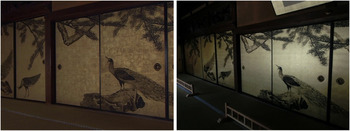
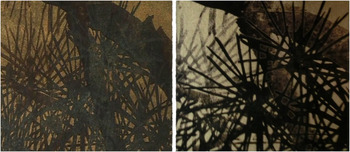
Despite the considerable time and resources devoted to this project, the digital reproductions are, in my view, deficient in a number of ways, perhaps fatally so. Owing to the restorative manipulation of the digital data, the copies appear far brighter than the now aged originals, an effect especially noticeable in the Peacock Room (Kujaku no ma), on which clean, new gold leaf has replaced the serenely weathered qualities of the gold leaf found on the original paintings, which had developed over centuries. This in turn produced a sharper tonal contrast in the reproductions between the ink brushwork and the shiny gold surface, distancing the copies even further from the appearance of the original paintings (Figure 1). Additionally, the subtle chromatic effect derived from Ōkyo’s use of shōenboku (a pine soot ink) for the peacock feathers, which appears blue under certain lighting conditions and is still visible in the original paintings, is not reproduced. Moreover, the printed (rather than hand-brushed) ink brush marks in the copies fail to capture the fine tonal gradations evident in the original paintings, seen, for instance, in the subtle variations in Ōkyo’s rendering of the overlapping pine needles. Clearly, the devil is in the details, and technical limitations in the printing process led DNP to enhance the visibility of the ink lines that represent the pine needles by adding white accents alongside the individual needles (Figure 2). In the process of this sort of retouching, a considerable amount of painting that the project team deemed to be discoloration was erased. For example, in the Landscape Room (Sansui no ma), a pale ink line deemed by some art historians to be the ocean horizon was “cleansed” from the digital data and the resulting copies because it was deemed by the project to be the result of tarnish from gold leaf squares rather than original brushwork.
Peacock Room (Kujaku no ma), Daijōji, Hyogo (left: photograph of original works in situ from Daijōji (Kū o egaku), date unknown; right: digital replacements in situ by the author with the permission of the temple).

Close-up of pine needles, Peacock Room (Kujaku no ma), Daijōji, Hyogo (left: original from Daijōji (Kū o egaku), date unknown; right: digital reproduction by the author with permission of the temple).

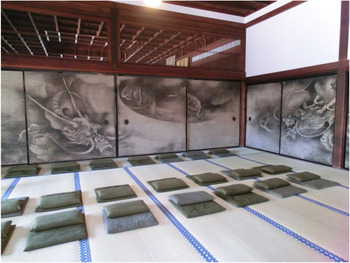
Between 2009 and 2013, meanwhile, Tsuzuri undertook the digitization of paintings by Kaihō Yūshō (1533–1615) that once decorated the abbot’s quarters in the Ken’ninji Zen monastery in Kyoto and were designated an important cultural property in 1919 and 1921. Footnote 40 In September 1934, the building was destroyed by a typhoon. Fortuitously, however, the paintings had been removed from the building prior to the storm (to open up the interior for a religious service) and therefore survived unscathed. Following this natural disaster, each of Yūshō’s sliding door panel paintings was remounted in hanging scroll format (kakejiku), which disrupted the continuous composition created by the panels installed in sequence in an architectural space. The reformatted paintings were then deposited in the Kyoto National Museum. In 1940, the renowned modern painter Hashimoto Kansetsu (1883–1945) produced a new set of sliding door paintings for Kenninji, including his masterpiece The Flow of Life (Shōjōruten), which were installed in the monastery’s reconstructed abbot’s quarters. Thereafter, Kansetsu’s paintings continuously decorated its rooms throughout the twentieth century and into the twenty-first century. In 2011, however, Kansetsu’s paintings were abruptly replaced with digital copies of Yūshō’s sixteenth-century paintings (Figure 3).
Digital reproduction of Dragons and Clouds (Unryūzu fusuma), Ken’ninji, Kyoto (photographed by the author).

The Tsuzuri project began by producing digital reproductions of the four panels of Yūshō’s Dragons and Clouds (Unryūzu) and the eight panels of his Flowers and Birds (Kachōzu), and, by 2013, the project had replaced 46 panels painted by Kansetsu with Yūshō copies. Comparison of the digital Yūshō reproductions and originals reveals the ink in the former to be noticeably darker than it is in the latter. Visitors are not able to make such comparisons, however, as is often the case with digital replacement, for, unlike the situation at Daijōji, the original Yūshō paintings (still hanging in scroll format) are stored in the national museum and are not on display in the temple museum space. The Ken’ninji project raises a number of critically important issues, including the judgment that Kansetsu’s paintings should be removed from their architectural setting and replaced with digital copies of the chronologically earlier Yūshō paintings. That Kansetu’s paintings are themselves candidates for the designation of future national treasures or important cultural property makes the project all the more controversial. As is the case with all digital replacement projects undertaken to date in and around Kyoto, however, the decision-making processes behind the project at Ken’ninji was entirely lacking in transparency. It is also problematic that the monastery discloses the presence of the digital reproductions of Yūshō’s paintings only in Japanese, despite the fact that the monastery is often filled with foreign visitors. Footnote 41
CRITICAL ISSUES
In his study of the replacement of Kanō Eitoku’s paintings in Jukōin, Daitokuji, with digital copies, Gregory Levine has argued that the contexts of original works of art should factor in any assessment of such projects. Footnote 42 In Andrew McClellan’s view, meanwhile, the affective power of art is weakened when removed from its original context. Footnote 43 Most Japanese art historians, however, do not attach such weight to the relationship between an original work and its original context. Nevertheless, in the case of wall and sliding door paintings installed within temple buildings, there is an intrinsic link between the pictorial work and its architectural context. Painters such as Eitoku and Ōkyo developed their compositions by taking into consideration the architectural plans of the individual rooms and buildings as well as of the surrounding spatial environments. In a number of cases, the pictorial compositions of wall and sliding door paintings connect visually with the compositions and motifs located in adjacent rooms and with exterior landscape gardens. The dislocation of a set of paintings from their intended location effectively destroys the symbiotic pictorial and architectural (and ritual and social) context, at least in terms of the integrity of its mutually original material and visual and spatial identity.
When original paintings emerge occasionally from their dark recessed storage spaces, their display is often under poor lighting in exhibition galleries; it is axiomatic that the painter did not paint these works with a museum environment in mind. Rarely do original works sequestered in storage return for display, even temporarily, within their original architectural contexts. Footnote 44 Moreover, when sliding door panel paintings are stored away from their original architectural settings, their wood frames—which are normally supported by beams that provide grooves for them to slide along (shikii) within specific rooms—may expand or warp, in turn preventing the paintings’ later re-installation in their original setting. Cultural heritage administrators, meanwhile, generally seek to avoid the “unnecessary” transport of large format wall and sliding door paintings, especially those designated as national treasures or important cultural properties, from museum storage back to their original sites.
The tendency to devalue the integrity of artistic and architectural contexts as interrelated wholes is in fact promoted by the administrative structure of cultural heritage management in Japan. The dislocation of wall and sliding door paintings from temple buildings in Japan generally raises no questions in part because different divisions of the Cultural Properties Department of the Agency for Cultural Affairs oversee different categories of cultural property: the preservation of paintings falls under the supervision of the Fine Arts Division; buildings under the Architecture and Other Structures Division; and landscape gardens under the Monuments and Sites Division. Footnote 45 Administratively, therefore, wall and sliding door paintings are separate entities and readily detachable from buildings and gardens. This management structure in turn reflects disciplinary divisions within art history, architectural history, and landscape design history as they are practiced in Japan, which leads to the segregated study of paintings, buildings, and gardens. Moreover, these sorts of subdivisions and disconnections are reproduced in the training of new generations of art historians, curators, and architectural and landscape historians. A vicious cycle has been set in place, therefore, which promotes the destruction of the interrelationships of original pictorial and architectural contexts. One might add that art historians and curators who view “observation under standardized lighting,” such as that used in museum contexts, as a prerequisite to the study of paintings, based on their disciplinary-bound training, are predisposed to support digital replacement, which brings original works into museum contexts, and, in turn, the destruction of original contexts of cultural heritage.
Additionally, it should be recognized that the placement in storage of cultural properties, such as the wall and sliding door paintings under discussion here, is by no means entirely, or in all cases, felicitous to their preservation. It is common knowledge that cultural properties should be kept in conditions of stable temperature and humidity and away from corrosive chemicals and entirely dark locations. Despite such common knowledge, a recent textbook edited by the National Research Institute of Cultural Properties in Tokyo, which is an authoritative institute for conservation science in Japan, indicates specifically that “[n]either the Agency for Cultural Affairs nor any academic body has defined the guidelines or criteria for establishing air cleanliness in the storage of cultural properties.” Footnote 46 This assertion should be sufficient to alert the general public that an unequivocal belief in the safety of museum storage may be misguided. The National Research Institute report provides target values for establishing air cleanliness for the short-term loan of cultural properties, but it does not advocate the long-term storage of wall and sliding door paintings that employ natural pigments, which is the case for all of the designated works subject to digital replacement.
Museum storage also subjects works to conditions of compact warehousing that may be deleterious to preservation by virtue of restricting the ease of close and routine observation. In contrast, when wall and sliding door paintings remain installed in their original buildings, they are available for conservation specialists to conduct direct and repeated evaluation of their physical conditions; in situ preservation also permits access for appreciation and research by larger numbers of people. Needless to say, close observation of original works of art is absolutely essential to the training of future generations of scholars and curators. As the case of the wall paintings from the late-seventh-to-early-eighth-century Takamatsuzuka Tomb demonstrates, meanwhile, the closing off of cultural property sites may allow degradation to occur unnoticed and may result in delays in necessary conservation measures. Footnote 47 In the case of one museum, I learned that objects placed in its storage are documented in terms of their dimensions and general conservation conditions and then photographed in black and white; no effort is made to document the object’s color. Footnote 48 In the case of large museums, such as Japan’s national museums, which are the custodians of designated cultural properties, it is simply impossible to conduct thorough examinations of the condition of each stored object on a routine basis.
The anxieties of temple owners, which I noted earlier, dovetail with the policies for the protection of cultural properties of the Agency for Cultural Properties, in turn promoting the development of digital replacement. It is obvious, however, that third-party players have actively promoted such replacement projects, namely the corporations that develop digital image technologies and manufacture digital reproductions. So far, these corporations seem to regard their involvement in the manufacture of digital copies of cultural properties as an advertising opportunity. Although HPJ, Canon, and DNP have not derived profits directly from their participation in digital replacement projects, they jointly hold exclusive rights to the image data of digitized works with the temple owners. Use of the image data requires permission from both parties. It would seem imperative, therefore, that the issue of public ownership of such image data be addressed since repeated scanning and photography of cultural properties is neither feasible nor conducive to preservation. Even with the primary ownership of works by religious institutions and the corporate-initiated acquisition of digital image data, an argument for the public ownership of such data can be made on the basis of the national ownership (and the national subsidy of conservation) of designated cultural properties. In my view, corporations should not hold unconditionally exclusive rights to such image data, which should be stewarded as a public asset for ongoing reproduction and educational use. One solution may be the donation of the image data to the national museums into which the original art works are deposited. This does not resolve the issue of the considerable cost of future reproductions to replace earlier copies that have degraded over time, for it appears far easier to generate capital for initial digitization and replacement projects than it is for the production of later copies to replace the initial reproductions. Although it might now seem unlikely that one would visit a temple only to see faded digital replacements of treasured paintings, now locked away in museum storage, this may very well come to pass in the near future.
Amid the rush of digital replacement projects, meanwhile, the voices of citizens who view national treasures and important cultural properties as “our culture” have been ignored entirely. This brings to mind Derek Gillman’s observations regarding cultural cosmopolitanism and particularism: the former seeks to promote the idea of “the heritage of all mankind” and the latter the idea that heritage is instrumentally and/or intrinsically valuable to particular people. Footnote 49 Arguments for the preservation of important cultural things on behalf of all humankind may be noble and worthy of support in principle, but they frequently conflict with two potentially competing social facts: that many things are claimed by particular cultures and many are privately owned. The quick answer would be that all things are equally part of “world heritage” and a particular national or local heritage. But that is too easy a response; it satisfies symmetry but at the expense of careful recognition of the realities of possession and control. Footnote 50
In digital replacement cases, the positions of the Japanese citizenry may be rather ambiguous. Some citizens may support a cosmopolitan perspective because they do not belong to the temple’s local community; they may therefore advocate against the digital replacement, thereby thwarting the local consensus sought by the temple. Simultaneously, however, they may advocate for a certain level of particularism since they may also view temple-held works of art as “our local culture” and give free hand to the temple, government, art historians, and corporations without acknowledging other voices, including those from abroad. Behind such ambiguity is the tension between, on the one hand, the Agency for Cultural Affair’s policy of reducing access to cultural properties and, on the other, the use of public taxes to support the preservation of designated objects, a tension that may grow if taxpayers are constrained from accessing these works of art or are no longer able to see the original works at their original sites. At the root of such tensions, meanwhile, is the absence of worldwide public consensus behind digital reproduction/replacement projects. The lack of public discourse in such projects has precluded open discussion of critical and long-term issues.
Indeed the long-term consequences of digital replacement are unclear. Temples have preserved wall and sliding door paintings in situ for centuries, and these works have undergone frequent conservation. The replacement of original works with digital copies may reduce the frequency of conservation, but, as already noted, museum storage is by no means the ideal environment for preservation. Moreover, the reduction of conservation work on cultural properties, following centuries of practice, may adversely impact the transmission to future generations of the conservation techniques necessary for the preservation of cultural properties. Indeed, works of wall and sliding door painting from early modern and modern periods have been preserved in an ecosystem of artists, artisans, temple clergy, and temple congregations. Digital replacement, I would argue, erodes this ecosystem, which has depended upon the transmitted skills of conservation, the artisanal production of the materials and tools used in conservation, the dignity of religious institutions arising both from religious belief and cultural heritage, and local devotion and support. I suspect too that the weakening of this ecosystem will potentially undermine religious communities and the Buddhist institution itself.
There is a common saying among engineers: “Do not use the latest technology if you are not allowed to fail.” In the case of Japan’s cultural properties, a “worn-out” conservation technology generally works just fine, while the warehousing of works of art in an artificial environment—the latest technology or at least one that has developed over the past several decades (rather than centuries)—seems to open up all sorts of problems with little or no room for failure. Footnote 51 We should also question the arrogance of certain temple leaders who believe that digital copies are sufficient for tourists (who “don’t know better”). It seems quite natural, meanwhile, that some, perhaps many, members of the general public as well as foreign visitors may become disinclined to visit temples at which original cultural properties have vanished, a phenomenon with implications for temple economies in which admission fees constitute important revenue. Footnote 52 The potential loss of revenue through the disclosure of digital replacement may lead some temples to obfuscate the fact that visitors are presented not with original works but, rather, with reproductions and, in the worst case scenario, create the false belief on the part of some visitors that they have viewed actual cultural properties. In my view, cultural properties should be preserved in their original contexts as evidence of enduring temple cultures and histories. What religious institutions should endeavor to do is attract a broader range of visitors (local, domestic, and international; tourists, scholars, and artists) and to empower the temple community and its abbot or abbess, who is surely motivated to pass on temple masterpieces to future generations.
PRINCIPLES AND A CODE OF PRACTICE
As long as the Agency for Cultural Affairs, temple and private owners, and image technology corporations believe that digital replacement contributes to the preservation of cultural properties, it will remain an active trend in heritage practice in Japan. If that is to be the case, then such projects should be carried out according to consensus-based principles and guided by a collectively agreed upon code of practice. To begin with, the criteria for undertaking digital replacement (and any other medium of reproduction-based replacement) should be defined, working from issues such as cultural significance, age, ritual function, conservation condition, cost of in situ maintenance of original works, and the possible impact of replacement on revenue. With regard to ritual functions, Supriya Singh, Meredith Black, and Jonathan O’Donnell point to a general consensus against the digitization of secret/sacred or ritual objects in the case of Pacific cultural collections. Footnote 53 No such consensus exists for the digitization of works of art in religious contexts in Kyoto. By and large, the wall and sliding door paintings preserved within Buddhist temples are not objects of direct religious worship and are recognized instead as works of art that adorn ritual spaces. This is not the case, however, with Buddhist iconic hanging scroll paintings that have been digitized, such as the Five Wisdom Kings (Godai sonzō), a set of iconic images owned by the Daigoji monastery that function in specific ritual performances. In this instance, digitization may have been deemed permissible by the monastery because of the traditional Japanese Buddhist concept of the “mobility/divisibility of spirit,” through which the inherent numinous spirit or identity of the icon/deity may be ritually transferred to, and may then reside within, the reproduction. Footnote 54
Nevertheless, the digital replacement of artworks should proceed following an assessment that includes consideration of alternative media. For instance, is digital reproduction necessarily superior to manual reproduction in every case? Moreover, would it not be preferable to commission contemporary artists to produce new programs of paintings to replace designated works, thereby sustaining a model of cultural patronage and the aforementioned ecosystem, which has operated in relation to Buddhist temples for centuries? At the very least, decisions regarding which works should be replaced and in which media requires transparency and consensus developed through the inclusion of multiple stakeholders. To support transparency and consensus and to provide proper oversight, an independent body—separate from temple owners, the Agency for Cultural Affairs, and digital image corporations—should evaluate each digitization project before it commences. This body should then monitor each replacement project as it proceeds as well as the condition of the original works placed in storage and in situ copies, providing guidance to owners and museums consistent with the complex issues that bear upon cultural properties. A code of practice for digital reproduction/replacement, meanwhile, might include the following items:
-
1. Present state reproduction: digital reproduction/replacement should be limited to the production of copies that reproduce the present physical and visual state or condition of the artwork, doing so without supposition regarding the original appearance. Reproduction that attempts to restore the state or appearance of the work as it existed several hundred years ago inevitably exacerbates the intrusion of personal judgments and creative solutions by art historians, engineers, and artisans, which, in turn, invites disagreement regarding the particular representation of the cultural property offered by the copy. Footnote 55
-
2. Explicit notification: in any instance of reproduction/replacement, especially involving digitization, a temple owner should provide clear and accessible notification in multiple languages regarding the replacement of original works with copies. Surprisingly, a number of temples do not follow this seemingly self-evident practice.
-
3. Local conservation: whenever possible, original works that have been replaced with digital copies should be preserved in a facility located at the site itself or as near as possible and should be accessible to the general public. Such proximity is necessary for comparison between original works and copies and to monitor the degradation of reproductions.
-
4. Monitoring of reproductions and original works: reproductions should be monitored regularly and scientifically in order to track fading and other types of degradation occurring over time. A set of protocols for enhanced monitoring of warehoused original works should be established to prevent unanticipated discoloration and other forms of degradation.
-
5. Replacement reproductions: given the unavoidable decay of digital reproductions, provisions should be established for the replacement of reproductions that show marked deterioration. Ideally, the production of such replacement copies will take advantage of up-to-date digital technology. Those who promote digital replacement should incur the costs of such ongoing replacement needs.
-
6. Periodical re-installation of original works: accompanying each digital replacement project should be a plan to periodically return original works to their site for temporary display that is open to the general public during specified periods. Ideally, the original works should reinstalled temporarily in their original architectural spaces.
The development of a code of practice for digital replacement should be a matter of broad-based consensus. Needless to say, the preceding six items are intended merely as a starting point for discussion. It is my hope that cultural property professionals, art historians, artists, government officials, and the general public will contribute to inclusive and in-depth conversations that bring greater attention and clarity to the issue of digitizing Kyoto’s cultural heritage.
ACKNOWLEDGMENTS:
The author wishes to thank Gregory P. Levine for comments and editing on the draft.