Introduction
The need to accurately estimate the prevalence of different taeniid species in wildlife is a critical component for understanding and modelling the transmission between definitive and intermediate hosts. In the intermediate host, morphological identification of metacestodes has been considered the standard method in epidemiological studies (Torgerson & Deplazes, Reference Torgerson and Deplazes2009). However, definitive morphological identification may be impossible if the cysts of several larval specimens isolated from small mammals are not fully developed (Reperant et al., Reference Reperant, Hegglin, Tanner, Fescher and Deplazes2009; Burlet et al., Reference Burlet, Deplazes and Hegglin2011). Species identification of larval stages is particularly important in the risk assessment and management of zoonotic diseases; for example, distinguishing undifferentiated taeniid stages of the zoonotic Echinococcus multilocularis from other taeniid infections. In such cases, morphological identification is highly uncertain, and identification could possibly be attained using molecular methods (Burlet et al., Reference Burlet, Deplazes and Hegglin2011).
While several polymerase chain reaction (PCR)-based assays have been developed to identify species causing human Taenia infections, few studies have focused on the development of a diagnostic PCR for identifying taeniid infections in wildlife. Previously, a single-step multiplex PCR assay based on mitochondrial 12S rDNA, or ssrDNA, was shown to distinguish between two species of Echinococcus from members of the family Taeniidae (Trachsel et al., Reference Trachsel, Deplazes and Mathis2007). This method is valuable in some epidemiological studies because it differentiates the zoonotic E. multilocularis from other taeniid species. However, sequence analysis is required for specific identification. A more recently developed PCR/dot blot assay (Armua-Fernandez et al., Reference Armua-Fernandez, Nonaka, Sakurai, Nakamura, Gottstein, Deplazes, Phiri, Katakura and Aku2011) may also differentiate between zoonotic taeniid infections, and the multiplex PCR assay developed by Al-Sabi & Kapel (Reference Al-Sabi and Kapel2011) is able to identify taeniid species within the rodent intermediate hosts and carnivore definitive hosts.
The aim of the present study was to test the ability of the recently developed multiplex PCR assay (Al-Sabi & Kapel, Reference Al-Sabi and Kapel2011) to identify taeniid species in field-collected intermediate hosts. We performed molecular typing on taeniid infections in small mammals sampled from three types of habitats in north-east Zealand, Denmark, namely rural forests, urban forests and parks, and residential localities. The sampling of rodents from these locality types would facilitate the identification of differences in taeniid transmission resulting from habitat variations, for example, the abundance of definitive hosts such as dogs, cats, foxes and mustelids (Baagøe & Ujvári, Reference Baagøe, Ujvári, Baagøe and Jensen2007).
Materials and methods
Collection and examination of larval cysts
Small mammals were trapped in and around the metropolitan area of Copenhagen, which is located in north-east Zealand, Denmark. It was expected that mammal densities would be influenced by human presence, induced both by a disturbance effect on wild reservoirs and by augmenting densities of reservoir hosts that are kept as pet animals. We, therefore, defined three types of habitats, which differed in their distance to human habitation and human population density. These habitats included 15 urban forests and parks within the urban area of Copenhagen, close to human habitation, five rural forests outside the urban area of Copenhagen, but close to human habitation, and 18 residential and farm gardens located, again, outside the urban area but close to human habitation.
Three types of live traps were used for trapping small mammals, namely Sherman (4′′ × 8′′ × 12′′, H.B. Sherman Traps, Tallahassee, Florida, USA), Ugglan-special and Ugglan-lemmel (Grahnab AB, Hillerstop, Sweden). In the residential and farm gardens, an additional trap was used to collect the northern water vole Arvicola amphibious and the common European mole Talpa europaea (Topcat trap®, Topcat GmbH, Switzerland). Small mammals were trapped using 150 live traps distributed in grids of 500 m2, consisting of five lines 10 m apart, and each line consisted of 10 trapping stations 10 m apart, or in transects of ten live traps that were placed in a linear arrangement. Traps were baited with commercial rodent food (Nutrazu® or Musli®, Brogaarden, Denmark,), left open for a week, re-baited and set for trapping, and checked daily for two consecutive days. Trapping started in July 2005 and ended in September 2009.
The live-trapped small mammals were euthanized by CO2 and autopsied immediately thereafter. The species was determined (Jensen, Reference Jensen1993), and measurements of body length and weight were taken. Internal organs were then examined, and cysts and any macroscopically visible spots or lesions in the peritoneal cavity and liver were isolated for further analysis. When applicable, well-developed taeniid cysts were morphologically identified to species (Loos-Frank, Reference Loos-Frank2000), and Taenia taeniaeformis was named Hydatigera taeniaeformis while Taenia mustelae was named Versteria mustelae according to current nomenclature (Nakao et al., Reference Nakao, Lavikainen, Iwaki, Haukisalmi, Konyaev, Oku, Okamoto and Ito2013). Cysts and any visible spots or lesions were preserved in 70% ethanol and stored at − 20°C for molecular identification.
Molecular analysis
DNA was extracted from 0.15–0.25 g of tissue lesions and/or cysts (Qiamp DNA mini kit®, Qiagen, Hilden, Germany). DNA quantity was measured and quality parameters of DNA purity were evaluated using a spectrophotometer (NanoDrop© ND-1000, Saveen Werner AB, Malmö, Sweden). DNA was amplified from each of the isolated lesions and/or cysts using multiplex PCR and taeniid species were typed using species-specific differences in the nuclear 18S rDNA gene and internal transcribed spacer 2 (ITS2) region (Al-Sabi & Kapel, Reference Al-Sabi and Kapel2011).
For validation and reference, selected DNA samples of liver lesions and/or cysts that were found to be positive in the multiplex PCR (N= 52) and all negative multiplex PCR samples were subjected to sequencing for specific Taeniidae species identification. This sequencing was done subsequent to amplification of part of the mitochondrial cytochrome c oxidase subunit 1 gene (cox1 PCR) using previously published primers (Bowles et al., Reference Bowles, Blair and McManus1992). Amplicons were purified directly from the PCR product (DNA and gel band purification kit®, Amersham Biosciences, Little Chalfont, Bucks, UK), and automated DNA sequencing was done by a private service company (MWG, Martinsried, Germany). The resulting sequence data were first analysed individually by assessing homology to available sequences in GenBank by BLASTn searches. Sequences showing the highest degree of similarity were aligned by pairwise comparison using the software CLC main workbench 5® (CLC bio, Aarhus, Denmark).
Data analysis
All prevalence values were based on the total number of positive findings obtained using the sum of morphological, multiplex PCR and cox1 PCR methodology. The final composition of sampled animals was too heterogeneous to allow for reliable multivariate analysis, as several species were found in only one habitat type and/or only for a limited number of months. Binomial models showed a very poor goodness of fit. Therefore, only simple statistics are presented, including chi-square tests for exploring differences in the prevalence of taeniid species in the different habitat types and seasons. Seasons were defined as spring (21 March–20 June), summer (21 June–20 September), autumn (21 September–20 December), and winter (21 December–20 March). A kappa test (Viera & Garrett, Reference Viera and Garrett2005) was performed for testing the agreement between morphological diagnosis and multiplex PCR. Analyses were performed using PROC FREQ in SAS 9.1 (SAS Institute, Cary, North Carolina, USA).
Results
Identification of taeniid species in potential intermediate hosts
A total of 127 cysts, visible spots or lesions in the peritoneal cavity and liver were isolated from 719 trapped small mammals. Among these cysts and/or spots and lesions, 95 were identified as taeniid infections by morphology and/or DNA sequencing. The remaining spots and lesions were identified microscopically and/or by molecular typing either to the species level, as in the case of Calodium hepaticum, Mesocestoides spp., or from host tissue. Up to 55 of 95 taeniid infections (57.9% ± standard error (SE) 9.9) were considered to be fully developed cysts for morphological identification, with up to 86 of 95 (90.5% ± 5.9) taeniid infections being identified using multiplex PCR. No infections with more than one species of Taeniidae were detected and no infections with E. multilocularis were found among the examined rodents and insectivores.
A moderate agreement between morphological examination and multiplex PCR testing was evident by kappa statistics: simple kappa value = 0.48. All infections with V. mustelae (N= 17) and approximately 94% of the 66 infections with H. taeniaeformis were identified by multiplex PCR (table 1). Of 26 morphologically unidentified H. taeniaeformis samples, multiplex PCR specifically identified 24 samples while two samples were identified by cox1 PCR only. Similarly, 14 of 17 V. mustelae-positive samples were identified by multiplex PCR but not morphologically. In contrast, all infections with T. polyacantha (N= 12) were diagnosed by morphology. However, multiplex PCR could not identify five of the infections with T. polyacantha that had been morphologically identified and four infections with H. taeniaeformis, two of which had been morphologically identified.
The prevalence of infection (%) of taeniid species in small mammals from three types of habitats in north-east Zealand, Denmark, assessed by morphology and multiplex PCR; up to 95 liver and peritoneal lesions, spots and cysts (CI: 95% confidence interval) were examined, with positive samples (N) being recorded when lesions had developed into cysts, and also positive samples * from cox1 gene sequencing as described by Bowles et al. (Reference Bowles, Blair and McManus1992).

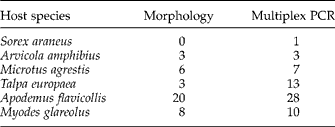
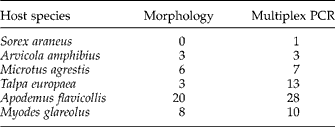
The added number of identified taeniid species by multiplex PCR differed between intermediate hosts (table 2). For example most infections with H. taeniaeformis in A. amphibius, the field vole Microtus agrestis, and the bank vole Myodes glareolus were mature, facilitating detection by morphology. On the other hand, several infections with H. taeniaeformis in T. europaea and the yellow-necked mouse Apodemus flavicollis, together with one H. taeniaeformis infection in the common shrew Sorex araneus were not fully developed and were better diagnosed using multiplex PCR. While all morphologically detected infections with T. polyacantha in A. flavicollis (N= 3) were identified by the multiplex PCR, the assay could detect only four of nine T. polyacantha infections in M. glareolus.
The identification of the taeniid species Hydatigera taeniaeformis in small mammals in the area of north-east Zealand, Denmark, using morphological methods and multiplex PCR.
Prevalence of taeniids in small mammals
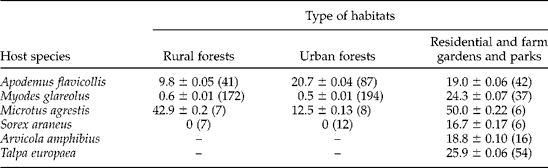
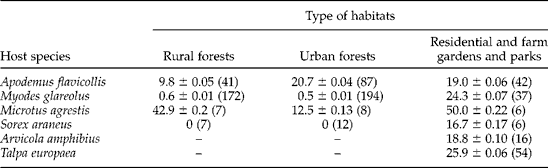
Up to 719 trapped small mammals were unevenly distributed among the habitat types, with 228 occurring in rural forests, 318 in urban forests and parks and 173 in residential and farm gardens. The overall prevalence of infection with taeniids was 13.2% (95% confidence interval (CI) = 10.8–15.9, N= 95). Hydatigera taeniaeformis was the most prevalent species, with 66 infections in 719 trapped small mammals (9.2%), followed by V. mustelae (2.4%) and T. polyacantha (1.7%). Myodes glareolus harboured, in total, 38.9% of all taeniid infections, while A. flavicollis harboured 34.7% of all taeniid infections. All infections with V. mustelae were found in the 17 M. glareolus, 16 of which (94.1%) had been trapped in the rural forest habitat; the remaining infected M. glareolus were trapped in urban forests and parks. Infections with T. polyacantha were equally distributed between M. glareolus and A. flavicollis, and were mainly found in rural forest animals (75%). The prevalence rate of T. polyacantha within A. flavicollis and M. glareolus populations in rural forests was 7.3% ( ± 0.4) and 3.4% ( ± 0.01), respectively. Taenia polyacantha was also found in M. glareolus in urban forests and parks, with a prevalence rate of 1.5% ( ± 0.01). No infections with V. mustelae or T. polyacantha were found in animals collected from residential and farm gardens. Apodemus flavicollis harboured 30 of the 66 (45.5%) infections with H. taeniaeformis (table 3). The remainder of the H. taeniaeformis infections were found in three other rodent species and two insectivore species. Infections with H. taeniaeformis were found mainly in animals trapped in residential and farm gardens (57.6%), followed by urban forests and parks (30.3%). None of the examined Pygmy shrews Sorex minutus (1) from rural forests, black rats Rattus norvegicus (3), common shrews Sorex araneus (6), S. minutus (1), house mice Mus musculus (1) and harvest mice Micromys minutus (1) from residential and farm gardens, and S. minutus (7), wood mice Apodemus sylvaticus (5) and water shrews Neomys fodiens (5) from urban forests were infected with any taeniid species.
The prevalence (± standard error) of Hydatigera taeniaeformis in small mammals from three types of habitats in north-east Zealand, Denmark; the number of hosts examined is given in brackets.
There were seasonal differences in the prevalence of taeniid species in the small mammal intermediate hosts. Infections with V. mustelae were mainly observed in the spring, in which 11 cases were observed (P <0.05), whereas only four cases were observed in the summer and only single cases were observed in the autumn and winter. Infections with T. polyacantha were mainly observed during the summer, in which eight cases were observed (P <0.05), while two cases were observed in the spring and another two in the autumn. Finally, infections with H. taeniaeformis were observed throughout the year, peaking in the summer, in which 24 cases were found (P< 0.01), followed by 15 cases in the spring, 14 in the autumn and 13 in the winter.
Myodes glareolus harboured higher parasite intensities with taeniid species compared with the other small mammals. Three M. glareolus infections with V. mustelae harboured more than one cyst. Two of nine M. glareolus from residential and farm gardens were infected with 11 and 13 H. taeniaeformis cysts, compared with only a single cyst in other mammalian hosts in all localities. Five of nine M. glareolus from rural forests were each infected with at least 100 T. polyacantha metacestodes, which were unencysted and freely floating in the peritoneal and pleural cavities.
Discussion
This is, to our knowledge, the first substantial epidemiological study in Europe that applies molecular typing of taeniid species on all observed peritoneal and liver lesions and cysts in small mammals. This is also the first study in Denmark to compare prevalence rates between different types of localities for taeniid infections (Tenora et al., Reference Tenora, Anderson, Hindsbo and Lodal1991). While morphological identification of fully developed visceral cysts still appears to be a fast and reliable detection method, it may tend to result in an uncertain assessment of taeniid prevalence rates. We propose that the greater number of infections identified by multiplex PCR compared with morphological examination indicates the usefulness of this technique. The contribution of the currently used multiplex PCR was particularly clear for H. taeniaeformis, found mainly in T. europaea and A. flavicollis, and for V. mustelae in M. glareolus, where several poorly developed cysts were observed. Since such liver lesions are frequently observed in epidemiological studies on small mammals (Deplazes et al., Reference Deplazes, Dinkel and Mathis2003; Burlet et al., Reference Burlet, Deplazes and Hegglin2011), a one-step PCR may be a relevant tool, particularly when the number of field samples is limited.
Despite the reported high sensitivity of multiplex PCR to identify taeniid infections (Al-Sabi & Kapel, Reference Al-Sabi and Kapel2011), some specimens in the present study were identified morphologically as taeniid infection but gave negative results by multiplex PCR. The reason for the five false-negative cases of T. polyacantha and four cases of H. taeniaeformis could not be determined, but can probably be explained by the properties of the collected samples and the inherent limitations of multiplex PCR, which requires DNA concentrations exceeding 20 μg/μl in order to correctly amplify taeniid DNA (Al-Sabi & Kapel, Reference Al-Sabi and Kapel2011). Despite the use of live traps and frequent monitoring, a number of the trapped small mammals were found dead when collected and many of these showed indications of conditions that were not optimal for the preservation of DNA integrity. In many cases, there was visible dark red staining of many peritoneal metacestodes of T. polyacantha (armatetrathyridium). Since these cysts are not separated by a cyst wall from the rodent body fluids, the rate of post-mortem tissue degradation is increased, rendering the purification of sufficient DNA from the degenerating cysts difficult, hence reducing the sensitivity of the multiplex PCR assay. Although imperfect, multiplex PCR did manage to amplify DNA from most of the H. taeniaeformis infections and from a number of encysted vesicles of T. polyacantha.
The current results showed that M. glareolus was the only intermediate host infected with all three species of taeniids, A. flavicollis harboured two of three taeniid species and, in total, these two rodents harboured approximately three-quarters of all taeniid infections. In the present study, M. glareolus harboured all infections of V. mustelae and most infections of T. polyacantha, although other rodents and insectivores were frequently captured in the same localities. The reason for this could not be determined here, but previous epidemiological studies have shown that V. mustelae was predominantly observed in M. glareolus (Tenora et al., Reference Tenora, Wiger and Baruš1979, Reference Tenora, Henttonen and Haukisalmi1983; Feliu et al., Reference Feliu, Renaud, Catzeflis, Hugot, Durand and Morand1997; Soveri et al., Reference Soveri, Henttonen, Rudbäck, Schildt, Tanskanen, Husu-Kallio, Haukisalmi, Sukura and Laakkonen2000). Furthermore, experimental infections have demonstrated that voles are more susceptible to V. mustelae than ICR, Balb/C mice (M. musculus) in terms of infection rate, recovery percentage and persistency of metacestodes (Iwaki et al., Reference Iwaki, Abe, Shibahara, Oku and Kamiya1996). Experimental studies have also demonstrated that voles are highly susceptible to infections with T. polyacantha (Rausch & Fay, Reference Rausch and Fay1988; Fujita et al., Reference Fujita, Oku, Okamoto, Sato, Ooi, Kamiya and Rausch1991). Hydatigera taeniaeformis, on the other hand, has low intermediate host specificity and occurs in several rodent species that inhabit rural and urban areas (Feliu et al., Reference Feliu, Renaud, Catzeflis, Hugot, Durand and Morand1997; Reperant et al., Reference Reperant, Hegglin, Tanner, Fescher and Deplazes2009).
A marked seasonal difference in the prevalence of taeniid infections was evident in this study, which could be explained by variation in the abundance of definitive hosts over the year. Hydatigera taeniaeformis is generally considered a parasite of cats (Bruzinskaite-Schmidhalter et al., Reference Bruzinskaite-Schmidhalter, Sarkunas, Malakauskas, Mathis, Torgerson and Deplazes2012) and geographical and seasonal variation in the prevalence of larvae of H. taeniaeformis has been previously linked to the concurrent abundance of cats (Tenora et al., Reference Tenora, Henttonen and Haukisalmi1983; Engbaek et al., Reference Engbaek, Madsen and Larsen1984; Schuster et al., Reference Schuster, Thomas, Sivakumar and O'Donovan2009) and the difference in food selection of cats inhabiting those areas (Engbaek et al., Reference Engbaek, Madsen and Larsen1984; Millan & Casanova, Reference Millan and Casanova2009; Schuster et al., Reference Schuster, Thomas, Sivakumar and O'Donovan2009; Abu-Madi et al., Reference Abu-Madi, Behnke, Prabhaker, Al-Ibrahim and Lewis2010). Similarly, large variations in the prevalence of T. polyacantha and V. mustelae in intermediate hosts have been suspected to be caused by differences in the abundance of definitive hosts (Haukisalmi & Henttonen, Reference Haukisalmi and Henttonen1993; Soveri et al., Reference Soveri, Henttonen, Rudbäck, Schildt, Tanskanen, Husu-Kallio, Haukisalmi, Sukura and Laakkonen2000; Stien et al., Reference Stien, Voutilainen, Haukisalmi, Fuglei, Mork, Yoccoz, Ims and Henttonen2010).
The presence of taeniid DNA in the liver of rodents and insectivores does not necessarily mean that cysts can develop successfully in these hosts, which consequently become a reservoir for the parasite, but it undoubtedly indicates the exposure of these hosts to infective taeniid eggs. The presence of a taeniid life cycle involving mustelids or cats may not be indicative of any zoonotic risk, since no association has been documented previously between mustelids and infections of E. multilocularis, and the role of cats in the transmission of E. multilocularis is still questionable (Kapel et al., Reference Kapel, Torgerson, Thompson and Deplazes2006). Foxes, on the other hand, are commonly known as the key contributor to the perpetuation of the sylvatic life cycle of E. multilocularis (Deplazes et al., Reference Deplazes, Hegglin, Gloor and Romig2004). A previous study in Denmark showed that rodents made up a major portion of a fox's diet, where up to 67% of fox stomachs contained rodents (Jensen & Sequeira, Reference Jensen and Sequeira1978). Recent studies in Denmark showed that foxes were mainly infected with rodent-transmitted taeniid species (Saeed et al., Reference Saeed, Maddox-Hyttel, Monrad and Kapel2006; Al-Sabi & Kapel, Reference Al-Sabi and Kapel2011; Al-Sabi et al., Reference Al-Sabi, Chriél, Jensen and Enemark2013), with higher prevalence rates recorded in rural rather than in urban foxes (Saeed et al., Reference Saeed, Maddox-Hyttel, Monrad and Kapel2006). In a study in an endemic area, higher levels of E. multilocularis copro-antigens were found in fox scat collected from peri-urban areas in comparison with those collected in urban areas (Stieger et al., Reference Stieger, Hegglin, Schwarzenbach, Mathis and Deplazes2002), which was explained by the lower predation of rodents in urban areas (Hofer et al., Reference Hofer, Gloor, Muller, Mathis, Hegglin and Deplazes2000). Consistently, the results of this study point to a potentially higher risk of exposure to E. multilocularis in rural and urban forests compared with residential and farm gardens.
The present study demonstrates the potential of multiplex PCR for screening intermediate hosts for taeniid infections, which may contribute to a better understanding of the epidemiology of particular taeniid species in wildlife. The PCR technique may not always improve the accuracy of the prevalence assessment for T. polyacantha, but may be very important for assessing the prevalence of H. taeniaeformis and V. mustelae. In epidemiological studies, the use of a PCR assay will be critical for the differentiation of liver lesions in rodents and insectivores caused by taeniid species.
Acknowledgements
Employees at the Department of Plant and Environmental Sciences are thanked for their help in the field and in the laboratories. Professor Dr Peter Deplazes from the institute of Parasitology, University of Zurich (Switzerland), Ian David Woolsey from the Department of Plant and Environmental Sciences, University of Copenhagen, and Cynthia Dawn Juel from the Section for Bacteriology, Pathology and Parasitology, Technical University of Denmark, and the journal editor and reviewers are thanked for carefully reading the manuscript and for giving detailed comments and suggestions that helped to improve it.
Financial support
This work was supported by a PhD grant from the University of Copenhagen, Denmark (LC 2570).
Conflict of interest
The authors declare that they have no conflict of interest.