Candidemia is the second most common cause of healthcare-associated bloodstream infections in the United States, with an in-hospital mortality rate of ∼25%. Reference Magill, O’Leary and Janelle1,Reference Tsay, Mu and Williams2 A meta-analysis evaluating infectious diseases consultation (IDC) in candidemia found lower mortality and increased ophthalmology consultation, echocardiography use, and central venous catheter (CVC) removal with IDC. Reference Kobayashi, Marra and Schweizer3 Adherence to Infectious Diseases Society of America (IDSA) candidemia guidelines is associated with lower mortality. Reference Patel, Kunz, Trivedi, Jones, Moser and Baddley4 The European Confederation of Clinical Mycology QUALity of Clinical Candidemia Management (EQUAL) score measures adherence to European and IDSA guidelines via a weighted quantitative score (Supplementary Table 1 online). Reference Mellinghoff, Hoenigl and Koehler5–Reference Pappas, Kauffman and Andes8 Lower EQUAL scores are associated with higher 30-day mortality, although some have not demonstrated mortality differences. Reference Huang, Lu, Wang, Chen, Chang and Lin9–Reference Calderón-Parra, Herraiz-Jiménez and Ramos-Martínez13 A Spanish study associated higher EQUAL scores with IDC, and some propose adding IDC to the EQUAL score as a quality measure. Reference Bal6,Reference Calderón-Parra, Herraiz-Jiménez and Ramos-Martínez13 The EQUAL score has not been evaluated in a US cohort.
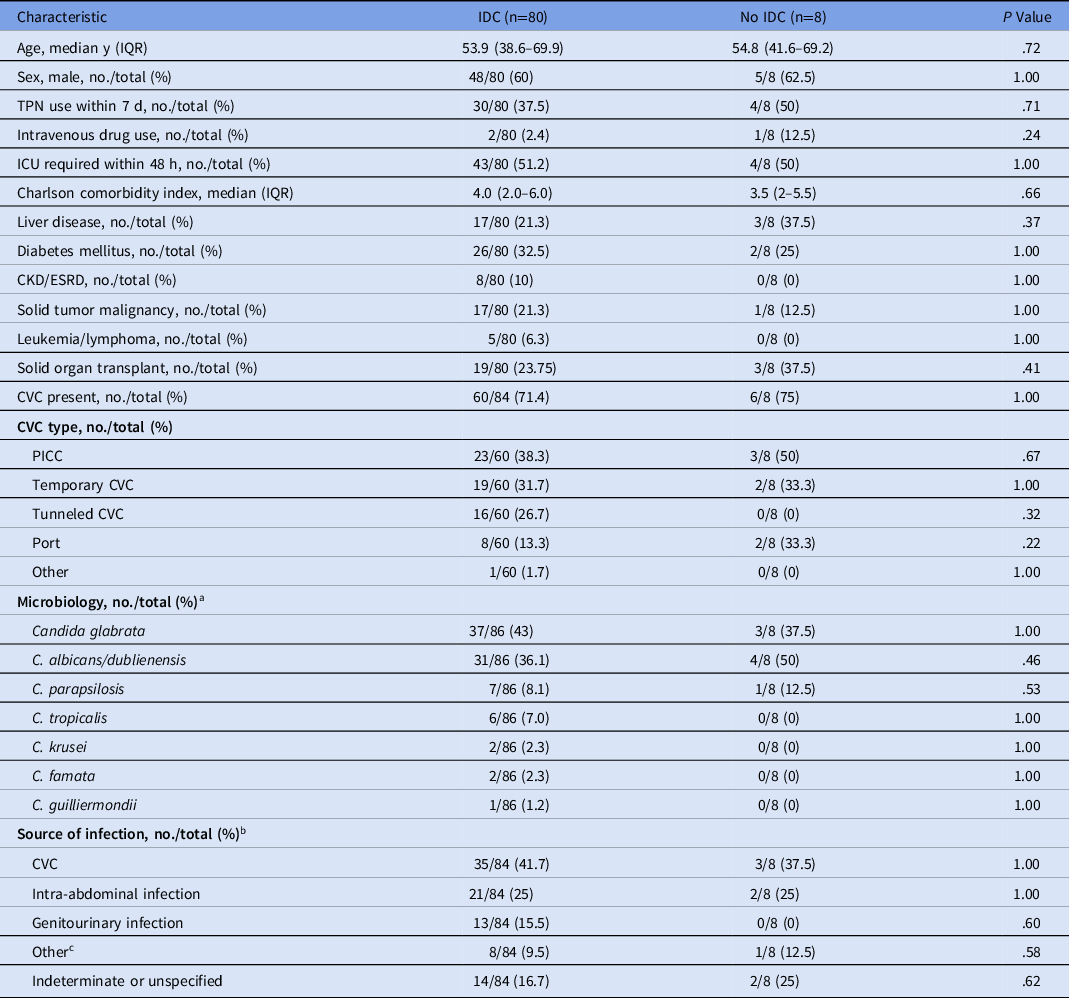
Patient Characteristics Stratified by IDC (n=88 Patients)

Note. IDC, infectious diseases consultation; IQR, interquartile range; TPN, total parenteral nutrition; ICU, intensive care unit; CKD, chronic kidney disease; ESRD, end-stage renal disease; CVC, central venous catheter; PICC, peripherally inserted central catheter.
a Multiple Candida spp isolated from 2 patients in the IDC group.
b Multiple categories of sources were identified for 7 patients in the IDC group, so percentages do not add up to 100%.
c Includes endocarditis/presumed endovascular infection, osteomyelitis, pulmonary source, and injection related.
Antimicrobial stewardship program (ASP) interventions in candidemia are associated with improved adherence to guidelines and care bundles without a mortality difference. Reference Antworth, Collins and Kunapuli14–Reference Pettit, Han and Nguyen17 Some institutions have mandated IDC for candidemia. Reference Lee, Zurko and Camins18 To determine whether mandatory IDC for candidemia would be beneficial at our institution with established ASP blood-culture review and guidance, we examined the influence of IDC on mortality and measures of guideline adherence, including the EQUAL score.
Methods
We performed a retrospective cohort study at a 718-bed academic hospital and its accompanying 91-bed community hospital. Patients with at least 1 blood culture positive for Candida spp between January 1, 2016, and December 31, 2019, were reviewed. Exclusion criteria included age <19 years, concurrent bacteremia in initial blood cultures, death or hospice care within 48 hours of positive blood-culture notification, patient-directed discharge within 7 days of positive blood-culture notification, and recurrent episodes of candidemia in which the initial episode predated January 2016. Time zero for an episode of candidemia was defined as the time of clinician notification of positive blood cultures for yeast. Microbiologic methods and EQUAL score calculation methodology are detailed in the Supplementary Methods (online).
Our ASP consisted of infectious diseases (ID) pharmacists and physicians who reviewed all positive blood-culture results and provided prospective audit and feedback during weekday standard business hours. Institutional guidelines for invasive candidiasis are available on our ASP website. Reference Hermsen, Njoku, Pfiifer and Van Schooneveld19
Researchers J.R. and E.S. performed manual data extraction from a list of all blood cultures with Candida. We collected demographics, microbiology, CVC removal (including exchanges), infection source (defined by treating clinicians), ophthalmologic examination, and echocardiogram performance within 1 week, antifungals, IDC, and ASP interventions. Charlson comorbidity index (CCI) was calculated. Reference Charlson, Pompei, Ales and MacKenzie20 Treatment duration was calculated using the planned duration, including at discharge. If death or an indefinite duration occurred, then these episodes were excluded from duration of therapy.
Primary outcome was all-cause 30-day mortality. Secondary outcomes included length of stay, 60-day recurrence, and components of the EQUAL score. Outcomes were stratified by IDC. A post hoc analysis included stratification of results by IDC within 48 hours of positive blood-culture notification.
Descriptive statistics were used for patient characteristics. The Fisher exact test and the Mann-Whitney test were used for associations of categorical and continuous data between IDC groups, respectively. All analyses were performed using SAS version 9.4 software (SAS Institute, Cary, NC). P < .05 was considered statistically significant. The University of Nebraska Medical Center Institutional Review Board (IRB) designated this work as a quality improvement effort, exempt from IRB review.
Results
We reviewed 186 episodes of candidemia. Reasons for exclusions were age <19 years (n = 21), death or hospice care within 48 hours (n = 33), concurrent bacteremia (n = 38), and patient-directed discharge (n = 2). We included 88 patients with 92 episodes of candidemia. IDC occurred in 84 (91.3%) of 92 episodes. Patient characteristics, microbiology, CVC type, and infection source were stratified by IDC (Table 1). The most frequently isolated species was C. glabrata (40 of 94, 42.6%). Among 92 episodes, 66 patients (71.7%) had CVCs. The most common sources of Candida were CVCs (41.3%) and intra-abdominal catheters (25%). Endophthalmitis was identified in 2 cases, and endocarditis was identified in 6 cases; all received an IDC.
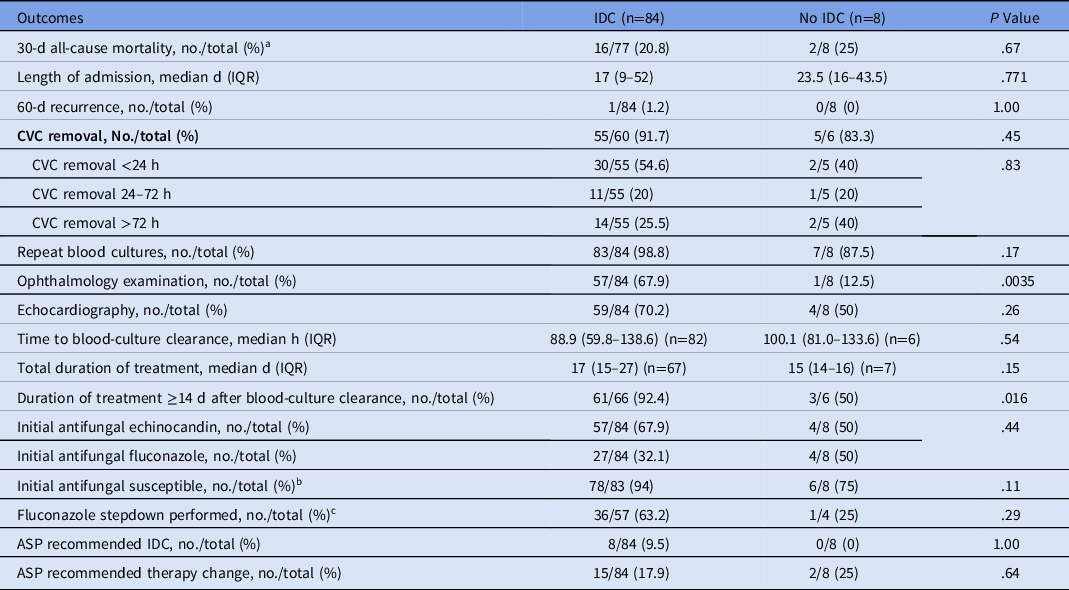
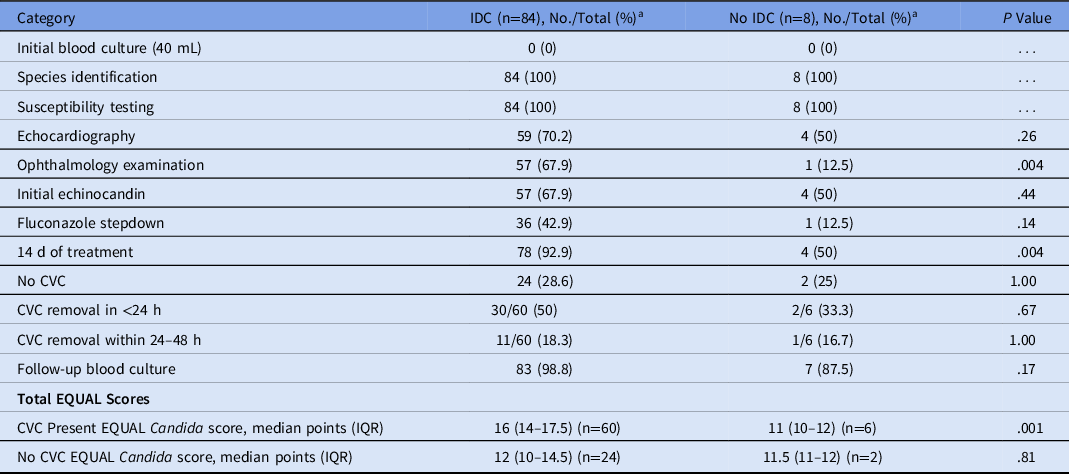
The 30-day all-cause mortality rates in the IDC group versus the no-IDC group were 20.5% (16 of 77) versus 25% (2 of 8; P = .67), respectively. Also, 3 patients (all with IDC) were excluded from mortality calculations because incomplete medical record data posthospitalization precluded 30-day survival confirmation. Outcomes stratified by IDC are detailed in Table 2. IDC resulted in more ophthalmology examinations (67.9% vs 12.5%; P < .0035). All candidemia episodes received antifungal therapy. Mean time to empiric therapy was 38.9 hours overall. In the IDC group, mean time to empiric therapy was 37 hours, and in the no-IDC group, the mean time was 58.1 hours (P = .007). The median planned treatment duration was higher in those with an IDC than in those with no IDC (17 days vs 15 days; P = .15). Also, 18 episodes had no assigned treatment duration due to indefinite duration or death. Among episodes with repeat blood cultures, treatment duration after blood-culture clearance was ≥14 days in 61 (92.4%) of 66 with IDC compared to 3 (50%) of 6 without IDC (P = .016). For episodes in patients with a CVC, the median EQUAL score was 16 in the IDC group versus 11 in the no-IDC group (P = .001). In episodes in patients without a CVC, the median EQUAL score was 12 with an IDC and 11.5 without IDC (P = .81). Table 3 demonstrates individual components of the EQUAL score stratified by IDC.
Outcomes by Episodes of Candidemia

Note. IDC, infectious diseases consultation; IQR, interquartile range; CVC, central venous catheter; ASP, antimicrobial stewardship program.
a n=85 due to 3 excluded patients who survived hospitalization but could not confirm 30-d survival, all in IDC group.
b One patient received empiric voriconazole, for which minimum inhibitory concentrations are provided, but susceptibility interpretation is not provided in our laboratory.
c Only calculated if patient received empiric micafungin.
EQUAL Score Components Stratified by IDC

Note. EQUAL, European Confederation of Clinical Mycology QUALity of Clinical Candidemia Management; IDC, infectious diseases consultation; CVC, central venous catheter; IQR, interquartile range.
a Units unless otherwise specified.
The ASP made recommendations in 19 (20.7%) of 92 episodes. The ASP recommended both IDC and antifungal therapy change recommendations in 6 (6.5%) of 92 cases, IDC alone in 2 (2.2%) of 92 cases, and antifungal therapy change alone in 11 (12.0%) of 92 cases. All recommendations for IDC were accepted. ASP did not document recommendation for IDC in the 8 patients without an IDC. The ASP recommended antifungal therapy changes in 15 episodes (17.9%) in the IDC group versus 2 episodes (25%) in the no-IDC group (P = .64).
A post hoc analysis of outcomes based on whether IDC occurred within 48 hours of positive blood-culture notification demonstrated that ophthalmology examination and the EQUAL score with CVC present were no longer significantly different. Other outcomes remained similar (Supplemental Table 2).
Discussion
We evaluated the effect of IDC on candidemia outcomes in the setting of an active ASP and included the first analysis of the EQUAL score in a US cohort. IDC occurred in >90% of episodes. Mortality within 30 days was lower among patients receiving IDC compared to those without an IDC, but this difference was not statistically significant. We detected higher EQUAL scores in candidemia episodes with a CVC and IDC.
ASPs play an important role in candidemia management, as demonstrated by ASP-implemented candidemia bundles, Reference Antworth, Collins and Kunapuli14–Reference Pettit, Han and Nguyen17 but improved adherence has not translated to decreased mortality. Reference Reed, West and Keating15–Reference Pettit, Han and Nguyen17 Our ASP contributed to nearly 10% of the IDCs performed and recommended therapeutic changes in 25% of episodes without an IDC, which may have offset a mortality benefit by providing optimal antifungal therapy. ASPs using audit and feedback serve a vital role in oversight by coordinating with IDCs. We demonstrated that a 48-hour delay in IDC did not result in worse outcomes, which supports the pragmatic weekday monitoring of blood cultures.
In contrast to prior studies, Reference Kobayashi, Marra and Schweizer3,Reference Lee, Zurko and Camins18,Reference Mejia-Chew, O’Halloran and Olsen21–Reference Chesdachai, Kline, Helmin and Rajasingham23 we did not detect a significant difference in mortality with IDC. Our 30-day mortality rate of 20.8% in the IDC group was akin to those in other studies (17.8%–20%). Reference Kobayashi, Marra and Schweizer3,Reference Lee, Zurko and Camins18,Reference Ishikane, Hayakawa, Kutsuna, Takeshita and Ohmagari22 However, these studies had a markedly higher 30-day mortality rates (28%–50%) without IDC. Reference Kobayashi, Marra and Schweizer3,Reference Lee, Zurko and Camins18,Reference Ishikane, Hayakawa, Kutsuna, Takeshita and Ohmagari22 We found similar rates of echocardiogram use, ophthalmologic examination, repeated blood culture, and CVC removal to prior studies with both the IDC and no-IDC groups. Reference Lee, Zurko and Camins18,Reference Mejia-Chew, O’Halloran and Olsen21
Several possible explanations exist for why our results differ. The primary reason is likely the high baseline rate of IDC >90%; a meta-analysis reported an IDC rate of only 50%. Reference Kobayashi, Marra and Schweizer3 Strong relationships between ID consultants and primary teams, especially with immunocompromised services, also facilitated high IDC rates. Second, our small sample size limited our ability to detect a significant difference in mortality. Third, our ASP team may have mitigated the effect of missing IDCs, as discussed above. The use of rapid diagnostic testing in conjunction with easily accessible institutional guidelines may have contributed also. Fourth, there were no untreated episodes of candidemia, which have been associated with a mortality of nearly 70%. Reference Mazi, Olsen and Stwalley24 A prior study reported that 14% of patients without an IDC were untreated. Reference Mejia-Chew, O’Halloran and Olsen21 This difference may be due to a more modern cohort in which clinicians are more likely to treat candidemia. Lastly, we detected high rates of CVC removal regardless of IDC compared to prior studies, and CVC removal has been associated with improved mortality. Reference Kobayashi, Marra and Schweizer3,Reference Lee, Zurko and Camins18,Reference Mejia-Chew, O’Halloran and Olsen21,Reference Andes, Safdar and Baddley25
To our knowledge, no prior studies have evaluated the EQUAL score in a US cohort. We found a significantly higher EQUAL score in the group with CVC who received an IDC. Although higher scores imply increased adherence to guideline recommendations, several issues are inherent with this measurement. Namely, higher rates of ophthalmologic examination and echocardiography drove the higher score in the IDC group. The utility of routine ophthalmologic examination is under scrutiny because the American Academy of Ophthalmology no longer recommends routine screening in candidemia. Reference Breazzano, Bond and Bearelly26 Only 67.9% of episodes with an IDC received an ophthalmologic exam: a discordance between practicing ID physicians and the guidelines. Echocardiography use is also controversial because it is recommended by European guidelines but not by the Infectious Diseases Society of America (IDSA), which may limit the generalizability of the EQUAL score in the United States. Reference Cornely, Bassetti and Calandra7,Reference Pappas, Kauffman and Andes8 Future revisions of the EQUAL score should reconsider the inclusion of echocardiography and ophthalmologic examination. Ultimately, both IDC and no-IDC groups in our study had an average EQUAL score >10, which has been used as a mortality cutoff, although other studies have used scores of 15 and 17 as their cutoffs. Reference Huang, Lu, Wang, Chen, Chang and Lin9,Reference Kim, Suh and Kim10,Reference Calderón-Parra, Herraiz-Jiménez and Ramos-Martínez13
The strengths of our study included our evaluation of the EQUAL Candida score in relation to IDC in a US cohort, which may have applicability to US academic medical centers. Our population was highly immunosuppressed with well-balanced comorbidities between groups. Our study adds to data suggesting that ASPs play a complementary role to IDC in candidemia management. Although ASPs can improve care, they cannot replace IDC; the benefit of direct patient evaluation and longitudinal management by ID experts has been demonstrated in similar conditions such as Staphylococcus aureus bacteremia. Reference Forsblom, Ruotsalainen, Ollgren and Järvinen27
This study had several limitations. It was conducted retrospectively at a single center and sample sizes were small, which limited our power to detect differences in mortality. The predominance of IDC further limited the size of the no-IDC group, precluding adjustment for baseline and time-varying differences. We did not assess antifungal dosing, for example, high-dose fluconazole for susceptible dose-dependent C. glabrata. Therapies assessed as targeting susceptible organisms may have been less effective. ASP interventions were assessed using charted documentation only, which may have underestimated the true effect of our ASP.
Given our institution’s high rates of IDC, ASP involvement, and absence of untreated candidemia, we did not find mandatory IDC to be necessary. The advantages of avoiding mandatory consultation may include increased provider autonomy and prioritization of ASP interventions. Additionally, we did not find an advantage to earlier IDC in our cohort. We ascribe this finding to an active ASP with institutional guidelines, rapid diagnostic testing, high baseline rates of institutional IDC, frequent CVC removal, and lack of untreated candidemia. We did find higher rates of guideline-concordant care in the IDC group, as reflected in a higher EQUAL score in patients with a CVC. However, the clinical utility of this score warrants further study.
Supplementary material
To view supplementary material for this article, please visit https://doi.org/10.1017/ice.2022.209
Acknowledgments
Study data were collected and managed using REDCap electronic data capture tools hosted at University of Nebraska Medical Center. REDCap (Research Electronic Data Capture) is a secure, web-based application designed to support data capture for research studies. REDCap at UNMC is supported by Research IT Office funded by Vice Chancellor for Research (VCR). This publication’s contents are the sole responsibility of the authors and do not necessarily represent the official views of the VCR and the National Institutes of Health.
Financial support
No financial support was provided relevant to this article.
Conflicts of interest
All authors report no conflicts of interest relevant to this article.