INTRODUCTION
Incumbent presidents and parties throughout Africa consistently poll better in rural areas than in cities. Cross-national analyses and single case studies repeatedly find that African incumbents tend to achieve their best electoral results among rural voters (Jeffries Reference Jeffries1998; Conroy-Krutz Reference Conroy- Krutz2009; Harding Reference Harding2010; Resnick Reference Resnick2011). In Senegal, presidents and ruling parties running for re-election have performed better in rural areas in every poll since the re-introduction of multi-party elections in 1978. Most interestingly, Senegalese rural voters tend to vote for the incumbent at higher rates regardless of who the incumbent is. The same party can have an urban base when it is in opposition and develop a strong rural base once it is in power. The recently ousted president, Abdoulaye Wade, is a case in point. As an opponent, between 1978 and 2000, Wade drew most of his electoral support from Senegalese urban voters and had relatively fewer rural enthusiasts. Yet once he became president, the majority of Wade's electorate came from rural areas and the gap between rural and urban voters’ support for President Wade progressively widened over the course of his two terms in office.
However, although the rural electorate voted for President Wade at much higher rates than urban voters, Wade's rural support diminished between 2007 and 2012, culminating in his defeat to Macky Sall in March 2012. The president's insufficient support in the countryside thus invites questions about the limitations of incumbency advantage in rural areas. By examining the Senegalese case, this article asks why incumbents consistently experience greater electoral advantage in rural areas vis-à-vis urban centres, and when does rural support for the incumbent wane?
The question of the extent – and the limits of incumbency advantage – in rural areas has been largely neglected by scholars. Interest in the urban/rural division in Africa is eclipsed by a focus on other electoral dynamics, such as ethnic and identity politics (Laitin Reference Laitin1986; Kaspin Reference Kaspin1995; Ferree Reference Ferree2004; Posner Reference Posner2005inter alia). Yet, as I show in this article, the difference between urban and rural voting patterns is not related to identity factors. The persistence of the urban/rural cleavage over time and in different settings makes it an important electoral dynamic to study.
In this article, I argue that although rural voters have few objective reasons to be more favourable toward incumbent presidents and ruling parties than urbanites, incumbents boost their electoral score among rural voters through clientelism, namely, the proffering of material goods in return for electoral support (Stokes Reference Stokes, Boix and Stokes2007). What is important, from the point of view of incumbent politicians, is that clientelist networks work more effectively in the countryside. Higher levels of individualism and less dependence on local leaders reduce the role of electoral intermediaries and make clientelist networks less effective in the urban setting. Furthermore, high social cohesion, combined with smaller polling stations in rural areas, facilitates the monitoring of voting behaviour at the local level.
Second, I argue that electoral support buttressed by clientelism is sensitive to the incumbent's chances of re-election. This is because, in addition to any gifts distributed during a campaign, voters and electoral intermediaries expect post-electoral rewards in exchange for their support. When there are doubts about an incumbent's victory, electoral intermediaries are reluctant to publicly back him. Even when presented with similar material benefits during a campaign, as was the case in Senegal in 2007 and 2012, (mostly rural) powerbrokers respond differently, depending on the level of (mostly urban) contestation against the incumbent and his perceived chances of re-election.
I support this argument using evidence from original interviews with politicians in Senegal,Footnote 1 combined with census and electoral data, media coverage of elections and rich secondary sources. Senegal is a particularly instructive case for studying incumbent advantage and urban/rural voting patterns: like many other African countries it is an agrarian society, with a largely rural electorate (60% of voters) that is diverse in terms of ethnicity and religion, and it has had uninterrupted, fairly free multi-party elections for over three decades, considerably longer than most African countries.
This article is organised as follows: it first discusses urban/rural electoral patterns using electoral data from Senegal from 1978, the year multi-party politics was re-introduced, to 2012, and it considers alternative explanations of the results. It then develops and substantiates the argument about qualitative differences between urban and rural settings and their implications for electoral politics. Finally, it analyses the growing contestation of President Wade's rule between 2007 and 2012, with its effects on the support of electoral intermediaries.
URBAN AND RURAL SUPPORT FOR INCUMBENTS IN SENEGAL
Urban and rural voters in Senegal exhibit strikingly different levels of willingness to vote for incumbent presidents and the ruling party. Throughout the four-decade-long rule of the Parti Socialiste (PS), the only party to govern the country from independence (in 1960) until 2000, major urban areas, and Dakar in particular, always voted least eagerly for the incumbent. During all presidential elections since the reintroduction of multi-party politics in 1978, PS's incumbent presidents, Léopold Sédar Senghor and then Abdou Diouf, always underperformed in Dakar, receiving on average 14 percentage points fewer than in the rest of the country. PS's incumbents’ score in the capital was 5 to 20 points lower in every single election (see Table 1). Conversely, the main opposition candidate, Abdoulaye Wade, always performed better in Dakar than in the rest of the country. For example, in the first round of the 2000 election Wade scored 49% in the capital and an average of only 25% in the remaining departments (Cour Constitutionnelle).
Incumbent vote share in presidential elections
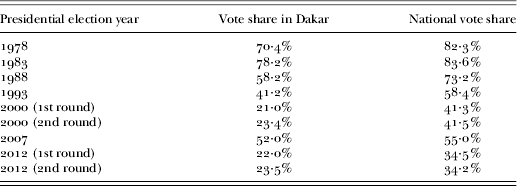
Sources: Cour Constitutionnelle, Dakar, Senegal; Agence de Presse Sénégalaise; and Beck (Reference Beck2008: 235). 2000 data include Greater Dakar.
The incumbent party also underperformed in Dakar in legislative elections. In the 1993 legislative election, the PS's score in greater Dakar was roughly half of its average result in other parts of the country (33% and 61%, respectively). Likewise, in the 1998 legislative election, the PS scored around 29% of the vote in the two departments that cover the capital, whereas its mean score in the rest of the country was 53%.
This is not merely a difference between Dakar and the rest of the country, but between urban and rural areas in general. This trend holds when we use a finer, continuous measure, a district's urbanisation level, namely, the percentage of a district's population living in urban areas. These levels range from 100% in Dakar to 5% in the district of Nioro, with a lot of variation in between (Projection de population du Sénégal, Recensement de 2002). In every election, urbanisation levels were negatively correlated with incumbent score (−0·56 for the 1998 election, −0·75 in 2000, −0·25 in 2007 and −0·52 in 2012), demonstrating that the more rural the district, the higher the incumbent score on average.
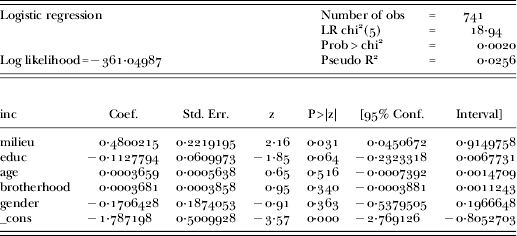
This relationship also holds at the individual level. Based on data from the Afrobarometer survey conducted in Senegal in 2003, which recorded how people voted in 2000 along with their place of residence,Footnote 2 it is evident that rural voters were more likely to support the incumbent. Twenty-four per cent of rural respondents stated that they voted for the incumbent, President Diouf, compared with only 14% of urban respondents (Afrobarometer, 2003). Place of residence is a significant predictor of support for the incumbent even when we control for respondents’ various social characteristics, such as age, gender, education and brotherhood affiliation (see Table 2).
Logistic regression of vote for the incumbent (inc) on place of residence (milieu, where 1=urban and 2=rural), level of education, age, brotherhood affiliation and gender

Source: Afrobarometer, Senegal, Round 2, 2003.
It is important to note that these trends say something specific about the urban and rural environment, but not about individual parties or candidates. After 40 years of one-party hegemony, Senegal experienced an alternation in power when Abdoulaye Wade won the 2000 presidential election, beating the incumbent president, Abdou Diouf, in the second round. As indicated above, Wade rode to power on an urban vote, garnering twice as many votes in the capital as in the rest of the country. Yet, during his first term in office Wade was able to increase substantially his hitherto limited support in rural areas. By 2007, when running for re-election, he was actually scoring higher outside the capital (57% to 54%). In fact, some of the least urbanised departments in Senegal, with urbanisation levels under 20%, made the most significant switch from voting against challenger Wade in 2000 to strongly supporting President Wade in 2007. For example, in the 2000 election the largely rural departments of Linguère, Matam and Podor cast over 70% of the vote for the incumbent, Abdou Diouf, and gave less than 10% of the vote to challenger Wade. Yet, in the 2007 election, when Wade was running as an incumbent, he received over 60% of the vote, which amounted to a 50 percentage-point gain since he became the incumbent.
The longer President Wade was in office, the more noticeable was the difference between his levels of support in urban and rural areas. During the first round of the 2012 presidential election, Wade's vote share in Dakar was 25·3%, compared with his national score of 34·5%. Likewise, in the second round, Wade polled 11 percentage points lower in Dakar than nationally (23·5% and 34·2%, respectively). Wade eventually lost the election to Macky Sall in the second round by a wide margin nationally, but the only parts of the country in which the majority of voters supported Wade over his challenger were some of the most rural areas, such as the departments of Sédhiou, Kédougou, Ranerou and Bignona. Out of 30 largely rural departments, with urbanisation levels below 50%, 24 voted for Wade at a higher margin than his national score and only 6 voted below average (Agence Nationale de la Statistique et de la Démographie (ANSD); Agence de Presse Sénégalaise (APS)). Those six departments were Fatick, Nioro, Mbour, Matam, Louga and Tivaouane, with the last three very close to the national score. Although these areas constituted a minority of rural departments, it is worth questioning why they were less eager to vote for the incumbent than other rural departments. What stands out about them is that four departments from this list had a serious challenger originating from the area, namely a fils du terroir. Moustapha Niasse is from Nioro, Ousman Tanor Dieng from Mbour and Macky Sall has family connections in both Fatick and Matam. Not surprisingly, it thus appears that rural areas with personal ties to a serious contender are more likely to turn against the incumbent than other rural areas.
Between 2000 and 2012, Wade's electoral base underwent a dramatic change. It is striking that while Wade was a challenger, his score was positively correlated with urbanisation level, but once he was an incumbent, this relationship became negative. As a challenger, Wade relied disproportionately on the support of the capital; the longer he stayed in office, the more rural became his electorate. In 2000, almost a third (32·3%) of Wade's vote came from the capital,Footnote 3 which encompasses approximately 23% of registered voters (Cour Constitutionnelle 2000). By 2007, only a quarter (24·3%) of Wade's support was found in the capital, and by 2012 Dakar contributed merely 17·5% of the president's total vote (Conseil Constitutionel 2007; APS 2012). Thus although Wade in 2012 had a lower score in rural areas than in 2007, the disparity between his support in urban and rural areas grew larger and the share of the votes coming from rural voters, as a percentage of his electorate, increased.
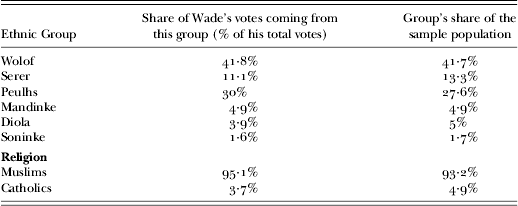
These voting patterns, with the visible differences between urban and rural areas, cannot be ascribed to factors such as ethnicity or religion. Ethnic and religious identity is poorly related to vote choice in Senegal, as evidenced by individual data from the Afrobarometer survey. The main contenders received roughly equal levels of support across ethnic groups and their score among any given group was proportional to that group's share of the population (see Table 3). Nor is religious identity a confounding factor. Vote shares from Catholics and Muslims appear proportional to their group size. Although this might not be surprising, given that all major candidates were Muslim, the same is true even when we account for the candidates’ Muslim brotherhood affiliation, considered by many the most salient identity in Senegalese politics. Here, candidates had contrasting backgrounds, but this did not seem to influence electoral results. As the data from the 2000 election show, when Wade, a Mouride, ran against Diouf, a Tijan, their levels of support among the two groups were almost indistinguishable, with Wade getting 46·5% of the Mouride vote and 45·1% of the Tijan vote and Diouf scoring 14·5% among the Mourides compared with 12·8% among the Tijans (Afrobarometer, 2003).Footnote 4 Again, the overall percentage of the total vote for each candidate was proportional to the size of that group. Forty-one per cent of Wade's total vote came from his fellow Mourides (who constituted 39·6% of the sample) and 38·3% of Diouf's votes were won among the Tijans (38·9% of the sample).
Percentage of incumbents' total score in 2000 contributed by different ethnic and religious groups and the respective sizes of those groups
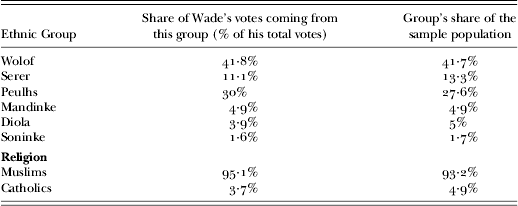
Source: Afrobarometer, Round 2, Senegal 2003, N=1147.
Nor can we attribute the observed voting patterns to the role of ideology or policy platforms of different parties and candidates. Firstly, as many observers note, African parties rarely have well-articulated and distinct ideologies (e.g. van de Walle Reference van de Walle2003).Footnote 5 Second, there is a remarkable absence of policy debates. In my interviews with politicians during the 2006–2007 campaign, I saw little evidence of ideological or policy differences between candidates and parties. In fact, some politicians were surprised when they were asked about their platforms. The media coverage of presidential elections can also attest to the extreme dearth of policy debates.
There are reasons to suspect that education plays a role in how people vote and undoubtedly urban voters are on average better educated than people in the countryside. In fact, politicians often describe urban voters as ‘brighter’, ‘more awakened’, or ‘more cultivated’ (Dieng 2007 int.; Diakhaté 2007 int.). Yet, the voters’ education does not provide a complete explanation. The voters’ place of residence plays a role independent of their education. Rural voters have a greater tendency to vote for incumbents, even if we take their level of education into consideration. Data from the Afrobarometer survey indicate that among voters with the same education level, urbanites vote for the incumbent at a lower rate. For example, among respondents with no formal education, which is the largest category of respondents, 21% of rural voters but only 8% of urban voters cast their ballot for President Diouf (Afrobarometer, 2003). Thus, the higher propensity in the countryside to vote for the incumbent is not merely an artefact of different education levels of urban and rural voters.
It also must be stressed that the incumbent's greater success in rural areas is not driven by differential turnout rates, because there is little variation in the level of voter participation between the metropolitan areas and the rest of the country (71·6% and 70·3%, respectively in 2007; 65·7% and 62·5%, respectively, in the first round in 2000; 61·6% and 61·9%, respectively, in the second round in 2000 [Cour Constitutionnelle]).
The higher support for the incumbent in rural areas cannot be ascribed to government policies either. In fact, the existing electoral outcomes seem in many ways counterintuitive, given the well-documented urban bias of most African governments. As Lipton (Reference Lipton1977) first pointed out, urban bias exists unambiguously whenever an outcome, such as an endowment of schools or the setting of prices, persistently favours urban rather than rural people, and thereby harms income distribution. In his seminal book, Markets and States in Tropical Africa, Robert Bates (Reference Bates1981) elucidated the policies through which successive African governments disadvantaged their rural constituents to bring disproportionate benefits to the cities. Among other tactics, state marketing boards for cash crops and foodstuffs paid producers well below world market prices. For example, in Senegal the government controlled the marketing of its main export crop, the groundnut. By the late 1960s, the Senegalese government reduced the official price of groundnuts by 15% and with a system of delayed payments to farmers, managed to decrease the actual price even further (Bates Reference Bates1981: 85). The government then diverted groundnut earnings to ‘feed the bureaucracy, while the producers went hungry’ (Fatton Reference Fatton1987). Because African farmers were legally obliged to sell their products to the marketing boards, short of resorting to the black market, they were effectively price takers at the mercy of their government. The key effect of this policy was a major transfer of resources from rural producers to urban consumers. Although structural adjustment reforms alleviated some of these harmful government policies, they have not fully reversed the fate of the countryside. Bezemer and Headey (Reference Bezemer and Headey2008) argue that systematic bias against the rural economy still persists in most parts of Africa.
Moreover, many rural areas in Africa receive only small shares of public expenditures, and are poorly endowed with schools and roads, further reducing the standard of living well below that found in an urban environment (Lipton Reference Lipton1993). Sahn and Stifel (Reference Sahn and Stifel2003) pointed out a continued large urban/rural gap in the delivery of public services and they saw no evidence that this disparity is decreasing. In the case of Senegal, many villagers complain that too much money is spent on infrastructure in the capital. President Wade seemed preoccupied with planning flagship urban infrastructure projects, including a new airport outside Dakar, a four-star hotel and a conference centre, the embellishment of the Corniche, Dakar's main coastal road, and future construction of a new capital, dubbed ‘Dubai on the Atlantic’. At the same time, only a small part of the country's scarce resources gets channelled into rural areas: although farmers and their dependants constitute 60% of the Senegalese population, this sector receives only 10% of public investments (ANSD). Many indicators show that the standard of living and the quality of available infrastructure is considerably lower in the countryside than in the city. For example, although 68% of Senegalese urban households have running water inside the house, only 11% of rural households do (ANSD). Only 38% of people in the countryside have access to safe drinking water, compared with 79% of urban-dwellers (Social Indicators of Development). The gap in the availability of electricity between urban and rural households is equally glaring: 76% and 10% respectively (ANSD). Rural areas in Senegal are also disadvantaged in terms of access to essential medical services and they suffer from higher poverty rates (Harsch Reference Harsch2003). Admittedly, urban existence in Senegal is by no means easy. Urban life creates a distinct set of problems, such as higher cost of living or greater social inequality. Urban voters’ access to important services is imperfect. Although urban areas have better roads, they also have persistent traffic jams. Many urban areas in Senegal experience frequent and prolonged power outages, which cause much frustration among urbanites. Yet, despite the significant inconveniences of urban life, urban dwellers have consistently received more state funding than their rural counterparts.
Policies harmful to rural areas are a common thread in Senegalese post-colonial history; they do not tend to vary too much, regardless of who is in power. Under Senegal's first president, Léopold Sédar Senghor, agriculture was in crisis, which led to poverty and food insecurity throughout the rural areas (Harsch Reference Harsch2003). The state of the rural sector further suffered under Senghor's successor, Abdou Diouf, when significant agricultural services, such as the provision of fertiliser, were reduced (Harsch Reference Harsch2003). After being ruled continuously by the Parti Socialiste for the first 40 years of independence, many Senegalese had high hopes for their new president, Abdoulaye Wade, and his Parti Démocratique Sénégalaise. Yet, following his arrival in office in 2000, the pace of change in the countryside remained disappointing. Instead, Senegal witnessed a continuous rural exodus and a staggering growth in illegal migration to Europe. President Wade should be credited with the construction of some new roads and health clinics in rural areas, but the majority of the infrastructure projects were nonetheless concentrated in the capital. Rural areas received a smaller share of public spending than their share of population would merit (ANSD). Crucially, Wade failed to make any significant improvement to agriculture, which is the most important pillar of economic activity in the countryside. As one commentator put it, Wade's plan for the development of agriculture ‘is not a serious response to the serious problems which Senegalese farmers experience’ (Jeune Afrique, 4–10.2.2007). That the state of the rural sector is dire became obvious when tens of thousands of farmers from across the country marched on the capital for the first time in Senegalese history to demand policies that would end their status as ‘second-class citizens’ (Harsch Reference Harsch2003: 14). Given the current and previous ruling parties’ indifference to the plight of the countryside, why do rural voters always tend to support the incumbent more vigorously than their urban counterparts?
CLIENTELISM IN URBAN AND RURAL AREAS
Urban voters are in many ways a tough constituency for incumbents; they are better educated and better informed, their daily lives are complicated and cannot be easily addressed by government programmes. Importantly, from the point of view of incumbent politicians, urban discontent cannot be easily offset by clientelism. This article argues that one of the principal reasons why African incumbents consistently poll better in the countryside is because clientelist electoral strategies, which allow incumbent politicians to boost their electoral results, are more effective in the countryside. This variation is a function of differences between rural and urban social structure. Clientelism is by no means the only factor influencing voters’ electoral choices. Incumbents’ overall performance may depend on many factors, including duration in office and economic performance (Posner & Simon Reference Posner and Simon2002). Instead, I argue that clientelism can explain incumbents’ relative success in rural vis-à-vis urban areas. I now explain the elements of this argument in greater detail.
Many incumbents in Africa rely extensively on clientelism, namely the provision of targeted benefits in exchange for political support. We are fortunate to have numerous studies that document clientelist electoral strategies. Cases ranging from early post-colonial elections in Senegal to the recent parliamentary elections in Ghana show that for many African voters there is an explicit quid pro quo between political loyalty and material benefits (Foltz Reference Foltz1969; Lemarchand Reference Lemarchand1972; Schumacher Reference Schumacher1975; Fatton Reference Fatton1986; Sandbrook Reference Sandbrook1996; Jeffries Reference Jeffries1998; van Walraven Reference van Walraven2002; Anderson & Maupeu Reference Anderson and Maupeu2003; Lindberg Reference Lindberg2003). Clientelism and patronage are widely regarded as a means of buttressing and prolonging the rule of the incumbent elite (van de Walle Reference van de Walle2003). In the Senegalese case, many studies provide convincing evidence that former presidents, Léopold Sédar Senghor and Abdou Diouf, were able to achieve several electoral victories with the help of generously rewarded local patrons (Cruise O'Brien Reference Cruise O'Brien1971; Young & Kanté Reference Young, Kante, Hyden and Bratton1991; Beck Reference Beck1997, Reference Beck2001, Reference Beck2008; Diop et al. Reference Diop, Diouf and Diaw2000; Diop Reference Diop2002; Boone Reference Boone2003).
It would be inaccurate to imply that incumbents are the only ones to rely on clientelism and patronage. This strategy is used, or at least contemplated, by many contenders. Yet, in presidential elections, the incumbent has a tremendous advantage in terms of the resources at his disposal. Vicente and Wantchekon highlight the fact that incumbents have a ‘pre-election disproportionate control of public resources and allocations’ (2009: 294). Many presidents freely use state money to run their re-election campaigns. Resources of such magnitude are simply not available to the majority of opposition candidates. In her study of the 1996 Senegalese local elections, Amy Patterson (Reference Patterson2002) observed that the main opposition party, the PDS, did not offer material benefits as a tool to gain supporters; unlike the ruling PS, it had no access to state patronage. In the 2012 election, the PDS also had a financial advantage over its opponents. The media noted that while President Wade was giving out millions, most of his adversaries ‘had to scramble’ (Sud Quotidien, 22.2.2012). They concluded that Wade's campaign is ‘without doubts the richest’ and they noticed a ‘visible lack of resources’ among some of the main contenders, including Moustapha Niasse and Ousmane Tanor Dieng (Sud Quotidien, 22.2.2012).Footnote 6 Because of this asymmetry of resources, clientelism overwhelmingly favours the incumbent, who tends to have the most money at his disposal.
Yet, clientelism does not work equally well in all settings. In general, clientelist networks are much more effective in the countryside. Firstly, monitoring voting behaviour in rural areas is easier. Under Senghor and Diouf, public voting in rural areas was common, with voters proudly holding up the ballot with their preferred candidate before throwing it into the ballot box. However, this practice has become very rare. The widespread use of a secret ballot makes monitoring individual voting behaviour very difficult. One indicator of the difficulty of bribing individual voters to vote a certain way was the fact that President Wade's camp during both the 2007 and 2012 elections frequently bought and destroyed voting cards from urban voters, thus preventing them from casting a ballot for the opposition. If the president could not buy individual votes for himself, he could deprive his opponents of some electoral support. Although individual vote buying is difficult to enforce, politicians can observe the collective behaviour of voters in a given polling station, because results are publicly displayed for each station. Polling stations in Senegal range from 400 to 800 registered voters, but rural stations tend to be closer to the lower bound and thus smaller in size (Kanté 2007 int.). There is typically one polling station per village (Kanté 2007 int.). Politicians take advantage of their ability to monitor the behaviour of an entire village, by offering rewards conditional on the voting behaviour of the village (Madieyna Diouf 2007 int.). President Wade was known to mention during various campaign stops that if he fails to get re-elected, the inhabitants of a given village would be ‘on their own’.
Second, rural areas are more conducive to clientelism because of their social cohesion. Tighter social structure is important because rather than providing benefits to individual voters, clientelism tries to tap existing social networks and relations of dependence. In particular, the type of clientelism commonly found in Senegal relies extensively on the use of local elites, or communal brokers, who mobilise voters for political candidates using both material benefits and their social authority. The concept of an intermediary, an actor who delivers blocs of votes to politicians, is well understood and so common in political discussion that the Senegalese have several words to refer to people serving such functions: porteurs de voix (literally ‘vote carriers’), the most frequently used term, but also ‘electoral relays’ (relais électoraux), vectors (vecteurs) and intermediaries (intermédiaires). Scholars of Senegalese politics have analysed the involvement in politics of these communal brokers, such as Muslim religious leaders, marabouts, and traditional elites, such as the Toorodo oligarchy in the Fouta region (Beck Reference Beck2001, Reference Beck2008). Politicians reward such patrons, who in turn influence their dependents to vote a certain way, by issuing voting orders, or ndigel, as they are known in the case of the marabouts. Since independence, electoral intermediaries have largely supported, and therefore legitimised, incumbents, earning this practice the term vote légitimiste.
The tradition of rewarding intermediaries with personal goods in exchange for electoral support was a hallmark electoral strategy of the PS regime, and it has continued under President Wade. During the 2007 presidential election, there were many reports of payments disbursed by President Wade's entourage. Two different MPs reported to me that marabouts who were heads of a lineage were receiving from the Wade campaign around 50 million francs CFA (about US$100,000) and a 4-by-4 car (Madior Diouf 2007 int.). Lesser marabouts were sometimes rewarded with a pilgrimage to Mecca, whereas the lowest level clerics, such as village imams, were given beautifully bound editions of the Qur'an (Gueye 2007 int.). President Wade's reliance on electoral intermediaries in his re-election bid in 2012 is also well documented by the media. For example, Le Soleil describes the president's ‘extreme generosity toward religious dignitaries’ (4–5.2.2012). Political analysts reported that Wade's strategy included ‘seducing the grand electors – marabouts, village chiefs and various religious dignitaries – with ever more resources’ (Jeune Afrique, 8.3.2012). The press chronicles how Wade tried to rely on traditional authority and continued making ‘rounds’ among religious leaders. The president gave local leaders ‘presents’: various sums of money, all-terrain vehicles, or diplomatic passports were among the most oft-cited gifts (Le Quotidien, 2.3.2012). In one instance of such an ‘electoral charm offensive’, on the eve of the 2012 election President Wade gave 30,000 village chiefs across Senegal allowances of 50–70,000 francs CFA and cars. In a more shocking example, Wade's entourage sent the sum of 2 billion francs CFA to the religious establishment in Touba, the capital of the Mouride brotherhood, via an ambulance to avoid detection (Le Quotidien, 2.3.2012).
Electoral intermediaries in urban and rural settings
These clientelist strategies are more effective for the politicians and local patrons in an environment where there is greater social control and tight social networks. In this respect, the nature of the relationships between local leaders and their dependents is markedly different in urban and rural settings. Politicians from all sides of the political spectrum in Senegal notice the difference in social structure and the effectiveness of local intermediaries in urban and rural areas. Babacar Gaye, an MP from the ruling party and a 3rd vice president of the National Assembly, paints a picture of the difference between urban and rural voters. For him, urbanites are more individualistic whereas in rural areas there is more collective voting (Gaye 2006 int.). Entire families and even whole villages often vote together. As Gaye explains, in the rural setting, ‘vote carriers’ play a bigger role and voters are deeply affected by them. As he sums up, in the countryside people follow their leaders, and leaders follow their financial interests. Moustapha Diakhaté, of the ruling PDS, confirms that his party is heavily relying on ‘vote carriers’, namely electoral intermediaries with large bases (Diakhaté 2007 int.). Yet, he acknowledges that this strategy is much harder in the capital, Dakar. As he explains, ‘in Dakar, it is not about “big personalities”; politics is individualised’. From a politician's point of view, you cannot force the inhabitants of Dakar to be part of your fief.
Opa Diallo, an opposition MP from Ligue Démocratique/Mouvement pour le Parti du Travail (LD/MPT), argues that rural voters are more ‘stable’ and they rarely ‘betray’ brokers, and thus it is easier to acquire whole blocks of voters in the countryside (Diallo 2006 int.) Ousman Tanor Dieng, presidential candidate of the PS, sees urban clientelist networks as less effective, mainly because one of the most prominent types of electoral intermediaries in the Senegalese context, Muslim religious leaders, play a much bigger role in the countryside (Dieng 2007 int.). Another opposition politician argues that in the city people are freer and more emancipated, whereas in the countryside, people are much more ‘structured’ (Sall 2007 int.). During a political campaign it is sufficient to talk to a rural leader and convince him rather than search individual votes. As another politician, Samir Abourizk, put it, ‘you spend two hours on the floor with a chief, give him 500,000 CFA (US$ 1000) and he will sell his soul to the devil’ (Abourizk 2006 int.).
In line with the cited difference in the nature of urban and rural voters and the varying efficiency of clientelist strategies, politicians from the ruling and opposition camps have substantially different expectations of electoral success. Incumbent politicians voice their misgivings about their electoral chances in the urban milieu. Mbaye-Jacques Diop, then president of the Conseil de la République (Council of the Republic), who has been in politics since the 1950s, noted in 2007 that winning in big cities, especially Dakar, has been difficult for every incumbent since independence. He admitted that throughout the 2007 presidential campaign Wade was worried about winning in Dakar (Diop 2007 int.). Several months before the 2007 poll Babacar Gaye, who was heavily involved in Wade's re-election campaign, expressed fears that the city would ‘sanction them’. At the same time, opposition politicians, Ousman Tanor Dieng (PS) and Baidy Sall (And-Jëf/Parti Africain pour la démocratie et le socialisme (AJ/Pads)) had great hopes for their success in urban districts, and argued that cities are much easier for the opposition than rural areas.
Politicians' views might not be a perfect reflection of reality. Yet, they are significant because by affecting expectations of one's electoral prospects they influence politicians’ electoral strategies, determining how and where they will campaign. For example, during the 2007 and 2012 campaigns, President Wade avoided campaigning in Dakar. At the same time, two of his main rivals, Moustapha Niasse and Ousmane Tanor Dieng, concentrated their efforts in the capital and did not campaign vigorously throughout the countryside, with the exception of their home areas. Thus, politicians’ beliefs about how they should spend their time and campaign resources reinforce the persistent urban/rural electoral cleavage.
The rich body of work on clientelism and rural authority in Senegal provides insights into why political actors believe that clientelism works better in rural areas. Rural patron–client ties tend to be based to a larger extent on deferential relationships, which enhances the capacity of local brokers to mobilise political support (Beck Reference Beck2008). Urban settings undermine the role of both religious and traditional authority figures, because urban leaders cannot manage the complicated urban existence of their followers to the same extent as their rural counterparts. Cruise O'Brien noted over 40 years ago that urbanisation would result in declining marabout power over urban disciples (1971: 238). He observed that ‘the cumulative effect of urban contact has been to weaken the talibes’ (followers) allegiance to their leaders’. Likewise, Villalón noted the ‘weakening in the practice of submission that follows migration to an urban area’ (1995: 119). Mame Less Camara observed that whereas marabouts are social mediators in the countryside, in the city their role is reduced because they cannot solve their followers’ most important problems (Camara 2006 int.).
There are structural explanations of this tendency, as religious organisation differs between urban areas and the countryside. Cruise O'Brien elucidated this difference with his case study of the Mouride order. Firstly, most shaykhs, religious leaders with followers, actually reside in rural areas (Cruise O'Brien Reference Cruise O'Brien1971: 238). Thus, migration to urban areas entails a physical separation of the disciple from his marabout, affecting the frequency of their interactions. Second, the most cohesive units of religious organisations, the collective maraboutic farms known as daaras, are obviously possible only in the rural setting. Religious organisation in the city developed its own form, the daaira, an association of followers of the same marabout, but as Cruise O'Brien argues the urban daairas ‘cannot compare favourably as an instrument of socialization by the religious leaders’ (1971: 259). He notes that the urban daairas are often more ‘active on paper than in reality’. He concludes that urban residence is less conducive to the preservation of the marabout-disciple ties than life in isolated villages, where the marabouts can dictate the terms of social existence (1971: 99). An easily quantifiable reflection of the different degree of deference to religious leaders in the two settings is the size of monetary contributions made by the followers to their marabouts. Urban taalibes reputedly give a much lower proportion of their income than do rural ones (1971: 248).
The same structural factors affect the role of traditional leaders.Footnote 7 To an even greater extent than the religious leaders, traditional leaders reside in rural areas. Separated by physical distance, they cannot exert the same influence over their (former) dependents, especially second-generation urbanites. For example, Beck (Reference Beck2008) notes that the Tukulor from the Fouta region often stop paying their customary tithes to the traditional toorobe elite after they move to the city. She concludes that the influence of the toorobe is tightly linked to physical presence on the land under their control. As people move to urban areas, their deference to traditional authority wanes. Although this discussion focuses on the Senegalese case, the same tendency has been noted elsewhere in Africa. In Botswana, for instance, the paramount chief of Bakgatla-Ba-Kgfela, Kgosi Linchwe II, argues that the power and prestige of the chieftaincy is being eroded by migration to urban areas (Herbst Reference Herbst2000: 179).
The differing role of local leaders in urban and rural areas is reflected in survey research. Question 32 from the 2005 Afrobarometer survey (Round 3), which asks respondents how often they turn for help to different leaders, provides a good proxy for the level of dependence on local leaders in the respective settings. The data show that, compared with urban respondents, a much larger proportion of rural respondents turn to local leaders for help. While 27% of Senegalese respondents in the countryside report relying on religious leaders, only 18% of urbanites made the same report. This difference is even more marked in the case of traditional leaders. Only 5% of urban dwellers are dependent on traditional leaders in this way, but this number is over four times higher in the countryside (23%).Footnote 8
There is evidence that the differences in social dependence in urban and rural areas affect the success of intermediaries. A survey conducted in 1999 by GERCOP, a group of researchers from the University of Saint-Louis in Senegal, provides concrete evidence that urban voters are influenced by their local leaders to a lesser extent. Respondents between the age of 18 and 34 in the departments of Thiès and Diourbel were asked whether they were likely to follow voting orders from their religious leaders.Footnote 9 The difference between urban and rural respondents was fairly substantial. Whereas 40% of rural inhabitants admitted being influenced in their vote choice by religious leaders, only 29% of urban dwellers responded in the affirmative (GERCOP 1999). The Afrobarometer survey found the same pattern: 18% of rural respondents in Senegal say that they are influenced a lot in their electoral choices by religious leaders, in comparison to only 9% of urban interviewees.Footnote 10
These general trends undoubtedly hide important variation across time and space. For example, different regions in Senegal have a distinct repertoire of electoral intermediaries. Whereas in central Senegal marabouts serve as the principal intermediaries, in the Senegal River Valley this role was traditionally played by the Toorodo elite (Boone Reference Boone2003; Beck Reference Beck2008). Casamance, in turn, is known for the weakness of local authority and the relative ineffectiveness of electoral intermediaries. Important changes in the patterns of authority and clientelist networks also occurred over time. The Toorodo elite of the Senegal River Valley saw substantial erosion of their material power. As emigrants from the region began to play an increasingly important role in the provision of services in the Fouta, they emerged as potential brokers, encroaching on the role traditionally played by the Toorodo elite (Beck Reference Beck2008). Social change also posed some challenges to the traditional clientelist networks. For example, social acceptance of religious voting orders (ndigel) has diminished over time. Although in the 1980s the practice of issuing a ndigel was very public, voting orders in the 21st century tend to be less overt. The belief among voters that religious leaders have the right to influence their electoral choices has encountered increasing social resistance. Despite this important variation, stark urban/rural differences in the effectiveness of clientelism continue to persist. Although there are significant differences among various rural regions, rural areas do have salient similarities when compared with the urban milieu. Regardless of distinct clientelist patterns throughout the Senegalese countryside, the body of work reviewed here indicates that since independence clientelism in urban areas has been less effective for the incumbent.
THE CONDITIONAL SUPPORT FOR THE INCUMBENT BY INTERMEDIARIES
Support from electoral intermediaries since independence has consistently skewed the vote in favour of the incumbent in rural areas. That was still the case in 2012, although President Wade's support in the countryside was less robust than in 2007. What distinguished the 2007 and 2012 campaigns was the willingness of electoral intermediaries to engage in clientelist exchanges with the incumbent. During both re-election bids, President Wade pursued the same electoral strategy of courting religious leaders and other dignitaries in an expectation of endorsements. In this respect, the two campaigns were conducted in a similar way (but in stark contrast to the 2000 campaign when Wade was a challenger). As already highlighted, the president's entourage approached all levels of marabouts and other authority figures and distributed large sums of money.
Yet, in 2012 the president's ability to acquire intermediaries was much diminished. In 2007, Wade enjoyed the support of some of the country's most prominent religious leaders, including the Khalifa Général of the Mouride brotherhood. The Khalifa's support for President Wade became clear during an announcement of the date for the annual Mouride pilgrimage, the Grand Magal. In 2007, the Magal was supposed to take place shortly after the presidential election. During the announcement, the Khalifa stated that President Wade provided all the necessary funds for the Magal and that right after the pilgrimage President Wade would personally oversee great state infrastructure projects (grands travaux) in the holy city of Touba, the centre of the brotherhood. The fact that the great projects associated with the Magal were supposed to take place after the election strongly indicated that the president needed to be re-elected in order to carry out his work (Bâ 2007 int.). In contrast, in 2012, the most important religious figures decided to stay on the sidelines. Wade had the backing of many secondary marabouts,Footnote 11 but the upper echelons of the religious hierarchies in Touba and Tivaouane remained silent, despite multiple visits by the president and frequent ‘requests for prayers’, a euphemism for endorsements. The differential behaviour of marabouts between 2007 and 2012 mirrors their fluctuating support over time for the Diouf regime. Although a large number of intermediaries issued voting orders in favour of Diouf in the 1983 and 1988 elections, including a ndigel from the Khalifa Général of the Mouride brotherhood, by 2000 most influential religious leaders abstained.
I would argue that intermediaries' support for the incumbent is highly contingent on his likelihood of winning.Footnote 12 When the incumbent is in a strong position, intermediaries are keen to issue voting orders. When a president running for re-election faces strong challenges, intermediaries are much less likely to embrace him. This is because intermediaries' actions are not only based on concrete goods offered at the time of election, but also on the prospects that the incumbent will be re-elected. As in the example of the Khalifa Général's backing of President Wade in 2007, apart from gifts issued during the campaign, part of the reward was to be provided after successful re-election. When the incumbent's re-election appears uncertain, the value of electoral promises is greatly diminished. Moreover, one could argue that intermediaries are risk averse, not wanting to damage their reputation among their followers by supporting a losing candidate. Serigne Mamoune Niasse provides an illustration of this logic. In 2007, he backed President Wade, but he declined to support him again in 2012. As he explained, ‘I have never associated myself with a loser’ (Le Quotidien 16.9.2011). The view that marabouts and other potential intermediaries are less inclined to support a struggling incumbent was present in the president's political camp. Babacar Gaye, who was closely involved in courting marabouts on behalf of the Wade campaign in 2007, explained that in 2012 ‘marabouts preferred to abstain, given the situation’ (Gaye 2013 int.). Another sign that electoral intermediaries' support is influenced by the likelihood of winning is the fact that several dignitaries defected from the president's camp after the first round, when the prospects of his victory further diminished (Sud Quotidien, 12.3.2012).
GROWING CHALLENGES TO THE WADE REGIME BETWEEN 2007 AND 2012
President Wade's electoral prospects were considerably less certain in 2012 than in 2007. Months prior to the election there were ominous signs that his re-election was in danger. I do not contend that Wade's defeat was certain, but that his re-election seemed much less inevitable in 2012 than in 2007, given the extent of highly visible social contestation. Most importantly, his bid for a third term was viewed as illegitimate by a substantial portion of the society. This sentiment was accompanied by a strong and unprecedented popular mobilisation against Wade's candidacy. Although the locus of this counter-mobilisation was urban, it was extensively covered by Senegalese media and thus known throughout the country.
There were several reasons why President Wade's second re-election bid was controversial and contested. First, many viewed his campaign as illegitimate because the Senegalese constitution allows only two consecutive terms in office. Although the Constitutional Court ruled in Wade's favour, arguing that his first term should not count because the constitution was adopted after Wade's first victory, many Senegalese were not convinced by this explanation. Even more controversial, and ultimately damming, was Wade's attempt to change the constitution to make it easier to win in the first round of a presidential election. As in many former French colonies, Senegalese electoral rules dictate a run-off if no candidate in the first round gains 50% of the vote. Wade's project would lower the threshold from 50% to 25%. When this proposed law was sent to the National Assembly, massive demonstrations erupted in large cities and even outside Senegalese embassies abroad. Even though the president eventually withdrew the bill, popular mobilisation persisted, leading to the creation of the Mouvement du 23 Juin (M23), named after the date of the aborted constitutional change.
Another important element of the controversy surrounding President Wade's potential third term was the role of his son, Karim. As Alpha Sy (2012) argues, the 2012 campaign was dominated by accusations of filialisme, a more specific version of nepotism, and a fear of possible presidential succession, widely referred to in Senegal as dévolution monarchique. The suspicion that President Wade was grooming his unpopular son to become his successor was widespread. Between 2007 and 2012, Karim Wade was placed in charge of an ever-increasing number of portfolios and ministries. He became the president of ANOCI, a national agency responsible for preparations of the 2008 summit of the Organization of Islamic Conference. Despite Karim Wade's electoral defeat at the hands of the Dakar electorate in the 2009 local elections, his father appointed him Minister of State. His complex ministerial portfolio included international cooperation, air transport, infrastructure, town and country planning (l'aménagement du terroir) and the energy sector. On the eve of the 2012 election, Karim Wade managed a large part of the Senegalese budget and had control over important infrastructure projects. The extreme concentration of responsibility in one person's hands was both glaring and highly unusual. Karim Wade's image also suffered from frequent allegations of financial mismanagement.Footnote 13 In addition, President Wade's advanced age and his frequent promises that, if elected, he would not serve a full term, contributed to the omnipresent speculation about the possible father–son succession.Footnote 14
These perceptions of illegitimacy and presidential overreach were accompanied by sustained and widespread mobilisation of the electorate against the incumbent. Opposition to the Wade regime was clearly articulated during the Assises Nationales (National Conference), which opened its doors in June 2008, and further developed by two civil society movements, Y'en a Marre (We've had enough) and the previously mentioned M23. Y'en a Marre protested against a wide array of grievances of the urban electorate, ranging from bad governance to power cuts to youth unemployment. Most importantly, the movement consistently campaigned against Wade's third term (Savané & Sarr Reference Savané and Sarr2012: 47). As Savané and Sarr document, assuming a ‘combat posture’, Y'en a Marre ‘broke the inertia, indifference and inaction of the Senegalese’ (2012: 35, 48).
Likewise, M23 constituted a very visible challenge to Wade's ambitions to serve a third term. With chants such as ‘Wade dégage!’ (Wade clear off!) and ‘Hands off my constitution’ (Touches-pas a ma constitution) this civil society group staged massive demonstrations to prevent constitutional changes which would make Wade's victory in the first round more likely. Even though the president withdrew the proposed law, stubbornly citing pressure from marabouts rather than demonstrators, 23 June turned out to be just the beginning of a sustained opposition as the M23 movement continued to campaign against the president and the legitimacy of his third term. The magnitude of this popular mobilisation distinguished the 2012 campaign from previous elections. As the Senegalese historian Ibrahima Thioub argues, referring to the M23, ‘there has never been a manifestation on such a scale in the history of Senegal’ (cited in Sy Reference Sy2012: 24). The media coverage of the run-up to the 2012 presidential election revealed frequent demonstrations, with events taking place almost daily in large Senegalese cities as well as abroad.Footnote 15 One of the Senegalese dailies even called the string of demonstrations a ‘crusade against Wade's candidacy’ (Sud Quotidien 3.2.2012).
Wade's bid for a third term was contested not only by Senegalese movements but also by foreign politicians and diplomats. The French Minister of Foreign Affairs, Alain Juppé, expressed France's wish to see ‘generational turnover at the head of Senegal’ (Sud Quotidien, 2.2.2012). Similarly, the US ambassador, Lewis Lukens, reportedly blamed President Wade's bid for a third term for instability in Senegal (Sud Quotidien, 8.2.2012). This led Walfadjri, a popular daily, to conclude that ‘President Wade lost the international opinion battle’ (Walfadjri 2.2.2012).
The scale and duration of these demonstrations, together with Wade's humiliating withdrawal of the proposed constitutional changes and his party's disappointing performance in the 2009 local elections, highlight Wade's visible vulnerabilities. As Sy argues, these were ‘early warning signs’ of Wade's future defeat (2013: 17). These factors shattered the image of invincibility and arguably had an impact on the behaviour of local powerbrokers. Overt endorsement of Wade's campaign was too risky, given the level of social contestation, and the potential payoffs were too uncertain for many high-profile intermediaries.
CONCLUSION
Many African countries exhibit striking differences between urban and rural areas in the level of voters’ support for the ruling and opposition parties. Indeed, the persistent pro-incumbent bias in the countryside is one of the most widespread electoral trends on the continent. Yet, these voting patterns cannot be easily explained by factors such as government policies, ideology or ethnic demographics. This article made the case that the observed differences in the rates of support for the incumbent in urban and rural areas can be accounted for by the distinct nature of urban and rural voters and their respective social environments. The strength of clientelist networks, embedded in the countryside's tight social structure, makes rural voters a prime electoral target for the incumbent. In contrast, cities, with their more individualistic inhabitants, create much more competitive electoral environments, giving the opposition a much better chance of winning votes. These trends seem independent of ideology or other characteristics of the incumbent, such as ethnic and religious identity, suggesting potentially wide applicability.
Although this article focused on outlining the mechanisms behind incumbent electoral advantage in rural areas with evidence from Senegal, the applicability of this argument is not limited to this single case. As already mentioned, similar voting patterns are documented in many countries across the continent (Parson Reference Parson and Stedman1992; Jeffries Reference Jeffries1998; Conroy-Krutz Reference Conroy- Krutz2009; Harding Reference Harding2010). Moreover, there are indications that the main elements of the argument presented here hold in other places. The variation in social conditions, which, as I argue, affects the efficacy of clientelism, exists in many parts of the continent. For example, writing about Botswana, Parson notes that ‘in rural areas, patron-client relations continued to be important underpinnings for a favourable election outcome for the [ruling] BDP’ (Parson Reference Parson and Stedman1992). Yet, the BDP could not use the same strategy in urban areas, as patron-client economic relations and traditional political ties could not solve all of the voters' problems to the same extent as in rural areas (Parson Reference Parson and Stedman1992).
Incumbents' electoral advantage in rural areas has important implications for the quality of democracy and political competition: it reduces competitiveness, uncertainty of electoral outcomes and the likelihood of political turnover; in other words, factors which can be considered signs of a robust democracy (Herbst Reference Herbst2001; van de Walle Reference van de Walle2003). However, the support of electoral intermediaries and rural voters is not unconditional. This article made the case that the perceived likelihood of an incumbent's victory is important, because clientelist exchanges depend not only on actual gifts received during a campaign but also on future benefits that are contingent on electoral success. In this respect, the Senegalese case revealed that urban contestation led by civil society groups, such as Y'en a Marre and M23, has an effect beyond urban areas. It can also affect rural support for the incumbent by altering his image of invincibility. Social activism, coupled with population growth in urban areas, has the potential to encourage more closely contested elections and create a more level playing field, as incumbents consider urban voters harder to bribe or influence through brokers and the opposition sees the promise of vigorous campaigns in the city.