

Whether you are an educator planning curricula, a teacher planning a course, or a student or practitioner browsing in a bookshop, you should remember that whatever you know about Chinese medicine—I mean East Asian medicine as opposed to any Western rewrite of it—reaches you by the medium of translation. However many hands any item of knowledge passes through before it reaches you, it has, at one point or another, had to be translated into English. (Wiseman Reference Wiseman2001:34)
Lemme tell ya that this whole issue of nomenclature in Chinese medicine just sucks. It really, really sucks. Translation sucks. Comparative nomenclature from book to book sucks. I mean tell me, does this not suck? It makes our job so much harder, and the reason for you guys it makes it so much harder is because you have textbooks that the state board relies on to write exams, and very often the nomenclature in those textbooks is misleading and not clinically relevant. So you know, bad for you, you gotta learn things the wrong way, and then you've got to apply them clinically in a completely different way. So I'm gonna try with this thready pulse to actually give you both and give you the explanation of why what's written in the book isn't necessarily as clinically accurate as it should be, ok?
–American teacher of Chinese medicine addressing a first-year diagnosis class
Toward an anthropology of translation
If one were to envision a truly anthropological theory of translation, language and the transfer of meaning between languages would obviously be key components. But more than anything, an anthropology of translation would be about the people doing the work of translation—speaking the languages, reading and writing the texts, and making the interpretive choices that create a basis for the way the texts are understood. Such a field would focus on the intricate process of interpreting and re-encoding meaning in the face of both real and imagined cultural and linguistic difference. It would pay heed to traditional, power-laden distinctions between source-oriented and target-oriented translation, where translators choose between honoring authentic, original meanings or shifting meaning in the name of making the material feel more comfortable to the receiving culture (cf. Schleiermacher Reference Schleiermacher, Barscht, Schulte and Biguenet1813/1992; Nida Reference Nida and Venuti1964/2000). An anthropology of translation, however, would also highlight the lived nature of translation as it occurs in everyday worlds. It would focus on the ways in which people “do things with translation,” and it would highlight the fact that acts of translating often provide critical sites for positioning actors as authorities in the social field, for establishing what counts as evidence in real-world decisions, and for negotiating ideas about what language is and what it should do. Finally, an anthropology of translation would foreground the ways in which the “microcosm” of translation activities offers a view into the “macrocosm” of broad-based cultural processes and social “facts” (Bauman & Briggs Reference Bauman and Briggs2003:318). In this article, I demonstrate some of this in the context of everyday translation work in a Southern California school of Chinese medicine.
This article builds on the work of several prominent scholars who have recently made inroads into developing a truly anthropological model of translation. Schieffelin (Reference Schieffelin, Makihara and B. Schieffelin2007), for example, focuses on the role of translation in the Christianization of the Bosavi, and shows in particular how culturally shaped epistemologies of the self, language, and culture can be accessed through a focus on translation activities. With this work, she further demonstrates the role of translation in shifting deeply embedded ways of being-in-the-world, all the while highlighting the role of individual actors—translators, interpreters, audience members—in facilitating this process. Hanks (Reference Hanks2010) similarly demonstrates, with a rich historical analysis of translation in the Spanish conquest of the Yucatan, the role of translation in shifting cultural and embodied habitus. He also shows how translation complicates the power dynamics in colonial encounters, and how exploited populations eventually came to use the language of translation as the language of resistance. Other prominent scholars in anthropology, sociolinguistics, and translation studies have further underscored the role of human relationships, power, understanding, and interaction in translation (Tambiah Reference Tambiah1990; Liu Reference Liu1995; Wadensjö Reference Wadensjö1998; Liu Reference Liu1999; Tymoczko & Gentzler Reference Tymoczko and Gentzler2002; Silverstein Reference Silverstein, Rubel and Rosman2003; Wolfgram Reference Wolfgram2010), the role of the body in translation (Emad Reference Emad1998; Pritzker Reference Pritzker2011a), and the historical and cultural multiplicity of translation (Clifford Reference Clifford1997; Montgomery Reference Montgomery2000; Bauman & Briggs Reference Bauman and Briggs2003; Rubel & Rosman Reference Rubel and Rosman2003; Bermann & Wood Reference Bermann and Wood2005; Zhan Reference Zhan2009; Sagli Reference Sagli2010).
This article focuses on translation in Chinese medicine, in particular the emphasis is on the translation of a single term, 饮 yin, or ‘rheum,’ a term that is phonetically the same as 阴 yin of the well-known yin-yang, but the meaning and orthography of the characters differ considerably. This article is based on ethnographic research, including participant observation, video recording, and open-ended interviewing, at an American school of Chinese medicine in Southern California. The school offers a four-year program in acupuncture and herbal medicine, and as is typical in American schools of Chinese medicine, all instruction takes place in English. Students are only required to take one quarter of Chinese at any point over the course of their studies, and only a fraction of teachers within most programs speak or read Chinese. Teachers and students in this context must thus rely on translations to teach and to learn Chinese medicine. Discussions regarding which translations are better, or more accurate (or even easier to understand) are thus a part of everyday interaction in this school, a situation that provides an excellent opportunity to observe translation as a lived event involving both textual artifacts and oral transmission. While other scholars have demonstrated the intersemiotic, co-constructed nature of translation in historical contexts, moreover, the current ethnographic situation offers the chance to witness translation unfolding in a constant stream of interaction and social action. What I call living translation is understood to be an engaged human process of interpretation of meaning across linguistic boundaries through conversation. It is also, as I show below, a social process of (i) establishing authority, (ii) creating an evidential basis for decision-making in practice, and (iii) articulating, sharing, and resisting various ideologies of language.
Translation in Chinese medicine
Chinese medicine is a highly developed intellectual, textually advanced tradition. In the richly interdiscursive web that comprises textuality in Chinese medicine, canonical, classic texts articulate with commentaries, case studies, and treatises on “integrative medicine.” Each text in Chinese medicine, even each term, is thus not only oriented towards a host of other texts (see Bauman Reference Bauman2004), but is also “multiply dialogical” (Irvine Reference Irvine, Silverstein and Urban1996:151) as specific authors explain the meaning of illness concepts by strategically weaving a whole network of quotes from classic and modern texts, and indexing multiple historical conversations, into a particular inscription. Translating this conversation from Chinese into English presents a challenge wrought with immense social, political, and economic considerations.
Not surprisingly, then, the field of Chinese medical translation is riddled with controversy. Debates over what it means to faithfully represent Chinese medicine, whether or not there should be an officially adopted standard terminology for the translation of Chinese medicine, and whether biomedical and scientific terminology should be used to translate Chinese medical concepts into English intermix with terrific struggles over the cultural rights to translate, the authority to publish, and the epistemological foundations of knowledge in this diverse healing tradition (Buck Reference Buck2000; Deadman Reference Deadman2000; Wiseman Reference Wiseman2000; Beinfield & Korngold Reference Beinfield and Korngold2001; Wiseman Reference Wiseman2001; Xie Reference Xie2002; Xie & White Reference Xie and White2005; Bensky, Blalack, Chace, & Mitchell Reference Bensky, Blalack, Chace and Mitchell2006; Emad Reference Emad2006; Ergil & Ergil Reference Ergil and Ergil2006; Flaws Reference Flaws2006; World Health Organization 2007; Pritzker Reference Pritzker, Scheid and McPherson2011b). The debates surrounding these issues are intensely ideological and personal, and have been carried out in journals, professional meetings, internet discussion groups, and conferences in both China and the West. Participants include everyone from delegates in the Western Pacific Division of the World Health Organization (WHO) to independent biomedical and Chinese medical scholars, translators, teachers, students, and practitioners. The diverse goals of the individuals in these populations have led to the development of multiple strategies for translating Chinese medical terms, with one Chinese term often carrying up to five different English translations. Each translation is not only linked to specific ideological positions, but it is also tied to personal and economic struggles in which different authors fight to defend their translation choices.
The present article shows how this plurality is approached in the classroom. So even though all instruction in this US school takes place in English, the presence of “translation talk” is constant. Students and teachers are continuously reminding each other that “this medicine” originates in a foreign land, with foreign customs and a foreign language, and that it must be translated into English and into an American context. Because multiple participants contribute to the indeterminate conversation, however, these necessary translations become subject to varying strategies, dispositions, and practices accomplished through interaction in the school environment, within texts, in the classroom, and beyond. Much more beyond “just” translation is accomplished in such interactions, however. Translation in Chinese medicine, as I show here, is a performance, an opportunity to interactively demonstrate one's linguistic, cultural, or scholarly expertise, to build a case for interpreting evidence in specific ways, and to demonstrate (and sometimes to learn) what language is and what language does. It is also, I suggest, an occasion to learn about how to practice Chinese medicine—how to make clinical choices regarding diagnoses and treatment based on a certain understanding of language.
Living translation in interaction
The critical role that interaction plays in living translation is grounded in a sociolinguistic and anthropological understanding of interaction and co-construction as the social process by which meaning is jointly formulated. As Ochs & Jacoby explain:
We refer to co-construction as the joint creation of a form, interpretation, stance, action, activity, identity, institution, skill, ideology, emotion, or other culturally meaningful reality. The co- prefix in co-construction is intended to cover a range of interactional processes, including collaboration, cooperation, and coordination. (Ochs & Jacoby Reference Ochs and Jacoby1995:171, emphasis in original)
Meaning here is produced in interaction. In examining what this might mean for translation, Wadensjö (Reference Wadensjö1998) calls attention to the limitations of the source-target conduit model in apprehending the complexity of the translation process:
Interpreters are thought of, and think of themselves, as conveyers of others' words and utterances. The interpreter as channel through which prepared messages go back and forth is a model that is perfectly in line with the norm of non-involvement. The conduit model is monological … The dialogical model, in contrast, implies that the meaning conveyed in and by talk is partly a joint product. (Wadensjö Reference Wadensjö1998:8, emphasis in original)
Wadensjö's perspective on translation thus challenges the traditional binary distinction of source and target, arguing that the result is achieved literally in the conversation. By focusing on real-time, spoken interpretation, rather than written translation, Wadensjö especially highlights the interactive unfolding of translation. Also discussing oral translation, Cronin similarly suggests an increased involvement of engaged participants: “One could argue that the moment of translation marks a shift from an encounter scene as a site of consumption to a site of interaction. Through the newfound ability to communicate via translation, the traveler is no longer an observer but part of what is being observed” (Cronin Reference Cronin, Tymoczko and Gentzler2002:60). In this sense, interpretive practices in the translation of Chinese medicine in spoken interaction become part of what is being translated. This view on translation allows us to consider teachers and students who participate in translation talk as participants in the overall process by which Chinese medicine is collaboratively translated into English vis-à-vis an extended “chain of authentication” (Agha Reference Agha2007:218) occurring through interaction.
Beyond the participation inherent in an interactive view of translation, however, the cases we will look at in this article reveal that precisely because of the social, interactive nature of translation talk, translation serves as a social tool at the same time as it unfolds as a social process. Translation talk then becomes a site for the building of social authority, the establishment of evidence, the articulation of language ideologies, and the laying of foundations for action in clinical practice.
Authority, evidence, and ideologies of language in the Chinese medical classroom
In a field like Chinese medicine, where there is so much unevenness with regard to participants' knowledge of Chinese language, culture, and literature, it is useful to keep in mind that, even though a co-constructive perspective acknowledges that “that there is a distributed responsibility among interlocutors for the creation of sequential coherence, identities, meanings, and events” (Ochs & Jacoby Reference Ochs and Jacoby1995:177), this does not necessarily erase the complex relations of power that are perpetuated in selective acts of translation:
Co-construction certainly does not mean that participants play identical interactional roles or that through interaction asymmetrical social relations fall away into an egalitarian utopia. (Ochs & Jacoby Reference Ochs and Jacoby1995:178)
In the context of the school, where the students only need one quarter of Chinese medical language and only a few of the teachers speak or write Chinese fluently, the fact that teachers serve as the first primary interpreters of the texts for the students provides an ideal venue to examine the social politics of translation in Chinese medicine. Interpreters are traditionally seen as taking part “in situations where they have a unique opportunity to understand everything said and therefore a unique position from which to exercise a certain control” (Wadensjö Reference Wadensjö1998:105). This power of the interpreter, Anderson explains, is rooted in the control of “scarce resources” (Reference Anderson, Bruce and Brislin1976:218 as cited in Cronin Reference Cronin, Tymoczko and Gentzler2002). In Chinese medicine, however, the resources are not so much scarce as they are plural. With multiple original sources, multiple translated sources, and multiple perspectives on experience and historical significance, translation talk in Chinese medicine reflects multiple ideologies jointly produced in interactions that themselves provide a ground for establishing social authority and social action.
Toury writes that “‘Translatorship’ amounts first and foremost to being able to play a social role, i.e., to fulfill a function allotted by a community” (1978/Reference Toury and Venuti2000:198, emphasis in original). For teachers, and often students, in Chinese medicine, such roles often relate to participants' need to establish legitimacy as players in the complex field of countless Chinese texts and multiple English translations (see Fox Reference Fox2001). Translation talk in this sense is used as a platform for positioning oneself in relation to “original” or “traditional” Chinese knowledge, whether or not one speaks Chinese. Translation talk and the evidence used to support it can thus be understood as a form of social and discursive deixis (Clift Reference Clift2006) in which participants epistemically position themselves with regards to information originating in a different language and time. In a field in which participants have varying degrees of skill in both Chinese and English, it is also a major way in which participants interactively establish the authority to report on the validity of certain translations and interpretations, and thus to participate in translation in the first place (see Duranti Reference Duranti, Hill and Irvine1993; Hill & Irvine Reference Hill, Irvine, Hill and Irvine1993; Shuman Reference Shuman, Hill and Irvine1993; Fox Reference Fox2001).
As with other scenarios in which uncertainty prevails (Pomerantz Reference Pomerantz1984), teachers and students in the plural field of Chinese medicine thus use different kinds of evidence to support their claims about various ways to translate Chinese medical concepts, and in so doing they demonstrate what counts as evidence in a clinical sense as well. After lodging the complaint about translation quoted in the opening of this article, for example, the teacher uses an “evidentiality strategy” (Aikhenvald Reference Aikhenvald2004) that privileges clinical experience over “misleading” texts to translate the Chinese term otherwise understood as a “thready” pulse. What is relevant here is that she argues against a certain translation based on what she has seen in the clinic. In this situation, then, the teacher draws upon an epistemology of experience over and above an epistemology of textuality to challenge the translation of the Chinese term, introducing students to the notion that clinical experience in Chinese medicine provides a better basis for decision making than textual sources. In other cases, participants draw upon an epistemology of canonical textuality as the foundation for translation, and teach students that their decision-making in practice must connect directly back to either original Chinese texts or, more often, translated volumes. Still other participants locate evidence for interpreting translations and making clinical choices based in cultural or aesthetic experience, where everyday involvement in cultural contexts serves as the ultimate evidential basis for action.
Finally, translation choices in Chinese medicine are often made in relation to particular ideologies of language, including common (Western) notions of language as merely referential to or designative of a separate reality (Silverstein Reference Silverstein, Clyne, Hanks and Hofbauer1979; Taylor Reference Taylor1985), language as unimportant in comparison with a supposedly universal divine truth (Taylor Reference Taylor1985:223), language as the mere “external clothing of thought” (Taylor Reference Taylor1985:223; see also Reddy Reference Reddy and Ortony1979), language as cultural capital (Bauman & Briggs Reference Bauman and Briggs2003), or language as abstraction or even distraction (Bauman & Briggs Reference Bauman and Briggs2003). Less common notions of language, including the idea that each “piece” of language is indexical of a network of interconnected meanings (Bakhtin Reference Bakhtin and Holquist1981), and more traditionally Chinese interpretations of language as a resonant reflection of the world (Bao Reference Bao1990; Hansen Reference Hansen1985; Hui Reference Hui Feng2009), or the idea of language as a tool for “deciphering classics to follow the example of former rulers” (Wang Reference Wang1981, as cited in Hui Reference Hui Feng2009:158) are also visible in participants' strategies for translating Chinese medicine. These notions shift over time and often provide a basis for moments of mutual socialization where teachers socialize students, but students often also socialize teachers into various ideologies of language. This is consistent with a language socialization view arguing for a process of mutuality in socialization (Schieffelin & Ochs Reference Schieffelin and Ochs1986). In addition, because they are so deeply tied to variable notions of authenticity, truth, and the purpose of healing, these moments of mutual socialization into ideologies of language are charged, reminding us that “ideologies of language are never only about language” (Gal Reference Gal2005:24). Furthermore, disagreements in the classroom over what language is and the way it functions to represent reality are reflections of the fact that “[c]ontrol of the representations of reality is not only a source of social power but therefore also a likely locus of conflict and struggle” (Gal Reference Gal1989:348). What makes the situation in Chinese medicine especially interesting is the fact that the sheer multiplicity of linguistic forms in the available translations creates a very diverse “linguistic market” (Woolard Reference Woolard1985:740) wherein ideologies of language are creatively formed and reformed in discussions about translation over time. In combination with the ongoing acts of social positioning and grounding of evidence that occurs in translation and talk about translation, the language ideological work done in translation provides an entry point for looking at the living nature of translation in Chinese medicine.
Rheum for interpretation
The term 饮 yin, in common Chinese language, refers to liquid or retained fluid. In Chinese medicine, it is a specific term referring to pathological fluid in the body, thinner than ‘phlegm’ (痰 tán) and manifesting in multiple ways depending on the affected organ (Wiseman & Feng Reference Wiseman and Ye1998:440). Wiseman & Feng, whose ideology of translation is based on an explicit source-oriented approach that embraces Venuti's style of “abusive fidelity” (Venuti Reference Venuti1992), translate yin with the uncommon English term “rheum.” According to both Venuti and Wiseman, the obscurity or unfamiliarity of certain terms requires readers to stretch their minds to grasp the full meaning of a given term in Chinese. The Wiseman & Feng term, however, is not used in many official texts.
The meaning of rheum
In the first set of excerpts (excerpts (1)–(3)), first year Chinese medical students are in a third-quarter class on organ theory in Chinese medicine. Dr. Liu, a Mainland Chinese doctor of Chinese medicine, responds to questions posed by his students, who have just been introduced to the term “rheum” in their teacher-constructed notebook. The teacher-constructed notebook, in contrast to texts, is an unofficial supplement to the required texts. As such, the language in such notebooks often differs from the official texts. Because rheum is not in any of their other texts, the students struggle to figure out exactly what this word means in the context of their current knowledge. About thirty-five minutes into class, Tanya, one of the students, questions Dr. Liu about this term.
(1) What is rheum?
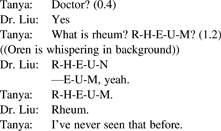
From the beginning of this interaction, Tanya topicalizes rheum. She continues her questioning of the term by spelling it out for the teacher, indexing her lack of familiarity with the term and perhaps distinguishing it from the more common “room.” She makes this lack of familiarity explicit by saying that she has never seen it before. Her tone here suggests that it might be a complaint, or at the very least that her lack of familiarity demands an explanation from the teacher. This initiates a sequence in which multiple parties, including Dr. Liu as well as two other students, Oren and Samantha, become involved in a discussion about translation.
(2) That word in Chinese

Here, Dr. Liu indicates that for him, as well as for Tanya, the concept of yin presents a translation problem. Instead of offering Tanya an explanation of the meaning of the term, however, Dr. Liu offers an explanation of his difficulties in finding an appropriate translation, difficulties which led him to the dictionary in the school library, itself only one of many dictionaries translating Chinese medicine into English. The choice to explain it this way could indicate that Dr. Liu thinks Tanya understands the English word but is just searching for what it means in Chinese. He therefore starts peeling back the translation, using the Chinese to clarify and appealing to the dictionary as evidence for the validity of his translation. He promptly interrupts his own explanation, however, by referencing the Chinese word yin as the ultimate evidence. Here, this code-switch to Chinese works to position Dr. Liu as an authority who can access the Chinese, and who can thereby speak about what should constitute the evidence for translational (as well as clinical) decisions. It also begins to signal one of the major language ideologies operating behind Dr. Liu's teaching strategy, approached in more detail below, by demonstrating his commitment to deciphering the meaning of authoritative sources in order to make sound diagnostic and treatment decisions.
In the classroom interaction we examine here, the use of Chinese creates confusion, however, as the students for the most part do not read or write Chinese and are clearly struggling to understand the meaning of rheum in English rather than Chinese. This is apparent in Oren's gloss, when he loudly whispers, “it's mucus” to his neighboring classmates. This statement demonstrates Oren's resistance to the more detailed explanation being concurrently offered by the teacher, indexing his preference for a quick translational gloss that disregards the complex implications of translation and displaces cultural authority. In fact, in a later interview, Oren explicitly articulates this preference by explaining how he would translate the term qi, a core term in Chinese medicine that has variously been translated as ‘energy’ or ‘life force’ and is often left in Romanized Chinese due to the renowned difficulty in rendering it accurately in English. Arguing that qi should be translated as ‘vitality’ (an uncommon gloss) rather than left in Chinese or described in lengthy exegeses on linguistic and cultural incommensurability, Oren says that, in fact, all Chinese terms should have straightforward English equivalents assigned to them. Oren justifies this view by explaining that since he will be using English in his practice, he does not want to give “Chinese people” the authority by using Chinese words. Oren's translation philosophy thus emerges out of a deeply felt ideology of language that not only privileges the supposed referential transparency and basic independence of specific terms, but also espouses the view that language is a tool of power, authority, and influence (cf. Bourdieu Reference Bourdieu, Raymond and Adamson1991; Bauman & Briggs Reference Bauman and Briggs2003). It makes perfect sense, then, that in a context where Dr. Liu is referring back to Chinese in order to explicate a difficult English translation, Oren interrupts and provides a simple, if inaccurate, gloss: ‘mucus.’
In contrast to Oren, Samantha—who early on in her studies freely discusses her own strongly felt ideology of language that deems words as arbitrary designations for a more universal, evolutionary truthFootnote 1—gets out her Chinese medicine dictionary and attempts to figure it out for herself. This action perhaps indicates a certain lack of clarity or understanding based on the teacher's explanation, as well as indicating her growing desire, developed over the course of two quarters, to learn as much Chinese as she can. In the context of her particular notions of what language is and how one should understand meaning, it further indexes her attempt to get a feel for what the term is beyond the language. Like Oren, then, Samantha here is actively participating in the translation of yin for herself as well as for those around her, especially observable later in the class when several students lean over Samantha's dictionary to see what she has found.
Meanwhile, Dr. Liu continues his translation endeavor by explaining yin in terms of a series of neighboring Chinese medical concepts—including 痰 tán ‘phlegm’ and 水肿 shŭi zhǒng ‘edema’—and differentiating it from these conditions by saying that it lies somewhere “between” the two. With this, Dr. Liu demonstrates an ideology of language that contrasts significantly with Oren's and Samantha's views. In placing yin somewhere between tan and shui zhong, Dr. Liu introduces students to the notion that, at least in Chinese medicine, specific words are mere indexes of a whole network of concepts that link the terms together. In this sense, it reinforces what some scholars have identified as the traditional Chinese ideology of language that sees words as resonant reflections of the world rather than distinct abstractions that refer to the world (Hansen Reference Hansen1985; Bao Reference Bao1990; Hui Reference Hui Feng2009). From this perspective, which reinforces his authority as a native Chinese speaker, there is never an easy or straightforward translation.
Following this portion of the interaction, Dr. Liu invokes the authority of the standard textbooks in China, presumably to back up the importance of his claim that the students know the concept of yin.
(3) No translation

Here, Dr. Liu complains about the English texts, and the fact that they do not include a translation for yin. He passes judgment on this lack of translation, complaining that in the standard Chinese books “it's a major part also.” This statement is followed by a snort that underscores the egregiousness of the offense that English language authors, deictically referenced as “they,” commit when they neglect to include the term in their books. Dr. Liu thus re-iterates the notion that the ultimate evidence for clinical decision making, including diagnoses, can and should be found in the Chinese texts. This strengthens his authority in relation to this evidence because he is, more so than even the authors of their primary texts, someone who understands the originals.
This causes even further confusion and disorientation. One student, for example, complains that he can't make sense of this new knowledge in practice if there are no books that explain it in English. Specifically, he argues, there will be no way for him to decide which formulas to prescribe for patients with rheum conditions if none of his English language texts describe it. This portion of the exchange highlights the fact that, in Chinese medicine, translations must be clinically useful in order to be meaningful. In this vein, then, the interaction continues with Oren pushing Dr. Liu to define yin as a “sub-category” of a more common condition. While Dr. Liu maintains his firm stance on yin/rheum as a uniquely important condition that deserves attention on its own terms, Tanya requests that Dr. Liu write the character for yin on the board for them. This proves an interesting discussion in light of the fact that the students, for the most part, do not write or read Chinese. In one sense, it reveals that many of the students are eager to learn the Chinese names for things, and do in some ways honestly consider Chinese language to be the ultimate source of knowledge in Chinese medicine. However, it also demonstrates that many of them are struggling with the idea that language in Chinese medicine is anything but referential, and shows that they are trying to map a more straightforward translation on their own. For a good twenty minutes, then, the class is embedded in an extensive discussion of the character for yin as well as several other surrounding characters that Dr. Liu insists are crucial in order to understand how to properly translate the term. At this point, the term “rheum” is all but abandoned.
This example offers several insights into the dynamics of translation in the school context. First, it shows how Dr. Liu draws upon ideologies of language and clinically important notions of meaning and evidence in order to interactively establish his authority in the social field of US Chinese medicine. Because the ultimate authoritative sources are in Chinese and not otherwise available to the students, who cannot read them, Dr. Liu thus positions himself as a gatekeeper to the Chinese, an authority whose English is often challengeable, but whose Chinese is not. Second, the interaction demonstrates that Dr. Liu understands and seeks to teach clinical decision-making. Here, the evidence that he offers as providing the ground for diagnosis is, again, the Chinese textual canon. This not only reinforces his authority but provides him with a platform for his introduction to his notion of what language is and should be in Chinese medicine: an entry point into a systematic understanding of the body and world.
Dr. Liu is not the only actor here, however. The interaction also offers students an opportunity to participate in translation, as they resist and contest Dr. Liu's strategies for handling the translation of yin at the same time as they resist his authority and socialize him into their own ideologies of language. Thus, from the beginning of this sequence, it is clear that disparate ideologies of translation, different demands of translation, can instigate struggle in the classroom. This “clash of ideologies” continues throughout the remainder of the class, as Oren, Tanya, and other students continue to wrestle with the term, attempting to classify it in terms of the knowledge included in their primary, English language texts. In the end, yin is translated vis-à-vis multiple explanations of the character, multiple explanations of neighboring concepts, and multiple suggestions of English equivalents, none of which prove to be completely satisfying. Taken together, the set of interactions aptly demonstrates the process of living translation as an interactively unfolding human process with implications far beyond “language” narrowly conceived.
Playing with rheum
The next set of examples (excerpts (4)–(6)) demonstrates a further strategy for teaching and performing the translation of rheum. Like the first example, it occurs interactively in a classroom moment that involves students, teachers, and authors as co-participants. In this case, Barbara—the teacher cited in the opening quote—attempts to explain the terms “loins” and “rheum.” The interactions take place in the same students' second quarter, three or four months prior to the example above. It begins with Barbara's use of a certain characteristic playfulness to approach the term “loins, ” a term used in the teacher-provided text to talk about the location where the students might feel cold on their patients' bodies.
(4) Gothic romance novel

In contrast to the previous example, this excerpt occurs in what Goffman (Reference Goffman1974) might call a “play frame,” as Barbara dramatically classifies the term “loins” as reminiscent of an entirely different genre of text than they are studying in class, namely a “gothic romance novel.” This drama is evident with the tossing of her head back and the sultry voice she affects to communicate an example of “loins” as used in a trashy novel. This drama instantly engages the students in a shared moment wherein certain American cultural understandings are made explicit. In Barbara's linking of the language used in their textbooks with the language used in novels, she also draws them in to a discussion of translation.
(5) The Chinese or whoever

In this part of the segment, Barbara continues to involve the students by maintaining a playful dramatic stance that hinges upon their participation as audience members who “get” her references. In so doing, she teaches translation as something dependent upon the audience and their popular cultural knowledge, revealing translation choices as funny or antiquated when they evoke certain cultural images like meat markets or harlequin novels. This perspective simultaneously invokes the notion that translators who “still” use these common terms to translate are stuck in the (vulgar?) past where language about the human body was embedded in discourses of sex and romance. This not only echoes an ideology of language that locates truth in nature as separated from language (cf. Bauman & Briggs Reference Bauman and Briggs2003), but also foreshadows the positioning that Barbara will take as the arbiter of knowledge that must be extracted from these sticky translations.
This strategy is therefore far from arbitrary. With it, Barbara positions herself as an authority capable of interpreting the silly translation choices of “the Chinese… or whoever's translating for them” to the students. This is especially interesting, considering the source of the term (loins) that sparks this discussion is her own teacher-provided text, which is based on a translation found in a text translated by a British scholar working for English and American audiences (Maciocia Reference Maciocia2005). This fact underlines that the important work being done here is not just translation. More importantly, the translation talk here functions to position Barbara in relation to the source of Chinese medicine. So while Dr. Liu establishes his authority based on his access to Chinese language and texts, Barbara establishes her authority based on a privileged, modern cultural stance. In so doing, Barbara also offers the students a way to relate to the unfamiliar English terms by showing them that they are not necessarily technical terms but are instead drawn from specific and outdated genres of writing. In addition to positioning Barbara as expert interpreter, this not only functions to draw the students into a world of “us” and “them,” but further reinforces the notion that the ultimate basis for their diagnosis of patients should be founded not on unreliable translations, but on the universal and unchanging human body. Ironically, Barbara then performs this universality by pointing to her own buttocks and using a culturally specific term (roast) to identify what the terms under discussion “actually” mean.
(6) Good roast
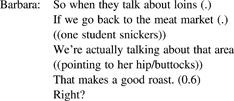
Here, Barbara uses deictic referencing to demonstrate the act of translation, positioning “the Chinese or whoever” as the talkers and “us” (herself and her students) as the interpreters. In other words, they talk about things, but we must participate, using our cultural and physical experience to interpret their talk. This statement initiates students into a dialogic relationship with translators where authors' voices must be heard against the backdrop of culturally influenced notions of language, nature, and the body. Her use of the word “actually,” when she says “we're actually talking about,” utilizes this ideology to contrastively accomplish the work of translation intersemiotically vis-à-vis her own embodied stance and the cultural awareness of what parts of the body make a good roast. It further indexes the ideology of language that locates language, especially the language of Chinese translators, somewhere far apart from the lived reality of the body.
This set of examples thus offers another example of the ways in which translation in the context of American schools is accomplished in interactive moments that involve teachers, students, and authors in dialogic encounters where translation talk becomes a site for participants to establish their authority, to socialize students' into various ways of finding and interpreting evidence, and to introduce and articulate various ideologies of language that will impact the way they make choices in practice. As the last example shows, such encounters are not always seamless. Conflict arises as translation strategies are measured against one another and found deficient for various reasons. In this case, it is Barbara who takes issue with “the Chinese or whoever is translating for them,” arguing that their persistent use of outdated terms more appropriate to harlequin romance novels than to Chinese medicine complicates the translation process and makes it difficult to understand the texts. As an example of living translation, excerpts (4)–(6) reveal the social work that is done with talk about translation, and suggest the ways in which translation talk is used to direct students' clinical practice of diagnosis, in this case guiding them away from the Chinese terminology and directly towards the human buttocks as the source of relevant information about illness.
Reflecting on rheum
Barbara's casual dismissal of terms such as loins and rheum perhaps contributes to the students' later difficulties in appreciating Dr. Liu's insistence on the importance of the concept. Interestingly, however, in the case of the discussion in Dr. Liu's classroom, the conflict itself generated a great deal of reflectiveness in many of the participants. Follow-up interviews offer a great deal of insight into how deeply such moments of confusion, perhaps even more than moments of clarity, influence the students' ideas about translation and encourage them to develop a strong discursive consciousness about translation. Treavor, for instance, who was home sick from Dr. Liu's class the day of the rheum discussion, hears about the conflict from Samantha and Sarah, and comments to me in an interview. He says that this “thing” that they are studying, that “we call medicine,” is also to a certain extent “history.”
(7) History
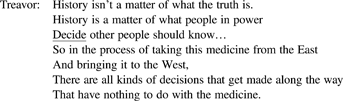
This comment reveals the ways in which interactions like those above can cause students to think more deeply about the language they are learning, and can spark an awareness of the contingency of the information in their texts. In this case, then, translation talk works to interrupt the common ideology of language as factual, introducing students to a world in which language is fundamentally social and historical. For Treavor, it provides an opportunity to strengthen his deeply felt ideology of learning that places his own experience at the center of interpretative truth. “Ultimately,” he says, in another interview, “because I'm the the one who's going to be in charge of my own practice, I just need to learn from [all of the different translations out there].” For other students, however, the instability that emerges from such conflicts inspire resistance and confusion. One student in this study actually dropped out once she realized that there was no way to fit Chinese medical terms into the neat little “drawers” that she had become accustomed to in her biomedical training. And Oren, the student who we saw arguing for a straightforward gloss for the Chinese, never ends up giving up on this quest, complaining later that Dr. Liu's English was not good enough to understand his superior interpretations. Sarah, on the other hand, who was present for both segments, says of the rheum conflict that “it's just really opening my eyes to the limitations of translation.” Conflicts like the one in Dr. Liu's class thus remind her that learning Chinese medicine is “like being a baby and learning a new language, where you really just have to be open to the language and not try to parallel it to what we already know.” Unlike Oren, then, Sarah here demonstrates a distinctly relativist understanding translation that refuses to accept simple correspondences and at least superficially strives to achieve a deep, childlike listening. Language, here, is an access point to a parallel world, and not at all a referentially transparent index of either a universally experienced reality or body-self.
The effects of such conflicts do not necessarily ever end. In fact, in even further interviews down the line, Samantha says in her third year that she finally understands what rheum is based on her experiences in the clinic. “I mean I do get now what it is,” she says, “But I had to see it to, to believe it, to know.” She goes on to describe her experience of rheum, saying that it is a “snotty but not snot, like phlegmy but not phlegm-dampy but not exactly damp, like sort of thing that is in somebody.” She reiterates that she must see it to truly get it, however, and only then can she communicate about it with her teachers and supervisors, who also know what it is through experience. She refers back to the day in Dr. Liu's class cited above as “the whole hilarious outburst about [rheum].”
(8) No sense-making

Here, Samantha references the intimate relationship that she has with language in Chinese medicine, in particular the word “rheum,” which was the source of so much discussion about translation back in her first year. It also highlights how experience with the language of Chinese medicine in practice changes her experience of language and meaning.
(9) It's a real thing
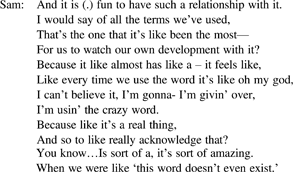
Here, then, we have Samantha experiencing a re-reading of a term that, prior to her experience in the clinic “seeing” rheum, did not even exist for her. In this sense, the translation provided by Dr. Liu vis-à-vis the Wiseman-Feng dictionary, ends up attaining legitimacy in Samantha's repertoire, despite being dismissed by her other teacher, Barbara, as well as her classmates. Two years down the line, Samantha thus expresses an “epideictic clarity” (Crapanzano Reference Crapanzano2011) regarding rheum that demonstrates the ways in which interactions about translation in Chinese medicine are ongoing endeavors that penetrate the realm of experience, and practice. While this experience does not necessarily change her basic ideology of language as an arbitrary signifier of a higher truth, it certainly expands upon it and can be said to move it at least a little more towards the language-as-network approach (“snotty but not snot, like phlegmy but not phlegm-dampy but not exactly damp”) that Dr. Liu teaches in excerpts 1–3. In many ways, it also legitimates Dr. Liu's authority many years after the fact, and introduces the realm of rheum into Samantha's clinical practice.
Discussion
In this article, I have shown several classroom interactions where translation talk unfolds as a social process with potential implications for clinical practice. Together, these data suggest that translation in US Chinese medical education unfolds as a conversation in constant motion, a hermeneutic endeavor in which the translation and explanation of foreign terms is always interactively mediated by the use of different kinds of evidence to epistemically position participants with regard to a set of imagined originals. Within this ongoing “conversation,” (cf. Gadamer Reference Gadamer, Weinsheimer and Marshall2006), multiple texts and other cultural, experiential, and linguistic sources are drawn upon to talk about and accomplish translation in an interactive setting involving multiple parties with divergent strategies for both listening and translating. This lends a quality of “multi-voicedness” to such interactions, where multiple voices are audible within each utterance about translated material—including the speaker's interpretation as well as the “refracted intention” of the translator, the original author, and all of the divergent interpretations that the speaker has been exposed to (Bakhtin Reference Bakhtin and Holquist1981:324). In addition to this, the interactions that lead ultimately to the translation of Chinese medical terms are always ongoing, as participants leave the classroom to translate and re-translate in various contexts. The result is, in the words of Octavio Paz, “a symphony in which improvisation is inseparable from translation and creation is indistinguishable from imitation” (Reference Paz, Corral, Schulte and Biguenet1971/1992:160–61). In living translation, then, Chinese medicine is translated via this “symphony” of multiple, complex strategies in interaction with one another. In the context of American Chinese medical education, yin becomes “rheum,” “mucus” is “something between phlegm and edema,” and “snot but not snot, phlegmy but not phlegm-dampy,” and the never-mentioned Chinese word for “loins” become “that part of your body that makes a good roast.”
Beyond just being a symphony of interactive accomplishment, however, translation in Chinese medicine functions as a platform for establishing social currency and social power. Not only teachers, but students, too, participate in this battle waged through diverse and conflicting ideologies of language. Moreover, we have seen, translation is a foundation for teaching evidence, for teaching action. In this sense, translation talk in Chinese medicine confirms Gal's (2005:30) assessment that “practice and ideology mutually generate each other.” Barbara's and Dr. Liu's strategies for teaching about language, for example, participate in generating certain forms of practice, while shifting Samantha's ideology of language—a process that results from the interpenetration of learning and experience—generates a distinct shift in her practice of Chinese medicine.
Within these examples, then, we have learned a little bit more about the anthropology of translation, or translation as not only a “linguistic” process but also an ongoing encounter between humans. These humans are vying for power in an uneven playing field, and are using translation and translation talk as a social positioning tool. They are also using it as a tool of socialization into various notions of evidence and ideologies of language. With this activity, they are also participating in much larger social structures and relations of power. Although I have not focused on it here, from the data I have shown it is possible to see how whole institutions of Chinese medicine in the US are founded on translations that themselves are rooted in language ideological conflicts, culturally shaped interpretive attempts to find common ground, and efforts to establish personal and cultural authority in an uncertain field. This study of translation talk in Chinese medicine thus provides a unique vantage point on the ways in which translation work unfolds in everyday practice. The view presented here not only complements scholarly appreciation of the human nature of translation as carried out historically in texts (Montgomery Reference Montgomery2000; Bauman & Briggs Reference Bauman and Briggs2003; Schieffelin Reference Schieffelin, Makihara and B. Schieffelin2007; Hanks Reference Hanks2010), or presently in talk (Emad Reference Emad1998; Wadensjö Reference Wadensjö1998; Cronin Reference Cronin, Tymoczko and Gentzler2002), but also highlights translation as an intersemiotic, socially mediated hybrid between talk and text, past and present. Ultimately, such a view strengthens the emerging anthropology of translation by firmly grounding translation in everyday practice.


