Introduction
In external beam radiation therapy, the patient is setup on a treatment couch-top while high energy radiation beams are delivered from multiple angles. These treatment couch-tops are designed to minimise the attenuation of radiation beams directed through them while at the same time providing a strong and stable surface to support a broad spectrum of patient sizes and weights. Current treatment techniques, such as intensity-modulated radiation therapy (IMRT) and volumetric-modulated arc therapy (VMAT), involve more degrees of freedom for the gantry than traditional conformal techniques. Consequently multiple beams are commonly used with an increased probability that one or more beams will intercept the treatment couch. This is particularly true of 360° volumetric arc therapy technique, where the treatment beam is intersected by the couch top for a significant portion of rotation. Current radiation therapy treatment couch-tops are usually made of carbon fibre, which is reasonably radio-transparent due to its low-density carbon fibre compositionReference De Ost, Vanregemorter, Schaeken and Van den Weyngaert 1 , Reference Meara and Langmack 2 and yet strong enough to support patients. Radiation beams passing through these couch-top undergo a non-negligible attenuation and corrections that take into account such attenuation differ between institutions. Some treatment planning systems offer the ability to include the couch-tops as a structure in the treatment planning process in order to account for the couch attenuation. Some studies have shown that neglecting the couch-top in the treatment planning process can lead to non-negligible differences between the planned and delivered dose ranging from 4 to about 16%.Reference De Ost, Vanregemorter, Schaeken and Van den Weyngaert 1 – Reference Butson, Cheung and Yu 18
Using IMRT or VMAT techniques allow a highly conformal radiation dose distribution to be delivered to a target volume. These techniques utilise multiple photon beams from different gantry angles. When the treatment fields are located posteriorly (180°–270° and 180°–90°), the beams transverse through different parts of the treatment couch, including in some cases the relatively highly attenuating movable support rails if present in the couch model. Due to its relative high attenuation some centres adopt a process whereby the moveable rails are moved out of some of the beam path during IMRT treatments, but difficult to avoid for a 360° volumetric arc treatment. Therefore methods of accounting for the beam attenuation by these treatment couch-tops and immobilisation devices and incorporating it in the treatment planning process have been a subject of interest.Reference De Ost, Vanregemorter, Schaeken and Van den Weyngaert 1 – Reference Butson, Cheung and Yu 18 There are generally two main methods to account for the attenuation of the treatment couch-top in the treatment planning process and each method has its own advantages and disadvantages. In one method, the treatment couch top can be included in the treatment planning process by either including it as part of the patient CT scanning or using an already scanned couch-top and fusing with the patient CT scan. The ability of the treatment planning system to adequately account for the low-density regions extending out and away from the patient must be investigated and a reduction of the air-patient threshold may be required. In this method of couch correction, recreating the exact position of the patient with respect to the couch-top (lateral displacements) may become an issue in patient setup and impact the accuracy of the treatment.Reference Vieira, Kaatee, Dirkx and Meijmen 6 Another approach is the post-planning correction of monitor units (MU) for beams passing through the treatment couch-top and this require a large quantity of measurements in order to accurately correct for every possible angle of incidence, field size and patient-specific geometry.
Spezi and FerriReference Spezi and Ferri 4 investigated the dosimetric characteristics of photon beam attenuation of a commercial carbon fibre treatment couch. Two sets of dosimetric measurements were performed. In the first experiment a polystyrene slab phantom was used: the central axis attenuation and the skin-sparing detriment were investigated. In the second experiment, the off-axis treatment couch transmission was investigated using a polystyrene cylindrical phantom. Measurements were taken at the isocenter for a 360° rotation of the radiation beam. Results show that the photon beam attenuation of the Siemens IGRT carbon fibre couch-top varies from about 2·1% (central axis) to about 4·6% (120° and 240° beam incidence). Pulliam et al.Reference Pulliam, Howell, Followill, Luo, White and Kry 7 investigated the clinical impact of couch-top and rails on IMRT and arc treatment techniques. They observed that accounting for the couch attenuation for IRMT plans resulted in doses difference of 4·2 and 2·9% with the rails in the ‘rails-out’ and ‘rails-in’ positions, respectively. Seppala and KulmalaReference Seppala and Kulmala 11 investigated the effects of commercially available couch-tops on beam attenuation and skin dose with 6 and 15 MV photon energies. The measured maximum attenuation by a couch-top with an oblique gantry angle was 10·8 and 7·4% at 6 and 15 MV energies, respectively. Myint et al.Reference Myint, Niedbala, Wilkins and Gerig 5 investigated the attenuation of 6 and 18 MV photon beams by a carbon fibre couch-top. They determined that neglecting the attenuation of oblique treatment fields by the carbon fibre couch-top can result in localised dose reduction from 4 to 16%, depending on energy, field size and geometry. Gillis et al.Reference Gillis, Bral and Wagter 14 reported gantry angle dependent attenuation measurements for a standard carbon fibre couch-top and reported difference of the order of 4·5 and 4·2% for both left and right posterior oblique beam, respectively. Vieira et al.Reference Vieira, Kaatee, Dirkx and Heijmen 15 used an EPID-based study and reported on Varian Exact treatment couch-top of carbon fibre with head and neck immobilisation devices and concluded an attenuation of 15% in clinical practice.
Despite the fact that treatment couch-tops and rails are known to cause non-negligible beam attenuation, there is limited data of the detailed angularly dependent attenuation characteristics for a wider range of energies. In this study we have investigated the attenuation characteristics of three different commercial couch-tops using five different photon beams and two different field sizes. We studied the attenuation characteristics of the Varian IGRT™ (Varian Medical Systems, PaloAlto, CA, USA), Qfix kVue™ Standard (WFR/Aquaplast, Avondale, PA, USA) and Qfix kVue Dose Max™ (WFR/Aquaplast) treatment couch-tops on a Varian TrueBeam™ machine using 6 MV, 6FFF MV, 10 MV, 10FFF MV and 15 MV photon beams and for 5×5 and 10×10 cm2 field sizes.
Materials and Methods
The attenuation characteristics of three commercially available treatment couch-tops were investigated with photon beam energies ranging from 6 to 15 MV. The couch-top investigated were: Varian IGRT™ couch-top, Qfix kVue™ Standard treatment couch-top and Qfix kVue Dose Max™ couch-top. The couch-tops were installed on a Varian TrueBeam™ machine capable of 6 MV, 6FFF, 10 MV, 10FFF and 15 MV photon energy beams.
Couch-tops
The Varian IGRT™ couch-top is constructed of an unbroken surface coating of carbon fibre with a foam core. The thickness of the couch top varies along its length sloping from a maximum of 75 mm, near the couch base, to 50 mm near its end. The thickest portion is 125 cm in length with a water equivalent buildup that is given by the manufacturer to be 8·4 mm. The couch-top then transitions from 75 mm in thickness to 50 mm over a length of 35 cm. The thinnest 50 mm section then extends a further 40 cm with a water equivalent buildup that is given by the manufacturer to be 5·2 mm. The Qfix kVue™ Standard couch-top measures 132·5 cm in length, 51·4 cm in width and a constant 2·8 cm in thickness. It is also composed of an unbroken surface coating of carbon fibre with a foam core and supported by two moveable rails composed of machined carbon fibre which can be positioned at the ‘in’ (rail-in) or ‘out’ (rail-out) of the treatment beam path. The Qfix kVue Dose Max™ couch-top measures 132·5 cm in length, 51·4 cm in width and a constant 2·8 cm thickness. It is composed of a carbon fibre grid with a foam core, encased in a clear plastic. The couch-top is intended to be as rigid as a solid carbon fibre shell couch while maintaining the radio-transparency of a carbon fibre grid. The couch is also supported by two moveable rails composed of machined carbon fibre which can be positioned at the ‘in’ (rail-in) or ‘out’ (rail-out) of the treatment beam path.
Couch attenuation measurements
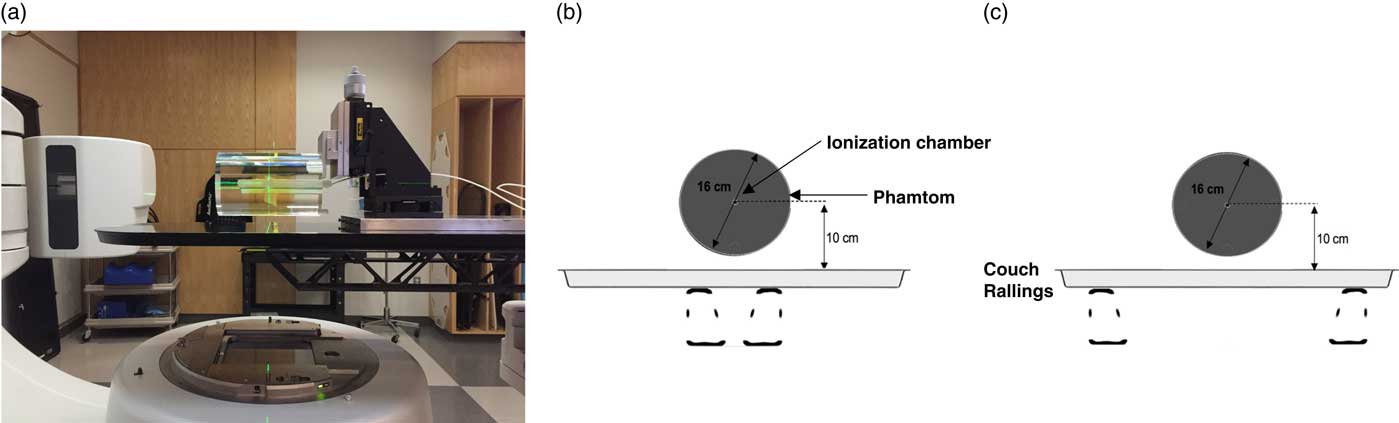
The variation of beam attenuation by couch-top with gantry angle was studied for field sizes of 5×5 and 10×10 cm2. All attenuation measurements were performed with a Farmer type Capintec PR06C™ ion-chamber (Capintec Inc., Florham Park, NJ, USA) positioned at the centre of a cylindrical acrylic phantom. The phantom used in this study was a 16-cm diameter cylindrical acrylic phantom. The measurement setup is as shown in Figure 1a and a schematic diagram in Figure 1b. The phantom was positioned on the treatment couch-top such that the ion-chamber holder at the central axis of the phantom is at the beam isocenter. The chamber holder is capable of holding the Capintec PR06C™ Farmer Chamber, which was connected to a Supermax 5000™ electrometer (Standard Imaging Inc., Middleton, WI, USA). The beam attenuation by the couch-tops was measured for two 180° gantry motions (clockwise and counter clockwise) each corresponding to 450-point measurements while the gantry moves about the stationary detector. The two 180° measurements were conducted to create a complete 360° attenuation measurement data set. The gantry steadily rotates about the isocenter during data acquisition. The maximum dose rates of each beam energy (6, 10 and 15 MV=600 MU/minute, 6FFF=1,200 MU/minute and 10FFF=2,400 MU/minute) was used with full arc duration of 7·5 minutes for the 6 MV, 6 MV-FFF, 10 MV, 10 MV-FFF and 15 MV photon beam energies. Where couch rails are present (Qfix kVue™ Standard and the Qfix kVue Dose Max™), measurements were taken with the moveable support rails positioned at both the couch midline ‘rails-in’ and at the maximum outward ‘rails-out’ position at the edges of the couch to include the attenuation effect of the moveable rails. The Varian IGRT™ couch-top has three different thicknesses along its length and therefore measurements were acquired at three different positions; the thinnest area of the couch-top, the central medium of the sloped region and the thickest area.
Experimental set up of the measurement geometry on a Qfix kVue Standard couch-top with a 16-cm diameter phantom position 10 cm above the couch top and with the isocenter at the centre of the phantom: (a) setup image, (b) schematic diagram with railings in the ‘rails-in’ position and (c) schematic diagram with railings in the ‘rails-out’ position.

Results
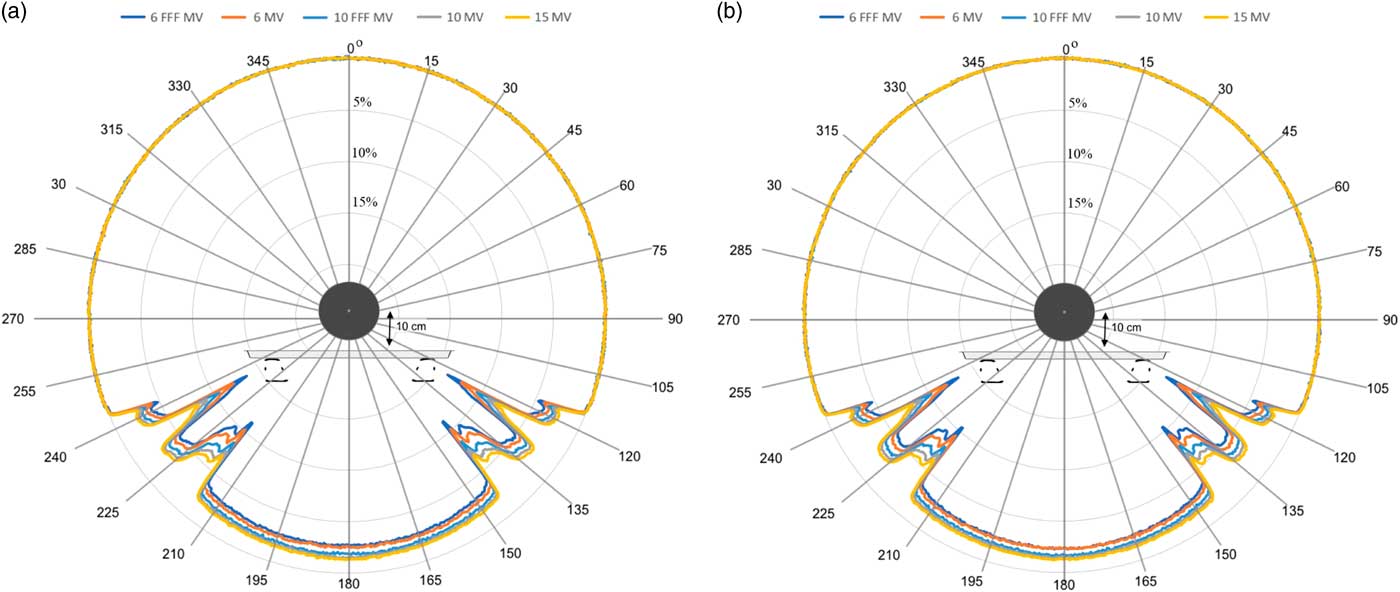
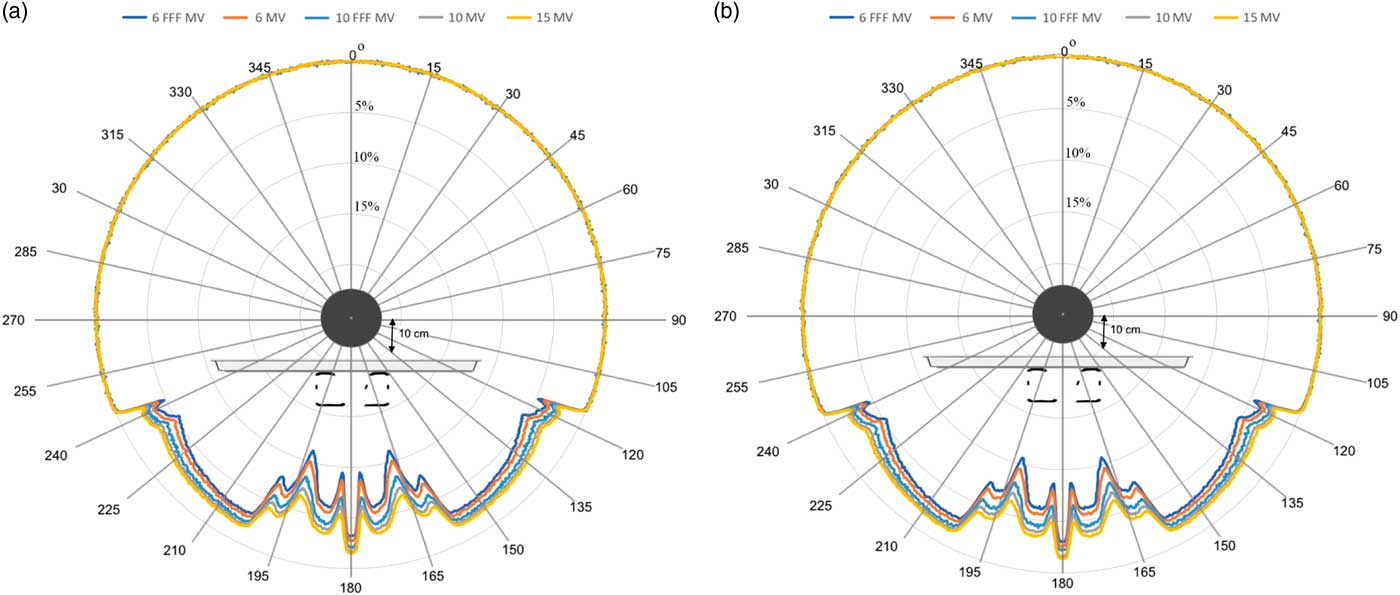
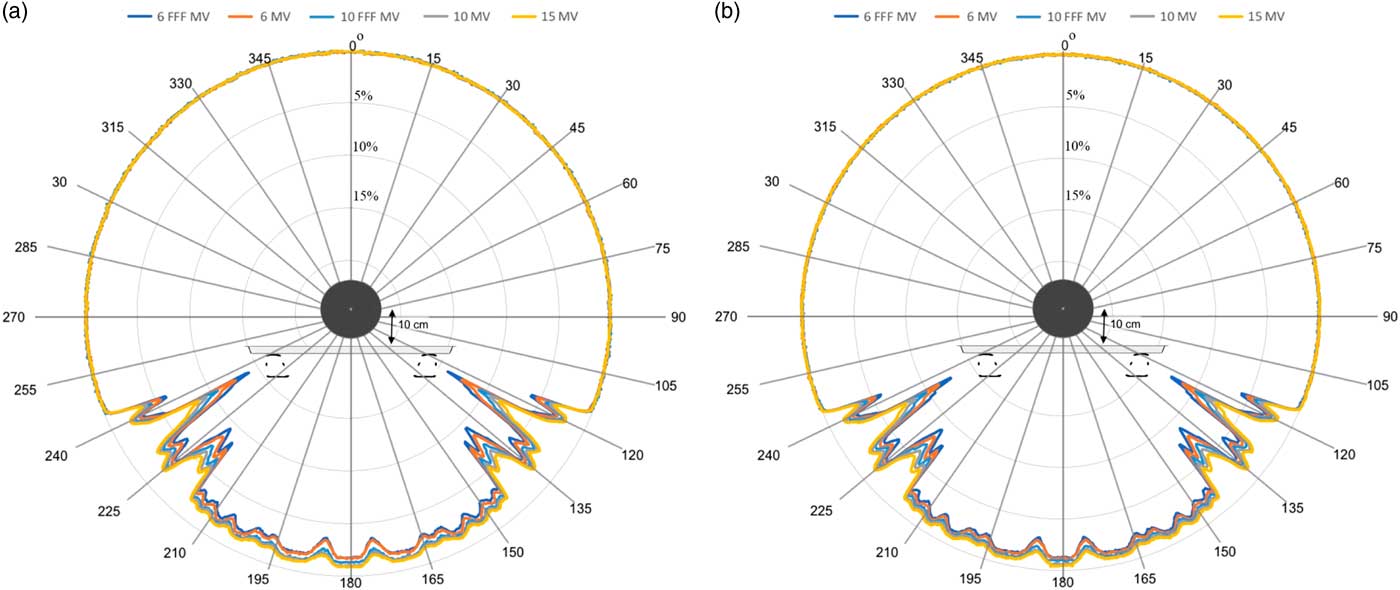
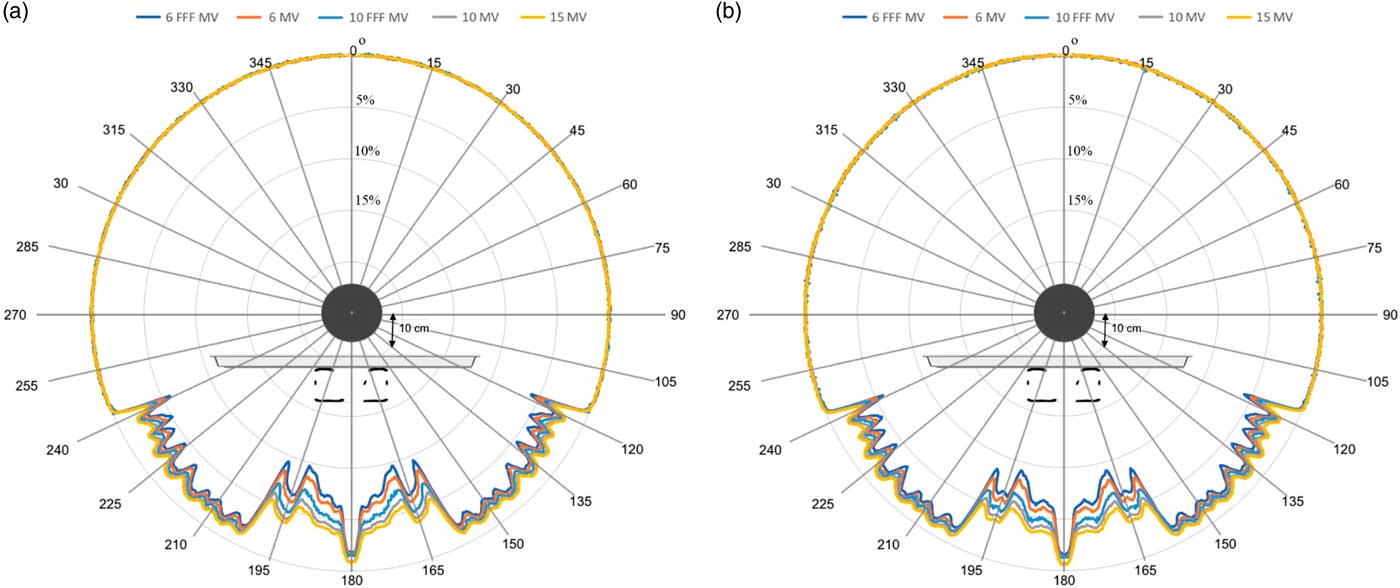
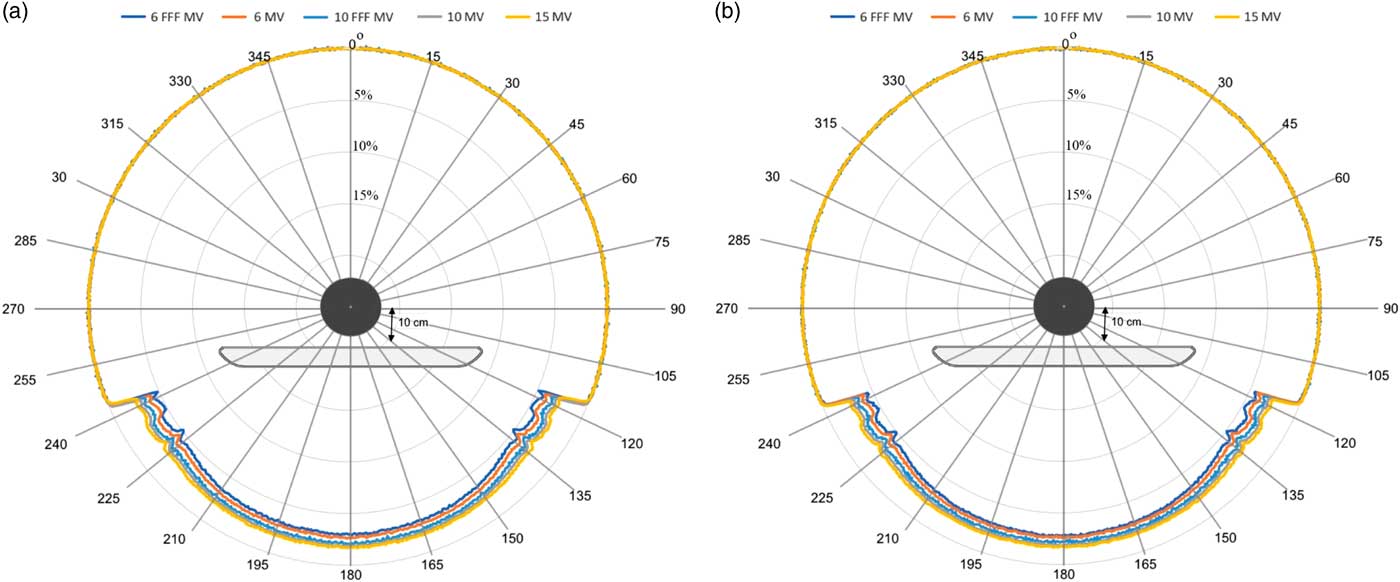
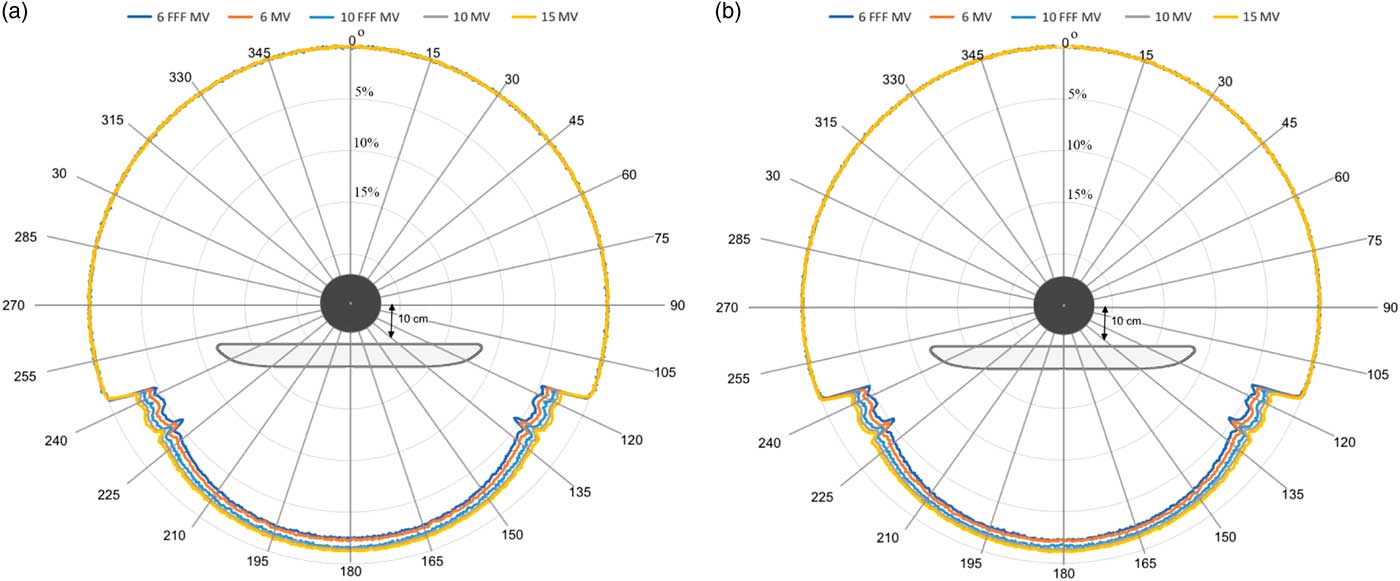
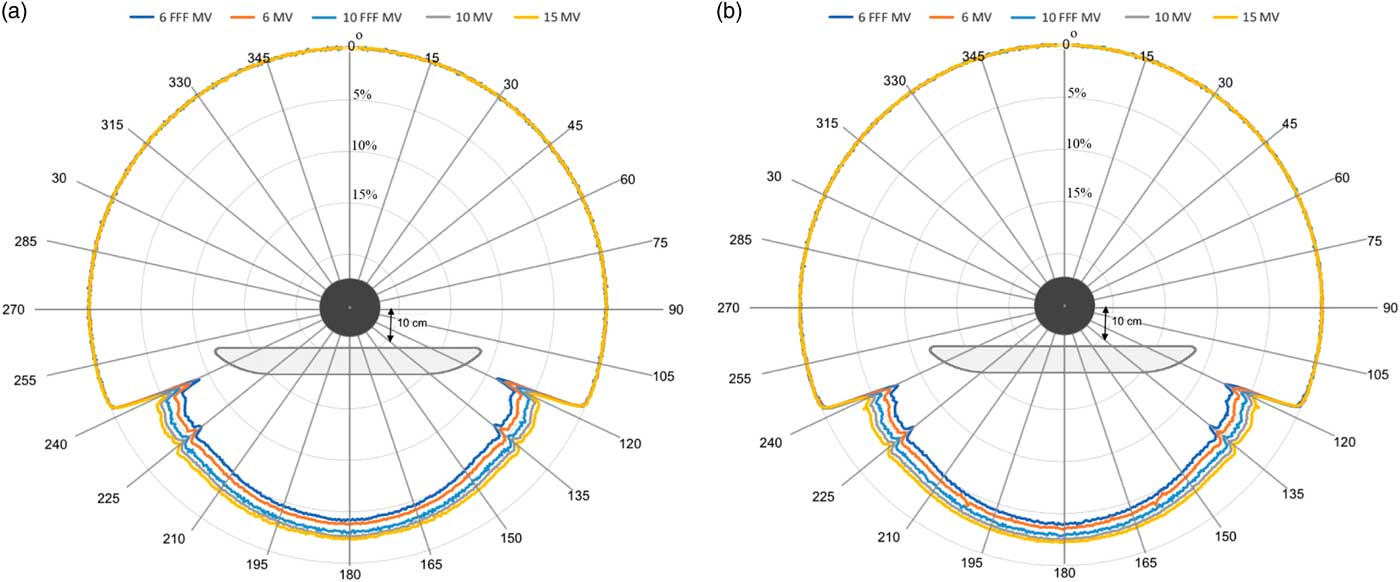
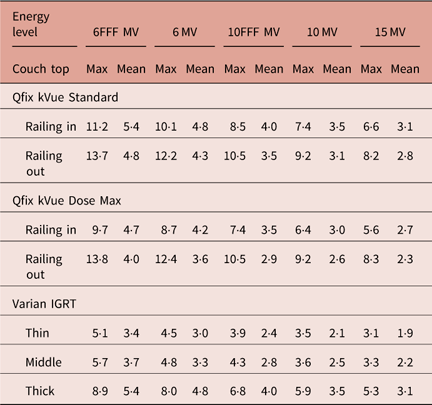
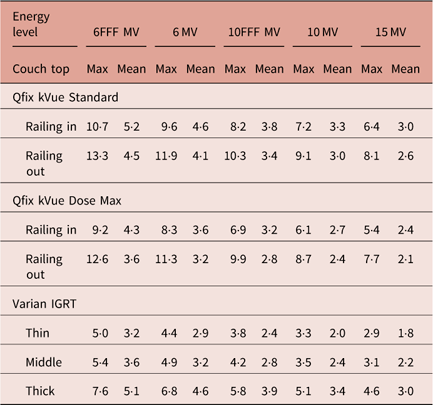
The variation of couch-top attenuation as a function of gantry angle irradiation in radar plots are shown in Figures 2–8. All measured dose data in each figure is normalised to the reading at 0° gantry angle. Figures 2 and 3 show radar plots of the variation of the Qfix kVue™ Standard couch-top attenuation as a function of gantry angle irradiation with the moveable rails in the rails-out and rails-in positions, respectively, using 6, 6FFF, 10, 10FFF and 15 MV photon beams. Similarly Figures 4 and 5 show radar plots of the variation of the Qfix kVue Dose Max™ couch-top attenuation as a function of gantry angle irradiation with the moveable rails in the rails-out and rails-in positions, respectively, using 6, 6FFF, 10, 10FFF and 15 MV photon beams. The thickness of the Varian IGRT™ couch-top varies along its length and therefore its attenuation as a function of gantry angle irradiation was measured at the three different positions along its length corresponding to the thin, medium and thick sections. Figures 6–8 show the radar plots of the attenuation measurements for the thin, medium and thick sections, respectively, using 6, 6FFF, 10, 10FFF and 15 MV photon beams. The maximum and mean attenuation through the Qfix kVue™ Standard and Qfix kVue Dose Max™ couch-tops with the rails in the rails-in and rails-out positions along with the Varian IGRT™ couch-top (thick, middle and thin) are shown in Tables 1 and 2, respectively, for field sizes of 5×5 cm2 and 10×10 cm2.
Radar plot of the percentage attenuation versus gantry angle for the Qfix kVue Standard couch-top with the railings in the ‘rails-out’ position at 6FFF MV (dark blue), 6 MV (orange), 10FFF MV (light blue), 10 MV (grey) and 15 MV (yellow) photon beams energies; (a) 5×5 cm2 field size and (b) 10×10 cm2 field size.

Radar plot of the percentage attenuation versus gantry angle for Qfix kVue Standard couch-top with the railings in the ‘rails-in’ position at 6FFF MV (dark blue), 6 MV (orange), 10FFF MV (light blue), 10 MV (grey) and 15 MV (yellow) photon beams energies; (a) 5×5 cm2 field size and (b) 10×10 cm2 field size.

Radar plot of the percentage attenuation versus gantry angle for Qfix kVue Dose Max couch-top with the railings in the ‘rails-out’ position at 6FFF MV (dark blue), 6 MV (orange), 10FFF MV (light blue), 10 MV (grey) and 15 MV (yellow) photon beams energies; (a) 5×5 cm2 field size and (b) 10×10 cm2 field size.

Radar plot of the percentage attenuation versus gantry angle for Qfix kVue Dose Max couch-top with the railings in the ‘rails-in’ position at 6FFF MV (dark blue), 6 MV (orange), 10FFF MV (light blue), 10 MV (grey) and 15 MV (yellow) photon beams energies; (a) 5×5 cm2 field size and (b) 10×10 cm2 field size.

Radar plot of the percentage attenuation versus gantry angle for Varian IGRT couch-top thin section at 6FFF MV (dark blue), 6 MV (orange), 10FFF MV (light blue), 10 MV (grey) and 15 MV (yellow) photon beams energies; (a) 5×5 cm2 field size and (b) 10×10 cm2 field size.

Radar plot of the percentage attenuation versus gantry angle for Varian IGRT couch-top middle section at 6FFF MV (dark blue), 6 MV (orange), 10FFF MV (light blue), 10 MV (grey) and 15 MV (yellow) photon beams energies; (a) 5×5 cm2 field size and (b) 10×10 cm2 field size.

Radar plot of the percentage attenuation versus gantry angle for Varian IGRT couch-top thick section at 6FFF MV (dark blue), 6 MV (orange), 10FFF MV (light blue), 10 MV (grey) and 15 MV (yellow) photon beams energies; (a) 5×5 cm2 field size and (b) 10×10 cm2 field size.

The maximum and mean percentage attenuation of photon beam by Qfix kVue Standard (railing in and out), Qfix kVue Dose Max (railings in and out) and Varian IGRT (thin, middle, thick) couch-top for a 5×5 cm2 field size and 6, 6FFF, 10, 10FFF and 15 MV photon energies

The maximum and mean percentage attenuation of photon beam by Qfix kVue Standard (railings in and out), Qfix kVue Dose Max (railings in and out) and Varian IGRT (thin, middle, thick) couch-top for a 10×10 cm2 field size and 6, 6FFF, 10, 10FFF and 15 MV photon energies
Discussion
The attenuation characteristics of three commercially available treatment couch-tops were investigated with clinical photon beam energies ranging from 6 to 15 MV and field sizes 5×5 and 10×10 cm2. The treatment couch-top attenuate the beam differently depending on the angle of incidence of the beam and also whether it traverse the moveable rail at the rail-in or rail-out position. In this study it was found that the beam attenuation varies from 1·1% to a maximum of 13·8% depending on the type of couch-top, beam energy and if it passes through the moveable rails. Attenuation by the Qfix kVue™ Standard couch-top varies from 1·8 to 5·3% through the couch and from 2·4 to 13·7% if it also passes through the moveable rails. Similarly, attenuation by the Qfix kVue Dose Max™ couch-top varies from 1·1 to 5·3% through the couch-top and from 1·1 to 13·8% if it passes through the moveable rails. The railing-out position on both couch-tops produces the maximum attenuation, presumably because of the longer photon beam path length through the railing. The attenuation by the Varian IGRT™ couch-top varies from 2·3 to 8·9%. For all three couch-tops the 5×5 cm2 6FFF MV beam was the most attenuated beam.
Using our current data, the influence of the Qfix kVue™ couch-top is expected to vary the prescribed dose at isocenter by 0·7–2·8% for a four equally weighted field technique. Similarly the effect will vary from 0·7 to 2·4% for the Varian Exact™ couch-top and from 0·8 to 1·4% for the Varian IGRT™ couch-top. In arc therapy and IMRT, posterior oblique angles of incidence are frequently used, leading more often to intersections of the beam with the treatment couch-top. For such treatment techniques, if the attenuation of the couch-top is ignored, the dosimetric impact could potentially be higher, depending on the number of radiation beams intersecting the couch.
Studies have been done by some investigators to determine the effect of couch-top on patient dose distribution. Vieira et al.Reference Vieira, Kaatee, Dirkx and Heijmen 15 conducted a two-dimensional measurement of photon beam attenuation by the Varian Exact™ couch-top. They indicated that for treatments of head and neck cancer patients with a 6-MV photon beam, they observed attenuation of up to about 15%. Their findings led to the development of new tools and procedures for planning and treatment delivery at their centre to avoid under dosages in the tumour dose. Pulliam et al.Reference Pulliam, Howell, Followill, Luo, White and Kry 7 investigated the clinical impact of the Varian Exact™ couch-top and rails for IMRT and arc techniques. They concluded that failure to account for the treatment couch and rails resulted in clinically unacceptable dose and volume coverage losses to the targets. They observed for an IMRT prostate plans that there was an average prescription dose losses (relative to plans that ignored the couch) of about 4·2 and 2·0% with the rails-out and rails-in, respectively. Whereas for RapidArc™ plans they observed 3·2 and 2·9% with the rails-out and rail-in, respectively. On the average, the percentage of the target covered by the prescribed dose dropped to 35 and 84% for IMRT (rails-out and rail-in, respectively) and to 18 and 17% for RapidArc™ (rails-out and rail-in, respectively).Reference Pulliam, Howell, Followill, Luo, White and Kry 7
In this study, the Qfix kVue™ Standard and Qfix kVue Dose Max™ couch-tops produced the highest attenuations of 13·7 and 13·8% when the central axis of the beam intersected with the edge of the couch-tops with the railings ‘out’. However, the mean attenuation of the Qfix kVue™ Standard couch was about 1% higher than the Qfix kVue Dose Max™ couch-top. This is because the Qfix kVue Dose Max™ couch-tops showed very low attenuation through the mesh portions, averaging about 1%. The Varian IGRT™ couch-top, having a lower maximum of 8·9% for 6FFF MV beam, also had the highest minimum attenuation for posterior beams normal to the plane of the couch-top. The treatment couch-tops can cause non-negligible attenuation of photon beams with posterior or posterior-oblique gantry angles. Therefore, neglecting the effect of the attenuation of the couch-top could be clinically significant. It was also demonstrated that the positions of the rails (rails-in or rails-out) are important in a clinical setting because the attenuation by the rails could be significant. The attenuation through the rails at the rails-in and rails-out positions ranges from 9·2 to 11·2% and 12·6 to 13·8%, respectively. The edges of both couch-tops account for the bulk of the attenuation as the beam would be passing through the most material at such an oblique angle. The Varian IGRT™ couch has no rails but relatively thicker than the other couch-tops leading to higher average attenuations of the beams.
Conclusion
Radiation treatment beams traversing through treatment couch-tops experience varying degrees of perturbation and thus can cause non-negligible beam attenuation with posterior and posterior-oblique gantry angles. Failure to account for treatment couch-tops and moveable rails attenuation could potentially result in clinically non-negligible dose and volume coverage losses to the targets. This study indicates that such attenuation is greatest when the beam is passing through the outer edge of the couch-tops and thus traversing more material. If posterior or posterior oblique beams are used in a treatment plan, then the couch top will be unavoidable and consideration must be given to avoid the moveable rails and edges of the couch-top where partial obstruction of the beam may not be accurately corrected. With the increased use of IMRT and VMAT and the subsequent increase in treatment complexity requiring a large number of posterior and posterior oblique beams, a detailed understanding of couch-tops attenuation and its correction in treatment planning becomes warranted in order to ensure adequate target coverage.
Acknowledgement
This research was supported with funding from the TELUS Ride For Dad (RFD) and the Prostate Cancer Fight Foundation (PCFF), Cancer Care Ontario Harold John’s studentship award and the University of Waterloo Undergraduate Physics and Astronomy Thesis programme.