


Introduction
Cognitive behavioural therapy (CBT) is recommended by the National Institute for Clinical Excellence (2004) as the treatment of choice for bulimia nervosa as it has the strongest evidence base in terms of reducing binge-eating, purging, dietary restraint and dysfunctional beliefs about body shape and weight (Wilson, Reference Wilson1999). The initial focus in CBT for the eating disorders (Fairburn, Reference Fairburn2008; Waller et al., Reference Waller, Cordery, Corstorphine, Hinrichsen, Lawson and Mountford2007) is on early change in eating behaviours (reduction in symptom frequency and increased structure in the individual's diet), as such changes by session five or six are predictive of better outcomes for bulimia nervosa (e.g. Agras et al., Reference Agras, Crow, Halmi, Mitchell, Wilson and Kraemer2000; Wilson et al., Reference Wilson, Loeb, Walsh, Labouvie, Petkova and Liu1999). Such behavioural change in CBT has the goal of changing the eating attitudes that maintain the eating pathology, so that relapse is prevented. Therefore it is important to understand the factors that facilitate or delay such cognitive change in the eating disorders. However, CBT is far from universally effective in the eating disorders (e.g. Bulik, Berkman, Brownley, Sedway and Lohr, Reference Bulik, Berkman, Brownley, Sedway and Lohr2007; Fairburn and Dalle Grave, Reference Fairburn and Dalle Grave2008; Fairburn et al., Reference Fairburn, Cooper, Doll, O'Connor, Bohn and Hawker2009; McIntosh et al., Reference McIntosh, Jordan, Carter, Luty, McKenzie and Bulik2005), and clearly needs to be developed further (Vanderlinden, Reference Vanderlinden2008; Wilson, Reference Wilson1999). The reasons why some eating-disordered individuals fail to respond to CBT are not well understood. One suggestion is that personality factors and personality disorders are involved, reducing the impact of treatments for the eating disorders (e.g. Herzog, Keller, Lavori, Kenny and Sacks, Reference Herzog, Keller, Lavori, Kenny and Sacks1992; Rø, Martinsen, Hoffart, Sexton and Rosenvinge, Reference Rø, Martinsen, Hoffart, Sexton and Rosenvinge2005).
It is commonly reported that personality disorder pathology has an impact on the outcome of treatment for axis 1 disorders (e.g. Hardy et al., Reference Hardy, Barkham, Shapiro, Rees, Stiles and Reynolds1995). However, there is controversy over whether that is the case (e.g. Mulder, Reference Mulder2002). One potential reason for the contrasting findings is the difference between the clinical utility of self-report and interview measures of personality disorder pathology (e.g. Samuel et al., Reference Samuel, Hopwood, Ansell, Morey, Sanislow and Markowitz2011), though it has also been suggested that apparent differences in the utility of these measures might be artefactual rather than real (e.g. De Bolle et al., Reference De Bolle, De Fruyt, Quilty, Rolland, Decuyper and Bagby2011). Beck, Freeman, Davis and Associates (Reference Beck, Freeman, Davis and Associates2004) have concluded that interview measures tend to be superior to self-report measures, though each is more reliable when used to provide dimensional scores rather than categorical diagnoses. However, both methods are limited by a lack of a clear basis for criterion validity (Beck et al., Reference Beck, Freeman, Davis and Associates2004).
There is high comorbidity between the eating disorders and cluster B and C personality disorders, particularly with avoidant, dependent, borderline and obsessive-compulsive personality disorders (Sansone, Levitt and Sansone, Reference Sansone, Levitt and Sansone2005, Reference Sansone, Levitt, Sansone, Sansone and Levitt2006). However, Connan et al. (Reference Connan, Dhokia, Haslam, Mordant, Morgan and Pandya2009) have shown that the key cognitive aspects of the personality disorders in the pathology of the eating disorders appear to be cognitions relating to the anxiety-based cluster C personality disorders (avoidant and obsessive-compulsive), rather than cognitions relating to the impulsive cluster B personality disorders (such as borderline). This conclusion is compatible with the finding that comorbid avoidant personality disorder (in combination with a trauma history) maintains eating disorder symptoms following inpatient treatment for eating disorders (Vrabel, Hoffart, Rø, Martinsen and Rosenvinge, Reference Vrabel, Hoffart, Rø, Martinsen and Rosenvinge2010). Therefore it is important to consider the potential role of a range of personality disorder cognitions in understanding the outcome of treatment, in terms of both drop-out and symptom reduction.
This study will examine whether the impact of the early stages of CBT for the eating disorders is influenced by the relatively high levels of personality disorder cognitions in this clinical group. Impact will be measured in terms of both drop-out and change in eating disorder attitudes over the first six sessions of CBT (the phase when behavioural change is particularly relevant to long-term positive outcomes; e.g. Agras et al., Reference Agras, Crow, Halmi, Mitchell, Wilson and Kraemer2000; Wilson et al., Reference Wilson, Loeb, Walsh, Labouvie, Petkova and Liu1999). Therefore the first aim is to investigate whether personality disorder cognitions at the beginning of treatment are associated with drop-out from CBT for eating disorders in this early phase. The second aim is to determine whether personality disorder cognitions are associated with change in eating disorder attitudes during this period.
Method
Participants
The sample consisted of 59 patients, who had been referred to a specialist eating disorder clinic in the UK and who were placed on the waiting list for outpatient, individual CBT. Where there were incomplete data sets, the number is reflected in the N given for the specific scale.
Patients were assessed using an interview developed for this purpose (Waller et al., Reference Waller, Cordery, Corstorphine, Hinrichsen, Lawson and Mountford2007), and were diagnosed using ICD-10 criteria (World Health Organization, 1992). Of the 59 patients, 35 had a diagnosis of bulimia nervosa (purging subtype = 29; non-purging subtype = 6); 5 had a diagnosis of atypical bulimia nervosa; 8 had a diagnosis of anorexia nervosa; 6 had a diagnosis of atypical anorexia nervosa; and 5 were diagnosed with eating disorder unspecified (all 5 had binge-eating symptoms). After comparison of diagnostic groups’ scores (see below), the patients were treated as a single transdiagnostic sample (Fairburn, Cooper and Shafran, Reference Fairburn, Cooper and Shafran2003), in keeping with the earlier finding that personality disorder cognitions do not vary across eating disorders (Connan et al., Reference Connan, Dhokia, Haslam, Mordant, Morgan and Pandya2009).
In addition to having a diagnosis of an eating disorder, inclusion criteria for the study were: being over 16 years of age; attendance at session one of outpatient CBT; completion of measures at session one of CBT; and consent given by participants for their scores to be used anonymously for research purposes (no patients declined consent). Exclusion criteria for the study (though not treatment) were: not being fluent in English; suffering from a psychotic disorder; having a learning disability (other than dyslexia); and having physical or psychiatric conditions that necessitated more intensive treatment (in- or day-patient care).
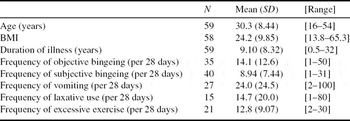
Table 1 shows the dimensional characteristics of the group, including mean age, body mass index (BMI), frequency of key symptoms (among those patients who engaged in them), and duration of illness. Of the 59 patients in the sample, 58 were female, and 61% regarded themselves as White British. All were assessed at the onset of treatment, so the time in current treatment was zero. Twenty-eight (47%) had prior experience of treatment for the eating disorder, including brief counselling, long-term dynamic therapies, and treatment with SSRI medication.
Characteristics of the patient group

Measures
Each patient completed a measure of personality disorder cognitions at the start of therapy, and a measure of eating pathology at the first and sixth sessions of CBT. These measures were administered as a routine part of treatment at the clinic to monitor early change in eating disorder behaviours and beliefs.
Personality Belief Questionnaire – Short Form (PBQ-SF; Butler, Beck and Cohen, Reference Butler, Beck and Cohen2007). The PBQ-SF is a 65-item self-report questionnaire designed to assess dysfunctional beliefs associated with 10 specific personality disorders. The PBQ-SF is an abbreviated version of the Personality Belief Questionnaire (PBQ; Beck and Beck, Reference Beck and Beck1991), and is argued to be a practical alternative for both clinical and research purposes, with good psychometric properties (Butler et al., Reference Butler, Beck and Cohen2007). Respondents are required to state how much they believe each of the 65 statements using a Likert scale (0 = not at all; 4 = totally). Each subscale is scored as the total of the scores on the relevant seven items (possible range = 0–28). Although the PBQ-SF itself is not a diagnostic tool for axis II disorders, higher scores reflect greater levels of the specific personality pathology. It does not yield a clinical cut-off score.
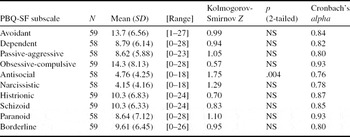
Table 2 shows the mean PBQ-SF subscale scores for all patients at session one of CBT for eating disorders, including the range of scores found in this group. All PBQ-SF subscales at session one had adequate internal consistencies (Cronbach's alpha > 0.70), and all were normally distributed (Kolmogorov-Smirnov tests) apart from the antisocial subscale. Although there are no comparable studies with eating disorder patients, PBQ-SF scores for many of the subscales (e.g. avoidant, obsessive-compulsive) were higher in this sample than scores reported by a general psychiatric sample (Butler et al., Reference Butler, Beck and Cohen2007).
Descriptive statistics for PBQ-SF subscales at session one

Note: NS = not significant (p > .05)
Eating Disorder Examination Questionnaire (EDE-Q; Fairburn and Beglin, Reference Fairburn and Beglin1994). The EDE-Q is a 36-item self-report measure designed to assess behaviours, feelings and attitudes regarding eating and body image. It is adapted from the Eating Disorder Examination (EDE; Fairburn and Cooper, Reference Fairburn, Cooper, Fairburn and Wilson1993), which is a structured interview used in the assessment of eating disorders. The EDE-Q requires respondents to rate the frequency of eating disorder behaviours, feelings and attitudes over the previous 28 days, using a forced-choice rating system. While the behavioural scores are less applicable across different diagnoses, the attitudinal scales of the EDE-Q are applicable to the full spectrum of eating problems. Four such subscale scores (restraint, shape concern, weight concern, and eating concern) are derived from 22 items, and a global score can be calculated. The scores on those scales range from 0–6, where higher scores indicate higher levels of eating pathology. The EDE-Q has good psychometric properties (Fairburn and Beglin, Reference Fairburn and Beglin1994; Luce and Crowther, Reference Luce and Crowther1999), and is suitable for assessing change in eating disorder symptoms over time (Mond, Hay, Rodgers, Owen and Beumont, Reference Mond, Hay, Rodgers, Owen and Beumont2004; Sysko, Walsh and Fairburn, Reference Sysko, Walsh and Fairburn2005).
Procedure
The study had ethical approval, and all patients in the sample had given consent for their measures to be used anonymously for research purposes. The patients completed the PBQ-SF and EDE-Q at their first CBT session (N = 59), and the EDE-Q at their sixth session if they were still in treatment (N = 24). The disparity in numbers is only partly reflective of the number who dropped out of treatment before session six (N = 15), as the initial sample included: other patients who remained in treatment but did not complete the session six questionnaires for a variety of reasons (N = 12); and patients who started treatment but had not yet reached session six at the time of data collection (N = 8). Considering all non-completers apart from the patients who dropped out (see below), there were no differences on session 1 measures of BMI, EDE-Q or PBQ-SF scores between the patients who had and had not reached session 6 or completed the session 6 measures (t < 1.1, p ≥ 0.3 in all cases). Therefore, while the numbers vary in the analyses below, there was no evidence of selective loss of data that would bias the conclusions.
Treatment
The individual outpatient CBT was delivered by nine different clinicians, eight of whom were qualified and one of whom was a doctoral clinical psychology trainee. The treatment followed the principles outlined by Fairburn (Reference Fairburn2008) and Waller et al. (Reference Waller, Cordery, Corstorphine, Hinrichsen, Lawson and Mountford2007) for CBT for eating disorders. Therefore early treatment sessions focused on building engagement and motivation, and on behavioural change (introducing regular eating; reducing eating disorder behaviours such as restricting food intake, binge-eating and purging behaviours). The interim goal of treatment was to establish behavioural change (more regular eating, reduction in bulimic symptoms, initial increase in weight) within the first six sessions. This was explained to the patients, citing the evidence base on the value of early change in facilitating success in CBT (e.g. Agras et al., Reference Agras, Crow, Halmi, Mitchell, Wilson and Kraemer2000; Wilson et al., Reference Wilson, Loeb, Walsh, Labouvie, Petkova and Liu1999). All patients were asked to complete food diaries and were weighed at each session, with feedback given on progress each week. Any issues with compliance (e.g. failure to complete diaries) were addressed as therapy-interfering behaviours, and the patient was asked to return to the plan of treatment immediately in order to have the best chance of recovery. All clinicians were supervised by the second author. Treatment integrity checks included reviewing randomly selected audiotaped sessions in supervision.
Data analysis
Cronbach's alpha coefficients were used to assess the internal consistencies of the PBQ-SF and the EDE-Q. Kolmogorov-Smirnov tests were used to determine whether to use parametric or non-parametric tests for the subsequent analyses. The different diagnostic groups’ PBQ-SF scores were compared using multivariate analysis of variance (MANOVA). A preliminary analysis was carried out to investigate whether those who dropped out of treatment before session six differed from those who stayed in treatment in terms of their EDE-Q scores at session one of CBT.
Correlational analyses were used to determine whether personality disorder cognitions (PBQ-SF scores) were associated with eating disorder attitudes (EDE-Q scores) at the beginning of CBT. Independent sample t-tests (or Mann-Whitney tests, if the Kolmogorov-Smirnov tests indicated a non-normal distribution) were used to determine whether specific personality disorder cognitions (PBQ-SF scores) were associated with dropping out of treatment before session six. Correlational analyses were used to investigate whether specific personality disorder cognitions (PBQ-SF scores) were associated with changes in eating disorder attitudes (change in EDE-Q scores between sessions one and six of CBT).
Results
Personality disorder cognitions among individuals with eating disorders
Multivariate analysis of variance (MANOVA) was used to investigate differences in personality disorder cognitions (PBQ-SF subscales) between three diagnostic groups: anorexic disorders (full anorexia nervosa or atypical anorexia nervosa, N = 14); bulimic disorders (full bulimia nervosa or atypical bulimia nervosa, N = 40); and eating disorder not otherwise specified (i.e. binge eating disorder, N = 5). There was no significant multivariate effect of eating disorder diagnosis on personality disorder cognitions (Wilk's lambda F 20,92 = 1.078, p = .385). Therefore the patients were treated as a single transdiagnostic eating disorder group for the subsequent analyses.
Associations between personality disorder cognitions and eating disorder attitudes at the beginning of CBT
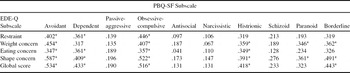
Bivariate correlational analyses were used to investigate associations between the PBQ-SF and the EDE-Q scores at session one (N = 57, using complete data sets only). Non-parametric (Spearman's rho) tests were used due to two subscales (the PBQ-SF antisocial subscale and the EDE-Q weight concern subscale) violating normality (Kolmogorov-Smirnov tests). As a large number of correlations were involved in these analyses, the alpha level was set at 0.01, in order to reduce the chance of Type I errors. The correlations are shown in Table 3.
Bivariate associations (Spearman's rho) of personality disorder cognitions and eating disorder attitudes at session one (N = 57)

* p < .01 (two-tailed)
Eating disorder attitudes were most strongly associated with cognitions related to cluster C, anxiety-based personality disorders. Both the avoidant and the obsessive-compulsive personality disorder cognitions subscales were significantly correlated with all EDE-Q subscales. The dependent personality disorder cognitions subscale was significantly positively correlated with all EDE-Q subscales except the weight concern subscale. Among the cluster B personality disorders, the histrionic personality subscale was significantly positively correlated with all EDE-Q subscales except the restraint subscale, and the borderline personality disorder cognitions subscale was significantly associated with the EDE-Q weight concern and shape concern subscales and with the EDE-Q global score. The remaining PBQ-SF subscales had no significant associations with any of the EDE-Q scales.
Personality disorder cognitions and drop out from treatment
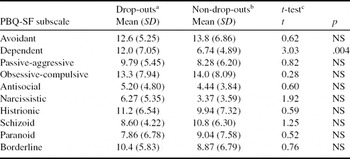
Prior to investigating associations between personality disorder cognitions and drop out from treatment, eating disorder attitudes were investigated as a potential confounding variable. Independent t-tests revealed no significant differences in session one EDE-Q scores between those who did (N = 15) or did not (N = 36) drop out of treatment prematurely. Therefore, the remaining analyses did not include eating attitudes. Table 4 shows the PBQ-SF subscale scores for those who remained in treatment and those who dropped out of treatment prior to session seven of CBT. There was only one significant difference between the two groups – those who dropped out of treatment prematurely had significantly higher levels of dependent personality disorder cognitions.
Personality disorder cognitions (PBQ-SF subscales) and drop out from treatment

Notes: NS = not significant (p > .05); a Drop-outs N = 15; b Non-drop-outs N = 36 (please note an additional 8 participants were not included in this analysis as they had not yet reached session six of CBT); c All t-values above assume equal variances, except for the Narcissistic subscale
Change in eating disorder attitudes over the first six sessions of CBT
Paired samples t-tests showed that there were significant reductions in all EDE-Q scores between sessions one and six of CBT (t > 3.1, p < .005 in all cases). This was also the case when non-parametric Wilcoxon tests were used, given the non-normal distribution of the weight concern subscale. The mean paired scores for the two time points were as follows: restraint T1 = 3.32 (SD = 1.95), T2 = 2.32 (SD = 1.50); weight concern T1 = 3.54 (SD = 1.61), T2 = 2.93 (SD = 1.62); eating concern T1 = 3.28 (SD = 1.71), T2 = 2.06 (SD = 1.28); shape concern T1 = 3.87 (SD = 1.71), T2 = 3.37 (SD = 1.56); and global score T1 = 3.50 (SD = 1.50), T2 = 2.67 (SD = 1.27). Considering Fairburn et al.'s (Reference Fairburn, Cooper, Doll, O'Connor, Bohn and Hawker2009) criteria for recovery over the course of CBT, it is noteworthy that the mean EDE-Q scores for the clinical group at session six of CBT had all moved from clinical levels to within one standard deviation of the mean for a normative non-clinical group (Mond, Hay, Rodgers and Owen, Reference Mond, Hay, Rodgers and Owen2006).
Associations between initial personality disorder cognitions and change in eating attitudes over the first six sessions of CBT
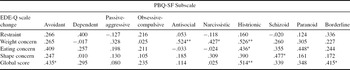
Table 5 shows the results of correlations (Spearman's rho) between PBQ-SF subscales at session one and subsequent change in eating disorder attitudes between sessions one and six of CBT (N = 24). There were significant associations between change in EDE-Q global score and three PBQ-SF subscales – avoidant, histrionic and borderline. Considering the EDE-Q subscales, no PBQ-SF scales were associated with changes in levels of restraint, and only PBQ schizoid scale scores were associated with changes in shape concern levels. The PBQ-SF histrionic and paranoid scales were associated with change in eating concerns, and histrionic, narcissistic and antisocial personality disorder cognitions were associated with changes in weight concerns. No other correlations were significant. In each case, the direction of the correlation indicated that higher levels of personality disorder cognitions were associated with a greater reduction in eating disorder attitudes (EDE-Q global score) between sessions one and six of CBT.
Bivariate associations (Spearman's rho) of personality disorder cognitions at the outset of treatment and change in eating disorder attitudes between sessions 1 and 6 (N = 24)

* p < .05; ** p < .01
Discussion
This study has examined the impact of personality disorder cognitions on early cognitive changes during CBT for the eating disorders. This is a novel approach to understanding the factors that might moderate the effect of evidence-based CBT for the eating disorders. Levels of personality disorder cognitions did not differ between diagnostic subgroups (Connan et al., Reference Connan, Dhokia, Haslam, Mordant, Morgan and Pandya2009). As shown by Connan et al. (Reference Connan, Dhokia, Haslam, Mordant, Morgan and Pandya2009), eating disorder attitudes were most strongly associated with cognitions reflecting the anxiety-based cluster C personality disorders (avoidant, obsessive-compulsive, dependent). This conclusion is in keeping with the comorbidity between eating disorders and anxiety disorders (e.g. Kaye, Bulik, Thornton, Barbarich and Masters, Reference Kaye, Bulik, Thornton, Barbarich and Masters2004; Swinbourne and Touyz, Reference Swinbourne and Touyz2007), and the suggestion that the two share a common core cognitive and behavioural pathology (Waller, Reference Waller2008). It also supports the work of Sansone et al. (Reference Sansone, Levitt and Sansone2005, Reference Sansone, Levitt, Sansone, Sansone and Levitt2006), who demonstrated that avoidant personality disorder is among the most commonly comorbid personality disorders in the eating disorders.
The first aim of the study was to investigate whether personality disorder cognitions at the beginning of treatment are associated with drop-out from the early stages of CBT for eating disorders. Patients who dropped out of treatment prior to session seven had significantly higher levels of dependent personality disorder cognitions than those who remained in treatment (rather than the borderline features that have been suggested to be relevant to drop-out – e.g. Bell, Reference Bell2001). This finding does not appear to be in keeping with the “submissive” and “clinging” behaviours of those with dependent personality disorder (American Psychiatric Association, 1994). It has been suggested that such individuals’ reliance on others might be expected to make them easy to engage and cooperative at the beginning of therapy (Beck et al., Reference Beck, Freeman, Davis and Associates2004). This unexpected finding might reflect the nature of CBT for the eating disorders, with its emphasis on encouraging the patient to take an active role in therapy from the first session (Waller et al., Reference Waller, Cordery, Corstorphine, Hinrichsen, Lawson and Mountford2007). Dependent personality disorder cognitions might result in the individual finding this approach challenging. If such individuals look to the therapist to solve their problems (Beck, Reference Beck2005), then the nature of the CBT approach might result in their disengagement from treatment.
The second aim was to determine whether personality disorder cognitions are associated with change in eating disorder attitudes over the first six sessions of CBT. Such attitudes improved over the first six sessions, lending support to previous findings that CBT has a rapid onset of action in terms of reducing eating disorder symptoms (Wilson et al., Reference Wilson, Loeb, Walsh, Labouvie, Petkova and Liu1999; Wilson, Fairburn, Agras, Walsh and Kraemer, Reference Wilson, Fairburn, Agras, Walsh and Kraemer2002). Indeed, over the first six sessions the mean EDE-Q global score for the sample was reduced to within one standard deviation of the community mean (Mond et al., Reference Mond, Hay, Rodgers and Owen2006). Three specific personality disorder cognition subscales were significantly associated with this early change in global eating disorder attitudes (although the pattern differed across EDE-Q subscales). Higher levels of histrionic, avoidant and borderline personality disorder cognitions were associated with a greater reduction in eating disorder attitudes over these first six CBT sessions. There are a number of possible explanations for these findings, including the possibility that patients with these cognitions report inflated levels of eating attitudes at the first session due to their anxiety levels, with those levels reducing more for such patients as they engage in therapy. However, a viable clinical explanation of these findings might be that these patients actually do improve in their eating attitudes, due to their responding to the boundaries provided by the goals and tasks of CBT. In other words, patients with relatively anxious or impulsive styles might find the structure of CBT to be containing of their drive to respond emotionally and behaviourally, allowing more predictability and reducing the sense of vulnerability associated with change. This is in keeping with the finding from a separate set of anorexic patients (Lockwood, Serpell and Waller, Reference Lockwood, Serpell and Waller2012) that anorexia nervosa sufferers with higher levels of anxious features are more likely to remain in therapy than those with low levels of anxiety. Future research should address the issue of whether other characteristics such as anxiety and depression moderate the impact of CBT upon eating attitudes.
These findings suggest that the PBQ-SF is a useful tool when assessing the pathology of patients entering CBT for the eating disorders, as it can be used to anticipate the likelihood that patients will remain in and benefit from the early part of treatment. Within the CBT model, such personality disorder cognitions can be used to understand how eating disorder symptoms are being maintained, thus directing treatment. However, such conclusions need to be considered in light of the study's limitations. The numbers were relatively small, meaning that the study might have been underpowered. Future work will need larger samples to determine whether these correlational findings hold true for different diagnostic subgroups and for different therapies, or whether further significant results emerge with a greater number of participants. Such studies should also consider the possibility that interview-based measures of personality pathology would be more effective as a predictor of outcome than self-report measures. It is also important to note that, although the data were prospective in nature, the exploratory nature of this study makes it inappropriate to draw causal connections. Furthermore, the sample included only one male and consisted of adults from a limited range of ethnic backgrounds, and therefore the conclusions are limited in their generalizability to males and to individuals from different ethnic backgrounds. It is unlikely that there will be inter-therapist differences in outcomes and drop-out rates, as such differences have not been found in CBT outcome studies (e.g. Loeb et al., Reference Loeb, Wilson, Labouvie, Pratt, Hayaki and Walsh2005; Wilson et al., Reference Wilson, Loeb, Walsh, Labouvie, Petkova and Liu1999), but this point might be investigated further with a larger sample. It will also be necessary to explore the reasons for drop-out, as those reasons will vary across individual patients. Finally, it has been hypothesized that anxiety and impulsivity might be key mechanisms underpinning the effects of these cognitions. However, future work might examine other types of cognition and related emotional states that merit such attention, and whether those cognitions and emotions have different impacts within different therapies.



Comments
No Comments have been published for this article.