Introduction
Many researchers have argued that children become better able to read or acquire literacy skills as they become more sensitive to the component sounds in words and as they learn to understand letter–sound correspondence, especially for alphabetic writing systems (Bialstok, Majumder, & Martin, Reference Bialystok, Majumder and Martin2003; Wang, Park, & Lee, Reference Wang, Park and Lee2006). Since most research has been based on the role of phonological awareness (PA) in reading development, relatively less attention has been given to identifying the language variables that explain PA.
Interest in the PA skills of bilingual children is now receiving serious attention with the predominance of bilingualism among the world's population. Bilingualism can be defined differently according to both the timing and the degree of children's bilingual exposure or input (Kim, Park, & Lust, Reference Kim, Park and Lust2018). Some children receive simultaneous exposure from birth to both languages in their home environment, which is referred to as simultaneous bilingualism, whereas other children have been successively first exposed to their first language at home, and then exposed to a second language later, which is referred to here as successive bilingualism (Tabors, Reference Tabors1997). Research in the field of successive bilingualism has tended to use the term bilingual loosely to describe any child exposed to more than one language (Loizou & Stuart, Reference Loizou and Stuart2003); thus, we have opted to use the term in this sense in this study.
In general, studies have predicted that young bilingual children exposed to more than one language would perform better on PA tasks than monolingual children (Campbell & Sais, Reference Campbell and Sais1995; Kang, Reference Kang2012). The effects of bilingualism on PA have provided evidence of a cross-language PA transfer theory in which the knowledge and skills associated with PA in one language can be transferred to a second language (Cisero & Royer, Reference Cisero and Royer1995; Cummins, Reference Cummins1979; Kou, Uchikoshi, Kim, & Yang, Reference Kuo, Uchikoshi, Kim and Yang2016; Lopez & Greenfield, Reference Lopez and Greenfield2004; Sun-Alperin & Wang, Reference Sun-Alperin and Wang2011).
To date, researchers have been attempting to identify factors related to the PA development of bilingual children with various language combinations, and they have mostly focused on bilinguals of two languages that share many linguistic, phonological, and orthographical characteristics. Relatively less effort, however, has been exerted to explain PA relationships between typologically different languages. Therefore, the present study seeks to explore the development of Korean PA and English PA for Korean preschoolers in the initial stage of learning English as a second language. Although Korean and English share a fundamental alphabetic principle – specifically, graphemes in both languages correspond to phonemes – Korean, with its non-Roman alphabet, has unique characteristics (Wang et al., Reference Wang, Park and Lee2006).
The Korean language has been referred to as an alphabetic syllabary (Taylor & Taylor, Reference Taylor and Taylor1995); it comprises 14 basic consonants and 10 basic vowels, and the syllable represents both the entire syllabic structure and its phonemic components (Cho & McBride-Chang, Reference Cho and McBride-Chang2005). Each Korean letter represents a phoneme much like letters in English, and the Korean language has a relatively transparent orthography with consistent grapheme–phoneme mappings, also known as a shallow orthography. Individual phonemes are grouped into syllables and words. The syllabic structures of Korean occur most commonly in either a consonant–vowel structure or a consonant–vowel–consonant structure, which is fairly simple compared to that in English. Thus, both phonemes and syllables are important phonological units (Coulmas, Reference Coulmas2003). No consonant clusters occur at the syllable onset. In Korean, each syllable in multisyllabic words is equally stressed, and there are clear syllable boundaries within words because of its separated syllable block arrangement (Cho & McBride-Chang, Reference Cho and McBride-Chang2005).
Furthermore, most studies have shown that children's vocabulary knowledge is related to PA, so that PA emerges primarily as children acquire increasing number of words (Chaney, Reference Chaney1994; Kang, Reference Kang2012; Metsala, Reference Metsala1999; Metsala & Walley, Reference Metsala, Walley, Metsala and Ehri1998). However, not much is known about whether a similar effect of vocabulary growth on PA development still holds for overall oral language skills. The level of receptive and expressive skills may act as a powerful catalyst for PA learning. Therefore, in the current study, we examined the contributions of the native receptive and expressive language skills, encompassing the properties of phonology, morphology, and syntax, to the relationship between the PA of a native language and the PA of a second language.
Phonological awareness and developmental properties of Korean
Phonological awareness, defined as an individual's ability to recognize that spoken words comprise smaller units of sound, is a complex metalinguistic construct for children. Numerous studies have shown that children's development of PA units follows a sequence from large units of sound to small units (Stahl & Murray, Reference Stahl and Murray1994; Treiman & Zukowski, Reference Treiman and Zukowski1996). Further, this sequence is universal across languages (Treiman, Reference Treiman1987). In other words, awareness of larger units, such as words and syllables, develops earlier than awareness of smaller units, such as onset–rhymes and phonemes. Studies have revealed a clear developmental hierarchical progress in acquiring PA skills, starting with early rhyming and word play, progressing to onset–rhyme tasks, and culminating in phoneme-level tasks (Chaney, Reference Chaney1992; Treiman & Zukowski, Reference Treiman and Zukowski1996).
Under the three nested levels of PA awareness – syllable awareness, onset–rhyme awareness, and phoneme awareness (Treiman & Zukowski, Reference Treiman and Zukowski1996) – a number of studies have illustrated that the saliency of the onset–rhyme unit exists in English as well as in other Indo-European languages, including Swedish, German, and Dutch (Goswami, Reference Goswami1991; Stahl & Murray, Reference Stahl and Murray1994). Although McBride-Change and colleagues (Reference McBride-Chang, Cho, Liu, Wagner, Shu, Zhou, Cheuk and Muse2005) indicated that explicit awareness of syllables, rhymes, and phonemic skills has often been considered a single indicator of phonological sensitivity, some research over the past decade has provided evidence that onset–rhyme awareness is not universal (Ziegler & Goswami, Reference Ziegler and Goswami2005).
Korean children show certain patterns of the developmental properties of PA. In other words, Korean children initially show evidence of syllable awareness as early as age three, and they learn to combine consonants and vowels to form syllables at age four. Later, around age five, they tend to form the sound structures of final consonants using open syllables, and most of them have acquired grapheme–phoneme correspondence rules quite well by age six (Cho, McBride-Chang, & Park, Reference Cho, McBride-Chang and Park2008). Early sensitivity to phoneme codas is considered as a hallmark of Korean children's PA development (Yoon, Bolger, Kwon, & Perfetti, Reference Yoon, Bolger, Kwon, Perfetti, Verhoeven, Elbro and Reitsma2002).
For the Korean language, it has been hypothesized that a distinct phonotactic and phonological structure exists that is highly sensitive to the body unit, illustrating that a body–coda structure (CV/C; e.g., segmenting cat into ca-t) is more accessible than an onset–rhyme structure (C/VC; e.g., segmenting cat into c-at) for Korean speakers (Kim, Reference Kim2007; Yoon & Derwing, Reference Yoon and Derwing2001). Consequently, it is plausible for Korean children to acquire a phonological developmental tendency to organize or segment a syllable into a body–coda structure rather than an onset–rhyme structure. Kim (Reference Kim2009a), for instance, examined 33 Korean–English bilingual kindergartners in the United States who were divided into two immersion groups in Korean–English bilingual programs. One group was born in Korea and had spent only a few years in the United States. This group was identified as Korean-dominant. The other group comprised students born in the United States but whose first language was Korean, as reported by their parents. Both groups received instruction in both English and Korean, and Korean and English PA tasks were administered. The results showed that the children in different programs varied in their accessibility to intrasyllabic PA. Regarding onset–rhyme awareness vs. body–coda awareness, Korean–English bilingual children born in Korea performed better in the body–coda unit than in the onset–rhyme unit using blending and segmenting tasks. In addition, body–coda awareness, but not onset–rhyme awareness, was positively associated with their English PA. These results indicate that a language-specific phonological property can be reflected in the case of Korean children's understanding of PA.
Cross-language transfer of phonological awareness
It is well established that PA skills can transfer across languages at an early age. Theoretical models (Cummins, Reference Cummins1979; Ziegler & Goswami, Reference Ziegler and Goswami2005) and a number of studies (Branum-Martin et al., Reference Branum-Martin, Mehta, Fletcher, Carlson, Ortiz, Carlo and Francis2006; Gottardo & Mueller, Reference Gottardo and Mueller2009) have provided evidence for the significance of including first-language measures in determining the predictors of second-language development. Specifically, Cummins's (Reference Cummins1979) linguistic interdependence model suggests that skills learned in L1 will aid in developing skills in L2. Simply stated, the degree of L1 PA competency affects the level of PA competency in L2. Other research has also provided evidence of the cross-language transfer of PA (Chen, Xu, Nguyen, Hong, & Wang, Reference Chen, Xu, Nguyen, Hong and Wang2010; Cisero & Royer, Reference Cisero and Royer1995; Durgunoğlu, Nagy, & Hancin-Bhatt, Reference Durgunoğlu, Nagy and Hancin-Bhatt1993; Loizou & Stuart, Reference Loizou and Stuart2003; Sun-Alperin & Wang, Reference Sun-Alperin and Wang2011).
Phonological awareness is a complex metalinguistic construct for children who are learning a second language (Chen et al., Reference Chen, Xu, Nguyen, Hong and Wang2010). Despite accumulated evidence to support the association between L1 PA and L2 PA among second-language learners (Dixon, Zhao, & Joshi Reference Dixon, Zhao and Joshi2010; Gottardo & Mueller, Reference Gottardo and Mueller2009; Kang, Reference Kang2012; Uchikoshi, Reference Uchikoshi2013; Wang et al., Reference Wang, Park and Lee2006), controversial issues persist, indicating that only when the two languages share the same writing system may PA be transferred (Bialystok, McBride-Chang, & Luk, Reference Bialystok, McBride-Chang and Luk2005). In contrast, a language-general property, especially for PA, can also be represented despite seemingly distant orthographic and phonological properties of the two different languages. This observation holds mostly true for the robust and universal cross-language transfer effects of PA from various first languages to bilingual English: Italian and English (D'Angiulli, Siegel, & Serra, Reference D’Angiulli, Siegel and Serra2001), Spanish and English (Cisero & Royer, Reference Cisero and Royer1995), and Chinese and English (Chen et al., Reference Chen, Xu, Nguyen, Hong and Wang2010). Cisero and Royer (Reference Cisero and Royer1995), for example, examined the longitudinal effect of cross-language transfer in PA in a sample of Spanish–English bilingual kindergarteners and first-grade children by assessing rhyme detection and initial and final phoneme detection, and they showed that phoneme detection in Spanish was significantly related to phoneme detection in English. In addition, a study performed by Chen and colleagues (Reference Chen, Xu, Nguyen, Hong and Wang2010) assessed the effects of cross-language transfer on the development of PA among Chinese children who received different amounts of English instruction. Their results illustrated that Chinese PA skills were associated with English PA skills for a mixed group of Chinese-speaking students from grades 1 to 8 who were English-language learners.
More recently, this strong facilitation from L1 to L2 phonology has also been evidenced in research on Korean-speaking children learning English as a second language. For instance, Kang (Reference Kang2012) investigated PA skills for both five- and six-year-old monolingual Korean-speaking children attending a regular Korean-medium kindergarten, and for Korean–English bilingual children attending English immersion kindergartens in which English was the only medium of instruction. For the bilingual children, English was a second language, and their exposure to this language lasted at least 2 years for approximately 5 hours per day. The study illustrated that there was a phonological processing transfer in L1 and L2 for both monolingual and bilingual children. Moreover, Wang and colleagues (Reference Wang, Park and Lee2006) similarly showed that PA skills when Korean was spoken as a first language were strongly correlated with those when English was spoken as a second language in a sample of five-year-old Korean–English bilingual children.
Influence of oral language skills on PA
Children's development of phonological processing skills has been suggested to be influenced by the acquisition of vocabulary. The lexical restructuring model was originally proposed by Metsala and Walley (Reference Metsala, Walley, Metsala and Ehri1998) to explain how vocabulary growth results in spoken word recognition. From this perspective, words are represented in the lexicon holistically, after which detailed phonological characteristics are restructured to enable children to represent smaller phonological segments of words, such as syllables, rhymes, and, finally, individual phonemes, all resulting from vocabulary growth in children (Kang, Reference Kang2012; Scarpino, Lawrence, Davison, & Hammer, Reference Scarpino, Lawrence, Davison and Hammer2011). As a result, studies supporting the lexical restructuring model have attributed the development of PA among monolingual children to the sizes of their vocabularies (Chaney, Reference Chaney1992, Reference Chaney1994; Cho & McBride-Chang, Reference Cho and McBride-Chang2005; Lonigan, Burgess, Anthony, & Barker, Reference Lonigan, Burgess, Anthony and Barker1998; Metsala, Reference Metsala1999; Metsala & Walley, Reference Metsala, Walley, Metsala and Ehri1998).
Some studies have addressed the role of vocabulary knowledge in performing PA tasks across languages, and this role also draws upon the facilitation of contextual language variability in the acquisition of phonology (Dickinson, McCabe, Clark-Chiarelli, & Wolf, Reference Dickinson, McCabe, Clark-Chiarelli and Wolf2004; Sun-Alperin & Wang, Reference Sun-Alperin and Wang2011). Dickinson and colleagues (Reference Dickinson, McCabe, Clark-Chiarelli and Wolf2004), for instance, demonstrated that the performance on Spanish and English receptive vocabulary tasks was significantly correlated with PA skills in Spanish, and another study performed by Sun-Aplerin and Wang (Reference Sun-Alperin and Wang2011) also illustrated that both Spanish and English vocabulary abilities were associated with PA tasks within and across languages for Spanish-speaking children learning English.
Empirical evidence of the association of children's oral language skills with PA development has been sparse, particularly relative to the many studies on the association of their vocabulary knowledge with PA development. Therefore, research using a proposed lexical restructuring model in which vocabulary is learned in the context of rich oral language exposure should be extended somewhat further. In other words, examining the contributions of overall native language skills on the relationship between L1 PA and L2 PA must be considered in greater detail. Lopez and Greenfield (Reference Lopez and Greenfield2004), for instance, argued that English PA was significantly related to PA in Spanish as well as to both English- and Spanish-language proficiency, and they concluded that, in addition to Spanish PA, English-language proficiency is an important predictor of English PA for children aged three to five.
The development of receptive and expressive language skills specifically, encompassing the properties of phonology, morphology, and syntax, emerges through rich spoken language experience. Oral language skills, in a broad sense, could be strongly related to PA development such that, in richer and more language-variable contexts, native language skills can enable children to distinguish similar-sounding words and to re-represent the phonological segmentation of these words to differentiate them. However, thus far, studies on this topic have been relatively scarce. Furthermore, although extant studies have addressed PA development across languages, few have focused on how L1 receptive and expressive language skills interact with preschools’ L1 PA, finally leading to L2 PA development. Hence, our interest is the extent to which phonological processing skills in one language are transferred to another language and the contribution of L1 receptive and expressive language skills in facilitating PA emergence in both languages.
Most research has also found that bilinguals scored higher than monolinguals in several PA tasks in circumstances in which bilingual children have experience with an additional language with one of the following features: simpler or more regular phonological structures (e.g., Campbell & Sais, Reference Campbell and Sais1995); more prominent segmental units (e.g., Kang, Reference Kang2012); or an alphabetical writing system (e.g., Kim, Reference Kim2009a). However, little is known about whether these findings hold for children who have just begun learning another language with different levels of transparency. As a result, more research is needed to determine whether these results apply to novice second-language-learning children whose two languages do not share much in terms of typological and phonological systems. In addition, previous research has been conducted primarily with school-aged children.
The primary goal of the current study was to extend the current literature by examining the relationship between Korean PA and English PA among Korean preschool children in the initial stage of learning English as a second language. Thus far, there have been few comprehensive studies of PA in Korean, and none of them has focused extensively on the measurement characteristics of the tasks. The current study might be a unique consideration of the relationship of PA transfer in L1 and L2 in processing two phonologically and orthographically different languages. Finally, we also expect that Korean language skills, particularly receptive language skills and expressive language skills, would moderate the association between Korean PA and English PA. The results of this study lead to the interesting prediction that children with high Korean language skills will perform well in Korean PA and that PA skills from the first language will contribute to the successful acquisition of English PA.
Methodology
Participants
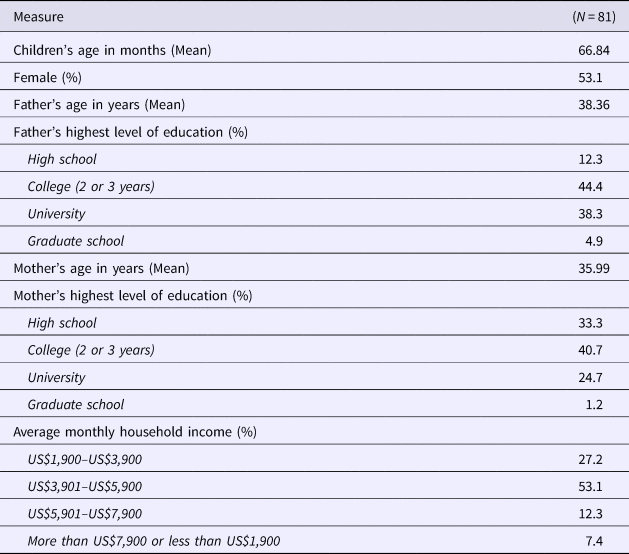
Forty-eight five-year-olds (M months= 62.40, SD = 3.694) and 33 six-year-olds (M months= 73.43, SD = 2.534) participated in the current study. All participants were native speakers of Korean, and none of the children had speech, language, hearing, or cognitive problems, as reported by their parents. Only those children whose parents granted consent were included in the study. The Korean monolingual participants were recruited from three preschools located in Seoul, the capital city of South Korea, and Gyeonggi Province, the second largest metropolitan area surrounding Seoul. They were mainly from middle-class backgrounds. Parents were asked to fill out a short questionnaire giving basic demographic information, as shown in Table 1. None of the participants had lived abroad, and all reported speaking only Korean at home.
Demographic characteristics of participants

Although all three preschools provide different English lessons as a standard extracurricular activity, all instruction and activities were conducted in Korean and were led by Korean natives who learned English as a second language. English lessons offered in those three preschools have this in common: they basically involve students watching short video clips, learning English songs, nursery rhymes, and short formulaic expressions, as well as being read short stories for 30 minutes three times a week. At the same time, according to parental reports, data related to how much time they make their children watch or listen to English story-telling, singing or chanting, and other activities at home were reported as follows: not at all (32.5%), no more than one hour (35.0%), one to two hours a week (20.0%), more than two hours (12.5%).
In general, there are in South Korea English kindergartens or private English institutions in which English is used as a medium of instruction, and all activities are conducted in English by native English speakers. However, they are not part of the public school system, and English is not introduced into the formal curriculum until the third grade in elementary schools. An additional 39 children were tested but excluded from the final sample because they were reported by their parents as receiving some form of English education through English tutors or private English institutions. Therefore, the children in this study were those who never used English for conversational purposes and were in the initial stage of learning English as a second language compared to children attending English immersion programs.
Measures
Korean receptive and expressive language skills
Korean receptive and expressive language skills were measured using the Preschool Receptive-Expressive Language Scale (PRES; Kim, Seong, & Lee, Reference Kim, Seong and Lee2003). PRES is a norm-referenced oral language proficiency assessment, developed for children from two to six years of age in South Korea, utilizing a convergent approach to measure and assess two categories: receptive and expressive language skills. It comprises carefully constructed instruments standardized on a large number of children. The receptive subtests include 45 items that assess children's comprehension of basic vocabulary; quantitative, qualitative, and spatial concepts; morphological and syntactic structures; and inferencing and categorizing. In addition, the remaining 45 expressive items instruct children to label and define words, explain the functions of words presented by the experimenter, judge the grammaticality of sentences and correct grammatical errors, or describe certain events using productive syntax and semantic verbal responses. The total raw scores were converted into standard scores based on age. It was reported that test–retest reliability was .78 to .91.
Korean and English phonological awareness tasks
Phonological awareness tasks for both Korean and English were administered. Because standardized PA measures are not yet available, all of the Korean measures used in this study were adapted from previous studies (Kim, Reference Kim2008; Pae, Sevcik, & Morris, Reference Pae, Sevcik and Morris2010), and a modified version of the tasks was constructed retaining items that were applicable (‘Appendix A’; see Supplementary materials for the stimuli used, available at < https://doi.10.107/S0305000919000229>). English PA measures were similarly adapted from previous studies (Lopez & Greenfield, Reference Lopez and Greenfield2004; Pae et al., Reference Pae, Sevcik and Morris2010) and were constructed so as to form a parallel instrument to the one in Korean based on phonological units, including onset–rhyme, initial phoneme, and final phoneme awareness (‘Appendix B’; see Supplementary materials for the stimuli used, available at < https://doi.10.107/S0305000919000229>). Although PA abilities can be tested using various subtests, such as segmenting words, blending words, deleting sounds, or detecting a phoneme oddity, previous research has indicated that the detection tasks could indicate a single fundamental ability largely responsible for performance on all tasks (Branum-Martin et al., Reference Branum-Martin, Mehta, Fletcher, Carlson, Ortiz, Carlo and Francis2006; Lonigan et al., Reference Lonigan, Burgess, Anthony and Barker1998; Yopp & Yopp, Reference Yopp and Yopp2000). As a result, one can reliably use the measures of detection tasks in preschool samples because they are the fundamental skills required to acquire PA abilities, as well as the least complex PA tasks.
Both Korean and English PA tasks were designed to assess different types of phonological units: a total of 10 items for Korean onset–rhyme awareness and 16 items for English onset–rhyme awareness; 10 items for Korean initial phoneme awareness and 10 items for English initial phoneme awareness; 10 items for Korean final phoneme awareness and 10 items for English final phoneme awareness. An additional 10 items for the body–coda awareness task were also included in the measure of Korean PA tasks to determine the ability to differentiate body structure, which exists specifically in the Korean language. The Cronbach's alpha internal consistency reliability for the Korean onset–rhyme detection task was .81, while for the English onset–rhyme detection task it was .79; for the Korean initial phoneme detection task, it was .84, while for the English initial phoneme detection task, it was .82; for the Korean final phoneme detection tasks, it was .80, while for the English final phoneme detection task, it was .78; and for the Korean body–coda detection task, it was .84.
Specifically, in onset–rhyme detection, the child heard three words, two of which rhymed, and the child was then asked to identify the word that did not rhyme with the other two words (e.g., eye, sky, whale). For the body–coda trial, the child heard three words, two of which had the same body structure, and the child was then asked to identify the word that did not share the body with the other two (e.g., /kaŋ/, /kam/,/mul/). Initial and final phoneme detection tasks were the same as the onset–rhyme and body–coda tasks, except that the words had to be categorized by their beginning phoneme sounds (e.g., hill, pig, pin) and their final phoneme sounds (e.g., sing, son, king).
The stimuli in each task consisted of recordings of both an English native speaker and a Korean native speaker in their 20s pronouncing all of the examples. The recording voice tone and pitch were adjusted consistently using a digital audio editor program. After recording all of the stimuli, each set of three words was repeated three times with a time interval of 2 s among the three words and an interval of 5 s between each pair of items. This time interval was sufficient to allow participants to respond. To reduce memory demands, the children had three number signs on their desks, each corresponding to ‘1’, ‘2’, and ‘3’. The numbers were printed in black in a square measuring approximately 30 cm with a white background. The experimenter pointed to the written number cards from 1 to 3 in a row, at the time when the children heard a set of three exemplars, after which they were required to choose one of the numbers that did not share the rhyme, body, initial phoneme, or final phoneme. Therefore, the participants were not asked to sound the words aloud. Two practice items were provided for each task for which they received feedback when their answer choices were incorrect. The real test items followed immediately, and the children were not provided with any feedback for incorrect answers. Each set of subtests was terminated following five consecutive errors, and each correct answer was awarded one point.
Verbal and non-verbal intelligence
Children's verbal and non-verbal intelligence was assessed using the Korean-Wechsler Preschool and Primary Scale of Intelligence (K-WPPSI; Park, Kwak, & Park, Reference Park, Kwak and Park1995), a standardized intelligence test designed for Korean children who are three to seven years old. Two subtests of verbal and non-verbal intelligence were administered to minimize children's fatigue in performing several intelligence tasks (Nuske & Bavin, Reference Nuske and Bavin2010). The verbal intelligence subtest required them to define or explain pictures of objects and concepts. Moreover, the non-verbal intelligence subtest, using two-dimensional, flat, red-and-white blocks, required them to reproduce either a model constructed by the examiner or a pictured design. The test was designed to measure children's ability to analyze and reproduce abstract visual stimuli. These subtests have high reliability (r = .91) and are correlated highly with full-scale intelligence (r = .86) across a broad range of ages (Sattler & Ryan, Reference Sattler and Ryan1999). It was reported that split-half reliability coefficients for K-WPPSI subtests generally averaged between .80 and .89.
Procedures
All of the tests were administered in a quiet area at the preschool. The children were tested twice, separated by an interval of 1 or 2 weeks to avoid practice effects. Each child was tested individually, and each session lasted approximately 35–40 minutes. During the first test session, all of the children were initially administered the two subtests of verbal and non-verbal intelligence followed by either a Korean PA task or an English PA task. During the second test session, the children were required to take the Korean language skills test, followed by one of the remaining Korean PA or English PA tasks. The order of the tests was counterbalanced across and within the preschool and the children.
Results
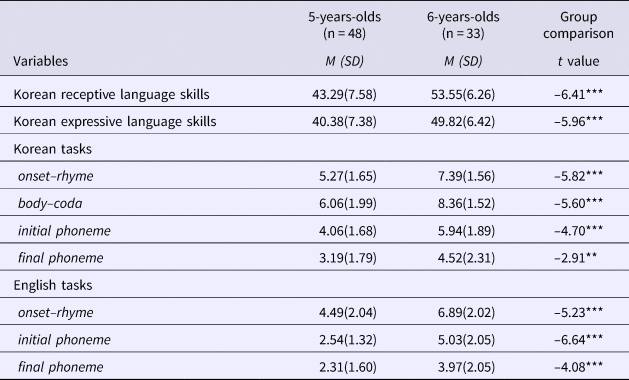
Means and standard deviations of the main study variables by age are presented in Table 2. Overall, the results revealed that the children's performance, not only in tasks of Korean receptive and expressive language skills but also in tasks of Korean and English PA, significantly increased with age on all of the measures (p value for t-tests of group difference were all < .01). The gender of the children was originally considered, but because boys and girls did not differ in the mean levels of any of the study variables, the effect of gender differences was trimmed in the model. For space reasons, the results are not shown in Table 2. Next, with regard to different phonological units of PA tasks within language, the children performed better on the body–coda unit than on the onset–rhyme unit of Korean PA tasks, and they scored highest on the onset–rhyme unit of English PA tasks. The scores on the initial phoneme and final phoneme units followed next for both Korean and English PA tasks.
Means, standard deviations (SD), and t-tests for differences between five-year-old and six-year-old children for the variables

Notes. All means for Korean PA and English PA tasks represent the score on a 10-point scale; English onset-rhyme, originally the total score of 16, was also converted into the score of a 10-point scale; ** p < .01; *** p < .001.
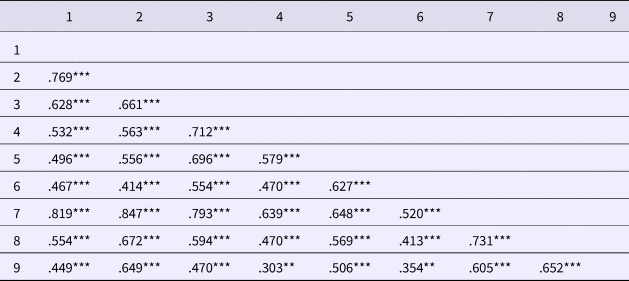
For preliminary analyses, two separate sets of correlations, one for children aged five and one for children aged six, were performed. The results showed similar patterns among variables between age groups, and thus the data were pooled together in the subsequent correlation and regression analyses to increase the power of analyses by having a larger sample size. Table 3 presents a correlation matrix partialling out the influence of age, and the study variables were significantly correlated with one another. Background factors, such as the mother's and father's age and educational attainment, as well as total household monthly income, were not significantly associated with the outcomes; therefore, these variables were not used in subsequent analyses.
Correlations among study variables controlling for age

Notes. 1. Korean receptive language skills; 2. Korean expressive language skills; 3. Korean onset–rhyme; 4. Korean body–coda; 5. Korean initial phoneme; 6. Korean final phoneme; 7. English onset–rhyme; 8. English initial phoneme; 9. English final phoneme ** p < .01; *** p < .001.
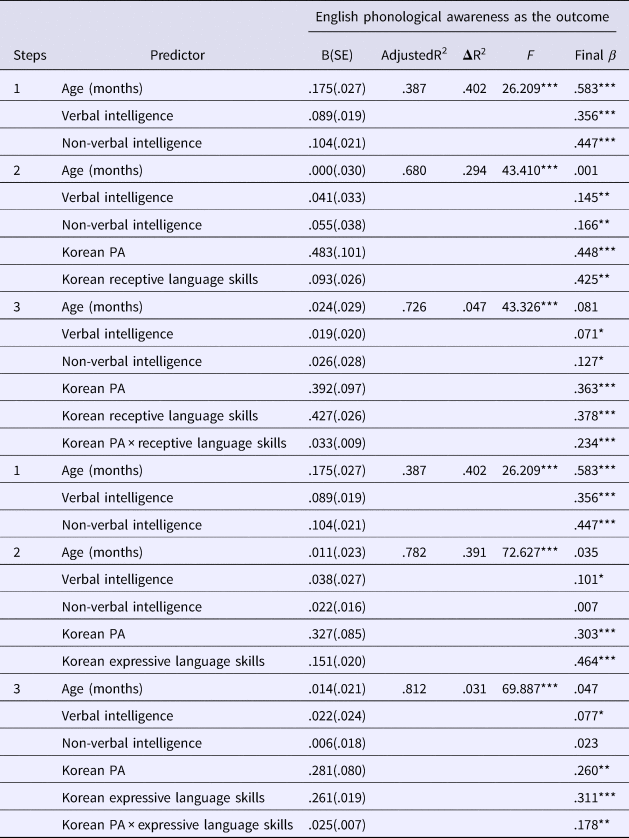
Two hierarchical regression analyses were computed separately to test for evidence of the moderating effect of Korean receptive and expressive language skills on the relationship between Korean PA and English PA. Prior to the analyses, all continuous independent variables were mean centered to reduce multicollinearity (Aiken & West, Reference Aiken and West1991). The total scores of each subtest of Korean and English PA were collapsed into single variables. This score was then used to evaluate the young children's Korean and English PA skills. All analyses were run first with age, verbal, and non-verbal intelligence included as covariates to investigate the relations between study variables above and beyond preschoolers’ age and verbal and non-verbal abilities. For the interaction, post-hoc analyses to examine significant simple slopes were performed (Aiken & West, Reference Aiken and West1991).
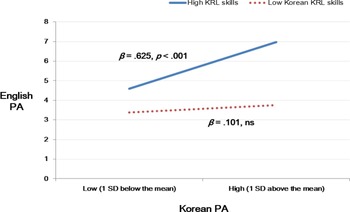
First, the result of the hierarchical regression analysis examining the moderating effect of Korean receptive language skills on the relationship between Korean PA and English PA is represented in Table 4 (upper panel). In step 1, children's age (β = .583, p < .001), verbal intelligence (β = .356, p < .001), and non-verbal intelligence (β = .447, p < .001) were shown to be significantly associated with English PA. In step 2, there were main effects for both Korean PA (β = .448, p < .001) and Korean receptive language skills (β = .425, p < .001) on English PA after controlling for children's age, verbal and non-verbal intelligence, and these explained an additional 29.4% in the variance of children's English PA. Last, the interaction term of Korean PA × Korean receptive language skills was significant (β = .234, p < .001), and this accounted for an additional 4.7% in the variance of English PA. To interpret the interaction, we computed high- and low-centered Korean receptive language skills at + 1 and –1 SD scores. As shown in Figure 1, simple slope analyses indicated that a stronger relationship between Korean PA and English PA was found when elevated levels of Korean receptive language skills were endorsed. Specifically, Korean preschoolers’ Korean PA was more strongly associated with English PA when children's scores on Korean receptive language skills were high (β = .625, p < .001); however, for children rating low on Korean receptive language skills, their level of Korean PA was not significantly related to English PA (β = .101, n.s.).
Graph illustrating the moderating effect of Korean receptive language skills on the relationship between Korean PA and English PA (KRL = Korean receptive language skills).

Hierarchical regression analyses predicting English PA from: (a) Korean PA and the interaction between Korean PA and Korean receptive language skills (upper panel); (b) Korean PA and the interaction between Korean PA and Korean expressive language skills (bottom panel)

Notes. Korean PA, Korean receptive language skills, and Korean expressive language skills were performed mean-centering process; * p < .05; ** p < .01; *** p < .001.
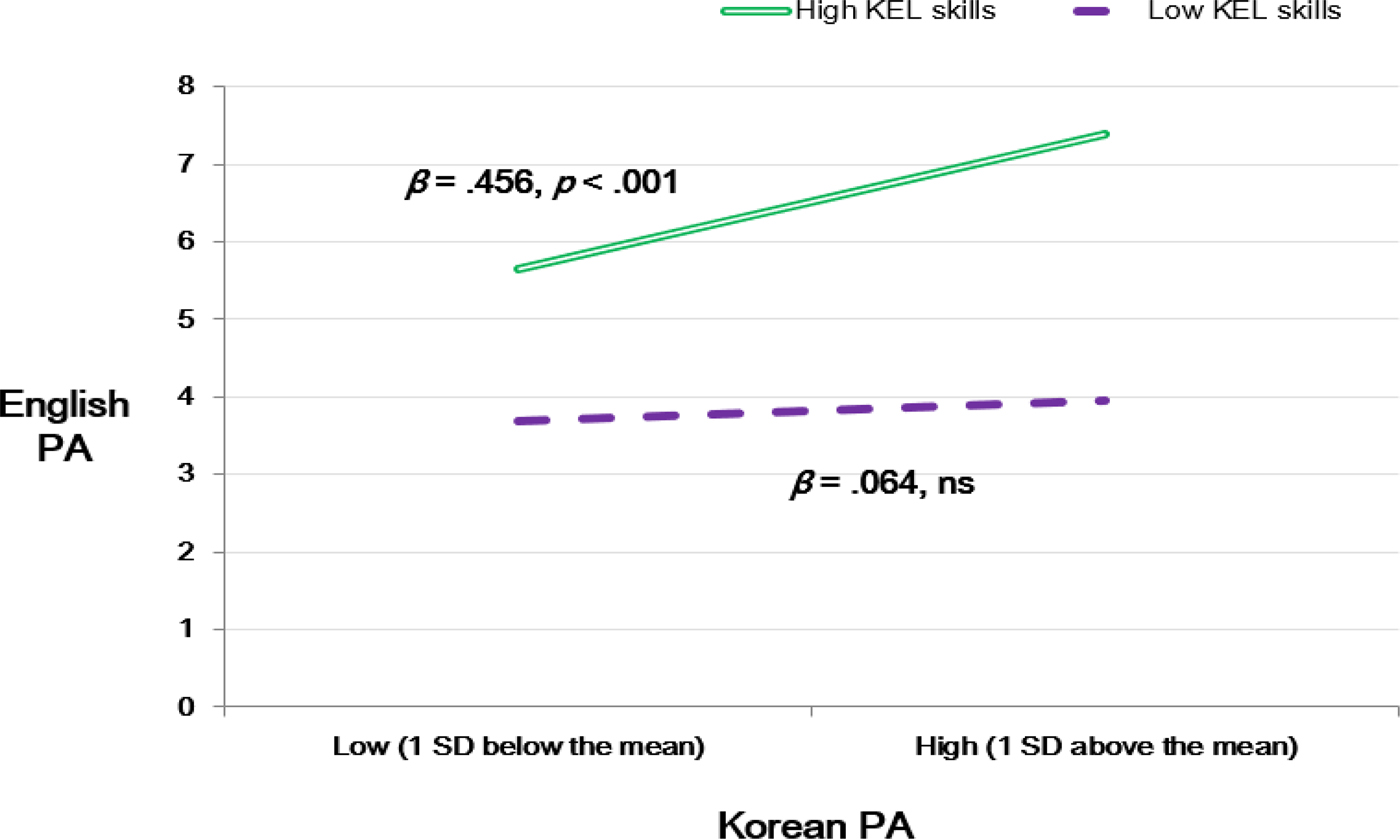
In addition, the result of the hierarchical regression analysis examining the moderating effect of Korean expressive language skills on the relationship between Korean PA and English PA is presented in Table 4 (lower panel). In step 1, children's age (β = .583, p < .001), verbal intelligence (β = .356, p < .001), and non-verbal intelligence (β = .447, p < .001) were shown to be significantly related to English PA. In step 2, there were main effects for both Korean PA (β = .303, p < .001) and Korean expressive language skills (β = .464, p < .001) on English PA after controlling for children's age, verbal, and non-verbal intelligence, and these explained an additional 39.1% in the variance of children's English PA. Last, the interaction term of Korean PA × Korean expressive language skills was significant (β = .178, p < .01), and this accounted for an additional 3.1% in the variance of English PA. To interpret the interaction, we computed high- and low-centered Korean expressive language skills at + 1 and –1 SD scores. As shown in Figure 2, a stronger relationship between Korean PA and English PA was found when elevated levels of Korean expressive language skills were endorsed. Specifically, Korean preschoolers’ Korean PA was more strongly associated with English PA when children's scores on Korean expressive language skills were high (β = .456, p < .001); however, for children rating low on Korean expressive language skills, their level of Korean PA was not significantly related to English PA (β = .064, n.s.). These results are worth further discussion, particularly in terms of the role of Korean language skills in children's cross-language PA transfer between L1 and L2.
Graph illustrating the moderating effect of Korean expressive language skills on the relationship between Korean PA and English PA (KEL = Korean expressive language skills).

Discussion
This research undertook a systematic and empirical examination of the interlanguage relationship between Korean receptive and expressive language skills as a native language, as well as the PA development saliency of various phonological units in both Korean and English among novice English-learning Korean preschoolers. This study was designed to build upon the current knowledge of cross-language transfer of the native language PA to a second language PA during the preschool years, when learning a second language in South Korea has just begun. For this purpose, data on Korean, a language that is typologically different from English, were extensively investigated. More specifically, we further predicted that Korean receptive and expressive language skills would moderate the relationship between Korean PA and English PA for young Korean children in the initial stage of learning a second language. To the best of our knowledge, this study was the first to examine how Korean language skills moderate the cross-language effects of PA.
The present study provides evidence for preschoolers’ development of language-general phonological properties. By examining different phonological units of PA tasks, our results support the findings of previous studies (Chaney, Reference Chaney1992; Treiman & Zukowski, Reference Treiman and Zukowski1996) which showed that children's awareness of larger units develops before their awareness of smaller units. In other words, they suggest that the ability to attend to phonemes seems to develop later than the ability to understand larger phonological units, such as the onset–rhyme divisions of a syllable. This study finding has therefore illustrated that Korean children also acquired Korean and English onset–rhyme or body–coda awareness before initial or final phoneme awareness. These larger units are easier to isolate and manipulate than the smaller units. It is also true that the characteristics of the samples for this study were unique to contemporary English education in Korea, indicating that the preschool children had been in the initial stage of learning a second language and had received no private English education prior to their formal learning.
Furthermore, our study successfully demonstrated that, for two phonologically and orthographically different languages, phonological awareness skills are highly correlated with each other. Correlations of all of the syllabic or subsyllabic units of both languages were examined, and the results showed that all of the units in Korean PA and English PA were significantly related to one another. This finding suggests that better phonological awareness skills in one language will lead to better phonological awareness skills in another language. On the other hand, identified associations need to be considered with great caution since causal relationships cannot be concluded in the current study.
It also provides counter-evidence for Bialystok and colleagues’ (Reference Bialystok, McBride-Chang and Luk2005) speculation that cross-language phonological processing transfer only exists when bilingual children's two languages share the same writing systems, but it strengthens the argument that the effect of cross-language transfer applies to bilingual children acquiring two phonologically and orthographically distinct languages. It is plausible that the Korean language system requires children to be sensitive to Korean syllabic or subsyllabic linguistic units, and, as a result, the acquired learning to detect given sounds positively transfers to English syllabic or subsyllabic linguistic units with similar patterns of development. In other words, despite the major challenges faced by novice learners of English in processing English PA tasks compared to Korean tasks, the children tended to treat the English syllabic or subsyllabic structures as congruent with Korean PA tasks.
Practically speaking, it has been suggested that units of PA to be measured cannot always be equivalent across languages (Cho & McBride-Chang, Reference Cho and McBride-Chang2005). What makes this condition a possibility is that some Indo-European languages have a relatively complex phonological structure due to the many consonant clusters that they incorporate; however, other languages, such as Chinese and Korean, have a relatively simpler structure in relation to consonants. Despite the differences between PA tasks across languages, we also note that these observations are compatible with the hypothesis that PA in L1 and L2 is a single fundamental ability. The participants’ phonological representations of L2 were influenced by their L1 phonological structure. Indeed, it seems that the construct for PA abilities for both L1 and L2 was represented by one fundamental construct. Nevertheless, other research has indicated that L1 and L2 factors are independent of each other; therefore, separate constructs for PA are necessary (Branum-Martin et al., Reference Branum-Martin, Mehta, Fletcher, Carlson, Ortiz, Carlo and Francis2006; Gottardo & Mueller, Reference Gottardo and Mueller2009). Thus, further studies on this issue are warranted.
Given the notion of Korean language-specific phonological structures, the findings showed that Korean children performed better in the body–coda unit than in the onset–rhyme unit. Specifically, the predominance of the CV syllable type in Korean could account for Korean-speaking children's high sensitivity to intra-linguistic information in this language (Kim, Reference Kim2007, Reference Kim2009a; Yoon & Derwing, Reference Yoon and Derwing2001). This hypothesis accords with growing evidence suggesting that Korean speakers find body–coda units to be more salient than onset–rhyme units, implying that early sensitivity to phoneme codas is a salient feature of PA development in Korean children. In fact, one study clearly indicated that young Korean children's body–coda awareness began at a higher level and grew at a faster rate than their onset–rhyme awareness (Kim, Reference Kim2009b).
The findings from the current study support those regarding the role of Korean receptive and expressive language skills in their relationships with L1 phonological processing skills, congruent with the results of Lopez and Greenfield (Reference Lopez and Greenfield2004). They showed that overall English-language abilities were the most potent predictors of English PA in four-year-old children. Another aspect of interest stems from the finding of the moderating effects of Korean receptive and expressive language skills on the link between Korean PA and English PA. First, given Cummins's (Reference Cummins1979) finding of the linguistic interdependence model, there was a relationship between Korean PA and English PA. Next, we found that the level of receptive and expressive skills acts as a powerful catalyst for second PA learning. The main effects of both Korean PA and English PA, as well as the interaction effect, remained significant even after controlling for factors such as the children's ages and verbal and non-verbal intelligence. In other words, it is evident that Korean PA is significantly associated with English PA and that the levels of Korean receptive and expressive skills moderated the association between Korean PA and English PA. In particular, our study demonstrated that, as children scored higher on Korean receptive and expressive language skills, the association between Korean PA and English PA was stronger. Indeed, Korean children's English PA levels rapidly increased when the children had high levels of Korean receptive and expressive skills, whereas those with low levels of Korean receptive and expressive skills saw their levels of English PA increase relatively steadily. Considering these findings together, we speculate that the linguistic complexity of a spoken language, encompassing the properties of phonology, morphology, and syntax, might work as a strong stimulus influencing cross-language phonological awareness development from L1 to L2.
With respect to this speculation, we would like to emphasize the role of the native language in the development of cross-language phonological skills for preschool children. We expected the children in our study to have had little prior experience or training in distinguishing different sounds in English. Hence, they might have had to rely on their fundamental skills of PA in L1 to perform underdeveloped L2 PA tasks and, at the same time, needed to exploit their overall native languages, including receptive and expressive language skills, while performing PA tasks in the weaker language. In contrast, when they are more exposed to a second language in a stage of balanced bilingualism, bilingual children can accelerate the development of PA through cross-language transfer, underscoring the mutual facilitation between L1 and L2 PA, with the additional benefit of more developed metalinguistic skills. In addition, backward transfer can be possible through the effects of L2 phonological characteristics on L1 PA with more heightened L2 proficiency development.
Despite the strengths of this study, a few limitations must be mentioned. First, this study used PA detection tasks as the only measure of children's PA abilities. Other components of PA subtests, such as segmentation, blending, and deletion, were not assessed because of the characteristics of the study sample. Since the children were in the initial stage of learning a second language, the least complex PA skills were the only viable option for this study. Although these tasks could indicate a single fundamental PA ability, future research is necessary to verify this finding using more elaborate PA tasks. Second, it should be noted that, given the cross-sectional research design, we were unable to pinpoint the direction of the effects. Future research would need to adopt a longitudinal research design in order to further expand these results. Third, other study variables regarding Korean children's PA development, such as family literacy practice or children's metacognitive knowledge, should be further studied to obtain more comprehensive and in-depth results. It would also be useful to relate the information collected on PA to reading, as has been done in previous research. Finally, future studies should be replicated using bilingual children in different language groups to examine the patterns of cross-language PA transfer across languages as well as the contributions of L1 receptive and expressive language skills to the relationship between L1 PA and L2 PA.
Nevertheless, this study has yielded interesting and straightforward results that could contribute both theoretically and practically to understanding second-language learners’ development of PA. The findings in the present study highlighted cross-language PA transfer between two languages of distinct orthographic and phonological properties, and it has made a unique contribution by taking the first step toward uncovering the mechanisms responsible for the role of Korean language skills in relation to Korean PA and English PA skills. That is, a strong relationship between children's Korean PA and English PA showed that the level of native language competency also has an effect on the level of competency in L2. Furthermore, in addition to addressing the native language as a critical element in second language acquisition, our study has highlighted the moderating role of Korean receptive and expressive skills in the association between Korean PA and English PA among Korean children in the initial stage of second-language learning.
Supplementary materials
For Supplementary materials for this paper, please visit <https://doi.org/10.1017/S0305000919000229>.
Author ORCIDs
Yea-Ji Hong, 0000-0003-4183-5373
Acknowledgements
The authors would like to express their sincere thanks to all the anonymous reviewers for the helpful comments on an earlier version of this article. Moreover, the authors are grateful to the children and parents who agreed to participate in the study.