The various types of vigilante groups in Plateau State constitute an important local response to insecurity and, more recently, collective violence. Their legitimacy is based on the functions they are supposed to carry out for communal benefit. These are principally to uphold socially defined norms of discipline and behaviour, buttress local authority, and provide security against petty thieves and armed robbers. They have a particularly important role in rural areas, where the state's security presence is more diffused. This is unexceptional; what now makes vigilantes in Plateau State more distinct are the ways they have adapted their functions and composition as a result of the violent conflicts that have swept through large areas of the state since 2001. In some places, forms of surveillance changed as vigilante groups expanded their objectives in relation to growing tension and violence. There was generally a shift or extension from vigilance against criminality to vigilance against attacks by opposing groups or militias defining themselves in religious or ethnic terms. The emphasis on social control within religious or cultural groups was also prominent in some areas. Hence, vigilantism in this context appears not only to have increased but also to have been transformed.
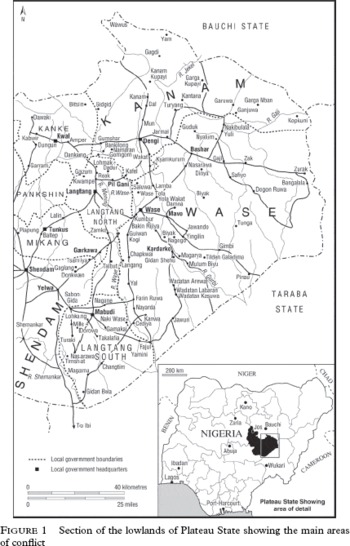
The collective violence in Plateau State began with urban riots in the state capital of Jos during 7–12 September 2001 that left over 1,000 people dead and spread to rural areas of the Jos Plateau, where there was intermittent violence until the end of 2002. There is some published material on the urban violence (Human Rights Watch 2001; Bawa and Nwogwu Reference Bawa and Nwogwu2002; Danfulani and Fwatshak Reference Danfulani and Fwatshak2002; Higazi 2007), but almost nothing has been published on the protracted violence in rural areas. The lowlands were particularly badly affected – this is a large territory of guinea savanna below the Plateau escarpment that stretches in an arc across southern and central areas of the state, descending towards the Benue Trough (see Figure 1. There are several provincial towns in the lowlands, including Shendam, Yelwa, Langtang, Wase and Dengi, but it is predominantly rural territory, dotted with hundreds of villages and farmsteads. The economy centres on agriculture and pastoralism. Most villages are neglected by local and state governments: only accessible by dirt road, often ungraded, and without basic amenities and services. There are acute water shortages in some areas during the dry season. Politicians sometimes go to villages to campaign in the lead-up to elections but they are seldom seen at any other time.
Violence spread through thousands of square kilometres of the lowlands after clashes between Muslims and Christians in Yelwa, a commercial hub in Shendam Local Government Area (LGA), on 26 June 2002. No fewer than six LGAs in the southern and central senatorial zones of Plateau State were affected between June 2002 and May 2004. The violence also spilled over into some of the border villages in Taraba State, where militias were camping and people had been displaced from Plateau. More than one hundred villages in the lowlands were damaged or destroyed in attacks by well-armed militias. The violence resembled guerrilla warfare, without ever being principally directed against the state – although the army and mobile police were important actors. The conflicts were rural-based and the main protagonists were generally small, highly mobile, well-armed groups with excellent local knowledge and familiarity with the bush. The militias carried out raids on villages or camps, and later, when they had the strength and experience, mobilized larger numbers to attack towns. Nobody knows the total number of people killed in the lowlands from 2002 to 2004, but based on data collected during my research there in 2006, which included visits to the worst affected areas, I estimate it was up to 2,000. The violence was only stopped when a state of emergency was enforced by the federal government, during which the government of Plateau State was suspended for six months (18 May to 18 November 2004) and a military administrator put in charge.
Mobilization occurred very quickly after the initial clashes in Yelwa; armed groups emerged over a large area and the violence soon spread. Local responses to the sudden insecurity varied, with many villages by necessity taking flight. In most instances, no prompting or elite manipulation was needed to mobilize people. Militias mobilized along religious or ethnic lines, typically with a localized support base, specific to each village. The fact that the violence was not contained raises doubts about the effectiveness and impartiality of the state. How and why did a seemingly localized conflict in Yelwa precipitate other outbreaks so rapidly in multiple local government areas? What was the nature of interaction between vigilantes, militias and the state, particularly the army and mobile police? It is now evident that the violence and population displacements have reconfigured political and social power in some areas, highlighting the ramifications of the outbreaks and the issues that were at stake. This article assesses the main forms of social mobilization in the lowlands during the crisis, particularly the activities and intersections of vigilantes and militias, and considers how this relates to the political and social underpinnings of the violence.
HISTORY AND SOCIAL INTERACTION IN THE LOWLANDS
The conflicts were fought between Muslims – notably Hausa, Boghom and Fulбe (or Fulani, the Hausa name most often used in Nigeria and by English speakers) – and non-Muslims, principally Tarok, but also Goemai, Montol and many others. The ethnic and linguistic composition of the lowlands is very diverse and has been constituted by migration and settlement over a long period of time. There were migrations from the Benue Valley, linked to Kwararafa (or ‘Kororofa’), the non-Muslim state associated with the Jukun (Isichei Reference Vansina1982; Meek Reference Meek and Palmer1931; Fremantle 1919), and Muslim areas further north, notably Bauchi (Aliyu Reference Aliyu1974). The history of the area has been characterized by encounters between religious and cultural groups at various scales, by the transformative effects of colonialism, and by the crises of the post-colonial state. This section gives a schematic outline of some of the more prominent aspects of history and social relations in the study area. This history is important because it has shaped patterns of interaction and is appropriated by religious and ethnic leaders today as they pursue their political ambitions.
At the centre of much of the conflict was Wase, which variously refers to the emirate, the town, and the largest local government area in Plateau State. The town of Wase was founded as a vassal of Bauchi in about 1820 after jihadist forces, led by Madaki Hassan, conquered the Yangkam (Basharawa) inhabitants (Hogben and Kirk-Greene 1966). Hassan established the outpost that became Wase having heard about its favourable location near the impressive granite monolith that towers above the surrounding plains from his father, Giwa, who settled and grazed cattle in the area and is regarded as the founder of the Fulбe dynasty in Wase. The emirate has strong links to Yelwa, which at its first site was founded or expanded by rebellious slaves from Wase, who after fighting emirate forces fled to Langtang and then Yelwa in about the 1850s (Ames Reference Ames and Kirk-Greene1972: 179; Aliyu 1974: 600). Much of the Yelwa population identify themselves as Jarawa from Dass (Bauchi State) rather than Hausa, although their lingua franca and culture is now Hausa. Wase is now the most important of two emirates located in Plateau State, the other being Kanam, founded by Hausas from Kano in around 1740 (Ames Reference Ames and Kirk-Greene1972: 170; Isichei 1982: 17). The Boghom (Burmawa), who are now the majority population in Kanam, were placed under the supervision of Wase after the jihad (Aliyu Reference Aliyu1974: 468) and are now predominantly Muslim.
The Jukun presence in the lowlands pre-dates the jihad of 1804–8; Jukun settlement in the vicinity of Wase is thought to go back to about the mid-eighteenth century. There has probably also been a long Tarok presence in the area, but the scale and nature of Tarok settlement is difficult to ascertain and is contested. Sections of the Goemai – who are settled in and around Shendam and are now predominantly Catholic – and Tarok claim Jukun descent, and their kingship had features in common (Isichei Reference Isichei1982: 19). There is little agreement over such claims, however, which are made by peoples throughout central Nigeria. The linkages are thought to have been two-way (Isichei Reference Isichei1982), with complex patterns of cultural and linguistic diffusion and fragmentation among the diverse peoples of the area.
The Tarok inhabit the area in and around Langtang, some 26 kilometres west of Wase town. The Hausa refer to the Tarok as ‘Yergam’, and the colonial literature divides them into the ‘Hill Yergam’ (Gazum) and ‘Plains Yergam’ (Gunnu) (cf. Ames 1972: 206–11). The situation is more complicated than this typology suggests, as the Tarok also have complex clan structures that traditionally had a bearing on social organization and marriage (Smith and Smith Reference Smith and Smith1990; Banfa 1982). However, it does indicate that movement between the hills and plains has been one of the features of Tarok adaptation to their environment, a pattern also seen among other groups in the region, notably the linguistically related groups who constitute the Kofyar (Netting Reference Netting1968; Stone 1996). Langtang and its immediate vicinity is hilly; as the Tarok population has grown, the terrain has not been able to support the agricultural needs of the people. The number of Tarok people on the plains, especially around Wase, increased rapidly from the mid-twentieth century as their population increased and more land was opened up for cultivation.1
About half the Tarok population follow Christianity and the other half traditional religion, with some overlap. The Sudan United Mission, having established an outpost in Wase in 1904, moved to Langtang in 1907. Christianity was associated not only with modernity but also with opposition to Islam, in turn associated with the Wase emirate. Memories of slave raiding – which in some areas of northern Nigeria continued into the colonial period (Hogendorn and Lovejoy 1993) – forced labour and, more recently, alleged discrimination in local politics sustain strong grievances against the Wase emirate and Muslims more generally. The conversion of many Tarok to Christianity in the twentieth century and their social advancement through Western education have led them – especially those living in what is now Wase LGA – increasingly to challenge emirate rule in Wase.
There are also large numbers of Fulбe throughout the lowlands, especially in Wase LGA, and their numbers have also increased substantially since the mid-twentieth century. This is due partly to what Stenning (1957: 68) describes as a process of ‘migratory drift’ and partly to improvements in veterinary services that have allowed the Fulбe to establish themselves in the savanna – and now even the humid zone (Blench Reference Blench1994) – on a more permanent basis. Many Fulбe in Wase today are settled, practising agro-pastoralism; those with larger herds are transhumant or semi-transhumant, sending younger members of the household south to the river Benue with the cattle during the dry season. The dwelling patterns of the Fulбe vary accordingly, ranging from permanent abodes inside villages to semi-permanent or short-term ‘camps’ on the margins of villages populated by Tarok or other ethnic groups. A grazing reserve, to encourage the settlement of the Fulбe and regulate their pastoral production, was established in 1965, but it was not formally gazetted and signed into law until 1985.Footnote 2 In recent years, most especially since the crisis, large sections of the grazing reserve have been cultivated by Kofyar and Tarok farmers, a source of current tension.
The Fulбe are predominantly Muslim, but they have great internal diversity in terms of clans and pastoral practices, and follow Islam with varying degrees of orthodoxy. In general, the more settled they are, the more orthodox they tend to be – although because education in rural areas is so poor, the level of scriptural understanding of Islam, except among mallams (Islamic religious scholars), is not high. Nomadic pastoralists tend to affiliate with Islam, but everyday practice revolves more around laawol pulaaku – a code of behaviour or ethos that defines ‘Fulбe-ness’, stressing qualities such as fortitude, humility, reserve and prudence (Kirk-Greene 1986). Nonetheless, Islam and pulaaku have become intertwined to varying degrees. The appearance of nomads is often distinctive, most obviously in garb, but to some extent also phenotypically because they tend to marry endogamously. Changing modes of pastoralism have resulted in social and cultural change, but the Fulбe ethnic category persists, Burnham argues, ‘as a function of the conditions governing the social reproduction of such categorisations and not as a function of the lifestyles of particular individuals or families’ (1999: 279).
DEFINING ETHNIC AND RELIGIOUS CLEAVAGES
There is a particularly heated debate in Wase over which group forms a majority. In fact this varies both between districts and between seasons (because many Fulбe move south to the river Benue during the dry season), and the population shifts during the crisis have further altered the demographic composition of different localities. The two largest groups are probably the Fulбe and Tarok, in no particular order, with the population of Muslims and Christians more generally being quite evenly balanced. The Tarok are the largest non-Muslim group living in Wase LGA, but there are also many others, the main groups being the Jukun (especially at Wase Tofa and Kumbur), Kofyar and Ngas, but there are also other Plateau peoples in smaller numbers, including Mupun, Mwaghuval, Yiwom and Montol, all of whom have migrated to the area to find farming land.
The main Muslim groups are the Fulбe, Boghom, Yangkam, Jar, Hausa and sections of the Jukun (especially at Mavo). Intermarriage is common and they are unified by religion and the Hausa language – except, to an extent, the Fulбe, most of whom speak Fulfulde as their lingua franca (although most also speak Hausa, and title holders in Wase Emirate who identify as ‘Fulani’ – including the Emir – do not speak Fulfulde). Hausa ethnicity tends to be de-emphasized in Muslim political discourse, to emphasize claims to indigeneity – even though indigenous cultures and languages have been largely though not entirely replaced by Hausa. The Yangkam language is moribund and the population has been assimilated into Hausa culture, but Boghom is still spoken – although it is threatened – and two different dialects of Jukun are spoken (one in Wase Tofa, another in Kumbur and Mavo). Muslims have customary land in different districts, a factor of political importance since it helps to sustain ethnic consciousness even while culturally groups are converging. Bashar District, one of four in Wase LGA, is controlled by the Rekna of Bashar (the Yangkam or Bashar paramount ruler), who is seen by some as a rival to the Emir of Wase. There are also different Muslim sects, notably the Sufi orders and non-Sufis such as the reformist group Izala.3
There was considerable social interaction across religious and ethnic lines in the lowlands prior to the crisis. Muslims, Christians and followers of traditional religion lived among each other; their lives were connected socially and economically. Intermarriage between Muslim men and Tarok (and other non-Muslim) women was quite common, with the latter converting to Islam, but this has stopped as a result of the crisis. Among Christians and followers of traditional religion intermarriage is two-way. I met some Tarok men who had converted to Islam from customary religion after living among the Fulбe at Magarya (Wase LGA). Significantly, however, they were still forced to leave during the crisis, fleeing back to their birthplaces at Pishe (Langtang North LGA) with little warning from their Fulбe neighbours.Footnote 4 Leach ([1965] 2000) pointed out how marriage patterns in ‘pre-modern’ societies were inhibited by conflict, but, as the above suggests, similar ideas apply in contemporary societies, and the absence of intermarriage in the lowlands today is an index of the deterioration in inter-religious relations.
Beyond marriage, the interaction between the Fulбe and Tarok in the rural areas was generally described as cordial prior to the crisis (see also Blench 2004a: 94). Fulбe households with large herds of cattle would hire Tarok boys for prolonged periods (up to five years) to provide additional labour for the rearing of cattle. In return, the herdboys would be given an agreed number of cattle for their work, increasing year on year, which would allow them gradually to build up their own herd. Tarok boys who were part of this arrangement learned Fulfulde and, to some extent, the customs of the Fulбe. This is a common practice between Fulбe and agricultural communities throughout West Africa – in Plateau it is most striking between the Fulбe and Tarok, due to the large Fulбe population in the lowlands, but it was also common on the Plateau proper, as between the Fulбe and Berom (Awogbade Reference Awogbade1983). In the villages, therefore, interaction between the two groups meant they often spoke one another's languages (Tarok and Fulfulde).
The salience of ethnicity and religion, as described here, is heightened through politics and ideological differences. Indigeneity, defined by group ancestry and customary land (usually gazetted in the form of chieftaincy areas), impacts on political and social rights (Bach Reference Bach, Diamond, Kirk-Greene and Oyediran1997), and is ethnically contested. History is interpreted and manipulated by all sides – particularly in the selective use of colonial sources – to fit current political agendas. None of the parties in the conflict recognize the fact that land was far more abundant in pre-colonial and even colonial times, and that land use before the imposition of colonial administrative boundaries was more flexible. The question of who came first to a particular area did not arise: this is driven by contemporary politics. Disputes over indigeneity ignore demographic and political changes, and what was often multi-ethnic expansion into new, previously uninhabited areas.
This is the context in which social mobilization has occurred: vigilante and militia groups are now defined along ethnic and religious lines. Ethnic consciousness appears to have become much more salient – partly due to the impact of contemporary politics and violence, but also due to wider social forces, perhaps linked to processes of globalization that as yet have not been explored adequately. The categorization of ‘indigenes’ and ‘settlers’ is further complicated by religious differences, which sometimes are conflated and at other times separated from discourses of indigeneity, depending on particular histories and political circumstances. In fact, Islam and Christianity have both gained converts among local populations, and much religious change has occurred recently – the highest conversion rates of the Boghom to Islam and the Tarok to Christianity were from the 1940s–1950s onwards. The idea that indigeneity can be viewed through a religious prism has political resonance but no consistent historical basis. Ethnic relations in Wase have been further diversified from about the 1980s, when large numbers of Kofyar and Doemak farmers,Footnote 5 and other migrant farmers from surrounding areas – including Ngas, Tiv, Yiwom and Montol – have settled in Wase LGA to utilize the very fertile land. This is part of an ongoing extension of agricultural frontiers in response to demographic and ecological exigencies that are seen throughout central Nigeria (Stone Reference Stone1996).
NARRATIVES OF VIOLENCE IN THE LOWLANDS
Politics and vigilantism in Yelwa, 2002
The lead-up to the violence in Yelwa was marked by a political crisis centred on a dispute over political power in the town. This came to a head in May 2002, when new districts were created in the southern senatorial zone of Plateau State. Yelwa is majority Muslim in population, but rather than being made a separate district, it was placed within Nshar District under the authority of Shendam, a Goemai (mainly Catholic) town. This gave political recognition to Goemai claims to indigeneity in the area, rather than to Muslims in Yelwa, and to the control of the Long Goemai (the Goemai paramount ruler) over Yelwa. Although the chief in Yelwa would likely be a Muslim, he would be appointed by the Long Goemai, rather than selected from among his constituency and formally installed by the Long Goemai. Muslims in Yelwa wanted their own district as a step towards the creation of a new local government area. That would provide financial opportunities for the local elite and raise the profile of Yelwa in Plateau politics.
The dispute over the chieftaincy was exacerbated in the first week of June 2002 by a disagreement at the ward congress of the People's Democratic Party (PDP) (the ruling party in Nigeria) over who should become chairman in Yelwa-Nshar ward. Muslims wanted the existing chairman to continue in office, whereas Christians wanted the position rotated to them. A Christian candidate was put forward and the position was contested in an open ballot, whereby voters for each candidate gathered into separate lines to be counted. A fight broke out between the lines, which due to bloc voting had separated according to religion. Some people were injured, but no one is reported to have been killed. The election was cancelled, but as Muslims form a majority, their candidate was appointed PDP ward chairman. Both sides agree that the congress divided Yelwa deeply along religious lines.
At the time, the chairman of the vigilante group in Yelwa was a Christian from Delta State. Muslims say this was not an issue until the crisis, as the vigilante group in the town was centralized and had Muslim and Christian members working together. But, as political tensions mounted, Christians in Yelwa responded by trying to prevent their women from having extramarital relations with Muslim men. This divided the vigilantes, as it was only Christian vigilantes who enforced the ban. It constituted a form of ‘within-group’ vigilance exercised by what appears to have been a loose collective of Christian youths in Yelwa. They harassed and stopped Christian girls whom they suspected of having sexual relations with Muslims, but Muslims claim they also harassed and even beat up some of the Muslim boys. The more general reaction of Christian women in Yelwa to this sanction is unclear. In defence of their actions, some Christians pointed out that Muslim youths seek relationships with Christian women, but it is never possible for Christian men to form relationships with Muslim women.
In the early hours of 26 June 2002 the nightwatchman (maigadi) of the Izala mosque in Anguwan Galadima – a majority Christian neighbourhood of Yelwa – is said to have been stabbed (wounded but not killed).Footnote 6 A security meeting – involving politicians, traditional and religious leaders, and security and police officers – was held at the local government offices in Shendam that morning to address the growing crisis, but violence broke out that night. Christians claim the sanction they placed on their women led to a fight on the street in the Anguwan Pandam area of town on the night of 26 June in which a Christian was killed. This was frequently cited by Christians as the trigger for the 2002 violence in Yelwa and the start of the wider crisis in the lowlands. Muslims say the crisis started when masquerades were heard coming towards town from the shrine at Anguwan Pandam that same night. Muslims claim the masquerades were part of an armed group, precipitating the start of the crisis when a Muslim youth was killed and the mosque burned in Anguwan Pandam.Footnote 7 All of this may have happened, but the sequence of events is unclear. Oral interviews and written memoranda to government by Muslim and Christian leaders in Yelwa emphasize different narratives. There are varying estimates of the number of casualties in Yelwa in 2002, ranging from 50 to over 200 Muslims and Christians killed (Human Rights Watch 2005: 13–14).8
The trajectory and spread of violence
The violence in Yelwa in 2002 and 2004 was linked to the wider conflicts in the lowlands, particularly Wase, and the same actors were involved in some of the main incidents. The LGAs directly affected by violence were Wase, Langtang North and South, Kanam, Mikang and Shendam, as well as border villages in Taraba State. The pattern of violence was internally variegated within the affected zone, but most of it occurred along religious lines, between Muslims and Christians or traditional worshippers. In the aftermath of the 2002 Yelwa clashes, some of the Tarok people living in Yelwa fled to Langtang South, where they are a majority. Tensions were raised as the impact of the violence on the Tarok in Yelwa was conveyed, and in the following days there were revenge attacks against Muslims in Langtang South.9
The spilling over of the violence into Wase LGA, the largest administrative area in Plateau State, marked the beginning of a wider crisis in the lowlands. In what could be described as sustained vigilante action, the Tarok blocked the road between Wase and Langtang for nearly two years, thus isolating Wase during the crisis. The violence in Wase was extensive and largely unreported in the press. Most villages were affected, some were destroyed completely, and up to a thousand people were killed. The Tarok stated that when the Fulбe from Langtang South arrived in the village of Wadatan Kasuwa, which at that time had a Muslim majority, the Fulбe threatened to take revenge for the attacks they claimed they had suffered after Yelwa.Footnote 10 They also told of strangers seen in the area some two weeks before the crisis, who they now believe to have been mercenaries invited by the Muslims. More extensive attacks began in July 2002, when groups of Fulбe men mobilized and attacked Tarok people in the village of Wadatan Arewa, followed by Wadatan Kudu, Farin Ruwa, Mayanga and Zhir: 29 people died.
While much of the violence in Wase was between Muslims and Taroks, it is clear that Christians more generally were a target, even if initially they were spared.Footnote 11 The religious orientation of the violence is also demonstrated by the destruction of churches and mosques – a pattern repeated throughout the lowlands. On Thursday, 4 July 2002, it is claimed that five Muslims were killed on their farms – one man at Mai Alewa, in southern Wase, and four at the village of Kogin Kassa, a few kilometres west of Wase town. On the same day, Christians were attacked in Wase town, the heart of the emirate and predominantly Muslim in population. Several people were killed and churches, houses and properties (including drinking parlours) were destroyed; all Christians fled the town.Footnote 12 Violent clashes and the burning of houses also led people to flee villages around Wase town, including Kuka, where around 25 Tarok people were killed on 5 July, and Saluwe, where at least 32 Boghom and Fulбe villagers were killed on 5–6 July.Footnote 13 Wase town was subsequently attacked numerous times by Tarok militias, and in response vigilantes patrolled and set traps on the edge of town.
The greatest loss of life in Wase town was incurred on the eve of the 2003 elections, held on Saturday 19 April, when about 37 residents and two soldiers were killed during a Tarok attack. I recorded close to one hundred villages in Wase that were destroyed or badly damaged during the crisis. Tens of thousands of people were displaced, with settlement patterns becoming more polarized. In broad terms, Tarok people fled Lamba, Wase, Bashar and parts of Mavo districts, while Muslims were driven out of much of Kadarko and parts of Mavo districts. The Tarok suffered the most deaths around Dogon Ruwa and Safiyo, in Bashar District, where at least seventy people were killed in July 2002 (Dungum Reference Dungum2002).Footnote 14 Meanwhile the Tarok drove out all Muslims from Kadarko, the largest settlement in the district of the same name, killing at least 110 people, including most of the leaders.Footnote 15 Kadarko was the site of many subsequent clashes as Muslims tried to gain back territory, and the Tarok Kadarko militia probably became the most battle-hardened, eventually spearheading the attack on Yelwa in May 2004.
The violence spread from Wase to surrounding areas in the lowlands, so that a large zone was drawn into the same dynamic of conflict. The violence broke out in Kanam LGA on 29 September 2002 as a result of cattle rustling, when displaced Fulбe fled there from Wase. Boghom villagers were drawn into the violence, clashing with Tarok militias that made incursions into Kanam, while the Boghom attacked border villages in Langtang North. In some areas (such as Gomgom village, which was attacked from Bankilong), the Boghom Christian minority were attacked by Boghom Muslims.Footnote 16 The escalating crisis in the lowlands led to the near-destruction of several towns, including Garkawa, Yamini, Shimankar and Yelwa, all of which were attacked by Tarok militias from outside in 2004, Muslims being the main victims following heavy firefights between the two sides. Muslim militias attacked numerous villages throughout the lowlands. There was further violence in Yelwa on 24 February 2004, where Christians claim they lost 265 people killed,Footnote 17 some 78 in a church compound (Human Rights Watch 2005), while Muslims claim 22 of their people were killed in the same episode.18
More than 700 Muslims were killed in a reprisal attack on Yelwa on 2–3 May 2004 – the third major incident of religious violence there in two years.Footnote 19 Christians/non-Muslims mobilized throughout the lowlands – and elsewhere in the state and possibly outside – to participate in the attack. It was sanctioned by Tarok and Goemai elders and there are strong indications of state or at least local government involvement, and of assistance from military contacts over the logistics of the operation and the supply of munitions. It made international news and led to the state of emergency in Plateau State after Muslim leaders in the north pressurized the federal government to take action. The Tarok were the main force behind the attack on Yelwa and it is possible that Wase would have been attacked on a similar scale (it was intended as the next target) had the state of emergency not been declared. The Yelwa massacre precipitated violence against Christians in Kano, where some 200 people were killed, demonstrating the potentially national repercussions of the violence in Plateau (Ehrhardt Reference Ehrhardt2007; Human Rights Watch 2005). It reached this point, however, as a consequence of unchecked violence in the rural areas.
SOCIAL MOBILIZATION IN THE LOWLANDS
In their ‘ideal types’, as they apply to this part of Nigeria, vigilantes could be defined as being orientated more towards the protection of a circumscribed locality, such as a village, and militias more towards offence, launching attacks either within or beyond the immediate locality of the village or town. In the case of the lowlands, there is no straightforward relationship – partly because there are local variations in the forms of social mobilization, but also because the same individuals or groups took part in many different forms of action during the conflict. Nonetheless, with these caveats in mind, it is possible to identify different forms of collective action in the crisis.
Mobilization was a situational response to insecurity, but the specific forms and patterns of mobilization were also informed by wider concerns associated with contemporary politics and more specific aspects of religious and cultural assertion. That social mobilization is both situational and politically and culturally grounded is also shown by the rise of the O'odua People's Congress in south-western Nigeria. It emerged as a socio-cultural movement in response to political marginalization and grievance, defining itself against northerners, and generating conflicts with resident Hausas in Yorubaland. Having mobilized to protect Yoruba interests, the OPC took on the role of a vigilante organization, but that was not its original purpose (Guichaoua Reference Guichaoua2007; Akinyele Reference Akinyele2001; Nolte this volume). Pratten (2007: 170) states that the rise of the OPC ‘highlights an enduring feature of contemporary Nigerian vigilantism, the relationship between social mobilization and the politics of belonging. OPC, while operating localized vigilante operations, also champions a Yoruba “ethnic nationalism” ‘. The same can be said in Plateau, where militias, especially, but also some vigilantes have formed along ethnic and religious lines. During the crisis, vigilantes tended to merge into militias. Perceptions of power and grievance are strong mobilizing factors, and socio-culturally defined groups tend to express themselves in relation to one another. The insecurity arising from violent conflict has sharpened divisions, and modes of religious and cultural expression that previously may have symbolized difference rather than discord now mark the lines of conflict.
The political and the cultural are intertwined; ethnic mobilization is informed by what Peel (1989: 200) describes as ‘cultural work’ – ‘a process or project’ that may be politically consequential but ‘still has to be worked at in cultural terms’, which means making contact with a history that resonates with people. Cultural modes of expression and performance, not inevitably a divisive force between groups, became important markers of identity in the crisis and, for some, were equated with group belonging and rootedness to particular traditions, linked to land and even customary claims. Vigilantes and militias defined themselves in cultural terms, even while being aware of the political or material dimensions of the violence. Through discourses of indigeneity, oral traditions – some distorted – highlighted social cleavages and shaped collective representations, conceived and understood ‘in the substantive cognitive terms of a culture’ (Vansina Reference Vansina1985: 124). Performative aspects of religion and culture were enacted during conflict in various forms, such as masquerades, charms and prayers or slogans, such as Allahu Akbar (among Muslims, meaning ‘God is great’). These were visible or audible expressions of power, faith, group belonging and history. Religion itself was important both as a marker of social difference and as a system of deeply held beliefs which affected decision making and social action.
A large number of sophisticated weapons came into circulation during the crisis, accounting for the high number of casualties recorded in some areas (Blench Reference Blench2004b). The types of guns I recorded in interviews included AK47 semi-automatics (the most common), MG machine guns, SMGs (sub-machine guns), G3 rifles, Mark 4 rifles, single- and double-barrel shotguns, pistols, Dane guns (used by hunters) and locally made guns.Footnote 20 Weapons were bought or supplied by all sides from a variety of local and national sources. Both state and military connections were important. Arms acquisition became a driving force in the conflicts, particularly in the way it seemed to accentuate cattle rustling – a source of funding for the purchase of weapons. Some guns were brought into Wase along bush paths from Taraba State, usually hidden in sacks of grain, skirting security checkpoints. There was a surfeit of weapons in Taraba due to the previous conflicts there between the Tiv and Jukun, which continued until 2001. There were also many other routes, Enugu being a major supply source (Blench Reference Blench2004b). On the Muslim side, the Fulбe seem to have been the main source of funds for arms purchases, principally because they hold readily marketable assets in the form of cattle, some of which they sell if they need to raise money. Both sides also claim they captured weapons from each other. Jukun Muslims were said to be involved in the purchasing of weapons, using their ethnic ties with the Jukun in Taraba. Much of the arms market itself, however, is controlled by Igbos. Since the crisis, with guns more easily available and poverty heightened, there has been a sharp increase in the number of armed robberies in some rural areas of eastern Wase.21
State functionaries and some traditional rulers and title holders were involved in the planning and perpetuation of violence, and in some areas well-known figures were reported to have participated in attacks. The notion of an elite is relational – a local elite would probably not be seen as an elite in a regional or national context – and therefore the influence of elites is context-specific and, to some extent, temporally variable. Elites are often portrayed as manipulating the actions of their constituencies to fit their agendas, even where this involves violence. While this is undoubtedly true in some instances, it has become a general assumption that is rarely verified in relation to specific cases. Politicians sometimes stoked tensions, but more often it was their sheer inaction that allowed the violence to escalate, either because continued violence suited their interests or because it did not concern them.
There is strong evidence that some elites in government and the military helped arm militias, and even after the violence ethnic and religious leaders continue to lobby for the political support of sectional interests, with divisive repercussions. Many Fulбe insisted that Tarok militias often moved in tandem with mobile policemen. Here the characterization of militias as separate from the state is problematic; they are not necessarily embedded in the state, but state connections are important. The strength of state connections and patronage varies and is a source of speculation. In the case of the conflict in Wase, for example, both Muslims and Tarok perceived each other as receiving support from the state government and viewed the security forces as favouring the other side. Some of the allegations are likely to be true, but the fact that both sides tended to view the entire state apparatus as working against them suggests the reality was more mixed.
Despite some involvement of the state and its security organs, the army, police and security services did not prevent the violence from spreading, and were unable to provide security across the whole area affected. This generated the need for vigilante patrols and gave space for militants to go about their activities. They were usually formed on a localized basis, and became more organized and acquired increasingly sophisticated weapons as the conflict went on. While elites had an important influence, therefore, the violence appears to have been driven by the decisions and actions of a wide spectrum of people, who very often mobilized on their own accord in response to current circumstances. Fulбe and Tarok responses are reviewed here to demonstrate the diversity of mobilizing factors at work in this violent context.
Fulбe (pro)actions and responses to insecurity
Prior to the crisis, cattle theft was less frequent than it was during and subsequently, and cooperation with farming communities such as the Tarok was greater. Especially today, when politics are less favourable towards them, both the physical and economic security of pastoralists depends more on cooperation with farmers (Blench Reference Blench2001; Moritz 2006: 6–7; Azarya et al. 1999). With the spread of conflict in the lowlands, the situation of the Fulбe became very precarious, as both access to grazing land and the security of their cattle were threatened. The Fulбe were very vulnerable to cattle rustling during the crisis, but they did not organize into vigilante groups as such, although the youth (suka) had some responsibility for protecting the livestock and responding to raids. Information passes quickly between households and camps, so when there is a problem in one area it is soon widely known and action can be taken. But given the scale of the violence, it does not appear the Fulбe were able to take effective preventative measures – apart from moving their herds out of Plateau State to other locations such as Taraba, as many did.
Cattle rustling perpetuated and in some areas instigated violence. Langtang was reportedly flooded with beef, but most of the livestock was sold at cattle markets further afield to avoid detection. The scale of cattle theft was enormous and helped fuel the crisis. Wase has the largest cattle population in Plateau State, even though it is now reduced. A livestock survey in 1996 in Wase LGA recorded 1.2 million cattle; the figure recorded in 2006 inside the grazing reserve was about 232,000, but it was estimated that there are probably double that number outside the reserve (which, de facto, is currently not functioning).Footnote 22 The losses (if the above figures are accurate, of approximately half a million cattle) occurred due to theft and the displacement of many Fulбe owners.
Most of the rustling was carried out by the Tarok, who sold the cows to buy arms or just for profit. They would also hide behind cattle to shield themselves when they were fighting the Fulбe. But not all of the cattle rustling was so clear-cut. As the rustling took its toll, cattle thieves among the Tarok and Fulбe started working together, meeting at local government or state borders to exchange money and cattle. While cattle rustling has been significantly reduced since the crisis, it is still going on and is a problem for the Fulбe – only instead of entire herds, now typically only a few cows are stolen.
Ethnic divisions and settlement patterns had some bearing on patterns of conflict and social mobilization among Muslims, but when in close proximity they joined forces on the basis of religious solidarity and common political interests. The cultural forms of the conflict highlight ethnic relationships. The Fulбe militia men I interviewed distinguished themselves from the yan tauri – a Hausa term signifying a vanguard, protected by charms, who give the lead in battle.Footnote 23 In Wase, the yan tauri tended to be described as a militia, but in Kanam, as is shown below, they were said to function as vigilantes. It may be a semantic rather than an actual difference. Fulбe men often said they had spiritual means of protecting or raiding cattle and waging war. The Fulбe militiamen claimed they went in front during the fighting as they had more potent herbal protection than the yan tauri.Footnote 24 Herbal medicines were said to protect them against bullets and render them invisible.
The Fulбe interviewed stated that at the start of the conflict their weapons were not as sophisticated as those of the Tarok, but their herbal protection enabled them to defeat Tarok attacks. In a well-known attack on Wase town, some Tarok ex-servicemen were killed and their guns captured. The Fulбe claimed they killed the men with gariyos, which are a kind of long hooked knife. It appears that charms were widely used by Muslims, though clearly not by all. The attitudes of Muslims to charms varies, partly depending on the type of charm, and to some extent may demonstrate tensions between scriptural interpretations and local practices of Islam. Murray Last noted in the context of a discussion on attitudes to the supernatural in the Sokoto jihadthat ‘One of the popular justifications for the use of charms is that they are a form of unspoken prayer, which may protect the wearer if he is unable to mouth the actual words in time of crisis. But whereas the texts of charms may often be in the form of a prayer, by no means may all permissible prayers be used as charms’ (Last Reference Last1967: 7). The use of charms or herbs was incidental to the violence, which as shown was driven by more tangible factors, but the spiritual dimension nonetheless had a role in shaping social action and relations between groups, and was a salient aspect of ethnic assertion during conflict.
The socio-cultural basis and organization of Tarok militias
Tarok mobilized into militias principally in response to the outbreak of violence in Wase. The shock and anger in Langtang at the sight of a steady influx of Tarok refugees from Wase, many exhausted and traumatized by the violence, compounded existing hostility towards the emirate. It led directly to mass mobilization and what was viewed as retributive violence against Muslims. The hatred towards Muslims became so strong that when the two mosques in Langtang were destroyed their foundations were dug out, so that they were completely erased. All Hausa traders left Langtang and the few Tarok Muslims – one of whom was allegedly killed – took refuge in Wase, where they remain. The Tarok formed militias wherever their populations are concentrated – Langtang, Pil Gani, Kadarko, Zamko and Mabudi being some of the main sites of mobilization – and in border villages along the local government boundaries with Wase and Kanam.
Militias were locally based but interconnected and were responsible for operations within their own area. Thus the Pil Gani militia carried out raids on nearby Lamba District, the Zamko militia was heavily involved in the attack on Garkawa (where it is alleged more than 200 Muslims were killed on 26 February 2004), and the Kadarko militia carried out attacks throughout Wase. They usually attacked at night, trekking through the bush to their intended targets, except in some of the larger attacks where vehicles were used. The villages inside Wase and Kanam LGAs bordering Langtang North and South were the worst hit – most were destroyed and had to be evacuated for the duration of the crisis – but there were also many attacks, especially from Kadarko, inside Wase, and numerous attacks on Wase town itself. Most actions of militias were part of a dynamic of violence in which Tarok villages in Wase and the border areas of Langtang North and South were also attacked. For big operations, such as the attacks on Yelwa and Garkawa, militias from different areas joined together.
Military links were important for the Tarok during the crisis, for they have a disproportionately high number of serving and former servicemen, some of whom were involved in the fighting. There are Tarok men serving at all levels of the Nigerian military, including many officers who have reached senior ranks. At the time of the crisis there were at least ten serving or retired Tarok military officers in the top echelons of the army and air force.Footnote 25 This powerful clique is often referred to as the ‘Langtang mafia’. One well-placed Tarok elder described the conflict as ‘the generals' war’, but, not surprisingly, information on the level and nature of their involvement was very difficult to obtain. The participation of ex-servicemen in the lower ranks is clearer, and they had a role in training militia fighters and procuring weapons. The leaders in the field were not necessarily ex-military, but they learned military tactics and became well acquainted with the use of weapons. State responses were also read as tacit support. During the 2–3 May 2004 attack on Yelwa, for instance, the security force was removed from the town the week before the attack and the military response from nearby Shendam barracks to the violence was extremely slow – partly because the road from Shendam was blocked by Goemai militia. The military response eventually came from predominantly Muslim Bauchi, by which stage much of the damage had been done.
Tarok militias and vigilantes had strong support among their people; the conflict tended to be viewed in existential terms, as a struggle for survival. This conferred militias with local legitimacy – mobilization was a practical response to a current problem, but one which also had widely recognized historical roots. The characteristics of mobilization among the Tarok were influenced by the nature of the conflict, with its different layers, but the conflicting sides each asserted their own religious and cultural identities. In an analysis of the Bakassi Boys in Aba, south-eastern Nigeria, Meagher (2007) emphasized that the vigilantes were initially an accountable and disciplined civil society response to disorder, anchored in the present. She notes that references to charms and occult practices are overstated, but that ‘Occasional emphasis on such practices served largely to tap into embedded notions of authority and legitimacy, rather than to call on supernatural powers.’ Moreover, ‘References to occult powers and practices … became more pronounced after the group came under the influence of state governors, when supernatural claims to legitimacy were used to cover for an increasingly compromised commitment to the public good’ (Meagher Reference Meagher2007: 99). This shows why vigilantes emerged in Aba, and in Plateau too they emerged as a rational response to insecurity. The difference is that the violent conflicts in Plateau meant social mobilization had a more explicitly religious and ethnic form, with militias mobilizing against each other, and this probably explains the prominence of customary and religious symbols and practices.
The cultural affinities of the Tarok are symbolized by customary institutions, headed by the Ponzhi Tarok, and represented by district and village heads. The Church of Christ in Nigeria (COCIN) now constitutes the basis of religious life for up to half the population. Yet traditional religion continues to serve important social functions. The chief priests, Ponzhi Mbin – ‘Lord of the land’ (Banfa Reference Banfa and Isichei1982: 93) – are the custodians of traditional religion and shrines, and influential figures in local society. The Ponzhi Mbin reside in the hills above Langtang, at sacred sites believed to be the dwelling places of ancestral spirits, which are honoured with shrines. These sacred sites are gathering places where important decisions, sanctioned by custom and ritual, can be made (in the absence of women). During the crisis, authorization was sought from the Council of Elders, chaired by the Ponzhi Mbin to defend the ancestral land of the Tarok, and subsequently to negotiate a ceasefire. Customary law and ritual, although weakened, is still an aspect of everyday peasant life, and gives religious and social meaning to agricultural cycles and production – especially relating to guinea corn (sorghum).
There are many types of spirits in the Tarok pantheon, including n`Zhìnggol and icir; these are also believed to be sources of supernatural power, but are distinct from ancestral spirits. n`Zhìnggol are found in the bush – such as in caves, hills and trunks of trees – and riverine areas, while icir is the generic name for spirits represented by physical objects.Footnote 26 They may be made manifest through dance and other forms of worship. Such spiritual powers are believed to be used by magicians in their preparation of charms, for either good or evil, and by medicine men for healing. It was claimed that magicians made the charms used by militias in their fight against Muslims. Charms were used according to individual volition or preference rather than as part of a collective imperative. Christians usually claimed they did not use charms: one leader described them as ‘black powers’, but claimed that although he did not use them they were effective in battle, but only for a short time period, after which they would have to be refreshed. He claimed Muslims were often heavily ‘charmed’; in such instances it was impossible to shoot them, even at close range, but he also stated that sometimes boys or women could take them down, implying that the charms were only prepared for protection against specific contingencies.
A further feature of Tarok militia mobilization was the role of masquerades. Each clan has a masquerade leader or custodian. Masquerades, or dodo, believed to be ancestral spirits called urim (singular) or orim(plural), emerge at socially significant events, including harvests, and often accompanied militias into action during the crisis. This was described in the following way:
The masquerades [orim or ancestral spirits] did not follow people to fight. No serious Tarok man will go without the bag containing the masquerades: the masquerades do not follow, they come out when necessary, by themselves.27
The masquerades wear garments that cover the full body, and project very loud, piercing screams. The cries of the masquerade are said to scare opponents and encourage the Tarok to go forward. Muslims described the Tarok as singing traditional songs, with n`cè (or, in Hausa, burukutu – locally brewed beer from sorghum or millet) at hand, and masquerades alongside them, when they attacked.Footnote 28 In a crisis, particularly for followers of customary religion, orim would be seen as a source of spiritual power, and are both a defining and reassuring presence for many Tarok people.
Mercenaries
The Tarok population insist that some of the militias consisted of mercenaries, and tell that strangers were seen in Wadatan Kasuwa for some two weeks before the crisis. They were described as having plaited hair and would venture into the bush during the day and stay in the primary school at night. It is unclear who these strangers were, but there is a widespread belief among Tarok and many other Christians in Plateau State that Muslims recruited mercenaries from the far north, Niger and Chad for the conflict. A non-Tarok Christian who was present in Wase at the start of the crisis said that one of his Hausa colleagues at work had warned him about the imminent crisis, saying that Muslims had travelled from Wase to the far north to distribute kola nuts, inviting mercenaries to come and fight. Kola nuts are a stimulant, used casually by people in the north on an everyday basis, but they are also culturally appropriated to mark formal agreements or exchanges.Footnote 29 The kola trade historically constituted the main form of exchange between the forest and savanna zones in West Africa, and led to the establishment of Hausa trading settlements and sabos in the south and the ‘Middle Belt’ (Lovejoy Reference Lovejoy1980).
It was claimed in several accounts that those recruited travelled to Wase unarmed, and were given weapons and organized into militias on arrival. The involvement of mercenaries was always strongly denied by Muslims, and I saw no actual evidence during my research, such as identity cards (which Tarok leaders claim to have recovered but handed over to the authorities), to suggest that mercenaries were present. Some of the descriptions of light-skinned, turbaned fighters with plaited hair do seem close to the characteristics of Tuareg people from Niger or Chad, but there is no proof, and such allegations must be treated with great caution.Footnote 30 There are other potential explanations for the presence of strangers and unfamiliar faces, especially during a conflict when there was widespread displacement from other areas. I recorded 23 Fulбe clans present in different parts of Wase LGA: some plait their hair, and many were displaced during the violence. It is possible that some of the Wodaabe in particular may hold identity cards from Niger or Cameroon, since they are spread over the whole region, and Fulбe from other areas may even have come to Plateau to assist their kin. In the Tarok accounts of mercenary involvement there are also conflicting statements as to when mercenaries became involved, whether from the beginning or mid-way through the crisis. On current evidence, we cannot draw conclusions either way, but the notion that there was a wider dimension to social mobilization on the Muslim side is very pervasive and underlines the threat felt by non-Muslim groups. This has discursive resonance that itself constitutes a form of social reality, whether or not it is factually true.
VIGILANTISM AND COLLECTIVE VIOLENCE
As physical insecurity has increased throughout Nigeria, rural areas have been badly affected by banditry, giving a prominent role to a variety of vigilante groups. In the lowlands of Plateau State vigilantes are local, village-based groups independent of government, supervised through village committees. They were referred to variously either just as vigilantes, or by the Hausa terms yan tauri and yan banga. Prior to the ethno-religious violence of 2002–4, vigilantes were said to have no sophisticated weapons – they used whistles and sticks, although Dane guns, used for hunting, would also have been available if necessary. In the Tarok villages of Zamgwar and Vongbap, situated in Langtang North LGA on the border with Kanam, it was explained that they had vigilante groups before the crisis to serve the functions of local police, as there were no police outposts in the area.Footnote 31 At night, the vigilantes split up and patrolled the villages, and if they caught a thief, he would normally be beaten and then taken to the chief, who might refer the case to a higher authority. There is no armed robbery in the area; the purpose of the vigilantes is to prevent petty theft and the stealing of livestock.
Vigilantes are found throughout Plateau State, including Wase, where most of the villages were religiously mixed and where both Muslims and Christians opted to join and worked together before the crisis to provide security. With the onset of the crisis, populations were displaced and became polarized, and this cooperation stopped. The emphasis of vigilance shifted to surveillance of religious or ethnic ‘others’, particularly against armed groups seeking to launch attacks. Some vigilante groups in Wase are said to have fought each other (on a religious basis), but such statements may be referring to vigilantes and militias interchangeably. During the crisis social mobilization was situational, reacting to threats and sometimes instigating reprisals. There was no clear distinction between vigilantes and militias, particularly where violent conflict was most intense.
In the weeks preceding the outbreak of violence in the lowlands, mixed communities organized vigilante patrols in response to the growing tension. In retrospect this has become a controversial element of the conflicts, with the Tarok accusing the Fulбe of putting on a façade of cooperation to hide their violent intentions, allowing them to attack while the Tarok were unprepared. This occurred in the lead-up to violence at a remote village called Safiyo, in Bashar District. The Tarok reported that after the violence began in Yelwa, the Muslims in Safiyo – most of whom are Fulбe – suggested they should form vigilante patrols together to guard against possible trouble in the area. But the violence spread through Wase, and the sizeable Tarok minority in Safiyo were attacked and their houses set ablaze. They were attacked on Sunday, 7 July 2002, unaware that violence had broken out in Wase three days previously. Mobile phone networks were non-existent in the lowlands at that time – and even now are only available in the main towns, not in remote rural areas such as Safiyo. Scores of Tarok people from Safiyo perished, killed in the village and in transit by militias as they tried to make the long journey through the bush to Langtang.Footnote 32 Some also died from exhaustion and dehydration.33
The Tarok claim the Fulбe in Safiyo misled them, but two Fulбe men who participated in the attack stated that the violence there was in revenge for the attacks against them elsewhere, particularly in Wadata and Langtang South.Footnote 34 Muslim leaders in Safiyo claimed that they suffered six attacks by the Tarok in July 2002,Footnote 35 but these were not before the Tarok were driven out. Whether the vigilance prior to the crisis reflected a genuine effort at cooperation between the Fulбe and Tarok is difficult to say. A complicating factor may have been that militias in Wase were very mobile, by no means restricted to their own areas. Many of the attacks were carried out by people coming into villages from outside, although locals were usually said to participate, and in some cases guide attackers to their targets. Whatever the reason for the vigilance in Safiyo, it is clear that the Tarok were not protected and were attacked soon afterwards. Those attacked were unarmed villagers, most of them farmers, and there were children among the victims. Few Tarok have returned.36
The role of vigilantes was also central in Lamba District, north of Wase town. The subject was raised in the context of a description by Boghom and Fulбe villagers of an attack on Yola Wakat and Yola Kumkyam in 2003.Footnote 37 The villages are close by, near the edge of Wase LGA, not far (5–6 km) from Pil Gani, a Tarok town in Langtang North. Pil Gani had a renowned militia that would cross into Wase and attack villages. In this instance the attackers came at night, apparently in large numbers, and met vigilantes from Yola Wakat in the bush. They fought, and two vigilantes were killed, but the villagers had enough warning to run away. The whole of Yola Wakat, except for three zinc houses, was said to have been burned down, but only one other person was killed. Almost all of Yola Kumkyam was also burned, but no one was killed. The attacks forced many villagers to leave for the duration of the crisis, variously to Jermai, Dengi, Bashar and Wase. It was recounted in Lamba that prior to the 2003 elections there were only five soldiers in the district.Footnote 38 Some soldiers and mobile policemen were brought in after the attack and stayed at the central primary school. They were given information by the vigilantes on the local security situation, but it was claimed they were too few in number to be effective, and refused to pursue Tarok attackers into the bush. Vigilantes also patrolled at Gimbar, on the other side of the river Wase, and this may have helped protect Lamba village, the district headquarters, as Tarok militias did not reach it.
Five vigilante units, all of them Jukun, were established to protect Wase Tofa during the crisis and respond to any attacks. Wase Tofa is a large Jukun village within Wase LGA, close to the border with Langtang North. Wase town is situated to the east, Pil Gani to the north, and Langtang to the west: Wase Tofa was thus on the front line of the conflict. Its population was not actively involved in the hostilities, but surrounding villages – including Saluwe, Kuka, Gandu, Gar, Runji, Wande, Bambori, Ja'oji, Gbak and Pako – were all sacked and many of the inhabitants took refuge in Wase Tofa. There were also refugees from further afield, including Safiyo, and in the early stages of the crisis Boghom and Fulбe refugees stayed there. The general influx of refugees was said to have been a considerable strain on the village. The Jukun themselves have various religious affiliations, complicating their social affinities during the crisis – although there is no record of their having fought each other. There are three main Jukun settlements in Wase LGA, with different religious compositions. Wase Tofa is composed mainly of followers of traditional religion, with a significant minority of Christians (including the chief);Footnote 39 Kumbur is more than 50 per cent traditional religion, with Christians more numerous than Muslims (but the chief is Muslim); Mavo is majority Muslim. There were several violent clashes in Mavo between the Jukun and Tarok, causing significant loss of life. The Tarok minority fled Kumbur village on 4 July and their houses were burned down. Kumbur was then subject to several attacks that destroyed the shrine and all but six houses in the village.Footnote 40 Wase Tofa was viewed with suspicion by both sides, but was not attacked.
Four Jukun men from Wase Tofa were killed in two incidents by the Tarok – in one case they had gone fishing and in another they were harvesting rice – generating tension in Wase Tofa.Footnote 41 In response, remarkably, the Jukun took counsel from Wukari (Tarabe State), their ancestral home. A letter was written and a delegation sent to Wukari explaining what happened: they were advised by the Aku Uka (the Jukun paramount leader) that they should not join in the crisis. They did, however establish vigilante units at Anguwan Makama, Anguwan Madaki and Anguwan Yosi (all of these were traditionalist); Anguwan Fun Vu (mainly Christian, mixed with traditionalists); and Anguwan Kuka (mainly Muslim). Each unit had a commander and its own command structure. There was also a Dangvani, or general commander, with his own executive council. One Jukun interviewee described the Jukun as ‘very diabolical in nature if fighting, using anti-bullet charms, spirits, winds, with the ability to make themselves invisible’.Footnote 42 They resisted even when the Tarok wanted to enter Wase Tofa and attack the few Muslims in their midst, but there was no indication of actual fighting. The Tarok resented the fact Wase Tofa did not directly assist them – this was confirmed by a Tarok militia leader – as they thought militants were sheltering there. Most of the Muslims in Wase Tofa during the crisis were Jukun, resident there before the crisis.
Elsewhere, in Dengi, the main town in Kanam LGA, the vigilante group had a similarly prominent role. They are referred to as yan tauri, but they have a dual purpose as they are registered with the state and local government as a hunters' group. In that sense they appeared to have more formal recognition than the yan tauri vigilante/militias in Wase. The yan tauri in Dengi said their main function as vigilantes was to protect the town and patrol the villages and bush along the borders of Kanam from attacks by Tarok militias and cattle rustlers.Footnote 43 The leader in Dengi was turbaned by the grandfather of the current Emir of Kanam as an official title holder, the Sarkin Tauri Kanam (the chief of the tauri in Kanam).Footnote 44 Such recognition was also evident in Bauchi emirate: during the Sallah (Eid al-Fitr) durbar celebrations in October 2006, the yan tauri were one of the groups on parade in front of the Emir's palace. The Sarkin Tauri Kanamwas a pullo,Footnote 45 originally from Kano, and a ‘traditional’ medicine practitioner, adept in the use of charms. That the yan tauri in Kanam hunt wild animals is clear – at his house in Dengi the Sarkin Tauri had a pack of well-trained hunting dogs and trophies such as antelope antlers and various other animal parts.Footnote 46 He emphasized that the main purpose of the yan tauri is to hunt, not to be vigilantes; they were just well suited to vigilantism because of their familiarity with the bush, their dogs, herbal medicine and hunting weapons. They claimed that they fought with local weapons – locally made guns, bows and arrows and knives – whereas the Tarok militias had sophisticated weapons. On the superiority of the Tarok weapons, one vigilante commented that ‘even the police do not have those types of guns’.Footnote 47 It is unclear whether the yan tauri had sophisticated weapons – certainly they did not admit to it – but undoubtedly some groups in Kanam did, as they were used in episodes of heavy fighting around Namaran and elsewhere. The yan tauri are Muslims, but their conceptions of spiritual power, particularly in the use of charms, and both their grounding in ‘tradition’ and recognition by state and traditional authorities, set them apart from modernist or reformist Islamic movements.
CONCLUSION
The analysis has shown that group mobilization and violence in the lowlands of Plateau State needs to be understood in terms of the constellation of factors shaping ethnic and religious interaction and expression. Mobilization occurred in a context of insecurity and violent conflict but was defined in the relational terms of ethnicity and religion. The actions of vigilantes and militias varied according to the dynamics of conflict in particular locations, informed by local politics, resource issues and struggles for territory, all of which shaped and were shaped by the complex ethnic and religious matrix.
The violence reconfigured social relations, as previous forms of interaction broke down and the relative power of groups shifted. Vigilantism was transformed as a result, principally reflecting the broader polarization of Muslims and Christians/traditional worshippers. The functional basis of vigilantism was extended as a result of the violence, as patrols sought to protect villages from attack, or at least alert them. Whereas vigilantes – popularly known as yan banga, and in some areas as hunting groups, such as the yan tauri in Kanam – existed before the crisis, militias were formed during the crisis. But because mobilization was so broad-based in the areas affected, the boundaries between vigilantes and militias during the conflict were blurred.
This is partly an issue of semantics; vigilantes and militias in Nigeria are often viewed interchangeably, as two sides of the same coin, but the situation in the lowlands indicates that this is misleading. Social mobilization was changed by the context of collective violence; established vigilantes began in some instances to behave more like militias, but generally militias were not formed on the basis of vigilante groups. The militias described in this article fit that epithet in a way that vigilante groups elsewhere in Nigeria do not.
ACKNOWLEDGEMENTS
I am grateful to Karin Barber, David Pratten, and Jimam T. Lar (University of Jos) for their very helpful feedback on an earlier draft of the article.
Section of the lowlands of Plateau State showing the main areas of conflict