Implications
In the Euro-Mediterranean basin, a number of sheep farms raising autochthonous breeds have intensified to increase productivity. However, this process of intensification does not always yield better economic results or improve efficiency. In addition, uncertainty in the socio-economic and physical environment is increasing. Adaptive capacity, diversification of production and farm self-reliance become the key attributes of sustainability. This paper demonstrates that low off-farm input dependence and enhanced feed self-sufficiency are crucial for labour profitability (net margin per working unit) in these farming systems, whereas animal productivity does not necessarily improve labour profitability.
Introduction
Less favoured areas (LFAs), predominant in many Mediterranean regions, are characterised by limited and uncertain rainfall, poor soil, steep slopes and/or other biophysical constraints. LFAs also include areas with limited access to infrastructure and markets, low population density or other socio-economic constraints (van Keulen, Reference van Keulen2006). In these environments, alternatives to agriculture are few or non-existent (De Rancourt et al., Reference De Rancourt, Fois, Lavín, Tchakérian and Vallerand2006). However, small ruminants that are raised with extensive systems can convert non-profitable renewable natural resources into useful and desirable human foods with high nutritional value (Wilkinson, Reference Wilkinson2011). Pasture-based livestock farming in the Mediterranean basin is important (Bernués et al., Reference Bernués, Ruiz, Olaizola, Villalba and Casasús2011), is closely linked with the use of semi-natural and natural areas and often involves well-adapted autochthonous breeds (Gandini and Oldenbroek, Reference Gandini and Oldenbroek2007). These systems are important for the management and conservation of the large high-nature value farmland (European Environmental Agency (EEA), 2004) in Europe and deliver a wide range of products and services to the local community with low to medium use of external inputs (Hoffmann, Reference Hoffmann2010).
However, traditional livestock farming systems in these regions are experiencing an intensification process (Bernués et al., Reference Bernués, Riedel, Asensio, Blanco, Sanz, Revilla and Casasús2005; Ryschawy et al., Reference Ryschawy, Choisis, Choisis, Joannon and Gibon2012), triggered by multiple economic and social factors, with the aim to increase productivity and improve the livelihoods of rural households (Udo et al., Reference Udo, Aklilu, Phong, Bosma, Budisatria, Patil, Samdup and Bebe2011). In Spain, many sheep farms have intensified the production system (Pardos et al., Reference Pardos, Maza, Fantova and Sepúlveda2008) through the intensification of arable land (Stoate et al., Reference Stoate, Boatman, Borralho, Carvalho, De Snoo and Eden2001), reduction or abandonment of grazing, augmentation of indoor feeding (Oregui and Falagán, Reference Oregui and Falagán2006) and substitution of on-farm natural resources with external inputs (Riedel et al., Reference Riedel, Casasús and Bernués2007). Nevertheless, this process of intensification does not always yield better economic results or improve efficiency (Pérez et al., Reference Pérez, Gil and Sierra2007; Benoit et al., Reference Benoit, Tournadre, Dulphy, Laignel, Prache and Cabaret2009). Certain studies suggest that many sheep farming systems are not economically profitable (De Rancourt et al., Reference De Rancourt, Fois, Lavín, Tchakérian and Vallerand2006; Dubeuf, Reference Dubeuf2011) and have an uncertain future with a high risk for further marginalisation (Bernués et al., Reference Bernués, Ruiz, Olaizola, Villalba and Casasús2011).
Farmers’ socio-economic and environmental uncertainties are increasing, and attributes other than productivity and efficiency are relevant (Darnhofer et al., Reference Darnhofer, Bellon, Dedieu and Milestad2010a and Reference Darnhofer, Fairweather and Moller2010b). Stability (resilience), adaptive capacity and self-reliance are important attributes to understand how farms will face changes in the future (Ripoll-Bosch et al., Reference Ripoll-Bosch, Díez-Unquera, Ruiz, Villalba, Molina, Joy, Olaizola and Bernués2012b). The level of intensification and specialisation, technical aspects of management of animals and grazing resources, household and labour characteristics and economic performances are aspects that largely determine the reproducibility of sheep farming (Bernués et al., Reference Bernués, Ruiz, Olaizola, Villalba and Casasús2011). Mixed crop-livestock farming is a good compromise of the economic and environmental dimensions, especially in LFAs and in certain regions that have viable alternatives to specialised livestock or cropping systems (Ryschawy et al., Reference Ryschawy, Choisis, Choisis, Joannon and Gibon2012).
Ojinegra is a Spanish autochthonous breed of sheep mainly reared for lamb meat production. Within its distribution area, a wide variety of farm management techniques, performances and types of product have been described (Ripoll-Bosch et al., Reference Ripoll-Bosch, Ripoll, Álvarez-Rodríguez, Blasco, Panea and Joy2012c and Reference Ripoll-Bosch, Villalba, Blasco, Congost, Falo, Revilla and Joy2012d). Farming systems are dynamic (García-Martínez et al., Reference García-Martínez, Olaizola and Bernués2009) and constantly changing in response to geo-bio-physical and socio-economic drivers to adapt and endure (Mottet et al., Reference Mottet, Ladet, Coqué and Gibon2006). However, farms evolve differently because of the diversity of households and local conditions. These different development pathways or strategies for adaptation are largely determined by farmers’ individual strategies (Riedel et al., Reference Riedel, Casasús and Bernués2007).
This heterogeneity shows a need for the characterisation of farming systems to identify opportunities for and constraints to sustainable development or enable technology adoption and innovation (Bernués and Herrero, Reference Bernués and Herrero2008). Deffontaines and Petit (Reference Deffontaines and Petit1985) proposed a methodological approach to study a diverse pool of farms by reducing the number of individual cases to specific farm types for analysis. The identification of farm typologies is an efficient method to summarise the diversity of farming systems (intrinsic to rural areas) and describe the diversity of the production systems in a particular region (Flamant et al., Reference Flamant, Béranger and Gibon1999).
This study aims to (i) typify sheep farms with an autochthonous breed in LFAs and (ii) elucidate the existing links between economic performances and select sustainability indicators, such as productivity, self-sufficiency and diversification of production.
Material and methods
Area of study
This research was conducted in North-East Spain (Province of Teruel; latitude 39°51′: 41°21′ and longitude 0°18E: 1°48W). Mediterranean climatic conditions with continental influences were mainly considered (800 m.a.s.l. altitude; −12°C to 40°C monthly minimum to maximum temperatures; 400 mm average annual precipitation). In Teruel, with 40.2% of the territory suitable for agricultural production, all usable agricultural area (UAA) is LFA because of the mountainous conditions (63.5%) or depopulation (36.5%; PDR, 2009). Therefore, agricultural activities are conditioned by a difficult topography and harsh climatic conditions. Most arable land is used for growing winter cereals (wheat, Triticum spp. and barley, Hordeum vulgare) in dry lands, whereas forage crops (Medicago sativa or Onobrychis viciifolia) are scarce. Most forests, shrub-lands and natural grasslands are public or communal land. The predominant livestock production in the region involves mixed cereal-sheep farms at medium-low stoking rates (Barrantes et al., Reference Barrantes, Ferrer, Reiné and Broca2009), whereas cattle and dairy farms are rare.
The Ojinegra sheep breed is rustic, precocious (Sierra, Reference Sierra2002), medium to small sized (∼43 kg live weight; Ripoll-Bosch et al., Reference Ripoll-Bosch, Díez-Unquera, Ruiz, Villalba, Molina, Joy, Olaizola and Bernués2012b) and well-adapted to local rough conditions. In general, Ojinegra sheep farms are considered to be semi-extensive and grazing management is based on available natural resources (such as semi-arid grassland, shrub pastures and understory) and crop by-products (i.e. annual fallows and summer stubbles of winter cereals; Barrantes et al., Reference Barrantes, Ferrer, Reiné and Broca2009). General flock management normally involves two main flocks according to different energy requirements (low and high) attributed to the ewe physiological status. The low-energy requirement flock involves adult ewes with maintenance and gestating status: ewes graze daily and remain stalled at night, receiving supplementary feeding (i.e. concentrates or cereal grains) when grazing resources are scarce (generally in winter and late summer). The high-energy requirement flock involves lactating ewes and, sometimes, ewes in late pregnancy: ewes are stalled indoors and mostly feed on concentrates, straw ad libitum and occasionally hay forage (Ripoll-Bosch et al., Reference Ripoll-Bosch, Ripoll, Álvarez-Rodríguez, Blasco, Panea and Joy2012c). There is limited technical data about the breed, but Arrufat (Reference Arrufat1982) described a prolificacy of 123% in a selection flock. Lambs are usually stalled with their dams until weaning, which generally occurs after the lamb is 45 days old or reaches a live weight of 10 to 12 kg (Ripoll-Bosch et al., Reference Ripoll-Bosch, Álvarez-Rodríguez, Blasco, Picazo and Joy2012a). However, management can vary depending on the farm, season and market prices. After weaning, lambs are fattened with concentrates, fodders and cereal straw ad libitum until reaching 20 to 25 kg (live weight) and an age of 80 to 100 days (Beriain et al., Reference Beriain, Horcada, Purroy, Lizaso, Chasco and Mendizabal2000). The fattening period can occur on-farm or in commercial feed-lots.
Data collection, selection of indicators and analysis
The analysed data were obtained through direct interviews with farmers belonging to the sheep breeders association (AGROJI): 35 farmers were interviewed, and five were excluded from the sample because of the incomplete data. The final sample consisted of 30 farms, representing 73% of the farms in the association. A 75% to 80% of the Ojinegra ewes belong to the AGROJI association, and non-associated herds are not important when considering size or breed pureness.
The interviews were conducted in 2009, and the obtained information refers to 2008. The questionnaire interview was structured to obtain information regarding: (i) family structure and labour; (ii) farm size, facilities and land use; (iii) herd size and structure, reproductive and feeding management and technical performances; (iv) annual economic assessment; (v) farm dynamics and continuity; and (vi) farmer's opinions and perceptions.
The methodological framework involved the following three steps: selection of variables; principal component analysis (PCA); and cluster analysis (CA).
In the first step, 32 indicators that were previously calculated in Ripoll-Bosch et al. (Reference Ripoll-Bosch, Díez-Unquera, Ruiz, Villalba, Molina, Joy, Olaizola and Bernués2012b) were classified into three main groups: (i) structure and size; (ii) management and intensification; and (iii) economics (Table 1). The low number of observations (farms) in relation to the number of indicators constituted a constraint for the factorial statistical analysis (Hair et al., Reference Hair, Black, Babin and Anderson2010), and therefore, a reduction in the number of indicators was mandatory. To focus on relationships between management and economic variables, size and structure indicators were removed from the analysis (Riedel et al., Reference Riedel, Casasús and Bernués2007). With the aim of further reducing the list of indicators, a correlation analysis was performed. Indicators that provided redundant information were identified and removed from the list. Six explanatory variables were selected for the statistical analysis (i.e. indicators in bold in Table 1).
List of indicators used in the study, definition and units

Max = maximum; Min = minimum; CV = coefficient of variation; PCA = principal component analysis; UAA = usable agricultural area; WU = working unit; MJ = megajoule; NM = net margin; exc. sub. = excluding subsidies; inc. sub. = including subsidies.
Average, max and min scores and CV. In bold PCA explanatory variables.
1Type of indicator: m, management; e, economic; s, structure.
2Type of reproductive management: 1 l/1 year, 1 lambing/ewe per year; 3 l/2 years, 3 lambings/ewe every 2 years; 5 l/3 years, 5 lambings/ewe every 3 years; other, any other reproductive management.
3NM = gross margin [agricultural outputs + subsidies − variable costs (feeding costs, cropping costs, veterinary and sanitary costs, machinery and building maintenance, fuel and electricity, insurances, temporary labour and other variable costs)] − fixed costs (permanent labour, financial costs and amortisation).
4All incomes from agricultural activities excluding subsidies.
5Dichotomic: yes/no
6Farmer's age (3 ⩽ 40 years; 2 = 40 to 55 years; 1 = 55 to 65 years; 0 ⩾ 65) + children (0 = no children or not in the household; 1 = children under 18 years; 2 = children working on the farm or willing to take the activity).
In the second step, a PCA with varimax normalised rotation was performed. PCA identifies the relationship between variables and reduces the original dimension of the data matrix through the identification of new groups of variables (factors), which retain as much variance as possible. Factors are a linear combination of the original variables and represent the underlying dimension that summarises the original set of observed variables (Hair et al., Reference Hair, Black, Babin and Anderson2010). Factor rotation is a process of manipulation of the factor axes to achieve a simpler and more pragmatically meaningful factor solution (Hair et al., Reference Hair, Black, Babin and Anderson2010). For the factor charge interpretation, only values larger than 0.5 were considered. By definition, the new variables (or factors) are not correlated and can be used in the subsequent analysis.
In the third step, a hierarchical CA that uses Ward's method as an amalgamation rule and the Euclidean distance as a measure of similarity was performed to classify the farms. CA was performed while retaining factors from the PCA with Eigenvalues >1, which provides a better explanation of variance than the original variables. CA allows for the classification of a wide group of subjects into meaningful subgroups of maximum internal homogeneity and maximum external heterogeneity (Hair et al., Reference Hair, Black, Babin and Anderson2010).
To identify differences between clusters or groups, a GLM with a Duncan adjustment was performed for the continuous variables, and a χ 2 analysis was performed for the class variables. Squared standardised Pearson residuals >4 were considered significant.
Results
General description of the sample
In the first step, 32 indicators were defined and calculated for each farm. The mean, maximum and minimum scores and coefficient of variation (CV) are presented in Table 1. In general, results show a high level of variability among farms. For example, farm net margin (NM; indicator no. 26; Table 1) averaged €14.1k, but varied from €120.6k to €−24.7k, with a CV of 131.12%. Similarly, the average herd size (no. 5) was 561 ewes, but ranged from 130 to 2164 (CV of 76.11%).
The productive orientation (no. 15) revealed that income relied mostly on livestock production (78% from lamb meat) rather than agriculture (22% from cash crops). However, the contribution of livestock to farm income can be relatively low (36% the lowest case) or high (100%) based on the degree of specialisation in production. All the farms combined livestock production with agriculture (no. 2; 60% of UAA was dedicated to crops on average, ranging from 3% to 100%).
The feed self-sufficiency is related to the capability of the farm to satisfy the total energy requirements of the herd with feed that is produced at the farm, that is, crops, forages and pastures, crop residues, by-products and natural resources available for grazing. The feed self-sufficiency (no. 14) was positively correlated with the amount of resources that was directly grazed by the ewes. All the farms were pasture-based, but the per cent of the ewe's diet that came from grazing (no. 19) was variable and depended on the farm management, ranging from 30% to 93%.
Reproductive management (no. 17) was classified according to the degree of intensification, in which 1 lambing/ewe per year is considered low-intensive, 3 lambings/ewe every 2 years is intensive and 5 lambings/ewe every 3 years is highly intensive. Ojinegra breeders mostly implemented intensive reproductive management (70% of farms), whereas only a few breeders used highly intensive management (7% of farms), and 23% of farms used other reproductive management systems, such as continuous mating or two mating periods per year. None of the farms implemented low-intensive reproductive management. Regardless of the reproductive management, no hormonal treatments were used.
The variability in economic performances among farms was large (see CV in Table 1). Regarding labour profitability (measured as the NM per working unit; no. 27), most farms demonstrated moderate economic performances, with 10% of farms scoring negatively. Farms were extremely dependent on common agricultural policy subsidies (no. 28), representing almost 50% of their income.
The average age of the farmer was 47 years. Only farmers younger than 50 years could guarantee farm continuity over a 15-year time horizon (no. 11). However, generational turnover was not guaranteed. None of the interviewed farmers had descendants over 16 years old who were willing to continue with the activity.
Factors explaining farm heterogeneity
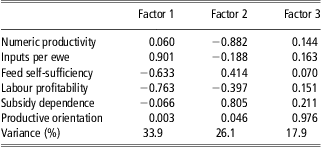
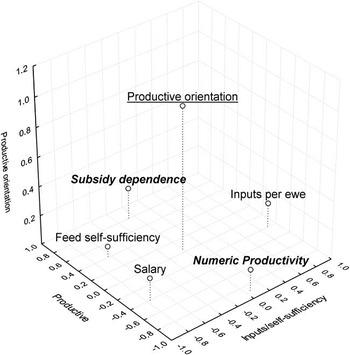
In the second step, three factors that were obtained with the PCA (Table 2) explained 77.9% of the original variance. The location of variables in the three-dimensional space that defined these three factors is represented in Figure 1. The factors are defined as follows:
Contribution of explanatory variables to the main factors in the PCA and variance explained per factor (77.8% in total)

PCA = principal component analysis.
Using varimax normalised rotation.
Factor 1: explained by feed self-sufficiency and labour profitability with positive sign and inputs per ewe with negative sign.
Factor 2: explained by numeric productivity and subsidy dependence contributed with opposite signs.
Factor 3: explained by productive orientation.
Location of main variables in three-dimensional space defined by factors 1 to 3 (factor self-sufficiency with variables in normal format; factor productive with variables in bold italics format; factor productive orientation with variables in underlined format). Using varimax normalised rotation. Factor 1: explained by feed self-sufficiency and labour profitability with positive sign and inputs per ewe with negative sign. Factor 2: explained by numeric productivity and subsidy dependence contributed with opposite signs. Factor 3: explained by productive orientation.

Factor 1: This factor was named inputs/self-sufficiency and explained 33.9% of the original variance. This factor is a combination of three indicators (defined in Table 1): inputs per ewe, feed self-sufficiency and labour profitability. Feed self-sufficiency and labour profitability contributed positively to this factor, whereas inputs per ewe were negatively correlated with this factor.
Factor 2: This factor was named productivity and explained 26.1% of the original variance. This factor is a combination of two indicators: numeric productivity and subsidy dependence. However, the indicators have different signs, indicating that increasing lamb productivity minimises the dependence from subsidies.
Factor 3: This factor was named productive orientation and explained 17.9% of the original variance. This factor comprises a single indicator that expresses the relative importance of the income from the livestock compared with the total farm income, indicating the degree of specialisation.
Typology of farming systems
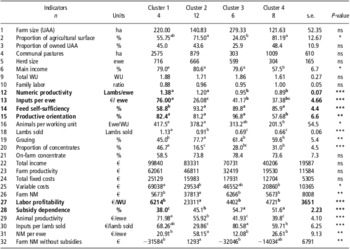
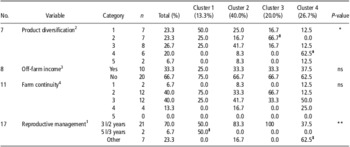
In the third step, the three previously described factors were retained for the CA. The hierarchical CA is represented in Supplementary Figure S1. This analysis resulted in four homogeneous groups of farms. General features of each group are shown in Tables 3 and 4.
Differences in quantitative indicators per cluster group (in bold PCA explanatory variables)

PCA = principal component analysis; UAA = usable agricultural area; WU = working unit; NM = net margin.
Least square means in the same indicator with different letters are different (P < 0.05). ns = P > 0.05; *P < 0.05; **P < 0.01; ***P < 0.001.
Differences in qualitative indicators per cluster group

1Type of reproductive management implemented: 3 l/2 years, 3 lambings/ewe every 2 years; 5 l /3 years, 5 lambings/ewe every 3 years; other, consider two alternative reproductive management: ‘two mating periods in the same year’ and ‘continuous mating’. No farm implemented 1 lambing/ewe per year reproductive management.
2Number of different products (incomes) commercialised by the farm (from one product up to five products).
3Dichotomic.
4Age (3 ⩽ 40 years; 2 = 40 to 55 years; 1 = 55 to 65 years; 0 ⩾ 65) + children (0 = no children or not in the household; 1 = children under 18 years; 2 = children working on the farm or willing to take the activity).
χ 2 with likelihood ratio χ 2 as statistic significance indicator. ns = P > 0.05; *P < 0.05; **P < 0.01.
‡Squared standardised Pearson residuals > 4.
Cluster 1: High-input intensive system. This group included four farms (13.3%). Farms in this group used a high-input and high-output system. These farms obtained the highest productivity in terms of lambs born per ewe and lambs sold per ewe, and therefore unitary income (€/ewe) were the highest. However, inputs per lamb were high and as a result the NM per ewe was low. The functioning of this system relied on the most intensive reproductive managements (5 lambings in 3 years and 3 lambings in 2 years), where high level of inputs per ewe are required. The proportion of concentrates in the diet for this cluster was the highest among the farms; consequently, the grazing diminished, and the feed self-sufficiency had the lowest scores of the sample.
Cluster 2: Low-input self-sufficient system. This group included 12 farms (40.0%) that had a low use of inputs per ewe and a pasture-based system, involving a high contribution of grazing to the total diet compared with the other groups. Therefore, the proportion of concentrates used for feeding in this group was low yielding a high level of feed self-sufficiency. Accordingly, inputs per lamb were the lowest, which resulted in the highest NM per ewe. The low inputs, however, did not impair the numeric productivity (second best score).
Cluster 3: Specialised livestock system. This group included six farms (23.3%) in which the productive orientation was mostly based on livestock production. Regarding land use, these farms had the highest share of non-arable land, but this land proportion was not translated into a large use of grazing resources. Despite the relatively high inputs per ewe, the numeric productivity of the herd was low and, hence, animal productivity was low. In this group, the economic performance relied on animal production such that the relatively high input costs and small animal productivity levels yielded the lowest labour profitability.
Cluster 4: Diversified crop-livestock system. This group included eight double purpose farms (23.3%) with sheep and agriculture (high proportion of agricultural products). The farm UAA was mainly used for growing cash crops (mostly cereals), although it was partly used to feed livestock (high proportion of concentrates in the diet). Therefore, feed self-sufficiency was high, and inputs per ewe were low. Meat from livestock was considered to be a co-product that complements other agricultural products. The number of adult ewes per unit of labour was the lowest of any group and the reproductive management was not clearly defined. Both the input used and productivity of ewes were low. Despite the diversification of production towards agricultural products and the relatively high proportion of subsidies as part of the total income, the labour profitability remained low.
Discussion
Natural areas provide renewable and cheap resources for grazing and are usually not used for other applications (De Rancourt et al., Reference De Rancourt, Fois, Lavín, Tchakérian and Vallerand2006). Intensive sheep production, however, leads to a reduction of grazing and a substitution of on-farm resources with external inputs (Riedel et al., Reference Riedel, Casasús and Bernués2007). As observed from Factor 1, high feed self-sufficiency result in lower variable costs per ewe and, consequently, better economic performance per work unit. This relationship was highlighted by the low-input self-sufficient cluster group (40% of farms), which achieved the best economic results (NM per work unit and per ewe) by reducing the purchase of inputs and maximising the use of on-farm resources while maintaining an intermediate technical productivity. Consequently, for farms raising local breeds, feed self-sufficiency seems to be a crucial attribute for explaining labour profitability.
Self-sufficiency can also be an advantage for highly uncertain and volatile markets. Lower dependence on external inputs reduces the effects from scarce resources or price fluctuations (Bernués et al., Reference Bernués, Ruiz, Olaizola, Villalba and Casasús2011). Industrial agricultural production relies largely on using non-renewable fossil fuels (Deike et al., Reference Deike, Pallutt and Christen2008). The rising fossil fuel prices result in lower business profitability through the direct cost of energy and the purchase of other inputs for the production process that have significant energy requirements (i.e. fertilisers, cash crops and transportation; Benoit and Laignel, Reference Benoit and Laignel2010). In the current uncertain market, characterised by a generalised increase in the prices of major inputs (concentrates, cereals and energy), the economic advantage is greater for feed self-sufficient farms (Benoit et al., Reference Benoit, Tournadre, Dulphy, Laignel, Prache and Cabaret2009), especially those with available private or communal grazing resources.
It is generally accepted that intensive systems improve animal productivity leading to better economic results. However, this relationship could not be established for the farms in this study. Farms of high-input intensive group were able to get significantly higher animal productivity ratios, but at the expense of large variable costs, which resulted in low economic margins per ewe. Intensification of animal production requires increased use of off-farm inputs and services (Udo et al., Reference Udo, Aklilu, Phong, Bosma, Budisatria, Patil, Samdup and Bebe2011) and hence, technical and economical efficiencies may be compromised during intensification (Pérez et al., Reference Pérez, Gil and Sierra2007) if management is deficient. In this study, the high-input intensive system scored the highest in animal productivity (1.3 times larger than the low-input self-sufficient system), but inputs per ewe were three times larger than the low-input self-sufficient system. Other studies have also shown that a higher intensification and biological efficiency does not automatically result in higher productivity and economic efficiency (Manrique et al., Reference Manrique, Choquecallata and Revilla1997; Benoit et al., Reference Benoit, Tournadre, Dulphy, Laignel, Prache and Cabaret2009). In order to make profitable the most intensive production systems, more prolific or selected breeds should be used, as local sheep breeds have a lower productive potential. However, optimal economic performance does not necessarily correspond to the maximum technical productivity. Therefore, the economic results per unit of labour and per animal seem to relate to an optimal farm management rather than to the intensification level and biological efficiency.
Sheep farming economic margins depend largely on subsidies in the European Union (De Rancourt et al., Reference De Rancourt, Fois, Lavín, Tchakérian and Vallerand2006). In this study, most farms showed moderate labour profitability, and 10% even scored negatively when subsidies were accounted for. On average, nearly 50% of the total farm income was obtained from subsidies. This means that only 26% of the farms obtained positive NMs when subsidies were not considered. Consequently, should policy support be removed, production would decline rapidly as producers would withdraw from sheep production and, possibly, from agriculture altogether (Canali, Reference Canali2006). According to factor 2, in order to reduce farm dependence from subsidies, numeric productivity should be adjusted according to the potential of the breed. In conclusion, the economic sustainability of autochthonous livestock breeds requires not only specific conservation policies and support, but also adequate technical and economic management.
Mixed sheep-cereal farming systems are traditionally adopted in Mediterranean areas (De Rancourt et al., Reference De Rancourt, Fois, Lavín, Tchakérian and Vallerand2006), allowing for the use of complementary resources and widening the product mix (i.e. diversification of production; Bernués et al., Reference Bernués, Ruiz, Olaizola, Villalba and Casasús2011). In the current study, the commercialisation of products ranged from one single product (lambs) to five products, including a wide range of cash crops. The most diversified farming system in our study (Cluster 4), where lamb production is mainly considered a co-product, obtained relatively low labour profitability. As with animal productivity, there is no evident relationship between the degree of diversification and economic performance of the farm. However, diversification allows farming systems to be less sensitive to inputs and sales prices (Ryschawy et al., Reference Ryschawy, Choisis, Choisis and Gibon2013), spreads risks, acts as a buffer to uncertain and unpredictable socio-economic and physical conditions, and increases flexibility (Kopke et al., Reference Kopke, Young and Kingwell2008). Globalisation is expected to increase uncertainty, and adaptability is no longer a single factor enhancing competitiveness on the market, but is instead a key aspect of farm sustainability (Darnhofer et al., Reference Darnhofer, Bellon, Dedieu and Milestad2010a). Poor performance in one farming activity can be compensated by better performance in others. However, diversity refers to products as well as resource availability and utilisation (e.g. the use of different natural resources available for grazing; crop rotations; diverse harvesting and conservation methods; valorisation of crop residues, stubbles and fallow lands; and utilisation of agro-industry by-products).
This study identified factors other than technical productivity as determinants for farm economic performance and sustainability. Resilience (Darnhofer et al., Reference Darnhofer, Fairweather and Moller2010b), flexibility and adaptability (Darnhofer et al., Reference Darnhofer, Bellon, Dedieu and Milestad2010a), diversification (Kopke et al., Reference Kopke, Young and Kingwell2008; Ryschawy et al., Reference Ryschawy, Choisis, Choisis and Gibon2013) and self-sufficiency (Ripoll-Bosch et al., Reference Ripoll-Bosch, Díez-Unquera, Ruiz, Villalba, Molina, Joy, Olaizola and Bernués2012b) are relevant in markets with rapid and unexpected changes in the physical, political and socio-economic environment. However, the farms’ capacity to reduce their dependency on external inputs; diversify the use of resources, activities, products and markets; or rationalise the management systems also depends on specific regional factors (e.g. production potential, access to inputs and markets and access to communal resources) and internal characteristics of the household (e.g. labour and work, farm structure and economics and sociological characteristics; García-Martínez et al., Reference García-Martínez, Olaizola and Bernués2009).
Certain limitations of this study should be acknowledged. The 30 analysed farms represent a particular autochthonous breed that is located in a specific area in Northeast Spain. The results may not be directly extrapolated to other sheep breeds and locations. In addition, the data present a static picture of the economic sustainability of farms. However, the uncertainty and variability of the physical and economic environment require a more dynamic approach to anticipate the evolution of farming systems (Bernués et al., Reference Bernués, Ruiz, Olaizola, Villalba and Casasús2011).
Conclusions
This study clustered four different groups of farms with regard to the utilisation of inputs, productivity of sheep and specialisation in production. A wide range of values was observed for every indicator, not only between the groups but also within the groups. However, the following factors were identified that address economic profitability and, therefore, farm sustainability for the farms in this study: (i) low off-farm input dependence (variable costs per ewe) and enhanced feed self-sufficiency is crucial for labour profitability for sheep farming of autochthonous breeds in LFAs; (ii) animal productivity, largely determined by the optimal management technique rather than the intensification level, is important for economic autonomy (reducing subsidy dependence) but does not necessarily improve labour profitability; and (iii) diversity of the production mix enhances farm flexibility and can be a strategy for handling uncertainty that does not necessarily improve labour profitability.
Acknowledgements
The research is funded by projects INIA-RTA2006-00170, INIA-PET2007-06-C03-01 and INIA-RTA2011-00133 of the Spanish Ministry of Science and Innovation, Government of Aragón and FEDER. The first author acknowledges the pre-doctoral financial support of INIA.