Introduction
While 50 to 80% of nursing home (NH) residents have a dementia disorder, apathy is the most common neuropsychiatric disturbance in these residents: more than one-third of them have apathy (Selbaek et al., Reference Selbaek, Engedal and Bergh2013). Apathy is associated with poor treatment response, reliance on caregivers to initiate activities of daily living, more rapid cognitive and functional decline, and increased mortality (Diesfeldt et al., Reference Diesfeldt, van Houte and Moerkens1986; van Reekum et al., Reference Van Reekum, Stuss and Ostrander2005; Starkstein et al., Reference Starkstein, Jorge, Mizrahi and Robinson2006; Tagariello et al., Reference Tagariello, Girardi and Amore2009). Given these negative correlates and the association of apathy with quality of life (Gerritsen et al., Reference Gerritsen, Jongenelis, Steverink, Ooms and Ribbe2005; Samus et al., Reference Samus2005), monitoring and management of apathy should be high on the agenda of NH professionals.
Apathy, which “conventionally describes a lack of interest or emotion” (Ishii et al., Reference Ishii, Weintraub and Mervis2009), is traditionally considered a symptom of depression by existing nomenclatures (American Psychiatric Association (APA), 2000; Olin et al., Reference Olin2002). However, it is increasingly recognized as a behavioral syndrome that can be discriminated from depression (van Reekum et al., Reference Van Reekum, Stuss and Ostrander2005; Starkstein and Leentjens, Reference Starkstein and Leentjens2008; Ishii et al., Reference Ishii, Weintraub and Mervis2009), and is characterized by diminished motivation in combination with a lack of goal-directed behavior and goal-directed cognition, and a lack of emotional effect (Marin et al., Reference Marin, Biedrzycki and Firinciogullari1991; Starkstein et al., Reference Starkstein, Petracca, Chemerinski and Kremer2001; Robert et al., Reference Robert2009). Apathy and depression do not overlap in mood-related symptoms such as sadness, feelings of guilt, and low self-esteem (Ready et al., Reference Ready, Ott, Grace and Cahn-Weiner2003; Leontjevas et al., Reference Leontjevas, van Hooren, Waterink and Mulders2009). But apathy and depression overlap in the so-called motivational symptoms, including loss of interest, reactivity, psychomotor retardation, energy loss, and lack of insight (Ready et al., Reference Ready, Ott, Grace and Cahn-Weiner2003; Leontjevas et al., Reference Leontjevas, van Hooren, Waterink and Mulders2009). Because of the overlap, treatment of depression may also have a positive effect on apathy. Indeed, depression treatment in NH residents may include behavioral activating strategies, such as a pleasant-activities plan (Teri et al., Reference Teri, Logsdon, Uomoto and McCurry1997; Verkaik et al., Reference Verkaik, Francke, van Meijel, Spreeuwenberg, Ribbe and Bensing2011), whereas activating strategies are shown to be beneficial for apathy (Brodaty and Burns, Reference Brodaty and Burns2012). However, most NH residents with depression are treated merely with drugs (Levin et al., Reference Levin, Wei, Akincigil, Lucas, Bilder and Crystal2007), and antidepressants may induce apathetic symptoms (Settle, Reference Settle1998; Barnhart et al., Reference Barnhart, Makela and Latocha2004). It is not clear to what extent apathy will be affected when depression is treated in NH residents using a multidisciplinary approach with psychosocial and pharmacological strategies.
Our first aim in this study was to determine whether a multidisciplinary approach to depression management would have an effect on apathy in dementia special care and in somatic NH units, and whether there was a difference in effect between the two unit types. A multidisciplinary depression program containing psychosocial and pharmacological treatment strategies reduced depression in somatic units but not in dementia units (Leontjevas et al., Reference Leontjevas, Gerritsen, Smalbrugge, Teerenstra, Vernooij-Dassen and Koopmans2013). Therefore, different effects in these NH unit types may also be found for apathy. Furthermore, because apathy and depression overlap in motivational but not in mood symptoms, we hypothesized that depression management will influence apathy and depressive motivational symptoms similarly (both increasing or decreasing), but the effects will differ for apathy and mood symptoms. From a nosological perspective, research on the effect of depression management on apathy can contribute to the debate whether apathy is a distinct syndrome. For improvement of the quality of care in NHs, it is important for NH professionals to be informed about effective depression treatment strategies and to what extent these could affect apathy.
Methods
Design overview
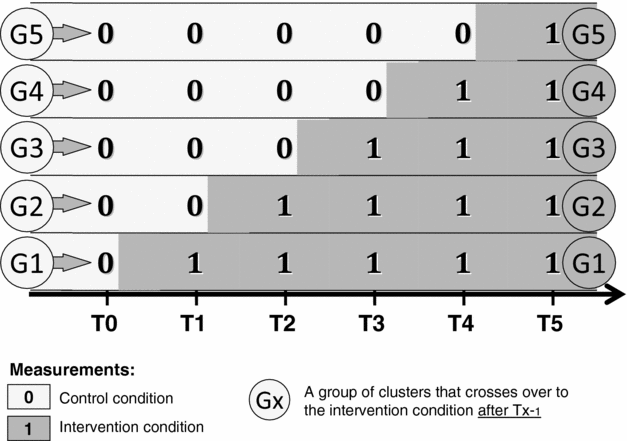
We used data of a pragmatic stepped-wedge (Hussey and Hughes, Reference Hussey and Hughes2007) trial on a multidisciplinary depression care program that showed reduction of depression prevalence in somatic NH units and improvement of quality of life in somatic and dementia special care units (Leontjevas et al., Reference Leontjevas, Gerritsen, Smalbrugge, Teerenstra, Vernooij-Dassen and Koopmans2013). Nursing home units were the units of randomization, intervention, and analyses. Clusters, randomized to five groups, crossed over from the control to the intervention condition at different time points, directly after a measurement (Figure 1). At baseline, all groups provided usual care. The first group crossed over to the intervention directly after baseline. Other groups crossed over sequentially after measurements at intervals of roughly four months.
Graphical representation of the stepped-wedge design with six measurements (T0–T5) and five cluster groups crossing over from the control to the intervention condition at different time points. Notes:. All clusters are in the control condition at baseline (T0) and they are randomly assigned to five groups that began implementation of the intervention after assessments (T0–Tx). Groups act as between-group controls to other groups receiving the intervention at a certain time point, whereas the same groups act as within-group controls to their future selves. For example, at T2, groups G3, G4, and G5 act as controls for groups G1 and G2, which are in the intervention condition. Group G2 acts as control at T0 and T1 for its future self at T2–T4.

Units were recruited by convenience between February 2009 and May 2009. The Nijmegen University Network of NHs (UKON, www.uko-n.nl), a collaboration between 12 care organizations and the Department of Primary and Community Care of the Radboud University Nijmegen Medical Centre, invited its organizations for participation. At each NH site, not more than one dementia and one somatic unit were invited. Before T0, residents were recruited directly after unit inclusion. Newly admitted residents were recruited until the last measurement.
The Medical Ethics Committee of Arnhem-Nijmegen region rated the study. The trial is registered with the Netherlands National Trial Register, number NTR1477, http://www.trialregister.nl/trialreg/index.asp.
Setting and participants
The residents were recruited from 16 dementia special care units (dementia units) and 17 somatic units by the nursing staff who did not have an impact on who was recruited; all residents or their legal representatives were to be approached. No exclusion criteria were used for residents with the exception of not providing written informed consent. Each participating NH resident and/or the legal representative (in case the resident was incapable of giving informed consent) received written and verbal information prior to joining the Act in case of Depression (AiD) study.
Randomization and intervention
Clusters were randomized to one of the five intervention groups by the researcher (Ruslan Leontjevas), who was not involved in the recruitment, using computer-generated random numbers. If there were two units in one NH, they were randomized in pairs to avoid contamination bias. Recruited residents were assigned a unique code. Interviewers who administered the outcome questionnaires were masked to intervention implementation or depression treatment and to previous test results. Residents did not know when the intervention was to be implemented or what were the program elements. Research staff administered the measurement instruments blinded to individual program components used for the resident.
A multidisciplinary program, AiD, was implemented in the units in the intervention condition. The AiD care program prescribes pathways for the assessment of depression (a two-step screening and a diagnostic procedure), three treatment modules, and monitoring of treatment results (see Figure 2). NH staff could use evidence-based treatment protocols that were provided in the program texts (see Appendix for the primary results (Leontjevas et al., Reference Leontjevas, Gerritsen, Smalbrugge, Teerenstra, Vernooij-Dassen and Koopmans2013)) or other protocols when deemed necessary. In all the cases, the staff was requested to follow the AiD pathways for collaborative care (Figure 2) (see Appendix, available as supplementary material attached to the electronic version of this paper at www.journals.cambridge.org/jid_IPG).
Act in case of Depression (AiD) pathways. Notes: Blue line: always prescribed; light blue broken line: to be considered if symptoms are severe, or when a psychosocial treatment, i.e. modules 1 and 2, was not effective. NORD: Nijmegen Observer Rated Depression scale; GDS8: Geriatric Depression Scale with eight items; CSDD: Cornell Scale for Depression in Dementia. AiD care program components: The AiD algorithms prescribe structural assessment procedures and the use of pathways for both pharmacological and psychosocial interventions. Depression assessment contains the following three elements: (1) detection, to be started every four months: the nursing staff uses a short observer-rated NORD scale (Leontjevas et al., Reference Leontjevas, Gerritsen, Vernooij-Dassen, Teerenstra, Smalbrugge and Koopmans2012d) with a cut-off score of >1; (2) screening: an extensive screening by NH unit psychologist using an interview-based instrument for resident (GDS8) (Jongenelis et al., Reference Jongenelis2007) with a cut-off score of >2) or for caregiver if resident cannot respond reliably (CSDD) (Alexopoulos et al., Reference Alexopoulos, Abrams, Young and Shamoian1988a) with a cut-off score of >7). Screening is to be started if indicated by previous step or based on clinical suspicion to reduce false negatives; (3) diagnosing: a diagnostic procedure by psychologist and elderly care physician using the Diagnostic and Statistical Manual of Mental Disorders, Fourth Edition, Text Revision (DSM-IV-TR) (APA, 2000) in residents without dementia, and the Provisional Diagnostic Criteria for Depression of Alzheimer's Disease (Olin et al., Reference Olin2002) in residents with dementia. Diagnosing is to be started when indicated by the screening instruments in screening or based on additional information provided by NH staff, resident, or another source. Treatment pathways prescribe the use of three treatment modules by the multidisciplinary team. Module 1 is for all residents with depressive symptoms or depression and consists of environmental and behavioral strategies that can be provided by the nursing staff and, if possible, by a recreational therapist. Module 2 is psychotherapy, which is complementary to treatment module 1 in case of depression. Module 3 includes the use of antidepressants complementary to modules 1 and 2, especially if depression is severe. Treatment protocols that can be used by multidisciplinary teams are described elsewhere (Leontjevas et al., Reference Leontjevas, Gerritsen, Smalbrugge, Teerenstra, Vernooij-Dassen and Koopmans2013). These protocols include a pleasant activities plan and a day structure (module 1) (Teri et al., Reference Teri, Logsdon, Uomoto and McCurry1997; Verkaik et al., Reference Verkaik, Francke, van Meijel, Spreeuwenberg, Ribbe and Bensing2011), life-review therapy (Bohlmeijer et al., Reference Bohlmeijer, Steunenberg, Leontjevas, Mahler, Daniël and Gerritsen2010) and mediative therapy (module 2), and a pharmacological protocol based on national and international guidelines (module 3). Monitoring is the evaluation of the treatment in multidisciplinary meetings of physician, psychologist, and the nursing staff.
No specific information about AiD was provided to NH staff and residents during the control condition. The units did not use any particular depression care program in the control condition, and depression was mostly assessed after indications of possible depression were reported by the nursing staff, resident, or any other informant. Teams provided ad hoc depression treatment and this was mainly in the form of drugs (Leontjevas et al., Reference Leontjevas, Gerritsen, Koopmans, Smalbrugge and Vernooij-Dassen2012a).
The research team provided units in the intervention condition with program texts and practical tools, a 3.5-h educational course about depression and AiD to the nursing staff, and a 3.5-h training session to psychologists about life-review therapy (Bohlmeijer et al., Reference Bohlmeijer, Steunenberg, Leontjevas, Mahler, Daniël and Gerritsen2010). A physician involved in the development of program contacted the unit physician on phone to discuss the medication protocol.
Outcomes and follow-up
Apathy
Apathy was assessed using the abbreviated 10-item Apathy Evaluation Scale (AES-10). Lueken et al. (Reference Lueken, Seidl, Volker, Schweiger, Kruse and Schroder2007) refined the original 18-item AES scale (Marin et al., Reference Marin, Biedrzycki and Firinciogullari1991) for the NH population by eliminating items that had either lost specificity mainly due to externally driven context in NHs or were difficult to measure in residents with severe cognitive deficits. Each item of the AES-10 gives an example of apathetic behavior. The answer categories are as follows: 1 = not at all characteristic, 2 = slightly characteristic, 3 = somewhat characteristic, and 4 = a lot characteristic, resulting in a scale ranging from 10 to 40. A higher total AES-10 score indicates more apathetic behavior. The AES-10 was validated in Dutch NH residents with and without dementia against diagnostic criteria for apathy and was found to be a valid instrument for distinguishing apathetic from non-apathetic residents in a heterogeneous sample of residents with and without dementia (Leontjevas et al., Reference Leontjevas2012b).
Depressive symptoms
Depressive symptoms were assessed using the Cornell Scale for Depression in Dementia (CSDD) (Alexopoulos et al., Reference Alexopoulos, Abrams, Young and Shamoian1988a). The CSDD consists of 19 items, each rated as 0 = absent, 1 = mild or intermitted, and 2 = severe. A higher total scale score indicates more severe depressive symptoms. The scale has been validated in patients with dementia (Alexopoulos et al., Reference Alexopoulos, Abrams, Young and Shamoian1988a) and without dementia (Alexopoulos et al., Reference Alexopoulos, Abrams, Young and Shamoian1988b). The scale showed acceptable accuracy in our sample of dementia (Leontjevas et al., Reference Leontjevas, Gerritsen, Vernooij-Dassen, Smalbrugge and Koopmans2012c) and somatic units (Leontjevas et al., Reference Leontjevas, Gerritsen, Smalbrugge, Teerenstra, Vernooij-Dassen and Koopmans2013). To determine subscales for motivational and mood symptoms, we performed factor analysis (eigenvalues greater than 1.0, varimax rotation loadings of 0.4 and greater), and revealed factors that together explained 37% of variance. Items of the first factor (20% of variance; items: retardation, loss of interest, appetite loss, weight loss, and lack of energy) constituted a motivational subscale. The sum of the items of the second factor (6% of variance; items: suicide, poor self-esteem, pessimism), the fourth factor (3% of variance; items: irritability, agitation, diurnal variation), and the fifth factor (2% of variance; items: anxiety, sadness) was used to compose a mood subscale score.
Adherence rate
To estimate the effects of individual AiD components, adherence rates were calculated per unit as the proportion of initiated cases of AiD components in relation to indicated cases in residents of the unit. For example, a 0 score for the adherence rate for the component screening by psychologist means that no screening was conducted for any of the unit's residents, and a 0 score for the adherence rate for treatment modules 1 and 2 means that, when prescribed, no psychosocial treatment containing activating strategies and psychotherapy was provided. For module 3, a 0 score means that no pharmacological treatment was started, or if pharmacological treatment was provided in usual care, it was neither changed nor monitored according to the AiD protocol. The rates were determined by the research team based on residents’ medical records and information from structured phone interviews with physicians, psychologists, and unit managers (Leontjevas et al., Reference Leontjevas, Gerritsen, Koopmans, Smalbrugge and Vernooij-Dassen2012a). Uncertainties were clarified in additional interviews with the NH staff.
The CSDD and AES-10 were administered in an interview with the primary professional caregivers (credentials can be compared with those of a licensed practical nurse in the United States) by the researcher, research assistant, and 32 graduate psychologists in their final year of MSc, none of whom was involved in providing the care program. Next to demographical data retrieved from the resident file, the standardized Mini-Mental State Examination (MMSE) (Molloy et al., Reference Molloy, Alemayehu and Roberts1991) was administered in a structured interview with the resident for assessing global cognitive functioning. The interviewers were trained in administering the scales. In accordance with the initial protocol (Gerritsen et al., Reference Gerritsen2011), the CSDD should only be assessed in dementia residents. The protocol was changed after the first week of the baseline measurement: The CSDD was administered in both dementia and somatic units, which makes a comparison between the two unit types possible using the same instrument.
Statistical analyses
We performed basic analyses using SPSS 17.0.0 (Chicago, IL). To compare the baseline characteristics and the adherence rates of AiD components between intervention groups, we used ANOVA on the unit means for continuous variables and proportions based on dichotomous variables at resident level. For newly admitted residents, we investigated at each T-measurement whether groups differed for the three outcome variables: apathy, motivational, and mood symptoms. A t-test was used to compare dementia and somatic units. χ 2 tests were used for categorical variables of units. For a maximum of four missing individual CSDD items, a 0 score was imputed (Leontjevas et al., Reference Leontjevas, Gerritsen, Vernooij-Dassen, Smalbrugge and Koopmans2012c). The same conservative imputation (lowest score = 1) was performed for a maximum of two missing AES-10 items.
To determine the effectiveness of transferring from standard care to the intervention condition, a comparison was made between groups in the intervention and control conditions at each time point, and within groups between two conditions. To account for the nesting of measurements within subjects, and subjects within units, continuous outcomes were fitted using linear mixed models with random effects for units and for subjects nested within units (SAS software 9.2, SAS Institute Inc., North Carolina). Primary dependent outcomes were the AES-10 and the two CSDD subscale scores. All estimates (here and below) were adjusted for age, gender, time trends (T0–T5), region of the country (province), and the unit type (somatic or dementia). To identify the intervention effect and to compare dementia and somatic units, we used likelihood ratio tests, comparing a model with the main intervention effect and its interaction with type of unit to a model without the interaction and then to a model without the main effect and interaction. (Verbeke and Molenberghs, Reference Verbeke and Molenberghs2000). Estimates of the intervention effect and possibly the interaction were taken from the most reduced model in which the fit was not significantly worse. Cohen's d is determined as the intervention effect divided by standard deviation. Exploratively, the influence of the duration of the intervention was investigated by first building a model with additional linear and quadratic terms for the duration (number of inter-assessment periods) and their interaction terms with the unit type, and then reducing it to the smallest model in which the fit was not significantly worse. On the unit level, the duration of the study was conceptualized by the number of inter-assessment periods (the T-measurements were held at approximately four months) in the intervention condition. On the resident level, the number of inter-assessment periods for which the resident participated in the study was used for the time influence; the number of periods the resident was in the unit in the intervention condition was used for the duration of the intervention.
A probability value of less than 0.017 with Bonferroni correction for three main variables (0.05/3) was considered significant.
To assess the influence of individual AiD components, we compared post hoc a model with the adherence rates of each component, their interaction effect with the type of unit, and the duration factors that were of influence by the previous analyses to the most reduced model that did not have a significantly worse fit.
Results
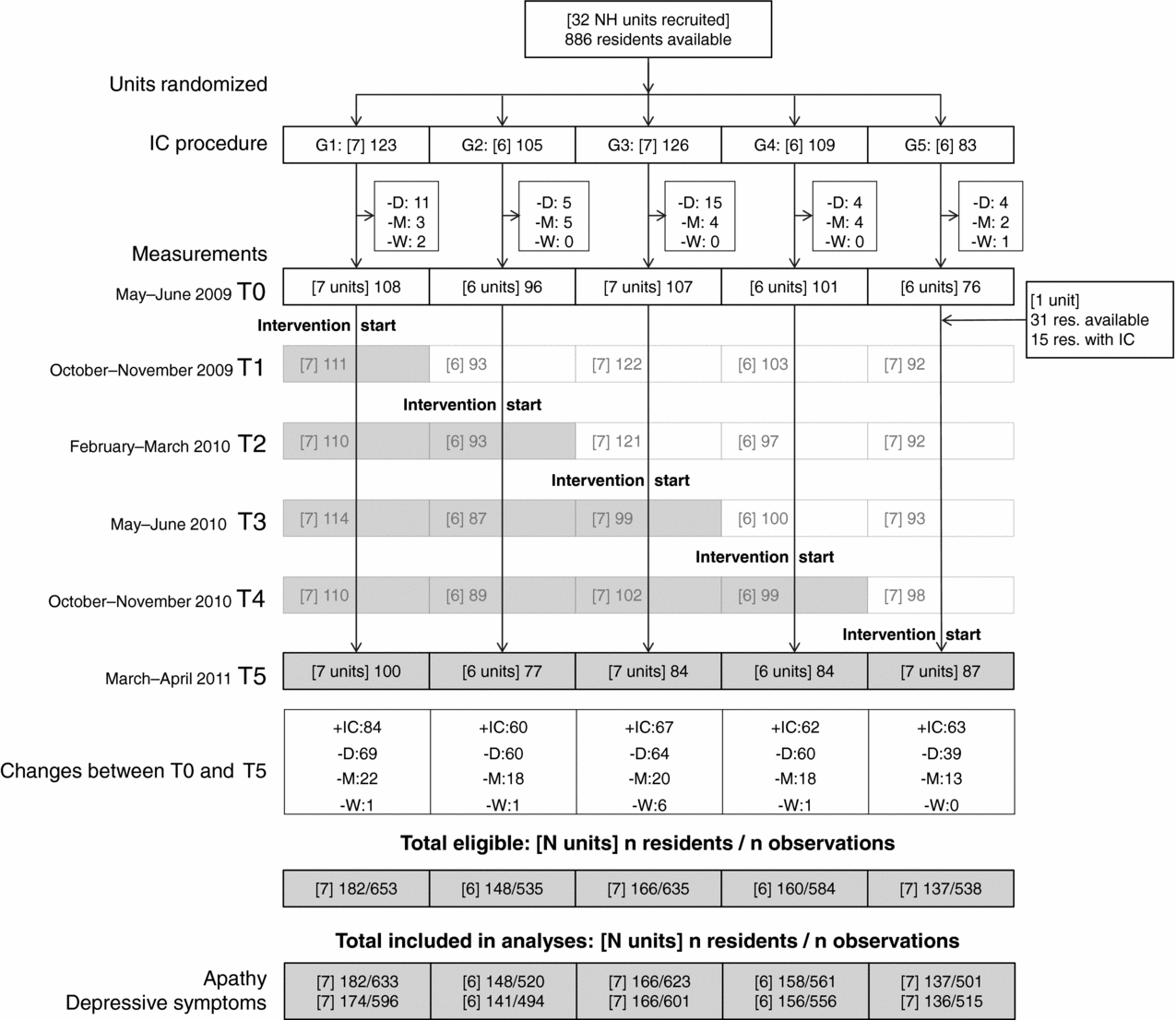
Figure 3 shows the trial profile (the detailed CONSORT diagram is presented elsewhere; Leontjevas et al., Reference Leontjevas, Gerritsen, Smalbrugge, Teerenstra, Vernooij-Dassen and Koopmans2013). Before T0, 503 (53% in dementia units) residents were enrolled in the study, and 290 (46% in dementia units) were enrolled after the baseline. Cluster groups did not differ in unit size (mean number of residents: 27.6; SD: 9.6), number of residents included in the study (15.2; SD: 5.2), age (mean, 80.5 years; SD: 6.5), and female gender (68.2%; SD: 12.2%) of the residents enrolled (details per cluster groups are presented elsewhere; Leontjevas et al., Reference Leontjevas, Gerritsen, Smalbrugge, Teerenstra, Vernooij-Dassen and Koopmans2013). The groups differed significantly in the number of units located in one of the four provinces (χ 2 (12, N = 33) = 23.3, p = 0.026). The difference in mood symptoms at T2 (F(4, 16) = 4.2; p = 0.016) was considered being by chance for 18 tests (three variables, six time points) at α = 0.05.
Study flow diagram. Notes: Measurements: Clusters crossed over from the control (in white) to the intervention condition (in gray) at different time points directly after a measurement.
Apathy: 10-item Apathy Evaluation Scale (AES-10). Missing values were due to problems with scoring by proxies, and due to 69 residents (all groups represented) that were not assessed for CSDD during the first week of T0 measurement, which was according to the former protocol prescribing the use of CSDD in dementia residents only (Leontjevas et al., Reference Leontjevas, Gerritsen, Smalbrugge, Teerenstra, Vernooij-Dassen and Koopmans2013). NH: nursing home; G = group; [N]: number of units; n: number of residents with informed consent (IC); -D: deceased; -M: moved to another unit; -W: IC withdrawal; T0–T5: measurements; +IC: recruited after T0; 1 unit included: paired with a previously randomized unit from the same NH to avoid contamination; res.: residents; observations: residents with available measurements.
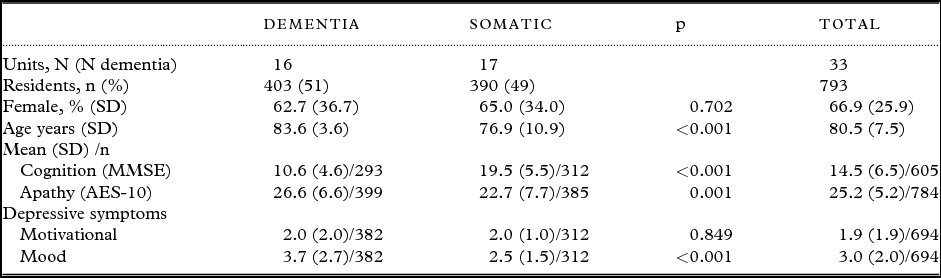
At the inclusion of the residents in the study, dementia residents were older, had more cognitive impairments, and more severe apathy and mood symptoms than somatic residents. They did not differ in gender, and motivational symptoms (Table 1).
Residents’ characteristics at their first measurement after inclusion in the study
Notes: p-values: t-test for dementia versus somatic residents, residents’ characteristics at baseline were adjusted for clustering.
Cognition measured with MMSE (minimum: 0, maximum: 30); apathy, AES-10 (minimum:10; maximum: 40); motivational symptoms, sum of CSDD items: retardation, loss of interest, appetite loss, weight loss, and lack of energy (minimum: 0; maximum 10); mood symptoms, sum of CSDD-items: anxiety, sadness, irritability, agitation, diurnal variation, suicide, poor self-esteem, pessimism (minimum: 0; maximum: 16).
Abbreviations. Dementia: dementia special care units; MMSE: Mini-Mental State Examination; AES-10: 10-item Apathy Evaluation Scale; CSDD: Cornell Scale for Depression in Dementia.
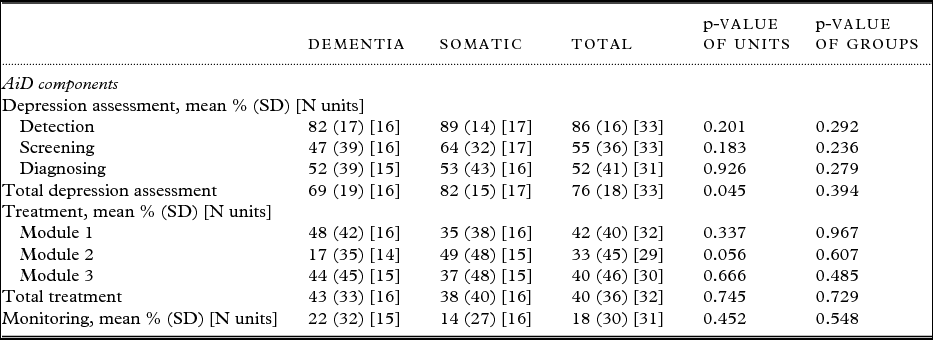
Dementia units showed a lower combined adherence rate for depression assessment (recognition, screening, and diagnosing) than somatic units (Table 2). No differences were found for individual assessment elements. Intervention groups did not differ in adherence rates (for detailed numbers, see Leontjevas et al., Reference Leontjevas2012a).
Extent to which NH teams used AiD components: proportion (%) of the residents receiving AiD components in relation to residents who should receive the component
Notes: p-value of units: significance tested for the difference between dementia and somatic units using t-test; p-value of groups: significance tested for the difference between groups using ANOVA –test.
Depression assessment contains detection, screening, and diagnosing; Treatment contains the following three modules: Module 1: day program and pleasant activities plan; module 2: psychosocial therapy by psychologist; module 3: (re-)considering medication.
Difference between depression assessment and treatment adherence rates: Mean difference (SD), 0.35 (0.35), paired t(31) = 5.5, p < 0.001.
Abbreviations. [N units]: number of units with residents for whom an AiD component should be performed (missing values are due to not indicated components); dementia: dementia special care units.
Apathy
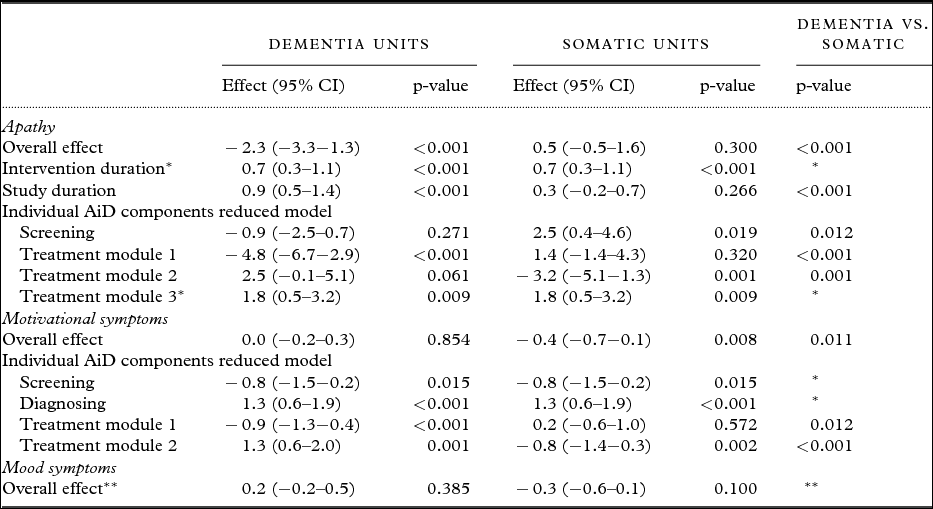
Table 3 shows the effects of the AiD program as compared with usual care. Intention-to-treat analyses showed a reduction of apathy in dementia units (overall effect across all time point, −2.3; 95% CI, −3.3–1.3; p < 0.001; Cohen's d, −0.35), and no significant change in apathy in somatic units (0.5; −0.5 to 1.6; p = 0.300). The difference in the effect between the dementia and somatic units was significant (difference in effect, −2.8; −4.2 to −1.5; p < 0.001). The time the resident participated in the study was associated with an increase in AES scores in dementia units (0.9; 0.5 to 1.4; p < 0.001). The time the resident was in the intervention condition was associated with an increase in AES scores in both dementia and somatic units (0.7; 0.3 to 1.1; p < 0.001).
Effects of AiD program and its components on apathy and depressive motivational and mood symptoms
Notes: Models are adjusted for gender, age, region of country, time points, adherence rates (extent to which NH teams used an AiD component), and the interaction with the unit type; dementia vs. somatic: significance tested for interaction with the unit type, i.e. whether effect in dementia units differs from the effect in somatic units.
Apathy: AES-10 (minimum: 10; maximum: 40). Motivational symptoms, sum of CSDD items: retardation, loss of interest, appetite loss, weight loss, and lack of energy (minimum: 0; maximum 10). Mood symptoms, sum of CSDD items: anxiety, sadness, irritability, agitation, diurnal variation, suicide, poor self-esteem, and pessimism (minimum: 0; maximum: 16).
Overall effect: Effect of the whole program. Intervention duration: effect of the time the resident was in the intervention condition (number of four-month inter-assessment periods). Study duration: number of the inter-assessment periods the resident was in the study.
Individual AiD components reduced model: Model that still has a non-significantly worse fit than a full model with all AiD components, estimates were taken from the most reduced model of which the fit was not significantly worse, other AiD components were deleted from the model without significant influence on the variance explained. Screening: screening by psychologist. Diagnosing: Diagnostic procedure by psychologist and physician. Treatment module 1: activating strategies; module 2: psychosocial therapy by the unit psychologist; module 3: use of a pharmacological treatment protocol.
*Interaction effect with the type of unit could be eliminated from the model.
**Both effect and interaction can be eliminated from the model.
Abbreviations. Dementia: dementia special care units; AES-10: 10-item Apathy Evaluation Scale; CSDD: Cornell Scale for Depression in Dementia.
Post hoc analyses revealed that adherence to treatment module 1 (activating strategies) was significantly associated with decrease in apathy in dementia units (−4.8; 95% CI, −6.7−2.9; p < 0.001; Cohen's d, −0.73). In somatic units, adherence to module 2 (psychotherapy) was associated with decrease in apathy (−3.2; 95% CI, −5.1−1.3; p < 0.001; Cohen's d, −0.42). Adherence rates of screening by psychologist in somatic units, module 2 in dementia units (borderline significance), and module 3, pharmacological treatment, in both dementia and somatic units were associated with apathy worsening (increase in AES-10 scores, Table 3).
Depressive symptoms
Act in case of Depression had a significant effect on motivational symptoms in somatic units (overall effect across all time points, −0.4; 95% CI, −0.7−0.1; p = 0.008; Cohen's d, −0.40), but not in dementia units. Mood symptoms were not influenced by intervention in both unit types (Table 3). The time factors could be deleted from the mixed models without worsening the fit.
Of the AiD components, the adherence rate of screening by psychologists was negatively associated with motivational symptoms, while diagnosing was associated positively (Table 3). Adherence to treatment module 1 was associated with less motivational symptoms in dementia units (−0.9; 95% CI, −1.3−0.4; p < 0.001; Cohen's d, −0.45) and module 2 in somatic units (−0.8; 95% CI, −1.4−0.3; p = 0.002; Cohen's d, –0.80). Adherence to treatment module 2 was associated with more motivational symptoms in dementia units (1.3; 95% CI, 0.6–2.0; p < 0.001; Cohen's d, 0.65).
Discussion
Our analyses showed that the whole multidisciplinary depression care program, including psychosocial and pharmacological treatment strategies, reduced apathy in dementia but not in somatic units. In contrast, the depressive motivational symptoms were reduced in somatic units but not in dementia units, which was in agreement with the results of primary analyses for depression outcomes (Leontjevas et al., Reference Leontjevas, Gerritsen, Smalbrugge, Teerenstra, Vernooij-Dassen and Koopmans2013). Although the current study showed that depressive mood symptoms were not affected, the effect sizes for apathy and motivational symptoms were larger than the minimum clinically important difference of 0.2 between a new intervention and usual care (Kazdin and Bass, Reference Kazdin and Bass1989). Different patterns for the effect on apathy versus motivational and mood symptoms underpin the nosological position of apathy as a distinct syndrome.
The positive effect of the depression management program on apathy in dementia units is an important finding considering that apathy is associated with a faster cognitive and functional decline in dementia (Starkstein et al., Reference Starkstein, Jorge, Mizrahi and Robinson2006). More research is certainly needed on whether managing apathy may help to slow down dementia progression.
Post hoc analyses provided more insight into the effectiveness of specific program components, into different effects in dementia and somatic units, and into the position of apathy as a distinct syndrome. Regarding psychosocial treatment strategies, there was an indication that apathy and depression overlap in motivational symptoms. In dementia residents, the effect on apathy was mainly attributed to activating strategies (module 1). There was also an indication that activating strategies may help to reduce motivational symptoms in these residents. In somatic residents, the effect on motivational symptoms was mainly attributed to psychotherapy (module 2), and there was an indication that psychotherapy could be effective for reducing apathy too. Unexpectedly, there was an indication that treatment module 2 in dementia units was associated with more apathy and motivational symptoms. This treatment module for dementia units included a mediative psychosocial approach. Process evaluation showed that it was implemented poorly (17% of the indicated cases). It is possible that psychologists provided the module mainly to those residents who showed worse symptomatology. More research is needed on how psychotherapy and mediative therapy can be used effectively beyond activating strategies in dementia residents. In contrast to dementia units, the adherence rate for module 2 was more acceptable (49%) in somatic units, which could explain positive effects on apathy and motivational symptoms in this unit type. Life-review therapy was the first choice for residents without severe cognitive impairments, and the effect of this therapy has been reported for depression in different studies (Bohlmeijer et al., Reference Bohlmeijer, Smit and Cuijpers2003). Hsieh et al. (Reference Hsieh2010) reported apathy decrease due to group reminiscence therapy, which is related to life-review therapy, in NH residents with mild to moderate dementia. More research on the effect of individual or group reminiscence therapy on apathy is welcomed in both somatic and dementia residents.
In contrast to psychosocial strategies, module 3 (the use of a pharmacological treatment protocol) did not show comparable effects on apathy and depressive symptoms. This underpins the distinct position of apathy. Apathy increased but depressive symptoms were not affected when this treatment module was implemented. It is possible that physicians started to use the medication protocol more often in the residents who showed more apathetic behavior. However, additional analyses adjusting for the actual use of antidepressants indicated more apathy but unchanged depressive symptoms in residents who used antidepressants during the study irrespective of the intervention condition (Roben, Reference Roben2012). A recent review of trials in the NH population showed a modest reduction of depression when antidepressants were used in non-randomized open-label trials, but there was no evidence for the effect of antidepressants on depression in randomized controlled trials (Boyce et al., Reference Boyce, Hanlon, Karp, Kloke, Saleh and Handler2012). These findings and possible worsening of apathy due to antidepressants call for more research on the effectiveness of antidepressants in the fragile NH population.
Next to different results for module 3 on apathy and depressive symptoms, depression assessment procedures showed different associations with apathy and depressive symptoms. Adherence to screening procedures was associated with reduced apathy and motivational symptoms in dementia units, and with reduced motivational symptoms in somatic units. This suggests a non-specific effect above treatment modules: NH staff might provide better care in the units where screening procedures were better implemented. However, screening by a psychologist was associated with more apathy in somatic units. Screening by a psychologist was initiated only in 55% of the prescribed cases. The screening was focused on depression but it is possible that psychologists decided to specifically screen those somatic residents in whom caregivers reported an increase in apathetic symptoms. In this context it is interesting that the higher adherence rate for diagnosing was associated with increased motivational symptoms but not with apathy. It is probable that psychologists were able to differentiate apathy from depressive symptoms and proceeded, in accordance with the AiD program, with diagnosing the residents who showed depression and not only apathy. However, another explanation for higher motivational scores after diagnosing is also possible. This may be due to caregivers’ increased awareness and knowledge of depression (Leontjevas et al., Reference Leontjevas, Gerritsen, Koopmans, Smalbrugge and Vernooij-Dassen2012a). In this study, caregivers were educated about depression and its association with quality of life. They might rate the residents as more “sick” after an official depression diagnosis was made in the intervention condition. Such scoring bias after diagnosing would not necessarily affect apathy scores, which corresponded with our findings. Future studies are needed to address a possible scoring bias by proxies after diagnosing residents having depression.
Another finding talks in favor of a distinct position of apathy: Apathy worsened with time in dementia units independent of the intervention, and the intervention effect on apathy declined over time in both dementia and somatic units. Such effects were not found for depressive symptoms. Apathy worsened with time in dementia probably due to the progressive nature of dementia (Starkstein et al., Reference Starkstein, Jorge, Mizrahi and Robinson2006). Weakening of intervention effects on apathy may imply that NH staff encountered problems in maintaining psychosocial treatment strategies that were effective for apathy. Another reason may reflect the use of antidepressants and their cumulative side effects on apathy. Indeed, more research is needed on the longitudinal effect of antidepressants on apathy.
Strengths and limitations
This trial on the effects of depression program has several strengths. The innovative stepped-wedge design, the large number of participating NH units and residents, the pragmatic nature of the trial, and the absence of exclusion criteria for the residents, which increases generalizability. However, generalizability of our results may be questioned for other countries than the Netherlands and because of a potential selection bias. We did not expect that 40 to 50% of the residents in the units would not provide informed consent in the study (Leontjevas et al., Reference Leontjevas, Gerritsen, Koopmans, Smalbrugge and Vernooij-Dassen2012a). Prevalence of depression in our sample was comparable to that in other studies (Leontjevas et al., Reference Leontjevas, Gerritsen, Smalbrugge, Teerenstra, Vernooij-Dassen and Koopmans2013). Prevalence of apathy could not be compared with other figures as the AES-10 has not been used on apathy in epidemiological studies. Another limitation of this trial may consider its pragmatic nature, which is also the strength of the study. Calls for pragmatic research have been made to maximize the applicability of interventions (Zwarenstein et al., Reference Zwarenstein2008) because pragmatic trials test whether an intervention is effective in real-life conditions. However, in contrast with an explanatory trial that tests an intervention in ideal conditions, pragmatic trials are not appropriate for sound conclusions about how and why an intervention works. The AiD trial was not focused on a specific treatment method or a specific drug but on a multidisciplinary approach prescribing pathways for assessment and treatment protocols. Therefore, conclusions on specific treatments and antidepressants in particular should be interpreted with caution. More high quality randomized controlled trials on apathy treatment and antidepressants in the NH population are certainly welcomed.
Conclusions
Our findings are important for the on-going discussion on the concept of apathy and for NH professionals providing high quality care. The depression management program affected apathy and depressive symptoms differently: apathy decreased in dementia units, but motivational depressive symptoms decreased in somatic units. Although post hoc analyses showed some congruent effects on apathy and motivational symptoms for psychosocial treatment modules, there were several indications for the concept that “apathy is not depression”(Levy et al., Reference Levy1998). For NH professionals, the conclusion is that activating strategies can be used effectively in dementia units for managing apathy, and probably depressive symptoms too. In somatic units, psychotherapy is effective for depressive symptoms, and probably for apathy too. More research is needed for improving depressive mood, and on the effects of antidepressants in NH residents.
Conflict of interest
None
Description of authors’ roles
D.L. Gerritsen, S. Teerenstra, M. Smalbrugge, and R.T.C.M. Koopmans designed the study. D.L. Gerritsen, R.T.C.M. Koopmans, and M. Smalbrugge obtained funding. R. Leontjevas and D.L. Gerritsen supervised the data collection. S. Teerenstra and D.L. Gerritsen were responsible for the statistical design, and, together with R. Leontjevas, carried out the analyses. R. Leontjevas wrote the paper and all other authors contributed to the writing and critical revisions.
Acknowledgments
The Netherlands Organization for Health Research and Development (ZonMW, Contract/Grant number: 170992801) supported the study financially, but had no role in the study design, data collection, interpretation, and reporting. We thank Alexandra Evers-Stephan, Ellen Jooren, Arjanne van Leeuwen, and all research team members and NH staff for contributing to the study.