Introduction
Popcorn sales increased globally from 160 million kg in 1970 to nearly 519 million kg in 2016 (Popcorn Board 2019). Popcorn production in the United States occurs predominantly in Illinois, Indiana, Iowa, Kansas, Kentucky, Michigan, Nebraska, and Ohio (Popcorn Board 2019). The United States produced 486 million kg of popcorn in 2017; Nebraska produced the most: 167 million kg annually or 34% of the total popcorn production in the United States on 25,949 ha (USDA 2019). Popcorn varies agronomically from field corn [Zea mays (L.) var. indentata] in several ways. It is generally shorter, has weaker and thinner stalks that make it more prone to lodging, produces narrower and more upright leaves, and generally emerges slowly and lags behind in leaf production compared with field corn (Ziegler Reference Ziegler and Hallauer2001).
Herbicide options in popcorn are limited compared with field corn (Pike et al. Reference Pike, Pritchett, Reynolds, Cook, Mueller, Green, Linn, Koinzan, Eisley, Obermeyer, Hoffman, Robbins, Sleaford, Schleisman, Sieg, Weaver, Ziegler, Duty, Iverson, Miyazaki, Jess and Burr2002; Ziegler Reference Ziegler and Hallauer2001). For example, thiencarbazone/isoxaflutole is labeled in field corn but not in popcorn (Anonymous 2016). This is because popcorn is more sensitive to several herbicides compared with field corn and seed corn. Atrazine and S-metolachlor are the most commonly used herbicides in popcorn, because of their crop safety. For example, Bertalmio et al. (Reference Bertalmio, Cook, Duty, Eisley, Green, Hacker, Hoffman, Iverson, Jess, Koinzan, Linn, Miyazaki, Mueller, Mueller, Obermeyer, Pike, Pritchett, Reynolds, Robbins, Schleisman, Sieg, Sleaford, Weaver and Ziegler2003) reported that atrazine (PRE and/or POST) was applied on 99% and S-metolachlor (PRE) on 11% of popcorn production fields in 1999 in the United States. In addition, a premix of atrazine and S-metolachlor can provide broad-spectrum weed control compared with either herbicide applied alone (Geier et al. Reference Geier, Stahlman, Regehr and Olson2009; Grichar et al. Reference Grichar, Besler, Brewer and Palrang2003; Steele et al. Reference Steele, Porpiglia and Chandler2005). As of 2018, there is no herbicide-resistant popcorn hybrid commercially available; therefore, the use of POST herbicides, such as glyphosate, glufosinate, or 2,4-D choline, used in herbicide-resistant field corn, are not options for weed control in popcorn (ISAAA 2018; Pike 2002). The use of a PRE herbicide is very important in popcorn production because of limited effective POST herbicides. PRE herbicides with multiple effective sites of action in corn production often result in reduced weed densities and weed biomass and leads to greater yields (Nurse et al. Reference Nurse, Swanton, Tardif and Sikkema2006; Schuster and Smeda Reference Schuster and Smeda2007). Although PRE herbicides are important to corn production, they usually do not provide season-long control of certain weed species with wide emergence patterns, such as common waterhemp [Amaranthus tuberculatus (Moq.) J. D. Sauer] and Palmer amaranth (A. palmeri S. Watson) unless followed by a POST herbicide (Chahal et al. Reference Chahal, Ganie and Jhala2018a, Reference Chahal, Irmak, Gaines, Amundsen, Jugulam, Jha, Travlos and Jhala2018b; Nolte and Young Reference Nolte and Young2002; Steckel et al. Reference Steckel, Sprague and Hager2002).
The critical period of weed control (CPWC) is the period during the life cycle of a crop when weeds must be controlled to avoid unacceptable yield losses (Zimdahl Reference Zimdahl, Altieri and Liebmann1988). The CPWC consists of the critical time for weed removal (CTWR), which determines the earliest point in the life cycle of a crop when weeds must be removed to prevent unacceptable yield losses (Knezevic et al. Reference Knezevic, Evans, Blankenship, Van Acker and Lindquist2002). Knowledge gained from understanding the CPWC aids in determining the need for and timing of weed control (Knezevic et al. Reference Knezevic, Evans, Blankenship, Van Acker and Lindquist2002). The CTWR has been determined in cotton (Gossypium spp.) (Bukun Reference Bukun2004), dry beans (Phaseolus vulgaris L.) (Burnside et al. Reference Burnside, Wiens, Holder, Weisberg, Ristau, Johnson and Cameron1998), peanut (Arachis hypogaea L.) (Everman et al. Reference Everman, Clewis, Thomas, Burke and Wilcut2008), field corn (Hall et al. Reference Hall, Swanton and Anderson1992), soybean [Glycine max (L.) Merr.] (Van Acker et al. Reference Van Acker, Swanton and Weise1993), spring canola (rape; Brassica napus L.) (Martin et al. Reference Martin, Van Acker and Friesen2000), sunflower (Helianthus annuus L.) (Knezevic et al. Reference Knezevic, Elezovic, Datta, Vrbnicanin, Glamoclija, Simic and Malidza2013), and winter wheat (Triticum aestivum, cv. Mercia) (Welsh et al. Reference Welsh, Bulson, Stopes, Froud-Williams and Murdoch1999). The CTWR in popcorn has been reported in Turkey to be at crop emergence (VE) (Tursun et al. Reference Tursun, Datta, Sakinmaz, Kantarci, Knezevic and Chauhan2016). The CTWR in field corn has been reported in several studies in North America. In Ontario, Canada, Hall et al. (Reference Hall, Swanton and Anderson1992) reported the CTWR to vary from the three-leaf stage (V3) to the 14-leaf stage (V14) in non-genetically modified field corn, whereas Halford et al. (Reference Halford, Hamill, Zhang and Doucet2001) reported it to be at V6 in no-till field corn. In Nebraska, Evans et al. (Reference Evans, Knezevic, Lindquist, Shapiro and Blankenship2003a) reported the CTWR in field corn from V4 to V7 under ideal nitrogen fertilizer. Norsworthy and Oliveira (Reference Norsworthy and Oliveira2004) found that the CTWR in field corn was variable between locations in South Carolina, such as V1 to V2 at one location and V5 to V6 at another research site, regardless of narrow-row (48 cm) or wide-row (97 cm) spacing. Although the CTWR in field corn has been well studied, this information is not available for popcorn in North America. Understanding the CPWC is a major requirement for developing an integrated weed management plan for a crop (Knezevic and Datta Reference Knezevic and Datta2015). The CTWR can be delayed by the application of a PRE herbicide, allowing for a longer application window for a POST herbicide (Knezevic et al. Reference Knezevic, Elezovic, Datta, Vrbnicanin, Glamoclija, Simic and Malidza2013).
The objective of this study was to determine the CTWR in popcorn produced with and without atrazine/S-metolachlor applied PRE. We hypothesized that atrazine/S-metolachlor applied PRE would delay CTWR compared with no herbicide applied, due to early-season weed control.
Materials and Methods
Site Description
Field experiments were conducted at the University of Nebraska–Lincoln, South Central Agricultural Laboratory near Clay Center, NE (40.5752°N, 98.1428°W) in 2017 and 2018. The most common weed species at the experimental site were common lambsquarters (Chenopodium album L.), common waterhemp, Palmer amaranth, velvetleaf (Abutilon theophrasti Medik.), and foxtail species, consisting of green foxtail [Setaria viridis (L.) P. Beauv.] and yellow foxtail [S. pumila (Poir.) Roem. & Schult.], which have been grouped and hereafter referred to as foxtails in this article. The soil texture at the experimental site was Crete silt loam (montmorillonitic, mesic, Pachic Argiustolls; 17% sand, 58% silt, and 25% clay) with a pH of 6.5, and 3% organic matter. The experimental site was disked with a tandem disk to a depth of 10 cm and fertilized with 202 kg ha−1 nitrogen in the form of anhydrous ammonia (82-0-0) in early spring.
Treatments and Experimental Design
The study was arranged in a split-plot design with main plots arranged in a randomized complete block with four replications. The main plot treatments consisted of (1) atrazine/S-metolachlor (Bicep II Magnum; Syngenta Crop Protection, Greensboro, NC) applied PRE at 2,470 g ai ha−1; and (2) no PRE herbicide applied. Atrazine/S-metolachlor was selected to represent the PRE herbicide treatment because it is used on 61% of commercial popcorn production fields in the United States (Bertalmio et al. Reference Bertalmio, Cook, Duty, Eisley, Green, Hacker, Hoffman, Iverson, Jess, Koinzan, Linn, Miyazaki, Mueller, Mueller, Obermeyer, Pike, Pritchett, Reynolds, Robbins, Schleisman, Sieg, Sleaford, Weaver and Ziegler2003). Subplot treatments consisted of a non-treated control, weed-free control, and five weed-removal timings, including V3 (weeds removed at the three-leaf growth stage of popcorn), V6, V9, V15, and R1 (popcorn reproductive silking growth stage). Subplot dimensions were 9-m long by 3-m wide. A yellow popcorn hybrid (VYP315; ConAgra Brands, Chicago, IL) was planted on April 27, 2017, and April 30, 2018, in rows spaced 76-cm apart and 4-cm deep at a planting density of 89,000 seeds ha−1. Starter fertilizer was applied as ammonium polyphosphate (10-34-0) in-furrow at 6 kg ha−1 during planting. Atrazine/S-metolachlor was applied on April 27, 2017, and May 2, 2018, using a handheld CO2-pressurized backpack sprayer equipped with four AIXR 110015 flat-fan nozzles (TeeJet® Technologies, Spraying Systems Co., Wheaton, IL) spaced 51-cm apart and calibrated to deliver 140 L ha−1 at 276 kPa at a constant speed of 4.8 km h−1. Popcorn emergence was observed on May 18, 2017, and May 14, 2018. Observable weed emergence in the plots without PRE herbicide was noted on May 13, 2017, and May 14, 2018. Weeds were removed by hand or with a hoe from the entire plot area after weed-removal timings and kept weed free by hand weeding until harvest.
Data Collection
Temperature and rainfall data for the 2017 and 2018 growing seasons were obtained from the nearest High Plains Regional Climate Center. Temperatures were converted to Celsius growing degree days (GDDc) using equation 1 (Gilmore and Rogers Reference Gilmore and Rogers1958):
 $${\rm{GD}}{{\rm{D}}_{\rm{c}}} = \,\mathop \sum \nolimits \left[ {\left\{ {{T_{max}} + {T_{min}}/2} \right\} - {T_{base}}} \right]$$
([1])
where T max and T min are the daily maximum and minimum air temperatures (°C), respectively, and T base is the base temperature (10 C; Gilmore and Rogers Reference Gilmore and Rogers1958).
During each removal timing, a randomly placed 1-m2 quadrat was used to collect weed species composition information from each plot, as well as density, height, and biomass data. Weed biomass of each species was measured by clipping weeds in the quadrat at the soil surface, placing them into paper bags, and drying them at 65 C for 10 d to constant mass and weighing the samples. Popcorn vegetative area index (VAI) was measured indirectly using a LAI-2200c Plant Canopy Analyzer (LI-COR Biosciences, Lincoln, NE) after the R1 removal timing from every treatment, excluding the non-treated control. Eight LAI-2200c readings in each plot were taken from the center two rows using the 45° sensor view cap in two diagonal transects, as described in the device manual (LI-COR Biosciences 2016).
Popcorn grain yield components, including plant number, ear number, hundred-seed weight, and total seed weight, were measured from 1 m of row subsample from the center two rows. Popcorn seed was dried at 65 C for 10 d prior to weighing and measuring hundred-seed weights. Three random ears from the 1-m subsample were selected and kernel number was counted. Popcorn yield was harvested from the center two rows of 9 m, using a plot combine, on October 23, 2017, and September 28, 2018. Popcorn seed yield was corrected to 14% moisture. Equation 2 was used to calculate yield loss (YL):
 $${\rm{YL }} = {\rm{ }}100{\rm{ }} \times {\rm{ }}\left( {1{\rm{ }} - {\rm{ P/C}}} \right)$$
([2])
where YL is the yield loss relative to the weed-free control, P is the treatment plot yield, and C is the yield of the weed-free control plot.
Statistical Analysis
Statistical analysis was performed in R (R Core Team 2018) using the base packages and the drc: Analysis of Dose-Response Curves package (Ritz et al. Reference Ritz, Baty, Streibig and Gerhard2015). Data were subjected to ANOVA to test for significance of fixed effects (treatments) and random effects (replications nested in years). Data were analyzed using the four-parameter log-logistic model (equation 3) (Knezevic et al. Reference Knezevic, Streibig and Ritz2007).
 $$Y = c + {\rm{ }}\left( {d-c} \right)/\left\{ {1{\rm{ }} + {\rm{ exp}}\left[ {b\left( {{\rm{log}}\,x-{\rm{ log}}\,e} \right)} \right]} \right\}$$
([3])
where Y is the dependent variable (yield [kg ha−1], plants per meter of row, ears per plant, seeds per ear, hundred-seed weight (g), or YL); c is the lower limit; d is the upper limit; x is time expressed in GDDc that corresponds with weed-removal timings and controls (weed-free control, V3, V6, V9, V15, R1, and non-treated control); e is the ED50 (i.e., GDDc where 50% response between lower and upper limit occurs; inflection point); and b is the slope of the line at the inflection point. The CTWR in this study was determined based on 5% YL. YL data were regressed using a four-parameter log-logistic model (equation 3), where x is the VAI of the weeded plots at the R1 stage to determine how well VAI described popcorn YL.
Root mean square error (RMSE) and modeling efficiency (ME) were calculated to evaluate goodness of fit for popcorn yield, popcorn YL, and VAI models (Barnes et al. Reference Barnes, Jhala, Knezevic, Sikkema and Lindquist2018; Roman et al. Reference Roman, Murphy and Swanton2000; Sarangi and Jhala Reference Sarangi and Jhala2018). The RMSE was calculated using equation 4:
 $${\rm{RMSE}} = \,{[1/n\sum\nolimits_{{\rm{i}}\,{\rm{ = 1}}}^n {{{(Pi - Oi)}^2}} ]^{1/2}}$$
([4])
where Pi and Oi are the predicted and observed values, respectively, and n is the total number of comparisons. The smaller the RMSE, the closer the model predicted values are to the observed values. The ME was calculated using equation 5 (Barnes et al. Reference Barnes, Werle, Sandell, Lindquist, Knezevic, Sikkema and Jhala2017; Mayer and Butler Reference Mayer and Butler1993):
 $${\rm{ME}} = 1 - \left[ {\sum\nolimits_{{\rm{i}}\,{\rm{ = 1}}}^{\rm{n}} {{{(Oi - Pi)}^2}} /{{\sum\nolimits_{{\rm{i}}\,{\rm{ = 1}}}^n {(Oi - \overline O i)} }^2}} \right]$$
([5])
where
 ${\overline O}i$
is the mean observed value and all other parameters are the same as in equation 4. Modeling efficiency differs from R
2 only in not having a lower limit. ME values closest to 1 indicate the most accurate predictions (Sarangi et al. Reference Sarangi, Irmak, Lindquist, Knezevic and Jhala2015).
Results and Discussion
Temperature and Precipitation
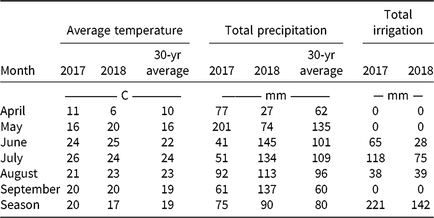
Near-average temperatures were observed during 2017 and 2018 growing seasons at the research site (Table 1). Monthly precipitation varied from the 30-yr average throughout the study but resulted in near-average seasonal precipitation. Irrigation was applied with pivot irrigation as needed (Table 1).
Average air temperature, total precipitation, and irrigation during 2017 and 2018 growing seasons and the 30-yr average at the University of Nebraska–Lincoln South Central Agricultural Laboratory near Clay Center, NE.a

a Air temperature and precipitation data were obtained from the nearest High Plains Regional Climate Center.
Weed Density and Species Composition, Biomass, and Height
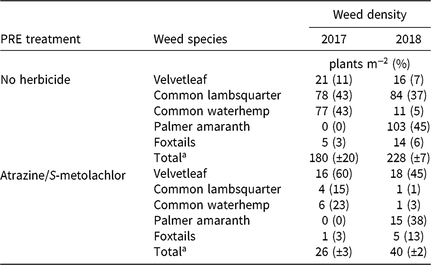
Common lambsquarters, Amaranthus spp., and velvetleaf were the dominant weed species at the research site. In absence of PRE herbicide, common lambsquarters averaged 78 plants m−2, accounting for 43% and 84 plants m−2, accounting for 37% of the species composition by density in 2017 and 2018, respectively (Table 2). Common waterhemp averaged 77 plants m−2 (43%) in 2017, and Palmer amaranth averaged 103 plants m−2 (45%) in 2018. To that point, Palmer amaranth in 2017 and common waterhemp in 2018 were not major contributors to total weed density. Velvetleaf averaged 21 (11%) and 16 plants (7%) m−2 in 2017 and 2018, respectively. Foxtails constituted only 3% and 6% of the total weed density in 2017 and 2018, respectively.
Weed composition and average density with and without atrazine/S-metolachlor applied PRE (2,470 g ai ha−1) in a field experiment conducted at the University of Nebraska–Lincoln, South Central Agricultural Laboratory near Clay Center, NE, in 2017 and 2018.

a Reported as plants m−2 (±SE).
When atrazine/S-metolachlor was applied PRE, the weed composition shifted to velvetleaf as the dominant species with 16 plants m−2 (60%) and 18 plants (45%) m−2 in 2017 and 2018, respectively. This was likely due to the lack of control atrazine/S-metolachlor provides for velvetleaf (Anonymous 2014; Taylor-Lovell and Wax Reference Taylor-Lovell and Wax2001). Common waterhemp was reduced to six plants m−2 and 23% of the total density in 2017, and Palmer amaranth was reduced to 15 plants m−2 and 38% of the total density in 2018. The total weed density was reduced from 180 plants m−2 with no PRE herbicide, to 26 plants m−2 with atrazine/S-metolachlor in 2017. Similarly, in 2018, total weed density was reduced from 228 plants m−2 with no PRE herbicide to 40 plants m−2 when atrazine/S-metolachlor was applied.
Atrazine/S-metolachlor applied PRE reduced weed biomass at the R1 popcorn growth stage from 1,034 g m−2 with no herbicide to 738 g m−2 in 2017 and from 867 g m−2 with no PRE to 195 g m−2 in 2018 (Table 3). Biomass of common lambsquarters and common waterhemp in 2017, and common lambsquarters, Palmer amaranth, and foxtails in 2018 was reduced by atrazine/S-metolachlor. Velvetleaf contributed more to total weed biomass when atrazine/S-metolachlor was applied, because of limited control in 2017.
Total weed biomass, individual species contribution to total weed biomass, and individual species height at the R1 popcorn growth stage with and without atrazine/S-metolachlor applied PRE (2,470 g ai ha−1) in a field experiment conducted at the University of Nebraska–Lincoln, South Central Agricultural Laboratory near Clay Center, NE, in 2017 and 2018.

a Abbreviation: NA, not applicable.
Velvetleaf was taller in the plots where atrazine/S-metolachlor was applied in both 2017 and 2018 in the R1 removal timing (Table 3). Furthermore, velvetleaf was taller in 2017 than in 2018. On average, weeds in 2017 were taller than in 2018 except for common lambsquarters where atrazine/S-metolachlor was applied (91 cm), as well as foxtails that were only present in 2018 in plots without PRE herbicide. Overall, there were greater weed densities in 2018 but greater weed biomass and height in 2017 (Tables 2 and 3). Weed density and biomass response to atrazine/S-metolachlor applied PRE were similar to those reported in the literature (Steele et al. Reference Steele, Porpiglia and Chandler2005; Swanton et al. Reference Swanton, Gulden and Chandler2007; Taylor-Lovell and Wax Reference Taylor-Lovell and Wax2001; Whaley et al. Reference Whaley, Armel, Wilson and Hines2009).
Popcorn Yield
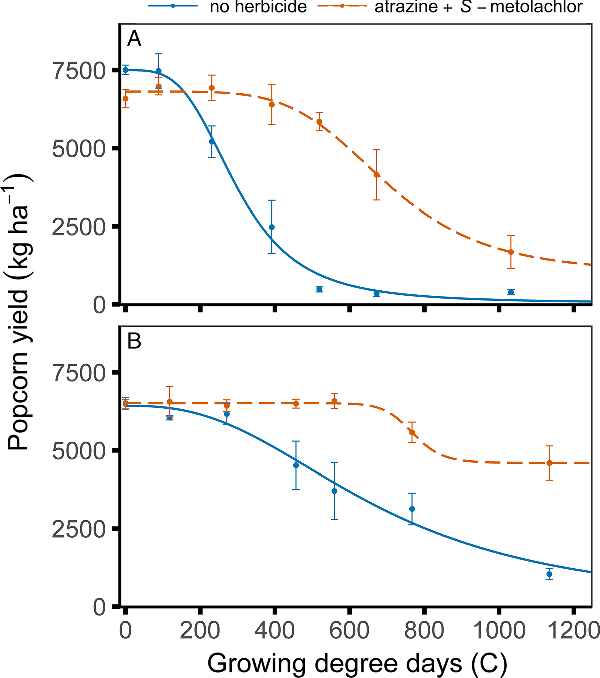
Popcorn yields varied between years, so data were analyzed separately for each year. Popcorn yield in weed-free treatments was greater in 2017 (7,045 kg ha−1) than 2018 (6,497 kg ha−1) (Figure 1; Table 4). Popcorn yield in non-treated control plots without PRE herbicide were 384 and 1,036 kg ha−1 in 2017 and 2018, respectively, compared with 1,677 and 4,069 kg ha−1 with atrazine/S-metolachlor applied PRE in 2017 and 2018, respectively. This was because the herbicide was effective in controlling the majority of weeds, except velvetleaf, and thus reduced weed interference (Tables 2 and 3). Whaley et al. (Reference Whaley, Armel, Wilson and Hines2009) reported variable field corn yield (3,870 to 9,080 kg ha−1) with atrazine/S-metolachlor applied PRE without a POST herbicide in a 3-yr study in Virginia. Yield reduction was attributed to reduction in crop yield components (Adigun et al. Reference Adigun, Osipitan, Lagoke, Adeyemi and Afolami2014; Eaton et al. Reference Eaton, Russ and Feltner1976; Elezovic et al. Reference Elezovic, Datta, Vrbnicanin, Glamoclija, Simic, Malidza and Knezevic2012; Trezzi et al. Reference Trezzi, Vidal, Patel, Miotto, Debastiani, Balbinot and Mosquen2015).
Popcorn yield (kg ha−1) in response to increasing duration of weed interference as represented by Celsius growing degree days (GDD) after emergence in popcorn with and without atrazine/S-metolachlor applied PRE (2,470 g ai ha−1) in (A) 2017 and (B) 2018 in a field experiment conducted at the University of Nebraska–Lincoln, South Central Agricultural Laboratory near Clay Center, NE. Regression lines represent the fit of a four-parameter log-logistic model.

Parameter estimates and SEs of the four-parameter log-logistic model, root mean square error, and modeling efficiency for popcorn yield with and without atrazine/S-metolachlor applied PRE in a field experiment conducted at the University of Nebraska–Lincoln South Central Agricultural Laboratory near Clay Center, NE, in 2017 and 2018.

a Abbreviations: ED50; Celsius growing degree days where 50% response between lower and upper limit occurs; GDD, growing degree days; ME, modeling efficiency; RMSE, root mean square error.
Popcorn Yield Components
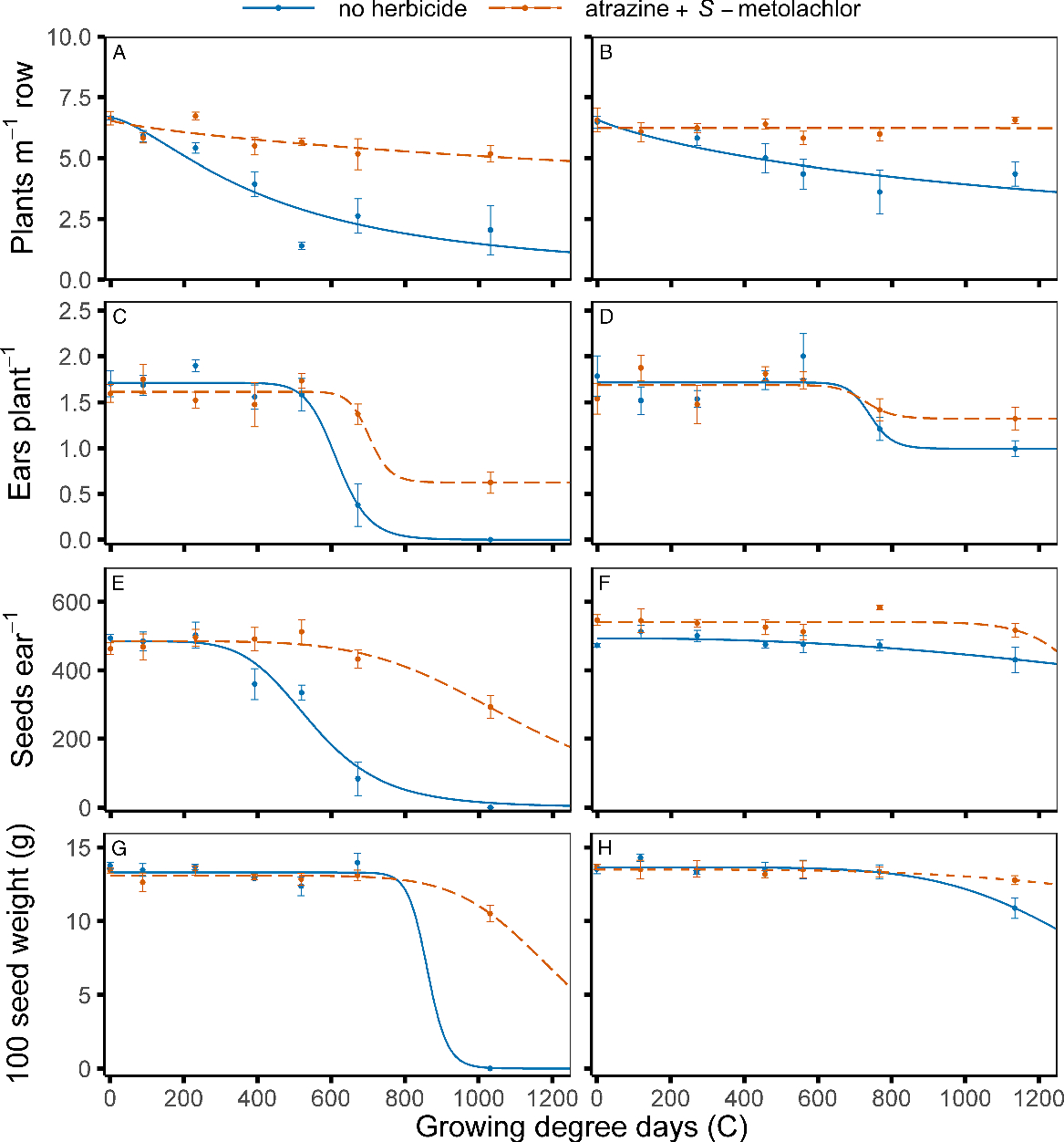
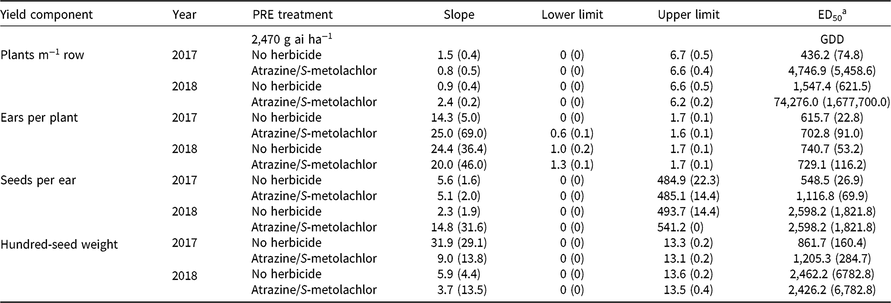
There was an impact of weed removal timing on popcorn yield components, including plants m−1 row, ears per plant, seeds per ear, and hundred-seed weight (Figure 2; Table 5). Atrazine/S-metolachlor applied PRE reduced the impact of weed interference on yield components with the exception of hundred-seed weights in 2018. In general, the impact of weed interference on yield components was greater in 2017 than 2018 for both main plots.
Popcorn plant density (plants m−1 of row) at harvest in (A) 2017 and (B) 2018; ears m−1 row in (C) 2017 and (D) 2018; seeds per ear in (E) 2017 and (F) 2018; and hundred-seed weight (g) in (G) 2017 and (H) 2018 in response to increasing duration of weed interference as represented by Celsius growing degree days (GDD) after emergence in popcorn with and without atrazine/S-metolachlor applied PRE (2,470 g ai ha−1) in a field experiment conducted at the University of Nebraska–Lincoln, South Central Agricultural Laboratory near Clay Center, NE. Regression lines represent the fit of a four-parameter log-logistic model.

Parameter estimates and SEs of the four-parameter log-logistic model, root mean square error, and modeling efficiency for popcorn yield components with and without atrazine/S-metolachlor applied PRE in a field experiment conducted at the University of Nebraska—Lincoln, South Central Agricultural Laboratory near Clay Center, NE, in 2017 and 2018.

a Abbreviations: ED50, Celsius growing degree days where 50% response between lower and upper limit occurs; GDD, growing degree days.
Weed-free control plots averaged seven popcorn plants m−1 row. In 2017, non-treated control plots where atrazine/S-metolachlor was applied PRE, the average popcorn density was five plants m−1 row compared to two plants m−1 row when no herbicide was applied (Figure 2A). In 2018, where atrazine/S-metolachlor was applied PRE, the average was seven plants m−1 row compared with four plants m−1 row when no PRE was applied (Figure 2B). Stand loss can be attributed to plant death due to high weed interference and accidental removal during pre- and post-weed removal as weeds were removed by hoe and hand weeding as needed. Smaller plants were observed as duration of interference increased and when no PRE herbicide was applied (data not shown); this decreased standability. As previously discussed, popcorn is generally shorter and has weaker and thinner stalks that make it more prone to lodging compared with field corn (Ziegler Reference Ziegler and Hallauer2001). Adigun et al. (Reference Adigun, Osipitan, Lagoke, Adeyemi and Afolami2014) reported similar stand reductions due to late-season weed competition and mechanical weed removal by hoe in cowpea [Vigna unguiculata (L.) Walp.]. Evans et al. (Reference Evans, Knezevic, Lindquist, Shapiro and Blankenship2003a) reported no decrease in field corn density with increasing duration of weed interference, which was not a significant yield component factor determining yield reduction.
Weed-free plots averaged 1.65 ears per plant. In 2017, yield in non-treated control plots to which atrazine/S-metolachlor was applied PRE was 0.6 ears per plant, compared with zero ears per plant when no herbicide was applied (Figure 2C). This means that where atrazine/S-metolachlor was applied PRE, 40% of the plants were barren; however, without PRE herbicide, all plants were barren in non-treated plots. In 2018, where atrazine/S-metolachlor was applied PRE, the average yield was 1.3 ears per plant compared with one ear per plant when no herbicide was applied (Figure 2D). This indicated that season-long weed interference in 2017 reduced the number of ears per plant by 100% and 64% with no PRE herbicide applied and with atrazine/S-metolachlor applied PRE, respectively, and 39% and 21% in 2018, with no PRE herbicide applied and with atrazine/S-metolachlor applied PRE, respectively. Reduction in ears per plant was not observed until the R1 weed-removal timing. Similarly, Evans et al. (Reference Evans, Knezevic, Lindquist, Shapiro and Blankenship2003a) reported a reduction in ears per plant with increasing duration of weed interference, which accounted for less than 10% of the subsequent grain-yield reduction in field corn.
The number of seeds per ear was reduced in no herbicide and herbicide-applied treatments in 2017 and in no herbicide treatments in 2018. The number of seeds per ear averaged 478 and 510 in 2017 and 2018, respectively, in weed-free plots. In 2017, non-treated control plots where atrazine/S-metolachlor was applied PRE, the average number of seeds was 293 seeds per ear compared with zero seeds per ear when no PRE herbicide was applied (Figure 2E). In 2018, where atrazine/S-metolachlor was applied PRE, the average number of seeds per ear was 517, compared with 431 seeds per ear when no herbicide was applied (Figure 2F). The earliest removal timing to observe a reduction in seeds per ear was at V9 in 2017, with no herbicide applied. Maddonni and Otegui (Reference Maddonni and Otegui2004) suggested kernel number may be affected as early as the V7 field corn growth stage with interplant competition. Cox et al. (Reference Cox, Hahn and Stachowski2006) reported a significant impact on seeds per ear in field corn when weeds were removed at the V5/V6 growth stage or later. Evans et al (Reference Evans, Knezevic, Lindquist, Shapiro and Blankenship2003a) reported that the response of field corn seeds per ear in response to increasing duration of weed interference mirrored the response of final grain yield.
Weed interference reduced hundred-seed weight in treated and untreated main plots in 2017 and in plots that did not receive an herbicide in 2018. Weed-free hundred-seed weights averaged 13.6 g. In the 2017, in non-treated control plots where atrazine/S-metolachlor was applied PRE, the average hundred-seed weight was 10.5 g, compared with 0 g when no PRE herbicide was applied (Figure 2G). Although the hundred-seed weight when no PRE herbicide was applied was reported as 0 g, it should be noted that this was because all plants within the subsample were barren. No hundred-seed weight reduction was observed in the R1 removal time for either main plot. In 2018, in non-treated control plots where atrazine/S-metolachlor was applied PRE, the average hundred-seed weight was 12.8 g, compared with 10.8 g when no herbicide was applied (Figure 2H). Similar to 2017, no hundred-seed weight reduction was observed at the R1 weed-removal timing. Atrazine/S-metolachlor applied PRE limited reduction in hundred-seed weight from season-long weed interference in 2017 and prevented reduction in hundred-seed weight from season-long interference in 2018. Cox et al. (Reference Cox, Hahn and Stachowski2006) did not observe reduction in field corn seed weight with increasing duration of weed interference compared with the V3/V4 weed-removal timing, except when weeds were allowed to compete with corn season long (27% reduction); however, it was not significantly less than the weed-free control (17% reduction). Evans et al. (Reference Evans, Knezevic, Lindquist, Shapiro and Blankenship2003a) reported that field corn seed weight was less variable than seeds per ear and accounted for only a minor portion of the observed yield loss. Seed weight reduction has been attributed to a reduced crop growth rate 2 to 6 wk after R1 (Maddonni et al. Reference Maddonni, Otegui and Bonhommie1998). Cathcart and Swanton (Reference Cathcart and Swanton2004) reported a field corn seed weight reduction of 8% to 12% when green foxtail (50 to 300 plants m−2) was allowed to compete season long.
Results suggest that weed interference had an impact on yield components and that atrazine/S-metolachlor applied PRE reduced the impact of weed interference on popcorn yield components and protected certain yield components such as seeds per ear and hundred- seed weight. Assuming the number of plants ha−1 was fixed, seeds per ear has been reported to have the greatest impact on corn yield than any other yield component (Andrade et al. Reference Andrade, Vega, Uhart, Cirilo, Cantarero and Valentinuz1999; Evans et al. Reference Evans, Knezevic, Lindquist, Shapiro and Blankenship2003a; Otegui Reference Otegui1997; Tollenaar Reference Tollenaar1977).
Popcorn Yield Loss
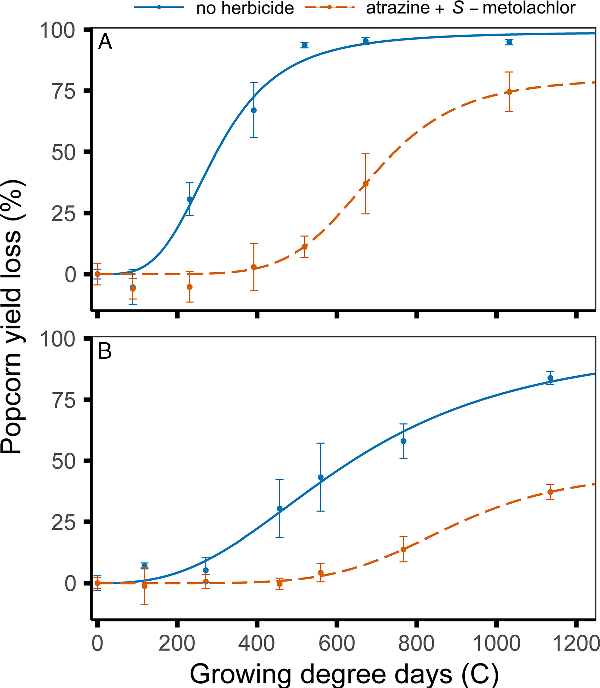
Popcorn YL increased as weed removal timing was delayed (Figure 3; Table 6). Greater YL was observed in plots without herbicide compared with plots with atrazine/S-metolachlor applied PRE. YL varied among years; therefore, data are presented separately. Without a PRE herbicide, yield of the non-treated control plots was reduced 95% and 84% in 2017 and 2018, respectively. YL curves fit the data well, with RMSE ranging from 7.2 to 14.2 and ME from 0.86 to 0.97. Tursun et al. (Reference Tursun, Datta, Sakinmaz, Kantarci, Knezevic and Chauhan2016) reported 50% to 79% popcorn YL from season-long weed interference in Turkey.
Popcorn yield loss (%) response to increasing duration of weed interference as represented by Celsius growing degree days (GDD) after emergence in popcorn with and without atrazine/S-metolachlor applied PRE (2,470 g ai ha−1) in (A) 2017 and (B) 2018 in a field experiment conducted at the University of Nebraska–Lincoln South Central Agricultural Laboratory near Clay Center, NE. Regression lines represent the fit of a four-parameter log-logistic model.

Parameter estimates and SEs of the four-parameter log-logistic model, root mean square error, and modeling efficiency used to determine the critical time for weed removal for popcorn with and without atrazine/S-metolachlor applied PRE in a field experiment conducted at the University of Nebraska–Lincoln, South Central Agricultural Laboratory near Clay Center, NE, in 2017 and 2018.

Abbreviations: ED50, Celsius growing degree days where 50% response between lower and upper limit occurs; GDD, growing degree days; RMSE, root mean square error; ME, modeling efficiency; YL, yield loss.
Critical Time for Weed Removal
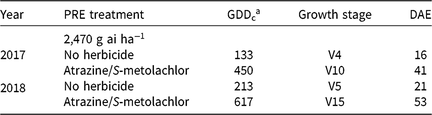
The CTWR based on 5% popcorn YL varied between years; therefore, data were analyzed separately (Figure 3; Table 7). The CTWR without PRE herbicide ranged from 133 to 213 GDD in 2017 and 2018. This corresponds to the V4 to V5 growth stages or 16 to 21 d after popcorn emergence. When atrazine/S-metolachlor was applied PRE, the CTWR ranged from 450 to 617 GDD in 2017 and 2018, corresponding to the V10 to V15 popcorn growth stages or 41 to 53 d after emergence. The difference in CTWR between years can be attributed to the difference in relative time of weed emergence compared with the crop, differences in weed composition, and competitiveness of velvetleaf in 2017. The CTWR for popcorn production without PRE herbicide in Turkey was reported to be VE (Tursun et al. Reference Tursun, Datta, Sakinmaz, Kantarci, Knezevic and Chauhan2016). The CTWR in sweet corn was reported to be V4 for planting during the first week of May and tasseling (VT) for planting during the third week of June in Illinois (Williams Reference Williams2006). Differences in CTWR have been reported in other crops such as field corn (Evans et al. Reference Evans, Knezevic, Lindquist, Shapiro and Blankenship2003a, Reference Evans, Knezevic, Lindquist and Shapiro2003b; Hall et al. Reference Hall, Swanton and Anderson1992), soybean (Gustafson et al. Reference Gustafson, Knezevic, Hunt and Lindquist2006a, Reference Gustafson, Knezevic, Hunt and Lindquist2006b; Knezevic et al. Reference Knezevic, Evans and Mainz2003; Van Acker et al. Reference Van Acker, Swanton and Weise1993), and sunflower (Knezevic et al. Reference Knezevic, Elezovic, Datta, Vrbnicanin, Glamoclija, Simic and Malidza2013). Evans et al. (Reference Evans, Knezevic, Lindquist, Shapiro and Blankenship2003a) reported the CTWR for field corn ranged between V4 and V7 between years and across locations in Nebraska. One major factor that can affect the CTWR is the field weed composition and relative time of weed emergence, with low weed density and late weed emergence further delaying the CTWR (Evans et al. Reference Evans, Knezevic, Lindquist, Shapiro and Blankenship2003a; Norsworthy and Oliveira Reference Norsworthy and Oliveira2004).
The critical time for weed removal in popcorn with and without atrazine/S-metolachlor applied PRE in a field experiment conducted at the University of Nebraska–Lincoln, South Central Agricultural Laboratory near Clay Center, NE, in 2017 and 2018.

a Abbreviations: DAE; days after crop emergence; GDDc, Celsius growing degree days.
Leaf Area
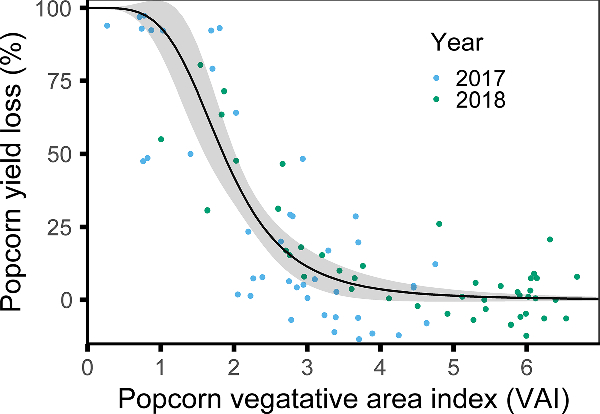
Popcorn VAI measurements taken at the R1 popcorn growth stage described popcorn YL well, with RMSE of 16.1 and ME of 0.83 (Figure 4). Greater YL was observed in 2017, with VAI ranging between 0 and 5 at the R1 growth stage compared with relatively less YL in 2018 and VAI ranging between 1 and 7. Cox et al. (Reference Cox, Hahn and Stachowski2006) reported field corn leaf area index reduction at R1 growth stage when weeds were allowed to compete without PRE herbicide and then removed at V5 to V6, V7 to V8; and season-long to be 35%, 47%, and 50%, respectively; however, no leaf area index reduction was observed when weeds were allowed to compete until V3 to V4. Hall et al. (Reference Hall, Swanton and Anderson1992) reported that weed interference increased the rate of senescence of lower corn leaves.
Popcorn yield loss (%) related to decreasing popcorn vegetative area index (VAI) at the R1 popcorn growth stage in a field experiment conducted at the University of Nebraska—Lincoln, South Central Agricultural Laboratory near Clay Center, NE, in 2017 and 2018. Grey ribbon represents 95% confidence interval of the line. Regression lines represent the fit of a four-parameter log-logistic model (root mean square error, 16.1; modeling efficiency, 0.83). Model parameter values are as follows: slope, 4.1; Celsius growing degree days where 50% response between lower and upper limit occurs (ED50), 1.9; lower limit, 0.0; and upper limit, 100.0.

Management Implications
The results of this study suggest that popcorn producers in Nebraska should not allow weeds to interfere in their fields for more than 133 to 213 GDD, equivalent to V4 (16 days after emergence [DAE]) to V5 (21 DAE) popcorn growth stage. When atrazine/S-metolachlor is used as a PRE herbicide, the delay of CTWR was an additional 25 to 32 d compared with when no PRE herbicide was applied, equivalent to 450 to 617 GDD or V10 (41 DAE) to V15 (53 DAE). Atrazine/S-metolachlor partially protected popcorn yield by delaying weed emergence and reducing weed density. Selection of a PRE herbicide on the basis of known weed composition of the field may increase PRE herbicide efficacy and further delay the critical time for weed removal.
Current affiliation
Oscar Rodriguez, PhD, Principal Development Scientist, ConAgra Brands, Inc, Brookston, IN 47923.
Acknowledgments
The authors would like to acknowledge the help of Irvin Schleufer, Amy Hauver, Brianna Schuck, Jasmine Mausbach, Adam Leise, and Shawn McDonald in this project. This project was based on research partially supported by the Nebraska Agricultural Experiment Station with funding from the Hatch Act through the U.S. Department of Agriculture (USDA) National Institute of Food and Agriculture and the USDA National Institute of Food and Agriculture’s Nebraska Extension Implementation Program. No conflicts of interest have been declared.