I. INTRODUCTION
In the spring of 1860, Henry C. Carey, the Philadelphia political economist and apostle of protectionism, offered a revision of his doctrine in hope of saving the Union. For several years, in such writings as The Slave Trade, Domestic and Foreign (1853) and The North and the South (1854), he had argued that reimposition of high protective tariffs promised material prosperity for the free population and gradual extinction of slavery. With sectional rancor growing and secession looming, he enlarged the argument. In a series of letters to the Memphis Daily Enquirer, he explained how the original error of liberal trade beginning in 1833 had interacted with differences of climate and migration among the country’s distinctive “zones” to produce economic crises and political controversy. The crises, the controversy, and ultimately the Union’s dissolution could be stopped, Carey believed, if only people could see their true causes. His theory would reveal them. It would even show why they were otherwise blocked from view.
This essay does not venture to say whether Carey’s theory in his Memphis letters was wrong or right. It aims to answer, or at least to begin to answer, three other questions the theory raises: one about American politics on the eve of the Civil War; another about American economics at the same moment; and the last about current economic thought as to the nexus of geography, political institutions, and economic progress.
The political question is how Republicans prevailed on the likes of Carey, a conservative, erstwhile Whig who was decidedly anti-abolitionist, to endorse the use of armed force to stay the southern states’ secession. As late as February 1861, Carey argued publicly that the Union should let the South go. Two months later, after the assault on Fort Sumter, he endorsed publicly a call to do the opposite (Smith Reference Smith1951, pp. 92, 98). Carey’s “zone theory” helps explain the consequential turn, at least in his own case, and perhaps in others’, too. It illustrates what Brian Schoen describes elsewhere in this volume as “the overlapping and competing political economies” of secession—sometimes in the mind of the same man.
The history-of-economics question is whether it can fairly be said, as Charles F. Dunbar did long ago (1876, p. 139), that Carey had not “established any new and valuable principle originated by himself”—that he had “led a school, perhaps,” but not made “a contribution to the science” of political economy (p. 138). To be sure, Dunbar, writing in the last years of Carey’s life, considered Carey the most deserving of scientific renown among American political economists. But so dim was his view of his countrymen’s contributions that “most” was not much. Regarding economic thought from 1840 to the Civil War, Dunbar justified his view with reference to the all-consuming sectional controversy. American economists put off deepening their understanding of economic principles, he implied, in order to pay attention to a controversy of tremendous but transitory significance.
Maybe Dunbar was right: Carey, for one, did devote a growing share of his attention to the controversy from the 1840s until the Civil War. However, maybe Dunbar was blind to a contribution that was right in front of him. Could the sectional controversy have sparked in Carey’s mind precisely the “new and valuable” thinking that Dunbar supposed it impeded?
The question about current thought follows from the last. One might admit that Carey’s political economy was novel but say its value is another matter. If one’s main preoccupations are not historical, one might say more: what matters is the value of Carey’s political economy, not to the Civil-War generation but to ours. So John Kenneth Galbraith seemed to say for his generation. Although Galbraith considered Carey an exception to the rule that “not much was added” by nineteenth-century American economists, in his view “little or nothing of Carey passed into the tradition of American economic thought. His books moldered and died” (1998, p. 42). Could a reassessment a half-century later produce a different view? Carey’s zone theory bears a resemblance to present-day theories of the interaction of geography, political institutions, and economic progress. The works of Daron Acemoglu, Simon Johnson, and James Robinson (2002) and Acemoglu and Robinson (Reference Acemoglu and Robinson2006, Reference Acemoglu and Robinson2012) come to mind. The claim made here is not that Carey inspired such works. Neither is it that his theory or recommendations should supplant theirs. It is that, in light of the resemblance, maybe Carey’s political economy has value now that was unseen before, or was once seen but then lost.
II. CAREY, TARIFF PROTECTION, AND TERRITORIAL EXPANSION
Carey’s treatment of the sectional question was bound up with his protectionism from the day of his conversion to that doctrine. He wrote his 1847 magnum opus, The Past, the Present, and the Future, with the hurry and zeal of a man struck by an epiphany. The vision he beheld “lying in bed one morning” showed all at once why his long-standing skepticism of David Ricardo’s rent theory was well founded; where precisely the theory required correction; why the true theory implied the necessity of tariff protection for the United States; and why the chosen means of US territorial expansion were amiss (Meardon Reference Meardon2011, p. 316). It was no accident that the epiphany followed close on the heels of Congress’s declaration of war against Mexico and passage of the liberal Walker Tariff Act, both in the summer of 1846.
What was Carey’s vision? In brief, it beheld the benefits of geographic concentration of people with various occupations. It drew from a synthetic history, of sorts, of the countries of the world and reflected a “stages” notion of economic development. It went like this. The first settlers of a place situate themselves not at the bottom of its river valley, where the soil is most fertile, but farther up on the hillside, where the original vegetation is easiest to clear. They lack the technology and equipment to do better. As they grow in population, they can divide their efforts. Some continue to cultivate the land; with their surplus they feed others who do manufacturing. Manufacturing is the locus of technological progress, which spills over into agriculture. Burgeoning organic waste from the manufacturing sector, assuming its proximity to the land that feeds it, aids development of the land at the intensive margin. Improvements in agricultural equipment aid development at the extensive margin, down the hill, where the land is inherently more fertile but harder to clear (see Ron, this volume).
So the settlers move down the hill and grow in numbers. As they multiply, they are able to produce more food and further divide their efforts, feeding more people who do manufacturing. By doing more manufacturing they can produce better equipment to clear more fertile land, and so on. After they reach the bottom of the river valley, they can reverse course and spread their settlement back up the hill. Taking a bird’s-eye view of several communities developing naturally in this fashion, one sees a number of “little pyramids, with heights proportioned to their breadth and depth” (Carey Reference Carey1872, p. 286). Thus Carey’s “‘pyramid theory’ of development” (Meardon Reference Meardon2011, p. 317).
The pyramid theory differed widely from the standard reference in American as well as British political economy: Ricardo’s Principles of Political Economy and Taxation. By Carey’s lights, his own theory controverted three claims of Ricardo’s rent theory. First, that the most fertile land is settled before the less fertile. (Carey contended the opposite.) Second, that rent is a payment made for the “original and indestructible powers” of better land when population growth necessitates the use of worse land. (Carey had long thought that rent was paid for the “advantages of situation” of a plot of land—the advantages arising from the concentration of people on or around it.) Footnote 1 Third, that as the rent paid to landlords rises, the wages of laborers fall. (Carey claimed instead that rent rises with concentration of people, making laborers better off both in absolute terms and in comparison with landlords. Rising rent evidences not a conflict, but a “perfect harmony of interests” between landlords and laborers.) Footnote 2
The differences were not merely academic. Carey drew a straight line from Ricardo’s alleged theoretical errors to bad US policies. In general, by obscuring the benefits of concentration, Ricardo’s theory caused people to flee from their developing “pyramids” before development had advanced far enough. In particular, Carey reckoned, Ricardian economics in the American theater meant free trade and the wrong kind of territorial expansion—to wit, the Walker Tariff and the Mexican War.
The Walker Tariff of 1846 was in intent and effect a liberal act. The Compromise Tariff Act of 1833 had reduced the average tariff, as measured by the ratio of tariff revenue to the value of either dutiable imports or total imports, by about a third, to 19% and 26%, respectively, in the nine years after its passage. The Tariff Act of 1842 undid the compromise. The Walker Tariff effectively reinstated it (Stanwood Reference Stanwood1903, v. 2, pp. 38–108; Carter et al. Reference Carter, Sigmund Garter, Haines, Olmstead, Sutch, Wright and Irwin2006, Table Ee429–430). Carey prophesied the effects of the Walker Tariff by recalling the dark years of the Compromise Tariff from 1833 to 1842. During that time, as he saw it, people had fled “the rich meadow-lands of Pennsylvania” and other eastern states to go “west, there to commence the work of cultivation on dry prairie-land upon which trees will not grow.” They substituted a market thousands of miles away, across the ocean in Great Britain, for the market previously afforded by their neighbors (Carey Reference Carey1872, p. 298). In doing so, they deprived eastern US manufacturers of a market for their wares. Worse, they forced upon themselves the massive per capita infrastructure expenses of a dispersed population (rural roads, courthouses, schools, and churches), whereas “had they been permitted to follow the bent of their inclinations they would not, at this time, have passed the Mississippi” (p. 299). Worse still, by shrinking the market for manufactures and spreading themselves thin, they slowed the productivity growth of agriculture and their own material and mental progress.
As for the Mexican War, it was the flip side of the liberal tariff coin, the means of gaining political control of the territory to which people would be driven by free trade. In depicting it so, Carey did not mean to imply that territorial expansion per se was pernicious, a view scarcely imaginable in America. The problem was expansion prior to the full development of the pyramid. Once development was achieved, people would seek to establish new pyramids in sparsely settled lands. At that moment they would undertake new settlements naturally and peacefully. Thus, the annexation of Canada was a project of which Carey approved: it was advanced by inhabitants of rich soils in the adjoining northern states “by aid of the peaceful machinery afforded by increasing wealth” (Carey Reference Carey1872, pp. 411–412). Mexico was another matter entirely: “those who cultivate the poor soils of the south and west are striving at the annexation of Mexico by the unprofitable machinery of war” (p. 412). If only Southerners and Westerners would spend their treasure “in placing the consumer of food by the producer of cotton and food,” they would double their power. By spending it instead to seize part of Mexico and disperse themselves through the new territories, they would halve it.
What the foregoing analysis elided, but everyone knew, was that the motive of territorial expansion in the Southwest was not only to settle the region for the benefit of the settler population, however real or chimerical that benefit may have been. It was also to extend the territory and increase the number of states where slavery was permitted, thus lending political support to slavery in states where it already existed. Shut slavery out of the territories, the thinking went, and, before long, free states would be numerous enough to amend the Constitution and forbid slavery where it was legal. It followed that Carey’s efforts to persuade the proponents of territorial expansion in the Southwest that their policy was economically unsound even for the settlers, for more or less the same reasons that free trade was unsound for them, were never likely to succeed. If Carey wanted to convince the South and West to support protection and geographic concentration, then he had to persuade skeptical Southerners that slavery itself was unsound, that their apprehensions about the political abolition of slavery where it was legal were amiss, or both. On the other hand, if such apprehensions were not amiss, then he had to persuade Northerners that abolition was a fool’s errand, thereby to temper sectional conflict and prepare Southerners to accept the case for protection and geographic concentration. In any case Carey would have to redirect his efforts. He would have to talk at length about slavery.
The imperative was clear by the early 1850s in the aftermath of the Fugitive Slave Act and Harriet Beecher Stowe’s Uncle Tom’s Cabin. Carey addressed the plight of Uncle Tom while cheeks were still wet from Stowe’s telling of it. His own book was titled The Slave Trade, Domestic and Foreign: Why it Exists, and How it May Be Extinguished (1853). Slavery, he aimed to show, was not so much unsound as regrettable and eradicable. But it could not be eradicated by political abolition. Negro slavery was but one form of slavery. The more salient form involved people of any color “being driven from their homes to perish in the road, or endure the slavery of dependence on public charity until pestilence shall send them to their graves” (Carey Reference Carey1853, p. 1). The general problem was the degradation of labor. Uncle Tom was sold and transferred from Virginia to “the wilds of Arkansas,” there to lose his life, because labor lost its value in Virginia. And why was that? Because, Carey answered, under the yoke of a low-tariff regime, Virginia had not “been enabled to avail herself of her vast resource in coal, iron ore, water-power, &c.” (p. 111). Abolish negro slavery without abolishing the true cause of Uncle Tom’s transfer to Arkansas and nothing would be accomplished but the substitution of one form of enslavement for another. Footnote 3
Such was the experience of Great Britain in the West Indies, Carey went on, the British “failure” evidenced by the freed slaves’ “fast relapsing into barbarism” (Carey Reference Carey1853, pp. 33–34). He concluded that it was erroneous to call Southern landowners “tyrants,” as Northerners were wont to do, and to seek the unconditional emancipation of their slaves. Protection, concentration, and “gradual steps toward civilization and freedom” were required (p. 33).
The Past, the Present, and the Future had challenged the South regarding territorial expansion. The Slave Trade, Domestic and Foreign challenged the North regarding abolition. The policy is futile, Carey argued in both instances, because it tries to impose by law or arms what is achievable only in the natural course of economic progress. In both instances, nature would take its course only with tariff protection.
Carey hoped his challenge to the North would make his challenge to the South more effective: it would show Southerners his good will. That hope, which was characteristic of Carey’s Whig party, was fading in the 1850s. The Whig chieftain and “Great Compromiser,” Henry Clay, was dead by 1852. By 1854 the Whig party itself was all but dead, a casualty of the revocation of the Missouri Compromise by the Nebraska Bill, the ensuing violent scramble over “popular sovereignty” in Kansas, and the rise of the Republican party amidst the furor. In a series of articles in the New York Tribune, collected and reprinted as The North and the South, Carey sharpened his tone toward the South. With the “monstrous Nebraska Bill,” he decided, “the cup of conciliation has … been drained” (Carey Reference Carey1854, p. 35).
To Carey, Southern landowners were no longer the benign stewards of a pernicious system, but the grasping perpetuators of that system. He figured the change was not in his own attitude, or at least not in his alone. “Differences in the modes of thought increase from day to day,” he observed. “Southern men now require Southern school-books for their children, and Southern teachers for themselves” (Carey Reference Carey1854, p. 7). Professional associations, political conventions, even churches broke into sections, North and South, “the one becoming more averse to slavery, and the other more enamored of it.” Southerners had come to believe “the area of slavery must be enlarged at any cost, but that of freedom must not” (p. 7). By their design, extending far beyond Kansas, Cuba would be purchased, then St. Domingo, then a treaty of commerce and alliance with the slave power of Brazil negotiated, all in order to “‘preserve domestic servitude’” (p. 42); whereas “we can have no commercial treaty with the people of Hayti, because they are black, and are not liable to be seized and sold” (p. 7). “Southern insanity,” Carey called it (p. 42).
In affected minds the insanity conjured up illusions of disunion. To Carey, only in the North could disunion be contemplated without illusion. Because of the expense of purchasing land for the South and providing fleets and armies to defend it, “the Union is maintained at the cost of taxation to the North twice greater than would be required for the North alone” (Carey Reference Carey1854, pp. 24–25). As if in return, immigration was discouraged, the annexation of Canada deterred, and tariff protection denied by the “domination of slave owners in our national councils” (pp. 34, 27, 25). All told, Carey estimated the gain to the North from maintenance of the Union at a paltry $0.40 per capita, the loss at $40, for a net loss of $39.60 per capita (p. 34). As for the South, it “plainly cannot afford to dissolve the Union” (p. 39). Carey knew the appropriate response. “When the North shall scorn the threats of disunion from the South, and calmly allow the Secessionists to go the whole length of their tether, these chronic threats of dissolution will quickly subside, and soon come to be looked upon as they should be, with utter contempt, both in and out of Congress” (p. 39).
Of course, through the end of the 1850s, as the scorn mounted, Southern threats of disunion did not subside. Carey needed to reconsider his response.
III. THE PANIC OF ’57 AND THE ZONE THEORY’S PRETEXTS
The necessity was plain as the election of 1860 loomed. The Republican Party’s nomination of John C. Fremont in 1856 yielded not only further threats of disunion, but also James Buchanan’s victory. The subsequent revision of the Tariff Law in 1857 soon brought the average tariff, measured as the ratio of duties collected to the value of imports, below 15% for the first time since 1791 (Carter et al. Reference Carter, Sigmund Garter, Haines, Olmstead, Sutch, Wright and Irwin2006, Table Ee429). While Carey figured that was already enough of a calamity, it was worsened by financial panic in the fall of 1857, which he saw as proceeding from the decline of protection. The restoration of protection and thereby financial stability required a new political strategy, and with it a new rhetorical strategy.
Carey tried out the new strategy in a letter to the Boston Evening Transcript in late November 1859 (Smith Reference Smith1951, p. 59; Carey Reference Carey1859). It began with his take on the old saw, “as Pennsylvania goes, so goes the Union.” Carey had heard that some Northerners, especially New Englanders, had come to doubt the old saying. Perhaps, they thought, it was mere superstition; and if so, then perhaps a radical anti-slavery type unpalatable in Pennsylvania might nevertheless win the coming presidential election. Carey urged the doubters to think again. The necessity of winning Pennsylvania in order to win the presidency was one of those articles of wisdom established by seasoned observation, if not methodical deliberation. “In time,” said Carey, “science steps in, to give us the law, in virtue of which such things are” (Carey Reference Carey1859). He would exposit the “science,” and thereby help Republicans decide whom to nominate.
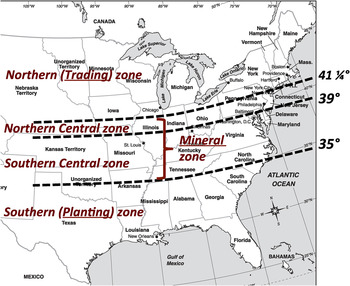
The scientific law Carey had in mind governed geographical patterns of human migration. When choosing where to settle, emigrants “seek the nearest approach to the temperatures to which they have been accustomed.” Thus, in the history of European migration to North America, Highlanders went to Canada, Irishmen to the middle US states, and Spaniards and Portuguese to the South. Likewise, as Americans moved westward, they kept to geographic “zones” that were already familiar to them. The number of relevant zones was four (Figure 1). New Englanders, the original inhabitants of the “Northern” zone, migrated first to New York and a sliver of northern Pennsylvania, then to the northernmost parts of Ohio, Indiana, Illinois, and Iowa, and all of Michigan, Wisconsin, and Minnesota. Inhabitants of New Jersey, Pennsylvania, Delaware, and Maryland, most of them in the “Northern Central” zone, decamped for the southern parts of Ohio, Indiana, Illinois, Iowa, and also the greater parts of the Kansas and Nebraska territories. Virginians and North Carolinians, of the “Southern Central” zone, moved on to Kentucky, Tennessee, and Missouri; South Carolinians and Georgians, of the “Southern” zone, to Alabama, Mississippi, Louisiana, and most of Arkansas and Texas.
Carey’s zones. Adapted by the author, in light of Carey (Reference Carey1859, Reference Carey1860), from a political map of the United States ca. 1860 in Houghton Mifflin’s “Education Place” outline map collection, http://www.eduplace.com/ss/maps/historical.html, accessed 26 March 2015.

If the law held true, then the old saw needed only minor adjustment to be wholly accurate. “Pennsylvania” should be replaced with the zone whose inhabitants “sympathize much with Pennsylvania,” the Northern Central. By Carey’s estimation the zone embraced 5.7 million people, almost three-tenths of the United States’ twenty million, and they were positioned both in geographical space and in “feelings and wishes” between the extremes of North and South. So too were the denizens of the Southern Central zone, but they were only about two-thirds as numerous as their nearest zonal neighbors to the North. “As the Northern Central zone goes, so goes the Union”: such was Carey’s gist. Republicans would be foolish to neglect public opinion in Pennsylvania, which held the key to opinion in the zone it seeded and likewise the election.
So far, Carey’s new strategy was a hardly modified version of a shopworn one. That changed in the spring of 1860, when he elaborated it to appeal to a Southern Central- as well as a Northern-zone audience. Beyond showing Bostonians (and other Northerners) that their political fortunes were tied to Pennsylvania’s, the zone theory would show Tennesseans (and other South Centralers) the similar unity of their economic fortunes. Like “as Pennsylvania goes, so goes the Union,” the general argument about the harmony of economic interests was hardly novel, especially for Carey (e.g., Carey Reference Carey1967). The novelty was in the particular combination of political and economic argument, which also, on the same theoretical grounds, explained why Northerners and South Centralers might have been reluctant to accept the argument. By explaining their reluctance, perhaps Carey could persuade them to overcome it.
The proximate cause of Carey’s appeal to South Centralers was his own serial ruminations over three months’ time, from December 1859 to March 1860, in response to a published snippet by William Cullen Bryant, editor of the New York Evening Post. Bryant, who, on most political and economic matters, was Carey’s opposite, had recently gone to Europe. Upon his return he published his foreign correspondence as Letters of a Traveller (Bryant Reference Bryant1859). At the end of one colorful letter about a bullfight in Burgos, Bryant had appended, apropos of nothing, a brief thought of home. “I am pained to hear such bad news from the United States,” he wrote in reference to the lingering effects of the panic of 1857. They included widespread business failures, loss of employment, and, for some, hunger. He hoped his readers would be consoled by the thought that although such “epidemic visitations” could be made less frequent, they could no more be avoided than scarlet fever or cholera. After all, “a money market always in perfect health and soundness would imply infallible wisdom in those who conduct its operations” (Bryant Reference Bryant1859, p. 108).
To Carey, Burgos and whatnot were “highly interesting,” but the last remark was provocative.
The epidemic visitations of which Bryant wrote, Carey shot back, were “the necessary results of an erroneous policy of which, during so long a period, you have been the steady advocate” (Carey Reference Carey1864, p. 8). The tendency toward financial panic and economic crisis was “always in the direct ratio of the distance of consumers from producers,” a ratio that Bryant caused to grow through his newspaper’s free-trade proselytizing (p. 5). The rationale was this. Free-trade policy fostered exchange between parties that were more distant geographically. But more distant exchanges required goods to change hands through more intermediaries, “each and every change giving occasion to the creation of notes and bills, [hence working toward] the creation of artificial credits, and toward speculation” (p. 9). Not only had the goods to change hands, but they had also to travel on railroads built to speed them along—railroads that were financed partly by the mortgage of lands “at enormous rates of interest” and partly by bonds sold “at enormous discounts” (p. 36). But the railroads failed to pay to the extent promised, and, worse, they diminished the value of much of the land that was mortgaged to build them. They caused “the annihilation of local action and domestic commerce—that commerce in the absence of which railroads can never be made to pay interest on the debts to the contraction of which their owners have been driven” (p. 37).
In the resulting bankruptcies and transfers of property, Carey went on, the participants in local action and domestic commerce, people of moderate means, were reduced “to the condition of mere laborers.” Their property, meanwhile, went toward “augmenting the number and the fortunes of ‘merchant princes’ who have no need to live by labor” (Carey Reference Carey1864, p. 3). Such redistribution was opportune for the rich traders of New York City, including a good many of Bryant’s subscribers. It also exposed the tenuousness of their anti-slavery protestations, and Bryant’s. After all, was there any greater promoter of an oligarchy of men who robbed others of the fruits of their labor than the recent financial crisis? And any greater promoter of the cause of the crisis, free trade, than Bryant and his New York Evening Post? (p. 44).
Here, Carey understood as he completed his final installment, was the kernel of an argument that could travel well outside the North.
IV. THE MEMPHIS LETTERS AND THE ZONE THEORY
The final installment was dated March 21, 1860 (Carey Reference Carey1864, pp. 355–358). That same day Carey duplicated most of its text, added a prefatory paragraph, and sent it off to the editor of the Daily Enquirer of Memphis—in the heart of the Southern Central zone, by Carey’s compass. He would show the inhabitants of that zone “the causes of the sectional discord that has now become so nearly universal, and that must result in dissolution of the Union, unless a remedy can be applied.” The Enquirer published it ten days later (Carey Reference Carey1860 [henceforth ML] #1, 31 March) and proceeded to publish four more letters from Carey, mostly original and to the same end, over the next two weeks. (The letters, ML#1, ML#2, ML#3, and ML#4, are transcribed in their entirety in an online appendix to this article.)
Carey’s argument read differently around Tennessee’s latitude than at New York’s or Philadelphia’s. To illustrate the connection between financial revulsion and sectional discord, Carey invited the reader into the hovel of an unemployed worker, his job lost because of his employer’s bankruptcy. The poor man knew well enough the cause of his condition: markets “gorged with the products of foreign labor, while our own laborers perish in the absence of employment that will give them food.” In such a condition, and having such knowledge, the man was susceptible to specious arguments about an “irrepressible conflict” between free and slave labor. Worse, “a year hence, he may be driven by poverty into abolitionism” (ML #1, 31 March 1860). What the argument meant in Memphis was that South Centralers were right to be dismayed by abolitionism, but wrong to think that sectional discord would be quelled if only the abolitionists would quiet down. They should think instead “whether they themselves have been the cause of the growth of the Anti-slavery and Abolition feeling in the North” by being unwitting accomplices of the policy promoting it (ML #5, 14 April 1860).
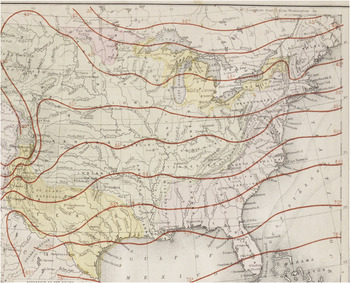
Unwitting indeed, because the forces directing their actions ran deep. Armed with more data than he had wielded in his article in the Boston Evening Transcript—owing partly to an anonymous correspondent who published an elaboration the following month in the Philadelphia Press (Anonymous Reference Anonymous1859)—Carey presented a refined version of the law of migration. The boundaries of the zones were defined more precisely: the southern boundary of the Northern zone was 41¼° north latitude (a line running westward from the southwestern corner of Connecticut and containing above it the state’s former Western Reserve, now in Ohio); of the Northern Central zone, 39°; and of the Southern Central zone, 35°. Yet these lines were held to be mere approximations of the boundaries that were truly relevant, which were isothermal lines—i.e., lines of equal temperature on a map like the one pictured in Figure 2, from an atlas well known in Carey’s time. The isothermal lines run less in parallel westward of the Mississippi, helping Carey to explain anomalies in light of the law as he had stated it earlier: specifically, why emigrants from the eastern part of the Northern Central zone, especially German ones, were lately found as far south as northernmost Texas, where the same isothermal line that intersects the Delaware River at its mouth on the Atlantic descends into the Texas Panhandle (ML #2, 7 April 1860).
A partial image of an isothermal map from 1860. The lines represent mean annual temperatures of the regions through which they pass. From Warren (Reference Warren1860), courtesy of the Watkinson Library, Trinity College, Hartford, Connecticut. In Carey’s zone theory, migration and political conviction depend upon geography and climate.

As the emigrants moved westward within their zones, they carried to their new lands the same creeds, prejudices, and policies that they had maintained in the old. English Puritans settled first in the eastern part of the Northern zone, then spread to the Western Reserve in Ohio—maintaining all along, in Carey’s view, their disdain for Irish and German Catholics who inhabited the Northern Central zone together with diverse others. Those others included English Quakers and Episcopalians, Scottish and Irish Presbyterians, and German Protestants. In the Southern Central zone, the Irish and German Catholics disappeared, but the English, Scottish, Irish, and German Protestants remained, less tolerant of Catholics because less needful of tolerance. The Southern zone, like the Northern one, was populated with English stock, albeit of a more aristocratic kind; and thus a fact apparently at odds with Carey’s earlier assertion that the South was fit for Spanish and Portuguese settlers was turned around to conform with it. The English who settled the Southern zone were a small fraction of the total English settler population of North America, and they were those most predisposed to be (or acquiesce to) a planter class (ML #3, 10 April 1860). They differed from their Northern kin in that respect, but they shared with them a penchant for anti-Catholicism. So they did in Charleston and Savannah, and so too as they moved west to Montgomery, Natchez, and beyond.
The relevance of anti-Catholicism was not only that it chafed Carey, given his ancestry. The greater relevance was seen by looking at the zones from another angle, not climatic but geological. In the two center zones combined, there was “an amount of mineral wealth elsewhere entirely unparalleled” (ML #3, 10 April 1860; erratum, ML #5, 20 April 1860). Thus combined, they were relabeled the “Mineral zone.” Wealth of that particular kind did not exist in the North, where the population specialized traditionally in trading. The Northern zone was therefore the “Trading zone.” The South had rich soil overseen by men with no scruple about commanding others to till it, so that was the “Planting zone.” In an narrow sense, the interests of the Northern zone and the Southern, the Trading zone and the Planting, were aligned: the people of the first could transport the products of the second to foreign markets. That was why “to a great extent they were united in their opposition to the protective tariffs of 1824 and 1828,” and why they were united too in passing the liberal tariff of 1857 (ML #3, 10 April 1860). The tragedy was that in a broader sense their interests were not so aligned, at least not by free-trade policy, because free trade would inevitably leave both worse off than they could have been with tariff protection. There lay the true alignment of their interests.
The Mineral zone, of course, was harmed even more by the joint political action of the Trading and Planting zones. Yet the South Centralers within the Mineral zone—the Virginians and Kentuckians, the upper North Carolinians, Tennesseans, and Arkansans—went along with it, voting like planters for free trade! Their folly was due to their close kinship with the Southern zone, and their anti-Catholicism shared with the Northern and Southern zones alike. Both affinities obscured their vision of where their material interests lay: with their Northern Central, Mineral zone neighbors and protectionism.
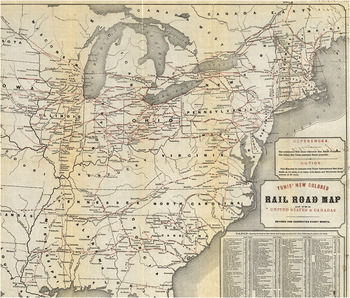
Two more forces locked in the folly. First, transportation routes, specifically railroads and canals, ran mainly in parallel throughout the country, facilitating lateral migration within zones but impeding trade between them. Figure 3, a railroad map from 1859, shows what Carey had in mind. At the moment, notwithstanding the abundance of east-west rail lines, especially in the North, and even a few projected north-south connections (shown with dashes), the existing rail connections depended on a single multijointed line through eastern Virginia. Yet only by “crossing and recrossing each other, and tying together the Puritan of the north, the Quaker, the German, and the Irishman of the center, and the Episcopalian of the south” could transportation routes “give unity and strength to the great whole that would be thus produced” (ML #1, 31 March 1860). Absent such unity, zonal prejudices and policies were reinforced, demanding more routes running east to west for intra-zonal migration and thus perpetuating the problem. By Carey’s later account, immediately after the fall of Fort Sumter he raised the point in conversation with President Lincoln, who was of a like mind. Having “made Liverpool the hub of our whole system,” Carey held, “all our great roads from Portland in the North to Savannah in the South are parallel lines ending in Britain; and of all the millions of people who have come from abroad, nearly the whole have gone to the Northwest, avoiding the great mineral centers” (Carey Reference Carey1878).
A partial image of a national railroad map from 1859. Carey believed that lack of understanding of the shared interests among the “zones” caused their inhabitants to extend transportation links within their zones rather than among them. What were needed were “iron cross-ties” to help bind the union together. From Tunis (Reference Tunis1859). Reproduced online by the Library of Congress, Geography and Map Division, http://hdl.loc.gov/loc.gmd/g3701p.rr000400 , accessed 26 March 2015.

Second, by producing a “constant succession of financial crises,” the prevailing free-trade policy destroyed manufacturing industry everywhere but in the zone where the property of the bankrupt was transferred. There, ironically, where the soil was poorest, agriculture could thrive because of the domestic market provided by manufacturers. Denizens of the Northern zone thus had a narrow interest in a trade policy producing crisis in the nation at large: “Southern policy thus forcing trade and manufactures to centralize themselves in the East, thereby giving to the Massachusetts agriculturalists a great domestic market, we wonder that New England farmers and manufacturers are well disposed to unite with Carolina planters in shouting hosannas to the British free-trade system?” (ML #3, 10 April 1860).
So went Carey’s zone theory. The aim here is not to evaluate its claims but to understand its character. To that end, a summing up is due. The theory presented its Southern Central audience, Tennesseans and the like, as misguided advocates of a deplorable policy. The policy was not so much the continuation of slavery (although Carey deplored that, too) as the dismantling of tariff protection. The Southern Centralers’ misguidance about protectionism was not their fault: they were the innocent victims of climate, human nature, and even a political conspiracy joined by the far North and deep South. The interactions of climate, inclination, and conspiracy turned their opinions against their Northern Central zonal neighbors and warped their institutions, giving them chattel slavery, low tariffs, excessive intra-zonal migration, and overextensive cultivation of agriculture. It produced the financial crises that roiled their communities, and not by accident. Finally, it inflamed the sectional conflict now threatening the Union.
If Carey could persuade his audience of the validity of his zone theory, he could garner a political consensus to change the subject. He beheld the prospect of a dazzling trifecta: enacting tariff protection at long last, thus slowing the torrent of westward migration and fostering industrial diversification; extinguishing slavery gradually by economic uplift, not political abolition; and “restoring harmony to our now distracted union” (ML #5, 10 April 1860). As a practical ploy, of course, it did not work, perhaps never could have worked. But as political economy, it was ingenious.
V. CONCLUSION
The ingenuity of Carey’s theory may be doubted. Conspiracy theories abound, not least among nineteenth-century opponents of free trade (Palen Reference Palen2013). What recommends this one? Three things.
First, it gives insight into the mind of an erstwhile Whig from the pivotal state of Pennsylvania on the eve of the Civil War. A Republican after the dissolution of the Whig party around 1854, Carey partook of the sectional passions of the time, particularly the North’s moral outrage at the pretensions of the Slave Power. But he was also instinctively conservative and vexed by what he saw as abolitionist overreaching. He was more interested in the traditional preoccupations of the Whig party, especially the tariff, than with the central preoccupation of the Republican party, namely, slavery—at least as most people understood slavery. So much was this his interest that, as mentioned earlier, he proposed the United States might “calmly allow the Secessionists to go the whole length of their tether” rather than have a fight over slavery. What was more, even after the southern state secessions began in December 1860, and the tether frayed and broke, he counseled “a peaceful separation from the Cotton States” (Carey to John Sherman, 25 March 1861, quoted in Smith Reference Smith1951, p. 97; emphasis in the original). His protectionist program was pursued more effectively with the South departed, of course, as seen in the successful passage of the Morrill Tariff in February 1861 after failure in the preceding year (Stanwood Reference Stanwood1903, v. 2, pp. 120–125).
Yet, as Smith (1951, p. 98) recounts, less than a month later, after the assault on Fort Sumter, Carey was among the signatories of a patriotic letter calling for the maintenance of “the honor, the integrity, and the existence of our National Union.” Later the same year he became a charter member of the Union League of Philadelphia (pp. 98–99). In short order he had gone from countenancing peaceful secession to urging military suppression of it. As Carey went, so went multitudes of like-minded, erstwhile Whigs.
The zone theory helps to explain why Carey may have been of two minds in the choice between secession with passive disapproval or union with force of arms. Granted, one explanation of his finally choosing the latter may be the flush of patriotism and wish for vengeance—feelings widely shared in the North (including even the Northern Central zone) after Fort Sumter. Such appears to be George Winston Smith’s explanation (1951, p. 98). But the point I wish to make is that Carey could have gone one way or the other, not only by feeling but also by reason. On the one hand, slavery of both the chattel kind and what Carey saw as the implicit kind could be extinguished more quickly and less rancorously, within the Union at least, by a peaceful separation. So he believed on the eve of the Civil War. On the other hand, climate, geography, and people’s natural inclinations in migration had locked in the United States’ purportedly bad tendency, abetted by free trade, to grow along parallel east–west axes. What the theory of this professed conservative implied was the necessity of radical action to reorient the whole country’s internal commerce along shorter, more numerous, and criss-crossing axes running generally north and south. “Le[t] our policy be such as to produce development of that commerce,” wrote Carey in his first Memphis letter, “and villages will become tied to villages, cities to cities, States to States, and zones to zones, by silken threads scarcely visible to the eye, yet strong enough to bid defiance to every effort that may be made to break them” (ML #1, 31 March 1860). After the first cannon blasts of the Civil War, in light of the zone theory, it was no great leap to think the reorientation could be effected better by putting down secession forcibly.
Second, the zone theory was indeed an example of “new and valuable” thinking in economics, notwithstanding the contrary implication by Charles F. Dunbar cited earlier in this essay. Carey had groped for years for a system explaining not only the baneful effects of free trade, but also its interrelations with several other phenomena: sectional political controversy; correlations of climate, geography, and patterns of western migration; financial crises; concentration of manufacturing industry in the North; persistence of slavery in the South; and more. When he sketched out the theory in his Memphis letters, there was nothing else like it. As for its value, that was reflected in its usefulness as a means of persuading inhabitants of the so-called Southern Central and Northern Central zones, a.k.a. the Mineral zone, to stand with the Union and even to fight the South’s secession. In the event, the theory was not so persuasive in most of Virginia and Arkansas, or even in Tennessee. But it was persuasive to Carey himself and, presumably, to other literate and like-minded observers in Pennsylvania, Maryland, northwestern Virginia, Kentucky, and thereabouts.
Third, although I will make no claim for the correctness of Carey’s zone theory even in his time, let alone in ours, it may be valuable today as a variant of theories of the interaction of geography, institutions, and economic development that have gathered force in the economics literature since the seminal one of Acemoglu, Johnson, and Robinson (Reference Acemoglu, Johnson and Robinson2002) and Acemoglu and Robinson (Reference Acemoglu and Robinson2006, Reference Acemoglu and Robinson2012). The former authors saw a “reversal of fortune” in the lands that European countries colonized from the 1500s through roughly the half-millennium thereafter. The colonizers, according to their theory, implanted “extractive institutions” in lands that were initially richer in natural resources and denser in population, which institutions turned out to be persistent and pernicious. Elsewhere, good institutions, especially those of private property, took root—and they too were persistent, but with the opposite effect. While Acemoglu, Johnson, and Robinson are “unaware of any other work that has noticed or documented this change in the distribution of economic prosperity” (2002, p. 1236), the resemblance of Carey’s zone theory to theirs is striking. His, like theirs, posits a circular and cumulative process of economic development, fostered by institutions locked in place by the interaction of geography, demographics, and public policy.
But the differences are striking, too. To Carey, the cycle that promoted industrial growth only in the Northern zone, where mineral resources were meager, was not virtuous but vicious. Its viciousness was what made the Civil War worth fighting.