INTRODUCTION
The Bay of Bengal (BoB) is the largest bay in the world. It is strategically situated in the north-eastern part of the Indian Ocean being bordered by the eastern coast of India and Sri Lanka at its west; southern coast of Bangladesh at its north and Myanmar and the Andaman and Nicobar Islands (part of India) at the east. The monsoon climate featuring the BoB produces unique ecological gradients (e.g. salinity gradient: Cullen, Reference Cullen1981) along the bay that are large compared to those in other open ocean areas of the world resulting in its rich biodiversity dispersed across different ecoregions ranging from coral reefs, mangroves to estuaries. Recently changes in hydrological parameters have been documented linking climate shifts from the northern sector of BoB encompassing parts of India and Bangladesh (e.g. Agrawala et al., Reference Agrawala, Ota, Ahamed, Smith and van Alst2003; Mitra et al., Reference Mitra, Gangopadhyay, Dube, Schmidt and Banerjee2009).
Information on the abundance, diversity, assemblage patterns and distribution of benthic foraminifers is very useful when tracking such changes over any ecoregion (e.g. Fujita et al., Reference Fujita, Omori, Yokoyama, Sakai and Iryu2010; Schmidt et al., Reference Schmidt, Heinz, Kucera and Uthicke2011). These organisms are widespread across different environments which can range from a supra-tidal ecosystem to an oceanic abyss. The number of existing foraminifer species are estimated to be 10,000 (e.g. Vickerman, Reference Vickerman1992) constituting approximately one-eighth of the estimated number of modern species within the kingdom Protista (Hammond, Reference Hammond, Allsopp, Colwell and Hawksworth1995), with benthic forms dominating in numerical diversity over the planktonic forms (Sen Gupta, Reference Sen Gupta1999). Benthic foraminifers play a major role in ecosystem processes and can be effectively used for different applications including sequence stratigraphy, biostratigraphy, palaeoecology, and paleoceanography, as well as proxies for natural environmental changes (such as sea level rise and climate) and monitoring changes caused by human activities (e.g. Gooday et al., Reference Gooday, Levin, Linke, Heeger, Rowe and Pariente1992; Linke et al., Reference Linke, Altenbach, Graf and Heeger1995; Murray, Reference Murray2006). Studies on recent benthic foraminifers, their assemblage patterns and taxonomic diversity in the BoB are sparse particularly in the present context of shifting hydrological conditions. Some dispersed reports on recent benthic foraminifera however provide valuable information about their distribution from selected sites across the BoB. For example, Kumar et al. (Reference Kumar, Manivanan and Ragothaman1996) identified 108 species of benthic foraminifera from the Palk Bay (south-west BoB) and reported their distribution linking increased concentration of calcium carbonate, sand and silt content in the sediments; Rao & Periakali (Reference Rao and Periakali2001) reported the occurrence of a new foraminiferal species Cocoarota madrasensis from the inner shelf of the BoB; Gandhi et al. (Reference Gandhi, Rajamanickam and Nigam2002) documented 102 benthic foraminiferal species from 42 sediment samples collected from the Palk Strait (south-west BoB); while Gandhi & Rajamanikam (Reference Gandhi and Rajamanickam2004) reported the occurrence of 36 living benthic foraminiferal species from the same region (Palk Strait) in their collections.
In an earlier study (2009) along a tropical turtle (Olive Ridley) mass congregation site in the north-west coastal BoB (Rushikulya, in Orissa, India), the benthic domain of the ecosystem was found to be dominated by benthic foraminifers (mean 88%) over other meio-benthic groups (Bhattacharjee et al., unpublished data). The consequent importance of the benthic foraminifers (owing to their numerical dominance and high live to dead ratios) in ecosystem processes (e.g. biomineralization, bioturbation and pollutant degradation) over the study area prompted us to undertake detailed research on their distribution and assemblage patterns in Rushikulya. In addition, efforts were also taken to study and compare the benthic foraminifers from two other Olive Ridley turtle congregation sites in Orissa (north-west BoB), namely, Devi river mouth and Gahirmatha in the present context.
The objective of this study was to illustrate the modern benthic foraminifers, their composition, distribution and assemblage patterns in coastal sediments of three marine turtle (Olive Ridleys, Lepidochelys olivacea) congregation sites in Orissa (India), north-west BoB. We sought this information with the aim to enhance the applicability of benthic foraminifers as environmental proxies in regional palaeoenvironment and sea-level reconstructions in the studied area. To our knowledge, this is the first attempt to systematically study recent benthic foraminifers in the sediments of north-west BoB shallow-water environments encompassing three ecologically vulnerable sites.
MATERIALS AND METHODS
Study area
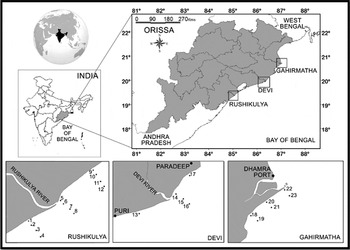
Sediment sampling was undertaken along three coastal sites in Orissa; Rushikulya (12 Stations; between 19°26′N and 85°09′E to 19°17′N and 84°57′E), Devi river mouth (5 Stations; between 20°01′N and 86°25′E to 19°54′N and 86°14′E) and Gahirmatha (6 Stations; between 20°41′N and 87°02′E to 20°30′N and 86°46′E) encompassing 23 sampling stations (1–6 km far-shore) in the north-west coastal BoB (Figure 1). The depth profile ranged from 2.9–22 m as depicted in Table 1. These sites are also world famous as marine turtle (Olive Ridley; Lepidochelys olivacea) congregation sites (Pandav & Choudhury, Reference Pandav, Choudhury, Choudhury and Shanker2006; Tripathy et al., Reference Tripathy, Kumar, Choudhury, Sivakumar and Nayak2008). All collections were made in the post-monsoon months (November–December) of 2009. Our sampling activities coincided with that of the season of onset of mating and nesting feat (congregation) for Olive Ridley turtles in the Indian Ocean.
Map of the study area.

Depth and distance profiles (from the shoreline) of the sampling stations. In addition, the percentage composition of benthic foraminifers in meiofauna, their total abundance in sediments and live on dead ratios are also shown across the stations. ‘–’ no data available.

Sample collection
Sediment samples were collected using a grab sampler (van Veen) of 0.1 m2 capacity. Representative sediment sub-samples (using a core sampler) of 10 cm3 from top 3 cm (common living depth: e.g. Castignetti & Manley, Reference Castignetti and Manley1998; Fontanier et al., Reference Fontanier, Jorissen, Licari, Alexandre, Anschutz and Carbonel2002) were then re-collected in duplicate from the bulk sample on-board and preserved immediately in 4% buffered formalin after staining them with rose Bengal (1g/l) to distinguish live foraminifers from the dead ones. Representative sub-sampling from top 3 cm was undertaken since benthic foraminifer are infaunal and live foraminifers move up and down below the sediment surface (Murray, Reference Murray2006).
Abundance analysis
In the laboratory, each sediment sample (10 cm3) was washed thoroughly over a 500 µm sieve to eliminate benthic macro-fauna and then on a 63 µm sieve to retain the meiofaunal foraminifers. The total sediment fraction retained by the 63 µm sieve was mounted over ordinary glass slides in glycerol (98% purified) as media (refractive index, 1.47 at 20°C) for enumeration of the functional foraminiferal taxa (live and dead separately).
Benthic foraminifera: isolation and taxonomy
All the benthic foraminifers, from a duplicate sub-sample (washed and retained on 63 µm sieve), were sorted under an ordinary dissection microscope (Magnus) from each station (1–23) and mounted on micro-fossil slides. Systematic identification of foraminifer taxa was primarily conducted following the methods of Lobelich & Tappan (Reference Loeblich and Tappan1988), some of which were imaged using a scanning electron microscope (SEM; INCA x-sight model 7636, Oxford Instruments America, Concord, MA). The taxonomy of doubtful specimens was verified from the Foraminifera Gallery website (http://www.foraminifera.eu/). Broken or beaten up tests of foraminifers were not considered for enumeration.
Salinity and grain size analysis
Salinity conditions along each site were checked using a hand-held refractometer (Brix) at the time of sampling.
Pre-weighed sediment samples from respective stations were oven-dried at 60°C for 24 hours and following the standard sieve-and-pipette method, developed by Folk (Reference Folk1968); grain sizes of the sediment samples were analysed. Components in the sediment (sand, silt and clay) were deduced in per cent.
Statistical analysis
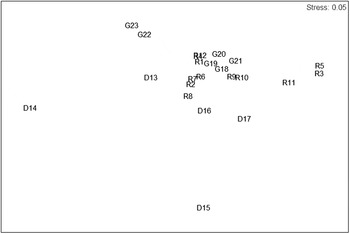
Fisher's alpha species diversity value for foraminifer from each station was calculated using DIVERSE in Primer v5.1 (Clarke & Warwick, Reference Clarke and Warwick2001). To investigate the relationships between observed foraminifer trend and sediment composition among the studied stations a non-metric multi-dimensional scaling (MDS) approach was applied. Foraminifer abundance, number of foraminifer genera detected, and sediment composition for each station were arranged in an input file and similarity matrices were created in Primer v5.1 by selecting Bray–Curtis similarity coefficient and transforming each value by the square root (Clarke & Warwick, Reference Clarke and Warwick2001). MDS which is an ordination technique and represented by multi-dimensional data (indicated by acceptable stress values) was then applied to the similarity matrices.
RESULTS
Substrate
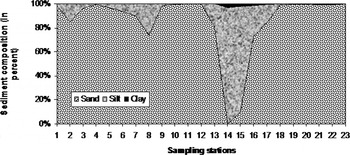
The results of the grain-size analyses, plotted in Figure 2, show that most of the sampled substrates over the study area were sandy. The near-shore substrate of Rushikulya (Stations 1–12) were composed of blackish to white calcareous sand (73.8–100%), in part derived from bivalves, gastropods, echinoderms and coral remains (Supplementary figure, S1). Few foraminifers in Rushikulya sediments (mostly in Stations 11 and 12) showed evidence of erosion (Supplementary figure, S2). Mean water salinity measured 31 psu in Rushikulya.
Sediment composition along the sampling stations in Orissa.

At Devi (Stations 13–17) the substrates were mostly sand dominated except in Stations 14 and 15 where silt contents (96.58 and 88.42% respectively) were higher than that of sand and clay. The sediments constituted blackish mineral particles, calcium carbonate and organic debris, in part derived from ostracods and decaying foraminifer shells. Mean water salinity measured 21 psu in Devi.
At Gahirmatha the average salinity over the stations was recorded to be 28 psu. The coastal sediments of Gahirmatha (Stations 18–23) were composed predominantly of calcareous sand (99–100%) with traces of silt and clay. The calcium carbonate in sand was derived in part from gastropods and bivalves. Most of the foraminifer shells in Gahirmatha sediments showed evidence of erosion and mineralization.
Benthic foraminifera in Orissa
The meio-benthic domain across the study area was found to be dominated by foraminifers (live plus freshly dead) over other meiofaunal groups. For instance, in Rushikulya benthic foraminifers constituted 87.6% (across 5 geographical stations) of the meio-benthic community while in Devi (across 5 geographical stations) and Gahirmatha (across 6 geographical stations) the proportions were 93.2% and 92.5% respectively for the study period (November–December 2009) (Table 1).
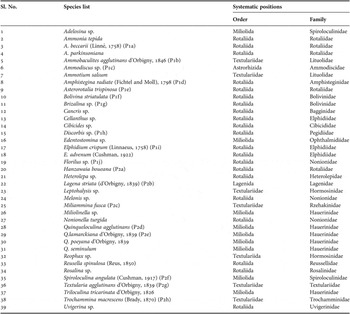
Thirty-nine benthic foraminifer species (39 were from Rushikulya, 22 from Devi and 12 from Gahirmatha) from 6 orders (6 in Rushikulya, 4 in Devi and 5 in Gahirmatha) and 23 families (23 in Rushikulya, 10 in Devi and 7 in Gahirmatha) were documented from the coastal substrates sampled in the present study. Table 2 presents the list of benthic foraminifers with their systematic positions, collected from 23 stations across the study area. In general, the order Rotaliida followed by Miliolida numerically dominated the list with 21 (21 in Rushikulya, 11 in Devi and 5 in Gahirmatha) and 9 (8 in Rushikulya, 5 in Devi and 3 in Gahirmatha) representative species respectively. Further, representatives from the family Hauerinidae (7 species; 6 in Rushikulya, 5 in Devi and 3 in Gahirmatha) followed by Rotaliidae (5 species; 5 in Rushikulya, 3 each in Devi and Gahirmatha) numerically dominated the foraminifer assemblages across the study sites.
Systematic positions (order, family, genus and species) of the benthic foraminifers documented from the study area. ‘P’ is the reference plate number.

The overall benthic foraminifer assemblages along the study sites were dominated by calcareous species (34), while a few agglutinated forms were also encountered.
Abundance, distribution and assemblage patterns of benthic foraminifers
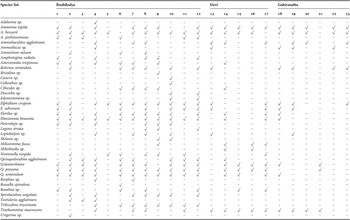
Total (live and freshly dead) foraminifer abundance in Rushikulya ranged from 36–500 individuals/10 cm3 in the sediment (upper 3 cm only). In Devi the abundance ranged from 145–2620 individuals/10 cm3, while that in Gahirmatha it ranged from 270–1478 individuals/10 cm3 (Table 1). Table 3 depicts the distribution pattern of benthic foraminifer across 23 sampling stations.
Station-wise presence/absence of benthic foraminifers. ‘-’ indicates absence while ‘√’ indicates presence of respective species.

Furthermore, in Rushikulya live foraminifers constituted around 0–50% of the foraminifer communities. In Devi and Gahirmatha it ranged from 5–33% and 1.2–12.5% respectively (Table 1).
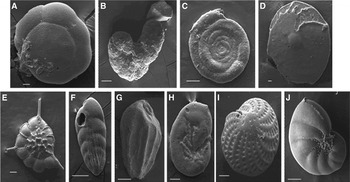
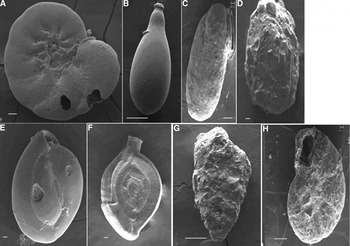
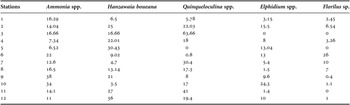
Interestingly, in Rushikulya three species of Ammonia (A. tepida–A. beccarii–A. parkinsoniana complex), two species of Elphidium (E. crispum–E. advenum complex), one species of Florilus (Florilus sp.), one species of Hanzawaia (H. boueana) and three species of Quinqueloculina (Q. lamarckiana–Q. poeyana–Q. seminulum complex) dominated the calcareous benthic foraminifer communities in our collections (Table 4a and Plates 1 and 2). Among agglutinated forms, Quinqueloculina agglutinans was frequently encountered in the sediment samples from Rushikulya.
(a) Ammonia beccarii (Linné, 1758); (b) Ammobaculites agglutinans (d'Orbigny, 1846); (c) Ammodiscus sp.; (d) Amphistegina radiata (Fichtel and Moll, 1798); (e) Asterorotalia trispinosa (Thalmann) 1933; (f) Bolivina striatula (Cushman, 1922); (g) Brizalina sp.; (h) Discorbis sp.; (i) Elphidium crispum (Linnaeus, 1758); (j) Florilus sp. Scale bar = 20 µm. Samples (a) and (b) were collected from Devi river mouth; (c–h) were collected from Rushikulya; while (i) and (j) were collected from Gahirmatha.

(a) Hanzawaia boueana (d'Orbigny, 1846); (b) Lagena striata (d'Orbigny, 1839); (c) Miliammina fusca (Brady 1870); (d) Quinqueloculina agglutinans (d'Orbigny, 1839); (e) Q. lamarckiana (d'Orbigny, 1839); (f) Spiroloculina angulata (Cushman, 1917); (g) Textularia agglutinans (d'Orbigny, 1839); (h) Trochammina macrescens (Brady, 1870). Scale bar = 20 µm. Samples (a) and (c–e) were collected from Devi river mouth; (b) and (f–h) were collected from Rushikulya site.

Relative abundance (in per cent) of numerically dominant taxa along the stations: (a) in Rushikulya; (b) in Devi river mouth; (c) in Gahirmatha.

In Devi two species of Ammonia (A. tepida–A. beccarii complex), one species of Miliammina (M. fusca) and three species of Quinqueloculina (Q. lamarckiana–Q. poeyana—Q.seminulum complex) dominated the calcareous foraminifer assemblage while the agglutinated assemblage was dominated by Trochammina macrescens and Ammobaculites agglutinans (Table 4b and Plate 1).
Relative abundance (in per cent) of numerically dominant taxa along the stations: (a) in Rushikulya; (b) in Devi river mouth; (c) in Gahirmatha.

Likewise, in Gahirmatha two species of Ammonia (A. tepida–A. beccarii complex), one species of Bolivina (B. striatulata), and two species of Elphidium (E. crispum–E. advenum complex) formed the representative assemblage of calcareous benthic foraminifers while Trochammina macrescens and Ammobaculites agglutinans dominated the assemblage of agglutinated foraminifers (Table 4c and Plate 2).
Relative abundance (in per cent) of numerically dominant taxa along the stations: (a) in Rushikulya; (b) in Devi river mouth; (c) in Gahirmatha.

Statistical analysis
Fisher's alpha species diversity value for all the stations ranged between 0.2 and 0.4 with the highest value recorded for Stations 3 and 5 in Rushikulya (0.44) and the lowest value for Station 14 in Devi (0.21) (see Table ST1). Based on the MDS in Figure 3 it is evident that the observed foraminifer abundance and diversity and sediment composition are similar for the majority of the sampled stations from Rushikulya and Gahirmatha whereas the Devi stations vary from the other two locations and among themselves. The observed stress value (0.07) for MDS was within the acceptable range.
Non-metric multi-dimensional scaling plot to investigate the relationship of observed foraminifer trends and sediment composition in the studied stations (R indicates Rushikulya, D indicates Devi and G indicates Gahirmatha). 0.07 indicates acceptable stress value.

DISCUSSION
The present study was conducted to illustrate the modern foraminifer assemblages and distribution in coastal sediments across three marine turtle (Olive Ridleys, Lepidochelys olivacea) mass congregation sites in Orissa (India), north-west BoB. To the best of our knowledge, this is the first study to systematically document recent benthic foraminifers and associated assemblage trends from this part of the north-west BoB (north-east coast of India). At all the three sites (Rushikulya, Devi and Gahirmatha), eurytopic rotalid (calcareous perforate) foraminifers were the main component of the total benthic foraminifer fauna (represented by 23 species in Rushikulya, 11 in Devi and 7 in Gahirmatha). Miliolids (porcelaneous) followed the rotalids (represented by 9 species in Rushikulya, 5 in Devi and 3 in Gahirmatha), followed in turn by the textularids (agglutinated) (7 in Rushikulya, 4 in Devi and 3 in Gahirmatha) in the coastal sediments of the Olive Ridley turtle congregation sites in Orissa. The abundant benthic foraminifers (mostly from the orders Rotalida, Miliolida and Textularida) from the study sites were opportunistic and are usually employed as bio-indicators of environmental perturbations (e.g. Ammonia spp., Elphidium spp. and Trochammina macrescens), as documented in earlier investigations from different polluted environments (e.g. Kfouri et al., Reference Kfouri, Figueira, Figueiredo, Souza and Eichler2005). In general, abundance of these opportunistic taxa in benthic foraminifer assemblages was reported to indicate stressful environmental conditions including low-oxygen, high organic matter flux and anthropogenic pollution (e.g Sen Gupta & Machain-Castillo, Reference Sen Gupta and Machain-Castillo1993; Dublin-Green, 1994; Moodley et al., Reference Moodley, van der Zwaan, Hermam, Kempers and van Breugel1997; Den Dulk et al., Reference Den Dulk, Reichart, Memon, Roelofs, Zachariasse and Van der Zwaan1998). Additionally, the miliolids are important environmental indicators of warm and shallow marine waters (Haynes, Reference Haynes1981) that match well with the kind of coastal settings that prevail in Orissa along the north-west BoB. The abundance of these taxa in the sediments of the study area indicated towards the presence of ample food resources across the sampling stations, as evident from the result of total organic carbon analysis (1176 mg/kg of the sediments from Station 3) from one of the stations in Rushikulya in a concurrent study that dealt with mapping the meiofaunal community structure along the coastal belt of Orissa (Bhattacharjee et al., unpublished data). Many of the foraminiferal diversity (taxonomic range of distribution) and assemblage patterns (calcareous and agglutinated forms) in the sediments along the three turtle congregation sites also pointed towards the influence of freshwater discharge (seaward flux of organic matter from land) and mixing processes across these coastal sampling stations, as also apparent from the occurrence of thecamoeba (testate amoebae) in Rushikulya, Devi and Gahirmatha (Bhattacharjee et al., unpublished data).
Agglutinated foraminifers were very rare in the sediments (7 species in Rushikulya, 4 species in Devi and 3 in Gahirmatha), on the other hand being dominated by Trochammina macrescens and Ammobaculites agglutinans along these sites. These agglutinated taxa (e.g. textularids; indicative of environments where seawater is under-saturated with respect to CaCO3, such as estuarine habitat) produce their tests by picking up tiny particles from the environment and glue these to themselves. It should be noted that the placement of foraminifer taxa into these functional groups is subjective (to some extent) as some of the taxa have species in more than one category. For example, Quinqueloculina, which is a smaller miliolid, has agglutinated species (Q. agglutinans).
Benthic foraminifer assemblages across the three sites were found to be dominated by Ammonia species complex (up to 38% in Rushikulya, 64% in Devi and 22% in Gahirmatha). As regard to this genus, many taxonomic and phylogenetic reports exist (e.g. Holzmann & Pawlowski, Reference Holzmann and Pawlowski1997; Hayward et al., Reference Hayward, Holzmann, Grenfell, Pawlowski and Triggs2004). High morphological diversity with respect to variable environmental conditions has created complications in the taxonomic attribution of Ammonia species. In the shallow-coastal waters of Orissa (Rushikulya, Devin and Gahirmatha), three forms exist, Ammonia tepida, A. beccarii and A. parkinsoniana. Their divergence is based upon the size-variability of the umbilical knob. As already illustrated, the life strategy of opportunistic taxa, like Ammonia spp., makes them sufficiently adapted to survive under stress and dominate in areas subjected to fast changing environmental parameters (e.g. Alve, Reference Alve2003; Melis & Violanti, Reference Melis and Violanti2006). Many of 39 identified species recorded from Orissa (north-west BoB) many have already been documented from different global locations with similar oceanographic settings (e.g. Hayward, Reference Hayward1981; Haunold et al., Reference Haunold, Baal and Piller1997; Javaux & Scott, Reference Javaux and Scott2003; Murray, Reference Murray2003; Abu-Zied et al., Reference Abu-Zied, Bantan, Basaham, El Mamoney and Al-washmi2011). For example, several species of Hanzawaia have been recorded from different coastal regions globally (e.g. Margreth et al., Reference Margreth, Ruggeberg and Spezzaferri2009) and in India including the coastal stretches of Orissa (e.g. Rao et al., Reference Rao, Jayalakshmy, Venugopal, Gopalakrishnan and Rajagopal2000; Kathal & Singh, Reference Kathal and Singh2010; Singh & Kathal, Reference Singh and Kathal2011). From a review of the existing literature, it appears that Leptohalysis sp. has been recorded for the first time from the east coast of India.
A comparison of live to dead benthic foraminifers across 23 sampling stations (live fauna ranged from 0–50% in Rushikulya, 5–33% in Devi and 1.2–12.5% in Gahirmatha) in coastal Orissa indicated that the turnover rates of foraminiferal tests were low. An early study by Jorissen & Wittling (Reference Jorissen and Wittling1999) suggested that interspecific differences in live to dead ratios are to a large extent determined by seasonal differences in reproduction. Interestingly, we also recorded the presence of the planktonic foraminifera Globigerinoides ruber with pink coloured test in the sediment samples in addition to pale, uncoloured Globigerinoides ruber test from all the three sites. As the white variant of Globigerinoides ruber is cosmopolitan in distribution, to our knowledge, this is the first report that describes the occurrence of the modern Globigerinoides ruber pink variant from the Indian Ocean. The two chromotypes (white and pink) also were recorded previously to have differences in their ecological requirements and seasonal occurrence (e.g. Tolderlund & Bé, Reference Tolderlund and Bé1971) and thus researchers deal separately with white and pink chromotypes of Globigerinoides ruber for the purpose of paleoceanographic reconstructions (e.g. Anand et al., Reference Anand, Elderfield and Conte2003; Chiessi et al., Reference Chiessi, Ulrich, Mulitza, Pätzold and Wefer2007). Occurrence of the pink variant along this province of the BoB needs further research to better understand its ecological implication.
Near absence of microalgae in the sediments of Rushikulya, Devi and Gahirmatha pointed towards fervent feeding behaviour of the benthic foraminifers (e.g Ammonia spp.) in these sites. Overwhelming dominance of one taxon over all others in the sediments was also reported earlier in literature by Chandler (Reference Chandler1989) who demonstrated the existence of an amensalitic relationship between meio-benthic functional groups (e.g foraminifera–copepod amensalism). Perhaps amensalistic interactions (resource monopolization) among taxa played an important role in shaping the meiobenthic communities across these sites in Orissa, where meio-benthic foraminifers overwhelmingly dominated in the sediments over other taxa. The coastal sediments of Orissa were also reported to have heavy mineral deposits like sillimanite, garnet and rutile in high concentrations (Behera, Reference Behera2003). It would be interesting to investigate if such concentrations can affect the distribution and assemblage patterns of sediment associated (meiofauna) organisms over the ecoregion.
Occurrence of live specimens of Amphistegina radiata in the sediments of Rushikulya corresponded with the presence of live coral chunks in our collections. Earlier studies confirmed the presence of this genus in and around carbonate beds (Rana et al., Reference Rana, Nigam and Panchang2007; Saraswati, Reference Saraswati2007). It should be noted that previously live coral beds were reported to exist in Gopalpur, a location south of Rushikulya (Rao et al., Reference Rao, Murthy, Reddy, Subramanyam, Lakshminarayana, Rao, Sarma, Preemkumar, Sree and Bapuji2001).
The Fisher's alpha diversity values observed across all the stations for the foraminifer communities were very low and indicate that the studied areas are typical marginal marine environments as categorized earlier by Murray (Reference Murray2006) based on the alpha diversity values for foraminifer. The MDS analysis did show that the observed foraminifer trends in links with sediment composition were similar in the majority of the stations representing Rushikulya and Gahirmatha. However, the Devi stations were different from Rushikulya and Gahirmatha stations, and in particular Stations 14 and 15 representing the Devi were significantly different from all the other Devi stations as well as from Rushikulya and Gahirmatha. The observed trend in Stations 14 and 15 could be linked to high silt content (more than 85%) compared to other stations and that may have influenced the foraminifer abundance, distribution and diversity. The role of sediment composition in controlling the foraminifer distribution beside other parameters like salinity and tidal elevation has been also detailed from other biogeographical locations on a global scale (e.g. Mendes et al., Reference Mendes, Gonzalez, Dias, Lobo and Martins2004; Armynot du Chátelet et al., Reference Armynot du Chátelet, Degre, Saurian and Debenay2009).
As evident from the present study, the ecological processes along the three most important but vulnerable congregation sites of Olive Ridleys were subjected to rapid changes that affected the foraminiferal communities (dominance of opportunistic taxa) during this period of sampling (November–December 2009). Overall these data provided valuable insights into the systematics, ecology, distribution and assemblage patterns of benthic foraminifers in the region (Orissa, north-west BoB) under the present context of shifting hydrological conditions, and the trends indicated by our foraminiferal data may serve as a benchmark for future reconstruction of sea level rise and climate change in the coastal plains of Orissa.
ACKNOWLEDGEMENTS
We thank the Field Assistants for their untiring assistance during the fieldwork and the State Forest Department Authority, Orissa, India, for their cooperation during the study. We also thank Mr S. Choudhury, Geological Survey of India, Kolkata, who helped us undertake scanning electron microscopy imaging of foraminifers. This research was financially supported by the Directorate General of Hydrocarbon, Ministry of Petroleum & Natural Gas, Government of India.
Supplementary materials and methods
The supplementary material refered to in this article can be found online at journals.cambridge.org/mbi.