1. Introduction
A growing body of literature has found evidence that children learning a second language (L2) are distinct from simultaneous bilinguals. In morphosyntactic research, child L2 learners (also called sequential bilinguals) have been separated from simultaneous bilinguals by their age of L2 onset, where acquisition of an additional language beginning between 3;0–4;0 years old is considered L2 learning (Paradis, Reference Paradis, Hoff and Shatz2007; Paradis, Genesee & Crago, Reference Paradis, Genesee and Crago2011; Schwartz, Reference Schwartz, van Kampen and Baauw2004; Unsworth, Reference Unsworth2005). A similar age division around 4;0 seems appropriate to the study of L2 phonological development. For example, Anderson (Reference Anderson2004) found that children with a mean age of 3;9 had a considerable command of English consonants after only 8–9 months exposure, suggesting that L2 exposure before four years of age leads to very rapid acquisition possibly akin to simultaneous bilinguals. Similarly, Flege, Munro and MacKay (Reference Flege, Munro and MacKay1995) found that the 78% of adults who began learning English before the age of four had “authentic pronunciation of English” (Flege et al. Reference Flege, Munro and MacKay1995, p. 3129), while most adults whose L2 acquisition began after age seven had a detectable foreign accent.
This paper focuses on this intermediate period – children whose L2 exposure begins around four–six years of age, whom we will refer to as early L2 learners. Early L2 learners obviously differ from first language (L1) learners in that the former have already acquired some of their L1 phonology, so that they are at least capable of transfer errors. In this way, early L2 learners have the potential to resemble adult L2 learners. Early L2 learners, however, are not simply younger versions of adult L2 learners because their L1 phonological development is likely not complete. English-speaking children, for example, do not completely master the consonant inventory of English until around six–eight years of age (Hoff, Reference Hoff2009). Early L2 learners are also different from adults because they retain the likely potential to become phonologically native or near-native in their L2, suggesting that early L2 learners’ phonological acquisition may more closely resemble L1 development. Given these apparent similarities and differences, we hypothesize that early L2 learners represent a unique population for linguistic study. Existing studies of early L2 phonology provide somewhat conflicting results, as to the rate of accuracy and the evidence for L1 transfer, so descriptive research on their phonological development remains necessary to establish basic facts.
This study focuses on the acquisition of word-initial consonant clusters. This area provides a reasonable starting point for examining early L2 learners’ phonological development because the facts of consonant cluster acquisition across other learner populations are well-known. While young children learning English as an L1 most often delete a segment within consonant clusters (e.g., Pater & Barlow, Reference Pater and Barlow2003), adult learners often rely on epenthetic vowels to deal with the same clusters (e.g., Broselow & Finer, Reference Broselow and Finer1991; Hancin-Bhatt & Bhatt, Reference Hancin-Bhatt and Bhatt1997; Karimi, Reference Karimi1987; Kwon, Reference Kwon2006; Major, Reference Major1994). Furthermore, consonant cluster productions allow an examination of the extent of L1 transfer. Many studies have found that adult L2 preferences for epenthesis into clusters can be heavily influenced by the adult's L1 phonology, though the extent of this transfer is not always consistent across studies (e.g., Broselow, Reference Broselow, Selinker and Gass1983, Reference Broselow, Flynn and O'Neil1988; Eckman & Iverson, Reference Eckman and Iverson1993; Karimi, Reference Karimi1987; Sato, Reference Sato1984; Tarone, Reference Tarone1980). Overall, English onset cluster production thus provides many opportunities for examining early L2 phonological acquisition, in comparison with other, better-studied learner populations.
1.1 Acquisition of onset clusters in L1 and adult L2 acquisition
Overall cluster accuracy
It is common practice in studies of consonant cluster acquisition to measure accuracy as the number of clusters produced compared to the number of clusters attempted. From this perspective, instances of deletion or epenthesis are considered as errors, but substitutions of one phoneme for another (e.g., [l] for [ɹ]) are still considered accurate (e.g., Becker & Tessier, Reference Becker and Tessier2011; Kirk & Demuth, Reference Kirk and Demuth2005; Pater & Barlow, Reference Pater and Barlow2003). Following this practice, this section details the overall cluster accuracy of different learner populations. Details about the types of errors made by various groups of English learners can be found in the following sections.
For children, the process of reaching native-like mastery of English onset clusters appears to be a fairly linear one, in which consonant clusters of various types gradually become more accurate, but there is a large degree of variation in English L1 children's rate of acquisition. For example, McLeod, van Doorn and Reed's (Reference McLeod, van Doorn and Reed2001) survey of the literature finds that the age of reported mastery of English consonant clusters (by English-speaking children) ranged from four years to nine years. Thus, the age-matched English L1 peers of the early L2 children in this study may not yet have fully mastered English onset consonant clusters – but it is still very likely that, in age-matched terms, the early L2 children will show delayed cluster abilities.
For adult L2 learners, cluster accuracy is heavily influenced by L1. For example, Broselow and Finer (Reference Broselow and Finer1991) found that the majority of Hindi-speaking adults did not make errors when producing English onset clusters that are also found in Hindi – Cj and Cɹ onsets in particular – whereas L1 Japanese- and Korean-speaking participants had more difficulty with these clusters. This increased difficulty is attributable to the transfer of L1 phonological restrictions insofar as Japanese and Korean have either fewer or no onset clusters (see Eckman & Iverson Reference Eckman and Iverson1993). Similarly, Hancin-Bhatt and Bhatt (Reference Hancin-Bhatt and Bhatt1997) found that Spanish native speakers, whose L1 allows a large subset of English obstruent–sonorant onsets, produced onset clusters more accurately than L1 Japanese speakers. The clearest evidence of L1 transfer is that stop–glide clusters were the only sequences in the study that Spanish does not allow, and they posed the most difficulty for the native Spanish speakers; in contrast, the Japanese speakers whose L1 contains neither of these cluster types showed no difference between stop–glide and stop–liquid sequences.
We also note the well-known fact that adult L2 speakers have more limited prospects for ultimate mastery of L2 phonology. The adult L2 learners in Hancin-Bhatt and Bhatt (Reference Hancin-Bhatt and Bhatt1997) had been learning English for between 4.4 and 6.8 years, and the participants in Broselow and Finer's (Reference Broselow and Finer1991) study were all classified as being high intermediate learners of English, but cluster errors persisted in their speech. We know of no published reports on adult L2 production of consonant clusters within the first year of L2 exposure. However, some recent studies have found that adult learners of English as a second language (ESL) are somewhat better than child ESL learners at producing and perceiving novel phones (notably vowels) after five or six months of L2 exposure. After a full year's exposure, however, L2 child learners have improved significantly and begin to outperform adult learners across the board (see Aoyama, Guion, Flege, Yamada & Akahane-Yamada, Reference Aoyama, Guion, Flege, Yamada and Akahane-Yamada2008; Oh, Guion-Anderson, Aoyama, Flege, Akahane-Yamada & Yamada, Reference Oh, Guion-Anderson, Aoyama, Flege, Akahane-Yamada and Yamada2011, on L1 Japanese learners; Baker, Trofimovich, Flege,Mack & Halter, Reference Baker, Trofimovich, Flege, Mack and Halter2008, on L1 Korean learners; see also L1 English learners of Dutch in Snow & Hoefnagel-Hohle, Reference Snow and Hoefnagel-Hoehle1977, Reference Snow and Hoefnagel-Hoehle1978). This body of research therefore suggests that the early L2 children reported in the present study, with between four and eight months English exposure, are in the process of eclipsing the overall accuracy of comparable adult L2 learners.Footnote 1
Types of errors
Most typically-developing children learning L1 English go through a phase of deleting one phoneme from onset consonant clusters (e.g., Chambless, Reference Chambless2006; Gnanadesikan, Reference Gnanadesikan2004; Goad & Rose, Reference Goad and Rose2004; Pater & Barlow, Reference Pater and Barlow2003; Smith, Reference Smith1973), and this has largely resolved itself by age five (McLeod et al., Reference McLeod, van Doorn and Reed2001). This prevalence of deletion in early consonant cluster productions holds across many diverse L1s (e.g., Adam, Reference Adam2002, on Hebrew; Barlow, Reference Barlow and Eddington2005, on Spanish; Lléo & Prinz Reference Lléo and Prinz1996, on Spanish and German; Rose, Reference Rose2000, on French). Examples of the deletion pattern commonly observed in L1 English productions are found in (1).
- (1)
a. clean /klin/ → [kin]
snow /snoʊ/ → [soʊ]
slip /slɪp/ → [sɪp]
spoon /spun/ → [bun]
(data from G; Gnanadesikan, Reference Gnanadesikan2004, pp. 77–78)
b. snake /snek/ → [nek]
smell /smɛl/ → [meʊ]
sleep /slip/ → [sip]
slide /slaɪd/ → [saɪd]
(data from Julia; Compton & Streeter, Reference Compton and Streeter1977, as cited in Pater & Barlow, Reference Pater and Barlow2003)
In addition to this dominant pattern, English L1 learners may also occasionally epenthesize a vowel to break up a word-initial cluster. For example, Smit's (Reference Smit1993) large-scale cross-sectional analysis reports “occasional” and “rare” schwa epenthesis across ages and segmental contexts; in fact, the highest proportion of epenthesis that is observed in this study is only 8% of productions.Footnote 2
In contrast to children, adult L2 learners of English rely most commonly on vowel epenthesis – see examples in (2) – and this finding also holds for speakers from diverse L1 backgrounds (e.g., Broselow, Reference Broselow, Flynn and O'Neil1988, for Arabic; Hancin-Bhatt & Bhatt, Reference Hancin-Bhatt and Bhatt1997, for Japanese and Spanish; Kwon, Reference Kwon2006, for Korean; Major, Reference Major1994, for Portuguese).
- (2)
a. school /skul/ → [sukul]
(Hancin-Bhatt & Bhatt, Reference Hancin-Bhatt and Bhatt1997, p. 355)
b. sky /skaɪ/ → [iskaɪ]
slab /slæb/ → [ǝslæb]
(Major, Reference Major1994, p. 666)
It is not the case, however, that all adult L2 learners are equally likely to epenthesize when producing onset clusters. Instead, there is good evidence that the prevalence of adult L2 epenthesis is influenced by L1 (see Broselow, Reference Broselow, Selinker and Gass1983, Reference Broselow, Flynn and O'Neil1988; Eckman & Iverson, Reference Eckman and Iverson1993; Karimi, Reference Karimi1987; Lin, 2003; Sato, Reference Sato1984; Tarone, Reference Tarone1980). Specifically, studies that have directly compared adult L2 English speakers with different L1s have often found that the likelihood of deletion increases for speakers of L1s without consonant clusters (Anderson, Reference Anderson1987; Broselow, Reference Broselow1984; Tarone, Reference Tarone1980). Nevertheless, this increase in observed deletions does not preclude speaker's use of epenthesis as well – more often, their speech will include both epenthesis and deletion.
Location of errors
When choosing a segment to delete from an onset cluster, L1 English children usually delete the second member of a two-consonant cluster, as in clean /klin/ → [kin] and snow /sno/ → [so] of (1a) above. The clear exception to this pattern is the set of English s-initial clusters where the first member, [s], is often deleted. There is abundant evidence from both developmental and cross-linguistic phonology that s-initial clusters can be treated as special or exceptional (for an excellent review see Barlow, Reference Barlow2001b) and several overlapping explanations for this exceptionality may be found. For some learners, the exceptional clusters which lose their initial s are only the s+stop clusters, illustrated here in (3).
- (3)
a. S-initial clusters
sky /skaɪ/ → [gaɪ]
skin /skɪn/ → [gɪn]
(data from G; Gnanadesikan, Reference Gnanadesikan2004 [1995], as cited by Pater & Barlow, Reference Pater and Barlow2003, p. 78)
b. Other clusters
clean /klin/ → [kin]
draw /dɹɒ/ → [dɒ]
(data from G; Gnanadesikan, Reference Gnanadesikan2004 [1995], as cited by Pater & Barlow, Reference Pater and Barlow2003, p. 77)
The prominent theoretical account of this pattern comes from sonority: s+stop clusters represent the only case of an English cluster in which the second member is less sonorous, so the pattern in (3a) has been analyzed as a consistent preference for minimizing onset sonority by deleting the more sonorous cluster member (Gnanadesikan, Reference Gnanadesikan2004; Pater & Barlow, Reference Pater and Barlow2003). However, other learners appear to delete the s in other s–consonant (sC) sequences independent of sonority: including s+nasal clusters (Julia, described in Pater & Barlow, Reference Pater and Barlow2003) or in fact deleting every s in an sC cluster (Amahl at 2;2–2;6, Smith, Reference Smith1973, and discussed in Goad & Rose, Reference Goad and Rose2004; see also Ingram, Reference Ingram1989; and Smit, Reference Smit1993). A broader account of sC exceptionality is beyond the scope of this paper, but many analysts have concluded that pre-vocalic sC sequences can differ in their structural representation (see especially Barlow, Reference Barlow2001a, Reference Barlowb; Goad, Reference Goad2012; Goad & Rose, Reference Goad and Rose2004).
The other most common error discussed here is vowel epenthesis. When L2 English-speaking adults produce an onset cluster with an epenthetic vowel, it is usually the case that the vowel is inserted within the cluster, as is shown in (4a), but pre-cluster epenthesis is observed, especially for sC clusters, as is shown in (4b) (see e.g., Broselow, Reference Broselow1984; Singh, Reference Singh1985).
- (4)
a. S-initial clusters
study [stɑdi] → [istɑdi]
ski [ski] → [iski]
special /spɛʃʌl/ → [izbasjʌl]
(data from L1 Egyptian Arabic; Broselow, Reference Broselow, Selinker and Gass1983, p. 301)
b. Other clusters
floor /flɔɹ/ → [filɔɹ]
translate /tɹænzlet/ → [tiɹænsilet]
(data from L1 Egyptian Arabic; Broselow, Reference Broselow, Selinker and Gass1983, p. 294)
1.2 Phonological development in early bilingual and L2 learners
Overall accuracy in early L2 learners
One general finding is that monolingual and bilingual children are roughly equally matched in terms of overall accuracy. For example, Goldstein and Washington (Reference Goldstein and Washington2001) report that bilingual Spanish–English children produce English phonemes with accuracy comparable to monolingual English learners; Fabiano-Smith and Barlow (Reference Fabiano-Smith and Barlow2010) also report that bilingual children have phonemic inventories comparable to their monolingual peers. Similarly, Anderson (Reference Anderson2004) and Gilhool, Burrows, Goldstein and Paradis (Reference Gilhool, Burrows, Goldstein and Paradis2009) found that early L2 learners from a range of L1 backgrounds were accurate with English consonants after an average of less than a year's exposure to English. In Gilhool et al.'s (Reference Gilhool, Burrows, Goldstein and Paradis2009) study, participants produced all sound classes except fricatives with at least 90% accuracy. In Anderson's (Reference Anderson2004) study, children's average accuracy scores ranged from 79.9% to 86.2%.
With respect to consonant clusters specifically, these studies provide limited evidence. Anderson (Reference Anderson2004) notes that only one child in that study had difficulty with English Cɹ clusters, repairing them 17% of the time, and Gilhool et al. (Reference Gilhool, Burrows, Goldstein and Paradis2009) report that an average of only 7% of all cluster productions involved reduction or deletion. Thus, it seems that early L2 learners may produce consonant clusters with a high degree of accuracy.
Despite these similarities with monolinguals, there are also indicators that bilingual children's phonologies can be less accurate than monolingual children's. Gildersleeve-Neumann, Kester, Davis and Peña (Reference Gildersleeve-Neumann, Kester, Davis and Peña2008) found that balanced English–Spanish bilingual children made more errors with English phonemes than English-dominant children. Gilhool et al.'s (Reference Gilhool, Burrows, Goldstein and Paradis2009) result that early L2 learners produced fricatives with a mean accuracy of only 78% (range = 57%–94%) demonstrates that certain aspects of the English phone system take more than a year's exposure to master. Additionally, while the bilingual Spanish–English children in Fabiano-Smith and Goldstein's (Reference Fabiano-Smith and Goldstein2010) study performed comparably to monolingual English-speaking peers, they also lagged behind their monolingual Spanish-speaking peers in overall accuracy. To our knowledge, no previous studies on early L2 phonology provide explicit evidence of L1 influences on the rate of development towards L2 English accuracy – a point which our results will begin to address.
L1 transfer in early L2 learners?
Regardless of the rate at which overall accuracy emerges, children who are learning two languages show cross-language interactions in all linguistic domains, including phonology (Paradis, Reference Paradis and Goldstein2012; Paradis et al., Reference Paradis, Genesee and Crago2011). Goldstein (Reference Goldstein and Goldstein2004) reviews a number of studies that provide evidence of phonological transfer in early bilingual acquisition, including higher accuracy with phonemes that are shared by a child's two languages compared to those phonemes found in only one language. Amastae (Reference Amastae1982) reports an English/Spanish bilingual child who acquired the Spanish process of spirantization at 3;2 and for two months thereafter transferred this process to relevant English contexts (e.g., water [‘waðɚ]). Fabiano-Smith and Barlow (Reference Fabiano-Smith and Barlow2010) also report examples of transfer among the phonemic inventories of three- and four-year-old English/Spanish bilinguals: one child used the English segment [ʒ] in some Spanish words, while another used the Spanish segment [β] in some English words (see also Barlow, Reference Barlow2003; Fabiano-Smith & Barlow, Reference Fabiano-Smith and Barlow2010; Fabiano-Smith & Goldstein, Reference Fabiano-Smith and Goldstein2005; Keshavarz & Ingram, Reference Keshavarz and Ingram2002).
It is thus established that transfer in the form of crosslinguistic influence occurs in the developing phonologies of simultaneous bilinguals. However, some studies cast doubt as to whether transfer also occurs with early L2 child learners who already have an established L1 phonology. Anderson (Reference Anderson2004) examined five English L2 children aged 3;9–4;9 from a range of L1 backgrounds (French, Russian and Korean) and found no evidence of process or inventory transfer in their speech; see also Piper (Reference Piper1984a, Reference Piperb). Gilhool et al. (Reference Gilhool, Burrows, Goldstein and Paradis2009) also found no difference in the accuracy of phonemic productions among early L2 learners from different L1 backgrounds.Footnote 3 Similar accuracy levels are reported in Piper (Reference Piper1984b), where only 4% of words from 15 five-year-old ESL children's spontaneous speech included cluster simplification of any sort.
Taken overall, the emerging body of literature about bilingual and early L2 phonological development still leaves a number of questions unanswered. Much of the previous work has considered phonological acquisition in a broad sense (e.g., overall accuracy with the entire category of consonants), so more detailed studies are necessary to understand the trajectory of L2 phonology in children. These issues, paired with the general lack of studies on early child L2 learners, motivated our research questions, spelled out in the next two sections.
1.3 Investigating L1 effects in this study
There are in principle two potential pieces to an argument that L1 phonology determines an observed L2 process: first, it must be the case that the L1 lacks the problematic L2 target structure, and second, the L1 must somehow provide a reason to use the observed repair.
Given the first criterion, this study examined the L2 English development of children whose L1s vary in their onset cluster inventories compared to English: Chinese on the one hand (including both Mandarin and Cantonese), and Hindi and Punjabi on the other. Chinese languages do not allow complex onsets at all (see e.g., Duanmu Reference Duanmu2000), nor do they provide any systematic evidence of a cluster repair strategy. Hindi and Punjabi, however, allow a subset of onset clusters also present in English.
With respect to this latter group, Hindi and Punjabi are two languages with many dialects, spoken primarily in India and Pakistan, and grouped by Ethnologue in the Indo-Aryan, Central Zone language families. The Ethnologue entry on Eastern Punjabi reports that “there is a continuum of varieties between Eastern and Western Panjabi, and with western Hindi and Urdu” and native speakers report considerable degrees of mutual intelligibility (Lewis, Reference Lewis2009). From this paper's perspective, we are therefore confident in grouping the two L1s together, as their consonant cluster phonologies are very similar, and we will refer to them here simply as “South Asian” languages.
Existing grammars and dictionaries of these languages depict a somewhat complex status for onset clusters, from which some clear generalizations can still be drawn. First, Hindi and Punjabi both permit words and syllables to begin with a small but robust set of consonant clusters, particularly C+glide and some C+liquid sequences such as pj, nj, dɽ, and gɽ shown in (5a) below (these Hindi patterns are discussed in Bharati, Reference Bharati1994; Mehrota, Reference Mehrota1980; Ohala, Reference Ohala1983; Punjabi patterns discussed in Bahri, Reference Bahri1973; Gill & Gleason, Reference Gill and Gleason1963). In addition, many other words in the Hindi and Punjabi lexicons contain potential onset clusters, including a wealth of borrowings originally taken from Sanskrit or from English and other languages. As discussed by the above authors and particularly by Bharati (Reference Bharati1994) in the case of Hindi, some such words are only used in more formal registers or dialects (what Bharati calls the “high register”), so that children might not yet have been exposed to their clusters. Furthermore, many other such words are reportedly used in less formal registers, but with their onset clusters simplified via epenthesis, see (5b).
- (5)


The question of which clusters are treated heterogeneously, as in (5b), may be answered differently in different areas of the many Hindi- and Punjabi-speaking regions, and unfortunately we do not have information on the particular dialects spoken by the children in our study. Nevertheless it is clear that L1 South Asian learners will have had some real exposure to onset clusters as in (5a), yet some English onset clusters will not be in their L1 inventory. In addition, these learners will have received some amount of L1 input with onset cluster epenthesis. As seen in (5b), this vowel may vary in its quality and location, and we will return in detail to the location of vowel epenthesis in our own data (see Section 3.3 below).
1.4 Goals and hypotheses of this study
The primary goal of this paper was to examine consonant cluster acquisition in early L2 learners, to understand the extent to which their overall accuracy and types of repairs are influenced by L1 transfer, or whether they follow developmental patterns typically followed by all L1 or L2 learners. Our specific hypotheses were as follows:
1. With respect to repair, we predict that L1 transfer will impact South Asian children's productions. Given their L1 exposure, their preferred repair for onset clusters will be epenthesis, predominantly within-cluster. We also predict that Chinese-learning children will pattern like monolingual English learners – in the absence of a transferrable repair, they will most often delete a cluster's more sonorous segment.
2. With respect to repair location, we hypothesize that deviations from the above trends are most likely for s-initial or specifically s+stop clusters.
3. With respect to overall accuracy, we predict that Chinese-speaking children will produce fewer English consonant clusters correctly compared to Hind-i and Punjabi-speaking children, as the former group has no previous experience with this structure.
Of course, it may also be the case that factors beyond general developmental principles and L1 experience contribute to between-child differences in cluster production. To search for such additional factors, we also consider the size of our participants’ lexical and questionnaire data about the amount and quality of English to which these children have been exposed (Pierrehumbert, Reference Pierrehumbert2006), and compare those measures to our cluster production data.
2. Methods
2.1 Participants
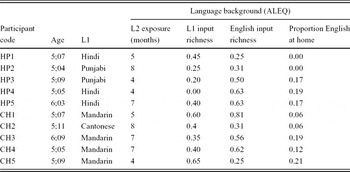
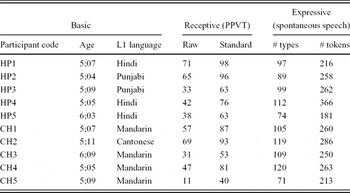
We examined the language skills of 10 early L2 learners (mean age 5;09) who at the time of data collection were learning L2 English (mean months of exposure 5.9) in major urban centers in Alberta, Canada. These children were selected from a larger corpus of early L2 learners being collected by the third author, based on their amount of English exposure and their L1 (Hindi, Punjabi, Mandarin, or Cantonese). To establish their language background, each child's parents or primary caregiver completed the Alberta Language Environment Questionnaire (ALEQ), administered orally by a research assistant and a cultural broker, which specifically quantified their L1 and L2 use: how much each language was used, by whom and in which interactions, at home, on television, at school, with friends and so on. Table 1 reports each child's ALEQ scores on three of these language environment measures: L1 input richness, English (L2) input richness, and proportion of English spoken at home – as well as their length of English exposure, based on the number of months that parents judged the child to have received “significant and consistent” exposure to English.Footnote 4 Through the Alberta Language Development Questionnaire (ALDeQ: Paradis, Emmerzael & Sorenson Duncan, Reference Sorenson Duncan2010), parents reported all of the children to have had typical L1 language development prior to L2 exposure.
Participant information.

ALEQ = Alberta Language Environment Questionnaire.
2.2 Procedures
We selected two measures of phonological ability: a spontaneous speech sample which consisted of a 15-minute conversation between the child and an English-speaking research assistant, and the Edmonton Narrative Norming Instrument (ENNI; Schneider, Dubé & Hayward, Reference Schneider, Dubé and Hayward2005). In the latter task, children are shown six sets of pictures one at a time, and asked to tell a story about each set to the experimenter (who provides only general encouragement as feedback). Children also completed a measure of receptive vocabulary (Peaboy Picture Vocabulary Task, third edition, revised (PPVT–IIIR); Dunn & Dunn, Reference Dunn and Dunn1997).
We chose to focus our analysis on word-initial, two-consonant clusters only, for several reasons. First, according to prior research, they are a source of many errors and thus provide a good test case to compare with existing studies, and specifically word-initial position is the overwhelming context for pre-vocalic clusters in our data. Second, focusing on word-initial position provides a somewhat restricted prosodic context, which is perhaps less susceptible than word-medial position to complications like preceding segmental context and the position of stress (see especially Chambless, Reference Chambless2006). We note nevertheless that #CC (word-initial consonant clusters) may not be a homogenous phonological structure like a syllable onset; as already noted in Section 1.1, some or all sC sequences may be analyzed otherwise, e.g., with only the second C as a singleton onset and the s as an appendix to the Prosodic Word (for a recent review of this and competing theories, see Goad, Reference Goad2012). Our choices in this study did not hinge on any particular representational account, and we will continue to use the term “clusters” to refer to all target #CC structures, but our data do provide the opportunity to further confirm a special status for #sC targets, whose exceptionality must find some place in the learner's phonology.
2.3 Transcription and coding
Both the spontaneous speech sample and the ENNI were recorded for later transcription, which was first done orthographically with CLAN (MacWhinney, Reference MacWhinney2000). The transcribed corpora utilized for this paper included utterances that had been deemed unintelligible to the initial transcriber; these were necessarily excluded, since the child's lexical targets within them cannot be known. A tally for each child of the number of utterances which contained unintelligible speech is provided below. This information is presented by utterance and not token because it was not always possible to determine the number of words that the child produced within the unintelligible segment. Nevertheless, Table 2 clearly shows that a very small portion of the data was excluded on the basis of intelligibility.
Unintelligible utterances, proportional to total.

Subsequently, a native speaker of Canadian English trained in phonetic transcription listened to the recordings and transcribed them narrowly in IPA, aided by the use of spectrograms and amplitude waves drawn in Wavesurfer. A second transcriber, also a native speaker of Canadian English and trained in phonetic transcription, listened independently to the recordings and provided IPA transcriptions. Recordings for which the transcribers disagreed were revisited together and transcribed by consensus. Recordings for which no consensus could be reached were discarded; there were only 17 such tokens across all 10 children. A further 12 tokens were excluded because of technical difficulties.
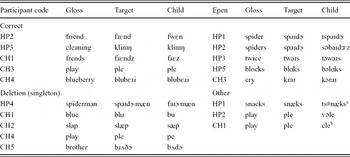
Each token with a target word-initial two-consonant cluster was classified in one of four ways: “correct”, “singleton”, “epenthesis”, or “other”. Examples of each of these classifications are provided in Table 3. Productions of consonant clusters were coded as correct when the child produced two consonants without an epenthetic vowel (whether or not both segments were target-appropriate, e.g., whether /pl/ was produced as [pl] or [pw]). Attempted clusters coded as singletons included both straight deletion of a target segment (regardless of featural substitutions like /p/ → [t]), as well as the few cases where children appeared to produce a singleton from coalescence (e.g., /sw/ → [f]). Productions were coded as epenthesis when both target segments survived and an additional audible vowel was heard adjacent to one of the cluster consonants; spectrograms were consulted to verify all epenthetic vowels.Footnote 5 Finally, productions were coded as “other” when the productions did not fit into any of the other three categories; productions in this final category were infrequent and most often appear to be the result of speech errors.
Sample transcriptions.

a # represents a pause between C1 (ts) and C2 (n).
b Identity of first consonant in this cluster was unclear.
3. Results
We first present results from the two L1 language groups separately, reporting the details of repairs by cluster type (Sections 3.1–3.4 below). We then turn to the broader picture of each group's overall accuracy, given various measures including age, L1 (Section 3.5), L1 vs. L2 exposure and vocabulary (Section 3.6). We conclude with an overall comparison of the two L1 groups, and a summary to fuel our discussion. Throughout the results, we collapse results across each child's spontaneous speech sample and narrative task, since a Wilcoxon non-parametric test revealed no significant differences between the two tasks (W = 35, p = .27).
3.1 Repairs by L1 and cluster type
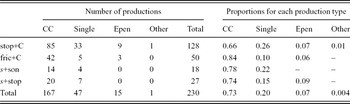
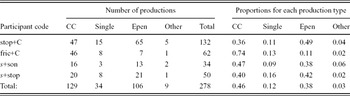
Table 4 provides a summary of the Chinese-speaking children's productions. Responses are tallied for four main cluster types: stop+consonant (stop+C, e.g., [pl]); fricative+consonant (fric+C, e.g., [fl]); s+sonorant (s+son, e.g., [sl], [sn], [sw]); s+stop (e.g., [st]). The effects of cluster type are discussed with reference to each table.Footnote 6
L1 Chinese cluster production by cluster type and production category.

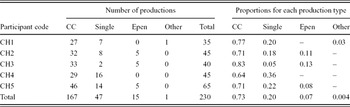
Table 4 shows that the Chinese-speaking children in this sample most frequently retain word-initial consonant clusters, producing a [CC] onset 73% of the time (167/230). However, this accuracy is somewhat dependent on the type of cluster: fricative-initial clusters (not beginning with /s/) were produced with 84% accuracy while stop–initial clusters reached only 66% accuracy. This difference in accuracy is not, however, due to any segmental repair pattern that children used only for fricatives but not stops, as children made an equal number of substitutions in fricative–C clusters (excluding s) compared to all other cluster types (16% and 15%, respectively). Table 4 also reveals that the most likely L1 Chinese error pattern is reduction to a singleton, which in all but four cases appeared as simple deletion of one cluster member. Deletion occurred almost three times as often as epenthesis and was preferred over epenthesis for all cluster types. This preference for deletion holds true at the individual as well as aggregate levels, as can be seen in Table 5, which breaks down the results by individual child.
L1 Chinese consonant cluster production by child.

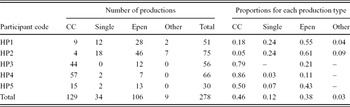
Table 6 reveals that unlike the L1 Chinese children, the Hindi-/Punjabi-speaking children in the study produced onset clusters in less than half of their attempted targets.
L1 South Asian cluster production by cluster type and production category.

Similar to the L1 Chinese group, the South Asian speaking children in this sample are more accurate with fricative-initial clusters (excluding /s/) than they are with other cluster types – in fact, the effect in this language group is considerably amplified, so that fricative-initial clusters are nearly twice as accurate compared to s-initial or stop-initial clusters. For these children, the majority of correct cluster productions (93% overall) included both of the target consonants, but it is noteworthy that 21% of fricative+C clusters contained substitutions (e.g., /fl/ becoming [fw] or [pl]) while only 3% of the other cluster types showed substitutions. Regardless of such featural changes, these L1 South Asian learners prefer to repair onset clusters with epenthesis, which was three times as likely as deletion. Table 7 shows that this preference for epenthesis is consistent across individual children, but also reveals a considerable degree of variability in general accuracy (5%–86% correct).
L1 South Asianconsonant clusters productions by child.

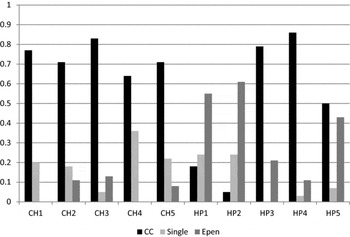
To summarize the results thus far, Figure 1 graphs each child's proportion of cluster accuracy and repairs, organized by L1 – it thus illustrates the combined data from Tables 5 and 7.
Cluster productions by child and L1.

3.2 Location of deletion
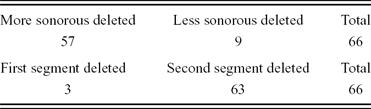
In this sample, 81/508 word-initial consonant clusters were reduced to singletons, 47 by Chinese-speaking children and 34 by Hindi-/Punjabi-speaking children. Of these 81 singleton productions, 15 resulted in a consonant that was not part of the target cluster (e.g., /sp/ → [f]) leaving 66 singletons that appeared to be straight deletions of one underlying CC member. Recall from Section 1.1 that for L1 English learners, the most likely targets for deletion are usually the more sonorous, and usually the second, members of a cluster. As such, Table 8 tallies the total number of deletions, both on the basis of sonority and on position.
Two analyses of /CC/ → [C] deletion location.
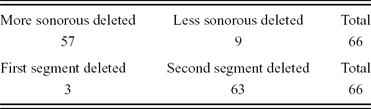
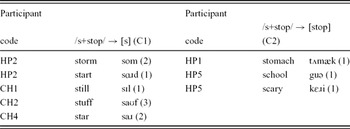
As discussed in the introduction, the majority of English clusters cannot distinguish between these two deletion predictors (because the second segment is also the most sonorous). The only clusters in which the two criteria conflict are s+stop. In our sample only 12 s+stop sequences underwent deletion so it is not possible to draw any firm conclusions about their treatment. From what data there are, presented in Table 9, we note a trend towards positionally-driven deletion rather than purely sonority-driven deletion, with 9/12 s+stop clusters retaining the initial [s] and only 3/12 retaining the less-sonorous stop.
Differences in deletion patterns across s+stop clusters.

The remaining 54 deletions, from clusters other than s+stop, all followed the most common monolingual pattern, meaning that the cluster's second and more sonorous member was deleted.
3.3 Location of epenthesis
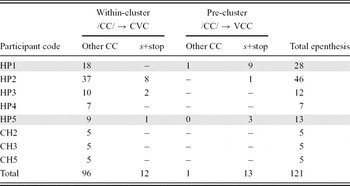
In our sample, 121 of the 508 total attempted clusters included an epenthetic vowel; only 15 of these epentheses were made by L1 Chinese-speaking children. (Impressionistically, these vowels were transcribed most often as either [ə] and [ʌ] or a higher lax vowel like [ɪ] or [ɨ]. We have not undertaken a thorough phonetic analysis of epenthetic vowel qualities and their predictability in this paper for reasons of space.)
In the vast majority of cases (108/121), the epenthetic vowel appeared between the two consonants (e.g., play /ple/ → [pɪle]), and Table 10 shows that, for six of the eight children who epenthesized, this was the only pattern observed. The remaining two children (HP1 and HP5) produced epenthetic vowels both within and before clusters: s+stop clusters received word-initial epenthesis before the cluster (11/12 tokens) whereas other clusters were repaired within the cluster (27/28 tokens):
Location of epenthesis into clusters. (This table only includes children who produced at least one epenthesis repair.) The highlighted rows represent children whose vowel placement seems to depend on the target cluster.

3.4 The special status of s+stop clusters across repairs
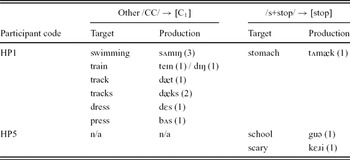
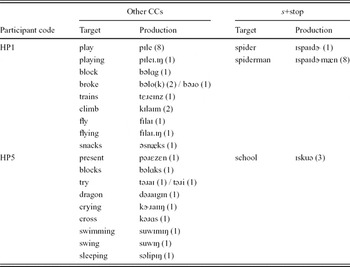
As corollary to the previous section, the distinction between s+stop and other clusters which appeared to influence HP1's and HP5's epenthesis in Table 10 also appears in their deletion patterns. In the tokens where HP1 and HP5 repaired an s+stop cluster with deletion, they deleted the /s/ and maintained the stop. This result is opposite to the pattern observed for the other eight children in this sample, as was seen in Table 9. Tables 11 and 12 allow the explicit comparison of s+stop vs. other clusters, and their differential treatment across both repair types:
Cluster type effects in HP1's and HP5's deletion.

Cluster type effects in HP1's and HP5's epenthesis.

3.5 Accuracy: Age and L1 effects
Totalling across all 10 children's responses, 58% (296/508) of the target word-initial consonant clusters were produced as clusters. Of the remaining consonant clusters, 16% were reduced to a singleton, 24% included an epenthetic vowel, and 2% were produced with some other error.
Before examining overall accuracy in more detail, we note that chronological age was not the major criterion determining accuracy in our sample. Table 13 provides a summary of the proportion of consonant clusters produced correctly by each child, ordered from left to right by age of participant.
Children's accuracy, ordered by age.

For example, HP4 is the second youngest child yet he produces the highest proportion of word-initial consonant clusters. HP5 is the second oldest child but produced less than half of the word-initial clusters, with the third lowest accuracy score of the children in this sample. Our conclusion that accuracy is not related to age in our study is supported by a Spearman's Correlation which shows no significant relationship between the two variables (r = .27, p = .43) – though the narrow age range and small sample make this result unsurprising.
Table 14 provides the same data, but this time grouped first by L1 and then by age. These results show a distinct L1 effect: the average accuracy for the five Chinese-speaking children was 73%, compared to 48% across the five Hindi-/Punjabi-speaking children. While there is great variation among the latter group, it is important to note that the lowest accuracy rate among the Chinese-speaking children was 64% – a score which three out of the five South Asian children fell well below.
Children's accuracy, grouped by L1 and age.

3.6 Accuracy: Language exposure and vocabulary effects
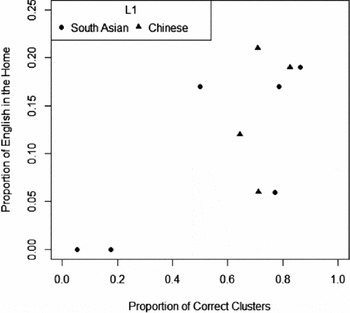
While all 10 children had comparable months of English exposure (between four and eight months), the quality and nature of this L2 English input might have significant influences on our results – for example, differences in their English cluster production might in fact reflect different degrees of English exposure at home and elsewhere. To search for such influences in our data, we chose to look for correlations between children's overall cluster accuracy and each of the three ALEQ measures reported in Table 1 above. Kendall's Tau tests for rank correlation revealed no connection between cluster accuracy and L1 input richness or English input richness (L1: τ(18) = –0.22204, p = .437; English: τ(18) = 0.267333, p = .338). A marginal correlation was found between cluster accuracy and proportion of English spoken at home (τ(18) = 0.510311, p = .0512) – but as Figure 2 reveals, this trend is only the result of two particular children (HP1 and HP2), who both received zero English input at home and produced very few CC onset clusters, and we see no trace of a positive slope through the other eight data points.
Overall cluster accuracy × proportion English spoken at home.

With respect to children's L2 English vocabulary, as mentioned in Section 2.1 above, we assessed receptive English vocabulary with the PPVT–IIIR (Dunn & Dunn, Reference Dunn and Dunn1997), and to attempt an assessment of productive vocabulary, we computed the total numbers of types and tokens produced by each child within their 15-minute spontaneous speech sample. Table 15 reports PPVT scores and productive vocabulary measures; Kendall Tau's rank correlation tests found no clear correlations between cluster accuracy and either receptive or productive vocabulary scores (all p values > .1).
Vocabulary measures.

3.7 Summary of results
Summary of cluster repairs
• When they made an error producing an English cluster, L1 Chinese children were three times as likely to repair via deletion rather than epenthesis, while L1 Hindi/Punjabi children were three times as likely to repair via epenthesis compared to deletion.
• When repairing obstruent+sonorant clusters, deletion always targeted the second member of the onset, and epenthesis always applied within the cluster.
• When repairing s+stop clusters, eight out of 10 children maintained their repair patterns mentioned in the preceding bullet point. Two South Asian speaking children, however, showed a different pattern: in s+stop clusters, deletion targeted the first onset member, and epenthesis applied before the cluster.
Summary of cluster accuracy
• L1 Chinese children produced more accurate onset clusters than L1 South Asian children.
• For L1 South Asian children, those clusters that survived were most often those beginning with some fricative other than [s] – mostly /fr/ and /fl/.
• Overall, cluster accuracy was not predictable by language background measures, or by receptive or productive English vocabulary.
4. Discussion
This section details the implications of the results summarized in Section 3.6, considering whether each one shows the influence of L1 or of developmental trends. We will refer to evidence of the former as an “L1 effect” rather than “L1 transfer”, since as we will see some of the L1 influences are perhaps more indirect than the term “transfer” implies. After considering each result in this light, we summarize our findings as to the complex nature of L1 influence on child L2 cluster production.
4.1 Choice of repair
Children's choice of repair offers evidence of both an L1 effect and also a common developmental trend. On one hand, the preference for epenthesis by Hindi/Punjabi L1 children is a clear candidate for an L1 effect, given that epenthesis in consonant clusters is a phonological process in both Hindi and Punjabi. On the other hand, the lack of onset clusters in Mandarin and Cantonese means that these children's L1 grammar does not provide an onset cluster repair. As a result, the Chinese-speaking children's preference for deletion appears to be evidence of a developmental trend common to all child learners (see Section 1.1).Footnote 7
4.2 Consistent location of repairs for obstruent+sonorant clusters
Excluding the s+stop clusters, the preferences for deleting the second member of a cluster and for epenthesizing within the cluster hold for all 10 children in our sample. Since this pattern holds regardless of L1, including all five children with no previous cluster experience, it would appear that these location trends are developmental in nature. With respect to deletion, this claim is verified by comparison with L1 learners, who overwhelmingly delete the second, more sonorous member of these onset clusters. With respect to epenthesis, this pattern is in line with adult L2 results and possibly also with monolingual children, although the L1 epenthesis evidence is rather scarce. There are nevertheless anecdotal L1 examples of cluster-medial epenthesis for obstruent+sonorant clusters. For example, Trevor (Compton & Streeter, Reference Compton and Streeter1977; Pater, Reference Pater1996) produced medial epenthesis into /br/ and /bl/ clusters e.g., [bəˈɹok] for broke, noted in Tessier (Reference Tessier2007). Thus, as predicted, the location of repairs in these clusters mimics patterns observed in other learner populations.
4.3 Variation in repair locations for s+stop clusters
In contrast to obstruent+sonorant clusters, our sample revealed inter-learner variation: eight children treated all clusters as above, but two of the Hindi/Punjabi children deleted and epenthesized differently within s+stop onsets. Since this variation is confined to the Hindi/Punjabi speakers, it might look like an L1 effect; this would mean that a child's experience of L1 Hindi and Punjabi could prime them in an unspecified way to treat s+stop clusters differently. However, Section 1.1 above already discussed L1 English studies in which monolingual learners treated s+stop clusters as special. For example, Trevor sometimes epenthesized within clusters (e.g., [bəɹok] for broke) but also epenthesized before some /s+stop/ clusters, e.g., [əsnaek] for snack (Becker & Tessier, Reference Becker and Tessier2011; Tessier, Reference Tessier2007). Thus, this variability may be possible for any child learner of English, but our sample size may not allow us to observe this special treatment of s+stop clusters by L1 Chinese learners.
More broadly, these results accord with the claim that English s+stop clusters are special, in that they are the only onsets in which a more sonorous segment precedes a less sonorous one – and as predicted, the grammars of some early L2 learners also treat these clusters specially.
4.4 Overall cluster accuracy
Unlike the children in Anderson (Reference Anderson2004) and Gilhool et al. (Reference Gilhool, Burrows, Goldstein and Paradis2009), the early L2 learners in this study did not produce English onset clusters with a high degree of accuracy. The L1 Chinese-speaking children in our sample preserved 72% of their onset clusters, whereas the L1 Hindi-/Punjabi-speaking children only produced 46% of word-initial clusters as such. This difference in accuracy between the two groups suggests an L1 effect (i.e., that it is not simply due to random variation within the sample) and we wish to defend this view here. However, it may not be immediately clear how this difference can be L1 influenced, given that in Section 1.5 above, we hypothesized the reverse trend because Hindi-/Punjabi-speaking children have some experience with consonant clusters and Chinese-speaking children do not. This result is also somewhat surprising given that the accuracy rates for adult L2 acquisition of onset clusters. For example, Broselow and Finer (Reference Broselow and Finer1991) found that the majority of Hindi-speaking adults do not make errors when producing English onset clusters; Chan (Reference Chan2010), on the other hand, reported that L1 speakers of Cantonese on average produced only 79% of English clusters correctly.Footnote 8 It is worth noting, however, that in those studies, the adults had considerably more exposure to English than our study's children. As such, comparisons between these more advanced adult learners and the early L2 learners in our study need to be interpreted cautiously – but it remains the case that adult Hindi and Punjabi speakers are reported as more accurate with L2 English clusters than adult Cantonese speakers, in contrast to the trends in our child data. Thus if accuracy rate is indeed an L1 effect, it must be that L2 children in the early stages of acquisition are not influenced by the existence or absence of onset clusters in their L1 in the same manner as adults.
To understand this difference in accuracy, we begin by equating higher accuracy with a faster rate of acquisition – since the two groups have comparable months of English exposure (four–eight months), it appears that the L1 Chinese speakers have progressed further towards the goal of onset cluster mastery than the L1 Hindi/Punjabi speakers in the same amount of time. We therefore suggest that L1 Hindi/Punjabi speakers have moved more slowly because their L1 phonologies do not automatically treat an L1-like production of English clusters as an error. In their first language, /#CC/ → [#CVC] is a possible grammatical mapping; to learn the correct English mapping /#CC/ → [#CC], they must first recognize that their epenthetic L1 approach is an L2 error. For the L1 Chinese speakers, on the other hand, their L1 grammar has no established method for mapping /#CC/ inputs of any sort, so any possible mapping they adopt for an L2 word-initial cluster is clearly an “error” from their initial L1 grammar's perspective. In this way, an L1 Chinese grammar flags every production of onset clusters as a novel phonological experience in a way that an L1 Hindi/Punjabi grammar does not – and so from the same amount of L2 English exposure, L1 Chinese speakers get more evidence that pushes them towards acquiring English onset clusters.Footnote 9
This explanation may connect the rate of acquisition in early L2 phonology with a finding in the clinical treatment of L1 phonological delays, namely, that children show faster improvement in production accuracy when trained on more complex or marked structures rather than simpler ones (see summary in Gierut, Reference Gierut2007, and especially Gierut, Reference Gierut2001, on the rate of word-initial cluster acquisition depending on the sonority profile of the treatment cluster).Footnote 10 The hypothesized explanation for this effect is that targeting a complex structure not only teaches the learner that structure, and also implies the existence of simpler structures. The related hypothesis in the present study would be that L2 “complexity” is a function of its degree of additional markedness compared to the learners’ L1. Exposure to English onset clusters would thus provide L1 Chinese learners with evidence of a completely novel marked structure, facilitating broad generalization of the new target structure #CC, whereas the same L2 English input would provide less novelty and evidence for learning to the L1 South Asian learners. This hypothesis might be used to predict many aspects of early L2 learning, depending on a child's L1 phonology and a theory of typological universals; we leave this question open for much potential future work.Footnote 11
Turning to a different domain, the explanation presented in this section for children's L2 production is also analogous to one given for some adult L2 perception – for example, the analysis in Escudero and Boersma (Reference Escudero and Boersma2004) of L1 Spanish-speaking adults’ identification of a non-native vowel contrast, after L2 acquisition with two different English dialects. Broadly speaking, that study's explanation of between-group L2 differences is that when an L2 dialect contains vowel categories that map easily onto native ones, L2 listeners tend to rely on their familiar L1 cues to identify L2 tokens, whereas when listening to an L2 with a clearly novel category, listeners can more readily rely on a non-native cue as well. In this way, learners can in fact become better perceivers of L2 vowels which are in some sense more dissimilar to their L1 vowels, compared to listeners acquiring more similar L2 vowels. Similar predictions are also possible within the L2 perception models of Best (Reference Best1995) and Flege (Reference Flege1995); see these original studies for detailed differences and implications. The analogous result in our study is that L1 Chinese-speaking children were more accurate in acquiring a completely novel phonological structure than the L1 Hindi/Punjabi speakers, who had at least some previous experience with that structure. Given the large differences between vowel identification and cluster production, we leave open any unified explanation of these analogous findings, but see Escudero and Boersma (Reference Escudero and Boersma2004) for a formal grammatical account of L2 category learning that derives such perception asymmetries.
One final possibility is that some inter-L1 differences in “cluster” accuracy might correlate simply with general segmental accuracy independent of these clusters, but we wish to suggest this unlikely. Because we coded any [CC] production as “faithful” regardless of its featural content, the only singleton-type repair that could skew our results is deletion, for example, if /st/ was reduced to [t] not because of the /st/ cluster but because /s/ was independently subject to deletion. However, Sorenson Duncan (Reference Sorenson Duncan2010) found that early L2 learners in an overlapping sample were very unlikely to delete singleton onsets (3.7% of singleton onsets undergoing deletion, on average across the eight children in her study).
This section provides, we think, the best evidence in our study that early L2 learners’ phonologies are influenced by their L1 in a unique way. Unlike the familiar adult L2 production pattern where L1 experience is usually a predictor of better L2 performance, children whose L1 offers no experience with onset cluster production were more accurate than children whose L1s include both some onset clusters and also a cluster repair strategy.
4.5 Segmental properties of the most accurate clusters
The special accuracy of clusters beginning with fricatives other than /s/, usually meaning /f/, provides further evidence of the type of L1 effects discussed in the previous section. The Chinese-speaking children in this sample produced these fricative-initial clusters with marginally greater accuracy than others (between 5%–18% better than the three other cluster types, see Table 4 above). For South Asian speaking children this effect was amplified, with /f/-initial clusters being 28%–38% more accurate (see Table 6 above). This marked difference between /f/-initial clusters and other cluster types for the South Asian speaking children can also be seen in their choice of repair: Table 6 shows both that there was very little epenthesis observed into these /f/- and /θ/-initial clusters (only 8/62 relevant tokens) and that in fact deletion was just as likely (7/62 tokens). Interestingly, Hindi and Punjabi do not contain clusters that begin with [f]. As such, it seems for these fricative clusters that the L1 Hindi and Punjabi pattern is more comparable with the L1 Mandarin and Cantonese children (including in the percentage of substitutions in correct productions), preferring deletion to epenthesis and again faster acquisition of English clusters that do not exist in their L1.
4.6 Connecting language environment, vocabulary and cluster production
The notion that phonological knowledge emerges from the generalizations made across the lexicon is well-supported by studies of both adult and child native speakers (e.g., Edwards, Beckman & Munson, Reference Edwards, Beckman and Munson2004; Frisch, Large & Pisoni, Reference Frisch, Large and Pisoni2000 Munson, Reference Munson2001; Pierrehumbert, Reference Pierrehumbert2006). In this paper we have explored the extent to which such links to the lexicon could be found post-hoc in our data, by comparing children's vocabulary scores, the quality of their L1 and L2 input, and the amount of English spoken at home, and we found no such strong correlations. However, given that our sample showed fairly comparable (and low) levels of English use at home and that the children formed a relatively homogenous group in terms of age and exposure, we leave open the possibility that children with more varied English exposure might show more of these influences on their L2 phonological development.
5. Conclusions
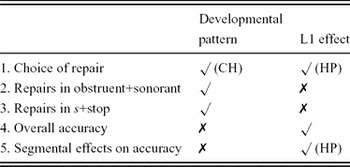
The roles for developmental and L1 effects argued above are summarized in Table 16.
Summary of developmental vs. L1 effects in early L2 onset clusters.

To pull together the strands of the above discussion, it seems necessary to propose that early L2 learning is a combination of monolingual and adult L2 learning. Our largest finding is that child L2 learners, like adult L2 learners, are indeed affected by their L1 while still also following attested developmental trends. Our account of these facts is that early L2 grammars are transferred though incomplete L1 grammars, in which the children's still-developing phonologies are now treating L2 data and repairing them accordingly. In our study, developmental patterns include the preference for deletion among L1 Chinese speakers and the loci of deletion and epenthesis sites, as well as a sensitivity to the special status of s+stop clusters. The evidence of L1 effects comes from the preference for epenthesis among L1 Hindi/Punjabi speakers, and the speed with which overall cluster accuracy is achieved.
From the preceding paragraph, it may seem as though our early L2 learners acquire phonology just like their adult L2 counterparts, but we wish to conclude by emphasizing two important differences. First are their prospects for ultimate attainment: while many adult L2 speakers never acquire a native-like phonology, we expect that all the children in this study probably will (or rather will have already done so by the time of writing.). This clearly suggests that while early L2 phonology may be filtered similarly to adult L2 phonology, the process by which those filters are overcome by the child is crucially much more successful than that of their parents. It remains to be discovered, of course, exactly what that child-specific learning process is like, and to what extent it is different from children's L1 learning process.
Second, we also note that our accuracy results suggest a way in which children may differ from adults in their L1 phonological transfer. Like adults, children appear to adopt L1 repair strategies for marked structures when they are available – but unlike adults, children may in fact be more accurate with novel structures not found in their L1, at least after several months of exposure. This finding matches some of the works cited in Section 1.1 above regarding L1 Japanese and Korean adult vs. child learners with less than a year of L2 English (Aoyama et al., Reference Aoyama, Guion, Flege, Yamada and Akahane-Yamada2008; Baker et al., Reference Baker, Trofimovich, Flege, Mack and Halter2008; Oh et al., Reference Oh, Guion-Anderson, Aoyama, Flege, Akahane-Yamada and Yamada2011). It also may relate to the incomplete nature of a child's L1 phonology at the onset of L2 English. If a child has not finished learning their L1 phonology, their cognitive learning mechanisms are still in the active process of organizing grammatical constructs (whether writing rules, setting parameters, ranking constraints, establishing statistical relationships, or otherwise encoding phonological knowledge). Thus, the early L2 learner may be in a qualitatively better position than an adult to treat L2 input as evidence to drive grammatical learning, speeding up their acquisition. Overall, we stress that child L2 learners represent a unique learner population, in a position intermediate between young monolingual and adult L2 groups, and that further study of their hybrid phonological development may shed new light on the spectrums and limitations of early language learning.