1. INTRODUCTION
This article discusses clefts introduced by il y a, a type of sentence that is typically used in spoken French (Klein, Reference Klein, Krifka and Musan2012):
-
(1) Y'a le téléphone qui sonne! (Lambrecht, Reference Lambrecht, Haiman and Thompson1988: 137)
-
~ ‘Le téléphone sonne!’
In line with seminal work by Jespersen (Reference Jespersen1927) and Lambrecht (Reference Lambrecht1994), clefts can be defined as sentences of the form [marker – X – pseudo-relative pronoun – embedded sentence], which express a simple predication by a binary (cleft) syntax.Footnote 1 The embedded sentence does not restrict the reference of the constituent X, as a restrictive relative clause does. Formally, il y a-clefts consist of il y a (with the personal pronoun il often omitted in spoken French)Footnote 2 followed by a nominal group – the clefted constituent –, and a sequence that resembles a relative clause – the pseudo-relative clause. This pseudo-relative clause looks like a relative clause, but is not one: unlike restrictive relative clauses (Riegel et al., Reference Riegel, Pellat and Rioul2009: 804–805), the pseudo-relative clause is not indispensable for the complete identification of the antecedent (le téléphone still refers to the same telephone, with or without the extra information that it is ringing (qui sonne)). The pseudo-relative clause in a cleft construction is also not a descriptive relative clause (Riegel et al., Reference Riegel, Pellat and Rioul2009: 804–805), which can always be omitted without altering the meaning of the sentence: leaving out qui sonne in (1) would change the interpretation of the sentence completely.
In contrast with c'est-clefts, il y a-clefts have not been described extensively. There is, however, agreement to some extent in that they prototypically present a new entity and/or a new event in the discourse (Lambrecht, Reference Lambrecht, Haiman and Thompson1988: 135–136; Ashby, Reference Ashby, Amastae, Goodall, Montalbetti and Phinney1995: 92; Choi-Jonin and Lagae, Reference Choi-Jonin, Lagae and Murguía2005: 12; Secova, Reference Secova2010: 247)Footnote 3 rather than specify a value for a variable, as c'est-clefts do; that is why il y a-clefts are often called presentational. The presentational value of il y a in the cleft structure is contrasted with its existential (2) or localising (3) meaning when it introduces a nominal phrase with a modifying relative clause (Giry-Schneider, Reference Giry-Schneider1988: 88; Choi-Jonin and Lagae, Reference Choi-Jonin, Lagae and Murguía2005: 4; Willems and Meulleman, Reference Secova2010: 4).
-
(2) Existential il y a
-
Il y a (des/beaucoup de/plusieurs) conducteurs qui sont potentiellement dangereux. (Anscombre, 1996: 95; cited by Choi-Jonin and Lagae, Reference Choi-Jonin, Lagae and Murguía2005: 4)
-
(3) Localising il y a
-
Sur l'autre trottoir, il y a quelques hommes qui sont gros. (Choi-Jonin and Lagae, Reference Choi-Jonin, Lagae and Murguía2005: 5)
Existential il y a (2) can be paraphrased as il existe/on trouve and localising il y a (3) as il se trouve/on aperçoit. A similar reformulation is much less straightforward for presentational il y a (1).
Another property often cited, is the possibility of transforming the il y a-cleft into a sentence with canonical (SVO or SV) word order (e.g. le téléphone sonne in (1)) (Léard, Reference Léard1986; Lambrecht, Reference Lambrecht, Haiman and Thompson1988: 137; Ashby, Reference Ashby, Amastae, Goodall, Montalbetti and Phinney1995; Secova, Reference Secova2010: 235), which shows that the cleft, via a biclausal syntax, in fact expresses a monoclausal proposition.
The examples of il y a-clefts that are provided in existing linguistic literature are often simple and prototypical and are not always presented with a large context:Footnote 4
-
(4) Il y a un chien qui arrive. (Léard, Reference Léard1986: 94)
-
(5) Y'a Jean qu'a téléphoné. (Lambrecht, Reference Lambrecht, Haiman and Thompson1988: 136)
-
(6) Il y a mes parents qui arrivent demain. (Secova, Reference Secova2010: 240)
In these examples, the clefted element is a proper name or a common name preceded by a determiner, and the predicate of the pseudo-relative clause only consists of an intransitive verb (arrive, a téléphoné, arrivent) and possibly an adverb, such as demain in (6). These clefts are said to present new events in the discourse context. Since the main explanations for the use of clefts all seem to suggest that they are discourse-functional variants for sentences with canonical word order (Léard, Reference Léard1986; Lambrecht, Reference Lambrecht, Haiman and Thompson1988: 137; Ashby, Reference Ashby, Amastae, Goodall, Montalbetti and Phinney1995; Secova, Reference Secova2010: 235), it is striking that the context of such clefts has not (explicitly) been taken into account. If the main motivation for the use of a cleft structure should be sought in the context (intra- and/or extra-textual), why then is this context not provided?
As far as we know, there is only one study, Secova (Reference Secova2010), that investigates il y a-clefts in a corpus of spoken French.Footnote 5 However, her corpus is rather small: it consists of about 11 hours of recorded speech.Footnote 6 She found 62 il y a-clefts in her corpus. In this article, we will present an analysis of the distribution and function of il y a-clefts in spoken French, on the basis of a corpus analysis. We will focus only on the clefts with definite clefted constituents (proper nouns and common nouns with possessive and demonstrative determiners are included). In this way, we exclude all occurrences where il y a has an existential interpretation (see (2)), which is incompatible with the cleft structure.Footnote 7 According to Choi-Jonin and Lagae (Reference Choi-Jonin, Lagae and Murguía2005: 4–5), il y a with an existential interpretation can only introduce indefinite nominal groups and always introduces an NP modified by a relative clause. Thus, by limiting ourselves to definite il y a-clefts, we narrow down the number of possible interpretations of il y a in the occurrences we are considering from three (presentational, localising, existential) to two (only presentational and localising). Moreover, definite NPs are particularly interesting because, in contrast with (non-generic) indefinite NPs, they can refer to referents which have been mentioned before in the discourse context and which, hence, could not be introduced again by a presentational construction. The restriction to only a subtype of all il y a-clefts also allows us to verify, for each single occurrence, if the tests provided in the linguistic literature apply to it.
This article has three main goals: (i) we will demonstrate that the tests and properties of il y a-clefts mentioned in the linguistic literature cannot always be straightforwardly applied to corpus examples; (ii) we will show that this can be explained by the fact that il y a-clefts in French do not only serve to present a new event in the discourse context, but also a new entity and, similarly to what happens in English, can also be used to enumerate entities of a class that is evoked in the co(n)text. We will thus show that the properties ascribed to il y a-clefts in the linguistic literature do not capture every possible function of definite il y a-clefts and propose a new typology of functions instead. Finally (iii), we will provide proof that these ‘new’ functions, which have not earlier been analysed on the basis of corpus research in spoken French, are no marginal or rare phenomena, but are well represented in our corpus.
In what follows, we will first provide some methodological information (section 2). Then, inspired by Lambrecht (Reference Lambrecht, Haiman and Thompson1988), we will show that a distinction should be made between different presentational uses of il y a-clefts (section 3). After that, we will demonstrate that some of the examples we found in our corpus of il y a-clefts have a specificational interpretation (section 4) and that there are also quite some examples which are not easy to classify (section 5).
2. METHODOLOGY
Our analysis is based on a corpus of spoken French: Discours sur la ville: Corpus de Français Parlé Parisien des années 2000 (CFPP2000) (http://cfpp2000.univ-paris3.fr/Corpus.html), a corpus of interviews with people living in Paris about life in Paris, recorded in 2005 and 2006 with firewire Tascam H2P2 (Branca-Rosoff et al., Reference Branca-Rosoff, Fleury, Lefeuvre and Pires2012: 3–6). The interviews are anonymised with Audicity (the names mentioned in the corpus are pseudonyms) and transcribed with the aid of Transcriber. The website provides the audio files (WAVE or MP3), the transcription files in the format of Transcriber or in HTML, and the alignments of the audio files with the transcriptions. This corpus was chosen because it provides an easy means to investigate spoken conversational French in Paris and because it is freely accessible on-line. The corpus contains 549 589 words recorded during 2334 minutes or 38,9 hours. Examples followed by DV are extracted from the corpus Discours sur la ville. The term after DV refers to the subcorpus, e.g. 11ième julie refers to the part recorded in the 11th district of Paris, more specifically julie_teixeira_f_18_katia_teixeira_f_15_11e ; the term after the location indication (11ième ) is always the first part of the description referring to the persons (julie)).
In this corpus, we retrieved all occurrences of il y a or y a and manually selected those sentences that were either clear examples of cleft sentences or sentences for which the classification is not clear (see section 5). A total of 794 examples were collected. Sentences like (7) were not retrieved since they are clear examples of nominal groups (ceux) modified by a restrictive relative clause: the relative clause qui font des brillantes études is necessary to determine the identity of the referent of ceux (the group of people who study extremely well):
-
(7) Il y a introducing a nominal group modified by a relative clause
-
et alors même question pour le lieu populaire + les enfants d'concierge(s) y a deux sortes y a ceux qui font des brillantes études et qui + n'sont plus du tout enfin bon (mm) X quittent leur milieu social et puis y a ceux qui restent dans leur milieu social est-ce que vous avez gardé des amis +Footnote 8 euh qui ont des
-
(DV: 5ième)
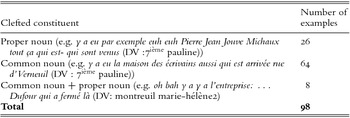
In this article, we only discuss a subset of this corpus of il y a-clefts, containing (il) y a + definite noun phrase (including NPs with a possessive or demonstrative determiner and proper nouns) + pseudo-relative clause. This subcorpus contains 98 examples (see Table 1).
Types of clefted constituents in our subcorpus. Common nouns can have a definite, possessive or demonstrative determiner.

3. PRESENTATIONAL IL Y A-CLEFTS
3.1 Background
According to the linguistic literature, il y a-clefts – as opposed to il y a introducing an NP modified by a relative clause – in French have the following properties:
-
(i) In the given context, the pseudo-relative clause cannot be omitted (Choi-Jonin and Lagae, Reference Choi-Jonin, Lagae and Murguía2005: 6).
-
e.g. Il y a le téléphone qui sonne. (Choi-Jonin and Lagae, Reference Choi-Jonin, Lagae and Murguía2005: 4)
-
? Il y a le téléphone.
-
(ii) In the given context, the corresponding SV(O) sentence can be used without a change of interpretationFootnote 9 (Giry-Schneider, Reference Giry-Schneider1988: 91; Lambrecht, Reference Lambrecht, Haiman and Thompson1988: 137;Footnote 10 Ashby, Reference Ashby, Amastae, Goodall, Montalbetti and Phinney1995: 91–93; Secova, Reference Secova2010: 249–250).
-
e.g. Monsieur le Président, il y a la Suisse qui a envahi notre pays. (Histoires drôles, 45; cited by Choi-Jonin and Lagae, Reference Choi-Jonin, Lagae and Murguía2005: 14)
-
Monsieur le Président, la Suisse a envahi notre pays.
-
(iii) In the given context, existential (il existe, on trouve) and localising (il se trouve, on aperçoit) paraphrases of il y a are not possible (Giry-Schneider, Reference Giry-Schneider1988: 88; Choi-Jonin and Lagae, Reference Choi-Jonin, Lagae and Murguía2005: 4; Willems and Meulleman, Reference Secova2010: 4).
-
e.g. Il y a le téléphone qui sonne. (Choi-Jonin and Lagae, Reference Choi-Jonin, Lagae and Murguía2005: 4)
-
*il existe/*on trouve/*il se trouve/? on aperçoit le téléphone qui sonne.
-
(iv) The cleft expresses an event; can serve as an answer to all-focus questions such as What's happening? and What happened? (Giry-Schneider, Reference Giry-Schneider1988: 91; Lambrecht, Reference Lambrecht, Haiman and Thompson1988: 138; Choi-Jonin and Lagae, Reference Choi-Jonin, Lagae and Murguía2005: 4; Willems and Meulleman, Reference Secova2010: 4), which means that the pseudo-relative clause has a specifying predicate (Kleiber, Reference Kleiber1981) – the verb expresses an event and the proposition is situated in space and time (Choi-Jonin and Lagae, Reference Choi-Jonin, Lagae and Murguía2005: 4–5).
-
e.g. Qu'est qui se passe? Il y a des conducteurs de taxi qui font grève. (Anscombre, 1996: 96)
The last property implies that il y a-clefts always introduce events, as has been argued by Giry-Schneider (Reference Giry-Schneider1988: 91), Choi-Jonin and Lagae (Reference Choi-Jonin, Lagae and Murguía2005: 4); Willems and Meulleman (Reference Secova2010: 4). As far as we know, only Lambrecht (Reference Lambrecht, Haiman and Thompson1988: 138) mentions the existence of entity-presenting il y a-cleftsFootnote 11 in addition to event-reporting il y a-clefts, although he does not provide tests or properties to distinguish between the two readings.
-
(8) Entity-presenting il y a-cleft
-
Y'a Jean qu'a téléphoné. (Lambrecht, Reference Lambrecht, Haiman and Thompson1988: 136)
In this type of sentence, the clefted constituent itself (Jean) is the most important piece of information in the sentence, whereas in event-presenting il y a-clefts it is the combination of the clefted constituent with the pseudo-relative clause that forms the most important part of the sentence (e.g. the combination of le téléphone and sonner in (1)).
In this section, we will first present examples from our subcorpus that are prototypical presentational il y a-clefts in the sense that they correspond to the description of il y a-clefts in the linguistic literature, i.e. the properties (i) to (iv) mentioned above (section 3.2). Then we will discuss the second type of presentational il y a-clefts, the one presenting a new entity rather than a new event into discourse (section 3.3).
3.2 Event-presenting il y a-clefts
Out of the 98 sentences in our subcorpus, only 16 satisfy the properties (i) to (iv) described above, which immediately casts doubt on the usefulness of these criteria.
-
(9) Event-presenting il y a-cleft
-
- A: + oui + + j' l'ai croisé plusieurs fois dans la rue par la suite + euh + + il est devenu directeur de maternelle Footnote 12 + parce que il en a eu marre de pas + de pas avoir les moyens euh j' repense toujours à papa qui a aussi qui s'est occupé d'un collège où et bon quand il était plus jeune mais il a il trouvait quand même qu'à la fin il avait plus les moyens de faire c' qu'il voulait par exemple y a eu un truc (qui a dit, XXX) dans cette école "c'est dégoûtant qu'il fasse CM1 CM2 parce qu'y a qu'une année sur deux qui peut profiter d' lui + + donc il a eu l'droit de faire plus qu'une classe mais lui il aimait s'investir assez avec des enfants pour pouvoir avoir
-
- B: suivre et
-
- A: le temps d' les connaître le temps de tu vois
-
- B: d'accord
-
- A: voilà ou il a plus eu l' droit de ne plus suivre le programme + comme il le faisait avant + + euh des choses comme ça donc il a il a voilà + et là ben parfait il peut enfin se faire le truc euh y a son fils qui m'a invitée comme amie donc + je lui parle pas il me parle pas je pense que il on s' connaît de nom d' famille mais + au fond d' moi je sais que le jour où j' veux euh le retrouver je peux + +
-
(DV: 11ième blanche)
-
If we apply the four properties mentioned in the previous section to the example (9), it is clear that this example fits in the description provided by the linguistic literature and is not an instance of il y a introducing a NP containing a relative clause:
-
(10) Application of the criteria to (9)
-
(i) # il peut enfin se faire le truc euh y a son fils donc je lui parle pas
-
(ii) il peut enfin se faire le truc euh son fils m'a invitée comme amie donc je lui parle pas
-
(iii) *il existe/*on trouve/*il se trouve/*on aperçoit son fils qui m'a invitée comme amie
-
(iv)
-
- Q: Qu'est-qui se passe/s'est passé?
-
- A: Y a son fils qui m'a invitée comme amie
-
-
The sentence denotes an event as (10iv) shows and il y a cannot be interpreted as existential or localising (10iii). If the pseudo-relative clause is left out (10i), the meaning of the original sentence gets lost, which is shown by the fact that, in this case, lui in the next sentence refers to le fils, whereas it originally refers to the man who is the subject of the conversation (the directeur de maternelle). The il y a-cleft can also be ‘de-clefted’ in the same context (10ii).
A second example of a prototypical event-presenting il y a-cleft (11) contains two successive pseudo-relative clauses: qu'est passé qui nous a demandé de remonter.
-
(11) Event-presenting il y a-cleft
-
- A: y a personne qui vous déloge
-
- B: après y a la police Footnote 13
-
- A: de là ?
-
- B: si
-
- A: si si
-
- B: y a la police qu'est Footnote 14 passée qui nous a demandé de remonter + donc on a remonté + après on a été se poser ben chez Oscar le café à un euro vingt
-
(DV: 11ième julie)
-
As the test in (12ii) shows, this example can be interpreted in different ways: as a juxtaposition (first paraphrase in (12ii)) or as a subordination, in which case either the first (second paraphrase in (12ii)) or the second (third paraphrase in (12ii)) part is a restrictive relative clause rather than a pseudo-relative clause. All properties of il y a-clefts are present: the pseudo-relative clauses cannot be omitted (12i); the SV(O) paraphrase is possible in the given context (12ii); the existential and localising paraphrases of il y a are not acceptable (12iii) and this cleft denoting two events can provide the answer to a question like Qu'est-ce qui s'est passé? (12iv).
-
(12) Application of the criteria to (11)
-
(i) # y a la police donc on a remonté
-
(ii) La police est passée, la police/elle nous a demandé de remonter donc on a remonté
-
La police qui est passée nous a demandé de remonter donc on a remonté
-
La police est passée qui nous a demandé de remonter donc on a remonté
-
(iii) *Il se trouve/? on aperçoit/*il existe/*on trouve la police qu'est passée qui nous a demandé de remonter
-
(iv)
-
- Q: Qu'est-qui s'est passé?
-
- A: Y a la police qu'est passée qui nous a demandé de remonter
-
-
3.3 Entity-presenting il y a-clefts
In our subcorpus, 14 examples can be classified as il y a-clefts presenting an entity into discourse, rather than an event:
-
(13) Entity-presenting il y a-cleft
-
- A : les filles vont changer d'école elles vont aller dans l'centre de Suresnes justement Footnote 15
-
- B : ah + elles vont aller dans le centre de Sur-
-
- A : de Suresnes d'accord
-
- B : voilà + voilà et donc X t'es contente de cette école ?
-
- A : je sais pas (rire)
-
- B : tu sais pas (rire)
-
- A : c'est très bien (non, donc) heureusement on y est allé euh y avait les autres enfants qui vont être avec elles et donc qui étaient d'l'école maternelle du coin bon euh c'était un peu métissé mais apparemment ils avaient l'air de + d'enfants à peu près bien équilibrés bien sages etcetera
-
(DV: suresnes)
-
If we apply the four tests from above to this example, we see that the first (14i) and third (14iii) test seem to indicate that the sentence is a cleft structure, whereas the fourth and second test seem to indicate the opposite: the entity-presenting cleft cannot serve as an answer to What's happening? (since it does not denote an event but rather two properties of les autres enfants) (14iv), and the sentence with canonical word order has a slightly different meaning: it seems to imply that the interlocutors already talked about les autres enfants (14ii). Especially the second pseudo-relative clause (qui étaient de l’école maternelle du coin) demonstrates that les autres enfants is a new referent in the discourse since it gives some extra information about the other children the speaker is talking about.
-
(14) Application of the criteria to (13)
-
(i) # Heureusement on y est allé euh y avait les autres enfants bon euh c’était un peu métissé
-
(ii) # Heureusement on y est allé euh les autres enfants vont être avec elles et (donc) étaient donc de l’école maternelle bon euh c’était un peu métissé
-
(iii) Heureusement on y a est allé euh *il se trouvait/*on apercevait/*il existait/*on trouvait les autres enfants qui vont être avec elles et donc qui étaient. . .
-
(iv)
-
- Q: Qu'est-qui se passe/se passait?
-
# - A: Y avait les autres enfants qui vont être avec elles et donc qui étaient. . .
-
-
In event-presenting il y a-clefts, an entity can be present but is only important insofar as it participates in the event (see the literature on thetic sentences, e.g. Kuroda, Reference Kuroda1972; Sasse, Reference Sasse1987). Entity-presenting il y a-clefts on the other hand, serve to introduce new entities as lexical subjects in a clause and immediately predicate something about them. Lambrecht (Reference Lambrecht, Haiman and Thompson1988: 135) states that the subject of the preferred clause of spoken French is an incorporated pronoun and the unmarked topic of the clause, hence not a lexical NP and a new entity in the discourse. Thus, we believe that the entity-presenting il y a-cleft functions in two steps: it introduces a new entity (in the form of a lexical subject) in the discourse and it immediately provides some new information about this entity. Event-presenting il y a-clefts, on the contrary, merely present the existence of an event in a given setting. This could also explain why, for entity-presenting clefts, the corresponding sentence with canonical word order seems to have a slightly different interpretation: the canonical SV sentence in (14ii) does not mark les autres enfants as an entity which is new in the discourse, in contrast with the il y a-cleft in (13). Our hypothesis is also supported by Lambrecht's (Reference Lambrecht, Haiman and Thompson1988: 150, 163–164) analysis of the relationship between the entity-presenting and event-reporting il y a-clefts: he claims that the ‘event-reporting function’ is ‘a case of pragmatic and semantic extension’ based on the ‘presentational function proper’: the event-reporting il y a-clefts have [[il y a][referent – proposition]] (one proposition introduced by il y a) as pragmatic structure rather than [[il y a – referent][proposition]]. Lambrecht also mentions that it is not always possible to make a neat distinction between the two functions.
Let us discuss a second example of an entity-presenting il y a-cleft. In (15), the interlocutors are talking about the different departments of Paris, and speaker A brings up the reputation of department 93, which is not so good.
-
(15) Entity-presenting il y a-cleft
-
- A: donc (mm) euh + moi j'le dis comme ça parce que ça ça ça m'(mm) dérange pas d'dire j'suis du quatre-vingt-treize (mm) moi ça me ++ donc ça
-
- B: on entend pas les gens dire tellement “j'suis du quatre-vingt-quatorze ou du quatre-vingt-dix ou” (mm) on entend que pratiquement que “je suis du quatre-vingt-treize” + c'qui fait qu'ça fait un petit peu petit drapeau vous savez ça m'donne
-
- A: ouais peut-être oui
-
- B: cette impression
-
- A: c'est vrai qu'on a peut-être plus l'habitude de dire “oui je viens du quatre-vingt-treize ou” plutôt que “je viens d'la Seine-Saint-Denis ou j'viens de telle commune
-
- B: ouais ++
-
- A: c'est vrai qu'moi je je enfin en tout cas mon dans mon cas oui j'dis toujours ”j'viens du quatre-vingt
-
- B: oui
-
- A: treize par exemple oui oui
-
- B: mais euh vous êtes d'accord avec moi on entend pas dire “j'suis du quatre-vingt-onze”+ +
-
- A: non c'est vrai c'est vrai (mm)
-
- B: vous l' comprenez pourquoi ? Qu'est-ce que ça veut dire de spécial “j'suis du
-
- A: ben je sais pas
-
- B: quatre-vingt-treize”
-
- A: peut-être que comme c'est un département qu'est tellement
-
- B: oui
-
- A: euh mal vu on va dire ou (mm)qu'a une réputation tellement ++
-
- B: ah on met ça en
-
- A: difficile
-
- B: avant pour avoir la paix après
-
- A: je sais pas j'- enfin moi (mm) c'est pas dans c'sens là c'est que
-
- B: oui
-
- A: que je je je l' dis parce que j'ai j'vous dis j'en ai pas honte et que pour moi c'est c'est un (mm) département comme un comme un autre Footnote 16 (mm) + mais euh bon y a la réputation qui est derrière quand même (mm) et qui euh (mm) qu'est pas facile quoi oui
-
- B : et alors si c'était pas la réputation un un un vrai habitant du quatre-vingt-treize là encore ça serait quoi ça serait qui euh au-delà justement d'la mauvaise réputation ça veut dire quelque chose ou finalement c'est rien + +
-
(DV: rosny-sous-bois)
-
In this example, the il y a-cleft y a la réputation qui est derrière gives an answer to the question vous êtes d'accord avec moi on entend pas dire “j'suis du quatre-vingt-onze” + + (. . .) vous l' comprenez pourquoi?. The il y a-sentence is clearly not presenting an event (16iv), but rather expresses a property of the clefted constituent, as the copula est indicates (the verb does not denote an event and the predicate is not situated in a specific time and place). The pseudo-relative clause can be dropped (16i) because the two interlocutors both know the (bad) reputation of department 93 very well.
-
(16) Application of the criteria to (15)
-
(i) mais euh bon y a la réputation quoi oui
-
(ii) ?# Mais euh bon la réputation est derrière quand même et n'est pas facile quoi oui
-
(iii) Mais euh bon ? il se trouve/?? on aperçoit/?? il existe/*on trouve la réputation qui est derrière quand même et qui est pas facile
-
(iv) - Q: Qu'est-qui se passe?
-
# - A: Y a la réputation qui est derrière quand même et qui est pas facile
-
3.4 Conclusion
In conclusion, presentational il y a-clefts can either present a new entity in the discourse (the clefted constituent) and immediately provide some additional information about it in the pseudo-relative clause (section 3.2), or present a new event in the discourse (section 3.1). In the latter case, the clefted constituent is nothing more than a participant in the event expressed in the pseudo-relative clause.
4. SPECIFICATIONAL IL Y A-CLEFTS
In this section we will first describe the analysis of specificational there-clefts in English according to Davidse (Reference Davidse, Tops, Devriendt and Geukens1999a; Reference Davidse1999b; Reference Davidse2000; Reference Davidse2013) (section 4.1.) and we will then show that similar examples have been mentioned in the linguistic literature on French il y a-clefts, although they have not always been analysed as such (section 4.2). We will then show that our corpus also contains examples of enumerative specificational il y a-clefts in French (section 4.3).
4.1 Specificational there-clefts in English
Davidse (Reference Davidse, Tops, Devriendt and Geukens1999a; Reference Davidse1999b; Reference Davidse2000; Reference Davidse2013) argues in favour of the existence of a class of enumerative specificational there-clefts in English.Footnote 17
-
(17) Enumerative specificational there-cleft
-
There's Jules and Jim that got away with it. (Davidse, Reference Davidse2000: 1121)
-
(18) Enumerative specificational there-cleft
-
I've really just got to fill them in on lexicographers’ needs just because we've been doing a lot of it but there's other people that you think are doing kind of creative corpus lexicography. – Well, there's McCarthy who's just building a new one. (Davidse, Reference Davidse2000: 1126)
Davidse considers clefts such as (17) and (18) to be specificational because they specify a value (the clefted constituent) for a variable (the pseudo-relative clause): the variable of people that got away with it can be ‘resolved’ by Jules and Jim (17), and McCarthy is presented as one of the people doing kind of creative corpus lexicography. These clefts are enumerative because they present the referent of the NP as just an example of the class of people that got away with it (17) and the people doing kind of creative corpus lexicography (18), while implicitly saying that they are not the only ones that belong to that class. According to Davidse, enumerative specificational there-clefts typically introduce definite NPs.
4.2 Similar examples of il y a-clefts in French
Lambrecht (Reference Lambrecht, Haiman and Thompson1988: 154) provides examples in French which are similar to (17) and (18), but considers them as listing there-constructions rather than as cleft sentences:
-
(19) Y'a Beth qui veut y'aller, euh, y'a y'a Jean-Marc, y'a moi, bon (Lambrecht, Reference Lambrecht, Haiman and Thompson1988: 154)
Ashby (Reference Ashby, Amastae, Goodall, Montalbetti and Phinney1995: 104) also provides similar examples (20), but classifies them as presentational rather than specificational clefts:
-
(20) [about up-coming elections]: Il y a Giscard qui veut faire un pas vers la gauche, à côté de lui par exemple, il y a Michel Poniatowski qui le tient plus vers la droite. (Ashby, Reference Ashby, Amastae, Goodall, Montalbetti and Phinney1995: 104)
He classifies these two il y a-clefts as presentational because the referent introduced by il y a (Giscard, Michel Poniatowski) is new in the discourse.
Lambrecht (Reference Lambrecht2001), moreover, mentions the existence of ‘non-exhaustive specificational avoir-clefts’ with a value-variable interpretation:
-
(21) [context: A mother looks around the dinner table and asks who wants some more meat. When she describes the scene later on, she says:]
-
Y avait André qui voulait encore de la viande, y avait Bertrand, mais Claude il en voulait pas. (Lambrecht, Reference Lambrecht2001: 506–507)
Hence, it seems that enumerative specificational clefts also exist in French, but, since this has – as far as we can tell – not been taken into account in a corpus analysis, it remains to be seen to which extent they occur in corpora of spoken French: are they frequent, or rather exceptional?
4.3 Specificational il y a-clefts in French: corpus research
In our subcorpus, no less than 50 out of 98 examples of (il) y a + NP + pseudo-relative clause have a discourse interpretation similar to that of Davidse's specificational clefts mentioned above.
Many examples in our subcorpus do not fit in the properties traditionally ascribed to il y a-clefts (see properties (i) to (iv) in section 3.1) and should thus, according to the tests, be considered as instances of il y a + NP with a real relative clause. In the following example (22), the Parisians are talking about green spaces in their neighbourhood (the class is explicitly mentioned in the conversation: et alors vous manquez un peu d'espaces verts tu dis vers le square), and speaker C uses il y a-clefts to identify the green spaces of Roquette and Père Lachaise as examples of this class.
-
(22) Enumerative specificational il y a-clefts
-
- A: et alors vous manquez un peu d'espaces verts tu dis vers le square Footnote 18
-
- B: on a un petit square
-
- C: euh oui oui y a celui-là y a celui d' la Roquette qu'est pas loin y a l' Père-Lachaise qui est un bel espace vert Footnote 19
-
- C: on a l' Père-Lachaise qui est un grand espace vertFootnote 20
-
(DV: 11ième blanche)
-
The criteria (i) to (iv) give contradictory results: the pseudo-relative clause can easily be omitted (23i); the SV(O) paraphrase does not have the same discourse interpretation as the construction with il y a (23ii) to the extent that it seems to imply that celui d’ la Roquette and l'Père-Lachaise have already been mentioned; an abstract localising paraphrase might be marginally possible (23iii) (since they are talking about green spaces located in the neighbourhood) and the sentence, whose main verb is a copula (est), does not express an event (23iv). One might argue that this sentence can also be analysed as il y a + NP + descriptive relative clause (see (23i)), but if one looks at the sentences in (23iii), one can see that replacing il y a with a localising paraphrase results in a sentence with a slightly different meaning, which focuses more on the fact that Père-Lachaise and the green space of Roquette are located in neighbourhood of the square than on the fact that those green spaces are examples of an evoked class.
-
(23) Application of the criteria to (22)
-
(i) Euh oui oui y a celui-là y a celui d’ la Roquette y a l'Père-Lachaise
-
(ii) ?# Euh oui oui y a celui-là celui d’ la Roquette est pas loin, l'Père-Lachaise est un bel espace vert
-
(iii) ? il se trouve/*on aperçoit/* il existe/*on trouve celui d'la Roquette qu'est pas loin
-
? il se trouve/*on aperçoit/? il existe/*on trouve l’ Père-Lachaise qui est un bel espace vert
-
(iv) – Q: Qu'est-qui se passe?
-
# - A: y a celui d’ la Roquette qu'est pas loin y a l'Père-Lachaise qui est un bel espace vert
-
The example (22), just as Davidse's enumerative specificational there-clefts, enumerates Roquette and Père Lachaise as examples belonging to the class of green spaces in the neighbourhood. The pseudo-relative clause of the second cleft (qui est un bel espace vert) almost literally depicts this class and repeats espaces verts, just as is often the case with c'est-clefts such as (24), in which qui cuisine repeats the subject of cooking.
-
(24) C'est-cleft
-
. . . mon père a vécu au Maroc alors on cuisine aussi un peu marocain de temps en temps à la maison. Enfin c'est lui qui cuisine parce que maman alors ça elle laisse le Maroc elle a découvert ça avec Papa, mais avant elle était, alors elle a pas, elle cuisine pas. . . (Katz, Reference Katz2000: 256)
Specificational il y a-clefts in French can thus be compared to specificational c'est-clefts: both types of sentences specify a value for a variable. The difference between the two types is that in clefts introduced by c'est, the referent of the clefted constituent (if only the clefted constituent is the focus of the sentenceFootnote 21 ) is implied to be the only one that satisfies the proposition described in the pseudo-relative clause (it is only the father that cooks in (24)), whereas this implication of exhaustivity is not present in il y a-clefts. In fact, in enumerative specificational il y a-clefts, the referent of the clefted constituent is presented as being just one example that satisfies the variable, implying that there exist other referents belonging to the same class: in (22), Roquette and Père Lachaise are not the only green spaces in the neighbourhood. Of course, the class to which the enumerated referent belongs should be implicitly or explicitly present in discourse. Note that specificational cannot only be interpreted as specifying a value (the clefted constituent) for a variable (the pseudo-relative clause), but also as specifying an example (the clefted constituent) belonging to a class. This class is, however, not necessarily described in the pseudo-relative clause: the pseudo-relative clause of the enumerative specificational il y a-cleft sometimes (partly) repeats the class that is evoked in the co(n)text (qui est un bel espace vert is almost a literal description of the evoked class, the only new information it adds is that the green space is beautiful), but usually it adds some information about the referent of the clefted constituent.Footnote 22 In the remainder of this section, we give examples of different types of enumerative specificational il y a-clefts and we illustrate how the description of il y a-clefts in the linguistic literature (see section 3.1) is not able to capture their interpretation. We classify a sentence as enumerative if there is no doubt that the clefted constituent is an example of an already evoked class.
In example (25), the full content of the pseudo-relative clause (qui vient) is given in the discourse context since the interlocutors are talking about people that come to the council. The enumerative interpretation is explicitly marked by the presence of comme. Footnote 23
-
(25) Enumerative specificational il y a-cleft
-
- A: mais: j'vois les gens qui viennent et ça m'fait rire parce que + + c'est pas les jeunes les gens jeunes qui du quartier qui viennent au conseil + + c'est toutes les personnes âgées
-
(. . .)
-
- B: on vous dit est-ce que vous voulez
-
- A: y a des tracts et tout
-
- C: mmh mmh
-
- A: et c'est souvent + + souvent c'est les personnes alors ils ils viennent aux conseils de quartier + mais c'est les personnes âgées alors Footnote 24 comme y a madame Blumenthal
-
- B: mmh mmh
-
- A: qui vient +
-
(DV: 12ième thérèse)
-
Since the information in the pseudo-relative clause is already evoked, it can be omitted (26i). The cleft cannot be ‘de-clefted’ (26ii), as can be done with event-presenting il y a-clefts. It can serve as an answer to the What's happening?/What happens? question (26iv), but this is not a defining property for enumerative specificational il y a-clefts, since other enumerative specificational clefts cannot answer such a question (see (22) and (23iv)); a class of referents can indeed be defined on the basis of a common property or a common event in which the referents are involved.
-
(26) Application of the criteria to (25)
-
(i) . . . mais c'est les personnes âgées comme y a madame Blumenthal
-
(ii) # . . . mais c'est les personnes âgées alors comme madame Blumenthal vient
-
(iii) *il se trouve/? on aperçoit/*il existe/*on trouve madame Blumenthal qui vient
-
(iv) - Q: Qu'est-qui se passe souvent?
-
- A: y a madame Blumenthal qui vient
-
Enumerative specificational clefts in which the information in the pseudo-relative clause is already evoked, such as (22) and (25), are quite rare in our subcorpus (only 11 of the 50 examples of specificational il y a-clefts), probably because it is not economical to literally repeat a given piece of information.Footnote 25 Note also that even in (22), the first cleft adds some new information (the fact that it is not far), and in the second cleft the pseudo-relative clause asserts that Père Lachaise is an example of a beautiful green space.
So mostly, the enumerative specificational il y a-clefts do not simply give an example of a class, but also provide additional information about it. This is very similar to what entity-presenting il y a-clefts do, but the latter type just introduces a new referent in the discourse without implying that this referent is an element of the class that the interlocutors are talking about (and that consists of more than just the referent of the clefted constituent). Thirty-nine out of the 50 enumerative specificational il y a-clefts in our subcorpus contain some new information in the pseudo-relative clause, such as in (27).
-
(27) Enumerative specificational il y a-cleft
-
- A: et alors Jean-Charles y passait sa vie donc mon fils lui c'étaient les librairies euh donc euh la librairie Gallimard a joué son rôle non non j'allais pas La Procure n'était pas par la suite parce que j'ai je travaillais dans dans l' sixième rue d'Vaugirard donc je passais plus facilement et puis j'étais aussi à L'âge d'homme Footnote 26 hein j'ai eu une collection à L'âge d'homme donc j' suis plus allée vers Saint-Sulpice
-
[. . .]
-
- A : d'accord non vous m’ direz si je je
-
- B : ne vous inquiétez pas au contraire c'est très bien
-
- A: y a eu Footnote 27 la maison des écrivains aussi qui est arrivée rue d'Verneuil mais avant ça y avait Gainsbourg qui habitait là avec Jane Birkin dans ce la rue d' Verneuil mais pas d' l'autre côté ils ont d'abord habité vers la + la Maison des é- la la Maison des écrivains
-
(DV: 7ième pauline)
-
In (27), the speakers are talking about bookshops and literary institutions, and la maison des écrivains is mentioned as an example. The fact that it has opened in rue de Verneuil is new information, but as (28i) shows, this information can also be left out. The SVO paraphrase changes the discourse interpretation of the sentence: it implies that they were previously talking about other things situated in rue de Verneuil (28ii). The localising and existential paraphrases are not possible (28iii), but the sentence could serve as an answer to What happened? (28iv). The adverb aussi reinforces the enumerative specificational meaning, similarly to comme in (25). The tense of il y a in this example (y a eu) corresponds to the tense in the pseudo-relative clause (est arrivée, passé composé).Footnote 28
-
(28) Application of the criteria to (27)
-
(i) Y a eu la maison des écrivains aussi mais avant ça y avait Gainsbourg qui . . .
-
(ii) #? La maison des écrivains aussi est arrivée rue d'Verneuil mais avant ça y avait Gainsbourg qui habitait là
-
(iii) *il s'est trouvé/*on a aperçu/? il a existé/*on a trouvé la maison des écrivains aussi qui est arrivée rue d'Verneuil
-
(iv) -Q: Qu'est qui s'est passé?
-
- A: y a eu la maison des écrivains qui est arrivée rue d’ Verneuil
-
Our subcorpus contains quite some examples of enumerative specificational clefts in which il y a could be argued to have a localising interpretation. In (29) for example, the Parisians are talking about animals in Paris that they do or do not like. The birds (toutes les espèces d'oiseaux) are mentioned as an example of likeable animals, and more specifically the birds at bois d'Vincennes.
-
(29) Enumerative specificational il y a-cleft
-
- A: X des petits cours d'eau puisque tout l'monde a un chien et tout l'monde fait tremper sa bestiole qui ensuite se secoue nous on lit et on se retr-
-
- B: voilà + que les ch- non mais c'est toujours pareil ça que les g- + que les gens fassent ce qu'ils veulent +
-
- C: et alors les animaux sympathiques
-
- B: avec c'est d'accord
-
- C: de Paris c'est quoi pour vous ? (rires Marie) c'est l'merle Footnote 29 qui nous réveille le matin dans la cour ?
-
- A: oui oui mais moi il me gêne pas
-
- B: les merles + euh: alors là bon X si j'vais au bois d'Vincennes évidemment y a toutes les espèces d'oiseaux qu'on peut voir les mésanges bon euh + euh même quand j'me promène là le + le le le le matin: tous les matins ben qu'est-ce que j'vois au bord d'la Seine + il y a des: + des bergeronnettes printanières j'ai même vu des chevaliers guignettes qui passaient bon ben: d'accord faut quand même pouvoir les
-
(DV: 12ième pierre)
-
Since the birds are explicitly localised in the forest of Vincennes and since the verb voir implies that there is a place where you see something, the localising paraphrases are acceptable (although perceived as redundant) in this context (30iii). In fact, this sentence could also be interpreted as an instance of localising il y a introducing a nominal group modified by a descriptive relative clause since it is possible to omit qu'on peut voir without changing the reference of toutes les espèces d'oiseaux (30i). It is not an event-presenting il y a-cleft, because the SVO paraphrase does not have the same meaning (30ii) and because it does not denote an event (30iv): qu'on peut voir refers to the property of being able to see rather than the act of seeing itself.
-
(30) Application of the criteria to (29)
-
(i) Si j'vais au bois d'Vincennes évidemment y a toutes les espèces d'oiseaux
-
(ii) # Si j'vais au bois d'Vincennes évidemment on peut voir toutes les espèces d'oiseaux
-
(iii) Si j'vais au bois d'Vincennes évidemment il se trouve/on aperçoit/*il existe/? on trouve toutes les espèces d'oiseaux qu'on peut voir
-
(iv) - Q: Qu'est qui se passe?
-
#- A: Si j'vais au bois d'Vincennes évidemment y a toutes les espèces d'oiseaux qu'on peut voir
-
The reason for the frequent ambiguity between presentational and localising il y a is probably to be sought in the origin of the examples: since Discours sur la ville contains conversations about Paris, it is natural that people enumerate persons and things that are also located in Paris. In any case, we found many examples where the interpretation of il y a is not univocal. This ambiguous interpretation for particular examples is probably caused by the fact that the existential, localising and presentational interpretations of il y a are not fully distinct: introducing a referent into discourse (presentational il y a) or locating it (localising il y a) also implies confirming its existence (existential il y a). Furthermore, presenting a new referent (presentational il y a) can be seen as locating it in an abstract way in the universe of the discourse (localising il y a).
Another example with an ambiguous interpretation is (31): speaker A and B are talking about how the centre of Rosny is delimited, and speaker A says that there is the motorway that delineates the centre.
-
(31) Enumerative specificational il y a-cleft
-
- A: non j'dirai “j'habite le centre-ville puisque euh + c'est quand même + en règle générale on sait (mm) quand on dit ”le centre ville de Rosny" on sait à peu près euh (mm) situer en fait + donc quand on j'ai j'ai déjà eu l'occasion de dire "j'habite le centre-ville de
-
[. . .]
-
- B: mm + donc + et c'est limité par quoi ? par les grands axes routiers qui l'encerclent ? euh ++ Footnote 30
-
- A: euh ben y a oui enfin y a (mm) à côté là y a l'autoroute qu'est pas (mm) effectivement qu'est pas loin (mm) qu'est pas loin d'ici + donc euh oui +
-
- B: et c'est vous l'faites à pied + en voiture + en vélo ?
-
- A: les deux à pied et + et en voiture(mm) + + mais euh après on j'peux m'déplacer facilement à pied en sachant qu'j'ai quand même pas mal de possibilités euh + (mm) au niveau des + des transports ou des choses comme ça euh on peut s'passer d'voiture en fait
-
(DV: rosny-sous-bois)
-
The fragment in (31) is thus a plausible candidate for an enumerative specificational il y a-cleft, but since the localising paraphrase il se trouve (32iii) is also possible, the sentence could also be analysed as il y a introducing a NP modified by a descriptive relative clause. Given that the other localising paraphrase in (32iii) is less acceptable (on aperçoit), we classify this sentence as an enumerative specificational il y a-cleft, but note that there is a very thin dividing line. After the motorway has been mentioned, the speakers do not talk about any other examples of things delineating the centre of Rosny, but by using the il y a-cleft, speaker A implies that the motorway is not the only thing. Hence, enumerative specificational il y a-clefts do not necessarily enumerate multiple things.
-
(32) Application of the criteria to (31)
-
(i) Euh ben y a oui enfin y a (mm) à côté-là y a l'autoroute donc euh oui
-
(ii) ?# Euh ben y a oui enfin y a (mm) à côté-là l'autoroute est pas (mm) effectivement est pas loin (m) est pas loin d'ici donc euh oui
-
(iii) Euh ben y a oui enfin y a (mm) à côté-là il se trouve/? on aperçoit/? il existe/? on trouve l'autoroute qu'est pas (mm) effectivement qu'est pas loin (mm) qu'est pas loin d'ici donc euh oui
-
(iv) – Q: Qu'est qui se passe?
-
# – A: y a l'autoroute qu'est pas (mm) effectivement qu'est pas loin (mm) qu'est pas loin d'ici donc euh oui
-
In the next example (33), the class consists of varieties of French that are used in Paris (différentes façons de parler français). This cleft is exceptional because it is not only the clefted constituent which refers to an example of this class, but rather the combination of the clefted constituent with an element in the pseudo-relative clause (argot ‘slang’): the argot spoken by the ragman is an example of différentes façons de parler français. Footnote 31
-
(33) Enumerative specificational il y a-cleft
-
- A: d'accord + et vous-même vous parlez pas d'autre langue que le: le français? vous avez pas l'occasion de ++ mm + d'accord (rires)
-
- B: non: j'ai fait de l'anglais mais je l'ai pas continué alors comme c'était Paul qui était: ++ enfin j'avais un professeur mais comme c'était Paul surtout qui me: ++ qui le parlait donc euh évidemment: +
-
- A: Paul c'était votre compagnon c'est ça d'accord
-
- B: eh ben maintenant:
-
- A: OK ben si on parlait du français euh: + est-ce que vous voyez différentes façons de parler français Footnote 32 dans euh + de de parler le français: dans dans les différents quartiers: à Pa-
-
- B: ben: le le français si on le p- si on le parle bien +
-
- C: oh il y avait les: les + les chiffonniers qui parlaient argot + c'est une langue un peu fermée évidemment c'est hermétique
-
- A: ouais ç-
-
(DV: saint-ouen louise)
-
As (34i) shows, the pseudo-relative clause cannot be omitted since it contains information that is required for interpreting the example that is enumerated. Hence, the possibility of omitting the pseudo-relative clause is entirely dependent on the context, rather than on the specific type of cleft. The second test (34ii), the SVO paraphrase, does not render the same discourse interpretation as the cleft sentence. The localising and existential paraphrases are not acceptable (34iii) and in this context, parlaient argot does not refer to an event of talking slang, but rather to a property of the ragmen (their language is slang) (34iv).
-
(34) Application of the criteria to (33)
-
(i) # oh il y avait les : les + les chiffonniers c'est une langue un peu fermée évidemment c'est hermétique
-
(ii) # oh les chiffonniers parlaient argot c'est une langue un peu fermée évidemment c'est hermétique
-
(iii) oh # il se trouvait/? on apercevait/*il existait/*on trouvait les chiffonniers qui parlaient argot
-
(iv) – Q: Qu'est-qui se passait?
-
# - A: il y avait les chiffonniers qui parlaient argot
-
4.4 Conclusion
We can conclude that the four properties described in section 3.1, which have often been mentioned in the linguistic literature as prototypical properties of il y a-clefts in French, cannot serve to distinguish enumerative specificational il y a-clefts from il y a introducing a nominal group modified by a relative clause. The omission of the pseudo-relative clause (property (i)) is often possible (e.g. (22) and (27)), but since it can contain new information, it is not always acceptable (33). The SVO paraphrase (property (ii)) changes the interpretation of the sentence because the enumerative meaning is lost (e.g. (22), (25) and (33)). The localising paraphrases (property (iii)) are possible if the enumerated entity is explicitly situated in a certain place such as in example (29). Finally, the last property traditionally ascribed to il y a-clefts, denoting an event, is also not a defining property of enumerative specificational il y a-clefts. The pseudo-relative clause in enumerative specificational il y a-clefts can denote both a property (see the examples (22), (29) and (33)) and an event (see examples (25) and (27)), as long as it is an event in which the members of the class are involved.
5. AMBIGUOUS EXAMPLES
Finally, our subcorpus contains 18 sentences that are no clear examples of either enumerative specificational, event-presenting or entity-presenting il y a-clefts.
In (35), the subject of conversation is possible schools for the children of speaker A, and to answer a question asked by speaker B about a possible school for speaker A's daughter Juliette, speaker A uses an il y a-cleft to start talking about another school that is much closer (to their home).
-
(35) Ambiguous example
-
- A: j'étais + ça ça m' ça m'déplaisait pas mais enfin si j'les ai pas mis là-bas parce que (mm mm) j'y étais non plus quoi mais (mm mm) + je savais par ailleurs que c'était une bonne école que ++ qu'c'était une école + enfin bon + a priori qui avait pas non plus + complètement changé donc
-
- B: et Juliette ira là-bas aussi Footnote 33
-
- A: euh c'est pas sûr ++ c'est pas sûr (mm) parce que d'ici là ++ y a quand même l'autre école qui est beaucoup plus près + (mm) et on (n')a a priori + pas d'raison de + j'suis ça ça dépend j'dis faut qu'on fasse nos calculs le problème c'est d'savoir quand le moyen sortira d'l'école si elle doit y rentrer bah peut-être qu'on sera obligés d'la mettre parce qu'on peut pas faire (mm mm) + plusieurs sorties en même temps (mm mm) c'est pour ça qu'le deuxième est allé là-bas alors qu'il aurait pu aller
-
(DV: 13ième)
-
The il y a-cleft in (35) could be interpreted either as an enumerative specificational cleft (l'autre école being an example of the class of schools) or as an entity-presenting cleft (l'autre école refers to a new entity in the discourse context, which is contrasted with the first school).
-
(36) Application of the criteria to (35)
-
(i) C'est pas sûr parce que d'ici là ++ y a quand même l'autre école
-
(ii) # C'est pas sûr parce que d'ici là ++ l'autre école est quand même Footnote 34 beaucoup plus près
-
(iii) C'est pas sûr parce que d'ici là ++ *il se trouve/*on aperçoit/? il existe/? on trouve quand même l'autre école qui est beaucoup plus près
-
(iv) - Q: Qu'est-qui se passe?
-
# - A: y a quand même l'autre école qui est beaucoup plus près
-
The second and fourth test clearly indicate that (35) is not an event-presenting cleft: the SVO paraphrase has a different discourse interpretation in which it looks like l'autre école has already been mentioned before (36ii), and the pseudo-relative clause described a property of the school, namely that is much closer (36iv). The third test (36iii) shows that (35) is not an example of localising or existential il y a introducing a nominal group modified by a relative clause. The pseudo-relative clause can be omitted (36i), but that does not help in deciding whether it is the enumerative meaning that prevails here or the entity-presenting meaning.
In the following example (37), the construction introduced by il y a can be interpreted as an entity-presenting il y a-cleft or as existential il y a introducing an extended NP.Footnote 35 The speakers are talking about the ambiguous attitude of the Parisians with respect to the homeless people (the SDF – sans domicile fixe): they do not want the homeless people to be chased away, but on the other hand they do not take the subway because it smells bad due to the defecation.
-
(37) Ambiguous example
-
- A: mais + parce que les gens sont très ambigus
-
- B: oui
-
- A: ils n' veulent pas qu'on chasse les SDF mais ils disent qu'ils n' prennent plus l'métro qui sent mauvais Footnote 36
-
- B: ah ben voilà
-
- A: donc euh
-
- B: et que moi j' reconnais qu'un jour il m'est arrivé un enfin c'était vrai c'était vrai aussi qu' y avait tous les euh le le problème de défécation et cetera + qui est énorme hein qu'on n'a pas résolu dans la ville hein et et que les gens sont ambigus ça c'est vrai
-
(DV: 7ième pauline)
-
As (38ii) and (38iv) and the localising paraphrases in (38ii) show, (37) is not an example of an event-presenting il y a-cleft or localising il y a introducing a NP modified by a relative clause. The problem of defecation is not an example of a class evoked in the context, so it is not an enumerative specificational cleft either. In our opinion, (37) can both be interpreted as presenting the problem of defecation in the discourse (38i) and as asserting the existence of it (38iii). As we already explained in section 4.2, the difference between presenting something and asserting the existence of something is not always clear.
-
(38) Application of the criteria to (37)
-
(i) C’était vrai c’était vrai aussi qu'y avait tous les euh le le problème de défécation et cetera + et et que les gens sont ambigus ça c'est vrai
-
(ii) # C’était vrai c’était vrai aussi que tous les euh le le problème de défécation et cetera + est énorme hein on ne l'a pas résolu dans la ville hein
-
(iii) C’était vrai c’était vrai aussi qu’*il se trouvait/*on apercevait/il existait/? on trouvait tous les euh le le problème de défécation et cetera + qui est énorme hein qu'on n'a pas résolu dans la ville hein
-
(iv) - Q: Qu'est qui se passe?
-
# - A: y avait tous les euh le le problème de défécation et cetera + qui est énorme hein qu'on n'a pas résolu dans la ville hein
-
6. CONCLUSION
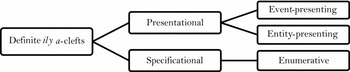
We conclude that, in contrast to what has often been argued (more or less explicitly) in the linguistic literature, il y a-clefts in French can have more than just one function. Although these clefts are most often said to present new events in the discourse context, we found many examples in our subcorpus that do not fit the properties traditionally ascribed to il y a-clefts. Hence, two types of il y a-clefts can be distinguished: presentational and specificational ones. Presentational il y a-clefts can be subdivided into two groups: the ones introducing an event and the ones introducing an entity (for an overview, see Figure 1). The entity-presenting type introduces a new entity into the discourse and immediately predicates something about it, whereas the event-presenting type expresses an event in the pseudo-relative clause, in which the referent of the clefted constituent is merely a participant. Enumerative specificational il y a-clefts on the other hand, introduce in the discourse a new entity belonging to a class that is previously mentioned or inferable: they specify a value that corresponds to a variable. They are similar to entity-presenting il y a-clefts in the sense that both types introduce a new referent in the discourse, but entity-presenting il y a-clefts do not specify a value for a variable and do not imply that the new referent is an example of an already evoked class. The predicate in the pseudo-relative clause of an enumerative specificational cleft can either describe a property of the enumerated referent, or something the referent is doing.
Presentational il y a-clefts can be subdivided into two groups

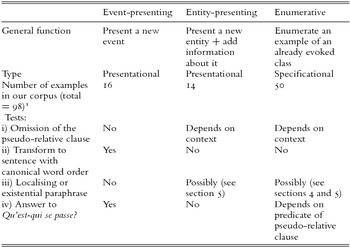
Since entity-presenting and enumerative specificational il y a-clefts do not exhibit the properties ascribed to il y a-clefts in the linguistic literature, none of the four criteria resumed in section 3.1 can be used to distinguish all types of il y a-clefts from sentences that superficially resemble them (il y a introducing an NP modified by a relative clause). These criteria have been proposed to account for il y a-clefts with the event-presenting function only. As regards the first test, omitting the pseudo-relative clause (i): it is applicable if the information in the pseudo-relative clause has already been evoked, regardless of the type of construction introduced by il y a. The second test, the transformation of the cleft into a sentence with canonical word order (ii), can be used to distinguish the event-presenting il y a-clefts from the entity-presenting and enumerative specificational il y a-clefts, since it is only possible for the former type. Thirdly, the localising and existential interpretations of il y a (iii) are not limited to clear cases of il y a introducing an NP modified by relative clause: in section 5, we have seen examples of sentences that are ambiguous between an interpretation as cleft and a construction with existential and/or localising il y a introducing an NP with a relative clause. The last test, whether or not the sentence can be an answer to a question such as What's happening? What happened? (iv), distinguishes event-presenting clefts from entity-presenting clefts, but not from enumerative specificational il y a-clefts, since the pseudo-relative clause of the latter type can express both an event and a property. For an overview of the application of the criteria on the different types of il y a-clefts we found in our subcorpus, see Table 2. Moreover, the fact that, when taking into account real examples in a large context, it is often hard to decide if these criteria can be applied (section 5), shows that they are not fully operational.
Overview of types of il y a-clefts in our subcorpus

1 18 examples in corpus were ambiguous between various interpretations.
Hence, in this article we proposed a new classification of il y a-clefts with definite clefted constituents: entity-presenting, event-presenting and enumerative specificational il y a-clefts. Whether or not a sentence is a cleft and what type of cleft it constitutes, is not only determined by the meaning of the sentence itself but also significantly by its context. We have shown that all three types are relatively well represented in our corpus, with the enumerative specificational type as the most frequent one. This is surprising, since this type has hardly been mentioned in the literature, but it illustrates the usefulness of qualitative corpus research. Whether or not these findings extrapolate to il y a-clefts with indefinite clefted constituents, is an interesting research question that still needs to be investigated. Taking into account the prosodic properties of cleft sentences might also improve our understanding of this fascinating construction.