1. Introduction
China has around 400 million hectares of natural grasslands accounting for 40 per cent of the nation's land area. Grasslands constitute the largest territorial ecosystem-type in China (Yang et al., Reference Yang, Yang and Meng2016). Grasslands and the people who live in grassland regions are, however, experiencing severe ecological, social and economic problems due to population growth, grazing intensity and land use change. More than 90 per cent of Chinese grasslands are degraded with 130 million hectares being moderately or severely degraded (Wang et al., Reference Wang, Bennett, Xie, Zhang and Liang2007a). Nationally, sandstorms have become more frequent: the frequency of spring sandstorms was 8.4 per year on average between 2000 and 2011 but increased to 11 between 2012 and 2014 (Lu et al., Reference Lu, Lu and Xin2005; Wang et al., Reference Wang, Dai, Liu, Liu and Wu2007b; Yan et al., Reference Yan, Gao, Lu and Ren2014). Young people have been moving out of grassland regions in search of better employment and income opportunities in the major cities. The average age of grassland residents has thus been rising, with adverse consequences for regional income and the sustainability of regional cultures (Xu, Reference Xu2017).
In response, the Chinese government has taken action to address the degradation of grassland areas. Policy initiatives have included the following measures (Grassland Monitoring Center of Ministry of Agriculture and Rural Affairs, 2014):
(1) The Beijing-Tianjin Sandstorm Source Control Project, implemented in 2000 and aimed at controlling desertification and reducing sandstorm frequency by means of various biological and engineering measures;
(2) The de-stocking of grasslands, launched in 2003 and involving fence construction and the reseeding for degraded grasslands; and
(3) The subsidization of reductions in stock number, which commenced in 2011.
According to the National Grassland Monitoring Report of 2016 (Liu, Reference Liu2017), all three policies had impacts on grassland conditions. The Beijing-Tianjin Sandstorm Source Control Project effectively contained the expansion of severe desertification. The proportion of severely degraded grasslands was reduced by 58.9 per cent in Xilinhot city, Xianghuang, and Lan Banners of Inner Mongolia between 2011 and 2016. The grassland de-stocking scheme increased the vegetation coverage by 10 per cent on average in the project area, as compared to the non-project area. China's central government spent US$2.14 billion on livestock reduction subsidies over the five-year period 2011–2016, US$0.65 billion of which was specifically allocated to Inner Mongolia (Gao et al., Reference Gao, Kinnucan, Zhang and Qiao2016). As a result, in 268 pastoral and semi-pastoral regions nationwide, the average overgrazing rate declined to 15.5 per cent in 2016 compared to 17 per cent in 2015 and per capita income of people increased to CNY8,078 per year in 2015, as compared to CNY6,286 in 2014 (Liu, Reference Liu2017).
Many of the current grassland protection policies involve the payment of public funds in the form of compensation/subsidies directly to participants. The extent of these payments, which is around CNY13 billion (US$2.14 billion), has stressed public finances and, combined with the grazing restrictions involved, has also led to lower levels of profitability for grazing enterprises (Uthes et al., Reference Uthes, Li, Zhen and Cao2010; Zhen et al., Reference Zhen, Li, Yan, Liu, Liu, Zhang, Du, Wu, Sun and Wang2014; Yin, Reference Yin2017). However, an economic justification for the investment in grassland protection has not been established because the benefits enjoyed by the Chinese people from the associated environmental improvements have remained largely unexplored. Very little information regarding the extent of the environmental and social benefits, expressed in monetary terms, is available (Wang et al., Reference Wang, Bennett, Xie, Zhang and Liang2007a). Cost-benefit analyses of grassland policy interventions have thus not been performed.
A number of the unexplored benefits of grassland protection – including aesthetic values, ecological values and social values – are non-market values. Such non-market values can be important components of the total economic value arising from land use changes caused by policy interventions. Ignoring them in a policy-making context could distort the reform of grasslands policy (Cai et al., Reference Cai, Li and Zhang2006). Hence, the evaluation of potential grassland policies should consider any non-market benefits arising from them. Because non-market values are not bought or sold in markets, market-based estimates of their extent are not available. Non-market valuation tools are thus required. One such non-market valuation tool is choice modelling (CM), a stated preference method so-named because it involves respondents to a survey being asked to state their willingness to pay (WTP) for a non-marketed benefit through the choices they make between alternative future scenarios (Bennett and Birol, Reference Bennett and Birol2010).
The aim of this paper is to report on a study that used CM to estimate the non-market benefits associated with changes in government policy designed to improve grassland protection. The intention is to provide data on the benefits of alternative policy regimes so that they can be compared against their respective costs. A case study approach is taken in which the specifics of the situation evident in Inner Mongolia are considered. The residents of Hohhot, the capital city of Inner Mongolia, are defined as the beneficiaries of policy changes.
The paper is structured as follows. In section 2, the geographic and social contexts of the case study are outlined. Following that, in section 3, the CM technique is described, along with details of the application to the case study. In particular, a novel surveying technique used to deploy the CM questionnaire is set out. In section 4, the sample characteristics are outlined, while in sections 5 and 6 the CM results are presented. A discussion of the results is presented and some conclusions are drawn in section 7.
2. Case study context
The Inner Mongolia Autonomous Region (IMAR) is located in the far north of China. The population of IMAR was 25.11 million in 2015 and its landscape is characterized by a plateau at an average altitude of around 1,000 meters. The total area of grassland in IMAR is 88 million ha (China National Statistical Bureau, 2016). Various grassland types comprise this area, ranging from meadow steppe in the east, typical steppe in the central areas and desert steppe in the west. The rate of ecological deterioration in the grasslands of IMAR has accelerated since the 1970s as a result of overgrazing. This has given rise to soil erosion and desertification (Wang, Reference Wang2011). In 2012, the area of degraded grassland in IMAR was around 38.7 million ha (Yang and Zhao, Reference Yang and Zhao2012).
Due to this deterioration of grassland condition in IMAR, the frequency of dust storms has increased: on average, 8.3 strong sandstorms and 11.1 weak sandstorms occurred each year from 2001 to 2015 (Sa, Reference Sa2009; Yuan, Reference Yuan2017). In addition, the average age of grassland residents has been increasing, as more young people from herder families have migrated to the city to seek alternative employment and improved incomes. Around 50 per cent of people migrating from the grasslands to the cities are between 21 and 30 years old (Qi, Reference Qi2013; Yang and Han, Reference Yang and Han2016).
Policies aimed at protecting grasslands and enhancing herder incomes have been implemented in IMAR by both central and regional governments. With these policies in place, the ecological condition of the grasslands has improved relative to the former trend of degradation. De-population has also been halted: the labor force employed in animal husbandry increased by 1.8 per cent in 2011 as compared to 2010, and by 10.6 per cent in 2013 as compared to 2013 (China National Statistical Bureau, 2010, 2011, 2012, 2013, 2014, 2015). Despite this, the proportion of herders aged over 65 years has increased from 5.99 per cent to 8.2 per cent between 2000 and 2010, according to 5th and 6th population census (Huo, Reference Huo2016). Therefore the grasslands remain a source of ongoing environmental and social issues. Sandstorms continue to be a source of discomfort for urban residents, and the increasing average age of herders continues to cause reductions in the strength of long-held traditions and customs.
These ongoing issues are a source of concern for policy makers. Interest in the development of new policies, or the modification of existing policies, continues in policy circles. Hence there exists a need to consider not only the costs of modifying policy settings but also to estimate the benefits arising from this. The benefits of interest in this paper relate to the off-site, non-market values enjoyed by urban residents of the IMAR. We take the residents of Hohhot, the capital city of IMAR, to be representative of the urban beneficiaries of environmental improvements arising from policy changes.
Hohhot's population is both large and heterogeneous. In 2015, the population of Hohhot was 3.1 million. The people of Hohhot are experiencing increased levels of affluence and higher levels of educational attainment: The average disposable income was CNY37,362 (around US$5,900) and over 90 per cent of Hohhot residents had finished at least nine years of schooling or above (China National Statistical Bureau, 2016). These changes have led to a greater appreciation of the intrinsic value of environmental services and the potential for a growing demand for environmental services (Wang et al., Reference Wang, Dai, Liu, Liu and Wu2007b). It is this potential for demand growth that is the focus of this paper. To estimate that demand, the non-market valuation technique, choice modelling, was applied.
3. Choice modeling and application details
3.1 Choice modeling
Choice modeling (CM) is a development of the dichotomous choice contingent valuation method (CVM): rather than asking respondents to choose between the status quo and one alternative policy, CM involves asking respondents to choose between a number of alternatives (including the status quo) that are described by attributes or characteristics of the outcomes (Adamowicz et al., Reference Adamowicz, Boxall, Williams and Louviere1998). Compared with CVM, the main advantage of CM lies in its ability to estimate the values of multiple attributes that are impacted by a policy. Moreover, CM has some advantages in mitigating several response biases that have been detected in CVM studies. These include hypothetical biasFootnote 1 and strategic biasFootnote 2 (Morrison et al., Reference Morrison, Blamey, Bennett and Louviere1996; Bennett and Birol, Reference Bennett and Birol2010).
The theoretical foundations of CM are based on Lancaster's characteristics theory of demand in which goods are described as ‘bundles’ of attributes taking different levels in different goods. Utility or preference orderings are assumed to rank collections of goods indirectly through the attributes that they possess (Lancaster, Reference Lancaster1966). It is also based on random utility theory, which posits utility as comprising a deterministic component and a random component (Bennett and Birol, Reference Bennett and Birol2010):
 $$U_{\hbox{an}} =V_{\hbox{an}} +\varepsilon_{\hbox{an}}\comma \; $$
where for any individual n, the utility function (U) is described by an observed component (V) revealed through respondents' choices of alternatives (a) and a random, unobserved component (ε).
Because of the random component, choices cannot be predicted perfectly, leading to an expression for the probability of choice (Wang et al., Reference Wang, Bennett, Xie, Zhang and Liang2007a). The probability that respondent n will choose alternative a over alternative j is given by:
 $$P\lpar a\vert C_n \rpar =P[\lpar V_{\hbox{an}} +\varepsilon _{\hbox{an}} \rpar \gt \lpar V_{\hbox{jn}} +\varepsilon_{\hbox{jn}}\rpar ] \comma \; $$
for all j alternatives in choice set C n.
To calculate choice probabilities, assumptions must be made regarding the distribution of the random element. A common assumption is that the random element is independently and identically distributed (IID) following a Gumbel distribution. The probability of choosing an alternative can then be expressed as a conditional logit distribution (McFadden, Reference McFadden and Zarembka1974), which is given by:
 $$\hbox{Prob}\lpar a\vert C_n\rpar =\displaystyle{{{\rm ex}{\rm p}^{\mu V_a}} \over {\sum\limits_{j\in C} {{\exp }^{\mu V_j}} }}\comma \; $$
where μ is a scale parameter, which is typically assumed to equal one (implying constant error variance).
The conditional indirect utility function (V) for the alternative can then be estimated as:
 $$V_{\hbox{an}} =\hbox{ASC}_{\rm a} +\mathop \sum \limits_k \beta _{\hbox{kn}} X_{\hbox{kn}} +\mathop \sum \limits_p \gamma _p \hbox{ASC}_a \times \hbox{SE}_p\comma \; $$
where ASC a is the alternative specific constant, β is the parameter vector associated with X, a vector of the k attributes used to describe the choice alternatives, and γ is the parameter vector associated with the ASC interacted with the respondents' p socio-economic variables (SE).
The ASC aims to capture the mean effect of the unobserved factors in the error terms for each alternative. The inclusion of ASC can help mitigate inaccuracies due to any violation of the assumption of Independence of Irrelevant Alternatives (IIA) (Blamey et al., Reference Blamey, Bennett, Louviere, Morrison and Rolfe2000). The interaction terms estimate the preferences for choosing change alternatives over the status quo alternative of respondents with differing socio-economic characteristics. When the IIA assumption is unlikely to hold, the conditional logit form is inappropriate. In such cases, the random parameter logit (RPL) form may be superior. Besides avoiding the need to assume IIA, RPL also allows the explicit modeling of unobserved preference heterogeneity (Bennett and Birol, Reference Bennett and Birol2010).
3.2 Application details
3.2.1 Questionnaire design
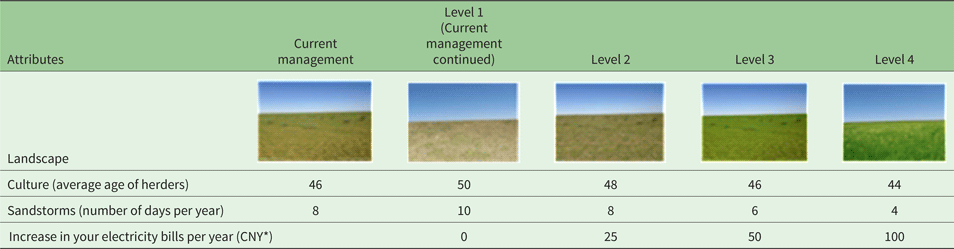
The questionnaire was initially drafted with reference to a sequence of focus group discussions held at the Inner Mongolia Agricultural University in Hohhot in June 2016. The effects of current grassland management practices on city residents, attributes that could be used to describe the outcomes of differing policy instruments and the levels those attributes could take, were topics that were discussed in the focus groups. The findings from the focus groups were confirmed with grassland management experts from the College of Economics and Management and the College of Grassland, Resources and Environment within Inner Mongolia Agricultural University and the Institute of Grassland Research of the Chinese Academy of Agricultural Sciences. The selected attributes and their levels are shown in table 1. Note that the second column in table 1 shows the current levels of the attributes, while the other columns set out other levels that could occur in 10 years' time under current policies and alternative policies.
Attributes and levels

Note: *Increase in electricity bills per year: 1.00 CNY = 0.158 US$.
The landscape attribute relates to the appearance of the grassland that is enjoyed by visitors to the area. If current grassland management continues for the next 10 years, grassland views would degrade to Level 1 (lower plant density and height and fewer grasses, with between 60 and 70 per cent of the land being bare ground). However, with better grassland management being implemented for the next 10 years, landscape would improve to Level 2 (poor plant density and height with around 40–50 per cent bare ground). With even better grassland management, landscape would be at Level 3 (fair plant density and height with around 20 per cent bare ground). With the best grassland management, landscape would achieve Level 4 (high plant density and height and no bare ground).
In terms of the culture attribute, different ethnic groups, such as the Mongols, have lived traditional lifestyles on the grasslands of Inner Mongolia for thousands of years. Their cultural practices are linked to grazing in the grasslands. If the herders of the grasslands cannot earn enough income, then young people will leave and their cultures will be lost. Currently, the average age of herders is 46 years. Better management of the grasslands would mean more income for herders. That would mean that more of the younger people would stay on to be herders and the average age of herders would fall. The average age of herders would be 50, 48, 46 or 44 years old under different policies (table 1).
Thirdly, sandstorms affect urban areas like Hohhot. They reduce air quality, and lead to an increase in breathing problems such as asthma. Sandstorms originate from grassland areas when there is not enough vegetation coverage. Currently there are, on average, 8 days of sandstorms each year in the Hohhot area. Management change of grasslands would lead to changes in the number and severity of sandstorms. The number of days of sandstorms each year could be 10, 8, 6 or 4 under different policies (table 1).
Finally, the cost attribute used was a payment made by Hohhot residents for grassland management by means of an extra charge added to the yearly electricity bill. If current management continues, residents would pay nothing extra. Otherwise, the increase in the electricity bill would be CNY25, CNY50 and CNY100 under the different policies (table 1).
Initially, an orthogonal experimental design was used to assign the levels of the attributes to two change alternatives in the choice sets for a pilot survey.Footnote 3 After removing dominant alternatives from the orthogonal design, 24 choice sets were selected and allocated to four blocks, with six choice sets for each block. Consequently, there were four versions of the questionnaire, each version being distinguished only by the levels of the attributes in the choice sets.
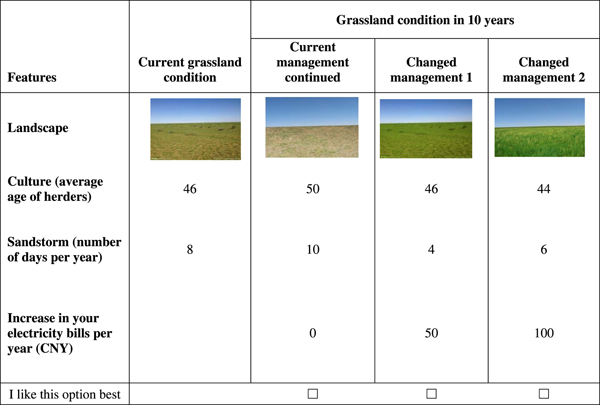
In the questionnaire, respondents were initially provided with background information on the condition of the grasslands in IMAR and the policy context. Respondents were then asked to answer six questions (choice sets) about grassland management in IMAR. Each question showed: the current conditions of grassland; what will happen to grassland in 10 years if current grassland management continues (the ‘status quo’ which was available at no additional cost to respondents); and, grassland conditions in 10 years under two different alternatives for changing current grassland management. An example choice set is shown in figure 1. Following the choice sets, respondents were asked for demographic information, experiences of grasslands and some questions regarding the ways in which they answered the choice questions.
Example choice set

3.2.2 Survey method
Taking into consideration the Hohhot population's heterogeneity and survey logistics, a form of online interview was developed using the social networking application, WeChat. WeChat is prevalent amongst Hohhot residents as a convenient form of communication. Conducting surveys through WeChat is not only cost saving and fast, but also allows better access to the heterogeneous population of Hohhot relative to more conventional methods of questionnaire delivery such as door-to-door interviewing or mail outs. The questionnaire was transformed into a screen-show version suitable for display on a mobile phone, using a web site as the base. The questionnaire was dispatched using the snowball sampling approach whereby friends were invited to forward it on to other friends from their WeChat ‘friends circle’. That procedure was allowed to continue until the required sample size was achieved. Sixty pilot questionnaires were collected from Hohhot residents in February 2017. Based on preliminary models estimated from those data, the experimental design was revised to be D-efficient for the main survey.Footnote 4
4. Data collection and descriptive statistics
4.1 Data collection
The survey was conducted through WeChat in Hohhot, focusing on Hohhot urban residents as the sample. An urban resident is defined as a person living in the city or its suburb for at least half a year. The questionnaire was structured so that respondents were first asked if they were Hohhot urban residents in order to screen potential respondents. A total of 819 completed questionnaires were collected. However, despite the screening question, some respondents were found to be from outside the Hohhot sample area. Excluding these respondents left 427 questionnaires available for analysis, with 141, 129, 94 and 103 respondents answering the four versions of the questionnaire.
4.2 Descriptive statistics
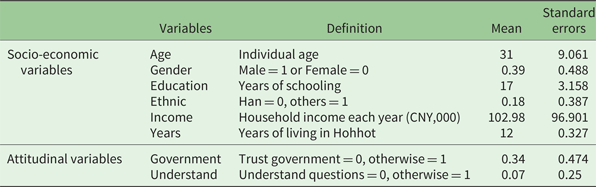
Descriptive statistics on the socio-economic variables for respondents are displayed in table 2. The average age of respondents was around 31 years old, with 39 per cent being male and 61 per cent being female. Respondents with Han ethnicity accounted for 81 per cent of the total sample. On average, household income was around CNY103,006 (US$16,275). The average number of years living in Hohhot for respondents was 12.
Descriptive statistics on socio-economic variables

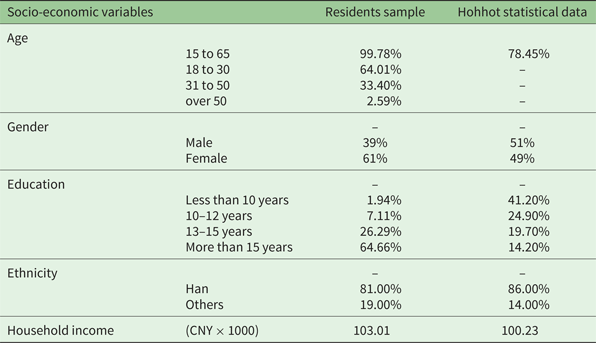
The socio-economic profile of the sampled residents was compared against the population of urban Hohhot, and the results are displayed in table 3.
Statistics on residents sample and urban population of Hohhot

Source: Hohhot Economic Statistical Yearbook (Hohhot Statistical Bureau, 2017).
The profile of respondents differs significantly from the characteristics of the population of urban Hohhot. The sample is biased toward younger, female, better educated and wealthier people. This is a consequence of the sampling method. By using WeChat and snowball sampling to distribute the questionnaire, ownership of a smart phone was a prerequisite for inclusion in the sample. While smart phone penetration is high in Hohhot, it is more prevalent in the younger generations. Furthermore, propensity to engage with WeChat is higher amongst females. The consequence of this biased sample is the need for appropriate care in the extrapolation of the survey results to the Hohhot population.
5. Model specification
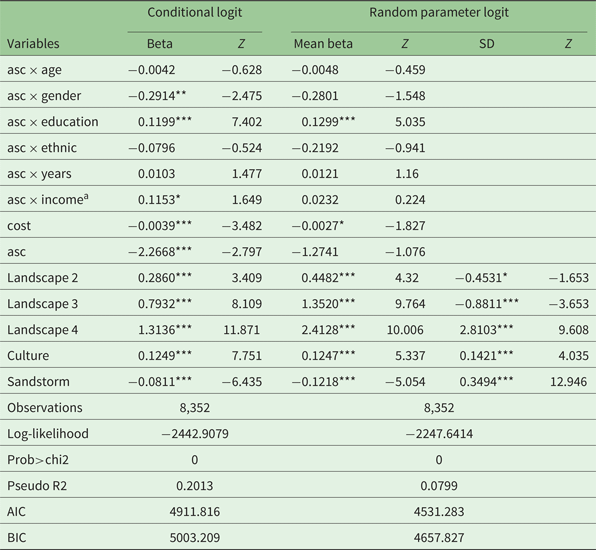
The residents' data were analyzed using the statistical software package Stata. Two kinds of choice models were estimated: CL and RPL. The aim was to examine the contribution made by the choice attributes and socio-economic characteristics to respondents' choices. The detailed results of models are displayed in table 4.
Conditional logit and random parameter logitmodel results

Notes:***p < 0.01, **p < 0.05, *p < 0.1.
aIncome was transformed into logarithm.
5.1 Conditional logit model
A CL model was estimated including the choice attributes and interaction terms between the ASC and socio-economic variables as independent variables. All choice attributes are signed consistent with expectations, apart from the culture attribute. Hohhot respondents preferred better grassland landscape, fewer sandstorm days and lower payment levels. Contrary to expectation, respondents preferred alternatives with higher future average age of herders. Possibly, respondents' perceptions were that herders with higher average age have been living in grassland areas for a longer time and have sustained traditional cultural activities, whereas younger herders are perceived to be moving out of grassland areas and making a living in the city. The socio-economic variables have different impacts on individual choice. Female respondents are more willing to support changed grassland management relative to male respondents. Respondents with higher educational attainments are more likely to choose change options over the status quo. Respondent's household income has a significant impact on preference: respondents with higher income levels were more inclined to choose change alternatives.
5.2 Random parameter logit model
The preferred model to explain Hohhot respondents' preferences was the RPL model. In the model, all the choice attributes were specified as random with normal distributions except for the cost attribute. This is because a randomly distributed cost coefficient can produce misleading moments for the distribution of the associated implicit prices. Hence the cost coefficient was defined to be fixed to ensure the appropriate identification and stability of WTP (Revelt and Train, Reference Revelt and Train1999; Daly et al., Reference Daly, Hess and Train2012). The fit of the RPL model using 500 Halton random draws was superior to that of the CL model (lower log-likelihood and AIC and BIC estimates). The significant standard deviations on the coefficients of the attributes assigned to be random demonstrated the importance of recognizing the heterogeneity of respondents' preferences. The same set of socio-economic variables (interacted with the ASC) that was used for the CL model was used for the RPL model.
Aside from the culture attribute, the choice attributes are significant and consistent with expectation. Respondents are likely to choose alternatives if the grassland landscape is better. Fewer days of sandstorms also induce resident respondents to choose changed grassland management alternatives. In addition, if the cost is lower, respondents are more willing to choose change options. As for the socio-economic variables, respondents with higher educational levels are more inclined to choose change alternatives.
6. Estimation of non-market values of changed grassland condition
6.1 Implicit prices
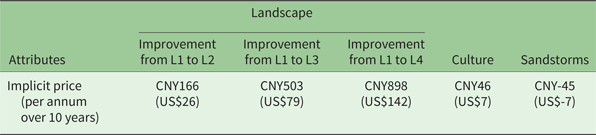
Implicit prices are the marginal rates of substitution between the environmental attributes and the monetary attribute (cost). In other words, implicit prices are respondents' WTP to attain more environmental/social benefits. Implicit prices for the grassland attributes featured in the RPL model are displayed in table 5.
Implicit prices

Respondents in Hohhot are, on average, willing to pay CNY166, CNY503 and CNY898 per annum for landscape improvement from L1 to L2, L3 and L4 respectively. Meanwhile, the average WTP of Hohhot residents to reduce the annual frequency of sandstorms is CNY45 per annum. Contrary to expectations, respondents are willing to pay CNY46 per additional year on the average age of herders.
6.2 Compensating surplus
Implicit prices estimate the marginal benefits of each attribute. The value of different combinations of attributes relative to the status quo can also be estimated as the compensating surplus (CS). This can be estimated using the formula:
 $$\hbox{CS}=-\displaystyle{1 \over {\beta _M}}\lpar {V_{\hbox{SQ}}-V_a}\rpar \comma \;$$
where β M denotes the parameter of the monetary attribute, V SQ represents the utility of the status quo and V a represents the utility of an alternative. Alternatively, it can be estimated by multiplying the individual implicit prices by the extent of change in the attributes that are affected by a change in policy.
The status quo refers to the situation if the current grassland management were continued over the next 10 years. A range of alternative change contexts can be considered. For example, one alternative is the achievement of the best outcomes for all attributes with landscape protected to level four, the number of days of sandstorms per year decreased to four days, and more younger herders living in the grassland areas, with an average age of 44 years. The CS based on the random parameter model estimates using equation (5) is estimated at around CNY892 on average per household per annum over 10 years. Extrapolating this estimate across the whole population of Hohhot involves calculating the present value of the CNY892 per annum 10 year annuity (CNY6888 at a discount rate of five per cent in 2017) and multiplying this by the total number of households and the survey response rate (Baker and Ruting, Reference Baker and Ruting2014; Shi and Zhao, Reference Shi and Zhao2015). According to the Hohhot Economic Statistical Yearbook in 2017, the number of households in Hohhot at the end of 2016 was 602,963 (Hohhot Statistical Bureau, 2017). The use of the WeChat app to distribute the questionnaire makes the estimation of a response rate highly problematic. However, given the biased sample (especially toward higher income, better educated people), a conservative response rate of five per cent is used. This assumes that five per cent of the population of Hohhot holds the same average preferences as the sampled respondents and that the remaining 95 per cent do not hold any values associated with the impacts of grassland management.Footnote 5 Under these assumptions, the non-market value of the designated change in grassland management from the status quo to the ‘best’ alternative is around CNY208 million (US$33 million).
Using the individual attribute CS estimation approach, a policy change that would reduce the number of sandstorm days by four through an improvement in landscape condition to level three yields:
 $$\eqalign{\hbox{CS} & =\lpar 4\ \ast \ 45\rpar +503 \cr & = CNY683 \hbox{ \lpar on average per household per annum over 10 years\rpar }.}$$
Extrapolating this estimate across the whole population of Hohhot involves calculating the present value of the 10 year annuity (around CNY5274 – about US$683 – at a discount rate of five per cent in 2017) and multiplying this by the total number of residents' households (602,963) and the survey response rate (five per cent). The estimated CS for this change scenario is CNY159 million (US$25 million).
7. Conclusions
The approach to policy making in China has, conventionally, been largely ‘top down’. Few studies have sought to quantify the benefits enjoyed by the population of improvements in grassland conditions. This study has sought to expand the grassland policy perspective to include a ‘bottom up’ recognition of environmental and social values. Direct payments supported by government funding increase the public financial burden and reduce the efficiency of improving the grassland environment. Recognizing the publics' value of the outcomes of grassland protection measures can also broaden the financial base of market-based mechanisms for grassland protection. In this study, the values of a series of attributes associated with grassland conditions were estimated using choice modeling. Respondents' choice behavior sheds light on their preferences for an improved environment and allows the estimation of their WTP. Different models were used to improve fitness and examine the importance of attributes to respondents. The estimation of WTP for each attribute also points to the relative importance of grassland ecological improvements for urban dwellers and further provides inputs to cost and benefit analyses of grassland policies.
There are differences in preference for attributes associated with grassland condition. Hohhot residents are more concerned about landscape and sandstorms, perhaps because grassland beauty and improved air quality can leave straightforward impressions on respondents. So, better grassland landscape is positive to individual preference, while more frequency of sandstorms is negative to choice. Note that preferences for the culture attribute were contrary to expectations: respondents are willing to support older herders to preserve cultural heritage. There are a number of possible reasons for this result. First, older herders have been living in the grasslands for long periods and may thus be expected to be better cultural custodians. Second, due to the relatively lower animal husbandry income, younger herders are migrating to the city to seek alternative income sources. This means that those young herders gradually merge with the existing urban dwellers. Several socio-economic variables also shed light on possible reasons for the unexpected preferences for herder age. Educational level has a positive correlation to choice of change alternatives. This indicates that residents with a higher educational level place higher values on grassland protection. Despite this, household income level does not impact on preferences.
Hohhot respondents demonstrated their values for changes in grassland management. They are willing to pay to improve the landscape and to avoid sandstorms. The estimated CNY683 per household per annum over 10 years value of CS for one example of improvement in grassland condition provides the basis for a benefit cost analysis of policy measures needed to ensure the change. The benefits of other policy contexts are readily estimated using the same approach. While the magnitude of the per household estimates of value reported in this paper are relatively modest relative to payments made by Hohhot households for other expenditure categories and their income base, the extrapolated values are noteworthy. Even with a very conservative sample response rate to reflect the prospect of a biased sample through the use of WeChat as a delivery mechanism, the sheer size of the overall population of Hohhot makes for a comparatively large total benefit. The extent of public sector investment in policies to generate such environmental improvements would appear small in comparison.
Acknowledgements
Funding for the research reported in this paper was provided by the Australian Centre for International Agricultural Research.