Implications
Feeding nursery and grow-finish diets that include 4% menhaden oil, a feed ingredient rich in polyunsaturated n-3 fatty acids, may be a practical approach for increasing pig farm profitability. This feedstuff enhances market hog performance by increasing feed conversion efficiency, and positively affects reproductive efficiency by decreasing age at puberty in gilts.
Introduction
Including polyunsaturated n-3 fatty acids in swine diets positively affected reproduction in some studies. The n-3 fatty acids increased early embryonic survival in gilts (Perez Rigau et al., Reference Perez Rigau, Lindemann, Kornegay, Harper and Watkins1995; Smits et al., Reference Smit, Patterson, Webel, Spencer, Cameron, Dyck, Dixon and Foxcroft2013), and litter size in sows (Smits et al., Reference Smits, Luxford, Mitchell and Nottle2011). Effects of dietary inclusion of sources of n-3 fatty acids on replacement gilt development and onset of puberty, however, has received little scientific attention.
A growing body of evidence supports the concept that the maternal environment in which a fetus develops plays a profound role in the development of physiologic systems that becomes evident later in life (O’Gorman et al., Reference O’Gorman, Gonzales, Eaton, Collard, Reyna, Laurenze, Stanko, Keisler, Carroll and Garcia2007; Estienne and Harper, Reference Estienne and Harper2010). Dietary fatty acids pass through the placenta during gestation and milk during lactation, and accumulate in the fetus and neonate (Innis, Reference Innis2005). Feeding sows a diet supplemented with n-3 fatty acids, beginning 30 days before breeding, affected endometrial, conceptus and fetal fatty acid composition in early pregnancy (Brazle et al., Reference Brazle, Johnson, Webel, Rathbun and Davis2009). We hypothesize that during the prenatal and early postnatal periods, pigs may be ‘programmed’ by sows consuming a source of n-3 fatty acids, such that future growth and reproduction are affected. Thus, the objective of this study was to determine the effects of dietary inclusion of menhaden oil on growth performance and onset of puberty in gilts farrowed by sows fed gestation and lactation diets containing menhaden oil.
Material and methods
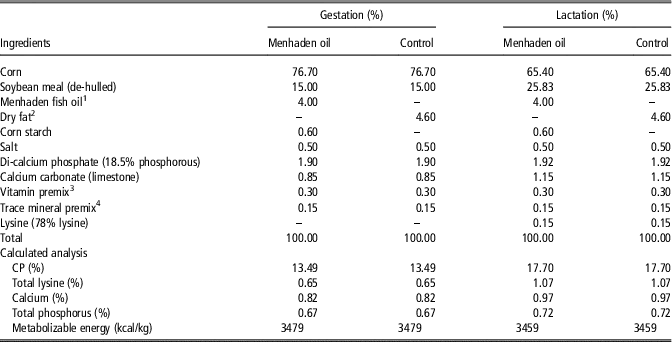
Yorkshire by Landrace gilts (n = 12) and weaned sows (n = 32) were checked for estrus daily in the presence of a mature boar and were mated by artificial insemination 0 and 24 h after first displaying the lordosis response. Semen containing at least 6 billion sperm cells/dose was procured from a commercial source (Swine Genetics International, Cambridge, IA, USA). Mated females were assigned to one of two dietary treatment regimens: (1) fortified corn-soybean meal gestation and lactation diets (control), or (2) fortified corn-soybean meal gestation and lactation diets that included 4% menhaden oil (Virginia Prime®; Omega Protein®, Houston, TX, USA) (Table 1). Control and menhaden oil diets were isocaloric and equal with respect to amino acids, minerals and vitamins, and the gestation and lactation diets met or exceeded published nutrient requirements (United States Pork Center of Excellence (USPCE), 2010; National Research Council (NRC), 2012). Sows had ad libitum access to water, and received ~2.2 kg of feed daily during gestation and ad libitum access to feed during lactation. Cross-fostering of pigs within dietary treatment was performed so that each sow was nursing approximately 10 piglets. Farrowing rates (number of sows farrowing/number of sows mated) and litter characteristics at farrowing (total born, number born live and pig and litter birth weight) and at weaning (number weaned and pig and litter weaning weight) were determined.
Composition of control and 4% menhaden oil diets fed to sows during gestation and lactation

1 Virginia Prime®.
2 Prilled saturated fat supplement (Fat Pak 100®; MS Specialty Nutrition, Dundee, IL, USA).
3 Vitamins provided per kilogram premix: 2933348 IU of vitamin A as acetate, 403 348 IU of stabilized vitamin D3, 12 650 IU of vitamin E as dl-tocopherol acetate, 1467 mg of vitamin K as menadione sodium bisulfate, 2567 mg of riboflavin, 8433 mg of d-pantothenic acid as calcium pantothenate, 12 445 mg of niacin as nicotinamide, 125 mg of d-biotin, 550 mg folic acid and 11 mg of vitamin B12.
4 Trace minerals provided per kilogram of premix: 7.35 mg of copper as copper sulfate, 120.26 mg of iron as ferrous sulfate, 36.75 mg of manganese sulfate, 120.26 mg of zinc sulfate, 0.33 mg of iodine as calcium iodine, 0.2 mg of selenium as sodium selenite.
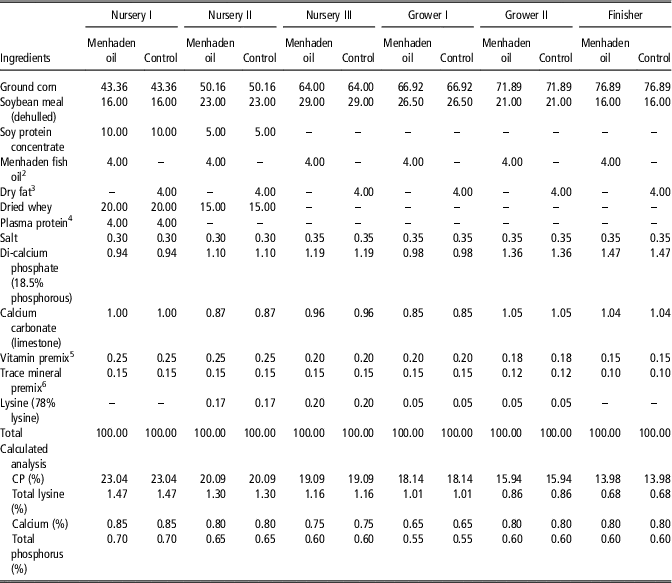
At weaning (25.1±0.7 days of age (mean±SE)), gilt pigs (8.7±0.3 kg BW) farrowed by control sows or sows fed gestation and lactation diets containing menhaden oil, were placed in pens of three gilts each. Animals were provided ad libitum access to nursery and then grow-finish control diets (USPCE, 2010; NRC, 2012), or diets containing 4% menhaden oil (Table 2). Control and menhaden oil diet formulations changed as pigs grew, consistent with commercial phase-feeding programs. Pigs were weighed at weaning, after the 7-week nursery phase of production and at the end of the grow-finish period. Daily weight gain, feed consumption and feed conversion efficiency were determined for the nursery and grow-finish phases, as well as for the overall experimental period. Thus, the trial consisted of a 2×2 factorial arrangement of treatments with the main factors being gestation and lactation diets (control or menhaden oil) of sows that farrowed and nursed the experimental pigs, and diets (control or menhaden oil) fed to experimental gilts.
Composition of control and 4% menhaden oil diets fed to pigs during the nursery, grower and finisher phases of production1

1 Nursery I, II and III diets were fed from 0 to 7, 7 to 21 and 21 to 35 days post-weaning, respectively; Grower I and II, and Finisher diets were fed to pigs weighing 20 to 50, 50 to 82 and 82 to 103 kg, respectively.
2 Virginia Prime®.
3 Prilled saturated fat supplement (Fat Pak 100®; MS Specialty Nutrition).
4 Appetein; American Protein Corporation Inc., Ankeny, IA, USA.
5 Vitamins provided per kilogram premix: 2 933 348 IU of vitamin A as acetate, 403 348 IU of stabilized vitamin D3, 12 650 IU of vitamin E as dl-tocopherol acetate, 1467 mg of vitamin K as menadione sodium bisulfate, 2567 mg of riboflavin, 8433 mg of d-pantothenic acid as calcium pantothenate, 12 445 mg of niacin as nicotinamide, 125 mg of d-biotin, 550 mg folic acid and 11 mg of vitamin B12.
6 Trace minerals provided per kilogram of premix: 7.35 mg of copper as copper sulfate, 120.26 mg of iron as ferrous sulfate, 36.75 mg of manganese sulfate, 120.26 mg of zinc sulfate, 0.33 mg of iodine as calcium iodine, 0.2 mg of selenium as sodium selenite.
After completion of the grow-finish phase, gilts (155.5±1.5 days of age and 102.7±1.7 kg BW) were limit-fed at a level of ~2.3 kg/head per day appropriate control or menhaden oil gestation diets. Gilts were placed daily in the presence of a mature boar to determine age at first display of the lordosis response (puberty). Gilts were sacrificed (captive bolt pistol followed by exsanguination) 8 to 11 days after onset of the pubertal estrus and reproductive tracts were removed and evaluated (Estienne et al., Reference Estienne, Harper, Horsley, Estienne and Knight2001). Ovaries were weighed and corpora lutea excised and weighed. Ovulation rate was determined by counting the number of corpora lutea. The remaining ovarian tissue was minced and blotted and weight of follicular fluid determined. Uteri were removed and weighed.
Statistical analysis of results
All data were subjected to ANOVA using the mixed model procedure of SAS (SAS Institute Inc., Cary, NC, USA). For sow reproductive performance, individual sow was considered the experimental unit. Sow performance response variables were analyzed using a model that included parity (1 or >1), diet and the parity by diet interaction as possible sources of variation. For analyses involving gilts, pen served as the experimental unit. Gilt growth and reproductive characteristics were analyzed using a model that included diet of the gestating sow, actual gilt diet and the sow diet by gilt diet interaction. Individual means were compared using the LSMEANS option of PROC MIXED and were adjusted using the Tukey–Kramer procedure. Values were considered significantly different at P < 0.05 with trends at P < 0.10. Results are reported as least squares means (+ SE).
Results
Reproductive performance of sows fed control diets or gestation and lactation diets containing menhaden oil
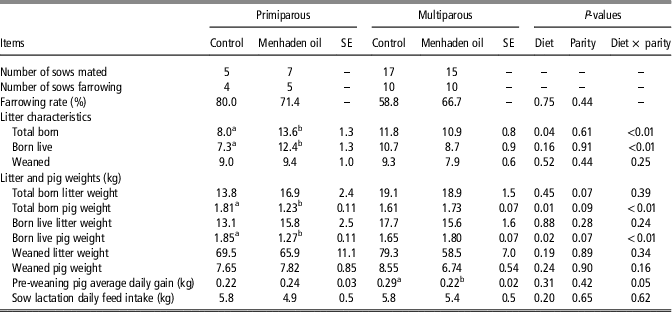
Performance of primiparous and multiparous sows fed the different rations is summarized in Table 3. Farrowing rates were not affected by parity (P = 0.44) or dietary treatment (P = 0.75). Sow feed intake during lactation was not affected by treatment (P = 0.20), parity (P = 0.65) or a treatment by parity interaction (P = 0.62). Total litter size and the number of pigs born alive were affected (P < 0.01) by parity by dietary treatment interactions. Primiparous sows fed the gestation diet containing menhaden oil had greater (P < 0.05) total litter size and pigs born alive compared to the primiparous control sows. In multiparous sows, however, there was no effect (P > 0.05) of dietary treatment on these response variables. The number of pigs weaned was not affected by diet (P = 0.52), parity (P = 0.44) or the diet by parity interaction (P = 0.25).
Reproductive performance of sows fed control gestation and lactation diets or gestation and lactation diets containing 4% menhaden oil

a,bWithin a parity, means with different superscripts differ (P < 0.05).
Aside from a trend (P = 0.07) for heavier total litter weights in multiparous compared to primiparous sows, there were no effects (P > 0.1) of diet, parity or diet by parity on total, born live or weaned litter weights. Total and live born individual pig weights, however, were affected (P < 0.01) by dietary treatment by parity interactions. Total and live born pigs farrowed by primiparous control sows were heavier (P < 0.05) compared to pigs farrowed by primiparous sows fed the diet containing menhaden oil. In multiparous sows, there were no effects (P > 0.05) of dietary treatment on these response variables. Individual pig weaning weights were not affected by diet (P = 0.24), parity (P = 0.90) or the diet by parity interaction (P = 0.16). Pig growth rate during the suckling phase was affected (P = 0.05) by a diet by parity interaction. In multiparous sows, pigs farrowed by control sows grew faster (P < 0.05) compared to pigs farrowed by sows fed the diets containing menhaden oil. However, pigs farrowed by primiparous control or menhaden oil-fed sows grew similarly (P > 0.05).
Post-weaning growth performance of gilts fed diets containing menhaden oil and farrowed by sows fed gestation and lactation diets containing menhaden oil
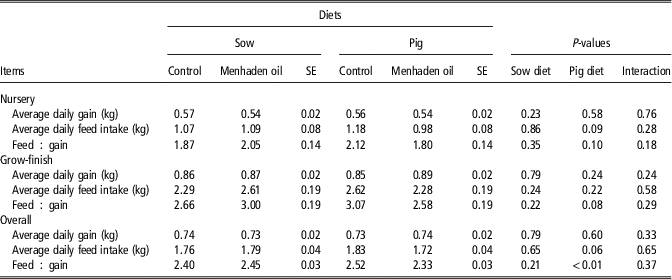
Table 4 summarizes growth performance during the nursery and grow-finish phases of production. There were no interactive effects (P⩾0.18) of sow diet (control or menhaden oil) and gilt diet (control or menhaden) on average daily gain or feed intake, or feed to gain ratio during the nursery or grow-finish phases or overall. Nursery, grow-finish and overall growth characteristics were similar (P⩾0.21) for gilts farrowed by sows that received control or menhaden oil-supplemented diets during gestation and lactation. Average daily gain during the nursery (P = 0.58) and grow-finish (P = 0.24) phases and overall (P = 0.60) were similar for gilts fed either the control or menhaden oil-supplemented diets. Gilts fed diets containing menhaden oil tended to consume less feed than control gilts during the nursery phase (P = 0.09) and the overall growth assessment (P = 0.06). Consequently, overall feed to gain was less (P < 0.01), and nursery (P = 0.10) and grow-finish (P = 0.08) feed to gain tended to be less, for menhaden oil-supplemented gilts compared with controls.
Growth performance during the nursery and grow-finish phases of production and overall for gilts fed diets with or without 4% menhaden oil and farrowed by sows that consumed diets with or without menhaden oil during gestation and lactation

Values are least squares means (±SE).
Reproductive performance of gilts fed diets containing menhaden oil and farrowed by sows fed gestation and lactation diets containing menhaden oil
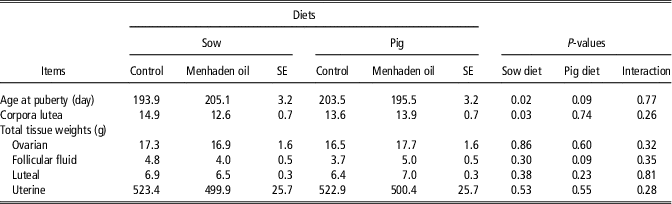
Shown in Table 5 are reproductive characteristics of gilts fed diets with or without 4% menhaden oil and that were farrowed and nursed by sows that consumed diets with or without menhaden oil during gestation and lactation. There was no sow diet by gilt diet interaction (P > 0.26) for any of the response variables measured. Age at puberty was greater (P = 0.02) for gilts farrowed by sows that consumed diets containing menhaden oil during gestation and lactation compared to gilts farrowed by control sows. In contrast, age at puberty tended to be greater (P = 0.09) for control gilts compared to gilts that had ad libitum access to diets containing menhaden oil during the nursery, grower and finisher phases of production. Ovulation rate was greater (P = 0.03) for gilts farrowed by control sows compared to gilts farrowed by sows fed diets containing menhaden oil. However, ovulation rate was not different (P = 0.74) in gilts consuming control or menhaden oil diets.
Reproductive characteristics in gilts fed diets with or without 4% menhaden oil and farrowed by sows that consumed diets with or without menhaden oil during gestation and lactation

Values are least squares means (±SE).
Follicular fluid weight tended to be greater (P = 0.09) for gilts farrowed by control sows compared to gilts farrowed by sows fed diets containing menhaden oil, but was similar (P = 0.30) for gilts consuming control or menhaden oil diets. There were no effects of sow diet during gestation and lactation (P > 0.38) or pig diet during the nursery, grower and finisher phase of production (P > 0.23) on ovarian, luteal or uterine tissue weights.
Discussion
Reproductive performance of sows fed control diets or gestation and lactation diets containing menhaden oil
Consistent with previous work (Estienne et al., Reference Estienne, Harper and Estienne2006; Smits et al., Reference Smits, Luxford, Mitchell and Nottle2011 and Reference Smits, Luxford, Mitchell and Nottle2013), dietary inclusion of rich sources of n-3 polyunsaturated fatty acids had no effects on farrowing rates. Studies designed to investigate the effects of n-3 fatty acids on other characteristics of reproductive performance of sows, however, have yielded equivocal results (for review, see Tanghe and De Smet, Reference Tanghe and De Smet2013). For example, sows fed a diet supplemented with fish oil from day 108 of gestation through lactation, exhibited increased total number of pigs born and the number of pigs born alive in the subsequent litter (Smits et al., Reference Smits, Luxford, Mitchell and Nottle2011). In contrast, Mateo et al. (Reference Mateo, Carroll, Hyun, Smith and Kim2009) fed a diet rich in n-3 polyunsaturated fatty acids for two successive gestation and lactation periods (from day 60 of gestation through lactation) and found no effects on litter size. It was not the main objective of the experiment reported herein to determine effects of dietary addition of menhaden oil on sow performance per se, but rather on growth and reproduction in gilts farrowed by and suckling sows fed the different diets during gestation and lactation. Nevertheless, there were significant effects of dietary treatment on litter characteristics that warrant further scrutiny and confirmation in larger trials employing greater numbers of sows. For primiparous, but not multiparous sows, total litter size and the number of pigs born live were greater for animals fed the menhaden diet compared to controls. Pig birth weights were greater for control v. menhaden oil-fed primiparous sows, possibly because of smaller litters. However, Rooke et al. (Reference Rooke, Sinclair, Edwards, Cordoba, Pkiyach, Penny, Penny, Finch and Horgan2001) found a slightly reduced litter weight for sows fed a diet containing salmon oil during gestation, although litter size was not affected. In addition, pregnant rats fed fish oil gave birth to lower birth weight pups compared with pregnant rats fed coconut or soy oil (Innis, Reference Innis2005).
The positive effects of menhaden oil on litter size could reflect an improvement in embryo survival. A tendency for greater embryonic survival in gilts fed menhaden oil before breeding was previously reported (Perez Rigau et al., Reference Perez Rigau, Lindemann, Kornegay, Harper and Watkins1995). Moreover, Smits et al. (Reference Smit, Patterson, Webel, Spencer, Cameron, Dyck, Dixon and Foxcroft2013) fed gilts diets containing fish oil for 3 or 6 weeks before mating and reported increased embryo survival although first-parity litter size was not influenced. Previous work from our laboratory (Estienne et al., Reference Estienne, Harper and Estienne2006) found no effects of n-3 fatty acids on embryo survival in gilts, however, in that study both control and treated animals exhibited a high level of reproductive performance (e.g. 100% pregnancy rates, 79% embryo survival, irrespective of treatment). In that backdrop of excellent fertility, it was perhaps not surprising that the dietary supplementation did not enhance reproduction further.
In the current study, there were no effects of dietary treatment on sow feed intake during lactation, the number of pigs weaned, or pig or litter weaning weights. These findings are in complete agreement with results reported by Smits et al. (Reference Smits, Luxford, Mitchell and Nottle2011). In the study reported here, however, pre-weaning average daily gain exhibited by pigs was decreased in multiparous sows consuming menhaden fish oil v. controls. In support of this finding, Cools et al. (Reference Cools, Maes, Papadopoulos, Vandermeiren, Meyer, Demeyere, De Smet and Janssens2011) reported that incorporating fish oil in the sow diet decreased weaning weights of piglets. Pups from rats fed fish oil during gestation had slower postnatal growth compared with pups born to rats fed coconut or soy oil (Siemelink et al., Reference Siemelink, Verhoef, Dormans, Span and Piersma2002). In contrast, sows fed diets containing salmon oil during gestation and lactation exhibited an increase in the proportion of farrowed pigs weaned (Rooke et al., Reference Rooke, Sinclair, Edwards, Cordoba, Pkiyach, Penny, Penny, Finch and Horgan2001). The reduction in pig mortality was attributed to an increase in brain activity and overall viability of the pigs, leading to a decrease in the number of animals crushed by the sow. Finally, Smit et al. (Reference Smit, Patterson, Webel, Spencer, Cameron, Dyck, Dixon and Foxcroft2013) reported that dietary supplementation with long-chain polyunsaturated fatty acids in sows increased pig growth from birth to day 34 post-weaning but increased pre-weaning mortality.
Post-weaning growth performance of gilts fed diets containing menhaden oil and farrowed by sows fed gestation and lactation diets containing menhaden oil
In the current experiment, there were no effects of maternal diets (control or menhaden oil) on nursery, grow-finish and overall growth rate, feed consumption or feed conversion efficiency. These findings are in agreement with Laws et al. (Reference Laws, Litten, Laws, Lean, Dodds and Clarke2009), who reported similar growth to slaughter for pigs farrowed by sows that received dietary supplementation with palm, olive, sunflower or fish oil during the first or second half of gestation. In addition, gilts in this study fed the isocaloric and isolysinic control or menhaden oil diets displayed similar growth rates. However, menhaden oil-supplemented gilts tended to consume less feed than controls and therefore, had superior feed conversion efficiency. Li et al. (Reference Li, Brendemuhl, Jeong and Badinga2014) reported no effects of dietary supplementation with 3% of a marine source of polyunsaturated n-3 fatty acids on overall average daily gain and feed intake, and feed conversion efficiency in male and female nursery pigs. However, female pigs consuming the n-3-enriched diet weighed less than control gilts at week 4 post-weaning, a relationship that did not exist for male pigs. Wilkinson et al. (Reference Wilkinson, Downing, Thomson and Newman2013) also found no statistically significant differences in growth characteristics for gilts fed safflower oil-supplemented diets or diets supplemented with fish oil extract post-weaning through slaughter. However, in one experiment, feed to gain ratio during the finisher period was 2.86 and 2.52 for the safflower and fish extract groups, respectively, which is consistent with our findings. Equivocal results in growth performance trials could reflect differences in experimental conditions among studies such as actual feed ingredients (including fatty acid compositions) or the genetic composition or sex of the pigs used. Moreover, typical grain-based diets used in commercial pork production have n-6 to n-3 ratios of greater than 10 : 1 (Dugan et al., Reference Dugan, Vahmani, Turner, Mapiye, Juarez, Prieto, Beaulieu, Zijlstra, Patience and Aalhus2015). Decreasing the ratio of n-6 to n-3 fatty acids in sow (Eastwood et al., Reference Eastwood, Leterme and Beaulieu2014) or pig (Huber et al., Reference Huber, Hooda, Fisher-Heffernan, Karrow and de Lange2018) diets may affect performance greater than increasing the level of n-3 fatty acids per se. In the current experiment, the menhaden oil employed had an n-6 to n-3 ratio of 0.14.
Reproductive performance of gilts fed diets containing menhaden oil and farrowed by sows fed gestation and lactation diets containing menhaden oil
Gilts farrowed by sows that consumed gestation and lactation diets containing menhaden oil reached puberty later than gilts farrowed by control sows. To our knowledge, this is the first report of possible fetal programming of gilt puberty onset by the consumption of fatty acids by gestating sows. However, male and female mice born to dams fed sunflower oil-enriched diets reached puberty later than did offspring from dams fed control or soy oil-enriched diets (Santillan et al., Reference Santillan, Vincenti, Martini, de Cuneo, Ruiz, Mangeaud and Stutz2010), and supplementation with oxidized fish oil in pregnant rats resulted in male offspring that exhibited delayed puberty (Albert et al., Reference Albert, Vickers, Gray, Reynolds, Derraik, Cameron-Smith and Hofman2015). Gilts farrowed by sows fed gestation and lactation diets containing menhaden oil had a decreased ovulation rate compared with gilts farrowed by control sows. The mechanisms responsible for this effect remains to be elucidated, however, maternal feeding of diets high in fat have been demonstrated to affect the ovaries of female offspring. For example, rats fed a high-fat diet from conception until the end of lactation had female offspring that displayed increased follicular atresia before and following the onset of puberty (Tsoulis et al. Reference Tsoulis, Chang, Moore, Chan, Gohir, Petrik, Vickers, Conner and Sloboda2016).
In contrast to the above, gilts consuming diets that contained menhaden oil tended to achieve first estrus at a younger age and have greater follicular fluid weights (indicative of follicular development). Smits et al. (Reference Smit, Patterson, Webel, Spencer, Cameron, Dyck, Dixon and Foxcroft2013), however, reported that diets containing fish oil did not affect age at puberty if supplementation commenced when gilts were approximately 170 days of age and was continued for either 3 or 6 weeks. In the current study, gilts were fed menhaden oil from weaning through first estrus. Thus, it can be speculated that a longer duration of n-3 fatty acid feeding is necessary to advance the onset of puberty. Leptin and its long form receptor were identified in the hypothalamus of pre-pubertal gilts (Lin et al., Reference Lin, Barb, Kraeling and Rampacek2001) and as gilts approach puberty, circulating leptin concentrations increase and immunostaining for leptin receptors in hypothalamic neurons intensifies (Qian et al., Reference Qian, Barb, Compton, Hausman, Azain, Kraeling and Baile1999). Recently, Moreira et al. (Reference Moreira, Cheuiche, Rizzoto, Santos, Schuch, Flach, Gasperin, Bianchi and Lucia2016) reported that supplementing gilt diets with n-3 fatty acids intensified immunostaining for both leptin and its receptor in oocytes from pre-antral follicles, although BWs and backfat thicknesses were unaffected. Thus, earlier puberty onset in gilts fed rich sources of n-3 fatty acids may be a consequence of increased leptin activity within the hypothalamic–pituitary–ovarian axis. Consistent with previous reports (Estienne et al., Reference Estienne, Harper and Estienne2006; Smits et al., Reference Smit, Patterson, Webel, Spencer, Cameron, Dyck, Dixon and Foxcroft2013) there was no effect of dietary treatment on ovulation rate as estimated by counting the number of corpora lutea at necropsy.
In summary, feeding gilts menhaden oil enhanced feed to gain ratio and hastened puberty onset. In contrast, puberty was delayed and ovulation rate was decreased in gilts farrowed by sows consuming menhaden oil during gestation and lactation. Feeding replacement gilts nursery and grow-finish diets that include 4% menhaden oil, a feed ingredient rich in n-3 fatty acids, may be an approach for enhancing feed conversion efficiency and reproductive efficiency by decreasing age at puberty. As gilts farrowed by sow consuming menhaden oil during gestation and lactation exhibited delayed puberty, however, retaining females from sows fed this feedstuff may be ill advised.
Acknowledgements
The authors thank K.J.L. Fuller and T.W. Lee for assistance with conducting this study. Funding for this work was provided in part, by the Virginia Agricultural Experiment Station and the Hatch Program of the National Institute of Food and Agriculture, US Department of Agriculture and a grant from Omega Protein, Inc. (Houston, TX, USA).
Declaration of interest
The authors report no conflicts of interest.
Ethics statement
The investigation was conducted at the Virginia Tech-Tidewater Agricultural Research and Extension Center in Suffolk, VA, USA, and all procedures were reviewed and approved by the Virginia Tech Institutional Animal Care and Use Committee.
Software and data repository resources
None of the data were deposited in an official repository.