Illicit antiquities are a major resource for traffickers, ranking among other highly trafficked commodities such as narcotics.Footnote 1 UNESCO estimates the antiquities trade to be worth US$2.2 billion annually; however, the financial scope of the illicit trade is ultimately unknowable as black market statistics are notoriously difficult to ascertain.Footnote 2 A precise characterization of the trade has arguably eluded researchers since the observable aspects of antiquities trafficking have proved to be incredibly variable. This article argues that the illicit antiquities trade is organized as a network similar to other trafficking, where loosely connected and interchangeable participants give the appearance of complexity;Footnote 3 however, participants are guided by simple rules that provide an identifiable underlying structure.Footnote 4 This research focuses specifically on trafficking, defined as transnational movement of illicit commodities, rather than local or indigenous looting as a function of engagement with the past, which exhibits its own structure.Footnote 5 The network paradigm links the trade's observable variability to four reoccurring stages, which provides a broad understanding of how antiquities trafficking functions.
Most modern criminal groups are characterized by “fluid network structures rather than more formal hierarchies,” an organizational structure that is particularly well suited for trafficking.Footnote 6 Criminal networks are typically composed of interchangeable participants collaborating together when mutually beneficial with limited complexity and no central organization.Footnote 7 Participants in criminal networks are not typically career criminals, but are generally rational thinking and otherwise ordinary individuals taking advantage of an opportunity to supplement their income.Footnote 8 With no central leadership, each participant is a replaceable cog in a series of criminal relationships analogous to a “plate of spaghetti [where] every piece seems to touch each other, but you are never sure where it all leads.”Footnote 9 The flexibility of criminal networks creates a myriad of challenges for law enforcement.Footnote 10
The network structure runs counter to popular views of organized crime, which “treat centralised hierarchies as synonymous with organised crime and to treat networks as disorganised crime,” when in reality “a network is … a highly sophisticated organizational form.”Footnote 11 The United Nations Convention Against Transnational Organized Crime categorizes criminal relationships with fluid membership as a “structured group,” which is defined as “a group that is not randomly formed for the immediate commission of an offence and that does not need to have formally defined roles for its members, continuity of its membership or a developed structure.”Footnote 12 In fact, as an organizational model, networks are a significant societal development currently being adopted by many legitimate organizations because of their efficiency. Despite the chaotic outward appearance of trafficking webs, criminologists have begun modeling the underlying structure of fluid networks.Footnote 13
Does the illicit antiquities trade operate as a network and, if so, what is its underlying structure? The antiquities trade has many similarities with the other commodities trafficked through networks. Demand in wealthy countries drives individuals in economically depressed countries to export material abroad.Footnote 14 This is characterized in the antiquities trade by artifacts passing transnationally from archaeological sites in “source” countries to collections in “market” countries, typically via transit countries.Footnote 15 Transporting illicit artifacts from source to market requires organization, though not necessarily centralization, and sources on antiquities trafficking show a vast population of participants, from farmers to university-trained antiquities experts, whose only connection is a shared opportunity. Within trafficking networks each interaction is personal with no obligation to others; rather than dividing profit following final sale, money is exchanged at each interaction along the line. Since no further interaction between participants is necessary, individual risk is reduced through the limited amount of time in direct contact.Footnote 16 Antiquities trafficking connections might be brief and occur only once, like an intermediary driving past a site to visit subsistence diggers,Footnote 17 or interactions might be more regular, like Italian tombaroli phoning smugglers with new finds.Footnote 18 All these elements are found in criminal networks, suggesting that the apparent complexity observed in the antiquities trade is best explained through fluid networks.Footnote 19
To test this hypothesis, this article first examines the observable roles within antiquities trafficking and the factors that drive role creation, which forms the underlying structure to the trade. Next, criminology's network paradigm is applied to three case studies—Afghanistan, Iraq, and Bulgaria—by tracing the sequence of events from source to market. Finally, the discussion uses the network paradigm as an analytical tool, applying what is known about other trafficking networks to infer the nature of the illicit antiquities trade. This offers the opportunity to address several lingering questions about cultural trafficking, such as whether antiquities are funding Afghanistan's Taliban and Iraq's insurgency, as well as how Internet auction sites impact the trade. Finally, the role and extent of organized crime within cultural trafficking is identified and the network paradigm is used to suggest new strategies to combat trafficking through anticipating network connections.
A discussion of antiquities trafficking would be remiss to only convey the financial implications of the trade and not mention the cultural impact of illicit antiquities. The exodus of cultural heritage from conflict areas and impoverished countries to wealthy countries is as much a cultural consideration as a financial or criminal one. In contrast to the quantitative side of trafficking, the social impact of stolen heritage is qualitative; it is based on the absence of physical evidence of the historical narratives that drive social cohesion and cultural legitimacy, especially in the postcolonial world.Footnote 20 The result is “symbolic domination,” even as far as “symbolic annihilation,”Footnote 21 through denying cultures their patrimony and whitewashing the historical narratives that are the mechanism for group identity.Footnote 22 It has been argued that desire for other cultures' art is tied to symbolic dominance of disadvantaged cultures, first developed in the colonial period.Footnote 23 While this article focuses on the process rather than impact, the qualitative losses are important to mention and the discussion will revisit this concept.
I. ORGANIZATION OF THE TRADE
Within the antiquity trade, several roles have been repeatedly observed. Paul Bator first noted them, stating the trade begins with “local diggers, who sell their finds through a black market to intermediaries, who in turn resell to local or foreign dealers” who then resell artifacts to collectors.Footnote 24 Later scholars have made similar role distinctions;Footnote 25 however, the reason behind these roles has not been satisfactorily explained. Since the roles are found ubiquitously throughout the trade, what is the empirical basis behind them? Network specialization may explain these roles.
Role specialization has been observed in other trafficking networks to fulfill specific tasks, as a higher success rate can be expected from specialists.Footnote 26 Specialization is the result of functional considerations, when one role must interact with another to fully exploit an opportunity.Footnote 27 That is to say, when participants are unable to complete the task themselves, they agree to collaborate and accept a smaller portion of profits in exchange for a higher success rate. This implies that specialization is a function of collaboration and therefore to be expected within networks.Footnote 28
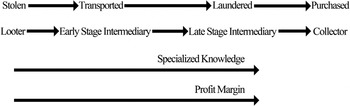
Specialist knowledge within antiquities trafficking includes locating sites, transportation, transnational smuggling, laundering, and art history.Footnote 29 Four general stages are observable within the trade—looter, early stage middleman or intermediary, late stage intermediary, and collector—and more than one individual may occupy a stage. Profit appears to favor the most specialized,Footnote 30 since rural looters lack smugglers' transportation knowledge, who in turn lack the gallery owners' appraisal skills. Therefore, specialization correlates with profit in each stage, as shown in Figure 1. Assuming that the antiquities trade resembles other trafficking, then specialized knowledge is likely the basis behind role development, reflecting the trade's network development over time.
The four stages observed within antiquities trafficking illustrating how both specialization and profit increase through the stages.

The reoccurring nature of these stages suggests that they are manifestations of an underlying internal structure. It appears that the stages are the result of role specialization dictated by physical and cultural limitations placed on participants due to geography, economics, local and international legislation, and cultural views on antiquities. In particular, three limiting factors emerge that create an unintentional and organically designed four-stage structure through which most trafficked antiquities pass.
The mechanism behind this internal structure warrants further examination. There exists a complex geographical, political, and economic framework that enmeshes antiquities and necessitates specialized roles. Antiquities can be distinguished from other trafficking in three regards: Cultural heritage is a finite resource that cannot be cultivated or manufactured, profits increase progressively from source to market, and artifacts must be laundered in order to appear legitimate.Footnote 31 While narcotics can be cultivated and arms can be manufactured, antiquities are a finite resource derived solely from looting cultural sites. Looters can be highly skilled at locating sites and knowledgeable about the local landscape, but they often lack the means to transport artifacts out of their immediate region or across international borders.Footnote 32 Antiquities are therefore typically transferred to participants with the means and knowledge to transport illicit commodities internationally. In turn, these early stage intermediaries lack the knowledge to judge the value of antiquities, including whether artifacts are real or fake,Footnote 33 or the ability to appear legitimate to collectors. The first two stages, theft and transport, therefore, have specialized roles of looter and early stage intermediary with the local knowledge required to extract antiquities from source countries.
Unlike narcotics and arms, antiquities often appear in legitimate sales in source countries. The reasons are economic and cultural. First, a larger purchasing population can be accessed through selling laundered artifacts in legitimate or gray market businesses.Footnote 34 Second, collectors generally purchase artifacts as status symbols and therefore objects to be displayed.Footnote 35 Symbols require shared experience with peers in order to communicate meaning, which in this case is the owner's wealth, prestige, or connoisseurship.Footnote 36 However, illicit activity typically earns disapproval, the opposite of the desired effect. Collectors therefore specifically purchase artifacts that have been laundered, even when they know the antiquities are looted, as demonstrated by several prominent museums.Footnote 37 This legitimacy concern creates the third stage, where laundering specialists interact with the black market while presenting themselves as legitimate to the public. Legitimacy and art history specialization, both important for the late stage intermediaries, is sometimes the result of university education. Notable examples include Robert Hecht, who studied Latin at Haverford College, classics at University of Zurich, and was a Rome Prize Fellow at the American Academy in Rome.Footnote 38 Jonathan Tokeley-Parry has degrees from Cambridge University and University College London.Footnote 39 Christoph Leon received a degree in archaeology before becoming known as the dealer who sold the J. Paul Getty Museum a looted gold funerary wreath.Footnote 40 Late stage intermediaries join collectors to form the third and fourth stages, respectively, which operate primarily in market countries.
The elements that distinguish antiquities from other trafficking serve as limiting factors for participants that typically precludes a single individual from acting alone due to lack of capital, mobility, or art history knowledge. This is not to say that nonspecialists do not attempt to traffic antiquities; however, probability suggests that specialists have a higher success rate, which is precisely why specialization develops and is favored within network structures. The emerging picture of the trade's structure is a framework unique to each series of transactions, rendered thus by conditions in source and market countries. On one end is a geographical, political, and economic framework that is specific to each source country, while on the other end exists a set of conditions for each market country. For example, antiquities smuggling from Afghanistan faces different geographical and cultural factors than Bulgaria, just as selling antiquities through eBay is quite a different skill set from owning a gallery.
Several well-documented antiquities trafficking cases are excellent examples of the four stages. Giacomo Medici's trial and subsequent conviction provided a wealth of information on the trade, which is presented in the seminal work “The Medici Conspiracy.”Footnote 41 Local tombaroli looted archaeological sites and Medici acted as an early stage middleman by purchasing artifacts from the tombaroli and their associates. Due to relaxed customs laws in the Freeport, Medici could sell the antiquities internationally to dealers in market countries from this transit country. Medici never sold directly to collectors, instead selling the artifacts to dealers, primarily Robert Hecht, who then resold the antiquities. In his role as late stage intermediary, Hecht laundered the antiquities onto the licit market to facilitate sales to collectors like the J. Paul Getty Museum and the Metropolitan Museum of Art. As the newly legitimized antiquities came to rest in museum cases, the final stage of trafficking ended.
The Italian prosecutor described Medici as part of a hierarchical antiquities organization, so it is important to understand why he made this claim and why it is false. It was based on two pieces of evidence, a tombarolo referred to a “cordata,” or mafia structure, when describing Medici and other participants and an organigram found in Pasquale Cameras' home.Footnote 42 The organigram diagrammed a path of antiquities flows leading to Hecht, creating a pyramid of relationships that looked similar to a hierarchy. However, criminology has determined that a hierarchical structure functions based on three features: (1) participants lower in the hierarchy are subject to a monopoly, (2) long-term agreements, and (3) sanctions.Footnote 43 In contrast, the Medici case showed that the transfer of looted artifacts from tombaroli to early stage intermediaries was optional and on an opportunity-to-opportunity basis, which implies a network structure. In fact, tombaroli freely sold artifacts to other early stage intermediaries than Medici like Gianfranco Becchina, so the looters had no fear of sanctions, even going so far as attempting to sell fraudulent artifacts to early stage intermediaries.Footnote 44 Hecht established himself as the top late stage intermediary through guaranteeing the best rate, as Medici discovered at the start of his career, rather than through agreements or sanctions.Footnote 45 The most dramatic evidence that the Italian illicit antiquities trade was not hierarchical is that it continues to thrive even with the conviction of key figures like Pietro Casasanta, Medici, and Hecht, as well as the death of Nino Savoca and Cameras. In light of analysis, the tombarolo who used the term “cordata” was apparently using a familiar word rather than an accurate one. Furthermore, the prosecutor had to approach the case under the existing laws and most Italian organized crime laws were written to combat hierarchical groups following years of mafia crime, so the prosecutor tailored the approach to Medici's case to the legislation. Antiquities trafficking fits none of the criteria for a hierarchal structure and scholars studying cultural trafficking have quite rightly rejected hierarchical structures for the illicit antiquities trade.Footnote 46
The Lydian Hoard is another well-documented case that clearly demonstrates the four-stage structure. In 1965, a group of Turkish farmers looted a tomb and sold the contents to smuggler Ali Bayirlar. Bayirlar sold them to two late stage intermediaries, Swiss dealer George Zacos and New York dealer John Klejman, who sold the artifacts to the Metropolitan Museum of Art from 1966 through 1970.Footnote 47
Few cases are as clear-cut as the two previous examples. Roles are often filled by multiple individuals, as Operation Ghelas illustrates. Eighty-five individuals were indicted in a case of criminal networks smuggling Italian antiquities across several countries. Tombaroli sold looted antiquities to smuggling cells that operated transnationally. Police located four cells that smuggled artifacts from Italy to Switzerland through a large population of participants, including taxi drivers and policemen. From Switzerland a network transported antiquities to Germany, Spain, the United Kingdom, and United States. Once in the market countries, several late stage intermediaries laundered the artifact from seemingly legitimate storefronts and auction houses including at least one notable dealer.Footnote 48
The Achyris phiale demonstrates the variable routes that antiquities can take in certain stages. Sicilian intermediary Vincenzo Pappalardo purchased the artifact from an unnamed Sicilian looter. Pappalardo traded it to another well-known Sicilian intermediary, Vincenzo Cammarata, who traded it to Hungarian intermediary William Veres. After three early stage intermediaries, the artifact passed to New York dealer Robert Haber. Haber and Veres falsified documents about the artifact's history in order to launder it. Haber then transported the gray-market phiale, selling it as an apparently licit item to collector Michael Steinhardt. In this case, Veres and Haber falsified documents in Switzerland, laundering the artifact before arriving in New York.Footnote 49
These cases demonstrate the known observable roles. The previous examples show the variety of participants, from Turkish farmers to New York gallery owners, found within the trade. Following the traditional law enforcement approach, these court cases focused on specific individuals or artifacts. In contrast, an effective model of trafficking networks synthesizes the behavior of all participants into a broadly applicable organizational model. If the roles are network based, then they can explain how participants interact. Similarly, the network's internal structure defines how participants behave. Understanding interaction and behavior is crucial for characterizing and anticipating trafficking. The following section focuses on three major source countries and charts the sequence of events from source to market demonstrating network organization with an underlying four stage structure.
II. CASE STUDIES
As major supply countries, the path that Afghan, Iraqi, and Bulgarian antiquities take from the ground to collections is largely representative of the trade as a whole. Significantly, these three countries are also the focus of several lingering questions about the trade. Each case is organized by stage and the interactions within each.
The first two case studies follow transactions through each stage, as suggested by network criminologists.Footnote 50 However, it should be noted that published trafficking sources, including antiquities, are limited and problematic.Footnote 51 The sources cited below are a collection of media and law enforcement reports, military records, online auction records, and research articles. While each of these source types has potential shortcomings, together they give a broad overview of the trade through their sequence of events. Readers would do well to consult the endnotes, which often contain several examples, since the overviews presented in the case studies are digests of many sources. Since media, military, and law enforcement records can create a potentially biased model of based on failed criminals,Footnote 52 this is balanced by the third case study that examines a specific individual that was a successful dealer for many years and how his antiquities were transferred through each stage.
A. Afghanistan
Afghanistan is a major victim of the illicit antiquities trade.Footnote 53 Subsistence diggers, local citizens that turn to looting due to economic hardship, are the primary looters.Footnote 54 This type of looting often occurs during the political turmoil following military action, when law enforcement is unable to protect sites.Footnote 55 Subsistence diggers sell artifacts to intermediaries who visit villages or archaeological sites.Footnote 56
The primary exit for Afghan antiquities appears to be Pakistan.Footnote 57 Though dangerous, this route is popular among smugglers.Footnote 58 Narcotics smugglers are known to cross easily into Pakistan at the unmanned border crossing at Baramcha.Footnote 59 Several established smuggling organizations operate on the border, the two largest being Hezb-i-Islami and the Haqqani network;Footnote 60 however, smaller groups also conduct narcotics, timber, and gem smuggling.Footnote 61 Jack-of-all-trades smuggling groups are likely the primary transportation for antiquities headed to Pakistan.Footnote 62
In her analysis of the opium trade, Gretchen Peters details how these organized smuggling groups operate along the Afghan-Pakistani border, engaging in any profitable enterprise including trafficking of narcotics, arms, humans, antiquities, and other commodities, as well as crimes including kidnapping and theft.Footnote 63 In Peters' report for the West Point Combating Terrorism Center, one Afghan source explained how the Taliban profits from illicit antiquities, stating “businessmen who smuggle precious stone, sculptures and other historic artifacts…pay dues to the Taliban to avoid trouble on road.”Footnote 64 According to the same source, this smuggling is tied to the Haqqani network and is major financial consideration for both the Taliban and the smugglers.Footnote 65
Once in Pakistan, antiquities are sold in border towns and transported to major cities.Footnote 66 Commercial airlines and ships transport the artifacts to cities like Sharjah or Dubai, United Arab Emirates, which has grown into the region's primary transit country due to few regulations.Footnote 67 The Afghan Transit Trade Agreement, which rescinds import taxes between Afghanistan and the Pakistani port of Karachi, ensures a large flow of Afghan goods through the port, including a large quantity of smuggled goods. There is also a large amount of air cargo between Kandahar and Dubai.Footnote 68 Illicit shipments have been found in Karachi destined for Sharjah as well as in Sharjah having arrived from Pakistan.Footnote 69 Antiquities are smuggled hidden in commonplace items like furniture, in falsified cargo manifests, or in false compartments.Footnote 70
United Arab Emirates is an arterial route for antiquities leaving the region for market countries. Illicit antiquities from the entire region, including Afghanistan, Iraq, Iran, Yemen, Azerbaijan, and Pakistan, as well as countries outside the immediate area like Turkey, are sent to Sharjah before being sent internationally.Footnote 71 The fact that a Turkish shipment worth an estimated at US$6 million was transported via Sharjah demonstrates the importance of United Arab Emirates as a transit country.Footnote 72 In the first six months of 2008, looted antiquities from Yemen alone amounted to 90 law enforcement raids capturing over 5000 antiquities.Footnote 73 Upon arrival in Sharjah, antiquities are purchased by individuals with connections abroad, who collaborate with corrupt customs officials in order to export them.Footnote 74 Many artifacts then head to the traditional European transit country of Switzerland.Footnote 75
Arriving in Europe, antiquities have passed through many hands, but now enter the same established routes detailed in the Medici case and other examples. Repatriated artifacts indicate travel from Switzerland and Germany to market countries like United Kingdom and Belgium.Footnote 76 In Blood Antiquities, documentary filmmakers captured how dealers launder Afghan antiquities in Belgian galleries. One dealer has a “safe house” off the main gallery street where newly smuggled antiquities arrive and are either sold to other dealers or placed in his gallery. Another dealer claimed an artifact came from an old collection, a traditional laundering practice, until the interviewer pointed out that it still contained dirt.Footnote 77 The film clearly illustrates that dealers are knowingly engaged in laundering Afghan antiquities onto the licit market.
After laundering, collectors purchase the newly legitimized artifacts. Collectors in traditional market countries including the United Kingdom, Belgium, and the United States have seen an increase in Afghan antiquities since the start of the recent conflict.Footnote 78 This increase underscores the scale of trafficking occurring since the export of unprovenienced Afghan antiquities is illegal.Footnote 79
B. Iraq
Similar to Afghanistan, Iraq experienced widespread looting following military conflict.Footnote 80 Numerous sources detail the looting of archaeological sites as well as Iraqi artifacts repatriated from market countries, but there is an information gap between looting and the licit market.Footnote 81 Antiquities disappear into the black market before reappearing laundered in galleries or collections, making evidence from this in-between phase problematic. Neil Brodie has argued that military records could contain a wealth of information on antiquities trafficking.Footnote 82 WikiLeaks' release of the Iraq War LogsFootnote 83 provides an opportunity to examine military records, albeit leaked, and fill the gaps in the middle of the Iraqi antiquities trade.
As a source, the WikiLeaks documents are not without issues. The documents appear to have been chosen randomly and span several years. It is impossible to determine if the information they contain is representative or not;Footnote 84 however, even as a fragmentary record, the WikiLeaks files confirm Brodie's hypothesis that military records have value for researchers.
Sources about Iraqi looting indicate a large amount of subsistence digging similar to Afghanistan, largely due to the country's 70% unemployment rate following the invasion.Footnote 85 The WikiLeaks files corroborate this, reporting raids on “major archaeological sites” that resulted in arrests and confiscation of looted artifacts.Footnote 86
The same economic hardship that drives subsistence diggers to loot also keeps them from transporting their looted material long distances. Iraqi intermediaries appear to come from various backgrounds. Roger Atwood records an incident where an individual parked on a site and purchased antiquities from the subsistence diggers.Footnote 87 Other sources describe criminal networksFootnote 88 and the WikiLeaks files, as law enforcement reports, support this view. Most of the antiquities reports come from countercrime raids.Footnote 89 Illicit antiquities are profitable for these groups, as demonstrated by one smuggler captured with artifacts and one million Iraqi dollars.Footnote 90
Media sources detail how antiquities exit Iraq. There are numerous exit locations, as smuggled antiquities have been found transited to Jordan, France, Italy, Syria, Switzerland, Kuwait, Saudi Arabia, Iran, and Turkey.Footnote 91 Many end up in established transit countries like United Arab Emirates and Switzerland, as well as the familiar Karachi to United Arab Emirates route.Footnote 92
Once in market countries, similarities are seen between Iraqi antiquities and those from other source countries. One Munich auction house attempted to sell a smuggled gold vessel, while another dealer purchased a stolen royal battle axe.Footnote 93 The Federal Bureau of Investigation (FBI) captured a dealer in the United States with a “multitude” of smuggled Iraqi antiquities.Footnote 94 Once laundered into European and North American galleries, antiquities pass easily to collectors. In an infamous case from the first Gulf War, University College London found that a collection of Aramaic incantation bowls owned by Martin Schøyen had been looted in 1991. The university suppressed the report, but it was eventually leaked through WikiLeaks.Footnote 95 A certain population of collectors is cognizant that available Iraqi antiquities are looted. On 24 January 2003, a group of collectors organized the American Council for Cultural Policy and met with the Bush administration about relaxing laws governing the sales of Iraqi antiquities in advance of the 20 March invasion.Footnote 96
C. Bulgaria
Bulgaria has long experienced looting problems as the third largest source country in Europe.Footnote 97 Bulgaria is also a major conduit for antiquities smuggled from the Near East, Middle East, and Africa since it is a popular trafficking route to European market countries.Footnote 98 The history of the Bulgarian antiquities trade shows a shift in the market upon entering the digital age, as exhibited by online auction sales.Footnote 99
Under the former communist government, trafficking was state run and fell under the auspices of the Bulgarian secret service. Using a front company named Kintex, the secret service held a monopoly on Bulgarian smuggling that included antiquities, arms, and other illicit goods.Footnote 100 Criminal groups supplied Kintex with antiquities from well-defined territories that were guarded and exploited through related crimes including murder.Footnote 101
Today, state run smuggling has been replaced by networks that supply market countries with large quantities of illegal commodities including humans, narcotics, arms, and antiquities.Footnote 102 Smugglers are known to transport antiquities with other illicit goods including human trafficking.Footnote 103 Law enforcement has found ties between narcotics, arms, and antiquities.Footnote 104 Widespread corruption aids smuggling. Georgi Getov, head of the National Police's Cultural Property Department, collaborated with an antiquities smuggling ring that included police, prosecutors, and museums.Footnote 105 Prosecutors colluding with Bulgarian criminal groups keep archaeologists from known archaeological sites.Footnote 106 Dealers take advantage of Bulgarian trafficking to create large online stores, such as one dealer identified by multiple sources as former Prosecutor General Nikola Filchev's brother, as he will be referred to in this article since he still freely operates in the United States.Footnote 107
According to sources, Filchev's brother has a history of run-ins with the law between 1994 through 2007 over illicit antiquities. He has not been convicted, but researchers suggest this is due to Filchev's status as Bulgaria's Prosecutor General.Footnote 108 Filchev himself has been accused of large-scale corruption while serving in office.Footnote 109 His brother allegedly held a protected position while Filchev was in power, allowing him to conduct antiquities smuggling.Footnote 110
Charges were first brought against Filchev's brother in April 1994 for antiquities trafficking and he faced charges again in December 1997. In May 1998, he was arrested at a checkpoint attempting to smuggle antiquities across the border to sell them to “an international organized crime organization.”Footnote 111 Filchev's brother was placed in custody, but prosecutor Kiril Ivanov released him “without giving due reason” and he left the country before his trial, while Ivanov received a promoted from Filchev.Footnote 112 In 1999, Filchev's brother moved to Hackensack, New Jersey, where he opened a business named Silenos Coins and Antiquities that sold artifacts on eBay.Footnote 113 Silenos Coins applied for several visas for foreign nationals traveling to the United States.Footnote 114 In March 1999, German officials captured a package of illicit antiquities that he was shipping to himself and police also identified eight previous packages that he had sent to the United States through Germany.Footnote 115
When German officials sent the details of Filchev's brother's case to Bulgaria, the prosecutor's office requested all documents related to the case and subsequently buried them from public view.Footnote 116 Journalists who mentioned the German incident were brought into the prosecutor's office for a false interrogation meant to intimidate them and Filchev told subordinates, “publishers and all people connected to them should be pressed not to allow such publications in the future.”Footnote 117 According to one of Filchev's prosecutors, Nikolay Kolev, Filchev told his staff that a case would not be pursued against his brother for antiquities trafficking. Shortly after speaking to the media about the incident, Kolev was murdered.Footnote 118
The contract killer who murdered Kolev was part of an organized crime group linked to Filchev and the prosecutor's office never investigated Kolev's murder. Kolev's widow won a human rights case based on the fact that the murder had not been properly investigated and the court ordered the case back open. Filchev is currently under investigation for ordering Kolev's murder, as well as a lawyer's murder in an unrelated case, and other crimes. It should be noted that Filchev is a polarizing figure in Bulgaria, so some accusations and court cases may be political maneuvers by political opponents.Footnote 119
Filchev left office in 2006 and Silenos Coins disappeared from eBay in June 2007.Footnote 120 In March 2007, the new prosecutor general had publically announced that his office was tracking the brother's online records.Footnote 121 Since eBay users in 2007 could leave feedback up to 90 days following purchase, Filchev's brother appears to have stopped selling under Silenos Coins immediately following the announcement.Footnote 122 However, another account allegedly owned by him, S*P*Q*R, continued selling antiquities into 2009.Footnote 123 It is unknown whether Filchev's brother continues to sell antiquities, but the Bulgarian court case is pending while he remains abroad.Footnote 124
Silenos Coins' eBay records can still be accessed,Footnote 125 providing detailed information about online antiquities sales. Most artifacts are coins and the other artifacts are likewise metal, such as bronze arrowheads, which suggests that looters used metal detectors. Periods vary from fourth century bce through eighteenth century with the bulk being late Roman bronzes from Thrace, modern Bulgaria, though coins originating in the Near East, Turkey, and Greece are found.Footnote 126 This geographic region fits well with historical events and antiquities trafficked through Bulgaria.Footnote 127
Unlike the two previous case studies, this discussion is heavily focused on an individual. While this is not ideal for a network approach,Footnote 128 the information is significant in that these records are detailed transactions of a successful antiquities trader. In contrast, many law enforcement or media sources are evidence of failed traffickers. Law enforcement sources can bias trafficking reconstructions,Footnote 129 so Silenos Coins provides researchers with direct documentation.
Bulgarian looting is a mixed population of impoverished individuals, hobbyists looking to supplement their regular income, and well-funded crews supplied with the latest technology.Footnote 130 The police estimate that Bulgaria has 30,000 looters, including criminal groups that oversee illegal excavations.Footnote 131 There is no evidence of Filchev's brother looting himself, so he likely used connections to purchase antiquities from looters. Early in his career, he was part of an “underground structure,” though it is uncertain whether this began with general smuggling or if he has always focused on antiquities.Footnote 132 He used at least two smuggling methods, physically carrying antiquities across the border and mail,Footnote 133 though other methods were potentially used following these reported incidents since he did not experience any law enforcement issues between 1999 and 2007. Once in the United States, Filchev's brother maintained a legitimate storefront; however, he lacked specialized knowledge about antiquities and resorted to hiring specialists to identify artifacts.Footnote 134 Silenos Coins was a staple of eBay antiquities sales from 2 February 2000 through 16 June 2007.Footnote 135 Online antiquities sales are likely to increase as the Internet offers an easy route to connect with collectors.
III. DISCUSSION
The case studies show large scale trafficking composed of diverse and loosely connected participants, with interchangeable individuals in the first two stages and a small reoccurring population in the third stage. Sources show that there is no representative type of participant in the first stage, revealing that any individual presented with a profitable opportunity might be inclined to participate. The second stage is composed of interchangeable transporters, often general smugglers that take on antiquities shipments on an opportunity to opportunity basis. The third stage has the smallest population, but observable trends show that even this stage is variable, with early stage intermediaries regularly using different late stage intermediaries. Interactions generally consist of single exchanges of capital and goods with no promise of long-term agreements or minimum guarantees of a portion of later profits.Footnote 136 In contrast to hierarchical structures, participants in the trade have no fear of sanctions if further interactions do not occur, as discussed in the Medici case. The mechanisms behind the trade's observable complexities as well as the similarities found with other trafficking networks suggest that antiquities trafficking has a network structure with four transitional stages. For this reason, the trade is characterized broadly and most accurately as a network with fluid interactions.
By focusing on a structural approach rather than specific individuals or crimes, behavior is explained as opposed to simply describing observable actions. During interactions participants are motivated based on personal risk and specialization, often with no cognizance of the preceding or proceeding nodes in the network. Money is exchanged at each interaction rather than collaborating together as a chain and partitioning profits after the final sale, so personal profit is a result of risk and specialization. Once in possession of an illicit item, concealment is necessary.Footnote 137 Seeking a higher profit requires more time to search for participants, resulting in extended risk. Additionally, the longer an individual has possession of the item, the more risk is compounded. Those in possession of an illicit object must balance concealing their crime with being public enough to attract the interest of participants in the next stage. A nonspecialized participant can attempt to fill a specialized role, but their lack of knowledge increases possession time with the illicit item and the corresponding risk, so nonspecialists face increased likelihood of arrest. Therefore, interactions weigh risk against knowledge, which correlates directly to a participant's profit.
This balance is observed through all four stages of the trade. Afghanistan, Iraq, and Bulgaria all have large populations of subsistence diggers attempting to supplement their meager incomes. These impoverished individuals are unable to transport the antiquities transnationally where demand is located, so they accept a small sum. A series of transporters then move the antiquities locally, nationally, and internationally. In the Afghan case, antiquities traded hands multiple times, while in the Bulgarian example there appeared to be only one or two early stage intermediaries. Once reaching a transit or market country, the artifacts are transferred to individuals offering either the largest profit or the safest transfer. Late stage intermediaries require legitimate storefronts to display artifacts for the widest population of the target demographic in order to command the highest price and maximize their own profits. This series of interactions maximizes each participant's profit while minimizing individual risk, creating a network from source to market with a predictable structure.
An interesting result of risk and specialization is decentralized market regulation. The United States Department of Defense noted that intermediaries in antiquities trafficking carefully regulate the market to keep demand and prices high.Footnote 138 During interviews, looters have noted that market forces maintain both supply and demand artificially.Footnote 139 For example, tombaroli are paid preestablished fixed fees by early stage intermediaries, removing the possibility of receiving a higher price from different intermediaries.Footnote 140 On the surface, it appears questionable that market regulation is possible in loosely based, noncentralized networks. However, regulation is maintained through the threat of risk extension. Each proceeding stage has specialized knowledge unavailable to the preceding one, meaning that the earlier participants can either accept the given price or extend their risk while attempting to find another buyer. The threat of risk extension causes early nodes to accept a lower price, demonstrating the influence of risk and specialization within the stages. These behaviors are useful for answering some of the lingering questions within this field of research.
A. Using the Network Paradigm: New Perspectives on Lingering Questions
The network paradigm allows researchers to interpret the antiquities trade on various scales. The case studies examined the observable aspects within each stage, so this discussion will focus on the behaviors found among each level of participants. Analyzing the previous case studies for behaviors using the network paradigm offers new perspectives on several lingering questions and demonstrates the interpretive ability of a structural approach over research focused on a specific individual or artifact.
Afghanistan and Terrorism
Whether illicit antiquities are funding terrorism is a hotly debated topic. Media sources claim that the Taliban and Al-Qaeda are benefiting from antiquities sales.Footnote 141 A widely cited Der Spiegel article states that 11 September 2001 terrorist Mohamed Atta contacted a University of Gottingen faculty member about selling Afghan antiquities, while also mentioning that he needed funds to purchase a plane.Footnote 142 This article is the most touted evidence of illicit antiquities funding terrorism, but the article is a brief seven sentences, published four years after the attacks, and written based on a law enforcement interview with an anonymous individual who has remained silent despite the enormity of the claim.Footnote 143 This is not to say the article is false, but extraordinary claims require evidence. The article's tenuous nature has not deterred writers from repeating it and citing each other, the result being articles far longer than the original Der Spiegel report without providing new evidence.Footnote 144 Until the faculty member comes forward, the Der Spiegel article cannot be viewed as more than what it is: an anonymous secondary source. However, given what is known about the trade as a network, could Atta have been acting as an early stage intermediary seeking a late stage intermediary? Do illicit antiquities fund terrorism?
As explored earlier, Afghan early stage intermediaries are typically general smugglers trafficking any illicit commodity that is in demand. The two major smuggling organizations are Hezb-i-Islami and the Haqqani network, who work closely with the Taliban.Footnote 145 In fact, the Haqqani network is recognized as the most dangerous insurgent group in Afghanistan and is considered the Taliban's chief ally.Footnote 146 The Haqqani network smuggles illicit commodities into Pakistan, primarily narcotics, where it exchanges them for arms that are in turn sold to the Taliban.Footnote 147 Assuming that looters receive around 2% of the final sale price similar to elsewhere,Footnote 148 the bulk of Afghan antiquities money goes to early stage intermediaries in the region and late stage intermediaries in transit or market countries, meaning that the Haqqani network and other smugglers may receive a significant amount through antiquities.
While affiliate organizations may be profiting, it is doubtful that the Taliban would handle antiquities if they do not even smuggle their own weapons. However, businessmen smuggling commodities in collaboration with the Haqqani network pay a tax to the Taliban to operate safely.Footnote 149 Based on currently available sources, this tax appears to be the only source of funding for the Taliban related to antiquities, though all commodities smuggled across the border are a facet of the arms trade that supplies the Taliban.
This fits well with the known Taliban structure in Afghanistan. Former Taliban foreign minister Waheed Mojda stated that “The international community and the Americans have been deceiving themselves for the past seven years, saying the Taliban has been getting all of their money from drugs.”Footnote 150 Hezb-i-Islami and the Haqqani network are hardly the only smuggling groups in Taliban controlled territory and the development of a high profit crime-driven economy has resulted in “a wide spectrum of illegitimate economic activity, including … smuggling of antiquities and other contraband… The main beneficiaries of these activities are the warlords, spoiler groups and an emerging narco-mafia.”Footnote 151 The many criminal groups exploiting this gray economy not only benefit the Taliban through tax revenue, but also supply them with weapons on the return route allowing the Taliban to prolong the conflict.Footnote 152 It is reasonable to claim that money from the antiquities trade is making its way to the Taliban. However, the vast majority of this money is likely lining the pockets of affiliated organizations such as the Haqqani network, though this indirectly extends the Afghan conflict and benefits the Taliban.
While the Taliban is a political group that governs territory, Al-Qaeda lacks a governance to impose a similar tax. It appears that Al-Qaeda receives most its revenue through patrons and donations; however, recent Islamist terrorist attacks have been funded by crimes including bank robbery and petty theft, credit card fraud, and drug trafficking.Footnote 153 The anonymous Der Spiegel source aside, there is currently no direct evidence of Al-Qaeda profiting from the antiquities trade, though it would not come as a surprise based on the group's funding from other criminal activities.
Iraq and Insurgency
Since the Iraq invasion, a number of individuals have claimed antiquities are funding either insurgency or terrorism. Iraqi ambassador Hussain Mahmood Fadhlalla al-Khateeb stated that antiquities trafficking is funding terrorists and Iraqi museum director Donny George claimed that illicit antiquities are funding insurgent groups.Footnote 154 The United States Marine Corps states that there is a “strong case” that illicit artifacts are funding weapons.Footnote 155 United States Colonel Matthew Bogdanos says, “There is no doubt that international trade in illegal Iraqi art and antiquities is funding the insurgency” and funding arms purchases.Footnote 156 Bogdanos describes a raid that captured a terrorist bunker containing weapons, ammunition stockpiles, and illicit antiquities.Footnote 157
The antiquities trade in Iraq and Afghanistan closely resembles each other. Subsistence diggers exploit known sites and sell artifacts for a small sum to early stage intermediaries.Footnote 158 General criminals or smugglers then transport the antiquities out of the country to established transit countries, such as United Arab Emirates or Switzerland.Footnote 159 This fits with Bogdanos' view that smugglers will transport any illegal commodity that is profitable, “whether the cargo is drugs, weapons, human beings, or antiquities.”Footnote 160 The WikiLeaks files mention links between general crime and antiquities. For example, in one raid five individuals were caught with stolen goods, counterfeiting machines, and 31 artifacts looted from the Baghdad Museum.Footnote 161 Another raid found smugglers with several valuable illicit commodities including rubies, platinum alloy, gold dust, and “archaeological material.”Footnote 162 Several other files indicate general smugglers were transporting antiquities.Footnote 163 The files reveal early stage intermediaries, rather than subsistence diggers, engaged in all manner of illicit business.
Connections to violent groups are documented as well, potentially linking antiquities to the insurgency. One raid captured more than 89 arms and related material, as well as antiquities including “several vases, statues and tools.”Footnote 164 Several individuals were arrested on a tip that they were selling weapons and antiquities.Footnote 165 The most direct example is a criminal group that planned a coordinated multipronged attack with rocket launchers. The purchaser of the rockets was a known antiquities trafficker.Footnote 166 Potentially related, the antiquities protection department found a large weapons cache that included 16 mortarsFootnote 167 and a similar cache was found in an “antiquities area” including masks, mortars, and launchers.Footnote 168
Are antiquities funding the insurgency? The fragmentary WikiLeaks files indicate that general, and at times violent, criminals are engaged in the antiquities trade, but are these insurgents? Certainly, the planned rocket assault paid by an individual profiting from antiquities fits with an insurgent attack.Footnote 169 Louise Shelley argues that there is an artificial distinction between crime and terrorism, since both groups have interchangeable members and exploit opportunities available for both.Footnote 170 However, claiming that insurgents fighting for their country, in their view, are the same as criminals or terrorists appears to be an oversimplification. Similar to Afghanistan, Iraqi smugglers acting as early stage intermediaries and market country dealers are most likely to profit from the trade. Participants that engage in both insurgency and antiquities trafficking are likely the result of “one crime depend[ing] on another” and smugglers pursuing any profitable commodity.Footnote 171 The link between insurgency and the antiquities trade is likely a question of scale as there is doubtless some measure of overlap between participants.
The Syrian civil war offers a supporting view on participants. Interviews with smugglers along the Syrian and Lebanese border regarding the role of antiquities in the conflict provide detailed information on the first two stages. According to the smugglers, looting is propagated by “opportunists,” or any individuals seeking extra money.Footnote 172 The majority of looters are subsistence diggers, “trying to take advantage of the conflict to earn a few extra dollars, whether to buy bread or weapons.”Footnote 173 However, smugglers claim both the Free Syrian Army and Bashar Al-Assad's regime are selling looted antiquities to raise money.
Antiquities and arms are a only portion of the smugglers' trade, as they transport a wide range of illicit materials including cigarettes and stolen goods.Footnote 174 Weapons are the general currency along the border. Syrians request weapons in exchange for antiquities, while the smugglers receive weapons instead of money from intermediaries in Beirut.
Smugglers report that the Free Syrian Army has created a looting team to fund their movement, which a spokesman denies with the caveat, “Sure, there are people who loot, but they work alone. If that is how they buy weapons to fight, we can't control them. It's revolution, we are not organized, and no one is supporting us.”Footnote 175 This telling quote points to the decentralized system at work, composed of a fluid population of participants similar to Afghanistan and Iraq. Do Iraqi, or Syrian, antiquities fund violence? In certain instances it appears so, but these cases show that marginal or desperate groups will exploit any profitable resources, whether it is counterfeiting, narcotics, or antiquities. To imply that antiquities fund violence instead of viewing their exploitation as a product of economic and political turmoil is placing the cart before the horse.
Internet Sales
The Internet has become a major conduit for criminal activities, so it is hardly surprising that illicit antiquities are available online.Footnote 176 The benefits of online sales for criminals include reaching a wider population, nonpersonal interactions, and what is termed “simple concealment,” based on the privacy afforded by a personal computer.Footnote 177 While some scholars claim that Internet auction sites are hurting the illicit antiquities trade by driving down prices and introducing fakes,Footnote 178 sales accounts show that both high- and low-end antiquities are being sold with considerably ease through websites, often for record sums.Footnote 179 Traditional dealers are frequently moving toward Internet sales, including established galleries with known links to the illicit antiquities trade.Footnote 180 Auction site dealers are able to sell large quantities of cheaply priced, but culturally significant, looted artifacts.Footnote 181 This activity is unlikely to cease in the future, so understanding how Internet sales function is important for researchers.
The Silenos Coins case study can provide insight into Internet sales. Antiquities trafficking by Internet dealers has the same basic structure as the rest of the trade, but the role of late stage intermediaries is revised, replacing the traditional participants with new a type of specialist skilled at Internet marketing. Looters supply intermediaries, who move Bulgarian antiquities through the same channels as other illicit commodities, reminiscent of the second stage in Afghanistan and Iraq.Footnote 182 Smugglers transport the antiquities to market countries and then mail them to dealers,Footnote 183 presumably because mail from other market countries is less likely to be screened than packages coming from source countries. Filchev's brother's arrests and German incident suggest that he originally smuggled antiquities himself, but others procured the artifacts after he moved to the United States. The establishment of a storefront allowed for sales through auction sites.
The Internet enters the network in the third stage, with auction sites replacing traditional late stage intermediaries and acting as the interface for the dealer and a much larger population of potential collectors than a gallery. Auction sites unwittingly launder artifacts through their appearance of legitimacy provided by the template structure, sustaining the gray market and being rewarded with a percentage of the profits. Collectors purchase items that are assumed to be legal based on the site's guidelines. In reality, there are few options for checking an item's provenience, as sites conduct no oversight of listed items and trust sellers to be ethical.
Silenos Coins' eBay records reveal the extent of the business. Silenos Coins' 41,198 transactions reviews are not a wholly accurate method for determining values since some auction lots contain multiple artifacts and a significant percentage of transactions are never reviewed. eBay users estimate that 40% to 90% of transactions are reviewed, but never 100%.Footnote 184 Similarly, seller feedback left by Silenos Coins totals 51,808 transactions; however, customer requests for feedback suggest that not every transaction was reviewed.Footnote 185 Therefore, any estimates based on eBay feedback are conservative. Sales prices are only listed on reviews left between November 14, 2006, and June 16, 2007. During this seven-month period, 4515 transactions occurred ranging between US$0.99 and US$481.50 and totaling US$109,109.64. This equates to an average price of US$24.17 per transaction. With 51,808 reviewed transactions, it can be conservatively estimated that Silenos Coins earned US$1,251,993.85 in the seven years and four months that it operated between 2000 and 2007. This equates to approximately US$465 each day since the store opened or US$779 per business day.Footnote 186 These figures only account for eBay transactions, but in-store sales, trade shows, and conventions also contributed profits. Silenos Coins reveals the element hidden behind innocuous listings on auction sites.
Future research on antiquities trafficking is likely to focus on Internet sales. The legitimate appearance of auction templates simplifies laundering and websites have access to a wider audience than traditional storefronts. eBay alone has over 212 million registered users.Footnote 187 eBay auctions are also viewable through major search engines like Yahoo and Google, increasing the audience to practically any Internet user. The detailed information from Silenos Coins is useful as a baseline for future research into Internet sales. Canadian officials captured more than 21,000 illicit Bulgarian antiquities that were destined for the United States and a numismatist estimated the total value at €100,000 (US$134,119), or fewer than €5 (US$6.71) per artifact.Footnote 188 Based on Silenos Coins' data, the shipment is more accurately estimated as €378,219 (US$507,570). This figure is conservative considering the presence of high-value antiquities, like jewels and glass objects, in the shipment. Internet auctions will likely become a popular research area since online transaction records can provide more detailed sales information than previously available.
B. Crime within the Network
Researchers have debated the character and proportion of crime within the illicit antiquities trade and few topics have such contrasting views as organized crime. Blythe Bowman Proulx argues that organized crime involvement is limited and claims of organized crime are in fact the product of definitional issues.Footnote 189 Andrew McCalister argues for large-scale organized crime participation in both looting and smuggling.Footnote 190 Noah Charney states that art crime has developed into a significant business for organized crime.Footnote 191 Simon McKenzie supports the notion that organized crime, in the traditional definition, is limited.Footnote 192
How are such different views possible while at the same time presenting accurate evidence and plausible conclusions? Sources reveal the issue. Bowman Proulx uses sources from the first stage from the perspective of archaeologists. McCalister draws on sources from the first and second stages. McKenzie's research is based on gallery and museum sources, the third and fourth stages. McKenzie notes this source issue, stating that dealers are least likely to know about or discuss organized crime involvement and this could affect his interpretation.Footnote 193 Within this field of study, primary source interviews are available from looters, late stage intermediaries, and collectors; however, sources on early stage intermediaries remain elusive.Footnote 194 Due to the nature of black market crime, sources on the third and fourth stage will always be more readily available than those about the second stage. In addition, sources that are available will be mostly failed intermediaries. Examining the available sources, the author argues that the type of crime is dependent on behaviors exhibited at each stage.
Crime in the first stage is characterized by theft from archaeological sites, museums, or cultural centers like churches or mosques. These participants generally use manual labor in public space to steal artifacts, which has limited concealment and makes it is a high-risk job. Despite the risks, this stage has the largest and most diverse population. Participants' second crime is selling stolen goods to early stage intermediaries.
The second stage has the most variable population in terms of skills and, therefore, has connections to other forms of crime. As a multibillion dollar industry with less risk than narcotics or arms, antiquities draw diverse profit-seeking participants, including established crime groups.Footnote 195 Researchers seeking connections between antiquities and narcotics, arms, human trafficking, and other illicit commodities should focus on the second stage.Footnote 196 Likewise, corruption is almost solely found in this stage, including public officials, police, ambassadors, and customs agents.Footnote 197 Violent crime, generally rare, is likewise primarily relegated to this stage when it does occur.Footnote 198
“Organized crime” is a problematic term whose meaning continues to be debated without resolution, including in the context of the antiquities trade.Footnote 199 Suffice it to say, when crime groups ranging from the Haqqani network to the mafia are involved in the trade, it is almost entirely found in the second stage. It is important to distinguish between organized crime members participating individually in a network and organizational participation. Crime begets crime and criminals can have multiple affiliations. For example, mafia member Vincenzo Cammarata acted as an intermediary for the Achyris phiale, but there is no evidence that this was a mafia endeavor.Footnote 200 However, organized crime does participate in the trade as an organization. Vaman Narayan Ghiya built a “smuggling cartel” in South Asia that operated for 30 years, transporting antiquities that ended in sales at auction houses like Sotheby's and Christie's.Footnote 201 Dealer Bruce McNall states that the Turkish mafia moves antiquities from looters to the legitimate market.Footnote 202 In Armenia, the mafia smuggles humans and antiquities.Footnote 203 Smugglers along the Syrian and Lebanese border are trafficking antiquities in exchange for arms.Footnote 204 The largest organized crime group involved in the antiquities trade is the Russian mob, known as the Red Mafiya.
The Red Mafiya is emblematic of modern organized crime, earning billions of dollars worldwide through business of “every shape, manner, and form of crime globally” including counterfeiting, money laundering, extortion, arms deals, drug trafficking, prostitution, theft, bribery, smuggling, fraud, tax evasion, contract killing, and even toxic waste dumping.Footnote 205 The Red Mafiya is also the preeminent example of a criminal network structure.Footnote 206 As one law enforcement agent stated “Whatever opportunity affords itself—that is what they do that day.”Footnote 207
If there is a central figure in the Red Mafiya, then it is man with the moniker the “Brainy Don,” who was labeled by the FBI as the “most dangerous mobster in the world.”Footnote 208 When he is not running the largest laundering schemes in the history of Canada and United States and taking out US$100,000 assassination contracts on journalists that write about him, he engages in a wide range of art crime.Footnote 209 Antiquities stolen from churches, synagogues, museums, and collectors in Russia, Germany, and Eastern European countries are smuggled to “front” stores operated by his partners in the Moscow-based Solntsevskaya crime group, which launders antiquities onto the licit market.Footnote 210 The former head of Russian mob activities in Italy was another member engaged in antiquities trafficking.Footnote 211 Significant organized crime groups participate in the antiquities trade; however, it is from an opportunity to opportunity basis as one would expect from a network structure.
The third and fourth stages are characterized by white-collar crimes with few examples of violent or crime group participation. Their absence is largely the result of success being dependent on maintaining a legitimate appearance and specialized knowledge in art history. The third stage is defined by laundering, but crimes also include fraud and tax evasion.Footnote 212 Crimes in the fourth stage consist of purchasing stolen property, as an unknown percentage of collectors are complicit with dealers.Footnote 213 Former J. Paul Getty Museum curator Marion True allegedly used the Fleishmann Collection to launder antiquities, even speaking to Hecht and Medici about areas where the tombaroli were working.Footnote 214 Some museum donors knowingly purchase illicit antiquities to launder the artifacts in return for tax write-offs.Footnote 215 Each of the four stages is populated by dramatically different participants, with behavior and crimes corresponding to their location within the network structure. This is not to say there are not exceptions; however, as a broad portrait of the trade, sources suggest this framework to be accurate.
While the network is composed of a series of individual transactions, it should be noted that the entire trade is criminal and organized.Footnote 216 Each participant is cognizant that they are stealing or purchasing stolen items, with the possible exception of some collectors, and participants are interacting with sole purpose of facilitating at least two crimes personally, since each stage has a crime at either interface. In other trafficking networks, every participant is considered part of organized crime.Footnote 217 Antiquities participants are variable, but from “one timers” to Mafiya members, each individual is performing a role that conspires to commit at a minimum, theft, transnational smuggling, fraud, and laundering over the course of the network.Footnote 218 In fact, compared to narcotic and arms trafficking that often commits only two crimes, transnational smuggling and possession of illicit goods, antiquities trafficking commits more offenses than these top two illicit trades. Purchasing laundered antiquities is communicating, directly or indirectly, with participants in each stage through feedback loops. This funds the trade as well as the numerous associated crimes discussed above. Mounting evidence reinforces Ricardo Elia's statement that collectors are the real lootersFootnote 219 and the network paradigm highlights their role. Antiquities trafficking participants have thus far escaped the label of “organized crime,” but it is a term that has encompassed the other forms of trafficking and their members.Footnote 220
C. Anticipating Antiquities Trafficking
Though “social phenomena are often too complex for social science to emulate the [predictive ability of the] natural sciences,” criminologists have identified a methodology for anticipating network crime.Footnote 221 Since networks lack a central authority to cut off at the head, they can be combated by removing locations where criminals interact, hence cutting them off at the feet. Physical locations where criminal interaction and exchange occurs are called “convergence settings.” On the surface this approach seems simplistic, but removing convergence settings has a significant impact since “crime prevented is largely crime depleted” and some criminologists suggest that this approach has more long-term effect than targeting individuals.Footnote 222 It is important to remember that participants in criminal networks typically exploit opportunities rather than create opportunities. Preventing participants from interacting with others in networks removes opportunity and extends risk. Anticipation offers nuanced and intellectual solutions for both source and market countries.
Limiting Convergence Settings
If the entire network is viewed as a criminal market, then targeting the convergence settings used by participants at each stage can have an immediate impact on combating the trade.Footnote 223 All trade, licit and illicit, is a social activity requiring a physical location and communication. International networks, though they stretch globally, are composed of a series of individual relationships that occur in local physical settings.Footnote 224 Since crimes of theft, smuggling, and laundering are necessary for each artifact within the network, preventing one crime also prevents the subsequent crimes. Prevention is easiest, and least dangerous, through removing convergence settings. When seeking an opportunity, participants seek a new collaborator or work with a previous one. Criminals congregate in locations where they can meet collaborators, but if these locations are identified by law enforcement, then criminals must find new, riskier, locations. Importantly, since general criminals participate in antiquities trafficking, collaborations with law enforcement can prevent other types of trafficking by removing a setting.Footnote 225 Barring entry to archaeological sites is an obvious example, but identifying cafes or bars where smugglers congregate prevents progression through the network. For example, Medici took advantage of private warehouses in Switzerland's free port, popular with smugglers, to meet with late stage intermediaries.Footnote 226
Internet crime is likewise affected by removing convergence settings. Restricting illegal activity on websites complicates interaction and prevents crime.Footnote 227 One potential target is the sale of “crusty” ancient coins on eBay, a name referring to their dirty state after coming fresh from archaeological sites.Footnote 228 While eBay claims that it is unable to monitor coin sales, prohibiting sale of these undeniably looted artifacts would restrict Internet convergence settings between late stage intermediaries and collectors. It is also important to remember that though the Internet is global, participants are nevertheless in physical locations and criminal transactions on auctions sites have a level of transparency, recording criminals' banking information and addresses.
Localized Response to Networks
Response to criminal networks can be tailored to the geopolitical conditions in each country. Why are there subsistence looters in Iraq and not in Italy, where there are tombaroli? Why are Afghan intermediary composed of smuggling gangs, while in Italy and Switzerland Medici worked alone as an intermediary? Importantly, why do antiquities from all these different groups in the first two stages end up in the same galleries together? Criminologists examining other trafficking have noted, “Understanding the cultures and subcultures that facilitate organized crime can provide an important basis for planning,” and ultimately anticipating networks.Footnote 229 Crime is dependent on its location and context,Footnote 230 and develops based on the economics, legislation, and cultural views in each country.
The case studies are good examples of each country's context. The type of looter is largely dependent on the economic situation. Subsistence looters are found in countries with high unemployment, while more specialized tombaroli or huaqueros are found in economies with less than 10% unemployment.Footnote 231 Violent and traditional organized criminal elements are likewise dependent on local conditions. The Afghanistan, Iraq, and Bulgaria cases are more violent than the examples from Italy and Turkey, who have more stable economies and governments. Scholarship has reached the level where if the unemployment rate of a country is known, then it is arguably possible to estimate the type of looters present. Furthermore, if there are observations from the first and third stages, then it is possible to infer information about the second stage. In this way, using what is known about networks and antiquities trafficking in general can be used to guide response to local conditions.
Arresting subsistence diggers has a minimal impact since participants are interchangeable and easily replaceable. It compounds what is at its root an economic problem; however, these countries can disrupt the trade through focusing on smuggling forms specific to their own legislation and borders. Organized crime clusters near arterial routes,Footnote 232 evidenced by antiquities over broad regions following familiar routes to transit countries like United Arab Emirates and Switzerland. International pressure placed on transit countries can lead to customs reforms, limiting all types of trafficking.Footnote 233 Note that the trade is never static and it changes with new legislation, as the economic situation improves or degrades, or to exploit new loopholes. For example, new routes are being formed to replace the traditional transit country of Switzerland, so even as scholars identify sequences of events the circumstances are changing. This is why tailoring response to local conditions and targeting convergence settings provides a nuanced and adaptable approach for each country. Importantly, the first two stages are unique to each source country, but two final stages are shared across the trade.
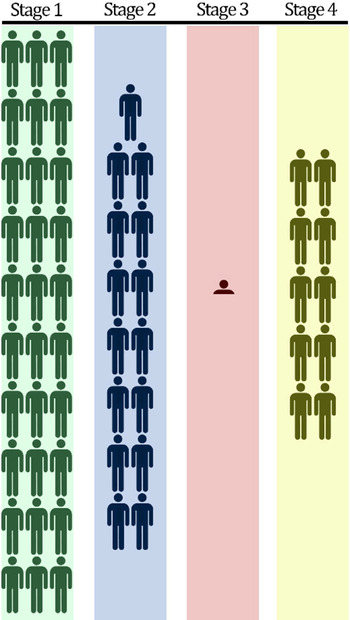
Crimes fall into certain rhythms based on local circumstances and response can be fitted to these rhythms.Footnote 234 For example, tombaroli and huaqueros work only at night due to local legislation and cultural views in Italy and Peru. This means law enforcement can maximize its presence through preventative measure such as early morning spot checks on roads leading from major archaeological areas, especially toward major cities where connections to early stage middle men will likely occur. Late stage intermediaries are tied to a physical location, their storefront, and as the most specialized they are the smallest population in the entire network, as Figure 2 illustrates. While individuals in the other stages may participate only once, late stage intermediaries are a constant population. This creates a bottleneck within the network that is vulnerable to disruption through monitoring. Black market interactions cannot occur at the store or during public hours, so law enforcement resources can be maximized during specific hours and targeting offsite locations. By understanding their own geographical, economic, and cultural factors, countries can anticipate the types of crime and the rhythms that criminals follow. Both limiting convergence settings and tailoring local responses are best carried out through law enforcement collaborations aimed at limiting all forms of trafficking, as well as other forms of crime.
Relative populations in each stage with each symbol representing 1000 participants.Footnote 244

Culture Change
The most effective long-term option is targeting the social nature of trade. Criminologists note how difficult it is for crime to continue when society is mobilized against it, removing both participants and convergence settings.Footnote 235 By challenging collectors' desire for status symbols, a culture change would prevent the trafficking from the top down. While admittedly difficult, this is the only real option for large-scale prevention of the trade. Culture changes have found varying success in other areas, including “blood” diamonds, the antifur movement, and the environmental movement.Footnote 236 This movement has already begun with archaeologists arguing the similarities between endangered species and cultural heritage as well as drawing parallels between blood diamonds and illicit antiquities.Footnote 237 A recent antiquities trade example of a mobilized society is the public protection of the Egyptian museum during the 2011 revolution.Footnote 238
Artifacts' esteem, and therefore value, is directly linked to significance within the culture of origin,Footnote 239 suggesting that ownership of illicit cultural items is a vestige of the colonial era tied to dominance over another's identity.Footnote 240 Indeed, the gentleman collector, a concept first introduced during the colonial period, is a common theme among modern collectors.Footnote 241 In contrast, the “Good Collector” recognizes the culture behind art, promoting knowledge over aesthetics, while disparaging destruction of archaeological sites and antiquities without provenience records.Footnote 242 Ownership of “old things” should never be discouraged, but knowingly purchasing stolen culture heritage is neither art appreciation nor the mark of a cultured individual. Rather, it is participation in organized crime and exploitation of another culture. Educating the public about the quantitative and qualitative impact of antiquities trafficking should help promote a culture change.
What would be the result of a culture change? A smaller purchasing population would decrease the value of the bulk of antiquities and cause capital traveling through the network to correspondingly decline. If capital decreases below the risk-to-profit threshold, then general criminal groups will cease to transport antiquities and cut looters' connections to dealers. This threshold is significant. The author was conducting archaeological research in Albania in 2011, when a local fisherman found a complete amphora in his nets. Based on previous sales, the fisherman believed he could get 100,000 leke (US$1000) from intermediaries selling to Italian collectors; however, the market has decline significantly due to the economy. With intermediaries apparently working elsewhere, there was no one to transport the artifact to collectors in Italy and in 2012 the fisherman reported that he had given up attempting to sell the amphora and discarded it. Influencing the market end of the network, as well as disrupting the middle, can affect the entire interaction chain back to the source country. There may never be an end to antiquities trafficking, but understanding its organizational structure can direct resources to combat the trade in an efficient manner through anticipating interactions at convergence settings and tailoring societal and legislative disincentives to regional contexts.
IV. CONCLUSION
The apparent complexity observed within the illicit antiquities trade can be usefully explained through the network paradigm. Hierarchical organization does not appear to exist currently within the trade. Antiquities trafficking has an underlying four stage structure that developed as part of role specialization within the network organization. Each stage is guided by behaviors based on the geographical, economic, legislative, and cultural conditions that the participants operate within. Participants are loosely connected through informal interactions, often one time transactions though sometimes repeating. The average participant is not a career criminal, but a regular citizen attempting to exploit an opportunity to supplement their income, especially in the first stage. Though participants may have no knowledge of the other nodes, network trafficking constitutes organized crime.Footnote 243
Rather than focus on specific criminals or artifacts, future research should continue to examining the organizational structure. This approach explains how participants both interact and behave. The network paradigm offers a nuanced view of cultural trafficking, including lingering questions within the field about terrorism, insurgency, and Internet sales. Future research will provide more detailed information on actual transactions as criminals are identified and their online accounts are examined. Organize crime, in the traditional sense, can be explored by researchers focusing on the second stage. By viewing antiquities trafficking as a network, criminal interactions can be anticipated and law enforcement can conduct safe, preventative measures like removing convergence settings.