Introduction
Amplexoid corals are characterized by development of amplexoid septa throughout their ontogeny, representing a distinctive clade of rugose corals in the Silurian (Hill, Reference Hill1981; Chen et al., Reference Chen, Wang and Wang1997). Pilophyllia Ge and Yu, Reference Ge and Yu1974, currently with more than 20 assigned species of various morphologies, forms a substantial component of the clade (Wang et al., Reference Wang, He and Chen1986; Tang et al., Reference Tang, He and Chen2007). However, there is considerable uncertainty concerning the species composition of the genus, whose taxonomic relationships have been queried by some authors (e.g., He and Tang, Reference He and Tang2013; McLean and Copper, Reference McLean and Copper2013) due to insufficient documentation of the type species, P. involuta Ge and Yu, Reference Ge and Yu1974. The phylogeny and evolutionary trends of Pilophyllia are also not well understood with many early species introduced by Ge and Yu (Reference Ge and Yu1974), Cao (Reference Cao1975), and Cao and Lin (Reference Cao and Lin1982) being poorly characterized.
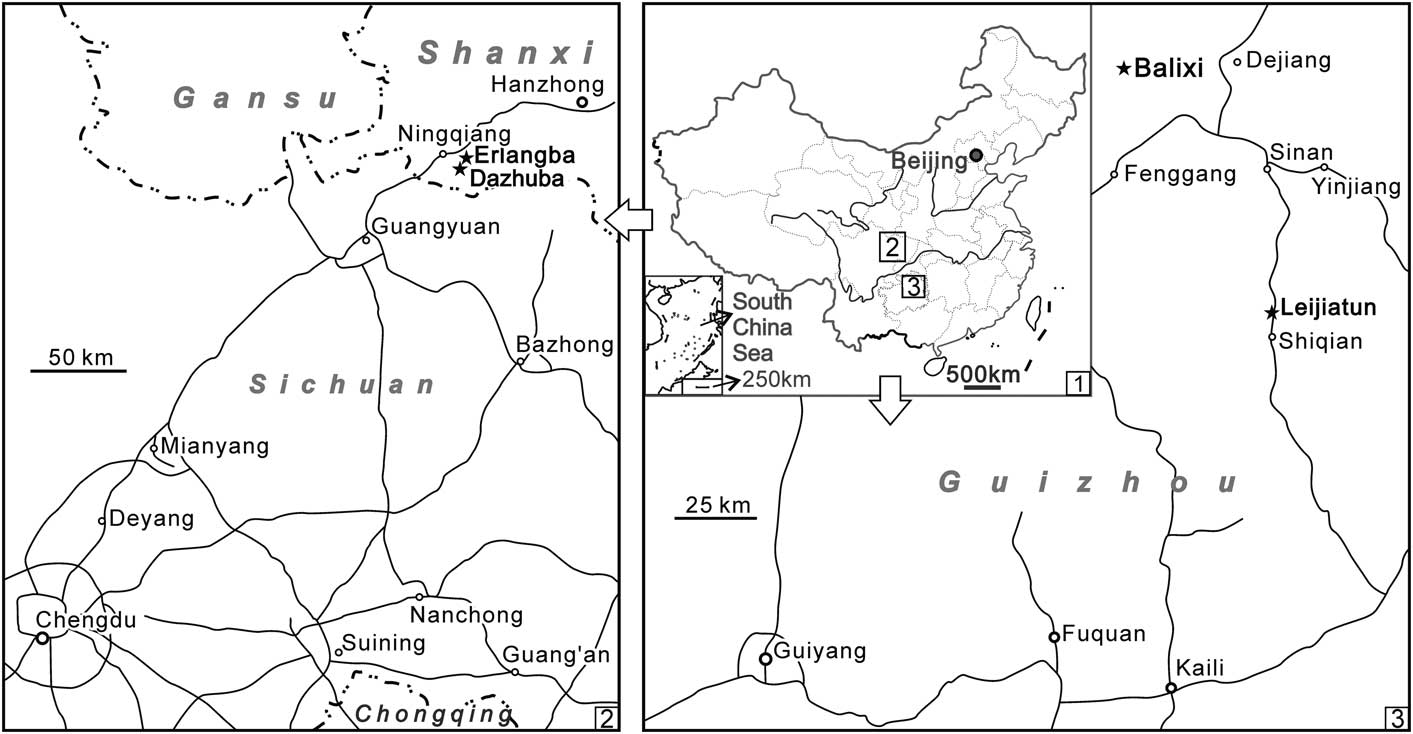
To resolve these problems, we restudied the type material of various species (and subspecies) of Pilophyllia, including P. involuta and many of the problematic ones mentioned above, as well as several new specimens of these forms, from Aeronian and Telychian rocks of many areas of southwestern China (Fig. 1). The present paper aims to reassess the species composition of Pilophyllia, to document the newly introduced genus Neopilophyllia n. gen. associated with a revised definition of Pilophyllia, and thus to explore the morphological trends of this species group, with an emphasis on evolutionarily significant characteristics of septal microstructure and minor septal development.
Geographic maps (1−3) showing localities (stars) of specimens mentioned in this paper.

Materials and methods
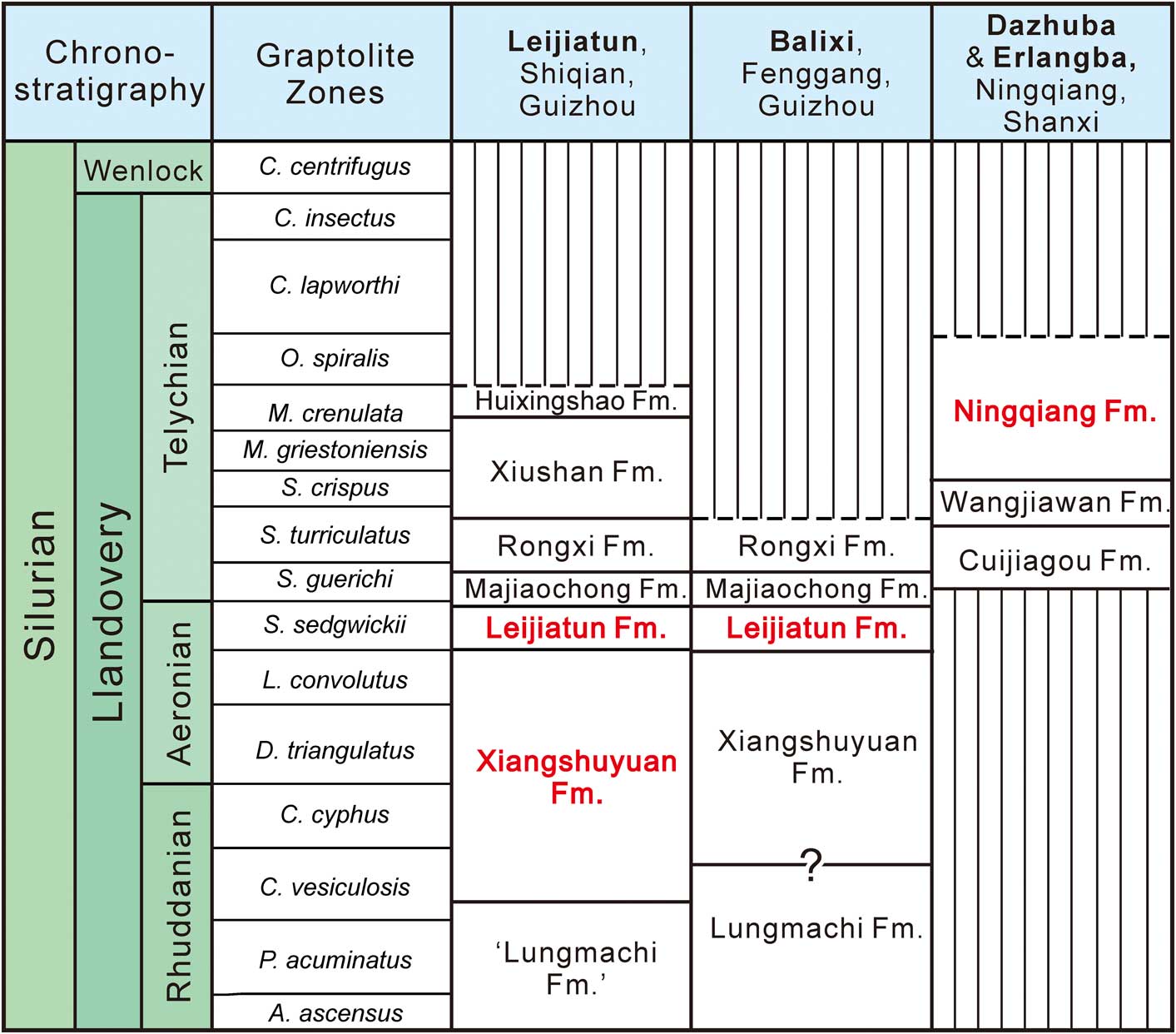
All specimens examined and cited in this paper occurred in various horizons of early Silurian age in South China (Fig. 2). Of vital importance are type specimens of several species belonging to Pilophyllia that have been documented by Ge and Yu (Reference Ge and Yu1974), Cao (Reference Cao1975), and Cao and Lin (Reference Cao and Lin1982), because all of these species are insufficiently known particularly in terms of diagnostically important features of septal microstructure. In view of recent great progress on the stratigraphic correlation of Silurian rocks in South China (Rong et al., Reference Rong, Wang and Zhang2012), the age constraint on the studied material provided in the original publications has been revised according to the most recent stratigraphic framework (Fig. 2).
Stratigraphic correlation chart showing units with occurrences of Pilophyllia and Neopilophyllia n. gen. examined and cited in this paper, indicated in red font. Modified after Rong et al. (Reference Rong, Wang and Zhang2012).
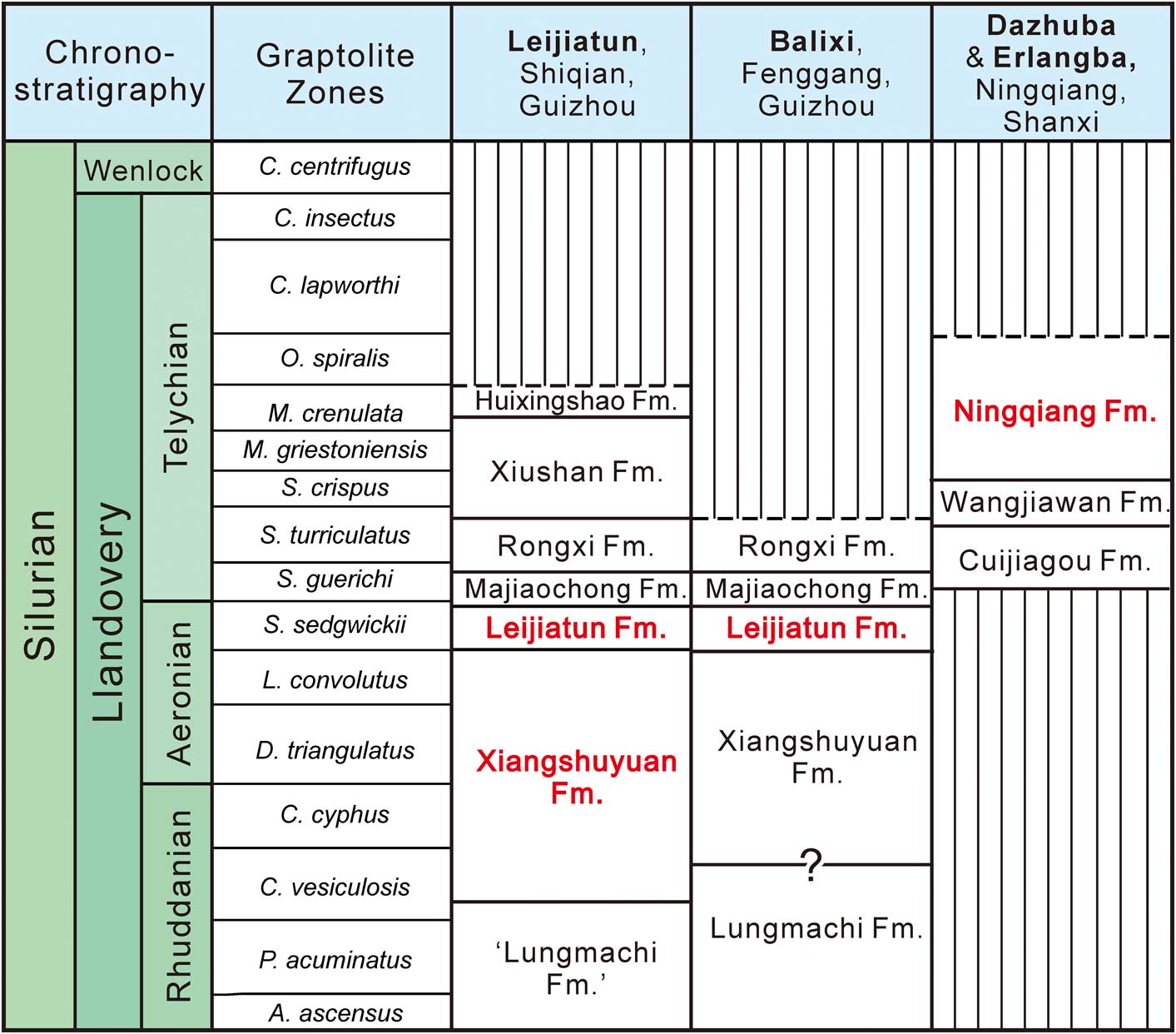
In addition, several new specimens, particularly those of the type species of Neopilophyllia n. gen., are studied in detail to establish it as a new genus. These materials were collected from the Ningqiang Formation (middle Telychian) of the Ningqiang area, southern Shanxi Province, by staff members of the former Research Group of Stratigraphy and Palaeontology at China University of Geosciences (Beijing) several times in 1981, 1992, and 2002.
Morphological terminology used herein largely follows Hill (Reference Hill1981). The abbreviations used in the synonymy lists follow Matthews (Reference Matthews1973). Transverse sections illustrated in this study are oriented with the cardinal side downward, wherever that feature can be recognized.
Repositories and institutional abbreviations
Specimens mentioned in this paper are indicated by prefixes for specimen numbers as follows: CUGB=China University of Geosciences, Beijing; NIGP=Nanjing Institute of Geology and Palaeontology, Nanjing, China; XACGS=Xi’an Center of Geological Survey, China Geological Survey.
Evolutionary trends in Pilophyllia and Neopilophyllia n. gen. and their biostratigraphic significance
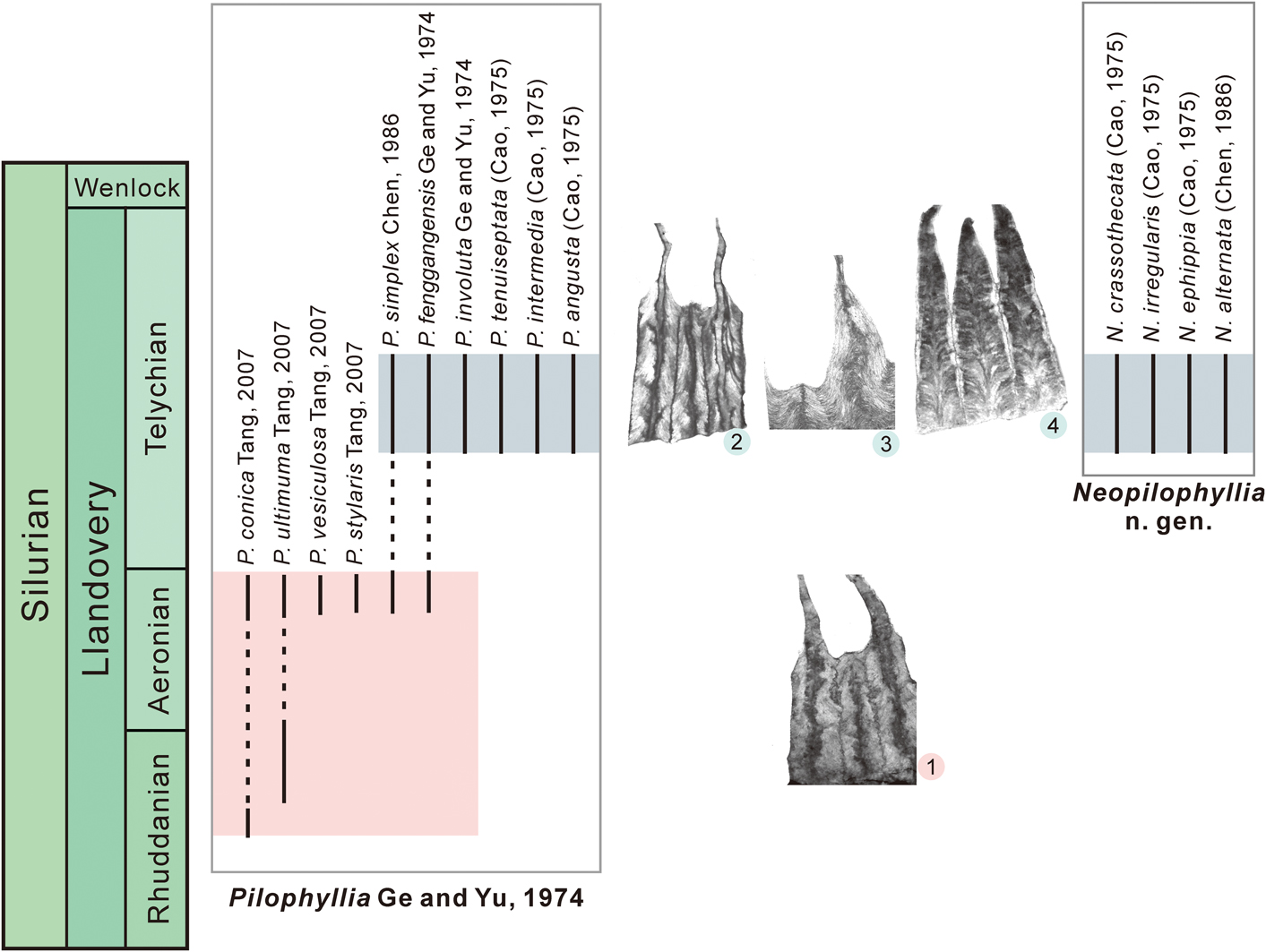
The species composition of Pilophyllia is reevaluated after restudy of the type species, P. involuta (see Fig. 3). Its concept is redefined and restricted to those forms that are characterized by a distinct peripheral stereozone and amplexoid major septa with club-shaped rhabdacanths set in thick lamellar stereomes. Those species previously included in Pilophyllia but possessing generally short septa with wedged-shaped rhabdacanths, are transferred herein to the new genus Neopilophyllia. Based on our revision, 11 valid species are confirmed to be representatives of Pilophyllia, and four are assigned to Neopilophyllia n. gen. on the basis of a thorough review of documented species. Except for P. poulseni (McLean, Reference McLean1977) from western Greenland, all 14 species of these two genera are documented solely from South China.
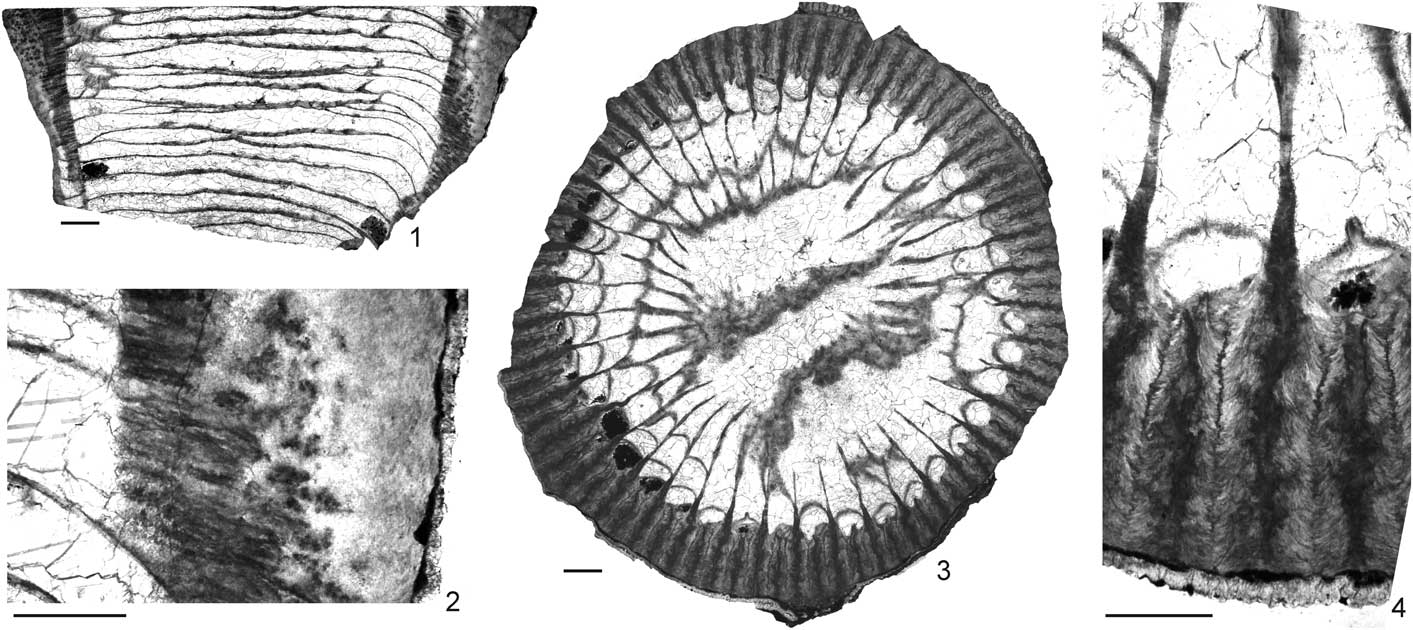
Range chart of species belonging to Pilophyllia and Neopilophyllia n. gen. documented on the Upper Yangtze Platform of South China. Pink and blue colors mark the ‘pre-middle Telychian’ fauna and the ‘middle Telychian’ fauna, respectively; details of thin sections of representative species of the two genera showing septal microstructure and development of minor septa: (1) Pilophyllia fenggangensis Ge and Yu, Reference Ge and Yu1974, NIGP 22085; (2−3) P. tenuiseptata (Cao, Reference Cao1975): (2) NIGP 166950; (3) XACGS-G360; (4) Neopilophyllia crassothecata (Cao, Reference Cao1975), NIGP 166953.
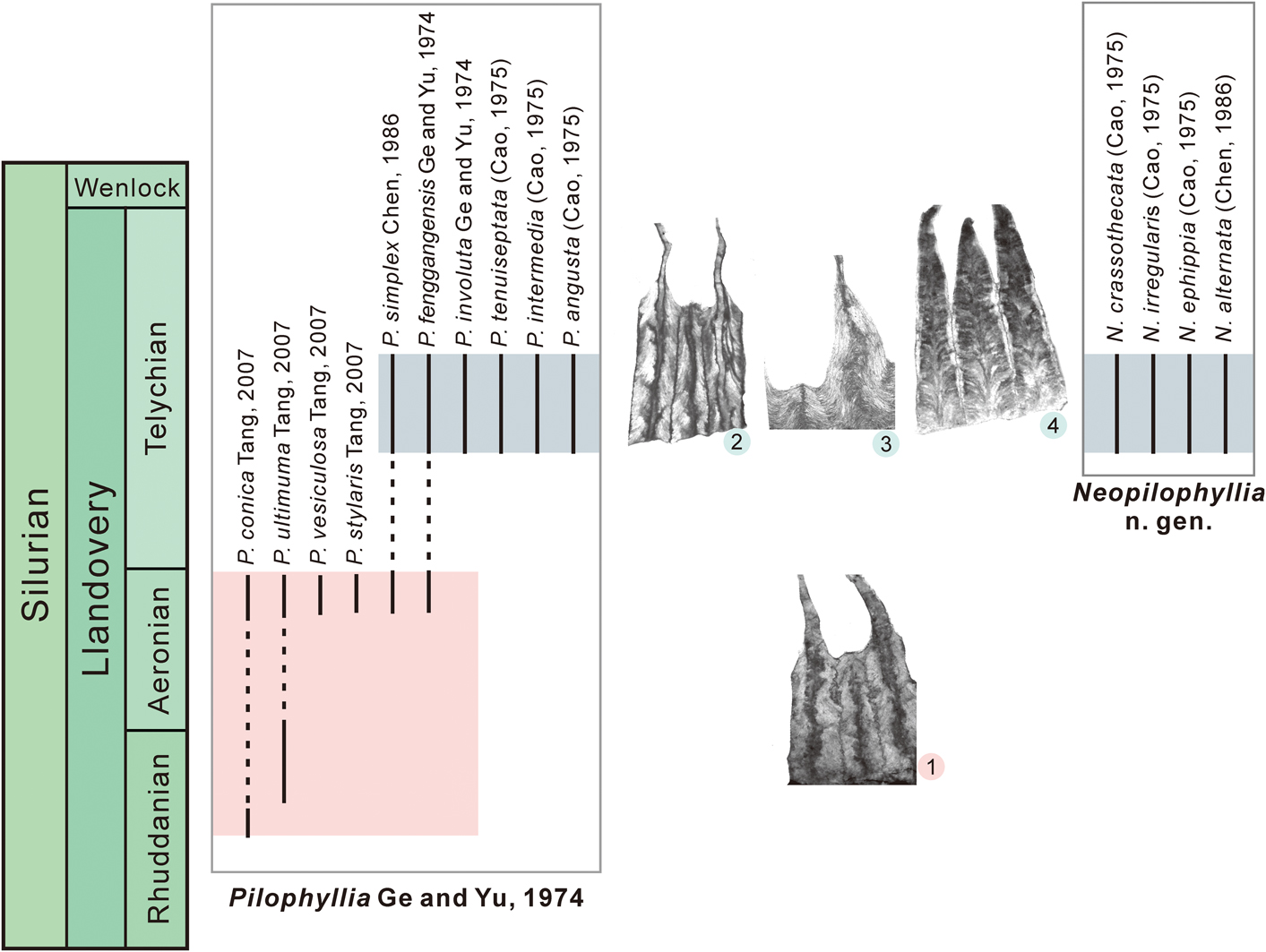
To explore the evolution of the Pilophyllia-Neopilophyllia group, two distinct faunas (referred to herein as pre-middle Telychian and middle Telychian) are readily distinguished in terms of species composition and stratigraphic horizon. Historically, morphological trends of the Pilophyllia-Neopilophyllia group have been discussed based on comparison of the above mentioned two faunas by Wang et al. (Reference Wang, He and Chen1986) and He et al. (Reference He, Wang and Li1989), and most fully by Tang et al. (Reference Tang, He and Chen2007). Several major points concerning overall morphological variation are further confirmed by our new observations. They are: (1) large individuals seem to be more common in the middle Telychian fauna; (2) rejuvenescence is observed in some forms of the pre-middle Telychian fauna, but never in the middle Telychian fauna; and (3) cardinal fossulae are generally indistinct in the pre-middle Telychian fauna, whereas they are commonly clearly developed in the middle Telychian fauna.
Morphological trends of septal microstructure and minor septa within the Pilophyllia-Neopilophyllia group are summarized below. Both features are insufficiently documented thus far, but are considered herein to be of evolutionary significance, and therefore deserve reconsideration in the light of new data (see also Fig. 3).
Septal microstructure
Ge and Yu (Reference Ge and Yu1974, p. 170) stated briefly that the type species of Pilophyllia possesses “septa consisting of trabeculae coated by lamellar tissues.” However, they did not show clearly the nature of trabeculae in either descriptions or illustrations. Later, Cao (Reference Cao1975) considered that the type of trabeculae observed in members of this genus are rhabdacanths. This interpretation was supported and strengthened by Wang et al. (Reference Wang, He and Chen1986) based on their own collections and has been widely echoed by subsequent authors (e.g., He et al., Reference He, Wang and Li1989; Chen et al., Reference Chen, Wang and Wang1997; He and Tang, Reference He and Tang2013; McLean and Copper, Reference McLean and Copper2013). Our study shows that the trabeculae, when well developed, are commonly comprised of coarse diverging rods of the secondary trabeculae, particularly as shown in transverse sections depicted herein (Figs. 4−16).
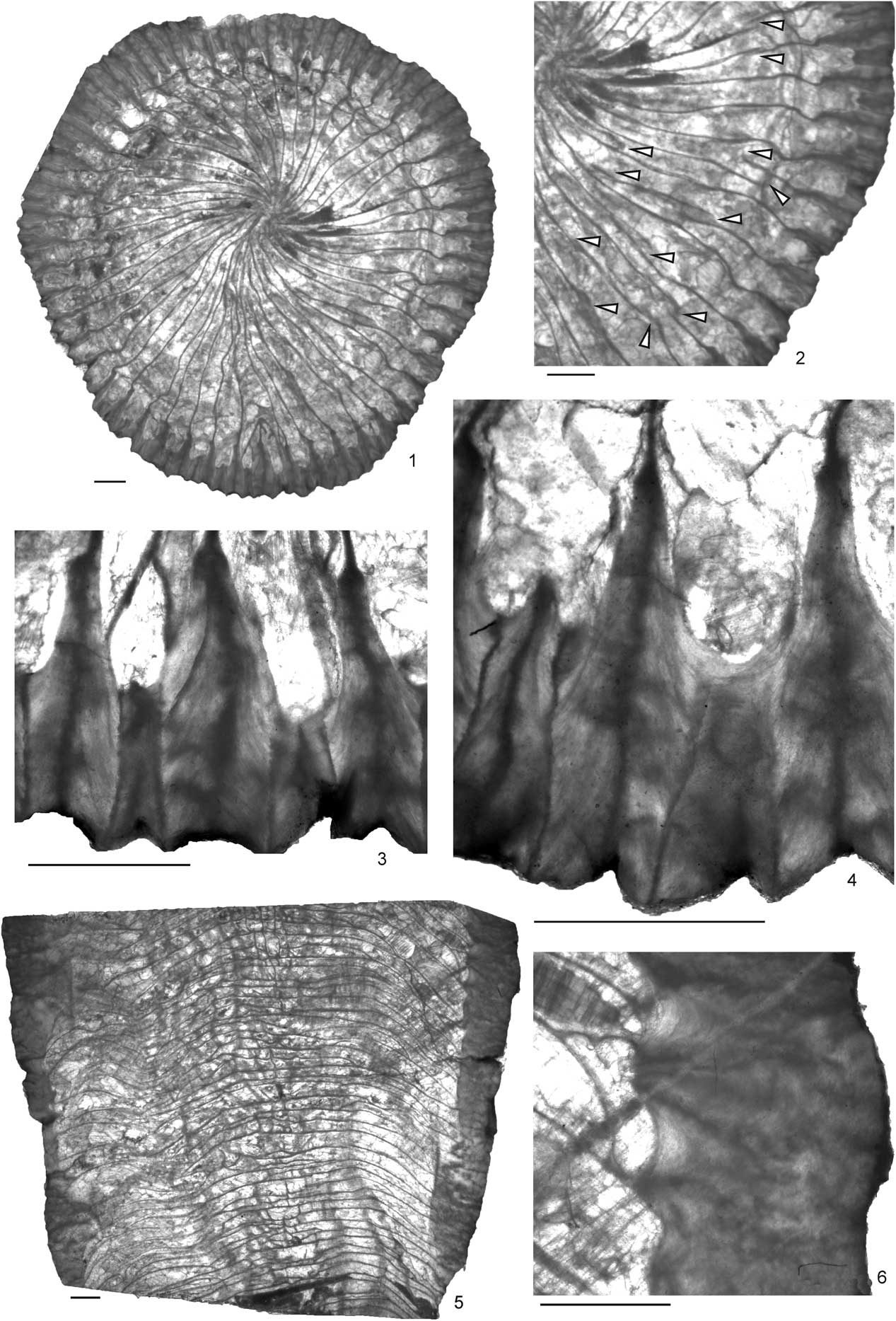
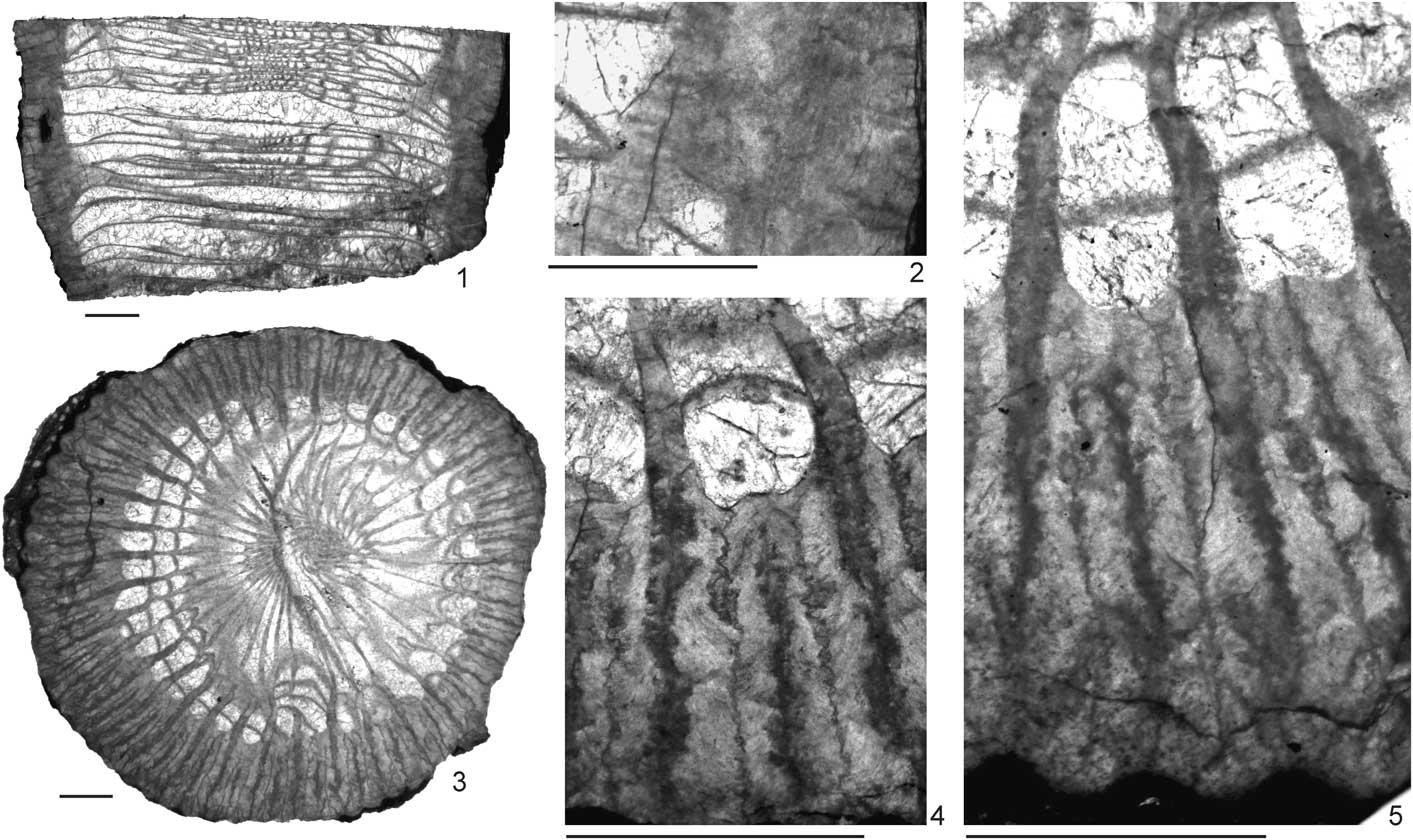
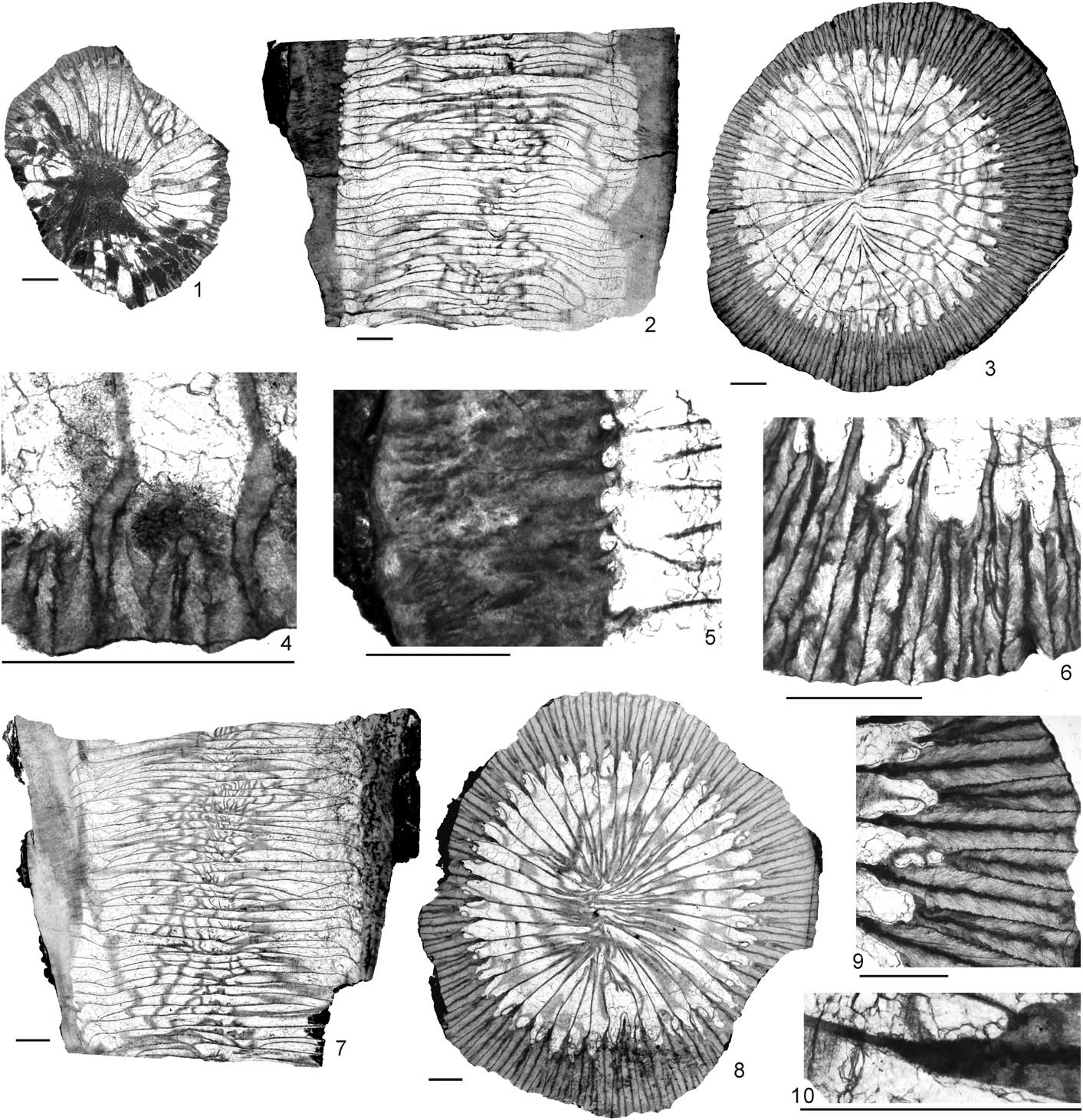
Pilophyllia involuta Ge and Yu, Reference Ge and Yu1974, type species of Pilophyllia, holotype: (1–4) transverse section (NIGP 22131) and three enlarged portions (2–4), with white arrows in (2) indicating where septa are interrupted; (5, 6) longitudinal section (NIGP 22132) and an enlarged portion (6). Scale bars=2 mm.

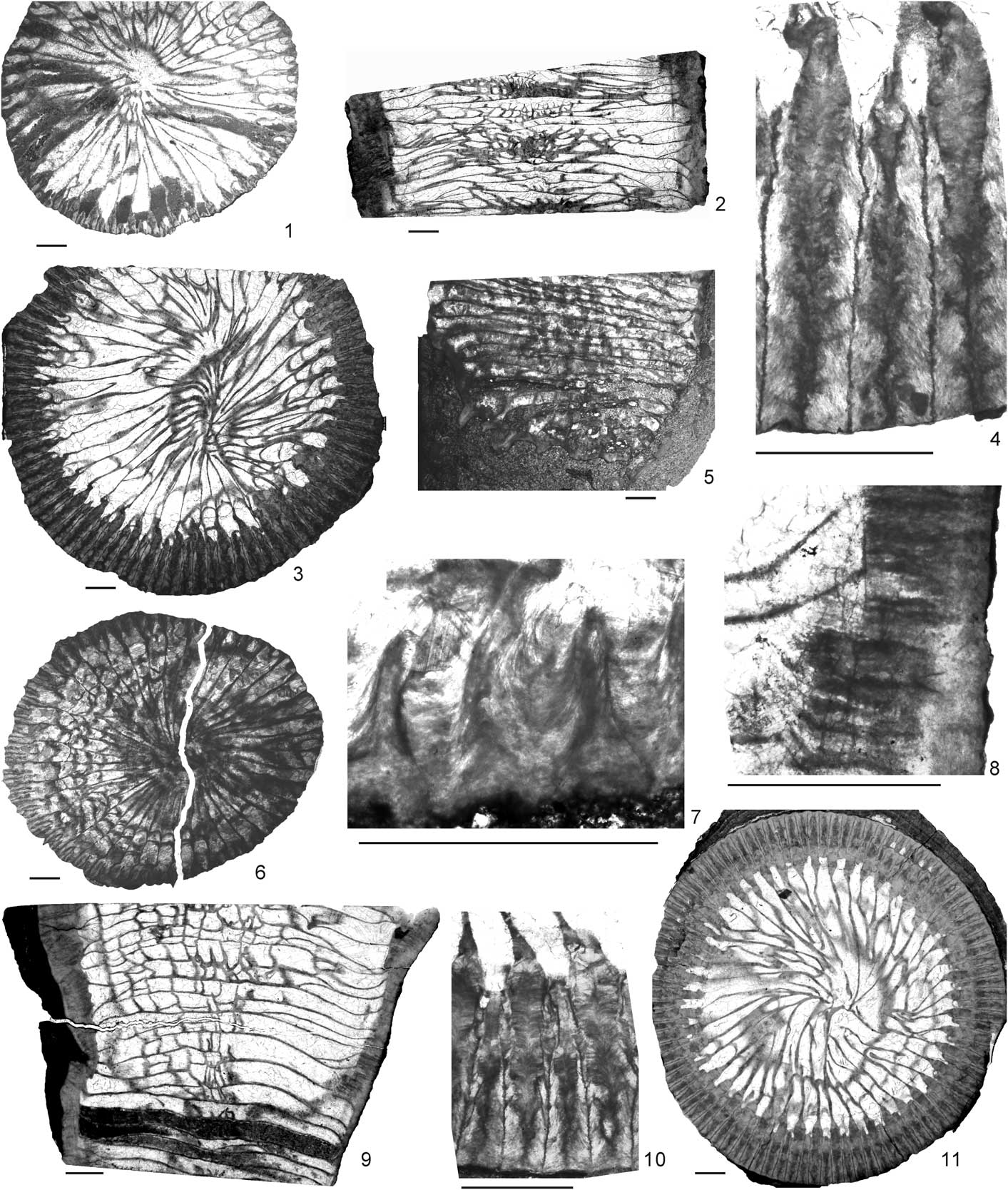
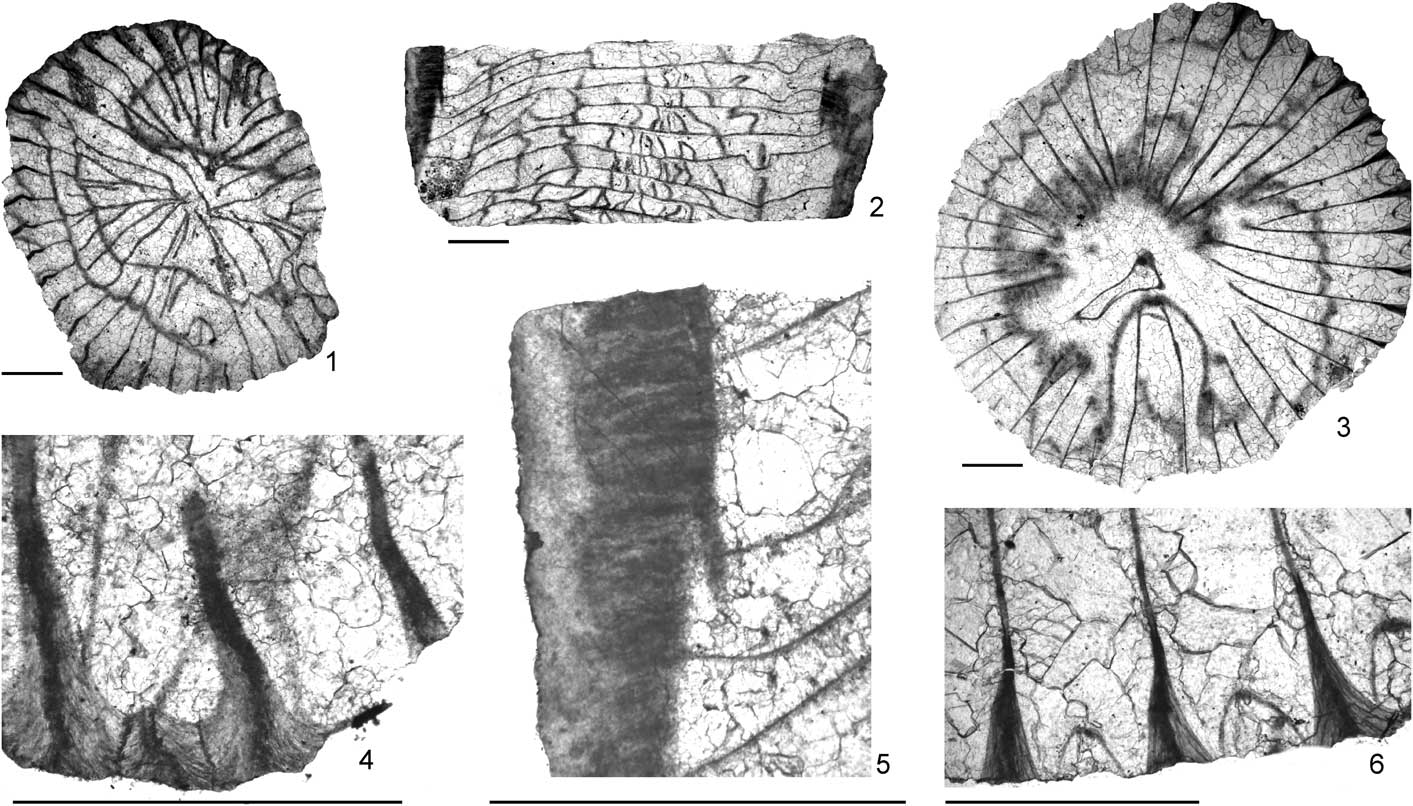
Pilophyllia fenggangensis Ge and Yu, Reference Ge and Yu1974, holotype: (1, 2) longitudinal section (NIGP 22086) and an enlarged portion (2); (3–5) transverse section (NIGP 22085) and two enlarged portions (4, 5). Scale bars=2 mm.

Pilophyllia fenggangensis Ge and Yu, Reference Ge and Yu1974: (1–4) XACGS-G366, holotype of Ningqiangophyllum involutum Cao, Reference Cao1975: (1) transverse section of earlier growth stage; (2) longitudinal section; (3, 4) transverse section of later growth stage and an enlarged portion (4); (5–7) XACGS-G367, paratype of Ningqiangophyllum involutum: (5) longitudinal section; (6, 7) transverse section and an enlarged portion (7); (8–11) NIGP 166948: (8, 9) longitudinal section and an enlarged portion (8); (10, 11) transverse section and an enlarged portion (10). Scale bars=2 mm.

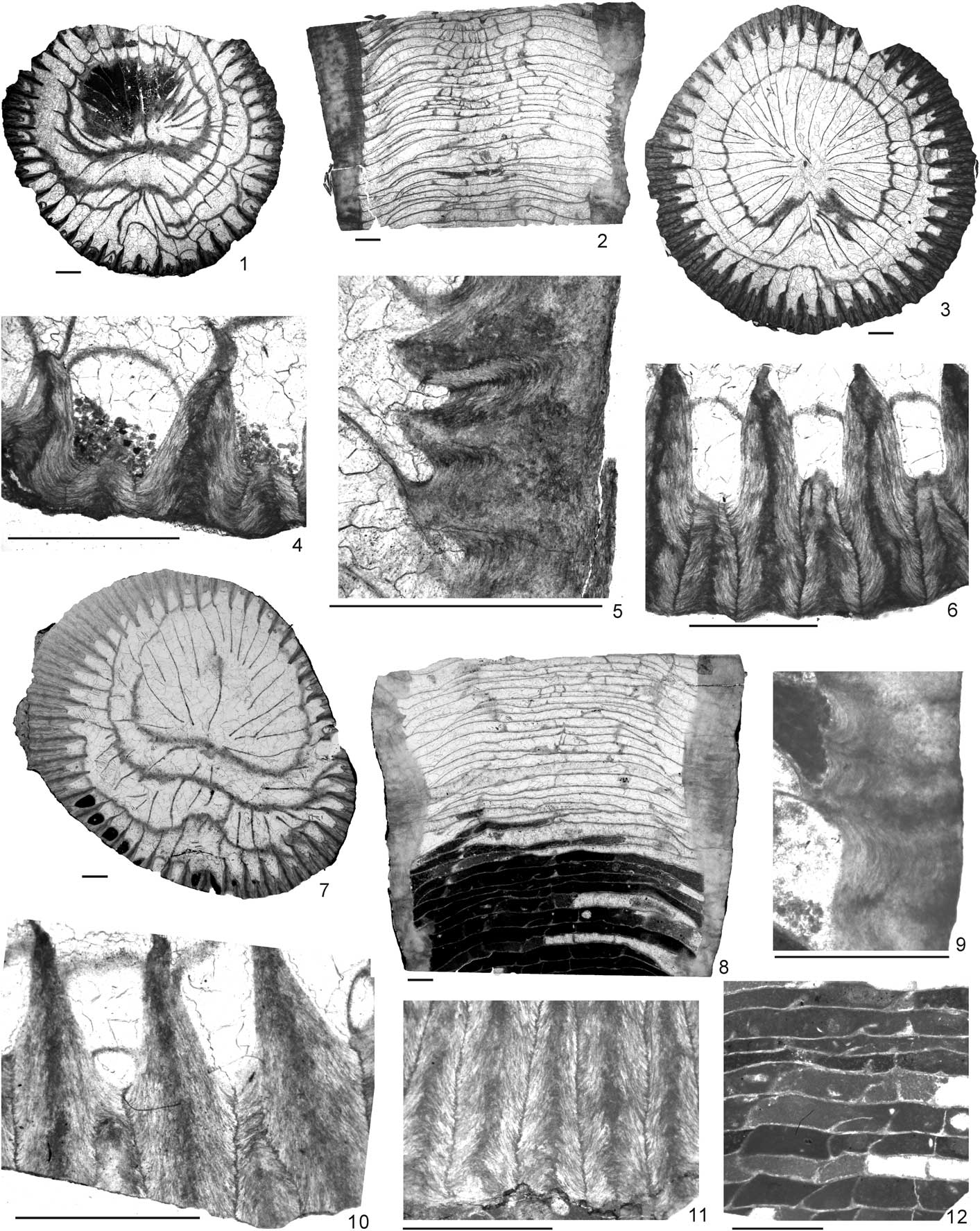
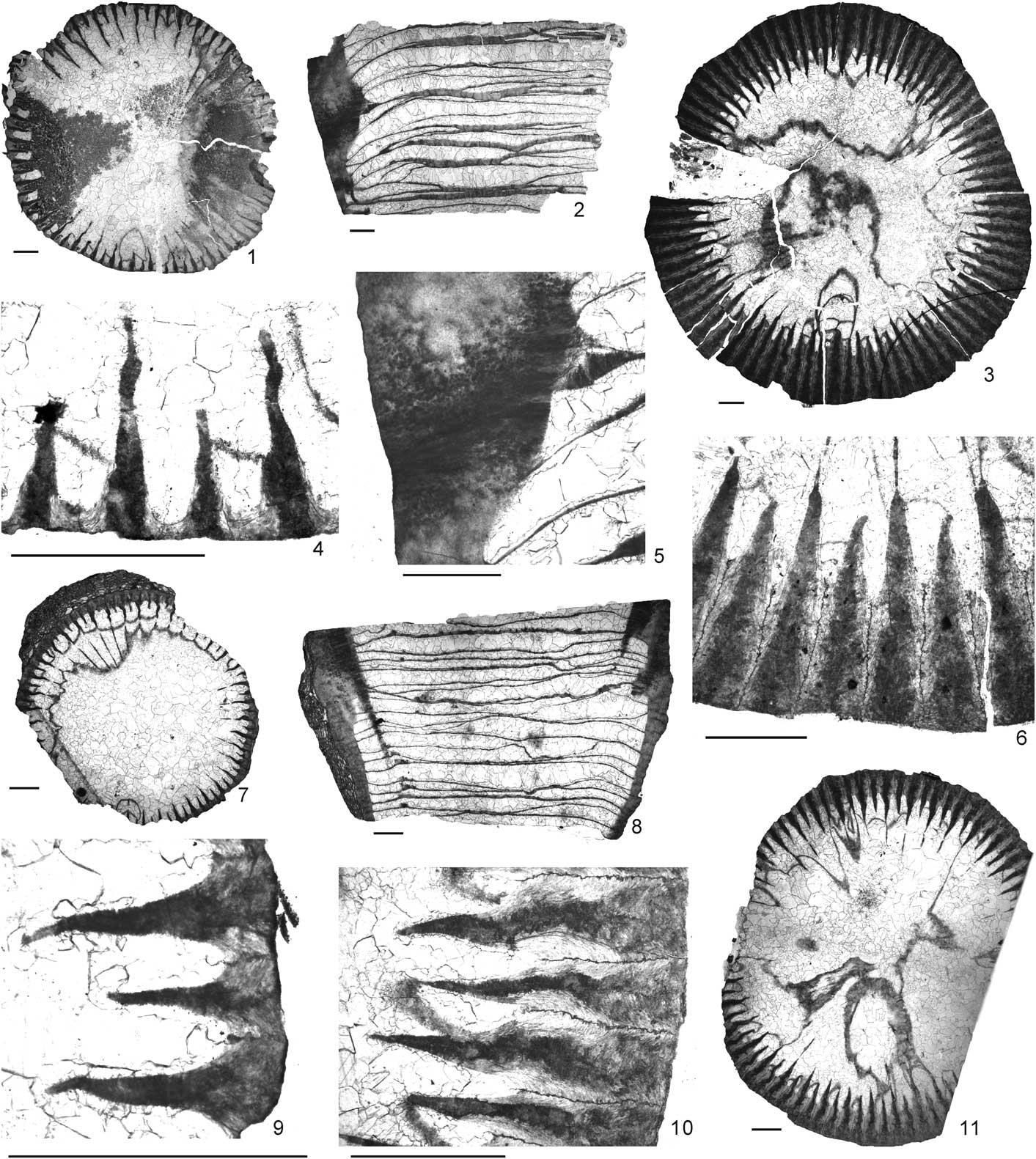
Pilophyllia tenuiseptata (Cao, Reference Cao1975): (1–6) XACGS-G360, holotype: (1, 4) transverse section of earlier growth stage and an enlarged portion (4); (2, 5) longitudinal section and an enlarged portion (5); (3, 6) transverse section of later growth stage and an enlarged portion (6); (7–12) NIGP 166949, topotype: (7, 10, 11) transverse section with enlarged parts (10, 11) showing septal microstructure; (8, 9, 12) transverse section with enlarged parts (9, 12) showing septal microstructure in peripheral stereozone and septal development on tabular floors, respectively. Scale bars=2 mm.

Pilophyllia tenuiseptata (Cao, Reference Cao1975), XACGS-G362, holotype of Ningqiangophyllum longiseptatum Cao, Reference Cao1975: (1, 4) transverse section of earlier growth stage and an enlarged portion (4); (2, 5) longitudinal section and an enlarged portion (5); (3, 6) transverse section of later growth stage and an enlarged portion (6). Scale bars=2 mm.

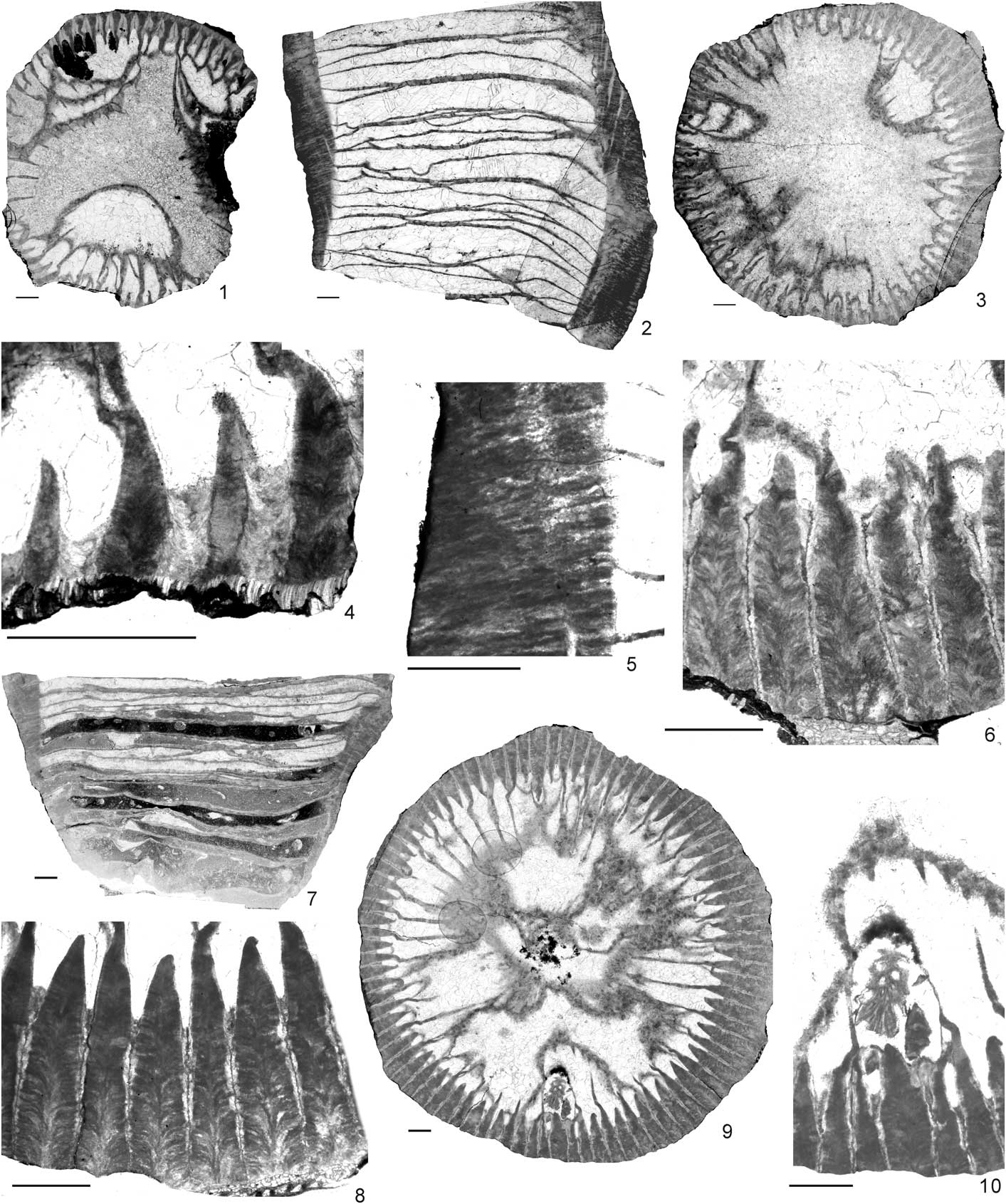
Pilophyllia tenuiseptata (Cao, Reference Cao1975): (1–6) NIGP 166950, topotype: (1, 4) transverse section of earlier growth stage and an enlarged portion (4); (2, 5) longitudinal section and an enlarged portion (5); (3, 6) transverse section of later growth stage and an enlarged portion (6); (7–10) NIGP 166951, topotype: (7) longitudinal section; (8–10) transverse section and two enlarged portions (9–10). Scale bars=2 mm.

Pilophyllia angusta (Cao, Reference Cao1975), XACGS-G375, holotype: (1, 2) longitudinal section and an enlarged portion (2); (3, 4) transverse section and an enlarged portion (4). Scale bars=2 mm.

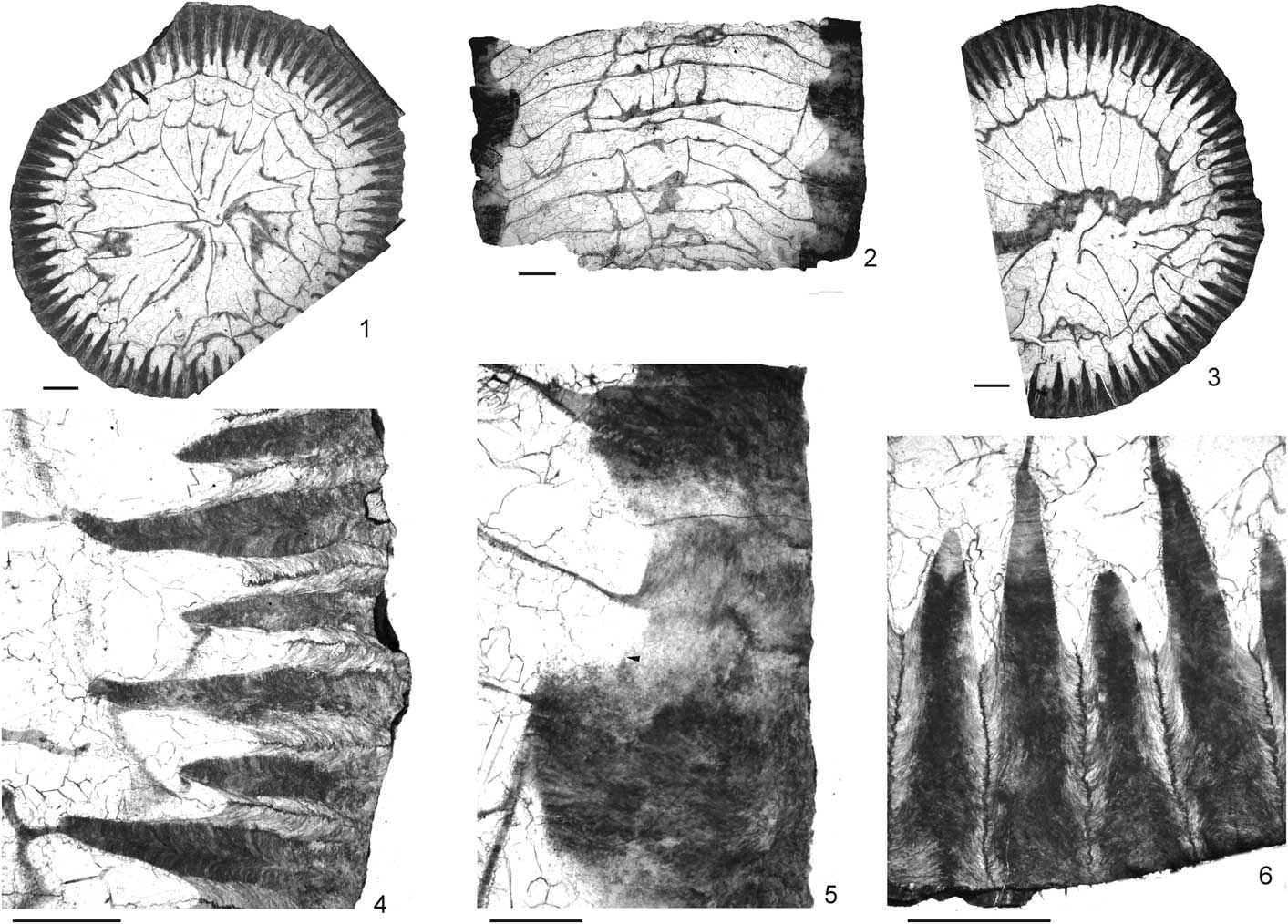
Pilophyllia intermedia (Cao, Reference Cao1975), XACGS-G368–G370, holotype: (1, 4) transverse section of earlier growth stage (XACGS-G369) and an enlarged portion (4); (2, 5) longitudinal section (XACGS-G370) and an enlarged portion (5); (3, 6) transverse section of later growth stage (XACGS-G368) and an enlarged portion (6). Scale bars=2 mm.

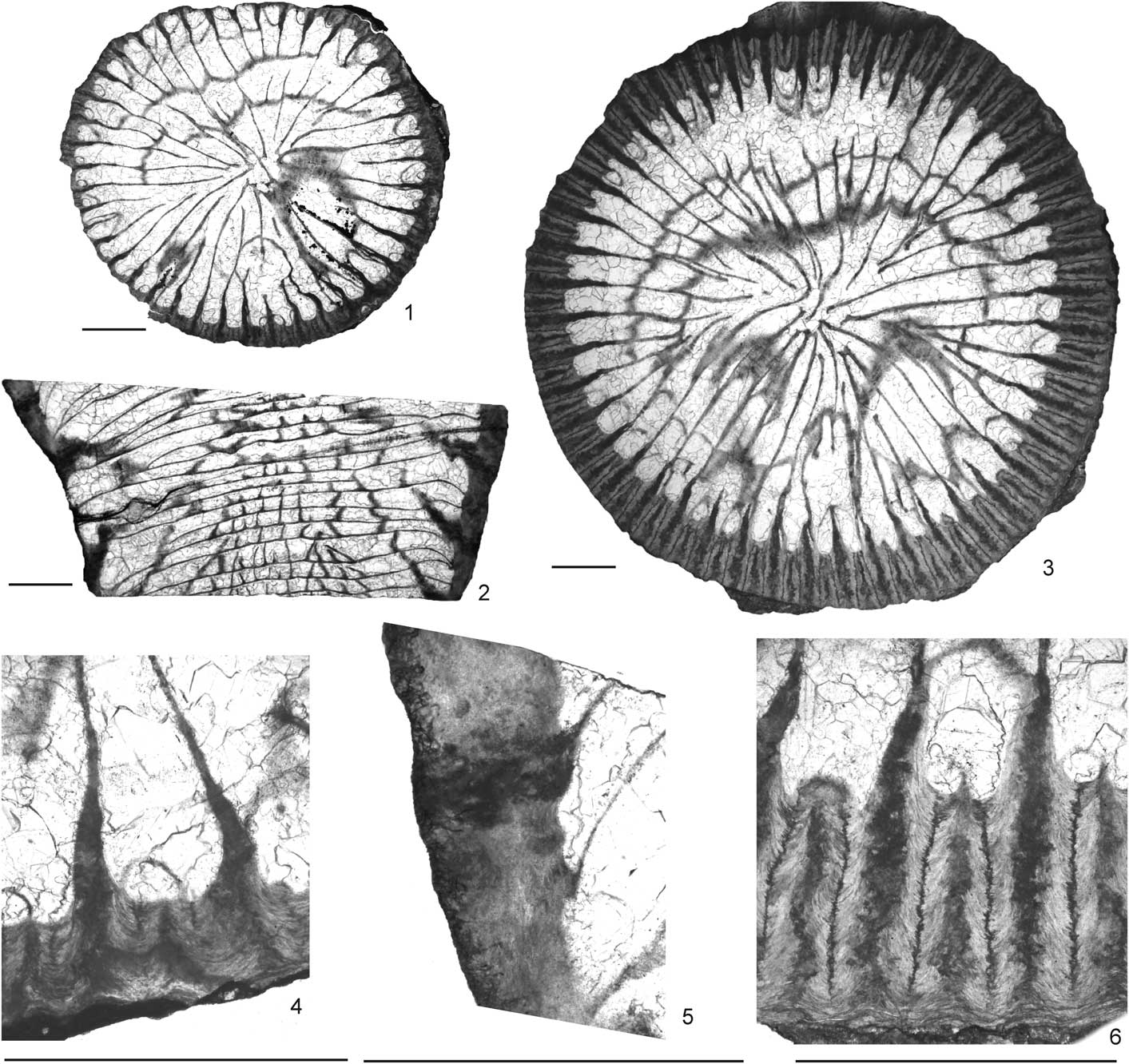
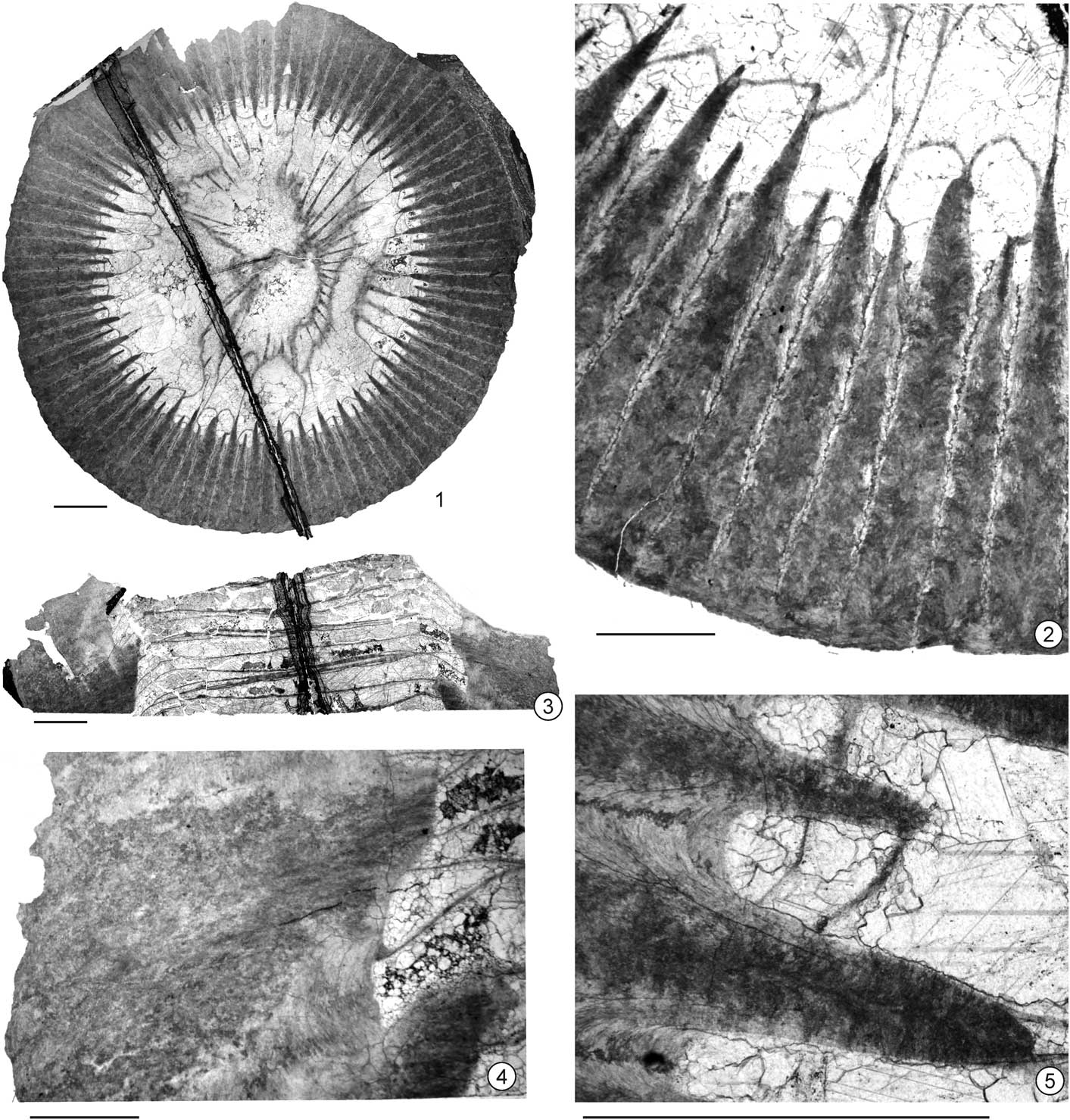
Neopilophyllia crassothecata (Cao, Reference Cao1975), type species of Neopilophyllia n. gen., XACGS-G363, holotype: (1, 2, 5) transverse section and two enlarged portions (2, 5); (3, 4) longitudinal section and an enlarged portion (4). Scale bars=2 mm.

Neopilophyllia crassothecata (Cao, Reference Cao1975), type species of Neopilophyllia n. gen.: (1–6) XACGS-G364, holotype of Ningqiangophyllum crassothecatum breviseptatum Cao, Reference Cao1975: (1, 4) transverse section of earlier growth stage and an enlarged portion (4); (2, 5) longitudinal section and an enlarged portion (5); (3, 6) transverse section of later growth stage and an enlarged portion (6); (7–11) XACGS-G365, paratype of N. crassothecatum breviseptatum: (7, 9) transverse section of earlier growth stage and an enlarged portion (9); (8) longitudinal section; (10, 11) transverse section of later growth stage and an enlarged portion (10). Scale bars=2 mm.

Neopilophyllia crassothecata (Cao, Reference Cao1975), type species of Neopilophyllia n. gen.: (1–6) NIGP 166952, topotype: (1, 4) transverse sections of earlier growth stage and an enlarged portion (4); (2, 5) longitudinal section and an enlarged portion (5); (3, 6) transverse section of later growth stage and an enlarged portion (6); (7–10) NIGP 166953: (7) longitudinal section; (8–10) transverse section and two enlarged portions (8, 10). Scale bars=2 mm.

Neopilophyllia irregularis (Cao, Reference Cao1975), XACGS-G361, holotype: (1, 4) transverse section of earlier growth stage and an enlarged portion (4); (2, 5) longitudinal section and an enlarged portion (5); (3, 6) transverse section of later growth stage and an enlarged portion (6). Scale bars=2 mm.

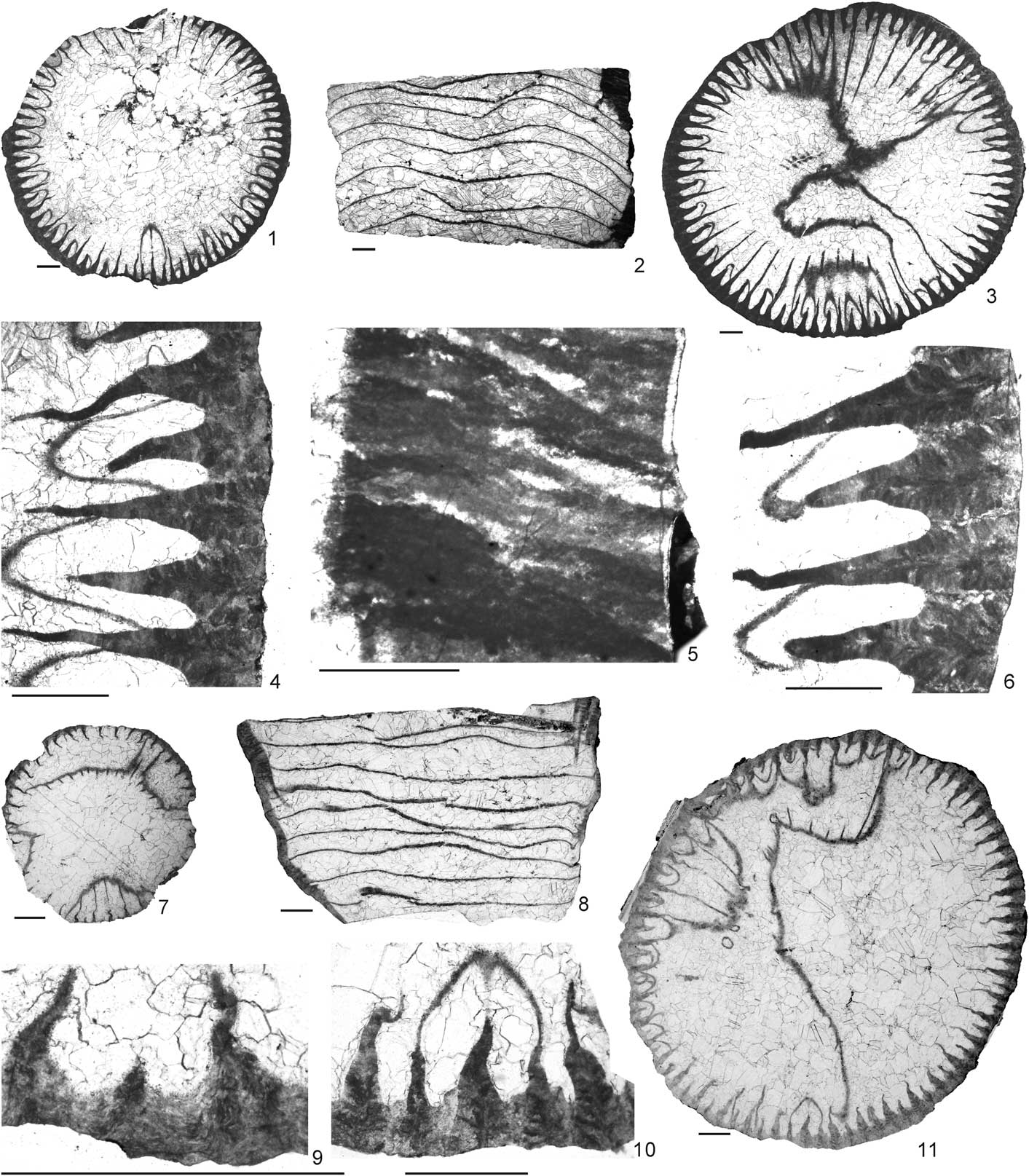
Neopilophyllia ephippia (Cao, Reference Cao1975): (1–6) XACGS-G374, holotype: (1, 4) transverse section of earlier growth stage and an enlarged portion (4); (2, 5) longitudinal section and an enlarged portion (5); (3, 6) transverse section of later growth stage and an enlarged portion (6); (7–11) NIGP 166954, topotype: (7, 9) transverse section of earlier growth stage and an enlarged portion (9); (8) longitudinal section; (10, 11) transverse section of later growth stage and an enlarged portion (10). Scale bars=2 mm.

Although we follow the widely accepted rhabdacanthine interpretation, it should be noted that rhabdacanthine septa in the Pilophyllia-Neopilophyllia group are radially continuous, and therefore not acanthine, and rhabdacanths are seemingly completely comprised of fibrous tissues. Such observations do not completely conform to the classical definition of rhabdacanths by Hill (Reference Hill1936, Reference Hill1981), in which each secondary trabecula is invested by lamellar tissues, as typically represented in some cystiphyllid corals such as Tryplasma Lonsdale, Reference Lonsdale1845.
Our study also shows that septa in all elements of the pre-middle Telychian fauna are composed of club-shaped rhabdacanths or trabeculae of unknown original microstructure (e.g., Fig. 3.1), whereas the type of septal microstructure had apparently diversified in the succeeding middle Telychian fauna (e.g., Fig. 3.2−3.4). Of particular interest is the first appearance of wedge-shaped rhabdacanths in septa of species of Neopilophyllia n. gen. during the middle Telychian, probably marking a significant stage in the evolution of Silurian amplexoid corals. At the same time, the appearance of forms with septa entirely consisting of lamellar tissues, as in P. involuta, might have represented retrogressive forms, because this kind of septal microstructure is characteristic of forms such as Amplexoides Wang, Reference Wang1947 and Synamplexoides Stern, 1956, among others, which are considered primitive by most authors (e.g., Wang et al., Reference Wang, He and Chen1986; He et al., Reference He, Wang and Li1989; Chen et al., Reference Chen, Wang and Wang1997). However, the possibility that lamellar tissues are a secondary feature cannot be ruled out.
Minor septa
The evolutionary trend of minor septa seems not to have been noticed by previous authors, perhaps due to its vagueness. New information in the present study demonstrates that minor septa are generally confined within the peripheral stereozone in the pre-middle Telychian fauna. By contrast, they normally extend beyond the stereozone a certain distance in most advanced forms, i.e., in nearly all forms of Neopilophyllia n. gen. of the middle Telychian fauna, probably related to their well-developed trabeculae.
Systematic paleontology
Order Rugosa Milne-Edwards and Haime, Reference Milne-Edwards and Haime1850
Family Amplexoididae Wang new family
Type genus
Amplexoides Wang, Reference Wang1947.
Other genera assigned
Lindstroemophyllum Wang, Reference Wang1947; Neopilophyllia n. gen.; Pilophyllia Ge and Yu, Reference Ge and Yu1974; Protopilophyllum Ivanovskiy, Reference Ivanovskiy1963; Pseudomphyma Wedekind, Reference Wedekind1927; Synamplexoides Stearn, Reference Stearn1956; and Zelophyllum Wedekind, Reference Wedekind1927.
Genus questionably assigned
Tabularia Soshkina, Reference Soshkina1937.
Diagnosis
Solitary or fasciculate coralla commonly with amplexoid major septa throughout growth. Major septa can extend to axis, generally without forming axial structure. Septal microstructure variously developed, can be entirely lamellar, or containing slender fibers, or consisting of slender to coarse rhabdacanthine trabeculae coated by lamellar tissues. Dissepiments commonly absent.
Remarks
When introducing Amplexoides, Wang (Reference Wang1947, p. 174) noted that “this genus is proposed for the ‘ampleximorphs’ in the Silurian which is not related to the Carboniferous Amplexus coralloides, the genotype of Amplexus,” the latter genus being type of the family Amplexidae Chapman, Reference Chapman1893. Amplexoididae n. fam., typified by Amplexoides, is introduced for the Silurian amplexoid rugosan genera listed above, which are only superficially similar and clearly phylogenetically unrelated to amplexoid forms from Devonian or younger strata, such as Mississippian Amplexus Sowerby, Reference Sowerby1814, particularly in relation to their septal microstructure.
Genus Pilophyllia Ge and Yu, Reference Ge and Yu1974
1974 Pilophyllia Reference Ge and YuGe and Yu, p. 170.
1974 Pilophylloides Reference Ge and YuGe and Yu, p. 167.
1974 Pilophylloia Ge and Yu, p. 170.
1975 Ningqiangophyllum Reference CaoCao, p. 184 (in part).
1977 Amplexoides Wang [Reference Wang1947]; McLean, p. 31.
1978 Pilophyllia ‘Yu and Ge’; He, p. 117.
1981 Pilophyllia; Reference HillHill, p. F173.
1982 Protopilophyllum Ivanovsky [Reference Ivanovskiy1963]; Cao and Lin, p. 13 (in part).
Type species
Pilophyllia involuta Ge and Yu, Reference Ge and Yu1974, Ningqiang Formation (middle Telychian), Ningqiang County, Shanxi Province, by original designation.
Other species
Pilophyllia angusta (Cao, Reference Cao1975); P. conica Tang in Tang et al., Reference Tang, He and Chen2007; P. fenggangensis; P. intermedia (Cao, Reference Cao1975); P. simplex Chen in Wang et al., Reference Wang, He and Chen1986; P. stylaris Tang in Tang et al., Reference Tang, He and Chen2007; P. tenuiseptata; P. ultimuma Tang in Tang et al. Reference Tang, He and Chen2007; and P. vesiculosa Tang in Tang et al., Reference Tang, He and Chen2007.
Pilophyllia simplex (holotype and one paratype, Ningqiang Formation, middle Telychian, Dazhuba, Ningqiang County, Shanxi Province) is also reportedly present in the Shihniulan Formation (Aeronian) of Xishui, northeastern Guizhou Province, and in the Sifengya Formation (early Telychian) of Daguan, northeastern Yunnan Province (Wang et al., Reference Wang, He and Chen1986). It is closely similar to P. fenggangensis and P. angusta, but differs from the former in having a narrower peripheral stereozone and straight major septa, and from the latter in possessing a much smaller corallum and slightly longer major septa. One specimen (CUGB-GSL0141) from the Leijiatun Formation (Aeronian) of the Shiqian area, northeastern Guizhou, was illustrated by Tang et al. (Reference Tang, He and Chen2007) as P. simplex, although it differs from the holotype of that species in having shorter major septa.
Pilophyllia ultimuma (holotype and one paratype, Xiangshuyuan Formation, late Rhuddanian to early-middle Aeronian, Shiqian, northeastern Guizhou; two paratypes from the Leijiatun Formation, Aeronian, same area) is characterized by possessing a small corallum, a wide peripheral stereozone, long and commonly involute major septa, and rejuvenescence. It is similar to P. fenggangensis but differs in having more major septa and rejuvenescence. One paratype (CUGB-GSL0711) is likely a representative of P. stylaris.
Pilophyllia conica (holotype, basal Xiangshuyuan Formation, middle to late Rhuddanian, Shiqian, northeastern Guizhou; two paratypes, Leijiatun Formation, Aeronian, same area) is characterized by a small corallum, a conical external form, and thick, short major septa in tabularium. One paratype (CUGB-GSL0703) is likely a representative of P. stylaris.
Pilophyllia vesiculosa (holotype and paratype, Leijiatun Formation, Aeronian, Shiqian, northeastern Guizhou) is characterized by having incomplete, variably spaced, and locally domed tabulae.
Pilophyllia stylaris (holotype and three paratypes, Leijiatun Formation, Aeronian, Shiqian, northeastern Guizhou) is characterized by a small to medium-sized corallum, a cylindrical external form, a wide peripheral stereozone, thick and short septa in tabularium, occasionally thick tabulae, and rejuvenescence.
Pilophyllia raritabulata (holotype and paratype, Leijiatun Formation, Aeronian, Shiqian, northeastern Guizhou) is regarded herein as synonymous with P. stylaris, only differing in having a slightly larger corallum size, a wider peripheral stereozone, and shorter major septa.
Pilophyllia leijiatunensis (holotype and paratype, Leijiatun Formation, Aeronian, Shiqian, northeastern Guizhou) is regarded herein as synonymous with P. stylaris, only differing in having a slightly larger corallum and lacking rejuvenescence.
Pilophyllia sp. indet. was documented from the Leijiatun Formation (Aeronian) of Shiqian, northeastern Guizhou, by Tang et al. (Reference Tang, He and Chen2007). It is extremely similar to P. leijiatunensis, only differing in having a wider peripheral stereozone and somewhat twisted and connected axial ends of the major septa. Thus, it is probably synonymous with P. stylaris.
Amplexoides poulseni McLean, Reference McLean1977 (holotype and paratype, Offley Island Formation, late Llandovery, Kap Tyson, western North Greenland) might be representative of Pilophyllia. It is characterized by long major septa and a well-developed peripheral stereozone. Slender fibers are likely present in the septa. As suggested by Tang et al. (Reference Tang, He and Chen2007), although its septa might not be typically rhabdacanthine, this species is more appropriately assigned to Pilophyllia rather than Amplexoides, based on the presence of long major septa and a distinct peripheral stereozone. Closely similar to P. ultimuma in many aspects (e.g., corallum size and rejuvenescence), it differs in having a much narrower peripheral stereozone and commonly shorter major septa. Note that the specimens referred to this species by McLean (Reference McLean1977) could represent different species.
Pilophyllia banbianduensis He, Reference He1978 (type material from Daugan Formation, Aeronian to early Telychian, Banbiandu, Yanjin, northeastern Yunnan Province) should be excluded from Pilophyllia. It is reportedly characterized by “short major septa, small septal number and complex morphology of tabulae” (He, Reference He1978, p. 118). However, from the illustration (He, Reference He1978, pl. 59, fig. 6b), the septa are likely continuous vertically indicating nonamplexoid affinity.
For discussion of Ningqiangophyllum longiseptatum Cao, Reference Cao1975, see discussion of Pilophyllia tenuiseptata below.
Diagnosis
Coralla cylindrical, less commonly ceratoid. Rejuvenescence can be present. Marginarium a distinct peripheral stereozone, narrow to wide, composed of laterally contiguous, strongly dilated major and minor septa. Major septa thinning in tabularium toward axis, gradually at first, then generally becoming attenuate rapidly, and either involute or straight. Cardinal septum generally short within indistinct to distinct cardinal fossula. Trabeculae generally present in axial part of septa, generally coated by thick lamellar tissues. In most cases, trabeculae club-shaped, apparently of rhabdacanthine type, or original microstructure obscured by recrystallization, or rarely appearing to be a thin median dark line, or completely replaced by lamellar stereomes. Tabulae complete, less commonly incomplete, variably spaced, slightly arched or subhorizontal, commonly with downturned margins. Dissepiments absent.
Remarks
In early publications, errors often occurred concerning the generic name, authorship, and type species of Pilophyllia. For example, Pilophyllia was misnamed as Pilophylloides (Ge and Yu, Reference Ge and Yu1974, p. 167) and Pilophylloia (Ge and Yu, Reference Ge and Yu1974, p. 170), authorship was wrongly attributed to Yu and Ge (He, Reference He1978, p. 117), and the type species was mistakenly cited as Pilophyllia fenggangensis Ge and Yu, Reference Ge and Yu1974 (Kong and Huang, Reference Kong and Huang1978, p. 47).
Pilophyllia has been generally regarded as possessing a wide peripheral stereozone with rhabdacanthine trabeculae, and a tabularium in which major septa are extremely thin and clearly amplexoid (Tang et al., Reference Tang, He and Chen2007). It should be noted that this concept basically follows that of Wang et al. (Reference Wang, He and Chen1986), whose revision was based on material that we do not regard as conspecific with the type species, P. involuta. As noted by McLean and Copper (Reference McLean and Copper2013, p. 95, 96), uncertainties over phylogenetic relationships between the type species and other species attributed to Pilophyllia would likely remain pending restudy of the type material of P. involuta to clarify its septal nature and microstructure.
In the present study, holotypes and paratypes of the type species belonging to either Pilophyllia or Neopilophyllia n. gen. were rephotographed to figure the characteristics, particularly septal microstructure, of the specimens. Illustrations of the holotype of P. involuta show that major septa are apparently intermittently discontinuous in transverse section (Fig. 4.2), and septal ridges rest on successive tabular floors in longitudinal section (Fig. 4.5). Both clearly indicate the amplexoid nature of the major septa. Septal microstructure appears to be entirely composed of lamellar stereomes, with no fibrous tissues observed (Fig. 4.3, 4.4, 4.6), which does not fit characteristics of the species group mentioned above. However, the trabeculae that are observed in the species currently assigned to Pilophyllia appear to be variably developed. The trabeculae generally arise from lamellar tissues, and gradually become thicker, as described commonly in species documented by Tang et al. (Reference Tang, He and Chen2007), or rarely are consistently rather thin and even seemingly absent with a replacement of lamellar tissues (Figs. 8.6, 9.6, 9.9). This observation could indicate that the two types of septal microstructure are closely related and are probably transitional.
We emphasize the significant taxonomic value of septal microstructure in amplexoid corals and regard the appearance of rhabdacanths of wedge-like shape in septa as representing a major step in the evolution of this distinctive coral clade. In view of this, those forms previously included in Pilophyllia that develop generally short septa with wedge-shaped rhabdacanths are transferred herein to a new genus Neopilophyllia n. gen. (see further discussion of Neopilophyllia n. gen., below). They are separated from other forms with longer major septa consisting of club-shaped rhabdacanths set in thick lamellar stereomes, which are retained within the redefined concept of Pilophyllia.
The revised concept of Pilophyllia necessitates reconsideration of its relationships with other morphologically similar genera, as discussed below. Ningqiangophyllum Cao has been closely associated with Pilophyllia (Wang et al., Reference Wang, He and Chen1986; McLean and Copper, Reference McLean and Copper2013), but is clearly a homonym of the unrelated Ningqiangophyllum Ge and Yu, Reference Ge and Yu1974, as noted by Hill (Reference Hill1981) and other authors (Lin et al., Reference Lin, Xu, Jia, Guo, Ouyang, Wang, Ding, Cao, Yan and Chen1995; McLean and Copper, Reference McLean and Copper2013). Moreover, its originally designated type species, N. tenuiseptatum Cao, Reference Cao1975 is proven to represent a typical member of Pilophyllia, as detailed in the discussion of P. tenuiseptata below.
Neopilophyllia n. gen. shows close similarities to Pilophyllia in having a medium to large corallum and a wide peripheral stereozone. However, it can be clearly distinguished from Pilophyllia in having distinctively different septa with wedge-shaped rhabdacanths, comparatively shorter major septa, and generally widely spaced tabulae. Minor septa generally extend beyond the peripheral stereozone in Neopilophyllia n. gen., whereas in Pilophyllia they are commonly confined within the stereozone.
A few other Silurian genera characteristically possessing amplexoid septa also show some similarities to Pilophyllia. They include Pseudomphyma, Zelophyllum, Amplexoides, Lindstroemophyllum, Synamplexoides, and Protopilophyllum, which were discussed in some detail by various authors, e.g., McLean (Reference McLean1977), Wang et al. (Reference Wang, He and Chen1986), He et al. (Reference He, Wang and Li1989), and McLean and Copper (Reference McLean and Copper2013). Although detailed analysis of their concepts and relationships is beyond the scope of the present study, Pilophyllia is clearly distinguished from these genera by the combination of a distinct peripheral stereozone and generally long major septa with commonly club-shaped rhabdacanths.
Our revision of Pilophyllia also contributes to clarification of its controversial familial assignment. When proposing this genus, Ge and Yu (Reference Ge and Yu1974) did not make any mention of this issue. It was subsequently assigned variably to Mucophyllidae Soshkina, Reference Soshkina1947 (Cao, Reference Cao1975; He, Reference He1978), Streptelasmatidae Nicholson in Nicholson and Lydekker, Reference Nicholson and Lydekker1899 (Kong and Huang, Reference Kong and Huang1978), Kodonophyllidae Wedekind, Reference Wedekind1927 (Hill, Reference Hill1981; Lin et al., Reference Lin, Xu, Jia, Guo, Ouyang, Wang, Ding, Cao, Yan and Chen1995; McLean and Copper, Reference McLean and Copper2013), or more widely by most Chinese authors to Amplexidae Chapman, Reference Chapman1893 (e.g., Wang et al., Reference Wang, He and Chen1986; Chen et al., Reference Chen, Wang and Wang1997; Tang et al., Reference Tang, He and Chen2007; He and Tang, Reference He and Tang2013). The presence of generally cylindrical forms, a wide peripheral stereozone commonly containing club-shaped rhabdacanths, and distinctive amplexoid septa throughout the growth stages, clearly excludes possibilities of its assignment to Mucophyllidae or Streptelasmatidae. The main reason suggested by McLean and Copper (Reference McLean and Copper2013) for inclusion of Pilophyllia in the Kodonophyllidae lies in its general similarity to Kodonophyllum Wedekind, Reference Wedekind1927 in overall morphology, and weakly amplexoid septa observed in very late stages of some specimens of this genus. However, given its clearly developed amplexoid septa and septal microstructure of both lamellar and rhabdacanthine types, Pilophyllia, together with other simpler Silurian amplexoid forms such as Amplexoides and Synamplexoides, is most appropriately referred to the new family Amplexoididae as defined above, rather than to the evolutionarily unrelated Amplexidae.
Pilophyllia involuta Ge and Yu, Reference Ge and Yu1974
v*1974 Pilophyllia involutus Reference Ge and YuGe and Yu, p. 170, pl. 78, figs. 1, 2.
v non 1975 Ningqiangophyllum involutum; Reference CaoCao, p. 185, pl. 39, figs. 1a, b, 2a, b.
?1978 Pilophyllia involutus; He, p. 117, pl. 59, fig. 1a, b.
v non 1982 Protopilophyllum involutum; Reference Cao and LinCao and Lin, p. 13, pl. 5, figs. 3a, b.
non 1986 Pilophyllia involuta; Reference Wang, He and ChenWang et al., pl. 1, figs. 3a−d.
Holotype
NIGP 22131 (transverse section) and 22132 (longitudinal section), Ningqiang Formation (middle Telychian), Ningqiang County, Shanxi Province.
Diagnosis
Pilophyllia with large corallum (at least 35 mm diameter). Marginarium a narrow peripheral stereozone. In tabularium, major septa amplexoid, thinning gradually at first, then rapidly becoming attenuate, and extending to axial region, where they can coil somewhat in one direction. Minor septa generally confined within stereozone. Cardinal septum short in indistinct fossula. Septal microstructure appears entirely lamellar. Tabulae mostly complete, densely spaced, with broad, subhorizontal central platform and narrow downturned margins. Dissepiments absent.
Description
Corallum solitary, large. Number of major septa 46 at 35 mm corallum diameter. Marginarium a distinct peripheral stereozone 3 mm in thickness, composed of thick minor septa and thickened peripheral ends of major septa. In tabularium, major septa amplexoid, thinning gradually at first, then rapidly becoming attenuate, and extending to axial region, where they can coil somewhat in one direction, without forming axial structure (Fig. 4.1, 4.2). Minor septa generally confined within stereozone. Cardinal septum short in indistinct fossula. Septal microstructure appears entirely lamellar (Fig. 4.3, 4.4, 4.6). Tabulae mostly complete, with broad, subhorizontal central platform and narrow downturned margins (Fig. 4.5). Tabular spacing 6 or 7 tabulae in 5 mm. Dissepiments absent. [Modified from Ge and Yu (Reference Ge and Yu1974, p. 170).]
Materials
Holotype only.
Remarks
The description and revised diagnosis of Pilophyllia involuta given above is based on restudy of its holotype, currently the only known specimen. Therefore, species variability is still not understood. Despite this, the combination of its large corallum and seemingly lamellar septal microstructure seems sufficient to justify separation of it from other species of Pilophyllia.
Several other forms were previously regarded as synonyms of Pilophyllia involuta, including coralla described as Ningqiangophyllum involutum by Cao (Reference Cao1975), Protopilophyllum involutum by Cao and Lin (Reference Cao and Lin1982), and Pilophyllia involuta by Wang et al. (Reference Wang, He and Chen1986), all of roughly comparable age. However, these forms are all much smaller in corallum size (commonly < 28 mm diameter) compared to the holotype of P. involuta. We reexamined the type material of N. involutum, originally illustrated by Cao (Reference Cao1975, pl. 39, figs. 1, 2). It is now clear that its septa are composed of rod-like trabeculae coated by lamellar tissues (reillustrated in Figure 6), which is remarkably different from those of P. involuta. This is also the case in the type material of Cao and Lin (Reference Cao and Lin1982) reexamined for this study. Similarly, the same septal microstructure is also clearly shown in illustrations of the specimen identified as P. involuta by Wang et al. (Reference Wang, He and Chen1986, pl. 1, fig. 3a−d). Therefore, we assign these forms to P. fenggangensis, rather than P. involuta (see more details below).
A further specimen, identified as Pilophyllia involutus by He (Reference He1978), from the Ningqiang Formation (middle Telychian) of Niufuling, Guangyuan, northern Sichuan, has superficially similar morphology to the holotype of P. involuta. Without information on its corallum size and septal microstructure, however, this identification is regarded here as tentative.
Pilophyllia fenggangensis Ge and Yu, Reference Ge and Yu1974
v*1974 Pilophyllia fenggangensis Reference Ge and YuGe and Yu, p. 167, pl. 73, figs. 8, 9.
v.1975 Ningqiangophyllum involutum; Reference CaoCao, p. 185, pl. 39, figs. 1a, b, 2a, b.
1978 Pilophyllia fenggangensis; Reference Kong and HuangKong and Huang, p. 47, pl. 15, fig. 4a, b (refig. Ge and Yu, Reference Ge and Yu1974, pl. 73, figs. 8, 9).
non 1978 Pilophyllia fenggangensis ‘Yu and Ge’; He, p. 118, pl. 59, fig. 7a, b.
v.1982 Protopilophyllum involutum; Reference Cao and LinCao and Lin, p. 13, pl. 5, fig. 3a, b.
v.1986 Pilophyllia involuta; Wang Reference Wang, He and Chenet al., pl. 1, fig. 3a−d.
?2007 Pilophyllia fenggangensis; Reference Tang, He and ChenTang et al., p. 103, pl. 3, figs. 3a−c, 4a−c.
Holotype
NIGP 22085 (transverse section) and 22086 (longitudinal section), Leijiatun Formation (Aeronian), Balixi, Fenggang County, Guizhou Province.
Diagnosis
Like Pilophyllia involuta, but with medium-sized corallum and club-shaped rhabdacanths coated with thick lamellar stereomes.
Description
Coralla solitary, ceratoid to cylindrical. Corallum diameter < 28 mm. In one specimen (XACGS-G366), corallum height to 52 mm with cup-shaped calice; interseptal ridges thin and densely spaced. Talons can develop.
Marginarium a distinct peripheral stereozone, composed of thick minor septa and thickened peripheral ends of major septa. Peripheral stereozone generally narrow in early stages, later gradually widening to 32% of corallum radius. Major septa amplexoid, thinning gradually at first, then rapidly becoming attenuate, and extending to axial region, where they can coil somewhat in one direction in late growth stage, without forming an axial structure (Figs. 5.3, 6.3, 6.11). Minor septa generally confined within stereozone. Cardinal septum short in an indistinct fossula. Trabeculae club-shaped, of rhabdacanthine type, coated by thick lamellar stereomes (e.g., Figs. 5.4, 5.5, 6.4, 6.7, 6.8, 6.10). Tabulae mostly complete, subhorizontal, or slightly arched with broad central platform and narrow downturned margins. Tabular spacing irregular, commonly 9−13, rarely 5−8, tabulae in 5 mm. Dissepiments absent.
Materials
Apart from the holotype, two additional specimens of this species were also examined during this study, including one (XACGS-G366) originally designated the holotype of Ningqiangophyllum involutum by Cao (Reference Cao1975), and the other (XACGS-G367), originally assigned to the paratype of this species, both from Ningqiang Formation (middle Telychian), Ningqiang and Mianxian counties, southern Shanxi Province.
Remarks
Several forms, originally described as Ningqiangophyllum involutum by Cao (Reference Cao1975), Protopilophyllum involutum by Cao and Lin (Reference Cao and Lin1982), and Pilophyllia involuta by Wang et al. (Reference Wang, He and Chen1986), are regarded herein as synonymous with P. fenggangensis (see the discussion of P. involuta above).
A further specimen, from the Daugan Formation (Aeronian to early Telychian) of Banbiandu, Yanjin, northeastern Yunnan, was included in Pilophyllia fenggangensis by He (Reference He1978). However, it seems more appropriate to exclude it from the species due to its much shorter major septa and apparently wider-spaced tabulae. Septal microstructure of this individual needs to be investigated to make a firm identification.
The material originally identified as Pilophyllia fenggangensis by Tang et al. (Reference Tang, He and Chen2007) fits well with the revised diagnosis of P. fenggangensis presented above in most aspects, except that the major septa are much shorter. Pending determination of variability, the two individuals are provisionally included in this species.
Pilophyllia involuta shows close similarities to P. fenggangensis, only differing as noted in the revised diagnosis given herein. Pilophyllia ultimuma also strikingly resembles P. fenggangensis but differs in having a wider peripheral stereozone and apparent rejuvenescence. Although likely to eventually prove synonymous, P. ultimuma is regarded provisionally as separate from P. fenggangensis.
Pilophyllia tenuiseptata (Cao, Reference Cao1975)
v*1975 Ningqiangophyllum tenuiseptata Cao, Reference Cao1975, p. 184, pl. 37, fig. 1a−d.
v non 1975 Ningqiangophyllum tenuiseptatum irregulare Reference CaoCao, p. 185, pl. 37, fig. 2a−c.
v 1975 Ningqiangophyllum longiseptatum Reference CaoCao, p. 185, pl. 37, fig. 3a−d.
?1978 Pilophyllia tenuiseptatus; Reference HeHe, p. 118, pl. 59, fig. 2a−c.
?1978 Pilophyllia tenuiseptatum irregularis; Reference HillHe, p. 118, pl. 59, fig. 5a, b. 1982 Protopilophyllum tenuiseptatum; Reference Cao and LinCao and Lin, p. 13, pl. 5, fig. 6a−d (refig. Cao, Reference Cao1975, pl. 37, fig. 1a−d).
?1986 Pilophyllia tenuiseptata irregularis; Reference Wang, He and ChenWang et al., pl. 2, fig. 2a − c. ?1989 Pilophyllia tenuiseptata; Reference He, Wang and LiHe et al., pl. 3, fig. 8a, b, pl. 28, figs. 5−12, pl. 29, figs. 1−3.
Holotype
XACGS-G360, with two transverse sections and one longitudinal section, from Ningqiang Formation (middle Telychian), Ningqiang County, Shanxi Province.
Diagnosis
Like Pilophyllia involuta, but with much smaller corallum. Major septa typically pinnately arranged, extending to axial region, but without forming a whorl. Cardinal septum short, prominent, in a broad fossula. Trabeculae absent to weakly developed; when present, club-shaped, very thin, of rhabdacanthine type, or with original microstructure unknown, coated by thick lamellar stereomes.
Description
Coralla solitary, mostly cylindrical. Corallum diameter 18−25 mm. In one specimen (XACGS-G360), corallum height 20 mm with cup-shaped calice, and interseptal ridges broad and flat.
Marginarium a distinct peripheral stereozone, composed of thick minor septa and thickened peripheral ends of major septa. Peripheral stereozone generally narrow in early stages, later gradually widening to 31% of corallum radius. Major septa amplexoid, typically pinnately arranged, thinning gradually at first, then rapidly becoming attenuate, and extending into axial region, but without forming a whorl. Minor septa generally confined within stereozone. Cardinal septum short, generally prominent, in comparatively broad fossula (Figs. 7.1, 7.3, 7.7, 8.1, 8.3, 9.3, 9.8). Trabeculae absent to weakly developed (Fig. 7.4−7.6, 7.9−7.11). When present, trabeculae club-shaped, very thin, of rhabdacanthine type or with original microstructure unknown, coated by thick lamellar stereomes (Figs. 8.4, 8.6, 9.4, 9.6, 9.9, 9.10). Tabulae mostly complete, subhorizontal, or slightly arched with broad central platform and narrow downturned margins (Figs. 7.2, 7.8, 8.2, 9.2, 9.7). Tabular spacing irregular, commonly spaced with 9−13, rarely 5−8, tabulae per 5 mm. Dissepiments absent.
Materials
Apart from the holotype, an additional four specimens of this species were examined during this study, including one (XACGS-G362) originally cited by Cao (Reference Cao1975) as the holotype of Pilophyllia longiseptata (Cao, Reference Cao1975), from the middle Ningqiang Formation (middle Telychian), Erlangba, Ningqiang County, Shanxi Province, and three new specimens (NIGP 166949−166951) from the middle Ningqiang Formation (middle Telychian), Dazhuba, Ningqiang County, Shanxi Province.
Remarks
The specimen described as Ningqiangophyllum tenuiseptatum irregulare is transferred herein to Neopilophyllia n. gen. Another specimen similarly identified by Wang et al. (Reference Wang, He and Chen1986, pl. 2, fig. 2a−c) is likely a representative of Pilophyllia tenuiseptata. See more details in the discussion of Neopilophyllia irregularis (Cao, Reference Cao1975).
The specimen originally identified as Pilophyllia tenuiseptatum by He (Reference He1978) from the Ningqiang Formation (middle Telychian), Niufuling of Guangyuan, northern Sichuan, accords well with the revised diagnosis of P. tenuiseptata in most aspects. However, lack of information on its septal microstructure makes this identification tentative. Two additional forms, identified as ‘Pilophyllia tenuiseptatum irregulare (Cao)’ by He (Reference He1978) and P. tenuiseptata by He et al. (Reference He, Wang and Li1989), are also likely to be representatives of P. tenuiseptata, but definite identifications require confirmation of their septal microstructure.
The type material of Pilophyllia longiseptatum, illustrated herein in Figure 8, shows close resemblance to P. tenuiseptata in most aspects. According to Cao (Reference Cao1975), who based comparison on holotypes of these two species, P. longiseptatum differs only in having slightly thicker major septa, a narrower peripheral stereozone, and more pronounced alar fossulae. We consider all of these features to be of low value as specific discriminators, whereas the presence of trabeculae in the holotype of P. longiseptatum (as confirmed by our observations) is regarded as more significant. However, a survey of new specimens, illustrated also in the present study, suggests that the development of trabeculae appears to be variable, from absent (Fig. 7.6, 7.10, 7.11) to prominent (Figs. 8.4, 8.6, 9.4, 9.6, 9.9, 9.10). Thus, P. longiseptatum is more appropriately regarded as a synonym of P. tenuiseptata.
Pilophyllia angusta (Cao, Reference Cao1975)
v*1975 Ningqiangophyllum crassothecatum angustum Reference CaoCao, p. 187, pl. 40, fig. 2a−c.
Holotype
XACGS-G375, with one transverse section and one longitudinal section, middle Ningqiang Formation (middle Telychian), Dazhuba, Ningqiang County, Shanxi Province.
Diagnosis
Pilophyllia with large corallum. Major septa comparatively thick, short, commonly 48−68% of corallum radius. Minor septa generally confined within peripheral stereozone. Cardinal septum and fossula indistinct. Trabeculae coarse, club-shaped, clearly of rhabdacanthine type, coated by thick lamellar stereomes within peripheral stereozone. Tabulae generally complete, moderately spaced.
Description
Coralla solitary, ceratoid, to 40 mm diameter. Number of major septa 42 at 34 mm corallum diameter. Marginarium a distinct peripheral stereozone, composed of thick minor septa and thickened peripheral ends of major septa. Peripheral stereozone generally narrow in early stages, later gradually widening to 30% of corallum radius. Major septa amplexoid, somewhat radially arranged, thinning gradually, and extending into tabularium, with length commonly 48−68% of corallum radius, rarely extending close to axial region (Fig. 10.3). Minor septa generally confined within peripheral stereozone. Cardinal septum and fossula indistinct (Fig. 10.3). Trabeculae coarse, club-shaped, thick, clearly of rhabdacanthine type, coated by thick lamellar stereomes within peripheral stereozone (Fig. 10.2, 10.4). Tabulae mostly complete, slightly arched with broad central platform and narrow downturned margins (Fig. 10.1). Tabular spacing generally regular, with 5 or 6 tabulae in 5 mm. Dissepiments absent. [Translated from Cao (Reference Cao1975, p. 187), with minor revision based on our observations.]
Materials
Holotype only.
Remarks
Details of the septal microstructure of this species were not provided by Cao (Reference Cao1975), but are included herein in the revised description. This taxon was originally regarded as a subspecies of Neopilophyllia crassothecata (Cao, Reference Cao1975). Illustrations of its holotype herein show septa consisting of club-shaped trabeculae coated by lamellar tissues, with minor septa generally confined to the peripheral stereozone (Fig. 10.4). Both features are inconsistent with the diagnosis of Neopilophyllia n. gen. given below, and therefore the subspecies is promoted herein to species rank and transferred to Pilophyllia.
Pilophyllia simplex is closely similar to P. angusta. This species, with its holotype from the same horizon and locality as that of the latter, has similar septal length and microstructure, and tabular spacing. However, P. simplex differs in having an apparently smaller corallum and slightly thicker major septa and tabulae. Pending sufficient knowledge of its variability, P. simplex is provisionally regarded as separate from P. angusta.
Pilophyllia intermedia (Cao, Reference Cao1975)
v*1975 Ningqiangophyllum intermedium Reference CaoCao, p. 186, pl. 39, fig. 3a−d.
Holotype
XACGS-G368 (transverse section of later growth stage), G369 (transverse section of earlier growth stage) and G370 (longitudinal section), middle Ningqiang Formation (middle Telychian), Erlangba, Ningqiang County, Shanxi Province.
Diagnosis
Pilophyllia with long, thin, generally straight, and somewhat pinnately arranged major septa. Major septa noticeably withdrawn in late stage. Peripheral stereozone narrow through ontogeny. Cardinal septum short, in a prominent cardinal fossula. Tabulae complete, slightly arched, and moderately spaced.
Description
Coralla solitary, cylindrical, to 16 mm diameter. Number of major septa 41 at maximum corallum diameter. Marginarium a narrow but distinct peripheral stereozone, composed of thick minor septa and thickened peripheral ends of major septa. Major septa amplexoid, somewhat pinnately arranged, thin, extending to axial region in early stage, but withdrawing later from axis, with length 27−84% of corallum radius (Fig. 11.1, 11.3). Minor septa generally confined within peripheral stereozone. Cardinal septum short, in prominent, elongated cardinal fossula (Fig. 11.1, 11.3). Trabeculae club-shaped, thick, of rhabdacanthine type, coated by thick lamellar stereomes (Fig. 11.4−11.6). Tabulae complete, slightly arched (Fig. 11.2). Tabular spacing generally regular, with 8 tabulae in 5 mm. Dissepiments absent. [Translated from Cao (Reference Cao1975, p. 186) with revisions based on our observations.]
Materials
Holotype only.
Remarks
Pilophyllia intermedia was proposed by Cao (Reference Cao1975) based on its holotype consisting of early and late stage transverse sections and a longitudinal section. Additional to morphological features originally described by Cao (Reference Cao1975), reexamination of the holotype further reveals that the septa are amplexoid, and are composed of club-shaped rhabdacanths coated with lamellar tissues in proximal ends (Fig. 11.4–11.6), as commonly described in Pilophyllia. These features are included here in the revised description.
Pilophyllia intermedia shows close similarities to P. tenuiseptata in having long, straight, pinnately arranged septa, and a prominent cardinal fossula. However, based on available data, it can be distinguished from the latter by having a much narrower peripheral stereozone and much shorter major septa in the late stage of development.
Pilophyllia intermedia resembles P. simplex in having similar corallum size, short major septa, and septal microstructure, but differs in having pinnately arranged septa and a prominent cardinal fossula.
Genus Neopilophyllia Wang new genus
urn:lsid:zoobank.org:act:D16A9834-751D-4D8C-A8B1-FC23D945A5DF
Type species
Ningqiangophyllum crassothecatum Cao, Reference Cao1975, middle Ningqiang Formation (middle Telychian), Erlangba, Ningqiang County, Shanxi Province.
Diagnosis
Coralla solitary, ceratoid to cylindrical, large. Marginarium a distinct peripheral stereozone composed of laterally contiguous, strongly dilated major and minor septa. Major septa amplexoid, commonly short, rarely extending close to corallum axis, without forming axial structure. Minor septa commonly extending beyond the stereozone a short distance. Cardinal fossula generally distinct, rarely indistinct. Trabeculae coarse, probably of rhabdacanthine type, in some cases coated by thin layer of lamellar tissue particularly in early stages. Tabulae mostly complete, widely to moderately spaced, with commonly broad, subhorizontal central platform and downturned margins. Dissepiments absent.
Etymology
Latin, neo=new, a reference to its younger first occurrence and more advanced septal microstructure compared to Pilophyllia.
Remarks
The new genus Neopilophyllia, characterized by commonly short septa with wedge-shaped rhabdacanths and by generally large corallum size, is introduced based on consideration of the evolutionary importance of septal microstructure in amplexoid corals. Forms with wedge-shaped rhabdacanths, previously included in Pilophyllia, are transferred herein to Neopilophyllia n. gen., as presented in the discussion of Pilophyllia above. Based on its close morphological relationship with Pilophyllia, Neopilophyllia n. gen. is similarly assigned to Amplexoididae n. fam.
Neopilophyllia n. gen. shows superficial similarities to some other amplexoid genera in having commonly short major septa, e.g., Pseudomphyma, Zelophyllum, Amplexoides, Lindstroemophyllum, Synamplexoides, and Protopilophyllum. It can be clearly distinguished from all of these by its distinctive septal microstructure.
The species Ningqiangophyllum crassothecatum, Ningqiangophyllum tenuiseptatum irregulare Cao, Reference Cao1975, Ningqiangophyllum ephippium Cao, Reference Cao1975, and Pilophyllia alternata Chen in Wang et al., Reference Wang, He and Chen1986, all occurring in the Ningqiang Formation (middle Telychian) of Erlangba and/or Dazhuba, Ningqiang County, southern Shanxi Province, are confirmed to be representatives of Neopilophyllia n. gen.
Neopilophyllia crassothecata (Cao, Reference Cao1975)
v*1975 Ningqiangophyllum crassothecatum Reference CaoCao, p. 186, pl. 38, fig. 1a, b.
v.1975 Ningqiangophyllum crassothecatum breviseptatum Reference CaoCao, p. 187, pl. 38, figs. 2a−d, 3a−c.
v non 1975 Ningqiangophyllum crassothecatum angustum Reference CaoCao, p. 187, pl. 40, fig. 2a−c.
1986 Pilophyllia densitabulata Chen; Reference Wang, He and ChenWang et al., p. 100, pl. 1, fig. 2a−c.
1986 Pilophyllia crassothecata; Reference Wang, He and ChenWang et al., pl. 2, figs. 4a−c, 7.
Holotype
XACGS-G363, with one transverse section and one longitudinal section, middle Ningqiang Formation (middle Telychian), Erlangba, Ningqiang County, Shanxi Province.
Diagnosis
Neopilophyllia n. gen. with large corallum size. Major septa generally short. Peripheral stereozone becoming wider in late growth stages. Cardinal fossula commonly prominent, less commonly indistinct. Tabulae mostly complete, with broad, subhorizontal central platform and downturned margins, generally closely spaced.
Description
Coralla ceratoid to cylindrical, 30−40 mm in mature corallum diameter. Corallum height unknown. Growth lines coarse; interseptal ridges broad, flat. Calicular features unknown.
Marginarium a distinct peripheral stereozone, composed of laterally contiguous, strongly dilated major and minor septa. Peripheral stereozone narrow in early stages, later becoming wider, to 24−36% of corallum radius. Major septa amplexoid, with length commonly < 50% of corallum radius, or rarely extending close to corallum axis, but never forming axial structure (e.g., Figs. 12.1, 13.3, 13.11, 14.3, 14.8). Minor septa generally extending a short distance beyond the stereozone. When present, cardinal septum much coarser and shorter than other major septa (e.g., Fig. 14.10). Cardinal fossula generally distinct (Figs. 13.1, 13.3, 13.7, 14.10), rarely indistinct (Fig. 12.1). Trabeculae coarse, wedge-shaped, of rhabdacanthine type (Figs. 12.2, 12.4, 12.5, 13.4−13.6, 13.9, 13.10, 14.4−14.6, 14.8), generally coated by thin layer of lamellar tissues in early stages, less commonly in later stages.
Tabulae mostly complete, rarely incomplete, generally thin, less commonly thickened by thin stereome coating (Figs. 12.3, 13.2, 13.8, 14.2, 14.7), slightly to moderately arched, commonly with narrow downturned peripheral zone. Broad central zone generally subhorizontal or slightly concave. Tabular spacing generally 5−8 in 5 mm. Dissepiments absent.
Materials
Apart from the holotype, an additional four sectioned specimens (XACGS-G364 and G365, NIGP 166952 and 166953) were examined in the present study, all from the same horizon and locality (middle Ningqiang Formation, middle Telychian, Erlangba, Ningqiang County, Shanxi Province) as the holotype. Note that the former two specimens were originally designated as holotype and paratype, respectively, of Ningqiangophyllum crassothecatum breviseptatum.
Remarks
Cao (Reference Cao1975) originally proposed two subspecies for Neopilophyllia crassothecata, named Ningqiangophyllum crassothecatus breviseptatum and Ningqiangophyllum crassothecatus angustum, both from the same horizon and locality as Neopilophyllia crassothecata. According to Cao (Reference Cao1975), the former subspecies differs from Ningqiangophyllum crassothecatum only in having slightly shorter major septa and a well-developed cardinal fossula. Both features are more appropriately regarded as intraspecific variability and thus this subspecies is recommended to be abandoned. The second subspecies, as noted in the discussion of Pilophyllia angusta above, is upgraded to specific level and transferred to the genus Pilophyllia primarily based on the nature of its septal microstructure.
One specimen from the lower Ningqiang Formation (middle Telychian) of Dazhuba, Ningqiang, was introduced as the species Pilophyllia densitabulata Chen by Wang et al. (Reference Wang, He and Chen1986). As originally stated, this species closely resembles Neopilophyllia crassothecata in most aspects, only differing in having thinner and more densely spaced tabulae, and in lacking a distinct cardinal fossula. These two features lie within intraspecific variability of N. crassothecata, as discussed above, and therefore P. densitabulata is regarded herein as its synonym.
Neopilophyllia alternata, documented by Wang et al. (Reference Wang, He and Chen1986), closely resembles N. crassothecata in having a wide peripheral stereozone and septal microstructure, but differs in having a much smaller corallum (23 mm maximum diameter), and more closely spaced tabulae (11−12 in 5 mm).
Neopilophyllia irregularis (Cao, Reference Cao1975)
v*1975 Ningqiangophyllum tenuiseptatum irregulare Reference CaoCao, p. 185, pl. 37, fig. 2a−c.
non 1986 Pilophyllia tenuiseptata irregularis; Reference Wang, He and ChenWang et al., pl. 2, fig. 2a−c.
Holotype
XACGS-G361, with two transverse sections and one longitudinal section, middle Ningqiang Formation (middle Telychian), Erlangba (or Dazhongba), Ningqiang County, Shanxi Province.
Diagnosis
Neopilophyllia n. gen. with thin, curved major septa of irregular lengths. Some major septa extending close to corallum axis. Tabulae complete, slightly arched, widely spaced.
Description
Coralla solitary, cylindrical. Number of major septa 40 at 23 mm corallum diameter. Marginarium a narrow but distinct peripheral stereozone, composed of thick minor septa and thickened peripheral ends of major septa. Major septa amplexoid, somewhat pinnately arranged, thin, slightly curved, of irregular length. Some major septa extending to axial region in early stage, becoming somewhat withdrawn later. Minor septa generally extending a short distance beyond the stereozone. Cardinal septum short, in distinct cardinal fossula (Fig. 15.1, 15.3). Trabeculae wedge-shaped, thick, of rhabdacanthine type (Fig. 15.4−15.6). Thin lamellar stereomes separating trabeculae in the early stage, becoming thinner later. Tabulae complete, slightly arched (Fig. 15.2). Tabular spacing generally regular, with 4 tabulae in 5 mm. Dissepiments absent. [Translated from Cao (Reference Cao1975, p. 185), with revisions based on our observations.]
Materials
Holotype only.
Remarks
When describing this species, Cao (Reference Cao1975) did not provide information about its septal nature and septal microstructure. Both features are diagnostically important and therefore are included in the revised description.
This taxon was originally considered as a subspecies of Pilophyllia tenuiseptata by Cao (Reference Cao1975, p. 185), who stated that it differed from the latter “in having irregular length of extremely thin, and curved major septa, and having complete and more widely spaced tabulae.” Further, illustrations of its holotype (Fig. 15.4−15.6) clearly show that it has wedge-shaped rhabdacanthine septa. This contrasts strongly with those in P. tenuiseptata, which appear to be entirely composed of lamellar stereomes. Considering these differences, this subspecies is regarded herein as unrelated to Pilophyllia, and is reassigned as a species of the new genus Neopilophyllia.
Neopilophyllia irregularis is represented only by its holotype at present. A specimen, illustrated as Pilophyllia tenuiseptata irregularis by Wang et al. (Reference Wang, He and Chen1986, pl. 2, figs. 2a−c), is unlikely to be a representative of N. irregularis, and should probably be transferred to P. tenuiseptata because it has closely spaced tabulae and lacks wedge-shaped rhabdacanths characteristic of Neopilophyllia n. gen.
Neopilophyllia ephippia (Cao, Reference Cao1975)
v*1975 Ningqiangophyllum ephippium Reference CaoCao, p. 187, pl. 40, fig. 1a−c.
?1978 Pilophyllia ephippia; Reference HeHe, p. 118, pl. 59, fig. 4a, b.
1986 Pilophyllia ephippta; Reference Wang, He and ChenWang et al., pl. 1, fig. 4a−c, pl. 2, fig. 5.
Holotype
XACGS-G74, with two transverse sections and one longitudinal section, middle Ningqiang Formation (middle Telychian), Dazhongba, Ningqiang County, Shanxi Province.
Diagnosis
Neopilophyllia n. gen. with narrow peripheral stereozone and commonly short major septa throughout growth. Tabulae complete, widely spaced.
Description
Coralla solitary, cylindrical, medium to large. Number of major septa 41 at 32 mm corallum diameter in holotype, 44 at 26 mm in other examined specimen. Peripheral stereozone composed of thick minor septa and thickened peripheral ends of major septa; narrow, with width generally < 7% of corallum radius. Major septa amplexoid, thin, generally straight; short, with length generally < 30%, rarely 57%, of corallum radius. Minor septa generally extending short distance beyond stereozone (Fig. 16.4−16.6, 16.10). Cardinal fossula indistinct (Fig. 16.3, 16.7) to distinct (Fig. 16.1, 16.11); when present, small, elongate, containing long cardinal septum. Trabeculae wedge-shaped, thick, of rhabdacanthine type (Fig. 16.4−16.6, 16.9, 16.10), laterally continuous or separated by thin to thick layer of lamellar stereome. Tabulae complete, subhorizontal, or slightly arched with moderately concave central portion (Fig. 16.2, 16.8). Tabular spacing generally regular, with 4 tabulae in 5 mm. Dissepiments absent. [Translated from Cao (Reference Cao1975, p. 187), with revisions based on our observations of holotype and one new specimen.]
Materials
In addition to the holotype, a new sectioned specimen of this species (NIGP 166954), from the same horizon (middle Ningqiang Formation) at Erlangba of Ningqiang, Shanxi Province, was examined.
Remarks
In describing the holotype, Cao (Reference Cao1975) did not mention whether the septa of this species are amplexoid; this feature is included in the revised description. In addition, tabulae are flatter (Fig. 16.8), and a thin lamellar stereome is present between rhabdacanths in the peripheral stereozone throughout ontogeny (Fig. 16.9, 16.10). A further specimen referred to this species by Wang et al. (Reference Wang, He and Chen1986, pl. 1, fig. 4a−c, pl. 2, fig. 5) from the same horizon and same locality as the holotype shows similar features.
One specimen identified as Pilophyllia ephippia by He (Reference He1978) is probably referable to this species based on its identical description and occurrence in the same horizon as that of holotype, but a definite identification needs confirmation of its septal microstructure.
Neopilophyllia ephippia is clearly distinguishable from other members of Neopilophyllia n. gen. by its distinctive narrow peripheral stereozone. It further differs from N. crassothecata in having smaller coralla and more widely spaced tabulae, and from N. irregularis in lacking longer major septa and more widely spaced tabulae.
Acknowledgments
We are grateful to Zhou Z.-Q. and Wang J. for access to the collections at Xi’an Center of Geological Survey, China Geological Survey, and to Zhang Z.-F. for assistance in taking photographs of some thin sections. We appreciate comments on an early draft of the manuscript by R. McLean, and also sincerely thank the reviewers, E. Kido and R. McLean, and the journal editors, E. Currano and R. Elias, for their incisive and helpful comments that improved the final version of the paper. Financial support for this study came from the National Natural Science Foundation of China (41602008, 41521061, and 41472006) and the State Key Laboratory of Palaeobiology and Stratigraphy. I. Percival publishes with permission of the Executive Director of the Geological Survey of New South Wales.