The Parisian choreographer Nyota Inyoka (1896–1971), who—at least at the end of her life—called herself “chorégraphe hindoue,” was a European artist of color known for her “non-European” dances, ranging from Indian via Cambodian to Egyptian, among others. However, she is not remembered as part of canonical European dance history at large. Her biographical narratives morph and change across time and context, while many facts about her origins remain undisclosed, even though our archival and iconographic research conducted since 2019 has elucidated many aspects of Nyota Inyoka's life and work: we have been able to draw on an impressive number of archival collections, databases, printed documents, material evidence, visual sources, and oral history testimonies, and to gather extensive documentation that allows for reconstructing a possible narrative of Nyota Inyoka's artistic career, her successes, travels, and creative output. She lived and navigated pre- and postwar France as a (single/widowed) woman of color, creating a mysterious artist persona in her professional life and parts of her personal life. Nyota Inyoka's biography and identity remain both (deliberately) mysterious and opaque, even after extensive research. Although many aspects of Inyoka's identity—including her father's origins and name—remain unknown, we are convinced, from looking at multiple sources and pictures, she was of mixed French and non-European heritage, and grew up as a non-white daughter of a white (single) mother in late nineteenth- and early twentieth-century Paris. Writing from a twenty-first-century perspective, we choose to refer to her as a woman/artist of color, even though we cannot know if she would have embraced that label had it existed with currency in her time. This choice—with all the temporal asynchronicities and gaps in meaning it brings to the foreground—resonates with our approach of consciously analyzing her archive, work, and positionality from twenty-first-century frameworks, thereby marking our twenty-first-century perspective as authors writing about her while interrogating our twenty-first-century assumptions and theories.
The differentiation between mysterious and opaque seems necessary in the process of putting into (three different) perspective(s) her positionality and her oeuvre because Nyota Inyoka presents herself as “mysterious” in the historically situated “Zeitgeist” of modernity. She actively disguises her origins; she changes her name; she invents herself as an Egyptian, as an Indian dancer. From a contemporary perspective, however, the simplified attribution of the secretive mysterious falls short. Rather, Nyota Inyoka—we argue—articulates her constant experience of difference within colonial France as a dancer of color and of mixed heritage. Here, the “right to opacity” demanded by Édouard Glissant offers itself, which we would like to work toward when we write about Nyota from a contemporary perspective, a right that Glissant demands above all in connection with issues of identity. He states: “I no longer have to ‘understand’ the other, that is, to reduce him to the model of my own transparency,…” (Glissant [1996] Reference Glissant and Britton2020, 45).
Remembering Nyota Inyoka on her own terms is an attempt toward inscribing an artist of color into European memory and (dance) history while respecting her “right to opacity.” In the process, we strive to facilitate the emergence of Nyota Inyoka's voice as a kind of fourth voice over the course of this article.
Queering as an Embrace of Multivocality?
Employing the analytical lens of queering is productive and illuminates crucial insights that other analytical perspectives may not reveal, even though queerness in the narrower sense of the word (i.e., in terms of relating to gender and sexual identification and orientation) does not appear to be central for thinking through Nyota Inyoka's life and oeuvre at first sight. Therefore, in this article we focus on the equally resonant lens of practices of “queering,” whereas obviously a host of theoretical frameworks—ranging from post- and decolonial theories, theories of (post)migration, and archive and critical (mixed)race theories—are required to illuminate and analyze Nyota Inyoka's oeuvre, life, and persona.
At the same time as we assume a perspective of queering here in an expanded sense, we acknowledge the importance that the terms queer, queer theory and queer activism hold for queer struggles: Kadji Amin traces its “affective histories” (Amin Reference Amin2016, 179) back to a “set of historical emotions generated within U.S. queer culture and politics around the early 1990s,” which is what he argues queer studies institutionalized (185). We also draw on a call for an expansion of the definition of queer beyond the direct reference to same-sex sexual identifications and choices, which was already debated during the beginnings of queer studies in the 1990s (cf. Sedgwick Reference Sedgwick1993; Warner Reference Warner1992; Denishoff Reference Denishoff1993; Lorey and Plews Reference Lorey, Plews, Lorey and Plews1998), with reference to the multiple etymological meanings of the root of the word queer—across:
Because the word queer can relate to whatever seems out of the ordinary, “abnormal,” “unconventional,” “strange” or simply “different” from our traditional or mainstream perception, queer resists any notion of being applied to or assimilated by one particular object, concept, person or group. (Lorey and Plews Reference Lorey, Plews, Lorey and Plews1998, xiii)
In the context of our research on Nyota Inyoka, we find points of connection in particular with queer's anti-identitarian and anti-assimilationist stance, as well as a critique of homonationalist norms, and aspire to a “connotative” (Amin Reference Amin2016, 184)Footnote 1 notion of “queer” that connects to “the transgression and political potency with which queer became laden around the early 1990s” (185).Footnote 2 In this broader sense, we argue that remembering Nyota Inyoka resonates with queering memory and dominant historical narratives. We understand resonating to include here that even “not speaking” or not disclosing something in the sense of enacting a “right to opacity” produces echoes if we, as three dance scholars, engage in “hosting the re-appearance of Nyota Inyoka” (Piña Reference Piña, Chatterjee, Cramer, Vivar, Haitzinger and Piña2021). Our text can be understood as a multivocal texture, interweaving our three voices with her voice—a vibrant fourth voice. We composed this article multivocally, not attempting to follow a singular line of argumentation. Instead, in this article, we (as three co-authors) will collaboratively address Nyota Inyoka in relation to practices of queering from three different research perspectives and relating to different aspects of her life and work. As researchers and authors, we develop varying kinds and degrees of intimacy with Nyota Inyoka. We strive to not only treat Nyota Inyoka as an object of our research, but, as much as possible, bring into the present her own voice, taking the artistic persona she created and her goals and strategies seriously.
Nyota Inyoka herself went “against the grain” in many ways by being anti-assimilationist (cf. Warner Reference Warner1992, 19) and undermining culturally monolithic narratives and aesthetics. Examples include when she constructs her persona and identity through enigmatic and obviously inconsistent narratives, through ambiguous amatory relations, as well as in her aesthetic choices, which will be discussed when focusing on the choreography of Shiva in this article.
We argue that Nyota Inyoka, in a way, makes visible Eve Sedgwick's expanded notion of queerness as an “open mesh of possibilities, gaps, overlaps, dissonances and resonances, lapses and excesses of meaning when the constituent elements of anyone's gender, of anyone's sexuality [and beyond] aren't made (or can't be made) to signify monolithically” (Reference Sedgwick1993, 8). In short, to us, both acts of remembering Nyota Inyoka—as well as Inyoka's biographical narratives themselves, her cultural and social identity, her archival practices, and her dance works—do suggest practices of queering, especially if we look at queering—as Lizeth Zepeda does—as an act that “actively complicate[s] traditional notions of how stories are told and documented” (Zepeda Reference Zepeda2018, 95).
As co-authors, we leave our three distinct perspectives and their varying relationships to the notion of queering intact as we look at (1) Nyota Inyoka's staging of Shiva as a performance of (culturally) “queer possibility” from the perspective of dance analysis and decolonial thought (Nicole Haitzinger); (2) Nyota Inyoka and practices of queering the Archive from the perspective of dance historiography and theories of the archive (Franz Anton Cramer); and (3) the postmigrant act of remembering Nyota's Inyoka as queering and the idea of “queering cultural belonging” (Chatterjee and Lee Reference Chatterjee, Lee and Croft2017, 47) in relation to her opaque positionality from the perspective of practice as research (Sandra Chatterjee).
In the process, we will address the following questions: How do notions of queering and créolité intersect in Nyota Inyoka's choreography and staging of Shiva if we understand creolization as a concept that is “simultaneously descriptive and analytical; it emerges from the experiential but provides a theoretical framework that does justice to the lived realities of subaltern subjects, while explaining their experience in terms of an epistemology that remains connected to those realities” (Shi/Lionnet 2011, 2)? How does the notion of queer possibility and creolization allow us to rethink her collaboration with one of the most prominent historians, curators, and philosophers of Indian art in modernity, Ananda Coomaraswamy, and the dancer and artist Stella Bloch, his third wife of Jewish-Austrian heritage, as a “ménage à trois”? How does Nyota Inyoka, and the way she conducted, shaped, and documented her life queer notions of the archive, archival practices, and (linear) biography writing? How can we think about remembering as queering in particular from a twenty-first-century artistic and theoretical perspective? What does the notion of “queering cultural belonging” (Chatterjee and Lee Reference Chatterjee, Lee and Croft2017, 47) mean in relation to Nyota Inyoka's biography and work?
Nyota's Staging of Shiva as a Performance of (Culturally) “Queer Possibility” (Nicole Haitzinger)
The complex paradigm of “queering cultural belonging,” (Chatterjee and Lee Reference Chatterjee, Lee and Croft2017, 47) which disruptively seeks to address naturalized, ethnicized, identitarian ascriptions and expectations, not only accompanies us collectively as a research group. In specific ways it also accompanies me in my positionality and relationality to Nyota Inyoka and her oeuvre. Repeatedly, since the beginning of my engagement with her productions, I have been confronted with a legitimizing why, which is spelled out more or less explicitly at different times. More fully articulated, the underlying question is this: Is it legitimate for me, as a white and German-speaking professor of dance studies, to engage with a French dancer of color and mixed heritage?
Depending on the situation, I “justify” this question by arguing the urgent need to expand the canon of dance historiography and our specific, multivocal, and intrinsically dialogic research constellation, which is insight generating through the interweaving of different perspectives. All this is true, and at the same time, there is another dimension to this relationship, which is more personal, maybe “hidden.” This facet is connected to how Nyota Inyoka and I actually “met” in 2015: I suddenly heard her voice, “unheard” in multiple ways, whispering insistently to me during the act of reading André Levinson's La Danse d'aujourd’hui (1929). The voice grew louder—so loud, in fact, that eventually in 2015, unplanned and surprising to myself, I traveled to Paris to sift through her estate, at that time independent of any institutional research.
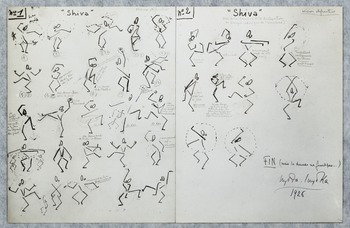
At the Bibliothèque-musée de l'Opéra in Paris, in a file titled “Portrait Inyoka,” I found—unexpected and without context—two photographs of notations of Inyoka's dance Shiva. In the following section of this article, I, or—by extension—we (taking in account our dialogic research process) will focus on this specific piece of Nyota Inyoka: the choreography titled Shiva, which was premiered in 1926 at the Salle Adyar de la Société Théosophique in Paris as part of a soirée.Footnote 3
The notations show a sequence of thirty-five stick figures with verbal annotations full of verve. She signed the sheet with “version définitive” and with the words “FIN (mais la danse ne finit pas …) Nyota Inyoka, 1926” (See Photo 1).Footnote 4 The notation as well as the notes she added are insightful for looking at Nyota's Shiva from the perspective of “queer possibility” and the “contradictions and disruptions that produce [it]”: “The juxtaposition of and friction between the multiple elements of any performance—dancing, costuming, sets, sound, and so on” (Croft Reference Croft2017, 10).
Nyota Inyoka. 1926. Shiva (version définitive). Paris: Bibliothèque nationale de France, Portr. / Ph. INYOKA (Nyota) 26 photos, N° 25 (2).

First, Nyota's notation shows (cultural) multiplicity, already within the element of movement when she interweaves at first sight seemingly contradictory regimes of movement and gesture—“Western” expressionist dance and “Asian” movement motifs, more specifically, variations on poses derived from Indian iconographies.Footnote 5 One can say that she is performing a specific kind of créolité. Interestingly (and often overlooked), Édouard Glissant, the main reference for creolization theory, emphasizes its form-generating potential. In contrast to terms such as synthesis, assimilation, and fusion, all of which reduce complexities and reproduce colonizing or exoticizing implications, Glissant's notion of créolité does not mediate between two autonomous strands but is a category marked by ambivalence, which potentially generates new forms even as it can be situated in a colonial matrix (Glissant Reference Glissant1989, 140). Nyota Inyoka remained one of the dancers “without history” throughout the twentieth century because of a movement and performance practice deeply rooted in ambivalent creolization processes in the colonial France of her time. However, at the same time she was also very much part of a certain cosmopolitan Parisian milieu, with its rather ambiguous and from today's perspective potentially problematic practices of artistic appropriation. Within a colonial matrix “creolization always entails inequality, hierarchization, issues of domination and subalternity, mastery and servitude, control and resistance. Questions of power, as well as issues of entanglement, are always at stake” (Hall Reference Hall, Enwezor, Basualdo, Bauer, Ghez, Maharaj, Nash and Zaya2003, 31).
Second, the notation evokes the god Shiva in performance as divine instance, the depth of which becomes visible, for example, in her note “FIN (mais la danse ne finit pas).”Footnote 6 Nyota thereby not only undermines the modernist implications for the new or rehabilitations of “ancient” India. Instead, she emphasizes the non-binary facets of Lord Shiva deciphered from Indian mythology and referring to the latest publications of the Indologist Victor Goloubeff (also Goloubew) (Goloubeff Reference Goloubeff1919). Nyota Inyoka embodies Shiva, moving between multiple, layered identities, and she decides not to transform him into a “goddess” like most of the other female dancers of her time, who kept the continuity of the dancer's gender with the gender of the figure embodied intact. In contrast to this trend, we can interpret Nyota Inyoka's Shiva performance as a queer gesture in the European sense because it refuses a conflation with her identity (in terms of gender by not transforming Shiva into a goddess, and culturally by using a Swahili name) and thereby refuses “monolithic significations and instead forges a politics from the productive frictions among identities” (Croft Reference Croft2017, 3).
Her seminal and at the same time particular work on Shiva with Ananda Coomaraswamy and Stella Bloch in a pleasure-filled intellectual “ménage à trois” is preceded by the historically situated phenomenon of a Shiva-mania during Paris's fin de siècle, as well as Nyota Inyoka's own performative embodiment of Hindu gods such as Vishnu in the early 1920s, which would bring her sudden fame.
Shiva-Mania around 1900
Around 1900, numerous staged interpretations of the Hindu god Shiva performed at the Parisian Music Hall are documented, in which the male god Shiva is transformed into a goddess: “At that time, in the Hindu numbers in the music halls, Shiva was indeed the most commonly portrayed divinity, though the god was often assimilated into a goddess as the performers on stage played either the role of a priestess officiating a ritual or the role of a goddess” (Légeret-Manochhaya Reference Légeret-Manochhaya2016, 30).
For example, one of the most famous dancers of the early twentieth century, Mata Hari, in the spirit of the time, performs a seductive dance of Shiva in 1905: “Her path is strewn with gold powder and rose petals.”Footnote 7 This transformation from god to goddess can be explained in the context of customary performance practices and the conditions of production at the Parisian Music Hall, and the so-called Nautch-Girl trend (Légeret Reference Légeret2014, 36–44; Fourmaux Reference Fourmaux2009, 24–25), which appropriated the motif of Shiva—decontextualized and undifferentiated.Footnote 8 Looking closely at the myth and history of Shiva and the simultaneously evolving practice of classical Indian dance, in which a single dancer can customarily embody characters independently of his or her own gender or costuming, and can even switch characters in the course of telling a story alone (Ekaharya Abhinaya), however, complexifies this. Archana Verma differentiates various Shivas in historical and mythological contexts and concludes that during the Chola Dynasty (ninth through thirteenth centuries) various mythical narratives, iconic appearances, polytheistic traditions, and spiritual meanings are woven together in the iconic figure of the Shiva Nataraja, the cosmic dancer, the first and final instance of the cosmos (see Verma Reference Verma2011, 24–25). What is important here is that Shiva Nataraja, with his four arms and raised leg, can only be understood in the context of his meanings in (primarily South Indian) Hindu mythology, specifically in relation to the violent circulation of the feminine and masculine attributed principles (Shiva and Kali)Footnote 9 and in relation to Coomaraswamy's concept of the cosmos as theater.Footnote 10 These two aspects will have to be decoded in Nyota Inyoka's notation and performance of Shiva.
Vishnu: Europeanized Icon of Indianness and Revelation
Nyota Inyoka achieved a first milestone in her career in 1921 with her performances of Vishnu and Krishna at the Théâtre Oasis owned by the well-known Parisian couturier Paul Poiret, whose spectacular costumes contributed to staging her as a Europeanized icon of Indianness. In the Vishnu photos of the early 1920s (printed in Roudanez Reference Roudanez1947, 78), Nyota Inyoka is wearing a large, ornamental golden headdress—a fashionable iconic visualization of an Indian temple—and a tight erotic bustier, a short with metallic sequins, as well as upper and lower arm bracelets. Her poses can be interpreted as a prototypical modern European (re)enactment of ancient Shiva and Vishnu sculptures. Although her performative, racialized appearance, along with signature iconographic poses, seems to evoke “Indianness” at first sight (at least for a Parisian audience in the beginning of the 1920s), neither the movement articulation and energetic regulation of her body nor the costumes conform to the conventions of the classical Indian dance dispositif or Asian performance practices and conventions of that time.
However, the year 1921 is also key, we argue here, for understanding her constantly growing artistic and intellectual interest in Indian dance and philosophy, which seemed to be more general and intuitive than specific in the early 1920s.Footnote 11 However, the avant-garde theater director and writer Aurélien Lugné-Poe emphasized the outstanding research and intellectual interest that led Nyota Inyoka to study at the Musée Guimet, as well as other Indian and Egyptian art collections (Lugné-Poe Reference Lugné-Poe1921). In 1919, she married André Krajewski, a banker with Polish Jewish origins who lived in France and was a collector of ethnographic artefacts in modernity, and traveled to Tahiti with him as his partner on one of his rather arcane business travels.Footnote 12 While returning to Europe aboard an ocean liner, she had her first vision connected to Hindu divinities: god Vishnu appeared to her as a sitting, dancing god, who delights with the gestures of his arms and hands and moves his torso in serpentine motions:
I saw a God in golden splendor on his pedestal, executing an extraordinary dance while sitting, with marvelous gestures of his arms and hands, accompanied by reptile-like movements of his torso.… It was a ray of light as though it were an order from above. All my cloudy projects became clear in front of this obsession: to create Vishnu, to dance Vishnu, to incarnate Vishnu …Footnote 13
After her return to Paris in spring 1921, she had her first successes as Mlle Nyoka “toute jeune danseuse hindoue.”Footnote 14 In a typescript about her choreography Vishnu Footnote 15 dated 1921, Nyota Inyoka narrativizes the transformative aspect of Vishnu and his incarnations and adds the following incantation twice: “For in reality, I am Vishnu.”Footnote 16 The transformation is temporarily all-encompassing: Vishnu and Nyota Inyoka become one staged figure that invokes the human and the divine dimension at the same time through the act of dancing.
Krajewski, who was accused of fraudulent activities, committed suicide near Paris in September of the same year. It is documented that shortly before and after Krajewski's death, Nyota Inyoka worked on several solos, which she presented at theaters in Paris and on tour. In fall 1922, she accepted her first transatlantic engagement at the Ziegfeld Follies in New York City. She was announced widely in the media as the Egyptian dancer “Princess Nyoka-Nyoka”Footnote 17 and gave numerous successful performances in several venues (see note 12). The dream of a career on Broadway seemed tangible.
Ménage à Trois: Working on Shiva with Stella Bloch and Ananda Coomaraswamy
In 1923–1924, Nyota Inyoka began intellectual and artistic work on her piece Shiva, motivated by her intimately friendly relationship with Ananda Coomaraswamy and Stella Bloch in New York and Boston. The first edition of Coomaraswamy's seminal essay, “The Dance of Śiva,” was published in 1912 in a regional journal in Madras. However, it only started circulating in intellectual and artistic circles after it was republished in 1918 in a collection of essays compiled under the same title.Footnote 18 Without a doubt, Coomaraswamy is present in the narrative of twentieth-century history as a figure of mixed heritage (from his father's side Sri Lankan, from his mother's side English) and an eminent historian and scholar of Asian cultures and Hinduism. However, two important personas have been eclipsed in this narrative: Ananda Coomaraswamy in his relationship to Stella Bloch, who was—just like him—shaped by the condition of migration. Stella Bloch was born in 1897 in Galicia, which was then Austro-Hungarian, into a Jewish family that emigrated from Europe to New York when Stella was a child. There she grew up in a secular and multilingual environment (English, German, Yiddish) and became one of the six “Isadorables” in Isadora Duncan's company. Bloch, we argue, decisively shaped Coomaraswamy's view on dance in the 1920s and contributed to specifications in the sense of an embodied knowledge, be it during joint research travel through Asia as lovers in 1920/1921, or—during their marriage—by way of her mythologically and historically well-researched reenactment of Javanese dances in the New York of the 1920s.
In the context of the heteronormative matrix of the time, Stella Bloch is known as Coomaraswamy's muse, while her own artistic position is not recognized.Footnote 19 There is a commonality here between Stella Bloch and Nyota Inyoka: both lived and worked as dancers in a time of patriarchy and heteronormatively constructed sexuality/gender roles. A queer perspective as an option for thinking and performing beyond the dominant paradigms allows uncovering the forgotten pleasurable, mutual “ménage à trois” in the context of Nyota Inyoka's choreography Shiva. Ananda Coomaraswamy's, Nyota Inyoka's, and Stella Bloch's oeuvres are determined by mixed heritage and/or diasporic conditions and pleasurably created interconnections: “In a [their] world of cross-cultural relationship, which takes over from the homogeneity of the single culture, to accept this opaqueness—that is the irreducible density of the other—is truly to accomplish, through diversity, a human objective.”Footnote 20 In their diasporic and multifaceted work on Hindu myths, and specifically on Shiva, against the backdrop of creolization, they paradoxically create a modern phantasma of universalist “true art” tied back to an idea of ancient India.
The great patriarchal historical narrative eventually places Coomaraswamy at the top, and blends out the triangular constellation and the invaluable contribution of the two women with a rather feminist approach in “performing Shiva” and embodied research at their time. Stella Bloch and Nyota Inyoka become shadowy figures in the one-dimensional and perspectively reduced history of the reception of Coomaraswamy's seminal work, “The Dance of Śiva,” in modernity.
Staging Shiva: Performing Créolité and Gender
In Nyota Inyoka's notation of Shiva, the intellectual “ménage à trois” can of course only be decoded abstractly. However, several sources legitimize this argument, among others. First are notes in Nyota Inyoka's dream diaries from 1923 to 1924,Footnote 21 in which erotic dream sequences with Stella Bloch are described, and Coomaraswamy is present only as a shadowy figure. Second is Bloch's letter to George Cukor, in which she explains that Nyota is “conscious of her success with everyone, of the excitement + delight she causes wherever she goes, but it never really takes root—that nothing ever comes out of it and that is elusive, intangible as air.”Footnote 22 Here, Bloch unerringly articulates the mysterious charisma of Nyota Inyoka: “intangible as air.” Stella Bloch seems to be disappointed because, even in their erotically stimulated pas de deux, Nyota does not unveil her “true” self; the artistic and diasporic persona overshadows private aspects in their relationship.Footnote 23 The connection between the two women remains determined—despite or maybe because of the intimate intellectual and erotic vibration, which, however, remains opaqueFootnote 24—by Nyota Inyoka's “amiable reserve.” Third, Nyota Inyoka assists Coomaraswamy at the Boston Museum of Fine ArtsFootnote 25 and engages intensely with his and Bloch's oeuvre (writings, ethnographic documentary films, etc.). Having collaborated with the dancer and musician Sarat Lahiri, and having been introduced by Goloubew to Coomaraswamy, she becomes part of the Indophile artistic-intellectual network on the East Coast. In the program note of a multipart dance recital by Nyota Inyoka at the Neighborhood Playhouse in New York City on May 11, 1924, there was a program item titled Evocation of Modern India, which included “Excerpts of ‘The Dance of Shiva’ by Dr. Coomaraswamy” recited by Sarat Lahiri.Footnote 26 This was the aesthetic and conceptual basis of Nyota Inyoka's Shiva notation, which she created two years later in Paris.
Reading Inyoka's Notation of Shiva
The Shiva notation shows a series of thirty-five poses, including written annotations.Footnote 27 Although visibly drawing on the physical, sculptural postures reminiscent of (South) Indian dance forms, it does not include the two defining and existential elements of (classical) Indian dance technique: the canonical rhythmic structures and iconic narrative expressive elements. Whereas the poses suggest the iconography of Shiva, they do so without the specific iconic attributes of tangible meaning, for example praising or describing the god through hand gestures. Nyota Inyoka's interpretation of Shiva instead is abstract and becomes evident through movement qualities reminiscent of (European and US-American) modern dance such as momentum, resisting gravity, swinging, and fluidity in order to convey a highly energetic and even violent interpretation of Shiva. Nyota Inyoka does not merely (mono- or interculturally) juxtapose elements from Indian iconography and “Western” modern dance forms. She also does not interpret Shiva from an exclusively female perspective or transform him into a “goddess,” like Mata Hari or the Nautch-Dancers in the music halls around 1900, who provoked criticism, for example, from the dancer Ram Gopal, who wanted to see Shiva exclusively performed by men.Footnote 28 Therefore, her Shiva performance can be read as an interweaving of choreographing créolité and queerness. It is structured by an interweaving of movement motifs drawn from different cultural contexts that are specifically connected to her life. Furthermore, it is based more on iconographic parameters than on dance technique. Nyota Inyoka's performance of Shiva across gender categories is evoked primarily through the way she works with energies in her flexible body, as she describes in the comments accompanying her notation: her use of energy in Shiva changes consistently between increased and decreased, modulating between the qualities of countertension and swinging. Her phrasing changes between a sudden use of a lot of energy and exquisite pauses (“arrêt brusquement”). In the context of the aesthetic experiences of European and US-American audiences of her time, accustomed to ballet and expressionist dance, she immediately alternates between movements marked as feminine and masculine. There are, for example, two recurring motifs: soft, “souple” arm movements and their reversal into “très violent” (quite violent). Also important is her stamping on the ground (“piétinant sur place”) and the recurring change between facing front and back, interspersed with phrases containing rapid turns. Loulou Roudanez, who witnessed a later performance of Shiva by Nyota Inyoka, decodes three significant motifs from a perspective informed by dance analysis: (1) disharmony, (2) polyrhythmic gestures, and (3) a contrast between warrior-like movement qualities (“un rythme très rapide et battailleur”) and a harmonic linking of movements (“un enchaînement continu de mouvements très harmonieux par une attitude subite”) (Roudanez Reference Roudanez1947, 92). The combination of a choreography based on a créolité of aesthetic languages, and the use of energy and movement qualities beyond a binary construction of gender, marks the staged presence of a dual figure: Shiva-Nyota—“Nyota Inyoka and Shiva together dissolve in the movement.”Footnote 29 The monocultural and heteronormative order of the “cosmic theater” seems temporarily suspended in Nyota Inyoka's Shiva.
Remembering and the Archive: Nyota Inyoka and Practices of Queering the Archive (Franz Anton Cramer)
As we have already noted briefly, remembering Nyota Inyoka through the historiographic process of researching her life and oeuvre remains tentative and provisional. The overall picture we can glean is far more obscure than the archival evidence regarding her career would lead us to think. Many details about Nyota Inyoka (especially about her life) remain opaque and instigate further questions, so that remembering her entails speculations, research, and constant re-reading of sources because Nyota Inyoka's primarily self-collected archive does not conform to the archival principle and conventional processes of linear narrative biography. It is because of this multifaceted appearance and the quite contemporary questions she helps to formulate that I am drawn into the research process in a different manner than usual. As a white male researcher approaching the age of retirement, I need to reconcile my archival and heuristic routines with a resistant reality: the one created by Nyota Inyoka and in part deposited by her heirs to the imperial institution of a national library. It is an institution I am far more familiar with than the life-world of a female PoC artist in the first half of the twentieth century. As a researcher used to browsing archival collections and various repositories of documents all based on writing, I have become used to the practice of partaking in the lives of those who are the object of my research in textual form: I write about what the person has written or what has been written on that person. This leads to a strange impulse of proximity—as though I want to know that person and be as close to them as possible and be part of their life in a fusional, even if phantasmal, quest. However, this affective aspect of archival research contradicts the mechanisms and protocols of research based on criticality, on doubt, on distrust against the materials in front of my eyes in relation to that which might still emerge. To be sure, this disposition is characteristic of all quests for knowledge: without curiosity no research, without obsession no rapprochement.
This obsessive dynamic with which I am trying to understand, to seize, and to reconstitute in a consistent narrative the artistic and existential biography, largely changes the epistemic architecture of the research. For it shows that the positionality of the researcher—of myself in that case—is necessarily always already implicated both by my gaze on the documents and by my exchange within the research team and their respective positions. What follows is a historiographic account of what we have been able to gather about her life, as a gesture toward remembering as queering ethnicity and inscribing her into dance history.
Nyota's Agency and Archival Collections: The Predicament of Coherence?
The difficulty begins when trying to determine Nyota Inyoka's identity, which on one hand seems meticulously constructed, and on the other hand is in a peculiar way just as meticulously unclear. Even her name, Nyota Inyoka, is a pseudonym. It was transformed several times during the early years of her career, from Nioka-Nioka (1917)Footnote 30 to Nyota-Nyota (1920)Footnote 31 to Nyota-Nioka (1920)Footnote 32 to Nyota Nyoka (1921)Footnote 33 to the “final version”Footnote 34 of Nyota Inyoka (1922/1923).Footnote 35 A newspaper article from 1932 reports that she was given her pseudonym by Swahili priests while she was traveling through what was British East Africa and Belgian Kongo at the time. “Nyota is Star, Inyoka is Serpent,” she is quoted. “Living under these signs is an important means to please the Gods”Footnote 36 (Chamine 1932, 2). Because Nyota consistently used her pseudonym, and her birth name was one of the innermost secrets she kept strictly all throughout her life and in all of the extant archival documentation, we made a conscious decision to respect her commitment to this secrecy and also call her by her pseudonym Nyota Inyoka, rather than to reveal her birth name, which we found out six months into our research process.Footnote 37 Nyota Inyoka's own voice here emerges most strongly in the silences and gaps of what she chose to consistently not communicate—her birth name.
As this stringent and exclusive use of her pseudonym until her death and even on her gravestone attests to, her origins are consistently and deliberately obscured by herself through the varying accounts of her life and career, which she herself circulated actively. Nyota recurrently connects her ethnic origins and also her artistic inclination to her father, who is sometimes identified as Indian, sometimes as Egyptian, and once as Algerian.Footnote 38 However, we do not know who her father was, whether she knew him, whether she ever met him, or even whether her mother told her about him. The figure of the absent father marks her life and is at the basis of her mystery, which she maintains without giving in to the logic of consistency and authenticity by trying to culturally match her name and her dance.
At the same time, based on the archival materials available, we are able to recount many aspects of her life. According to reconstructive accounts as told by herself or by third parties, she started her stage career in 1917, at the age of twenty-one, in a vaudeville show at the Folies Bergère in Paris, and subsequently made a name for herself performing dances with Indian and Egyptian mythological as well as worldly themes in various shows in Paris. Nyota spent extended time periods in Tahiti and the United States between 1919 and 1924. Upon her return to Europe in 1924, she was based in Paris and continued to create and perform extensively on a national and international level. In 1931, after her successful appearances during the International Colonial Exhibition in Paris, she founded her own company, the Ballets Nyota Inyoka. In the early years, her company was composed of female dancers, some of them with mixed heritage. She became a star of the cultural scene in interwar Paris. During the German occupation, she stayed in town, performing occasionally for gala and showcase evenings. After her last major production in Venice, Italy, in 1952, she turned to teaching and a range of activities situated in an interreligious and spiritual context.Footnote 39
The Affective Archive and Its Potentials for “Queering” the Archive
The factual evidence we found was retrieved from Nyota's own records, as well as various contemporaneous collections about her, the International Archives of the Dance, and the fonds Rondel,Footnote 40 among others. Even with such extensive documentation available, the conventional forms of biography writing fail in the case of Nyota Inyoka, as it is as yet impossible to fully determine how and why she created her identity. We only have clues that lead to certain assumptions and guesses. However, Nyota has arranged the available documentary material in a way that forces us to admit the indeterminacy of factual (archival) items with regards to coherence and consistency in the resulting (my own) narrative.
In continuation, as it were, to the unknown aspect of her paternal origin, it is possible for her to dismantle what has been identified as the archive's male principle of origination (Derrida Reference Derrida1996; Steedman Reference Steedman2001). Rather, the archive follows her own inclinations and strategies; it is not the one archival gatekeeper, the arkhon, who determines what is or is not part of the archival representation. We can think here of new conceptualizations of “The Archive” put forth by Robert Reid-Pharr and his invectives against “the tyrannies of philosophy and sociology” so as to reach a “post-humanist archival practice” (Reid-Pharr Reference Reid-Pharr2016, 9); or of Arjun Appadurai's notion of the migrant and diasporic archive, the archive as “an aspiration rather than a recollection” (Appadurai Reference Appadurai, Brouwer and Mulder2003, 16), with its potential to disrupt habitualized memory-building: “the archive of possible lives is now richer and more available … than ever before” (19). Of course, the entire notion of the “Affective Archive” comes into play (Palladini and Pustianaz Reference Palladini and Pustianaz2017).
In sum, though, Nyota has assembled her public and not so public life (for herself) in what seems to have been her own artistic and personal system of reference, and creative and intellectual laboratory. It was only well after her death that these holdings were handed over to the French national library in order to become a fonds d'archives. In the first place, Nyota Inyoka's archive is a private collection and as such, it is autonomous, wild, affective, and disorderly. The intimacy of this private collection also shifts the act of researching and remembering her via these documents to a personal register as it raises the question whether some of these materials, such as diaries and personal notes, were actually meant to be read by us. It makes us rethink our relationship as researchers to her, to the archive and its institution, and to the process of remembering Nyota Inyoka and writing her back into a more public memory.
In viewing Nyota Inyoka's records, not as part of a universalist institution fetishizing the written document but as an amalgamation of proof, lived experience, and sovereign construction profoundly marked by Nyota's mysterious personality, we are most of all dealing with factual variants, discursive incongruities, disparate traces of which we can make sense only by stepping beyond habits of binary true-or-false evidence and by accepting uncertainties, affective and otherwise. As Carolyn Steedman points out: “No one historian's archive is ever like another's.… Each account of his or her [the historian's] experience within them [the archives] will always produce counter narratives, of different kinds of discomfort” (Steedman Reference Steedman2001, 9).
Such counternarratives, in the case of Nyota Inyoka, are part of the very story to be understood; the methodological discomfort starts when ascertaining historical facts because so much of her life remains enigmatic, and each answer only leads to more questions. The subjectivity of the researcher, in our case multiple subjectivities of different researchers with different positionalities, alter what can be made of documents. “Objects in a collection begin to speak about their world as we invest time in them,” states Elizabeth Vincelette (Reference Vincelette2018, 59). “Archival sensibilities” (Stanley Reference Stanley, Moore, Salter, Stanley and Tamboukou2017, 66) differ according to subjectivities involved, and the archive itself may be considered a subject (cf. 2017, 66), just as Nyota's subjectivity and positionality have informed what and how we see, and guide the emotions we invest in the research-as-remembering, both from a documentary/archival and an embodied/enacted practice. That is how, in culturally invested historiographic and anthropological studies, it is commonly accepted as part of the archival turn that any given archive is never the same (Cramer Reference Cramer, Büscher and Cramer2021a). Of course, by employing investigative techniques common to all archive-based research, it is possible to overcome some of these evidentiary barriers and to track details about the chronologies of Nyota's life. However, at the core of the results generated, blind spots remain: Was there more material, and if so, where did it go? What happened to her library? What of her private estate, such as personal pictures, musical instruments, furniture? In a larger perspective: Was Nyota wealthy? And if so, since when? Why is there no record of her inheritance with the probate courts of Paris? These questions are doubtless also due to general problems in the transmission of documents, their state of conservation, their accidental loss, or misinterpretations. However, the way Nyota Inyoka lived and organized her life infers an active blurring of traces, a disruption of order and finality, a self-absorbed interiority heedless of structural documentation. She applied similar strategies to her choreographies that were modified and re-invented throughout her career, starting with the choreographic piece Shiva, analyzed in the first section. We may even draw a parallel to the permanent working and re-working of her unpublished intellectual and literary projects that can be observed in her collection: countless versions revised and rewritten, copied and altered, abridged or augmented testify to her constant concern to change rather than to fix. All these observations may well be considered as strategies of queering, even if avant la lettre.
In that way, the “personal truth” of Nyota Inyoka forecloses, in many respects, the “factual truth” of historiographical and archival evidence. Put more concretely, Nyota on the one hand actively claimed her position as author in her own right, for instance by having her choreographic pieces protected under copyright laws.Footnote 41 On the other hand, she seems to have curtailed her own authorial powerFootnote 42 by attributing her inspirations to powers outside herself: callings, divine visions, astrological and numerological constellations.Footnote 43
What is important, then, for the story-telling of biography-based historiography in the case of Nyota Inyoka, is the observation that the very principle of the archive—that is, the principle of the male arkhon as the one power who controls and disposes of world, ideas, and memories—is bypassed in Nyota's world: she claims it was not her ideas, but gifts of divinities; her paternal origin and the person of her father remain opaque; even her name is said to have been chosen by spiritual powers.
We may therefore claim that the archival principle is queered by the way in which Nyota Inyoka led, documented, and embodied her very life. Both—the factual archive and the subjective refiguring of its contours—are constantly intermingling, which is why we can narrate her life at all. However, we have to understand—and accept then—that the researcher's position is guided by the subjectivity of the figure of Nyota Inyoka and her choices.Footnote 44 This is one of the reasons we deliberately chose not to reveal her birth name, even though we were able to identify it in the course of our research. We believe it would be unethical to counteract Nyota's own utmost concern. It is not enough, in our view, just to unravel facts heedless of the lived life and positionality of the person in question. The archive, then, is dynamized and turned toward a realm of potential (non-monolithic) signification—and affective, multifaceted remembering rather than being a storage space for material knowledge. Nyota Inyoka thus queers the archival principle also by destabilizing conventional processes of linear narrative biography. She withholds the idea of origin and inception, and at the same time refuses the totalizing aspect of the historiographic end.
Queering Ethnicity and Cultural Belonging: Remembering Nyota Inyoka as a European Artist of Color (Sandra Chatterjee)
Over the course of this article, we have positioned our archival research, the analysis of Nyota Inyoka's oeuvre (here based on the example of her work Shiva), as well as the reenactment of her scores in the context of “practice as research,” as acts of remembering Nyota Inyoka, a dancer of color, who is not remembered as part of canonical European dance history. We have also attempted to remember her in ways that allows her voice to emerge, by placing an emphasis on and respecting what she wanted to communicate and what she chose to render opaque.
In their book Performing Memory in Art and Popular Culture: An Introduction, Liedeke Plate and Anneke Smelik describe active remembering as an act that
[is] performative [in Austin's and Taylor's sense of the word of “doing something”], making the past present in ways that can be experienced, generating a knowledge of the relationship between past and present that is oftentimes troubling, other times comforting.… The notion of “performing memory” thus presupposes agency. (Plate and Smelik Reference Plate and Smelik2013, 3)
Performing Nyota Inyoka's memory through archival research, analysis, as well as embodied research and reenactment is our collaborative assertion of the agency of remembering as acts of queering, but also a gesture toward decolonizing (dance) historiography.
Here the question of the politics of remembering and the politics of historiography becomes important: Who is remembered and who is not, and on whose terms? Who appears in dominant versions of (dance) history and in what capacity, and who does not? What are the repercussions of such lacunae and erasures? What does it mean to respect an artist's “right to opacity” in the process of rendering her visible in dance historiography? What are the ethics of attempting to queer historiography? What are the ethics of decolonizing gestures? What are the ethics of publicly remembering?
Reenactments or Memory as Agency
What is the importance of reactivating the memory of a European artist of color such as Nyota Inyoka for current European of color artistic production? What is the agency in performing Nyota Inyoka's memory, whether through archival research, dance analysis, or re-enactments of her notation?
Even though Nyota Inyoka's origins remain opaque,Footnote 45 what we know is that she was a mixed-race dancer, who was variously assigned many identity labels such as Indian, Egyptian, Cambodian, or, less specifically, “créole”Footnote 46 or “exotic,”Footnote 47 for example, by the press. Her oeuvre overall, drawing on a host of culturally and ethnically marked iconographies and sources, has been located outside Europe, categorized (by herself and others) as non-European, notably “Indian,” “Hindu,” “Egyptian,” etc. From my contemporary European of color perspective, this is a point of connection in terms of a shared condition of being othered, ethnicized, and racialized via identitarian ascriptions, for example, from the press, organizers, and audiences with which one is bound to wrestle. To me, a late twentieth- and early twenty-first-century European choreographer of color, Nyota thereby resonates as a predecessor to current othered European identity and artistic positions (Chatterjee Reference Chatterjee2018; El-Tayeb Reference El-Tayeb2011a), including my own. Such predecessors are conspicuously absent from dance history—but not only from dance history. In her book European Others: Queering Ethnicity in Postnational Europe, Fatima El-Tayeb discusses “Europeans of color” in terms of Étienne Balibar's notion of the “fictive ethnicity” on which all nation states are built:
“No nation possesses an ethnic basis naturally, but as social formations are nationalized, the populations included within them, divided up among them or dominated by them are ethnicized—that is, represented in the past or in the future as if they formed a natural community, possessing of itself an identity of origins, culture, and interests, which transcends individual and social conditions.” (Balibar Reference Balibar1994, 224; El-Tayeb Reference El-Tayeb2011a, xiii)
The exclusionary fictive identity situates Europe outside narratives of race—advancing a narrative of “political racelessness,” which results in “an image of a self-contained and homogeneous Europe in which racialized minorities remain outsiders permanently” (El-Tayeb Reference El-Tayeb2011a, xxx). One of the results of this exclusionary fictive identity is that current European Others, because they—their origins, their ancestors, their histories, their artistic practices and contributions—are consistently located outside of Europe, have no history in Europe. A “memory of their century-long history is … not something that comes organically with being a European of color” (xxx).
Here the relevance of reactivating and performing the memory of a European artist of color, such as Nyota Inyoka and her work, becomes apparent because the very act of remembering her and her oeuvre, analyzing and circulating knowledge about her work, can contribute to “queering ethnicity” (El-Tayeb Reference El-Tayeb2011a, xxix) as a “process of alternative community building” (xxx) across time (and place).Footnote 48 Remembering and recovering Nyota Inyoka's work in El-Tayeb's sense “rewrite(s) European history through a queer practice” (xxx) and is thereby part of complex and circular processes of knowledge.
The act of remembering not only inscribes artists like Nyota Inyoka into European (dance) history, but also contributes to giving European artists of color a history in Europe—and thereby to queering ethnicity by going against the grain of a monolithic, raceless, white historiography. Engaging with Nyota's notations, her impulses, and what we might know or are able to deduce of her intentions, all become imperfect acts of remembering. The acts of remembering hover between her materials and our embodied memories today, thereby counteracting erasures, institutionalized lacunae, and structural forgetting by way of the “intimacy with which dancers embody cultural values and memories” (Burt Reference Burt2003, 37). Ramsay Burt argues that “through an appreciation of the role of embodied memory, it is possible to avoid replicating the institutionalized effects of modernity and globalization on history.…” (Burt Reference Burt2003, 37).
For dancers of color, remembering Nyota by way of moving through her notations, on one hand makes her intimately present today in and through our bodies, for example in a (contemporary) dance studio or university. It also creates an immediate “relationship between past and present that is oftentimes troubling, other times comforting” (Plate and Smelik Reference Plate and Smelik2013, 3).
One of the ways in which this relationship between the present and the past is troubling to me as a dancer today, is the fact that we do not know what Nyota's work actually looked like, what her politics were, how she explicitly related to and reflected on exoticism and colonialism. We cannot enter into a dialogue with her about (current) politics, discourses, and concerns. Although we gain more and more insights and certainties as we delve deeper, we cannot be sure of her politics and whether she would have at all related or agreed with the politicized and overtly anti-racist, self-assumed label of “choreographer of color.” At the same time, these unsettling aspects of remembering do not take away from the agency and intimacy of remembering, the importance of inscribing an artist like Nyota Inyoka into European memory and (dance) history. The work with the material we have available of her dances mirrors the memory of her as an artist of color ancestor with all its opacities, intergenerational asynchronicities, and partial information, withholding the sense of reassurance we might crave. Just as the lingering questions around explicit political solidarity across time, the process of embodying the often incomplete, only partially available, or only partially legible notations, such as that of Shiva, necessarily brings Nyota in dialogue with our current embodied cultural memory, which, in the case of Europeans of color, is marked by historical absences, voids, and erasures. It resists normative processes of exclusion (cf. Burt Reference Burt2003, 37) and the reproduction of a monolithically signifying (dance) history.
Melancholic Remembering and Queering Cultural Belonging
The absence of a history in Europe for Europeans of color and the exclusivity of the fictive raceless identity is, we argue, also detectable in dance histories and historiography. This invokes resonances with both notions of racial and notions of queer melancholia. Contrary to Freud's definition of melancholia in opposition to mourning, queer and racial melancholia are not understood as pathological, but as “unresolved process[es]” of suspension or conflict in relation to unattainable norms (such as whiteness or heterosexuality).Footnote 49
David Eng and Shinhee Han draw a parallel to José Esteban Muñoz (Reference Muñoz1999), who—talking about racial and queer melancholia—“states that, for queers as well as for people of color, melancholia is not a pathology but an integral part of daily existence and survival” (Eng and Han Reference Eng and Han2000, 693; referring to Muñoz): “It is a mechanism that helps us (re)construct identity and take our dead with us to the various battles we must wage in their names—and in our names” (Muñoz Reference Muñoz1999, 74; also cited in Eng and Han Reference Eng and Han2000, 694).
Muñoz invokes community and (chosen) family building across times, generations, and death, which also resonates with a queer/artist of color engagement with Nyota, particularly through the intimate act of embodying her notations. Remembering Nyota from a European of color perspective is a melancholic memory as it speaks to the conflict around the unattainability of a European (of color) history and of (white European) embodied cultural memory. Remembering Nyota Inyoka and respecting her right to opacity, however, also means remembering a continuity of European of color agency and invoking resistance through a refusal of assimilation that can be understood as practices of queering and creolization. The analyses of Nyota's agency in terms of collecting and thereby shaping the fabric of the archive, as well as her approach to staging and choreographing Shiva marked by créolité and queer possibility, trace the transhistorical continuity of such European of color agency, as it teases out the ways in which she was, for example, anti-assimilationist in multiple registers, thereby resonating with practices of queering. Critiquing Europe's “exclusionary fictive identity” (El-Tayeb Reference El-Tayeb2011a, xiii) associated with racelessness, for example, El-Tayeb counterposes this racelessness with creolization: “Racelessness can be read as a counterstrategy to the creolizing taking place in contemporary Europe, creolizing not (only) in the sense of a mixture of cultures and groups but as an active reworking of essentializing ethnic ascriptions” (El-Tayeb Reference El-Tayeb, Lionnet and Shu-mei2011b, 230). In other words, the concept of racelessness counteracts creolization. Creolization, on the other hand, can be seen as queering notions of authenticity and cultural belonging.
Despite Nyota's mystified and opaque origins, we do know that she was a mixed-heritage Parisian woman of color, but we cannot conclusively determine her belonging to a specific community of color. It becomes necessary, therefore, to take a closer look at how Nyota Inyoka's indefinable origins, and by extension (ethnic) identity, raise questions of cultural belonging in relation to the dances she produced, from “Egyptian,” via “Cambodian” and “Persian,” to “Indian” (Brahmanic, Vedic, Buddhist …). How do her choreographic practices (which, in an expanded notion here, are meant to include how she choreographs her biographical narratives and the opacities around her persona) “queer” notions of cultural belonging and modernist dance practice in twentieth-century France? The various origin stories that circulated about her publicly (in the name of publicity?), refer to her as Indian/Hindu, Cambodian, Egyptian, or Persian. They attest to attempts—by herself as well as others—to locate both her dances and her identity outside Europe, thereby constructing a continuity between her ethnicity and the dances she performed, even if this continuity is marked by inconsistencies. This linking of ethnicity with dance forms—from the perspective of a European dancer of color—is a gesture of exoticization that continues to be familiar today and translates into a pressure to cater to notions of performing authenticity, and the “burden of representation,” in Kobena Mercer's words (Mercer Reference Mercer1990).
In such a matrix, for example, the (Indian) identity of a dancer—corresponding to the Indianness of the dance—gains and maintains currency. Nyota Inyoka's repeated claims to perform “danses hindoues,” while at the same time keeping her origins ambiguous (at different points) as well as assuming a name that is Swahili rather than Indian, actively complicates the question of the correlation of identity and dance—as well as the closely related questions of “authenticity,” “representation” and “appropriation.” Instead, she celebrates ambiguities and inconsistencies. Here, we might be able to look toward the notion of “queering cultural belonging,” which is
define[d] … as a subversive disruption of a dominant naturalized cultural norm that complicates notions of cultural authenticity, appropriation, and identity-based representation, particularly in relation to artistic production. [In the context of our case study] queering cultural belonging aims to undo the easy equation between ethnicized and racialized identities, cultural and artistic production, and (post)national imaginaries without ignoring uneven power hierarchies or histories of inequality. (Chatterjee and Lee Reference Chatterjee, Lee and Croft2017, 47)
Although we cannot know whether it can be argued that Nyota intended to subvert the gesture of linking her identity and the dances she performed, the way she chose to be remembered invokes such a rupture: after a certain time in her life, she consistently uses her Swahili pseudonym, Nyota Inyoka, in conjunction with “chorégraphe hindoue” (at least in the later part of her life, as well as on her gravestone).Footnote 50 Her creolized choreographic approach, which, as the analysis of her work Shiva demonstrates, interweaves movement and embodied iconographic motifs from different cultural contexts, also queers notions of cultural belonging as well as ethnicity through creolization. As such, we argue that processes of remembering Nyota Inyoka—which are filled with “obstacles”—can be seen as contributing to queering ethnicity, while teasing out the way she choreographs her persona and her dances illuminates Nyota's own practices that resonate with queering.
Conclusion: Opacity and Multivocality
Over the course of this article, we have set out to remember Nyota Inyoka in different registers—in terms of movement analysis, historiographically and personally as a predecessor and through embodiment. In the process, notions of queering and créolité have been interwoven. The practices of queering and creolizing emerge as full of opacity and multivocality, possibility and restrictions. They make visible the lacunae in our dance memories, (European and/or heteronormative and patriarchal) historiography, and canonical understanding of dance in Europe. Interweaving queering and creolizing opens the possibilities of revisiting, challenging, re-inscribing, rewriting, subverting, amending, making reparations for, etcetera, and can be seen as gesturing toward decolonizing dance.
The question that remains following these interweavings of queering and creolization, and the decolonizing gestures underlying them, is how we, as scholars and dancers of the twenty-first century, can look at Nyota Inyoka's twentieth-century modernist dance, archive, and biography and activate it in the present?
To us, the work is about remembering Nyota on her own terms instead of reconstructing a linear biography, embracing multivocality instead of streamlining a singular perspective. We strive to allow her voice to emerge through our text and respect her silences instead of perpetrating unwanted disclosures. We seek to respect her right to opacity instead of reproducing a model of historiography that values facts over her desires.
This article intends to contribute to queering the rules of historiography in ways that exceed inscribing an almost forgotten dancer into dance history. We want to instigate a prospective shift away from models of transparency based on homonationalist and colonizing principles.