Clostridium difficile infection (CDI) is the leading cause of healthcare-associated diarrhea in the United States leading to significant morbidity and mortality.Reference Loo, Poirier and Miller 1 , Reference Peery, Dellon and Lund 2 The economic burden associated with CDI is estimated to be $1.2–$5.9 billion annually in United States, with similar burdens observed in Europe.Reference Bouza 3 , Reference Kwon, Olsen and Dubberke 4 For a first episode of CDI, the standard of treatment is either oral vancomycin or fidaxomicin.Reference McDonald, Gerding and Johnson 5 However, when CDI recurs, the treatment approach is less clear. Recurrence is common, with reported rates ranging from 5% to 50% for healthcare-associated CDI, and most studies reporting between 10% and 30%.Reference Lessa, Mu and Bamberg 6 , Reference Aslam, Hamill and Musher 7 Furthermore, recurring patients have a higher risk for subsequent recurrences, which may contribute to diminished quality of life and further financial burden on the healthcare system.Reference Kelly 8
Evidence supporting the use of different treatments for recurrent CDI is lacking. Current European Society of Clinical Microbiology and Infectious Diseases guidelines recommend treating the first recurrence of CDI with either oral vancomycin or oral fidaxomicinReference Debast, Bauer and Kuijper 9 ; whereas the Infectious Disease Society of America Guidelines recommend treatment of first recurrence of CDI with either vancomycin, vancomycin taper, or fidaxomicin.Reference Sheitoyan-Pesant, Abou Chakra, Pepin, Marcil-Heguy, Nault and Valiquette 10 For subsequent recurrences, the IDSA guidelines also mention the possibility of using tapered doses of oral vancomycin, fidaxomicin, or FMT.Reference McDonald, Gerding and Johnson 5 Recently, bezlotoxumab was FDA approved to reduce the recurrence of CDI, when used in combination with other CDI treatments. In a report of two phase 3 clinical studies, bezlotoxumab was associated with substantially lower rates of recurrent infection than placebo (MODIFY I: 17% vs 28%, P<.001; MODIFY II: 16 vs 26%, P<.001).Reference Wilcox, Gerding and Poxton 11
Although bezlotoxumab is associated with lower rates of recurrence, it is associated with substantial cost, approximately $4,500 per patient course. Given the substantial cost associated with the treatment, the lack of guideline consistency for the treatment of recurrent CDI, and the paucity of studies comparing existing therapies for the treatment of recurrent disease, a cost-effectiveness analysis (CEA) may be helpful to elucidate which regimen represents the most efficient use of resources. Several CEAs have been performed regarding treatments of recurrent CDIReference Baro, Galperine and Denies 12 – Reference Prabhu, Dubberke and Dorr 16 ; however, only 1 has included bezlotoxumab as a treatment option, and this CEA did not specifically evaluate its use for recurrent CDI.Reference Prabhu, Dubberke and Dorr 16 As such, more cost-effectiveness data are necessary.
Methods
Model structure
This study follows the guidance provided by the International Society of Pharmacoeconomics and Outcomes Research for the design, conduct, and analyses of pharmacoeconomic models.Reference Briggs, Weinstein and Fenwick 17 – Reference Siebert, Alagoz and Bayoumi 20 This CEA was performed using a decision analysis tree with 3 arms: bezlotoxumab plus vancomycin, vancomycin alone, and fidaxomicin. Table 1 summarizes the evaluated treatment regimens and the time to recurrence (among patients who experience subsequent recurrences). For recurring patients, it was assumed that they were in a healthy state in the period between the end of initial treatment to onset of recurrence. Bezlotoxumab plus fidaxomicin was not evaluated as an option because the clinical trials involving bezlotoxumab had few patients treated with that combination. Fecal microbial transplantation (FMT) was also not included as a treatment option because most clinical evaluations have reported only using that therapy for patients with multiple recurrences.Reference Johnson and Gerding 21
Medication Regimens and Time to Recurrence

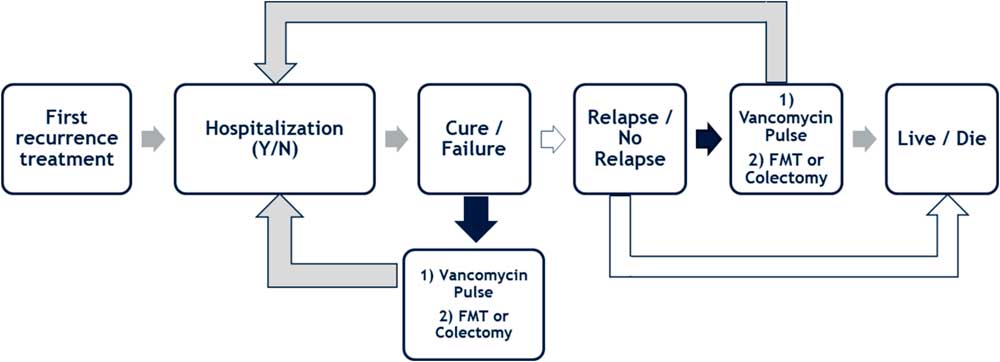
Figure 1 illustrates the decision-tree progressions. Specifically, for each patient who presented as an outpatient with the first episode of recurrent CDI, a treatment strategy can be chosen. In addition, depending on the condition of the patient at presentation, the clinician chose whether to admit the patient for treatment. Regardless of admission, patients experienced either a failure or a cure with the initial treatment choices. Those who failed initial treatment could progress sequentially to vancomycin taper, and then to either FMT via colonoscopy or colectomy. Those who experienced a cure could develop subsequent recurrent CDI, which could also be sequentially treated with vancomycin taper, FMT via colonoscopy, or colectomy. Up to 2 subsequent recurrent CDIs were modelled. Patients who experienced a cure and no subsequent recurrences progressed to the end of the study with risks of death similar to those of patients who experienced CDI recurrence.Reference Sheitoyan-Pesant, Abou Chakra, Pepin, Marcil-Heguy, Nault and Valiquette 10 TreeAge version 2016 software (TreeAge, Williamstown, MA) was used to construct the model and to populate the parameters. The time horizon evaluated was 1 year, which was sufficient to capture all treatments and recurrences.
Recurrent Clostridium difficile clinical course model. Black arrows denote negative clinical sequelae (eg, failure, recurrence). White arrows denote positive clinical sequelae (eg, cure, no recurrence). Gray arrows denote additional clinical decision points. NOTE. FMT, fecal microbial transplantation.

Model inputs
A search of studies for the evaluation of recurrent CDI treatment was performed. Principal studies included the landmark studies comparing bezlotoxumab to the standard of careReference Wilcox, Gerding and Poxton 11 and a study comparing fidaxomicin to vancomycin in a subset of patients with recurrent CDI.Reference Cornely, Miller, Louie, Crook and Gorbach 22 These 2 studies provided much of the clinical information needed to evaluate the 3 treatment strategies. Outcomes associated with vancomycin taper, FMT via colonoscopy, and colectomy and the risk for hospitalization were derived from published sources.Reference Sheitoyan-Pesant, Abou Chakra, Pepin, Marcil-Heguy, Nault and Valiquette 10 , Reference Bhangu, Nepogodiev, Gupta, Torrance and Singh 23 – Reference Hota, Sales and Tomlinson 25
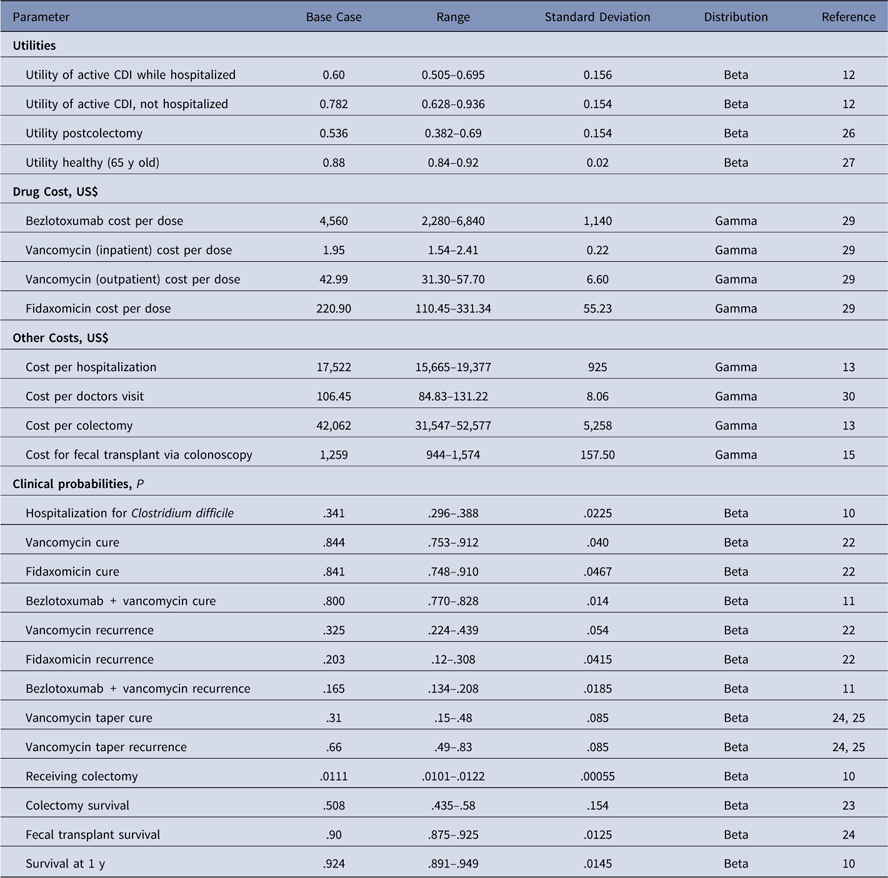
The efficacy outcome evaluated was quality-adjusted life years (QALY). Utility describes the quality of life for different health states and ranges from 0 (death) to 1 (perfect health). Utility values for each patient undergoing CDI treatment as an inpatient, outpatient, healthy 65-year-old, and postcolectomy patient were extracted from current literature.Reference Baro, Galperine and Denies 12 , Reference Hayes and Hansen 26 , Reference Tengs and Wallace 27 Utility values were multiplied by the amount of time each patient spent in each of those states to determine QALY. Among hospitalized patients, it was presumed that they completed their treatment course in the hospital and discharged after treatment was completed, except for vancomycin taper, for which it was assumed that the first 2 weeks of the taper was performed in the hospital prior to discharge. For patients who experienced cure, they were considered healthy until time to recurrence, which varied based on initial treatment choice. The base case values and ranges for utilities are summarized in Table 2.
Model Inputs

The cost was taken from a payer’s perspective, which included direct costs, such as medication, procedures, and hospitalization. Costs include those associated with medication, hospitalization, colectomy, FMT, and subsequent therapies for further recurrent infections. Cost evaluations did not include indirect costs, such as loss of productivity and patient travel times. Cost data were obtained from public sources, such as average wholesale price for medications (as of October 1, 2017) and 2017 CMS reimbursement rates for doctor visits and procedures. When a medication was manufactured by more than 1 drug company, the median cost for the medication was used. For patients treated in the hospital, the cost of vancomycin was calculated based on using the intravenous formulation of the medication compounded and administered orally. All costs gathered from previous economic analyses were inflated to current medical costs using medical cost inflation rates from the consumer price index.Reference Mullins, Seal and Seoane-Vazquez 28 Cost parameters and ranges are summarized in Table 2.
Base case and sensitivity analysis
Baseline values for costs, utilities, and clinical probabilities were used for the base-case analysis. The primary outcome measure was the incremental cost-effectiveness ratio (ICER) between different therapies, where the incremental costs were divided by the number of QALYs gained. The ICER was compared to a willingness-to-pay (WTP) threshold, which was set at $100,000 for this study.
To evaluate for the robustness of the model and the effect of parameter uncertainty, one-way sensitivity analyses were completed for nondominated strategies by fluctuating individual cost and probability variables within prespecified ranges. Ranges for clinical probabilities were determined using a binomial distribution–derived 95% confidence interval. Ranges for medication costs were determined using the median average wholesale price ±50%. 29 Ranges for procedural and hospital charges were gathered from Centers for Medicare and Medicaid Services reimbursements ±25%. 30 Results of one-way sensitivity analyses were illustrated using tornado diagrams.Reference Briggs, Weinstein and Fenwick 17 Probabilistic sensitivity analysis (PSA) was conducted using 10,000 second-order Monte Carlo simulations, where each input was sampled randomly from distribution values of each input parameter. Probabilities and utilities were modelled using a beta distribution, whereas costs were modelled using a gamma distribution. The 10,000 patient simulations were used to generate a WTP acceptability curve.Reference Briggs, Goeree, Blackhouse and O’Brien 31 Ranges and distributions of all parameters are summarized in Table 2.
Results
Base case analysis
Our model generated cost and health outcomes for each of the 3 treatment options for patients presenting to an outpatient physician with their first recurrence of CDI. Table 3 highlights the cost and relative effectiveness of each strategy. Utilizing oral vancomycin alone as an initial treatment strategy was associated with the lowest cost and a QALY gain of 0.8019. Fidaxomicin was the second least costly agent, with modest gains in QALY (0.8046) over vancomycin alone. This strategy led to an ICER of $500,975 per QALY gained if fidaxomicin was used in lieu of vancomycin. Bezlotoxumab plus vancomycin was associated with a cost that was higher than that of fidaxomicin alone, but with an incremental decrease in QALY; hence this regimen was dominated in the current analysis. Based on our WTP threshold, our base case analysis demonstrated that vancomycin alone is the most cost-effective regimen because the ICER of fidaxomicin was >$100,000 per QALY gained.
Base Case Results: Incremental Cost-Effectiveness Ratio

NOTE. ICER, incremental cost-effectiveness ratio; QALY, quality-adjusted life years.
Sensitivity analysis
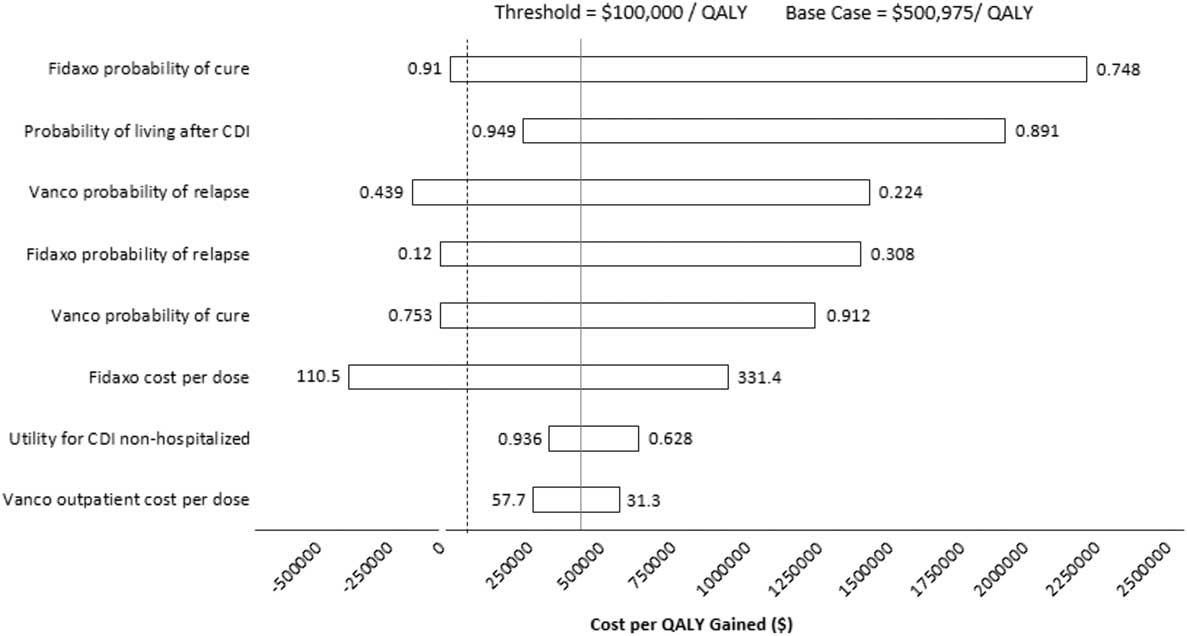
Results of one-way sensitivity analysis for ICER for vancomycin versus fidaxomicin is shown as a tornado diagram in Figure 2. The diagram depicts the effect of each input across the range of fluctuations. The inputs are stacked in decreasing order of width to depict the descending order of effect each input has on the outcome. As illustrated in the diagram comparing vancomycin versus fidaxomicin, several of the model inputs could have independently shifted the ICER to below the WTP threshold. Those include the probability of fidaxomicin cure (>89.7%), the probability of recurrence associated with vancomycin (>38.5%) and fidaxomicin (<14.2%), the cost per tablet of fidaxomicin (<$166.68), and the probability of a vancomycin cure (<77.9%). No other model parameters were independently capable of bringing the ICER below $100,000 per QALY gained. In threshold analyses, if the probabilities of the initial cure rates of fidaxomicin and relapse were <80.8% and >24.8%, respectively, then bezlotoxumab plus vancomycin would be considered cost-effective at a WTP of 100,000 per QALY gained. Notably, fluctuating the cure and relapse rates of bezlotoxumab plus vancomycin within the sensitivity ranges did not produce an ICER <$100,000 per QALY gained.
One-way sensitivity analysis—tornado diagrams. ICER: fidaxomicin versus vancomycin. NOTE. CDI, Clostridium difficile infection; ICER, incremental cost-effective ratio; QALY, quality-adjusted life years.

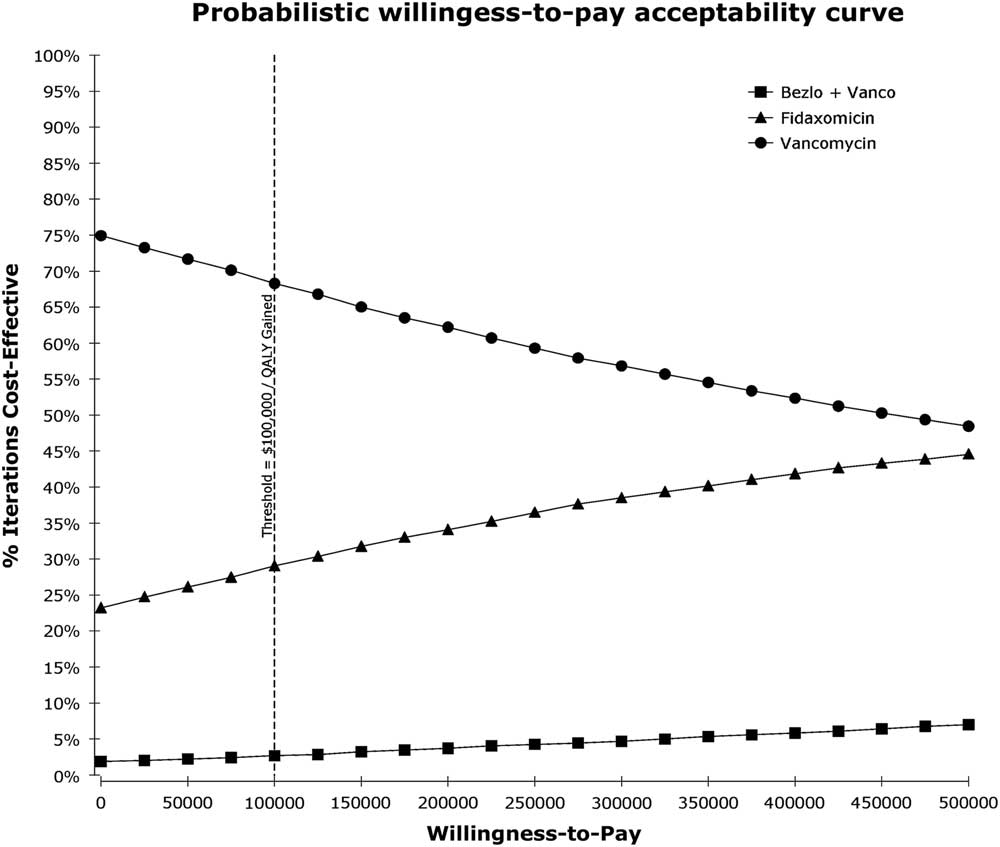
We performed a probability sensitivity analysis, and we constructed a cost-effectiveness acceptability curve to illustrate the simulations (Figure 3). The curve reveals the preferred strategy when using a range of WTP thresholds. It demonstrates that, at a WTP threshold of $100,000 per QALY gained, vancomycin has a 68.4% probability of being the most cost-effective therapy, while fidaxomicin has a 29.2% probability and bezlotoxumab plus vancomycin has a 2.4% probability. In the model, when the WTP threshold was increased to $500,000 per QALY gained, the probabilities for being the most cost-effective changed to 48.0%, 45.1%, and 6.9%, respectively, for vancomycin, fidaxomicin, and bezlotoxumab plus vancomycin.
Probabilistic willingness-to-pay acceptability curve. NOTE. Bezlo, bezlotoxumab; QALY, quality adjusted life years; Vanco, vancomycin.

Discussion
The current analysis is the first since bezlotoxumab became available to evaluate the cost-effectiveness of CDI treatment in patients presenting to their outpatient physician with their first recurrent episode. We determined that vancomycin alone was the most cost-effective regimen. Fidaxomicin led to higher QALY gained; however, it came at a cost well above the WTP threshold. Furthermore, according to the PSA, it was unlikely to be cost effective at a WTP of $100,000 per QALY gained. Even at a WTP threshold of $500,000 per QALY gained, fidaxomicin was still less likely to be cost-effective than vancomycin. The regimen of bezlotoxumab plus vancomycin was dominated by fidaxomicin because it cost more, generated fewer QALY, and was unlikely to be cost-effective, even at a WTP threshold of $500,000 per QALY gained.
The ideal treatment of recurrent CDI is unknown. Clinical evidence supports the decrease of recurrences when patients are treated with fidaxomicin or regimens including bezlotoxumab.Reference Wilcox, Gerding and Poxton 11 , Reference Cornely, Miller, Louie, Crook and Gorbach 22 Separate clinical studies have demonstrated significant differences in the rates of recurrence of either regimen when compared to oral vancomycin.Reference Wilcox, Gerding and Poxton 11 , Reference Cornely, Miller, Louie, Crook and Gorbach 22 The decrease probability of recurrence with fidaxomicin and bezlotoxumab was reflected in the current model. However, the 3 arms modelled in the current study had remarkably similar overall effectiveness, as measured in QALY. In the case of bezlotoxumab, the decreased probability of recurrence may be overshadowed by the fact that the probability of cure was higher in those who received fidaxomicin and vancomycin. Although not statistically significant, the clinical studies evaluating bezlotoxumab-containing regimens did find a numerically lower cure rate than either standard of care regimen without bezlotoxumab (76.7% vs 80.3%). Numerically higher cure rates were also observed with fidaxomicin and vancomycin in a separate study, 84.4% and 84.1%, respectively.Reference Cornely, Miller, Louie, Crook and Gorbach 22 Given that recurrences can only occur in patients who initially exhibited cure, it is likely that the initial decreased cure rates of bezlotoxumab led to overall lower QALYs; thus, we concluded that it was dominated by fidaxomicin. The fact that the magnitude of the change in QALY is relatively small between fidaxomicin and vancomycin is likely related to a combination of having few patients who experience recurrence and the treatments for recurrence being similar. Indeed, based on the probabilities of cure and recurrence, for every 100 patients treated with vancomycin, 10 fewer patients will experience a recurrence if treated with fidaxomicin. Furthermore, among those who do experience a recurrence, their subsequent outcomes should be similar because the treatment options for additional recurring episodes do not differ.
The current findings of vancomycin being the most cost-effective pharmacologic strategy and marginal improvements in QALY between different pharmacologic treatment options is corroborated in several other CEAs. Konijeti et alReference Konijeti, Sauk, Shrime, Gupta and Ananthakrishnan 13 evaluated different treatment strategies for the management of recurrent CDI and found that vancomycin was the most cost-effective pharmacologic regimen. Fidaxomicin was associated with a marginally higher QALY (0.865 vs 0.858), which translated into an ICER of $184,023 per QALY gained. Similarly, Lapointe-Shaw et alReference Lapointe-Shaw, Tran and Coyte 14 performed a CEA that utilized a lifetime health effects calculation and demonstrated a marginal improvement of 0.13 QALY gained when comparing fidaxomicin and vancomycin.Reference Lapointe-Shaw, Tran and Coyte 14 The current study adds to these CEAs by incorporating the recently approved strategy of bezlotoxumab plus vancomycin. In addition, it specifically evaluates the first recurrence while incorporating FMT as a mechanism of treatment for patients with further recurrences, which is more representative of current clinical practice.
A recent pharmacoeconomic analysis of bezlotoxumab compared with placebo was completed.Reference Prabhu, Dubberke and Dorr 16 This analysis was performed for patients with either their initial episode or recurrent episode of CDI, and it evaluated a bezlotoxumab-containing regimen or standard of care. In this analysis, bezlotoxumab was associated with a 0.12 QALY gain compared to standard of care with an ICER of $19,824 per QALY gained. The discordant findings from the current study may be attributable to several factors. The current study evaluated specifically fidaxomicin and vancomycin as comparators, whereas the analysis by Prabhu et alReference Prabhu, Dubberke and Dorr 16 utilized standard of care as a comparator. In the clinical studies of bezlotoxumab, standard of care can include metronidazole, vancomycin, or fidaxomicin. Furthermore, the current analysis specifically evaluated patients with their first recurrent episode of CDI, as opposed to an analysis of either the index or recurrent episodes. Given the novelty of bezlotoxumab, no clinical guidelines currently include recommendations for its use. As such, the decision to specifically evaluate the first recurrent episode was made in conjunction with local clinicians who believe they are most likely to consider bezlotoxumab in that setting. This difference may have limited the cost-effectiveness of fidaxomicin and bezlotoxumab because prevention of the initial recurrence may have more dramatic downstream cost and outcome differences. Finally, in the study by Prabhu et al, they utilized a one-time cost to estimate the cost of recurrence, without considering subsequent treatment options for further recurrent CDI episodes (eg, vancomycin taper or FMT). As such, based on these differences, the discrepant results of the 2 CEAs may be a result of evaluating different clinical scenarios and different choices in cost inputs.
This CEA has several limitations. First, the analysis required compiling data from multiple comparative studies. Although patients all had similar diagnoses, it is not possible to balance the baseline differences among patients that may have accounted for the treatment outcome differences. To account for this, sensitivity analyses were performed, and despite accounting for uncertainties, both one-way sensitivity and PSA did not demonstrate drastically different results. Second, the data were all collected from randomized controlled trials, where care and follow-up are likely more abundant than for patients in a clinical setting. As such, the cure rates and recurrence rates may represent best-case scenarios. Third, this CEA did not consider adverse effects. This decision was made in conjunction with several clinicians who did not believe that the differences in adverse effects among the treatment arms were significant enough to warrant incorporation into the model. Fourth, the current analysis does not account for different strains of C. difficile and their influence on recurrence rates. As such, if a center has a high proportion of BI/NAP1/O27 clones of C. difficile, the findings from this pharmacoeconomic analysis may not be applicable.Reference Marsh, Arora, Schlackman, Shutt, Curry and Harrison 32 Fifth, due to the paucity of data, the probabilities of recurrence, cure, and hospitalizations beyond the second recurrence were all assumed to be similar to the first recurrence. This likely underestimates the clinical sequelae associated with subsequent recurrences. Sixth, the rate of hospitalizations from recurrent CDI was derived from only 1 study.Reference Sheitoyan-Pesant, Abou Chakra, Pepin, Marcil-Heguy, Nault and Valiquette 10 Because hospitalizations are such costly interventions, if the rate of hospitalization was dramatically different than those used in this study, there may be significant differences in the cost-effectiveness of each therapy. Seventh, the costs associated with bezlotoxumab were not included in the cost evaluations because there are many options for outpatient infusion therapy. However, adding further cost to bezlotoxumab would presumably further contribute to its lack of cost-effectiveness. Lastly, as with all pharmacoeconomic models, it is not possible to simulate all treatment decisions during a patient’s course. As such, the current model represents a reasonable approach to treatments and subsequent therapies associated with each successive recurrent CDI episode.
In conclusion, our cost-effectiveness analysis illustrated vancomycin alone as a cost-effective regimen for the treatment of the first recurrent episode of CDI. Bezlotoxumab plus vancomycin was a dominated strategy; therefore, it was not likely to be cost-effective. Fidaxomicin did lead to the highest QALY gained, but at a significantly higher cost than the specified WTP threshold.
Acknowledgments
Financial support
No Please provide the Acknowledgment section.financial support was provided relevant to this article.
Potential conflicts of interest
All authors report no conflicts of interest relevant to this article.