When Salvador Allende was elected president of Chile on 4 September 1970, he became the first democratically-elected self-proclaimed Marxist president in the world, having won a 36.3 per cent majority. His election triggered a reaction from the Nixon administration in the United States. Seeking to prevent the spread of communism – after the Cuban revolution of 1959 – Nixon met with advisors on 15 September to design a plan to obstruct Allende's inauguration and, if he did assume power, destabilise his government. Nixon called on his advisors to ‘make the economy scream’. The US government's plan was premised on the logic that difficult economic conditions would undermine support for Allende. Yet, after two years of reforms and in the midst of an economic crisis, Allende's Popular Unity (UP) coalition received 44.1 per cent of the vote in the 1973 legislative election. Allende also had an approval rating of 49.7 per cent in February 1973, a few months before a military coup overthrew him on 11 September 1973.
We use polling data to analyse voting intention for Allende in 1970 and the change in support for his government. We also use municipal level data to analyse his electoral base and support for the UP coalition. High levels of political polarisation explain Allende's victory more than economic vote variables. Deteriorating economic conditions did not alter support for Allende in early 1973. Support for Allende is better explained by ideology, as presidential approval was higher among the left, not among the working class. Those who opposed Allende did so because of their prior political inclinations rather than their socio-economic conditions or their views on the economy.
Despite the difficult economic conditions under Allende, partially resulting from the destabilisation strategy promoted by the right-wing opposition – and by US government covert operations – support for Allende remained strong among the groups that initially voted for him. Our findings are consistent with claims that, in ideologically divided societies, economic voting has a more limited capacity to explain electoral preferences.Footnote 1 In fact, our findings suggest that economic voting might be endogenous to ideological predispositions. The implications of our findings are that in Latin American countries that concurrently experience polarisation and economic crises, one should not overestimate the power of economic variables. Citizens in highly polarised societies will react differently to worsening economic conditions based on whether they share the government's ideology or identify with the opposition.
Determinants of Vote Intention and Presidential Approval
Vote intention and political predispositions are normally explained by theories that focus on long-, medium- and short-term variables.Footnote 2 Long- and medium-term considerations rely on social cleavages and political socialisation – through families or other means – to explain electoral preferences.Footnote 3 Ideological orientation and party identification are strong predictors of vote intention and presidential approval.Footnote 4 Though they do not always mean the same, ideology and identification with a political party are normally treated interchangeably in countries with stable party systems.
Claims on the declining importance of the class voteFootnote 5 and the rise of post-materialist concerns,Footnote 6 together with the growing importance of the economic vote,Footnote 7 have driven attention away from long- and medium-term variables – which vary less and thus have a more limited explanatory capacity. Short-term considerations are usually seen as opposite to explanations that attribute vote intention to ideology. The way voters experience economic developments – such as inflation, employment or growth – leads them to reward incumbents when economic conditions are favourable. However, when voters are ideologically motivated, economic conditions will have a weaker effect on vote intention. In fact, some researchers have conditioned the effect of the economic vote to ideology and political predispositions, especially in ideologically divided societies.Footnote 8 When political identification is high, the effect of the economic vote is mediated by ideology, with those who support the government interpreting negative economic conditions in ways that are more favourable to it.
Between elections, presidential approval ratings are a good indicator of government support.Footnote 9 When presidential approval is low, presidents find it more difficult to deliver on campaign promises. When elected without a majority, the government needs to build popular support for its campaign promises. In fact, the vote–popularity function attributes the same determinants of vote intention to presidential approval.Footnote 10 Some people show stable voting patterns, reflecting strong party identification.Footnote 11 Those patterns are also reflected in presidential approval. Nonetheless, even in countries with stable voting patterns, presidential approval varies as people who normally vote for the party of the president might disapprove of presidential performance.
In countries with strong party systems, explanations based on ideology would predict stable support for a president, while those based on political socialisation would allow for fluctuations in support when economic conditions vary. The economic vote links approval to economic performance. However, perceptions of economic performance are themselves conditioned by people's ideology.Footnote 12 Thus, in ideologically polarised societies, the effect of a deteriorating economy on presidential approval would be strongly mediated by people's ideology, in the same way that ideological polarisation influences vote choice.Footnote 13
Accounts based on ideology and political socialisation would predict other explanations than economic vote variables for the victory of Allende in 1970 and for the change in support for his government. As Allende's ‘Road to Socialism’ had effects on the lives of people, the determinants for the 1970 vote can be different from those for the 1973 legislative election even if the only reasons behind vote choice and approval are ideology and socialisation. As the urban population was growing rapidly, the UP coalition sought to draw electoral dividends from its strongest support base in urban areas. Thus, long- and medium-term variables that explain Allende's 1970 victory can be different from those that explain presidential approval for Allende and support for the UP in 1973. Since the economy deteriorated between 1970 and 1973, economic vote accounts would predict declining support for Allende. However, given the context of polarisation, the effect of economic performance might have been highly conditioned by ideology.
Allende's Victory
Since the early twentieth century the Chilean party system has been defined as institutionalised and stable, with parties aligned on a left-centre-right scale based on deeply ingrained social cleavages.Footnote 14 Though some have called that claim into question owing to the shallow roots of parties and high electoral volatility,Footnote 15 and the emergence of the Christian Democratic Party (PDC), the collapse of the Partido Agrario Laborista (Agrarian Labour Party), the decline of the Radical Party (PR) and the constant break-ups and reunifications of the Socialist Party (PS) seem to confirm that assertion, the dominant reading of the Chilean party system reports it as stable. Since parties were aligned on the left-centre-right scale, identification on the ideological scale and political party identification were used interchangeably.
The notion that the party system and the electorate were split among three segments (which were not necessarily equal) is prevalent in descriptions of Chilean politics before 1973.Footnote 16 Since 1925, every presidential election resulted in a victory by a different combination of left-centre-right alliances. The 1970 election was the first direct face-off between the three segments, with a different candidate representing the left, centre and right – Allende, Radomiro Tomic and Jorge Alessandri, respectively.
The rapid rise of the centrist PDC starting in the 1950s together with the increasing electoral power of the left – represented by the PS and Communist Party (PC) – characterised political developments before 1973.Footnote 17 Electoral turnout increased rapidly until it reached 61.6 per cent of the voting age population (VAP) in 1964. Turnout in 1970 declined slightly to 56.2 per cent of VAP (although the voting age was lowered from 21 to 18 in late 1970, young voters did not have enough time to register). In the 1973 legislative election, turnout hit a record high of 69.1 per cent.Footnote 18 The period was characterised by the incorporation of millions of Chileans into the political process and by the growth of reformist and revolutionary parties.Footnote 19
The left had a long history of participation in electoral politics.Footnote 20 In 1952, Allende participated in the Presidential campaign for the first time. A physician who had served as Minister of Health, Allende was elected to the Chamber of Deputies in 1941. He was elected senator in 1945 and re-elected in 1953, 1961 and 1969. In the 1958 presidential election, Allende was the candidate of the Frente de Acción Popular (Popular Action Front, FRAP) and lost by 2.7 percentage points (28.5 per cent to 31.2 per cent) to right-wing candidate Alessandri. In 1964, PDC Eduardo Frei defeated Allende by 55.6 per cent to 38.6 per cent.
Under Frei (1964–70), GDP expanded by an annual average of 3.9 per cent. Inflation in mid-1970 was around 40 per cent, the same as in 1964. Unemployment was 6.5 per cent in 1975, one percentage point higher than six years earlier. There was a perception among the elite that the Frei government had a disappointing economic performance, but the data shows mixed economic results. There is no strong evidence to claim that voters would want to punish the outgoing government for the state of the economy. In 1970, macro-economic conditions were not favourable for a presidential candidate who promised sweeping economic reforms. Yet the PDC chose a candidate who distanced himself from Frei's reformist policies. As a result of internal PDC conflicts which also provoked the exit of young left-wing leaders to form the Movimiento de Acción Popular Unitaria (Popular Unitary Action Movement, MAPU) in 1969, Tomic campaigned on a platform to the left of Frei. The right-wing candidate, former President Alessandri, campaigned on an austerity platform. The fact that centre and right-wing parties split the anti-Allende vote allowed him to reach the presidency with a lower vote share (36.6 per cent) than he received in 1964 (38.9 per cent).
Allende's September 1970 victory attracted attention from social scientists in different fields.Footnote 21 There are different and often contradictory explanations for his victory. Daniel Hellinger asserts that ‘the 1970 election was more highly polarised along class lines than the election of 1958’.Footnote 22 Arturo Valenzuela has argued that it did not result from an increase in support for the left but from the failure of centrist and right-wing parties to offer a unified alternative.Footnote 23 The emergence of a highly ideological PDC rendered the centre unable to remain as a power broker. Using municipal level data, Robert Ayres reports strong continuity in support for left parties in the 1960s and 1970s.Footnote 24 Confirming the findings on working-class support for Allende,Footnote 25 Valenzuela reports class-based support for the left in mining areas.Footnote 26 James Prothro and Patricio Chaparro argue against the polarisation claim, pointing out that support for the left had not grown, and that ‘the fact that Allende won in 1970 and not in 1958 was an accident as far as public opinion is concerned’.Footnote 27 Using electoral results and aggregate polling data, Nancy Bermeo confirms the absence of polarisation and underlines the stability in political identification among the people at times of elite polarisation.Footnote 28
Similarly, class-based analyses have been used to explain the opposition to Allende by the landed oligarchy and the business sector, and support among the poor and working class.Footnote 29 Some point to worsening economic conditions as a reason for the alleged decreasing support for Allende before the coup.Footnote 30
Explaining Allende's Victory: Our Hypotheses
Our first hypothesis is that economic performance explains electoral support for Allende and the Popular Unity government. Our second hypothesis is that ideology and social class explain vote intention for Allende and support for his government. We test the hypotheses on the vote for Allende in the 1970 election, on presidential approval for Allende and on support for the Popular Unity coalition in the 1973 legislative election. Given the US strategy to destabilise the economy, worsening economic conditions should have hurt support for Allende and his coalition.
There are two ways in which we can assess the determinants of Allende's vote in 1970, with actual electoral results and with polling data. Polling data also allow us to assess people's perception of the economy and its effect on voting. Most contemporary studies on electoral behaviour rely primarily on polling data. Unfortunately, the scarcity of national polls in Chile for the period limits our options.
Thus, in addition to polling data, we also use electoral results at the lowest available electoral unit, the municipal level, to assess vote intention for Allende. As others have done,Footnote 31 we use the same municipal level data as those used by ValenzuelaFootnote 32 to explain vote intention by socio-demographic conditions. We are aware that using municipal level data implies deriving conclusions about individual behaviour using aggregate data. However, this procedure has been widely used to account for vote intention in the period in Chile, and elsewhere. As we discuss below, we weight by the varying population size of the municipalities. Since our findings from polling data and municipal level data are consistent, we are confident in the robustness of our results.
The polls conducted by sociologist Eduardo Hamuy since 1957 offer invaluable insight into the perceptions of Chileans and the changes in their political preferences.Footnote 33 Hamuy generated the first sampling frames for Santiago and three other cities in Chile. Using the 1952 census, Hamuy introduced probabilistic polls at all levels – block, household and individual. The sampling frames were used for all his polls conducted between 1957 and 1973.Footnote 34 The data sets for most Hamuy polls are housed at the Facultad Latinoamericana de Ciencias Sociales (Latin American School of Social Science, FLACSO) and the Roper Center for Public Opinion Research (Cornell University).
Hamuy polls have some limitations. They were only representative of Santiago, the number of respondents was not ideal (it fluctuated between 300 and 900 respondents), the error margin was not reported and the wording of the questions was not always consistent.Footnote 35 Logically, generalising preferences expressed by Santiago residents to the rest of the country might lead to biased conclusions. As the largest urban area, Santiago had higher living standards than the rest of Chile. Though left-wing parties were stronger in urban areas, Santiago was not a stronghold of the left. In fact, Allende lost the 1970 election in the province of Santiago. Hamuy polls also tended to over-represent women. According to the 1970 census, 53 per cent of the adult population in Santiago were women, but in Hamuy's August 1970 poll, 63.1 per cent of respondents were women while in his poll of February 1973 the figure was 58.9 per cent.
Despite these limitations, Hamuy polls have been used to explain political developments during the pre-1973 period, as early as 1958.Footnote 36 They have also been used to explain Allende's victory,Footnote 37 the breakdown of democracy,Footnote 38 attitudes under authoritarian rule,Footnote 39 political party support base comparisons before and after the dictatorship,Footnote 40 and values and views before and after authoritarian rule.Footnote 41
Explaining Allende's Victory with Polling Data
Between 1969 and 1970, Hamuy conducted nine polls in Santiago inquiring about presidential vote intention.Footnote 42 In the August 1970 Hamuy poll that assessed the evaluation of the outgoing government, 13.6 per cent considered it excellent or very good, 36.3 per cent considered it good, 39.8 per cent deemed it regular and only 9.8 per cent said it was a bad government (0.4 per cent had no opinion). Despite economic difficulties, Chileans had a positive perception of the Frei administration (but his popularity was not transferred to Tomic in the election).
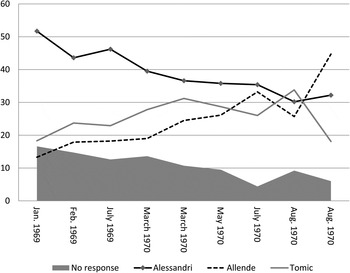
As Figure 1 shows, Hamuy polls reported fluctuating vote intention for the three candidates in the months leading up to the election. Figure 1 might be seen as questioning the alleged stable support for the left. Vote intention for Allende showed an upward trend from around 10 per cent in early 1969 to over 40 per cent in August 1970. Since Allende was confirmed as the UP candidate only in early 1970, the upward trend in his vote intention might be because left-wing voters rallied behind him after he was named the candidate. The early favourite was Alessandri, the former president whose vote intention was above 40 per cent in January 1969. The fact that Alessandri was the first declared candidate helps explain his strong support early in the race. As the election neared, support for Alessandri declined and the vote intention for Tomic and Allende increased. By July 1970, less than 10 per cent separated the front runner from the other two candidates. The last poll before the election, in August 1970, had Allende in first place (44.7 per cent), Alessandri second and Tomic third in Santiago. The actual vote for the three candidates in Santiago was 38.4 per cent for Alessandri, 34.8 per cent for Allende and 26.8 per cent for Tomic.
Changes in Vote Intention in Hamuy Polls before the 1970 Presidential Election (%)

When asked which candidate they would definitely not vote for, 41.6 per cent mentioned Allende, 27.3 per cent said Alessandri and 18 per cent said Tomic. When asked who they thought would win the election, 31.9 per cent said Alessandri, 28.4 per cent mentioned Tomic, and only 22.9 per cent mentioned Allende. A larger percentage of people favoured Allende over Tomic, yet the dominant perception was that Tomic had a better chance than Allende of defeating Alessandri.
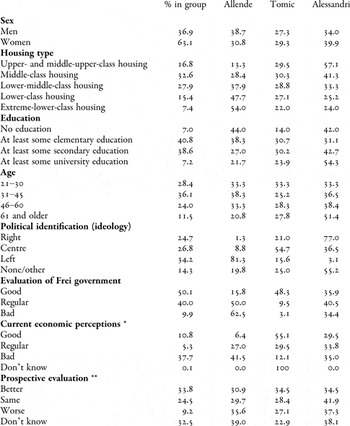
Table 1 shows the presidential vote intention by different socio-demographic variables, political categories and economic perceptions. Allende had stronger support among men than women, confirming the strength of right-wing parties and PDC party candidates among women.Footnote 43 Despite having advocated for women's rights, left-wing parties struggled to attract support from women. In 1958, Allende had won among men, but lost so decisively among women that he lost the election. In 1964, Frei won overwhelmingly among women.
Vote Intention in August 1970 by Different Categories

* ‘Thinking about the general situation of the country, do you think it is good, regular or bad?’
** ‘For the coming years, do you think the situation of the country will be better, the same or worse?’
Source: Hamuy poll no. 37, Aug. 1970. See Navia and Osorio, ‘Las encuestas de opinión pública en Chile antes de 1973’ for poll classification.
Hamuy polls used different proxies for socio-economic status. Pollsters classified respondents’ housing type, collected information on educational background, and registered socio-economic status based on their subjective perceptions of ‘housing type, furniture quality and personal appearance’ (as indicated in the poll data report). Though the three variables are highly correlated, they assess different things. We use the objective measures (housing type and educational level) and exclude the pollster's perception (only partially based on the objective measures).
Allende had stronger support among those living in low-income housing, Alessandri was strongest among upper-income housing and Tomic had similar support across different housing types. Allende had more support among the poor, while Alessandri was stronger among the well-to-do. By educational level, Allende also had stronger support among those with less education, Alessandri's support was strongest among those with most and least education, and Tomic had strongest support among middle educational levels. Younger voters were more equally split between the candidates, but older voters were less likely to support Allende than Alessandri.
Because the party system at the time was organised on a left-centre-right divide, ideology was also commonly classified along the same divide. Parties were highly ideological and there was a clear programmatic distinction between left-wing, centre and right-wing parties. Hamuy asked for identification on the left-centre-right scale. People who identified with parties also identified almost perfectly with the corresponding segment on the left-centre-right scale. Thus, we use identification on the ideological scale rather than identification with parties. Support for Allende was strongest among those identified with the left. Tomic had more support among centrists and Alessandri among rightists, but Alessandri also did reasonably well among centrists and the non-identified. Table 1 shows mixed evidence on the degree of polarisation among Chileans. While left- and right-wing voters were highly polarised, centrist voters split their support between Allende, Tomic and Alessandri.
Support for Tomic was strongest among those who approved of President Frei, while support for Allende was strongest among those who disapproved of Frei. But among those who approved of Frei, vote intention was higher for Tomic (48.3 per cent) and Alessandri (35.9 per cent) than for Allende (15.8 per cent). Prospective evaluation on the future of the country was not clearly related with stronger support for any of the candidates.
We also considered the possible effect of religion on vote intention. Non-Catholics were more likely to vote for Allende (53.7 per cent) than Catholics (30.8 per cent), but since the overwhelming majority of respondents (86.7 per cent) were Catholic, the small sample size of non-Catholics makes it impossible to draw robust inferences about their behaviour.
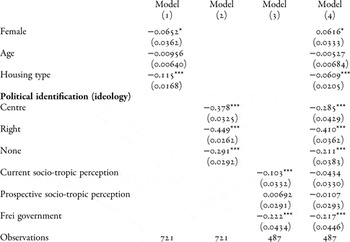
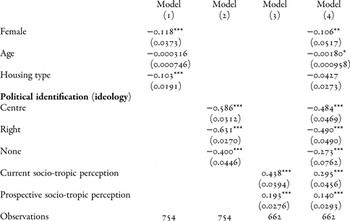
In Table 2, we present the marginal effects of a probit (binary classification) model, using Hamuy's poll no. 37 of August 1970.Footnote 44 Our dependent variable is vote intention for Allende (we set vote intention to 1 when voting for Allende and 0 for all other options). We use sex, housing type, age, political identification, current and prospective socio-tropic perceptions and evaluation of the Frei administration as independent variables.
Marginal Effects (Probit Model) on Intention to Vote for Allende in 1970

*** p < 0.01, ** p < 0.05, * p < 0.1; standard errors in parentheses.Vote intention for Allende is the reference category in the dependent variable.
Housing type is an incremental variable, from lowest to highest quality of housing.
Current and prospective socio-tropic perceptions were recoded into -1, 0 and 1 (see: Erikson et al., The Macro Polity).
The reference category for political identification is identification with the left.
Source: Hamuy poll no. 37, Aug. 1970. See Navia and Osorio, ‘Las encuestas de opinión pública en Chile antes de 1973’ for poll classification.
We use housing type as an explanatory variable instead of socio-economic status or education. Socio-economic status was assigned by the pollster given a previously defined criterion and had less variance than housing type, as half of the sample was classified as ‘medium’ in a five-level scale. Education too is highly correlated with housing type, but it also presents less variance as more than 80 per cent of those polled were in two educational categories – at least some elementary education and at least some secondary education.
Model 1 in Table 2 shows the effect of three socio-demographic variables: gender, age and housing type. Women were less likely to vote for Allende as reflected by the negative coefficient. Those living in lower-quality housing were more likely to do so. Model 2 presents the effect of ideological identification. The reference category is left-wing identification. Allende had stronger support among those identified with the left. The group least likely to vote for Allende were those on the right (as reflected by the largest negative coefficient in the equation). Those in the centre were less likely to vote for Allende than those non-identified – when both groups are compared to left-wing voters. Model 3 shows the effect of economic perceptions and presidential approval for President Frei on vote intention for Allende. Those with positive current socio-tropic perceptions and those who approved of Frei were less likely to vote for Allende.
Model 4 uses socio-demographic, ideological and short-term perception variables to explain vote intention for Allende. Housing type continues to be significant and so are ideology and presidential approval. The marginal effect of each variable associated with ideology is significant, which points to the importance of ideology as a determinant of vote intention. We also tested models (not included here) using religion as an independent variable. Though non-Catholics were more likely to vote for Allende, when religion is included with other variables it loses its explanatory power.
The probit models in Table 2 confirm that ideology was significant and strong in explaining vote intention for Allende. Short-term variables – such as current and prospective socio-tropic perceptions – do not explain vote intention in 1970. Housing type also has a significant effect, pointing to the existence of a class-based vote in the 1970 presidential election. As those who approved of Frei were less likely to vote for Allende and since the marginal effects of ideology were the strongest predictors of vote intention, we conclude that the 1970 vote was driven primarily by ideology.
Explaining Allende's Victory with Municipal Level Data
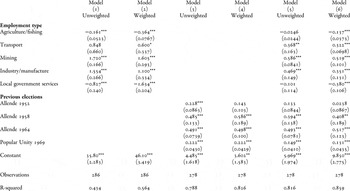
We also conducted an analysis using the vote for Allende and socio-demographic indicators at the municipal level for the entire country. Table 3 presents six different models. The dependent variable is Allende's vote share in each municipality. Three models are weighted by the municipal population to capture any possible effects explained by the largely different populations of Chile's 286 municipalities. The independent variables are proxies for long- and medium-term determinants. We use the percentage of the population employed in different trades in each municipality, as reported in the 1970 census, as a proxy for social class. We also use the vote share for Allende in the previous three elections (1964, 1958 and 1952) and the vote for the UP in the 1969 legislative election as predictors for Allende's vote share in 1970. It would be logical to expect that the vote for Allende in 1952, 1958 and 1964 and the vote share for the UP in 1969 would be highly correlated. We checked the residuals in the regressions and found no correlation with the variables. As turnout increased dramatically from 1952 (957,000) to 1964 (2.5 million) and new voters were enfranchised, using the previous elections as independent variables to explain Allende's vote share in 1970 is justified.
Ordinary Least Square (OLS) Regression on Allende's Vote in 1970 by Socio-demographic Municipal Data

*** p < 0.01, ** p < 0.05, * p < 0.1; robust standard errors in parentheses.
We weight variables by the 1970 population of each municipality. Since municipal population ranged from 800 inhabitants in rural municipalities to more than 500,000 in urban areas, we present both the weighted and unweighted data.
Source: Valenzuela, Political Brokers.
As models 1 and 2 show, the electoral base for Allende was higher in municipalities with strong mining and manufacturing, though mining was the strongest determinant of his vote (note the large, positive coefficient for mining). His support was inversely related to the size of the workforce in agriculture and in local government services. This confirms that Allende was strongest in areas with an established working class. At the time, working for the government was an indication of middle-class status.Footnote 45 As Allende's support was lower in municipalities with a higher share of workers in local government services, we can conclude that his support among the middle class was lower than his support among the organised working class. Since the share of the workforce employed in each trade varied significantly across municipalities, we can confidently assert that Allende's support was highest in cities with strong manufacturing and mining sectors.
Models 3 and 4 show the effect of Allende's vote share in previous elections on the 1970 vote for Allende. These models point to a stable vote base for Allende, in spite of the growing voting population. The vote for Allende in his first presidential campaign in 1952 – when he received 5.5 per cent – has limited explanatory power for the vote in 1970. Turnout in 1952, when women were first allowed to vote in presidential elections, was only 29.1 per cent of the VAP.Footnote 46 As participation among women increased in subsequent elections and a higher share of eligible men registered to vote – as a result of the adoption of mandatory registration and mandatory voting in 1962 – the Allende vote in 1958 is a stronger predictor for the Allende vote in 1970. When weighted by the population of each municipality, the 1958 vote is an even stronger predictor for the vote in 1970. In 1958, turnout was 33.8 per cent of the VAP. The vote for Allende in 1964, when turnout was 61.6 per cent of the VAP, is also a strong predictor for Allende's 1970 vote. The fact that twice as many people voted in 1964 as in 1958 (2.5 to 1.2 million) justifies our use of the Allende vote in both elections as determinants of the Allende vote in 1970.
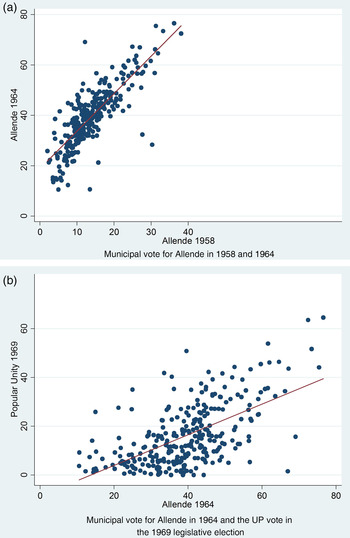
Figure 2 shows two scatterplots: one for the municipal vote for Allende in 1958 and 1964, and the other for the municipal vote for Allende in 1964 and the UP vote in the 1969 legislative election. Though there is a high correlation, there is also high variance in Allende's vote in 1964 in municipalities where Allende's 1958 vote was low. In places where Allende received less than 20 per cent in 1958, his support in 1964 ranged from a low of less than 10 to a high of more than 50 per cent. Similarly, there is a high correlation in the vote for Allende in 1964 and the vote for the UP in 1969. However, there is high variance in places where Allende received more than 20 per cent in 1964 and the vote for the UP in 1969. The electoral bases were similar, but the high variance justifies using the vote for Allende in all previous presidential elections as independent variables for Allende's 1970 vote. To be sure, Allende's coalition in 1958 – FRAP – was politically less diverse than the UP in 1970, as the UP included former Christian Democrats, the Radical Party and other groups.
Vote Scatterplots for Allende in 1958 and 1964 and Popular Unity in 1969

Models 3 and 4 in Table 3 have stronger explanatory power than models 1 and 2. To assess the combined effect of socio-demographic and political variables, we include models 5 and 6. The coefficients continue to have the same signs and similar significance. However, the explanatory power of models 5 and 6 is only slightly better than that of models 3 and 4. That is, political variables explain almost equally well vote intention for Allende in 1970 as the combined political and socio-demographic variables.
The strongest determinants of the Allende vote in 1970 were political variables, consistent with what we showed in Table 2 (using polling data). Table 2 shows that socio-demographic variables associated with class status were important as well. Our Table 3 regression with municipal level data only marginally captures that effect, but that is probably due to the fact that most municipalities had people of different socio-economic status and thus the effect of the socio-demographic variables gets lost.
Table 3 has high R-squared values. This should not come as a surprise for the models that include previous election results as independent variables. Past elections are good predictors of future elections in Chile. However, the R-squared values are also high for the models that exclude past electoral performance, meaning that the model is robust.
The Allende Government, 1970–3
Since he did not win an absolute majority of votes, Allende needed a majority vote in a joint session of Congress to be elected president. President Nixon used the ‘make the economy scream’ expression as his administration plotted to block Allende's election in the Chilean Congress. After the UP offered a set of constitutional guarantees to the PDC, Allende was inaugurated in November 1970, with PDC backing. Upon taking office, the Allende administration began a process of social and political transformation that alienated the right-wing opposition. Seeking to strengthen support for UP parties in the March 1971 municipal election, the government increased social spending and wages. The strategy paid off as the PS increased its vote share from 13.9 per cent in 1967 to 18.6 per cent in 1971. The PC also increased its vote share from 14.8 per cent to 16.9 per cent.Footnote 47 The UP captured more than 50 per cent of the vote in 1971.
Economic conditions worsened after 1971. Government critics argued that the expansionary economic policies triggered inflation while the government alleged that opposition by the landed oligarchy, the business sector and the United States was responsible for the high inflation and the overall deterioration in economic conditions. The government introduced price controls and unsuccessfully fought black markets. By the end of 1972, inflation was at 80 per cent.
For the legislative elections of March 1973, the opposition, comprising the right-wing Partido Nacional (National Party, PN) and the PDC, formed a coalition with the intention of capturing a two-thirds majority in the Chamber of Deputies to impeach Allende. The high turnout (66.1 per cent of the VAP – higher than ever before) in March 1973 reflected the critical importance of the election. Defying predictions that gave the PN-PDC opposition a sufficiently large vote share to secure a two-thirds majority, the UP received 43.7 per cent of the vote, securing 42 per cent of the seats (63) in the Chamber and 11 of the 25 seats in the Senate. Although it received a majority of votes (56 per cent) and 87 seats (58 per cent) in the Chamber and 14 out of 25 seats in the Senate, the PN-PDC opposition did not have enough seats to impeach Allende. After the 1973 election, celebrated by Allende and the UP as a sign of support – as the vote was higher than in 1970 – a negotiated solution to the political impasse became even more difficult. The indecisive results of the election further polarised the political elite. In the remaining months of 1973, the confrontation between the UP and the PN-PDC opposition worsened. Talks between the government and the opposition resulted in little progress. Eventually, the military stepped in on 11 September 1973 to overthrow the Allende government.
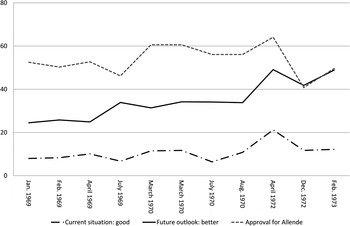
Accounts that analyse the 1973 breakdown abound. It suffices to say that most of those accounts point to political polarisation as a contributing factor – if not the main explanatory one – for the breakdown of democracy in Chile. However, was Chilean public opinion in general as polarised as the elite? Figure 3 shows changes in presidential approval and current and future outlook between 1969 and 1973. Under Allende, presidential approval moved together with the current and future outlook. The three indicators improved until mid-1972, when presidential approval took a dive, as did those for a positive present and future outlook. In February 1973, when Hamuy conducted his last poll, almost 50 per cent approved of Allende and the same percentage had a positive future outlook.
Presidential Approval, Current and Future Outlook, 1969–73

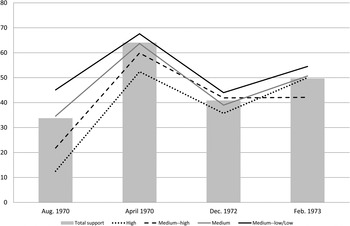
Explanations that point to ideological polarisation often use class identification as a strong determinant for ideology.Footnote 48 The Hamuy polls, however, do not confirm ideological polarisation. Figure 4 shows vote intention for Allende in August 1970 and the changes in presidential approval by socio-economic groups. Approval within the four socio-economic groups (high, medium-high, medium and medium-low/low) changed similarly. Allende had higher support among the lower groups, but when overall support for Allende increased in 1972, it did so among all groups. In fact, there were smaller differences in presidential approval in 1972 between socio-economic groups than in vote intention for Allende in 1970. The socio-economic gap further narrowed by December 1972. The last poll conducted in February 1973 showed an increase in approval for Allende. There is no evidence of class-based difference in terms of presidential approval. In the midst of an economic and political crisis in early 1973, Allende's UP received 44.1 per cent of the national vote. Unfortunately, there were no Hamuy polls after the election, so we cannot assess presidential approval in the months leading up to the coup nor can we verify if polarisation increased.
Intention to Vote for Allende and Presidential Approval by Socio-economic Groups, 1970–3

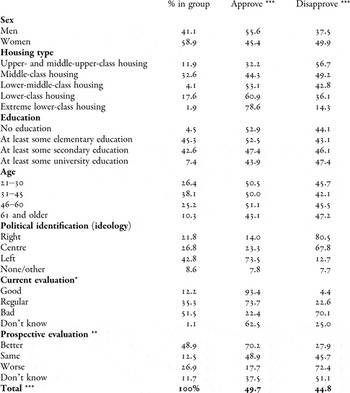
In February 1973, as Table 4 shows, support for Allende was higher among men and among those in low-quality housing. Younger Chileans and those with lower levels of education also supported Allende more strongly. Not surprisingly, those with a positive prospective evaluation supported Allende much more strongly (70.2 per cent) than those who believed the future would be the same (48.9 per cent) or worse (17.7 per cent). Though there is some evidence of class-based support for Allende in 1973, the clearest distinction in presidential support was based on ideology. Among those identified with the left, support for Allende was 73.5 per cent, much higher than among those identified with the right (14 per cent) and centre (23.3 per cent).
Presidential Approval by Selected Categories, February 1973

* ‘Thinking about the general situation of the country, do you think it is good, regular or bad?’
** ‘For the coming years, do you think the situation of the country will be better, the same or worse?’
*** ‘Don't know’ answers and no answers are not included, so ‘Approve’ and ‘Disapprove’ do not add up to 100%.
Source: Hamuy poll no. 45, Feb. 1973. See Navia and Osorio, ‘Las encuestas de opinión pública en Chile antes de 1973’ for poll classification.
Table 5 shows the marginal effects of a probit model on presidential approval in February 1973. The dependent variable is approval, which takes the value of 1 for those who approved and 0 for everyone else. Model 1 presents the effect of socio-demographic variables on presidential approval. Support was higher among men and among those in lower housing types. Model 2 shows the effect of ideology on presidential approval. The reference category is those identified with the left. Support for Allende was lower in all other groups, with those on the right being more strongly opposed when compared to leftists than those in the centre or the non-identified. Model 3 shows the effect of short-term variables. Those with a positive outlook were more likely to approve of Allende. Model 4 shows the effect of all the variables combined. Support for Allende was higher among men, the young, leftists and those with a positive outlook. Ideology was a stronger determinant than socio-demographic variables and economic perception. In fact, it might be that prospective evaluation itself was explained by ideology, with those in the left showing a more positive outlook than the rest. Table 5 confirms that ideology was a strong driving force behind presidential approval in early 1973. When comparing the marginal effects of Table 5 with those of Table 2 (the determinants of vote choice in the 1970 election), we find that that support for Allende in 1973 is even more strongly explained by ideology than in the 1970 election and that the marginal effect of housing type is no longer statistically significant.
Marginal Effects (Probit Model) on Presidential Approval, February 1973

*** p < 0.01, ** p < 0.05, * p < 0.1; standard errors in parentheses.
Presidential approval (for Allende) is the reference category in the dependent variable.
Housing type is an incremental variable, from lowest to highest quality of housing.
Current and prospective socio-tropic perceptions were recoded into -1, 0 and 1 (see Erikson et al., The Macro Polity).
The reference category for political identification is identification with the left.
Source: Hamuy poll no. 45, Feb. 1973. See Navia and Osorio, ‘Las encuestas de opinión pública en Chile antes de 1973’ for poll classification.
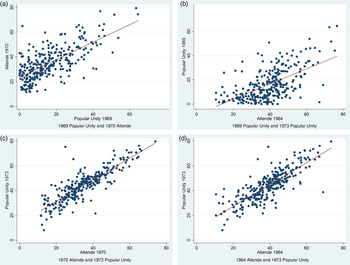
To complement the findings from the Hamuy poll, we also analysed the 1973 legislative election and compared it to previous elections. Figure 5 shows four scatterplots with the vote for Allende at the municipal level in 1964 and 1970 and for his coalition in the 1969 and 1973 legislative elections. All vote shares are highly correlated. Wherever Allende did well in 1964 and 1970, the UP also did well in 1969 and 1973. However, the UP vote in 1969 is less strongly correlated with the other elections. This makes sense, as each UP party ran separately in 1969 and the UP was formed only for the 1970 election. We have added the vote share in 1969 for all the parties that later formed the UP, but we take this comparison with a grain of salt because there was realignment – especially with the division of the PR into a pro- and anti-Allende factions.
Scatterplots for Allende's Vote in 1964 and 1970 and the Popular Unity Vote in the 1969 and 1973 Legislative Elections

The 1964 and 1970 vote for Allende is strongly correlated with the 1973 UP vote. The vote for UP in 1969 has the weakest correlation with the 1973 UP vote. The results of the 1973 legislative election resembled the vote for Allende in 1964 and 1970. Figure 5 shows that the 1973 election reflected an ideological divide. Just as the 1964 election constituted a split between those who supported Allende and those who wanted to prevent him from winning, so the 1973 election too divided the electorate among those who supported Allende and those who opposed him. The vote in 1970, which also constituted a three-way split between the right, centre and left, is highly correlated with the vote in 1973.
The electoral base for Allende and the UP government did not change between 1970 and 1973. The troubled economy and high inflation reduced the purchasing power of middle- and lower-income Chileans. If Chileans had been influenced by economic variables, they should have punished Allende by voting for the opposition in 1973. However, that election showed a highly polarised electorate. Those who supported Allende in 1970 also supported the UP in 1973.
Conclusion
Though accounts of what caused the breakdown of Chilean democracy abound, there is less information on how support for Allende changed after the election in 1970. The support base for Allende was mostly ideological – and to a lesser extent based on socio-economic status – and not driven by economic concerns in 1970 or 1973. After Allende assumed power, the ideological divide that characterised the political elite, and has motivated so much scholarly work, permeated the rest of society. As the UP government began to implement its transformative programme, public opinion became more polarised, but support for Allende remained high, close to 50 per cent. Using polls and electoral results at the municipal level, we reject the hypothesis that economic conditions explain the change in vote intention for Allende and support for his government.
Allende and the UP electoral base remained stable. Wherever Allende did well in 1964 and 1970, the UP did well in 1973. The UP 1973 vote is better explained by the vote for Allende in the 1964 and 1970 presidential elections than by the UP vote in 1969. Long- and medium-term determinants of electoral preferences explain support for Allende and the vote for the UP in 1973 better than short-term economic variables. There is also little evidence that economic vote variables had an effect on presidential approval for Allende. Despite deteriorating economic conditions, support for Allende continued to be strong among the low-middle class and among those identified with the left.
Though economic performance helps explain electoral preferences and presidential approval in many countries, the evidence from Allende's Chile shows that ideology and socio-economic status have a stronger effect in explaining vote intention and support for his government. Thus, the phrase used by Allende supporters in the 1973 legislative election campaign – ‘This might a shitty government, but it is my government’Footnote 49 – effectively summarises the support base of Allende and the UP. Contrary to what Nixon assumed in 1970, ‘making the economy scream’ did not change political preferences of Chileans. The implications of our findings are relevant for other countries undergoing economic crises and political polarisation. While the economy matters, political polarisation leads voters to assess economic variables in light of their own ideological inclinations.