Introduction
The surge capacity of emergency medical services (EMS) systems in the United States is limited. Even in meeting the demands of daily operations, the emergency and trauma care system in the US is often operating at or beyond its capacity. 1 An MCE can overwhelm the capability and function of various aspects of an EMS system. A successful EMS response ensures fast triage, scene evacuation, and appropriate distribution of casualties that takes into consideration the different capacities of receiving hospitals. The prehospital response component to an MCE requires the mobilization of an adequate number and type of EMS resources to meet the needs of the casualties from triage to initiating treatment and transport to designated hospitals.
Estimating the number of ambulances required in an MCE is challenging. This estimation is hampered by several complexities including: (1) the real-time variation of the number of critical (T1) and moderate (T2) patients at the scene needing ambulance transport; (2) the evacuation and transport of more than 40% of those injured by means other than formal EMS system;Reference Hogan, Waeckerle, Dire and Lillibridge 2 , Reference Auf der Heide 3 (3) the simultaneous activities of various ambulances (treatment, transport, and delivery, recovery, return to scene); (4) the variability of the transport time intervals from the scene to designated hospitals; and (5) the different surge capacities of various hospitals. EMS regions in the United States have different “best practices” for the required number of ambulances in an MCE, none of which is based on quantitative criteria to account for transport times and capacities of designated hospitals. 4 - 7 To the best of the authors’ knowledge, there is only one article in the literature, published in 1996 by de Boer, that proposed a quantitative method to estimate the number of ambulances needed to respond to an MCE.Reference de Boer 8 The author described the different variables in the following formula X = Nt / Tn; where X is the number of ambulances, N is the number of victims needing transport, t is the average traveling time, T is the total time available for transportation of N and n is the number of victims that can be transported on each journey. There are several conceptual gaps in de Boer's model. First, it adopts a numerical constant to calculate the average traveling time (t) that is applicable only in the Netherlands. Second, it does not account for the time required for recovery of ambulances and return to the scene. Third, it ignores the time elapsed since injury, and the different capacities of designated hospitals. Therefore, there is a need for a new and comprehensive model that takes into account all the concerns mentioned above.
The objective of this study was to estimate the number of ambulances required to respond to the scene of a trauma-related MCE, in order to initiate treatment and complete the transport of critical (T1) and moderate (T2) patients. The proposed model takes into consideration the different transport times and capacities of receiving hospitals, the time interval from injury occurrence, and the pre-designated time frame allowed from injury until the transfer of care of T1 and T2 patients.
Methods
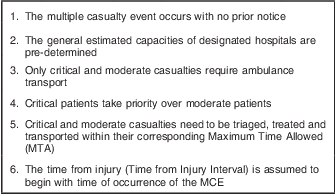
The main theoretical framework for the proposed model is based on the prehospital time intervals used by EMS systems. These intervals were proposed by Spaite et al in 1993 to evaluate operational and patient care issues in EMS systems (Figure 1).Reference Spaite, Valenzuela and Meislin 10 The prehospital average time intervals for trauma patients described by Carr et alReference Carr, Caplan and Pryor 11 in 2005 were also used for calculations in the proposed model. The model was then applied to a hypothetical MCE in the city of Chicago for illustration purposes. Several model assumptions are highlighted in Table 1.
Prehospital Time Intervals (adapted from Spaite et al, 1993)

Model Assumptions

In this prehospital system modeling methodology, the North Atlantic Treaty Organization (NATO) triage categories (T1-T4) were used for simplicity.Reference de Boer 9 Critical casualties (T1) were considered to be equivalent to trauma casualties with an Injury Severity Score ≥16, and to the red category in the Simple Triage And Rapid Treatment (START) system. Moderate casualties in this model (T2) were considered to be equivalent to trauma casualties with an Injury Severity Score <16 requiring admission to the hospital, and to the yellow category in the START system. T3 (minor) and T4 (expectant) categories were excluded from this model, because they are not prioritized for ambulance transport.
Results
The concept of Maximum Time Allowed (MTA) is the essential premise under which the prehospital system operates worldwide. 12 The MTA is defined as the time interval from injury to the transfer of care to the hospital. It is applicable to T1 and T2 patients, as their care is consequential.Reference de Boer 8 , Reference de Boer 9 , 12 The proposed model adopts the concept of MTA in MCE modeling despite the controversy surrounding the exact values of MTA for T1 and T2 trauma patients. 12 - Reference Di Bartolomeo, Valent and Rosolen 26 Several trauma systems refer to the golden hour as the MTA for critical (T1) casualties.Reference de Boer 8 , Reference de Boer 9 , 12 - Reference Pepe, Wyatt and Bickell 22 The MTA for T2 casualties (MTA2) is referred to as Friedrich's time, and is estimated by some experts to be between four and six hours.Reference de Boer 8 , Reference de Boer 9 , 12 In the state of Virginia, for example, the EMS response plan in MCE assumes that patients will be triaged, treated and transported within three hours of a no-notice event. 4
Estimation of the Minimum Number of Ambulances (Am) Required for the Response to an MCE
Taking the mean time intervals in urban settings from Carr et al (response time interval five minutes and on-scene interval 13.4 minutes) and Spaite et al (patient access interval 1.4 minutes, delivery interval 3.5 minutes, and recovery interval of 23 minutes), and assuming a very short transport interval of four minutes, the time interval from ambulance activation until the transfer of a patient's care to the hospital is approximately 26 minutes (5 + 13.4 + 3.5 ≈ 22).Reference Spaite, Valenzuela and Meislin 10 , Reference Carr, Caplan and Pryor 11 If two casualties are triaged as critical (T1) at the same location, and assuming only one ambulance is responding, that one ambulance would recover in 23 minutes, come back to the scene in four minutes, spend an average on-scene interval for the second casualty (13.4 minutes), transport (four minutes), then deliver (3.5 minutes), putting the total time interval for the transfer of care of the second casualty at more than one hour from triage (≈74 minutes) (Figure 2, color online).
(Color online) Time Intervals for One Ambulance Responding to Two Successive Patients (total 74 minutes)

Thus, the same ambulance cannot treat and transport two successive critical casualties within an MTA of one hour, even if the transport time is extremely short (four minutes), and even if the recovery time is abbreviated to 10 minutes. Thus, the number of T1 casualties (estimated or actually triaged) becomes the most important determinant for the minimum number of ambulances (Am) required to respond to an MCE scene. If at any time during the MCE, the number of ambulances involved in the response is less than the number of T1 that are present at the scene, more ambulances need to be activated from within the region itself first, and if need be, by requesting assistance from adjacent jurisdictions to increase the prehospital capacity. The latter is usually preceded by more stringent criteria for ambulance deployment for routine runs (prioritization of 911 calls), in order to augment the intrinsic immediate prehospital capacity to respond to an MCE.
Estimation of the Number of Ambulances (A) for Critical and Moderate Patients (T1+T2) Accounting for Different Transport Times to and Different Capacities of Designated Hospitals
In order to estimate the number of ambulances needed to respond to the scene to initially treat, transport and transfer the care of all T1 and T2 patients, taking into consideration the transport times and capacities of designated hospitals, the authors propose a new prehospital parameter, namely the Patient to Patient Interval (PPI). PPI is the time interval for each ambulance from contact of patient i (after triage) to the contact of the next patient i + 1 (after triage) (Figure 3). Note that PPI is not ambulance-specific, but rather hospital-specific, i.e., it is estimated for every receiving hospital, based on the transport time.
Components of the Patient-to-Patient Interval (PPI)

The hypothetical example of an MCE involving an explosion/blast in Chicago's United Center during a hockey game on a Sunday at 8:36 PM CST can be used for illustration (Figure 4). Chicago is an urban setting with six level I trauma centers. The PPI of the closest one (Stroger Hospital) with four minutes transport time would be estimated at 48.2 minutes [12 minutes (initial assessment of patient i + treatment + removal) + four minutes (transport) + 3.5 minutes (delivery) + 22.9 minutes (recovery) + 4 minutes (return to scene) + 1.4 minutes (access to patient i + 1) ≈ 48 minutes].
United Center and Chicago Area Level I Trauma Centers with their Corresponding Transport Intervals

Assuming that Stroger is the only hospital receiving critical and moderate patients, the number of ambulances needed to treat, transport, and transfer the care of all T1 and T2 patients would be equal to:
 $$\scale 98%{{\rm{\bf A}}\, {\rm{ = }} \, {\bf{[(T1}}\:{{ \bf+ }}\:{\bf{T2)}}\, {\bf x }\, {\bf{PPI]\bf/[\bf(MTA2 {\hbox-} TII)}}\, {\bf x }\, {\bf{n]}} \, {\bf{with}}\,{\bf{A}}\, {\bf{\geq}} \, {\bf{Am}}\,{\bf{at}}\,{\bf{all}}\,{\bf{times}}\eqno\rm$$
MTA2 is the maximum time interval allowed from injury (assumed to coincide with MCE occurrence) to the transfer of care of all T2 to designated hospitals (Friedrich's time; four to six hours). TII is the Time from Injury Interval, and was defined as the time from the occurrence of an MCE (assumed to be time of injury) until any point in time when the number of required ambulances is estimated. The other parameter, n, is the number of patients per ambulance (set at one in the US and most of Europe). TII is important because several factors such as safety and security might delay access to patients in an MCE, and therefore this elapsed time needs to be accounted for by subtracting it from the MTA. As a hypothetical example, consider an MCE generating five T1 and 40 T2 patients with a TII of 20 minutes (due to scene safety concerns), and an assumed MTA2 of four hours (240 minutes). The number of ambulances needed to treat, transport and transfer the care of all of the 45 patients (T1 + T2) to the Stroger Hospital is equal to [(5 + 40) x 48]/[(240-20) x 1] ≈ 10 ambulances. In another scenario with the same total number of T1 + T2 patients (45) but with 20 T1 patients, the number of ambulances needed is not 10, but rather 20, since it was demonstrated earlier that the minimum number of ambulances should be equal at least to the number of critical patients T1.
In reality, more than one hospital receives patients from an MCE, and the higher the capacity of designated hospitals to receive T1 and T2, the higher the number of ambulances directed to that particular hospital should be. Hence, the PPI of a particular hospital that will receive more patients needs to be represented more in the equation. Therefore, the proportionate PPI (PPIp) needs to be used in the final formula when more than one hospital is designated to receive patients:
 $$\scale 97%{{\bf{A}}\, {\bf{ = }}\, {\bf{[(T1}}\, {\rm{ \bf+ }}\, {\bf{T2)}}\, {\bf x} \, {\bf{PPIp/(MTA2 {\hbox-} TII)}}\, {\bf x }\, {\bf{n]}} \, {\bf{with}}\,{\bf{A}}\, {\bf\geq} \, {\bf{Am}}\,{\bf{at}}\,{\bf{all}}\,{\bf{times}}\eqno\rm$$
PPIp is calculated based on the estimated PPI and individual capacity for each hospital. The latter is based on the quantitative model on hospital surge capacity described by Bayram et alReference Bayram, Zuabi and Subbarao 27 in which the proposed per-hour capacity for T1 + T2 (termed Hospital Acute Care Surge Capacity or HACSC) is equal to the number of emergency department (ED) beds divided by the average ED time for T1 and T2 combined (estimated to be 2.5 hours in trauma).Reference Bayram, Zuabi and Subbarao 27 The cumulative HACSC (per-hour surge capacity for T1 + T2) for all six level I trauma centers in the Chicago area is 97.Reference Bayram, Zuabi and Subbarao 27 Therefore, if designated as a receiving hospital, for example, Stroger hospital should be receiving 34% of the load, based on its HACSC compared to the total HACSC of all designated hospitals (33/97 = 0.34). Stroger's PPI contribution would be its estimated PPI (48.2) multiplied by its proportionate HACSC (0.34) ≈ 16 minutes. Repeating this process for all six hospitals and summing their PPI contribution, the overall PPI proportionate (PPIp) = 9 + 16.4 + 7.2 + 5.4 + 7.7 + 19.8 ≈ 65 (Table 2).
Estimated Patient-to-Patient Intervals and their Derivations for Chicago Area Level I Trauma Centers

Considering the example above, with five T1 and 40 T2 patients distributed to all six hospitals, the number of ambulances needed would be equal to [(5 + 40) x 65]/(240-20) x 1] ≈ 13 ambulances. Note there are two reasons for the increase in the number of ambulances from the scenario with only one hospital receiving all T1 + T2, which required only 10 ambulances. First, other hospitals have been incorporated, including two with long transport times (Loyola 15 minutes and Advocate Christ 27 minutes), in order to avoid overwhelming the resources of the closest hospital (Stroger). Second, the capacity of some distant hospitals is high, which translates into more hospital runs (e.g., Advocate Christ taking 20% of the load has 27 minutes of transport time). This proposed model ensures that all eligible trauma centers have received patients proportionate to their capacities.
Discussion
Estimation of the number of ambulances needed to respond to the scene of an MCE is very important to the overall prehospital management, with significant impact on the designated hospitals. The “customary” method of EMS operations in an MCE is for the first scene responders to provide a preliminary estimate (from initial visual clues) of the number of casualties and their levels of acuity, based on which the dispatch center—under the direction of the EMS director—would deploy a certain number of ambulances based on pre-defined levels of response, educated guesses and best practices. This is in line with the recommendation by Heightman to develop a response plan for MCE that dispatches a pre-determined number of transport units and ambulances, based on the level of response.Reference Heightman 28 Various EMS regions in the United States, however, have different levels of response to an MCE, different specifications for those levels, and different “best practices” for the required number of ambulances (Table 3). 4 - 7
Sample of “Best Practices” in the US for the Number of Ambulances Responding to Multiple Casualty Events

In addition, the best practices of various EMS regions with regards to MCEs are usually without quantitative criteria to account for the transport times and capacities of designated hospitals. The number of ambulances needed for a trauma-related MCE is dependent on six factors: (1) the number of casualties that need treatment and transport (assumed in the proposed model to be the critical and moderate patients, T1 and T2 respectively); (2) the total time interval—from injury—available for ambulances to initiate treatment, transport and transfer of care of T1 + T2 casualties (MTA); (3) the various transport times to designated facilities; (4) the different capacities of designated hospitals receiving casualties; (5) the time interval elapsed since the injury occurrence; and (6) the number of casualties transported per ambulance. The proposed model accounts for all of the above parameters. In the US and in parts of Europe, the number of casualties transported per ground ambulance is fixed at one, though in extreme situations two patients might be accommodated per ambulance.Reference de Boer 8 The concept of MTA in multiple casualty events is used by various EMS regions, like the state of Virginia. 4 The proposed model is dynamic, as the information about the number of T1 + T2 is variable during an event. As more accurate information is collected and disseminated, the number of ambulances needed to transport all T1 and T2 changes accordingly. The proposed model demonstrates that the minimum number of ambulances needed to respond to an MCE is primarily determined by the number of critical (T1) casualties, estimated or confirmed at the scene, at any time throughout the MCE. It also provides a dynamic estimate of the number of ambulances needed to treat and transport T1 and T2, taking into account the various transport times and capacities of designated hospitals.
Strengths and Limitations
A major strength of the model proposed in this manuscript is that it is the first—to the best of the authors’ knowledge—quantitative model to allow dynamic estimation of the number of ambulances needed to care for critical and moderate patients anytime during an MCE, taking into consideration the different transport times and capacities of multiple receiving hospitals, the time interval from injury occurrence, and the pre-designated time frame to transfer the care of all T1 and T2 patients. Furthermore, this model builds upon already existing and accepted concepts in EMS, namely Spaite et al's prehospital time intervals. Hence, it can be incorporated into EMS response protocols for MCE. The proposed model also accommodates the fact that many casualties during MCE are transported by private vehicles. Subsequently, as the number of T1 and T2 remaining at the scene decreases, the number of ambulances required also decreases. In addition, the model takes into account any changes to the capacities of receiving hospitals through continuous communication and coordination. If a hospital is overwhelmed with T1 and T2 walk-ins, that hospital can be removed from the receiving list and the PPIp can be re-calculated. The Maryland Institute for Emergency Medical Services Systems (MIEMSS) County Hospital Alert Tracking System (CHATS) is one example of how ongoing updates from receiving hospitals can improve EMS systems management. Another strength of the model is the introduction of a new interval, PPI, which improves estimation of the time needed for ambulances to transport patients to multiple hospitals and return to scene. The advantage of the PPI over the average transport time proposed previously in the literature is that hospitals with larger capacities are expected to have more ambulance runs and hence more PPIs during the life of the MCE. An additional model strength is its adaptability to various EMS systems. Urban, suburban or rural EMS systems can utilize their target response times, response zone characteristics, ambulance deployment strategy and their hospitals’ surge capacities to generate their own PPIs and PPIp. They can designate a specific MTA that might be less than four hours, depending on their intrinsic capacities. The model also takes into account the time from injury (Time from Injury Interval), which is assumed to coincide with MCE occurrence. However, if another group of casualties occur at a later time, the same fundamental model concepts would still apply for that group. Finally, EMS regions can change the number of patients per ambulance (n) in an MCE (e.g., from one to two) and still use the proposed formula.
The proposed model has its share of limitations. Most notably, it is based on the concept of Maximum Time Allowed and assumes accurate triage categorization, both of which remain a subject of debate in the literature.Reference Baxt 13 - Reference Di Bartolomeo, Valent and Rosolen 26 , Reference Cone, Serra, Burns, MacMillan, Kurland and Van Gelder 29 - Reference Lerner, Cone, Weinstein, Schwartz and Coule 36 However, this limitation is not specific to the model but rather a shortcoming of the triage systems themselves. Another limitation is that this is a proposed conceptual model that has not yet been validated through simulation studies or actual MCEs. In addition, some of the new parameters may require basic calculations that are unfamiliar, and thus require training for EMS managers and directors.
Conclusion
Estimating the number of ambulances needed in an MCE to treat, transport, and deliver critical and moderate patients is challenging due to the many variables encountered. This study proposes a robust quantitative model to dynamically estimate the number of ambulances required at any time during an MCE, in order to initiate treatment and complete the transport of critical (T1) and moderate (T2) patients. The proposed model takes into consideration the different transport times and capacities of receiving hospitals, the time interval from injury occurrence, number of patients per ambulance, and the pre-designated time frame allowed from injury until the transfer care of T1 and T2 patients. Prospective studies of this model are needed to examine its validity and applicability.
Abbreviations
- ED:
-
emergency department
- EMS:
-
emergency medical services
- MCE:
-
multiple casualty event
- MTA:
-
Maximum Time Allowed
- PPI:
-
Patient to Patient Interval
- TII:
-
Time from Injury Interval