Memory and monument are to each other as process and product…
— Nelson and Olin Reference Nelson, Olin, Nelson and Olin2003:4In 1926 archaeologist Franz Blom and ethnographer Oliver La Farge jointly published the results of the Tulane University expedition to Middle America under the title Tribes and Temples. This report, detailing one of the first archaeological explorations of the region, contained some of the earliest accounts of the ancient sculptural works scattered throughout the area. Within their text, Blom and La Farge often used the term “monument” interchangeably with “idol” to describe these artworks of unknown antiquity.
The Tulane report was one of several accounts that served to lure Matthew Stirling, director of the Bureau of American Ethnoloy, to the Mexican Gulf lowlands for more intensive investigation. In his published accounts of excavations conducted at several lowland archaeological sites between 1938 and 1946, Stirling continued Blom and La Farge's application of the term monument when discussing stone sculpture. His usage shifted the referent slightly, however, to apply to any worked stone that was not obviously a tool, such as a mano or metate (Stirling Reference Stirling1940, Reference Stirling1943, Reference Stirling1955, Reference Stirling and Willey1965, Reference Stirling1968).
Adhering to the precedents set by these foundational publications in the archaeology of the Gulf lowlands, scholars addressing the Olmec and their Preclassic contemporaries (1500–400 b.c.) have consistently employed the word monument in conjunction with the sculpting or nonutilitarian manipulation of stone.Footnote 1 Subsequently, use of the term when addressing the Preclassic period sculptural traditions of Mesoamerica seems unremarkable, perhaps even unworthy of discussion. Yet, such usage often overlooks the complex of commemorative functions attached to the category of monuments worldwide. This category has been under increasing discussion over the past few decades by sociologists, historians, art historians, and archaeologists as part of a broader exploration of social memory (Alcock Reference Alcock2002; Ashmore and Knapp Reference Ashmore and Knapp1999; Bender Reference Bender1998; Bradley Reference Bradley1998; Choay Reference Choay and O'Connell2001; Connerton Reference Connerton1989; Halbwachs Reference Halbwachs, Ditter and Ditter1980; Hutton Reference Hutton1993; Mills and Walker Reference Mills and Walker2008; Nelson and Olin Reference Nelson, Olin, Nelson and Olin2003; Nora Reference Nora1989; Tilley Reference Tilley1994; Tilley and Bennett Reference Tilley and Bennett2004; Van Dyke and Alcock Reference Van Dyke and Alcock2003; Yates Reference Yates1966; Young Reference Young, Nelson and Shiff2003).
The ill-defined application of the term monument to Preclassic sculpture becomes understandable when one considers the fast and loose definitions that have been given to the word over the course of the last few centuries. While predominantly attached to concerns of public commemoration and memorialization, monument is a term that has also been applied more broadly to refer to both natural and human-made objects or landscape features that are evocative of ancient cultures and periods of antiquity, or that simply conjure a sense of aesthetic grandeur (Choay Reference Choay and O'Connell2001:7–8). Nevertheless, in contemporary scholarship, monuments are most often discussed as public works that act as repositories of shared cultural memory (Choay Reference Choay and O'Connell2001; Nelson and Olin Reference Nelson, Olin, Nelson and Olin2003; Stocker Reference Stocker and Turner1996; Young Reference Young, Nelson and Shiff2003). This scholarship situates the monument as a category of object squarely within the vast discourse on memory, specifically social or collective memory, which has been mounting over the past few decades. Further discussion of monuments and their place within this discourse will be considered below.
Perhaps the primary reason for the continued ambiguity of the term monument as applied in Olmec studies is a persistent lack of distinction between appearing monumental (stylistic monumentality) and functioning as a monument in the commemorative sense. While many writings on Olmec art address the monumentality of the sculptural tradition (its grand proportions, swelling volumes, harmonious balance, and aesthetic magnificence), only a handful have explicitly claimed a commemorative function (Clark Reference Clark, DeMarrais, Gosden and Renfrew2004; Clark and Colman Reference Clark and Colman2008; Clark, Guernsey, and Arroyo Reference Clark, Guernsey, Arroyo, Guernsey, Clark and Arroyo2010:25; Coe and Diehl Reference Coe and Diehl1980:293; Covarrubias Reference Covarrubias1946:90, Cyphers Reference Cyphers, Benson and de la Fuente1996:68; Cyphers and Di Castro Reference Cyphers, Di Castro, Fash and Luján2009:28). Moreover, the possible places of monument creation and uses in relation to the production of Olmec social memory have never been fully explored.
The suggestion that certain Olmec sculptures functioned as monuments in the commemorative sense, in addition to appearing monumental, should not be viewed as merely semantic. Rather, if specific works can be identified as commemorative, they can then be positioned as material mediators within the processes of remembering and forgetting that are integral to the production, reproduction, and transformation of all human societies (Gillespie Reference Gillespie2010:402; Olick and Robbins Reference Olick and Robbins1998). As Schwake and Iannone (Reference Schwake and Iannone2010:332) have observed, “The role of objects as mediator [of collective memory] is a powerfully different interpretation of material culture than other forms of analysis based on style or appreciation of the piece in isolation from its mnemonic context.” Nevertheless, this different interpretive framework is only useful if (1) its relevance is first established through various analytical methodologies, rather than assumed, in relation to specific objects or artworks, and (2) if analysis can be extended beyond the claim that a work is commemorative to a discussion of how it functioned within the broader social praxes of memory work.
In this article I address the practices of commemoration and the production of social memory in the Preclassic period and the ways in which they may be elucidated by the sculptural remnants left to us by the Gulf lowland Olmec. First, I propose to explore the question of how we might determine whether or not Olmec sculptures were intended to function commemoratively. By examining the formal elements, iconography, and archaeological contexts of Gulf Olmec sculptures, I argue for the intentional usage of particular works as commemorative monuments that facilitated social engagement with the processes of public remembering and forgetting. Additionally, through the analysis of specific Olmec sculptures in a series of case studies, I demonstrate how context may be used to illuminate the practices of memory manipulation during the Early and Middle Preclassic periods. I suggest that through contextual analysis it is possible to trace continuities and shifts in Preclassic social memory over time, allowing us to observe points of negotiation between the past and present in Olmec societies.Footnote 2 Ultimately, this exploration of mnemonic practices suggests the need for a critical reconsideration of the word “monument” as a blanket term for Preclassic sculptures in favor of an application limited to works associated with a commemorative function.
SOCIAL MEMORY AND THE SIGNIFICANCE OF MONUMENTS
Lack of discussion around the commemorative possibilities of Preclassic monumental sculpture can be largely related to historical trends in the scholarly treatment and perception of monuments as a whole. The twentieth century saw the widespread critical dismissal of the monument as antiquated, in direct opposition to the individuality and innovation embraced by the avant-garde of modernity, and a symbol of tyrannical politics (Nelson and Olin Reference Nelson, Olin, Nelson and Olin2003:2–3; Stocker Reference Stocker and Turner1996:48–49; Young Reference Young, Nelson and Shiff2003:234–236). Very few studies, art historical or otherwise, had been conducted on the nature and use of monuments before the last decade of the twentieth century (Nelson and Olin Reference Nelson, Olin, Nelson and Olin2003:2–3). By the time scholars had begun to address the sculptural production of Mesoamerica's Preclassic period, the monument was largely ignored as a subject of scholarly investigation (Young Reference Young, Nelson and Shiff2003:235–236).
It has only been with the advent of the postmodern period, and its attendant fixation on memory, that a resurgence of monument studies has occurred (Nelson and Olin Reference Nelson, Olin, Nelson and Olin2003:3). With new insights into the nature of these objects we are now, more than ever, at a place in history where we might recognize the roles that monuments played in cultural memory work by their contexts and archaeological evidence of the social rituals surrounding them, allowing us to distinguish them from other types of public sculpture. Moreover, the polysemy and mutability of these objects, previously viewed as the epitome of intransigence and tradition, are now seen to reify the dynamism of memory work (Nelson and Olin Reference Nelson, Olin, Nelson and Olin2003:3).
Because current investigations of the monument as an object category have been intertwined with the larger discourse of social memory, it is necessary to briefly define this discourse as it relates to the arguments of this article. Since the 1980s, social memory has become the topic of a vast and interdisciplinary field of study, intersecting with varied cultural themes such as tradition, history, identity, nationalism, performance, ritual, and landscape, which are themselves decentered with respect to any one discipline or dominant paradigm. The field of memory studies has roots in various modernist writings, particularly the work of Halbwachs (Reference Halbwachs, Ditter and Ditter1980), and has become an area of intense interest in postmodern scholarship, where it has been linked to deconstructionist inquiries concerned with history, hegemony, and power (Olick and Robbins Reference Olick and Robbins1998:108). The discourse of social memory is too extensive to outline in full here (see Olick and Robbins [1998] for a review of the relevant literature), and there is no single definition for the term itself. Social memory as a concept may be used interchangeably with terms such as collective, public, cultural, local, popular, or shared memory, or these descriptors can be further distinguished from one another by nuances of definition, depending on the author (Cattell and Climo Reference Cattell, Climo, Climo and Cattell2002:5; Gillespie Reference Gillespie2010:401; Olick and Robbins Reference Olick and Robbins1998:111). Certain commonalities exist, however, which can be used to narrow and delimit the field of inquiry.
Social memory is a dynamic and continuous process carried out by individuals at the level of the group and within the sphere of social interactions (Cattell and Climo Reference Cattell, Climo, Climo and Cattell2002; Connerton Reference Connerton1989; Fowler et al. Reference Fowler, Borgstede and Golden2010; Gillespie Reference Gillespie2010; Halbwachs Reference Halbwachs, Ditter and Ditter1980; Olick and Robbins Reference Olick and Robbins1998; Schwake and Iannone Reference Schwake and Iannone2010:331; Staller Reference Staller2008; Stockett Reference Stockett2010:315–316; Van Dyke and Alcock Reference Van Dyke and Alcock2003). Social memories are mediated by objects or texts and rooted in the physical spaces that link the practice of memory with the material world (Connerton Reference Connerton1989:37; Gillespie Reference Gillespie2010:402; Schwake and Iannone Reference Schwake and Iannone2010:332; Stockett Reference Stockett2010:316). These memories are held by individuals but may be incorporated into the long-term collective memory of a group that outlives any single individual (Gillespie Reference Gillespie2010:406). The collective memory is intersubjective and transgenerational, and is selectively maintained and presented in order to influence the present or future by constituting a particular version of the past (Gillespie Reference Gillespie2010:401, 406; Olick and Robbins Reference Olick and Robbins1998; Schwake and Iannone Reference Schwake and Iannone2010:331).
While the use of collective memory as a concept is intimately tied to that of history, the relationship between the two remains unclear and widely debated (Borgstede Reference Borgstede2010:385; Burke Reference Burke and Butler1989; Hutton Reference Hutton1993; Olick and Robbins Reference Olick and Robbins1998:110–112). History is often characterized as a conscious, authoritative, and codified construction of the past created by those in power, typically employing the use of records, whether textual, oral, or representational (Borgstede Reference Borgstede2010:385; Burke Reference Burke and Butler1989; Gillespie Reference Gillespie2010:407; Olick and Robbins Reference Olick and Robbins1998:110–112). Theorists have also observed that history is often employed in the service of memory (Olick and Robbins Reference Olick and Robbins1998:110). “[C]ollective memory ‘is not an alternative to history (or historical memory) but is rather shaped by it as well as by commemorative symbolism and ritual’” (Schwartz, cited in Olick and Robbins Reference Olick and Robbins1998:112). In this article I refer to history or the historical in relation to the codified narrative of the past constructed by those in power. This narrative undoubtedly combined with unofficial memories, stories, rituals, and representations to become part of the collective memory of Olmec societies.
Social memory as a theoretical framework is still being developed within the field of pre-Columbian scholarship, but recent years have seen the application of this theoretical discourse to a wide variety of cultures, objects, and archaeological contexts within Mesoamerica (see, for example, Borgstede Reference Borgstede2010; Fowler et al. Reference Fowler, Borgstede and Golden2010; Gillespie Reference Gillespie, Mills and Walker2008, Reference Gillespie2010; Golden Reference Golden2010; Joyce Reference Joyce, Mills and Walker2008; Just Reference Just2005; O'Neil Reference O'Neil2010, Reference O'Neil2011; Schwake and Iannone Reference Schwake and Iannone2010; Stanton et al. Reference Stanton, Balderas and Fowler2011; Stockett Reference Stockett2010; Urcid Reference Urcid2004, Reference Urcid2005; Vail and Hernández Reference Vail and Hernández2011; Winter Reference Winter2011). Gillespie (Reference Gillespie2010:402) has observed that these and other archaeological investigations of memory emphasize one or more of three potential foci: (1) the subject (who or what) of remembering or forgetting; (2) different memory communities (who is remembering); and (3) the praxis of memory that is at the heart of social reproduction and transformation (what she calls memory work).
This article will touch upon all three foci delineated by Gillespie, with its primary emphasis on the third area, the memory work that defines social memory as a process, rather than a thing (Gillespie Reference Gillespie2010:402). My goal here is to discuss social memory as it relates to public practices of commemoration involving the commissioning, creation, display, manipulation, and mutilation or destruction of stone monuments. Therefore, more emphasis will necessarily be placed on the formation of memory as it relates to the shared recollections of the group, rather than the private and personal experiences of the individual.
The praxis surrounding social memory is not limited to straightforward acts of official commemoration but may include efforts to redact or transform the existing narrative of the past as a way to allow for competing memories or to reflect changes in the preexisting social order (Olick and Robbins Reference Olick and Robbins1998:126–128). Consequently, monuments often play a key role in negotiations of hegemony and resistance, particularly at the highest social levels, although these negotiations may be initiated at the lower end of the hierarchy (Olick and Robbins Reference Olick and Robbins1998:126). Whoever controls the collective memory of the past has the power to affect the present and future (Schwake and Iannnone Reference Schwake and Iannone2010:332; Stockett Reference Stockett2010:315; Van Dyke and Alcock Reference Van Dyke and Alcock2003).
Because Olmec stone sculptures were costly, specialized objects, it must be assumed that their initial role in public remembering was envisioned and to some extent controlled by elite individuals or corporate bodies. Many were also displayed in elite settings not available to the general populace. Yet, the accessibility of spaces and artworks often change over time and the manipulation, mutilation, and destruction of monuments are not activities exclusive to the elite class. Evidence of such activities may allow for considerations of how the nonelite could have actively participated in the processes of memory work. “The chewed up scraps of [Preclassic] sculptures show that they were caught up in rival claims of remembering and forgetting” (Clark et al. Reference Clark, Guernsey, Arroyo, Guernsey, Clark and Arroyo2010:25). Such claims could have been made either by elites or nonelites.
The identification of Olmec sculptural works as monuments has implications far beyond a simple identification of the commemorative function. Once recognized as a public monument, the context of a sculptural work, as well as its recarving, mutilation, or resetting may have implications for the trajectory of Olmec social development. Continued veneration of a monument over long periods of time suggests that it remained culturally relevant to the collective memory, whereas recycling, mutilation, or erasure imply social transformation or change. Resetting also suggests shifts in the shared memory but of a different sort than out-and-out erasure. The public or private nature of the setting of a monument also has implications for the production of differing, perhaps even competing, versions of the past, based on social rank or kinship affiliations within and between sites, what Burke (Reference Burke and Butler1989:107) refers to as “memory communities.” Finally, the sharing of monument forms or subjects between sites may indicate that some narratives of the past were regional, whereas other, more idiosyncratic monuments may be linked to the social memory of a single community or site.
Monument usage is typically multifaceted, often leaving behind vestiges of social praxis that, when examined closely, may provide a better understanding of the dynamism, change, and struggle during the Preclassic period. Before exploring these implications, however, the case must first be made that Olmec sculptures were in fact used in Preclassic practices of memory making.
THE FORMAL PROPERTIES OF MONUMENTS
The formal properties of Olmec sculptures have been integral to their identification as monuments in the stylistic or aesthetic sense. While not fully conclusive, an exploration of these properties does suggest that Olmec sculptures possess qualities often shared by other commemorative monuments worldwide. These qualities—material, size, proportion, and volume—not only evoke a sense of grandeur, but also lend themselves to the production and maintenance of collective memory.
In order to function as a mnemonic repository for one or more memory communities, monuments must first and foremost give the impression of stability and continuity over large spans of time (Nelson and Olin Reference Nelson, Olin, Nelson and Olin2003:3–4; Osborne Reference Osborne1970:737; Stocker Reference Stocker and Turner1996). Material durability, or “temporal longevity” (Schwake and Iannone Reference Schwake and Iannone2010: 332), is necessary if the memory an object mediates is to appear contiguous between the past and present and to be maintained transgenerationally. For this reason, the majority of monuments worldwide are either sculptural or architectural, the preferred media of stone or metal serving to project a message of endurance and immutability (Osborne Reference Osborne1970:737). Over time they merge with the places in which they are erected to become part of the stabile material milieu in which societies collectively conserve their recollections and rediscover their past (Connerton Reference Connerton1989:37). Yet, it should be noted that this message of immutable permanence is often at odds with the transience and polysemy that monuments actually attain over the course of their lives (Elsner Reference Elsner, Nelson and Olin2003:210–211; Nelson and Olin Reference Nelson, Olin, Nelson and Olin2003:3–4, 205–207).
The basalt stone used for the majority of Olmec monuments in the Gulf lowlands would have provided a visual manifestation of elite power, as communicated by the enormous amounts of labor and political clout mobilized for its transport from the slopes of the volcanic Tuxtla mountains, through the lowland territories, and on to their final destinations (Cyphers and Zurita-Noguera Reference Cyphers, Zurita-Noguera, Lucero and Fash2006:39 − 41; Williams and Heizer Reference Williams and Heizer1965). The remote source of this exotic stone may also have bestowed connotations of sacredness on the material and its final sculpted form or subject (Clewlow Reference Clewlow1974:150; Cyphers Reference Cyphers, Grove and Joyce1999:167–168; Gillespie Reference Gillespie1994:231; Stark Reference Stark, Grove and Joyce1999:301–307). Furthermore, the permanence of stone would have ensured a material continuity throughout successive generations. Through such continuity, stone monuments would have become what Nora refers to as “lieux de memoire” or sites of memory, in which memory “takes root in the concrete” (1989:9). These lieux de memoire, the containers of memory, are found in the built environment—the architecture, monuments, and depositional matrix of archaeological sites—and can be excavated to reconstruct, however imperfectly, milieu de memoire, or real sites of memory (Nora Reference Nora1989:7).
In the landscape of the Gulf lowlands, where stone was relatively scarce and architectural environments were primarily constructed of sand, clay, mud, and plant materials, the immutability of stone over long periods of time would have been particularly remarkable (Coe and Diehl Reference Coe and Diehl1980; Cyphers Reference Cyphers1992b, Reference Cyphers, Benson and de la Fuente1996: 65–70, Reference Cyphers, Stark and Arnold1997; Cyphers et al. Reference Cyphers, Hernández-Portilla, Varela-Gómez, Grégoz-López, Lucero and Fash2006; Diehl Reference Diehl and Benson1981; Drucker et al.Reference Drucker, Heizer and Squier1959; Gillespie Reference Gillespie, Mills and Walker2008; González-Lauck Reference González-Lauck, Benson and Fuente1996, Reference González-Lauck, Uriarte and Cicero2004, Reference González-Lauck2007; Symonds Reference Symonds, Clark and Pye2000:56). The phenomenological experience of Olmec sites, which appear to have needed constant refurbishment to counter the erosion of the elements, likely mirrored the experience of the riverine ecosystems of the lowlands—one of constant, cyclical change from season to season. In such an environment, stone monuments must have been particularly affective, their appearance of stasis and permanence across generations naturally lending itself to the adherence of memory through the passage of decades and centuries. It is important to note, however, that this appearance of stasis belies the dynamism inherent in the memory work of all human societies and may conceal the processes of redaction and reconfiguration at work in the production of collective memory that includes as much forgetting as remembering—a point to which I will return.
A less immediately perceivable effect of stone's temporal endurance is that sculptural monuments tend to have several “lives,” as their use and significance changes over time. As Rowlands (Reference Rowlands1993:144) has observed, “[o]bjects of a durable kind assert their own memories, their own forms of commentary and therefore come to possess their own personal trajectories.” Such trajectories may include reconfigurations of appearance, context, and meaning as monuments were remade, resited, or removed. It has become increasingly clear that both the present appearance of Preclassic sculptures and archaeological evidence of their treatment indicate practices of erasure, recarving, resetting, and recycling over time (Cyphers Reference Cyphers1992b:47–48, Reference Cyphers, Benson and de la Fuente1996:66, Reference Cyphers, Grove and Joyce1999:166–168, Reference Cyphers2004a:34; Cyphers and Botas Reference Cyphers and Botas1994; González-Lauck Reference González-Lauck1991; Graham Reference Graham, Sharer and Grove1989:229, Reference Graham, Uriarte and González-Lauck2008; Grove Reference Grove and Benson1981; Porter Reference Porter1990). These practices link the social lives of Olmec sculptures to those of monuments produced and used by other cultures worldwide, which often undergo similar treatments over the course of their “lifetimes.”
Descriptions of the formal qualities of Olmec sculptures frequently emphasize their colossal size, which is a common quality of monuments intended to glorify their subjects (Osborne Reference Osborne1970:737). Great mass or volume can also serve to equate perceived weight with the ideological weight or importance of the subject. The colossal size and mass of Olmec sculptures therefore serves to emphasize the elite status of Olmec lords on altar thrones, stelae, and the colossal heads. Additionally, formal elements of style may create an impression of grandeur that allows the work to appear larger than its actual dimensions. This is often the case with both colossal and portable works of Olmec sculpture, whose swelling curves, proportional harmonies, and static yet vital postures have often led scholars to describe their style as “monumental” (for examples see Clewlow Reference Clewlow1974; Coe Reference Coe and Willey1965:749; Fuente Reference Fuente1977:37–38, Reference Fuente and Benson1981, Reference Fuente, Benson and Fuente1996:42; Graham Reference Graham, Sharer and Grove1989:230; Tate Reference Tate and Guthrie1995:47). The aesthetic grandeur or monumentality of Olmec sculpture would certainly have been remarkable to Olmec audiences, faced with the sculptural indexes of elite affluence, wealth, and control over specialized labor able to transform the foundational material of the earth into fantastic images representing individual rulers.
While it can be observed that many of the formal qualities of Olmec sculptural works are shared by the corpus of monuments found worldwide, a formal analysis is hardly sufficient to prove that they were designed with the intent to function as commemorative monuments, rather than simply appearing monumental. Small, portable works of sculpture are unlikely to have served public audiences as sites of collective memory, whatever their stylistic properties. Their scale does not invite viewing by, or interaction with, groups of viewers but, rather, lends itself to a more private form of consumption. This is not to say that portable objects cannot have a mnemonic function, only that they are less suited to the practices of public remembering and forgetting under consideration here. Even grand public sculpture may not be made with any commemorative function in mind. Examples of such works serving as guardians, cult objects, works of pure aesthetic contemplation, and so forth, are found throughout the history of art, from Assyrian lamassu to Richard Serra's Tilted Arc. In order to discern whether a sculpture was commissioned to serve as an intentional monument (as opposed to unintentional monuments created by an object's progressive accrual of memory over time [Nelson and Olin Reference Nelson, Olin, Nelson and Olin2003:2]) we must move to considerations of subject matter, iconography, and context.
THE ICONOGRAPHY OF MONUMENTS
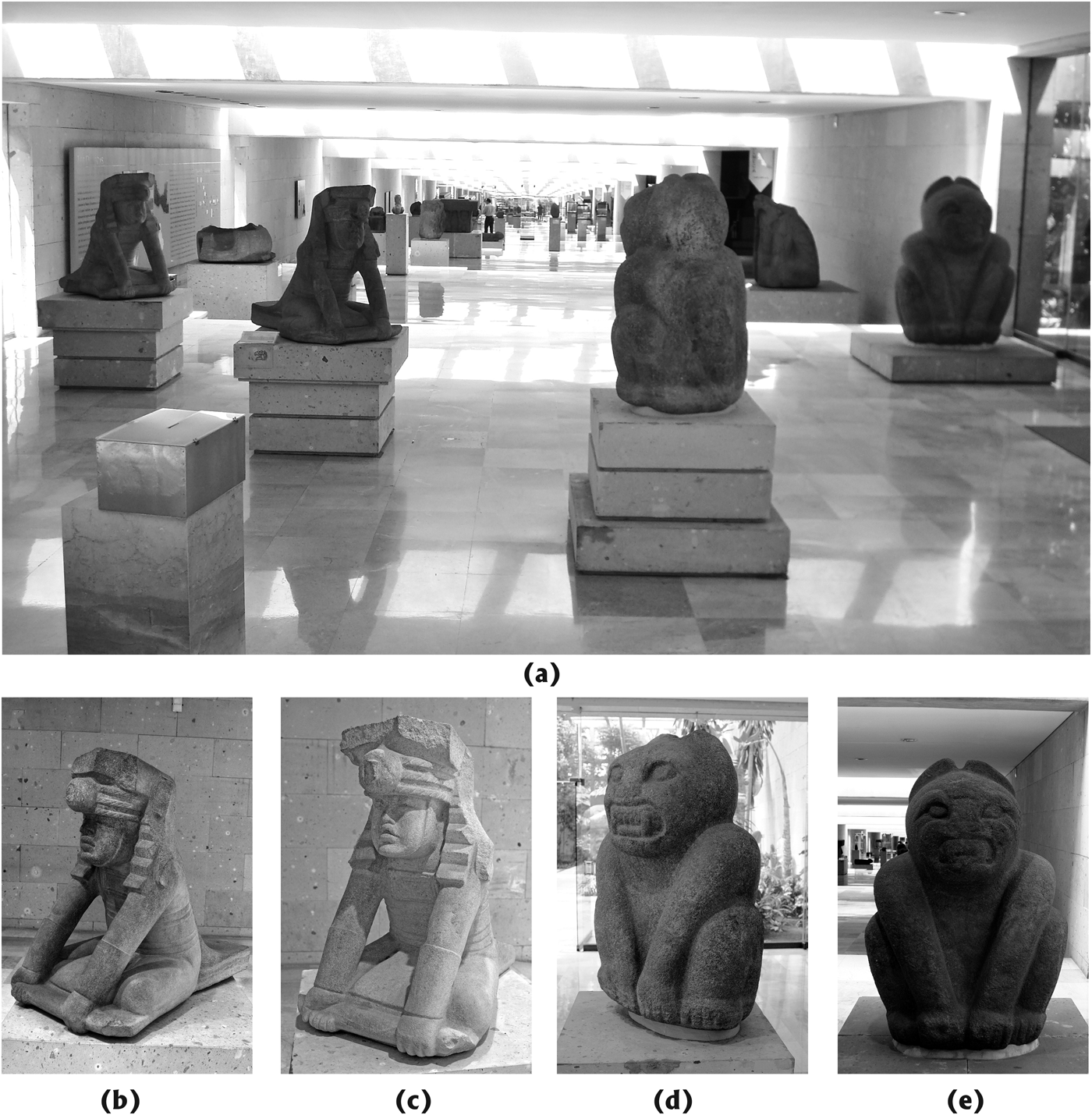
The iconography and subject matter of the Olmec sculptural corpus suggest a progressive conception of the commemorative and the historical from the Early (1500–850 b.c.) to Middle Preclassic (850–400 b.c.) period. The Early Preclassic development of portraiture, as exemplified by the colossal heads, is accompanied by the assemblage of sculpted figures into scenes that likely drew from the myth-histories of Olmec societies (for example, Loma del Zapote Monuments 7–10 from El Azuzul) (Cyphers Reference Cyphers1992a) (Figure 1). During the Middle Preclassic period, relief carvings of greater iconographic complexity, showing more interaction between the figures, largely replaced individuals sculpted in the round. In both periods, sculptures featuring representations of specific individuals and their deeds can be considered historically commemorative, intended to preserve the people and events of the past in the collective memories of present and future communities.
Loma del Zapote Monuments 7−10. (a) Monuments as arranged when found in situ, (b) Loma del Zapote Monument 8, (c) Loma del Zapote Monument 9, (d) Loma del Zapote Monument 7, (e) Loma del Zapote Monument 10. Photographs by the author.

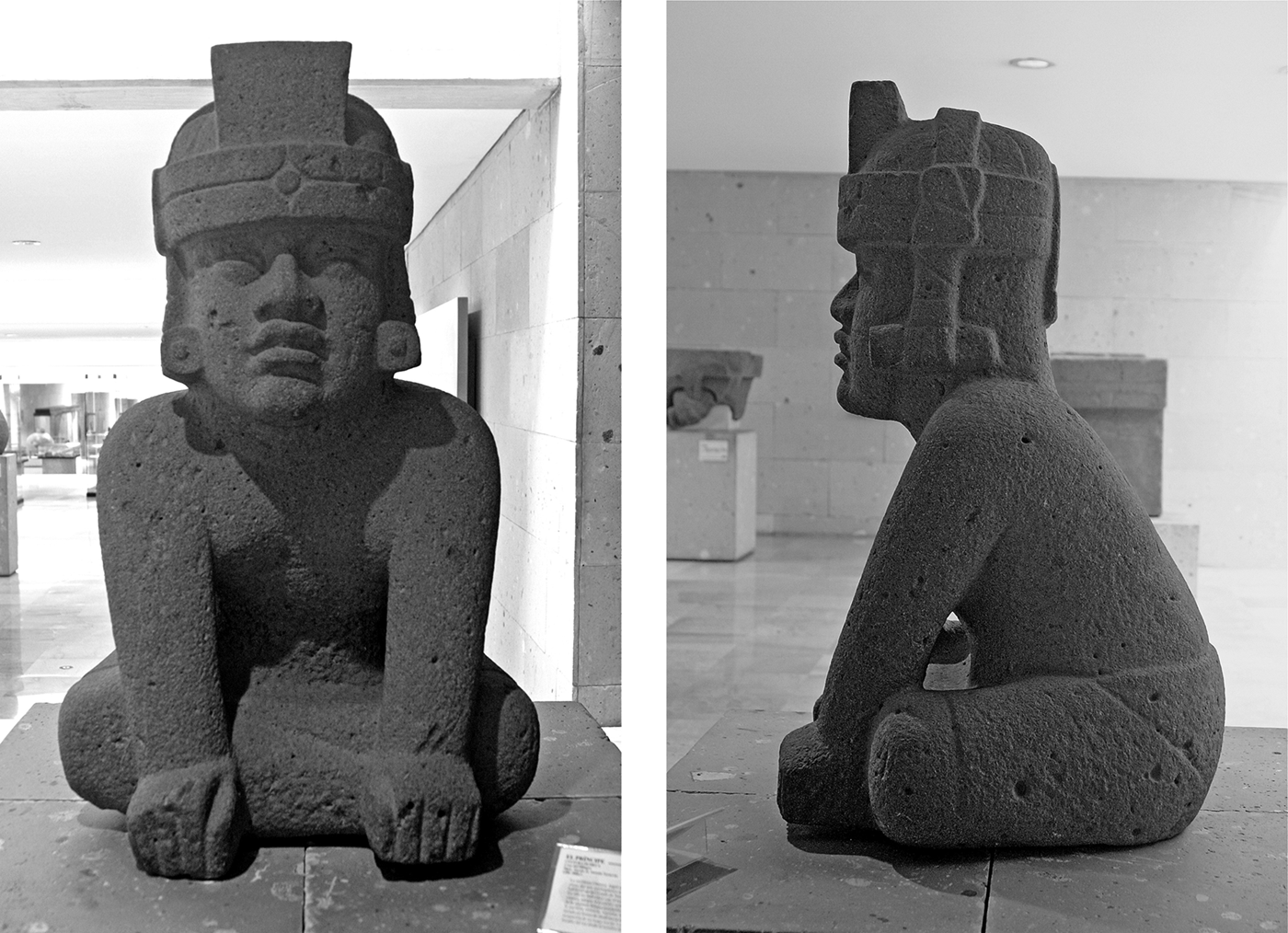
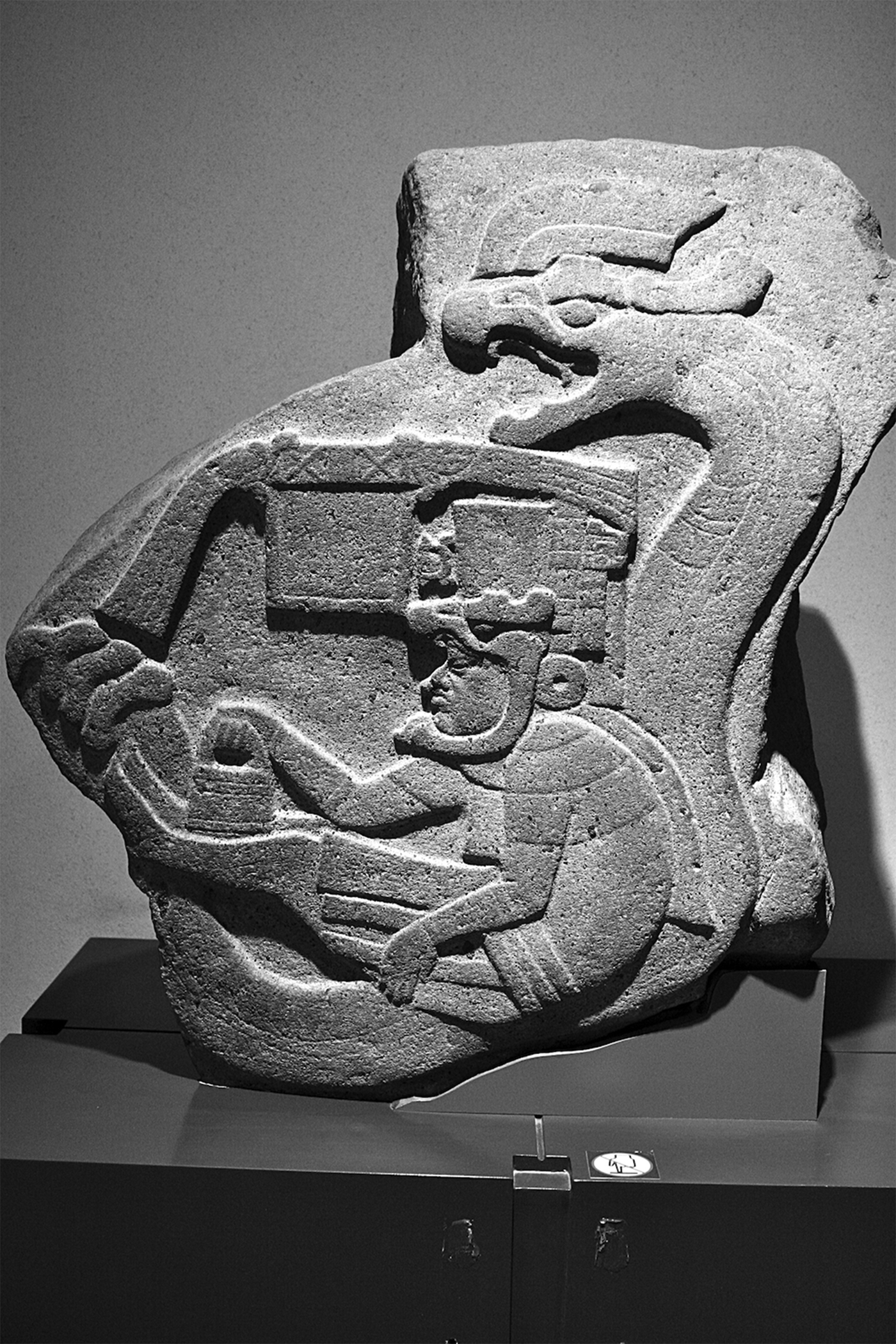
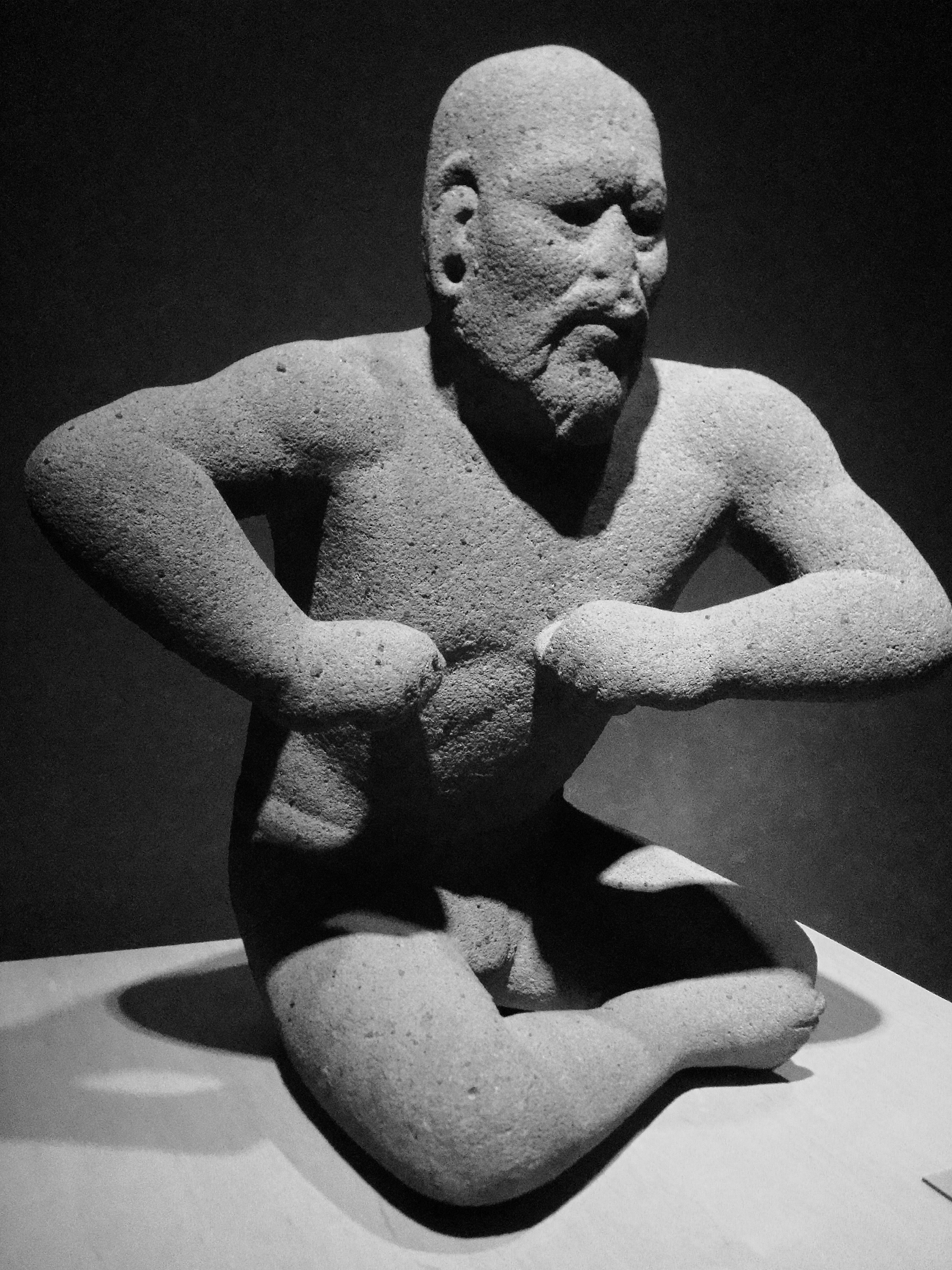
Portraiture preserves the memory of an individual through careful documentation of his or her features and identifying insignia. The colossal heads are the clearest examples of Preclassic portraiture, but the presence of insignia worn by other sculpted individuals likely indicates that the heads are not the only records of historical personages (Fuente Reference Fuente1977:89; Grove Reference Grove1973:130, Reference Grove and Benson1981:61; Stirling Reference Stirling1955:20). Many Olmec monuments take the form of human figures, sculpted in the round or carved in relief on altar thrones and stelae, with naturalistic, sensitively modeled features and wearing unique headdresses with recognizable insignia (Fuente Reference Fuente and Benson1981; Grove Reference Grove and Benson1981:65–66). Examples include the Príncipe from Cruz del Milagro, Loma del Zapote Monument 12, the human figure on La Venta Monument 19, and the majority of individuals appearing on altar thrones and stelae (Figures 2–4). The insignia worn by these figures vary widely, and scholars have observed that they probably relate to the individual's name, dynastic ties, and/or rank (Coe Reference Coe and Adams1977:186; Grove Reference Grove1973:130, Reference Grove and Benson1981:65). Therefore, even individuals who appear more generalized or idealized in appearance may have been recognizable to informed Olmec viewers. It is also possible that figures sculpted with a high level of detailed naturalism and individuality, such as the so-called “Wrestler,” may have been recognizable without accompanying insignia (Figure 5). Alternatively, this sculpture and others similarly devoid of insignia may have been adorned with ephemeral costume elements (such as clothing or jewelry) that could have identified them as specific individuals. Indeed, this seems probable in the case of the Wrestler, whose ears have carefully sculpted holes through which ear ornaments could have been threaded or affixed. As de la Fuente (Reference Fuente and Clark1994:220) has observed, the Olmec tradition of portraiture appears more concerned with the representation of power and authority, expressed through recognizable cultural symbols, than with the nuances of an individual's expressions or physiognomy that might be used to create a psychological portrait of the person represented.
El Príncipe from Cruz del Milagro. Photographs by the author.
Loma del Zapote Monument 12. Photograph by the author.
La Venta Monument 19. Photograph by the author.
The Wrestler. Photograph by the author.
Many of these individuals interact with each other and with a variety of supernatural beings in scenes formed by sculptural groupings, such as the four figures from El Azuzul, and in relief carvings decorating the surfaces of stelae and altar thrones. These scenes of interaction most likely commemorate specific events in the Olmec past, either distant or recent. The events recorded, however, need not have actually taken place, nor must they be limited to events occurring within the human realm.
Pre- and post-Conquest documents demonstrate the widespread Mesoamerican propensity to seamlessly blend history and myth into a single narrative (Boone Reference Boone2000:13–20). Preserved textual examples range widely in their geographical origins, from the Yucatec Mayan codices—specifically the Dresden and Madrid codices (Vail and Hernández Reference Vail and Hernández2011)—to the highland K'iche’ Maya Popol Vuh (Tedlock Reference Tedlock1996), the central Mexican codices (Boone Reference Boone2000), and Colonial period narratives, such as the Historia Tolteca-Chichimeca (Leibsohn Reference Leibsohn2009). Within these texts, gods, heroes, animals, and historical personages all intermingle, and the mythic time of creation merges with events in the human time of recordable history. These documents are among the latest in the long-standing tradition of Mesoamerican historical narratives—presented via carved lintels, painted murals, and screen-fold books—that combined events of the visible and invisible, human and supernatural worlds.
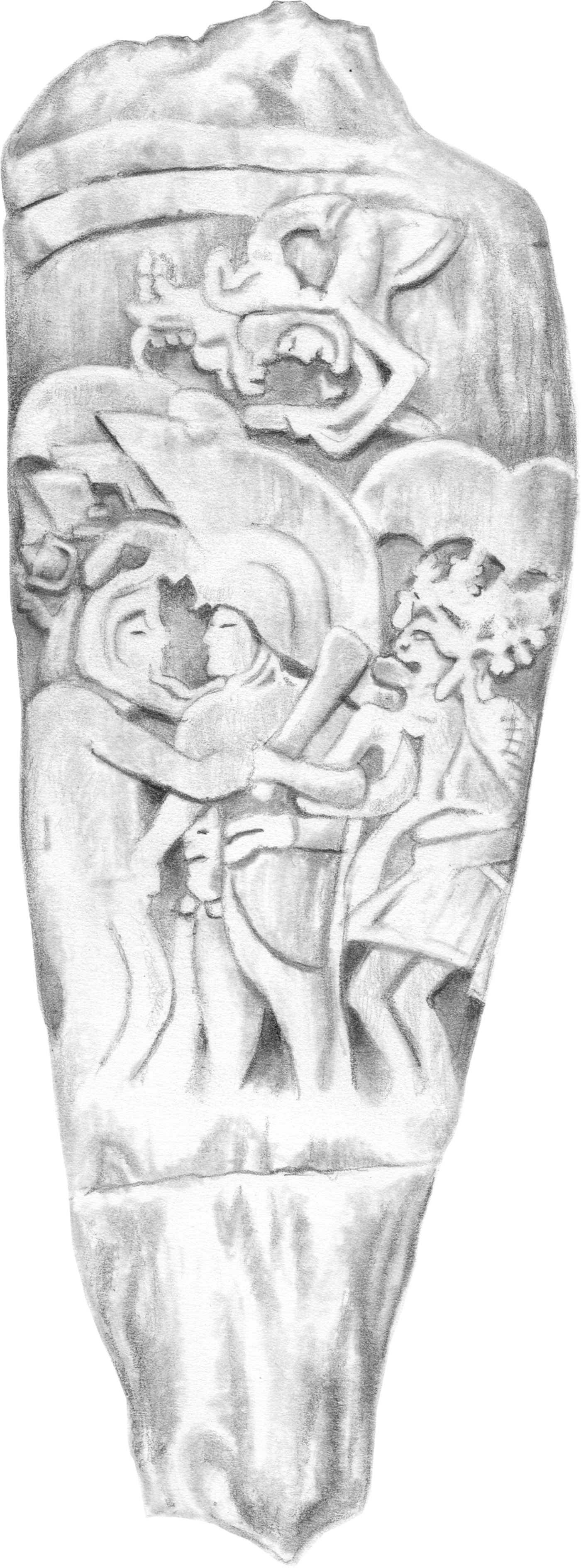
Documentation of purely human interaction in Mesoamerica also shows evidence of modification and redaction to suit the propagandistic whims of the ruling elite. Examples include the manufacturing of specific ritual events on the lintels of Yaxchilan and the almost total rewriting of history by the Aztecs after their ruler, Iztcoatl, ordered the burning of all the earlier codices created in the Basin of Mexico (Clark and Colman Reference Clark and Colman2008:93; Marcus Reference Marcus1992:146–149; O'Neil Reference O'Neil2005, Reference O'Neil2011:250). Events depicted on Olmec stelae and other monuments need not have actually taken place or even be limited to the involvement of human characters to be conceived of by their audience as historical and incorporated into the collective memory. For example, the interaction on La Venta Stela 5 occurs between two human males, a third figure who appears supernatural, and a fourth figure, human in appearance, emerging from the celestial realm (probably an ancestor) (Figure 6). Such a scene may very well have been part of the historical past for the people of La Venta, despite incorporating elements that are clearly supernatural.
La Venta Stela 5. Drawing by Randall Felker.
Considerations of sculptural iconography provide the most immediate evidence for the subjects of public commemoration by Olmec societies—specifically the lives, status, and actions of individual elites. The homocentric nature of Olmec art indicates that its primary use was to represent the world of humans and the social realms through which they moved. Portraits of elite individuals commemorated elements of their identity by means of costume and insignia. These insignia could have encoded personal names and ranks as well as dynastic, religious, and/or political affiliations or even the territories they governed. Portraits served to reify authority and status. They also may also have gone beyond simple representations to actually manifest the presence of the person represented.
Houston and Stuart (Reference Houston and Stuart1998) have documented the ontological overlap between rulers and their portrait images among the Maya. It is possible that the Olmec also conflated the personhood of the individual with the essence of their representation, if not in the exact manner expressed by the Maya then via the principle of distributed personhood, which marks many traditions of portraiture worldwide (Gell Reference Gell1998). Through the mechanism of distributed personhood, an individual may extend themselves and their influence beyond the bounds of their physical body by way of object mediators (Gell Reference Gell1998; Hoskins Reference Hoskins, Tilley, Keane, Küchler, Rowlands and Spyer2006). Olmec monuments would likely have commemorated the individuals represented, not just by calling attention to their existence in the past, but also by manifesting their personhood in the present, thereby metaphysically linking the two.
The sculptures of the Olmec elite would also have served to index the components of labor and ritual required for the production and display of the works. The latter would have included the quarrying, sculpting, transport, erection, and dedication of each sculpture—activities carried out by various cross-sections of the Olmec populace. These activities would have worked to connect the social and individual memories of these experiences with the person(s) represented, their power, and their position within the social realm. The subjects of commemoration and remembrance would therefore not only have been comprised of people and events but also of social structures and the individual's place within them.
An examination of the iconography of Olmec monuments suggests that many, though probably not all, Olmec sculptural works were erected to commemorate specific individuals and events from the myth-histories of various Olmec communities. Iconography, however, can do little to elucidate the actual practices and processes of commemoration as a part of social life and interaction. These practices undoubtedly included the transformation and erasure of memory, in addition to its generation and preservation. The subjects and attendant imagery of Olmec sculptures only indicate what was commemorated at the time of carving or recarving, not how that memory changed over time. Cyphers (Reference Cyphers1992a) has observed that stone sculptures could have been repeatedly configured and reconfigured into different groupings that would have shifted the significance of any single work based on changes in context and association. This suggests that the subject of commemoration for any given monument would be open to transformation based on context, rather than being inherent to the work itself.
The iconographic approach is also insufficient when approaching the fragmentary or idiosyncratic forms found in the Olmec corpus. Mutilation or destruction frequently obscures the original subject of these works. Others may be difficult to decipher due to a lack of cultural information that would allow us to interpret their iconography. It is possible that Preclassic cultures attached monumental associations to objects that would diverge significantly from our etic expectations of appropriate form and subject matter. Archaeological context is therefore of the utmost importance in allowing us to identify commemorative monuments and to analyze their role in these diverse and diachronically shifting processes.
THE CONTEXT OF MONUMENTS
The praxis of memory making and remaking often combines tangible practices of recording through the creation of mnemonic objects or written documents with more ephemeral, “incorporated” practices, which focus on the corporeal and immaterial performances linked to individual and collective remembering (Connerton Reference Connerton1989:72–73). For this reason, the settings of monuments are often also the sites of rituals and other social activities intended to reinforce the messages and memories evoked by the monument itself. Material traces left in the archaeological record allow us to detect certain actions occurring around and in conjunction with the space of Olmec monuments (Alcock Reference Alcock2002; Gillespie Reference Gillespie2010:401–403; Joyce Reference Joyce, Mills and Walker2008; Joyce and Lopiparo Reference Joyce and Lopiparo2005; Rowlands Reference Rowlands1993; Schawke and Iannone 2010:332; Van Dyke and Alcock Reference Van Dyke and Alcock2003). These traces may indicate which monuments were set in sacred or politically significant spaces, which monuments were purposely removed from the task of memory making through processes of destruction or effacement, and which monuments were remade or reused in order to transform the shared recollection of a group.
To illustrate these points further I have selected four stone sculptures to serve as case studies of how archaeological context may inform our understanding of the memory work undertaken by Olmec communities. Monument 61 from San Lorenzo Tenochtitlan and Monument 23 from La Venta are examples of sculptural works erected in the urban spaces of primary centers, while Monument 5 from Loma del Zapote was excavated from a second-tier site. Monument 1 from San Martín Pajapan is an example of a sculpture erected at a site of pilgrimage. Within their archaeological contexts, each of these monuments may be read as an effort to engage directly with and influence viewers' recollections of the past. Some of this analysis is necessarily speculative. I believe, however, that studies of context, when combined with cross-cultural comparisons of monument use and the theories of social memory, may elucidate the Olmec praxes of collective remembering and forgetting.
Loma del Zapote Monument 5 and La Venta Monument 23
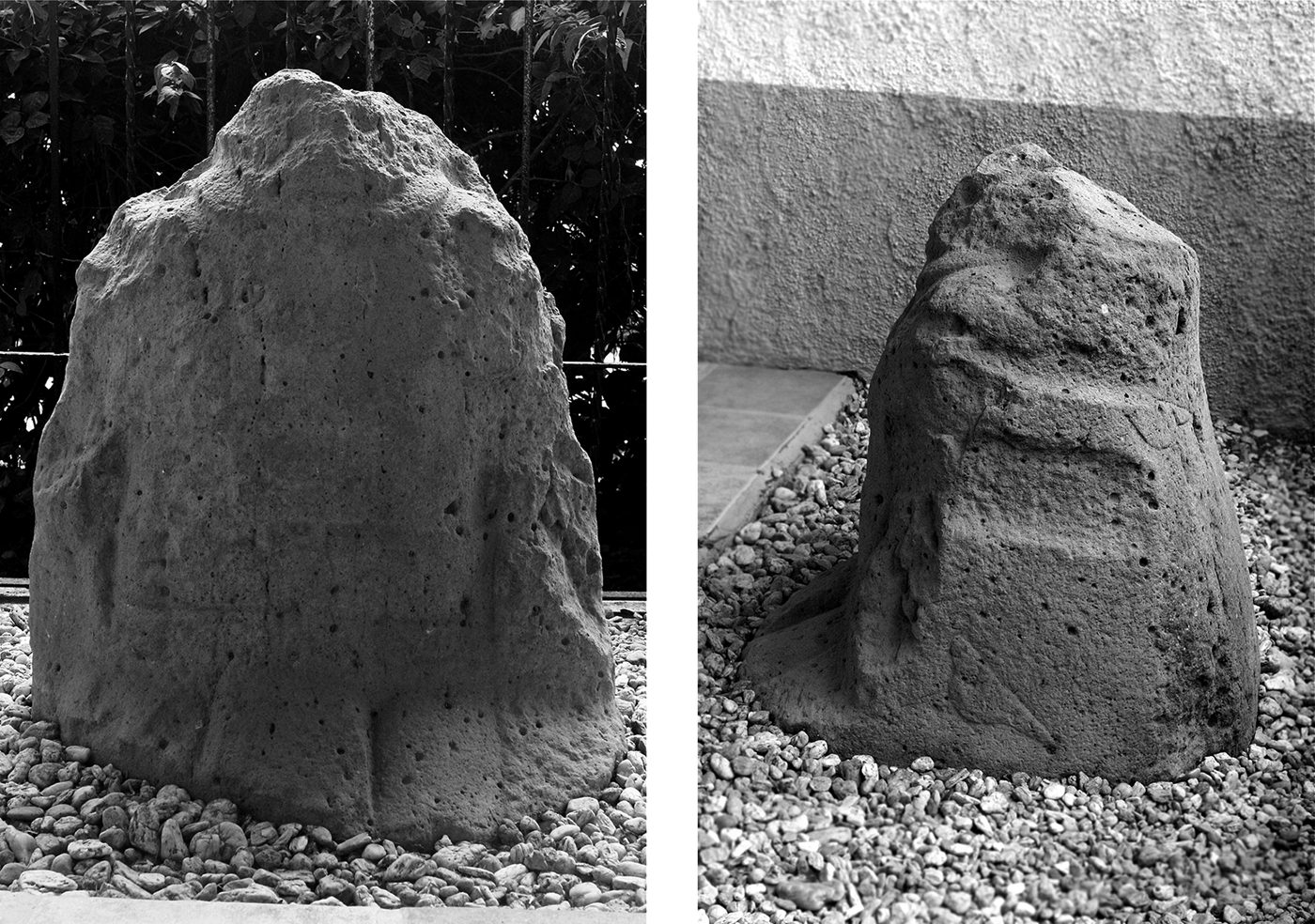
Monument 5 from Loma del Zapote was discovered by the Proyecto Arqueológico San Lorenzo Tenochtitlan (SLTAP) during the excavations conducted between 1990 and 1992 (Cyphers Reference Cyphers1992b) (Figure 7). The monument was encountered where it had been reset upon a cruciform bentonite pavement after undergoing extreme erasure and breakage. Once commemorating an Olmec lord—represented seated or kneeling and adorned with cape, belt, and pectoral—the legs, arms, and head of the figure were removed before it was reset on the eastern edge of the pavement, facing west. The surface upon which it sat was placed over another pavement, with two secondary burials sandwiched in between. One of these burials had been disturbed by a later intrusion, while the other was undisturbed (Cyphers Reference Cyphers, Grove and Joyce1999:173). These two burials were deposited without accompanying grave goods, perhaps suggesting that they were sacrificial victims; however, ceramics and jade beads were discovered where they had been placed around the sculpture. Investigation of monument's context showed that it had received offerings over an extended period of time (Cyphers Reference Cyphers1992b:51–52, Reference Cyphers1997:191, Reference Cyphers, Grove and Joyce1999:173–74, Reference Cyphers2004a:243–44). These offerings provide evidence of the otherwise ephemeral activities that marked interaction between the human viewers and the stone monument.
Loma del Zapote Monument 5. Photographs by the author.
The archaeological record in this case allows us to recognize the ritual reuse of a monument after its mutilation almost to the point of destruction. All evidence of the person represented has been erased, including possible identifying insignias removed by hammering (Cyphers Reference Cyphers1992b:52, Reference Cyphers2004a:244). The reconfiguration of the monument to remove all signs of the individual, while simultaneously remaking it to mark a ritual site of interment and offering, most likely signifies changes in the site's mnemonic narrative.
Reuse of monuments usually suggests that one existing version of the past is transformed or erased to be replaced with someone else's preferred account. Alternatively, such reuse can be a way to allow monuments to remain relevant after more gradual social processes have made one version of the historical narrative irrelevant or obsolete. In the case of Monument 5, however, the extreme mutilation sans recarving suggests that the process of remaking the past in this instance was due to more immediate and volatile processes. The individual commemorated by the original form of Monument 5 has been overtly obliterated, and what remains is the evidence of that destruction, perhaps marking a point of extreme sociopolitical upheaval that necessitated the reconfiguration of the social memory embodied by the sculpted figure.
Effacement and erasure are integral to the processes of forgetting that must take place if the social memory is to be remade. As cognitive studies have shown, forgetting is a key element in memory formation (Joyce Reference Joyce, Van Dyke and Alcock2003:107). In order to form clear, meaningful memories, disparities and details must be forgotten or minimized. Additionally, Elsner (Reference Elsner, Nelson and Olin2003:210) has observed that monuments that are preserved or displayed postmutilation signal the point of divergence between two historical directions: the past that was marked by the monument premutilation and the new or altered state of the social memory after damage or effacement has taken place. Displaying the mutilated image of a person previously commemorated may therefore serve to “preserve the memory of the condemned in the very act of obliteration” through the material evidence of their absence (Elsner Reference Elsner, Nelson and Olin2003:211).
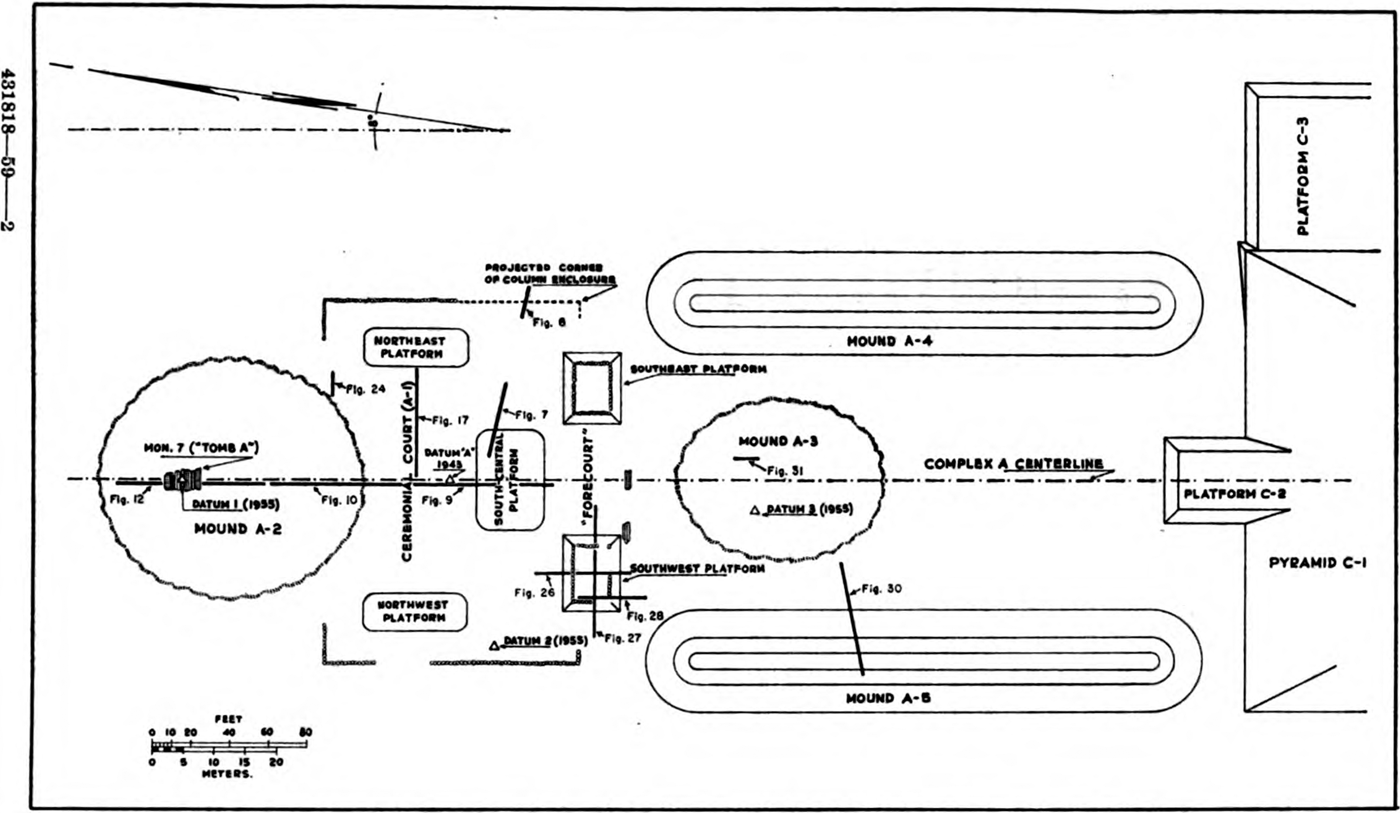
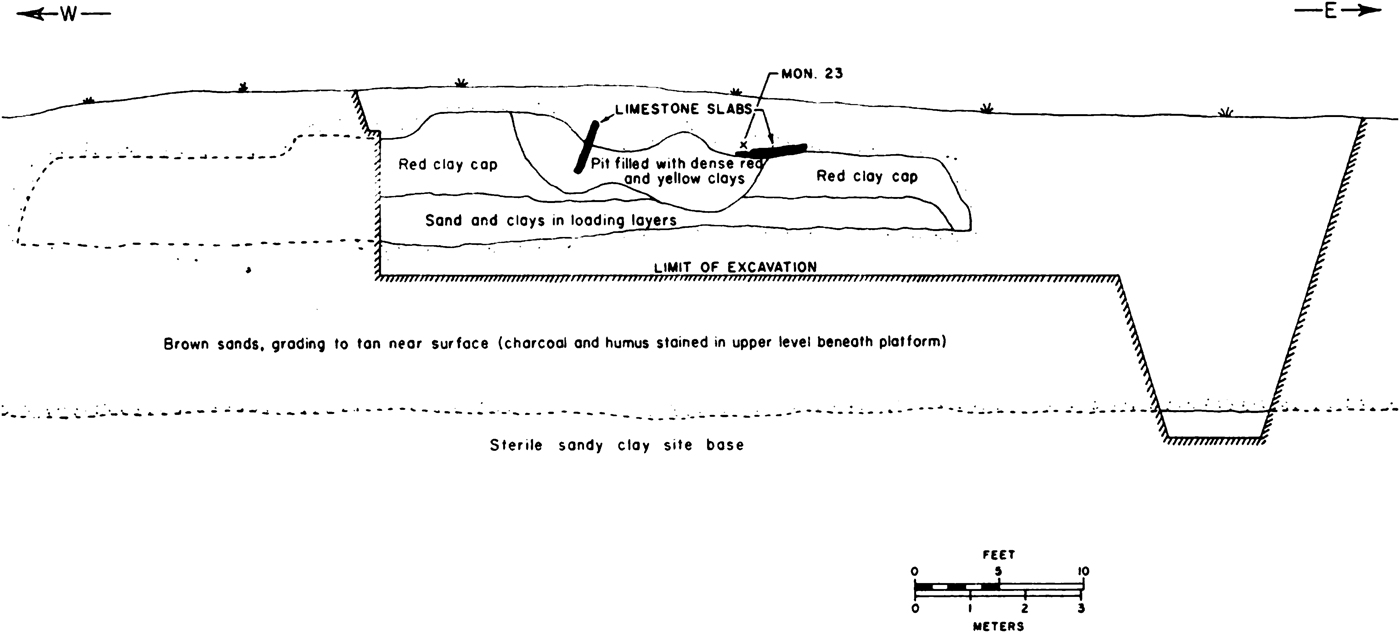
Another example of monument resetting comes from La Venta's Complex A, where Monument 23 was erected, postmutilation, on the lower western terrace of Mound A-5 (Figures 8–9). This mound was once a long, low platform, possibly with rounded ends, which had two terraces stepping down from the upper surface of the structure. The monument was found placed atop a pavement consisting of unworked, water-worn limestone slabs. Its setting can be roughly dated to the site's Phase IV, but the monument's original carving may have taken place long before (Drucker et al. Reference Drucker, Heizer and Squier1959:109–111).
La Venta Complex A map (Drucker et al. Reference Drucker, Heizer and Squier1959:9).
La Venta Complex A, Mound A-5, profile of east-west trench (Drucker et al. Reference Drucker, Heizer and Squier1959:110).
Mound A-5 was one of two parallel terraced constructions located within the southern part of Complex A, between the ceremonial court and the C-1 pyramid. The two parallel platforms (Mounds A-4 and A-5) delineated a second, southern court containing the A-3 platform and a series of offering deposits dating to Phase IV (Drucker et al. Reference Drucker, Heizer and Squier1959:126). Complex A in its entirety is believed to have been an area of restricted elite access, possibly under the direction of two or more distinct corporate groupings (Gillespie Reference Gillespie, Mills and Walker2008; González-Lauck Reference González-Lauck, Benson and Fuente1996:76).
Like Monument 5 from Loma del Zapote, Monument 23 once represented a seated Olmec lord (Figures 10–11). Yet, at some point the sculpture underwent extreme mutilation, resulting in the removal of the head and arms, along with the right foot. The elaborate ornamentation marking the power and influence of the individual once represented, however, was left intact. These ornaments include an elaborate pleated belt with a rectangular plaque or buckle, as well as a multistrand collar from which is suspended a concave oval mirror.
La Venta Monument 23. Photograph by Robert Heizer. © Smithsonian Institute, National Anthropological Archives and Human Studies Film Archives.
La Venta Monument 23 as discovered in situ on a pavement of limestone slabs. Photograph by Robert Heizer. © Smithsonian Institute, National Anthropological Archives and Human Studies Film Archives.
Given the erosion of the sculptural breaks, along with the lack of associated stone fragments, it seems likely that LV-23 was set in its final location only after undergoing severe breakage. The removal of the head and limbs and concurrent retention of costume elements is analogous to the treatment of Loma del Zapote's Monument 5. Clearly the monument was able to retain a significant level of social importance despite its mutilation, although its original meanings and associations were most likely reconfigured, reoriented, or redacted postmutilation.
For both Monuments 5 and 23, the mutilation of the monument did not preclude its resetting but, rather, served to transform the memory of the individual once represented into a more general image of shifting power relationships. In each case the ornamentation indicating elite status was left intact, even as the most individualized and emotive parts of the body (head and arms) were removed. The memory mediated by these images was thereby transfigured from the authority and presence of the individual to the events and persons responsible for their removal from power. Additionally, the spaces of resetting were clearly ritual in nature, incorporating both burials and offerings. Presumably, the reconfiguration of power would have also involved performances and ceremonies that complemented the social messages conveyed by the newly remade monuments.
Many Gulf Olmec monuments demonstrate similar efforts to rewrite the past through the removal of individuals and insignia that may represent shifts in the political landscapes of the Preclassic period (for example, San Lorenzo Monuments 14, 53, and 56; La Venta Monument 57 and Altar 4). As Clark (Reference Clark1997:222) has suggested, the frequent recurrence of monument mutilation and resetting among the Olmec may stem from factional competition and could indicate continuous competition for influence at the highest levels of Olmec governance. The recarving or recycling of stone sculptures would have corresponded with a more ephemeral removal from or transformation within official versions of the past. It should be noted, however, that public forgetting may be and often is accompanied by the silent memories maintained by marginalized agents as acts of resistance (Alcock Reference Alcock2002:16; Cattell and Climo Reference Cattell, Climo, Climo and Cattell2002:28–30).
San Lorenzo Monument 61
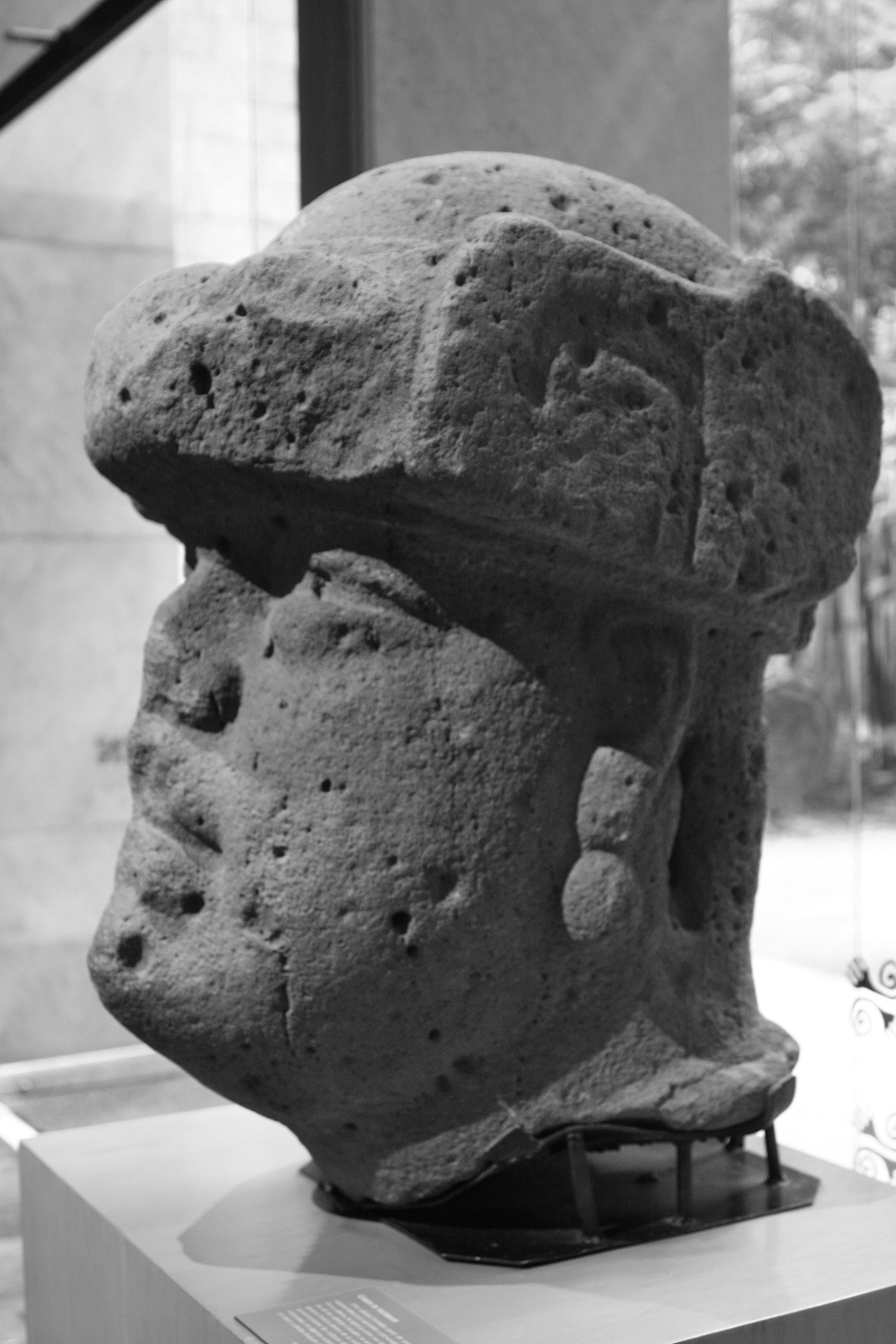
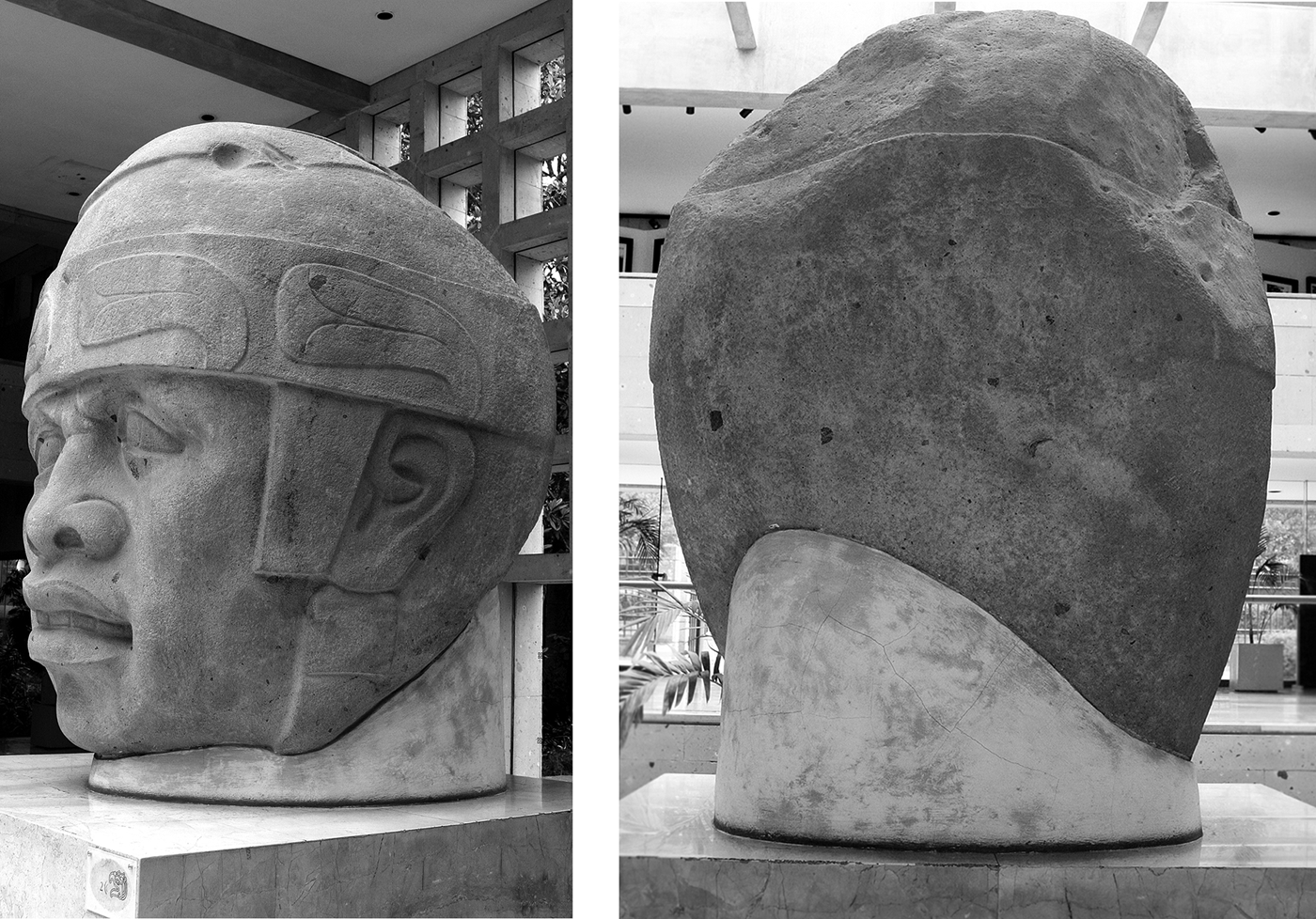
Monument 61 from the nearby San Lorenzo also suggests reuse of the sculpture but in a manner entirely divergent from Loma del Zapote Monument 5 and La Venta Monument 23 (Figure 12). The eighth colossal head from the site of San Lorenzo, Monument 61 was first discovered during the magnetometer surveys conducted by Brüggeman and Hers (Reference Brüggemann and Hers1970). Although originally believed to have been buried in a large pit, more recent analysis by Cyphers has revealed that the head was actually interred within the fill of Group E's eastern mound and covered with a red sand floor (for image see Cyphers and Di Castro Reference Cyphers, Di Castro, Fash and Luján2009:31; see also Cyphers et al. Reference Cyphers, Hernández-Portilla, Varela-Gómez, Grégoz-López, Lucero and Fash2006:25; Cyphers and Di Castro Reference Cyphers, Di Castro, Fash and Luján2009:33). This mound, along with the group's northern and southern platforms, defines and encloses a sunken patio. Within Group E a number of other sculptures (including Monuments 9, 14, and 52) were discovered, in addition to the remains of a well and part of a drainline, which formed a subfloor aqueduct (Coe and Diehl Reference Coe and Diehl1980:118–124; Cyphers Reference Cyphers, Grove and Joyce1999:161–162; Cyphers and Di Castro Reference Cyphers, Di Castro, Fash and Luján2009:33).
San Lorenzo Monument 61 (Head 8). Photographs by the author.
Archaeological explorations of Group E have revealed two phases of construction, the first marked by a red sand construction surface and the second by a yellow clay surface. Dating of the group has placed its period of use between 1150 and 850 b.c. (Cyphers and Di Castro Reference Cyphers, Di Castro, Fash and Luján2009:31). Material remains of ritual practices have led Cyphers and colleagues (Reference Cyphers, Hernández-Portilla, Varela-Gómez, Grégoz-López, Lucero and Fash2006:26) to propose that this space was primarily dedicated to elite ritual practices and that it was associated with “notions of sovereignty, ancestry, water, and the underworld.” The restricted access and limited space of Group E also suggests that the corporate activities taking place there, including the processes of memory work, were conducted by a small fraction of the site's total population.
In this context, Monument 61 is transformed into an invisible presence in the site's collective memory. It continues to have significance only if the memory of its presence within Group E's eastern mound is continuously maintained. The invisible presence works as a powerful mnemonic device because the threat of forgetting is stronger and the practices of remembering to counter that threat must be that much more potent. The performance of object deposition forms an important ephemeral, embodied component within the praxis of social memory, as the recollection of the location, form, and significance of the object is maintained over time (Mills Reference Mills, Mills and Walker2008; Pollard Reference Pollard, Mills and Walker2008; Schwake and Iannone Reference Schwake and Iannone2010). Additionally, the memory of the act of deposition itself may prompt “a recalling of the histories and connections of the things deployed and of the places where these performances happened” (Pollard Reference Pollard, Mills and Walker2008:58). The concealment of stone sculptures and ritual objects within the spaces and structures of Olmec sites could have functioned as a part of the millieux de memoire, hidden yet present, where Preclassic communities could engage with the events and personages of the past.
Although the sculptural quality is high, portions of Head 8 are missing or deformed due to the irregular outline of the boulder from which it was carved. Unlike the other heads from the San Lorenzo plateau, Cyphers (Reference Cyphers, Grove and Joyce1999:163, Reference Cyphers2004a:127) believes that this one was not recarved from an altar throne, but was instead sculpted from a basalt boulder resulting in the irregular form. In this respect, Head 8 is unique among all the known Olmec colossal heads, and it may be that this singularity was the cause of, or related to, its deposition within the Group E platform mound. It seems probable that this unique and sensitive portrait of an ancestral ruler was on display for a period of time before its interment, allowing it to accrue significance as it was viewed and/or interacted with during rituals of remembrance, perhaps relating to dynastic history. Therefore, its placement within the mound likely constitutes a resetting.
The monument was not mutilated nor destroyed before its interment, but rather carefully covered with a red sand floor. The placement of the ruler portrait within the eastern platform structure would have added significance, perhaps even sanctity, to the ceremonial and possibly governmental proceedings taking place in Group E. Yet, in order for it to continually activate the space with the history of the ancestral past it reified, the memory of the monument's location had to be maintained through ephemeral practices of remembering. Thus, the physical reification of the past could be transformed into a powerful generator of embodied memory work through its invisible, yet potent presence.
While only one other stone sculpture has been located in a context similar to that of Monument 61—interred whole within a platform's interior (San Lorenzo Monument 112)—the concept of the invisible presence in the Early Preclassic may have been extended to the Middle Preclassic ritual deposition of offerings below the floors of La Venta's Complex A (Cyphers Reference Cyphers2004b) (Figure 8). These offering caches, interred below the court surfaces and platform structures, may have been comparable to San Lorenzo's Monument 61 in their ability to activate the collective memory of past rituals and related historical narratives on the part of the elites who engaged with La Venta's ceremonial complex. Gillespie (Reference Gillespie, Mills and Walker2008:132) has suggested that these elites “performed their history” within La Venta's ceremonial complex by employing offering deposition as a strategy to index their identities, in part by asserting dynastic and ancestral ties. Likewise, the interment of monuments within elite architectural settings could have been a way to performatively embed the space with the history of a ruling lineage.
The offerings interred within La Venta's Complex A provide evidence for the continuity of ritual practices involving the concealment of objects and artworks within architectural spaces. It should be noted, however, that the interment of a colossal head—portrait and embodiment of an elite individual—is not entirely comparable with the deposition of either large-scale or portable offerings of the sort interred below the surfaces of La Venta's Complex A. Because portrait images are ontologically tied to the person they portray, the very nature of the colossal head is distinct from offerings of serpentine bricks, mirrors, celts, figurines, and the like. The social life and function of the monument prior to its interment would also have differed greatly from such objects as were included in the La Venta offerings, having been designed for large-scale public display and commemoration. It may be that, given the overlap between conceptions of personhood attributed to an individual and their portrait, the interment of Head 8 at San Lorenzo would conceptually parallel the later Maya practice of interring the bodies of the dead (as well as their sculptural surrogates in the form of commemorative monuments) into residential and ritual architecture (Gillespie Reference Gillespie2010:405; Just Reference Just2005:70–71).
The deposition of bodies or objects necessarily transforms the subject and process of remembering. Rowlands (Reference Rowlands1993:146–147) has observed that deposition transforms the interred into an objectified memory. The interment of Head 8 at San Lorenzo would have transfigured it from a portrait of an individual, an aide-mémoire functioning to visibly manifest the presence or personhood of a past ruler into an embodiment of memory that becomes a part of the milieu of ritual and remembrance. The memory it thereby evokes is as much one of ancestral presence in the present as it is of the historical events and people of the past.
San Martín Pajapan Monument 1
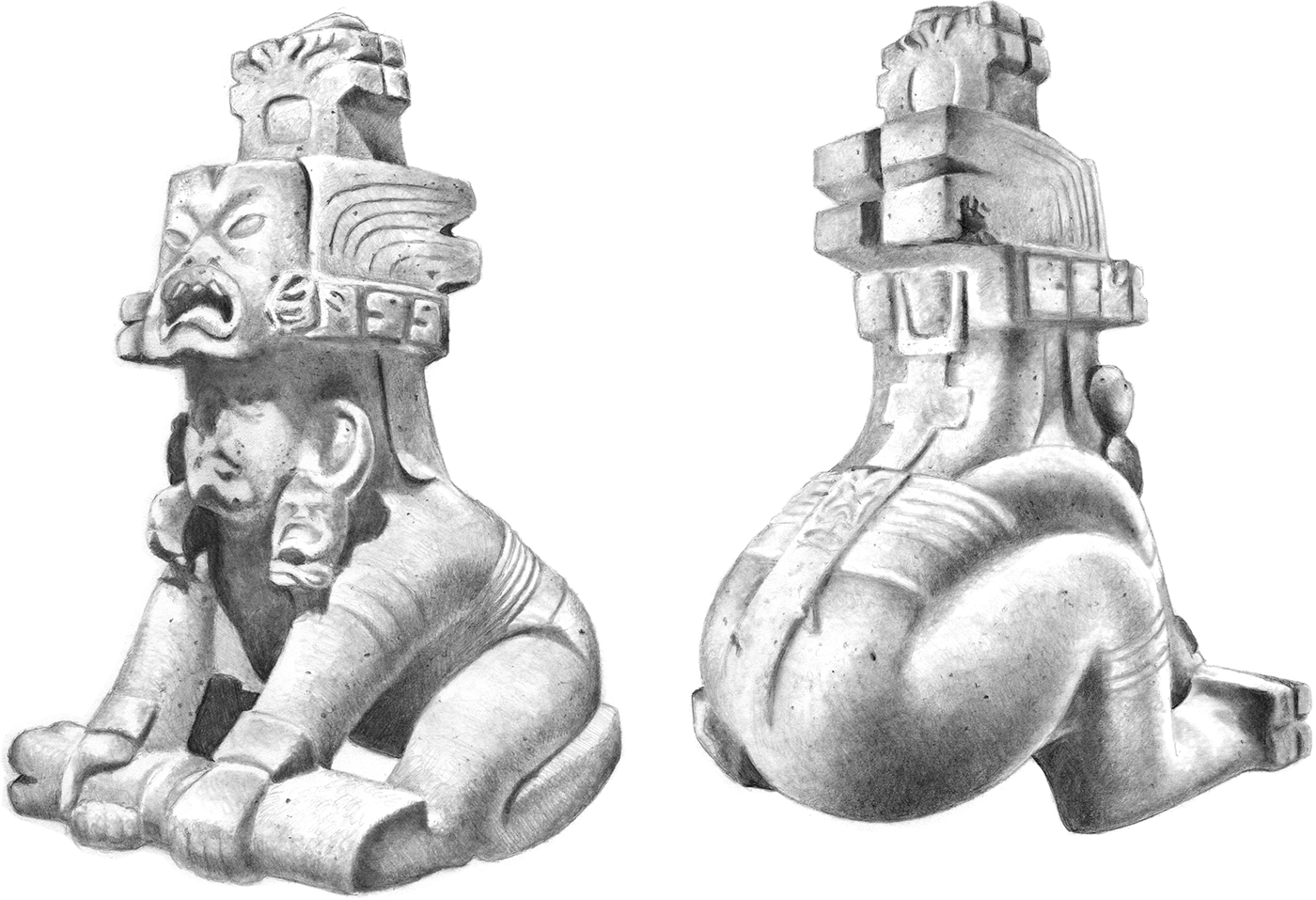
While all three of the monuments discussed above (Loma del Zapote Monument 5, La Venta Monument 23, and Monument 61 from San Lorenzo) were located in primary or major secondary centers, their contexts at the time of excavation indicate that they were situated in areas of limited access within those sites. The intended audience would likely have been an elite fraction of the centers’ populations. Yet, the viewing of each of these took place within the hearts of urban locations, physically, if not ideologically, near many. The last case study considers a significantly different viewing environment within the social context of pilgrimage: that of the stone monument discovered at the volcanic peak of San Martín Pajapan in the southern tail of the Tuxtla Mountains (Figure 13). Due to its distant location, the sculpture in this context would have evoked memories of more recent travel to distant places, as well as recollections of the past.
San Martín Pajapan Monument 1. Drawings by Randall Felker.
Archaeological evidence recovered at the time of its removal suggests that Monument 1 from San Martín Pajapan served as a site of pilgrimage and ritual for centuries, beginning in the Middle Preclassic period (Medellín Zeñil Reference Medellín Zeñil1968:10–12). The sculpture sat atop a platform of small stones covered with a layer of red clay, situated within the saddle of the San Martín Pajapan volcano (Blom and La Farge Reference Blom and Farge1926:46). Medellín Zeñil's excavations of the platform found offering remains dating to various periods in Mesoamerica's past accrued around the monument, demonstrating a sustained period of ritual activity at the site. Jade and jadeite beads, as well as a jadeite pectoral decorated with an incised face, were recovered from the Preclassic strata associated with the red clay surface of the platform (Medellín Zeñil Reference Medellín Zeñil1968:13). Ceramics dating from the Middle Preclassic through the Late Classic period were also encountered during the excavation of this structure (Medellín Zeñil Reference Medellín Zeñil1968:11–12). The deposition of both ceramic and lapidary materials allude to one prominent component of the ritual activities (i.e., the presentation of offerings) carried out by pilgrims over many centuries. Local populations later continued to venerate the sculpted figure as “El Señor de San Martín” or “el chaneque” up until the time of its removal in the 1960s (Medellín Zeñil Reference Medellín Zeñil1968:9–11).
The monument from San Martín Pajapan clearly represents a human figure dressed in ritual regalia, including a large headdress dominated by the face of the composite anthropomorph (Pohorilenko Reference Pohorilenko, Benson and Fuente1996:125). The face of this supernatural, probably a deity, is a motif repeated throughout the figure's regalia, appearing on the pectoral, ear ornaments, and the back of the loincloth where it intersects with the belt or torso wrapping (Medellín Zeñil Reference Medellín Zeñil1968). Such a costume would have fused aspects of the supernatural with the body of the person portrayed. As Clark (Reference Clark, DeMarrais, Gosden and Renfrew2004:215) has observed, “The costuming of late Olmec kings constituted a public claim to supernatural power and legitimacy. Kings were god impersonators and perhaps avatars.” The figure appears to commemorate the codified ceremonial activity of a human lord or ritualist—possibly while impersonating or embodying a deity—who holds a bar similar to the staffs or clubs held by figures on La Venta's Stelae 2, 3, and 5 (see, for example, Figure 6). Although it may seem strange to venerate the image of a human elite in a place of pilgrimage, it is possible the rulers who commissioned the work felt the message of human power over the supernatural was more efficacious for their political agenda.
San Martín Pajapan Monument 1 is stylistically most similar to stone sculptures located at the site of La Venta, particularly Monument 44 from that site. Although in a fragmentary state, La Venta Monument 44 is very nearly identical to the San Martín Pajapan sculpture in subject, dimensions, and even stone type (Clewlow Reference Clewlow1968:60, 87–89; Clewlow and Corson Reference Clewlow and Corson1968:175–177). These stylistic similarities, combined with the probable limitations of access to both the basalt and the sculptors who carved it (see Cyphers Reference Cyphers, Grove and Joyce1999) suggest that the commissioners of the monument were most likely the La Venta elite. This hypothesis is in keeping with the trends in La Venta elite representations (Clark Reference Clark, DeMarrais, Gosden and Renfrew2004:215) and with the material evidence discovered during the excavation of the platform (Medellín Zeñil Reference Medellín Zeñil1968:11–12). Yet, it is unclear whether the monument was originally commissioned for display in its place of discovery or whether it was moved there after a period of use within the bounds of La Venta itself.
The placement of this monument at a sacred site of pilgrimage would have reified the connection between these two sites, one sacred, the other a political center. The link between the two sites may have been intended to draw upon what Lefebvre (Reference Lefebvre and Smith1992:225) refers to as the play of substitutions “in which the religious and political realms symbolically and ceremonially exchange … the attributes of power.” By erecting a monument at the sacred site of the San Martín Pajapan volcano, La Venta's elite could reinforce their own claim to dominance. This effort would be in keeping with other evidence that La Venta was intentionally being modeled as a cosmic city (Clark Reference Clark, DeMarrais, Gosden and Renfrew2004:214). The choice to represent a human ritualist further emphasized the idea of an Olmec lord harnessing the sacred power of the place and transforming it into political authority. “Olmec kings at La Venta fused the regal and godly symbols of the preceding era into a unitary system and conveyed the message of divine kingship and they embodied this union in their own being” (Clark Reference Clark, DeMarrais, Gosden and Renfrew2004:215). The ability of the San Martín Pajapan monument to effect and reinforce this new form of authority, however, was predicated upon the process of pilgrimage to view the monument and the maintenance of the pilgrims’ memories after their journey.
The location of the San Martín Pajapan monument was approximately 85 km away from the site of La Venta via land routes (Marcus Reference Marcus1976:30), and travel to the monument would likely have been costly and time-consuming. The necessity of leaving the space of everyday habitation and journeying to the monument to view it would have been a significantly different experience from the ones associated with urban or even hinterland monuments. As Nelson and Olin (Reference Nelson, Olin, Nelson and Olin2003:6) have observed,
Travel to the monument, like all forms of pilgrimage, transforms the object and the beholder. The round trip, the full rite de passage as van Gennep analyzed it, remakes the memories of individuals and connects both object and beholder to larger social structures, thereby inculcating senses of personhood and history that society deems important.
Perhaps even more than the rituals and ceremonies associated with viewing urban monuments, travel to view the San Martín Pajapan monument would have fused the experiential memories of pilgrims with the social praxis and products of the collective memory. This fusion may have been reinforced by ritual practices carried out on both an individual and collective level, similar to pilgrimage rituals among contemporary Maya communities. The inaccessibility of the site would have also served to reinforce the sacred nature of the place and the ritual importance of the journey undertaken to reach it (Borgstede Reference Borgstede2010:388).
Taken together, the case studies of monument use and reuse outlined above demonstrate the vital and varied use of social memory as a tool for political maneuvering among Olmec social groups and elite individuals. This maneuvering took place in primary centers and hinterland outliers, sites of pilgrimage and public plazas. The spatial contexts of the monuments examined within these case studies indicate that many Olmec sculptures were placed in areas of limited access, suggesting that they were intended to mediate the collective memory of a specific faction of the population. These factions could have formed distinct memory communities whose corporate identities were partly predicated upon their shared access to certain mytho-historic narratives (Burke Reference Burke and Butler1989; Olick and Robbins Reference Olick and Robbins1998:122–126). Yet, the wider population may have had their own memories of these monuments constituted by their participation in the labor required to sculpt (or resculpt), transport, and erect these monuments in the spaces of the elite.
The contexts of Olmec monuments suggest that complex negotiations of the past and present were at work during the Early and Middle Preclassic periods. These negotiations involved practices of erasing, mutilating, and concealing as well as the juxtaposition of distant periods with places both near and far in the social memory of the present. Such manipulations indicate that Olmec commemorative practice was far from stable and contiguous but was rather dynamic and at times disparate among differing sectors of the populace.
CONCLUSIONS
Since the first years of their discovery, Olmec stone sculptures have been regularly referred to as monuments, often without discussion of the word's commemorative connotations or its applicability to specific Preclassic artworks. From an examination of the formal, iconographic, and contextual evidence, it seems probable that many Olmec stone sculptures did function as commemorative monuments. The widely noted properties of stylistic grandeur, including size, mass, volume, and proportional relations, would have combined with the material endurance of the stone to attach a sense of status, significance, and temporal continuity to the subjects they represented. Examination of sculptural imagery also reinforces the use of both three-dimensional sculptures-in-the-round and relief carvings to commemorate individuals and events from the myth-histories of the Olmec culture. Neither formal nor iconographic approaches alone are sufficient indicators of commemorative practices, but in combination with contextual evidence they can illuminate the strategies of memory making and remaking employed by Olmec artists on behalf of their elite patrons.
The contexts of Olmec monuments are far more informative when it comes to tracing the actual praxis of memory work taking place at Olmec sites. The case studies I have outlined here reveal the mutilation, reuse, resetting, and interment of and travel to Olmec monuments as recognizable practices involved in the generation, transformation, and erasure of social memory. This memory undoubtedly varied between communities, even within sites, with elites and commoners holding shared and separate narratives of the past that undoubtedly informed the construction of distinct corporate identities. Analysis of context also suggests that the memories mediated by Olmec monuments were not simply those of elite individuals and past events, but of political struggle and change, the metamorphosis of rulers into ancestors or divine beings, travel to sacred sites, and the physical merging of the past with the spaces of the present.
Because of the specialized and extensive manpower involved in the production of these monuments—including their sculpting and the costly, labor-intensive acquisition of materials—elite individuals likely controlled the practices of official commemoration and the construction of historical narratives inscribed in stone. Olmec lords also placed some of these monuments in areas of restricted access (Cyphers et al. Reference Cyphers, Hernández-Portilla, Varela-Gómez, Grégoz-López, Lucero and Fash2006:22; González-Lauck Reference González-Lauck, Benson and Fuente1996:78–79; Grove Reference Grove, Grove and Joyce1999:275), allowing for the use of specific monuments and the memories they embodied in the production and support of elite status and identity. Yet, these monuments most likely existed within a panoply of commemorative processes that would have involved more ephemeral and embodied practices of remembering. These may have included ritual or ceremonial feasting, performances (including dance, music, public speeches, and masking), and the dedication of offerings (Gillespie Reference Gillespie2010; Schwake and Iannone Reference Schwake and Iannone2010; Stockett Reference Stockett2010). Through the production of a multisensorial milieu of memory, embodied practices could have supported the creation and maintenance of competing or contradictory versions of the past, some existing outside the dominant narrative of the hegemonic elite.
Recent scholarship has seen a flourishing interest in the role social memory played throughout Mesoamerica. A discussion of the commemorative strategies of the Preclassic record becomes particularly important with this new attention to the pre-Hispanic processes of remembering because it allows us to trace the trajectory of memory work to the foundations of Mesoamerican civilizations. Olmec stone monuments and their associated contexts allow us to recognize some of the constructions and shifts in Preclassic mnemonic practices. While these are sometimes no more than minute traces in the fragmentary picture of the past, the information they provide may still give us insights into the continuities and disjunctions that were taking place in the lives and memories of Olmec populations.
RESUMEN
Desde los primeros años de su descubrimiento, esculturas de piedra olmecas han sido tradicionalmente llamadas “monumentos,” a menudo sin discusión de las connotaciones conmemorativas de la palabra o su aplicabilidad a obras específicas de arte preclásicas. Tras examinar las pruebas formales, iconográficas y contextuales, parece que muchas esculturas de piedra olmeca probablemente funcionaron como monumentos conmemorativos. La grandiosidad estilística de estas esculturas (una propiedad que se ha destacado a menudo) se refleja en su tamaño, masa, volumen y proporciones, que al combinarse con la perdurabilidad de la piedra confieren estatus, importancia y la idea de continuidad temporal de los sujetos que representan. Un examen de la imaginería escultórica también refuerza la idea de que tanto esculturas en bulto redondo como relieves se usaron para conmemorar individuos y eventos de las mito-historias de la cultura olmeca. Ni planteamientos formales ni iconográficos por sí solos son suficientes indicadores de prácticas conmemorativas, pero en combinación con evidencia contextual pueden iluminar las estrategias que los artistas olmecas emplearon en el proceso de hacer y rehacer la memoria en nombre de sus patrones de élite.
Los contextos de monumentos olmecas son mucho más informativos cuando se trata de rastrear la utilización real de la memoria llevada a cabo en centros olmecas. Estudios de caso de esculturas de piedra olmecas revelan que la mutilación, reutilización, restablecimiento, y entierro de monumentos olmecas son prácticos que se utilizaron comúnmente para generar, transformar y borrar memoria social. Sin duda, esta memoria varió entre comunidades, incluso dentro de los sitios, con las élites y los plebeyos manteniendo narrativas compartidas y separadas del pasado e informando la construcción de identidades corporativas. Debido a la mano de obra especializada involucrada en la producción de estos monumentos—tanto la ejecución propia de la escultura como la costosa adquisición de materiales—las élites probablemente controlaban las prácticas de conmemoración oficial y la construcción de narrativas históricas inscritas en piedra. Los nobles olmecas también colocaron algunos de estos monumentos en áreas de acceso restringido (Cyphers et al. Reference Cyphers, Hernández-Portilla, Varela-Gómez, Grégoz-López, Lucero and Fash2006:22; Grove Reference Grove, Grove and Joyce1999:275; González- Lauck Reference González-Lauck, Benson and Fuente1996:78 − 79), permitiendo el uso de monumentos específicos y sus narrativas mnemónicas en la producción y defensa de la identidad y estatus de la élite. Sin embargo, estos monumentos en su mayoría existieron dentro de una serie de procesos conmemorativos que habrían implicado más prácticas efímeras y que encarnarían prácticas de recuerdo. Estas prácticas podrían haber apoyado la creación y mantenimiento de versiones alternativas o contradictorias del pasado, independientes de la narrativa dominante de las élites hegemónicas.
ACKNOWLEDGEMENTS
I am grateful to many people who provided their insight and advice during the development of this article. Thanks to my advisor, Elizabeth Newsome, and to all of my dissertation committee members for their thoughtful comments on the subject of Olmec monuments. I owe especial thanks to Ann Cyphers for sharing her considerable knowledge and providing clear commentary for the development of this research. I am also indebted to John Clark and the two anonymous reviewers whose helpful suggestions contributed significantly to the development of this text. Natalia Donner and Christopher Pool gave important feedback within the context of the SAA session during which much of this material was first presented in 2009. Funding for research and travel was provided by the Visual Arts Department at the University of California, San Diego, and the Russell Foundation. The Dumbarton Oaks Research Library and Collection also generously provided support in the form of a short-term residency. Finally, thanks to my colleagues, Carmen Ripollés and Heather Graham, for their time and editing expertise, and to Shawn Mollenhauer for his support and assistance at every step of the process.