1 INTRODUCTION
In Andreï Tarkovsky’s famous 1979 film, the eponymous ‘stalker’ character gives voice to ambiguous thoughts about music: ‘Although [music] goes right to your soul ... if it has anything at all to do with life, it is mechanical, lacking ideas or associations’ (Tarkovsky 2006). One could argue that such a statement is not far from an enduring paradigm of electroacoustic and especially acousmaticFootnote 1 music, according to which composers have to consciously blur any and all connections to the actual sources of the sounds involved in their music – sounds, more often than not, gathered from everyday life. Although it is true that from early on in the history of electroacoustic music, composers such as Luc Ferrari, Michel Chion or Bernard Parmegiani strived to maintain a firm grip on reality through the transparent use of everyday sounds and spoken-voice recordings, Pierre Schaeffer himself, at the very dawn of what would soon be known as musique concrète, wrote in his journal entry of 15 April 1948: ‘All those sounds are identifiable. Hearing them conjures the thought of glass, bell, wood, gong, iron … This is pulling me away from music’. Four days later, he goes on to say that he has found a ‘crack in the enemy defences’ by removing the attack from a bell sound, feeling that pushing this connotative sound away from its own reality finally gives way to music: ‘could it be that at last, the advantage switches sides?’ (Schaeffer Reference Schaeffer1952: 14–15).
Of course, many years and trends have passed since those early experiments, and sonic referentiality has gradually earned a legitimate place in electroacoustic practice. Ferrari, Chion and Parmegiani are among the most notable early examples, but one also thinks of R. Murray Schafer and the soundscape movement that emerged in the late 1970s, which gave way to eloquent pieces of music entirely based on real-life sounds and clearly identifiable sonic environments – composers Barry Truax and Hildegard Westerkamp are noted examples in that field. Today, it is not uncommon to come across the works of field recordists such as Jana Winderen or Chris Watson in concerts or festivals dedicated to electroacoustic music. Moreover, many composers have been explicitly exploring the sonic territories comprised between soundscape and acousmatic music for many years now: Natasha Barrett, Francisco Lopez, Yves Daoust or BJ Nilsen are some of the names that come to mind.
In fact, as is the case with much of the work of the aforementioned composers, the electroacoustic repertoire contains a great number of pieces that are clearly based around elements of documentary natureFootnote 2 – although it is rarely stated as such by the composers themselves.Footnote 3 More specifically, one may think of works such as Hildegard Westerkamp’s Into India (Westerkamp 2002), John Young’s Ricordiamo Forli (Young 2007), French duet Kristoff K.Roll’s Corazón Road (Kristoff K.Roll 1999), Yves Daoust’s Ouverture (Daoust 2001) or more recently Jonty Harrison’s Going / Places (Harrison 2016). These are all pieces that, in their own way, find themselves at the frontier of electroacoustic music and audio reportage or documentary.
That being said, most works along these lines tend to document mostly the composer’s own experience of given places or events, which in turn, is meant to resound with the listener’s own experience or imagination.Footnote 4 Fewer works, on the other hand, seem to show a willingness to bring together imagination and factual information, in a way more closely related to documentary as it is known in the spheres of cinema, radio or photography. Interestingly, many other art forms, such as theatre, graphic novels and even video games, have shown a tendency in recent years to integrate more and more factual informative content,Footnote 5 including spoken descriptions and narrations, real-life audio and video recordings, archives and interviews – in short, any component that may serve to address a given real-life issue through fact and description, as opposed to documentary elements used within a primarily subjective or experience-based focus.
In acousmatic music in particular, the rarity of factual information might be explained as a remnant of Schaeffer’s days, when the main focus was to separate musique concrète from concrete sounds, and when occasional forays into the territory of Hörspiel and radio plays were considered as straying from the path of music – a fact famously demonstrated by Ferrari, who humorously tagged his own music as ‘anecdotique’. Nonetheless, considering that an important part of the raw materials used by acousmatic composers already comes from the sounds of reality, it does not seem too far stretched to think that factual documentary elements such as those mentioned above should also be able to cohabit with the more abstract sounds of acousmatic music, as they do with the specific constituents of other artistic mediums. As a matter of fact, although it is seldom in an attempt to inform the listener, spoken voice has been used prominently in acousmatic music as early as the 1950s, probably much more in proportion than in any other genre of music.
It is with such considerations in mind that we, both acousmatic composers first and foremost, undertook the composition of Archipel (2016), a 29-minute work that focuses on access to the waterfront in the city of Montréal, taking as its keystones both an exploration of the informative aspects of sound, as well as the inclusion of more factual documentary elements, such as interviews. This is the piece that will be discussed here in order to illustrate the compositional steps, implications and philosophy behind our use of the documentary approach in the context of acousmatic composition.
2 ARCHIPEL: ORIGINS, GOALS AND DIFFERENT FORMS OF THE PROJECT
2.1 Choice of the subject and documentary concerns
Aside from a common interest in the St Lawrence River and Québec’s relation with water, the choice to investigate urban access to water in Archipel was also motivated by the subject’s prominence in Montréal’s politics and public affairs in recent years. Like many of our fellow citizens, we have long been struck by the difficulty of accessing the waterfront from the more central areas of the island, where most of the population is concentrated. Despite this situation – or perhaps owing to it – access to the waterfront has become a hot topic in Montréal in recent years. As the city celebrated its 375th anniversary in 2017, many new projects and openings towards the river have been announced by the city authorities, most of which are regrouped under the city’s Water Plan.
Considering these circumstances, the subject of access to the waterfront in Montréal seemed to offer many documentary and musical assets. On the documentary side of things, the general interest towards the subject in recent years assured a pool of easily accessible experts and interviewees. Moreover, the topic is not restricted to the Montréal area, but has been a major issue in urban development all over the world in the previous decades (examples such as Barcelona or Hamburg come to mind, among others), ensuring that the documentary scope of the project reaches beyond strictly local concerns. Musically, the waterfront in Montréal offers a wide range of sounds and acoustic environments, which both appealed to us as composers for the richness of the material, but also from a documentary point of view, as the sounds of the waterfront by themselves exemplify the dichotomy between access and barrier, city and nature, recreational and industrial occupation.
2.2 Musical and aesthetic motivations
Aesthetically, the main goal of this project was not only to address a social problematic within the musical discourse, but also to merge these two elements so that both musical and informative content would occupy the same level of importance and form a cohesive discourse. The intention behind this approach is at once to inform the listener on the subject matter, while striving to intrinsically musicalise this topic, so that the musical part does not appear only subordinate to the text.
A prominent example – and a major influence for us – in regards to this equity between speech and non-vocal material in acousmatic music comes from French composer Francis Dhomont, who has made extensive use of spoken voice within his work. In the Cycle des profondeurs (Dhomont 1996a, 1996b, 2016), for instance, Dhomont expanded his musical practice through external concepts embodied by spoken voices – mainly, excerpts from writings by Bruno Bettelheim, R. D. Laing and Franz Kafka – thus creating an hybrid art form that was meant to ‘replace purely musical materials with hybrid ones that [would] nonetheless be heavily influenced by the acousmatic medium’ (Dhomont Reference Dhomont2009). Doing so, Dhomont proposed an approach that draws heavily from extra-musical spheres in order to create a new means of musical expression, one ‘which can introduce the musicality in a larger and more complex perspective’ (ibid.), thus strengthening and legitimising the extra-musical discourse in a new way, all without compromising musicality.
2.3 Different forms and evolution of the project
In its concert version, Archipel consists of a 29-minute piece, made of six interrelated yet clearly distinct musical movements, organised according to the narrative structure provided by the informative content we had at hand:
-
I– Obstacles and infrastructures
-
II– Foreign influence and comparison
-
III– Beaches and nautical activities
-
IV– Transportation and public shuttles
-
V– Doubts and political plans
-
VI– Societal concerns and looking to the future
However, upon completion of the concert piece, it soon became apparent that the format and nature of the work did not benefit very well from the standard acousmatic diffusion context, which alone could obviously not allow the project to reach its full potential. In reaction to this situation, we have undertaken, in complement to the 29-minute concert piece, to develop a website and mobile application. The website enabled us to divide the piece into six concrete sections, according to the themes mentioned above, and to complement each of them with new musical content and information. As for the mobile application, it benefits from technologies such as geolocation, head-tracking and ambisonic recording, in order to appeal to audiences interested by such technologies, but perhaps not familiar with acousmatic music, and to bring people to discover some under-represented areas of Montréal’s shore through interactive soundwalks. These two platforms, available as of now, will hopefully help bring the diffusion of the project to a larger scale, and perhaps open new avenues of diffusion for other such productions.
That being said, for the purpose of this article, we will concentrate on the 29-minute concert piece, which remains the core of the now larger Projet Archipel. The next sections will focus on analysing the key components and constituting elements of the piece, which will serve as an example of the compositional and creative process behind our documentary approach.
3 EXPLORING THE DOCUMENTARY APPROACH: THE EXAMPLE OF ARCHIPEL
3.1 The sounds of Archipel
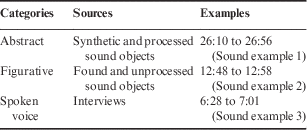
First of all, let us introduce the sonic materials found in the piece, before we elaborate on how they interconnect to form a cohesive musical and informative discourse. Those sounds can be listed in three distinct categories as shown in Table 1.
The three sound-categories of Archipel

3.1.1 Abstract sounds
As Archipel is first and foremost a musical project, the most prominent sonic materials encountered in the piece fall in the first category, that of abstract sound materials. However, those heavily processed or synthesis-based sounds remain mostly driven and organised according to archetypical movements found in natural and real-life elements relating to the piece (the crashing of the waves on the shore, the turmoil of water, the rumble of city traffic, etc.). Such synergy between musical materials and natural models, found both in electroacoustic and instrumental music, has been discussed extensively by French composer François-Bernard Mâche, who argues that the music should imitate or refer to archetypal and natural behaviours and models that resound with human memory and sensitivity, in order to reach the listener in a strong and meaningful way. Partly inspired by Mâche’s notion of a link between abstract musical materials and what he calls ‘natural sound models’ (Mâche Reference Mâche1983), the compositional approach behind Archipel is clearly oriented and driven by the piece’s subject itself: every musical gesture or material moves towards the evocation of the Montréal’s waterfront, as will be explained in the next sections.
3.1.2 Figurative sounds
The second category, that of figurative sounds, consists of unprocessed or lightly processed field recordings and found sound objects. Those sounds thus remain clearly identifiable and linkable to their source. As stated by R. Murray Schafer in his famous 1977 book The Tuning of the World, the conception that all sounds are equal as a musical source – a notion initiated a few decades earlier by John Cage – serves as a basis to how figurative sounds find their place in Archipel: ‘Today all sounds belong to a continuous field of possibilities lying within the comprehensive dominion of music. Behold of the new orchestra: the sonic universe!’ (Schafer Reference Schafer1994: 5). In a similar approach, found sounds and field recordings in Archipel sometimes serve to create a contrast within the musical discourse. They are either superimposed on the more abstract material – creating musical tension – or left on their own – releasing musical tension. On the other hand, those sounds are also intended as geographical markers, so that the listener may perceive a sense of space and a sound signature related to the actual locations put forward in the piece. Whether or not the listener is familiar with the various soundscapes of Montréal’s waterfront, the field recordings and figurative sound elements in Archipel are intended to provide acoustic information about those locations and help create such a sense of space for the listener.
3.1.3 Spoken voice
The last category, the spoken voice – consisting mostly of interviews, aside from a few distant, indistinct voices that rather fall under the category of figurative sounds – is the core of the documentary aspect of Archipel. This material helped to create the entire narrative form of the piece and to provide the structure for the six movements of the piece, listed earlier in this article. Even if the interviews are the main informative element of the piece, they do also provide guidance for the musical discourse, and sometimes fade into the sonic background and become used as a musical material themselves: distortion, fragmentation and editing are used to turn voice recordings into elements of the musical discourse. We will develop this topic further later on.
The three sound categories found in Archipel make the project lean towards what Bill Nichols calls, in a rare effort to classify filmic documentary genres, a ‘poetic documentary’ (Nichols Reference Nichols2001). Adapting Nichols’s terminology to the radiophonic medium in his essay Le documentaire sonore, Christophe Deleu notes that the poetic documentary subgenre is actually very close in its methods to acousmatic music and the earlier musique concrète:
In 1948, Pierre Schaeffer also invents musique concrète, with the help of Pierre Henry. Although it might not qualify as a documentary genre per se, it certainly shares the same objective of creating an artistic device composed of sounds that are recorded, edited and mixed according to a pre-established sequence. This invention will lead radio practitioners to work with sound in a different way. (Deleu Reference Deleu2013: 165)
The connection between the two genres underlined by Deleu, present from the very beginning of electroacoustic music’s history, suggests that their common methods encompass very concrete possibilities of development and creative exchanges. The next sections will show how various concepts and techniques originating from both sides complement each other in Archipel.
3.2 Conceiving the documentary aspect
3.2.1 Voice and interviews as primary documentary component
The interviews of the seven interviewees found in Archipel have mostly been conducted following the model of the ‘talking-head’ technique, originating from documentary film. This technique, widely used in recent years and mainly instigated by Errol Morris in The Thin Blue Line (1988), consists of a close shot of the interviewee, so that the interviewer is not part of the action – his or her presence is subtracted.Footnote 6 In the context of acousmatic documentary, we can highlight two major advantages of this way of collecting informative material. First, using only one interview method ensures the homogeneity of the recordings and facilitates the continuity of the narrative plot of the piece. Second, close-up interviews of the different interviewees allow the voices to fit more easily with the musical materials: since no background sound is heard, the recorded interviews are more flexible in terms of editing, composition and mixing.
One may argue that background sounds in interviews could also prove to be a source of information, given the right context. Although we aimed for the cleanest recordings possible as a rule of thumb, that is not something we entirely overlooked either, as is shown in the piece by the interviews of two fishermen on Montréal’s shores (12:40 to 15:21). Apart from their voices, this segment of the piece exclusively comprises unprocessed, figurative sound materials, both part of the actual interview recordings and gathered from additional recordings. This is also the case of the press conference on the city’s Water Plan, heard towards the end of the piece (20:32 to 23:00), where we can hear the full ambiance of the city hall behind the politicians’ discourse. This different approach to recording voices serves as a means to enhance the auditor’s feeling of authenticity, given that the interviewees are placed within a clearly identifiable and contextually consistent sonic environment, as opposed to most other parts of the piece, where more musical and abstract elements surround the interviewees’ speech.
3.2.2 The informative role of other sound categories
In our approach, the musical and informative roles of every sound are closely related. Whenever a musical gesture is put in place, an underlying informative or documentary meaning appears, and vice versa. At the beginning of the piece, right after the first interviewee explains that there is virtually no way to discover that Montréal is in fact an island, a short musical passage provides a metaphorical representation of this idea, with distant and blurry soundscapes of Montréal’s shores obscured by the presence of more abstract and melodic materials (Sound example 4). Inversely, primarily informative or referential sounds sometimes reveal musical characteristics, as is the case in the same example where the high-pitched sound introducing the melodic motive is in fact the sound of the floodgates of the Lachine Canal, a very representative element of that place’s sonic identity. The sound thus acts both as a musical pitch and as a location marker, which may enable the listener to identify the site where the recording was made – or, if he or she has never been there, to make up a subjective mental representation of the place, based on the sound’s resonance with the listener’s own experience.
Many other examples of this semiotic relation between sounds, music and information are found within Archipel. However, since we have considered from the very beginning of the project that musical and informative characteristics were interrelated aspects of sound, they were both developed simultaneously within the piece, while assembling its musical framework. Accordingly, the informative role of non-vocal sounds will be discussed in greater details in the following section, which documents the musical elaboration of Archipel.
3.3 Conceiving the musical aspect
3.3.1 Field recordings
A great effort has been made by the composers to record and assemble field recordings from the archipelago of Montréal, which serve as the primary sound source of the whole project, along with voice recordings. This working approach can be traced back to an important figure in the field of sound documentary: the French sound artist Yann Paranthoën. Very concerned by the evocative power of field recordings, Paranthoën, with his first radio documentary, Un petit chariot pour la Grande Ourse (1967), undertook to evoke the world around us without the use of the voice. Although his later work would give a large place to remarkable voice recordings, the choice to rely on non-vocal sounds in Paranthoën’s first attempt at sound documentary is indicative of aesthetic concerns that remained present throughout his entire career. As stated by Christophe Deleu, ‘Yann Paranthoën thinks that voices and non-vocal sounds occupy the same level of importance, and thus deserve equal consideration, be it during the recording, editing or mixing stages’ (Deleu Reference Deleu2013: 180). The great care given by Paranthoën to his recordings is closely related to the way the field recordings are treated in Archipel. Those sounds do not strictly serve as musical materials: the territory also acts as an actor and as a key figure. The recordings of the shores, the St Lawrence, the fields around particular spots, all of them point, in a documentary approach, towards the core of the subject. More than an artistic statement, it is an ethical one.
Indeed, the use of found sound objects and soundscapes in the documentary context is, in the case of Archipel, a politically and environmentally engaged act. Douglas Kahn, in his book Noise, Water, Meat, goes in the same direction when talking about the use of water in contemporary music: ‘If we were to continue to divine water in the arts, it would necessarily invoke an ecological self-consciousness … where materials and techniques themselves become political’ (Kahn Reference Kahn2001: 244). This deep individual commitment to the subject is notable within our own methodology, given that we opted for the exclusive use of sounds recorded by ourselves and in locations solely limited to the subject’s geographical delineations. This echoes our concern of rendering the locations’ sonic identity and our own experience of them, which in our view bears far more documentary value and authenticity than we may have achieved through the use of found footage or sound objects and soundscapes borrowed from other similar locations and sources.
3.3.2 Sound processing and synthesis
Alongside field recordings, sound processing and synthesis are widely used in Archipel to create a metaphoric evocation of water. Our use of synthetic noise and processing to portray this natural material can be linked to ecomimetism, a concept related to the musical representation of the concrete world. This technique, initiated by the use of sonograms and implemented by spectral composers Gérard Grisey and Tristan Murail in the early 1970s, still resonates today with composers such as Charles-Antoine Fréchette. According to Fréchette, ‘ecomimetic composition defines as the exploration of the relationship between any trivial sound from our acoustic environment and its metaphorical, expressive and structural potential in a musical work’ (Fréchette Reference Fréchette2015: 19). As such, ecomimetism is not far from François-Bernard Mâche’s concept of ‘natural sound models’, which we touched upon earlier. Although more often associated with instrumental music, both concepts are employed in Archipel in order to reverse the acousmatic listening habit: the abstract materials are treated so they can relate to something known in the real world. Sound example 5 serves to illustrate this application, where the most prominent musical gestures clearly echo the movements and turmoil of water and waves.
3.3.3 Melodic and harmonic content
Perhaps the only musical component of Archipel that does not bear any intrinsic documentary meaning, the harmonic and melodic content is, however, in close relationship with other sounds. In fact, all of it has been inspired by or extracted from tones and spectral characteristics present in the field recordings used throughout the piece. It is the case of the opening melodic motive (Sound example 4), based on the tone produced by the closing and opening of the floodgates on the Lachine Canal, as previously mentioned. The motive derived from this sound was then used to elaborate most of the melodic and harmonic content of the remainder of the piece. Among other sounds that informed the melodic gestures are the short excerpts of children’s voices found between 2:11 and 2:33 (Sound example 5) – sounds that, at the same time, remain closely woven with that of the floodgates. On the other hand, most of the melodic content also tends to follow the mood and nature of the discourse of the interviewees, whether dramatic, light, hopeful, solemn, etc. In that regard, this material remains implicitly supportive of the documentary scheme of the piece.
3.3.4 Voice as a musical material
As stated earlier, most interviews in Archipel have been conducted using the talking head technique, in order to achieve the cleanest and most neutral voice recordings possible. Helped by the greater flexibility provided by this technique, we not only used the voice as an informative and narrative material, but also as a musical one. As stated by composer and film theorist Michel Chion, the voice occupies the foreground of the listener’s attention: ‘it tends to emerge in comparison to any other sound, as far being heard or imagined within other sounds than itself’ (Chion Reference Chion2011: 14). Well aware of the primacy of the voice within a complex auditory scene, we have used three compositional techniques to infer musicality to this usually rigid sound material: counterpoint, micro-editing and filtering.
The first technique can be traced back to the Canadian pianist and composer Glenn Gould, who actively used vocal counterpoint in The Idea of North, the first and best known of his three radio documentaries (Gould 1992) on the topic of northern life and identity. Gould edited and mixed the voices vertically, connecting the different layers in a complex and semantically relevant manner, reminiscent of Anton Webern’s serial music.Footnote 7 The section in Archipel about international influences – from 8:23 to 8:56 (Sound example 6) – adopts this vertical collage technique, in order to poetise the discourse of the interviewees and emphasise the multiplicity and blooming of different projects regarding access to water in big cities abroad.
In the case of micro-editing, the voice acts as a purely musical material: the statements cannot be heard, only the sound of the fragmented voice recording, thus treated as any other material. This compositional process is best displayed in two places in Archipel: from 15:38 to 15:52 (Sound example 7), and 16:32 to 17:01 (Sound example 8). In both examples, micro-editing occurs when a given topic within the interviewees’ discourse is described as blurred, inchoate or hardly reachable. For instance, in Sound example 8, the technique serves to emphasise the fact that most people in Montréal have a very uncertain idea of the complex geography of the archipelago. The interviewee describes it as a blurred and distant concept, difficult to assess for most citizens, an impression strengthened by the micro-editing of his own voice interfering with his statement.
The last technique, filtering, is used mostly to prevent monotony from crippling the interaction between voice and music, and as a way to connect the two entities in terms of spectral content during certain passages. A segment in the first part of the piece – from 2:59 to 3:36 (Sound example 9) – best highlights this technique: as the interviewees speak of the obsolescence of Montréal’s harbour infrastructure, the voices are tweaked with interference and telephone-type filters, so that they blend more easily with the noisy musical sequence. In a similar fashion to micro-editing, filtering thus serves to emphasise passages of the piece where past, historical and problematic aspects of the subject are brought forward by the interviewees.
3.4 How music and information benefit from each other
Movie critic and essayist Guy Gauthier, in his book Le documentaire, un autre cinéma, states that ‘what the viewer perceives of real life, even when recorded from its most intimate sources, must first pass through the double filter made of [the filmmaker’s] subjective vision and of a device more fitted for fantasy than critical thinking’ (Gauthier Reference Gauthier2000: 14). This is no less true in the auditory realm, especially in the case of the documentary approach in acousmatic music, where the methodology involves a considerable amount of musical abstraction. While the previous sections served as an account of the documentary and compositional techniques put to use in Archipel, little has been said in regards to the more practical and epistemological motivations behind such an approach. Indeed, one may very well question the actual benefits of blending music and documentary elements together, notwithstanding the aforementioned affinities between acousmatic music and documentary practices. The example of the Sensory Ethnography Lab (SEL), a research group based in Harvard University and known for iconoclastic documentaries such as Leviathan (Castaing-Taylor and Paravel 2012) or Sweetgrass (Castaing-Taylor and Paravel 2009), might help provide an answer.
Falling more or less within the definition of Bill Nichols’s poetic documentary subcategory, the SEL proposes documentary films where sound and image often act as the sole source of information, without resorting to interviews or descriptive voice-over. The viewer experiences the subject, rather than being given a spoken description of it, by the use of strong and engaging images and sounds, often obtained through innovative recording and filming techniques. This is best shown in the movie Leviathan, which follows a crew of fishermen in high sea, mainly through the lenses and microphones of Go-Pro cameras. In terms of depicting the violence and hardships of this industry, the achieved effect greatly surpasses that of most ‘classic’ documentary production on the same subject. Indeed, without a single word or any kind of descriptive information, Leviathan succeeds in enthralling the viewer into perhaps the closest thing to being on an industrial fishing boat in high sea, providing a viewing and listening experience by far more striking and unsettling than any statistical or spoken description.
In Archipel, the ‘experience’ is a bit more nuanced, perhaps due to the choice of traditional documentary interviews as primary informative device. Nonetheless, helped by the evocative and metaphorical tools of acousmatic composition, we managed to create what we consider a very personal and hopefully relevant depiction of the many aspects of Montréal’s maritime soundscapes and of the issues surrounding access to its waterfront. Moreover, the combination of acousmatic and documentary devices makes it possible to effectively emphasise important aspects of the subject through musical means, whenever the spoken discourse calls for it. In turn, the interviewees’ interventions help shape the form, direction and structure of the musical continuum. In the end, our goal is for the music to reinforce the impact of factual information, acting as a sort of affective and mnemonic agent during the listening experience, in a fashion similar to the SEL’s sensory approach. It is also our hope that in return, the documentary aspect may benefit and appeal to audiences less familiar with acousmatic music, enabling a better understanding and appreciation of this complex genre of music for the neophyte.
4 CONCLUSION
In the course of this article, we summarised the primary motivations and strategies behind our use of documentary devices and techniques in the context of acousmatic composition. The benefits of such an approach have been underlined, bridging gaps between shared and complementary elements that have long been present in both acousmatic music and documentary practices. Before we conclude, however, it seems appropriate to highlight some of the most salient drawbacks of the approach we put forward through the composition of Archipel.
The first downside to the documentary approach lies in its format. The coherent combination of acousmatic music and factual information – at least in the form of detailed interviews – seems bound to generate pieces of rather long durations. Generally speaking, this makes them less likely to be programmed both in acousmatic concerts and in most radio broadcasting contexts. The second drawback is also related to the choice of interviews as the main informative element. More than once during the composition process, we had to make difficult decisions and trade-offs regarding the information we could include in the piece. Indeed, imperatives concerning the pacing and combination of the speech with the musical context made it impossible to include all the information we deemed significant. We had to make choices according to the metaphorical potential of the topics we chose to tackle, as well as to the length of the interview segments. Lastly, those choices and the laborious tasks of editing and mixing they implied made for a rather lengthy composition process. In fact, it took us close to two years to complete the research, interviews and musical composition behind Archipel, and it will take one more year before the release of the digital platforms currently under development. From a documentary perspective, one has to be certain that the relevance of the chosen subject will endure whenever such production delays are implied.
It is our hope, however, that the new means of diffusion we are currently developing will succeed in overcoming most of these problems. Concerning the format, the website will enable us to split the piece according to its six movements, as previously mentioned. This will make for a lighter listening experience for most people, given that these two platforms will enable us to reach an audience that may not be familiar with acousmatic music at all. Regarding the amount of information that we could include in the piece, both the website and mobile application offer the possibility to add a virtually endless amount of new or previously omitted content. This will also enable us to palliate the issue of lengthy production delays, as we will have the possibility to create and add shorter, up-to-date content as the situation of access to the waterfront evolves. In addition, the mobile application will add a more interactive and explorative documentary dimension to the project, with the melding of traditional soundwalks and virtual sound reality. Through the use of geolocation and the device’s built-in microphone, music, facts and the location’s actual sounds will blend with the visual experience of three carefully selected places, all representative of different aspects of Montréal’s waterfront.
Time will tell if these platforms prove to be an efficient means of diffusion in order to mitigate the issues of the concert form. Nonetheless, those issues do inspire further reflections on the methodology we may adopt for future compositions relying on the documentary approach. Indeed, instead of clean, close-shot interviews, one could imagine the use of interviews and information gathered more along the lines of cinéma vérité and cinéma direct, where documentarists follow their subjects rather freely, relying on the natural unfolding of events, in what has been compared to a sort of ‘fly on the wall’ position (Nichols Reference Nichols2001: 114). In regards to the length of the compositional process and of the works themselves, one could also imagine a kind of acousmatic reportage, focused on covering relevant current events and incorporating a more concise format that would presumably be fit for podcast and web-diffusion formats.
In the broader context where acousmatic music has been in search of new means of mediation and diffusion in recent years,Footnote 8 the possibilities encompassed by the documentary approach seem most relevant and appropriate. We hope it will also appeal to other composers in the same ways that it appeals to us, mainly through its capacity for social implication, which in our opinion remains its most valuable potential. From our point of view, it serves both as a way to reach out to a broader audience and as one of many solutions to the global lack of social criticism and involvement in acousmatic music,Footnote 9 which is manifest in comparison to many other art forms, including other electroacoustic subgenres, such as sound art and installations.