INTRODUCTION
The Gulf of California (GoC), also known as the Sea of Cortez, is a UNESCO World Heritage Site that contains unique coastal and pelagic ecosystems supporting productive sport and commercial fisheries, breeding grounds for migratory sea turtles and several species of whales, and remarkably diverse communities of invertebrates (Steinbeck & Ricketts, Reference Steinbeck and Ricketts1941; Brusca, Reference Brusca1973). Overexploitation by small-scale fisheries and bottom trawling for shrimp already impact this remarkable region (The Packard Foundation, 2013). Its ‘hidden’ deep-sea environments are also unusual, ranging from sparsely populated anoxic basins off Bahía Concepción to densely populated chemosynthetic habitats at hydrothermal vents and cold-water hydrocarbon seeps (Simoneit et al., Reference Simoneit, Lonsdale, Edmond and Shanks1990; Edgcomb et al., Reference Edgcomb, Kysela, Teske, de Vera Gomez and Sogin2002). Understanding the biodiversity and connectivity of its deep-sea fauna along with other areas of the North and Central American margins is essential for management of this region's natural resources and its marine protected areas.
An expedition conducted by the Monterey Bay Aquarium Research Institute (MBARI) during the spring of 2012 had the purposes of mapping, exploring and sampling GoC deep-sea habitats. Methane seeps were explored along transform faults in the central GoC, and new hydrothermal vents were discovered along the Alarcón Rise in the southern GoC (Paduan et al., Reference Paduan, Clague, Caress, Lundsten, Martin and Nieves-Cardoso2012). Biological samples and images obtained during this expedition with the remotely operated vehicle (ROV) ‘Doc Ricketts’ provide the first confirmed records for two species of file clams (genus Acesta, family Limidae) in the GoC. Previously, Acesta agassizii (Dall, Reference Dall1902) was the only file clam species reported in the GoC (Coan & Valentich-Scott, Reference Coan and Valentich-Scott2012). Clague et al. (Reference Clague, Jones, Paduan, Clague and Vrijenhoek2012) reported that videos obtained during a 2003 MBARI expedition to the GoC revealed clams tentatively identified as Acesta cf. sphoni, but specimens were not collected for taxonomic or molecular identification. However, the Clague et al. (Reference Clague, Jones, Paduan, Clague and Vrijenhoek2012) study carefully documented the distribution of two species, Acesta sphoni (Hertlein, Reference Hertlein1963) and Acesta mori (Hertlein, Reference Hertlein1952), from escarpments and seamounts bordering the Pacific margin of the United States between Southern California and Northern Oregon. Though distinct morphologically and genetically, neither species showed evidence for geographical subdivision across the 1700 km sampled range.
Herein, we report the first confirmed records of Acesta mori and A. sphoni from the GoC. Species identifications were based on morphological and DNA-barcoding criteria. Mitochondrial cytochrome-c-oxidase subunit I (COI) sequences from samples of each species provided no evidence for geographical isolation of GoC populations from their counterparts along the Pacific margin of the United States. However, the depth ranges and associations with oxygen concentrations are shifted slightly for the GoC populations.
MATERIALS AND METHODS
Samples
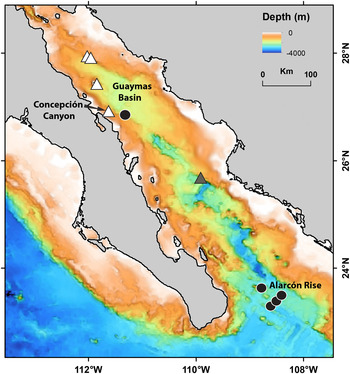
Acesta individuals were collected from several sites in the GoC during March–May of 2012 (Figure 1; Table 1). Collecting whole specimens of these thin-shelled clams with the robotic manipulators on the submersible was difficult. The suction sampler was used to gently lift individual specimens into a sample box that was closed to retain near-bottom temperatures during the ascent. Specimens were held for up to two hours in chilled (4°C) seawater prior to dissection for tissue samples. Voucher specimens for morphological analysis were preserved in 95% ethanol. Vouchers were deposited in the Santa Barbara Museum of Natural History, Santa Barbara, CA (catalogue numbers: SBMNH 424255–424257 and 424260–424265).
Observation and collection sites for two Acesta species in the Gulf of California, Mexico, during the MBARI expedition of March–May 2012: white triangles for Acesta sphoni and black circles for A. mori. Grey triangle designates a site where Acesta clams were observed on video but could not be identified to species level and sample collections were not made (remotely operated vehicle was too far from the seafloor for us to determine if these clams were A. agassizii or A. mori).

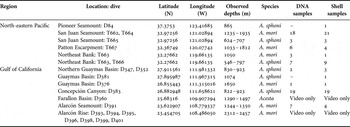
Acesta video observations and collections for molecular work and shell measurements: specimens deposited at Santa Barbara Museum of Natural History, California (catalogue numbers SBMNH 424255–424257 and SBMNH 424260–424265).

Habitat characterization
Video was recorded and stored on high-definition videotapes for all benthic ROV dives during the GoC expedition from March–May 2012. Videotape data were analysed by MBARI biologists after the expedition and all identifiable animals were catalogued in the MBARI Video and Reference System (VARS) database (Schlining & Stout, Reference Schlining and Stout2006). Acesta clams were annotated to species level when possible. In cases where the submersible was not close enough to seafloor to identify the Acesta species, individuals were annotated as Acesta. Then, the VARS database was queried for all Acesta clams catalogued on this expedition. Depth (m), temperature (°C), salinity (psu) and oxygen content (ml/l) were continuously recorded from sensors mounted on ROV ‘Doc Ricketts’. These data were concatenated with catalogued identifications of Acesta species in the VARS database and returned with each record to determine environmental conditions for each species.
To determine the density of A. sphoni clams at two GoC sites, frame-grabs were taken from ROV video. Two lasers, mounted 29 cm apart on the ROV camera housing, were used to determine approximate area of the seafloor in each frame-grab. All visible clams in the frame were quantified using the count tool in Adobe Photoshop CS 6.0.
Shell morphology
Acesta mori and A. sphoni clams were previously collected from multiple sample locations along the north-eastern Pacific: Pioneer Seamount, San Juan Seamount, Northeast Bank Seamount, and Patton Escarpment; and were collected in the spring of 2012 from the GoC: Guaymas Basin, Concepción Canyon, and Alarcón Seamount (Table 1). Clams collected in the Clague et al. (Reference Clague, Jones, Paduan, Clague and Vrijenhoek2012) study were used for molecular analysis; the shells were not used for morphological analysis until this study. Shells were cleaned, dried, and measured with calipers to nearest 0.01 mm for height (H), width (W) and shell inflation (I), as described in Figure 2 and by Järnegren et al. (Reference Järnegren, Schander, Sneli, Rønningen and Young2007) and Carter et al. (Reference Carter, Harries, Malchus, Sartori, Anderson, Bieler, Bogan, Coan, Cope, Cragg, Garcia-March, Hylleberg, Kelley, Kleemann, Kriz, McRoberts, Mikkelsen, Pojeta, Skelton, Temkin, Yancey and Zieritz2012). The number of radial ribs on the exterior of dried A. sphoni shells was recorded. Means of all measurements were calculated.
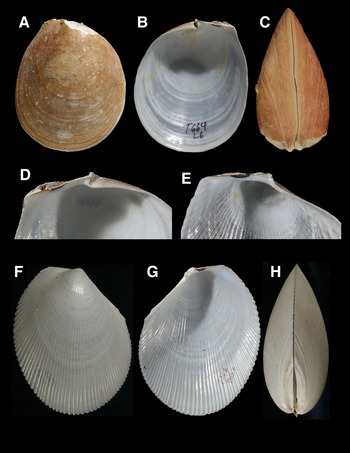
Acesta mori: (A–B) external and internal views of valves; (C) shell inflation; (D) detailed view of hinge. Specimen from San Juan Seamount, north-east Pacific (catalogue number SBMNH 424257), height = 73.67 mm, width = 64.32 mm, inflation = 38.22 mm. Acesta sphoni: (E) detailed view of hinge; (F–G) external and internal view of valves; (H) shell inflation, note large byssal gape in A. sphoni. Specimen (E) from Concepción Canyon, Gulf of California (catalogue number SBMNH 424261), width = 60.85 mm. Specimen (F–H) from Northeast Bank Seamount, north-east Pacific (catalogue number SBMNH 424255), height = 104.07 mm, width = 82.67 mm, inflation = 46.05 mm (photograph by Paul Valentich-Scott, SBMNH).

Molecular analyses
Genomic DNA was extracted from approximately 50 mg of adductor muscle tissue with Qiagen DNeasy isolation kit (Valencia, CA) using manufacturer's protocol. Polymerase chain reactions were run for the following primers (Table 2): LCO1490 and HCO2198 (for A. mori; Folmer et al., Reference Folmer, Black, Hoeh, Lutz and Vrijenhoek1994), and new COI internal primers Sph1F and Sph2R (for A. sphoni) for 35 cycles at an annealing temperature of 48°C and 55°C, respectively. DNA sequences were proofread, edited and aligned in Geneious v6.0 (Biomatters Limited, Auckland, NZ). Haplotypes were imported to TCS v1.21 for comparisons to published haplotypes (Clague et al., Reference Clague, Jones, Paduan, Clague and Vrijenhoek2012). Hierarchical F-statistics were estimated with Arlequin 3.5.1.3 (Excoffier & Lischer, Reference Excoffier and Lischer2010). New sequence haplotypes were submitted to GenBank (Accession Numbers: KJ147468–KJ147474).
Primers for molecular analysis: *, from Folmer et al. (Reference Folmer, Black, Hoeh, Lutz and Vrijenhoek1994).

RESULTS AND DISCUSSION
Habitat characterization
Habitat conditions for Acesta in the GoC mostly resemble those previously described for file clams in the north-eastern Pacific (Coan et al., Reference Coan, Valentich Scott and Bernard2000; Clague et al., Reference Clague, Jones, Paduan, Clague and Vrijenhoek2012). Acesta mori occur in deep, cold and more oxygenated waters whereas A. sphoni occur at shallower depths in warmer water with less oxygen (Table 3). The southernmost individuals of A. mori were observed on video from the Alarcón Rise. They represent the first members of this genus sampled from the nearby vicinity of an active hydrothermal vent, and at 2450 m, these clams were found at the greatest depth recorded for this species. Scattered individuals at this site were singly attached to large rocks on a talus slope or found in fields of pillow lava. The northernmost individual from the GoC was attached to a small rock found on a muddy slope in Guaymas Basin (1643 m depth). This observation was the northernmost collection site for A. mori in the GoC.
Environmental data for Acesta observations in the Gulf of California (GoC), Mexico, and data from the north-eastern Pacific margin study (from Clague et al., Reference Clague, Jones, Paduan, Clague and Vrijenhoek2012). *, indicates new greatest depth record for each species from the GoC observations.

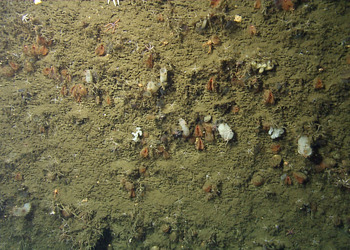
Acesta sphoni clams were found densely aggregated, approximately 58 individuals per m2, in a narrow band on a heavily sedimented vertical wall of Concepción Canyon in the GoC (Figure 3), and one individual was found at 1075 m, the greatest depth record for A. sphoni, attached to a small, submerged rock on the muddy seafloor of Guaymas Basin. Another dive in Guaymas Basin found dense aggregations of A. sphoni, approximately 25 individuals per m2, inhabiting a heavily sedimented horizontal talus field (Figure 4).
Frame-grab from ROV Doc Ricketts video of Acesta sphoni clams inhabiting a heavily sedimented vertical wall in Concepción Canyon, Gulf of California, Mexico, at densities around 58 clams per m2 (depth = 829 m, oxygen concentration = 0.08 ml/l). Other animals at this site included a diversity of white sponges, Psolus cucumbers, galatheid crabs and brittle stars.

Frame-grab from ROV ‘Doc Ricketts’ video of Acesta sphoni clams inhabiting a heavily sedimented horizontal talus field in the northern Guaymas Basin, Gulf of California, Mexico, at densities around 25 clams per m2 (depth = 837 m, oxygen concentration = 0.13 ml/l). Other animals at this site included a diversity of sponges, brittle stars, black corals, anemones, tunicates, cup corals and Psolus cucumbers.

Shell morphology
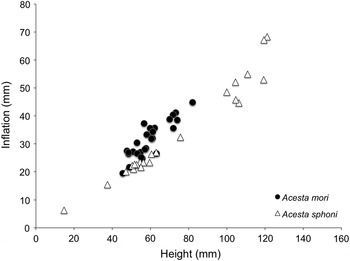
Thirty-one specimens of Acesta mori had an average shell height of 59.7 mm, width of 51.7 mm and inflation of 31.4 mm, whereas 27 specimens of A. sphoni had an average height of 80.2 mm, width of 65 mm and inflation of 33.7 mm (Table 4). Both species from all sites were in agreement with original species descriptions. In general, shells of A. mori were rounder and more inflated than the elongate, slim shells of A. sphoni (Figure 5). Our samples of A. sphoni had between 31 and 77 radial ribs on the exterior of the shell. The type specimen for A. sphoni has 52 radial ribs (Hertlein, Reference Hertlein1963), and a description of A. agassizii, previously the only file clam species in the Gulf of California, reported between 85 and 120 broad, very low radial ribs with shell widths to 93 mm and heights to 116 mm (Coan & Valentich-Scott, Reference Coan and Valentich-Scott2012).
Shell height and inflation measurements for Acesta sphoni and A. mori clams from both the north-east Pacific margin and Gulf of California regions. The A. mori shells are slightly more inflated than shells of A. sphoni with similar height. The largest shells were from A. sphoni, collected from San Juan and Northeast Bank seamounts.

Shell measurements from Acesta clams collected in the Gulf of California, Mexico, and from locations in the north-eastern Pacific: Pioneer Seamount, Rodriguez Seamount, San Juan Seamount, Patton Escarpment and Northeast Bank. Range of radial ribs for A. sphoni is 31 to 77.

Molecular diversity
The most frequent (leading) haplotypes Am1 and Am2, found in populations of Acesta mori from the US Pacific margin, also were most common in the small sample of GoC individuals (Figure 6A). Three new haplotypes, observed as singletons, were only one (Am39 and Am40) or two (Am38) mutation-steps distant from Am1 and Am2. A previous analysis of molecular variance (AMOVA) for A. mori (Clague et al., Reference Clague, Jones, Paduan, Clague and Vrijenhoek2012) partitioned the Pacific margin samples into three regions: (1) north of the Mendocino Fracture Zone; (2) central California; and (3) Southern California, south of Point Conception. No significant component of molecular variance could be attributed to subdivision among the three regions. Thus, for the present analysis, we combined the Pacific margin samples into a single group for comparison with the GoC sample. No evidence for subdivision existed between the two groups. The between group variance component was negative due to corrections for sampling variance (F CT = –0.0192, P = 0.878) and, thus, accounted for 0% of the total variance.
Addition of mitochondrial haplotypes from Gulf of California Acesta clams into the haplotype network published by Clague et al. (Reference Clague, Jones, Paduan, Clague and Vrijenhoek2012): (A) A. mori haplotypes from the Gulf of California are Am1, Am2 and Am38–40 (GenBank Accession Numbers KJ147472–KJ147474). Dashed lines indicate non-seamount habitats for A. mori; as in the Clague et al. (Reference Clague, Jones, Paduan, Clague and Vrijenhoek2012) study; (B) A. sphoni haplotypes from the Gulf of California are As1 and As5–8 (GenBank Accession Numbers KJ147468–KJ147471).

The previous sample of Acesta sphoni was small (N = 10) and limited to two localities from Southern California, San Juan and Northeast Bank (Clague et al., Reference Clague, Jones, Paduan, Clague and Vrijenhoek2012). The new sample included 19 individuals from Bahia de Concepción and two from Guaymas Basin. The leading haplotype at the Southern California localities, As1, was also the most frequent in the GoC sample (Figure 6B). Four new haplotypes observed as singletons, As5–8, were only one mutation-step from As1. Hierarchical AMOVA based on haplotype frequencies compared the Southern California and GoC specimens. Frequency differences between the two groups accounted for 13.1% of the total variance, but the value was not statistically significant (P = 0.125). The within group variance of 5.7% was significant (P = 0.028).
Neither species is known from the Pacific margin of Baja California (Figure 1), but their apparent absence probably reflects undersampling of this region. To our knowledge, ecologically focused submarine expeditions have not been conducted in this region. We are unaware of dredged Acesta samples from the Pacific margin of Baja California (Coan & Valentich-Scott, Reference Coan and Valentich-Scott2012). Nonetheless, the present genetic data indicate no restrictions of gene flow across the entire known range of A. mori, from southern Washington to Guaymas Basin in the GoC. Inferences about unrestricted gene flow in A. sphoni are less clear, however. About 13% of the variance in COI haplotype frequencies occurred between the Southern California and GoC regions, but the value was not significantly different from zero. Additional samples of this species are needed to determine whether the two regions are truly divergent. Overall, mitochondrial diversity is much lower for A. sphoni (Figure 6), but this might be a consequence of the limited number of geographical samples and the overall sample size. On the other hand, our observations from research submersibles might truly reflect a more limited distribution and abundance for A. sphoni. If this species' overall effective population size (N e ) is small, its normalized molecular diversity (θ) for selectively neutral mitochondrial variation is also expected to be small, because θ ≈ 2N e µ (Nei, Reference Nei1987). Assuming a common mutation rate (µ), the smaller N e for A. sphoni would create more opportunities for genetic drift and geographical differentiation, even if dispersal (m) rates of the two species are identical. Inferences about the demographic history of populations are risky, however, if based on information from a single gene (Karl et al., Reference Karl, Toonen, William and Bowen2012). Analyses of independent nuclear gene markers and more exploration of the Baja California's Pacific margin may help to resolve some of these issues.
ACKNOWLEDGEMENTS
We gratefully acknowledge the pilots of the ROV ‘Doc Ricketts’ and crew of the RV ‘Western Flyer’ for their expert help. We thank the MBARI video laboratory staff for annotations, L. Lundsten and L. Kuhnz for samples, J. Paduan for assistance with figures, and S. Johnson for assistance in the laboratory and with the manuscript (all from MBARI). We thank Paul Valentich-Scott from SBMNH for the beautiful shell photographs. Two anonymous referees provided valuable comments. This study was supported by grants from the David and Lucile Packard Foundation.