


Introduction
Supervision can be defined as: ‘an intervention provided by a more senior member of a profession to a more junior colleague or colleagues who typically (but not always) are members of the same profession’ (Bernard and Goodyear, Reference Bernard and Goodyear2013, p. 9). The purpose of supervision can be expressed in different ways. Bernard and Goodyear (Reference Bernard and Goodyear2013) state that the purpose is the supervisees’ professional development, to ensure the clients’ welfare and to guarantee the clients’ security, which is called the ‘gate-keeping function’.
Supervision of psychotherapists is widely accepted to ensure optimal client outcome, especially during training and in the early years of practice (Bambling et al., Reference Bambling, King, Raue, Schweitzer and Lambert2006; Milne and Reiser, Reference Milne and Reiser2011). Clinical supervision is seen as essential within cognitive behavioural therapy (CBT) training (Rakovshik and McManus, Reference Rakovshik and McManus2013). There are a few scales that seek to measure CBT supervisory competence, e.g. the Supervisor Competency Scale (SCS) (Kennerley et al., Reference Kennerley, Butler, Clohessy and Westbrook2010) and Supervision: Adherence and Guidance Evaluation (SAGE) (Milne and Reiser, Reference Milne, Reiser, Watkins and Milne2014). However, there are no available models and theories of clinical supervision that have empirical support (Johnston and Milne, Reference Johnston and Milne2012; Milne et al., Reference Milne, Aylott, Fitzpatrick and Ellis2008). The need for future research regarding active elements in training, in which supervision is one part, has been noted (Rakovshik and McManus, Reference Rakovshik and McManus2013). In addition, there are no evaluated guidelines for supervision within CBT (James et al., Reference James, Milne, Marie-Blackburn and Armstrong2006; Milne, Reference Milne2009), and only a few qualitative studies on the effect of supervision from the perspective of the supervisee (Hill and Knox, Reference Hill, Knox and Lambert2013). A small study (Milne et al., Reference Milne, Pilkington, Gracie and James2003) describes that supervision in CBT can be effective when the supervision material for the therapy was repeatedly obtained in all the therapy sessions. This study recommends further qualitative research to complement the quantitative research that is currently more dominant.
Clinical supervision is a learning process with a constructivist stance (Johnston and Milne, Reference Johnston and Milne2012; Scaife, Reference Scaife2008). Learning is thought to be unlikely if the supervisees are told or instructed by the supervisor (Scaife, Reference Scaife2008). In the constructivist relationship, a supervisee is assisted by the supervisor in adopting an active, adult role in the construction of his/her own competence. This dynamically positions the supervisee as an ‘artful and energised collaborator’ (Milne, Reference Milne2009, p. 129). This stance is in keeping with Vygotsky and Cole's (Reference Vygotsky and Cole1978) concept of the zone of proximal development (ZPD), which describes the process of learning and development in an interpersonal context. According to this model, individual learning is enhanced and generalized through problem solving under adult guidance or in collaboration with more capable peers.
Reflection is seen as an essential aspect of learning CBT (Bennett-Levy and Lee, Reference Bennett-Levy and Lee2014; Bennett-Levy et al., Reference Bennett-Levy, McManus, Westling and Fennell2009; Rakovshik and McManus, Reference Rakovshik and McManus2010). CBT therapists rate reflection as an important training or supervision method (Bennett-Levy et al., Reference Bennett-Levy, McManus, Westling and Fennell2009; Rakovshik and McManus, Reference Rakovshik and McManus2013). Johnston and Milne (Reference Johnston and Milne2012) describe in a study the importance of including reflection and its influence on learning during training. Supervisees were interviewed about their experience of supervision based on a cross-sectional qualitative design. The seven participants in this study were purposively sampled from the final year of a doctorate course in clinical psychology. The aim of the study was to conceptualize, from the perspective of the supervisee, the reception of clinical supervision with a CBT approach. The authors concluded that reception changes over the course of the supervisees’ developmental stages and is influenced by key constructs, which allow learning to take place. These key constructs are Scaffolding, Socratic Information Exchange, Reflection and Supervisory Alliance. In the earlier stages of training, supervisees had less confidence and felt more anxious, needed more containment and fewer direct challenges. The supervisees wanted more practical and informational support and a greater amount of educational scaffolding. As the supervisees developed their therapeutic skills, there was a movement away from discussion about specific skills and techniques (what to do) towards a deeper collaborative discussion and reflection about the inter-personal process (how to do it). This study had limitations, as it was restricted to supervisees who were known to the researcher and from one course. This could have influenced some of the responses provided (Johnston and Milne, Reference Johnston and Milne2012).
The importance of making supervision effective by letting the supervisees receive evaluation in the form of positive feedback is emphasized in the literature and research around supervision (e.g. Bernard and Goodyear, Reference Bernard and Goodyear2013; Johnston and Milne, Reference Johnston and Milne2012; Rakovshik and McManus, Reference Rakovshik and McManus2013). Evaluation is aimed to be a mutual continuing process in which the supervisee is involved in what is to be learned. In particular, the formative aspect of evaluation should be the most active (Bernard and Goodyear, Reference Bernard and Goodyear2013). It is important for supervisors to be clear about expectations of the evaluation process (e.g. Bernard and Goodyear, Reference Bernard and Goodyear2013; Johnston and Milne, Reference Johnston and Milne2012; Kennerley and Clohessy, Reference Kennerley, Clohessy and Westbrook2010). The clearer and fairer the evaluation process is perceived to be, the less anxious and more trustful the supervisee will be (Bernard and Goodyear, Reference Bernard and Goodyear2013).
Also, different developmental models describe the importance of feedback as a form of evaluation. The Integral Development Model (IDM) (Stoltenberg and McNeil, Reference Stoltenberg and McNeil2009) describes how supervisees with limited training are dependent on the supervisors’ positive feedback. The life-span model (Ronnestad and Skovholt, Reference Ronnestad and Skovholt2012) describes how novice students are dependent on the supervisors’ support, for example through positive feedback, in order to build self-confidence as a therapist.
The effect of working alliance is a fundamental component of supervision (Ladany et al., Reference Ladany, Friedlander and Nelson2005). The clinical working alliance and symptom reduction was evaluated in a study by Bambling et al. (Reference Bambling, King, Raue, Schweitzer and Lambert2006). Clients diagnosed with major depression were randomly assigned to supervised or unsupervised therapists to receive eight sessions of problem-solving treatment. The study then assessed the client outcome. The result showed no effect differences between supervision conditions. However, there was evidence of effect on the supervision conditions in the event of working alliance from the first session of therapy; this included symptom reduction and treatment retention. Clients that were treated by supervised therapists were more satisfied than those treated by non-supervised ones.
The supervisory alliance is highlighted in research investigating how supervisees learn during supervision (Johnston and Milne, Reference Johnston and Milne2012). The supervisees in their study reported that they were not open and honest about their needs when they perceived the supervisory alliance to be weak when they felt insecure. This happened when the supervisors were inconsistent and when feedback was either missing or communicated in an overly critical manner. In a study about the willingness to disclose in supervision (Mehr et al., Reference Mehr, Ladany and Caskie2014), the findings provided further empirical support for the view that a stronger working alliance would predict less anxiety in supervision and greater willingness to disclose.
This present study aims to contribute to the knowledge around supervision during training to become a CBT therapist from the perspective of the supervisee. It is a qualitative study focusing on what in particular during the supervision process the supervisees perceive contributes to the therapy process.
Method
Participants
In Sweden, the training of psychotherapists is a two-step process. The first step is a part-time 18-month foundation course. In order to apply for this course, one must have a Bachelor degree in a health-care related profession. The second step consists of a 3-year part-time advanced psychotherapy course. Admission criteria for the advanced psychotherapy course are at least two years of documented clinical work under supervision following completion of the foundation course. A qualification from the advanced course leads to licensing by the National Board of Health and Welfare. With this licence, one is free to work independently as a psychotherapist.
The study took place at the SAPU (Skandinaviens Akademi för Psykoterapiutveckling) education centre in Stockholm, which provides all levels of psychotherapy training. Supervisees from one of the foundation courses in CBT-oriented psychotherapy were invited to participate in the study. The selection of participants followed the recommendations on how to select participants in qualitative research (Braun and Clark, Reference Braun and Clark2013).
Fourteen of the 16 students agreed to participate. The supervisees were, at the time of the study, at the beginning of the course. The participants were between 24 and 56 years of age, with a mean age of 34 years. The participants had limited experience of working with CBT, but all of them worked in healthcare-related professions such as counsellors, psychiatrists, nurses and physiotherapists.
The supervisees had supervision once a week for three hours throughout the course. The supervision was conducted in groups with one supervisor and three or four supervisees. Altogether there were five supervision groups with five different supervisors included in this study. The supervisees receive supervision for one client at a time and had one therapy session with this client each week. The supervision followed Kennerley and Clohessy's recommendations on how to supervise within a CBT approach (Kennerley and Clohessy, Reference Kennerley, Clohessy and Westbrook2010). All the supervisors were trained as CBT-oriented psychotherapists and were trained, experienced supervisors.
Measurement
Research-directed structured diaries were chosen for data collection (Braun and Clark, Reference Braun and Clark2013). All participants were asked to keep two different diaries. The first diary was written after the supervision session, limited to a few sentences to describe how they perceived what was most important from the supervision session and what they then would use in the therapy session. The second diary was written after the therapy session, limited to a few sentences to describe what they perceived was most important from the supervision session, and if, following the therapy session, they felt they lacked anything from the supervision.
In order to understand the context of the different sessions the supervisees were also asked to describe what was on the agenda during the therapy session concerning what to do in the therapy and how to work together with the client.
Procedure
First, the supervisees were informed about the study both verbally and in writing, and then the supervisees who volunteered to participate were assigned random numbers to ensure anonymity and were asked to write this number in every diary entry together with the date of the session.
During the study, the supervisees were asked to write in their diaries on four occasions (i.e. once a month). This time interval was chosen in order to guarantee that everyone had a supervision session followed by a therapy session during the different time periods. Moreover, as there was just one diary entry every month this minimized the risk that the various diaries were mixed up.
The participants were reminded by email each time it was time to write a diary entry. They were asked to fill in their diary right after the supervision session and leave it in a special mailbox at the centre. After the therapy session, they were instructed to post the diaries in hard copies to the centre. The participants received stamped addressed envelopes in order to facilitate the posting of the hard copies. Finally, all the diaries were then transcribed into a Microsoft Word document, as they were handwritten documents.
Analysis
The diaries were analysed using the method of thematic qualitative analysis (Braun and Clark, Reference Braun and Clarke2006; Hayes, Reference Hayes2004), a method that is recommended for determining important themes in an event or process (Hayes, Reference Hayes2004). The themes were analysed using an inductive approach, which means the themes emerged from the data through the analysis, rather than being preconceived and applied to the interview transcripts (Braun and Clark, Reference Braun and Clarke2006). The diaries from the supervision session and from the therapy session were analysed separately and after defining different themes, the themes from the supervision and therapy sessions were compared with each other. The coding process was carried out by one researcher (A.T.).
As the participants were going to record their experiences in both the supervision and the therapy sessions, it was beneficial for them that they could fill in the diaries right after the current session and not confuse their perceptions of their experiences from the supervision or therapy session that followed. Another advantage of written diaries is that the data can be recorded anonymously and it thus also complied with the ethical requirements of not referencing the individual writers.
After repeated readings of the material to obtain an overall picture, the diaries were analysed by dividing the text into meaning units. These units were assigned codes taken from the participants’ own words. The resulting codes were compared and grouped into categories with similar codes. The categories were then reviewed by comparing codes within each category to make sure that they did indeed all capture the same meaning, and comparing them against codes in other categories to make sure all meaning was captured in the analysis. In this way, validity was established. The categories of codes were then compared using mind maps, and grouped in higher categories of codes in order to find overarching themes/patterns. Through repeated reading, the themes were refined and a thematic map of the analysis was generated. The chosen themes were assigned names and descriptions from different quotations from the diaries.
Ethical consideration
Relevant ethical practice was followed according to recommended practice (e.g. Braun and Clark, Reference Braun and Clark2013; Vetenskapsrådet (The Swedish Research Council), 2011; Willig, Reference Willig2013) concerning information, confidentially, respect and debriefing. Ethical approval was obtained from SAPU Education Centre's ethical committee. The supervisees were informed about the study both verbally and in writing. This information clarified that it was voluntary to participate and that those who accepted to participate were guaranteed anonymity.
Validity
Validity was established by means of peer debriefing, external audit, exclusion and prolonged time (Braun and Clark, Reference Braun and Clark2013; Creswell, Reference Creswell2013; Hayes, Reference Hayes2004). A colleague of the first author (A.T.) was consulted during the research process (peer debriefing). Further, a researcher who was not familiar with the subject provided advice on the research process (external auditor). The supervision group that was supervised by the first author (A.T.) was excluded from the analysis in order to ensure objectivity (exclusion). Finally, the entire process took place over a prolonged period of time in order to acquire as deep an understanding as possible of the supervisees’ perception of supervision.
Results
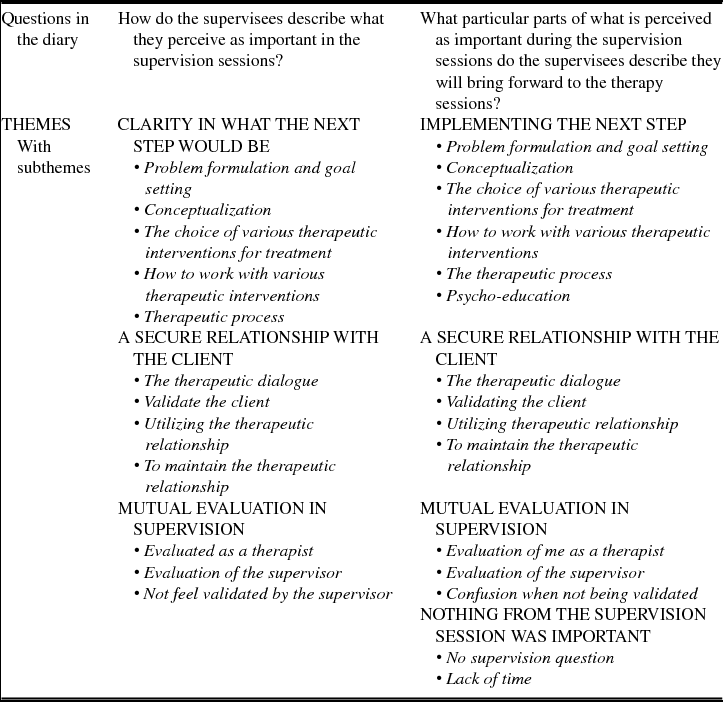
The results are presented with the themes established after the supervision session followed by the themes after the therapy session. The various themes and subthemes are presented in the Table 1 below.
Summary of themes and subthemes from supervisees’ diaries

Themes and subthemes following the supervision session
After the supervision session, the themes were ‘clarity in what the next step would be’ in the therapy, how the supervisees can create ‘a secure relationship with the client’, and the ‘importance of mutual evaluation’ in supervision.
Clarity in what the next step would be
This post-supervision theme can be described as a response to the supervision questions concerning what to do and how to work with various therapeutic interventions. This theme included therapeutic interventions around ‘problem formulation’, ‘goal setting’, ‘conceptualization’, ‘choice or various interventions for treatment’, ‘how to work with various interventions’ and supervision around the ‘therapeutic process’.
‘Problem formulation’ and ‘goal setting’ are therapeutic interventions that were perceived as important after the supervision session, especially at the beginning of the therapy. One supervisee described it as: ‘clarity in identifying the client's problems, what the client needs right now in order to achieve the goal of the therapy’; but it is also described as confusing to know whether to start with problem formulation or goal setting and the differences between these two therapeutic interventions.
Supervision with suggested therapeutic interventions around ‘conceptualization’ is described as important after the supervision session. The supervision around conceptualization was a response to a formulated supervision question, especially at the beginning of the therapy. For example, one supervisee wrote the following question in the diary: ‘how does my client's ambivalent attachment pattern influence the pattern of being afraid of loneliness’?
‘The choice of various therapeutic interventions for treatment’ was often described in the diaries as a specific recommendation or instructions from the supervisor in what to do but also ‘how to work with various therapeutic interventions’. Examples are how to work with Socratic questions or various behavioural experiments and how one was going to do it.
Supervision around the ‘therapeutic process’ was also perceived as an important area of supervisory focus, with suggestions to the therapist about maintaining the therapeutic alliance as well as how to terminate therapy.
A secure relationship with the client
The overall aim of this post-supervision theme was to make the relationship with the client as secure as possible in order to fulfil the client's goal for the therapy, but also to make the relationship secure in order use it as a model for other relationships. This theme included supervisory discussions of the therapeutic interventions ‘therapeutic dialogue’, ‘how to validate the client’, ‘how to utilize the therapeutic relationship’ and ‘how to maintain the therapeutic relationship’.
Supervision around ‘the therapeutic dialogue’ could include suggested therapeutic interventions of pacing the dialogue that were defined by observation of the recorded session rather than by answering a supervision question. For example, one supervisee, who had been looking at a recorded therapy session with the supervisor, found it important to ‘wait for a while and not rush the session’.
How to ‘validate the client’ was supervisory discussion with suggested therapeutic interventions that arose when the aim of the therapy was to improve various relationships. The suggested therapeutic interventions could concern validating the client when the client became emotional on account of the sensitive challenges he/she perceived in various relationships.
‘Utilizing the therapeutic relationship’ was supervisory discussion with suggested therapeutic interventions that described how one could make use of the experience from the therapeutic relationship in order to find strategies to solve problems on one's own outside the therapy room, using the therapeutic relationship and dialogue as a model.
Supervisory discussion with suggested therapeutic interventions in how ‘to maintain the therapeutic relationship’ arose when there were conflicts in the relationship, for example how to maintain a therapeutic relationship even if the client was aggressive.
Mutual evaluation in supervision
This post-supervision theme emerged from general comments made by the supervisees, after the supervision session, regarding the importance of evaluation in the form of positive feedback during the supervision sessions. Positive feedback is described as valuable and important for confidence building.
This is also in line with what the supervisees expressed in their diaries after the supervision session when they indicated that they were satisfied with the therapy overall. The supervisees who were satisfied also described how important it was to feel the support from the supervisor. This support made it easier to know what to do and when to use various interventions in therapy.
Mutual evaluation in supervision included the subthemes of being ‘evaluated as a therapist’, the supervisees’ ‘evaluation of the supervisor’ and problems that arise when you do not ‘feel validated by the supervisor’.
When the supervisees were ‘evaluated as a therapist’ from the supervisor and the supervision group it was often more a validation of how one works generally than what one has done specifically. For example, one supervisee wrote that what was most important from the previous supervision session was the: ‘encouragement and acknowledgement from the supervisor and the supervision group that I am doing a good job as a therapist’.
‘Evaluation of the supervisor’ in the form of acknowledgement is a comment that can be expressed by the supervisees when things are going well in the therapy and the supervisee has been positively validated during the supervision session. The diaries could then include comments like: ‘I am very satisfied with my supervisor’.
To ‘not feel validated by the supervisor’ made the supervisees confused around what was important from the supervision session. The supervisees then described that they had nothing to bring forward to the next therapy session. This could be expressed as: ‘it seems like I and my supervisor perceive the client in different ways – it is difficult to know what is essential to now bring forward to the next therapy session’.
Themes and subthemes following the therapy session
After the therapy session the themes were ‘implementing the next step’, ‘a secure relationship with the client’, ‘mutual evaluation in supervision’ or that ‘nothing from the supervision session was important’.
Implementing the next step
This theme includes how important various interventions that were brought up in the supervision were perceived and possible to be implemented in therapy. Although the supervisees often found the CBT methods with suggested interventions described in the post-supervision theme ‘clarifying the next step’ as important, they were not perceived as so important after the therapy session. One reason for this was that the supervisee perceived problems in implementing the various therapeutic interventions. The one most significant factor contributing to whether or not implementation was perceived as problematic or not was if one had the supervisor's support and felt free to decide if and when the suggested interventions should take place or not.
Suggested therapeutic interventions around ‘problem formulation’, ‘goal setting’ and ‘conceptualization’ were still perceived as important to bring forward after having had the therapy session, but not as important as after the supervision session. One reason why they were not perceived as important was that the interventions were described as difficult to implement since, for example, ‘something else turned up’.
There are examples of when suggested interventions, from the supervision session around conceptualization was perceived as important after the therapy session even if it was not a chosen intervention at the following therapy session. One supervisee had made a suggestion around conceptualization that had been approved by the supervisor and the approval was seen as the most important aspect of the supervision session. The supervisee described it as important that the supervisor believed in the supervisee and gave them a lot of acknowledgement in what had been done so far, and that the supervisor also approved further plans for the therapy. He/she felt free to conceptualize when it was suitable as he/she had the supervisor's support in doing so.
‘The choice of various therapeutic interventions for treatment’ was not perceived as being as important after having had the therapy sessions compared with what was written in the diaries after the supervision sessions. When there were difficulties in bringing any suggested therapeutic interventions forward, the supervisees expressed dissatisfaction with supervision and confusion about what the next step would be in the therapy.
‘How to work with various therapeutic interventions’ was perceived to be equally important after the therapy session as after the supervision session. One supervisee wrote in his diary after the therapy session that it was perceived to be important to practise role-play during the supervision session and then do the same role-play with the client. The role-play contributed in aiding the client to deal with exposure in real life. When there were difficulties in implementing how to work with various suggested interventions, the supervisees perceived the instructions as vague or that there was a lack of time during the previous supervision session.
Therapeutic interventions around ‘the therapeutic process’ were perceived as more important after having had the therapy session than after the supervision session. This was mentioned in the diaries after the therapy session as a combination of general comments such as it was good to know how you could continue and terminate the therapeutic process and that it had been discussed with the supervisor who approved the supervisees’ plan of the process.
‘Psycho-education’ is an intervention that emerged for the supervisees after having had the therapy session. This is a therapeutic intervention that concerns understanding theories behind the client's problems and being able to explain these theories to the client in a satisfactory manner. The supervisor could have explained a theory around the client's problem and the supervisee found the explanation useful to bring forward to the client.
A secure relationship with the client
This theme is more often mentioned in the diaries after having had the therapy session than after the supervision session. The content of the theme was the same as after the supervision session, that of making the relation secure in order to fulfil the goal of the therapy and to use it as a model for other relationships.
Therapeutic interventions around ‘the therapeutic dialogue’ are perceived as being more important after the therapy session compared with after the supervision session. It is as if the supervisees found it useful when in the therapy they had tried out the suggested interventions from the supervision session, e.g. interventions around pacing the session and being more explicit with the client. This is expressed as follows by one supervisee: ‘the tempo in the session was very beneficial for me and the client. Thanks to us slowing down and not going on to the next subject too quickly we could also make some new discoveries around her beliefs’.
In addition, therapeutic interventions around ‘validating the client’ were perceived to be more important after realizing the interventions in the therapy session. One supervisee described it as useful ‘to validate the client when she is here and now during our session despite uncomfortable emotions’.
Therapeutic interventions around ‘Utilizing the therapeutic relationship’ such as reflections on how the therapeutic relationship had been helpful and how it could be used in other relationships was also described as a useful therapeutic intervention after having had the therapy session. There was a pattern of it being more useful following on from the therapy session than it was described as useful in the diaries after the supervision session. One supervisee illustrated this with writing the following in the diary: ‘To ask the client to summarize what has been useful in the therapy and when she meets similar problems – to ask herself what would my therapist say in this situation?’.
Therapeutic interventions concerning how ‘To maintain the therapeutic relationship’ were also perceived to be important after having had the therapy session. Those supervisees who perceived it as important to handle conflicts in the therapeutic relationship in order to maintain this relationship perceived it to be even more important after having had the therapy session. Here there is a pattern concerning the importance of the supervisees appreciating the supervisors’ support in handling conflicts.
Mutual evaluation in supervision
This theme is most accordant with the similar theme around what was most important after the supervision session. To be positively assessed in the feedback from the supervisor but also from the supervision group is perceived as being important for an overall positive perception of the therapy. The supervisees perceived that this was important after the supervision session and they kept evaluations from the supervision and had them in their minds even after having had the therapy session.
‘Evaluation of me as a therapist’ was important even after the therapy session. A pattern emerged in which the supervisees described themselves as more secure and calmer in what they were doing in therapy when they had been validated by their supervisor. One supervisee wrote in their diary that: ‘The feedback that I am doing a good job made me much calmer and the therapy is now going well’.
‘Evaluation of the supervisor’ that was mentioned in the diary entries after the supervision sessions was also mentioned after the therapy sessions if something was continuing to work well in the therapy. If an intervention concerning what to do in therapy continued to go well, the supervisees also wrote that they were satisfied with their supervisor. There is also a pattern in the diaries of validating the supervisor when one is satisfied with the therapy and has oneself been validated. This can be described as: ‘I feel secure in that I am doing things the right way now and am very satisfied with my supervision’.
When there was an expectation of being validated in supervision with positive feedback and this did not happen, there was a pattern expressed in the diaries after the therapy session related to ‘confusion of not being validated’ and that this influenced the therapy in a negative manner. The result of this confusion was that the supervisee decided for him/herself what to do in the therapy or expressed confusion in their diary, indicating that there was nothing to bring forward.
Nothing from the supervision session was important
This is a different theme that does not directly answer the question of what the supervisee brings forward from the supervision session to the therapy session. The theme is included as it can provide information around what is important to consider when one as a supervisor wants to make sure that the supervisees have something to bring forward.
There were two patterns in the diary that described when nothing was important from the supervision session after having had the therapy session. One was that there was ‘no supervision question’ and the other was that the supervisee did not get any supervision due to ‘lack of time’. When the supervisees did not have anything to bring forward, they also expressed disappointment in the supervision in their diaries. The consequences of when nothing seemed important were that the supervisees decided for themselves what interventions they were going to use in the therapy.
Discussion
The conclusion drawn from the answers in the diaries after the supervision session was that clarity in what the next step would be in the therapy was important, as was how the supervisee can use and work with the therapeutic relationship and the satisfaction experienced by them on being validated or dissatisfaction on not being validated.
The answers in the diaries after the therapy session described that there were some difficulties in implementing various interventions that were suggested at the supervision session. One factor contributing to whether these difficulties were perceived as a problem or not was if one had the supervisor's support and felt free to decide if and when the suggested interventions should be implemented. Interventions around the therapeutic relationship were perceived as important to bring forward to the therapy session and these interventions were implemented more than other interventions. Evaluation was perceived to be important after the therapy session, often described as an important factor for satisfaction in the therapeutic process. Finally, there was a different theme after the therapy session that described when the supervisee did not get anything out of supervision. The unifying pattern was that the supervisee did not have a supervision question or that they did not get any supervision due to lack of time.
Looking at the results of this research there are some areas that seem more central than others: the importance of evaluation and the importance of following the learning process. According to the diaries, the sense of the evaluation being positively validated is not a tangible aspect of the supervision regarding what to do or how to work in therapy. The importance of being validated is more a question of personal experience for the supervisees, giving them the confidence to use their knowledge and skills and then, based on their own judgement, consider what to do and how to work in the therapy.
The evaluation that appears to be essential is the formative evaluation through direct supportive feedback. The developmental model theories around the importance of the supervisors’ support for supervisees with limited training (Stoltenberg and McNeil, Reference Stoltenberg and McNeil2009) are confirmed in the research. The supervisees describe that it is important to sense their supervisors’ support if they are to be satisfied with the therapy and their role as therapists. They expressed this satisfaction by writing that they felt more ‘secure’ or ‘calmer’.
The importance of validation for satisfaction with the therapeutic process is also exemplified in the diaries when the supervisees get negative feedback or no feedback at all from the supervisor. The supervisees that were not satisfied did not express lack of self-confidence, as is the conclusion from the life-span model (Ronnestad and Skovholt, Reference Ronnestad and Skovholt2012), rather they expressed confusion around how they should continue in the therapeutic process. It is also obvious that the supervisees wished to solve problems around how to continue the therapeutic process, but it was perceived as difficult to have a dialogue with the supervisor around alternatives.
The question remains as to whether the supervisors in this study are aware of their essential role as evaluators and if they would have tried to solve these problems if they had been aware of the consequences of not evaluating or having a mutual dialogue about various problems with the supervisee. The literature and previous research both emphasize the importance of the supervisor being clear in the evaluation process (Johnston and Milne, Reference Johnston and Milne2012; Rakovshik and McManus, Reference Rakovshik and McManus2013) in order to make the supervisee less anxious and more trustful (Bernard and Goodyear, Reference Bernard and Goodyear2013). The view that the supervisory alliance is affected by feedback (Johnston and Milne, Reference Johnston and Milne2012) is also confirmed in the diaries. The supervisee's reliance on validation also relates to the support required to promote their development of new skills within the zone of proximal development (ZPD) (Vygotsky and Cole, Reference Vygotsky and Cole1978)
As mentioned in the Introduction, the learning process during supervision is described from a constructive stance where interaction and communication are important factors and learning is unlikely when the supervisees are instructed (Johnston and Milne, Reference Johnston and Milne2012; Milne, Reference Milne2008; Scaife, Reference Scaife2008). There are many examples in the diaries confirming that the learning process during supervision is constructive, such as when the supervisees describe how the supervisors and supervisees have been working collaboratively to enhance the learning and the therapeutic process. One example of the result of learning from a constructive stance is when the supervisees feel free to choose the most suitable interventions due to the supervisors’ support. There are also examples of when the supervision is not constructive and the learning process causes frustration. Examples of this are when supervisees are instructed in supervision to work in a special direction when they themselves considered that it would be the best to do something else.
The effect of feedback on the supervisory alliance on how supervisees learn during supervision (Johnston and Milne, Reference Johnston and Milne2012) is confirmed in this study. The supervisees in their study reported that they were not open and honest about their needs when they perceived the supervisory alliance to be weak and/or when they felt unsafe. This happened when the supervisors were inconsistent and when feedback was either missing or communicated in an overly critical manner. The supervisees in this study describe positive feedback as valuable and important for confidence building. This support affected the learning in supervision and made it easier to know what to do and when to use various interventions in therapy. When there was an expectation of being validated with positive feedback but this did not happen, there was a pattern of expressed ‘confusion of not being validated’ and this influenced the therapy in a negative manner. The result of this confusion was that the supervisee did not learn anything from the supervision session and decided for him/herself what to do in the therapy, or expressed confusion in their diary that there was nothing to bring forward.
As has been shown previously, the supervisory alliance determined the supervisees’ willingness to disclose in supervision (Carlsson et al., Reference Carlsson, Norberg, Sandell and Schubert2011; Mehr et al., Reference Mehr, Ladany and Caskie2014). Negative feedback on the supervisees’ performance would typically result in alliance ruptures. When this happened, the supervisees tended to decide for themselves on what to do in the therapy, without sharing this with the supervisor.
Limitation of this research
With regard to the generalization of these results to other settings, there are several limitations that are important to consider. Participants are from a single cohort of a course run in Sweden and may not be representative of other settings. They come from the same education centre and are all in the same phase in their development as therapists. Other limitations are use of retrospective recall in doing diaries, no triangulation of results (e.g. by getting the supervisors’ or the patients’ views). There is no objective assessment of how supervision actually influenced therapy. There is also a risk of bias as there was no use of a second coder for the thematic analysis.
The limitations with respect to the diaries as data collection are that there can be differences in how the participants perceive the experience of writing a diary, what attitude the participants have towards writing and how much they write in their diaries (Braun and Clark, Reference Braun and Clark2013; Willig, Reference Willig2013). Another limitation with written diaries is that it is more difficult to reflect over various issues compared with what could be more possible in personal interviews.
Conclusions
This study showed that supervisors’ support during training is perceived to be important for supervisees. To receive positive feedback in an evaluation seems to have a great impact on whether interventions suggested are brought forward. Also, the importance of following all the steps in the learning process has been briefly considered. It has been found in certain cases that the therapeutic and learning process has been discontinued as a result of not following the recommended learning cycle (Milne, Reference Milne2009; Roth and Pilling, Reference Roth and Pilling2008). The research also tells us that it is important that the supervisees are prepared for their supervision by having a supervision question in place if they are to perceive that they have anything to bring forward at all. This research is a small case study and the results are similar to those of other research, as has been presented in this study (e.g. Milne and Johnston, 2012). The findings can be seen as an illustration and acknowledgement of previous research but they might be unique since they are presented from the perspective of the supervisee with a focus on the process between the supervision and therapy session.
What this study has highlighted is the need for more research concerning how evaluation and the learning process influences the supervisees’ satisfaction with their supervision. One needs to carry out the same research with supervisees at a more advanced level to be able to assess the differences when one has gained basic knowledge within CBT and the therapeutic process; in what way is the supervisors’ support significant for how the supervision is perceived? It would also be beneficial to attain knowledge on how the supervision is perceived from the perspective of the supervisors with respect to how they perceive the supervisory process.
Acknowledgements
The authors thank the SAPU Education Centre and the Oxford Cognitive Therapy Centre for their support on this project.
Ethical statements: The authors assert that all procedures contributing to this work comply with the ethical standards of the relevant national and institutional committes on human experimitation and with the Helsinki Declaration of 1975, as revised in 2008. Ethical approval was obtained from SAPU Education Centre's ethical committee.
Conflicts of interest: The authors have no conflicts of interest with respect to this publication.
Financial support: This research received no specific grant from any funding agency, commercial or not-for-profit sectors.



Comments
No Comments have been published for this article.