

1 Introduction
The fundamental characteristics of infrastructure investment are that up-front resources are spent on the construction of assets that provide benefits to numerous users for many years into the future. This immediately establishes the essential components of infrastructure benefit-cost analysis (BCA); the investment cost, the number of users and how much each of them benefit, and the relative weighing of current versus future costs and benefits. To simplify, desirable projects are, ceteris paribus, not costly and benefit a relatively large number of users, and vice versa for less efficient investments.
Beginning as a planning tool within the national road administration in the 1970s, BCA has a long tradition in the planning of Sweden’s transport infrastructure and has gradually become a pillar of national transport policies for road and railway projects. Two parliamentary decisions were instrumental for this. The Transport Policy Act of 1979 established that marginal instead of average cost should be the overarching basis for the pricing of transport, and the 1988 Act separated rail infrastructure from train-service provision, making BCA instrumental for assessing both road and railway projects. The evolution of the model has come to add benefits in addition to time savings. The first addition was the expected reduction in the number of accidents when a road was improved and the corresponding value of a statistical life (VSL). Much attention has subsequently been given to the environmental consequences of new and/or improved infrastructure. The progress over time of the model has been supported by development of software for both the BCA per se and for increasingly more elaborate traffic forecasting.
In this paper, we summarize the discussions over some of the most important economic parameters and compare their current levels to the corresponding values in neighboring Norway and partly also to the United States. The purpose is to describe the design of BCA in Sweden as an instrument for informing decision makers about projects that are clearly beneficial as well as projects that are clearly off the mark for implementation. Moreover, the institutional context of BCA is described, emphasizing the role of the public administration and the government, respectively. An additional institutional feature is that BCA results are covered by the Public Access to Information and Secrecy Act (SFS 2009:400). This contributes to transparency, informing the public, and facilitating communication with interested parties.
Where possible, the Swedish practices are benchmarked to the common European practices and standards such as the recommendations made by European Commission (2014) and HEATCO (2006). No upgrading of airports is being, or has recently been, considered, and improvements in maritime infrastructure (dredging and lock renewal) have only recently been made part of the infrastructure planning process. Focus is therefore on road and railway infrastructure. In recent years there has been a surge of interest in using BCA for assessment of environmental policies, but we are not aware of any comprehensive assessment of its consequences.Footnote 1
Next, we briefly discuss the historical background of economic analysis in the Swedish transport sector (Section 2) and the structure of BCA of infrastructure projects (Section 3). Section 4 addresses some aspects of estimating benefit and cost components while Section 5 reviews studies that have considered the impact of BCA on actual priorities. Section 6 concludes.
2 Background
Sweden’s railways were built during the second half of the 19th century, resulting in a dense and, considering the low standard of roads at that time, highly competitive network. The core lines were built and operated by the state-owned administration Swedish State Railways (Statens Järnvägar, SJ), but many complementary lines were private. A structural transformation of the country’s industries in combination with the growth of competing truck services put heavy stress on railway operations during the first decades of the 20th century. Many lines were closed while others were added to SJ’s network. By the mid-1950s, railways were in practice a national monopoly. But consolidation did not stop the industry’s deteriorating performance, and starting in the late 1950s, the parliament annually had to allocate budget resources to SJ to avoid bankruptcy. For the present context, it can be noted that no railway investments, and few reinvestments (track rehabilitations), were implemented between about 1930 and the late 1980s.
While local roads are built and maintained by local communities, national roads have been under centralized, national control since the 1940s. The growth of road traffic induced the government to assign a committee that drafted a comprehensive road construction program in 1958 (Govt. Report, 1958). For some 20 years, this report provided the blueprint for the parliament’s annual allocation of resources for road construction and for the consequential gradual upgrading of the national road network. In combination with subsequent governments’ use of road construction as an employment instrument during recessions, this has resulted in a vast, high-quality road network that includes even remote parts of the country.
The 1958 road construction program was prepared by a committee with experts from the road administration, giving road engineers a strong influence over priorities. Sweden’s National Road Administration (Vägverket) subsequently started developing BCA for the evaluation of national road investment objects in the 1970s (see, Statens Vägverk, 1981).Footnote 2
A parliamentary decision in 1979 established that the pricing of infrastructure should be guided by economic principles (Govt. Bill, 1978); this was consistent with ideas proposed by Swedish economists grounded in welfare economic theory (Bohm et al., Reference Bohm, Bruzelius, Hesselborn, Johannesson, Ruud and Thedéen1974; Bohm, Reference Bohm1978; Bruzelius, Reference Bruzelius1979). In practice, the resulting Act formalizes the rationality of preserving loss-making (railway) services as long as assets are usable. Moreover, the Act also formally established the need to make road traffic externalities part of the policy to tax road users.
In 1988, SJ was vertically split, at that time into an Infrastructure Manager (Banverket) and one operator that kept the name SJ. The separation had its origin in both the trends that have been described, that is, the annual need for parliament to allocate subsidies to the loss-making railways, and the fact that road use generates external effects. Severing the railway monopolist meant that infrastructure, the part with obvious scale economies, had to be subsidized up-front while traffic operations were supposed to cover their own costs. Therefore, the source of deficits became clear. Separation also became a means for forward-looking resource allocation, that is, for upgrading and building new railways rather than ex post covering deficits. From that time, political decisions became influential not only for the overall allocation of investment resources but also in establishing which projects that were to be built.
After the 1988 vertical split , and based on the framework from the road sector, BCA was developed for planning of investments also in rail infrastructure (Hansson & Nilsson, Reference Hansson and Nilsson1991) by the National Rail Administration (Banverket). From 1988 forward, the country therefore had two agencies responsible for supplying the government with input for infrastructure planning, one for roads and the other for railways. In 1993 the government established another agency, SIKA (Statens Institut för KommunikationsAnalys), in charge of “making traffic forecast, planning models and cost-benefit assessments of the development of the transport system” (Govt. Directive, 1993). One purpose was to avoid the situation in which the road and rail administrations, in their competition for national investment funds, would strategically select forecasts and parameters that would favor their own mode. From 2010 forward, this potential modal conflict was eliminated by a merger of Vägverket and Banverket into the Swedish Transport Administration (Trafikverket), which then took over the responsibility for maintaining and developing the respective BCA models. Starting in 2012, it updates the BCA parameters for handling price level adjustments and occasional revisions of specific items.Footnote 3 To conclude, Sweden’s structure for BCA in the transport sector is not given the legitimacy of a formal central-governmental approval but is delegated to the government’s administrative level.
3 The structure of BCA in the transport sector
The foundations of BCA were in textbooks by the late 1950s (Eckstein, Reference Eckstein1958) and, while refined, its core is basically unchanged in modern treatments (see, e.g., Boardman, Greenberg, Vining & Weimer, Reference Boardman, Greenberg, Vining and Weimer2013).Footnote 4 The relevant research literature in the transport sector is primarily concerned with the choice of parameter values as well as the establishment of the causal consequences of interventions. The latter includes estimating time savings, the impact on the number of accidents of the choice between different road designs, and the reduction of noise disturbances from building road or railway bypasses or tunnels. The idea of identifying the consequences of marginal interventions is often beyond the realm of several fields of scientific research, not least with respect to environmental consequences of transport sector policy interventions. Consequently, planners and economists are frequently forced to provide at least crude estimates of these causal effects such as changed emissions of CO2, or reduced travel time because of an investment project.
BCA is concerned with identifying which out of potentially many infrastructure improvements should be given priority. Since the counterfactual may be difficult to pinpoint, the prioritization of projects can be manipulated. For instance, a means for promoting a certain solution could be to pretend that no low-budget alternative is available, leaving the decision maker with no other option to solve a pressing problem than a gold-plated alternative.Footnote 5 To avoid these pitfalls, the construction of alternatives for the analysis must be transparent.
The starting point for policy interventions in the transport sector is the identification of roads and railways that have capacity or safety problems and the availability of means that are available for resolving shortcomings. Over many years, a four-step principle has been developed as a generic checklist for systematically considering alternative means for addressing challenges. Today it is standard text in the government’s and the parliament’s formal decisions. Consider …
(1) means for affecting the demand for transport and travel and the modal choice;
(2) means that optimize the use of existing roads and railways;
(3) the possibility to upgrade existing roads and railways that still require reinvestment; and
(4) to build new roads and railways.
Although the logic of delaying costly spending until all other options have been considered is straightforward, it presumes that the analyst has control over all four alternatives. The most obvious counterexample is that road user taxation, in Sweden as well as in most countries, is handled by the parliament. Policy makers typically do not want agencies to draft proposals for politically sensitive tax changes. In addition, rules and regulations for how the infrastructure is to be used are spread across several different agencies and tiers of the public sector. The systematic comparison of different means for establishing efficiency in the sector often requires sophisticated analyses, but this idea is not well implemented (Nerhagen & Forsstedt, Reference Nerhagen and Forsstedt2016).
The BCA used for investment appraisal is part of a larger evaluation framework. The agency guidelines provide instructions for handling a project’s effects on such things as health or the landscape that have not been quantified and/or given a value. Another component of the framework refers to possible distributional aspects. The purpose is to identify if some group(s) – which could be defined by gender, age, regional aspects, infrastructure users or bystanders – systematically benefit or lose from the implementation. This framework also seeks to identify the impact of projects with respect to explicit criteria established in the instructions for the planning process. The framework includes what are called the functional objectives (effects on travelers, transport firms, people with functional disabilities, pedestrians and public transport) and impact objectives (for climate and health).Footnote 6
The wider framework is obviously close to a Multi Criteria Analysis (Belton & Stewart, Reference Belton and Stewart2002). No explicit weights are used for combining effects from the different dimensions, and several consequences may appear under two or even all three sections of the framework. Analysts have been unable to identify any degree of consistency with respect to the impact of these guidelines for priorities, and it will therefore not be further discussed here.
4 Economic valuation of cost and benefits in infrastructure planning
This section provides a discussion of how some crucial issues in the economic valuation of consequences of investments in transportation infrastructure have been and are treated in the Swedish BCA models. Two sections address challenges when estimating investment costs, namely the risk of optimism bias (Section 4.1) and the appropriate way to handle the opportunity cost of public funds (Section 4.2). The subsequent two sections discuss the valuation parameters used to assess the social benefits, first from a methodological point of view (Section 4.3) and then by an overview of the current levels of some of the most important valuation parameters, using corresponding values in Norway and the United States, and to some extent Europe for a comparison (Section 4.4). Finally, Section 4.5 considers the discounting of future benefits and costs.
4.1 Costs and optimism bias
Starting with Flyvbjerg, Bruzelius and Rothengatter (Reference Flyvbjerg, Bruzelius and Rothengatter2003), the literature has identified a systematic underestimation of costs and overestimation of benefits for many so-called megaprojects.Footnote 7 One explanation has been to refer to tendencies of analysts and/or decision makers to enhance the chances for their pet projects (Flyvbjerg, Skamris Holm & Buhl, Reference Flyvbjerg, Skamris Holm and Buhl2004). An alternative or complementary reason has been suggested by Eliasson and Fosgerau (Reference Eliasson and Fosgerau2013). Their simple logic is that projects that are selected in competition with other projects give rise to a “winners curse” selection bias; the probability of being selected is higher if costs (benefits) by mistake are underestimated (overstated) than for the opposite bias.
Regardless of the source of the bias, and partly in response to the findings by Bent Flyvbjerg and his colleagues, several European countries have formalized procedures for reducing the risk that construction costs are biased downwards. This is particularly important at early phases of the investment planning process since the longer a project proposal has “survived,” the more difficult it is to stop it from being implemented if costs turn out to be higher than originally predicted.
One example is the U.K. framework for BCA which makes it mandatory to add an “optimism bias”Footnote 8 component in the calculation of construction cost (U.K. HM Treasury, 2013). This will automatically increase costs and will, ceteris paribus, reduce the chances for projects to pass a benefit-cost test. Another example is Norway that has introduced a two-stage formal Quality Assurance (QA) process scheme for all public investment projects costing more than NOK 750 million (USD 93 million).Footnote 9 It comprises two external reviews. The purpose of first stage is to ensure that the underlying documents for the decision to start a preproject are of high quality. The focus is on consistency, that alternatives are relevant to needs, strategy, and requirements, and that the opportunity space is fully exploited. An independent uncertainty analysis and a BCA are also performed. The second stage considers the project management and cost estimates before the project is submitted to parliament for approval and funding.Footnote 10
In Sweden, the (then) separate road and railway administrations were repeatedly criticized during the 1990s and the first years of the 2000s for poor precision in their cost estimates; cost overruns were regularly huge (National Audit, 1994). Rather than constructing a formal rule for curbing the risk for optimism bias, Trafikverket has introduced the much-touted “successive method.” The idea is to start from an overall cost assessment, and to focus attention of experts on the least certain and most costly components. While the basic concept is straightforward, there is yet no assessment of whether the precision of the ex ante cost estimates is improving or not. A recent update of the estimate for a large railway project indicated that the initial cost, at SEK 35 billion, had increased to SEK 55 billion (USD 3.9–6.5 billion). Since both estimates are based on the successive-method idea, there is scant evidence that the situation has improved.
Further indications of this problem are provided in current research that systematically compares costs in contracts with entrepreneurs with actual, ex post costs. Since Trafikverket’s accounting and case management systems do not support a direct comparison of these two numbers, a manual update of projects (Trafikverket, 2015) concluded during 2014 established an average 22% cost overrun. The single most important reason for cost overruns in this nonrandom sample of some 100 projects seems to be overly optimistic ex ante estimates of the quality of soil or rock. The analysis did not account for the fact that the decision to implement each project, and the cost estimate at that time, is taken several years before tendering construction. The previous references to work by Bent Flyvbjerg and colleagues indicate that the cost increase is substantially larger than indicated by a simple comparison of tendered and final costs. To summarize, a main concern with BCA results today is the underestimation of construction costs.
These observations should be seen against the background of how decision-making in Sweden’s public sector at large is structured. Focus is on what to do – how much to spend – for the future, while little interest is given to the outcome of completed projects (Tarschys, Reference Tarschys2002). Hence, the idea of learning from previous successes and failures is often missing, from parliament, to the central government and down to its agencies. This is, however, not related to the BCA method per se, but is primarily a sign of a systematic shortcoming with respect to cost control. Although a wealthy country can handle cost increases, one consequence is a pressure toward overinvestment in transport infrastructure.
4.2 The cost of public funds
Funding by way of taxation creates an excess burden. For this reason, publicly funded investment costs in Sweden are multiplied by a factor 1.3, representing the marginal cost of public funds (MCPF). This contrasts with the European harmonization recommendations that suggest that this additional cost should be ignored (HEATCO, 2006). HEATCOFootnote 11 agrees on the principal grounds for inclusion of the MCPF but has three practical, or politico-tactical, objections; (1) that there is a large uncertainty about how large the MCPF is, (2) that MCPF is normally not considered when evaluating other public sector projects, “thus, inclusion in the transport sector would bias decisions against transport,” and (3) “Because only the best projects get financed, these projects tend to have a high [Benefit-Cost Ratio]” (HEATCO, 2006, p. 48). The newer European guideline has not changed this practice and, in absence of national guidelines, recommends a value on MCPF of 1 (European Commission, 2014, p. 55).
The arguments of HEATCO are less relevant for Sweden: (1) A study for the Ministry of Finance (Birch Sörensen, Reference Birch Sörensen2010) provides a basis for using the MCPF parameter 1.3.Footnote 12 (2) BCA is not regularly used for making priorities in allocation of public funds between sectors. However, public funding is increasingly being mixed with funding through public–private partnerships, user charges, and so forth that may involve additional excess burdens and financial costs, which should be compared to the cost of regular tax funding. (3) Many projects that get funding have a Net Present Value (NPV) ratio close to zero (Eliasson & Lundberg, Reference Eliasson and Lundberg2012).Footnote 13
A related deviation from the HEATCO recommendations concerns the treatment of indirect taxes. HEATCO (2006) recommends that both benefits and costs should be expressed in the same “unit of account,” with a preference for factor prices as this facilitates the evaluation of infrastructure projects that include several countries with varying indirect tax rates. However, the MCPF in Sweden accounts for all taxes,Footnote 14 which means that benefits expressed in market prices are compared to costs in factor prices times the MCPF for tax-funded expenditures.
Importantly, the major impact of using an explicit value for MCPF is on the number of projects that have a NPV ratio above zero.Footnote 15 Based on the same logic, if construction costs for all projects are artificially low due to optimism bias, this would also affect only the number of socially beneficial projects. On the other hand, the choice of the discount rate (cf. Section 4.5) affects the number of beneficial projects but may also have consequences for the relative ranking of projects with different time profiles of investment costs and future net benefits.
4.3 Estimating benefits
A crucial issue in BCA in transport is to value time savings, traffic-safety enhancement and other benefits from improving roads and railways that are not priced in markets. Two main approaches are available. Revealed preference (RP) methods are based on observational data, so this approach is limited to cases where such data are available. RP studies are also constrained by the methodological problems that often arise with such data, such as omitted variable bias and multicollinearity. In transport, common applications include the elicitation of the value of travel time, reduced number of fatalities and injuries and traffic-noise reduction.
The alternative approach is to use stated preference (SP) methods. These are based on data from hypothetical market scenarios constructed by the analyst that can be designed to value all sorts of benefits and costs and controlling for various possible confounders.Footnote 16 However, since respondents make choices from hypothetical alternatives, these methods are subject to challenges with respect to external validity. A recent update of the large literature discussing multiple aspects of this issue, together with recommendations on how to conduct demand-revealing SP studies, is Johnston et al. (Reference Johnston, Boyle, Adamowicz, Bennett, Brouwer, Cameron, Michael Hanemann, Hanley, Ryan, Scarpa, Tourangeau and Vossler2017).
Many economists in the 1970s were skeptical about SP methods, mostly due to the risk of untruthful answering reflecting incentives to free riding in public goods setting. The main theoretical works on environmental valuation by leading Swedish scholars (Mäler, Reference Mäler1974; Johansson, Reference Johansson1987), however, took a broadminded attitude toward various valuation methods. Some early experimental findings by Bohm (Reference Bohm1972) even indicated that there were remedies to strategic responsebehavior.
Since the late 1980s, SP has been the dominant approach for the estimation of value parameters for the Swedish BCA models for transportation investments, such as values of traffic-safety improvements, travel-time savings and even of freight-time savings. For the value of travel-time savings, a turning point was a study by Hensher and Truong (Reference Hensher and Truong1985, p. 238) that pointed out several serious drawbacks of the RP-based studies that previously had been the main source. From then on SP was adopted as the main vehicle for eliciting value of travel-time savings (VTTS) in Sweden, in particular in two large national studies in 1994 (Algers, Dillén & Widlert, Reference Algers, Dillén and Widlert1995; Hultkrantz, Li & Lindberg, Reference Hultkrantz, Chuan-Zhong and Lindberg1996; Hultkrantz & Mortazavi, Reference Hultkrantz and Mortazavi2001) and in 2007–2008 (Börjesson, Fosgerau & Algers, Reference Börjesson, Fosgerau and Algers2012; Börjesson & Eliasson, Reference Börjesson and Eliasson2014). Likewise, for the value of traffic-safety improvements, the Swedish BCA models changed from an initial RP “indirect approach”Footnote 17 (Jonsson, Reference Jonsson1975) to the use of SP estimates from 1989. This change was based on an influential study in the U.K. by Jones-Lee, Hammerton and Phillips (Reference Jones-Lee, Hammerton and Phillips1985) and to date SP studies have dominated in the valuation of traffic safety in Sweden (Hultkrantz & Svensson, Reference Hultkrantz and Svensson2012).Footnote 18
This reliance on SP methods has remained until today in the Swedish guidelines despite the scholarly criticism triggered by the discussions following the NOAAA (National Oceanic and Atmospheric Administration) panel recommendations in 1993 after the Exxon Valdez accident (NOAA, 1993). Subsequent evidence has indicated serious internal and external validity problems, for example, hypothetical bias, inconsistency in actual and stated behavior, as well as scope insensitivity (for instance in relation to changes of low probability traffic-safety outcomes) (Cummings, Harrison & Rutstrom, Reference Cummings, Harrison and Rutstrom1995; Murphy, Allen, Stevens & Weatherhead, Reference Murphy, Allen, Stevens and Weatherhead2005; Harrison, Reference Harrison2006, Reference Harrison and Kanninen2007; Harrison & Rutstrom, Reference Harrison, Rutstrom, Plott and Smith2008; Svensson, Reference Svensson2009; Loomis, Reference Loomis2011; Andersson, Reference Andersson2013; Andersson, Hole & Svensson, Reference Andersson, Hole and Svensson2016). The prevalence of a hypothetical bias that leads to overestimation of the actual (real) value of public and private goods in hypothetical valuation surveys is well documented (see, e.g., Murphy et al., Reference Murphy, Allen, Stevens and Weatherhead2005; Blumenschein, Blomquist, Johannesson, Horn & Freeman, Reference Blumenschein, Blomquist, Johannesson, Horn and Freeman2008). It is true that the underlying empirical studies have tried to reduce these problems by a range of methodological refinements. For instance, both national VTTS studies apply the so-called “referencing” approach, where hypothetical choice alternatives are constructed around a recently experienced real trip, which has been suggested to reduce hypothetical bias (Hensher, Reference Hensher2010).Footnote 19
Although some major methodological uncertainties remain, much accumulated evidence from RP and SP studies suggest similar (within ranges) parameter values. Moreover, Börjesson, Eliasson and Lundberg (Reference Börjesson, Eliasson and Lundberg2014) and Asplund and Eliasson (Reference Asplund and Eliasson2016) demonstrate that the ranking of investment objects in the national planning is robust to variations in the value of time savings, accident reductions, and other impacts, where RP and/or SP studies have been used for deriving parameter estimates.
4.4 Main benefit parameters – an overview and comparisons with Norway and the United States
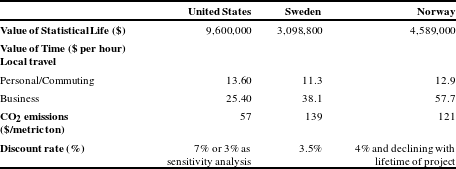
The current Swedish BCA models include a large set of parameters used to assess the economic values of the benefits of investment projects. Table 1 provides a compilation of a selection of parameters for which direct comparison of the magnitudes across countries is meaningful. It shows parameters in Sweden, Norway and the United States for VSL, travel time, CO2 and the discount rate. All monetary values are expressed in 2015 USD prices.

For safety, the VSLFootnote 20 is decisive for the economic benefit of reducing accident risk. As can be seen, there are significant differences in the VSL, with the Norwegian value 50% above the Swedish. A recent study commissioned by Trafikverket has, however, recommended a 60% increase of the Swedish value (Hultkrantz, Reference Hultkrantz2016). The U.S. value is three times the current Swedish value. This value is RP based,Footnote 21 while the Swedish and Norwegian values are derived from SP studies, which may suggest that the difference cannot be attributed to a potential hypothetical bias of the SP estimates. Except for VSL, the three countries also value the reduction of nonfatal injuries, but these are not comparable due to differences in definitions. The recent European guideline (European Commission, 2014) does not recommend a value for the VSL while the older HEATCO (2006) recommended a value corresponding to USD 1.8 million, which is significantly lower than the more recent recommendations in the table.
The value of travel-time savings for personal local travel (as well as for walking, access and waiting time, not shown in the table) is similar, while there are large differences for business travel. A reason for the latter value differences may be the differences of the income tax wedges, as the value of personal travel reflects the wage level after tax while business travel time is valued with wage before tax. However, while the value of personal travel is differentiated between local travel and intercity travel in Norway and the United States, it is not so in Sweden. There is no obvious explanation for this difference.
The table indicates significant differences in the recommended value of greenhouse gas (CO2) emissions with twice as high values in Sweden and Norway. The European Commission (2014) recommendation corresponds to a central value of 36 USD/ton for 2015 with an interval between 15 and 60 USD/ton. From an economic perspective this variation is problematic as a common value on global emissions could be expected. However, the high CO2 values in Sweden and Norway have probably their origin in these countries’ high profile in the international climate policy arena and national ambitions when there is a wide range of uncertain estimates to choose. Norway, for example, aims to stop the introduction of new fossil fueled private cars and light duty vehicles by 2025.
4.5 Discounting
The discount rate for calculations of the expected net present value of a stream of future benefits and costs is often the single most important parameter for the outcome of an economic analysis. Explicitly or implicitly, discounting addresses a complex set of interrelated aspects, involving intertemporal preferences, intergenerational equity, project risk, macroeconomic growth and risks,Footnote 22 and future relative price changes. It is no wonder, therefore, that selection of an appropriate discount rate has proven to be difficult.
In a review of basic principles, including whether or not to use a declining discount rate, Harrison (Reference Harrison2010) documents disagreements among scholars and actual practices in several countries. He also shows that national recommendations vary from 1 to 15%. However, there has been a trend over time toward lower rates. This is also the case for the Swedish transport planning where the discount rate has been successively reduced from 8% in 1981, to 5, 4 and, since 2012, 3.5%.
The discount rate can be seen from the supply side as the opportunity cost of capital, corresponding to the rate of return on the investment capital in its second-best use (before tax, after tax or a weighted average combination). It can also be seen from the demand side as a reflection of the society’s “pure” time preference (utility discounting), possibly including cross-generational preferences, and the diminishing marginal utility of consumption due to income growth (consumption discounting), as described by the Ramsey equation (Ramsey, Reference Ramsey1928).Footnote 23 Ideally, discount rates from these two perspectives coincide. However, there are (at least) two supply side rates, without and with accounting for risk. The latter includes a component that compensates for (average) project risk. The observed magnitude of this component, however, has been difficult to reconcile with the standard parameters of the Ramsey equation (the equity premium puzzle, Mehra & Prescott, Reference Mehra and Prescott1985).
These issues could be conveniently ignored in the first version of the BCA model in 1981, since on the one hand some studies had noticed that real returns to industry investments were around 8% (Bohm & Hjort, Reference Bohm and Hjort1972; Mattsson & Thompson, Reference Mattsson and Thompson1975), while, on the other hand, an early application of the Ramsey equation, based on a rather optimistic assumed interval of the real rate of per capita economic growth at 3–5%, suggested 5–12% rates of discount (Bruzelius, Reference Bruzelius1980). Eight percent was therefore seen to be in the middle of that interval and was chosen as the base discount rate, disregarding the difference in these estimates into whether compensation to risk was included or not. However, from 1995 the discount rate was entirely based on the Ramsey equation and it was acknowledged that plausible parameter values implied a considerably lower rate (see also Harrison, Reference Harrison2010, p. 36). The 2012 reduction to 3.5% was based on a projected growth of GDP per capita at 1.78.
Discount rates based on the Ramsey equation seem to be the rule in most countries, not just Sweden (Harrison, Reference Harrison2010).Footnote 24 This means that nondiversifiable project risk should be addressed in other ways, if at all. Norway is an exception with earlier official guidelines (Hervik et al., Reference Hervik, Hagen, Nyborg, Scheel, Sletner and Åvitsland1997) recommending a rate equal to the market average return to equity, fixed to 4.5%, with the possibility to use a lower rate, the risk-free rate plus one percent, for some category of “less risky investments,” and new guidelines (Hagen et al., Reference Hagen, Berntsen, Bye, Hultkrantz, Nyborg, Pedersen, Sandsmark, Volden and Åvitsland2012) recommending a risk-adjusted social rate of discount based on a theoretical method advanced by Weitzman (Reference Weitzman2012, Reference Weitzman2013). The rate comprises a weighted average of the rates of return on risk free and risky assets that over time declinesFootnote 25 toward the lower (risk free) rate. For road investments with a lifetime of 40 years the Norwegian Road Administration uses a discount rate of 4% which declines for projects with longer lifetime (Statens vegvesen, 2017). In an empirical analysis of rail and road transportation data for Sweden, Hultkrantz, Krüger and Mantalos (Reference Hultkrantz, Krüger and Mantalos2014) and Mantalos and Hultkrantz (Reference Mantalos and Hultkrantz2018) show, however, that – since transport investment and GDP are co-integrated time-series variables – the returns from transportation infrastructure investments, at an aggregate level, are not, or only to a small degree, diversifiable in relation to consumption. This suggests that the appropriate rate using Weitzman’s approach is (or is close to) the average return to equity. As it happens, this was suggested by Bohm and Hjort (Reference Bohm and Hjort1972).
A closely related aspect that until recently has been largely ignored concerns changes of relative prices – in this context of project benefits – over time. The lion’s share of benefits of a road or rail project normally emerge from improvements in travel time and reliability. Recent research on the value of travel-time savings (Ramjerdi, Flügel, Samstad & Killi, Reference Ramjerdi, Flügel, Samstad and Killi2010; Abrantes & Wardman, Reference Abrantes and Wardman2011; Börjesson et al., Reference Börjesson, Fosgerau and Algers2012) suggests that the willingness to pay (WTP) for travel-time reductions is closely related to income, with an elasticity close to one. Moreover, the value of traffic safety, in particular VSL, also strongly depends on income (Viscusi & Masterman, Reference Viscusi and Masterman2017). Based on longitudinal data, the income elasticity may even exceed unity (Hammitt & Robinson, Reference Hammitt and Robinson2011). Based on such results, Norway, Sweden and the U.K. have recently revised BCA guidelines, recommending that these economic parameters are assumed to increase over time with the growth of GDP per capita.Footnote 26
The rate of discount for infrastructure investments in Sweden has nominally been reduced to 3.5% in 2012. But the combination of ignoring risk and compounding future benefits means that the current effective rate, accounting for the escalation of benefits, is closer to 2%, magnifying the present value of benefits up to double compared to the previous 4% level.
5 The role of BCA in actual decision-making
Section 5 considers three aspects of the understanding of the consequences of using a systematic BCA framework in the planning of infrastructure expansion; the impact of BCA at large (Section 5.1), the drivers behind the impact, where there is one (Section 5.2), and finally the prioritization of megaprojects from a BCA perspective (Section 5.3).
5.1 Has BCA had any influence?
The national transport infrastructure planning process is initiated by the government sending a bill to the parliament, establishing broad guidelines as well as a tentative budget for a 12-year program. After parliamentary approval, the government instructs Trafikverket to prepare a program proposal. This is sent for a formal remittal process where after the government establishes the program. In this way, the prioritization of investment objects is affected by politicians (government and parliament) both in the initial phase, where some projects can be marked as being given priority already before the agency has performed a BCA and, of course, in the final prioritization of projects. During the process there is, however, ample room for Trafikverket to affect priorities. One means for affecting the outcome emanates from the choice of which out of typically multiple design alternatives that is chosen. The selection of objects for the proposal to the government provides another means for affecting the outcome.
The extent to which results of BCA actually affect the final outcome of this process has been investigated in several studies. Nilsson (Reference Nilsson1991) analyzed the ranking of investment projects in the 1985 (then) ten-year national program to the ordering implied by the results of NPV ratio estimates. He concluded that there was a considerable discrepancy between the two orderings, implying that the BCA results had a weak impact on the final decision-making.
More recently, Eliasson and Lundberg (Reference Eliasson and Lundberg2012) established that projects with a higher NPV ratio had a higher probability of being included in the 2010–2021 program. This relationship was, however, stronger at lower NPV ratio levels, indicating that economic evaluations were used to exclude unprofitable projects, whereas among profitable projects the relationship was weaker. While difficult to substantiate, the initial emphasis on BCA may have made planners at the agency “trim” proposed investments by trying to reduce investment costs without significantly reducing benefits. Moreover, projects given high priority by politicians but not by the agency did not show any relationship between the NPV ratio and the probability of being included in the plan.
In an extension of that study, Eliasson, Börjesson, Odeck and Welde (Reference Eliasson, Börjesson, Odeck and Welde2015) compare the influence of BCA in the Swedish planning of road investments for the same period with that of Norway, which has a similar planning process, for the period 2014–2023. Splitting decisions into those made by the respective administrations and those made by politicians, they found that in Sweden, the administration’s decisions were affected by projects’ NPV ratios, that is, a higher rate of return increased the chance of a high ranking. The administration attained 61% of the potential welfare gains that a strictly benefit-maximizing decision maker would have attained (a measure of selection efficiency) over a random selection. Politicians’ decisions were only weakly influenced by NPV, and only for small projects, and the overall selection efficiency was in fact negative. In contrast, in Norway, neither the decisions of the administration nor those of the government seemed to have been affected by the NPV ratios, the selection efficiency of the outcome being close to zero.Footnote 27
5.2 What is affecting the role of BCA?
To consider the role of BCA in Sweden it is useful to compare priorities to the situation in Norway. The national differences may reflect the stronger role of central versus regional government in Sweden than Norway.Footnote 28 As observed above, the prioritization of road investments in Sweden was very much in the hands of the road-administration officials well into the 1990s.Footnote 29 The administration was at that time divided into 24 counties, each sending a list of projects to the national headquarter. Funding was supposed to be based on a ranking based on NPV ratios. Even if Nilsson (Reference Nilsson1991) could not establish that the results from economic assessments affected priorities, it is still possible that the way in which the process was designed may have deterred the districts from prioritizing projects with low ratios.
Another recurrent aspect of the prioritization process was first demonstrated by Hultkrantz, Lindberg and Nilsson (Reference Hultkrantz, Lindberg and Nilsson1997). They established that the government tended to (force) megasize projects through the parliament on a special track aside from the regular evaluation process. The absence of economic assessment of these megaprojects was subsequently criticized by the Parliament Audit (2000) and both the parliament’s permanent committee for transport and communication and the ministry of finance indicated that BCA should play a more prominent role in the planning process.
Sager (Reference Sager2016) raises several possible explanations for the low impact of BCA results in Norwegian planning. Importantly, the limited impact of the economic analysis is observed early in the planning process, already when the regional offices of the road administration adopt projects proposed by local politicians. These projects are forwarded without adjustments to the Ministry and to the Parliament. This indicates that the local governmental tier is provided with limited incentives to hold down costs or maximize aggregate benefits.
Norway’s local communities have strong power in the planning process for several reasons: The Planning and Building act gives local politicians decision power;Footnote 30 many projects are co-financed by local toll-road companies; and regional equity aspects have traditionally a strong standing on the national political agenda. This influence may come through the electoral system where candidates have to promote projects from their own region and also through the organizations of political parties where local support is paramount (Halse, Reference Halse2017).
Jussila-Hammes and Nilsson (Reference Jussila-Hammes and Nilsson2017) consider both political and economic determinants of the selection of national road and rail investments projects in Sweden in three consecutive national transport plans; 2004–2015, 2010–2021, and 2014–2025. Using a municipality level panel model with fixed effects and spatial interdependencies they establish that the prioritization of projects can be explained by three factors. First, projects with a BCA result have a better chance to be included than projects that do not. Surprisingly, this is so even if the NPV ratio is negative. Second, and less surprising, co-funding from a municipality increases the probability to be given priority. Finally, investments in one community that also benefit inhabitants in neighboring communities (projects with spill-over effects) have a higher chance of being funded. It should be noticed that the observed causalities of this correlation can go two ways; objects with a greater chance of being approved, with or without BCA, may also be more likely to be submitted to a BCA study.
5.3 BCA and megaprojects
The evidence obviously indicates only a weak influence of BCA results on the decisions made by policy makers. A conspicuous example is given by “Göteborgspaketet,” a SEK 15 billion project (see, e.g., Flam, Börjesson, Mörth & Nilsson, Reference Flam, Börjesson, Mörth and Nilsson2016) that was squeezed into the 2014–2023 program by the government at the very last stage of the process. It was after the program proposal had been through its referral process and just before the priority list was published. This investment had a negative NPV ratio and squeezed out several projects that would otherwise have been on the list. The government was in its full right to act in this way, but since the project was not included in the program proposal, it was never scrutinized in the public debate.
It is still reasonable to argue that BCA has a role also for the outcome of the political processes within the government and the parliament. An example is the lengthy political struggle over the construction of a high-speed rail (HSR) network between the country’s three largest cities. After lobbying by industry groups and the cities that expected to get stations along the new lines, there seemed to be a majority in the parliament around 2008 for going ahead with this project, which initially was assessed to cost around 100 billion SEK (10 billion EURO). This cost estimate has subsequently quadrupled.
At least partly because of persistent negative NPV ratios in three studies (Banverket, 2009; Trafikverket, 2012, 2016), successive governments have postponed the final decision, and – referring to the BCA results – some political parties that previously supported the proposal are now less keen. The most recent (but probably not the last) occurrence in this process is that the government in 2016 instructed Trafikverket to include some sections of the HSR network in the next transport plan. Even if these bits of the overall package have more traffic than the rest, there are no indications of a positive rate of return; this has been criticized in the public debate. So even if a HSR network at the end of the day will be built, BCA has played a role in the political process and has succeeded in postponing multibillion projects with too few users to be motivated from a welfare perspective.
6 Conclusions
This article gives substantial scope to a description of the institutional structure in which BCA results are an input. One Swedish feature of transport sector decision-making is that the BCA model is administered by one of the country’s government administrations and that the ultimate decision makers, the central government, except at grand speeches, has a hands-off attitude toward the model.
The paper has reviewed the gradual introduction of BCA as a means for prioritizing infrastructure improvement projects competing for a common state budget. Prioritization was initially delegated to road-administration bureaucrats and the BCA provided a degree of transparency in their choices between investments. As part of an increasingly politicized prioritization process, the role of BCA came to have a profound legal status. Rather than producing an overt power struggle for funds, it was tolerated as a means for handling conflicts of interest. Prioritization in the most recent investment programs has less to do with the estimation of project benefits and costs and is rather an opaque means for political “horse-trading” (or dealing). The prime role of BCA today is therefore again as a transparency instrument and a means for questioning the merits of grand road and railway improvements. While the structure of BCA is well known and accepted by economists, it is questioned by some other scholars and most of all by interest-group representatives that have their pet, or favorite, projects questioned.
Delegation of responsibility for providing the BCA instrument to the agencies has resulted in substantial resources being spent on the estimation of costs and benefits. Despite domestic efforts and international research, several challenges however remain. A never-ending debate concerns the level of the discount rate, where one unresolved concern relates to the appropriate way to handle intertemporal uncertainty. The choice between a “low” and a “high” discount rate is decisive not only for whether projects pass the NPV test, but even more so for the significance of future benefits. Although the relative weight of current versus future generations is close to the tasks of policy makers, it is reasonable to ask economists for a (country specific) growth rate as well for consensus on the treatment of risk.
The methodological challenges in the valuation of various nonmarket benefits are inevitable and require regular updating inter alia to handle the consequences of rising real incomes and gradual preference changes. Moreover, the environmental consequences of traffic and transport are getting more attention, especially the impact on global warming. Parameter values to handle changes in emissions have also been introduced into BCA practice. Since road investments primarily affect local environmental quality, those investments are less suitable policy instrument for curbing emissions on a national or global scale. Except for in rather special choices between policy options, the valuation of externalities is of secondary relevance to the use of BCA for investment prioritization at large. The trend toward vehicles that do not rely on combustion engines is further strengthening this position.
For Sweden, the single biggest concern is the systematic downward bias of construction cost estimates. While this is unrelated to BCA as a method, it has a huge impact on the outcome of the planning process. Moreover, the country’s political process has a strong forward-looking emphasis. Since historic spending on infrastructure is unchangeable and since it is the use of resources for the future that may make a difference for generations to come, future orientation is appropriate. But, there are still lessons to learn from history. By increasing interest in outcomes and what has driven cost increases, important lessons for the design of new activities can be learned.
The validity of economic appraisals as a basis for policy making is frequently questioned and the most common domestic criticism is that BCA results underestimate project benefits. To a degree, this critique is inevitable and often emanates from representatives of special interests that are not interested in a balanced discussion. Moreover, researchers must keep explaining that project benefits can only be counted once. Any increase in value of real estate is typically a secondary consequence, a knock-on effect. In contrast, BCA analysts seek to estimate the original, primary benefits of road and railway improvements to the travelers and freight customers. Although asset value changes can be used as an indirect means for benefit estimation, they are not an additional benefit.
A domestic version of the criticism against BCA emphasizes the right of elected representatives of the people to decide which projects that are to be funded by tax revenue. The right of decision makers to pick winners is, however, not tantamount to the result that the selected projects represent the best way to use scarce resources. It is obvious that economists and other scholars can identify important trade-offs in a complex world that may be difficult to discern for nonspecialists. This capability is particularly important since many projects have both positive and negative consequences and the systematic treatment of goal conflicts is an important quality and contribution of BCA and economics.
Acknowledgments
The authors are grateful to the editors and reviewers for their helpful comments on earlier drafts. Henrik Andersson gratefully acknowledges financial support from VTI and the Centre for Transport Studies, Stockholm. The usual disclaimers apply.