I. INTRODUCTION
Metal–matrix composites (MMCs) are engineered mixture of two or more materials (one of which must be a metal) where, tailored properties are attained by systematic processing of different elements. Compared to aluminum composites, conventional monolithic alloy materials have limitations in respect to achievable blends of strength, stiffness, and density. Engineered MMCs consisting of reinforcement particles in a matrix metal achieve improvements of very high strength and mechanical properties. Besides, efficient blueprint and manufacturing techniques allow exceptional varieties of mechanical properties in composites like high strength, fatigue strength, compressible property, thermal coefficients, and friction coefficients and wear resistance. Fundamentally, MMCs consist of homogeneous or nonhomogeneous distribution of fibers, whiskers, or particles in a matrix material which improves necessary properties that is not achievable in monolithic alloys. Considering the manufacturing aspects of composite materials, where the volume and shape of component is governed by phase maps, for instance, aluminum alloys composites, can be produced by powder metallurgy route faster than any other conventional methods. The recent development in composites manufacturing diverge in the sense that any selected volume, shape, and size of reinforcement can be artificially introduced in the matrix. Conventional materials for industrial applications are replaced by composites which contain calculated volume fraction blends of metals and ceramics reinforcements, where there are lesser thermodynamic constraints on the volume percentages, shapes, and size of both matrix phases and ceramic particulates. Composites are manufactured by carefully varying the relative amounts and distribution of the particulates constituting a composite as well as the processing conditions, MMC's can be processed with a bespoke set of valuable engineering properties which can be a replacement for conventional monolithic alloy materials. These could include improved strength, lesser weight, higher temperature resistance, improved wear resistance, improved elastic modulus, better coefficients of thermal expansion, and better fatigue properties. The expedition for improving performances of developing MMC fabrication technology is very much easier when fabricating the MMC's through powder metallurgy. These include both the preparation of the reinforcing phases and the development of fabrication technique. The enormous ingesting of monolithic 2xxx aluminum alloys in aerospace application has empowered the improvement of production technology such as powder metallurgy to a very efficient and dependable level of producing MMC's. Conventionally, liquid state processes, such as various casting methods, typical shaping methods, such as extrusion, forging and rolling and powder metallurgical techniques are used in fabrication of particulate reinforced aluminum metal matrix composites (MMCs). Reference Lindroos and Talvitie1 Powder metallurgy method is tough to be fully automated specially in case of complicated parts manufacturing and, thus it is perhaps not the right option for low cost production of aluminum MMCs for industrial applications. Reference Lindroos and Talvitie1 To ensure homogenous distribution of reinforcement particulates in the matrix metal, mixing by any mechanical means, electromagnetic means, or gas mixing is necessary. SiC particulate is one of the commonly used discontinuous reinforcements in aluminum MMCs although the density of SiC is slightly greater than that of aluminum. This might be because it is available readily at low cost, indeed gives the composite high strength and elastic modulus compared to monolithic aluminum alloys. Another commonly used reinforcement material in aluminum MMCs is Al2O3. When compared to SiC particulates, Al2O3 particulates are much more inert in aluminum matrix and Al2O3 has also exhibited good oxidation resistant property, found to be more appropriate for high temperature fabrication technique and application.
A12O3 addition to aluminum matrix faces poor wettability problem when processed by the liquid stirring techniques, powder metallurgy route has an excellent solution to overcome such problems because of variety of blending methods available for composite mixing. Reference Lindroos and Talvitie1 Secondary operations are practically not needed to produce a component from MMCs since powder metallurgy process aims for a near net shape manufacturing. In case of both monolithic aluminum alloys and aluminum MMCs, fabrication by powder metallurgy is more feasible. Nevertheless, accurate machining and secondary operation methods are necessary to enable the extensive utilization of MMC's. In the future, environmental factor plays major role in materials usage and the standard of production processes. Hence, methods for regaining and reconditioning of composite materials must be industrialized and well systematized. Reference Lindroos and Talvitie1
II. PROPERTY AND APPLICATIONS OF ALUMINIUM 2XXX SERIES
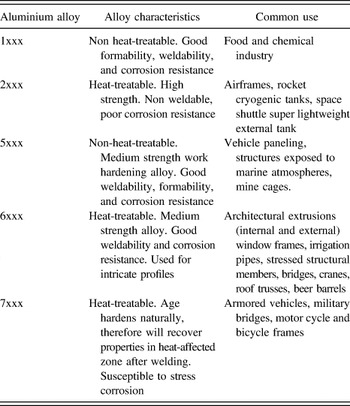
Choosing appropriate aluminum alloy with characteristic alloying elements such as copper, magnesium, manganese, silicon, and zinc are used for a desired industrial application where the mechanical properties like tensile strength, relative density, ductility properties, formable feasibility, workability, wear properties, and corrosion resistance are taken into consideration. The application of various aluminum alloys are shown in Table I. Aluminum alloy 2xxx series which are heat treatable, and containing copper as major alloying element possessing unique characteristics such as high strength to weight ratio at room temperatures and elevated temperatures are used in aerospace applications. Ultimate tensile strength (UTS) of aluminum alloys 2xxx series range from 27–62 ksi. Aluminum alloys 2xxx have good ductile and formability characteristics, good toughness characteristics and are not corrosion resistant at atmospheric condition. The higher strength aluminum alloy series of 2xxx alloys are primarily used for aerospace application (2024), automobile bodies (2014), and similar industrial applications. Some aluminum alloys series (i.e., 2219 and 2048) are spot welded, and is used in spacecraft applications. Alloy 2195 is a new Li-bearing alloy for aerospace applications providing improved modulus of elasticity along with improved strength to weight ratio and improved weldability. There are also existence of aluminum alloys with high-toughness (i.e., 2124, 2324, 2419), which have proper control on the impurities that may reduce the mechanical properties. Aluminum alloys 2011, 2017, and 2117 are extensively used for fasteners and screw-machine stock.
List of aluminum alloy series and its applications.

III. PROPERTY AND APPLICATIONS OF CERAMIC REINFORCEMENT
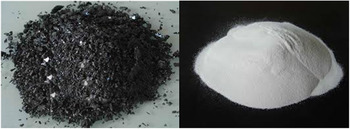
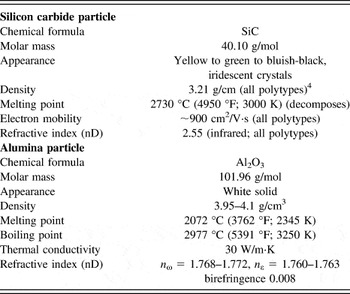
The reinforcement particulate is mixed and implanted into the metal matrix to produce MMC. The reinforcement particulates afford a fundamental mechanism in changing the structural properties of the MMC such as strength properties, hardness, wear resistance, coefficient of friction, and thermal properties. The reinforcement particulates mixed can be either homogeneous, or nonhomogeneous in the matrix metal. The most common reinforcing particulates used in MMC's are SiC and Al2O3 (Ref. Reference Torralba, Costa and Velasco2) which is shown in Fig. 1. Silicon carbide (SiC) is the combination of two compounds carbon and silicon. It can be effectively produced by an elevated temperature electro–chemical reaction of fine particle of sand and carbon material in a controlled atmosphere. SiC is an excellent abrasive resistance material even at high temperature application. Reference Torralba, Costa and Velasco2 Recently SiC material has been advanced into an improved quality which in addition to the matrix metal will improve the mechanical properties. Reference Srinivasa3 The motivation to use SiC as reinforcing material is when the purpose is to achieve improved abrasive resistant, improved wear resistance, and various advanced performance applications of the MMC. Reference Torralba, Costa and Velasco2,Reference Persson, Weiland, Hultman and Wahlstro4 SiC material can also be used to achieve improved electrical conductivity and to improve heating resistance. Silicon carbide (SiC) particulates consist of tetrahedral carbon and silicon atoms which has strong bonds in the crystal structure. Reference Srinivasa3,Reference Marahleh5 This provides a very hard and tough material. Reference Persson, Weiland, Hultman and Wahlstro4 Properties of silicon carbide (SiC) are low density, high strength, low thermal expansion, high thermal conductivity, high hardness, high elastic modulus; exceptional thermal shock resistance, superior chemical inertness, and the specific characteristic properties, which are given in Table II.
Blackish grey colored SiC powder and white colored Al2O3 particles.

Properties of silicon carbide (SiC) and alumina (Al2O3) particulates.
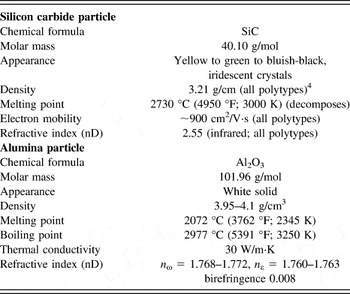
Aluminum oxide (Al2O3), universally mentioned as alumina, has a quality of high inter-atomic bonding which provides appropriate material characteristics as an effective ceramic reinforcement. Al2O3 existing in various crystalline phases is capable of relapsing to the best balanced hexagonal alpha phase while sintering at high temperatures. Reference Marahleh5 Alpha phase Al2O3 is the durable and hardest of the ceramics in oxide form. Al2O3 which possess high hardness, exceptional dielectric properties, good bonding nature, and decent thermal properties make it an effective reinforcing material of choice for an extensive variety of applications in the area of MMC. Exceptionally pure alumina (Al2O3) is always used in both oxidizing and reducing atmospheres at 1925 °C. The variation in volume percentage or weight percentage of the ceramic particulates can enhance specific necessary material characteristics in the case of MMC's. The effect of the larger weight or volume percentage of second phase Al2O3 particles; can be foreseen in the housing stage during super plastic flow. Reference Mishra, Bieler and Mukherjee6 It is normally believed that diffusion aided slip occupation is rate controlled when the MMC's are super plastically deformed. Reference Mishra, Bieler and Mukherjee6 In this condition, intra-granular ceramics reinforcements would obstruct the displacement of lattice dislocations from one side to the other, thereby making slip housing throughout the grain more challenging. Reference Mishra, Bieler and Mukherjee6 The amounts of avoidance of displacements of the grain rest on the dispersion parameters such as inter particle positioning and the weight percentage of ceramic reinforcements. Reference Mishra, Bieler and Mukherjee6 Further, the ceramic reinforcement particulate directly controls the grain boundary sliding, as they act as barriers in addition to the matrix metal. Various parameters connected to the ceramic particulates distribution can be obtained. Those are the particle to particle distance that defines the mean value of the distances of individual particulate to its nearest one. The statistical parameter that best agrees the difference in the deviations of different sets of values and to standardize measurements is the coefficient of variation (COV). Reference Corrochano, Lieblich and Ibáñez7 The COV of a particular measure is well-defined as the relation between standard deviation and the average, COV(m) = rm/m, where rm is the standard deviation and m is the average.
IV. EFFECT OF CERAMIC REINFORCEMENT ADDITION
A. Influence on the strength properties of the MMC's
Aluminum MMCs are produced by adding harder ceramic particles such as SiC and Al2O3 into monolithic aluminum alloys to obtain improved strength properties and heat treating the MMC's will further help in improving specific properties such as compressive strength, ductility, and microstructural refinements. Commonly, tensile strength of MMC's prepared by casting method is about 1.5–2 times of the samples produced by powder metallurgy route. The powder metallurgy route had comparable compressive strength and hardness data as samples prepared by casting route. Tensile and compressive strength were decreased and hardness is increased by increasing the ceramic particulate amount. Reference Ünlü8 In addition, as particulate amount increased, notch impact strength decreased in casting materials and bending strength decreased in powder metallurgy processed samples. Reference Ünlü8 The increase in the volume percentage of SiC particulates refines the structure of the matrix and gives a finer grain size when samples produced through squeeze casting technique. Reference Bekheet, Gadelrab, Salah and El-azim9 The highest hardness of MMC's is marginally higher than that of 2024 monolithic alloy, which was achieved by cold deformation process after adding SiC particles. The time required to reach the highest hardness is apparently affected by the presence and amount of SiC particulates. Reference Bekheet, Gadelrab, Salah and El-azim9 The addition of SiC particulates and artificial aging of the aluminum alloy with copper presence greatly improves the fatigue limit of the MMC's. Roughly 100% increase in the fatigue limit has been accomplished by addition of 5 wt% SiC particulates to the monolithic aluminum alloy. Reference Bekheet, Gadelrab, Salah and El-azim9
Age hardening is an inexpensive way to improve the mechanical properties of MMC's compared to monolithic aluminum alloys. During the powder metallurgy fabrication of aluminum alloy 2014 which are heat treatable, age-hardening of aluminum alloy MMC's occur in three different steps; solution treating at (510 °C), quenching in water medium and aging at (20, 150, 200 °C), which increases strength and hardness by maximum 80% and minimum 40%. Reference Durmuş and Meriç10 The Vickers hardness values have increased during aging duration accounts for roughly 60% of the overall hardness increase witnessed at the high hardness condition for sintered at 600 °C and natural aged sample. At both temperatures, rapid increase in hardness is witnessed within aging duration of 20 h for sintering temperature at 600 °C artificial aged and natural aged sample, supreme hardness value was ensured in samples sintered at 600 °C and samples that are artificial aged at 150 °C found with hardness value of (120 HV), in these samples the microstructure was uniformly dispersed with Al2Cu precipitates and over aging of the composites caused the degradation of the mechanical properties because of larger amount of precipitates formed and dispersed in the matrix when processed by powder metallurgy route and hardness increased with the increase in artificial aging time. Reference Durmuş and Meriç10 A direct correlation exists between the density and hardness, where density reduces with increase in the reinforcement percentage, the hardness increased and vice versa. All natural aged samples are observed to have lesser hardness than artificial aged MMC samples. Reference Durmuş and Meriç10 Peak hardness was observed for natural aged and sintered MMC's sample at 620 °C. The micro hardness of natural aged samples decreased with increasing the sintering temperature. There was an increase in theoretical density with increase in the sintering temperature of the MMC's. Peak theoretical density values are noticed for MMC samples that are sintered at 620 °C. Reference Durmuş and Meriç10
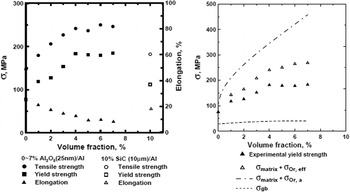
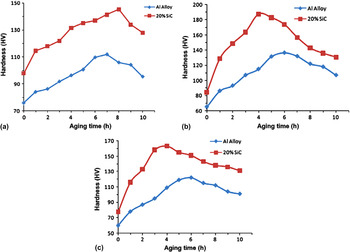
Compared to conventional sintering methods discussed earlier, mechanical properties of aluminum alloys can be improved by hybrid microwave sintering process conducted near to melting temperature of the monolithic parent metal, where diffusion process intensifies because of microwave processing of the composites and improved grain distribution can be attained. Reference Wai, Eugene and Gupta11–Reference Singh, Gupta, Jain and Sharma13 The micro hardness of microwave processed composite samples was 1064 HV, and percentage of porosity was considerably reduced to ∼0.89%. Improvements in the field of microwave processing of composites have improved strength when compared to conventional heating techniques. Reference Singh, Gupta, Jain and Sharma13 For samples with monolithic aluminum alloys, an observed development in MMC's hardness, 0.2% yield strength, UTS and work of fracture was noticed when compared with hybrid microwave sintered samples with conventionally sintered one's. Reference Wai, Eugene and Gupta11 Aluminum with TiN as reinforcement with various fractions of 10, 20, and 30 wt% MMC's were manufactured by powder metallurgy route and microwave processed. Experimental data propose that the microwave sintering for 2 min is satisfactory and melting of composite pellet was observed while increasing the sintering time. Increasing the reinforcement of TiN from 10 to 30 wt% exhibited higher hardness and strength properties when compared to aluminum with TiN composites prepared by conventional hot pressing. This is attributed to good interfacial bonding noticed in the matrix microstructure due to excellent diffusion mechanism assisted by microwave sintering technique. Reference Venkateswarlu, Saurabh, Rajinikanth, Sahu and Ray14 Considering ceramics reinforcements like SiC and Al2O3, alumina has a better reflection on the mechanical properties of the composite as shown in Fig. 2. However wear behavior of the composites might be diminished. Reference Senthilvelan, Gopalakannan, Vishnuvarthan and Keerthivaran15,Reference Kang and Chan16 Heat treating the aluminum alloy 2xxx, the precipitation phases found in the MMC's in both as processed and solutionized conditions were CuAl2 and CuMgAl2 phases. The MMC's samples solution treated for 1 h has a larger amount of these undissolved precipitates in the matrix microstructure than those solutionized for 2 h and 3 h. Reference Mousavi Abarghouie and Reihani17,Reference Dhadsanadhep, Luangvaranunt, Umeda and Kondoh18 . The MMC's reached its max hardness in lesser time compared with the unreinforced monolithic aluminum alloy on solution treatment for 2 h and 3 h, but reached it in longer time on solution treatment for 1 h, where considerable amount of uniformly dispersed strengthening precipitates are observed in the matrix (Fig. 3). Reference Mousavi Abarghouie and Reihani17
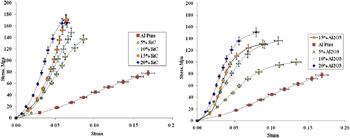
Tensile properties of the aluminum and composites and yield strength for nano-Al2O3/Al composites compared with experimental results. Reference Kang and Chan16

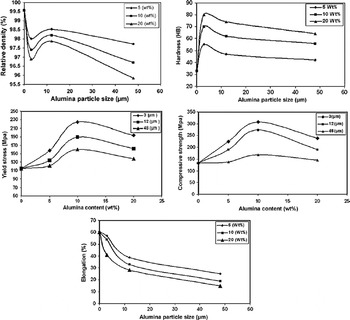
Effect of alumina particle size and weight percentage on the strength parameters of the composites. Reference Rahimian, Parvin and Ehsani25

Current trend in powder metallurgy is fabrication of hybrid aluminum alloy composites by adding two or more reinforcements to the matrix. The increase in weight percentage of glass and SiC particulates as reinforcement in the aluminum matrix increases the strength characteristics of the MMC's, because of decrease in pore size or improvement in relative density of the samples were observed when fabricated by powder metallurgy route. In general, the strain hardening index value increases with increasing weight percentage of glass and SiC particles as the pore size decreases. This intern decreases the geometric work hardening and increases the metal matrix work hardening. The strength coefficient value increases with higher weight percentage addition of glass and SiC because of better densification of powder mixtures processed by powder metallurgy. Reference Persson, Weiland, Hultman and Wahlstro4,Reference Kumar, Narayanasamy and Loganathan19 The coarser particulate of size (150 µm) of glass and SiC added in hybrid MMCs shows an increase in strain hardening index and increase in strength coefficient characteristics because of improved load transfer rate of glass and SiC is observed in the aluminum matrix compared to fine particulate sizes. Reference Persson, Weiland, Hultman and Wahlstro4,Reference Kumar, Narayanasamy and Loganathan19,Reference Purohit, Rana and Verma20
The improved strain index and improved formability stress index are again noticed because SiC ceramic particles are harder than glass. Al-4% glass with various volume percentage of SiC particulate hybrid MMC's shows improved formability stress index characteristics when compared to Al-4% SiC with various percentage of glass hybrid MMC's, which actually infers that the amount of ceramic content positively influence the strength behavior and the microstructural behavior of the composites. Reference Kumar, Narayanasamy and Loganathan19 Varying the particle size of the ceramic content also has better effect on the strength properties of the composites. Pure monolithic aluminum alloy and its MMCs reinforced with 10 vol% SiC particulates of average particle size 3.5, 10, and 20 µm were fabricated by powder metallurgy route. The result obtained indicates that both monolithic pure aluminum and SiC-particulates-reinforced powder metallurgy processed composites exhibit improved characteristics of apparent-stress exponent of 14.3 ± 26.1 and superficial activation energy (253 ± 261 kJ/mol). Reference Tjong and Ma21 The creep rates of aluminum composites reinforced with lesser SiC particles size of 3.5 µm are 2 times lesser in magnitude and creep resistance with larger particulates of size 10 and 20 µm are nearly to those of monolithic aluminum alloys. Reference Tjong and Ma21 A diffusion or super solidus liquid state sintering method was used to enhance desired properties of powder metallurgy based aluminum alloy 2014 with additions of Ag or Sn. But by using such diffusion and liquid state sintering technique, hardness and tensile properties of highly aged powder metallurgy processed aluminum alloy 2014 were superior to the wrought alloys. As well, the powder metallurgy processed composites exhibited better corrosion resistance. Reference Bishop, Cahoon, Chaturvedi, Kipouros and Caley22 The passive oxidation performance of SiC particulates at elevated temperatures, interfacial response in aluminum alloy 2014 reinforced with SiC particles after prolonged high thermal exposure was characterized for the samples fabricated by liquid infiltration technique. According to the oxidation characteristics of SiC particulates, the oxidation constraints and the degree of oxidation for SiC particulates can be efficiently controlled. Reference Shi, Yang, Lee, Zhang, Lee and Wu23 Observation on the interfacial response between the oxidized SiC particulates and aluminum alloy (AA) 2014 metal matrix displayed that nano-particles MgO can form primarily but will ultimately turn into a thermo stable MgAl2O4 crystals. The SiO2 layer which exhibit good bonding adherence with both SiC and 2014 aluminum matrix metal; however, it can be exhausted by the interfacial response after prolonged high thermal exposure. Reference Shi, Yang, Lee, Zhang, Lee and Wu23 Apart from preprocessing of ceramic reinforcements with techniques like oxidation and ceramic coatings, mechanical alloying of the matrix metal improves the composites characteristics by the increased grade of deformation, increased density of displacements and strengthening by oxide and carbide scattering. The addition of ceramic reinforcement particulates drives the mechanical alloying technique due to the improved deformation enforced on the matrix metal phases. Reference Purohit, Rana and Verma20,Reference Fogagnolo, Velasco, Robert and Torralba24 In a study, the investigation of 0–20 wt% alumina (Al2O3) with average particle sizes 48, 12, and 3 µm and aluminum matrix of average particle size of 30 µm fabricated by powder metallurgy route on the mechanical properties like relative density, hardness, yield strength, compressive strength, and elongation. Axial compaction pressure of 440 MPa and sintering temperature of 550 °C for 45 min was used in the fabrication of this MMC's. As the amount of Al2O3 particles increases, the aluminum MMC's relative density reduces.
As the Al2O3 particle size increases, the relative density increases at first, and then reduces. Reference Rahimian, Parvin and Ehsani25,Reference Pournaderi, Mahdavi and Akhlaghi26 Reducing the alumina (Al2O3) particulate size increases the hardness and raising the amount of Al2O3 from 10 to 20 wt% with 12 µm particle size gives rise to an increase in hardness from 62 to 74 Brinell hardness number (HBN), with peak hardness of 79 HBN for 20 wt% 3 µm sized Al2O3 particulates. Reference Rahimian, Parvin and Ehsani25,Reference Pournaderi, Mahdavi and Akhlaghi26 The finer particulate size of Al2O3 offers superior yield strength and compressive strength of the composites which is because of decrease in the particle size and at lesser weight fraction of the ceramic content, grain size and alumina particle distribution homogeneity was observed to increase in the microstructure of the MMC's. By raising the amount of Al2O3 up to 10 wt%, yield strength and compressive strength raises, where peak was 307 MPa for particulate size of 3 µm, conversely, raising the amount of Al2O3 from 10 to 20 wt% exhibited a reverse trend. Reference Rahimian, Parvin and Ehsani25,Reference Kok27 Existence of finer Al2O3 in MMC's affects peak elongation. Addition of 20 wt% of 12 µm Al2O3 to the monolithic aluminum alloys, results in reduction of elongation percentage by 32% because at lesser particle size and with more weight percentage the number of particles count increase which leads to agglomeration of the ceramic reinforcements. Reference Kok27 The reduction in the Al2O3 particle size in a stable quantity results to a raise in the elongation. Reference Rahimian, Parvin and Ehsani25,Reference Kok27
The fabrication of macro aluminum composites reinforced with 1.0 to 5.0 wt% percentages of boron nitride nano tube (BNNT) were produced by two different techniques of powder metallurgy, namely spark plasma sintering (SPS) and high pressure torsion (HPT). The characteristics for aluminum with BNNT 3.0 wt% MMC's was observed to be double (190 MPa) when compared to monolithic aluminum–HPT compacts (90 MPa). And the ultimate tensile strength of aluminum with BNNT MMC's comprising 3.0 wt% BNNT (∼300 MPa) ∼1.5 times higher than that of a nano tube free HPT–aluminum material(∼200 MPa). Reference Yamaguchi, Meng, Firestein, Tsuchiya and Golberg28 Remarkable grain refinement was observed in HPT samples compared to SPS ones which leads to an overall denser microstructure with a minor amount of micro pores between the sintered aluminum grains. Reference Yamaguchi, Meng, Firestein, Tsuchiya and Golberg28
Generally in heat treatable aluminum alloys, failures occur by dimple type fracture from inclusions or second phase particulates where inter granular, volumetric shear, and delamination type fractures were observed. Fracture of precipitate phases of intermetallic compounds like CuAl2 and Al2CuMg is noticed in the size range of 5–8 µm and their strength is valued approximately 710 MPa and decreasing with increasing particulate sizes. Reference Kobayashi29 Fractures of metal ceramic compositions like Al3Zr or Al3Ti particulates were not observed in MMC's. Besides, it is understood that delamination happens when the normal stress against the grain boundary inter phase reaches 116 and 113 MPa when synthesized at liquid helium and room temperature, respectively. Reference Kobayashi29
An examination on the forgeability and strength properties of powder metallurgy processed and extruded, co-sprayed SiC reinforced 2014 and 2618 MMCs were studied. The results examined leads to a conclusion that, segregated bands, holding high and low concentration of SiC particulates, formed an exceptional metallurgical array in the co-sprayed reinforced matrix material only. Reference See and Dean30 The forgeability of powder metallurgy processed AA 2014 MMC is superior, but strength properties are inferior compared to MMC's manufactured by the co-spray deposition method. Reference See and Dean30 The forgeability characteristics of AA 2618 MMC's are less than one half of it characteristics when compared to AA 2618 monolithic alloy.
The lesser ductility characteristics of the MMC's containing more SiC ceramic particles may confirm the fact that higher volume fractions generally give a nonhomogenous mixture and grouping of the ceramic particles, reducing the mechanical properties of the MMC's i.e., increasing the volume fraction of 16 µm SiC particulates reduces the strain to fracture characteristics as shown in Fig. 4. Reference Marahleh5,Reference Hassani, Bagherpour and Qods31 MMC's with higher amount of SiC particles or with lower particle size, the total metal matrix–ceramic interfaces is longer because of which the finer reinforcement particulates cause an raise in strength and a reduction in ductility and formability of the MMC's (Fig. 5). Reference Hassani, Bagherpour and Qods31
Stress strain behavior of aluminum material reinforced with various percentage of SiC and Al2O3 ceramic particulates. Reference Marahleh5

Variation of hardness versus aging time for 2024Al-20 vol% SiC composite and 2024 Al alloy aged at 191 °C and solutionized at 495 °C for: (a) 1 h; (b) 2 h; (c) 3 h. Reference Mousavi Abarghouie and Reihani17

Powder metallurgy technique was used to fabricate a dense AA-4.0 Cu (wt%) MC's reinforced with 3–15 µm-65 vol% Si particulates which were uniformly dispersed where, larger volume fractions of silicon has been the auspicious material for lightweight and low-thermal-expansion characteristics. Reference Liu, Wei, Fan, Ma and Zuo32 Tensile strength and flexural strength of the MMC's were recorded as 282 and 455 MPa, respectively. The observed fracture toughness of the MMC's was 4.90 MPa √m. The enhanced strength of 65%Si-AA was qualified to the optimized particle behavior and metal matrix characteristics. Reference Liu, Wei, Fan, Ma and Zuo32
The validation of various volume percentage of β phase-Al3Mg2 intermetallic compounds as strengthening agents in powder metallurgy processed MMCs were studied, results outcome showed that compression tests at room temperatures exposes that the adding of the β phase-Al3Mg2 intermetallic compounds curiously increases the strength properties of monolithic aluminum alloy. Reference Scudino, Liu, Sakaliyska, Surreddi and Eckert33 In specific, the MMC's with 20 and 40 vol% of reinforcement shows yield strength and compressive strengths exceeding the monolithic aluminum alloy by a multiple of 2–3, however holding considerable plastic deformation characteristic ranging from 15% to 45% to . Reference Scudino, Liu, Sakaliyska, Surreddi and Eckert33 The strength of the MMC's is additionally increased for the samples reinforced with 60 and 80 vol% of β phase-Al3Mg2 intermetallic phases; however, the MMC's exhibit negligible plastic deformation. Additionally, adding the low-density β phase-Al3Mg2 particles decrease the density of the MMC's compared to that of monolithic aluminum alloy, noticeably increasing the specific strength of the MMC's. Reference Scudino, Liu, Sakaliyska, Surreddi and Eckert33
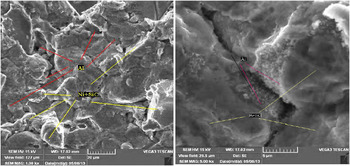
As discussed earlier, improvement on the interfacial strength of powder metallurgy processed aluminum–ceramic (SiC) MMC's were studied by coating electroless nickel on the ceramic particle SiC. It was visualized that ultimate failure load for electroless nickel coated ceramic (SiC) reinforcement has shown an increasing trend by 40% with respect to uncoated one. Reference Umasankar, Karthikeyan and Xavior34 The improvement in interfacial bonding strength was witnessed for coated ceramics (SiC) reinforcement in aluminum matrix. The coating improved diffusion of ceramics reinforcement (SiC) into the aluminum matrix as shown in Fig. 13. Reference Umasankar, Karthikeyan and Xavior34
Investigating the effect of Al2O3 of particle size 12 and 48 µm, sintering temperature of (500–600 °C) and sintering time of (30–90 min) on the properties of Al–Al2O3 composite were studied. The peak strength of 318 MPa, maximum hardness of 76 HB was observed in samples having average particulate size of 3 µm and conventionally sintered at 600 °C for duration of 45 min and increasing in sintering time to 90 min results in a decreasing in hardness by 59 HB, which is of 33% reduction in hardness values in prolonged sintering time. Reference Rahimian, Ehsani, Parvin and Baharvandi35 For prolonged sintering times and smaller the particle sizes of Al2O3, larger the compressive strength and improved elongation percentage of the MMC's were noticed. Reference Rahimian, Ehsani, Parvin and Baharvandi35 Peak elongation was 61.8% in MMC's samples having the average particulate size of 3 µm because at lesser particle size of ceramic contents the porosity levels in the matrix micrographs are observed to be less and leads to higher relative densities of the composites, in turn improved mechanical properties. Reference Rahimian, Ehsani, Parvin and Baharvandi35
For powder metallurgy processed aluminum composites tensile strength properties of artificially under aged and over aged MMC's were observed to be merely same. Notched bend results showed that artificially under aged MMC's fracture at higher bending stresses than did the artificially over aged MMC's. Fracture in artificially under aged MMC's initiated through ceramic SiC particles fracture ahead of the crack tip point by following linkage through failure in the monolithic matrix metal. Reference Chennakesava Reddy and Kotiveerachari36 Crack diverging and crack bridging were observed in the artificially under aged MMC's, while the over aged MMC's displayed a planar crack with a more liking for fracture near the ceramic SiC metal matrix interface. Reference Chennakesava Reddy and Kotiveerachari36
MMC's of aluminum alloy 2900 metal matrix reinforced with 10%, 15%, and 20% wt% of SiC, Al2O3, and graphene were prepared by powder metallurgy route. The brittleness was observed in the sample when the hardness test was conducted after duration of 2 months letting the samples to natural age, which had lead to formation of intermetallic compounds such as Al2Cu in larger amount in the matrix that dispersed which degrades the strength of MMC's. Reference Ashwath and Xavior37 The results were obtained when the samples are microwave sintered at rate of heating 20 °C per minute because of carbide formation in the samples considering the rate of heating factor. At 2 °C per minute heating which is almost equal to conventional sintering type will eliminate such issues. Reference Ashwath and Xavior37
Conventional powder metallurgy method was used to fabricate nanometric particulates reinforced aluminum MMC's. It is obvious from the effort that the nanometric particulates enhance the mechanical properties in the monolithic aluminum alloy. The major strengthening mechanism was observed to be the Orowan strengthening by these ceramics particulates. Reference Kang and Chan16 However, as the particulate volume percentage increased, the degree of agglomerations of the ceramic particulates increased. The nano-particulate amount in the MMC's when increased more than 4 vol%, the agglomerations were observed to reduce. Reference Kang and Chan16
B. Influence on the tribological properties of the MMC's
Among all the ceramic reinforcements such as SiC whiskers, TiC particles, boron, carbon and Al2O3, SiC particulates are widely used due to their low cost, varied choices of available grades, mostly more stable and chemically compatible SiC and Al2O3 particles addition improves the resistance to wear of the monolithic aluminum alloys. The experimental data verified that addition of the 20 wt% of SiC particulate to the liquid metallurgy processed aluminum alloy steered to an intense improvement in resistance to wear property of the monolithic aluminum alloy. The wear resistance of MMCs was found favorable and observed to be better than those of ductile iron, its alloy and heat-treated specimens, tested at the 70 µm size of abrasive sheets. The resistance to wear increased with increasing wt% ceramic particles added to the MMCs. Reference Sahin and Kilicli38 When composites tested against 70 µm sized abrasive sheets, it was noticed that the amount of wear rate in the MMC's was less than that of the aluminum alloys irrespective of all applied loads with, micrographs observations such as small quantity of wear craters, reattachment of debris particles due to abrasion of fractured particles in MMC's. Reference Sahin and Kilicli38 Considering the MMC's, the harder reinforcing SiC particulates might be resisted against the micro material removal action of abrasives, and the least material removal was observed for the 20 wt% SiC particles reinforced MMC's than that of the 10 wt% SiC particulate reinforced MMC's, but no substantial variances were noticed between them because of comparable mechanism throughout abrasive wear. Reference Sahin and Kilicli38
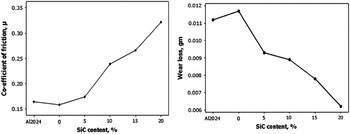
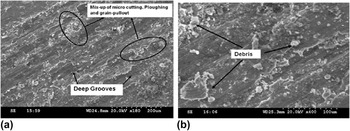
Testing powder metallurgy processed aluminum alloy with ASTM standard, resistance to wear was observed to reduce as sintering time was increased. This behavior is a result of micro structural coarsening. Reference Bishop, Li, Tandon and Caley39 Out of samples that were Ag reformed, and Sn reformed aluminum alloy and wrought 2014, Sn reformed powder metallurgy processed specimens showed the peak resistance to wear. Reference Bishop, Li, Tandon and Caley39 Hybrid MMCs based on Al/SiC/Gr have been effectively fabricated by powder metallurgy route tested for various loadings and sliding velocities examined, MMC's have displayed improved resistance to wear and improved coefficient of friction when compared with monolithic alloy matrix. The fusion of ceramic SiC particle reinforcement and addition of graphene to AA 2024 matrix raises the resistance to wear of the MMC's. The resistance to wear property and coefficient of friction of the MMC's samples increases with increasing the reinforcement percentage as shown in Fig. 6. Reference Ravindran, Manisekar, Rathika and Narayanasamy40 From Fig 15, the existence of harder SiC particulates in higher amount had influence on the wear behavior for which SEM micrographs clearly displays the existence of deep permanent grooves, micro cutting, grain pullouts and fracture of the oxide debris, which have lead to increase in wear loss. Reference Ravindran, Manisekar, Rathika and Narayanasamy41 The wear mechanism driving in hybrid MMC's with 20 wt% SiC and 5% graphite hybrid MMC's was delamination and oxidative wear (Fig. 7). Reference Ravindran, Manisekar, Rathika and Narayanasamy40,Reference Ravindran, Manisekar, Rathika and Narayanasamy41
Variation of COF and wear loss with SiC content. Reference Ravindran, Manisekar, Rathika and Narayanasamy40

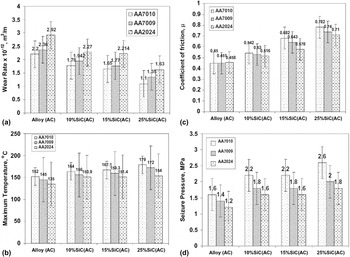
Effect of matrix alloy on (a) wear rate; (b) maximum temperature; (c) coefficient of friction; (d) seizure pressure; sliding velocity: 3.35 m/s. Reference Rao and Das46

A study on heat treatable aluminum alloy 2024 with Al2O3 processed by liquid metallurgy route does not reflect a valuable role of alumina (Al2O3) particles during the wear process for MMC's in extruded condition. The as extruded aluminum alloy 2024 comprises fine precipitate particulates and alumina particles aligned along extrusion direction. Reference Narayan and Bai42 Moreover, unlike SiC particulates which are recognized as a good load bearing material and resist surface plastic flow, the alumina (Al2O3) particles have the tendency to form fragments and disperse. Reference Narayan and Bai42 Heat treating the MMC's with alumina exhibited lesser surface cracks and failure where the precipitates are observed to be uniformly dispersed. Alumina with finely dispersed precipitates in the matrix material enhances the tribological property of the composites even at higher loading conditions. Reference Narayan and Bai42
Results on wear study of powder metallurgy processed Al-MMC's reinforced with 15 wt% ceramic SiC particulates using pin on disc wear testing machine against several SiC particle abrasive grades showed that, the abrasive grain size applied the highest effect on the wear rate of MMC's, followed by the improved hardness properties. Reference Şahin43 In consideration, bigger particles in the composites lead to more resistance to wear than those of smaller particle sized reinforcements in the composites, where the matrix microstructure with bigger particles ceramic content was observed to be agglomeration free compared with lesser particle sized reinforcement. This wear behavior might be because of fabrication technique of powder metallurgy, particulate sizes, the interaction effects, and testing conditions of the experiments planed. Reference Şahin43
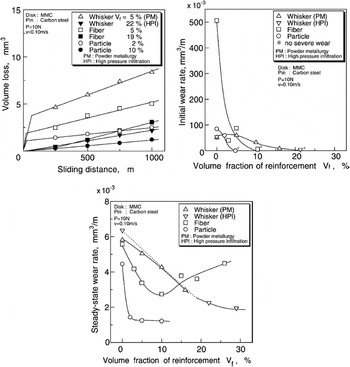
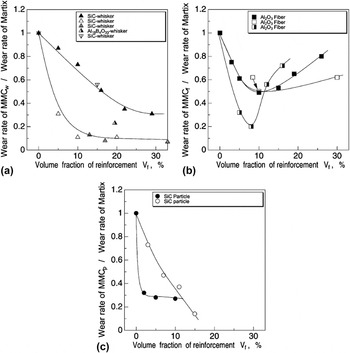
Dry sliding wear experiments on cast samples were conducted by a pin-on-disk wear testing machine where the disks materials were aluminum alloy MMCs reinforced with various ceramic reinforcements such as SiC-whiskers, Al2O3-fibers and SiC-particles, and the pin materials were made of 0.45% carbon steel. The amount of enhancement on resistance to wear of MMCs powerfully relies on the type of ceramic reinforcement and its volume fractions. Firstly severe wear rate was not observed for MMCs for volume fractions V fp = 5%, V ff = 10%, and V fw = 22%. Reference Miyajima and Iwai44 It is understandable that the ceramic reinforcement effectively prevents the initial severe wear rate and both fibers type and particulates type ceramics reinforcement was more operative in this respect than whiskers type once.
The steady-state wear of the composites were observed to decrease with increase in volume fraction of the ceramic reinforcement V f. Reference Miyajima and Iwai44 The volume percentages at which the steady-state wear attained the least value were 2, 10, and 29% for MMC with particulates, MMC's with fibers and MMC's with whiskers, respectively. Ceramic whisker fragments developed in the wear process were smaller in size, resulting in a lesser destructive action on the counter face of the rubbing material. Reference Miyajima and Iwai44 Moreover, fiber and particulate fragments were large in their size and angular in their shape, so that they encouraged abrasion on the counter face at higher volume fractions V f. particulate type ceramic reinforcements are better in case of improving wear resistances and frictional coefficient as a focused property as shown in Fig. 14. Reference Miyajima and Iwai44
Aluminum alloy matrix composite reinforced with low amount (0.2–0.6 wt%) of graphene have been effectively fabricated through powder metallurgy technique and it was noticed that change in the hardness data on addition of graphene is inadequate. The wear studies obviously prove the optimistic effect of graphene addition where it suppresses the friction coefficient and wear rate (weight loss). Especially, graphene addition to the matrix acts as a film which improves the tribological property. Reference Kumar and Xavior45 However, it progresses the surface roughness constraints by diminishing the wear grooves and least value is seen for 0.4 weight percentage of graphene in the aluminum matrix alloy. Reference Kumar and Xavior45
Sliding wear characteristics of the aluminum alloy composites examined for various weight fractions with response constraints such as amount of wear rate, seizure pressure, temperature rise, and frictional coefficient were studied. The wear resistance of the alloy is improved significantly due to ceramic particle addition. The wear rate is observed to decrease with increase in SiC content irrespective of matrix metal. At early wear period, the temperature rise in the aluminum alloy sample is noticed to be least. Reference Rao and Das46
Amongst the MMC's samples, rise in temperature is noticed to be high in AA-25 wt% SiC MMC's and less in the case of AA-10 wt% SiC reinforced MMC's, this behavior is addressed that, at higher amount of SiC the large number of particles count in the matrix is observed to be dispersed, which when wear tested will create high temperature in the contact interface where more particles come into contact with the mating disc. 2024 aluminum alloy system suffers from maximum material removal rate, where as the 7010 aluminum alloy system showed least material removal rate regardless of SiC amount and processing conditions. Aluminum alloy and ceramic SiC reinforcement plays a significant role in governing the wear behavior of the MMC's. Reference Rao and Das46 In a nut cell growth of seizure temperature because of varying SiC amount from 0 to 25 wt% is noted to be around 25 °C. An average seizure temperature increase is observed at the factor of 1 °C per wt% SiC particles. The coefficient of friction values increases at a factor of 0.123 per wt% of SiC ceramic particles. Reference Rao and Das46
Seizure pressure during wear varies with various aluminum alloy systems, 7010 displayed highest seizure pressure, while 2024 displayed least seizure pressure irrespective of processing condition and SiC ceramic content. 7010 alloy exhibited good tribological characteristics because of the higher amount of alloying elements added which leads to formation of intermetallic precipitates in larger amount and dispersed evenly when compared to 2024 and 7009. The material removal coefficient is observed to decrease with increase in the applied load reaching to a least value and then again observe to increase when the applied load reached near to the seizure of the samples. Reference Rao and Das46,Reference Asif, Chandra and Misra47 It is motivating to notice that the seizure load of MMC's barely affected when SiC ceramic content increase from 10 to 15 wt%. This was attributed to the fact that higher temperature flowability of the MMC's systems cannot be changed when SiC ceramic amount varied from 10 to 15 wt% weight percentage. Reference Rao and Das46
The hardness values and density measurements of the hybrid MMC's were observed to decrease with an increase in graphite amount. The MMC's with 5 wt% graphite showed both exceptional resistance to wear and frictional coefficients. The addition of solid lubricant particulates as the second phase reinforcement in the metal matrix successfully increases frictional coefficients and wear behavior. Reference Asif, Chandra and Misra47,Reference Ravindran, Manisekar, Narayanasamy and Narayanasamy48 A consistent graphite film on top of the worn surface helped to reduce both the wear loss and friction coefficient avoiding severe wear in the Al/5% SiC/5% Gr composites. Inclusion of graphite as primary reinforcing material increases the resistance to wear characteristics of MMC's by developing a defensive layer between mating pin and counter face of the disk and the addition of alumina (Al2O3) as a secondary ceramic reinforcement also had an important effect on the wear behavior of the MMC's. Reference Radhika, Subramanian and Prasat49,Reference Iacob, Popescu and Buzatu50
The effects of the hardness characteristics of counter face on the wear rate of ceramic SiC whisker or SiC particle reinforced aluminum MMCs were examined with pin-on-disk wear testing machine in which MMC were coupled by pins or disks. Concerning MMC's pin against steel disk mating specimens, the wear rates of MMC's of pins were persistent below a given hardness values, but varying inversely proportional with increasing hardness values of the mating steel counter face. Reference Miyajima, Sasayama, Honda, Fuwa and Iwai51
Looking on the other hand, the amount of wear on the steel disk material, varying inversely proportional with their hardness values. Concerning MMC's disk against steel pin samples, the amount of wear of MMC's whiskers was observed to increase marginally but those of MMC's particles displayed almost persistent values with increase in counter face hardness values. The amount of wear of the steel counter faces was curiously less and observed to increase for elevated hardness. Reference Miyajima, Sasayama, Honda, Fuwa and Iwai51
For the MMC fabricated by stir casting technique comprising the equal amount of B4C particulate reinforcements, the specific wear rates were observed to decrease with increase in amount of B4C particle. Plastic deformation (micro-cutting and micro-ploughing) was identified as the main wear mechanism operating on the worn surfaces of the composites that is investigated. Plastic plowing and cutting parameters are affected and shows a decreasing trend by adding B4C particulates. Reference Canakci and Arslan52
The penetration and amount of trenches in MMC's are decreasing with increasing volume percentage and particle size of B4C particles. Reference Canakci and Arslan52 The surface roughness of the MMC's specimens increased rapidly with sliding duration up to 670 s and then increased gradually or practically stranded with the sliding duration for all specimens after 670 s. The surface roughness of the MMC's is observed to be decreasing normally with increasing volume percentage and particle size of ceramic reinforcement (Fig. 8). Reference Canakci and Arslan52
Effect of wear loss, initial wear rate and steady state wear wrt sliding distance and volume percentage for three different type of reinforcement. Reference Miyajima and Iwai44

C. Influence on the microstructural properties of the MMC's
Powder metallurgy processing cover a major area of green compact sintering out of which there are various types available for sintering the MMC's. Those are conventional sintering electrical furnace type; microwave sintering, hybrid microwave, and SPS. Among researchers, there is a misconception that all metallic materials reflect microwave or cause plasma creation, and hence cannot be microwave heated except exhibiting surface heating due to limited diffusion of the microwave emission. Many commercial powder metallurgy components of various alloy material compositions including iron and steel, copper alloys, aluminum alloys, nickel alloys, Mo, Co, Ti, W, Sn, etc., have been microwave processed to attain better properties than their conventional counterparts. The properties of the materials are determined by their microstructures. Reference Oghbaei and Mirzaee12,Reference Singh, Gupta, Jain and Sharma13 It is usually agreed that a decisive concern in microstructural development is the relationship between relative densification and grain coarsening. To control this microstructural growth, parameters such as sintering temperature, compaction pressure, sintering duration, and rate of heating should be optimized. Reference Oghbaei and Mirzaee12,Reference Singh, Gupta, Jain and Sharma13 Out of all these parameters, fast heating rates have seemingly created helpful properties such as improved final sintered density for a given grain size or fine microstructure compared with conventional type processing techniques. Microstructural improvement, improved finer grain size on an average and excellent relative density achieved in products by microwave sintering, result in superior mechanical properties with respect to conventionally processed samples (Fig. 9). Reference Singh, Gupta, Jain and Sharma13
Normalized wear rate of MMCs as function of V f. (a) Whisker reinforcement MMC, (b) fiber reinforced MMC and (c) particle reinforced MMC. Reference Miyajima and Iwai44

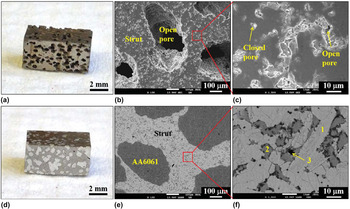
Current activated, pressure activated infiltration technique was observed to be the effective way of producing ceramic metal composites where the ceramic foam Ti2AlC was infiltrated with molten aluminum alloy 6061. From Fig. 10 it is understood that 97% of the pores in the foam was infiltrated by molten aluminium. Reference Hu, Kothalkar, O'Neil, Karaman and Radovic53 Nearly all the residual pores observed in the samples are closed pores and are formed due to incomplete sintering during fabricating of the preform samples. This novel method leads to improvement in the mechanical property of specific compressive strength of the composite by 1.5 times of the specific yield strength of peak aged aluminum alloy 6061. Reference Hu, Kothalkar, O'Neil, Karaman and Radovic53 Small reaction was between the ceramic foam and the molten aluminum, which suggests that the current activated, pressure activated infiltration method a highly reactive ceramic–metal composite processing method which could not be achieved by using powder metallurgy and conventional infiltration methods. Reference Hu, Kothalkar, O'Neil, Karaman and Radovic53
(a) A picture of a porous Ti2AlC preform, and SEM images of (b) showing open pores and struts, (c) showing both closed pores and open pores. (d) A picture of an as infiltrated AA 6061/Ti2AlC composite, and SEM images of (e) showing AA 6061 (dark gray) infiltrated into the open pores, (f) enlarged view on the strut showing Ti2AlC (1, light), titanium aluminide (2, gray), and Al2O3 (3, dark). Reference Hu, Kothalkar, O'Neil, Karaman and Radovic53

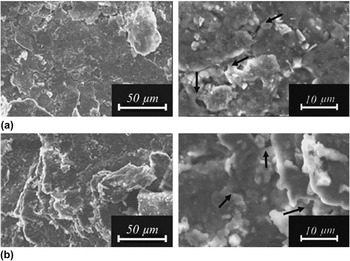
MMC's with larger quantity of ceramics reinforcement are marked with arrows in SEM images of Fig. 11 which shows little amount of porosities in the sintered MMC's specimens. By decreasing the particulate size from 16 to 12 µm, the amount of porosity was decreased by a factor of about 3.7%. In the MMC's with larger quantity of ceramic reinforcements or lesser particulate size, the total matrix–ceramic interfaces are observed to be longer. As a result the paths for diffusion, is one of the mechanisms for pore elimination during sintering process in the MMC's. As a result, the reduction of porosity is accelerated. The finer particle size of ceramic reinforcement leads to a huge number of minor pores after sintering of MMC's. The microstructure properties and mechanical properties of a MMC, is directly related with the volume fraction and particle size of its ceramic reinforcements.
SEM images of sintered MMC's (a) Al-10% SiC-12 µm and (b) Al-10% SiC-16 µm. Some porosity is indicated by the arrows. Reference Hassani, Bagherpour and Qods31

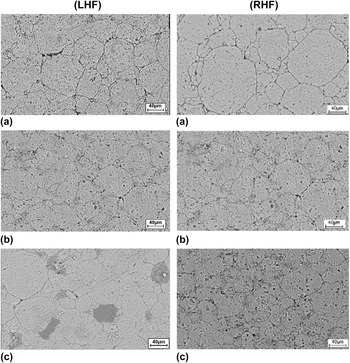
Figure 12 shows the optical micrographs which indicate the microstructure of the specimens containing 5–20 wt% of alumina (Al2O3) with average particulate size of 12 µm. It can be observed that the increase in the volume percentage of alumina (Al2O3) leads to a finer grain microstructure which have a favorable effect on the hardness values of the composites fabricated by powder metallurgy route. Reference Rahimian, Parvin and Ehsani25,Reference Rahimian, Ehsani, Parvin and Baharvandi35 As the alumina (Al2O3) amount decreases in the MMC's, alumina (Al2O3) particulate dispersion homogeneity increases. This is because alumina (Al2O3) particulates perform as a barrier against the grain boundary sliding during sintering process. This quality of ceramic behavior in the MMCs leads to improved mechanical properties. The ceramic particulate dispersion in the matrix containing 20 wt% (Al2O3) will decrease because of larger tendency for clustering and agglomeration with increased amount of ceramic reinforcements. Reference Rahimian, Parvin and Ehsani25,Reference Rahimian, Ehsani, Parvin and Baharvandi35
SEM micrographs showing the effect of 12 µm Al2O3 particle content on the microstructure (LHF a, b, c) and the effect of Al2O3 particle size on the microstructure (RHF a, b, c). Reference Rahimian, Ehsani, Parvin and Baharvandi35

SEM images of Ni coated Al-SiC composites. Reference Umasankar, Karthikeyan and Xavior34

In aluminum alloy based MMCs, particle to particle bondability is reduced because of the formation of oxide layer on aluminum surfaces in the matrix. Nevertheless the development of metalized Nickel layer on SiC particulates helps the interface bonding. Reference Umasankar, Karthikeyan and Xavior34 The coverage of aluminum alloy powders by metalized SiC is observed to be nonuniform in nature. This may be because, emanation of aluminum alloy starts at 500 °C sintering temperature.
Addition of the ceramic particulates reduced the grain size in the MMC's. The biggest reduction was noticed at early additions of the ceramic particulates, i.e., at 5 wt% irrespective of the aluminum matrix metal, then the reduction was noticed at 20 wt% ceramic particulate additions the grain sizes were more or less even, which is reflecting in the strain characteristics as shown in Fig. 4. From Fig. 4 the lesser ceramic content which leads to better strain rate is compared to other percentage of ceramic reinforcements. Reference Marahleh5 The MMC’s grain sizes are finer than that of the monolithic aluminum matrix. This modification is caused by the ceramic reinforcement particulates performing as nuclei for the grain construction during the process of solidification and similarly these ceramic particulates would restrain the process of the grain growth. Reference Marahleh5 The amount of ceramic addition had a positive influence on the stress strain behavior of the composites where the lesser amount of ceramic addition lead to considerable stress strain behavior equal to the monolithic matrix metal as shown in Fig. 4. Reference Marahleh5
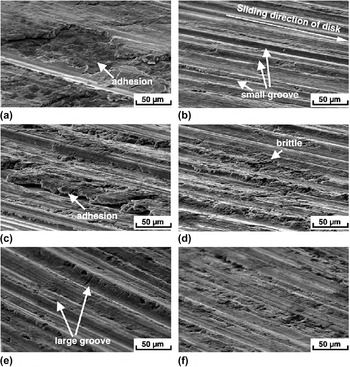
The maximum effect in refining the grain size was in case of the SiC reinforced MMC's. Similar observation was seen where 20 wt% Al2O3 addition produced 90% decrease in the grain size growth of the MMC's. Reference Marahleh5 Considering the wear micrographs of the MMC's reinforced with ceramic contents, at minimum volume fraction V f [Figs. 14(a) and 14(c) and (e)], the worn out surfaces were significantly dissimilar for every MMC's. MMC with whiskers and MMC's with fiber type formed bigger wear scars caused by adhesion of the ceramics to the matrix. Reference Miyajima and Iwai44 The damages by adhesion were heavier for MMC with fibre type than that of MMC with whiskers type. Only deep grooves were noticed for MMC with particle type. For higher volume fractions V f [Figs. 14(b), 14(d) and 14(f)], the bonding area and huge grooves vanished on all composite samples. MMC with fiber-type displayed a brittle worn out surfaces with undersized grooves, but MMC with particle-type had a leveled and soft surfaces. Reference Miyajima and Iwai44 Comparing the three types of reinforcements used, the microstructural observation reveals that particle type ceramic reinforcements gives better microstructural characteristics without compromising the tribological properties of the MMCs as discussed earlier.
SEM photographs of the worn out surfaces of MMCs in steady-state wear regime (sliding distance 1000 m). (a) SiC-whisker, V fw = 5%; (b) SiC-whisker, V fw = 29%; (c) Al2O3-fiber, V ff = 5%; (d) Al2O3-fiber, V ff = 19%; (e) SiC-particle, V fp = 5% and (f) SiC-particle, V fp = 10%. Reference Miyajima and Iwai44

Figure 15 shows the worn out surfaces of the aluminum alloy 2024 matrix (Figs. 15a and 15b) which clearly displays the existence of deep eternal grooves, micro cutting, particle pullouts, and fracture of the oxide fragments, which might have caused the amplification of the wear loss. This morphology shows that the aluminum alloy 2024 matrix has undergone considerable rigorous plastic deformation. Reference Ravindran, Manisekar, Rathika and Narayanasamy40
SEM morphologies of the worn out surface of Al 2024 matrix at applied load of 20 N. (a) Low-magnification micrograph and (b) high-magnification micrograph. Reference Ravindran, Manisekar, Rathika and Narayanasamy41

V. CONCLUSIONS
Material characterization of aluminum alloy 2xxx series based MMCs reinforced with ceramic particulates has been explored and presented. Mechanical, tribological, and microstructural property evaluation as reported by the researchers in the recent past have been compiled and discussed. The manufacturing issues associated with fabrication of MMCs through various conventional routes and its influence on the overall properties have been reported. It is hereby found that, using the powder metallurgy process, mechanical properties of the MMC's of aluminum alloy 2xxx were comparable and the factors like wettability, homogeneous dispersion of reinforcements in matrix, density, sintering conditions, particle size, volume percentage of particle can be played carefully to enhance the properties at low cost of manufacturing avoiding secondary operations. Adding ceramic reinforcements to the aluminum matrix improves the mechanical properties out of which Al2O3 is exhibiting a good strength to microstructure relationship and comparatively good tribological performance equal to SiC. Addition of ceramic reinforcements hold a threshold weight percentage, i.e., 10 wt% below which the composites is displaying an excellent mechanical properties with no compromise in the tribological and microstructural behavior. Microwave processing and heat treating of AA 2xxx series based composites processed through powder metallurgy are the future scope in which excellent improvement in mechanical properties and tribological properties can be achieved.