INTRODUCTION
Overview of Pediatric Epilepsy
Across the various epilepsy syndromes, the primary target of intervention is seizure control, for which the first line of treatment is anti-epileptic drugs (AEDs); in cases refractory to AED treatment, surgery may be an option if a clear unilateral seizure focus can be identified. Beyond the impact of seizures, the burden of disease commonly extends to cognitive, behavioral, psychosocial, and vocational functioning, and persists well into adulthood (Hamiwka & Wirrell, Reference Hamiwka and Wirrell2009; Ottman et al., Reference Ottman, Lipton, Ettinger, Cramer, Reed, Morrison and Wan2011; Reid et al., Reference Reid, Metcalfe, Patten, Wiebe, MacRodimitris and Jetté2012).
The focus of the present study was on academic achievement, a commonly reported area of difficulty in children with epilepsy (for review, see Reilly & Neville, Reference Reilly and Neville2011) that is associated with poorer quality of life (Elliott, Lach, & Smith, Reference Elliott, Lach and Smith2005). The current study is part of a larger project on long-term outcomes related to cognition, behavior, emotion, quality of life, and social participation following epilepsy surgery in childhood. We retrospectively analyzed clinical data collected from neuropsychological baseline assessments that were conducted as part of surgical candidacy evaluations, and compared these data with results from follow-up neuropsychological evaluations conducted for research purposes 4 to 11 years following surgery (or baseline evaluation for those patients who did not undergo surgery). For patients within the surgical group, this follow-up period should have allowed sufficient time for recovery following surgery, reduction and changes in medication (as warranted by seizure control), as well as return and adjustment to regular activities of daily life (e.g., school).
Long-Term Outcomes Following Epilepsy Surgery in Childhood
Intellectual functioning
Measurement of long-term outcomes in children with epilepsy is important for informing developmentally-appropriate interventions. Most studies evaluating short-term cognitive outcomes post-surgery (6 months to 2 years) find little to no change (Smith, Lah, & Elliott, Reference Smith, Lah and Elliott2011), which is not entirely surprising given the protracted course of neurodevelopment and the time potentially needed for functional reorganization following surgery. Based on the studies that have examined long-term post-surgery intellectual outcomes, a clear prognostic picture has not yet emerged as data from some studies support stability over time (Adams, Beardsworth, Oxbury, & Fenwick, Reference Adams, Beardsworth, Oxbury and Fenwick1990; Battaglia et al., Reference Battaglia, Chieffo, Lettori, Perrino, Di Rocco and Guzzetta2006; Hallböök, Tideman, Rosén, Lundgren, & Tideman, Reference Hallböök, Tideman, Rosén, Lundgren and Tideman2013; Viggedal, Kristjansdottir, Olsson, Rydenhag, & Uvebrant, Reference Viggedal, Kristjansdottir, Olsson, Rydenhag and Uvebrant2012), whereas others find improvements in specific intellectual functions (Battaglia et al., Reference Battaglia, Chieffo, Lettori, Perrino, Di Rocco and Guzzetta2006; Hallböök et al., Reference Hallböök, Tideman, Rosén, Lundgren and Tideman2013) or overall IQ (Skirrow et al., Reference Skirrow, Cross, Cormack, Harkness, Vargha-Khadem and Baldeweg2011). Notably, in a recent long-term outcomes study from our larger project (Puka, Tavares, & Smith, Reference Puka, Tavares and Smith2015), improvements in some aspects of intellectual function were found for both surgical and non-surgical patients with controlled seizures 4 to 11 years after surgery or baseline assessment.
Seizure status
It is well-established that uncontrolled, persistent seizures may be associated with a range of cognitive impairments (see Dodrill, Reference Dodrill2004 and Elger, Helmstaedter, & Kurthen, Reference Elger, Helmstaedter and Kurthen2004 for reviews). Conversely, there is also evidence that improvements in seizure frequency or seizure freedom may also improve cognition. For example, improvements in overall intelligence have been noted to be associated with reduced seizure frequency (Dodrill, Reference Dodrill2004). Moreover, in a longitudinal study of adults with temporal lobe epilepsy, seizure-free patients showed improvements in attention, fluency, and memory abilities, as well as in reported quality of life and depression symptoms compared to those with persistent seizures (Helmstaedter, Kurthen, Lux, Reuber, & Elger, Reference Helmstaedter, Kurthen, Lux, Reuber and Elger2003).
Along these lines, through our larger project an interesting trend has emerged in which seizure status (presence of recent seizures at the time of long-term assessment) was a better predictor than surgical status (whether a patient had surgery or not) with respect to various measures of intellectual functioning (Puka et al., Reference Puka, Tavares and Smith2015), health-related quality of life (Puka & Smith, Reference Puka and Smith2015), as well as behavioral (Puka & Smith, Reference Puka and Smith2016b) and affective symptoms (Tavares, Puka, & Smith, Reference Tavares, Puka and Smith2015). Therefore, we examined the potential effect of seizure status, as opposed to surgical status, on long-term academic outcomes.
Academics
Low academic achievement (performance significantly below age-matched peers) is common in children with epilepsy, with estimates ranging from 60 to 72% (Fastenau, Jianzhao Shen, Dunn, & Austin, 2008; Puka & Smith, Reference Puka and Smith2016a; Reilly et al., Reference Reilly, Atkinson, Das, Chin, Aylett, Burch and Neville2014). In fact, in children with epilepsy (without intellectual disability), the likelihood of developing a learning disability is irrespective of seizure severity or control (Fastenau et al., Reference Fastenau, Jianzhao, Dunn and Austin2008). In a recent study of both surgical and non-surgical patients (Puka & Smith, Reference Puka and Smith2016a), there was little evidence of group-level long-term improvements in reading, spelling, and arithmetic scores, even with seizure control. However, when looking at patients with changes of at least 10 standard score points from baseline to follow-up on academic performance measures, declines were more frequent among patients with persistent seizures than patients who were seizure-free at follow-up. Considering that children with learning disabilities are at risk of poorer vocational outcomes (Rabren, Eaves, Dunn, & Darch, Reference Rabren, Eaves, Dunn and Darch2013), as are children with epilepsy (Puka & Smith, Reference Puka and Smith2016a), the combined impact of both epilepsy and learning difficulties may elevate the risk of adverse long-term outcomes.
A few studies have addressed how specific cognitive domains may impact academic abilities (Fastenau et al., Reference Fastenau, Shen, Dunn, Perkins, Hermann and Austin2004; Seidenberg et al., Reference Seidenberg, Beck, Geisser, O’Leary, Giordani, Berent and Boll1988; Williams et al., Reference Williams, Phillips, Griebel, Sharp, Lange, Edgar and Simpson2001), although none to our knowledge have addressed how certain cognitive skills may affect academic achievement in the long-term. Relevant to the present study, changes in academic performance have shown associations with changes in neuropsychological functioning. In a study of children assessed on various neuropsychological and academic abilities at baseline and 3 years after seizure onset, Dunn et al. (Reference Dunn, Johnson, Perkins, Fastenau, Byars, deGrauw and Austin2010) found positive correlations between composite change scores of several cognitive functions (language, processing speed, attention/executive function, learning) and changes in reading, writing, and math performance. We intend to contribute to this growing literature by examining the specific influence of working memory on academic outcomes in children with epilepsy. As will be outlined below, working memory is believed to be fundamental to academic success.
Working memory
Working memory deficits are common in epilepsy and have been shown to underlie academic difficulties (Elger et al, Reference Elger, Helmstaedter and Kurthen2004; Fastenau et al., Reference Fastenau, Shen, Dunn, Perkins, Hermann and Austin2004). Working memory may be broadly defined as the ability to store information for short periods of time, with the intention of fulfilling a goal-directed activity (reviewed, e.g., Baddeley, Reference Baddeley2012). In a recent study from our larger long-term outcomes project (Puka et al., Reference Puka, Tavares and Smith2015), the presence of seizures at follow-up was associated with declines in working memory (Working Memory Index; WMI) scores. Although significant improvements were not observed among the seizure-free patients compared to baseline, they had higher overall WMI scores than patients with persistent seizures.
Relevant to the present study, there is accumulating evidence that working memory is central to the development of academic abilities. For example, superior working memory tends to characterize high ability students compared to lower ability students (Alloway & Elsworth, Reference Alloway and Elsworth2012), and working memory functions are associated with academic skills for students with and without intellectual disability (Poloczek & Hasselhorn, Reference Poloczek and Hasselhorn2012). Working memory also appears to a better predictor of academic abilities than overall intelligence (Full Scale IQ; FSIQ). Alloway and Alloway (Reference Alloway and Alloway2010) found that in a longitudinal study beginning at age 5 years, working memory was a unique predictor of reading, spelling, and math performance 6 years later, and explained more variance in academic scores than FSIQ. In several other studies, working memory scores predicted the presence of learning difficulties regardless of FSIQ (De Weerdt, Desoete, & Roeyers, Reference De Weerdt, Desoete and Roeyers2013; Gathercole, Alloway, Willis, & Adams, Reference Gathercole, Alloway, Willis and Adams2006; Maehler & Schuchardt, Reference Maehler and Schuchardt2009). Using structural equation modeling, Fastenau et al. (Reference Fastenau, Shen, Dunn, Perkins, Hermann and Austin2004) found that in children with epilepsy, a neuropsychological factor they called “Rapid Naming/Working Memory” significantly predicted reading, writing, and math abilities.
Study Objective
Through this brief literature review, we have established that academic and working memory difficulties are common in children with epilepsy. Moreover, recent long-term studies suggest that effective seizure control is associated with a range of positive outcomes. Persistent seizures may negatively impact academic outcomes (Puka & Smith, Reference Puka and Smith2016a), although the cognitive mechanism(s) responsible for this effect are poorly understood. Importantly, working memory abilities have shown predictive value in identifying academic skill deficits in both clinical (Fastenau et al., Reference Fastenau, Shen, Dunn, Perkins, Hermann and Austin2004) and non-clinical (Alloway & Alloway, Reference Alloway and Alloway2010) samples. Thus, it is worth examining how working memory functioning may impact academic outcomes in children with epilepsy. We investigated this question in a cohort of individuals with childhood epilepsy who had been tested on two occasions, 4 to 11 years apart. We predicted that the presence of seizures at the second assessment would be associated with lower working memory ability, which would in turn result in poorer word reading, spelling, and arithmetic performance.
METHODS
Participants and Procedures
All participants had undergone neuropsychological evaluations to determine candidacy for epilepsy surgery between 2002 and 2009 at the Hospital for Sick Children in Toronto, Canada. This evaluation served as the baseline assessment. All patients had failed to achieve seizure control from at least two trials of AEDs. Patients who underwent surgery had a clear unilateral seizure focus not involving the eloquent cortex. We excluded surgical patients who underwent hemispherectomy or corpus callosotomy from our sample as these patients often had marked neurological impairment, and surgery may have been done for reasons other than obtaining complete seizure control (e.g., preventing drop attacks). Non-surgical cases were those patients who were deemed inappropriate candidates for surgery because they achieved adequate seizure control after medication adjustment (n=12), had bilateral seizure onset or seizures that could not be localized or lateralized (n=11), had involvement of the eloquent cortex (n=2), or who declined surgery (n=5).
Exclusion criteria for the control group were the types of epilepsy that are not treated with surgery, such as Lennox–Gastaut syndrome, benign occipital epilepsy, absence epilepsy, Janz syndrome, benign rolandic seizures, severe childhood myoclonic epilepsy, and epilepsy associated with neurodegenerative disorders such as progressive myoclonic epilepsy. Patients were recruited for the present study 4 to 11 years after surgery or baseline assessment (for nonsurgical patients), and offered a neuropsychological assessment as part of a larger childhood epilepsy surgery long-term outcomes project.
A total of 152 patients met criteria for participation in the study; 17 could not be contacted, 2 were deceased, and 36 declined or were unable to participate due to distance. Ultimately, 97 patients completed a neuropsychological assessment at long-term follow-up, and informed consent/assent was obtained from those patients and/or their parents. Retention rates were very similar between our surgical (66%) and non-surgical groups (60%) overall. For our larger long-term outcomes project, it has been established that surgical and non-surgical patients who agreed to participate did not differ significantly from patients in each group who declined participation on baseline demographic, seizure and cognitive variables, follow-up seizure status, and AED use (Puka & Smith, Reference Puka and Smith2016a; Puka et al., Reference Puka, Tavares and Smith2015).
Baseline academic scores were incorporated in our meditational analyses as covariates. There were missing academic data at baseline due to time limitations or poor cooperation during the assessment, or due to the young age of the child. Rates of missing data were statistically similar between the surgical and non-surgical groups on measures of baseline spelling (p>.05) and arithmetic (p>.05). However, rates of missing data were higher for the surgical group (26%) than the non-surgical group (7%) on baseline reading (p<.05).
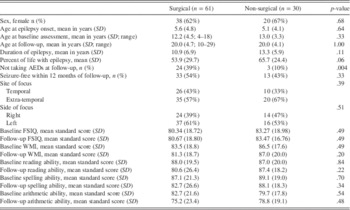
Between-group differences on several demographic and epilepsy-related variables were examined using independent samples t tests or chi-squared (χ2) tests. As seen in Table 1, with the exception of AED use, the surgical and non-surgical patients were similar on relevant characteristics. A significantly greater proportion of surgical patients (39%) were not taking AEDs at the time of long-term assessment compared to non-surgical patients (10%), which is expected given that medication is often integral to seizure management. The proportions of patients who were seizure-free in the 12 months preceding the follow-up assessment also did not differ between the surgical (54%) and non-surgical (43%) groups. Critically, for the purposes of the present study, surgical and non-surgical patients did not differ in their overall intelligence (FSIQ), working memory, or academic abilities at baseline or follow-up (p ≥ .2). Given the similarity of the surgical and non-surgical participants on these aforementioned characteristics, they were combined for further analyses to allow for the examination of seizure status in both surgical and non-surgical patients. The mean follow-up period for our sample was 7.04 years (SD=2.22; range: 4.00 to 11.83 years).
Demographic, epilepsy, and cognitive characteristics of the surgical and non-surgical patient groups

Measures
Seizure status
This variable was defined as the presence or absence of seizures in the 12 months preceding follow-up assessment as indicated by patient report.
Working memory
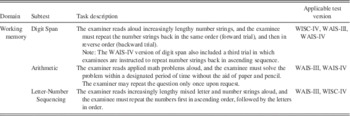
In this study, we were interested in working memory functioning at the time of follow-up assessment only. Working memory abilities were measured using the Working Memory Index (WMI) standard score on the age-appropriate Wechsler intelligence test administered at the time of follow-up assessment (Wechsler, Reference Wechsler1997, Reference Wechsler2003, Reference Wechsler2008). Most participants completed the WAIS-III (72%), with others completing the WAIS-IV (~3%) and WISC-IV (~24%). The WMI is a composite score made of two or three subtests (see Table 2 for descriptions of each), depending on the version of the Wechsler scale administered. Note that all of these tasks measure verbal working memory; thus, no comment can be made about visual aspects of working memory from these tasks.
Descriptions of possible subtests comprising the Working Memory Index across various Wechsler intelligence tests administered at follow-up assessment

Academics
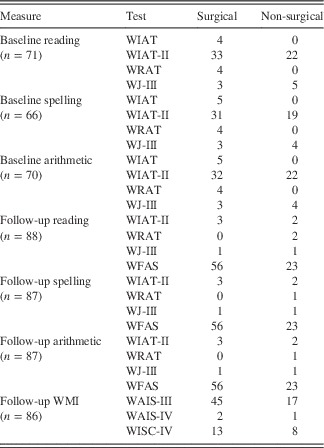
The academic skills of interest were word reading, spelling, and arithmetic, which were assessed using standardized tests of achievement that are meant to measure skills/knowledge gained through classroom instruction. Specifically, the Wechsler Individual Achievement Test – Second Edition (WIAT-II; Wechsler, Reference Wechsler2001) was administered to most participants at baseline assessment, although some completed the WIAT (Wechsler, Reference Wechsler1992), Wide Range Achievement Test (WRAT; Wilkinson, Reference Wilkinson1993), or the Woodcock-Johnson Tests of Achievement – Third Edition (WJ-Ach III; Woodcock, McGrew, & Mather, Reference Woodcock, McGrew and Mather2001). A summary of the number of participants who completed each measure is provided in Table 3.
Number of participants in the surgical and non-surgical groups who completed each academic and intelligence test

Across measures, the word reading task involved reading single words aloud. The spelling task involved spelling single words to dictation. The arithmetic task involved solving math problems printed on a sheet of paper. As will be explained below, baseline academic scores were used as covariates in the primary statistical analyses because they were found to significantly predict follow-up academic performance. Our primary outcome variables of interest are reading, spelling, and arithmetic scores at the time of follow-up assessment, which were assessed using the Wechsler Fundamentals Academic Skills (WFAS; Wechsler, Reference Wechsler2008) for most participants. There was more heterogeneity in the measures used at baseline since the data were analyzed retrospectively and spanned several years, during which there were changes in clinicians and the availability of measures.
By conducting analyses of variance with surgical status and test (version) as fixed factors, and baseline academic scores, follow-up academic scores, and follow-up WMI as dependent variables, we established that there were no statistically significant differences (p>.14) in the scores obtained between the surgical and non-surgical groups, and between the different test versions on working memory or academic outcomes. Note that correlations between length of follow-up (in years) and academic or working memory scores at follow-up evaluation were also non-significant (p values >.44).
This study was conducted in accordance with the Helsinki Declaration, and approved by the Research Ethics Board at the Hospital for Sick Children in Toronto, Canada. All measures were administered by experienced psychometrists or trained research assistants. Data were managed and stored using REDCap (Harris et al., Reference Harris, Taylor, Thielke, Payne, Gonzalez and Conde2009).
Statistical Approach
Primary analyses
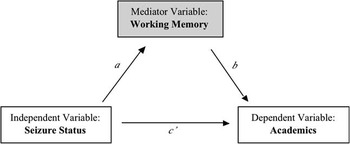
Mediation analyses, using ordinary least-squares path analysis, were conducted to examine the potential indirect effects of seizure status on long-term academic outcomes via working memory. Referring to Figure 1, the following regressions were tested as part of the mediation analysis: seizure status should predict working memory ability (path a); working memory should predict academic performance (path b); seizure status should have little predictive value for academics when working memory is taken into account (suggesting complete mediation; path c’); and seizure status should have an indirect effect on academics through working memory (product of paths a and b). A total of 5000 bias-corrected bootstrap resamples with replacement were used to calculate the 95% confidence intervals for the indirect effects for each dependent variable (reading, spelling, and arithmetic scores). Significant mediation is indicated by the omission of zero from the confidence interval (p<.05). List-wise deletion was used to handle missing data. Two patients were identified as outliers and excluded from the mediation analyses due to large Mahalanobis distance; results were highly similar with or without their data.
Proposed mediation model.

Follow-up analyses
Additional statistical procedures were done to investigate the scope of effects through the following additional research questions: (1) Do changes in working memory ability from baseline to long-term assessment also predict changes in academic scores? Mediation analyses were repeated using working memory difference scores as the mediator, and academic difference scores as the outcome variables. Difference scores were calculated as the baseline working memory or academic scores subtracted from these scores at long-term assessment for each patient. Since baseline working memory and academic scores were incorporated into these analyses, they were removed as covariates. (2) Are the mediation effects primarily driven by patients with low intellectual functioning? Mediation analyses were repeated only using patients with IQ greater than 70. Patients with low IQ were not excluded from our primary analyses to assess mediation effects in patients with a range of intellectual functioning, although other studies that have examined academic outcomes in epilepsy have excluded patients with intellectual disability (e.g., Fastenau et al., Reference Fastenau, Jianzhao, Dunn and Austin2008; van Iterson, de Jong, & Zijlstra, Reference van Iterson, de Jong and Zijlstra2015). (3) Is seizure status a better (indirect) predictor of academic outcomes than surgical status? Surgical status was used as the independent variable (instead of seizure status) in the mediation analysis. (4) Does working memory specifically mediate the relationship between seizure status and academic outcomes? Certainly, working memory would not be the only cognitive function contributing to successful academic performance. Therefore, it is worth examining whether other intellectual functions may also mediate the relationship between seizure status and academic outcomes. To address this question, mediation analyses were repeated using other composite indicators of cognitive ability that are not confounded with working memory, and are thus not calculated using the subtest scores that comprise the WMI. Specifically, the Perceptual Organization Index (POI) from the WAIS-III and the Processing Speed Index (PSI) from the WISC-IV, WAIS-III, and WAIS-IV were entered as potential mediators in place of WMI to examine the roles of visual problem solving and psychomotor speed abilities, respectively, in long-term academic outcomes.
RESULTS
Primary Analyses
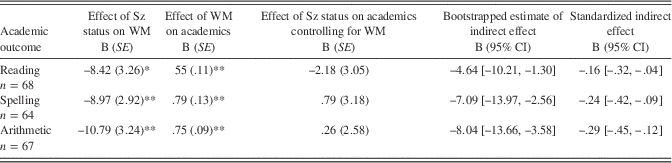
See Table 4 for the results of the mediation analyses, with unstandardized regression coefficients (B) and associated standard error (SE), as well as the bootstrapped estimate of the indirect effect and effect size of the indirect effect (standardized indirect effect) with associated confidence intervals. According to preliminary regression analyses, baseline academic scores were significant predictors of academic performance at long-term assessment (p<.05). Therefore, in the primary mediation analyses, baseline academic scores were included as covariates and were consistently significant (p<.05). As hypothesized, the presence of seizures at follow-up was associated with weaker working memory ability, which in turn led to poorer scores on measures of word reading, spelling, and arithmetic. Medium effect sizes were observed for the mediation models predicting reading and spelling outcomes, and a large effect size was observed for the mediation model predicting arithmetic (Cohen, Reference Cohen1988).
Summary of mediation analyses with unstandardized regression coefficients: The relationship between seizure status (Sz Status) and academic outcomes (reading, spelling, arithmetic) as mediated by working memory (WM), controlling for baseline academic performance

*p<.05.
**p<.01.
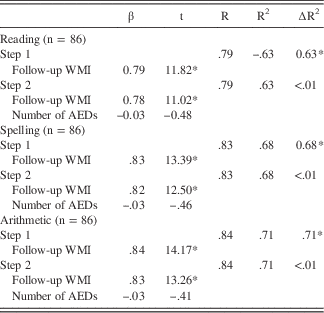
We acknowledge that we did not consider AED use in our statistical analyses, given the practical difficulties in standardizing this variable (e.g., different combinations and dosages across patients). Nevertheless, to examine whether number of AEDs might account for any additional variance in follow-up academic scores beyond working memory, we conducted hierarchical regression analyses with WMI scores entered in the first step, and number of AEDs entered in the second step (see Table 5). Across all academic scores at follow-up, number of AEDs did not predict significant additional variability beyond WMI scores, suggesting that AED use is likely not a confound in our results, at least according to this gross measure of medication effects.
Hierarchical regression analyses predicting academic scores with follow-up WMI scores entered in step 1 and number of AEDs entered in step 2

*p<.05.
Follow-Up Analyses
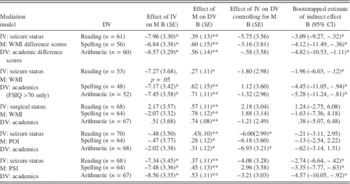
Similar mediation analyses were repeated post hoc to address the following related research questions. The results of these analyses are presented in Table 6. (1) Do changes in working memory ability from baseline to long-term assessment also predict changes in academic scores? Consistent with the primary analyses above, changes in working memory scores from baseline to follow-up significantly mediated the relationship between seizure status and changes in reading, spelling, and arithmetic scores. (2) Are the mediation effects primarily driven by patients with low intellectual functioning? When mediation analyses were repeated only using patients with IQ greater than 70, mediation effects continued to be significant, albeit somewhat attenuated. (3) Is seizure status a better (indirect) predictor of academic outcomes than surgical status? Consistent with other studies within our larger project that show seizure status is a better predictor of long-term outcomes than surgical status (Puka & Smith, Reference Puka and Smith2015, Reference Puka and Smith2016a; Puka et al., Reference Puka, Tavares and Smith2015; Tavares et al., Reference Tavares, Puka and Smith2015), there were non-significant mediation effects across academic tasks when surgical status was used as the independent variable. (4) Does working memory specifically mediate the relationship between seizure status and academic outcomes? POI scores did not significantly mediate the relationship between seizure status and any of the academic outcomes. PSI scores were found to be significant mediators across academic outcomes, but with substantially smaller effect sizes for reading (standardized indirect effect=−.10), spelling (standardized indirect effect=−.11), and arithmetic (standardized indirect effect=−.16) compared to the models using WMI as the mediator.
Results of additional mediation analyses with variations in mediators (M), independent variables (IV), and dependent variables (DV)

*p<.05.
**p<.01.
DISCUSSION
The goal of the present study was to examine the relationship between seizure freedom and academic performance 4 to 11 years after surgery or baseline assessment, as potentially mediated by working memory ability. Indeed, in our sample of surgical and non-surgical pediatric epilepsy patients there was a significant indirect effect of seizure freedom on academic abilities through working memory functioning, such that the presence of seizures was associated with lower working memory abilities, which in turn predicted poorer word reading, spelling, and arithmetic scores. Similarly, mediation effects were also found when working memory and academic change scores from baseline to follow-up were analyzed; that is, presence of seizures at follow-up was associated with declines in working memory scores, which in turn were associated with declines in academic performance. Consistent with other studies within our larger project, seizure status was a better (indirect) predictor of academic outcomes than surgical status, emphasizing the importance of successful seizure control regardless of how it is achieved (i.e., through surgical or non-surgical methods).
Our results highlight the importance of working memory for academic functioning, and additionally indicate an indirect effect of seizure status on academic outcomes. Consistent with Fastenau et al.’s (2004) finding that a rapid naming/working memory function strongly predicts reading, writing, and math abilities in children with epilepsy, our mediation analyses suggest that when working memory is compromised by persistent seizures, a similar range of academic skills is likely to be negatively impacted. More broadly, previous studies on both typically developing children (Alloway & Elsworth, Reference Alloway and Elsworth2012) as well as children with learning disabilities (De Weerdt et al., Reference De Weerdt, Desoete and Roeyers2013; Gathercole et al., Reference Gathercole, Alloway, Willis and Adams2006; Maehler & Schuchardt, Reference Maehler and Schuchardt2009) have shown that working memory abilities are useful for predicting a range of academic skills. Our data lend additional support to this argument within a sample of surgical and non-surgical pediatric epilepsy patients 4 to 11 years after baseline assessment.
The role of working memory as a mediator across academic areas in the present study reasonably raises the prediction that working memory remediation may be a worthwhile intervention in children with epilepsy. Overall, reviews and meta-analyses of working memory training programs using non-clinical samples have not produced compelling support for the efficacy of such training programs in improving academic outcomes, although near-transfer effects are often reported (Kearns & Fuchs, Reference Kearns and Fuchs2013; Melby-Lervåg & Hulme, Reference Melby-Lervåg and Hulme2013; Rapport et al., Reference Rapport, Orban, Kofler, Friedman, Ko and Friedman2013; Redick, Shipstead, Wiemers, Melby-Lervåg, & Hulme, Reference Redick, Shipstead, Wiemers, Melby-Lervåg and Hulme2015). Given these findings, it may be that working memory training equips struggling students with improved skills that increase their cognitive “availability” within the classroom, which then make them more responsive to remediation in target academic areas. Thus, working memory training may be a useful adjunct to (but not a substitution for) formal academic instruction or remediation.
Along these lines, Roberts et al. (Reference Roberts, Quach, Spencer-smith, Anderson, Gathercole, Gold and Wake2016) conducted a recent Cogmed population-based randomized control trial investigating the academic outcomes of children aged 6–7 years screened for low working memory. Visuospatial short-term memory benefits were observed in the treatment group at 6 and 12 (but not 24) month follow-up, with no academic improvements. Thus, the authors did not recommend population-based delivery of Cogmed intervention given the relatively short-term benefits, loss of classroom time, and cost.
However, in children with symptomatic epilepsy, for whom working memory deficits may be an especially salient barrier to learning, working memory interventions may be critical for facilitating academic progress. The results of a recent randomized control trial showed significant immediate post-treatment effects in the intervention group on measures of visual attention span, auditory working memory, and visual-verbal working memory (Kerr & Blackwell, Reference Kerr and Blackwell2015). The persistence of these improvements, as well as their potential impact on academic functioning has yet to be established, but is a worthwhile future area of investigation.
STRENGTHS AND LIMITATIONS
To our knowledge, the current study was the first to examine how long-term academic outcomes in children with epilepsy may be indirectly affected by seizure status through functioning in a specific cognitive domain (i.e., working memory). Given that our samples of surgical and non-surgical patients were well matched on several demographic, epilepsy-related, and cognitive/academic measures at baseline, we were able to study the effects of seizure-freedom across both groups. In this way, we found that the attainment of seizure-freedom was more important than the method of attainment (surgery vs. AEDs alone) when predicting academic outcomes. We also made use of a sample with heterogeneous epileptogenic foci, thus increasingly our confidence in the generalizability of our findings to the population of children with epilepsy.
Conversely, we are unable to make specific comments about how academic achievement may differ between different epilepsy etiologies or syndromes. Due to the variability in medication management within our sample, we did not account for medication effects directly in our analyses; however, hierarchical regression analyses suggested that number of AEDs did not account for any significant additional variability in academic scores beyond that attributable to working memory at follow-up assessment. This study also examined several fundamental academic skills (word reading, spelling, arithmetic), although it has yet to be established whether our findings are consistent with other academic outcomes (e.g., written expression, reading comprehension).
Although different standardized tests were used at baseline assessment, the tasks were very similar across tests. Since the follow-up assessments were conducted for research purposes, data from all measures were complete for a greater number of participants (n=91) compared to data from baseline assessments (n=64–68), which were conducted for clinical purposes. Baseline academic scores were used as covariates in the mediation analysis, and therefore our results were limited to those patients with available baseline data. Estimates of baseline reading may have been somewhat biased as rates of missing data were higher for the surgical versus non-surgical group.
For this study, we relied on a single composite measure of working memory, the WMI, which captures verbal working memory ability only. Therefore, our argument that working memory mediates the relationship between seizure status and academic outcomes should also be tested using other measures of working memory, including visual working memory. Finally, due to the use of different age-specific composite indices of working memory, intelligence, visual-perceptual, and processing speed tests used in our analyses, patients may not have received the same subcomponent tasks of these abilities at baseline and follow-up. Variability in the aspects of these cognitive skills assessed at different developmental stages is thus a source of error in our data.
CONCLUSIONS AND FUTURE DIRECTIONS
In sum, our long-term outcomes data from surgical and non-surgical children with epilepsy suggest that persistence of seizures at follow-up is associated with lower working memory ability, which then negatively impacts reading, spelling, and arithmetic performance. Therefore, for children with intractable epilepsy, working memory deficits present a substantial barrier to the development of academic skills. In addition to direct instruction and remediation for specific academic difficulties, working memory interventions may be a helpful adjunct to promote optimal learning.
The present study focused on the impact of seizure freedom and working memory on academic outcomes in pediatric epilepsy, although there are a host of other factors contributing to academic outcomes in this population. Our follow-up analyses suggest that information processing speed also contributes to academic performance, consistent with other studies (Dunn et al., Reference Dunn, Johnson, Perkins, Fastenau, Byars, deGrauw and Austin2010; Fastenau et al., Reference Fastenau, Shen, Dunn, Perkins, Hermann and Austin2004), albeit to a lesser degree than working memory. Academic skills are complex and rely on a range of abilities; thus, a greater understanding of the constellation of neuropsychological functions important for academics would further inform interventions supporting remediation efforts in children with epilepsy and low academic achievement.
In addition to working memory and processing speed, lower academic achievement has also been associated with psychiatric concerns such as ADHD (Fastenau et al., Reference Fastenau, Jianzhao, Dunn and Austin2008), emotional maladjustment (Sturniolo & Galletti, Reference Sturniolo and Galletti1994), attitude toward epilepsy (Austin & Huberty, Reference Austin and Huberty1993), home enrichment factors (Mitchell, Chavez, Lee, & Guzman, Reference Mitchell, Chavez, Lee and Guzman1991), parenting style (Oostrom, Smeets-Schouten, Kruitwagen, Boudewyn Peters, & Jennekens-Schinkel, Reference Oostrom, Smeets-Schouten, Kruitwagen, Boudewyn Peters and Jennekens-Schinkel2003), and high parental anxiety (Dunn et al., Reference Dunn, Johnson, Perkins, Fastenau, Byars, deGrauw and Austin2010). Future work should address how various outcomes (e.g., cognitive, academic, behavioral, psychosocial) interrelate to develop a comprehensive understanding of how different patterns of functioning may impact long-term outcomes. For example, Drewel, Bell, and Austin (Reference Drewel, Bell and Austin2009) have shown that neuropsychological functioning and seizure status may have an indirect impact on peer difficulties through anxious or inattentive behaviors. These findings, in addition to those from the present study, highlight the varied direct and indirect pathways through which epilepsy-related variables may influence functioning years after diagnosis. Understanding the nature of these pathways has the potential to inform different trajectories of patient outcomes, and target areas for intervention.
Acknowledgments
We are grateful to all the participants and their parents for taking part in our study. We thank Klajdi Puka, Tamara Tavares and Monique Tremblay for their assistance in data collection. This research was conducted with the support of EpLink – The Epilepsy Research Program of the Ontario Brain Institute (OBI). The OBI is an independent non-profit corporation, funded partially by the Ontario government. The opinions, results, and conclusions are those of the authors and no endorsement by the Ontario Brain Institute is intended or should be inferred. The authors have no conflicts of interest to declare.