Introduction
With rapid population ageing, the effects of spousal care-giving on the health of older care-givers, and specifically whether it is associated with declines in functioning and self-rated health, are pressing issues. There is a substantial literature on the health effects of care-giving (Ory, Tennstedt and Schulz Reference Ory, Lee, Tennstedt, Schulz and Schulz2000), and on the time and other costs associated with care-giving for various diseases such as dementia (Langa et al. Reference Langa, Chernew, Kabeto, Herzog, Ofstedal, Willis, Wallace, Mucha, Straus and Fendrick2001) and diabetes (Langa et al. Reference Langa, Vijan, Hayward, Chernew, Blaum, Kabeto, Weir, Katz, Willis and Fendrick2002). The total cost of the time spent by care-givers in the United States has been estimated at nearly $200 billion per year (Arno, Levine and Memmott Reference Arno, Levine and Memmott1999). The studies that have examined the relationship between care-giving and various health outcomes show mixed results. Some suggest that care-giving has a negative effect on health because it reduces the time devoted to self-care (Marton, Sox and Krupp Reference Marton, Sox and Krupp1981). Care-giving has been associated with increased rates of depression and anxiety (Ory, Tennstedt and Schulz Reference Ory, Lee, Tennstedt, Schulz and Schulz2000; Schulz et al. Reference Schulz, Newsom, Mittelmark, Burton, Hirsch and Jackson1997). These negative health effects may be due, in part, to inadvisable health behaviours (less physical activity, sleep and rest) (Ory, Tennstedt and Schulz Reference Ory, Lee, Tennstedt, Schulz and Schulz2000; Schulz et al. Reference Schulz, Newsom, Mittelmark, Burton, Hirsch and Jackson1997). In one study, individuals who reported ‘strain’ associated with their care-giving had significantly higher rates of mortality over four years (Schulz and Beach Reference Schulz and Beach1999). By contrast, other studies have found evidence for beneficial physical and mental health effects associated with care-giving (Beach et al. Reference Beach, Jackson, Schulz and Yee2000; Brown et al. Reference Brown, Nesse, Vinokur and Smith2003). Recent findings from the Care-giver Health Effects Study suggest that care-givers who provide some care to their disabled spouse, but who do not perceive associated strain, have lower rates of anxiety and depression compared to spouses who provide no care at all to their disabled spouse (Beach et al. Reference Beach, Jackson, Schulz and Yee2000). Others have found an association between care-giving and decreased mortality (Brown et al. Reference Brown, Nesse, Vinokur and Smith2003). Potential explanations for these positive health effects of care-giving include stress reduction through mutual affection, interdependence and companionship, which may protect individuals from the adverse consequences of care-giving (Beach et al. Reference Beach, Jackson, Schulz and Yee2000; Brown et al. Reference Brown, Nesse, Vinokur and Smith2003).
The relationship between spousal care-giving and functional or self-rated health is believed to be complex in that care-giving may lead to intermediate outcomes, such as increasing negative health behaviours, which are associated with disability (Burton et al. Reference Burton, Newsom, Schulz, Hirsch and German1997) and poor self-rated health (Dunlop et al. Reference Dunlop, Semanik, Song, Manheim, Shih and Chang2005). For example, stress from care-giving may make one more likely to smoke or drink alcohol. In a study of over 3,000 married older adults, Burton and colleagues found that individuals who provided more intensive care-giving were more likely to have poor health behaviour, such as lack of exercise and rest compared to individuals who did not provide care (Burton et al. Reference Burton, Newsom, Schulz, Hirsch and German1997). Care-giving may also affect functional and self-rated health declines through its relationship to certain diseases. The strain associated with care-giving may worsen or contribute to the onset of such illnesses as heart disease, hypertension, diabetes, cancer and stroke, which may then cause declines in functioning. Also, self-rated health is positively correlated with objective health status, which is affected by various chronic diseases and disease symptoms (Singh-Manoux Reference Singh-Manoux, Martikainen, Ferrie, Zins, Marmot and Goldberg2006). With this in mind, if one has poorer physical health, this is likely to translate into poorer self-rated health.
For this study, we used data on older married couples from the 2000 and 2002 waves of the United States Health and Retirement Study (HRS) to test the effects of spousal care-giving on functioning and self-rated health declines over two years. We wanted to answer two broad research questions that have not previously been addressed in the literature:
1. Is there a relationship between care-giving and declines in functioning and self-rated health among older adults?
2. If so, is the relationship explained by socio-demographic characteristics, health behaviours and chronic conditions?
It was hypothesised that care-giving is associated with declines in functioning and self-rated health, even after controlling for socio-demographic characteristics, health behaviours and chronic conditions.
Methods
The data
Of the 19,580 respondents interviewed by HRS in 2000, 12,704 were married and then living with their spouse. Of these, 11,503 individuals also participated in the 2002 survey. From this longitudinal sample, we excluded 452 respondents whose age was less than 50 years at the time of the 2000 interview, five respondents who reported limitations on all six Activities of Daily Living (ADL) in 2000, and 67 who reported limitations on all five Instrumental ADLs in 2000. To assess self-reported health status decline of the care-giver, we excluded 2,477 individuals whose self-reported health status in 2000 was only ‘fair’ or ‘poor’ and three whose status was unknown. For these analyses, we identified 8,571 respondents who were representative of approximately 39.5 million married individuals aged 50 or more years in 2000. For the respondents who were unable or unwilling to complete an HRS interview, a proxy respondent was sought: 10.5 per cent of HRS respondents were represented by proxies in 2000 and 11.2 per cent in 2002.
Attrition
The attrition group from 2000 to 2002 comprised 1,159 individuals. Of these, 453 (29.1%) were alive or known to be alive, and 626 (54%) were known to have deceased at the time of the 2002 interview. Comparing the baseline characteristics of the attrition group with the interviewed sample in 2002, it was found that the attrition group were more functionally impaired (i.e. more limitations in ADLs and IADLs), had worse self-reported health status, and provided more hours-of-care. Except for care hours, the differences between the two groups were statistically significant (p<0.001).
Calculating care-giving hours provided
To calculate the number of care-giving hours provided, we used information from the spouse who received care. Each respondent was asked to report whether he or she received help for a health problem from their spouse in at least one ADL (eating, transferring, toileting, dressing, bathing, walking across a room) or IADL (preparing meals, grocery shopping, making phone calls, taking medications, managing money). Care recipients were asked the following two questions: (a) ‘During the last month, on about how many days did your spouse help you?’ and (b) ‘On the days your spouse helps you, about how many hours-per-day is that?’ The responses to these two questions were then multiplied, and the average weekly care-giving hours provided by the spouse during the last month calculated. Because data on hours-per-day of care were not collected for some care-givers, the authors imputed weekly hours-of-care for these helpers using a regression model based on reported care-giver characteristics (gender, residential status and relationship to the respondent). Care-giving hours were imputed for 6.9 per cent of the care-givers that had missing data for either days-per-month or hours-per-day of care-giving. The analyses were re-run after dropping any imputed observations and no results changed significantly. A limit of 16 hours-of-care per day was imposed for any individual care-giver, to allow for eight hours of sleep (Ernst and Hay Reference Ernst and Hay1994). This truncation affected about five per cent of the care-givers in the HRS survey. Approximately one-half of the care-givers provided fewer than 14 hours-of-care per week, and the distribution of care-giving hours was non-normal, so dummy variables were used to indicate whether the spouse provided 0, 1–14, or 14 or more hours-of-care per week.
The dependent variables
In both years the respondents were asked about limitations in six ADLs: eating, transferring, toileting, dressing, bathing, and walking across a room; and in five IADLs: preparing meals, grocery shopping, making phone calls, taking medications, and managing money. A respondent was considered to have poor functioning on an ADL (coded ‘1’) if they reported having difficulty with or receiving help for that ADL, and were considered to have poor functioning on an IADL (‘1’) if they reported having difficulty performing the IADL without help or were unable to perform an IADL because of a health problem. Responses to the six ADL questions were aggregated to create a summary score, and similarly a summary score of the five IADL questions was derived. As explained above, we excluded those individuals from further analysis who had cumulative ADL scores of ‘6’ or cumulative IADL scores of ‘5’ in 2000. The care-givers whose 2002 scores on either the ADL or IADL measures were higher than in 2000 were considered to have experienced a decline in functional health. To assess declines in self-rated health, the responses from 2000 and 2002 were compared (after excluding respondents who reported ‘fair’ or ‘poor’ health status in 2000). Care-givers whose self-rated health status went from ‘good’, ‘very good’ or ‘excellent’ in 2000 to ‘fair’ or ‘poor’ in 2002 were regarded as having experienced a health decline. Some authors have suggested that self-report measures of unfavourable health, such as declines from ‘fair’ to ‘poor’ health, may not indicate clinically important differences, and some have argued for a dichotomous rather than a continuous measure of health decline (Heisler et al. Reference Heisler, Langa, Eby, Fendrick, Kabeto and Piette2004; Baker et al. Reference Baker, Parker, Williams, Clark and Nurss1997, Reference Baker, Sudano, Albert, Borawski and Dor2001).
Independent control variables
All the independent measures were care-giver characteristics except for spouse's Nagi functioning (explained below). The included socio-demographic measures for the care-givers were: age (categorised as 65–74, 75–84 and 85 or more years), race (white, black, other), sex, net worth (financial assets in quartiles), and years of education (<12, 12 and >12). The health behaviours that were considered were: current smoker, drinks alcohol, and participates in vigorous physical activity such as sports or heavy housework. ‘Body Mass Index’ (BMI) was assessed using self-reported height (measured in feet and inches) and weight (measured in pounds). The BMI was then calculated as weight divided by the square of height (in metres) to be consistent with the US National Heart Lung and Blood Institute (NHLBI 1998) clinical categories and guidelines.Footnote 1 The self-reported chronic medical conditions of the care-giver included were: high blood pressure, diabetes, lung disease, heart disease, cancer, stroke, psychiatric problem, incontinence, and dementia. The reference category for each of the health conditions was that a physician had not diagnosed the condition. Spouse's Nagi functioning score (measured by the ability to lift a bag of groceries, pick up a dime from a table, push a living room chair etc.) was also included (Nagi Reference Nagi1976).
The analytic framework
We estimated four regression models to determine the impact of spousal care-giving on declines in functioning and self-rated health in the care-giver. Model 0 considered only the level of care-giving (hours-per-week). Model 1 included only the socio-demographic characteristics. To each subsequent model we sequentially added other independent variables that might account for some of the variation in functional and self-rated health declines. Model 2 included socio-demographic measures and health behaviour measures, and Model 3 included socio-demographic, health behaviours, self-reported chronic medical conditions and spouse's Nagi functioning. All analyses were weighted and adjusted for the complex sampling design (stratification, clustering, and non-response) of the HRS.Footnote 2
Results
Characteristics of the study population
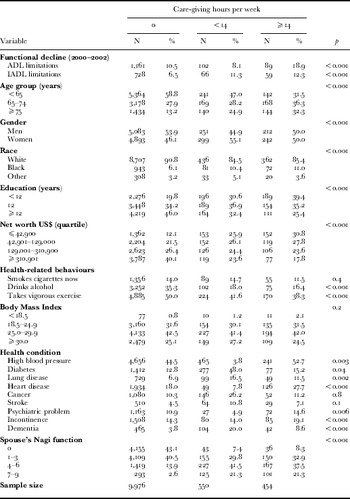
Table 1 shows the characteristics of the 10,980 care-giving spouses by number of care-giving hours provided. Those who provided any amount of care, whether up to 14 hours-per-week or more, were much more likely to experience declines in function in both ADLs and IADLs than those who provided no care per week. Of those who provided 14 or more hours-of-care per week, approximately one-third (32.3%) were aged 75 or more years and were equally divided between men and women. Across all three categories of hours-of-care provided, the majority of individuals were white. Care-givers who provided 14 or more hours-of-care per week had fewer years of education and lower net worth than those who provided less care. Interestingly, care-givers who provided less than 14 hours-of-care per week were less likely to drink alcohol (18.0%) and less likely to participate in vigorous exercise (41.6%) than those who provided zero care. Care-givers who provided 14 or more hours-per-week were the least likely to drink alcohol (16.4%) and to participate in vigorous exercise (38.3%) compared to the other two groups. For medical conditions, care-givers who provided less than 14 hours-of-care per week were most likely to report diabetes, lung disease and dementia. Care-givers who provided 14 or more hours-of-care per week were most likely to report high blood pressure, heart disease and psychiatric problems.
Functional health, health and socio-demographic characteristics of the sample of spouse care-givers by hours-of-care, United States 2000

Notes: The data source was the 2000 and 2002 Health and Retirement Study. The total sample size was 10,980. Data were weighted and adjusted for the complex sampling design. The significance levels were obtained with a design-based Pearson chi-squared test.
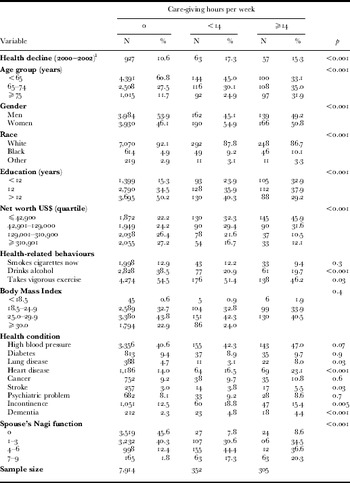
Table 2 presents the characteristics of the 8,571 care-giving spouses by number of care-giving hours and self-rated health. Individuals who provided less than 14 hours-of-care-giving per week were more likely to experience declines in self-rated health (17.3 per cent went from ‘excellent’ to ‘good’ self-rated health in 2000 to ‘fair’ or ‘poor’ in 2002) than either those who provided 14 or more hours-of-care or those who provided no care. Approximately one-quarter (24.9%) of those who provided less than 14 hours-of-care per week were aged 75 or more years (45.1% men and 54.9% women). For all three categories of hours-of-care provided, the majority in the sample were white. Care-givers who provided 14 or more hours-of-care per week had fewer years of education and lower net worth than those who provided less than 14 hours or no hours-of-care per week. Care-givers who provided 14 or more hours-per-week were the least likely to drink alcohol (19.7%) and to participate in vigorous exercise (46.2%). Regarding medical conditions, care-givers who provided 14 or more hours-of-care per week were most likely to report heart disease (23.1%). Care-givers who provided less than 14 hours-of-care per week were most likely to report dementia (4.8%).
Self-rated health in 2000 of the sample of spouse care-givers by socio-demographic and diagnosed health characteristics and hours of care, and decline in health from 2000 to 2002

Notes: The data source was the 2000 and 2002 Health and Retirement Study. The total sample size was 8,571. Data were weighted and adjusted for the complex sampling design. The significance levels were obtained with a design-based Pearson chi-squared test. 1. Health status declined from ‘excellent’ or ‘good’ in 2000 to ‘fair’ or ‘poor’ in 2002.
Functional decline
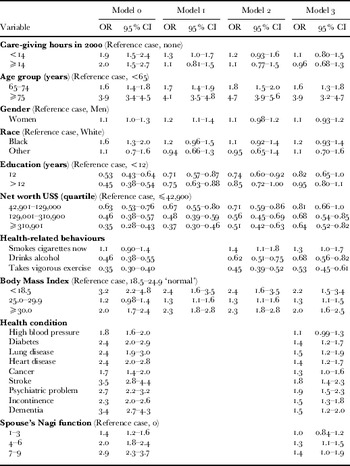
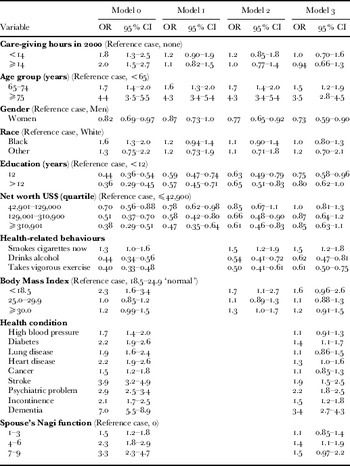
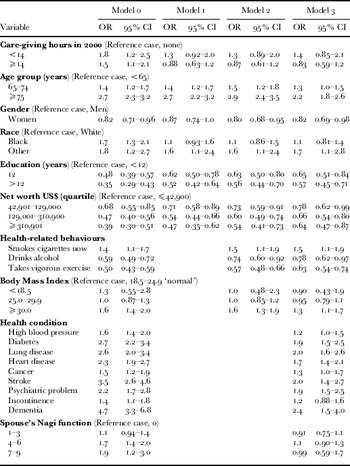
Model 0 is reported in Tables 3 and 4, which show the unadjusted odds ratio for functional decline (in ADLs and IADLs) among the spouse care-givers. In this model, which considers only time spent in care-giving, those who provided any amount of care to their spouse were more likely to experience functional declines in ADLs (Table 3) and IADLs (Table 4) than those who provided no care. More specifically, spouse care-givers who provided less than 14 hours-of-care had 90 per cent higher odds of ADL decline, and those that provided 14 or more hours-of-care per week had twice the odds of ADL decline. Similarly for IADLs: those who provided less than 14 hours-of-care had 80 per cent greater odds of decline, while those who provided 14 or more hours had twice the odds. Models 1–3 are reported in Tables 3 and 4, which show the relationship between spousal care-giving hours and ADL and IADL declines in function while controlling for other covariates. Interestingly, the addition of socio-demographic characteristics (Model 1 of Tables 3 and 4) eliminated the independent relationship between care-giving hours and functional decline. This suggests that the relationship between care-giving hours and functional decline may be attributed to socio-demographic characteristics. Further adjustment for health behaviours in Model 2 and for chronic conditions in Model 3 did not significantly change the coefficients by care-giving hours. Thus, care-giving hours did not have an independent effect on declines in ADL or IADL functioning in any of the adjusted models (Models 1–3 of Table 3 and 4), as it did in the unadjusted model (Model 0).
Logistic regressions of decline in ADL functioning between 2000 and 2002

Notes: OR odds ratio. 95% CI 95 per cent confidence interval of OR. The data source was the 2000 and 2002 Health and Retirement Study. Data were weighted and adjusted for the complex sampling design. Model 0 included care-giving hours (with zero as the reference case). Model 1 included Model 0 variables plus age, race, sex, net worth and education. Model 2 included Model 1 variables plus current smoker, drinks alcohol, participates in vigorous physical activity and BMI. Model 3 included Model 2 variables plus the nine medical conditions and Nagi functioning variables.
Logistic regressions of decline in IADL functioning between 2000 and 2002

Notes: OR odds ratio. 95% CI 95 per cent confidence interval of OR. The data source was the 2000 and 2002 Health and Retirement Study. Data were weighted and adjusted for the complex sampling design. Model 0 included care-giving hours (with zero as the reference case). Model 1 included Model 0 variables plus age, race, sex, net worth and education. Model 2 included Model 1 variables plus current smoker, drinks alcohol, participates in vigorous physical activity and BMI. Model 3 included Model 2 variables plus the nine medical conditions and Nagi functioning variables.
Self-rated health decline
Model 0 of decline in self-reported health is reported in Table 5, which shows the unadjusted odds ratio for self-rated health decline among spousal care-givers by amount of weekly care provided. In this model, care-givers who provided any amount of weekly care to their spouse were more likely to experience declines in self-rated health than respondents who provided no care. Specifically, respondents who provided less than 14 hours-of-care had 80 per cent greater odds of a decline in self-rated health, while those who provided 14 or more hours-of-care had 50 per cent greater odds of a decline. Models 1–3 (in Table 5) explored the relationship between spousal care-giving hours and a decline in self-rated health while controlling for other covariates. Interestingly, the subsequent addition of socio-demographic correlates (Model 1) eliminated the relationship between care-giving hours and a decline in self-rated health. This suggests that the relationship between care-giving hours and a decline in self-rated health is also likely to be attributed to socio-demographic characteristics. This is similar to the relationship we found between care-giving and declines in functioning; that is, care-giving did not have an independent effect on self-rated health decline in the adjusted models as it did in the unadjusted model.
Logistic regressions of decline in self-rated health between 2000 and 2002

Notes: Decline in self-rated health is from ‘excellent’ or ‘good’ in 2000 to ‘fair’ or ‘poor’ in 2002. OR odds ratio. 95% CI 95 per cent confidence interval of OR. The data source was the 2000 and 2002 Health and Retirement Study. Data were weighted and adjusted for the complex sampling design. Model 0 included care-giving hours (with zero as the reference case). Model 1 included Model 0 variables plus age, race, sex, net worth and education. Model 2 included Model 1 variables plus current smoker, drinks alcohol, participates in vigorous physical activity and BMI. Model 3 included Model 2 variables plus the nine medical conditions and Nagi functioning variables.
Discussion
This paper has addressed a significant gap in the care-giving literature by examining two relatively unexplored health outcomes – functional and self-rated health declines – among older spouse care-givers. This population-based analysis suggests that, once socio-demographic characteristics are taken into account, the negative association observed in the unadjusted models between care-giving and functional/self-rated health disappears. Put another way, the relationships in the unadjusted models can be explained by socio-demographic characteristics. Our findings support the notion that caring for a spouse does not have an independent negative impact on the carer's health, as some studies have indicated (Ory et al. Reference Ory, Lee, Tennstedt, Schulz and Schulz2000; Schulz et al. Reference Schulz, Newsom, Mittelmark, Burton, Hirsch and Jackson1997). Our results are also in line with other studies that find that socio-economic status, race and ethnicity correlate with both the amount of care provided and certain health outcomes such as disability (Tennstedt and Chang Reference Tennstedt and Chang1998). Since some work has suggested that it is the stress and strain associated with care-giving that contributes to poorer care-giver health, rather than the actual amount of time devoted to it, the perceived stress and coping mechanisms that probably vary by socio-economic characteristics may be a proxy for the level of care-giver stress and strain, so the unadjusted relationship of care-giving hours to health decline (found in the unadjusted Models 0) is no longer apparent once socio-economic characteristics are controlled. Differences in living arrangements and work status may also explain at least some of the relationship between care-giving and functional and self-rated health declines (Borg and Kristensen Reference Borg and Kristensen2000; Henz Reference Henz2004).
Several variables were particularly important correlates of both functional and self-rated health declines. One is older age: in the fully adjusted models, care-givers who were aged 75 or more years were more likely to experience functional and self-rated health declines than younger subjects Regarding health behaviours, spousal care-givers who drank alcohol and participated in vigorous exercise were less likely to experience functional and self-rated declines. Four chronic conditions were related to both functional and self-rated health declines: stroke, psychiatric problems, diabetes and dementia. Additional health characteristics that put a subject at particular risk for decline included: (1) for ADL decline, being underweight, overweight or obese, being incontinent, and having lung disease or heart disease; (2) for IADL decline, smoking and being incontinent; and (3) for self-rated health decline, being of ‘other’ race, smoking, being obese, and having lung or heart disease. These particular characteristics are important patient traits that should alert clinicians to implement preventive or supportive measures to promote a care-giver's health.
This study has important implications for policy and clinical practice. Understanding that certain subgroups of care-givers may be more susceptible to the negative health effects associated with care-giving allows clinicians and policy makers more effectively to target prevention and treatment efforts. For example, rather than focusing on reducing a high risk patient's care-giving time to improve care-giver health, a clinician may consider including an exercise programme in their treatment regimen. Policy makers interested in this area might also tailor their work toward activities that promote healthy weight maintenance and an active lifestyle, such as safe walking trails, rather than focusing on reducing the amount of hours devoted to caring for a loved one. Both, however, should also consider more subjective aspects of care-giving (such as the stress associated with it) when making recommendations.
Two potential limitations of the study merit comment. It is important to note that care-giving and functional and self-rated health declines may be subject to measurement and response effects. An additional limitation of our study is that all data were self-reported without external verification. Future studies should consider the time that spouses spend in care-giving and its effects on other outcomes such as mortality. These studies might focus on which if any aspects of health and functioning are positively or negatively influenced by spousal care-giving and, if a relationship exists, which aspects of spousal care-giving are particularly detrimental or beneficial to a particular outcome. Other outcomes that might be considered are the impact of care-giving hours on health behaviours and employment (e.g. job loss and reduction in work hours). It is plausible that the amount of care-giving provided could reduce the amount of time available to engage in positive health behaviours such as exercise and healthy eating. Also, care-givers who work may find it difficult to balance paid-work and care-giving and as result may experience job loss or a reduction in the number of hours spent in paid work. Changes in care-giving time could also be a productive area of research. Examining changes in the number of care-giving hours over time with changes in the various outcomes already mentioned (e.g. changes in positive health behaviours) may shed light on the temporal order of these relationships, as well as what specific care-giving hour amounts may be more beneficial in promoting favourable outcomes, such as positive health behaviours and job security. A more complete understanding of the relative care-giving burdens associated with other outcomes might help both policy makers and clinicians target care-giver interventions and resources most cost-effectively.
Acknowledgements
Support for this project was provided by a grant from the Paul Beeson Physician Faculty Scholars Program. The United States National Institute on Aging (NIA) funds the collection, processing, and dissemination of Health and Retirement Study data (grant U01 AG09740), which were used for this article. Additional funding was provided by NIA grant R01 AG027010. An earlier version of this paper was presented at the 2006 Gerontological Society of America Annual Meeting. The authors would like to thank N. E. Barr for her helpful editorial comments.