Introduction
Mobility Is Vital to Healthy Aging
Mobility is broadly defined as the ability of individuals to move themselves within community environments (Webber, Porter, & Menec, Reference Webber, Porter and Menec2010). Mobility is a fundamental component of healthy and active aging because it enables engagement in daily activities (e.g., shopping), including physical activity (e.g., walking for exercise), and participation in society (e.g., getting to places by car or public transport) (Canadian Institutes of Health Research, 2014; Satariano et al., Reference Satariano, Guralnik, Jackson, Marottoli, Phelan and Prohaska2012). Through hindrance or support of these activities, mobility may also have an influence on social and economic independence (e.g., inability to engage in social activities and/or maintain employment due to lack of transportation) as well as physical and mental health (Canadian Institutes of Health Research, 2014; Centers for Disease Control and Prevention, n.d.; Satariano et al., Reference Satariano, Guralnik, Jackson, Marottoli, Phelan and Prohaska2012). Mobility-disability is defined as difficulty in (1) walking up and down a flight of stairs, (2) standing in one spot for 20 minutes, or (3) moving from one room to another (Human Resources and Skills Development Canada, 2011). Despite the importance of mobility to everyday life, mobility-disability is the most common type of disability experienced by Canadian older adults (Human Resources and Skills Development Canada, 2011). Approximately one third of Canadians aged 65 years and older have a mobility-related disability, with higher prevalence among women and with older age (Statistics Canada, 2008). Given the significance of mobility to healthy and active aging, and the prevalence of mobility-disability among older adults, a thorough understanding of factors associated with older adults’ mobility is a public health priority.
Framework of Older Adult Mobility
The built environment is defined as human-made infrastructure that comprises urban design, land use, and transportation systems (Handy, Boarnet, Ewing, & Killingsworth, Reference Handy, Boarnet, Ewing and Killingsworth2002). The built environment plays an important role in older adults’ mobility because it is the setting in which outdoor mobility occurs. Age-related declines in health and function can make it more difficult for older adults to be mobile in the built environment (Noreau & Boschen, Reference Noreau and Boschen2010; Shumway-Cook et al., Reference Shumway-Cook, Patla, Stewart, Ferrucci, Ciol and Guralnik2003). Lawton and Nahemow’s (Reference Lawton, Nahemow, Eisdorfer and Lawton1973) ecological model of adaptation and aging states that the extent to which an individual successfully functions in his/her environment is a result of the interplay between individual capacity (referred to as individual competence) and the supports and pressures present in the environment (referred to as environmental press). Applied to older adult mobility, the model posits that if the pressure imposed by a built environment is greater than an older adult’s functional capacity, the older adult is likely to stop engaging with the outdoor environment (Noreau & Boschen, Reference Noreau and Boschen2010; Shumway-Cook et al., Reference Shumway-Cook, Patla, Stewart, Ferrucci, Ciol and Guralnik2003). Therefore, it is necessary to consider individual (person-level) variables, environment-level variables, and their interaction when studying older adults’ outdoor mobility.
Webber et al. (Reference Webber, Porter and Menec2010) developed a framework of older adult mobility that organizes person-level variables that influence the capacity to be mobile into four categories of determinants (cognitive, financial, physical, and psychosocial). These categories interact with a fifth, environmental, category to influence older adult mobility. The framework also acknowledges that gender, culture, and personal life history indirectly influence mobility through their association with categories of mobility determinants, as well as by shaping individuals’ experiences, opportunities, and behaviours. Although Webber et al.’s (Reference Webber, Porter and Menec2010) framework helps to ensure a holistic approach to measurement of person-level variables that influence the capacity to be mobile, another important consideration is the multi-directional association between mobility and its determinants.
Mobility limitations can have a negative influence on determinants of mobility, which may, in turn, directly or indirectly (e.g., through mediating variables such as health) bring about further declines in mobility and health (Satariano et al., Reference Satariano, Guralnik, Jackson, Marottoli, Phelan and Prohaska2012). For example, walking difficulties may precipitate increased loneliness in older adults as a result of decreased autonomy to participate outdoors (e.g., autonomy to make trips and travel, meet other people) (Rantakokko et al., Reference Rantakokko, Iwarsson, Vahaluoto, Portegijs, Viljanen and Rantanen2014). Loneliness, in turn, may be associated with motor and functional decline in old age (Buchman et al., Reference Buchman, Boyle, Wilson, James, Leurgans, Arnold and Bennett2010; Perissinotto, Stijacic Cenzer, & Covinsky, Reference Perissinotto, Stijacic Cenzer and Covinsky2012), which may bring about further declines in mobility. On the other hand, positive mobility outcomes or behaviours may directly or indirectly (e.g., through mediating variables such as good health) help promote future mobility. For example, engagement in regular physical activity may reduce perceptions of stress in older adults (Rueggeberg, Wrosch, & Miller, Reference Rueggeberg, Wrosch and Miller2012). Lower levels of perceived stress can protect against developing chronic health problems in older adults (Rueggeberg et al., Reference Rueggeberg, Wrosch and Miller2012) and thereby have a protective effect against subsequent mobility loss. A comprehensive study of older adult mobility, therefore, requires that one considers multi-directional and interconnected influences of factors across the person, environment, and mobility.
How Socioeconomic Status Influences Mobility
Older adults of low socioeconomic status represent an understudied segment of the older adult population with potentially unique mobility-related needs and characteristics. This segment comprises approximately 12 per cent of Canadian older adults, as estimated by Statistics Canada’s low-income cut-off measure, and is on the rise (The Conference Board of Canada, 2013). Older adults of low socioeconomic status may have an increased reliance on walking to get to places to meet their day-to-day (i.e., basic, social, medical) needs in order to preserve financial resources or as a result of financial restrictions that prohibit them from owning a car or utilizing other travel options (e.g., taxi, bus). Indeed, the association between low socioeconomic status and decreased likelihood of travel by car is well established in older adults (Cao, Mokhtarian, & Handy, Reference Cao, Mokhtarian and Handy2010; Frank, Kerr, Rosenberg, & King, Reference Frank, Kerr, Rosenberg and King2010; Turcotte, Reference Turcotte2012). At the same time, the association between low socioeconomic status and poor health outcomes is also well established in epidemiologic studies (Institute of Medicine (US) Committee on Health and Behavior, 2001; Marmot et al., Reference Marmot, Smith, Stansfeld, Patel, North, Head and Feeney1991; Mustard, Derksen, Berthelot, Wolfson, & Roos, Reference Mustard, Derksen, Berthelot, Wolfson and Roos1997; Reid et al., Reference Reid, Hamilton, Keen, Brett, Jarrett and Rose1974). Studies of older adults report that low socioeconomic status is an independent risk factor for morbidity, walking difficulty, and incident mobility-disability (Huisman, Kunst, & Mackenbach, Reference Huisman, Kunst and Mackenbach2003; Koster et al., Reference Koster, Penninx, Bosma, Kempen, Harris, Newman and Kritchevsky2005; Nilsson, Avlund, & Lund, Reference Nilsson, Avlund and Lund2010; Shumway-Cook, Ciol, Yorkston, Hoffman, & Chan, Reference Shumway-Cook, Ciol, Yorkston, Hoffman and Chan2005). There is also some evidence to suggest that biomedical factors (e.g., high body mass index [BMI], high serum levels of inflammatory markers), behavioural factors (e.g., lower physical activity levels), and psychosocial factors (e.g., smaller social networks and lower feelings of self-efficacy) may mediate the association between low socioeconomic status and mobility-disability, poor function, and/or health (Koster et al., Reference Koster, Bosma, van Groenou, Kempen, Penninx, van Eijk and Deeg2006b; Koster et al., Reference Koster, Penninx, Bosma, Kempen, Harris, Newman and Kritchevsky2005; Ovrum, Gustavsen, & Rickertsen, Reference Ovrum, Gustavsen and Rickertsen2014). Clearly, this presents a complex landscape. However, it speaks to the likelihood that older adults of low socioeconomic status may rely more on walking to meet their day-to-day needs. At the same time they may be at increased risk of functional limitations that interfere with walking, especially if there is a mismatch between their capacity and the pressures exerted by the environment. We need to elucidate characteristics and mobility profiles of older adults of low socioeconomic status to better understand and support older adult mobility.
Aim of This Study
Consequently, the aim of this study was to comprehensively describe person- and environment-level characteristics and mobility of older adults of low socioeconomic status across a diverse range of built environments in Metro Vancouver.
Methods
Walk the Talk: Transforming the Built Environment to Enhance Mobility in Seniors (Walk the Talk) is a cross-sectional study of the association between the built environment and the mobility and health of older adults (aged > 65 years) who live on low income and reside in Metro Vancouver, Canada (http://www.hiphealth.ca/research/research-projects/walk-the-talk-team–wtt-/).
Setting
Metro Vancouver is a regional district in British Columbia (BC) that comprises 21 urban and suburban municipalities. In 2011, the population of Metro Vancouver was approximately 2.3 million; 13.5 per cent of residents (312,095 people) were aged 65 or older, on average (Statistics Canada, 2012).
Population
We identified older adults living on low income through our partnership with BC Housing, a provincial crown organization that provides affordable housing options across a continuum from emergency shelters to public housing and rental assistance in the private market (BC Housing, n.d.). BC Housing services the most vulnerable members of society – the homeless, older adults and families living on low income, individuals with disabilities, women and children at risk of violence, and First Nations peoples. BC Housing provides the Shelter Aid for Elderly Renters (SAFER) rental subsidy program. This program offers a monthly rental subsidy to older adults aged 60 or older who live in British Columbia and who pay more than 30 per cent of their gross monthly household income in rent for their residence (https://www.bchousing.org/housing-assistance/rental-assistance-financial-aid-for-home-modifications/shelter-aid-for-elderly-renters). The average before-tax household income of SAFER recipients was approximately $18,000 in 2011 (Chudyk, personal communication, August 23, 2013). In comparison, this is about three times lower than the 2011 Canadian average after-tax income ($57,700) for families where the major income earner is age 65 or older, and up to two times lower than that of older adults living alone ($34,400 for males and $29,700 for females) (Statistics Canada, 2013).
Our source population consisted of 5,806 households in eight select cities within Metro Vancouver (Burnaby, New Westminster, North Vancouver, Richmond, Surrey, Vancouver, West Vancouver, White Rock) that were in receipt of SAFER, had a household member aged 65 or older, and a telephone number on file with BC Housing. We excluded individuals who self-reported that they (1) were diagnosed with dementia, (2) left their home to go into the community less than once in a typical week, (3) were unable to understand or speak English, (4) were unable to walk 10 or more meters with or without a mobility aid (e.g., cane, walker), and/or (5) were unable to participate in a mobility assessment that involved a 4-meter walk with or without a mobility aid. This study was approved by the University of British Columbia’s Clinical Research Ethics Board (certificate H10-02913). All participants provided written consent and received a $20 honorarium for participation in the study.
Recruitment
We sampled households using a stratified design, randomly selecting 200 households from within strata (deciles) of Walk Score® (www.walkscore.com) across the Metro Vancouver region (n total = 2,000) to ensure diversity across the built environment. Walk Score is a publicly available index that measures the walkability (pedestrian friendliness) of an address based on distance to nearby destinations. Upper cut-points (deciles) were 100 (1), 93 (2), 87 (3), 78 (4), 72 (5), 67 (6), 60 (7), 52 (8), 43 (9), 32 (10). We mailed study information (a letter that introduced the study and a copy of the study’s consent form) to sampled households. The mail out was addressed to head of household as determined by BC Housing. We followed up with a telephone call to review the study purpose, screen for eligibility, and answer any relevant questions. We made up to two attempts during the daytime to establish initial phone contact with each individual. Recruitment took place during January and February 2012.
Measurement
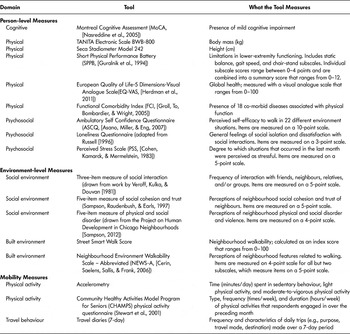
Each participant took part in one, 2-hour measurement session held during the March through May 2012 time frame. Measurement sessions took place at our Vancouver research facility (Centre for Hip Health and Mobility) or at community centres (n = 5) located outside the City of Vancouver. We collected participant data (perceptions of the environment, person-level characteristics as assessed by objective measures, and interviewer-administered questionnaires) during measurement sessions. We also measured select mobility outcomes (physical activity and travel behaviour) in the week that immediately followed these sessions. We present relevant measures in Table 1 and describe them in detail, below.
Select person-level, environment-level, and mobility measures used in the study

Measures of Person- and Environment-level Characteristics of Participants
We applied Webber et al.’s (Reference Webber, Porter and Menec2010) framework of older-adult mobility to comprehensively measure participants’ characteristics across the multi-level domains (environmental, cognitive, physical, and psychosocial) of older adult mobility. We substitute the term “domain” for “determinant” to underscore the multi-directional nature of associations between these variables and mobility. Further, although psychosocial variables include psychological attributes that exist at the person level and are likely to result from the process of socialization (e.g., thoughts and feelings), as well as variables that exist at a wider structural level (e.g., interpersonal relationships) (Singh-Manoux, Reference Singh-Manoux2003), we distinguish the two as separate domains to differentiate between variables within (person level) and outside of the individual (environment level). Specifically, we grouped measures of interpersonal relationships (e.g., social networks, social support) and neighbourhood characteristics (e.g., social cohesion, neighbourhood social and physical disorder) into a social environment domain (McNeill, Kreuter, & Subramanian, Reference McNeill, Kreuter and Subramanian2006) and measures of thought and feelings (e.g., self-efficacy, stress, loneliness) into a psychosocial domain.
Measures of Person-level Characteristics
Sociodemographic Information
We measured participants’ age, gender, culture (ethnicity, self-identity as visible minority), highest education level attained, years lived in residence, whether they possessed a valid driver’s license, whether they had access to a vehicle in the seven days preceding study participation, and whether they owned a dog with a self-report questionnaire.
Cognitive Domain
Mild Cognitive Impairment. We administered the Montreal Cognitive Assessment (MoCA), a brief clinical screening tool with high sensitivity and specificity to detect mild cognitive impairment, to screen for possible mild cognitive impairment (Nasreddine et al., Reference Nasreddine, Phillips, Bedirian, Charbonneau, Whitehead, Collin and Chertkow2005). The MoCA asks participants to complete visuospatial drawing tasks; identify animals; recall letters, words, and digits; perform mental calculations; list words that start with a given letter; identify similarities between objects; and orient themselves in space and time. It is scored out of 30 points, with a total score of less than 26 used as a cut-off for suspected mild cognitive impairment.
Physical Domain
Body Mass Index. We used a TANITA Electronic Scale Model BWB-800 and Seca Stadiometer Model 242 to objectively measure participants’ weight (kg) and height (cm) respectively. We used these data to calculate participants’ BMI (kg/m2).
Limitations in Lower Extremity Functioning and Gait Speed. We objectively measured participants’ limitations in lower extremity functioning and gait speed using the Short Physical Performance Battery (SPPB) (Guralnik et al., Reference Guralnik, Simonsick, Ferrucci, Glynn, Berkman, Blazer and Wallace1994). The SPPB is a reliable and valid measure of older adults’ mobility and balance that consists of standing balance tests, a 4-meter walk at usual pace, and a sit-to-stand test (Freire, Guerra, Alvarado, Guralnik, & Zunzunegui, Reference Freire, Guerra, Alvarado, Guralnik and Zunzunegui2012; Guralnik, Ferrucci, Simonsick, Salive, & Wallace, Reference Guralnik, Ferrucci, Simonsick, Salive and Wallace1995; Guralnik et al., Reference Guralnik, Simonsick, Ferrucci, Glynn, Berkman, Blazer and Wallace1994; Ostir, Volpato, Fried, Chaves, & Guralnik, Reference Ostir, Volpato, Fried, Chaves and Guralnik2002). Individual scores on each component range between 0–4 points and are summed to create a score that ranges from 0–12. We calculated participants’ gait speed (m/s) based on the time taken to walk four meters at usual pace.
Health. We used a self-report questionnaire to obtain data on participants’ use of mobility aids (number, type) and falls history in the past six months. We also used self-report questionnaires to measure participants’ global health (European Quality of Life-5 Dimensions visual analogue scale [EQ-VAS] [Herdman et al., Reference Herdman, Gudex, Lloyd, Janssen, Kind, Parkin and Badia2011]) and co-morbidities (Functional Comorbidity Index [FCI] [Groll, To, Bombardier, & Wright, Reference Groll, To, Bombardier and Wright2005]). The European Quality of Life-5 Dimensions is a generic measure of health status, widely used across countries and clinical populations (http://www.euroqol.org). The EQ-VAS asks participants to indicate their current health state on a scale from 0 (“the worst health you can imagine”) to 100 (“the best health you can imagine”). The FCI was designed to assess the presence of 18 co-morbidities associated with physical function; these include bone, cardiac, gastrointestinal, neurological, psychiatric, pulmonary, and spinal disc diseases or disorders, as well as hearing and visual impairments. The reliability and validity of the FCI was established in clinical adult populations (Fan et al., Reference Fan, Gifford, Chandolu, Colantuoni, Pronovost and Needham2012; Fortin et al., Reference Fortin, Hudon, Dubois, Almirall, Lapointe and Soubhi2005; Groll et al., Reference Groll, To, Bombardier and Wright2005).
Psychosocial Domain
Self-efficacy for Walking. We used self-report questionnaires to measure participants’ self-efficacy for walking in different environment situations (Ambulatory Self-Confidence Questionnaire [ASCQ] [Asano, Miller, & Eng, Reference Asano, Miller and Eng2007]) and walking in the neighbourhood (five-point scale, where 1 = “not at all” and 5 = “very much”). The ASCQ is a 22-item questionnaire that asks respondents to rate – on a 10-point scale, where 1 = “not at all confident” and 10 = “extremely confident” – how confident they are in their ambulatory abilities across different environmental situations (e.g., stepping on/off a curb/steps/ramp, crossing the street, walking on different surfaces, walking at different times of day, walking in different contexts). The validity and reliability of the ASCQ was established in community-dwelling older adults (Asano et al., Reference Asano, Miller and Eng2007). We calculated a summary score for the ASCQ by averaging responses across all items. We also list items (environment situations) with which participants reported the least confidence.
Attitudes towards Walking. We measured how much participants liked to walk outside by self-report (5-point scale, where 1 = “not at all” and 5 = “very much”).
Stress. We used the Perceived Stress Scale (PSS), a popular self-report questionnaire, to measure psychological stress (Cohen, Kamarck, & Mermelstein, Reference Cohen, Kamarck and Mermelstein1983). It asks participants about the frequency (never, almost never, sometimes, fairly often, and very often) of thoughts and feelings (e.g., upset, nervous/stressed, in control, like things were going their way) in the past month. The validity of the PSS was established in community-dwelling older adults (Ezzati et al., Reference Ezzati, Jiang, Katz, Sliwinski, Zimmerman and Lipton2014), and the reliability of the PSS was established in a variety of adult populations (Lee, Reference Lee2012). We computed a score for the scale by summing responses across all 10 items. Higher scores indicated higher levels of perceived stress.
Loneliness. We assessed loneliness with 11 items drawn from the Revised UCLA Loneliness Scale (R-UCLA), a validated and reliable measure that taps general feelings of social isolation, loneliness, and dissatisfaction with one’s social interactions (Hawkley, Browne, & Cacioppo, Reference Hawkley, Browne and Cacioppo2005; Hughes, Waite, Hawkley, & Cacioppo, Reference Hughes, Waite, Hawkley and Cacioppo2004; Russell, Reference Russell1996). The 11-item scale asks participants to indicate how much of the time (often, some of the time, hardly ever, or never) they feel – for example – left out, alone, part of a group of friends, and so on. The 11-item scale has established reliability in community-dwelling older adults (Smith et al., Reference Smith, Fisher, Ryan, Clarke, House and Weir2013). We averaged responses across all 11 items to calculate an index score of loneliness. Higher scores represented greater perceived loneliness.
Measures of Environment-level Characteristics
Social Environment Domain
Interpersonal Relationships. We assessed dimensions of participants’ interpersonal relationships (marital status, living arrangement, and perceived presence of people that offer physical and/or social support to go outside) using a self-report questionnaire, as well as a three-item measure of social interaction. The three-item measure of social interaction was drawn from Veroff, Kulka, and Douvan (Reference Veroff, Kulka and Douvan1981). Two items ask participants to indicate how often (> 1/week, 1/week, 2–3 times/month, about 1/month, < 1/month, or never) they (1) get together with friends, neighbours, or relatives to go out or visit in each other’s homes; and (2) attend meetings or programs of groups, clubs, or organizations that they belong to. A third item asks how often in a typical week (> 1/day, 1/day, 2–3 times/week, about 1/week, < 1/week, or never) they talk on the telephone or exchange emails with friends, neighbours, or relatives. The scale has established validity (Clarke, Ailshire, Nieuwenhuijsen, & de Kleijn-de Vrankrijker, Reference Clarke, Ailshire, Nieuwenhuijsen and de Kleijn-de Vrankrijker2011; Musick, Herzog, & House, Reference Musick, Herzog and House1999) and reliability in samples of community-dwelling older adults (House, Reference House1994). We calculated a mean score across the three items. A higher score indicated more frequent interactions.
Neighbourhood Social Environment. We measured neighbourhood social environment characteristics with a five-item measure of social cohesion and trust (Sampson, Raudenbush, & Earls, Reference Sampson, Raudenbush and Earls1997) and a five-item measure of social and physical disorder drawn from the Project on Human Development in Chicago Neighbourhoods (Sampson, Reference Sampson2012). The five-item measure of neighbourhood social cohesion and trust asks participants to indicate their agreement (on a five-point scale that ranges from strongly disagree to strongly agree) with statements that tap mutual trust and cohesion in the neighbourhood. The scale asks participants to indicate: (1) how close-knit their neighbourhood is; and whether people in the neighbourhood are (2) willing to help each other; (3) don’t get along; (4) don’t share the same values; and (5) can be trusted. The measure has demonstrated reliability in community-dwelling samples (Raudenbush & Sampson, Reference Raudenbush and Sampson1999; Sampson et al., Reference Sampson, Raudenbush and Earls1997) and validity with respect to both individual and community-level outcomes (Cradock, Kawachi, Colditz, Gortmaker, & Buka, Reference Cradock, Kawachi, Colditz, Gortmaker and Buka2009; Lochner, Kawachi, Brennan, & Buka, Reference Lochner, Kawachi, Brennan and Buka2003; Sampson et al., Reference Sampson, Raudenbush and Earls1997). We calculated a mean score across the five items. A higher score indicated greater social cohesion and trust.
The five-item measure of neighbourhood physical and social disorder asks participants to indicate on a 4-point scale: how much (none, a little, some, a lot) (1) broken glass or trash they see on neighbourhood sidewalks and streets and (2) graffiti they see on neighbourhood buildings and walls; (3) how many (none, a little, some, a lot) vacant/deserted houses or storefronts they see in their neighbourhood; and how often (never, not very often, sometimes, very often) they see (4) people drinking in public places in their neighbourhood, and (5) unsupervised children hanging out on the street in their neighbourhood. This measure has established validity and within-neighbourhood reliability in community-dwelling samples (Mair, Roux, & Morenoff, Reference Mair, Roux and Morenoff2010; Raudenbush & Sampson, Reference Raudenbush and Sampson1999; Sampson & Raudenbush, Reference Sampson and Raudenbush1999). We calculated a mean score across the five items. A higher score indicated more disorder.
Built Environment Domain
Objective Measure of Walkability. Although we used Walk Score for sampling, we describe the walkability of participants’ neighbourhoods with Street Smart Walk Score® (www.walkscore.com) as it uses a methodology that has been updated to better reflect empirical research and to better predict time spent in moderate-to-vigorous physical activity (MVPA) for adult and older-adult populations (Frank, Reference Frank2013). The correlation between participants’ Street Smart Walk Score and Walk Score obtained at time of recruitment was r = 0.92. Street Smart Walk Score is a publicly available index that calculates the walkability of an address on a scale of 0–100 based on distance to nine different destination categories (e.g., grocery stores, restaurants, shopping). Street network characteristics (intersection density and block length) are also factored into the score. Categories of walkability (Street Smart Walk Score range), as provided by the manufacturer, are as follows: “Car dependent” (0–49), “Somewhat walkable” (50–69), “Very walkable” (70–89), and “Walker’s paradise” (90–100).
Perceptions of Neighbourhood Built-Environment Features Related to Walking. We used a modified version of the Neighbourhood Environment Walkability Scale – abbreviated (NEWS-A) – to measure participants’ perceptions of neighbourhood built environment features related to walking (Cerin, Saelens, Sallis, & Frank, Reference Cerin, Saelens, Sallis and Frank2006). Subscales of the NEWS-A include residential density, land-use mix (diversity), land-use mix (access), street connectivity, infrastructure and safety for walking, aesthetics, traffic hazards, crime, lack of parking, lack of cul-de-sacs, hilliness, and physical barriers. We did not collect all of the items that comprise the infrastructure and safety subscale, so we do not present outcomes for this subscale. All subscales, with the exception of residential density and land-use mix (diversity), use a 4-point scale from 1 (strongly disagree) to 4 (strongly agree). The residential density subscale uses a 5-point scale from 1 (none) to 5 (all) that is converted to a sub-score that ranges between 173 and 865. The land-use mix (diversity) subscale uses a 5-point scale from 1 (1–5 minutes) to 5 (> 31 minutes/don’t know) to measure participants’ perceptions of time required to walk from home to select destinations. Reliability of individual items and validity of the NEWS-A is established in adults residing in the United States (Brownson et al., Reference Brownson, Chang, Eyler, Ainsworth, Kirtland, Saelens and Sallis2004; Cerin, Conway, Saelens, Frank, & Sallis, Reference Cerin, Conway, Saelens, Frank and Sallis2009; Cerin et al., Reference Cerin, Saelens, Sallis and Frank2006).
Measures of Participants’ Mobility
We assessed participants’ mobility using measures of physical activity and travel behaviour.
Physical Activity
Physical Activity Patterns. At the end of the in-person measurement session, we provided participants with ActiGraph GT3X+ (LLC, Fort Walton Beach, FL) tri-axial accelerometers to measure participants’ physical activity patterns. We requested that participants wear the accelerometer on their right hip, during waking hours, during the following week; the accelerometer was removed during any water-based activities. Participants received a log to record the dates and times they wore the accelerometer.
The accelerometer recorded data continuously (at 30 Hz), and we reintegrated the data to 60-second epochs. We considered more than 60 minutes of continuous zeroes as non-wear time. For analyses, we included data with three or more valid days (> 8 hours wear time per day) of wear time. We used cut-points proposed by Matthews et al. (Reference Matthews, Chen, Freedson, Buchowski, Beech, Pate and Troiano2008) to classify time (minutes) spent in sedentary behaviour (< 100 counts/minute [CPM]) and the cut-points proposed by Freedson, Melanson, and Sirard (Reference Freedson, Melanson and Sirard1998) to classify time (minutes) spent in light physical activity (100–1,951 CPM) and MVPA (> 1,952 CPM). We also estimated time (minutes) spent in bouts of 10 or more minutes of MVPA, allowing for a 1–2 minute interruption. We derived time (minutes) spent in sedentary behaviour, light-intensity physical activity, and MVPA using batch processing with ActiLife software version 6.5.4 (LLC, Fort Walton Beach, FL).
Self-reported Physical Activity. We identified the physical activities that participants most frequently reported participating in with the Community Healthy Activities Model Program for Seniors (CHAMPS) physical activity questionnaire (Stewart et al., Reference Stewart, Mills, King, Haskell, Gillis and Ritter2001). CHAMPS evaluates the type, frequency (times/week), and duration (hours/week) of physical activities that respondents engaged in over the preceding month. Items include pre-defined physical activities that are of light (e.g., light gardening, stretching, light housework), moderate (e.g., water exercises, heavy housework) and vigorous (e.g., jogging, walking uphill, moderate-to-heavy strength training) intensity, and items specific to walking for errands and walking for leisure. Validity and reliability of the CHAMPS is well established in community-dwelling older adults (Colbert, Matthews, Havighurst, Kim, & Schoeller, Reference Colbert, Matthews, Havighurst, Kim and Schoeller2011; Harada, Chiu, King, & Stewart, Reference Harada, Chiu, King and Stewart2001; Stewart et al., Reference Stewart, Mills, King, Haskell, Gillis and Ritter2001).
Travel Behaviour
Self-reported Travel Behaviour. We measured participants’ self-reported travel behaviour with travel diaries. Participants recorded their daily trips including start location and time, end location and time, reason for trip, travel mode, and social accompaniment. A trip was defined as one-way travel between two locations. Participants filled out their travel diaries in the week immediately following measurement sessions and concurrently with accelerometry data. Detailed information on travel diary data cleaning have been published elsewhere (Chudyk et al., Reference Chudyk, Winters, Moniruzzaman, Ashe, Sims-Gould and McKay2015).
Data Analysis
We describe participants’ person- and environment-level characteristics using means (SD) and counts (per cent). The exception is participants’ years lived at current residence, which we present as a median value (25th and 75th percentiles) because these data were skewed (Altman & Bland, Reference Altman and Bland1994). We describe participants’ mobility (physical activity and travel behaviour) using medians (25th and 75th percentiles) and counts (per cent) because trip frequency and MVPA data were also skewed. We calculated average daily time (minutes/day) in sedentary behaviour, light-intensity physical activity, and MVPA as total time (minutes) divided by valid accelerometry days. We calculated weekly time (minutes/week) in MVPA and whether participants met physical activity guidelines (engaged in > 150 minutes of MVPA per week, accumulated in bouts of > 10 minutes [Tremblay et al., Reference Tremblay, Warburton, Janssen, Paterson, Latimer, Rhodes and Duggan2011]) by multiplying daily estimates of MVPA (minutes/day) by seven. We standardized daily estimates (minutes/day) of sedentary behaviour, light-intensity physical activity, and MVPA to a 13-hour wear day (Herrmann, Barreira, Kang, & Ainsworth, Reference Herrmann, Barreira, Kang and Ainsworth2013). Trajectories of aging vary between men and women, as does physical activity and travel behaviour (McPherson & Wister, Reference McPherson and Wister2008; Spirduso, Francis, & MacRae, Reference Spirduso, Francis and MacRae2005; Sun, Norman, & While, Reference Sun, Norman and While2013; Turcotte, Reference Turcotte2012). Therefore, although ours was not a longitudinal study, we present data separately for men and women to more comprehensively describe this cohort in the context of aging. We used Stata version 13.0 for analysis (Stata Corp, TX).
Results
Flow of Participants into the Study
A detailed description of the flow of participants into the study is published elsewhere (Chudyk et al., Reference Chudyk, Winters, Moniruzzaman, Ashe, Sims-Gould and McKay2015). Briefly, of 5,806 households in our source population, we randomly sampled 2,000 individuals (from 2,000 households) and contacted 1,995 individuals (from 1,995 households) for study participation. Of these, 161 individuals (102 women and 59 men) signed consent forms and participated in measurement sessions. The recruitment rate (contacted for participation/signed consent form) was 8 per cent. Of the 1,834 individuals who did not participate in our study, we could not reach approximately 32 per cent in person. Reasons for non-contact included wrong/inactive telephone numbers (11%), inability to be contacted directly at place of residence (< 1%, e.g., resided at a hotel), and failure to return our telephone messages (20%). Of the remainder (68%) of individuals who did not participate, 38 per cent declined because they were not interested in study participation, 18 per cent did not meet inclusion/exclusion criteria, 6 per cent declined because of health problems, and 6 per cent did not participate for other reasons (e.g., away during study measurement sessions, deceased).
Person-level Characteristics of Participants
Sociodemographic Information
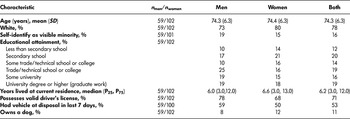
We provide descriptive statistics for select sociodemographic variables in Table 2.
Descriptive statistics for select sociodemographic characteristics

Participants were aged 74.3 (SD = 6.3) years, on average. They were predominantly White (men:women [%], 73:80). Most participants completed at least a secondary school education (men:women [%], 90:86); 19 per cent of participants obtained a university degree or higher (e.g., graduate work). Participants lived at their current residence for 6.2 (3, 12; median P25, P75) years. Approximately three fourths of participants (men:women [%], 78:68) possessed a valid driver’s license; however, only about half (men:women [%], 59:50) had a vehicle at their disposal in the seven days preceding study participation.
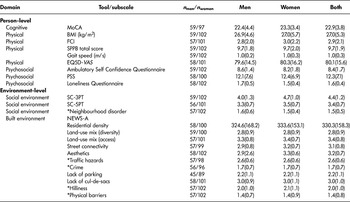
We present descriptive statistics for select person- and environment-level characteristics of participants in Table 3.
Descriptive statistics for select measures by domain of mobility, mean (SD)

* For these tools/subscales, higher scores indicate greater disorder/worse walkability.
Ambulatory Self Confidence Questionnaire scale range 1–10
BMI = Body Mass Index
EQ-VAS = European Quality of Life-5 Dimensions-Visual Analogue Scale; scale range 0–100
FCI = Functional Comorbidity Index; scale range 0–18
Gait speed calculated as part of the SPPB; a gait speed of > 0.8 m/s is required for community ambulation (Fritz & Lusardi, Reference Fritz and Lusardi2009), whereas a gait speed of > 1.2 m/s is needed to cross the street (Asher, Aresu, Falaschetti, & Mindell, Reference Asher, Aresu, Falaschetti and Mindell2012; Montufar, Arango, Porter, & Nakagawa, Reference Montufar, Arango, Porter and Nakagawa2007).
Loneliness Questionnaire = 11 item questionnaire drawn from the Revised UCLA Loneliness Scale; scale range 1–3
MoCA = Montreal Cognitive Assessment; scale range 0–30; total score < 26 indicates suspected mild cognitive impairment (Nasreddine et al., Reference Nasreddine, Phillips, Bedirian, Charbonneau, Whitehead, Collin and Chertkow2005).
Neighbourhood Disorder = 5-item measure of neighbourhood physical and social disorder drawn from the Project on Human Development in Chicago Neighbourhoods; scale range1–4.
NEWS-A= Neighborhood Environment Walkability Survey-Abbreviated; residential density sub-scale range 173–865; land-use mix (diversity) sub-scale range 1–5; range of other subscales 1–4.
PSS = Perceived Stress Scale; scale range 0–40
SC-3PT = 3-item measure of social interaction drawn from Veroff, Kulka, & Douovan (Reference Veroff, Kulka and Douvan1981); scale range 1–6
SC-5PT = 5-item measure of social cohesion and trust; scale range 1–5
SPPB = Short Physical Performance Battery; scale range 0–12; total score of 10–12 indicates minimal limitations and a score of 7–9 indicates mild limitations in lower extremity function (Guralnik, Ferrucci, Simonsick, Salive, & Wallace, Reference Guralnik, Ferrucci, Simonsick, Salive and Wallace1995).
Cognitive Domain
Of the 156 participants (75%) who completed the MoCA, 115 scored below the cut-off for suspected mild cognitive impairment (total score < 26).
Physical Domain
Participants were diagnosed with three chronic conditions, on average – most commonly arthritis (48%), visual impairment (43%), and/or obesity (23%). Most participants had few physical limitations on the basis of the SPPB, gait speed, use of mobility aids, and falls history. Specifically regarding limitations in lower extremity function, 60 per cent of participants (men:women [%], 59:61) had minimal (SPPB score 10–12), 33 per cent of participants (men:women [%], 36:31) had mild (SPPB score 7–9), and 7 per cent of participants (men:women [%], 5:8) had moderate (SPPB score 4–6) limitations. Further, 79 per cent of participants (men:women [%], 76:80) had a gait speed that supported community ambulation (> 0.8 m/s, [Fritz & Lusardi, Reference Fritz and Lusardi2009]). Eighty-eight percent of participants (men:women [%], 88:81) reported that they did not use a mobility aid when walking; 81 per cent of participants (men:women [%], 86:77) did not report a fall during the six months preceding study participation.
Psychosocial Domain
Most participants liked to walk outside (88% scored > 4 on a 5-point scale) and were confident walking in their neighbourhood (93% scored > 4 on a 5-point scale). Participants reported being least confident walking on a moving bus, in the dark or at night, and on uneven or slippery ground (as measured by the ASCQ). Participants’ average score on the Loneliness Questionnaire indicates that they were most typically lonely “hardly ever or never” or “some of the time.” Participants’ mean (SD) perceived stress scores were similar to reference population norms for American older adults (12.3 [7.14] vs. 12.0 [6.3], [Cohen, Reference Cohen and Oskamp1988]).
Environment-level Characteristics of Participants
Social Environment Domain
Most participants were unmarried (never married, widowed, separated, or divorced; men:women [%], 81: 97) and lived alone (men:women [%], 68:88). Forty-nine per cent of men and 70 per cent of women felt people in their lives offered physical and/or social support when they went outside. Most participants reported frequent social interactions, particularly with friends or relatives. Approximately two thirds of participants (men:women [%], 56:75) visited with friends or relatives at least once a week, and approximately two thirds of participants (men:women [%], 64:72) talked on the telephone or exchanged emails at least once a day. Approximately 60 per cent of participants (men:women [%], 51:65) attended group programs, clubs, or organizations they belonged to at least once a month. The vast majority (∼90%) of participants tended to have neutral or positive views about the social cohesiveness of their neighbourhoods, except when asked about shared values among neighbourhood residents; for this item, answers were evenly distributed among strongly disagreed/disagreed, neutral, and agreed/strongly disagreed categories. Finally, participants generally reported “no” (2/3 of participants) or “a little” (1/4 of participants) neighbourhood social and physical disorder, except when asked about how much broken glass or trash they see on neighbourhood sidewalks and streets. Responses for this item were more evenly distributed among the first two answer categories, where approximately half of participants reported “no”, and one third of participants reported “a little”, disorder.
Built Environment Domain
Participants’ neighbourhoods spanned the walkability continuum, as measured by the Street Smart Walk Score. As percentages, 19 (both men and women) resided in “Car dependent”, 21 in “Somewhat walkable” (men:women, 22:20), 25 in “Very walkable” (men:women, 20:28), and 35 in “Walker’s paradise” (men:women, 39:33) neighbourhoods. Participants generally reported positive perceptions of walkability (mean scores were in the positive half of the scale range – e.g., > 2.5 on a 4-point scale where higher scores reflected a more walkable environment) across NEWS-A subscales (range = 59%–87% of participants). Exceptions were residential density, traffic hazards, and lack of parking subscales, where participants (%) with positive perceptions were 15 (men:women, 17:14), 42 (men:women, 47:39), and 42 (men:women, 40:43) respectively.
Mobility
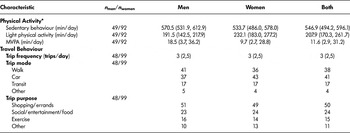
We provide descriptive data for objectively measured physical activity and travel behaviour in Table 4.
Descriptive statistics for mobility outcomes (sedentary behaviour, different physical activity intensities, and trip frequency, median [p25, p75]; trip mode and purpose, %)

* As measured by accelerometry (ActiGraph GT3X+, 60-second epochs), based on > 3 days with > 480 minutes/day valid wear time. Estimates have been standardized to a 13-hour wear day.
MVPA = moderate to vigorous physical activity
Physical Activity
Participants spent most of their day engaged in sedentary behaviour (men:women [%], 73:68). Men spent 24 per cent of their day engaged in light physical activity and 3 per cent in MVPA. Women spent 30 per cent of their day engaged in light physical activity and 2 per cent in MVPA. Importantly, MVPA incorporates both moderate and vigorous physical activity. Men and women spent a negligible percentage of their day in vigorous physical activity (0.05 and 0.03 respectively). Thirty-nine percent of participants (men:women [%], 49:33) engaged in 150 or more minutes of MVPA per week; 18 per cent of participants (men:women [%], 22:15) engaged in 150 or more minutes of MVPA per week, accumulated in bouts of 10 or more minutes. Percentage of the day spent by participants in physical activity and sedentary behaviour was similar to that for Canadian older adults assessed as part of the Canadian Health Measures Survey (accelerometry; 2007–2009, [Colley et al., Reference Colley, Garriguet, Janssen, Craig, Clarke and Tremblay2011]).
The most common types of physical activity that participants engaged in (as measured by CHAMPS) were as follows: light work around the house (93%), walking for errands (77%), walking leisurely for exercise or pleasure (66%), stretching/flexibility exercises (51%), walking/hiking uphill (48%), light gardening (45%), and walking fast or briskly for exercise (38%). Less than 25 per cent engaged in other activities.
Travel Behaviour
We published an in-depth analysis of participants’ common travel destinations (Chudyk et al., Reference Chudyk, Winters, Moniruzzaman, Ashe, Sims-Gould and McKay2015). Participants made three (2, 5; median P25, P75) trips per day. Half of all trips were made to run errands/go shopping, 24 per cent were for social/entertainment/eating out, 15 per cent for exercise, and 11 per cent for other purposes (e.g., medical appointments, volunteering/work, to attend a place of worship). Forty-one percent of trips were by car (men:women [%], 37:43), 38 per cent by foot (men:women [%], 41:36), 17 per cent by transit, and 4 per cent by other travel modes (e.g., bicycle, taxi). In comparison, regional travel survey data showed that older adults (ages 65–79) in Metro Vancouver made a smaller proportion of trips by foot (8%) and a higher proportion of trips by car (82%) (TransLink, 2010).
Discussion
Mobility and Health of Older Adults Living on Low Income
We extend and enhance the scant literature on older adults living on low income by providing an in-depth description of their person- and environment-level characteristics as they relate to mobility. We found that participants tended to make a high proportion of trips by foot, as compared to regional travel survey data, although these did not, on average, increase participants’ physical activity levels above population-level norms. Further, although this population may be at increased risk of morbidity, poor physical function, and incident mobility impairment (Huisman et al., Reference Huisman, Kunst and Mackenbach2003; Koster, et al., Reference Koster, Bosma, van Groenou, Kempen, Penninx, van Eijk and Deeg2006b; Koster et al., Reference Koster, Penninx, Bosma, Kempen, Harris, Newman and Kritchevsky2005; Nilsson et al., Reference Nilsson, Avlund and Lund2010; Ovrum et al., Reference Ovrum, Gustavsen and Rickertsen2014; Shumway-Cook et al., Reference Shumway-Cook, Ciol, Yorkston, Hoffman and Chan2005), this was not the case in our cohort of participants. For example, participants’ self-reported health, as measured by the EQ-VAS, was better than population norms available for older adult residents of Alberta, Canada (80% vs. 76% for older adults aged 65–74 and 68% for older adults aged > 75) (Johnson & Pickard, Reference Johnson and Pickard2000), and their average self-reported number of co-morbidities (three) is similar to population norms available for Canadian older adults (Wister, Levasseur, Griffith, & Fyffe, Reference Wister, Levasseur, Griffith and Fyffe2015). Furthermore, over 90 per cent of participants had minimal-to-mild limitations in lower-extremity function as assessed by the SPPB (Guralnik et al., Reference Guralnik, Ferrucci, Simonsick, Salive and Wallace1995) and almost 80 per cent had a gait speed (> 0.8 m/s) that supported community ambulation (Fritz & Lusardi, Reference Fritz and Lusardi2009).
In this article, we consider three factors that could result in differences we observed between our cohort and other samples of older adults of low socioeconomic status. First, we consider our findings within the context of our framework of older adult mobility. Specifically, we discuss the potential influence of synergy among mobility domains and overall competence of participants. Second, we do not know how long our participants were in a low socioeconomic stratum, as our data do not provide a person’s socioeconomic history. Low income, therefore, could represent either a recent or a lifelong circumstance. Finally, we are unable to rule out selection bias.
Framework of Mobility and the Person–Environment Fit
Participants generally displayed positive profiles across person- and environment-level domains of mobility. Although we cannot ascertain causality, synergy between and within person- and environment-level factors most likely contributed to the positive profiles across most domains of mobility. For example, features of the social environment such as social networks, social interactions, and social support are associated with older adults’ physical functioning and health, as well as mobility patterns and time spent in physical activity (Annear et al., Reference Annear, Keeling, Wilkinson, Cushman, Gidlow and Hopkins2014; Hanson, Ashe, McKay, & Winters, Reference Hanson, Ashe, McKay and Winters2012). Psychosocial resources such as control beliefs, coping styles, positive/negative emotion states, and social support may partially mediate the association between socioeconomic status and health (Matthews, Gallo, & Taylor, Reference Matthews, Gallo and Taylor2010; Taylor & Seeman, Reference Taylor and Seeman1999). Participants’ high level of competence across domains may also have allowed them to better utilize and/or adapt their personal and environmental resources to meet their needs and maintain their mobility and independence (Lawton, Reference Lawton, Spacapan and Oskamp1989). For example, although most participants were single and lived alone, they regularly socialized with friends, family, and/or neighbours and generally did not report being lonely or stressed.
Although our current study focused on mobility as it relates to person- and environment-level resources and barriers, we pause here to further consider how behaviour-driven agency might shape the person-environment interaction (Wahl, Iwarsson, & Oswald, Reference Wahl, Iwarsson and Oswald2012). Older adults’ mobility is heavily influenced by the interplay between person- and environment-level characteristics. However, older adults are not passive recipients of the environment’s pressures but proactively shape their environment, tasks, or self to meet their needs and to maintain their independence (Lawton, Reference Lawton, Spacapan and Oskamp1989; Wahl et al., Reference Wahl, Iwarsson and Oswald2012). To illustrate, older adults may decide to walk with a mobility aid (e.g., cane) to compensate for loss of physical function. This active choice promotes their continued mobility in an environment that would otherwise not be walkable. They might also otherwise self-restrict their activities to environments and familiar places they perceive to suit their capacities and needs. We did not measure older adults’ proactive behaviours directly. However, in a companion study, researchers used qualitative methods and a strengths-based approach to assess a subgroup of Walk the Talk participants to better understand factors that facilitated physical activity among highly active participants (Franke et al., Reference Franke, Tong, Ashe, McKay and Sims-Gould2013). Resourcefulness (e.g., engagement in self-help strategies such as self-efficacy, self-control, and adaptability) was a key facilitator to physical activity, despite personal challenges. The nuanced and multi-faceted nature of the intersection between person- and environment-level factors, proactive behaviours, and older-adult mobility is worthy of further investigation.
We are drawn to one exception to participants’ generally positive profiles across the domains of mobility. A relatively high proportion of participants (75%) scored below the cut-off point for mild cognitive impairment (MoCA score < 26, [Nasreddine et al., Reference Nasreddine, Phillips, Bedirian, Charbonneau, Whitehead, Collin and Chertkow2005]). Interestingly, recent community-based studies have reported similar rates and suggested that low scores might result either from poor specificity of the measurement tool or a true higher proportion of older adults with cognitive dysfunction across a range of populations (Freitas, Simoes, Alves, & Santana, Reference Freitas, Simoes, Alves and Santana2011; Fujiwara et al., Reference Fujiwara, Suzuki, Kawai, Hirano, Yoshida, Kojima and Obuchi2013; Narazaki et al., Reference Narazaki, Nofuji, Honda, Matsuo, Yonemoto and Kumagai2013; Rossetti, Lacritz, Cullum, & Weiner, Reference Rossetti, Lacritz, Cullum and Weiner2011). Dementia is decline in cognitive function severe enough to affect social or occupational functioning (American Psychiatric Association, 1994); however, mild cognitive impairment typically does not interfere with independence in everyday life (Lin, O’Connor, Rossom, Perdue, & Eckstrom, Reference Lin, O’Connor, Rossom, Perdue and Eckstrom2013). Nonetheless, those with mild cognitive impairment are at an increased risk of developing dementia (Dong et al., Reference Dong, Lee, Basri, Collinson, Merchant, Venketasubramanian and Chen2012; Petersen, Reference Petersen2004; Petersen et al., Reference Petersen, Smith, Waring, Ivnik, Tangalos and Kokmen1999). Importantly, physical activity was associated with reduced risk of cognitive decline and dementia (Blondell, Hammersley-Mather, & Veerman, Reference Blondell, Hammersley-Mather and Veerman2014). This speaks to an even greater need for environments that support physical activity of older adults with suspected mild cognitive impairment.
Considerations Related to Socioeconomic Status
Socioeconomic indicators are diverse and typically include measures of income, education level, and/or occupational status (Grundy & Holt, Reference Grundy and Holt2001). Education and occupational status may represent social class at an earlier stage of the life course, whereas income may represent social class at a later life stage (Koster, et al., Reference Koster, Bosma, Kempen, Penninx, Beekman, Deeg and van Eijk2006a). Both measures of socioeconomic status are associated with health outcomes in old age (Grundy & Holt, Reference Grundy and Holt2001; Huisman et al., Reference Huisman, Kunst and Mackenbach2003). Although study participants were considered of low socioeconomic status as measured by income, they were highly educated as compared with normative data for Canadian older adults. Eighty-eight percent of participants completed secondary school, and 19 per cent completed post-secondary education (obtained a bachelor’s degree or higher). In comparison, approximately 57 per cent of Canadian older adults aged 65 or older completed secondary school, and 10 per cent completed post-secondary education (obtained a bachelor’s degree or higher) (Statistics Canada, 2009). This potential discrepancy between participants’ present socioeconomic status and that of earlier life stages needs to be addressed. In future, studies of older adults living on low income might assess socioeconomic status across the lifespan. This would shed some light on what may be different roles for more recent versus lifelong low socioeconomic status on older adult mobility.
A third factor that warrants consideration when discussing our study findings is selection bias. Individuals of low socioeconomic status are an understudied subgroup. There are many reasons for this – for example, they are more difficult to access and are more concerned than others their age about participating in studies (Schnirer & Stack-Cutler, 2011). We employed several strategies to address these considerations so as to enhance participation. We established a key partnership with BC Housing personnel who provided a sampling frame of community-dwelling older adults living on low income. BC Housing had established relationships with many older adults who met our eligibility criteria. They served as knowledge brokers and addressed participant questions or concerns as a means to enhance participant buy-in. We also sought to diminish barriers to study participation (e.g., lack of vehicle access, concerns with transportation costs, trouble walking) and reduce non-response bias. We conducted measurement sessions at local community centres that were in close proximity to older adult participants who lived outside Vancouver. We also offered free rides to/from measurement sessions. We enlisted a courier service to retrieve take-home measures from participants during the week following measurement so as not to inconvenience them with “mail ins” or “drop offs.”
Despite these best efforts, recruitment rate into our study was 8 per cent. Selection bias may be present if healthy participants were more likely to participate. Although other studies that evaluated the association between the mobility of community-dwelling older adults and the built environment reported recruitment rates as high as 20–25 per cent, they did not target low-income or other vulnerable populations (e.g., Davis et al., Reference Davis, Fox, Hillsdon, Sharp, Coulson and Thompson2011; King et al., Reference King, Sallis, Frank, Saelens, Cain, Conway and Kerr2011; Rosso, Grubesic, Auchincloss, Tabb, & Michael, Reference Rosso, Grubesic, Auchincloss, Tabb and Michael2013; Winters et al., Reference Winters, Voss, Ashe, Gutteridge, McKay and Sims-Gould2015). Others document that older adults of low socioeconomic status are less likely to participate (Martinson et al., Reference Martinson, Crain, Sherwood, Hayes, Pronk and O’Connor2010). It is possible that our relatively low recruitment introduced selection bias that influenced health and mobility outcomes. When we compared participants to those in the sampling frame, the gender distribution was similar although participants in our study were slightly younger (74 vs. 77 years).
Strengths and Limitations
Our study had a number of strengths. These include (1) a theoretical framework that guided selection of variables across person- and environment-level domains of mobility; (2) a community partner who guided recruitment of a well-defined source population of older adults living on low income; (3) an objective measure of the physical domain of mobility (SPPB) to complement self-report questionnaires; (4) objective measurement of sedentary behaviour and physical activity (accelerometry) to complement a self-report questionnaire on specific physical activities participants engaged in; and (5) a 7-day travel diary to measure travel behaviour.
Our study also had several limitations. As the over-arching aim of Walk the Talk was to assess the association between the built environment and older adult mobility, participants were required to have a minimum level of mobility to be eligible for study participation. These inclusion criteria prevent us from generalizing our findings to a larger population of older adults living on low income, those who had severe mobility impairments, and those unable to leave their homes. We did not assess a higher-income comparison group, but used normative data and population-level comparators where available. Finally, the cross-sectional design prevents us from drawing causal inferences from our findings.
Conclusions
Unlike those of other studies, our findings did not generally support that older adults of low socioeconomic status have a reduced capacity to be mobile (Koster, et al., Reference Koster, Bosma, van Groenou, Kempen, Penninx, van Eijk and Deeg2006b; Koster et al., Reference Koster, Penninx, Bosma, Kempen, Harris, Newman and Kritchevsky2005; Nilsson et al., Reference Nilsson, Avlund and Lund2010; Ovrum et al., Reference Ovrum, Gustavsen and Rickertsen2014; Shumway-Cook et al., Reference Shumway-Cook, Ciol, Yorkston, Hoffman and Chan2005). Despite an economic disadvantage, participants presented with positive profiles across person- and environment-level domains that influence the capacity to be mobile. Participants also made a high proportion of trips by foot, although these did not together serve to meet physical activity guidelines for most. We challenge future researchers to focus on innovative strategies to recruit this difficult-to-access population, to consider the influence of socioeconomic status across the lifespan, as well as to consider the role of behaviour-driven agency when investigating the association between the person, environment, and older adult mobility.