Due to the modern phenomenon of so-called ‘fast fashion’, the textile industry has burgeoned. This relies on the rapid manufacture and increased consumption of short-duration clothing. With the help of the internet, there has been an increase in the speed of purchasing clothing items via e-commerce (Niinimäki et al., Reference Niinimäki, Peters, Dahlbo, Perry, Rissanen and Gwilt2020). As a result, the excessive consumption of such clothing has had significant environmental impacts, such as water pollution from discarded textile waste containing organic chemicals, among them organic dyes that have toxic effects on the environment (Aksu, Reference Aksu2005). In addition to dyes, other pollutants contained in wastewater include chemical contaminants such as heavy metals, organic and inorganic particles, toxins, pharmaceuticals, hormones and other hazardous substances, and biological pollutants such as bacterial species and viruses, worms and/or algae can also be present in large quantities (Nayl et al., Reference Nayl, Abd-Elhamid, Arafa, Ahmed, AbdEl-Rahman and Soliman2023). As a result, degradation of the organic material in water has occurred.
Within this context, synthetic dyes are also used widely in the paper, plastic, leather, pharmaceutical, cosmetics and food industries (Aksu, Reference Aksu2005; Rodrigues et al., Reference Rodrigues, Villalba, Santos, Melquiades and Anaissi2020). In general, dyes are classified as anionic or cationic based on their chemical functionality, and they are highly toxic and harmful to humans and the environment (Munir et al., Reference Munir, Nazar, Zafar, Zubair, Ashfaq and Hosseini-Bandegharaei2020) when industrial effluents contain concentrations of such dyes that are greater than allowed limits. Because there is no specific legislation that establishes colour standards for effluents in Brazil, such standards must be adopted; for freshwater bodies, the tolerable value of real or true colour is up to 75 mg Pt L–1 (Conama, 2005). Therefore, effluents need to be treated before being discharged into aquatic environments (Aksu, Reference Aksu2005; Conama, 2005; Rodrigues et al., Reference Rodrigues, Villalba, Santos, Melquiades and Anaissi2020).
Colour is one of the first results of contamination that can be observed by the human eye (Aksu, Reference Aksu2005). From an aesthetic point of view, colour removal can be considered very important because it is associated directly with public perceptions of water quality (Pereira & Alves, Reference Pereira, Alves, Malik and Grohmann2012). Among the organic dyes used in the textile industry, methylene blue (MB; 3,7-bis(dimethylamino)phenothiazine chloride tetramethylthionine chloride) is a cationic dye used in the dyeing of cotton and wool fabrics, presenting in its structure (–N=N–) groups linked to aromatic systems, giving it great chemical stability (Honorato et al., Reference Honorato, Machado, Celante, Borges, Dragunski and Caetano2015). When MB is released in rivers and lakes, it decreases the passage of solar radiation, reducing natural photosynthetic activity and causing changes in aquatic biota (Honorato et al., Reference Honorato, Machado, Celante, Borges, Dragunski and Caetano2015).
MB has been found have some medicinal effects when used appropriately as opposed to ingestion via contaminated water. For example, it can be used to treat vasoplegia after transplant operations, to treat malaria at a treatment dosage of 36–72 mg kg–1 over 3 days and in the neutralization of heparin (Oladoye et al., Reference Oladoye, Ajiboye, Omotola and Oyewola2022). However, the release of untreated dye-laden wastewater can lead to many health risks. For example, in humans, MB dye can induce various diseases, such as cyanosis, tissue necrosis, the formation of Heinz bodies, vomiting, jaundice, shock, increased heart rate, etc. (Alver et al., Reference Alver, Metin and Brouers2020; Oladoye et al., Reference Oladoye, Ajiboye, Omotola and Oyewola2022).
Various techniques for dye removal can be found in the literature, among them coagulation/flocculation and electron beam irradiation (Anvari et al., Reference Anvari, Keirkhah and Amraei2014), ozonation (Zhao et al., Reference Zhao, Shi and Wang2004), electrolysis (Wang, Reference Wang2009), photocatalysis and electrochemical approaches (Anantha et al., Reference Anantha, Olivera, Hu, Jayanna, Reddy and Venkatesh2020) and adsorption (Almeida et al., Reference Almeida, Debacher, Downs, Cottet and Mello2009). Adsorption is one of the most efficient and advantageous of these techniques due to its simplicity, low cost and use of various adsorbents (Moreira et al., Reference Moreira, Sousa, Oliveira, Nascimento and de Brito2009; Shen et al., Reference Shen, Fan, Zhou, Gao, Yue and Kang2009). Several sorbents are used for the adsorption of dyes and other contaminants in aqueous media, the most pertinent being activated carbon, which is expensive and is only available in limited quantities. Some alternative and sustainable sorbents have been employed, such as agricultural residues and bagasse. However, these biosorbents need to undergo a series of physical and chemical modifications to improve their efficiency, including burning, grinding and acidic or alkaline activation, and their quantities are also limited (Munir et al., Reference Munir, Nazar, Zafar, Zubair, Ashfaq and Hosseini-Bandegharaei2020). In the studies by Hameed et al. (Reference Hameed, Din and Ahmad2007), bamboo was used to prepare activated carbon via physicochemical activation with potassium hydroxide (KOH) and carbon dioxide (CO2) as activating agents at 850°C for 2 h. Similarly, in the report by Benhachem et al. (Reference Benhachem, Attar and Bouabdallah2019) for the activation of starch-activated carbon, in addition to calcination at 500°C for 2 h, high concentrations of NaOH for activation, several steps of washing with HCl and oven drying were also used. These are all processes that increase the cost and difficulty of preparing such adsorbents.
Brazil contains large volumes of soils with significant iron oxide contents. Depending on the region and the iron level, these soils can be classified as Latosols, Argissols, Cambissolos, Chernossolos or Nitossolos (Ker, Reference Ker1997). The main activities of iron oxides present in soils are related to the retention of pollutants (heavy metals) and the fixation of phosphorus in soils, making this nutrient unavailable to plants and affecting soil cation-exchange capacity (dos Santos & Zaroni, Reference dos Santos and Zaroni2021). The most common phases found are hematite and goethite, which are responsible for the red and yellow colours of these soils, respectively (Bortoluzzi et al., Reference Bortoluzzi, Pernes and Tessier2007). In highly weathered soils of tropical and subtropical regions, such as those where Brazil's Latosols are found, goethite and hematite are the dominant iron oxides, being related to the evolution of these soils (Ker, Reference Ker1997).
Within these circumstances, the iron oxides, hydroxides and oxyhydroxides comprise a group of minerals that have received increasing attention from the scientific community because they can interact with pollutants due to specific aspects of their crystal chemistry or participate in various reactions as sorbents or oxidant reducers (Melo & Alleoni, Reference Melo and Alleoni2009). These iron oxides are found among the main components of the clay fractions of highly weathered soils. They are often dispersed in the soil solution as fine particles of varying degrees of crystallinity covering the clay minerals or in the form of organic complexes (Ker, Reference Ker1997). These iron oxides together with clay minerals can be applied in the treatment of aqueous solutions of MB, making them an excellent choice for the sorption process because they are abundant, low cost and classified as environmentally friendly materials. Therefore, they could replace low-performance biosorbents and expensive activated carbons in the sorption process (Gonçalves et al., Reference Gonçalves, de Castro, Oliveira and Guerreiro2009).
Within this context, various new adsorbents have been tested to help with the control of pollutants. In this study, a reddish soil was heat-treated for use as a low-cost adsorbent to remove MB from an aqueous solution. This study also highlights the use of the residue generated during the adsorption process as a pigment for dispersion in paint.
Materials and methods
Purification and thermal treatment of the adsorbent
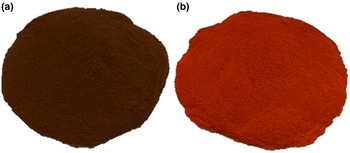
The adsorbent material, a reddish soil (Fig. 1a), was soil collected in the region of Palotina, PR, Brazil (24°17'46"S, 53°50'35"W). First, the soil was purified by placing it in drinking water and shaking it mechanically for 24 h to achieve total dispersion. Then, this dispersion was sieved through a coarse mesh sieve for domestic use to remove fibrous material and debris. The sieved suspension was kept at rest for 24 h, and then the first wash was performed, which consisted of adding water to cover two-thirds of the material, stirring for ~20 min and leaving it to decant for 24 h. After decanting, the water was removed before another wash was performed. After three decanting steps, the suspension was filtered through a porous plate funnel (number 4). The red mass obtained was dried in an oven at 80°C for 24 h. Then, it was pulverized in a pestle and mortar set and sieved through a stainless steel sieve (250 μm and 65 mesh). The reddish soil was separated into two parts (Fig. 1), one part being the raw red soil (RS) and the other part being calcined at 800°C for 60 min (ramp of 10°C min–1). The latter sample was called RS800.
Photographic images of (a) RS and (b) RS800.

Quantification of MB dye
The MB solutions were quantified from a calibration curve according to the Lambert–Beer law using an ultraviolet–visible (UV–Vis) spectrophotometer (Shimadzu UV-1800) in the spectral range 400–800 nm with a wavelength of 665 nm. A stock standard solution of MB of concentration 1000 mg L–1 was prepared, from which dilutions were made to obtain the other curves in the construction of the calibration curve (Fig. 2).
Calibration curve for MB dye.

Characterization techniques
The determination of the ζ-potential was performed according to an adaptation of the methodology of Lima et al. (Reference Lima, Anderson and Curi2000). The adsorbent potential was measured before the adsorption process using 1 mg of material dispersed in 1 mL of 10–2 mol L–1 NaCl solution. The suspensions were placed in an ultrasonic bath for 8 min and left to rest for 15 min. The ζ-potential was measured as a function of pH variation between 2 and 12. The pH adjustment between 2 and 12 was performed by adding hydrochloric acid (HCl; 0.1 mol L–1) and sodium hydroxide (NaOH; 0.1 mol L–1). The ζ-potential measurements were performed using ZETASIZER Malver equipment (NANO ZS90 model), and the correlation between clay mass and solution volume was the same for all points on the curve at 1 mg mL–1.
The samples were characterized in terms of their composition using energy-dispersive X-ray fluorescence spectroscopy (EDXRF). The analysis was performed using a Shimadzu model EDX-700HS, with an acquisition time of 60 s per analytical channel, a vacuum atmosphere and a 10 mm collimator. The crystalline phases were identified using powder X-ray diffraction (XRD) with a Bruker model D2 Phaser using Cu-Kα radiation (λ = 1.5418 Å), scanning over 2–50°2θ at a step rate of 0.2° s–1, a power of 300 W, a voltage of 30 kV and a current of 10 mA. The average size of crystallites was calculated using the Scherrer equation (Cullity & Stock, Reference Cullity and Stock1956), and basal spacing values were calculated using the Bragg equation (Cullity & Stock, Reference Cullity and Stock1956). The morphologies of the RS and RS800 particulate samples were examined using scanning electron microscopy (SEM-VEGA 3, TESCAN). For the analysis, each sample was placed on carbon tape. The samples were gold-coated to make their surfaces conductive. Fourier-transform infrared spectroscopy (FTIR) analyses were performed using a PerkinElmer Frontier spectrometer in the 4000–650 cm–1 region, and eight scans were performed with a resolution of 2 cm–1. FTIR spectra were obtained in attenuated total reflectance (ATR) acquisition mode using a high-capacity ZnSe crystal. The electronic spectra of the powdered samples were measured in the range of 400–900 nm using a UV–Vis Ocean Optics spectrophotometer (model USB-2000) in absorbance mode. The colorimetric measurements (CIEL*a*b*; Quindici, Reference Quindici2013) were performed on pigments in powder form, and after application to a test specimen of plaster, the pigments were dispersed in a proportion of 5% (w/w) in commercial white paint. According to this method, L* is the colour lightness, ranging from black (L* = 0) to white (L* = 100), a* is the green (–)/red (+) axis and b* is the blue (–)/yellow (+) axis (Quindici, Reference Quindici2013).
Adsorption studies
MB removal assays were performed with aqueous solutions containing 100–225 mg L–1 of the dye. Flasks containing 30 mL of dye were placed under magnetic stirring in a thermal bath at 25, 35 and 45°C for 30 min. Thereafter, 500 mg of RS800 was added, and the system was kept under constant magnetic stirring and controlled temperature for 60 min. Aliquots of the supernatant were analysed in a spectrophotometer in the wavelength range of 400–800 nm before and after adsorption to evaluate the performance of the adsorbent. The RS800 samples collected after the adsorption assays were used as pigments. The amount of MB adsorbed and the percentage of dye removed were calculated using Equations 1 and 2, respectively:


where q is the amount of dye adsorbed by the adsorbent (mg g–1), C 0 is the initial dye concentration (mg L–1) in contact with the adsorbent, Cf is the dye concentration (mg L–1) after the process of adsorption, m (g) is the mass of the adsorbent and V (L) is the volume of the solution.
Pigment dispersion in commercial paint
The materials from the adsorption process were used in 5% (w/w) dispersions in white paint. The procedure consisted of spraying the pigment and then homogenizing it in white paint for coating plaster blocks in a single coat to simulate its application in buildings.
Colour stability
Colour stability tests were performed in acidic and alkaline environments using desiccators to control the experimental environment. Petri dishes containing HCl and NaOH were placed in different desiccators to reproduce the acidic and alkaline environments, respectively (Horsth et al., Reference Horsth, Primo, Dalpasquale, Bittencourt and Anaissi2021). The paints that were used to coat the plaster blocks were added to the desiccators, which were then sealed. Colorimetric measurements were performed before the test and after 72 h to verify the colorimetric stability of the pigments.
Results and discussion
Mineralogical analysis: constituent phases (XRD) and chemical analysis (EDXRF)
The XRD traces (Fig. 3) show the main constituent phases of soil identified for samples RS and RS800. The XRD trace of the RS sample shows peaks related to the kaolinite phase, identified by the presence of the peak 12.4°2θ corresponding to the basal spacing with a value of 7.28 Å, and the other peaks indicating this phase are 19.9 and 24.9°2θ (Bortoluzzi et al., Reference Bortoluzzi, Pernes and Tessier2007). Kaolinite exists in soil samples from various places around the world, including soils from southern Brazil, and it is reported very frequently. The great abundance of this clay mineral in Brazilian soils is due to the country's environmental conditions. As Brazil is a tropical country, a hot and humid climate predominates and, in association with the acidic environment of the soil, this favours the alteration of a considerable amount of primary minerals such as feldspars and micas or of secondary minerals degrading clays of the 2:1 type. Kaolinite is a phase that has been found in clay fractions of soils containing various materials from various geological periods (Ker, Reference Ker1997; Bortoluzzi et al., Reference Bortoluzzi, Pernes and Tessier2007). After calcination at 800°C, the XRD trace of sample RS800 shows changes in the interlamellar layers of its clay fraction, evidence of which is the disappearance of the kaolinite peaks, as kaolinite loses its hydroxyls at high temperatures, contributing to the degradation of the structure of this phase (Moraes et al., Reference Moraes, Machado and Pergher2003; Bortoluzzi et al., Reference Bortoluzzi, Pernes and Tessier2007). In addition to kaolinite, the phases quartz (SiO2), goethite (FeO(OH)) and hematite (Fe2O3) were identified in the RS sample. These iron oxides are dominant in soils with a high degree of weathering, called Latosols, from tropical and subtropical regions (Ker, Reference Ker1997; Inda Junior & Kämpf, Reference Inda Junior and Kämpf2005), and even after the calcination of RS there were no structural changes to these phases. From this analysis, great concentrations of Si, Al and Fe ions were identified due to the kaolinite, goethite and hematite phases identified using XRD (Fig. 3). The chemical compositions of the qualitatively analysed samples are shown in Table 1.
XRD traces of samples RS and RS800.

Chemical compositions of samples RS and RS800.

In the RS sample, the presence of silicon dioxide (SiO2) was substantial, in addition to aluminium oxide (Al2O3) and iron oxide (Fe2O3). These components are due to the presence of varying amounts of kaolinite, gibbsite, goethite and hematite, and there were lesser proportions of other components in the clay fraction of the soil. A high aluminium oxide content is common because gibbsite is a significant mineral in soil, along with quartz, representing the silicon dioxide fraction. Quartz is one of the most resistant and abundant primary minerals in the rocks of the Earth's crust, and soils derived from rocks containing quartz and iron minerals are considered much more evolved (i.e. they will have an advanced pedogenetic degree; Ker, Reference Ker1997).
Iron components include oxides, hydroxides and oxyhydroxides, which are among the main components of the clay fraction and are found dispersed in the soil mass in the form of organic complexes or particles containing clay minerals. A high titanium content is also characteristic of the region's soils (Ker, Reference Ker1997). It was also observed that thermal treatment did not alter the sample constituents significantly.
Colorimetric measurements (CIEL*a*b*)
The thermal treatment of the RS sample promoted a color change. This indicates the importance of carrying out colorimetric measurements to verify the difference in color (ΔE) between the RS and RS800 samples. The ΔE value refers to the comparison between colours, and the total colour variation was calculated using Equation 3 in ColorMine software (Horsth et al., Reference Horsth, Primo, Dalpasquale, Bittencourt and Anaissi2021):

The colour difference obtained between the two samples was 4.77, which is considered a very clear difference (Quindici, Reference Quindici2013). The colorimetric parameters of the RS and RS800 samples are shown in Table 2. The L* parameter is the brightness of the colour, and the most luminous sample is RS800, while the RS sample is the least luminous. The parameters a* and b* refer to the chromaticity (C*) of the samples, where a* represents the variation from red to green, with (+)a* tending to red and (–)a* tending to green. The b* parameter indicates the variation from blue and yellow, with (+)b* tending to blue and (–)b* tending to yellow (Horsth et al., Reference Horsth, Primo, Dalpasquale, Bittencourt and Anaissi2021). In this case, the heat treatment caused an increase in the values of the coordinates a* and b*, with both remaining positive and in the red and yellow colour quadrants, rendering the sample redder. This behaviour is observed due to goethite undergoing dehydroxylation and forming hematite at temperatures >200°C, the latter of which has a red colour (Oliveira et al., Reference Oliveira, Fabris and Pereira2013).
Colorimetric parameters of samples RS and RS800.

ζ-potential
The clay fraction of the soil showed a pH-dependent surface charge (Fig. 4). Tropical soils are abundant in kaolinite, iron oxide and aluminium oxide, producing a variable surface electrical charge due to the surface hydroxylation of soil colloids. The hydroxyl groups of these minerals can be linked to one, two or three metals in the mineral structure, so positive and negative charges can be created in this hydroxylated layer, protonating or deprotonating the molecules within the mineral (Fontes et al., Reference Fontes, de Camargo and Sposito2001).
ζ-potential as a function of pH for RS and RS800.

In a very acidic environment (pH 2), the soil had a positive surface charge, ranging from +21.2 mV for RS to +24.2 mV for RS800, due to the protonation of the hydroxyl groups of the iron and aluminium oxides (Fontes et al., Reference Fontes, de Camargo and Sposito2001). As the pH increased to pH 4, deprotonation of the hydroxyl groups occurred for both samples, generating negative surface charges that remained unchanged until pH 12. For the RS sample, the charge was more negative, with a ζ-potential of –34.6 mV at pH 12.
Vibrational spectroscopy (FTIR)
Figure 5 shows the FTIR spectra for RS and RS800. The main difference between the spectra before and after calcination relates to the shape of the bands after the calcination process, as the RS sample showed typical kaolinite bands with well-defined peaks at 3696 cm–1 (O–H axial deformation in kaolinite), 3647 cm–1, 3621 cm–1 (O–H axial strain in kaolinite), 1030 cm–1 (Si–O axial deformation in kaolinite) and 914 cm–1 (O–H angular deformation in kaolinite), characteristics that are shared by similar spectra found in the literature (Benites et al., Reference Benites, Mendonça, Schaefer and Martin Neto1999; Gonçalves et al., Reference Gonçalves, Leite, Brinatti, Saab, Iarosz and Mascarenhas2008; Kumar & Rajkumar, Reference Kumar and Rajkumar2014). The band at 799 cm–1 (Si–O–Si vibrations) refers to quartz. The vibration mode at 749 cm–1 indicates the presence of hematite (Fe–O; Martinelli et al., Reference Martinelli, Barrada, Ferreira, de Freitas and Lelis2014). In the spectrum of the RS800 sample, changes in the band profile can be observed. Due to the thermal treatment of the sample, the bands that identify kaolinite disappeared, which corroborates the XRD results.
FTIR spectra for samples RS and RS800.

Absorption spectroscopy
Figure 6 shows the electronic absorbance spectra in the visible region for the RS and RS800 samples. A band at 525 nm was identified for both samples, the absorbance of which indicates a double-excitation process related to the electronic transition 6Al(6S)–6A1(6S) → 4T1(4G)–4T1(G), which is responsible for the reddish colour of the hematite phase (Horsth et al., Reference Horsth, Primo, Dalpasquale, Bittencourt and Anaissi2021). A band at 670 nm was identified only for the RS800 sample, and this band can be associated with the Fe3+ ion in an octahedral coordination in the electronic transition 6A1 g → 4T2 g (Gargori et al., Reference Gargori, Cerro, Galindo, García, Llusar and Monrós2012).
Absorbance spectra in the visible region for samples RS and RS800.

Figure 7 shows the linear extrapolation of the curves obtained from the reflectance spectra of the RS and RS800 samples, which represents the estimated value for the band gap (E gap) obtained using the direct Kubelka–Munk method (Morales-Marín et al., Reference Morales-Marín, Ayastuy, Iriarte-Velasco and Gutiérrez-Ortiz2019). The direct gap is the one in which the maximum energy of the valence band coincides with the lowest-energy wave vector of the conduction band (Borth et al., Reference Borth, Galdino, Teixeira and Anaissi2021). Band gap values of 1–3 eV correspond to semiconductor materials, and the calculated data confirm the semiconductor nature of the iron oxides existing in the soil samples before and after calcination (Deotale & Nandedkar, Reference Deotale and Nandedkar2016). The energy variation between the two samples was ΔE band gap = –0.01 eV.
Band gap energy estimations of samples RS and RS800. Red lines represent the linear extrapolations for calculating the band gaps of the samples.

Surface morphology (SEM)
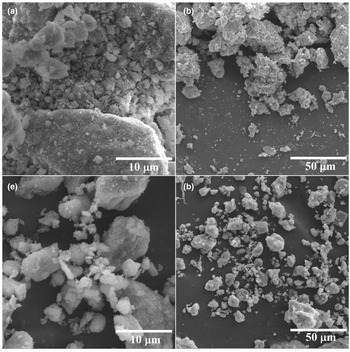
SEM images of the raw soil sample and after thermal treatment are shown in Fig. 8. The RS sample (Fig. 8a,b) shows a disorganized morphology with varied and overlapping shapes of various sizes, a morphology that is similar to kaolinite (Xu & Van Deventer, Reference Xu and Van Deventer2002), corroborating the XRD data. After thermal treatment, the RS800 particles (Fig. 8c,d) in the sample became more compact and defined as pseudospheres of irregular size, demonstrating the loss of the kaolinite phase after calcination at 800°C (Moraes et al., Reference Moraes, Machado and Pergher2003).
SEM images of the morphology of (a,b) RS and (c,d) RS800.

MB adsorption isotherms using RS800
Figure 9 presents the MB removal percentage via adsorption with RS800 at 25, 35 and 45°C at various initial MB concentrations. The results show that the percentage removal of MB increases as the initial concentration decreases. However, more ions of MB dye were retained by RS800 when the initial MB concentration increased. This result supports the findings of the great adsorption capacity of RS800. When the mass of the adsorbent is fixed and the amount of adsorbate (MB) increases, the adsorption sites become occupied until achieving saturation of the surface layer.
Experimental curves for the adsorption of MB dye onto RS800 at 25, 35 and 45°C.

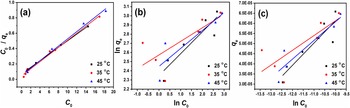
The determination of the equilibrium conditions between the solute concentration in the solution and the adsorbed phase is crucial for the appropriate design and operation of an adsorption process (Meili et al., Reference Meili, Lins, Costa, Almeida, Abud and Soletti2019). A correct modelling analysis is fundamental for managing adsorption processes as it can enable the accurate determination of the performance of such systems (Meili et al., Reference Meili, Lins, Costa, Almeida, Abud and Soletti2019). In this study, the data regarding the adsorption of MB dye onto RS800 were adjusted according to Langmuir, Freundlich and Temkin isotherm models, and their correlation parameters are presented in Fig. 10 & Table 3.
Linear forms of (a) Langmuir, (b) Freundlich and (c) Temkin adsorption isotherms for the adsorption of MB dye onto RS800 at 25, 35 and 45°C.

Parameters of the Langmuir, Freundlich and Temkin isotherms for the adsorption of MB dye onto RS800 at 25, 35 and 45°C.

For systems that follow the assumption of ideal homogeneous surface adsorption, the Langmuir model is applicable. This model also considers that the adsorption energy is constant and does not depend on the degree of adsorbent-site occupation (Meili et al., Reference Meili, Lins, Costa, Almeida, Abud and Soletti2019). Therefore, the Freundlich model fits better for multilayer adsorption with non-uniform energy distribution and a heterogeneous system (Meili et al., Reference Meili, Lins, Costa, Almeida, Abud and Soletti2019). The Temkin model assumes a uniform distribution of bonding energy up to some maximum bonding energy level (Inyinbor et al., Reference Inyinbor, Adekola and Olatunji2016). This model ignores extremely low and high concentrations and assumes that any decrease in adsorption heat is linear (Inyinbor et al., Reference Inyinbor, Adekola and Olatunji2016; Bingül, Reference Bingül2022).
The Langmuir isotherm in its linear form is usually given as Equation 4:

where C e is the dye concentration dye at equilibrium (mg L–1), q e (mg g–1) is the amount of MB adsorbed per unit mass of RS800 at equilibrium, KL (L mg–1) is the Langmuir constant related to the affinity of the binding sites and q max (mg g–1) is a parameter related to the maximum amount of MB per unit weight of RS800.
The linearized form of the Freundlich isotherm is given as Equation 5:

where KF (mg L–1) is the Freundlich constant and n is a parameter related to the intensity of adsorption and the heterogeneity of the system. KF and n are the Freundlich constants found from the intercept and slope of the straight line of the plot lnq e vs lnC e.
The Temkin model can be expressed as Equation 6:

where b is the Temkin isotherm of the heat of adsorption (J mol–1), T is the absolute temperature (K), R is the gas constant (8.314 J mol–1 K–1) and KT is the Temkin equilibrium constant (L mg–1).
Figure 10 shows that the Langmuir isotherm curve is the most suitable isotherm curve for the experimental data, as has been observed previously (Bingül, Reference Bingül2022). Table 3 shows that the correlation coefficient (r 2) obtained using the Langmuir isothermal model demonstrates a better fit (r 2 > 0.99) than that obtained using the Freundlich model (r 2 < 0.99). Therefore, the adsorption process of MB dye ions onto RS800 consists of monolayer adsorption with no significant interaction with neighbouring adsorbed molecules (Jaerger et al., Reference Jaerger, Dos Santos, Fernandes and Almeida2015; Meili et al., Reference Meili, Lins, Costa, Almeida, Abud and Soletti2019). The maximum adsorption capacity (q max) is another important property that can be obtained using the Langmuir isotherm model, and its values were 23.256, 21.659 and 21.186 mg g–1 for the RS800 at 25, 35 and 45°C, respectively.
The Freundlich isotherm considers an empirical relationship demonstrating the interaction between heterogeneous surfaces and adsorbate molecules (Bingül, Reference Bingül2022). Values of 1/n from 0 to 1 indicate the degree of linearity between solution concentration and adsorption: the smaller the 1/n value, the greater the expected heterogeneity (Bingül, Reference Bingül2022). The adsorption is considered chemical if n < 1 and physical if n > 1. Table 3 shows that the 1/n values were calculated as 4.192, 6.741 and 5.104 at 25, 35 and 45°C, respectively. These values are >1, indicating that the adsorbent is homogeneous. The n values were calculated as 0.239, 0.148 and 0.196 at 25, 35 and 45°C, respectively, indicating that the adsorption process is chemical.
The Temkin isotherm ignores extremely low and high concentrations and assumes a linear rather than a logarithmic decrease of the heat of adsorption (Inyinbor et al., Reference Inyinbor, Adekola and Olatunji2016). Table 3 shows that r T2 is <0.99.
The thermodynamic parameters of an adsorption process such as the Gibbs free energy change (ΔG°ads), enthalpy change (ΔH°ads) and entropy change (ΔS°ads) show whether the process is endothermically favourable (Bingül, Reference Bingül2022). The parameters ΔG°ads, ΔH°ads and ΔS°ads were determined using Equations 7–9:


where T is the adsorption temperature (K), R is the ideal gas constant (8.314 J K–1 mol–1) and k d is the distribution coefficient.
Figure 9 shows that increasing adsorption temperature does not have a significant effect on the removal capacity. Table 4 shows the thermodynamic data from this process. Sample RS800 showed a positive ΔH°ads value, which indicates endothermic adsorption. ΔH°ads values can also provide information regarding the mechanism of the adsorption process (Güleç et al., Reference Güleç, Williams, Kostas, Samson, Stevens and Lester2022). The process is controlled by physical adsorption if its ΔH°ads value ranges from 0 to –20 kJ mol–1, or it will be a chemisorption process when it ΔH°ads value ranges from –400 to –80 kJ mol–1 (Chaari et al., Reference Chaari, Fakhfakh, Medhioub and Jamoussi2019). According to the isotherm discussion above, the adsorption of MB onto RS800 follows a chemisorption process.
Thermodynamic parameters for the adsorption of MB dye onto RS800 at 25, 35 and 45°C.

The negative ΔG°ads values observed indicate that this adsorption is a non-spontaneous process (Bingül, Reference Bingül2022). Additionally, Table 4 shows that increasing the adsorption temperature increases the ΔG°ads value. This suggests that the process decreases in spontaneity at greater temperatures. Therefore, the adsorption process of MB onto RS800 becomes more favourable with decreasing temperature (Güleç et al., Reference Güleç, Williams, Kostas, Samson, Stevens and Lester2022).
The negative ΔS°ads values observable in Table 4 indicate a decrease of randomness at the solid–liquid interface during adsorption of MB onto RS800 (Chaari et al., Reference Chaari, Fakhfakh, Medhioub and Jamoussi2019). This result demonstrates the low affinity between the adsorbate MB molecules and the RS800 surface, which could explain the low values obtained for the adsorption capacity (q max) observable in Table 3.
Comparison with other adsorbents
Table 5 presents the adsorption capacities of other adsorbents regarding the adsorption of MB. As can be observed, the raw RS obtained in this study has a greater adsorption capacity value compared to the samples RS-TC and RS-HC (both samples of biochar produced from rapeseed, whitewood and seaweed) and sugarcane bagasse (Meili et al., Reference Meili, Lins, Costa, Almeida, Abud and Soletti2019; Güleç et al., Reference Güleç, Williams, Kostas, Samson, Stevens and Lester2022). RS-TC and RS-HC had negative ΔS°ads values that were very close to zero, indicating low affinity between the MB molecules and the adsorbent surface (Güleç et al., Reference Güleç, Williams, Kostas, Samson, Stevens and Lester2022). Brown clay, natural clay and chemically modified lychee seed biochar had positive ΔS°ads values, indicating the randomness at the solid–liquid interface during adsorption of MB onto these adsorbents due to the high affinity between the adsorbate molecules and the adsorbent surface (Munir et al., Reference Munir, Nazar, Zafar, Zubair, Ashfaq and Hosseini-Bandegharaei2020; Sahu et al., Reference Sahu, Pahi, Tripathy, Singh, Behera, Sahu and Patel2020; Bingül, Reference Bingül2022). Therefore, in this study, it is observed that positive ΔS°ads values can affect adsorption capacity directly, especially due to the low affinity between the MB molecules and raw RS surface.
Comparison of MB adsorption capacities (mg g–1) of the adsorbent from this study and other adsorbents reported previously.

Colour stability
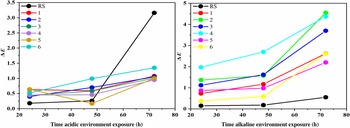
Colour stability was verified using colorimetric measurements before and after 72 h of direct exposure to acidic or alkaline environments (Tables 6 & 7). The total colour variation (ΔE) was calculated using Equation 3 in ColorMine software. The CIEL*a*b* system defines three parameters: L*, a* and b*, which represent black/white (lightness), red/green and yellow/blue colour pairs, respectively, and these can be used to evaluate changes in colour due to the physical and chemical properties of various species (Almeida et al., Reference Almeida, Almeida, Gonçalves and Lahr2021). The CIEL*a*b* system of evaluating colorimetric stability is used because it expresses colour values precisely and numerically, allowing comparison before and after exposure to acidic or alkaline environments in this study (Ezati et al., Reference Ezati, Bang and Rhim2021; Horsth et al., Reference Horsth, Primo, Balaba, Anaissi and Bittencourt2023).
In an acidic environment, the RS800 sample showed greater colour variation after 72 h of exposure (at ΔE = 3.16), which is considered a clear difference (Horsth et al., Reference Horsth, Primo, Dalpasquale, Bittencourt and Anaissi2021), and the other samples (Table 6) showed values that represent a very clear colour difference, demonstrating that the adsorption of the dye in the sample provides colour stability to the obtained hybrid pigment. The opposite outcome occurs in an alkaline environment, in which the samples with the adsorbed MB dye demonstrated greater colour variation than pure samples. This behaviour is observed because the dye used is basic (Leon, Reference Leon1996); therefore, in an alkaline environment, the dye tends to become bluer, demonstrated by a tendency towards negative b* values, causing greater colour variation (Fig. 11).

Colorimetric parameters of pigments after 72 h in an acidic environment.

Numbers 1–6 refer to samples resulting from adsorption (Fig. 9) dispersed in ink for acid–base stability testing.
Colorimetric parameters of pigments after 72 h in an alkaline environment.

Numbers 1–6 refer to samples resulting from adsorption (Fig. 9) dispersed in ink for acid–base stability testing.
Conclusions
The performance of RS was investigated in terms of its ability to remove MB dye from an aqueous medium as a low-cost alternative for wastewater treatment. The soil was treated thermally at 800°C to remove volatiles, open pores and lamellar spaces. The XRD, EDXRF and FTIR characterization techniques indicate that the RS used contains kaolinite and iron oxides in the form of goethite and hematite.
ζ-potential measurements indicated a negative surface charge of RS at pH > 4, facilitating its application in the adsorption of cationic dyes. Increasing temperature decreased removal efficiency; therefore, ambient conditions (25°C) were considered appropriate for its use, removing the need for a heating step, which would make the water-treatment process more expensive.
Colorimetry measurements indicate that, after adsorption, the solids can be used as hybrid pigments. Colour stability tests showed greater stability in acidic environments, while in alkaline environments the pigments showed colour variation, suggesting less stability; however, colour variation in the paint could be used as an indicator of a more acidic or a more alkaline environment. The results discussed allow us to propose that this purified and heat-treated RS could be used as an alternative for removing cationic dyes from effluents and could then be used as an organic–inorganic hybrid pigment for building paints, representing a possible circular economy.
This RS could potentially be diversified by functionalizing it with electron donor or acceptor groups for the selective removal of the metallic ions, phosphate, chlorates and sulfates present in wastewaters, lakes and streams. This RS represents an inexpensive alternative for water treatment.
Financial support
DLS thanks CAPES (grant number 88887.628497/2021-00) for a graduate scholarship. FJA thanks CNPq for the following grants: 310815/2022-3 and 427127/2018-1.