Introduction
The ratio of Cr2O3 to CaO is very specific in pyrope from inclusions in natural diamond and has become a recognised method for the paragenetic identification of mantle garnets derived from the cratonic lithosphere (Sobolev et al., Reference Sobolev, Lavrent’ev, Pokhilenko and Usova1973; Gurney, Reference Gurney, Glover and Harris1984). These garnets are classified as harzburgitic, lherzolitic and wherlitic according to their paragenetic association with the host rocks (Sobolev, Reference Sobolev1977; Dawson and Stephens, Reference Dawson and Stephens1975; Gurney, Reference Gurney, Glover and Harris1984; Grütter et al., Reference Grütter, Gurney, Menzies and Winter2004; Griffin et al., Reference Griffin, Fisher, Friedman, Ryan and O’Reilly1999a, Reference Griffin, Fisher, Friedman, O’Reilly and Ryan2002; Schulze, Reference Schulze2003; Stachel and Harris, Reference Stachel and Harris2008). A unique subcalcic Cr-rich pyrope, termed in the international literature as a G10 garnet (Grütter et al., Reference Grütter, Gurney, Menzies and Winter2004), is typical for inclusions in natural diamond and considered as the main indicator mineral in diamond exploration (Afanasiev and Pokhilenko, Reference Afanasiev and Pokhilenko2022). The garnet belongs to the harzburgitic suite and usually contains ∼2–4 wt.% CaO and 6–12 wt.% Cr2O3. However, garnets with Cr2O3 content exceeding 14 wt.% are rare. The ‘competition’ for recording the maximum content of the knorringite component (Mg3Cr2Si3O12) in garnet commenced more than half a century ago. The reported ratios of Cr2O3 to CaO (wt.%) include the following: 10.9 – 2.19 (Meyer, Reference Meyer1968); 12.6 – 1.74 (Meyer and Boyd, Reference Meyer and Boyd1972); 13.7 – 3.38 (Sobolev et al., Reference Sobolev, Lavrent’ev, Pokhilenko and Usova1973); 17.7 – 0.93 (Meyer and Svisero, Reference Meyer and Svisero1975); ≈15.5 – ≈1.5 (Gurney, Reference Gurney, Glover and Harris1984); 20.6 – 1.57 (Stachel and Harris, Reference Stachel and Harris1997b); 17.28 – 0.39 (Harris et al., Reference Harris, Stachel, Leost and Brey2004); ≈15 – ≈5 (Davis et al., Reference Davies, Griffin, O’Reilly and Doyle2004); 20.9 – 2.19 (Logvinova et al., Reference Logvinova, Taylor, Floss and Sobolev2005); and ≈17.5 – ≈3 (Smith et al., Reference Smith, Pearson, Bulanova, Beard, Carlson, Wittig, Sims, Chimuka and Muchemwa2009). Though there are a few analyses with Cr2O3 content in harzburgite garnet exceeding 20 wt.% (Stachel and Harris, Reference Stachel and Harris1997a, Reference Stachel and Harris1997b; Logvinova et al., Reference Logvinova, Taylor, Floss and Sobolev2005), the majority (95%) of analysed samples worldwide have contained <16 wt.% Cr2O3 (Stachel and Harris, Reference Stachel and Harris2008; Turkin and Sobolev, Reference Turkin and Sobolev2009). It is pertinent to note that on the one hand, the enrichment in Cr (over 20 wt.% Cr2O3) is not uncommon for a wherlitic garnet, it is not, however the subcalcic variety as it is Ca-rich. On the other hand, natural samples usually demonstrate a negative correlation between the Al2O3 content of xenoliths and Cr2O3 in their garnets (Griffin et al., Reference Griffin, O’Reilly, Ryan, Fei, Bertka and Mysen1999b). Therefore, the proportions of Cr, Al and Ca in a rock can significantly affect the formation of specific varieties of garnets in peridotites.
The garnet formula is A3B2Si3O12, where A = Mg+2, Fe+2, Mn+2, Ca+2, Y+3 and rarely Na+; and B = Al+3, Fe+3, Cr+3, Mn+3, rarely V+3, Ti+4 and Zr+4. As a result of experimental studies, it has become obvious that the knorringite component (Mg3Cr2Si3O12) increases in garnet with increasing pressure (Malinovsky and Doroshev, Reference Malinovsky and Doroshev1977; Turkin et al., Reference Turkin, Doroshev and Malinovsky1983; Irifune and Hariya, Reference Irifune and Hariya1983; Nickel, Reference Nickel1986; Doroshev et al., Reference Doroshev, Brey, Girnis, Turkin and Kogarko1997) and therefore that Cr is higher in garnets formed at higher pressures (the basis of the Cr in garnet barometer, which assumes equilibrium with spinel). An increased amount of Cr in garnet can also be a result of the increase of the uvarovite component (Ca3Cr2Si3O12) in pyrope (Mg3Al2Si3O12), which implies that such isomorphism is accompanied by a simultaneous increase of Ca and Cr with a decrease of Mg and Al. The complexity of garnet compositions is due not only to the broad isovalent isomorphism between elements within the A and B groups, but also to more complex heterovalent substitutions (Godovikov, Reference Godovikov1975). The possibility of excess silicon with coordination VI, which has been reported for majoritic garnet in experiments above 9 GPa (Ringwood and Major, Reference Ringwood and Major1966; Ringwood, Reference Ringwood1967) together with the discovery of majorite in the Coorara meteorite (Smith and Mason, Reference Smith and Mason1970), has motivated investigations into garnet–pyroxene solid solutions at high pressures (Ringwood and Major, Reference Ringwood and Major1971; Akaogi and Akimoto, Reference Akaogi and Akimoto1977; Jakubith and Hornemann, Reference Jakubith and Hornemann1981; Jeanloz, Reference Jeanloz1981; Kato et al., Reference Kato, Irifune and Ringwood1987; Irifune, Reference Irifune1987; Herzberg and Gasparik, Reference Herzberg and Gasparik1991; Hazen et al., Reference Hazen, Dawns, Conrad, Finger and Gasparik1994a, Reference Hazen, Downs, Finger, Conrad and Gasparik1994b; Ono and Yasuda, Reference Ono and Yasuda1996; Nakatsuka et al., Reference Nakatsuka, Yoshiasa, Yamanaka and Ito1999; Gasparik, Reference Gasparik2002; Sobolev et al., Reference Sobolev, Wirth, Logvinova, Yelisseyev and Kuzmin2016; Thomson et al., Reference Thomson, Kohn, Prabhu and Walter2021 and others). An isomorphic substitution of 2B3+ = A2++ Si4+ or B3++ A2+ = X+ + Si4+ has been established for the classical garnet structure VIII[A2+]3VI[B3+]2IV[Si4+]3O12 with increasing pressure. Here, Si displaces trivalent cations (including Cr) from the octahedral site. As a result, Mg4Si4O12 content can increase up to 4 mol.% in pyrope at a pressure of 5 GPa (Akaogi and Akimoto, Reference Akaogi and Akimoto1977) and ∼15 mol.% in knorringite at 8 GPa (Zou and Irifune, Reference Zou and Irifune2012). Note that a recalculation of the composition of harzburgitic knorringite-rich garnet (20.2 wt.% Cr2O3 – Stachel and Harris, Reference Stachel and Harris1997b) demonstrated over 8 mol.% pyroxene component (Mg0.625Ca0.385)4Si4O12.
Cr-rich pyrope is usually associated with silicate minerals, mainly olivine and pyroxene, which are characterised by high Mg-numbers, typically of 92–94 in olivine. Additionally, the spinel when present, is Cr-rich (Harris, Reference Harris1968; Meyer and Boyd, Reference Meyer and Boyd1972; Sobolev, Reference Sobolev1977; Harris and Gurney, Reference Harris, Gurney and Field1979; Grütter et al., Reference Grütter, Latti and Menzies2006; Stachel and Harris, Reference Stachel and Harris2008; Lenaz et al., Reference Lenaz, Princivalle, Logvinova and Sobolev2009). Taking this into account, the objective of the present experiment was to examine the composition of garnet that crystallised in contact with chromite in a model harzburgite under the P–T conditions of a diamond stability field.
Materials and methods
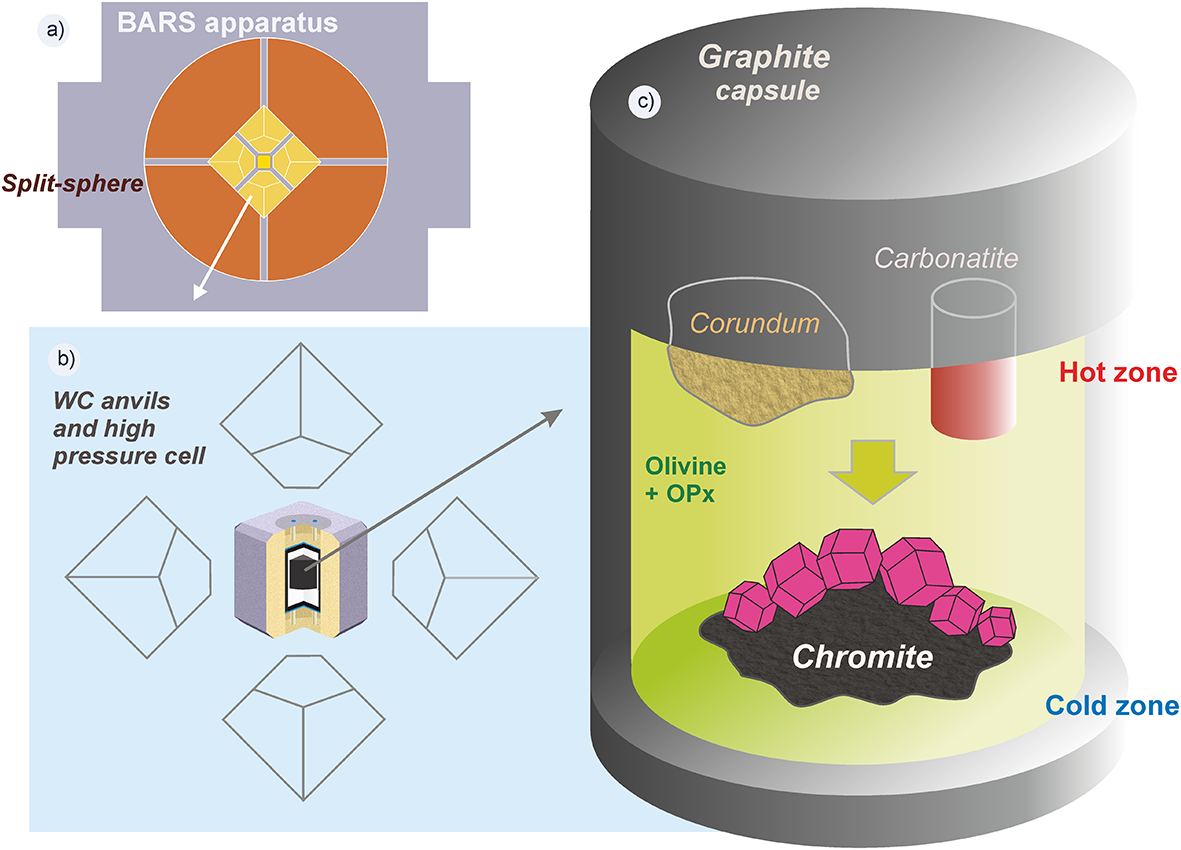
Six experiments (Table 1) were carried out using a multi-anvil split-sphere type high-pressure apparatus (BARS) developed according to the state assignment of IGM SB RAS (Fig. 1a,b). A high pressure cell was made of a mixture based on ZrO2 oxide. The cell was a rectangular cuboid (20×20×23 mm) with truncated edges and vertices. A tubular heating element was made of graphite. Pressure in the cell was calibrated at ambient temperature using reference substances Bi and PbSe (Turkin, Reference Turkin2003). Temperature was measured using a PtRh30-PtRh6 thermocouple without pressure correction. The temperature correction for pressure was determined by melting of metallic Ag and Au (Tonkov and Ponyatovsky, Reference Tonkov, Ponyatovsky, Fridlyander and Eskin2004). Measurement errors were estimated as ± 0.2 GPa and ± 25°C. The samples were heated by a gradual temperature increase and cooled by quenching. The P–T conditions for the experiments were 5.5 GPa and 1300°С, which correspond to the garnet stability field (Turkin and Sobolev, Reference Turkin and Sobolev2009). In order to obtain relatively large grains of garnet, the experiments were run for 25 hours. Further details of the experimental procedure are described in our previous papers (Chepurov et al., Reference Chepurov, Turkin and Dereppe2016, Reference Chepurov, Dereppe, Turkin and Lin2018).
Schematic drawing of (a) high pressure apparatus BARS; (b) WC anvils – internal block of anvils made of tungsten carbide; and (c) general view of the high pressure cell. The sources of Al and Ca (corundum and carbonatite, respectively) were placed in the upper part of the cell which corresponds to higher temperature, while the garnet growth occurs on chromite at the bottom of the chamber. An arrow indicates direction of components flow.

Products after the experiments at 5.5 GPa and 1300°C

Notes: Serp – serpentine, Ol – olivine, Opx – orthopyroxene, Gar – garnet, Sp – spinel, Chr – chromite, Cor – corundum.
The initial materials for the experiments were natural serpentine (antigorite), chromite and corundum. Mineral compositions were determined by electron probe microanalysis (EPMA) using a JEOL JXA-8100 microanalyser. The composition of the serpentine, collected from Eastern Sayan ophiolites in Russia was (EPMA, wt.%): SiO2 – 42.36; TiO2 – 0.02; Al2O3 – 0.93; Cr2O3 – 0.74; FeO – 2.34; MnO – 0.07; MgO – 39.96; CaO – 0.34; NiO – 0.37; Na2O – 0.30; K2O – 0.02; SO3 – 0.10; LOI – 12.42; total – 99.97. Serpentine was chosen as the starting component because at the chosen P–T parameters it decomposes into a mixture of olivine, orthopyroxene and an aqueous fluid (Ulmer and Trommsdorff, Reference Ulmer and Trommsdorff1995). Hence, at the initial stage of each experiment the sample represented a model peridotite with fluid of predominantly aqueous composition. Chromite grains 2–3 mm in size were hand-collected from xenoliths of peridotites from the Udachnaya kimberlite pipe (Yakutia) and were used as a source of Cr. Chromite composition was determined to be (wt.%): TiO2 – 0.67; Al2O3 – 6.10; Cr2O3 – 54.04; FeO – 26.97; MnO – 0.00; MgO – 11.51; total – 99.29. Corundum (Al2O3) grains of 0.1–0.2 mm in size were added to the initial charge in order to increase the amount of Al, due to low Al2O3 content in the initial chromite. Such methodology ensured the crystallisation of the pyrope variety of garnet during the experiment. Natural carbonatite from Snap Lake dyke (Canada) was added to the charge as a Ca source (Agashev et al., Reference Agashev, Pokhilenko, Takazawa, McDonald, Vavilov, Watanabe and Sobolev2008). The carbonatite composition was (EPMA, wt.%): SiO2 – 3.74; TiO2 – 0.12; Al2O3 – 0.95; Fe2O3 – 2.86; MnO – 0.19; MgO – 18.86; CaO – 31.88; Na2O – 0.00; K2O – 0.24; P2O5 – 4.51; LOI – 36.82; total – 100.17.
The assembly scheme of the high pressure cell is shown in Fig. 1c. The sample was placed in a graphite capsule. The configuration, without an isolating Pt-capsule, allowed the fluid to penetrate through the sample during the experiment. As no water-bearing phases were detected in the run products (Chepurov et al., Reference Chepurov, Tomilenko, Zhimulev, Sonin, Chepurov, Kovyazin, Timina and Surkov2012), the fluid participated in chemical reactions mainly as a transport of components. The temperature gradient present in high-pressure cells induces the crystallisation of large grains of garnet in the colder zone (Fig. 1c). A thermocouple was placed next to the garnet crystallisation area (as in figure 1 of Sonin et al., Reference Sonin, Leech, Chepurov, Zhimulev and Chepurov2019).
After the experiments samples were sawed along a vertical axis and observed with an optical microscope (MC2-Zoom, Olympus BX35) equipped with UC50 camera. Back-scattered electron images (BSE) were obtained using MIRA 3 LMU scanning electron microscope equipped with X-ray microanalysis system INCA Energy 450 Xmax-80 energy dispersive spectrometer in the Analytical Center for multi-element and isotope research SB RAS (Novosibirsk, Russia).
Results
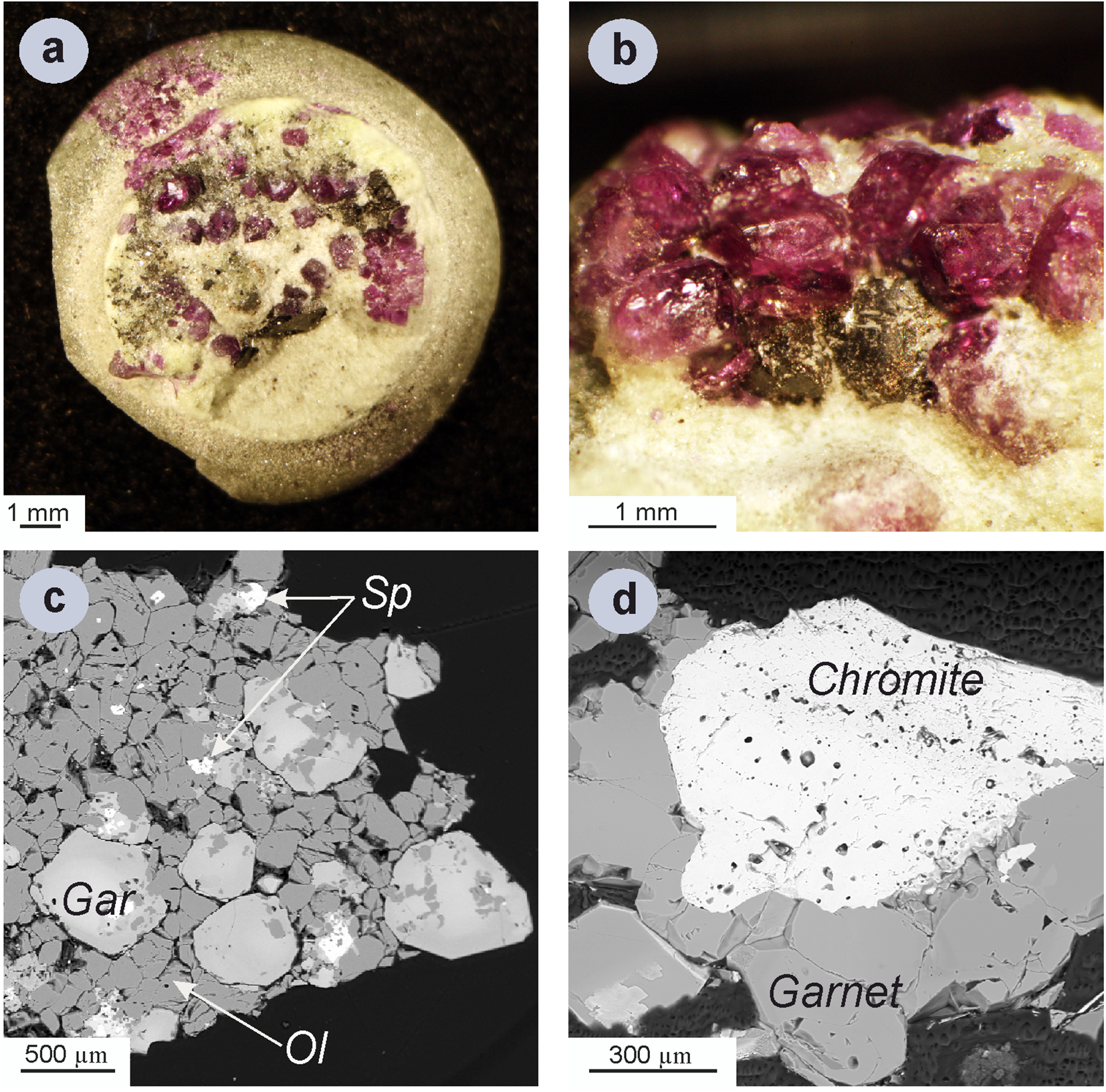
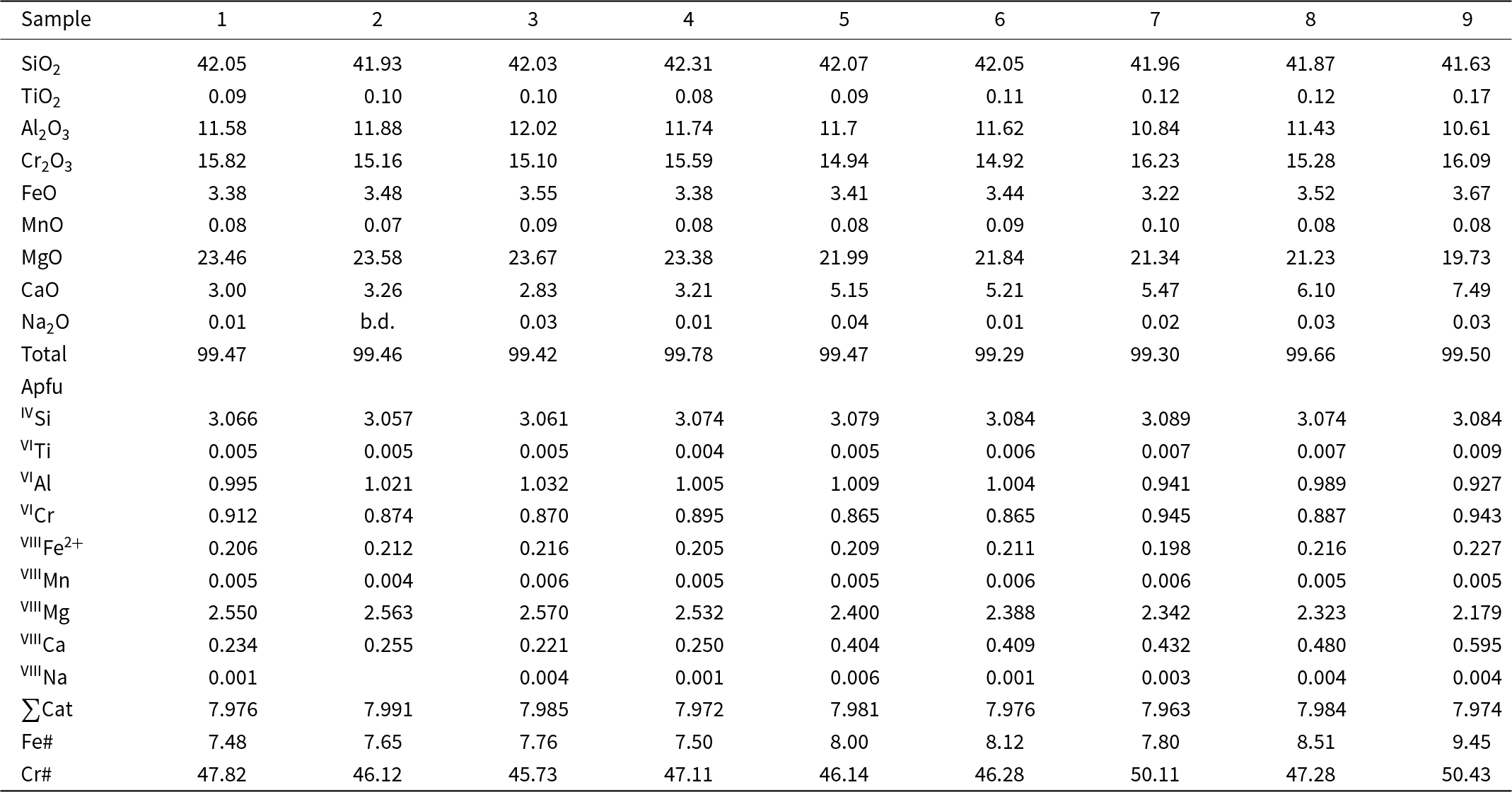
The composition of the products from the experiments are given in Table 1 and show that samples were composed of newly formed olivine, orthopyroxene, garnet and spinel. Due to the design of the experiment, garnet crystallised in the bottom part of the sample where chromite grains were initially placed (Fig. 1c). The garnet has a characteristic morphology with well-developed {110} faces and a purple-rich colour (Fig. 2a,b). Representative compositions of garnet (Table 2) with the highest contents of Cr were obtained by analysing the grains in contact with the initial chromite (Fig. 2d). The maximum Cr content is 16.25 wt.% Cr2O3. Calcium in these garnets is as low as 2–4 wt.% CaO, however, individual grains contain 6–7 wt.% CaO. Titanium is very low and does not exceed 0.06 wt.% TiO2. Manganese ranges from 0.17 to 0.38 wt.% MnO. The Fe# and Cr# values range within 7.48–9.45 and 46.12–50.43, respectively. We also noted a slightly increased silicon content, Si (per formula unit) = 3.057–3.084.
Representative microphotographs of samples after the experiments: (a) general view of the sample which consists mainly of olivine + orthopyroxene (white groundmass) and garnet (purple grains); (b) detailed view of Cr-pyrope crystals which grew on chromite (black grain exposed partially in the centre); note the intensive colour of the garnet. BSE images of experimental products: (c) garnet (Gar) and spinel (Sp) grains in the groundmass which consists of olivine (Ol); and (d) initial chromite which is overgrown by garnet.

Representative compositions of garnet synthesised in contact with chromite (wt.%)

b.d. – below detection
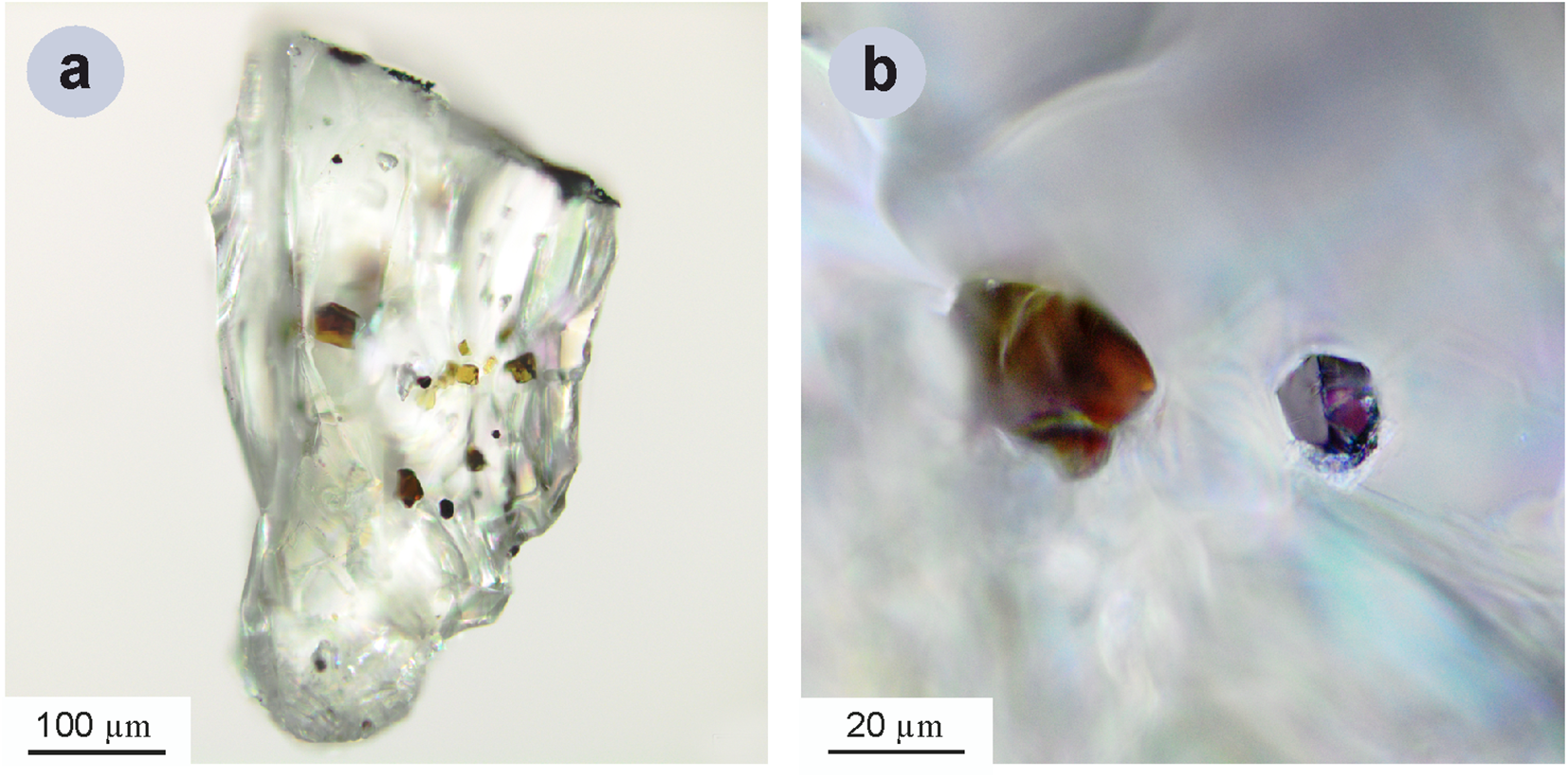
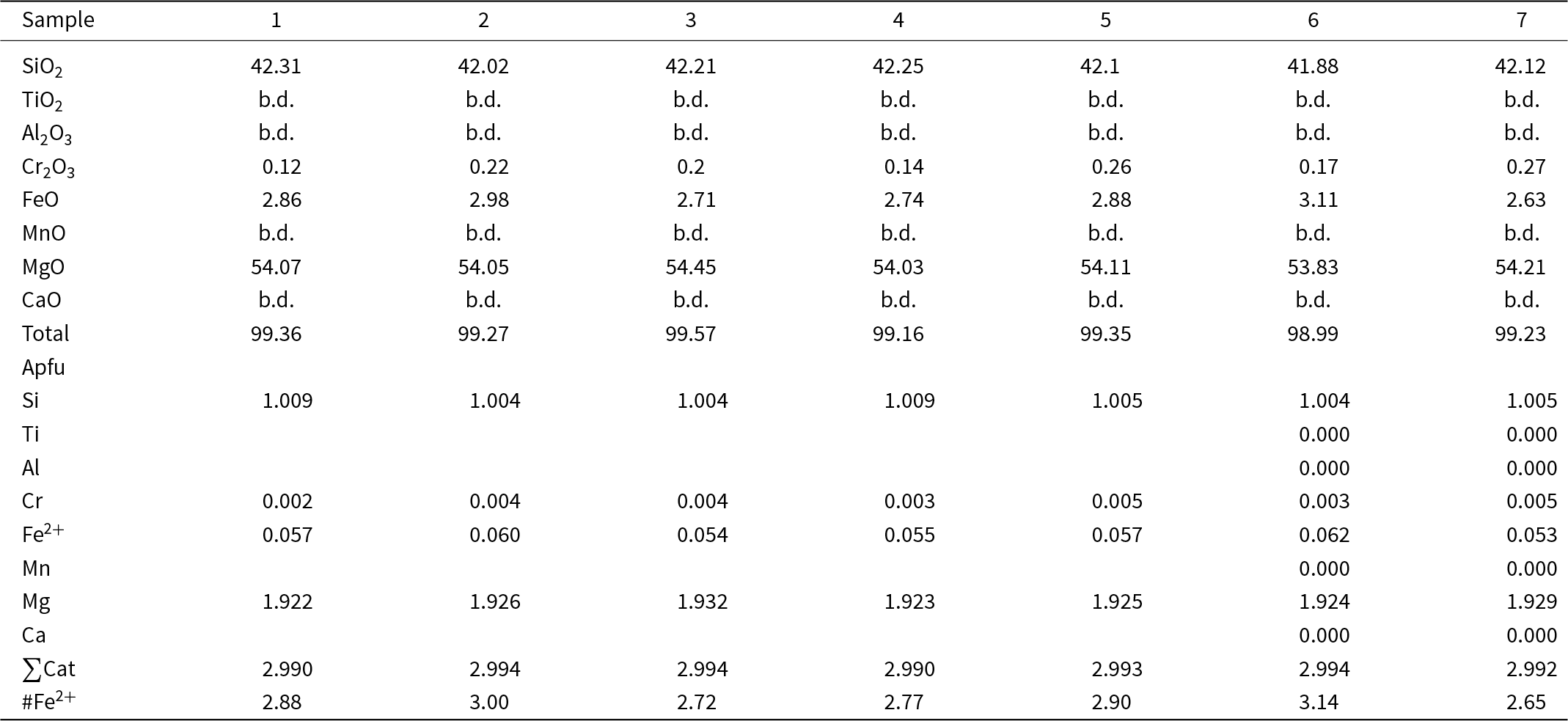
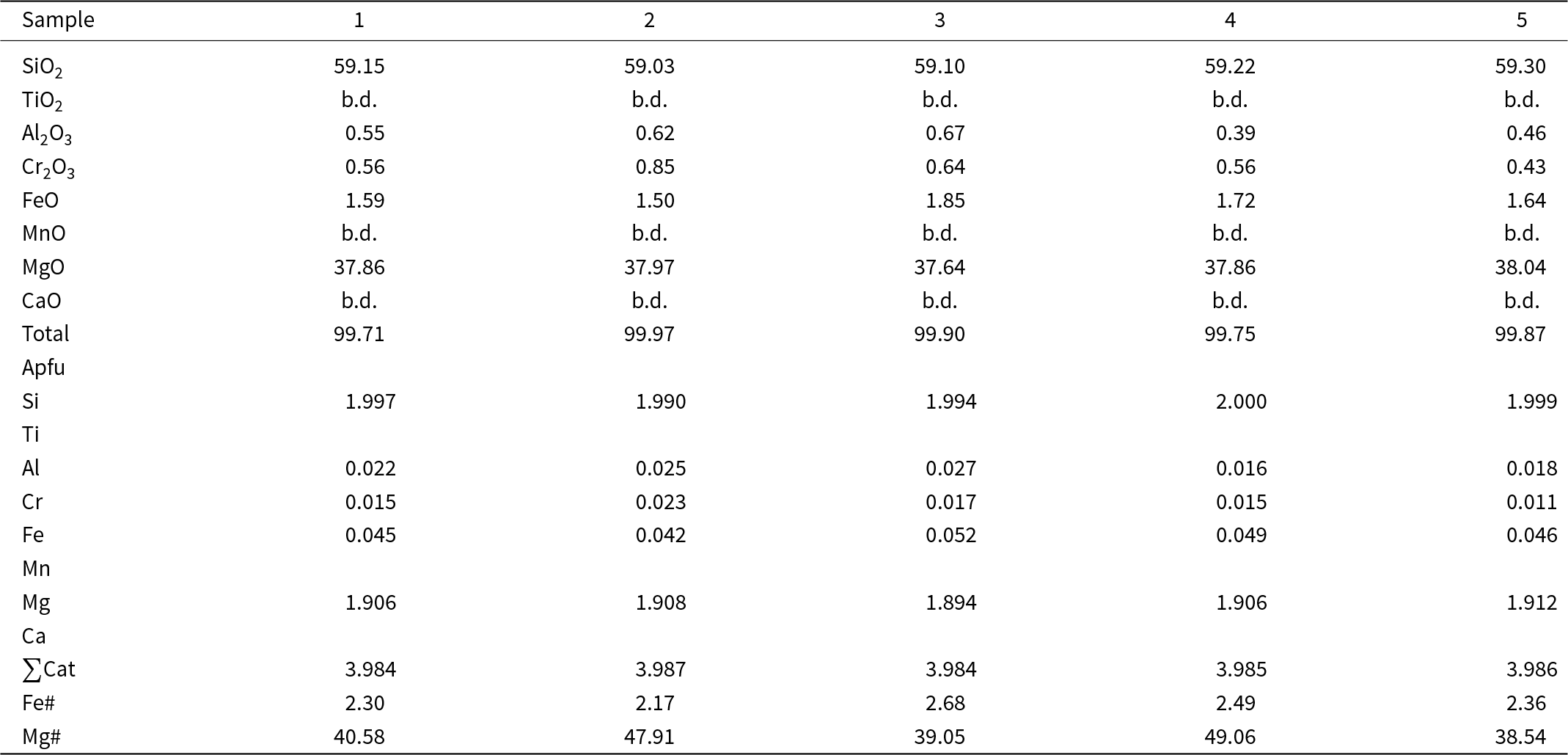
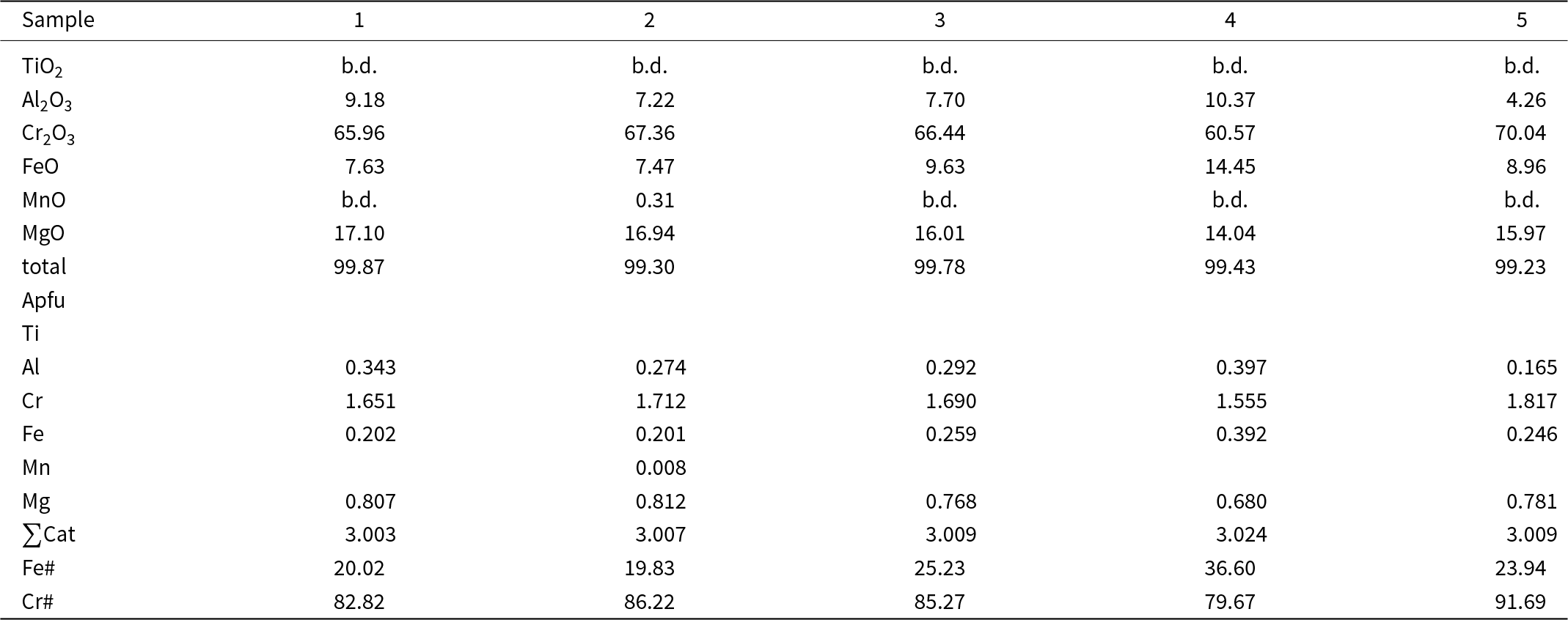
Olivine occurs as a fine-grained aggregate and as elongated grains reaching 1 mm in size (Fig. 3a). The olivine is highly magnesian (Mg# 97) and contains only 2.63–3.11 wt.% FeO. The microprobe analysis revealed an admixture of Cr up to 0.27 wt.% Cr2O3 (Table 3). Orthopyroxene is characterised by low Fe contents (2.5–2.8 wt.% FeO) (Table 4). Clinopyroxene was not found in the run products. Newly formed Cr-spinel occurs as small grains, evenly distributed over the whole sample (Fig. 2c). The spinel and garnet were found together as inclusions in the large transparent olivine grains (Fig. 3b). The composition of spinel varied with Cr# 84.64–86.59 and Fe# 19.44–36.06 (Table 5).
(a) Colourless transparent crystal of olivine with numerous inclusions of other minerals; and (b) enlarged view of Cr-garnet (right) and Cr-spinel (left) in olivine.

Representative compositions of olivine after the experiments (wt.%)

b.d. – below detection
Representative compositions of orthopyroxene after the experiments (wt.%)

b.d. – below detection
Representative compositions of spinel after the experiments (wt.%)

b.d. – below detection
Discussion
Growth of garnet and associated minerals
These experiments have demonstrated how Cr-rich garnet can grow, both in groundmass and on initial chromite. The largest crystals of garnet were synthesised in the bottom zone of the reaction chamber in contact with the chromite (Fig. 1c) and are characterised by a deep purple colour in comparison with garnets of the groundmass (Fig. 2). The mechanism of crystallisation has been described in detail in a previous publication (Chepurov et al., Reference Chepurov, Faryad, Agashev, Strnad, Jedlicka, Turkin, Mihaljevic and Lin2019). In the present investigation, it is emphasised that garnet and other phases grew under subsolidus conditions in the presence of a fluid. As shown in the Methods section, at the beginning of each experiment the fluid has a predominantly aqueous composition (Ulmer and Trommsdorff, Reference Ulmer and Trommsdorff1995; Chepurov et al., Reference Chepurov, Tomilenko, Zhimulev, Sonin, Chepurov, Kovyazin, Timina and Surkov2012), however during the run, a water reaction with the carbon of the graphite capsule (which surrounded the sample) resulted in the formation of oxygen-containing hydrocarbons (Sonin et al., Reference Sonin, Tomilenko, Zhimulev, Bul’bak, Chepurov, Timina, Chepurov and Pokhilenko2023). Thus, the fluid becomes a C–O–H system. A similar effect is expected with the addition of carbonatite: decomposition of carbonate at high temperatures and thus the appearance of СО2, which reacts with the carbon of the graphite capsule and water, and might also lead to the formation of a fluid rich in oxygen-containing hydrocarbons. Such a system corresponds to the conditions of a C–CO buffer which is close to the fayalite–magnetite–quartz (FMQ) buffer at a pressure of 5.5 GPa and temperature of 1300°С. This type of oxidized environment corresponds realistically to the geological scenarios present at mantle depths <250 km, so this type of fluid composition is a good candidate to model natural metasomatic agents in the lithospheric mantle. Specifically: investigations of fluid inclusions in natural diamonds confirms the presence of a mixture, which is characterised by wide variations of H2O, CO2 and hydrocarbons; and Si, Al, K, Ca and Cl as well as LILE (large ion lithophile elements), HFSE (high field strength elements) and REE (rare earth elements) may also present in different proportions. These so-called ‘High Density Fluids’ (HDFs) have been proposed as a diamond forming medium (Tomlinson et al., Reference Tomlinson, Jones and Harris2006; Klein-BenDavid et al., Reference Klein-BenDavid, Weiss, Navon, Logvinova, Sobolev, Schrauder, Spetius, Hauri and Kaminsky2009; Zedgenizov et al., Reference Zedgenizov, Ragozin, Shatsky, Araujo, Griffin and Kagi2009; Shirey et al., Reference Shirey, Cartigny, Frost, Keshav, Nestola, Nimis, Pearson, Sobolev and Walter2013; Weiss et al., Reference Weiss, Kiflawi, Davis and Navon2014; Klein-BenDavid et al., Reference Klein-BenDavid, Pearson, Nowell, Ottley, McNeill, Logvinova and Sobolev2014; Sobolev et al., Reference Sobolev, Logvinova, Tomilenko, Wirth, Bul’bak, Luk’yanova, Fedorova, Reutsky and Efimova2019). In the present experiment the fluid was a transporter of the main petrological components through interstices between mineral grains, because their sources (corundum and carbonatite, respectively) were placed apart from the garnet crystallisation zone (Fig. 1c). Therefore, the growth of garnet in the presence of a fluid of complex composition has demonstrated metasomatic formation of Cr-rich pyrope in natural peridotite, although more magnesian (because of the choice of starting serpentine), at P–T parameters of the Earth’s upper mantle.
In this discussion on the experimental results, it is important to take into account the association of minerals usually accompanying Cr-rich garnet in mantle xenoliths or within diamond: olivine, orthopyroxene and spinel. Natural chromite, an important mineral of the harzburgite–dunite paragenesis, usually contains >62 wt.% Cr2O3 together with low TiO2. Discoveries of such a chrome spinel together with Cr-rich pyropes are a reliable criterion for the diamond potential of kimberlites (Sobolev, Reference Sobolev1971). The synthesised spinel has a very high Cr content, up to 70 wt.% Cr2O3 (Table 5). Such a value is noticeably higher than that of the initial spinel before the experiment, presumably because the Al is preferentially incorporated into the garnet. However, such a composition is in agreement with the data for natural spinel inclusions in diamonds of peridotitic suite rocks (Sobolev and Logvinova, Reference Sobolev and Logvinova2005; Lenaz et al., Reference Lenaz, Princivalle, Logvinova and Sobolev2009). Orthopyroxene from inclusions in natural diamond is commonly Mg-rich enstatite characterised by a small admixture of Al (<1 wt.% Al2O3). The Cr-number (Cr/Cr+Al) of natural enstatite usually has a positive correlation with that of the associated pyrope. Values of up to 0.5 wt.% Cr2O3 are typical for enstatites from inclusions in diamonds of South Africa and Yakutia (Sobolev, Reference Sobolev1977). The results of our experiments have demonstrated the synthesis of pyroxene of similar composition, which correlate with high Cr content of the synthesised garnet (Table 4). The composition of olivine in the experimental samples is a very good match for the diversity of xenolithic olivines from kimberlites, in terms of their high Mg/(Mg+Fe) ratio (Tychkov et al., Reference Tychkov, Agashev, Pokhilenko, Tsykh and Sobolev2020). Additionally, these synthetic olivines contained an admixture of Cr (Table 2). The elevated Cr2O3 concentrations in pyroxene and olivine from diamond-bearing assemblages have long been a topic of discussion (Meyer and Boyd, Reference Meyer and Boyd1972). The present experiment confirms that olivine, which crystallises together with Cr-pyrope at 5.5 GPa in the presence of C–O–H fluid, corresponding to C–CO or fayalite–magnetite–quartz (FMQ) buffers, can contain an admixture of 0.27 wt.% Cr2O3 – as is typically observed in olivines from diamond inclusions worldwide (Stachel and Harris, Reference Stachel and Harris1997a). Although higher values of Cr2O3 are known, such as in olivine inclusions in the Luobusa mantle chromitite (up to 1.49 wt.% Cr2O3, FengHua et al., Reference FengHua, Jingsui, ZhiQin and JiaNan2014) or olivine in chromite from De Beers Pool Kimberlites (1.10 wt.% Cr2O3, Phillips et al., Reference Phillips, Harris and Viljoen2004), the detection of high Cr2O3 values in olivine should always be considered with caution due to the possible presence of Cr-spinel either in the form of numerous chromite intergrowths (Dobrzhinetskaya et al., Reference Dobrzhinetskaya, Green and Wang1996) or microinclusions, such as observed in synthetic olivines (Fig. 3).
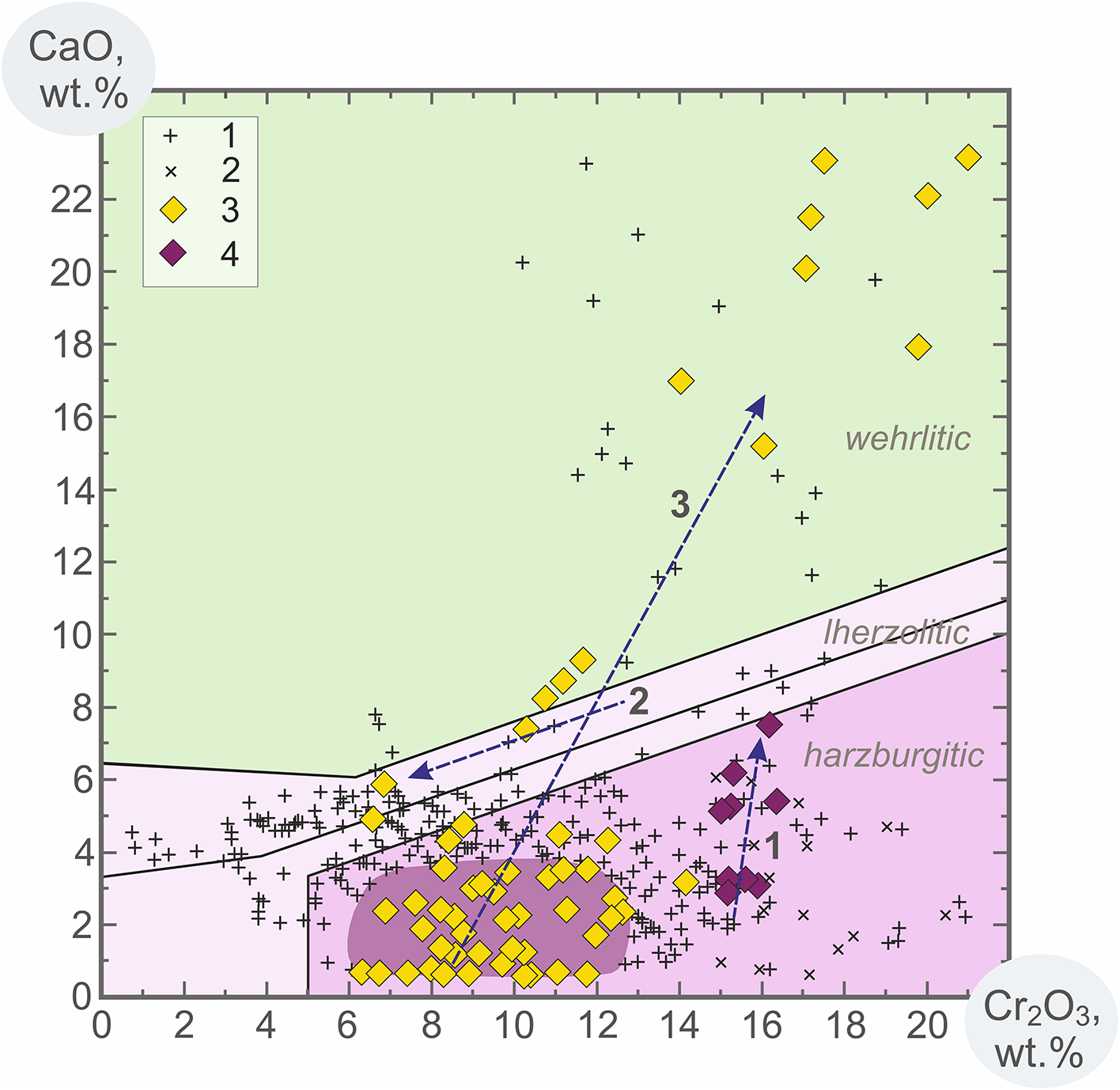
In terms of the target composition of garnet, it was not intended to add much Ca into the experiment. The choice of our experimental system made it possible to synthesise Cr-rich pyrope in which the CaO content was <3 wt.% for 1 wt.% carbonatite in the initial charge. Such garnet compositions are very interesting, because they are similar to the typical Ca-poor garnet inclusions in diamonds (Fig. 4).
CaO–Cr2O3 plot for Cr-rich garnet in natural diamond combined with the experimental data. 1 – natural garnets from the localities worldwide, data source: Sobolev (Reference Sobolev1977); Kovalsky et al. (Reference Kovalsky, Bulanova, Nikishov, Botkunov, Makhotko, Shestakova and Gotovtsev1979); Griffin et al. (Reference Griffin, Sobolev, Ryan, Pokhilenko, Win and Yefimova1993); Sobolev et al. (Reference Sobolev, Lavrent’ev, Pokhilenko and Usova1973, Reference Sobolev, Kaminsky, Griffin, Yefimova, Win, Ryan and Botkunov1997, Reference Sobolev, Logvinova, Zedgenizov, Seryotkin, Yefimova, Floss and Taylor2004); Zedgenizov et al. (Reference Zedgenizov, Logvinova, Shatskii and Sobolev1998); Harris et al. (Reference Harris, Stachel, Leost and Brey2004); Meyer and Svisero (Reference Meyer and Svisero1975); Stachel et al. (Reference Stachel, Brey and Harris2000, Reference Stachel, Aulbach, Brey, Harris, Leost, Tappert and Viljoen2004a, Reference Stachel, Viljoen, McDade and Harris2004b); Logvinova et al. (Reference Logvinova, Taylor, Floss and Sobolev2005). 2 – Representative harzburgitic garnets with Cr2O3 content higher than 14 wt.% (Stachel and Harris, Reference Stachel and Harris2008); oval field represents 95% of all garnets analysed, data reproduced from Turkin and Sobolev (Reference Turkin and Sobolev2009). 3 – Summarised data on garnets synthesised in previous experiments – data taken from Chepurov et al. (Reference Chepurov, Dereppe, Turkin and Lin2018, Reference Chepurov, Faryad, Agashev, Strnad, Jedlicka, Turkin, Mihaljevic and Lin2019); Turkin et al. (Reference Turkin, Chepurov, Zhimulev, Lin and Sobolev2021). 4 – Cr-rich garnets from the present experiments. The arrows: 1 – low-carbonatite trend of the present experiment; 2 – silicate metasomatism trend after Pokhilenko et al. (Reference Pokhilenko, Agashev, Litasov and Pokhilenko2015); 3 – high-Ca high-Cr trend after the previous experiments by Chepurov et al. (Reference Chepurov, Dereppe, Turkin and Lin2018, Reference Chepurov, Faryad, Agashev, Strnad, Jedlicka, Turkin, Mihaljevic and Lin2019) and Turkin et al. (Reference Turkin, Chepurov, Zhimulev, Lin and Sobolev2021); for further explanation the reader is referred to the main text.

The use of carbonatite is significant, because it is considered as one of the main metasomatic agents in the Earth’s mantle (Shu and Brey, Reference Shu and Brey2015). It should be noted that the experimental samples modelled a natural harzburgite with a relatively low percentage of garnet in the bulk. Such a rock is considered to have experienced only a slight degree of mantle metasomatism (Doucet et al., Reference Doucet, Ionov, Golovin and Pokhilenko2012; Ilyina et al., Reference Ilyina, Agashev, Pokhilenko, Kozhemyakina and Pokhilenko2022). A further small addition of Ca into the medium (2 wt.% carbonatite) has led to the crystallisation of pyrope with up to 16 wt.% Cr2O3 and 7.5 wt.% CaO (Fig. 4, Table 2) in the absence of clinopyroxene.
The role of the Ca/Cr/Al ratio
In the CaO vs Cr2O3 diagram (Fig. 4) the natural garnets, which contain high Cr2O3, have variable amounts of CaO. The garnet compositions in the experiment demonstrate an increase of CaO and only a slight increase of Cr2O3 (Fig. 4, trend line 1). This suggests that a small amount of carbonatite in the medium (1–2 wt.%) slightly influenced a further increase of Cr in garnet. Among natural garnets the samples U-4-76 (Howarth et al., Reference Howarth, Barry, Pernet-Fisher, Baziotis, Pokhilenko, Pokhilenko, Bodnar, Taylor and Agashev2014) and U-105-89 (Pokhilenko et al., Reference Pokhilenko, Sobolev, Kuligin and Shimizu1999) are representative cases: they show vivid Ca-zoning and, at the same time, stable Cr2O3 contents. This is explained by the effect of carbonatite metasomatism (Pokhilenko et al., Reference Pokhilenko, Agashev, Litasov and Pokhilenko2015), when percolating fluids introduce mainly Ca. Here, the role of the CaO/Al2O3 ratio of the growth medium should also be taken into account, because natural peridotites demonstrate a positive correlation between CaO and Al2O3 (Pearson and Wittig, Reference Pearson and Wittig2008). The introduction of both CaO and Al2O3 by metasomatic process might induce the formation of more garnet, however, in such a case the new garnet will not be of the Ca-poor varieties. Additionally, a negative correlation between the Al2O3 content of xenoliths and Cr2O3 in their garnets (Griffin et al., Reference Griffin, O’Reilly, Ryan, Fei, Bertka and Mysen1999b) suggests that Cr-rich and Ca-poor garnet can only grow in peridotite at early stages of mantle metasomatism. Additionally, Al2O3 deficiency in such ultra-depleted rock may even result in cessation of the growth of pyrope as has been already shown experimentally (Chepurov et al., Reference Chepurov, Turkin and Dereppe2016). Another trend, which should be considered, is the effect of so-called silicate metasomatism (Pokhilenko et al., Reference Pokhilenko, Agashev, Litasov and Pokhilenko2015), which implies significant mineralogical and geochemical changes in the mantle rocks, this was not the focus of the present study as it tends to form Cr-poor garnet compositions (Fig. 4, trend line 2).
Further discussion of the Ca/Cr/Al ratio of the medium should also involve the garnet compositions with more than 16 wt.% Cr2O3. The present experiment was not aimed at further enriching the charge with Ca to demonstrate an intensive carbonatite effect, which is accompanied by the appearance of clinopyroxene and crystallisation of Ca-rich garnet. In such cases, the introduction of a high content of Ca into a Cr-rich system may cause the crystallisation of garnet containing both very high Cr and Ca. An interesting example is the garnet found in the Kao kimberlite called knorringite (Nixon and Hornung, Reference Nixon and Hornung1968), which is very Cr-rich (17.4 wt.% Cr2O3), but also the Ca content is high (8.14 wt.% CaO). Additionally, this garnet has a green hue. Such green-coloured Cr-rich garnets have already been synthesised in association with olivine, orthopyroxene and clinopyroxene. The Cr content of these can be extremely high (up to 21.62 wt.% Cr2O3) together with Ca contents of 13–24 wt.% CaO (Chepurov et al., Reference Chepurov, Dereppe, Turkin and Lin2018). This was explained by the deficiency of Al in the Cr-rich medium and thus the introduction of Ca leads to a substitution of the (Mg+Al) pair by (Ca+Cr) thus increasing the uvarovite component in pyrope (Fig. 4, trend 3). Therefore, crystallisation of garnet with Cr2O3 content higher than 16 wt.% can be easily explained, although the high content of CaO as well as the greenish colour set them apart from harzburgitic varieties, which typically contain less Ca (1–4 wt.% CaO) (Fig. 4) and are of purple colour. Oversaturation of the crystallisation medium with Cr2O3 is also a possibility to produce very Cr-rich garnet. The present experiment has demonstrated that Cr in synthetic garnet varies with the distance from the source (initial chromite). As a result, garnets with the maximum Cr2O3 content of 16.23 wt.% were formed in contact with the initial chromite. Such conditions can be considered as a Cr-saturated medium. The composition of the present samples is close to natural harzburgite, which usually has Cr-numbers of <0.3. The increase of Cr/Cr+Al of the medium may produce garnets with Cr2O3 higher than 16 wt.%, as has been shown by Canil and Wei (Reference Canil and Wei1992), although the medium in their experiment has Cr-number of 0.84. Natural rocks of such composition are very rare, here the reference example may be harzburgites from ophiolites in the Papuan Ultramafic Belt, which have Cr/Cr + A1 of up to 0.8 (Jaques and Chappell, Reference Jaques and Chappell1980). It can be concluded that Ca-rich wherlitic garnets (Cr2O3 >16 wt.%) or garnets probably originated from extremely Cr-saturated Ca-poor media (Cr/Cr+Al of 0.8) are very rare in nature and thus the conditions which lead to their formation rarely existed in the Earth’s mantle. Decades of collecting analytical data on garnet compositions of the ultramafic paragenesis in diamonds indicates a maximum content of the knorringite component in natural garnets, not exceeding 60 mol.% (Sobolev et al., Reference Sobolev, Logvinova, Zedgenizov, Seryotkin, Yefimova, Floss and Taylor2004; Stachel and Harris, Reference Stachel and Harris2008). Therefore, the present experiment justified the boundary at 16 wt.% Cr2O3 proposed by N.V. Sobolev based on the analysis of more than 1500 natural Cr-garnets from Yakutia (Fig. 4). Such knorringite-rich garnets are predominant in concentrates of the heavy fraction of all diamondiferous kimberlite deposits worldwide (Sobolev et al., Reference Sobolev, Lavrent’ev, Pokhilenko and Usova1973; Gurney and Switzer, Reference Gurney and Switzer1973; Gurney, Reference Gurney, Glover and Harris1984; Sobolev, Reference Sobolev, Glover and Harris1984; Pokhilenko et al., Reference Pokhilenko, Sobolev, Reutsky, Hall and Taylor2004).
Application to the growth mechanism
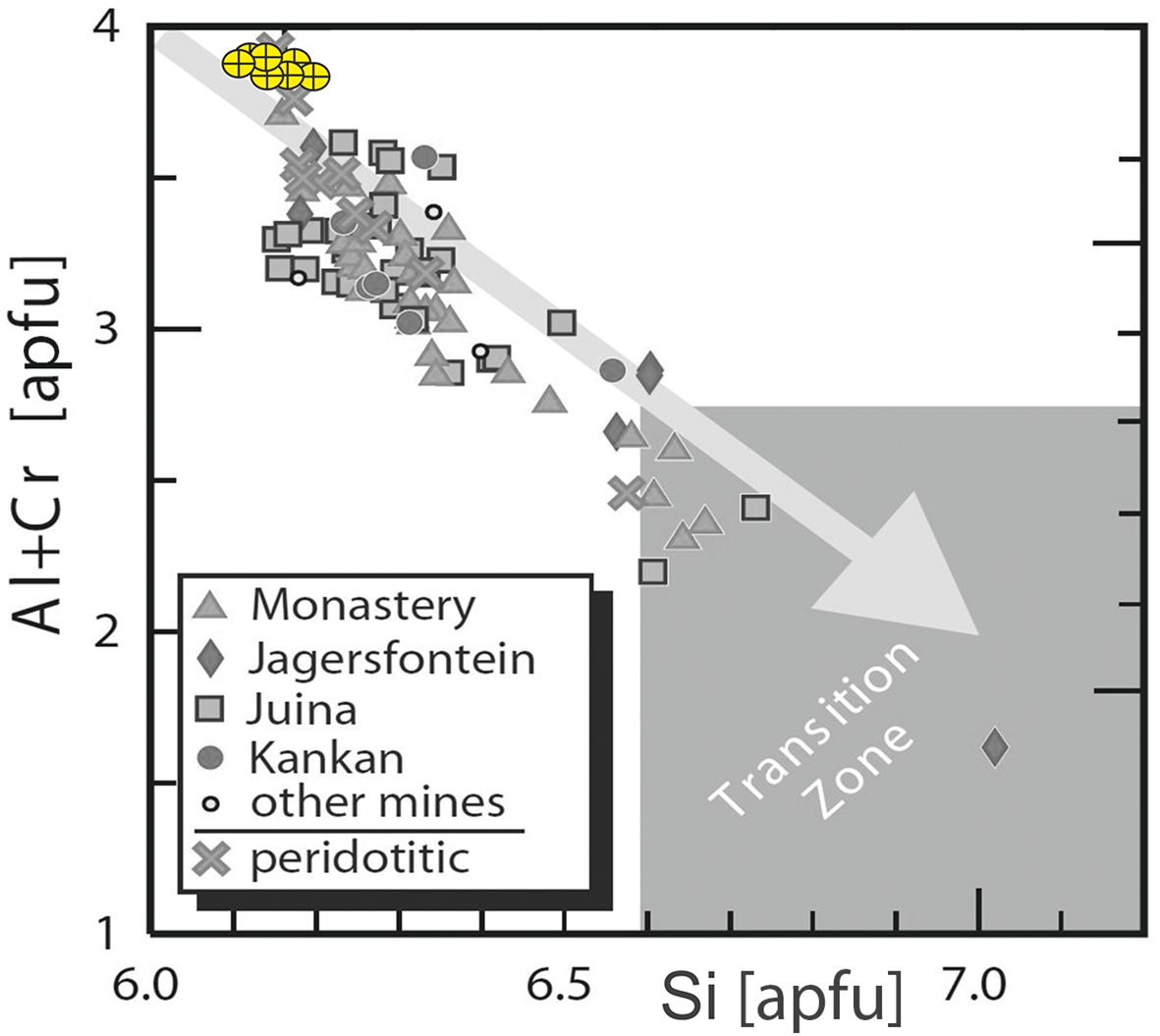
The experiments have elucidated some important aspects of the mechanism, which may lead to crystallisation of garnet with a high knorringite component in nature. The possibility that Cr-rich garnet can grow through a metasomatic process, at pressures and temperatures corresponding to the conditions of formation of lithospheric diamonds, is in good agreement with experimental results obtained earlier by Canil and Wei (Reference Canil and Wei1992). These authors demonstrated that the residues of one stage melting of typical peridotites at high pressures (>3 GPa) produce garnets with <3–4 wt.% Cr2O3 and suggested that a more Cr-rich population of low Ca garnets requires a multiple melt extraction. Whether such conditions can be widespread in the Earth’s history remains unclear; although, the formation of such residues can be adequately explained by melting in the stability region of spinel, i.e. by low pressure melting that leaves a residue with high Cr/Al ratios (Ringwood, Reference Ringwood1977). According to the hypothesis of the present investigation, growth of garnet occurred in subsolidus conditions at 5.5 GPa and 1300°C in Cr-rich starting compositions. The mechanism of growth of garnet crystals in the experiment represents the formation of so-called ‘metacrystals’ which grew metasomatically in a solid medium due to thin capillary films of feeding solution surrounding them, replacing the surrounding minerals (Grigoriev and Zhabin, Reference Grigoriev and Zhabin1975). During the experiments, fluid of C–O–H composition entered the interstices between mineral grains and transported the components. Such interstices between minerals are clearly seen in the microphotographs and SEM images (Fig. 2). In the present experiment the temperature was not changed. As has been shown by Brey et al. (Reference Brey, Kohler and Nickel1990) in experiments with natural lherzolitic compositions, Cr in garnet does not change with increasing temperature in the range of 900–1300°C. A further increase of temperature in our system leads to the appearance of melt, which most probably will decrease the role of any fluid phase due to its dissolution in the melt. The pressure in our experiments was also not changed. The experiments performed by Canil and Wei (Reference Canil and Wei1992) with spinel-harzburgite in which the authors obtained garnets with very high Cr2O3 contents, were conducted at higher pressure (8 GPa). Here, it should be taken into account that at such pressures an excess of SiO2 in garnet becomes noticeable (majoritic component). As noted above, the synthesised Cr-rich garnets were obtained at 5.5 GPa, however, they contained a minor Si excess. These results are not enough to discuss the presence of majorite in the experiment in detail, although the following considerations should be taken into account: Akaogi and Akimoto (Reference Akaogi and Akimoto1977) studied pyroxene–garnet solid-solutions in the system Mg4Si4O12–Mg3Al2Si3O12 in the pressure range of 4–20 GPa and showed that the solubility of the pyroxene component in garnet increases gradually with increasing depth. They suggested that pyroxenes begin to react with the already present pyrope-rich garnet at depths of ∼150 km, which corresponds to the pressures close to that of the present experiment. Most probably, the minor excess of Si obtained in the garnets is characteristic of a gradual transition between the normal and majorite-containing garnet. It should also be taken into account that “majoritic knorringite becomes more Cr-deficient with increasing pressure, which is similar to the Al-deficient nature of majoritic garnet in the MgSiO3 – Al2O3 system” (Zou and Irifune, Reference Zou and Irifune2012). In other words, a further increase of pressure would mostly increase the Si content, but not Cr in garnet. Additionally, when plotted on a Si vs. (Al+Cr) diagram (Fig. 5) the synthesised garnets matches the trend proposed by Stachel et al. (Reference Stachel, Brey and Harris2005) for majoritic garnets from diamond inclusions.
Si vs Al+Cr (in atoms per formula unit, apfu) for garnet inclusions in natural diamonds worldwide, reproduced after Stachel et al. (Reference Stachel, Brey and Harris2005). Yellow circles with crosses – experimental data of the present study.

In this context, a diamond crystal with inclusions of both majoritic and ‘normal’ garnet is worth noting (Sobolev et al., Reference Sobolev, Logvinova, Zedgenizov, Seryotkin, Yefimova, Floss and Taylor2004). The genesis of this diamond is explained by growth under the decrease of pressure. This suggests that the limit of 16 wt.% Cr2O3, which characterises 95% of natural peridotitic garnets, corresponds to the pressures at which the displacement of Cr (Al) by majoritic component is not noticeable.
Conclusions
The article presents the results of experiments on crystallisation of a subcalcic pyrope with the objective of determining the maximum Cr content in the garnet. The system chemistry coincides with that of natural spinel–harzburgite characterised by typical Cr/Cr+Al and the mineral association in experimental products consisted of Mg-olivine, orthopyroxene, Cr-spinel and Cr-garnet. The garnet synthesis occurred in subsolidus conditions in the presence of a C–O–H fluid, which demonstrated a possible scenario of metasomatic formation of Cr-rich pyrope at the P–T parameters of the formation of typical lithospheric diamonds. The use of natural carbonatite as a source of Ca showed the crystallisation of garnet with varying contents of Ca and almost the same Cr, which is in agreement with the existing trend for carbonatite metasomatism – introduction of a small amount of Ca-carbonatite into depleted harzburgite (∼2 wt.%) shifts the garnet compositions to more Ca-rich, but does not lead to further increase of Cr. The experiments confirmed the boundary at 16 wt.% Cr2O3 for subcalcic Cr-rich pyrope associated with diamond as was proposed earlier by N.V. Sobolev. It is concluded that garnets with higher Cr cannot form due to the change of pressure or temperature. The origin of natural samples of Ca-rich lherzolitic/wherlitic and Ca-poor harzburgitic garnets with >16 wt.% Cr2O3 is attributed to the specific Ca/Cr/Al ratios of the medium, although the rarity of such garnets indicates that such conditions occurred rarely in the Earth’s history.
Acknowledgements
Principal Editor Roger Mitchell and three anonymous reviewers are thanked for their detailed and constructive comments which greatly improved the manuscript. We also thank D. Shcheglov and S. Sitnikov of the CKP “Nanostruktury” (Novosibirsk, Russia) for help with the preparation of the optical photographs. Work is done on state assignment of IGM SB RAS № 122041400157-9.
Competing interests
The authors declare none.