





Domestic violence in Nepal
Domestic violence is a widespread public health problem and a serious human rights violation. 1 It occurs worldwide, across all generations, nationalities, communities and spheres of societies, irrespective of age, ethnicity, disability or other background. 2 Domestic violence can manifest in various forms, including verbal (shouting, blaming, taunting, conflicts), physical (beating, shoving, pushing), emotional (feeling anxious because of conflicts with in-laws or husband) or sexual (unwanted sexual acts, comments, sexual coercion). 3 Despite the formulation of international and national laws and regulations to prevent violence, domestic violence is a problem deeply rooted within the realm of gender inequality, patriarchy and constructions of masculinities and femininities that act to normalise violence between genders. Reference Mshweshwe4 Studies from 161 countries indicate that around 30% of women have experienced violence of any kind, be it from a current or former partner or from a non-partner. 5 The scenario in Nepal becomes gravely concerning as it is characterised by the dominant patriarchal systems accompanied by traditional gender roles. 6 According to the latest Nepal Demographic and Health Survey (NDHS), 23% of women aged 15–49 years reported experiencing physical violence, 7% reported having experienced sexual violence and 13% reported emotional violence during their lifetime. 7 These estimates might be underestimated as reporting rates of domestic violence in Nepal tend to be very low. This is because most women hesitate to admit to experiencing any abuse for fear of being stigmatised, a lack of faith in support systems or protection, and in many cases, because of threats from the abuser. Reference Shrestha, Sapkota, Sarraf, Mehra, Ekström and Deuba8
Familial and societal role in domestic violence
A systematic review of domestic violence risk factors in Nepal has highlighted the multifaceted nature of violence, emphasising the interplay between individual, familial and societal influences. Reference Sapkota, Simkhada, Newton and Parker9 Many Nepalese women experience physical violence, often at the hands of their husbands who are under the influence of alcohol. Reference Bhatta, Assanangkornchai and Rajbhandari10 Women who lack decision-making autonomy and have controlling husbands are at greater risk of intimate partner violence (IPV) in Nepal. Reference Dalal, Wang and Svanström11 Nepalese women often rely on their husbands for financial support, which is found to be one of the major reasons for IPV in Nepal. Reference Dhungel, Dhungel, Dhital and Stock12 The control exerted by husbands or in-laws can arise in the form of verbal abuse, threats and humiliation, and this emotional violence can lead to emotional distress. Reference Jina, Jewkes, Hoffman, Dunkle, Nduna and Shai13 Sexual violence is another type of abuse present in Nepal that is underreported because of societal stigma and legal barriers. Reference Puri, Shah and Tamang14 Many women in abusive marriages experience rape, which is often normalised or minimised by societal beliefs that view a wife’s consent as unnecessary within marriage. Reference Colombini, Mayhew, Hawkins, Bista, Joshi and Schei15
Nepal’s actions toward gender-based violence
Despite substantial evidence on the health consequences of gender-based violence globally, Nepal’s health sector has been slow to recognise gender-based violence as a legitimate public health problem. It was only in 2010, after development of the National Plan of Action against Gender-Based Violence, that gender-based violence was incorporated as a health sector response. Reference Colombini, Mayhew, Hawkins, Bista, Joshi and Schei15 Despite the legal provisions and policies aimed at addressing gender-based violence in Nepal, societal stigma remains a prominent hindrance to women seeking help or wanting to leave abusive relationships. Many women believe that it is justified for husbands to beat wives, and so they stay silent about their experiences. 16 This deeply rooted societal acceptance of violence, coupled with a lack of accessible support services, usually discourages women from seeking help or leaving violent conditions. 16
Violence and mental health
Women experiencing IPV show significantly higher levels of depression and anxiety. Reference Shoib, Khan, Baiou, Chandradasa, Swed and Turan17 A study done in Sri Lanka revealed that women exposed to IPV had a higher odd of engaging in self-harm and suicide attempts (adjusted odds ratio for association with physical/sexual abuse: 5.17; adjusted odds ratio for association with psychological abuse: 4.64). Reference Bandara, Page, Rajapakse and Knipe18 In Nepal, women who die by suicide often face physical abuse shortly before their deaths, with major factors being marital conflicts, financial hardships and mental health challenges such as depression. Reference Kasaju, Krumeich and Van der Putten19 In certain instances, survivors of domestic violence may blame themselves for their partner’s verbal abuse, which leads to difficulty in forming future relationships. 20 Although existing studies have identified domestic violence as a significant contributor to mental health issues, exploration of the specific associations between different forms of violence (physical, sexual and emotional) and distinctive mental health issues like depression has rarely been done. Reference Sapkota, Anderson, Saito and Baird21 Thus, to bridge the gap, this study aimed to investigate the association between depressive symptoms and different forms of domestic violence – physical, sexual and emotional violence. By examining the prevalence and severity of depressive symptoms among women experiencing domestic violence, we hope to inform future interventions and policies, and develop culturally sensitive and effective responses to both domestic violence and the mental health crises it triggers.
Method
Study design and setting
A cross-sectional study was conducted among women aged 30–60 years who registered for human papillomavirus self-sampling, offered by Dhulikhel Hospital in Dhulikhel and Banepa municipalities, Kavrepalanchowk District, Nepal. The data was collected between 15 March and 15 June 2021.
Study participants and recruitment
A total of 429 women were enrolled conveniently, of age group 30 years and above, out of 1856 women participating in the cervical cancer screening programme of Dhulikhel Hospital. The sample size was estimated with 50% proportion of depression among women experiencing domestic violence, Reference Gnawali, Atteraya and Kim22 at 95% confidence interval and 5% allowable error.
The inclusion criteria of the study were women aged 30–60 years who were residents of Dhulikhel and Banepa. The exclusion criteria were presence of a severe mental health condition, presence of hearing impairment or inability to provide informed consent.
Our research assistants contacted female community health volunteers (FCHVs) and oriented them to the study objective and expectations. These FCHVs have worked in Nepal at the community level for a long time, and play a pivotal role in the Nepali community health workforce, specialising in health education, counselling, outreach and resource distribution. The FCHVs disseminated information about the study to women in their network and shared the contact details of the interested participants with the research assistants. Subsequently, the research assistants contacted the women, outlining the study’s objectives and explaining their potential role. Women expressing interest were then formally enrolled in the study after verbal informed consent was obtained, ensuring the anonymity and confidentiality of their information.
Ethical considerations and consent to participate
The authors assert that all procedures contributing to this work comply with the ethical standards of the relevant national and institutional committees on human experimentation and with the Helsinki Declaration of 1975, as revised in 2013. All procedures involving human patients were approved by Kathmandu University Institutional Review Committee (identifier 35/2021). Verbal informed consent was obtained from participants by telephone, as this study took place during the second wave of the COVID-19 pandemic. Telephone interviews were used instead of face-to-face interviews because of the public health restrictions in Nepal at the time. The interviews were also audio-recorded for future reference, with their consent. Before initiating the interview, participants were informed about the nature of the study. Participants were asked whether they were currently in a safe and private environment to continue the conversation. Interviews were conducted only when participants confirmed privacy. Participants were clearly informed that they could pause, reschedule or terminate the interview at any time, without any consequences. Further, all the participants were informed about the available local support services to seek in case of domestic violence or depressive symptoms. The information on national helpline numbers for suicide prevention and nearest One-Stop Crisis Management Centers were shared at the end of the interview.
Data collection
The research assistants were trained before data collection specifically for collecting data on sensitive topics, including questions related to domestic violence and depressive symptoms, using a standardised electronic questionnaire on kobotoolbox. The interview lasted between 20 and 25 min.
Study metrics
A questionnaire assessing socioeconomic characteristics, including age, marital status, education, ethnicity and presence of domestic violence and presence of depressive symptoms, was used.
Domestic violence and abuse
Domestic violence and abuse was measured with a Nepali-translated version of the domestic violence module developed by the United States Agency for International Development. 23 The instrument consists of seven questions related to experiences of physical violence, three questions on sexual violence and three questions on emotional abuse. All questions were presented as binary (yes/no) items, and lifetime exposure was observed. A respondent was classified as having experienced domestic violence if they answered ‘yes’ to any of the questions. Respondents were categorised as having experienced physical, sexual or emotional violence if they answered ‘yes’ to any of the questions in the respective sections on physical, sexual or emotional abuse.
Depressive symptoms
Presence of depressive symptoms was assessed with the Nepali-translated, nine-item Patient Health Questionnaire (PHQ-9), 24 which is based on the DSM-IV. Reference Bell25 Participants were asked to rate nine common symptoms of depression they experienced over the past 2 weeks, using a four-point Likert scale ranging from 0 (not present at all) to 3 (almost every day), yielding a total score between 0 and 27. A score of 10 or higher was used as the cut-off to indicate the presence of depressive symptoms. Reference Kohrt, Luitel, Acharya and Jordans26
Data analysis
Characteristics of study participants was summarised by frequency and percentage for categorical variables, and means and standard deviation for numeric variables. Univariable and multivariable logistic regression models were used to assess the association between depressive symptoms and domestic violence and abuse.
The prevalence of depression and domestic violence was calculated with 95% confidence intervals. In the multivariable model, the confounding variables were adjusted. Crude and adjusted odds ratio were reported with 95% confidence intervals and p-values. All analyses were conducted with Stata version 13.0 for Windows (Stata Corp., College Station, Texas, USA) for cleaning, coding and statistical analysis.
Results
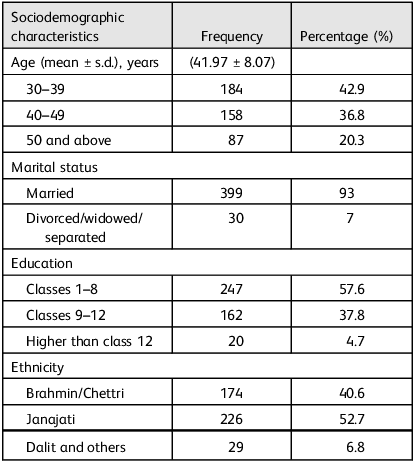
Table 1 illustrates the sociodemographic information of the participants. The mean age of the participants was 41.97 (s.d. 8.07) years. Most of the participants (42.9%) belonged to the age group 30–39 years, and the majority of the participants were married (93%).
Sociodemographic characteristics (n = 429)

Table 1 Long description
The table presents sociodemographic characteristics of 429 participants. It has 4 rows and 3 columns. The columns are labeled Frequency, Percentage (percent), and Sociodemographic characteristics. The rows are labeled with different sociodemographic categories and their subcategories. Row 1: Age (means.d., years) (41.97±8.07), 30–39, 184, 42.9. Row 2: Age (means.d., years) (41.97±8.07), 40–49, 158, 36.8. Row 3: Age (means.d., years) (41.97±8.07), 50 and above, 87, 20.3. Row 4: Marital status, Married, 399, 93. Row 5: Marital status, Divorced/widowed/separated, 30, 7. Row 6: Education, Classes 1–8, 247, 57.6. Row 7: Education, Classes 9–12, 162, 37.8. Row 8: Education, Higher than class 12, 20, 4.7. Row 9: Ethnicity, Brahmin/Chettri, 174, 40.6. Row 10: Ethnicity, Janajati, 226, 52.7. Row 11: Ethnicity, Dalit and others, 29, 6.8. The table shows that the majority of participants are aged 30-39 years, married, have education up to class 8, and belong to the Janajati ethnicity.
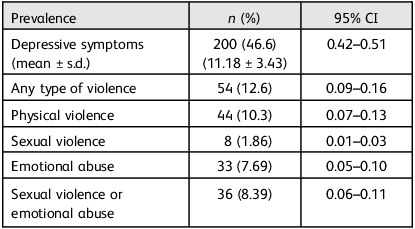
Almost half of the participants (46.6%) had depressive symptoms. The mean score of depressive symptoms was 11.18 (s.d. 3.43). Overall, the prevalence of domestic violence was 12.6%. Most of the participants (10.3%) reported that the violence they experienced was physical violence, followed by sexual violence or emotional abuse (8.39%) (Table 2).
Prevalence of depressive symptoms, domestic violence and emotional abuse (n = 429)

Table 2 Long description
A table showing the prevalence of depressive symptoms and types of violence among 429 participants. The table has 7 rows and 3 columns. The columns are labeled ‘Prevalence’, ‘n (%)’, and ‘95% CI’. The rows are labeled with different categories: Depressive symptoms, Any type of violence, Physical violence, Sexual violence, Emotional abuse, and Sexual violence or emotional abuse. Each row provides the number and percentage of participants in each category, along with the 95% confidence interval. Row 1: Depressive symptoms, 200 (46.6 percent), 0.42-0.51. Row 2: Any type of violence, 54 (12.6 percent), 0.09-0.16. Row 3: Physical violence, 44 (10.3 percent), 0.07-0.13. Row 4: Sexual violence, 8 (1.86 percent), 0.01-0.03. Row 5: Emotional abuse, 33 (7.69 percent), 0.05-0.10. Row 6: Sexual violence or emotional abuse, 36 (8.39 percent), 0.06-0.11.
The cut-off score taken for the Patient Health Questionnaire-9 scale was 10, i.e. 0–9 indicated absence and ≥10 indicates presence of depressive symptoms.
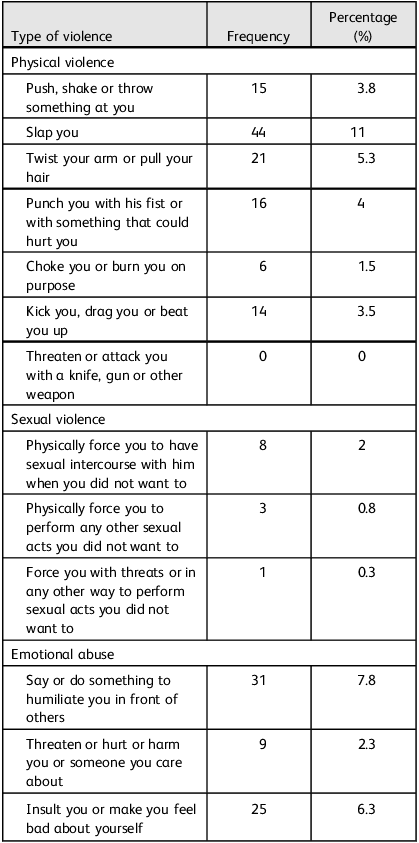
Table 3 shows that the most common form of physical violence experienced by the participants was being slapped (11%), whereas the most common form of emotional abuse was being humiliated in front of others (7.8%). None of the participants reported that they have been threatened or attacked with a knife, gun or other weapon by their partners. A total of 1.5% of participants said that they have been burned or choked on purpose. Overall, only one of the participants reported that they were forced by their partners with threats or in any other way to perform unwanted sexual acts.
Items used to assess domestic violence (n = 429)

Table 3 Long description
A table detailing types of violence, their frequencies, and percentages. The table has three columns: Type of violence, Frequency, and Percentage (%). It is divided into three main categories: Physical violence, Sexual violence, and Emotional abuse. Each category lists specific types of violence along with their corresponding frequency and percentage. Physical violence includes actions like push, slap, twist arm, punch, choke, kick, and threaten with a weapon. Sexual violence includes physically forcing sexual intercourse or other sexual acts, and forcing with threats. Emotional abuse includes humiliating in front of others, threatening, and insulting. Notable data points include: Push, shake or throw something at you: Frequency 15, Percentage 3.8%. Slap you: Frequency 44, Percentage 11%. Twist your arm or pull your hair: Frequency 21, Percentage 5.3%. Punch you with his fist or with something that could hurt you: Frequency 16, Percentage 4%. Choke you or burn you on purpose: Frequency 6, Percentage 1.5%. Kick you, drag you or beat you up: Frequency 14, Percentage 3.5%. Threaten or attack you with a knife, gun or other weapon: Frequency 0, Percentage 0%. Physically force you to have sexual intercourse with him when you did not want to: Frequency 8, Percentage 2%. Physically force you to perform any other sexual acts you did not want to: Frequency 3, Percentage 0.8%. Force you with threats or in any other way to perform sexual acts you did not want to: Frequency 1, Percentage 0.3%. Say or do something to humiliate you in front of others: Frequency 31, Percentage 7.8%. Threaten or hurt or harm you or someone you care about: Frequency 9, Percentage 2.3%. Insult you or make you feel bad about yourself: Frequency 25, Percentage 6.3%.
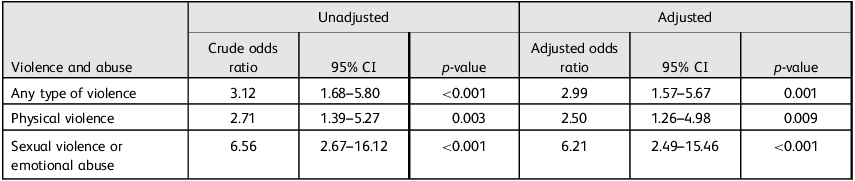
Table 4 depicts the crude and adjusted association between violence and depressive symptoms. When we compare two groups of participants with and without experience of any type of violence, the odds of having depressive symptoms were 2.99 times (95% CI 1.57–5.67, p = 0.001) higher among those who had experienced any type of violence. Similarly, the odds of having depressive symptoms were 2.5 times (95% CI 1.26–4.98, p = 0.009) higher in participants who had experienced physical violence, and 6.21 times (95% CI 2.49–15.46, p < 0.001) higher among participants who had experienced sexual violence or emotional abuse.
Association of depressive symptoms with domestic violence and abuse (n = 429)

Table 4 Long description
The table presents the crude and adjusted associations between violence and depressive symptoms. It has four rows and six columns. The columns are labeled Unadjusted cOR, Unadjusted 95% CI, Unadjusted p-value, Adjusted odds ratio, Adjusted 95% CI, and Adjusted p-value. The rows are labeled Any type of violence, Physical violence, and Sexual violence or emotional abuse. Row 1: Any type of violence, 3.12, 1.68-5.80, <0.001, 2.99, 1.57-5.67, 0.001. Row 2: Physical violence, 2.71, 1.39-5.27, 0.003, 2.50, 1.26-4.98, 0.009. Row 3: Sexual violence or emotional abuse, 6.56, 2.67-16.12, <0.001, 6.21, 2.49-15.46, <0.001.
Adjusted for age, marital status, education and ethnicity.
Discussion
Findings from our study showed that any type of domestic violence in women is significantly associated with depressive symptoms. In our study, depressive symptoms were prevalent among almost half of women (46.6%). This finding aligns with existing literature on depression among similar demographics, emphasising a concerning trend in mental health. For instance, a study conducted in Algeria found that more than half of its participants (58.9%) experienced severe depression. Reference Boussafsaf27 Similarly, a study from Indonesia reported a prevalence of severe depression at precisely 50% among its participants, Reference Gurning, Camellia, Parinduri and Effendy28 and a study in Pakistan reported 55.1% of women exposed to IPV reported symptoms of depression. Reference Nowshad, Jahan, Shah, Ali, Ali and Alam29 This shows depression is a significant issue among women across diverse cultural contexts, despite notable socioeconomic differences between the countries studied.
In this study, 12% of women reported experiencing any form of violence, which is considerably lower compared with the 28% prevalence of any form of IPV, including physical, sexual or emotional violence, reported in the 2022 NDHS survey of Nepal, which was done among women aged 15–49 years. Reference Sapkota, Pandey, Adhikari, Shrestha, Piya and Lamichhane30 The 2022 NDHS further indicates that 23% of those women reported physical violence, 12% reported sexual violence and 7% reported emotional violence, all of which are higher compared with rates reported in our study. Reference Sapkota, Pandey, Adhikari, Shrestha, Piya and Lamichhane30 The prevalence of all kinds of violence reported in the 2022 NDHS is two times or more than that reported in our study; this may have been affected by the participants’ age range. We included women aged 30–60 years whereas the 2022 NDHS included women aged 15–49 years. Studies have shown that depression and anxiety, like mental health problems, affect younger people more than elderly people. Reference Sikström, Kelmendi and Persson31
A study conducted in Indonesia with women aged 18–60 years reported that 9.8% participants experienced physical violence, Reference Gurning, Camellia, Parinduri and Effendy28 which is consistent with the findings in our study. However, another study conducted in Algeria with women aged 20–60 years showed a 33.9% prevalence of physical violence among their participants, which is remarkably higher. Reference Boussafsaf27 Regarding sexual and emotional violence, our study showed that the prevalence of sexual violence or emotional abuse was 8.39%. This is in line with the findings from the Indonesian study, where the psychological violence was 8.5%. Reference Gurning, Camellia, Parinduri and Effendy28 Contrastingly, a study conducted in Indian women showed that the prevalence of psychological violence was much higher (19.8%). Reference Joshi, Arora and Mukherjee32 These variations in results from different studies might be attributed to differences in awareness about domestic violence among women, as well as the reporting mechanisms of different areas. In areas with limited awareness, women may not recognise certain behaviours as forms of violence, leading to underreporting. In addition to this, there are various stigma, shame, embarrassment and fear attached to the disclosure of the violence.
Our study showed that women who experienced any type of domestic violence tend to have depressive symptoms 2.99 times more than those who did not experience it. This is supported by the findings of a qualitative study conducted in Pakistani women, in which thematic analysis suggested a close relationship between domestic violence and depression. Reference Sultan, Khawaja and Kousir33 Another longitudinal study conducted in the UK showed that women who experienced IPV had double the odds (odds ratio 2.10, 95% CI 1.57–2.81) of having depressive symptoms above the threshold defining depression. Reference Herbert, Heron, Barnes, Barter, Feder and Meghrawi34 Being a victim of domestic violence has been associated with several physical and mental health effects. It has been linked with increased stress, fear and isolation and, eventually, to depression and suicidal behaviour or thoughts. 35
Our study showed that women who experienced physical violence had higher odds of having depressive symptoms. These findings are comparable with another study in Sweden, where women who were exposed to physical violence had 3.78 times higher odds of having depressive symptoms (95% CI 1.99–7.17). Reference Lövestad, Löve, Vaez and Krantz36 Similarly, in Pakistan, women exposed to IPV had 1.97 times higher odds of experiencing depressive symptoms. Reference Nowshad, Jahan, Shah, Ali, Ali and Alam29 In Norway, physical abuse was also significantly associated with depression, with an adjusted odds ratio of 2.35, further supporting the association between physical violence and depression. Reference Melby, Sørensen, Henriksen, Lukasse and Flaathen37 The consistency of findings across diverse geographical contexts highlights the global relevance of this association. Cultural and societal norms may influence the prevalence and reporting of violence, but the psychological impact remains. Violence can leave women feeling helpless, diminish their self-esteem and lead to social isolation, all of which heighten the risk of depression, a condition closely linked to a history of exposure to stressful life events. Reference Beydoun, Beydoun, Kaufman, Lo and Zonderman38
Our study also suggested that the women who had ever experienced sexual violence or emotional abuse were likely to have 6.21 times more odds of depressive symptoms compared with those who had not. This is consistent with the findings of the study done in Sweden, where women who experienced sexual violence had higher odds of having depressive symptoms (odds ratio 5.10, 95% CI 1.74–14.91). Reference Hatcher, Mkhize, Parker and Kadt39 In South Africa, past-year exposure to sexual violence or IPV was associated with an increased likelihood of depressive symptoms (adjusted odds ratio 2.05). Reference Hatcher, Mkhize, Parker and Kadt39 Some studies have suggested that the effects of emotional violence are more severe and may even last longer when compared with the effects of physical violence. Reference Dye40 This is because of the psychological mechanisms where emotional abuse, rooted in manipulation and control, can create lasting psychological scars and a cycle of revictimisation. Reference Cinquegrana, Marini and Galdi41 Those effects may include depression, anxiety and panic disorders, in addition to a distorted self-image or broken sense of self. Some victims ultimately even state that they deserved to be abused. Reference Dalal, Wang and Svanström11
Strengths and limitations
This study has several key strengths. First, it is one of the few studies to determine the association between depressive symptoms and the experience of domestic violence and abuse, contributing valuable evidence to a relatively underresearched area. Second, we utilised the PHQ-9, a validated tool for measuring depressive symptoms, with the Nepali version demonstrating adequate internal consistency with the Cronbach’s alpha of 0.84. Reference Kohrt, Luitel, Acharya and Jordans26 Finally, the result of this study are the output of rigorous statistical analysis done after adjusting for potential confounding variables. However, there are several limitations to consider. First, the cross-sectional design prevents us from establishing a temporal relationship between depressive symptoms and experiences of domestic violence. Second, the participants for this study were recruited from cervical cancer screening programme, so the findings might differ from the general community population, who have a different socioeconomic status and different healthcare-seeking behaviour compared with those attending the screening programme. Third, the findings may lack generalisability, as the study was limited to women from only two municipalities, and who were aged 30 years and above. Finally, although we adjusted for known confounders, there is the possibility that residual confounding could introduce bias into the results.
Data availability
The data that support the findings of this study are available from the corresponding author, A.S., upon reasonable request.
Acknowledgement
We are extremely thankful to Dhulikhel Hospital for conducting cervical cancer screening programmes, which is the major source of participants for this study.
Author contributions
A.S. and B.P. designed and conceptualised the study. A.K. and S.M. had a major role in data acquisition. B.S. and P.P. analysed and interpreted the data of the study. B.S., Y.A. and P.T. were major contributors in drafting the manuscript. B.S., Y.A., P.T., P.P., A.K., S.M., B.P. and A.S. rigorously contributed in editing, revising and proofreading the manuscript. All the authors read and approved the final manuscript.
Funding
The work was supported by Yale University (grant number P30CA016359).
Declaration of interest
None.

 Open access


eLetters
No eLetters have been published for this article.