American historians and social scientists are evincing a growing interest in the subject of disaster. True, there has been never been any shortage of journalistic and novelistic literature on particular catastrophes, focusing on themes of tragedy and renewal, on human drama, villainy and heroism.Footnote 1 But until recently there was a surprising paucity of serious academic writing either on particular disasters or on the broad subject of how American society has responded to catastrophe. This is no longer the case: since the mid-1980s, a series of important books has sought to employ disaster not simply as a vehicle for telling a good story but as a way of analyzing broader themes in national life: humanitarianism, the growth of government, environmentalism, social and racial injustice, and the list could easily be extended.Footnote 2 What is more, this trend has been accelerating, and one small symptom of that trajectory was the presence on the 2010 Policy History Conference program of no fewer than three panels on American disaster politics (this was the origin of the present volume).Footnote 3
Why should this be? Doubtless the pattern owes something to recent events: to the terrorist attacks of 2001 and Hurricane Katrina, most obviously, but also to a series of vivid and widely publicized natural disasters elsewhere in the world (2010 saw the Haitian earthquake, massive flooding in China and Australia, the Eyjafjallajökull volcano in Iceland, a tsunami in Indonesia). Still, every period in human history has featured catastrophic epidemics, fires, and climatic and seismological disasters, and indeed the human toll of disaster is probably lower in the twenty-first century than it was during the past, so there must be more to the story than this. Perhaps disasters are especially salient now because of the ever more sensational and immediate way in which they are covered, compared to the past.Footnote 4 Certainly it is differential media coverage, and not just the level of destruction in property and human life, that explains why some disasters resonate more than others—why Hurricane Audrey, which killed six hundred people in rural western Louisiana in 1957 should be largely unknown, while Hurricane Betsy, which barreled through metropolitan New Orleans in 1965 and killed only eighty-one, is much more familiar.Footnote 5 Now, in the age not just of twenty-four-hour news and satellite television but of social media, few inhabited locations are so remote that a major climatic or seismological event will go unnoticed, or fail to produce newsworthy, tear-jerking news stories.
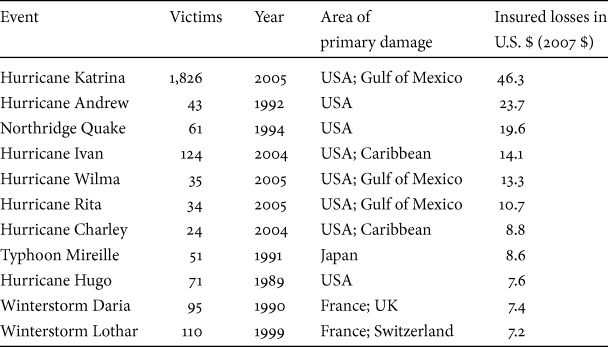
Also, if disasters now generally cause fewer fatalities than in the past (this is one reason why the enormous death toll of Katrina was so shocking), it is also paradoxically the case that they are becoming more expensive, and this too helps to explain why the subject of catastrophe has such salience in academia and in society generally. A 2008 attempt to calculate the most expensive global catastrophes since 1970 highlights this trend: half of them had taken place during the previous four years, and all of them were from the second half of the period under review (see Table 1):

Source: Wharton Risk Center (data from Swiss Re and Insurance Information Institute), reproduced in Howard C. Kunreuther and Erwann O. Michel-Kerjan, “Comprehensive Disaster Insurance: Will It Help in a Post-Katrina World?” in Hurricane Katrina: Risk Assessment, Economic Impacts, and Social Implications, ed. Harry W. Richardson et al. (Cheltenham, UK, 2008), 12.
Quite apart from this temporal concentration, one is struck in this table by the geographic concentration of these disasters, and by the disparity between their immense financial cost and the comparatively low death tolls, Katrina apart: eight of the ten most expensive events hit the United States, and not one of them features on lists of the deadliest natural disasters.Footnote 6 This pattern reflects the high and growing concentration of expensive real estate located in especially disaster-prone sections of the United States, together with the limited effectiveness of federal efforts to dissuade such development and make such locations more resilient.Footnote 7
Another development that has presumably helped to stimulate new writing on both contemporary and historical disaster is the growing environmental sensibility of the past half-century.Footnote 8 Disasters provide an obvious focus for historians and geographers interested in highlighting the vulnerability of human society to environmental catastrophe and the role humankind has played in exacerbating that vulnerability. Central, for example, to recent writing on “natural” disaster, including the essays in this volume, is the idea that the human consequences of seemingly natural events (a flood, an earthquake, a drought) result from human decisions over where and how they should live.Footnote 9 “Floods are an act of God,” wrote the great American geographer Gilbert F. White in a pioneering 1966 report that foreshadowed this trend, but “flood damages result from acts of men,” born as they frequently are of unwise development and an exaggerated faith in engineering structures.Footnote 10
Like the environmental movement, the growing interest of historians in disaster is a worldwide, and not simply an American, phenomenon. What is more, since climatic, seismological, and public health disasters do not respect national borders, they have been of special interest to scholars of transnational history, a field that has grown tremendously in recent years, in parallel with the rise of environmental history (and for many of the same reasons).Footnote 11 Once this exciting new genre of disaster history has further matured, perhaps a future special issue of the Journal of Policy History might explore the evolution of disaster politics through a global lens. As for the present volume, we hope that readers will forgive our decision to focus in a more concentrated way on the development of disaster politics in the United States since the Civil War.
In the first essay, Gareth Davies explores how a new national politics of disaster first emerged after the Civil War, in response to a heightened national consciousness, a strongly developed sense of collective obligation, and the development of the technological and organizational capacity to undertake a swift, large-scale response to catastrophe. Sometimes disaster relief was provided by government, but this did not become the norm—more commonly, the national effort was coordinated by private philanthropy. Davies argues that the case of disaster relief illuminates the unique character of late nineteenth-century political culture, sharply differentiated both from the early national period (when disasters had been largely local affairs), and still more so from the twentieth and twenty-first centuries, with which the other essays in this volume are concerned.
The 1926 Miami hurricane is overshadowed in historical memory by the great Mississippi flood of the following year, despite the massive dislocation, trauma, and loss of life that it caused. Marian Moser Jones argues that black Miamians were especially hard-hit, not because of the direct effects of the storm (whose worst ravages missed them), but rather because of the intense discrimination to which they were subjected in its aftermath, both by government and by the American Red Cross. This, as much as the storm itself, was what made the 1926 Miami hurricane a catastrophe for so many poor and black Floridians. Jones argues that this remains a persistent pattern in American disaster politics: the response to Hurricane Katrina, eight decades later, similarly served to exacerbate racial and social inequities.
In the third essay, Patrick Roberts identifies another strong and persistent pattern in the history of American disaster response: the link between national security politics and disaster politics. The connection has been evinced most recently by the Department of Homeland Security’s absorption of the Federal Emergency Management Administration (FEMA), but Roberts shows that this is not simply a new variation on an old theme, for DHS’s intensely top-down approach to emergency management is fundamentally new. He illustrates this through a comparison with civil defense arrangements during the early Cold War, showing that Washington exhibited a much greater confidence in the capacity of states and local officials a half-century or so ago than is the case today. Roberts uses this contrast to illuminate the broader transformation in American federalism that has taken place since the 1960s, emphasizing the negative impact of this pattern on how communities and states prepare for disaster.
Like Marian Moser Jones, Andrew Morris is concerned with the racial politics of hurricane relief, this time in relation to Hurricane Camille in 1969. Again, the story is one of discrimination, but whereas public concern over race in 1926 was largely confined to black newspapers and activists, by the end of the 1960s it was accusations of racism that did most to make the disaster a national political drama. Furthermore, Morris shows that Camille created the political “window” that ushered in the contemporary world of disaster politics, one in which Washington plays the leading, and not merely a supporting, role. Like Roberts, Morris is impressed by the degree to which the new model broke with traditional American federalism, and he shows that it also transcended standard left/right divisions: while liberal Democrats took the lead in driving the Federal Disaster Act of 1970 through Congress, conservatives went along with it too.
The closing essay brings us right up to the present day, with the passage of the Flood Insurance Relief Act of 2014. Scott Knowles and Howard Kunreuther—the latter an eminent academic expert on flood insurance since the inception of the program in 1968—explain how the idea of federal flood insurance first took root in the 1960s, and attribute its failure to make disaster-prone communities more resilient to the existence of a persistent “disaster science-policy action gap.” Whereas Roberts and Morris highlight transformations in federalism since the 1960s, Knowles and Kunreuther document the strong persistence of localism when it comes to land use: vulnerable communities have an inexhaustible appetite for federal disaster dollars, but usually they resist the idea that this involves significant deference to federal land-use priorities. That said, they highlight evidence that the bipartisan disaster politics regime whose advent is charted by Morris may be beginning to break up—that the “relief” approach to disaster no longer commands all-but-universal support on Capitol Hill. This change, to conclude on an at least modestly hopeful note, is one of the reasons why Knowles and Kunreuther see the new act as a significant step forward, in terms of closing the disaster science-policy action gap and effectuating a stronger policy emphasis on hazard mitigation.